
Premiere Pro, Pinnacle, and Proficiency

By Joe Berk

I’m learning a new video program (new to me, at least) called Premiere Pro.  It’s part of the Adobe Creative Studio suite, and it is way more complicated than anything I’ve ever used before.  Well, maybe that’s not fair:  The only video program I ever used in the past was something called Pinnacle.  It was a low-bucks affair at Best Buy 16 or 17 years ago.  I bought it because I was doing a lot of videos for CSC Motorcycles and the kid at Best Buy said even an old guy could use it.  You can see many of those videos (along with the excellent ones Joe Gresh created) on our YouTubby page.

About that YouTubby thing:  The Chinese marketing guys at Zongshen were following the CSC blog closely back in those days, and they knew me from the videos before I went there and met them for the first time.  When they saw me, they pointed and exclaimed, “Youtubby, Youtubby!”  They didn’t realize the “e” in YouTube was silent.  I didn’t realize what they didn’t realize, and my first thought was “yeah, I guess I am carrying a few extra pounds.”  My second thought was that the Chinese don’t hold back (I later learned that they do; in fact, as a group the Chinese are the most polite people I’ve ever known).

To get back on topic, when good buddy Greg shot a video of me doing my thing with the Mini 14, I decided it was time to learn Premiere Pro.  I’ve been paying for that program for years because it is in the Adobe package, which you have to buy as a subscription.  Sometimes, you just have to set your mind to doing something, and that’s what I did.  Between my firm commitment to learning Premiere Pro, Google’s help (I asked it a ton of questions, because the program is anything but intuitive and the Adobe tutorials are close to useless), and a lot of trial and error, I was able to create the Mini 14 video.

Then I did the one on the Monster Guns a few days ago.

I like both the above videos.  In creating them, I used maybe 1% of what Premiere Pro can do.  It is an intricate software package and I have a lot to learn.  It keeps my mind going, as does writing this blog.  I guess that’s the good news.

I never made any money off YouTube.  I’ve heard of folks having insanely high view counts and making maybe 37 cents.  Nope, I’m not in it for the money.   But the two gun videos above got me thinking:  Maybe I should do more gun videos.  Then came another surprise:  I already have.  In reviewing my videos on YouTube’s summary page, I found several gun videos I had forgotten.  These were all uploaded either directly from the camera, or I assembled them using the old, cheap, easy-to-use Pinnacle program.  I thought I’d post them here in case any of you had nothing else to do or you have insomnia.  Enjoy.


Here’s one that’s a little unusual. I have a 50-year-old Weatherby Mark V chambered in .30 06 and sometimes I can sometimes coax a 1-inch group from it. I bought a borescope and, surprisingly, you can make a video with the borescope as you run the fiber optic cable through the rifle. The marks you see in the bore are pretty typical machining marks made during the rifle barrel fabrication process. Most folks are alarmed when they first use a bore scope and see this sort of thing. I was. But hey, the thing groups pretty well for a glamour gun.

Here’s one that’s pretty cool.  My buddy Mike, a retired chief of police, goes to the International Association of Chiefs of Police convention and when it’s on the west coast, I go along as his assistant (I got a badge out of the deal, but no gun).  One of the exhibitors had a video/handgun-based training system.  Mike and I both tried it.  It was awesome.

Here’s one from long ago that could use Premiere Pro’s lighting adjustment tool.  It’s my buddy Duane shooting reduced loads in his World War II bring-home Mauser 98.

I recently mentioned my Model 52 Smith and Wesson here on ExNotes.  It’s an amazing pistol.  What’s part of the wow factor is how well it feeds wadcutter ammo; in fact, it’s so good it will feed an empty case.

I have a Weatherby that has a custom Douglas .300 H&H barrel on it.  The .300 H&H is an amazing cartridge with plenty of energy.  Here’s a video of a couple of shots on the gongs at 100 yards.  That .300 H&H energy really makes them jump around.

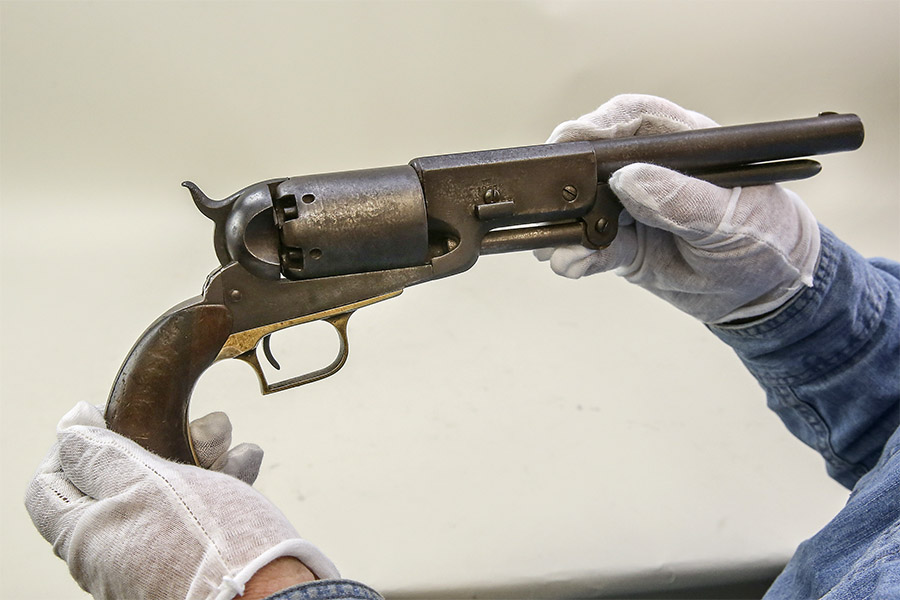
My buddy Paul is a serious black powder shooter and collector, and his enthusiasm (along with watching Lonesome Dove about a hundred times) convinced me my life wouldn’t be complete unless I owned a Colt Walker.  I ordered one and created a video unboxing it.  It’s a thing people do.  So I did it, too.

When I resurrected the Star progressive reloader, I shot a series of short videos on its operation.

Back in the day, a watch company (Gear’d; I don’t know if they’re still around) sent a couple of watches to Gresh and me so we could review them on the blog.  I thought it would be a good idea to see how mine would stand up to the recoil after firing a hundred shots of .45 ACP hardball.

I always wanted an 1886 with fancy walnut, but I didn’t want to mortgage the house to get one. So I bought a Chiappa (an Italian copy). This is another video that could have been helped by Premiere Pro’s advanced features.

Some of my friends think I’m fast. The rest know that I’m just half fast.

Here’s one I did years ago on loading cast bullet ammo for the Mosin-Nagant rifle, with accompanying music from the movie, Enemy at the Gates. I used Pinnacle on this one, and I think I exercised all its capabilities.

I guess I had more gun videos than I realized.  Maybe I’ll become an influencer (whatever that is).  I’ll keep plugging away polishing my very meager Premiere Pro skills, and you’ll see the results in future blogs.
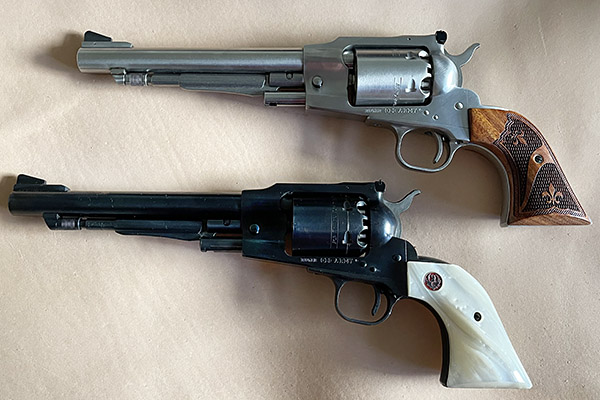
A Tale of Two Old Army Black Powder Rugers

Good buddy Paul is a black powder enthusiast.  I am, too, except I’m completely inexperienced as a shooter in the blackpowder world.  I owned an 1858 Remington reproduction (it was a Pietta, I think, and it was beautiful).  Good buddy Duane wanted one and I sold mine, new in the box, to him without ever firing it.  I’ve seen it fired, as Duane is a range regular and he’s had it out a few times.  And I have a beautiful reproduction Colt Walker (made by Uberti; you can read that story here), but I haven’t fired that yet, either.

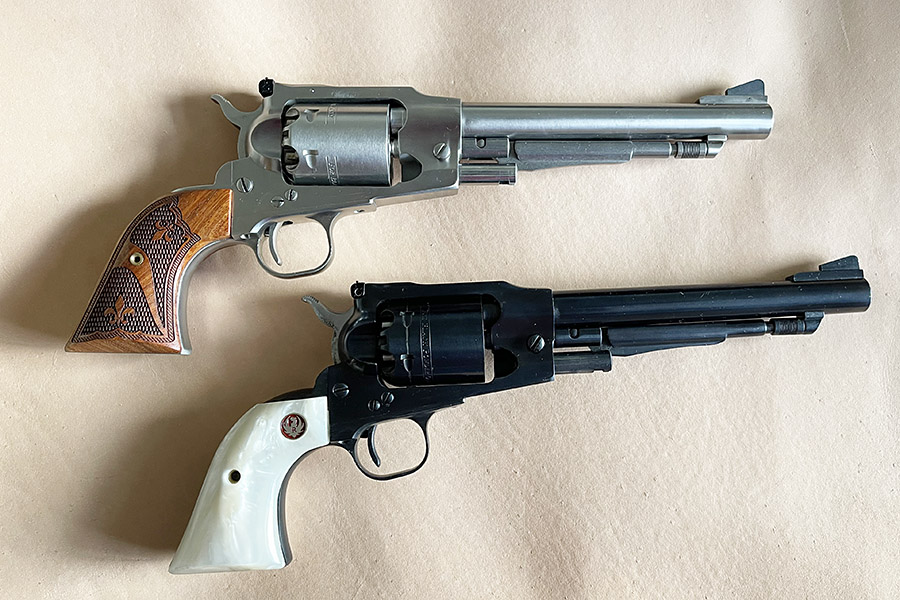
But I digress; this story is about the Ruger Old Army.  Two of them, in fact.  The name notwithstanding, the Ruger Old Army is a completely modern gun, with the exception of it’s being a cap and ball revolver.  Ruger made a few variations of this fine weapon, with the variations being barrel length (the ones Paul owns are both 7 1/2-inch barreled guns; Ruger also made 5 1/2-inch barreled versions), blue steel or stainless steel construction (the ones you see here are samples of each), satin or highly-polished stainless steel, and fixed or adjustable sights.  Ruger also offered a brass grip frame on the blue steel version (those are beautiful handguns).  Ruger also offered the Old Army with simulated ivory grips for a while.

Paul added custom grips to his Old Army revolvers, and in both cases, the grips add considerably to the revolvers’ appearance.

Big bore percussion revolvers have simultaneously been called either .44 caliber or .45 caliber.  They are not a .44, though.  They are all .45s, and you can fire either a .457 lead ball, or a .454 conical lead bullet.

Ruger introduced the Old Army in 1972 and discontinued it in 2008 as sales slowed.  From what I’ve read, Ruger Old Army revolvers can be extremely accurate.  I can’t tell you that from personal experience, however.  As I said above I have absolutely zero range time with the Old Army or any other black powder firearm.  Caps are difficult-to-impossible to find these days with the pandemic-induced components shortages (I haven’t fired my Walker yet for that reason).

Paul’s two Old Army Rugers are beautiful.  One of these days, when components are flowing freely again, we’ll have to get them and my yet-to-be fired Colt Walker on the range.


More Tales of the Gun!


Never miss an ExhaustNotes blog…get a free subcription here:


Those popup ads…give them a click or two!

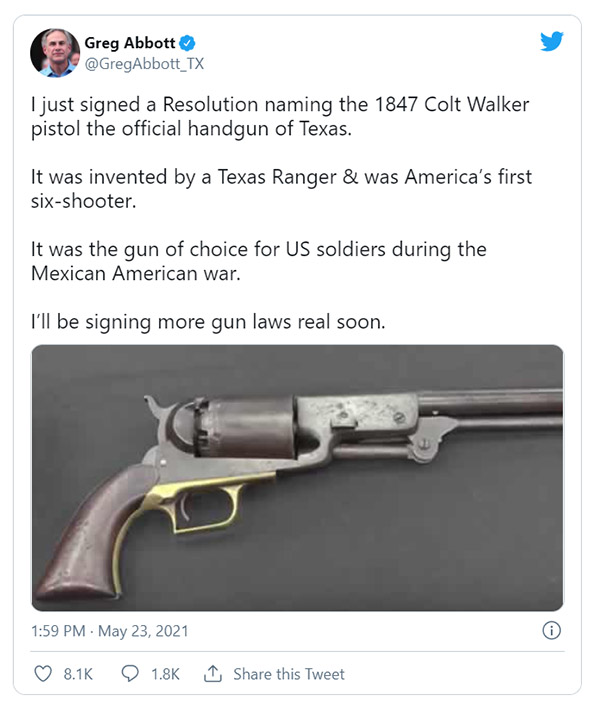
Colt Walker: The Official Handgun of Texas

Governor Greg Abbott of the great state of Texas is a leader who gets it…he understands what “common sense” gun laws should be.  Need proof?

Good buddy Paul alerted me to Governor Abbott’s proclamation, and I like it.  I used to live in Texas, you know.  Sometimes I wonder why I moved.

In case you were wondering, here’s what the Resolution for such an act looks like:


SENATE CONCURRENT RESOLUTION

WHEREAS, The original 1847 Colt Walker pistol was
historically crucial to the early survival of the great State of Texas; and
WHEREAS, The original 1847 Colt Walker pistol was an essential tool in the defeat of the Mexican army during the Mexican-American War to reclaim Texas, the 28th state of the Union; and
WHEREAS, The co-inventor of the original 1847 Colt Walker pistol, Samuel Walker, was a captain in the Texas Rangers, the first state police agency in the country; and
WHEREAS, The original 1847 Colt Walker pistol was America’s first pistol to hold six rounds, otherwise known as a “six-shooter”; and
WHEREAS, The original 1847 Colt Walker pistol is still the most powerful black powder pistol in existence; now, therefore, be it
RESOLVED, That the 87th Legislature of the State of Texas hereby recognize the original 1847 Colt Walker pistol as the official handgun of the State of Texas.


That’s pretty cool.

We’ve written about the Walker Colt, its history, and the Uberti replica of that great gun before.  I haven’t shot mine yet, but that’s a character flaw I aim to correct in the near future.  When I do you’ll read about it here on the ExNotes blog.  At the risk of being redundant, here are a few excerpts from our previous Colt Walker blogs:

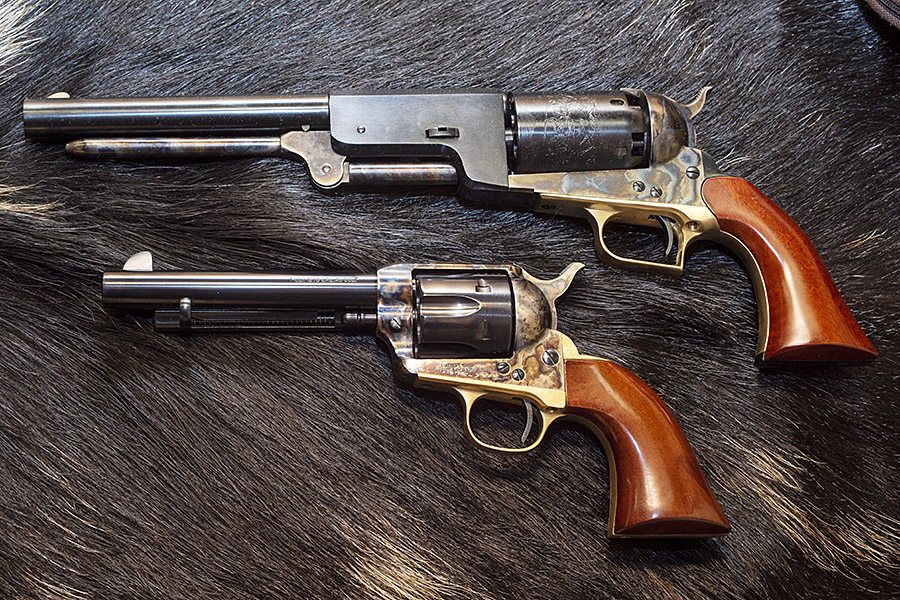
And one more…a photo I like a lot. It’s my Uberti duo…the Colt Walker and a Single Action Army.


There’s more good gun stuff here, folks.


Never miss an ExNotes blog…guns, motorcycles, bicycles, reloading, Baja, the Compleat Concreat comrade, and more!

Lonesome Dove

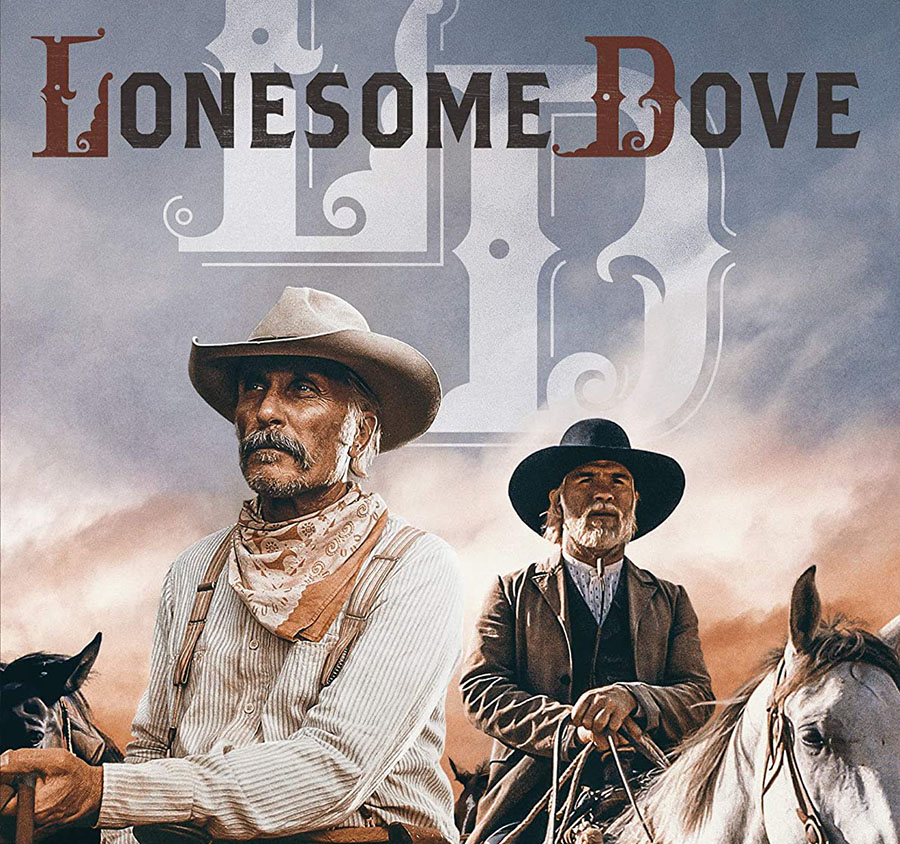
The greatest story ever told:  That’s Larry McMurtry’s blockbuster work, Lonesome Dove.  We’ve touched on it before with our book review on Revolver – Sam Colt and the Six Shooter that Changed America.  This is another book review, and a movie review, too, as Lonesome Dove was also made into a four-part TV special three decades ago.
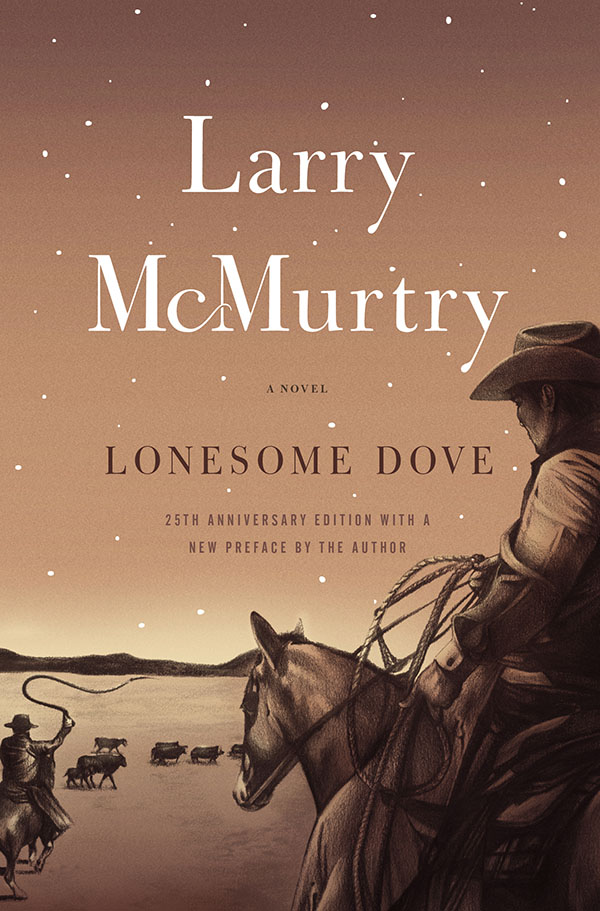
McMurtry wrote Lonesome Dove in 1985.  It was loosely based on the true story of Charles Goodnight and Oliver Loving, and their third cattle drive north.  I have a copy of Lonesome Dove that I bought when it first came out, and I’ve probably read it a half dozen times.  Sometimes a few years will go by before I see it tucked away in the bookshelf, and I’ll pull it down and take a few days to read it again   Even though I know what’s coming next (I almost have it memorized), I still enjoy reading it.  It’s that good.

Motown Productions did the Lonesome Dove four-part television mini-series in 1989.  Most of the time a movie based on a book gives up a lot, but this one did not.  When it pops up as a re-run, I’m in.  I’ve probably watched it no fewer than five times.

The scenes in both the book and the TV series (which stayed faithful to the novel) are well crafted and memorable.  Several stood out, including the river crossing water moccasin attack, McCrae’s taking out a group of renegades while rescuing Lorena, Call’s horse-collision-takedown of an arrogant and abusive cavalry officer, and the bar room scene in which McCrae puts his Colt Walker to good use teaching a surly bartender western etiquette (that one is my favorite).

If you’ve read the book or seen the TV series, you know what I’m talking about.  If you haven’t, you need to. Trust me on this one one, folks.  The next time Lonesome Dove is on TV you’ll want to see it, and if you have a chance to grab a copy of Lonesome Dove, you should do so.


More ExNotes reviews are here.