
By Joe Berk
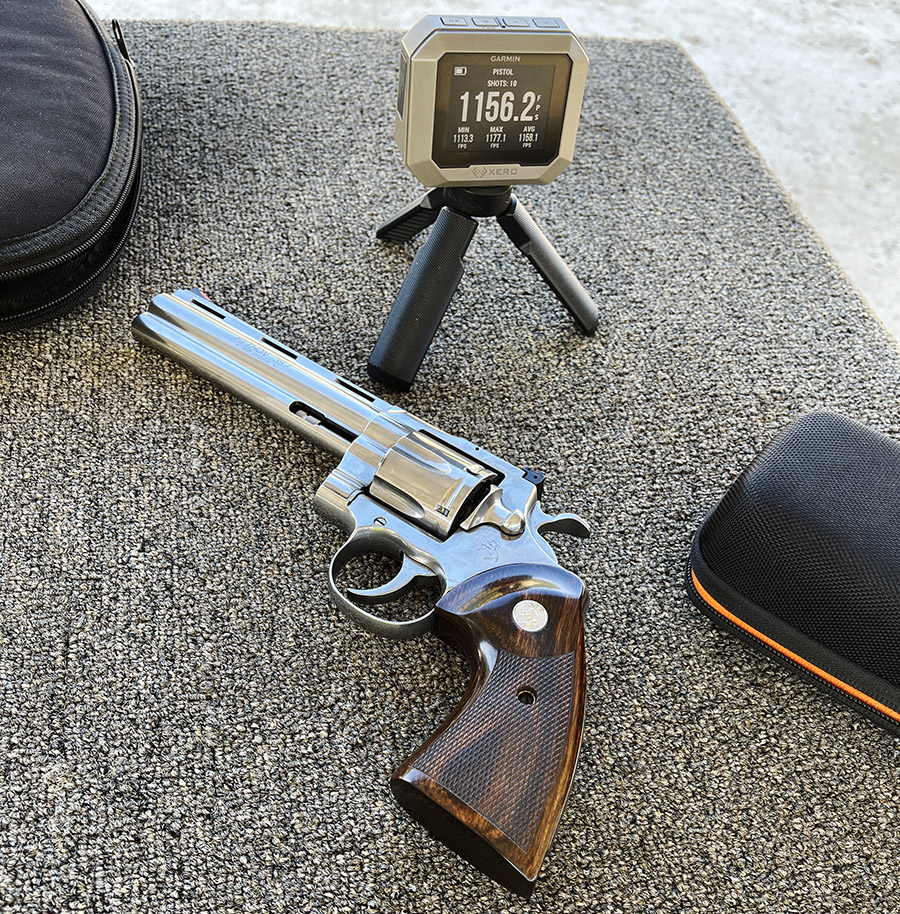
Man, I love my Colt Python. I thought I’d get that out of the way first in case anyone had any doubts. The Python is one of those things that just feels right. I’m glad I bought it and every time I take it to the range I feel good because I know I made a good decision.
I’ve been on a kick lately developing different loads for the Python with a focus on 158-grain and 180-grain jacketed bullets, and different propellants (including Winchester 296, Bullseye, IMR 4227, and Unique). Not to be combative and before you get your inner keyboard commando up, let me state at the outset that I can hear the comments already: What about 2400, or Power Pistol, or (fill in with your favorite powder). You go to war with the Army you have and I had to put a cap on the development work (and the above listed powders are what I had). If you want to see more development work with other powders, hit the donate button below and send me a note. Or start your own website.
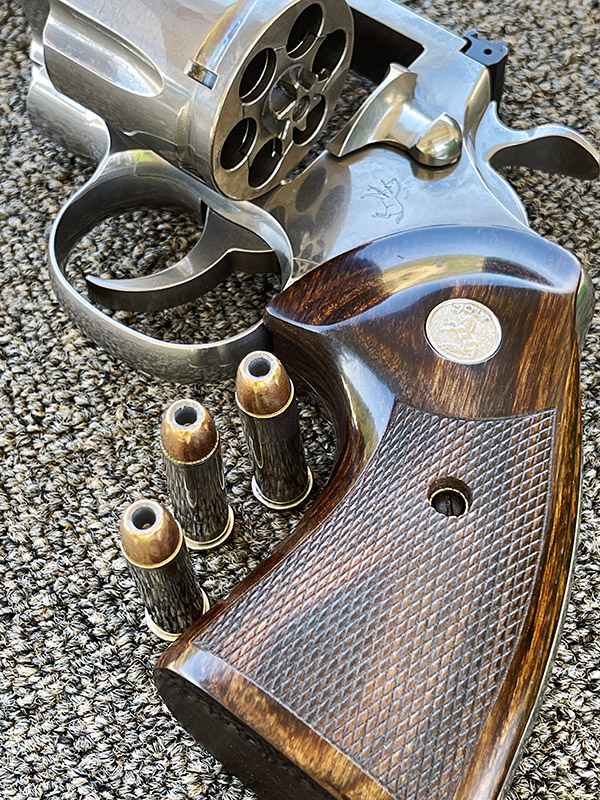
I keep a stash of Hornady jacketed bullets as my preferred projectiles in the .357 Magnum, mostly because of their consistent quality and accuracy. Recently, I received an email from Raven Rocks for DKC 158-grain jacketed hollowpoint bullets, so I thought I’d try those. DKC is a Turkish bullet maker, and I know from prior defense industry experience that the Turks usually do a good job on armament components. You may recall that I recently tested some of DKC’s 147-grain 9mm bullets in three different handguns and I wasn’t too impressed with them (that blog is here). I wanted to see if the DKC .357 bullets were any better than the 9mm bullets (spoiler alert: they are).
For this testing, I fired all loads at 50 feet, I used my Garmin chronograph to measure the velocities, and I used my Lee classic four turret press and Lee’s .38/.357 four-die set for loading the ammo. I believe in Lee reloading gear, and when it comes to getting a good crimp on hot revolver cartridges, the Lee dies work best (you can read about that here). That’s especially critical on the Colt Python, which has a very short cylinder compared to some other sixguns). Making sure the other bullets in the cylinder don’t jump forward under recoil is critical with the Python (see our earlier testing).
So what’s the bottom line?
It’s 15.0 grains of IMR 4227, CCI 550 primers, and the DKC 158-grain jacketed hollowpoint bullet. Here’s how I got there:
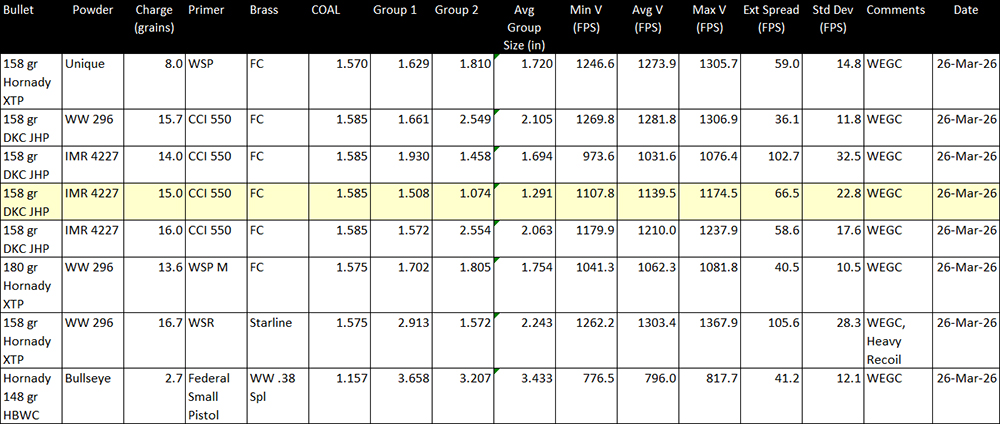
I know the table’s font is too small to read as presented here. If you click on the table, a larger table will appear. You can thank me by clicking on the Donate button.
As stated above, I found that 15.0 grains of IMR 4227, a magnum primer (I used CCI 550 primers), and the DKC 158-grain bullet gave the smallest groups, but several of the other recipes were not too far behind. Just about any load combo worked well. But that 15.0-grain load…wow, it was a honey. The velocity (which averaged 1140 fps) was what I would consider moderate for a .357 Magnum. The recoil was correspondingly moderate.
Every gun is different, and it’s interesting to see what works best in different guns chambered for the same cartridge. The Unique load at the top of the table above was the accuracy load for my 6 1/2-inch blue steel Ruger Blackhawk. The 158-grain Hornady jacketed hollowpoint load with 16.7 grains of Winchester’s 296 worked best in my 6 1/2-inch Ruger stainless Blackhawk and it was stunningly accurate in my 8 3/8-inch Model 27 Smith and Wesson 40 years ago. But 16.7 grains of 296 makes for a religious experience type of load. Recoil is impressive and steady servings of those cartridges beat both the stainless Ruger Blackhawk and the Smith Model 27 to death. I only tried a few of those monster loads in the Python, and I’m glad they weren’t the accuracy winner.
I keep a stash of the .38 Special standard target load (2.7 grains of Bullseye with a 148-grain Hornady hollowbase wadcutter bullet) on hand. It is a one-hole load in my Model 52 Smith, and it’s been accurate in other .357 and .38 Special handguns. I wanted to use it in the Python as a standard of comparison, and it surprised me. It was the least accurate of any of the loads tested in my Python. Like I said above: Every gun is different.
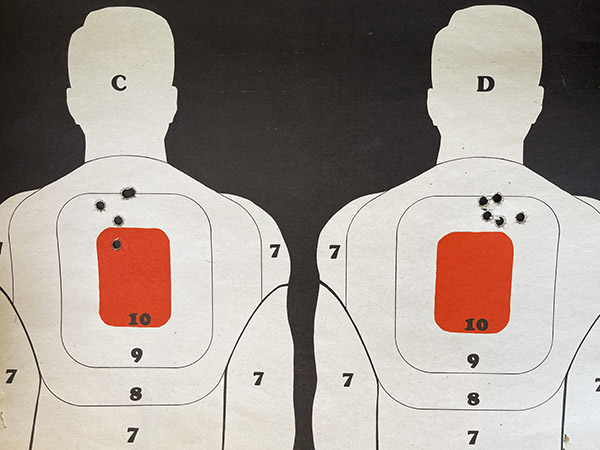
After settling on the 15.0-grain IMR 4227 load, I wanted to see how it would do at 25 and 50 yards. I went to the West End Gun Club on a beautiful Sunday morning and set up targets at both distances.
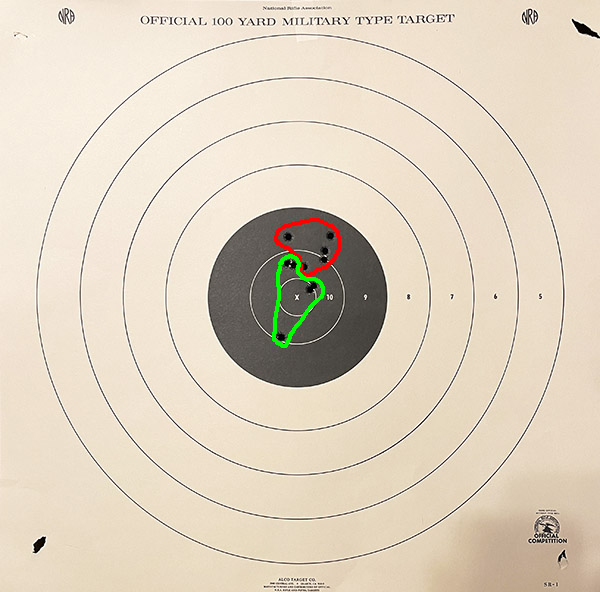
I first shot at the 25-yard target and shot a great group, but it was high (it’s the group circled in red in the target below). The rear sight only had four more clicks left in the down direction, so I dialed those in and fired another five rounds. That produced the group circled in green in the target below. I used a 6:00 hold on the black bullseye for both groups.
After firing the first 25-yard group, I shifted to the 50-yard target before adjusting the rear sight. That produced the group outlined in red in the target below. After lowering the rear sight, I shot the group outlined in green in the target below. It was a good group at 50 yards, but still too high (I was using the same 6:00 bullseye hold mentioned above). Because I was out of adjustment on the rear sight, I tried to hold about 4 inches below the bottom of the bullseye, and I shot the group outlined in yellow.
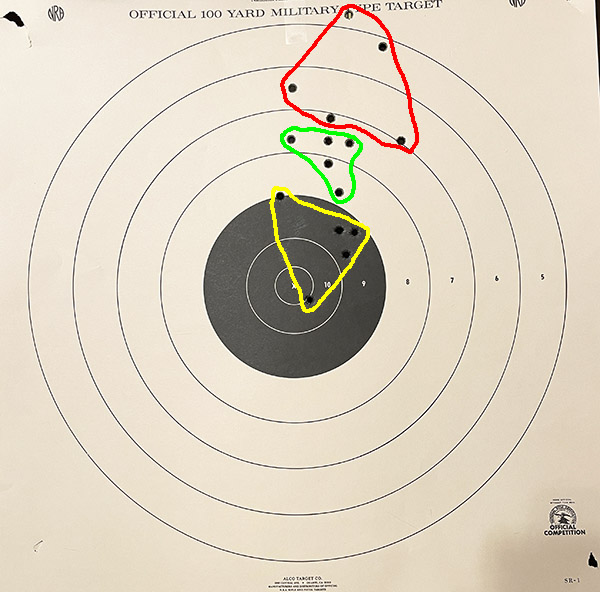
I’m pleased with these results. I might need to move the rear sight a scosh to the left, but I want to shoot a few more groups to confirm that. That will happen in the near term. I am also thinking about a taller front sight. The rear sight is already in its lowest position; a taller front sight would bring the point of impact in line with the point of aim. We’ll see.
What’s next? I’m thinking a trip to Arizona for some more pork. I’d like to see how this combo works on a pig, and I think there’s enough energy and accuracy to humanely take next year’s stash of bacon. Well, okay, you got me: I’m just kidding about the bacon part. There’s no belly fat on a wild pig. There’s plenty of other meat on one of those Arizona hogs, though, and I’m already thinking about a cookbook featuring recipes for the same.
Stay tuned.
Keep us in components!
Never miss an ExNotes blog:
More gun stuff? You bet!
More Python? You bet. Here are our earlier Python related posts:
Python versus Blackhawk
110-Grain Python Load
Python TJ Trigger
Python Update
New Python Range Test
New Colt Python
A Colt Visit
Boudreau Bullets
A Pair of Prancing Ponies
Join our Facebook ExNotes page!