The Wayback Machine: Yellowstone National Park

By Joe Berk

I’ve been to a lot of great places.  None were as grand as Yellowstone National Park.  I was reminded of that when watching the Kevin Costner special, Yellowstone One-Fifty.
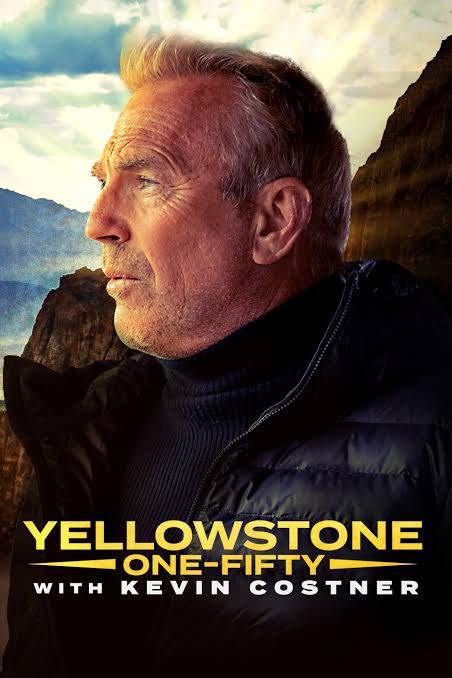
I’ve been to Yellowstone twice.  The first time was with a bunch of guys from China, two guys from Colombia, Baja John, and Joe Gresh.  The second time was with Susie.  Both trips were great.  Seeing the Costner special reminded me of a blog I wrote about those trips a few years ago, and I thought you might enjoy reading it again.


Man, it was cold.  It was the coldest we would be on our 18-day, 5000-mile ride around the western United States.  Yellowstone National Park was our destination and we wanted to arrive early.  Baja John was doing the navigating and the trip planning, and we were leaving early that morning out of Cody, Wyoming, at 5:00 a.m. to beat the tourist traffic in Yellowstone.  I had an electric vest; our Chinese and Colombian guests did not.  I knew they had to be hurting.  I had my vest dialed all the way up and I was.  Did I mention it was cold?

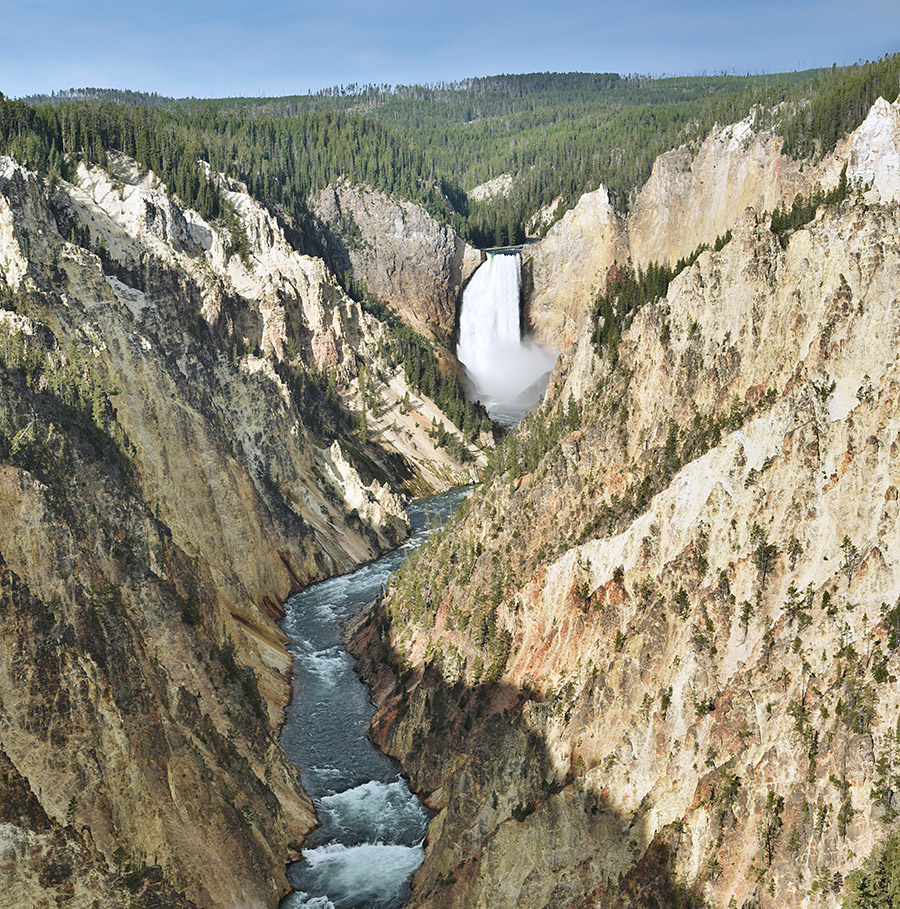
So, about that big photo above:  That’s Yellowstone Falls on the Yellowstone River.  There are something like 10 waterfalls in Yellowstone National Park.  I’ve only seen the one above.  That means I have at least nine reasons to return.

Back to the story.  I did mention it was cold riding into Yellowstone that morning, didn’t I?
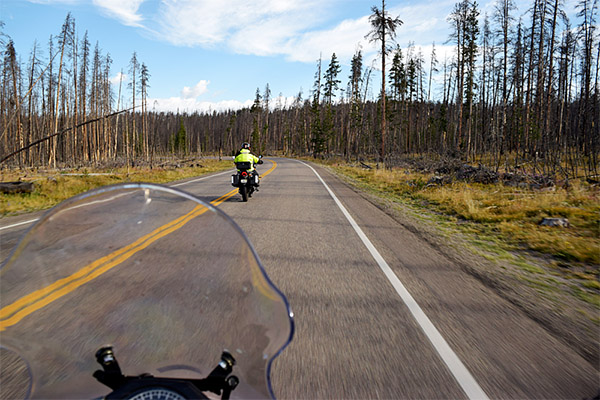
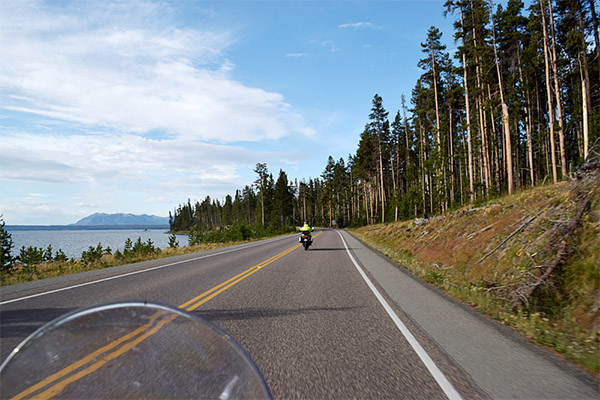
Following Baja John into Yellowstone. That trip was 6 years ago, and I still get cold looking at this photo.
Another shot entering Yellowstone National Park from the east.  That’s Baja John in front of me…we were dressed for the cold, but I think our guests found it to be a little colder than the weather they are used to in southern China.

The trip was a wild one…18 days on the road with a dozen guys from China, two from Colombia, and all on free motorcycles provided by Zongshen via CSC Motorcycles.  CSC was the importer, I was the go-between spanning the CSC/Zongshen interface (and two continents), and while we were arranging the initial shipment Zongshen asked if I had any ideas to promote the bikes in the US.  Wow, did I ever!

In Zongshen’s main offices, with key Zongshen execs viewing photos from my rides in the US and Baja. Sue grabbed this photo and it’s one of my favorites. Without realizing it, I was selling those guys on giving us 15 motorcycles to ride around the US.  This looks like a staged photo.  It’s not.

That ride became the Western America Adventure Tour, and it was a hoot.   I mean, think about it:  Every angry and ignorant asshole on the Internet was condemning Chinese bikes and here we were, with 15 of the things that had just arrived in America, setting off on a 5,000 mile ride from So Cal to Sturgis, west across the US to the Pacific Ocean, and then riding the Pacific coast back to So Cal.  On that epic ride we didn’t have a single breakdown and that was giving the Internet trolls meltdowns.  It was a grand adventure.

But I digress.  Back to Yellowstone.  On our ride, we hit every National Park along the way, and Yellowstone was one of the best.   Prior to that ride, I’d never been to Yellowstone and I had always wanted to see it.  And for good reason…it is (in my opinion) the quintessential National Park.  Yellowstone is surreal, with sulfur-laden steams and ponds spewing forth, majestic views, waterfalls, bison, bears, deer, elk, wolves, geysers, and more.   It was a first for me.  I was a Yellowstone green bean.

When we entered Yellowstone, we arrived so early the gates were unmanned and we entered for free.  But it had been a long, cold ride in from Cody and we were nearly out of gas.  My fuel light was blinking as we entered the park and I didn’t know for sure if there would be gas in Yellowstone.  John felt confident there would be, and he was right.   I saw the Sinclair sign up ahead, but before we got there, we had a close encounter of the bison kind.  We were cruising along at about 30 mph, and all of a sudden I noticed this locomotive next to me.  I was too slow to realize what it was until I was alongside, but our chase vehicle driver John (we had two Johns and one Juan on this ride) grabbed this photo…I had passed within 10 feet of this monster!
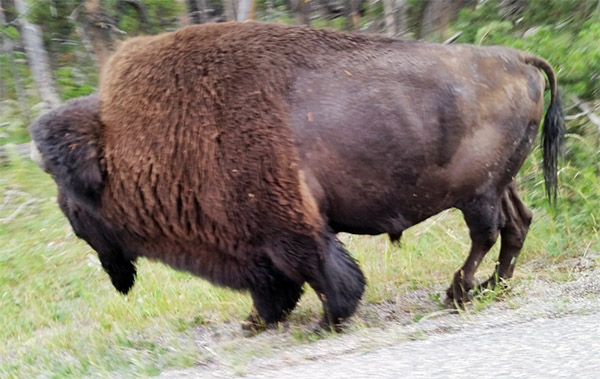
Just as I went past my big buff buddy above, he exhaled.   In the frigid Yellowstone air, fog came out of his nostrils.   It was like riding alongside a steam locomotive.

Here’s another cool shot in Yellowstone:  The Continental Divide.  We had crossed it several times on the ride to Yellowstone already, but I think this is the first time I stopped for a photo.
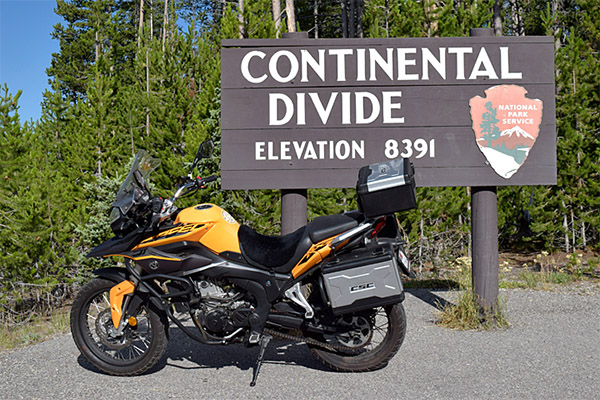
Sometimes the photos almost take themselves.

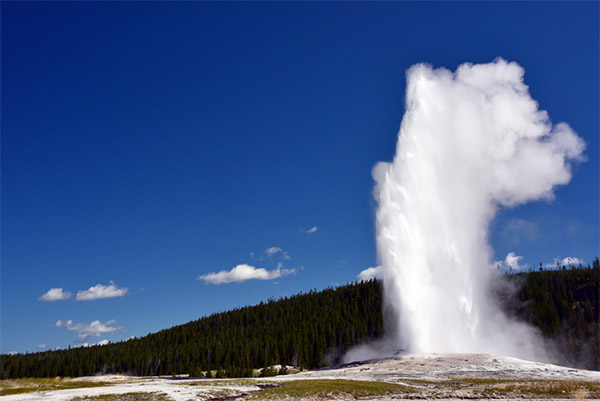
One of the many attractions in Yellowstone is Old Faithful.   Here’s a shot of the geyser in its full glory.
It was one of those motorcycle rides that was so much fun it made me feel a little guilty.  (That’s a Jewish thing; maybe some of our Catholic readers will understand it, too.)  I felt bad because Sue wasn’t enjoying the trip with me.  So I fixed that.  A few years later Sue and I hopped in the Subie, pointed the car north, and a few days later I rolled into Yellowstone National Park again (this time with my wife).  Naturally, I grabbed a few more photos.
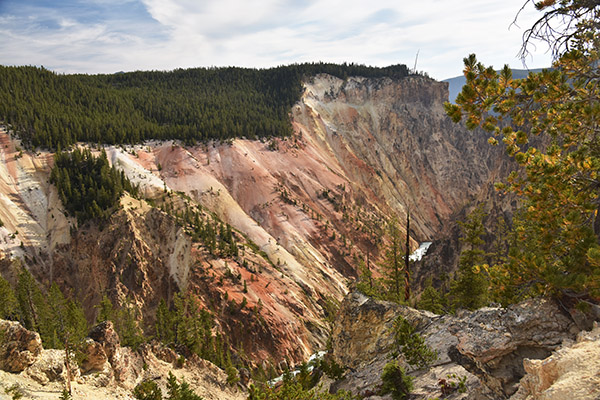
Peering into the valley carved by the Yellowstone River.
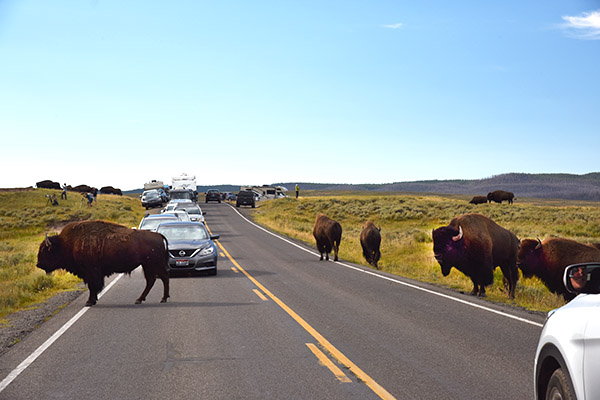
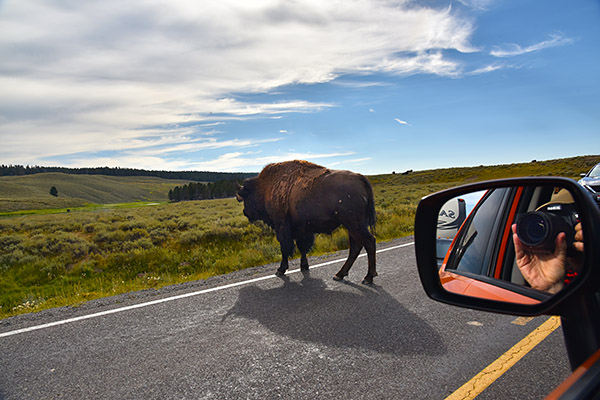
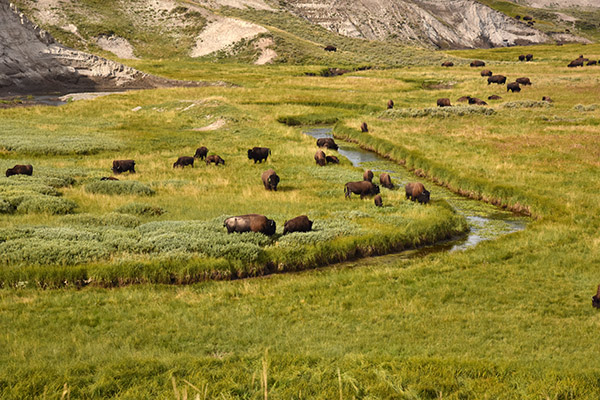
Ah, the bison. This was really cool stuff.
Click. Click. Click.
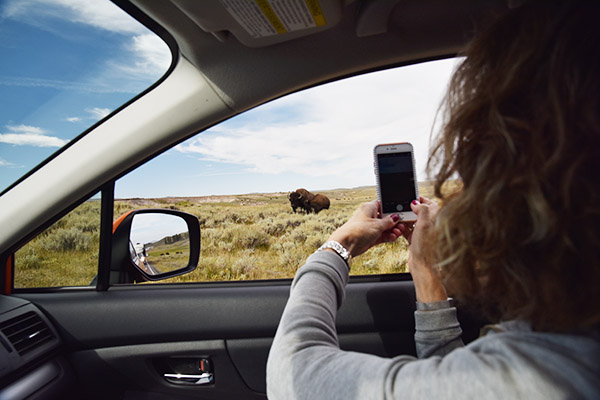
A photo of Sue in the Subie photographing a bison.
Wow.

I’m not a geologist, but geology seems to me to be a pretty interesting subject and there sure are a bunch of geological things in Yellowstone.  Like the bubbling and burbling pits and pools you most definitely do not want to fall into.

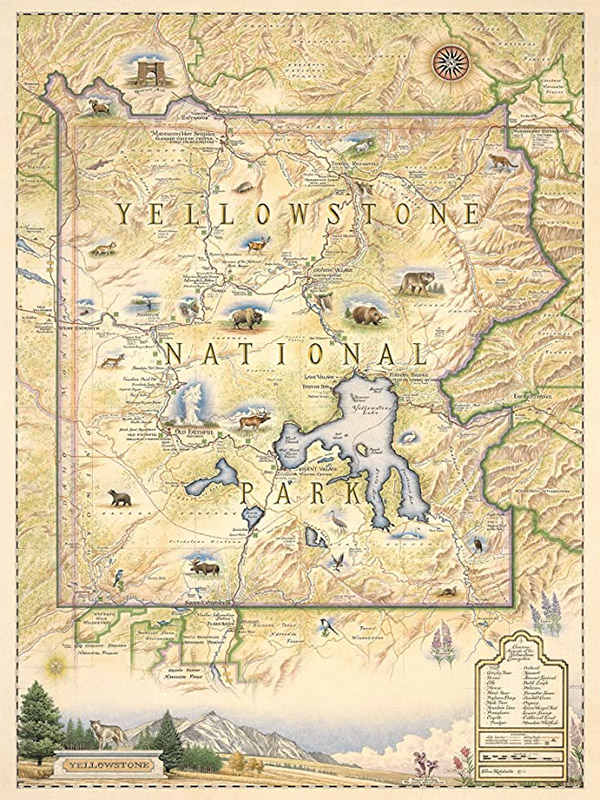
You get the idea.  In doing a bit of Internet research on Yellowstone, I came across this Yellowstone map.  It is a good way to get the lay of the land up there in Wyoming, but visiting Yellowstone National Park would be even better.
You can learn a little bit more about Yellowstone as a destination (and how to get there) by reading an article I wrote for Motorcycle Classics magazine.  It’s a cool place and I’ve never met anyone who felt like visiting Yellowstone was anything other than a marvelous experience.  Trust me on this:  Yellowstone National Park belongs on your bucket list.


Never miss an ExhaustNotes blog:


Would you like to read more Motorcycle Classics Destinations articles?  Hey, just click here or better yet, buy your own copy of Destinations.


One more thing…if you’d like to learn more about the RX3 motorcycle and our 5,000-mile Western America Adventure Ride, you should do two things:  Buy yourself a copy of 5000 Miles at 8000 RPM, and watch Joe Gresh’s video:
Case Buffalo Horn Hunter

By Joe Berk

Case is a old-line American knife manufacturing company with roots that reach all the way back to 1889.  I knew them as a pocketknife manufacturing company, and without really knowing anything about them, one of the first knives I purchased when my interest in pocketknives was rekindled was a Case Stockman (you can read about that knife here).  I mentioned to good buddy and edged weapons rabbi Paul that I had purchased a Case, and he gave the company his seal of approval: “They’re an old line knife company, they’re made in America, and they’re good,” he told me.  I didn’t know any of that when I purchased the Stockman, but it felt good to know Paul thought I had made a good decision.
The Case at hand…sorry, couldn’t resist that.

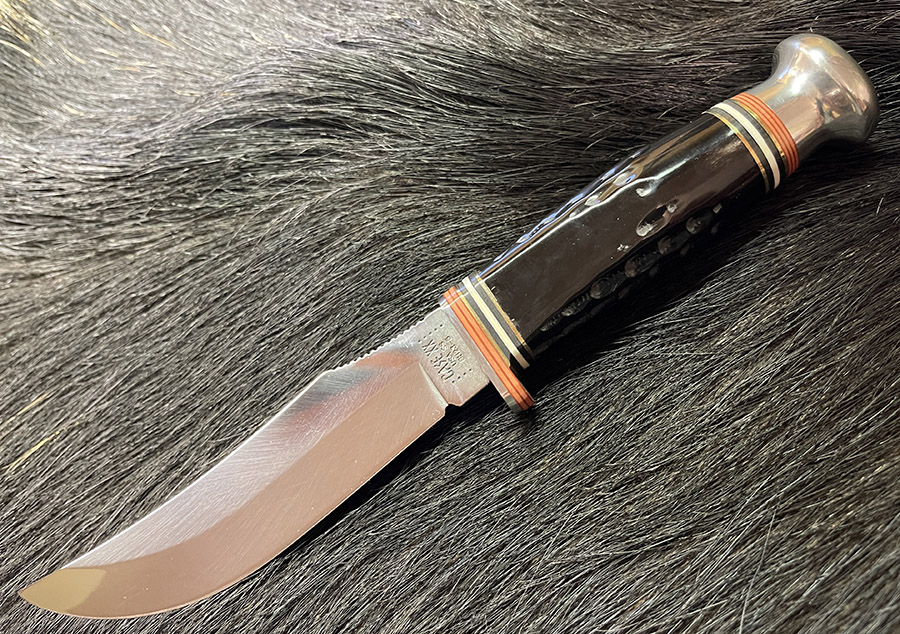
Not long ago I received an email from the Chicago Knife Company (an online retailer) offering a Case Hunter.  The knife had my attention immediately for several reasons:  It was a fixed blade Bowie/hunting knife (I didn’t know Case made such an item), it had a jigged buffalo horn grip, it was mirror finished, and the price was right.  Buy now, a credit card number, free shipping, no sales tax, and it was on its way to me.

Made in America. Case has an American manufacturing history that goes back more than a century.

The Hunter arrived a few days ago, and it’s beautiful.  I’m glad I ordered this one.  For me, it’s a collectible.  I won’t be wearing it in the field and I have no intentions of skinning or field dressing anything with it (as I watched our guide Tom do on a recent pig hunt in Arizona).  I just enjoy looking at it.

To me, the knife feels a little small and a little bit light, although I’m not sure why it does.  It has an overall length of 10 inches, a blade length of 5 inches, and a handle length of 4 inches.

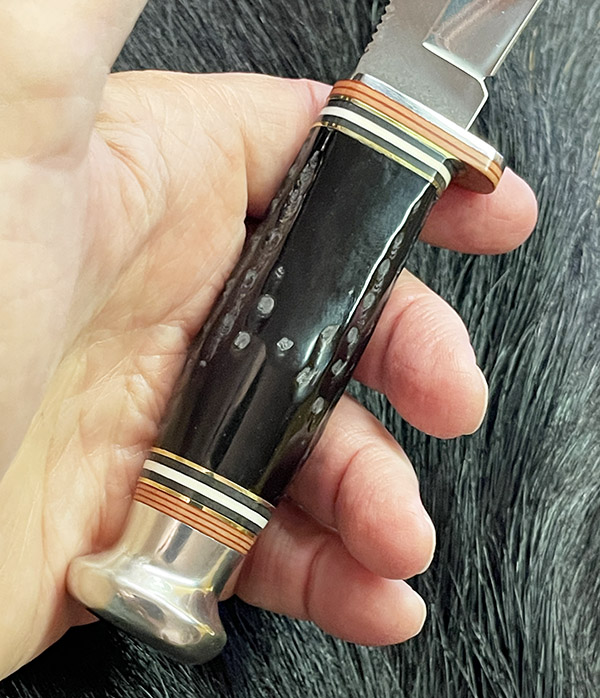
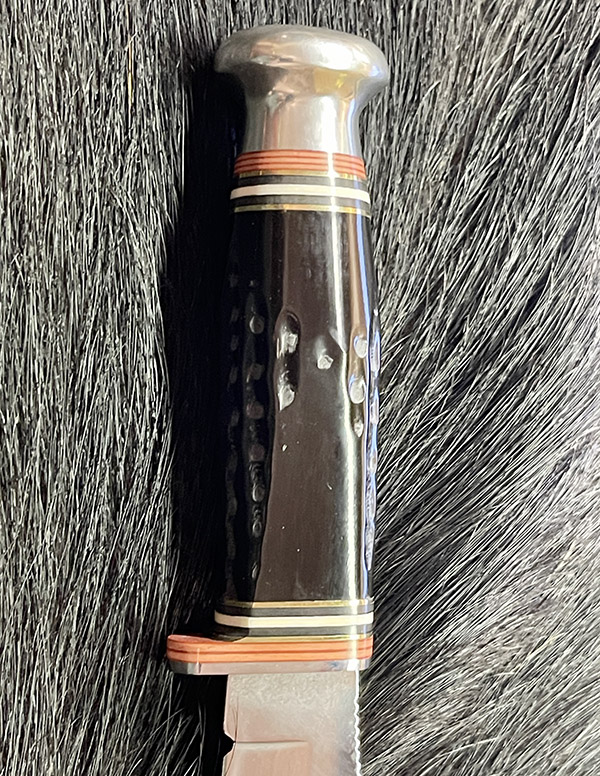
The polished buffalo horn grip from the left side.
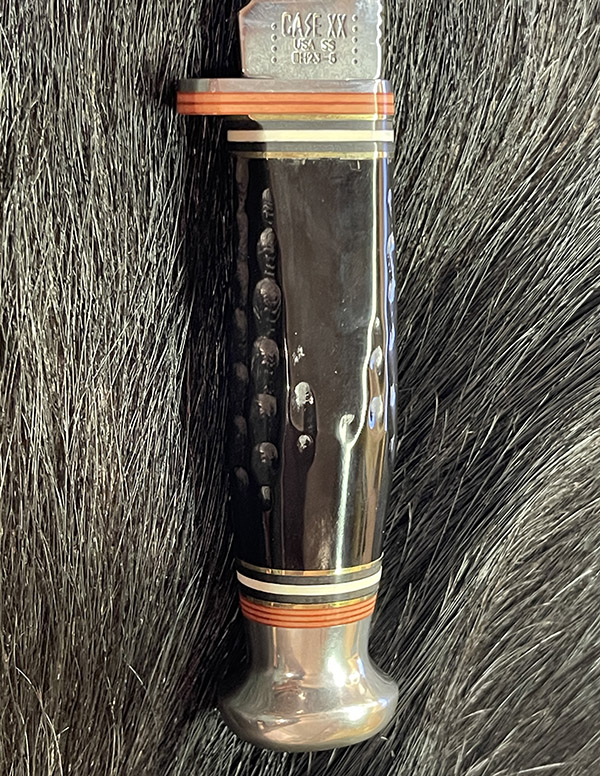
A view of the buffalo horn grip and spacers from the right side.
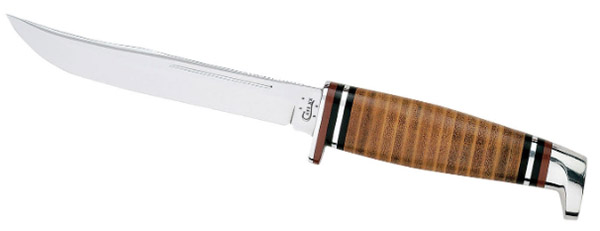
As a potentially more usable grip, stacked leather is available.

The buffalo horn grip is highly polished.  Maybe too much so, as it feels a bit slippery.  That’s okay, I think, for something I intend to admire a lot and use little.  If I was buying this knife as a tool (and not as a bit of artwork), Case also offers it with a stacked leather handle.  That might be more practical.

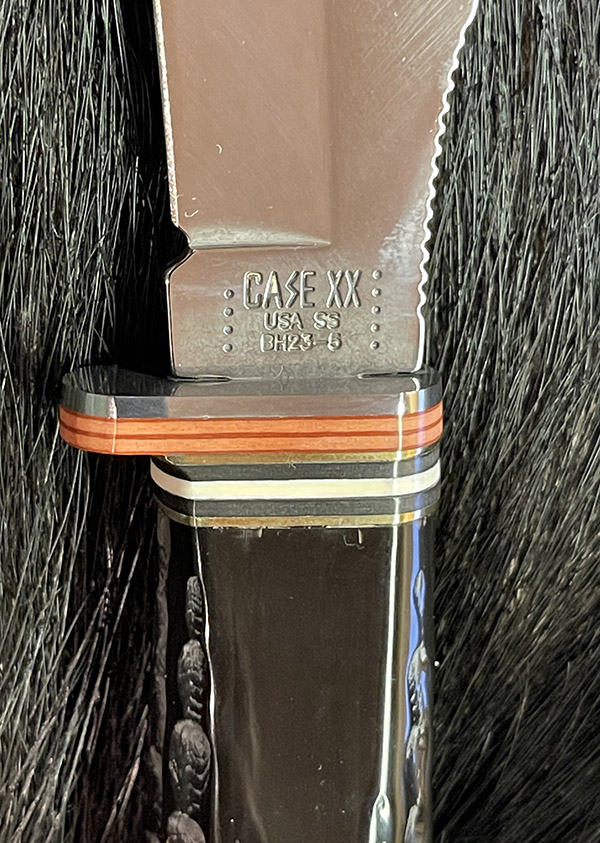
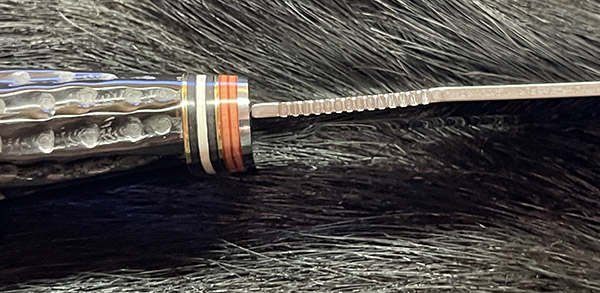
Serrations on top of the bade. The 5-inch blade is relatively narrow compared to some of my other knives.

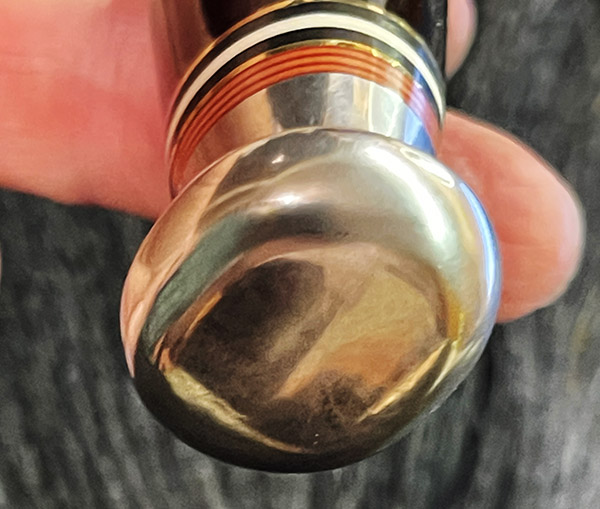
The blade has a serrated edge along the top.  Maybe that’s intended to be used for sawing.  Again, it doesn’t matter to me.  It’s decorative as far as I’m concerned.  The pommel is cool, too.  It’s polished aluminum and it looks great along with the knife’s red, yellow, white, black, and brass spacers.

The Case Hunter’s polished aluminum pommel.

On the Chicago Knife Works site, the blade material is identified as H-2.  Here’s what Google says about that steel:

H-2 steel has extreme corrosion resistance, especially in saltwater environments. Its composition uses nitrogen instead of carbon.  It is described as tough and capable of holding an impressive edge.  The strengthening process for H-2 steel involves intense rolling and cold-working, not traditional hardening and tempering.  H-2 is an evolution of H-1 steel, while retaining its desirable properties and being easier to manufacture. It can attain a Rockwell hardness in the high 60s while remaining resilient. In summary, H-2 steel is used in some knives and offers exceptional corrosion resistance, toughness, and good edge retention. 

The Case Hunter is not listed on the Case Knives website, but it is listed on the Chicago Knife Works site.   I called Case to confirm it is still available, and it is.  This is not a Chinese or Pakistani knife; it’s made in Bradford, Pennsylvania.  A black leather sheath is included with the buffalo horn Case Hunter.


Join our Facebook ExNotes page!


Never miss an ExNotes blog:


Help us keep the lights on:


Don’t forget: Visit our advertisers!


A Great Video

By Joe Berk

We are living in interesting times.  I like to read the news every morning with my first cup of coffee.  This assessment and presentation by General Caine is worth watching in its entirety.

The presentation struck a lot of notes for me.  I think you’ll enjoy it.  I sure did.


Join our Facebook ExNotes page!


Never miss an ExNotes blog:


Help us keep the lights on:


Don’t forget: Visit our advertisers!


A Decade Ago…

By Joe Berk

Man, the years do fly by:  It was just over a decade ago we did the inaugural CSC Baja ride!

Those were good times and the RX3 was a great motorcycle.  I was shocked when Zongshen stopped making them, but I guess those guys knew what they were doing.  We had a lot of fun on those annual excursions.

I need to get back down to Baja again.  Maybe I’ll do so next year.  I’d like to say hello to the whales!

If you’d like to learn more about our Baja adventures, pick up a copy of Moto Baja!  It was a fun book to write.  Doing the research that allowed me to write it was even more fun.


Join our Facebook ExNotes page!


Never miss an ExNotes blog:


Help us keep the lights on:


Don’t forget: Visit our advertisers!


Gordon Knives

By Joe Berk

Gordon knives?  You may think you’ve never heard of them, but maybe you’ve seen them without realizing what you were seeing.  Gordon, you see, is the house brand for Harbor Freight knives.  You know Harbor Freight: It’s where the folks who badmouth Chinese motorcycles buy their tools.

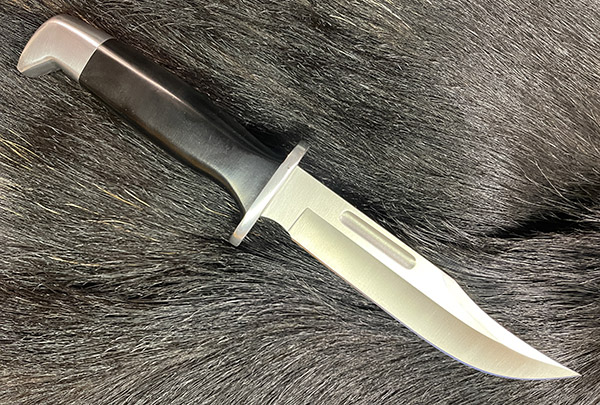
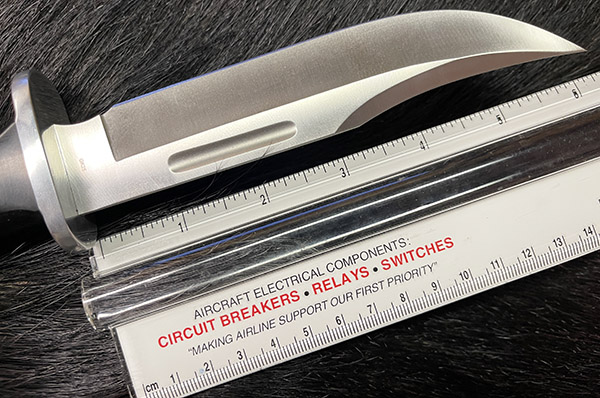
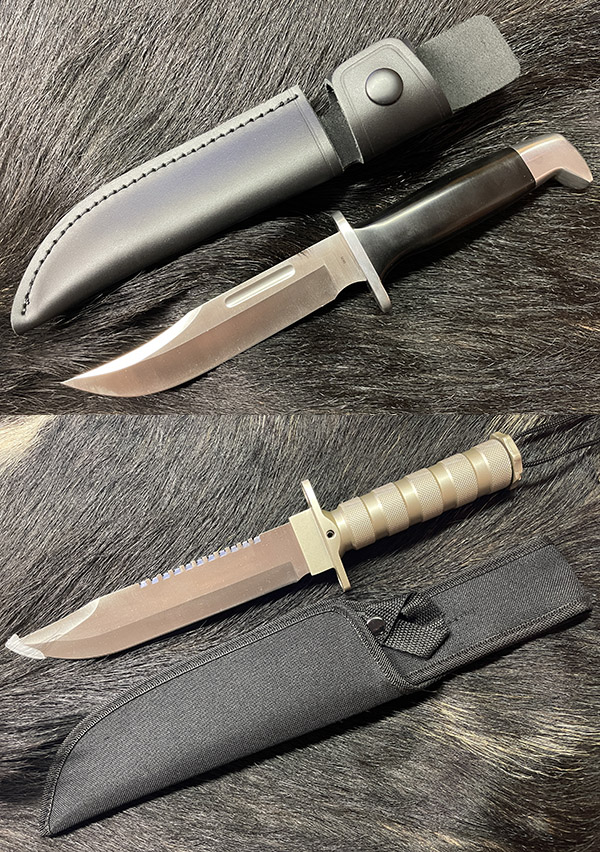
The Gordon Bowie. It’s a nice knife.

I don’t shop much at Harbor Freight these days, but it’s not because I think their stuff isn’t any good.  I’m an old  guy and I have all the tools I’ll ever need.  But I still get the Harbor Freight ads, and one of them caught my eye recently.  It was for what I initially thought was a Buck 119 hunting knife, but it wasn’t a Buck: It was a Gordon.  They call it the Gordon Bowie/Hunting knife.  So I rolled on over to my local Harbor Freight store to check it out.

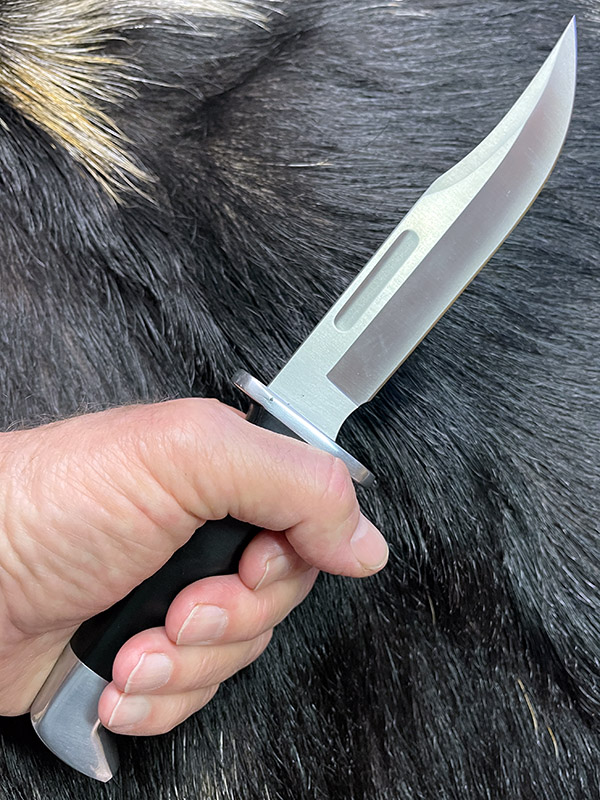
The Gordon has some heft to it. It seems to fit my hand perfectly.
The Gordon Bowie has a 6-inch blade.

You can see the Gordon Bowie before you buy it because it’s packaged in a clear plastic bubble wrap container.  Getting the knife out of that package was a bit of a challenge.

The Harbor Freight website lists the blade material as 7Cr17MoV stainless steel.  Even though I had a course or two in metallurgy in my formative years, I wasn’t sure what that meant, so I Googled it:

7Cr17MoV is a Chinese stainless steel, often used in budget-friendly survival and kitchen knives, known for its good balance of hardness, corrosion resistance, and toughness. It’s essentially a modified version of 440A steel, with added vanadium to enhance strength and wear resistance. While it may not offer the best edge retention compared to high-end steels, it’s relatively easy to sharpen and is known for its durability under hard use.

A Buck 119 goes for about a $75.  The Gordon?   It’s a whopping $29.99.  I had to take a look, and when I did, I liked what I saw.  So I picked one up.  At $30, I can take the risk of it not being perfect.

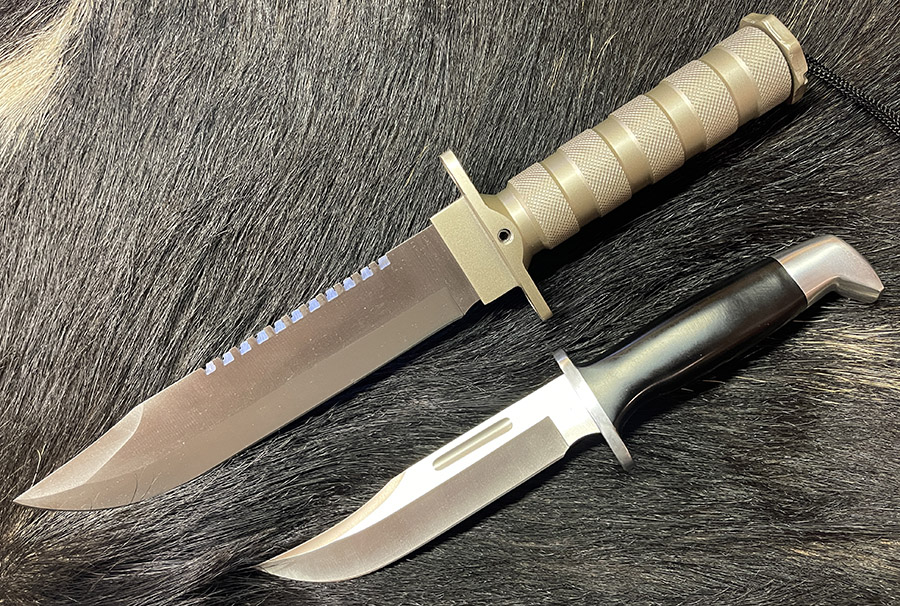
Then I noticed another Gordon knife hanging on the Harbor Freight display next to the Gordon Bowie.   It was a monster that caught my attention (it was hard to miss, actually).

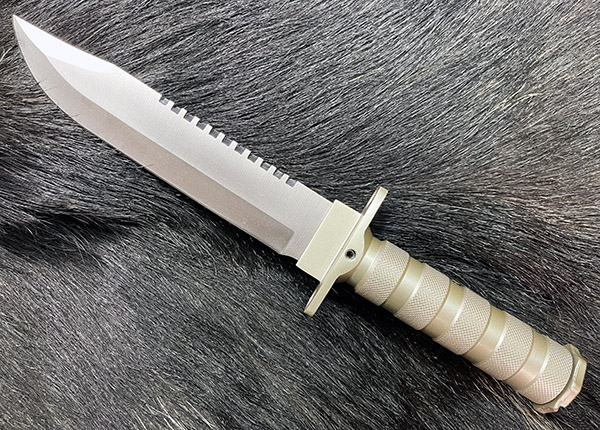
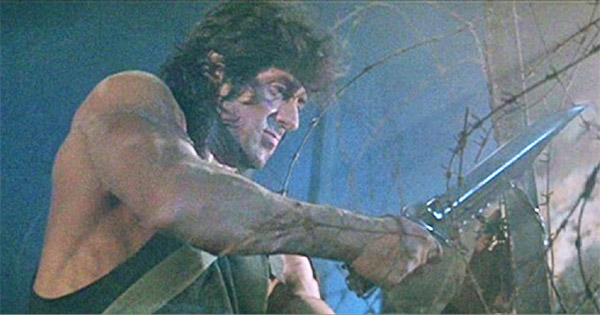
Visions of Sylvester Stallone as Rambo swam through my mind when I saw this Gordon. Check out the sawing serrations on top of the blade.

Harbor Freight calls the knife you see above their Survival/Hunting knife.  In addition to its size, the other thing that grabbed my attention was the price.  It was either $9.99 or $6.99.  I couldn’t tell which, and I’ll return to that part of the story in a minute.

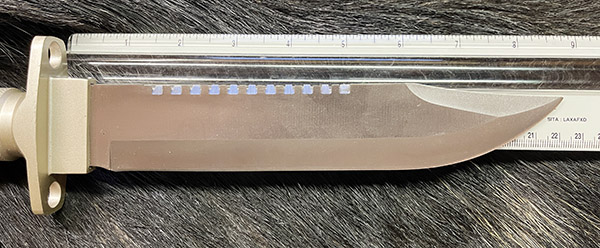
The Gordon Hunting/Survival knife has an 8-inch blade. It’s an impressive knife.  I don’t know what impressed me more:  The knife’s size, or its low price.

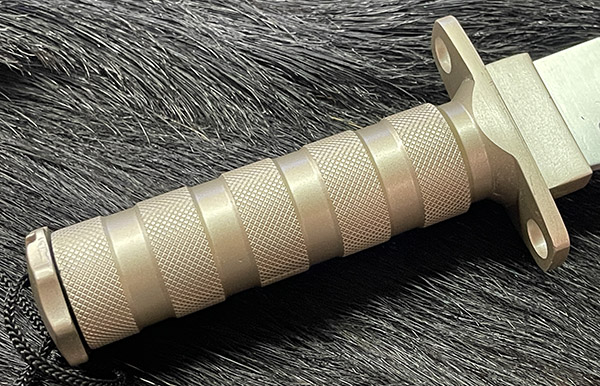
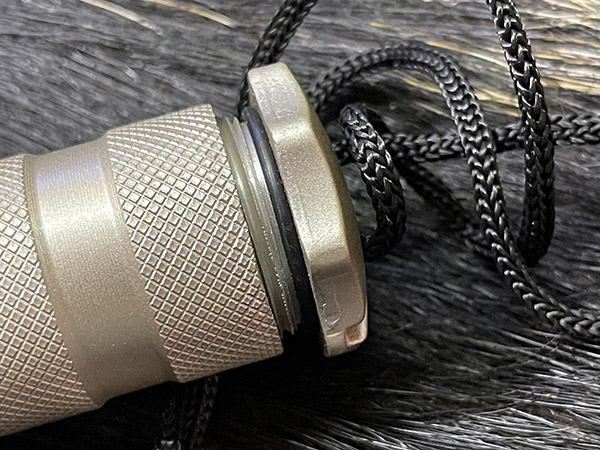
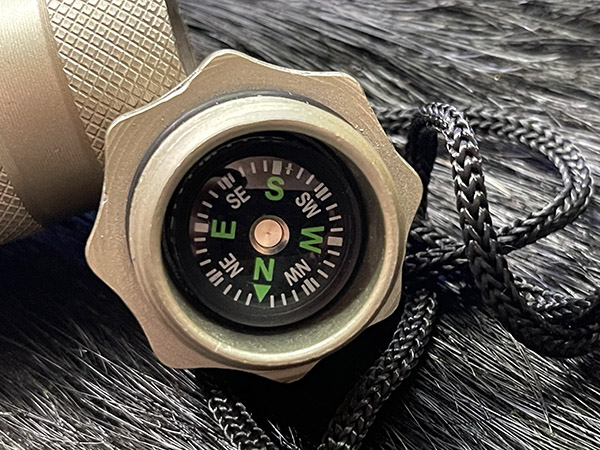
The gigondo Gordon is called their Hunting/Survival knife.  It’s a monster with an 8-inch blade.  The knife has a hollow handle with a cap that unscrews, and inside the cap, there’s a compass.  Cool beans.  A compass.

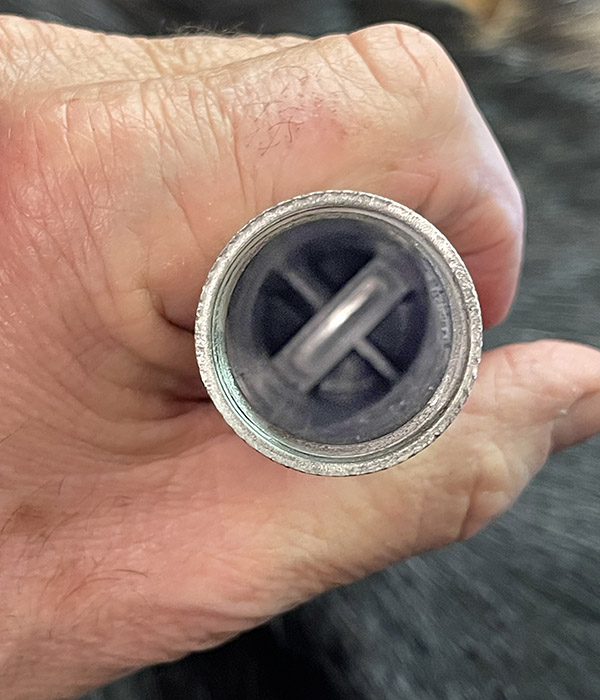
The Gordon Hunting/Survival knife handle. The end cap unscrews and you can store stuff inside the handle.  Because the handle is hollow and made of aluminum, the knife feels much lighter than it looks.

When I later read the online reviews, one guy said the compass didn’t work.  But you know those online reviews.  Some folks would complain if you hung them with a new rope.  Mostly these reviews consist of what emanates from the southbound end of a northbound bull.  My compass works just fine.

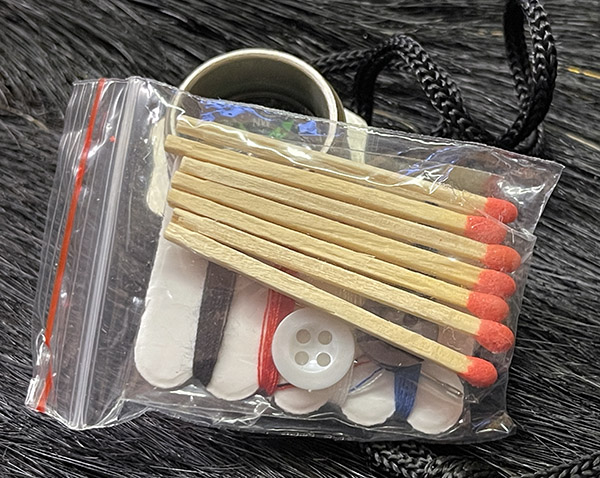
Gordon also gives you some thread, a few matches, and oddly enough, a button or two.  It all fits in the handle and it’s focused on helping you survive in dangerous places.  You know, like LA.   In case you need to hack your way through some bamboo or you lose a button.

The handle’s cap is sealed with an o-ring.
A compass inside the handle’s end cap.
There’s room inside the handle to store the survival accessories that come with the knife, and maybe some other stuff.
This little package of survival stuff came with the Grodon knife.

The Gordon survival knife is cool.  It makes me feel like Rambo. Maybe that’s what it is supposed to do.  The upper part of the blade has a sawtooth pattern milled into it.  The blade is sharp.  Is the metal any good?  Hell, I don’t know, and I probably won’t find out.  I’m not planning any expeditions into the Amazon basin, and even if I were, I probably couldn’t get on the airplane with this thing.  Will it hold an edge? I don’t know that either.  But at $9.99, if I can’t sharpen the thing I’ll just buy another.

The blade material is specified on the Harbor Freight website simply as “stainless steel.”  A Reddit post by one of the many folks on the internet who post such things states that it is 8CR13MOV steel (I don’t know if that’s accurate, but it’s the only blade material reference I found).  Here’s what Professor Google has to say:

8Cr13MoV steel is a popular Chinese stainless steel known for its good balance of performance and affordability, making it a common choice for budget-friendly knives. It offers decent edge retention, corrosion resistance, and ease of sharpening.

Both knives come with sheaths, not that I’ll ever use either.  But it’s nice to know they’re there just in case I ever get the urge to make a Rambo movie.

The Gordon Bowie and Survival/Hunting knives both include sheaths in their incredibly low prices.

You know, it’s funny.  The young lady cashier at Harbor Freight asked if I knew the price of the knives.  I told her the 6-inch Bowie Buck 119 wannabe was $29.99, and the big Gordon survival knife was either $9.99 or $6.99.  I explained that I wasn’t sure because there were two price tags on the larger knife.  She explained that if I was a Harbor Freight member, I could buy the knife for the lower $6.99 price, but as a plain old Harbor Freight nonmember, I’d have to pay the higher $9.99 price. She went on to explain that the annual Harbor Freight membership fee is $29.95.  I told her I didn’t want the membership because, like Woody Allen, I wouldn’t be a member of any organization that would have me as a member (I thought I was really on top of my game with that one, but my borscht belt shtick went right over her head).  She then told me if I told her my email address, I could select one of four different prizes.  As a guy who still gets excited opening a box of Cracker Jacks, her offer appealed to me.  (I was really having a good day.  I love going into any store that sells tools, I was getting two cool knives, and now I had a offer for another free prize.)  I gave that young lady my email and she showed me a menu.  I selected the convertible screwdriver.  And finally, when she rang up the knives, she looked at the Buck 119 wannabe.  “Why is this one so expensive?” she asked, pondering its $29.99 price against the much larger $9.99 survival knife.

Me? Not hardly. But I have the blade if they ever offer the role to me.

So there you have it.  Are these knives any good?  I think they are, but hey, at these prices, who cares?


Like our knife stories?   We have more, you know.

A Custom Bowie Knife
A Buck Canoe
Buck, Cold Steel, and Chinese vs. US Quality
Man, This Is Scary
A Tale of Two Pocketknives
A Stag Film?
Texas Rangers Smith and Wessons
The Buck Stopped Here
The Buck Stops Here


Join our Facebook ExNotes page!


Never miss an ExNotes blog:


Help us keep the lights on:


Don’t forget: Visit our advertisers!


A Day At The Range

By Joe Berk

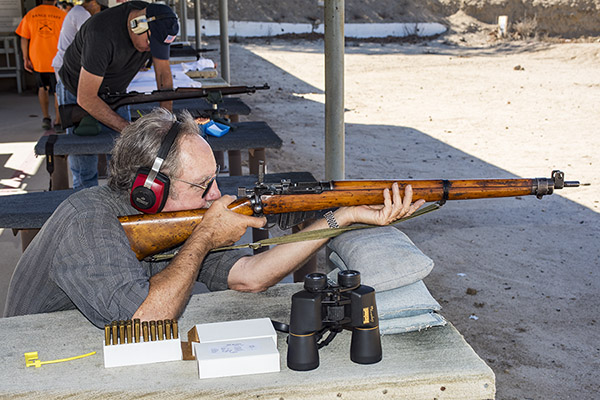
Yesterday was about a perfect day at the West End Gun Club. I didn’t even have to unlock and open the gate (it was already open because the weed abatement guys were doing some work there).  The skies were overcast, the temperature was comfortable, there was no wind, and there were no bugs. I shot four rifles (which is more than usual and I probably overdid it, especially with the big bores). My neuropathy was kicking my ass last night and it still is a little bit today. Ah, to be 72 again…

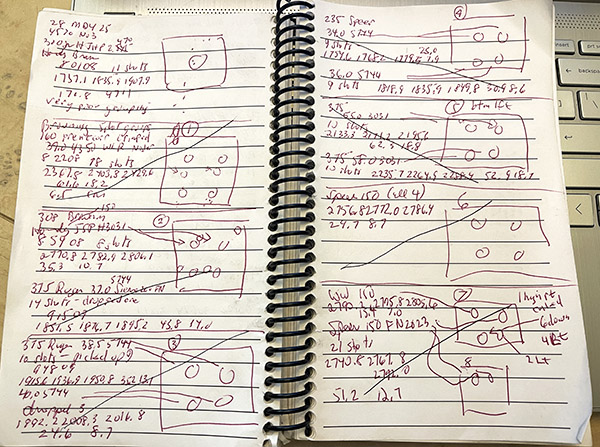
Lots of data to record. The Garmin chronograph captures everything, but I also write it in my logbook to keep a record. If I don’t do this, I can get confused about what I shot on each target.

Ruger No. 3 .45 70

First up was the .45 70 No. 3, a rifle I posted about recently here on ExNotes.. I had 11 rounds left with a hot XBR 8208 load in Hornady short brass originally loaded for a 26-inch barreled Ruger No. 1.  For some reason Hornady’s .45 70 brass is about a tenth of an inch shorter than industry standard.   I suppose it facilitates loading longer bullets in some lever guns.  For me, the shorter brass is not as accurate as the standard-length cases. But one of my buddies has a custom Martini chambered in .45 70, and he needs the shorter brass to be able to load the cartridges in his rifle.  I wanted to use up my shorter case ammo so I could give the brass to my friend.

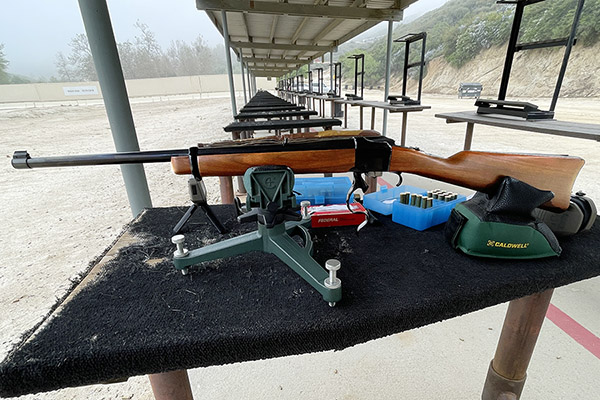
A .45 70 Ruger No. 3 on the line at the West End Gun Club. I’m usually out there early, which explains the vacant shooting benches. I like being retired.

The hot XBR 8208 load (in regular brass) is incredibly accurate in my 26-inch No. 1, but it proved to be just awful at 100 yards in the No. 3.  It’s a hot load and it kicked like hell, pounding my shoulder and my cheek.  To compound the felony, the bullets were tumbling by the time they reached the target.  In my No. 3, the vertical stringing was terrible.  The average velocity with this load’s 300-grain Hornady jacketed hollowpoint bullets was a smoking 1839 feet per second, but it had a huge velocity spread (which explains the vertical stringing).  Although the load worked well in the longer-barreled No. 1, it is definitely not a No. 3 load.   But I learned a little more, and I had the brass ready to give to my friend.

6.5 Creedmoor Browning X-Bolt

I recently wrote about developing a hunting load for my 6.5 Creedmoor Browning X-Bolt.  I fell in love with the 160-grain Hornady jacketed roundnose bullet and when working up the IMR 4350 load for it, I found that my resizing die’s expander ball was too large (I wrote about that here).  I had a box of ammo I had already loaded before I discovered the expander ball issue and I wanted to use it up.

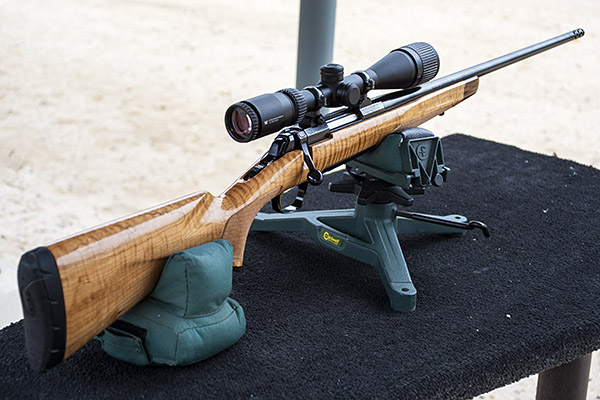
A Browning X-Bolt in 6.5 Creedmoor. The rifle’s performance matches its looks; both are superb.
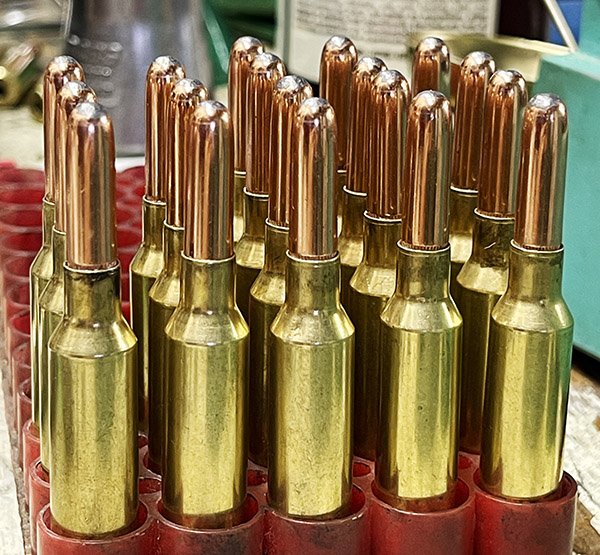
6.5mm bullets originally developed for the 6.5 Swedish Mauser. The look both weird and cool in the 6.5 Creedmoor. I didn’t think they would chamber in my rifle, but they do.

Even with the oversized expander ball, the 6.5 Creedmoor still shot well. The 160-grain Hornady jacketed roundnose bullet with 39.0 grains of IMR 4350 is accurate. I shot a 0.890-inch 5-shot group and a 0.651-inch 3-shot group.  With my Browning, the average velocity was 2404 feet per second and the velocity standard deviation was a low 6.5 feet per second (coincidentally matching the caliber designation…I guess there’s something magic about “6.5”).  This is a great rifle and a great load.

A lot old timers (guys my age) badmouth the 6.5 Creedmoor as an unnecessary cartridge.  When we get old we get funny, and I suspect a lot of these geezers would complain if you hung them with a new rope.  Not me.  I am a 6.5 Creedmoor believer. It is a superb cartridge.

You might have noticed that the Browning has a muzzle brake.  It’s cool.  A split second after each shot, you feel a breezy puff on your face, almost like the rifle is blowing you a kiss.  One of my friends asked if the muzzle brake affected accuracy or if there were any other disadvantages.  Truth be told, I don’t know about the accuracy issue (I’ve never shot the rifle without the muzzle brake).  The only downside I can think of is that the muzzle blast and report from the rifle feels like it’s a little louder with a muzzle brake.  Another downside is that with big bore, high-powered rifles, guys on the benches to the left and right feel the increased blast.  I remember a guy shooting a .50-caliber Barrett rifle a couple of stations down several years ago and the blast was so severe I moved away to escape it.   One more potential disadvantage is the muzzle brake makes the rifle longer. That might be an inconvenience in the field.  It hasn’t bothered me.

.308 Browning A-Bolt Gold Medallion

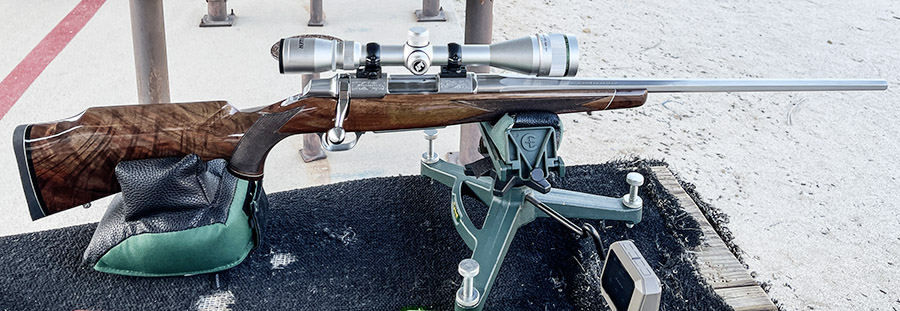
I’ve been working on developing loads for this rifle. Baja John got me turned on to these rifles about ten years ago. I loaded several different 150-grain bullets, all with 47.0 grains of BallC2. Groups ranged from mediocre to decent. The best load so far has been the same one I’ve used for the M1A, which is 44.0 grains of BallC2 and a 168-grain Speer match boat tail bullet. That’s not a hunting bullet, though, and for that, the Speer jacketed flatnose bullet grouped best (with 47.0 grains of BallC2).

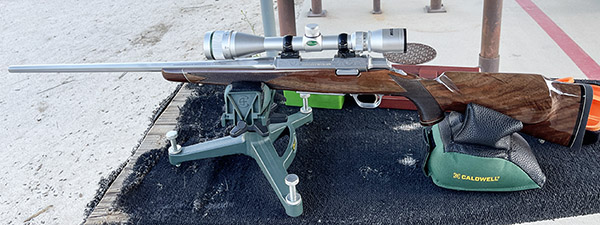
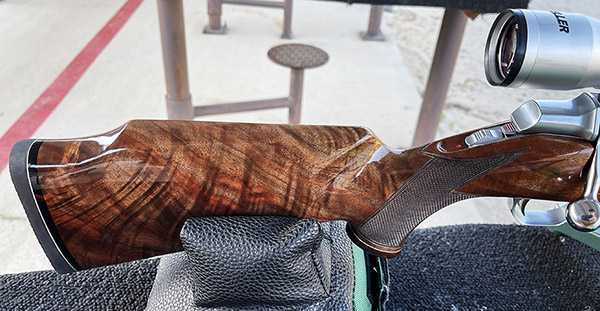
The .308 Browning A-Bolt rifle. It is a good looking firearm.
Highly-figured walnut stands out. This rifle was a Browning show gun at one of the SHOT shows.

The silver Mueller scope I put on the rifle is okay, but the optics are not in the same league as a Leupold (and they shouldn’t be, as the Mueller is a $145 scope). Compared to the 6.5 Creedmoor, the Browning .308 kicks big time. It’s tolerable and certainly not anywhere near the .375 Ruger (see below), but the 6.5 Creedmoor is much more pleasant to shoot.  Like I said, I’m a believer in the Creedmoor.  That said, I plan to hunt with the .308 Browning on my next pig hunt, and I’ve been working up different loads for it.  You’ll read about that in an upcoming blog.

.375 Ruger/Howa 1500

I shot 90 rounds in the mighty .375 Ruger yesterday, and I’m feeling it today. I wanted to evaluate 5744 and IMR 3031 in this cartridge using lighter 200-grain and 235-grain jacketed bullets.

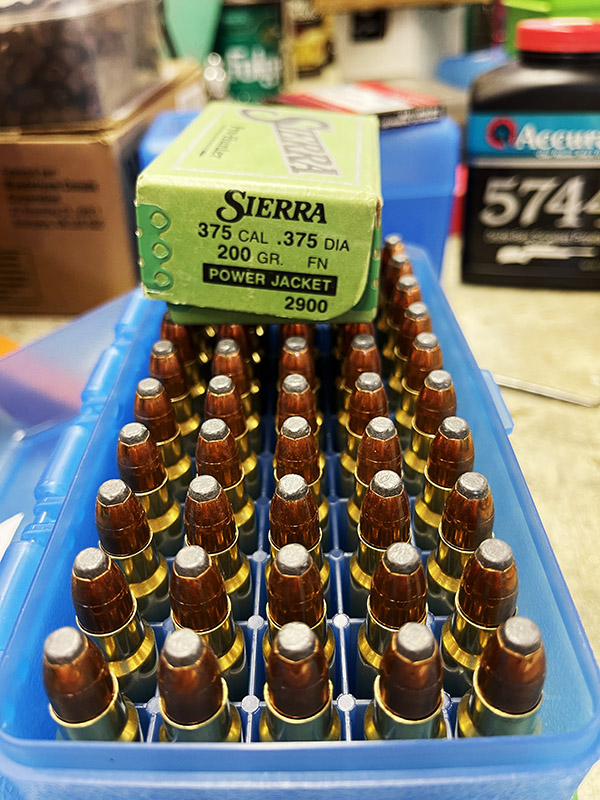
.375 Ruger ammo loaded with the Sierra 200-grain jacketed flatpoint bullet.

The bottom line is this rifle likes everything, and several loads would put 5 shots into a 1.5-inch cluster (which is pretty cool with a 4X scope and an elephant gun). The best load is 38.5 grains of 5744 and the Sierra 200-grain jacketed flatnose bullets one of my friends gave to me (those shot a 1.330-inch 5-shot group at 100 yards). The rifle fed both bullets well from the magazine.  The action on this rifle is super slick.  Howa makes a good rifle. The IMR 3031 loads (at 55.0 and 58.0 grains) shot well, too, but the recoil is more than I care to subject myself to (the loads were below the recommended minimum with the Speer 235-grain bullets; the max loads must be brutal).

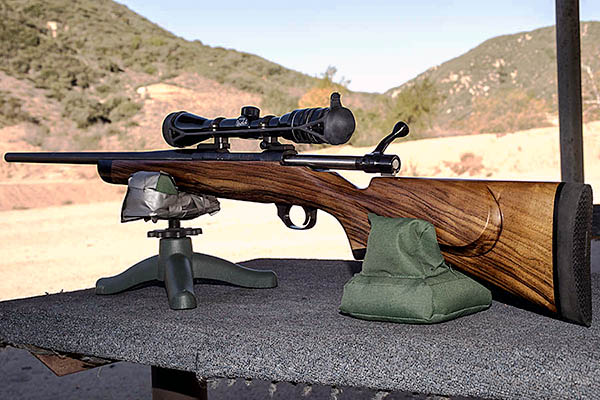
The .375 Ruger Howa 1500 in an English walnut stock.

While we were there, an old timer named Marcus stopped by with a custom Mauser .25 06, also stocked in English walnut like my .375 Ruger. I enjoyed meeting and chatting with him, and I enjoyed seeing that Mauser.


Join our Facebook ExNotes page!


Never miss an ExNotes blog:


Help us keep the lights on:


Don’t forget: Visit our advertisers!


RIP, Rick Courtright

By Joe Berk

One of the problems with getting old is that you lose friends along the way.  I’m not as good as I should be staying in touch with people, and I recently learned that Rick Courtright, one of the guys I’d sent a few emails to without receiving responses passed away a couple of years ago.  I was sad when I learned of Rick’s passing.

I first met Rick through the Internet on the Ruger forum.  I had posted something (I can’t remember what), Rick responded, and we started sending messages back and forth.  I learned that Rick lived only a few towns over, and I invited him to our monthly military surplus rifle matches.  We became friends.

Rick impressed me with his complete lack of pretentiousness and his willingness to share whatever he knew about shooting and reloading.  I enjoyed his friendship and I can still hear his voice.  A rabbi once told me that folks we’ve lost live on in our minds, and I guess that’s true.

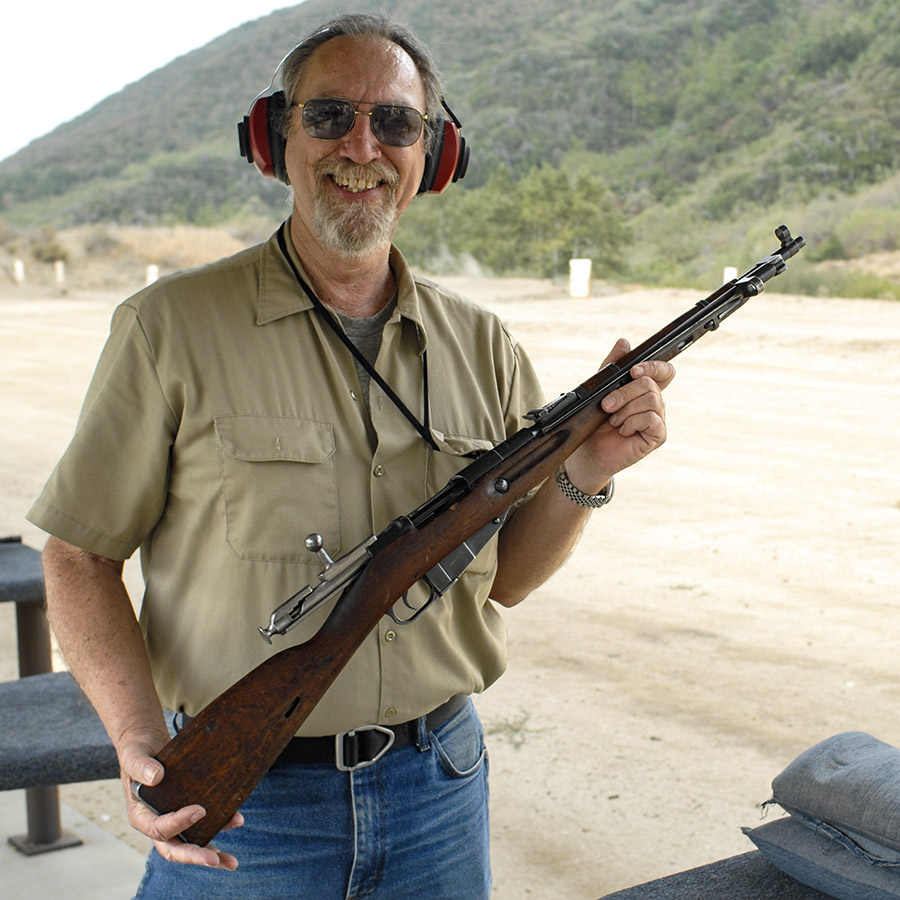
I found a few photos of Rick at our informal West End Gun Club milsurp matches, and I thought I’d share them here.  Those were fun matches and fun days.  The matches were always followed up by lunch at a favorite local Mexican restaurant.  Good times, those were.  Rest in peace, Rick.  You are missed.


Join our Facebook ExNotes page!


Never miss an ExNotes blog:


Help us keep the lights on:


Don’t forget: Visit our advertisers!


Nepal: The Everest Base Camp Trek That Never Was

By Mike Huber

Day 1

The phone in my hotel began ringing, I fumbled for the receiver as I looked at my cell phone stating the time was 00:02. I had slept pretty hard and woke up thinking I was in Marrakesh, Morocco. I had one hour remaining before my Sherpa was due to arrive at my hotel.  As I became a bit more aware it hit me that none of what just went through my head made any sense.  Suddenly a pounding on my hotel door began echoing through my head. Ok, it was my Sherpa, but I was in Katmandu and not Morocco.  Dammit, it happened again: I lost track of where I was.  To add to the matter, the Sherpa was an hour early or I was an hour late.  Either way there was a gap in communication somewhere and it was time to get going.

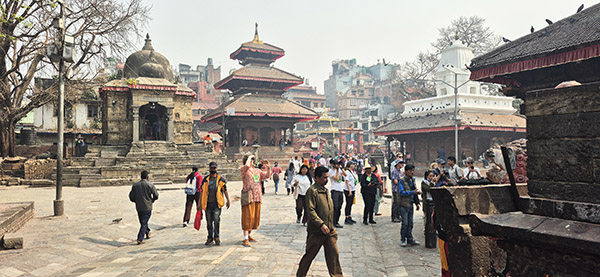
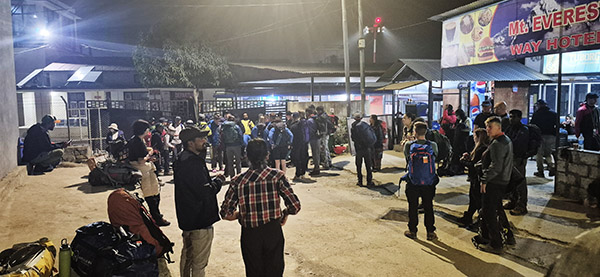
Having just spent two days exploring and meandering through the vast number of temples in Kathmandu, the time had come for me to load up my gear and begin a 12-day trek to Everest Base Camp.  Once having my wits about me and double checking all my sensitive items were in tow, my Sherpa and I began our walk to a local bus stop where we would catch a shuttle to Ramechhap Airport.  My flight was set to depart at 0700 that morning.

The 5-hour shuttle ride to Ramechhap was anything but smooth.  Most of the roads through this portion of Nepal were under construction so there was no sleep to be had by anyone along the ride.  Eventually the rough van ride came to an end.  I had arrived at Ramechhap Airport with enough time to grab myself a coffee and my Sherpa a hot tea prior to checking in for what was to be a quick flight to Lukla Airport.

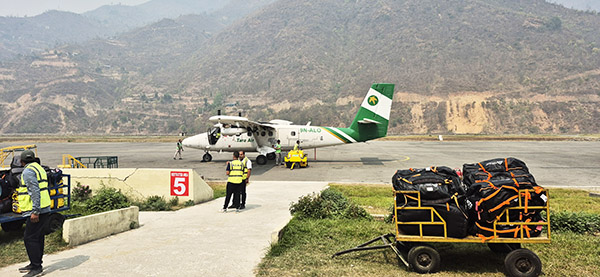
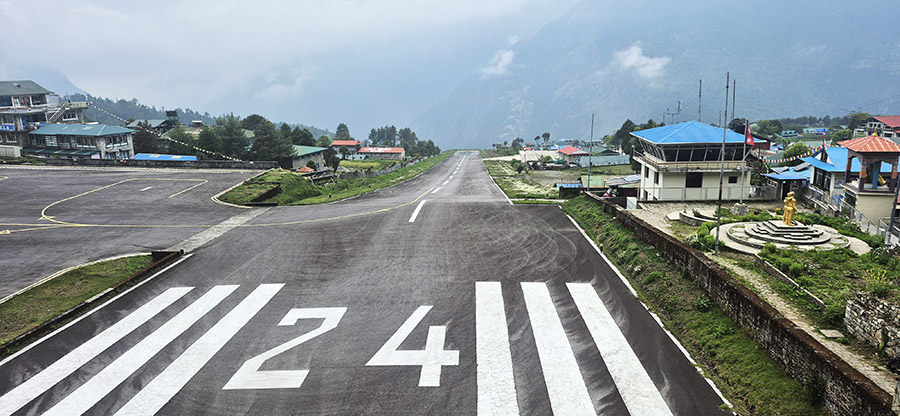
Lukla is the world’s most dangerous airport. It sits at around 9,000 feet in altitude and the runway is literally a giant ramp.  This airport even on good days faces some heavy dangers for aircraft due to winds and very low visibility. It is also the start for the Everest Base Camp (or summit) treks and during the high season is very bustling for such a small hub with only that one ramp of a runway.

As I checked my backpack and went through the airport security at Ramechhap I learned my flight would be delayed due to low visibility. I wasn’t thrilled but I also have the luxury of time, so there was little to do outside chat up several other travelers who were also doing the trek.  As far as airport delays, this one was actually pleasant due to all these really wonderful people I was surrounded by.

As the day went on (as did the full ground stop) my Sherpa and I began to lose hope of making it to Lukla.  This was a bit frustrating but out of our control, so we booked a hotel and would try again the following morning to get to Lukla.  There was really nothing to do but go with the flow and enjoy some of the local food and people that were here.

Day 2

The routine was similar and again there was yet another full ground stop for fixed-wing aircraft.  This time it was fog at Lukla.  It was only a 20-minute flight to get there.

With many of the same people from the previous day there we all began talking and telling stories to pass the time.  Some of these people chose to pay $400USD to take a helicopter into Lukla as the conditions were safe enough for them.  Many of the others didn’t have that luxury of time that I did, as most were on vacation. As 1400 rolled around we knew we would not be making it to Lukla this day and yet again a hotel was the plan. We would try again tomorrow.

Day 3

This was starting to get a bit silly.  The airport café guy knew my order by this point.  I was one of the first people at the airport that morning and I helped with opening the gates and letting vehicles onto the airfield (I probably wasn’t’ supposed to do that).  I was feeling like Tom Hanks in the movie The Terminal, but the weather looked sunny and the first couple flights had taken off.  Cheers erupted through the airport and it was now our turn to board our flight.  Everyone was loaded into the small prop plane and just as soon as the engines fired up they were cut.  We were told to deplane and that winds kicked up again.  It was our third day being scratched and although I was in no rush this scene was getting old.

Rarely do I use tourism companies but this was one time I was happy I did with all the cancellations. Kiran, the tour operator from Holiday Treks & Expeditions, took care of everything from the rebooking, to the hotels, to (sadly) my painful van ride back to Kathmandu. This made my life much less stressful and quite easy, but it didn’t look like Everest Base Camp was in the cards for me. It was a somber ride back to the city, but sharing a couple beers and jokes with my Sherpa helped keep morale up.  My main objective in Nepal was to see Mt Everest and to experience the base camp trek, so I wasn’t sure what would be my next move.


Join our Facebook ExNotes page!


Never miss an ExNotes blog:


Help us keep the lights on:


Don’t forget: Visit our advertisers!


A Buck Canoe

By Joe Berk

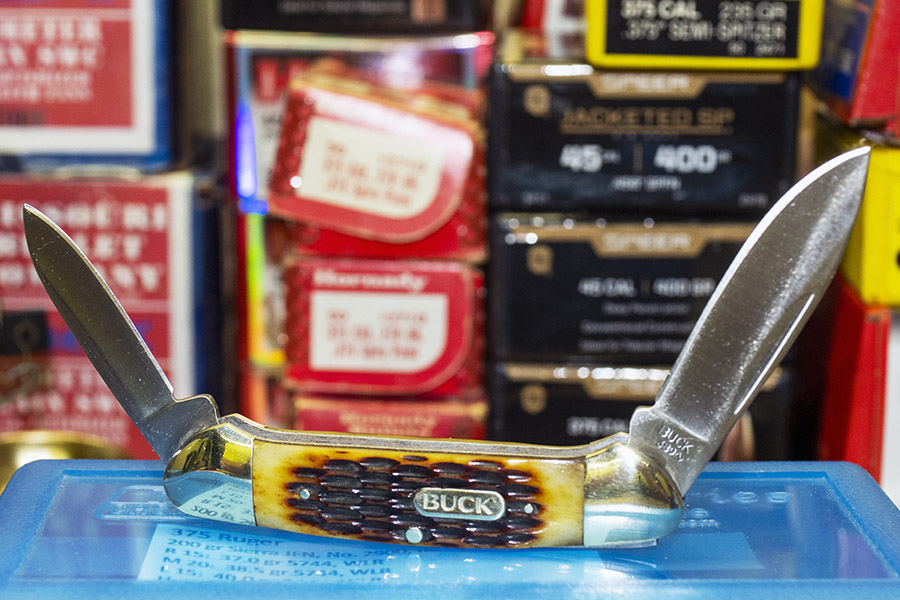
Several months ago as part of my new pocketknife collecting hobby (and to hit the $100 free shipping threshold for MidwayUSA.com), I bought another Buck pocketknife.  This one was the Buck Canoe.  The Canoe moniker comes from the pocketknife’s shape (when its two blades are folded and you view it from the side, it looks a little like a canoe).  The knife was only $30, I liked the look of the thing, and I clicked on it.  My reloading components and the Canoe bumped me over $100, and the order shipped for free.   Free shipping.  Yippee!

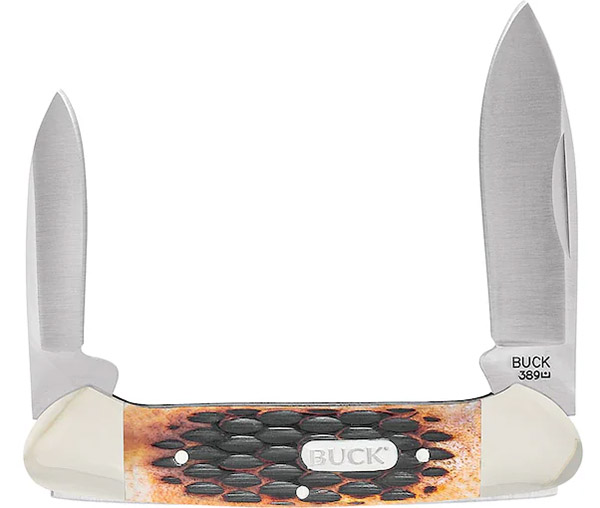
The Buck Canoe with jigged bone grips.  It’s the knife you see in the photo above this blog.

It wasn’t too long after I entered the order and the pocketknife (along with my bullets) arrived.  I like it.   The scales are jigged bone replicas (they’re some sort of plastic) and they look good.  The bolsters are nickel plated, and the two blades are fabricated from  420J2  stainless steel (from what I’ve read, 420J2 is a good and economical knife steel). Yes, there are better steels out there, but this thing was only $30.  The knife is made in China, so if that sort of thing bothers you, you can stop reading here.   It’s doesn’t bother me.  I like the knife and I’m a happy camper.

My next email from MidwayUSA showed their price had dropped to a third of what the Canoe’s cost had been:  It was now just $10.  Folks, any time you can pick up a Canoe for $10, that’s a good deal.  You might think I was annoyed that the price dropped, but I wasn’t.  In fact, I ordered four more of the things.  I’ve giving them away as gifts to my friends.  They think I’m generous and a big spender (so don’t tell them about this blog).

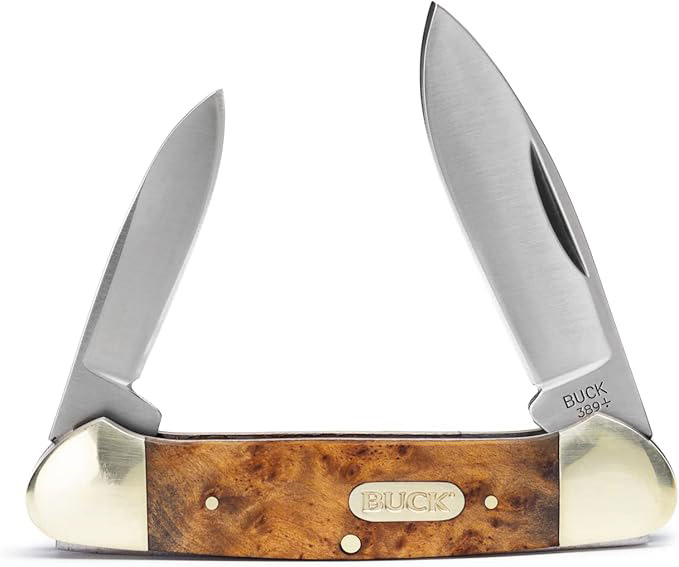
The Buck Canoe with burlwood grips.  This is a good looking knife, too.

What’s going on here is that Buck discontinued the jigged bone scaled Canoe, and they now only offer a version with wood scales (like the one you see with burlwood above).   I got a good deal on mine, and my friends will get an even better deal.  That burlwood knife goes for about $27 from Midway, and it’s kind of appealing, too.  Maybe the next time I need to hit that $100 free shipping threshold from MidwayUSA, I’ll add one of them to my order.


If you missed the Canoe on ordering one of these from MidwayUSA, fear not.  You can still buy a Buck Canoe from Amazon.


Join our Facebook ExNotes page!


Never miss an ExNotes blog:


Help us keep the lights on:


Don’t forget: Visit our advertisers!


India 2025: Amritsar to Rishikesh

By Mike Huber

India Part XII

Loading the bikes the following morning, we were still basking in the Golden Temple’s magical glow.  We were amped up for our next leg. This portion would be a relaxing two-day journey via Shimla to Rishikesh and would give us a glimpse of the lower Himalayan Mountain ranges. The roads would mostly be mountain twisties. This was what we wanted for riding (or so we thought).

The roads, although having great twisties, were extremely narrow.  So narrow, in fact, that on more than one occasion oncoming busses would find themselves in stalemates as to who would back down and reverse to allow the other to pass.  When this happened, we usually could squeeze through while they were conferring on who would back up.  There also were the usual obstructions:  Monkeys, cows, goats, and an occasional camel. This made for very slow going and by the end of this portion of the trip we were starting to miss the major roads we had previously ridden.
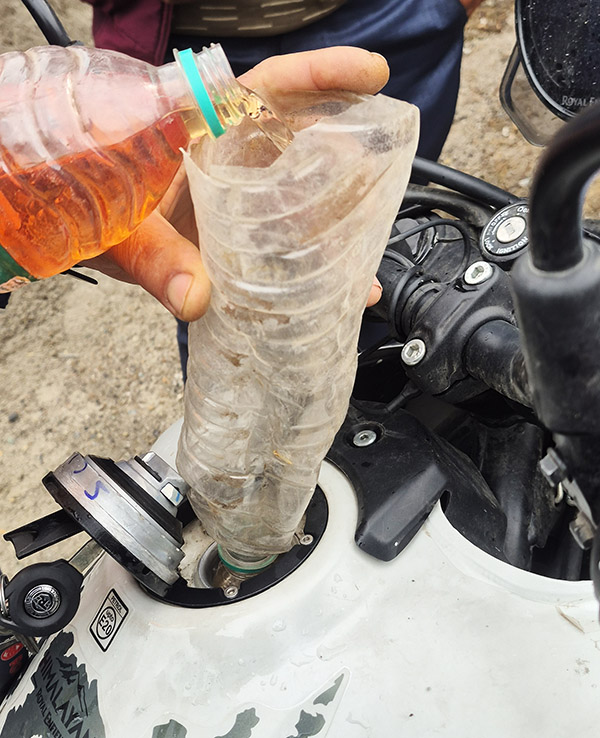
A sure way to tell you are off the beaten path is when you have to refuel your bike by purchasing fuel that is brought to you in plastic water bottles.  Along these roads this refueling process became the norm, which I always find cool.

All in all it was part of the journey and we had a blast on this portion of our ride.  Upon arriving in Rishikesh and seeing the Ganges River, we were exhausted and looking forward to a few down days to explore the city and have a couple of cold Kingfisher beers.  I think my friend may have had another Bhang pastry as well.

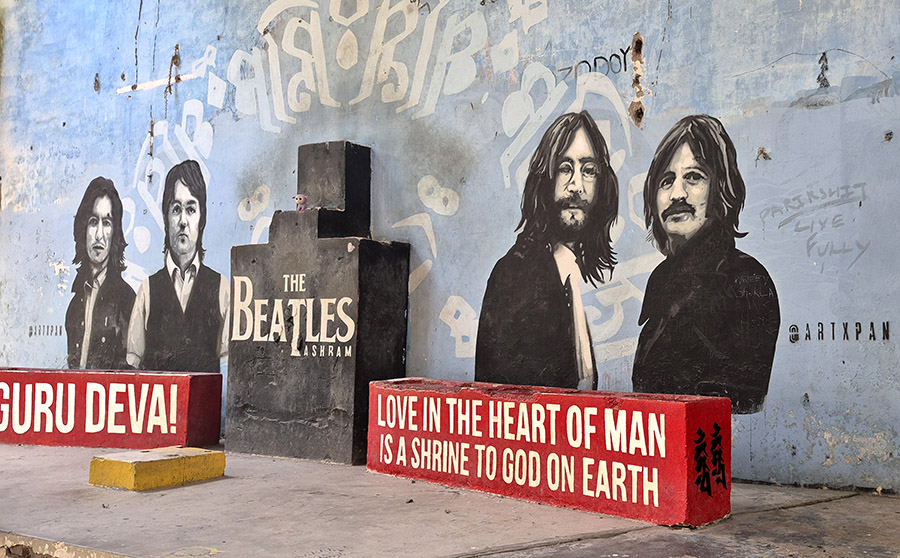
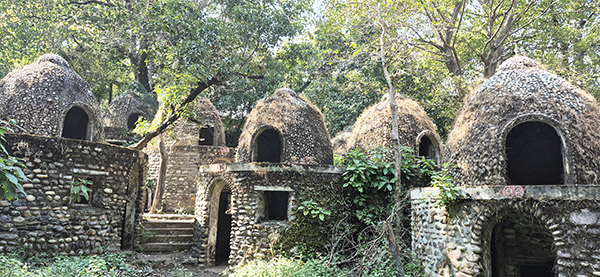
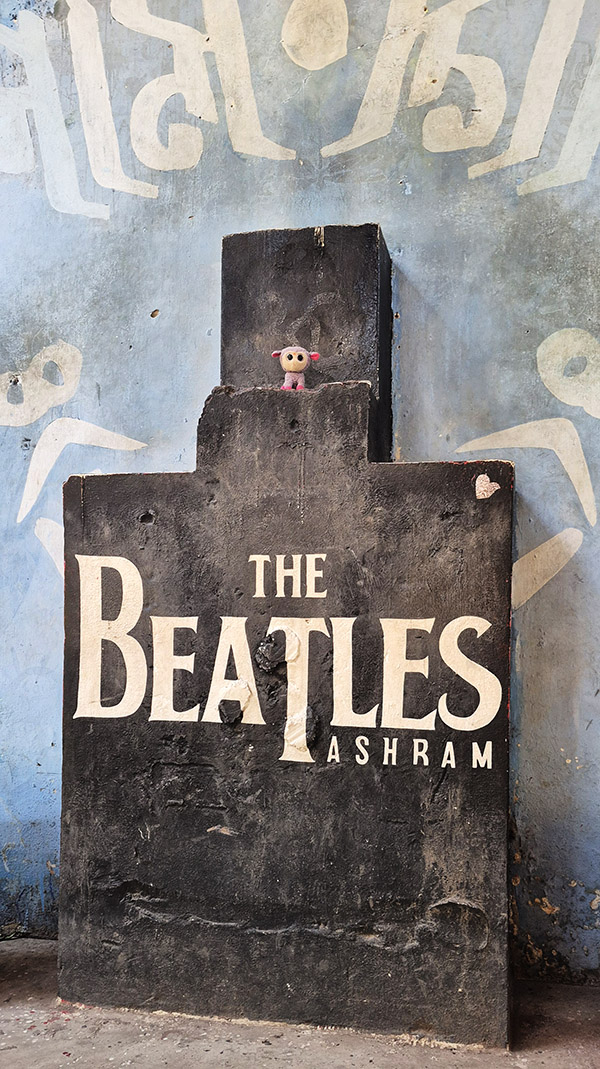
The only thing I knew of Rishikesh was that the Beatles wrote most of their White Album there.  We did the tourist thing and visited the Beatles’ Ashram (where they during that period).  The Ashram was mostly overrun by jungle, but it was a decent side quest, and a reason to listen to the White Album that evening.

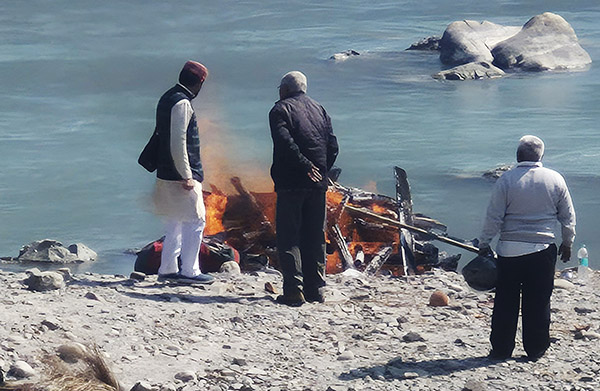
We took a different way back to our hotel from the Beatles’ Ashram.  It allowed us to cross a narrow (mostly pedestrian) suspension bridge over the Ganges.  We were about 100 feet above the river on this narrow bouncy bridge, moving very slowly due to the immense pedestrian traffic.  It allowed us to observe Rishikesh from our high location, including the ceremonial burning of bodies along the Ganges’ banks.  The crossing took about five minutes, but there was so much to take in during that five minutes that it felt as though we were on the bridge for hours.  It was other-worldly, to say the least.

After reaching the other side of the bridge, we parked the motos.  We sat along the Ganges and took everything in.  Rishikesh was where we would begin to part ways on this journey, as my friends needed to return to Canada, their jobs, their wives, their children, and their world.

It was a crossroads for me.  I didn’t have a next location or activity planned, as the trip through India during the past month had consumed every waking hour.  I wasn’t concerned; this was the norm for me and I knew I would figure it out.  I just didn’t expect to learn of my next destination by my phone exploding with calls in the middle of the night.


Join our Facebook ExNotes page!


Never miss an ExNotes blog:


Help us keep the lights on:


Don’t forget: Visit our advertisers!