In the pocketknife world, Case is an old school, respected, made in America marque that has been around for a long time. I’ve written before about Case knives. Case makes a very reasonably-priced, premier American product. They are a first-class item.
You can imagine my surprise, then, when a Priority Mail item showed up in my mailbox (my real mailbox, not the Outlook one on my screen). I saw that it was from good buddy TK halfway across the country, but I had no idea what it would be. I knew TK from my CSC Motorcycles days, when we both worked at the company. Those were good times and TK was a good guy. We shared common interests in motorcycles, guns, knives, and other things. TK and I rode the Death Valley rally on CSC Mustangs. TK had previously worked at a knife shop, and it’s been said that his name was short for “Tommy Knives.”
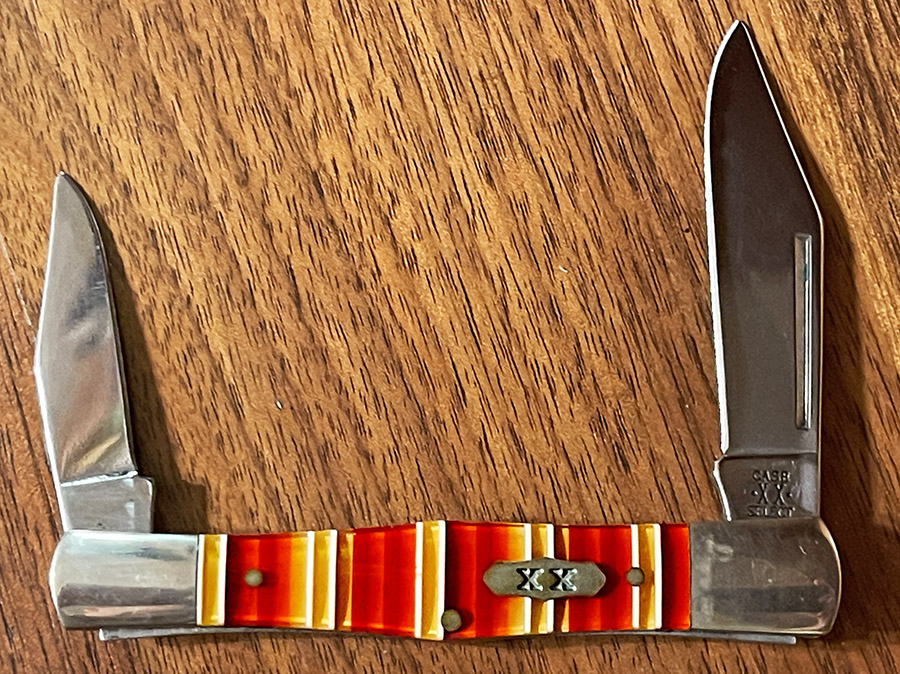
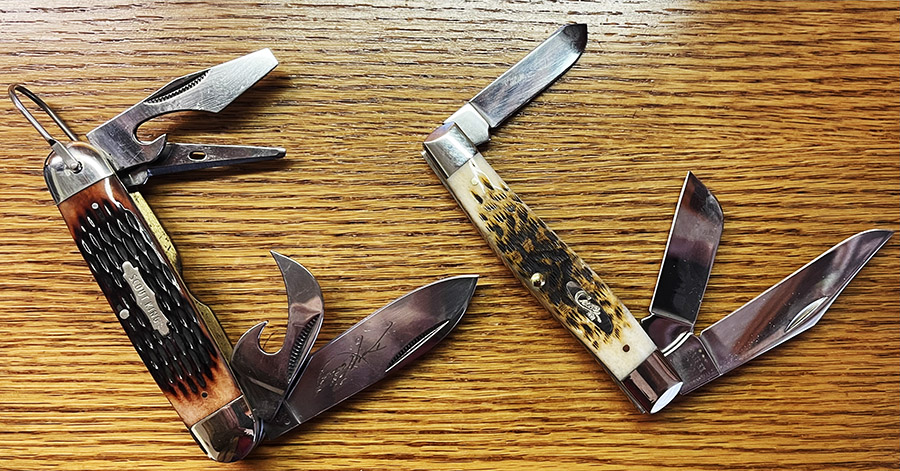
When I opened the box from TK, it was Christmas Day here in California. TK had sent a beautiful Case XX two-bladed folder, one that I had never seen or known about previously.
I took a photo and uploaded it to Google to learn what this new-to-me collectible was, and it was indeed a collectible item. A Case XX Whittler, to be specific, with candy stripe scales, made in 2001. Very, very cool.
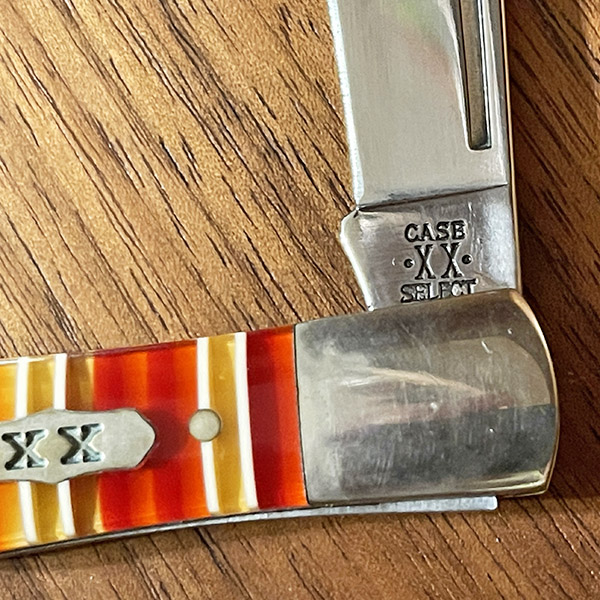
You might be wondering what Case’s “XX” denotes, as did I. Here’s what Google said:
The “XX” on Case knives…signifies that the blade has undergone a specific heat-treating process, specifically that it was tempered and tested twice for strength and durability.
Historically, the “XX” mark originated as a quality control system during the heat-treating process at W.R. Case & Sons Cutlery Co. When blades were initially hardened in the furnace, an “X” was marked on the pan. A second “X” was added when the blades returned to the oven for tempering, indicating they had been properly and fully treated. Today, the Case “XX” trademark serves as a distinction of the quality and craftsmanship inherent in each knife.
This is a very nice and much appreciated gift, TK. Thanks very much!
A sad note to this story: I wrote this blog a couple of weeks ago, and then I learned a couple of days ago that TK passed away after undergoing heart surgery (TK passed on 18 September). Godspeed, TK. Our thoughts are with you. I enjoyed your friendship and you will be missed.
Case is a old-line American knife manufacturing company with roots that reach all the way back to 1889. I knew them as a pocketknife manufacturing company, and without really knowing anything about them, one of the first knives I purchased when my interest in pocketknives was rekindled was a Case Stockman (you can read about that knife here). I mentioned to good buddy and edged weapons rabbi Paul that I had purchased a Case, and he gave the company his seal of approval: “They’re an old line knife company, they’re made in America, and they’re good,” he told me. I didn’t know any of that when I purchased the Stockman, but it felt good to know Paul thought I had made a good decision.
The Case at hand…sorry, couldn’t resist that.
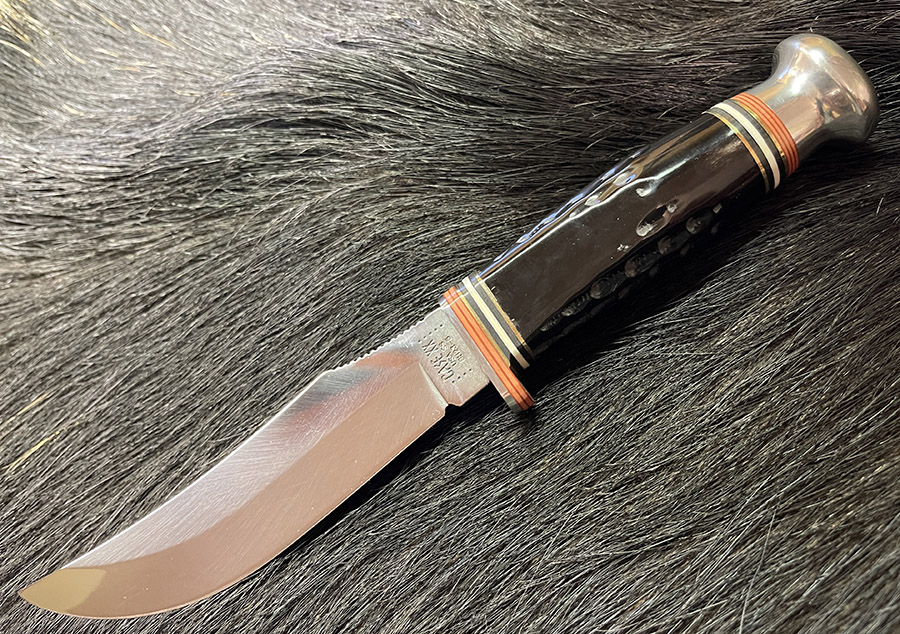
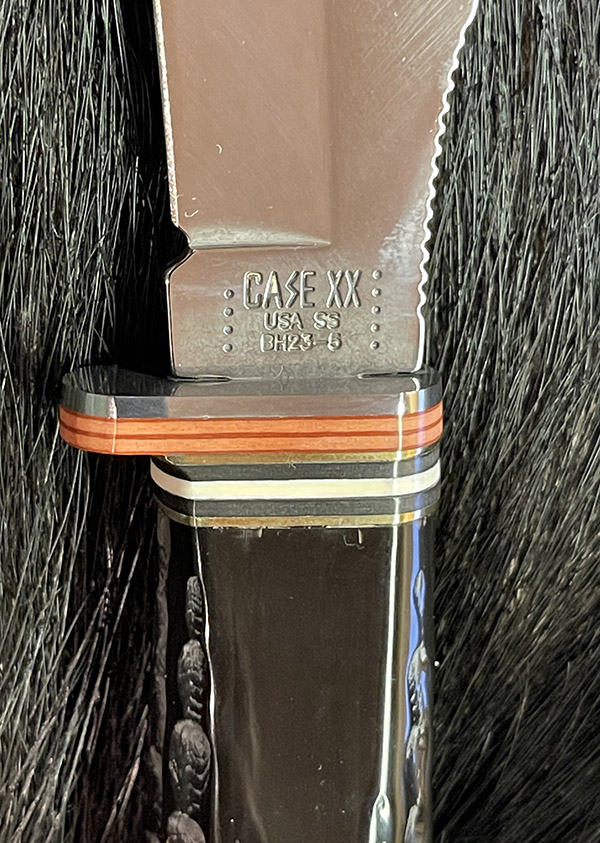
Not long ago I received an email from the Chicago Knife Company (an online retailer) offering a Case Hunter. The knife had my attention immediately for several reasons: It was a fixed blade Bowie/hunting knife (I didn’t know Case made such an item), it had a jigged buffalo horn grip, it was mirror finished, and the price was right. Buy now, a credit card number, free shipping, no sales tax, and it was on its way to me.
Made in America. Case has an American manufacturing history that goes back more than a century.
The Hunter arrived a few days ago, and it’s beautiful. I’m glad I ordered this one. For me, it’s a collectible. I won’t be wearing it in the field and I have no intentions of skinning or field dressing anything with it (as I watched our guide Tom do on a recent pig hunt in Arizona). I just enjoy looking at it.
To me, the knife feels a little small and a little bit light, although I’m not sure why it does. It has an overall length of 10 inches, a blade length of 5 inches, and a handle length of 4 inches.
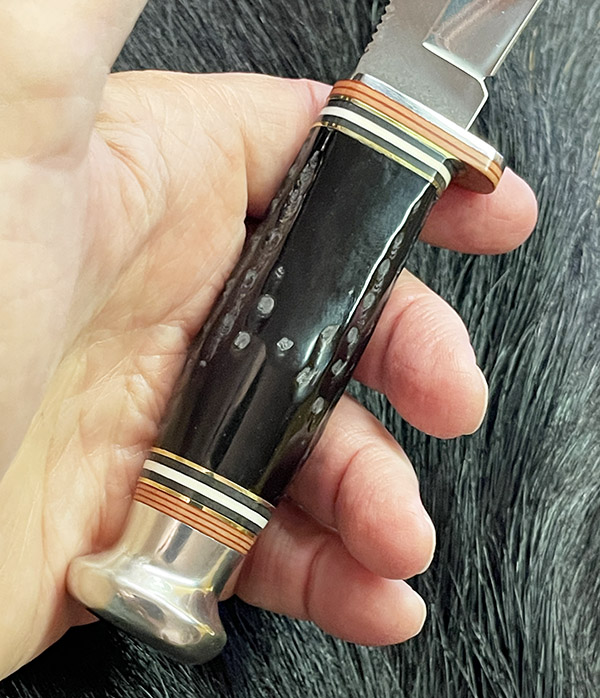
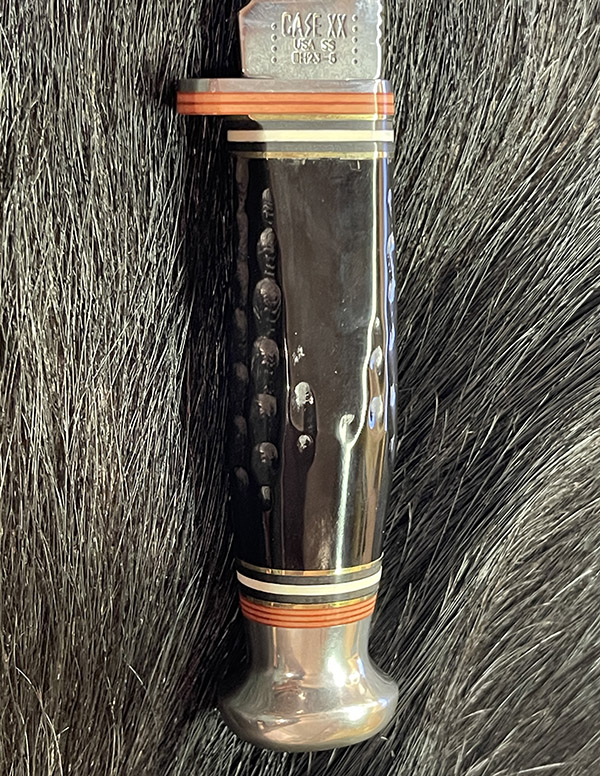
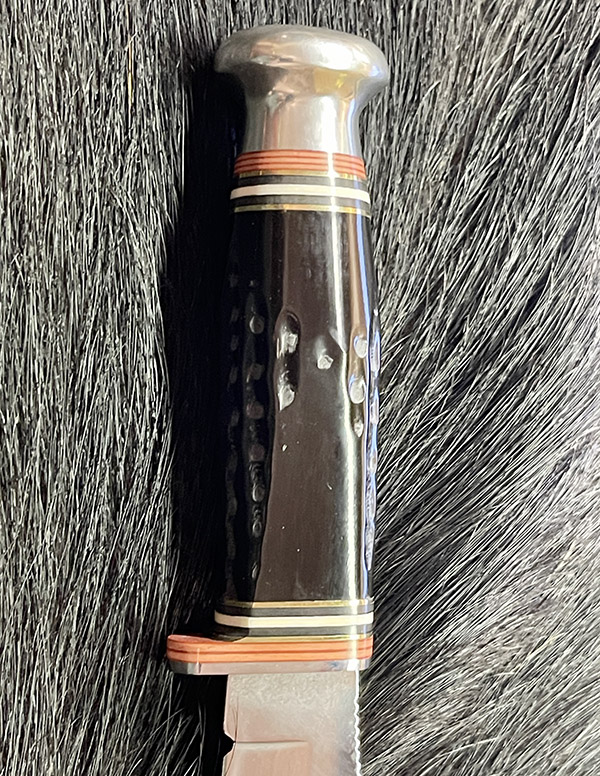
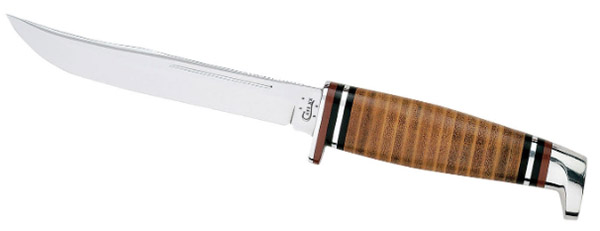
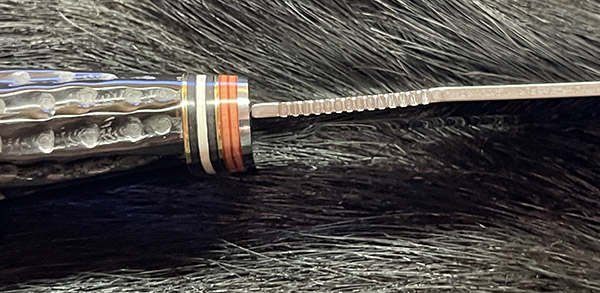
The polished buffalo horn grip from the left side.A view of the buffalo horn grip and spacers from the right side.As a potentially more usable grip, stacked leather is available.
The buffalo horn grip is highly polished. Maybe too much so, as it feels a bit slippery. That’s okay, I think, for something I intend to admire a lot and use little. If I was buying this knife as a tool (and not as a bit of artwork), Case also offers it with a stacked leather handle. That might be more practical.
Serrations on top of the bade. The 5-inch blade is relatively narrow compared to some of my other knives.
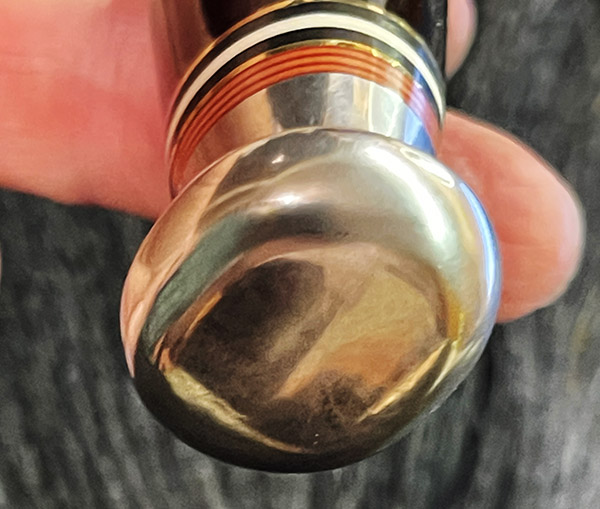
The blade has a serrated edge along the top. Maybe that’s intended to be used for sawing. Again, it doesn’t matter to me. It’s decorative as far as I’m concerned. The pommel is cool, too. It’s polished aluminum and it looks great along with the knife’s red, yellow, white, black, and brass spacers.
The Case Hunter’s polished aluminum pommel.
On the Chicago Knife Works site, the blade material is identified as H-2. Here’s what Google says about that steel:
H-2 steel has extreme corrosion resistance, especially in saltwater environments. Its composition uses nitrogen instead of carbon. It is described as tough and capable of holding an impressive edge. The strengthening process for H-2 steel involves intense rolling and cold-working, not traditional hardening and tempering. H-2 is an evolution of H-1 steel, while retaining its desirable properties and being easier to manufacture. It can attain a Rockwell hardness in the high 60s while remaining resilient.In summary, H-2 steel is used in some knives and offers exceptional corrosion resistance, toughness, and good edge retention.
The Case Hunter is not listed on the Case Knives website, but it is listed on the Chicago Knife Works site. I called Case to confirm it is still available, and it is. This is not a Chinese or Pakistani knife; it’s made in Bradford, Pennsylvania. A black leather sheath is included with the buffalo horn Case Hunter.
My collecting bug has taken a turn. Instead of guns, motorcycles, bicycles, or watches, the latest craze is pocketknives. I’m not sure what drives the collecting bug (that is to say, what the underlying psychology is); that’s a topic for further research and when I feel like I can explain it, maybe a future blog.
I’ve been using pocketknives and inexpensive hunting knives as a filler/fulfiller on the reloading sites. I buy a lot of reloading components online from the big reloading supply stores (Natchez Shooters Supply, Midsouth, Midway, Powder Vally, and one or two others), and they all run frequent sales where shipping is free if the order crosses a $100 or $150 threshold. There are times when I’m under that threshold (sometimes by a lot) and that bothers me. I can’t pass up a bargain and I want that free shipping. I’ll use a knife to get me over the magic number. Most lately it was a Case large Stockman pocketknife.
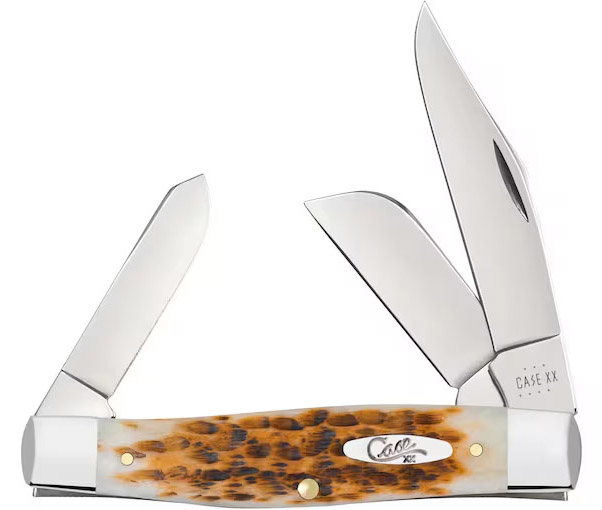
The Case large Stockman with polished stainless steel blades. The blade on the left is the Spey blade. The other two are for whittling, cutting twine, or whatever suits your fancy.
I’m not sure why I wanted the Case, but as I started poking around on the Midway site for things to get me over $100, the Stockman popped up. And then it kept popping up. If I look at something once, I’ll start getting all kinds of emails offering it. Sometimes, I swear I can just talk about something and I’ll start getting emails with deals on that item. Siri is a nasty and nosy bitch who seems to hear everything.
The Stockman knife looked interesting. I knew I didn’t want plastic handles (they’re called “scales” by the knife people), and the Case knife had jigged bone. I didn’t even know what jigged bone was (other than that it was bone of some sort). I thought I wanted something made in America (Hack has influenced my thinking on such things, I suppose, unless something that’s made in China is a really good deal, and I’ll get to one a little lower in this blog). The Case Stockman is American made, and they offer it in two sizes. I didn’t know what a Stockman was, either, but the name sounded kind of John Waynish and I used to live in Texas. I saw that the knife was available in either a satin or high polish finish. I opted for the large Stockman with a high polish finish. It was $82, which took my $45 reloading supplies order handily over the $100 free shipping hurdle. Yep, they got me again with that free shipping gimmick.
The Stockman knife arrived a few days later along with the $45 of cartridge case corn cob polishing media (I like my ammo shiny). The knife is beautiful.
All the above got me to wondering: What is exactly is Stockman, and what is its history?
The story goes like this: Pocketknives are thought to have originally been invented five or six hundred years before the Christian era (that’s mind boggling, but I read it on the Internet, so it must be true). The Stockman style of pocketknife is thought to have originated around 1880 in the American West as a cowboy tool. I watched a lot of Westerns as a kid, so I feel pretty good about that. The Stockman has three blades, with one (the large one) having its own spring and two sharing a spring (the spring is the leaf spring thingamabobber that assists the blade going into its closed position and then holds it there). The long Stockman blade is for whittling. I’m an old guy with a penchant for the American West, so maybe I’ll take up whittling after I finish leaning how to play “Buffalo Gal” on the harmonica. One of the other two blades is a backup to the long one, and from what I’ve read it is the preferred blade for cutting twine. (I’ll pick up some twine on the next Walmart visit to check this out). And finally, the third blade, the so called “Spey” blade (spelled here as they spell it in the knife community) is for castrating young male bull calves. You know, spaying them. Ouch. I read this on the Internet, too (see above regarding veracity). I’m not going to touch this intended use. If you’re a rancher who needs help in this area, don’t call me.
I like my Case Stockman. I haven’t done anything other than look at it so far, but maybe I’ll whittle something later. As mentioned above, the Stockman is made in America, although truth be told, other made-in-China knives I’ve seen look just as good (Hack, that’s your cue for a comment or two). That brings me to the second pocketknife I recently purchased.
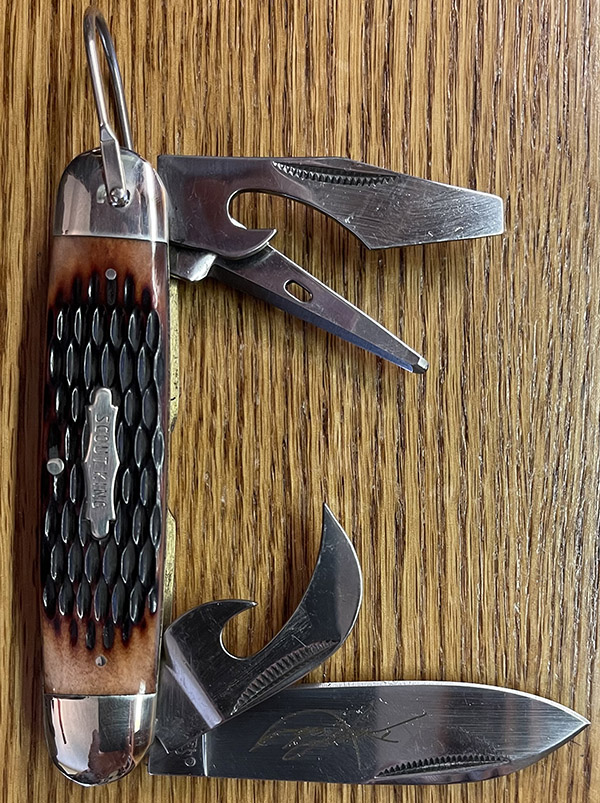
My new Marbles Scout King knife. I think it’s bigger than what I had when I was a Cub Scout. The uppermost blade is a screwdriver and bottle opener. The next one down is an all-purpose awl. The blade one up from the bottom is a can opener (think P38, and if you’re old enough to remember what that is, my compliments and thanks for your service to you). The bottom blade is for carving, cutting, and any of the other things you can do with a knife. It is a handsome knife.
It’s the Marbles (no, I haven’t lost mine) Scout King, and I came across it while I was reminiscing about the first pocketknife I ever owned. That knife was a Cub Scout knife. I have no idea who made it or where it went after I left the Cub Scouts, but I know I liked it. I played with it constantly. The first time I ever cut myself badly, it was with that knife despite all the admonitions from Mom and Dad (yes, I’m the guy who has to urinate on the electric fence…you know, just to see). While writing this blog, I looked for the scar from my Cub Scout knife (I thought it might add context), but the years have obliterated it.
When looking for a replacement Cub Scout knife, I found that I could buy an original on Ebay, but they all looked pretty rough and they were all expensive. Then I found there are a few companies out there still offering Scout knives. The Marbles knife was the only one offering polished stainless steel (I like shiny things) and genuine jigged bone scales (instead of plastic), and it had the added advantages of a stunningly low price ($15 and change) and free shipping. The decision was easy: Add to cart, buy now, and it was on its way from Chicago (by way of China). It arrived a few days later, and it’s beautiful. I’m a happy camper.