
By Joe Berk
Case is a old-line American knife manufacturing company with roots that reach all the way back to 1889. I knew them as a pocketknife manufacturing company, and without really knowing anything about them, one of the first knives I purchased when my interest in pocketknives was rekindled was a Case Stockman (you can read about that knife here). I mentioned to good buddy and edged weapons rabbi Paul that I had purchased a Case, and he gave the company his seal of approval: “They’re an old line knife company, they’re made in America, and they’re good,” he told me. I didn’t know any of that when I purchased the Stockman, but it felt good to know Paul thought I had made a good decision.
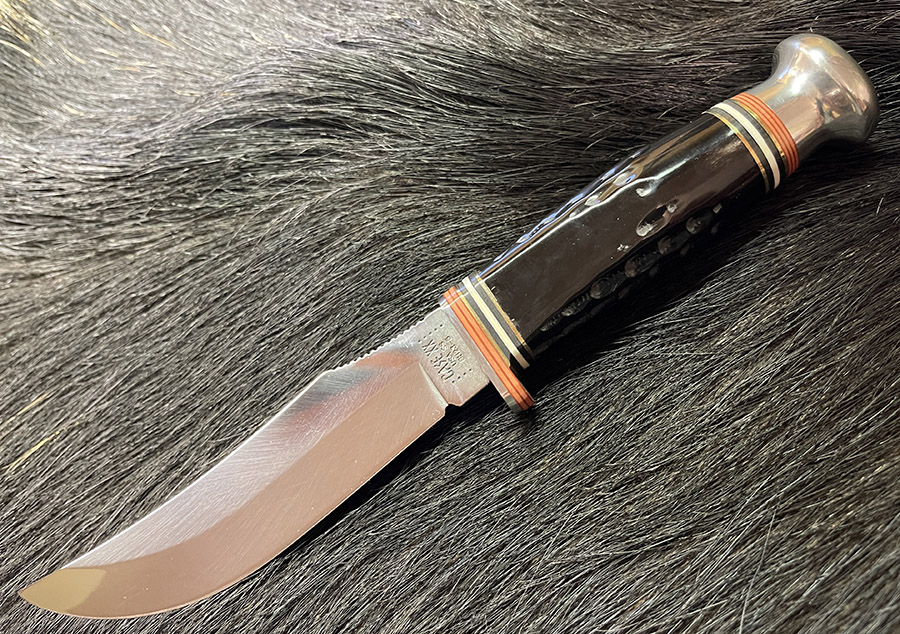
Not long ago I received an email from the Chicago Knife Company (an online retailer) offering a Case Hunter. The knife had my attention immediately for several reasons: It was a fixed blade Bowie/hunting knife (I didn’t know Case made such an item), it had a jigged buffalo horn grip, it was mirror finished, and the price was right. Buy now, a credit card number, free shipping, no sales tax, and it was on its way to me.
The Hunter arrived a few days ago, and it’s beautiful. I’m glad I ordered this one. For me, it’s a collectible. I won’t be wearing it in the field and I have no intentions of skinning or field dressing anything with it (as I watched our guide Tom do on a recent pig hunt in Arizona). I just enjoy looking at it.
To me, the knife feels a little small and a little bit light, although I’m not sure why it does. It has an overall length of 10 inches, a blade length of 5 inches, and a handle length of 4 inches.
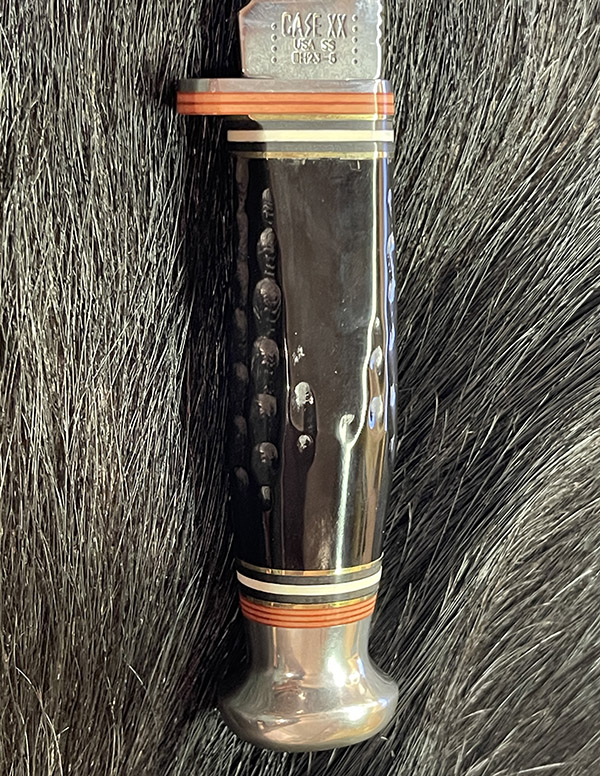
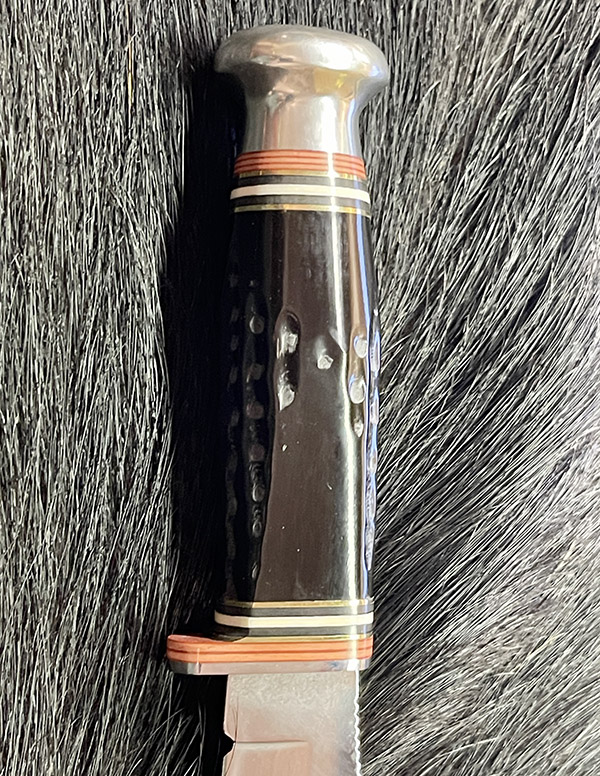
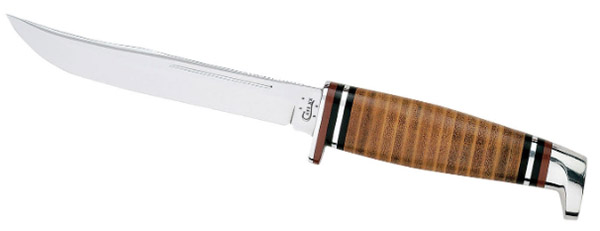
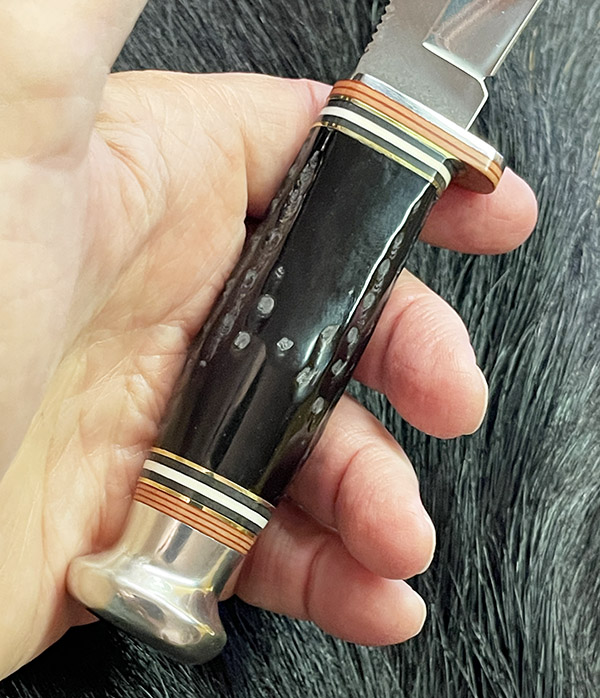
The buffalo horn grip is highly polished. Maybe too much so, as it feels a bit slippery. That’s okay, I think, for something I intend to admire a lot and use little. If I was buying this knife as a tool (and not as a bit of artwork), Case also offers it with a stacked leather handle. That might be more practical.
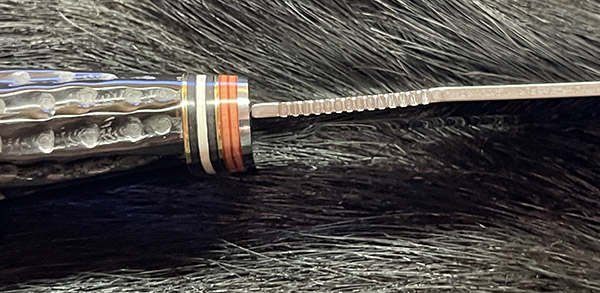
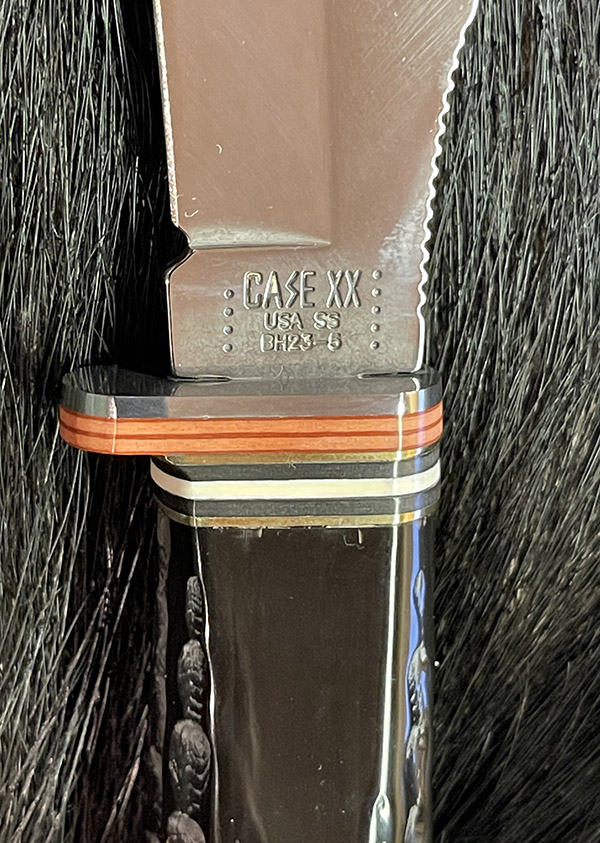
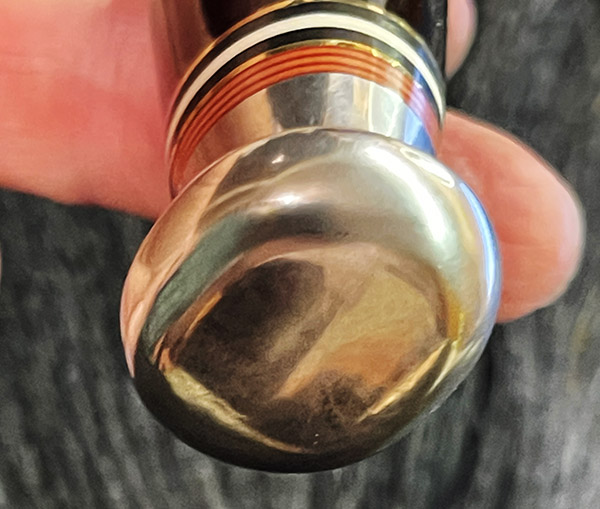
The blade has a serrated edge along the top. Maybe that’s intended to be used for sawing. Again, it doesn’t matter to me. It’s decorative as far as I’m concerned. The pommel is cool, too. It’s polished aluminum and it looks great along with the knife’s red, yellow, white, black, and brass spacers.
On the Chicago Knife Works site, the blade material is identified as H-2. Here’s what Google says about that steel:
H-2 steel has extreme corrosion resistance, especially in saltwater environments. Its composition uses nitrogen instead of carbon. It is described as tough and capable of holding an impressive edge. The strengthening process for H-2 steel involves intense rolling and cold-working, not traditional hardening and tempering. H-2 is an evolution of H-1 steel, while retaining its desirable properties and being easier to manufacture. It can attain a Rockwell hardness in the high 60s while remaining resilient. In summary, H-2 steel is used in some knives and offers exceptional corrosion resistance, toughness, and good edge retention.
The Case Hunter is not listed on the Case Knives website, but it is listed on the Chicago Knife Works site. I called Case to confirm it is still available, and it is. This is not a Chinese or Pakistani knife; it’s made in Bradford, Pennsylvania. A black leather sheath is included with the buffalo horn Case Hunter.
Join our Facebook ExNotes page!
Never miss an ExNotes blog:
Help us keep the lights on:
Don’t forget: Visit our advertisers!