Our good buddies at Janus Motorcycles have a special deal for ExhaustNotes readers…if you mention ExhaustNotes when ordering a new motorcycle, Janus will give you a free polished stainless steel exhaust upgrade (or anything else of equivalent value). Just click here to get to the Janus order page.
I had a grand time on the Janus Baja adventure ride, and these are unique motorcycles. Janus motorcycles are handcrafted gems with an exquisite fit and finish, and they gather crowds wherever they go.
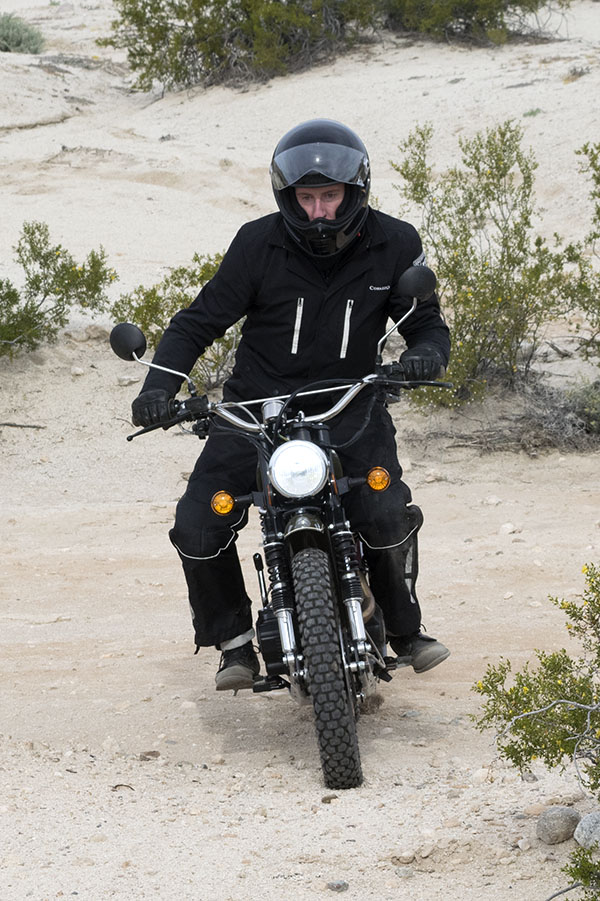
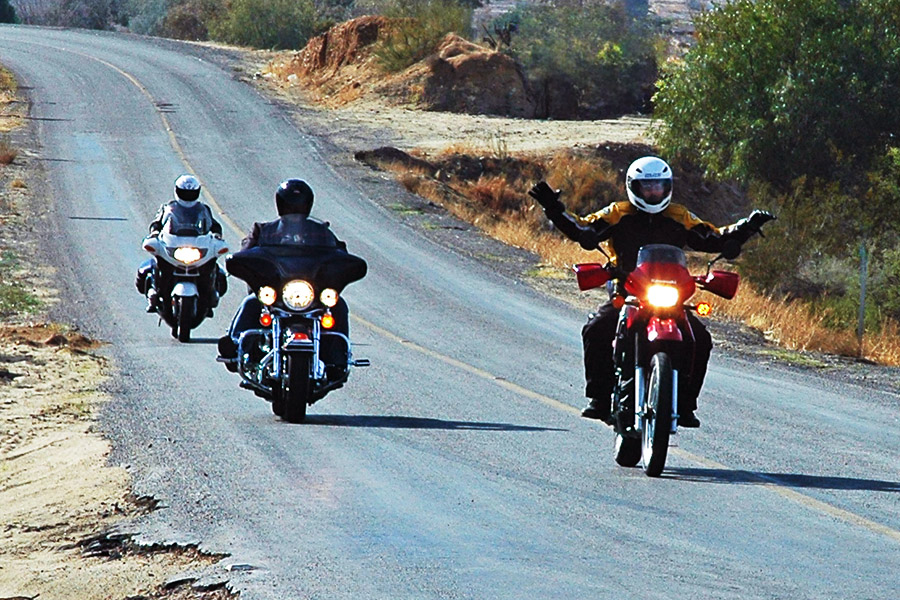
Devin Biek, one of the Janus co-founders, putting a Gryffin through its paces on our Baja adventure ride.
Here’s more news, this time from CSC Motorcycles. CSC has announced new colors for their 2019 TT250 motorcycle, which include subtle letter decal color changes on the white and black versions of the bike, and an all new blue color (a first on the TT250).
The 2019 TT250 colors. The 2019 bikes should be in the US in a couple of weeks.
These are cool colors on the new TT250s, and at $2,195, this motorcycle has to be one of the best deals on the planet. I have a black one and I love the bike. To get to the CSC order page, you can click here.
A question I sometimes hear about traveling in Baja is: What about gasoline?
Getting fuel in Mexico is pretty much about the same as getting fuel in the US. There are a few things you should know, but concerns about fuel shouldn’t hinder your plans to ride south of the border. Let’s take a look at what folks planning a Baja expedition might worry about.
Availability
Baja has gas stations distributed about like we do here in the US. There are lots of them in and around the cities, one or two in each of the smaller towns, and they are farther apart in the deserts (all similar to the situation here in America).
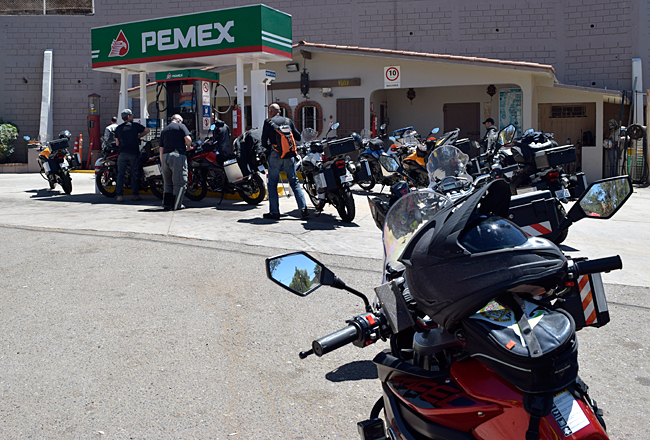
A typical Pemex in Baja.
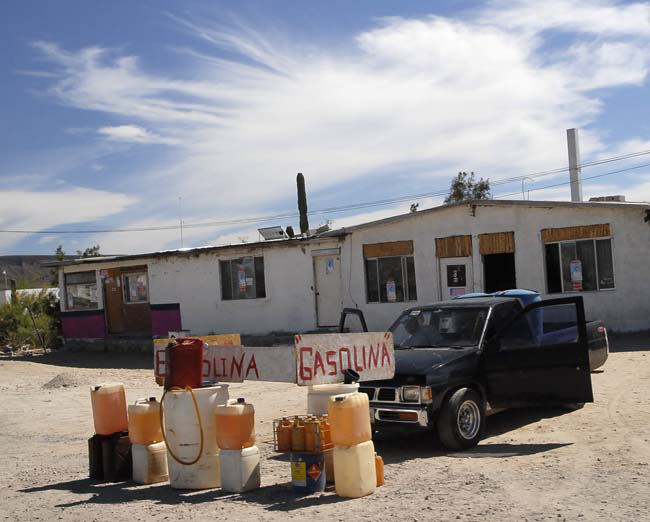
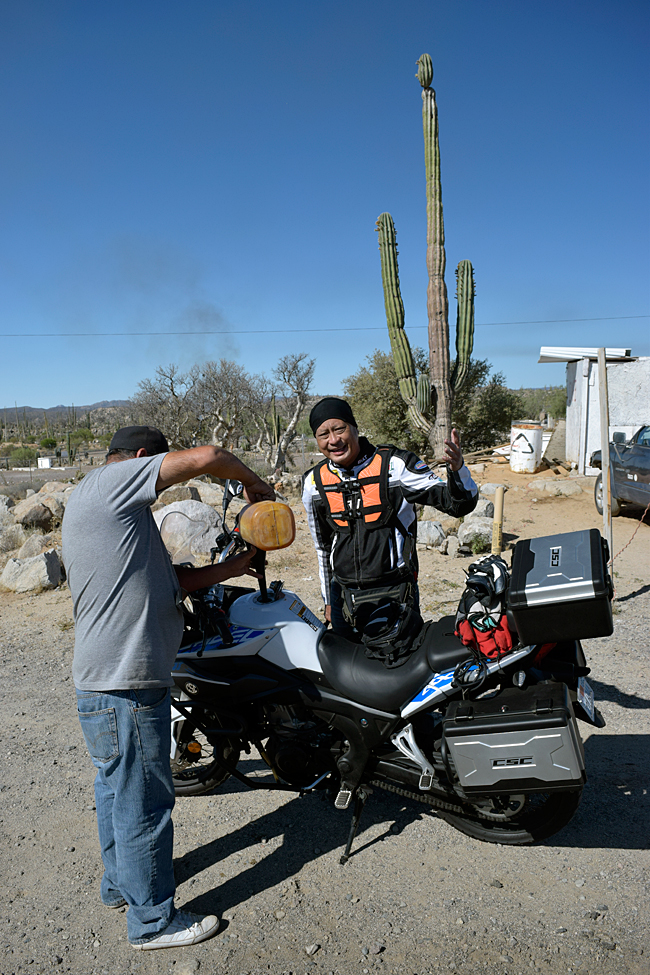
The only stretch where it can be concern is the long stretch through the Valle de Los Cirios between El Rosario and Guerrero Negro, where it’s a cool 200 miles (that’s miles, not kilometers) between Pemex stations. That’s beyond the range of many motorcycles’ fuel tanks, but don’t worry about it. In Catavina, which is very roughly at the midway point between these two spots, you’ll a bunch of enterprising Mexicans selling fuel in plastic jugs or pumping it out of a 55-gallon drum. Capitalism rules, folks!
Refueling in Catavina. It’s all part of the adventure!
There’s another plus to stopping for fuel in Catavina and buying gasolina from the guys selling it out of bottles: It makes for a great photograph!
Price
I live in California, the land of exorbitant taxation and left-wing loonies run amuck. What that means is that our gasoline prices are usually about 50% higher than what people in the more-sensibly-governed parts of the US pay. The advantage here, for me, is that the fuel prices in Baja are about the same as what I pay for gas in the Peoples Republik of Kalifornia. As of this writing, we pay somewhere around $3.25/gallon for regular, and something closer to $4.00/gallon for high test. Another thing to consider here is that you don’t buy fuel by the gallon in Baja; you buy it in liters. And the price is not in dollars; it’s in pesos. Today, it’s about 17 pesos per liter, which is about $3.39 (US) per gallon. See what I mean? The prices are roughly equivalent to California.
One more minor point: Mexico uses the dollar sign for pesos, so when you see a fuel price of, say, $17.85, that’s 17.85 pesos per liter. Use of the dollar sign for pesos is a little unnerving at first, but you’ll soon get used to it.
Paying for Fuel
Most places in the US require that you pump your own gas, and most of us pay with credit cards at the pump. You can forget about that in Baja. The way it works in Mexico is that every gas station has attendants, and they’ll do the pumping for you. They all seem to know that you’ll want to handle the nozzle when you’re on a motorcycle, but they’ll take the nozzle out of the pump, hand it to you, and then you can do the pumping.
You pay the attendants directly, too, so then the question becomes: Do you pay in dollars or pesos? I always have enough pesos that I pay directly in their currency. I’d go nuts trying to the convert the pesos to dollars in my head, and I don’t like to try screwing around with a calculator when I’m filling up, so I just pay directly in pesos. The attendants will take the cash from you and run up to the cashier if you have change coming; you don’t pay the cashiers directly.
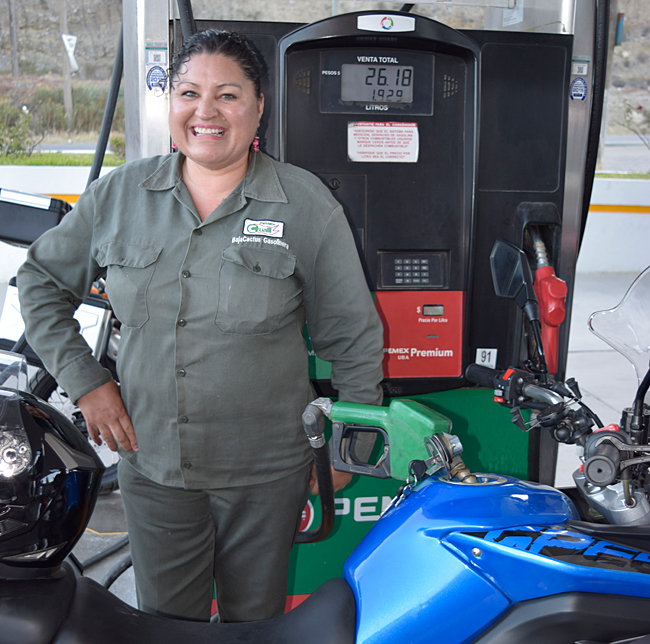
Roselda, the prettiest pump attendant in Baja!
I’ve never used a credit card at a Baja gas station. Some of them may take credit cards, but I don’t like the idea of giving my credit to somebody who’s going to run into an office to use it. I always pay in cash.
One more thing: Tipping is a good idea. Yeah, you’ll probably never see the attendant again, but it’s peanuts to us and a livelihood to them. Do the right thing, and give a few extra pesos to the person who helped you.
Fuel Brands
Until relatively recently, the government-run Pemex brand was the only fuel station in Mexico (other than the guys selling it out of bottles in places like Catavina). The story was that the government subsidized the price of fuel but did no exploration, so ultimately their fields played out. That’s when the Mexican government realized that Margaret Thatcher was right: Socialism works until you run out of other people’s money. Within the last year, Mexico started allowing Arco, Mobil, British Petroleum, and others to sell gas in Mexico, with the understanding that they had access to larger reserves and these companies would pour a portion of the profits back into exploration.
Regular or Premium?
Some stations will offer both regular and premium fuel; in the more remote parts of Baja it’s regular fuel only. I always run regular, and I’ve done so even on bikes that required premium. I’ve never had a problem doing this.
Fuel Quality
We’ve all heard the stories about bad gas in Baja. Folks, it’s all Internet rubbish. I’ve never had a problem with fuel quality in Mexico, even when buying it from the guys selling out of bottles. That said, I do sometimes carry a small container of Sea Foam just in case I get fuel with water in it, but it’s never happened. I think the last time I used the Sea Foam was when I rode my Triumph Tiger in Baja. It started running a little rough somewhere north of Santa Rosalia, so I put a little Sea Foam in the fuel tank and maybe the roughness went away. Or maybe I imagined it. The bottom line here is you can forget about fuel quality issues in Baja. It just doesn’t happen.
Restroom Availability and Cleanliness
We often stop at gas stations to use the restrooms. You might have visions of filthy, disease-laden banos, but that’s another thing that just isn’t true. Most bathrooms in Baja fuel stops are relatively clean, about the equivalent of what you might see at any gas station in the US. What is different, though, is toilet paper. There’s usually none in a Mexican gas station rest room, so it’s a good idea to bring toilet paper with you. You may or may not see a sign asking that you not flush toilet paper, but to instead deposit it in a waste basket in the stall. I guess the deal is that the sewage systems are not set up to process toilet paper. It’s counter to our custom, but it’s what they do.
So there you have it. Fuel is not an issue in Baja, and it’s certainly not a reason for being apprehensive about an adventure ride in an area that arguably offers the best riding on the planet. The cost is reasonable, it’s available about like it is in the US, the quality is good, and the photo ops are awesome.
Want to make sure you never miss an ExNotes blog post? Sign up for our email updates in the widget you see to the right (if you’re on a laptop) or at the bottom of this post (if you’re on a smartphone). We’ll never give your email to anyone else, and you’ll automatically be entered in our quarterly moto-adventure book giveaway.
Like what you read here about riding in Baja? Hey, there’s lots more where that came from! Take a look at our ExNotes Baja page!
It doesn’t happen often, but when it does, it’s an easy fix. You know the drill…you open your fuel petcock on a carbureted bike, and a few seconds later you smell gasoline. And then a few seconds after that you see fuel on the ground, dripping from your bike. Most of the time, the culprit is a stuck fuel float valve in the carb’s float bowl.
In the old days, before there where vacuum lines and multiple cylinders and all kinds of complications, getting to the offending valve was a relatively easy fix. There would typically be three Phillips-head screws holding the float bowl to the carb, they came out, you gently pulled the pin holding the float to the carb, and the valve mechanism dropped out into your hand. You might see a bit of debris that held the valve open, or you might not.
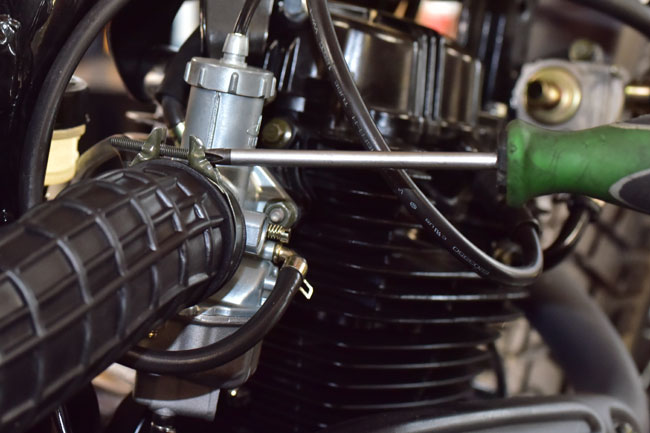
The carb on a TT250. Getting to the three screws securing the float bowl to the carb body was a bit of a bitch.
Weirdly, in our world of fuel injected, multi-cylindered motorcycles, this happened to me twice in just the last few weeks. Once was at the very beginning of a Baja trip, and the other was just a day or two ago on my TT250. The fix was easy both times, except for access. Even on our simple single cylinder carbureted machines, the manufacturers have made getting to the float valve challenging. On my TT250, I had to loosen the clamp securing the rubber passageway from the carb to the airbox, pull that passageway away, and then remove the two nuts securing the intake manifold to the cylinder head. All this was just to get the carburetor away from the engine a bit so I could turn it enough to get access to those three little Phillips head screws on the float bowl. After I did that and I pulled the float (which works exactly like the one in your toilet bowl, which works exactly like the one in a wing-mounted F-16 drop tank, but that’s a story for another blog), the float valve dropped out. Sure enough, there was a bit of rubber debris (or was it detritus?) on the valve. I flicked it away, reassembled the thing, and oila, no more fuel leak.
The trick for me on a go-forward basis is to find a very tiny, very short Phillips head screwdriver that will allow me to get the thing under the float bowl with the carb still on the bike. That will turn a 20-minute job into a 20-second job the next time this happens. It’s off to Harbor Freight for me. I’ll keep you posted.
Wow, it has been pouring here for the last week, with little respite other than this past Sunday. Sunday was nice. Every other day this week and the tail end of last week has been nonstop rain. Big time. Buckets full. And my iPhone just started buzzing with a flash flood warning for this area. Wow again.
So I’m sitting here at the computer, enjoying a hot cup of coffee, looking out the window, and I’m thinking about what it’s like to ride in the rain. We’ve all had those rides. Those memories stick in my mind. I remember every one of those rides like they happened yesterday.
The first was the return leg of my first international motorcycle foray, when good buddy Keith Hediger and I rode up to Montreal and back. That was in the early ‘70s, and we didn’t call them adventure rides back then. They were just motorcycle rides. I was on a ’71 CB750 and Keith was on a Kawi 500cc triple. It rained the entire length of Vermont at about the same intensity you see in the video above. We had no rain gear. It wasn’t cold, but it sure was wet. We were soaked the entire day. Wouldn’t trade a minute of it. It was a great ride.
Another time was on the second ride I ever did in Baja with good buddy Baja John. It was pouring when we left at 4:00 a.m., and it didn’t let up for the entire day. I was on a Harley then, and we finally stopped somewhere around Colonet to checked into a cheap Baja hotel (a somewhat redundant term, which is becoming less redundant as Baja’s march in to the 21st century unfortunately continues). Leather, I found out on that trip, makes for lousy rain gear. I went hypothermic, and I had the shakes until 4:00 the following morning. It made for a good story, and the rest of that trip was epic. Down to Cabo, back up to La Paz, on the overnight ferry over to Mazatlan, out to Puerto Vallarta and Guadalajara, back up to Nogales, and a thousand-mile one-day dash to make it home on New Year’s Eve. Wouldn’t trade a second of it.
Riding with Marty on the ’05 Three Flags Classic, we were caught in a downpour the second day out as we rode along the Dolores River in Colorado. It was a magnificent ride, with Marty on his K1200RS and me on my 1200cc Daytona. It wasn’t a drizzle. It was a downpour, just like you see in the video above. I remember it vividly, and I wouldn’t trade it for anything.
Colombia had lots of rain, but it only hit us hard on the very first day. It was raining hard that first morning as we rode out of Medellin and into the Andes early on that fine Colombian morning, but it lightened up by breakfast. I had real rain gear and the only issues were visibility and passing 22-wheelers on blind curves, as my Colombian riders did with gleeful abandon. Exciting times. But good times, and certainly ones I remember. Colombia was an adventure for the ages. I wouldn’t trade a second of it for anything else.
I’d have to say the heaviest rains I ever rode through were in China, where it rains a lot. It probably rained 25% of the time on that trip, and the first few days were the worst. Imagine riding up into the Tibetan Plateau, in the dark, on dirt roads, in rain way heavier than what you see in the video above. That’s what it was like, and I loved every mile of that ride. I wouldn’t trade it for anything else on the planet.
You might be wondering…why no photos? Well, the simple truth is that my cameras on each trip were tightly wrapped in plastic bags, and I wasn’t about to break them out in the rain. That’s something I guess I forgot to mention in my earlier blog about what to bring on a Baja trip: Garbage bags. They take up almost no space when you’re not using them, and they work great for keeping stuff dry when you ride in the rain.
One question I heard a lot when I organized a tour in Baja is: What spare parts should I bring? It can get desolate down there, and it makes sense to be prepared.
Well, that’s a great question. The idea is to bring enough things you might need so you don’t get stranded, but to also travel light. You don’t want to get weighed down carrying too much stuff, but you want to have the items you might need. The simple fact is that most motorcycles today are extremely reliable, so the likelihood of needing a spare part is remote. That said, there are a few things that I always bring.
When you’re out here, you can’t call Triple A. Rural Baja is the great equalizer among motorcycle marques. You’ll see the same number of Honda, Kawasaki, Suzuki, Yamaha, BMW, Harley, and Ducati dealers: That number is zero. You need to be able to take care of your motorcycle.
I used to say getting a flat tire on a motorcycle trip is a relatively rare event. Unless you’re Joe Gresh. The first time I met Gresh, which was on the CSC Western America Adventure Ride, he told me that he’s “that guy” who usually gets a flat tire. I kind of blew off that thought when Joe said it, and it slipped further from my mind for most of our Western America adventure. We had covered roughly 4500 miles of a 5000-mile ride with nary a single flat, but sure enough, Joe got one just north of San Francisco on the way back to So Cal. We limped into an independent cycle shop, with me realizing that Gresh was right. He was “that guy.” Won’t happen to me, I thought. Then I got a flat on the ride across China. Hey, it happens.
So, the deal is this…if you’re running tubeless tires, you’ll need a patch kit and something to put air back in the tire. If you’re running tube tires it gets a bit more complicated: You’ll need an approach for getting the bike off the ground and you’ll need tools to get the deflated wheel and tire off the bike, and then you’ll need tire spoons to get the tire off the wheel. Since both of my current bikes run tube tires, I carry spare tubes and a tire pump. I have a small electric pump that runs off my bike’s battery (you need to start and run the engine while you’re pumping the tire up, or you’ll kill the battery). Since most of us ride bikes that have different front and rear wheels, when I’m traveling with others I’ll usually take the front tube, and one of my friends will take the rear tube.
Next up…the spark plug. I’ve never replaced one on a trip, but I always carry a spare. They’re small. It makes me feel good.
I always carry a throttle cable and a clutch cable. Same deal…I’ve never needed to replace these on the road, but they don’t take up much space.
I bring chain lube with me, but if I forget to bring it, it’s not a big deal. Someone has always just put a quart of oil in their car at every gas station I’ve ever been in, and I can always find an “empty” quart container. Usually there’s enough residual oil in it that I can hold it upside down and get some oil on my chain. But it’s better just to bring along a spray can of chain lube, and you won’t get the back of your bike sprayed with motor oil if you rely on residual oil from someone’s empty oil can.
If I’m going to be out in the boonies (like on a trip through Baja), I’ll bring a spare quart of oil with me, especially if I’m on my TT250. CG clone motors use a little oil, especially if you push them hard. KLRs have a reputation for being oilers. You know your bike. If it uses oil, better to bring some along rather than having to go look for it. And on that topic, I check my oil every night when I’m on a long ride. You’d be surprised how many bikes come into dealers with seized engines and no oil in the crankcase.
I bring a spare headlight bulb and a spare taillight bulb. Baja and its topes usually induce a bulb failure about every third trip I make down there.
I bring Sea Foam with me. If my bike starts running rough after I put gas in it, a capful of Sea Foam is just what the doctor ordered. It takes care of any water that might have found its way from the gas pump into your tank.
If I’m riding my RX3, I bring along a spare countershaft sprocket nut. On my first ride in Baja with a bunch of other guys on RX3s, good buddy Justin lost his, and after screwing around for a day or two we ended up having to pay a machine shop to make a custom nut. If your bike has a part that it occasionally loses, bring a spare. You know your bike better than I do, so do your homework and decide what makes sense to bring along.
A spare master link is a good idea. I’ve never needed one, but I feel better knowing I have one with me. They take up almost no space.
I always bring an assortment of the small nuts, bolts, and screws that my bike uses. You never know what’s going to vibrate off. It happens on all bikes.
I always bring a tool kit, but it’s never the tool kit that comes with the bike (if, indeed, your bike even has one). The tools that come with a bike are almost always cheaply made and they often don’t work well. Whenever I get a bike, I’ll put together a collection of sockets, a ratchet, the two or three box end wrenches the bike needs (including those for the axle nut and bolt), a screwdriver with Phillips and blade tips, a small crescent wrench, and whatever Allen wrenches the bike needs. Throw in a set of pliers, a small pair of vise-grips (which can be used as a shift lever in a pinch), a bit of steel wire, and I’m good to go.
Hey, there’s lots of good stuff coming up, folks. Our next Baja ride, how to pack for Baja, what kind of camera gear to bring with you on a Baja ride, and more. Lots more. We’ll continue to include links to our Baja stuff on our ExNotes Baja page, and you don’t want to miss any of it. Sign up for our automatic email updates every time we post a new blog, and you won’t miss a thing!
We’ve said it before and we’ll say it again: If you’re headed to Baja, you have to have insurance for your auto or motorcycle, and there’s none better than BajaBound. Check out these awesome videos highlighting Baja from our good buddies at BajaBound!
BajaBound has several more videos on YouTube. Like the company and the insurance they offer, they’re great!
The very title conjures excitement. Whales! Big, giant monsters…the creatures of legend. Visions of Moby Dick. Herman Melville. Call me Ishmael, and all that…
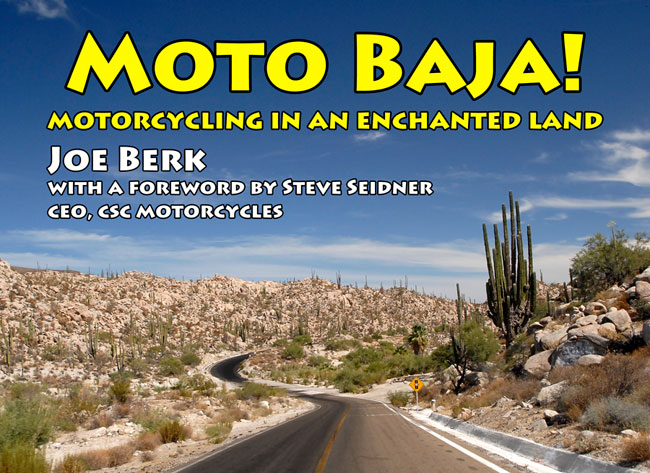
Yep, this is a topic I’ve covered before, back in September, but I like whale watching in Baja so much I thought we’d cover it again. And yeah, Danny boy, you’re right…we’re inviting you to ride with us in March if you want to go. You have to pass the personality test (which basically means if you’re a jerk we’ll take a pass) and you’ll have to convince us you have a significant social media presence (we want you to help us spread the ExNotes word). Oh, yeah…one more thing…you’ll have to show up with a copy of Moto Baja! We’ll sign it for you, and we want you to read the book so you know a bit more about riding in Baja before we head out. We’ll be putting out more details on our March Baja ride in the near future, so keep an eye on the blog.
The best book on the best riding on the planet!
I’m convinced that the only reason the towns of Guerrero Negro and San Ignacio are not absolutely overrun with visitors during the months of January through March is that most folks just don’t know about the whale watching in Baja. To get to the point: It is the best in the world. That’s no idle overreach or hyperbole on my part. It is the best. It is the only place on the planet where you can get up close to the California grays and, in many cases, actually touch them. Go whale watching here in California and there will be maybe a hundred or more people on a large boat, and the closest you’ll get to a whale is maybe a hundred yards out in the open ocean. You might see one or more spout in the distance and it’s “mission accomplished.”
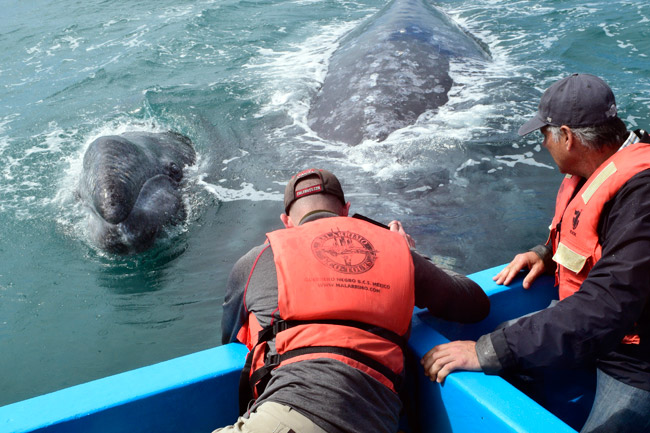
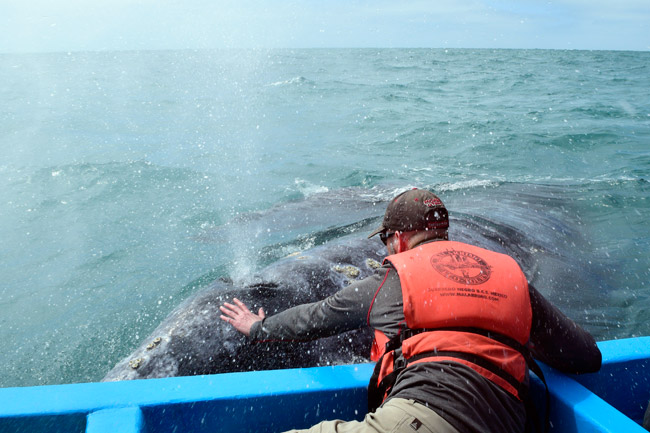
Not in Baja. It’s way better in Baja. You’ll get on a little boat carrying maybe 8 or 10 people, you’ll go out in Scammon’s Lagoon or San Ignacio Lagoon, and you’ll be in the middle of a pod of whales. Up close and personal. One will spout, then another, and then, suddenly, it’s like being caught in a lawn when the sprinklers go off. You’re surrounded, and they’re all close.
Mama and baby and me makes three. Baja whale watching. It’s the best in the world.
That’s when the fun starts. A whale or two, maybe twice the length of the little boat you’re bobbing around in, come right up to your boat. As in touching your boat. Then they exhale, or spout, and you’re covered in what you hope is sea water and not whale snot. Everybody laughs, including the whales. You realize there are literally thousands of whales in your lagoon. And then you see two whales, and you realize the larger one is the mom. She’s literally pushing the little one closer to your boat, training her calf not to be afraid of people.
Ewwwww!
You’re excited about seeing the whales. They’re excited about seeing the people. That’s when you feel it. There’s some kind of extra-sensory-perception thing happening between you and the whales. No one who ever does this goes away feeling the same. I’ve done it maybe 20 times now, and I can’t wait to get down there to do it again.
The story goes like this: More than a century ago, whalers wondered where the whales were going. You see, the California grays spend their lives on the longest migration of any mammal. They winter in Baja and summer in Alaska (which probably makes them smarter than us). But when the whalers were hunting them, the bad guys didn’t know this. They harvested (read: slaughtered) the whales they could catch out in the open ocean heading south in the months before that January-March window, or headed north after those three months, always wondering where they were headed. Then, in the 1800s, a whaling captain named Scammon discovered the lagoon that carries his name today and the word got out: These whales are all holed up in Scammon’s Lagoon. It was a blood bath and the herd of approximately 20,000 California gray whales nearly went extinct.
That’s when the Mexican government stepped in and protected the herd. It’s taken a while, but they’re back up to a population of 20,000 whales, which is what the ocean will support.
A few years ago when I was on one of my whale-watching Baja trips, there were half a dozen Mexican Navy gun boats out in the lagoon, something I had never seen before. I asked our boat captain about it, and he told me that none other than Vincente Fox, President of Mexico, was going whale watching that day. He had plans to develop the Guerrero Negro area into an industrial center, a home for manufacturers, a move opposed by Mexican environmentalists because they feared it might affect the whales, the ospreys, the sea lions, and the other protected critters in this corridor. They implored Mr. Fox to see the whales, knowing that ESP thing would kick in. The day I was there he was doing that. After his excursion, folks asked the President if he would pursue his vision of an industrial zone. “Leave it as is,” Mr. Fox answered. He knew.
Getting there takes a day or two, and taking two days is the better approach. Simply head south from California. Cross in Tijuana, stop to pick up a free Tourist Visa, and head south. I’ve made Guerrero Negro in a single day, but that required getting up at 4:00 a.m. here in Los Angeles and riding hard for the next 700 miles, much of it in the Valle de los Cirios twisties. No, it’s better to take an easy lope down, spend the evening in San Quintin, El Rosario, or Catavina, and then continue the trek south the next morning. Hotels abound in all locations, and the ride south is best savored like a fine wine. Make sure you have Mexican insurance (go with BajaBound; we always do), and bring your passport. You won’t need it to get into Mexico, but you will need it to get back into the US.
The options are to stay in Guerrero Negro and grab a whale watching tour there, or continue south for another 70 miles to San Ignacio. In my opinion, Guerrero Negro is the better option because the ride to the Scammon’s Lagoon takes only a few minutes. If you stay in San Ignacio (a beautiful little town in the center of the peninsula) getting to San Ignacio Lagoon is an hour ride on a rough dirt (read: soft sand) road.
Malarrimo’s in Guerrero Negro is a wonderful place to stay, but the other hotels in Guerrero Negro are also great.
There are hotel choices in both places. I like Malarrimo’s in Guerrero Negro, but they’re all good. Malarimmo’s is the original place for Baja whale watching, but there are others and they are all good. You may be able to call ahead and get reservations, but it helps if you speak Spanish. If it just me and one or two of my friends, we just go. If I’m bringing a group down, I call ahead for reservations.
The whale watching tours are $50 (that’s US dollars), but trust me on this: It’s the best $50 you’ll ever spend.
You can go out in the morning or the afternoon (I usually pick the morning tour), and like I said above, the whales are in town from January through March. I like March, because the weather is milder, and I think the whales are friendlier (they’ve had three months to get used to interacting with people). You’ll see whales, you’ll see baby whales, and you might even get to see whales mating. Actually, if that’s going on, all you’ll see is a lot of turbulence on the surface, but they tell me there’s a whole lotta shakin’ goin’ on down there.
Whale watching in Baja: It’s a hoot…and it’s still one of the best-kept secrets on the planet. You need to get down there and see it before the rest of the world finds out. You can thank me later.
I first met Buffalo Bonker on one of the CSC Baja rides and I liked the guy immediately. I think it may have taken him a bit longer to warm up to me, but I’m told I’m an acquired taste, so that’s okay. Anyway, Buffalo bought his first motorcycle ever and learned to ride just for the Baja trip, and he caught the spirit. The guy is a true adventure rider, so much so that he and his cousin (and his cousin’s daughter) flew to Vietnam, rented motorcycles, and toured the country. That’s very, very cool. I’m in awe.
Buffalo created a series of videos about his Vietnam adventure ride. I’m including the first one here, and a link to the entire series. Enjoy, my friends. I sure did!
You guys and gals will remember my good buddy Baja John, a guy with whom I’ve been exploring Baja for close to three decades now…
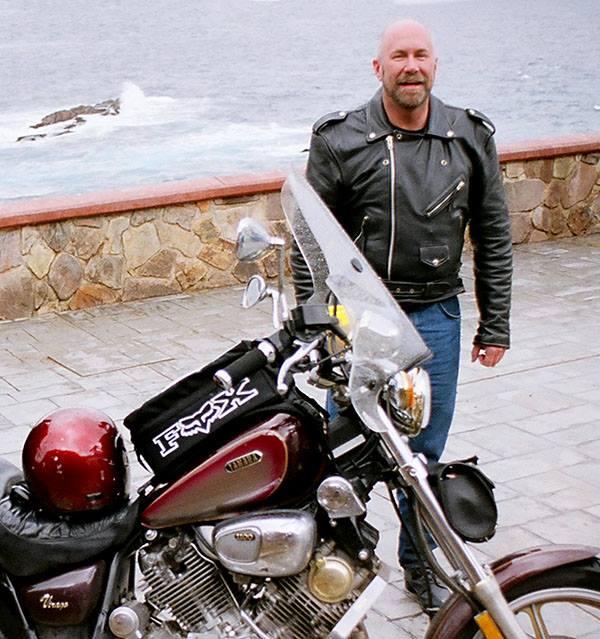
Baja John back in the mid-’90s. Big V-twins and black leather were all the rage. I shot this photo at La Bufadora during a break in the El Nino rains.
John sent an invitation to me to ride with him in Baja this month, but I couldn’t make it (I’ve been in northern California this week). I suggested to John that our ExNotes readers sure would appreciate it, though, if he could send photos from his trip, though, and here’s an email I just received from him…
Joe,
I was originally going to send you just the pictures when you mentioned putting pictures in the blog, so I thought that you might want a story to go with them. I’ve attached a Word document with a story just in case. For some reason, I cannot transfer the pictures to my laptop, so I left places within the document to place the pictures. I will try again to upload the pictures from my phone to my email. Hopefully it works this time. It should be easy to figure out which picture goes where. If you don’t want the story, just enjoy the pictures. BTW, I just finished two fish tacos and two shrimp tacos at Antonio’s. I may go back and eat another one for you before I leave town.
John
That sounds awesome, John. Tell Tony hi for me when you see him again, and tell him I’ll be down there soon enough! We sure appreciate the story and the photos. And folks, without further ado, here’s Baja John’s most recent Baja adventure…
In early 2002, I bought a house in Bahia de Los Angeles on the Baja Peninsula with thoughts of retiring there someday. Over the ensuing years, I continued to ride motorcycles to and from Mexico, anxious for the day when I could leave from my house in Mexico instead of riding 600 miles just to get there, and then begin my ride. Well, that day finally arrived, and I decided to take a ride to Jardines in San Quintin for lunch. I’d heard a number of positive remarks from fellow Americans who had stayed there and who had eaten there. It was time to give the place a personal assessment.
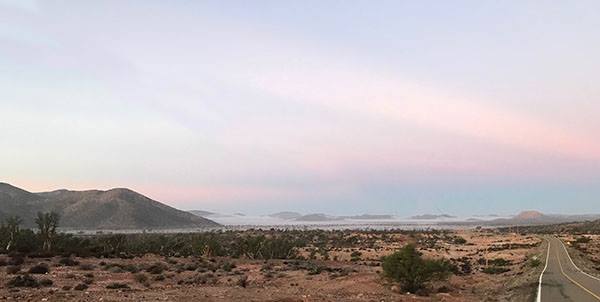
I packed some snacks and water in my tank bag in preparation for my trip. The morning was cool and crisp when I left. It was within a couple of days of the winter solstice and the days were short, so my plan was to leave at sunup, hoping to complete the 450-mile roundtrip before dark. This picture was taken about 20 miles out of town.
The fog nestled so close to the ground made it appear as though I was looking at a forest of cacti poking their heads through the clouds. For some unknown reason, I took that as an omen of good things to come. I passed one truck on that 40 mile stretch to the main highway.
When I reached the junction at Highway 1, my fuel gauge read 3/4 full. I turned to the north, and immediately saw this sign.
I wasn’t yet familiar with my CSC TT250, but I had read reviews of 65 mpg, and since I didn’t yet know what 3/4 full meant on my bike, I decided to press on, optimistic that I would find gas somewhere on the way.
Traffic increased on Highway 1. I guess that’s to be expected since it’s the only paved highway that travels the entire length of the peninsula. After passing 6 vehicles within the first 30 minutes, I decided that traffic probably wasn’t going to be bad enough to have a negative impact on my ride, so I continued north, enjoying the solitude and watching the highway twist its way through the desert as I came down yet another mountain.
As I continued north, I noticed my gas gauge reaching 1/2 full at Chapala. I still had 63 miles to go to Catavina, which was the only place that I thought may have gas. Hoping that the gauge accuracy was a bit on the conservative side, I continued on. Running the numbers in my head, I concluded that I should make it to Catavina, even if my actual fuel level was a little less than indicated. However, if Catavina didn’t have gas, then I was going to either have to stay there until I could find someone passing through with extra gas, or try to locate a rancho that might have a couple of gallons to spare. Fortunately, in Catavina I came across a small sign stuck in the dirt on the left side of the highway that said Pemex. The arrow pointed to the right side of the road, and as my eyes scanned the opposite side of the highway, I saw a pickup truck with a couple of 55 gal drums and a few one gallon plastic containers. By this time I had travelled about half the distance to San Quintin, and although my low fuel light was already flashing, I still had not gone on reserve
I figured the price would be astronomical, but that was ok since I would only need a couple of gallons. Surprisingly, it was only $1 per gallon higher than the Pemex station where I had filled up in my town the day before. Confident that I could now make it the rest of the way to San Quintin, I pressed on north, maintaining between 60 and 65 mph indicated.
The desert continued to get greener as I closed in on the town of El Rosario where Mama Espinoza’s famous restaurant is located. I passed by knowing that I had a meal waiting for me in less than an hour at Jardine’s. Traffic remained consistent through the remainder of my trip, and I reached my destination at 11 a.m.
Jardines was like an oasis in the middle of the desert. There were no signs indicating its presence, and as I turned off the main highway just south of town, I thought the place must really be nice since it appeared that they relied on word of mouth for advertisement. Making the turn onto the final dirt road, I still didn’t see it, and there was no indication that a hotel existed anywhere ahead.
After a 1/2 mile, a beautiful hotel, restaurant, and gardens appeared on the right through the trees.
I pulled into the empty parking lot of the restaurant, dismounted, and approached the door. It was locked. Fortunately the hours were posted. Another hour before they opened. That wasn’t good. If I waited around until they opened, got seated and served, I wouldn’t get back on the road until after 1 p.m. That would make it difficult to make it home before dark. Hmmm! Better check the hotel. I had heard the rates were good, but I was pleasantly surprised that a single room was only $31. A two bedroom-suite was a bit steeper at $45. It didn’t take me long to decide to take advantage of one of the perks of retirement – unscheduled time. I quickly pulled out my wallet, checked in, walked around the grounds for a few minutes, and then waited outside the restaurant until they opened.
I opted for the Mediterranean Shrimp at $8.40.
It was fantastic. I was seriously glad that I decided to stay. I kept occupied throughout the day by reading my kindle and talking to Anna, the hotel manager that day. She had spent several years in Wichita, KS, so she spoke English quite well. That night I paid a whopping $4.00 for some Fish and Chips. Another great meal.
The next morning I took my time riding around the area before heading home. I finally left town at 11 a.m. Traffic was the same as the previous day, and I made it home at 3:30 p.m. I stopped for a moment, looking at the moon over the bay before winding my way down the mountain toward home.
Hard to believe; for less than $100 I had a wonderful two days of riding, great food, a good night’s sleep and not one stop light. I feel truly blessed.
Just awesome, John! I had never heard of Jardines, but you can bet it’s on the list for my next visit. Thanks again.
Folks, if you’d like to know more about Baja and our moto adventures down there (and our recommended insurance company, BajaBound), just click here! And if you’d like a more in-depth discussion of what is arguably the greatest adventure riding spot on the planet, why not pick up a copy of Moto Baja!

 The fog nestled so close to the ground made it appear as though I was looking at a forest of cacti poking their heads through the clouds. For some unknown reason, I took that as an omen of good things to come. I passed one truck on that 40 mile stretch to the main highway.
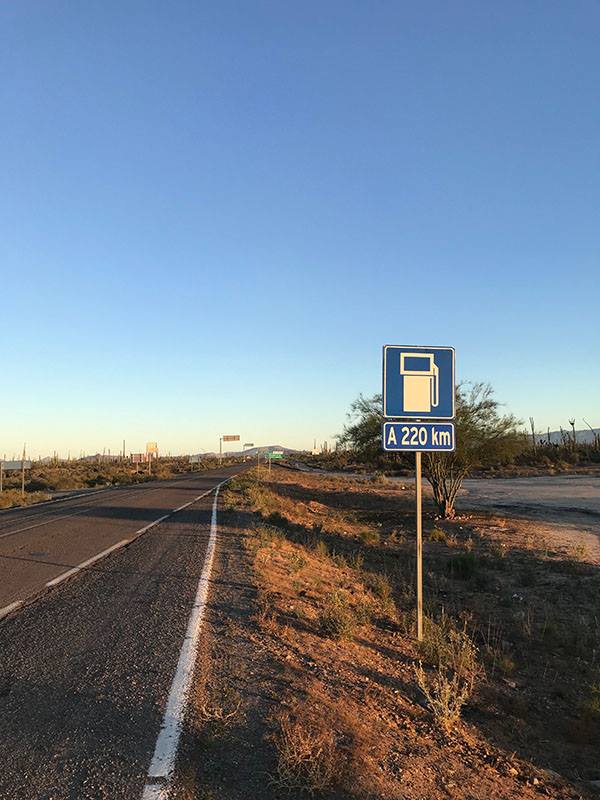 I wasn’t yet familiar with my CSC TT250, but I had read reviews of 65 mpg, and since I didn’t yet know what 3/4 full meant on my bike, I decided to press on, optimistic that I would find gas somewhere on the way.
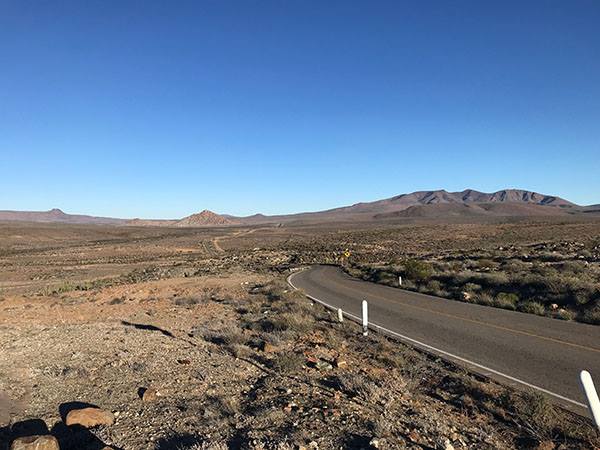 As I continued north, I noticed my gas gauge reaching 1/2 full at Chapala. I still had 63 miles to go to Catavina, which was the only place that I thought may have gas. Hoping that the gauge accuracy was a bit on the conservative side, I continued on. Running the numbers in my head, I concluded that I should make it to Catavina, even if my actual fuel level was a little less than indicated. However, if Catavina didn’t have gas, then I was going to either have to stay there until I could find someone passing through with extra gas, or try to locate a rancho that might have a couple of gallons to spare. Fortunately, in Catavina I came across a small sign stuck in the dirt on the left side of the highway that said Pemex. The arrow pointed to the right side of the road, and as my eyes scanned the opposite side of the highway, I saw a pickup truck with a couple of 55 gal drums and a few one gallon plastic containers. By this time I had travelled about half the distance to San Quintin, and although my low fuel light was already flashing, I still had not gone on reserve
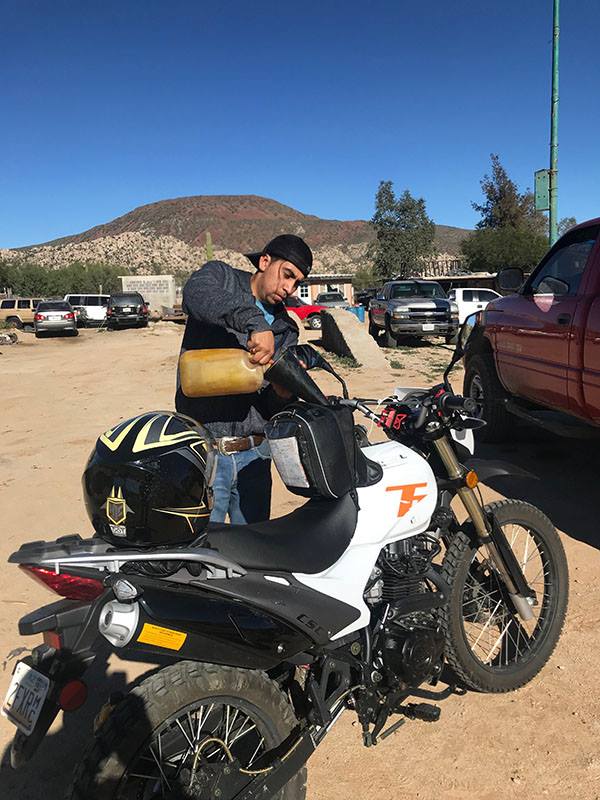 I figured the price would be astronomical, but that was ok since I would only need a couple of gallons. Surprisingly, it was only $1 per gallon higher than the Pemex station where I had filled up in my town the day before. Confident that I could now make it the rest of the way to San Quintin, I pressed on north, maintaining between 60 and 65 mph indicated.
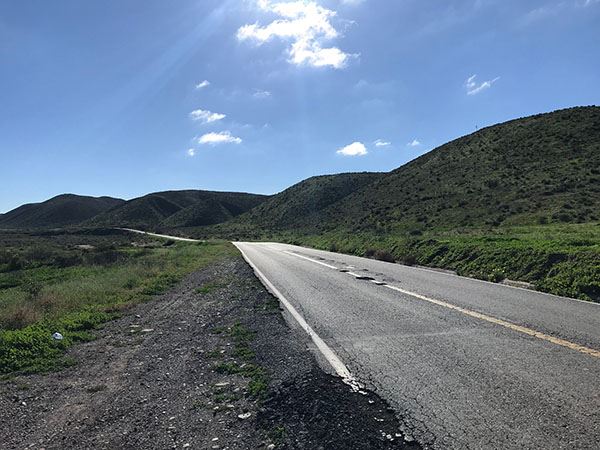 The desert continued to get greener as I closed in on the town of El Rosario where Mama Espinoza’s famous restaurant is located. I passed by knowing that I had a meal waiting for me in less than an hour at Jardine’s. Traffic remained consistent through the remainder of my trip, and I reached my destination at 11 a.m.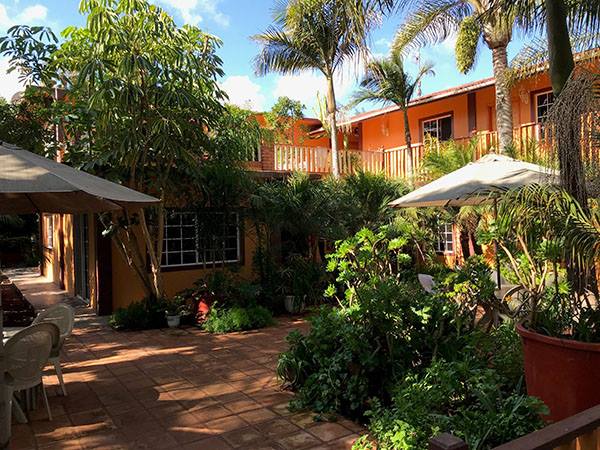
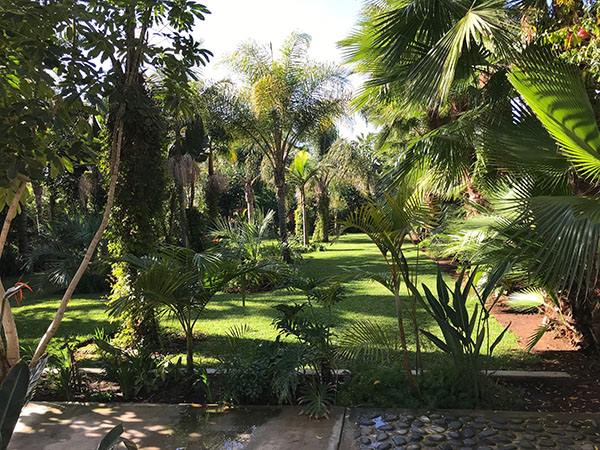 I pulled into the empty parking lot of the restaurant, dismounted, and approached the door. It was locked. Fortunately the hours were posted. Another hour before they opened. That wasn’t good. If I waited around until they opened, got seated and served, I wouldn’t get back on the road until after 1 p.m. That would make it difficult to make it home before dark. Hmmm! Better check the hotel. I had heard the rates were good, but I was pleasantly surprised that a single room was only $31. A two bedroom-suite was a bit steeper at $45. It didn’t take me long to decide to take advantage of one of the perks of retirement – unscheduled time. I quickly pulled out my wallet, checked in, walked around the grounds for a few minutes, and then waited outside the restaurant until they opened.
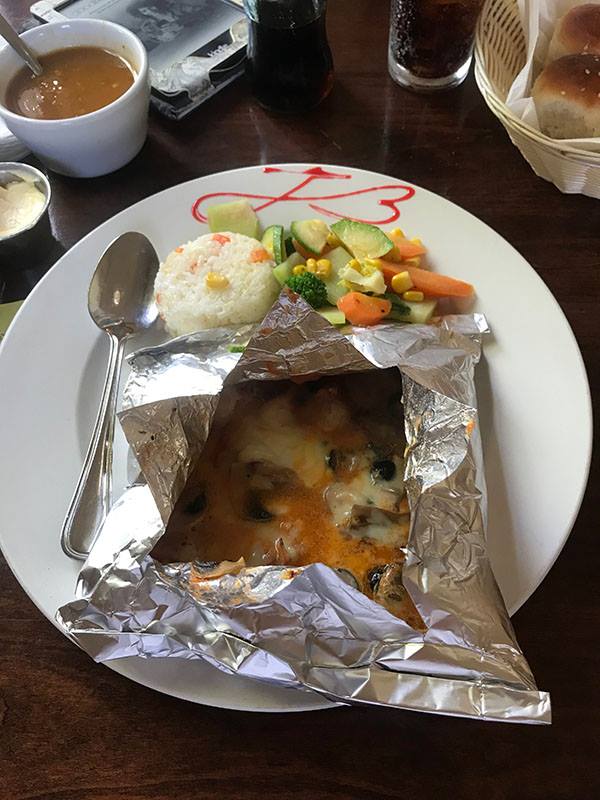 It was fantastic. I was seriously glad that I decided to stay. I kept occupied throughout the day by reading my kindle and talking to Anna, the hotel manager that day. She had spent several years in Wichita, KS, so she spoke English quite well. That night I paid a whopping $4.00 for some Fish and Chips. Another great meal.
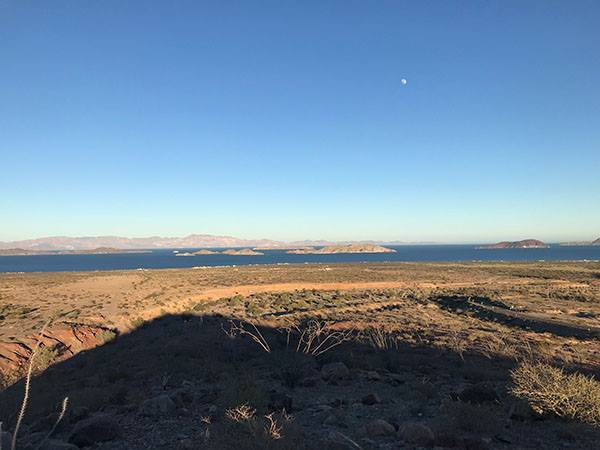 Hard to believe; for less than $100 I had a wonderful two days of riding, great food, a good night’s sleep and not one stop light. I feel truly blessed.