Getting my kicks, on Route 66…

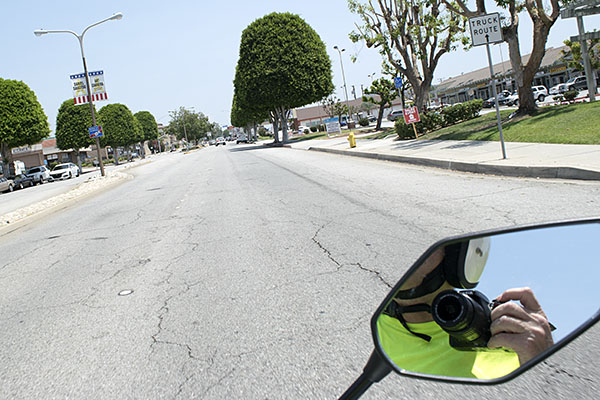
Route 66 from Slick’s cockpit…

This is Phase II of our CSC City Slicker range testing.  Phase I examined how the bike performed in the Eco mode. In this phase, today I tested the bike’s range in the Power mode.

Bottom line first: The bike went further then Zongshen said it would. Zongshen claimed the bike would go 37 miles at 37 mph. I managed to go  40.7 miles when starting with a 100%-charged battery.  I attribute that to the fact that part of the course I ran today had a gradual downhill slope.
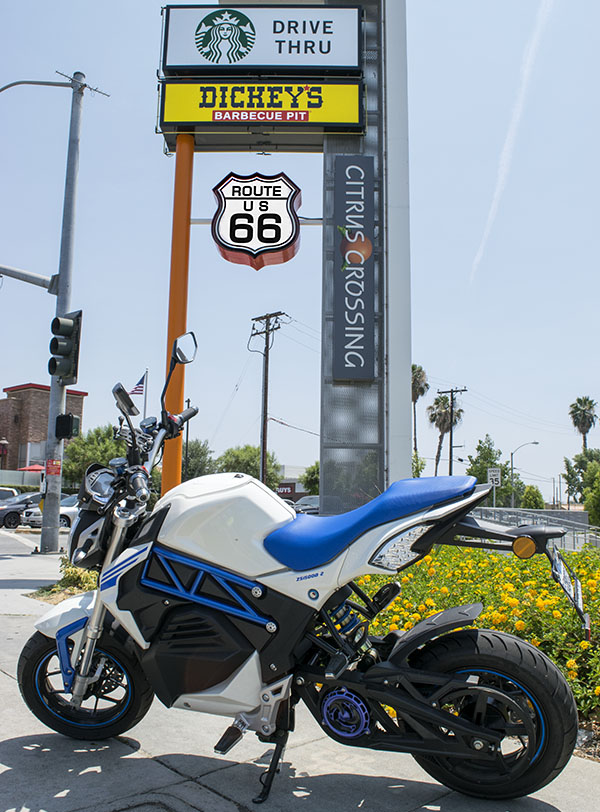
The next big thing…the newest bike in America on the grandest road in America: The CSC City Slicker on Route 66!

There’s a lot more to this test than what I did in the Eco mode testing. I should start out by telling you that this was not a test run on a perfectly flat, uninterrupted test track (I’m pretty sure if I did that I would have managed to get even a few more miles out of Slick). Nope, this was real world testing on American roads. In fact, I’d say it was real world testing on what is arguably the most famous road in America: Route 66.  (Cue in the theme music from the ‘60s TV show, Route 66).  It was that cool. Call me Todd. Arjiu can be Buzz. All we’d need is the Corvette.  But I digress…back to the main attraction.
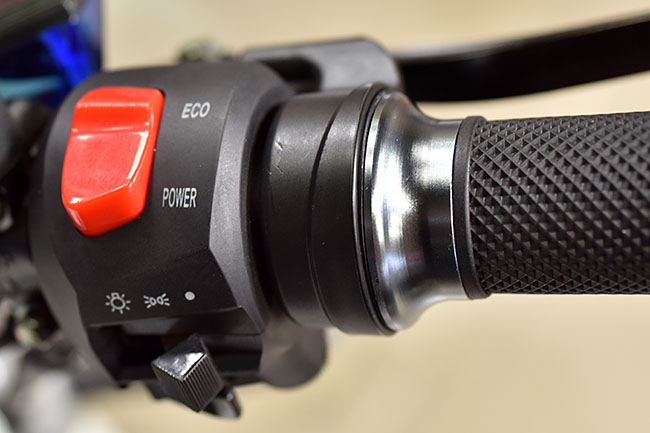
Power mode, Amigo! It’s like kicking in the afterburners!

So, I live a little over 16 miles east of CSC at the base of the San Gabriel Mountains. My home is at 1700 feet above sea level. CSC, from my home, is headed toward the ocean, and that means a gentle downhill slope all the way. CSC sits about 610 feet above sea level. You might wonder why all the topological details, and here’s the reason: I found during my Eco mode testing that Slick uses less energy going downhill than it does going uphill. The bike covered about a mile for each 1% of battery charge going downhill, and about 0.4 miles for each 1% of battery charge going uphill. One of the things I wanted to find out in today’s Power mode testing is how the bike would perform from an energy consumption perspective in the Power mode, going downhill and then uphill.

I guess I ought to point out that I had a difficult time staying at 37 mph during this test, which is the speed for which Zongshen provided the range statistic.  Every time I wasn’t really paying attention, I found myself going 42 or 43 mph (and those higher speeds use more energy). It was a challenge watching the road, watching the battery charge indicator, watching the mileage, and recording the data on my high-tech data logging system.
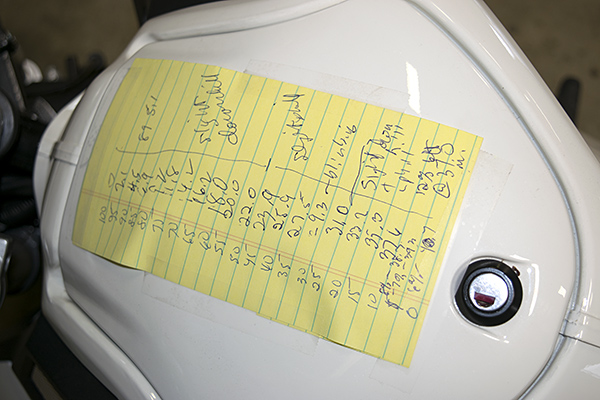
The ExhaustNotes.us high-tech data logger…

The bottom line here is I probably penalized the bike a little because I spent more time than I thought I would above 37 mph.

Oh, and in case you’re wondering what’s magical about 37 mph, I’m only hanging on that number because that’s the data point Zongshen gave us for range and speed in the Power mode: 37 miles at 37 mph.  And in case you’re wondering why Zongshen picked the number 37, they really weren’t being cute about it.  Zongshen’s real magic number was 60.  37 miles at 37 mph is 60 km at 60 kph.  They’re on the metric system.

To cut the chase, here are the results…
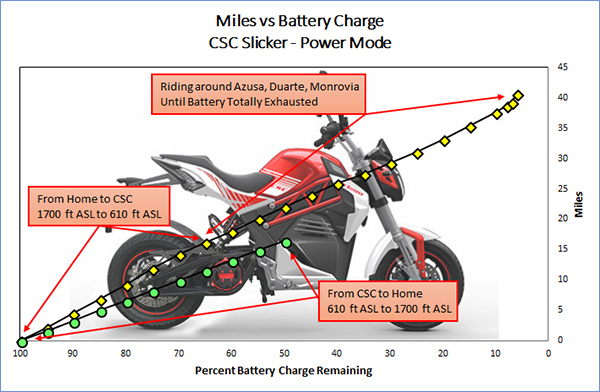
Lots of good info. The top line with the yellow dots was the ride out. The bottom line with the green dots was the ride home.

I know that’s a complicated chart, but hey, I’m an engineer, and there’s a lot going on here. Let me explain it a bit.

I only recorded the data with each 5% decrease in battery charge for this test. I was moving a lot faster than I was in the Eco mode test, and I didn’t want to try to capture data points with every 1% decrease in battery charge.

The top line (the one with the yellow data points) was my ride out to CSC and beyond. It was downhill for the first 16.4 miles (from my home to the CSC plant).  Starting with a 100% battery charge, my ride to the CSC plant took me down to 65% charge remaining.  Stated differently, I used 35% of the battery charge to get from my place to CSC.  I was impressed.  If I was still a working stiff this would be a cool commuter bike.

I wanted to run the battery all the way down until the bike quit, and that meant I kept riding back and forth between Azusa, through Duarte, and into Monrovia.  Those are the yellow data points on the upper line after reaching the CSC plant. I kept doing that until the battery hit 30% charge remaining (at which point the red plug to the left of the charge indicator started flashing, just as it had in the Eco mode test).
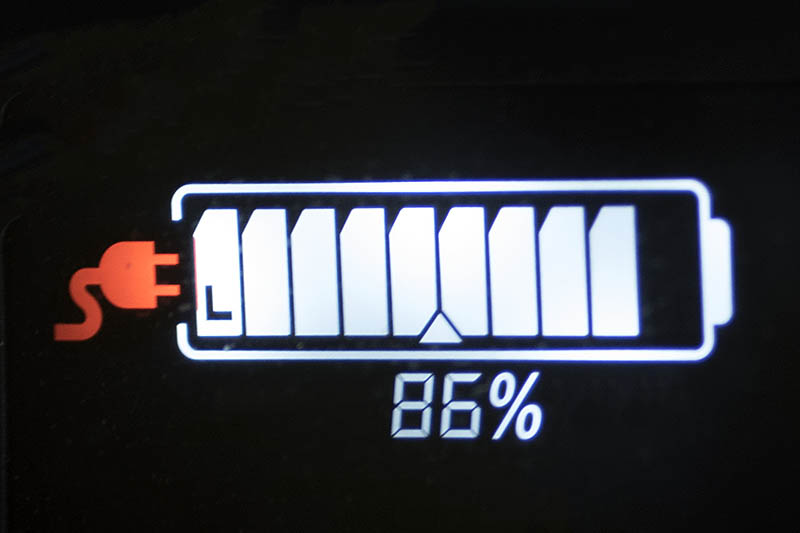
The dashboard battery charge indicator. The red plug lights when the bike is being charged by the external charger. It will start flashing when the charge level gets down to 30% while you are riding the motorcycle. It also lights up during regenerative braking.

When I got down to 15%, the bike went into its “limp home” mode again, just as it had in the Eco mode. When this happens, it accelerates much more gradually (that’s a gentle way of saying Slick is getting tired), and the bike tops out at about 20 mph.

I kept going in the CSC parking lot, riding in circles until the bike hit 6% charge remaining. I rode for another 0.4 miles at 6% charge when Slick called it a day. I watched to see if it would indicate 5% just before giving up the ghost, but I didn’t see that on the dash. I think when the bike drops from 6% to 5%, you don’t get to see it indicate 5%, but that’s where it quits.

To my surprise, I blew right through Zongshen’s claimed 37 mile range. I made it to 40.7 miles. And, as I mentioned in the Eco mode test, the odometer is about 5% pessimistic, so the indicated 40.7 miles is actually 42.7 miles. This is good, folks.  Again, though, the fact that I went more than 37 miles is at least partly due to the fact that this leg of the test was slightly downhill.

I mentioned in the specs that the bike has regenerative braking. When that occurs, the red plug to the left of the battery charge bar illuminates. I never actually got it to cause the indicated charge percentage to increase, though. If it was at, say, 67% and it went into a regenerative braking mode, there wasn’t enough regeneration going on to bump it back up to 68%. The bike is obviously consuming less energy and it is charging, but not enough to register on the numerical percentage indicator. You do see the charge bar go up sharply (it swings to the right) while the red charging plug flickers on during deceleration. It’s cool.  You feel like you’re giving something back.

The other thing I could not discern is how the algorithm operates the regeneration function. It seemed to me that the regeneration light came on while I was decelerating as my speeds dropped below about 10 mph and I was braking. I don’t know if that’s because there’s a lag between when the regeneration actually starts and when it is displayed on the dash, or if Zongshen has programmed something into the bike to prevent too much regeneration. I’m emailing them to find out, and I’ll let you know.

My big disappointment today?   There was only one:  When I got to CSC, all the burritos were gone. Saturday is burrito day at CSC. But I’m still young, and I’ve been working on handling disappointment.

Steve had a freshly charged battery waiting for me, and I wanted to do a video of the battery removal. One of the guys following the ExhaustNotes blog asked for that, so here you go…

Guys, when you see the video, be gentle.  I’m not Cecil B. DeMille.  I know that.  You need to know that I know that.  If you want to be a video critic, start a blog or something.

With a new battery in place, it was time for my ride home. I was very curious to see how this would go, because now instead of descending from 1700 feet to 610 feet, I’d be climbing that same 16.4-mile grade.  I’ll post the graph here again so it’s easier to put the words and the music together…

The bottom line with the green dots was the ride home.

The bottom data line (the one with the green data points) shows energy consumption as a function of miles on the uphill ride home. You can see that the bike uses more energy going uphill than it does going downhill (again, duh, but the data shown in the above graph makes it clear).  Some folks are confused by x-y plots (hell, some folks are confused by, well…never mind).   Don’t look at this graph and think that the shorter lower line with the green dots means the bike will only go 16.4 miles.  I still had 50% of the battery charge left at that point.  I was home.  I parked the bike, went inside, and opened a can of Tecate (which I’m nursing as I write this blog).

So, here’s the take-away from today’s testing:

  1.  The bike goes further in the Power mode than Zongshen said it would.  This is good, but temper my results with the course I rode (part of it was slightly downhill).
  2. I used 35% of the battery’s energy going from my home to CSC (a gradual descent) and I used 50% of the battery’s energy going from CSC to my home (a gradual climb).
  3. This motorcycle is a lot of fun and it gets a ton of attention.  Every time somebody stopped alongside me at a light, the questions and compliments started.  I don’t mind admitting I enjoyed that.
  4. I think these guys (that is, CSC) aren’t charging enough for the bike, but hey, what do I know?

And there you have it.  Slick’s on the charger now.  I’m going to the rifle range tomorrow to send some lead downrange.   On Monday or maybe a little later in the week, me and Slick are going to do some climbing up in the San Gabriels to see how the steeper grades affect range.  As always, if you have questions, post them in the Comments section, and I’ll do my best to get answers for you.
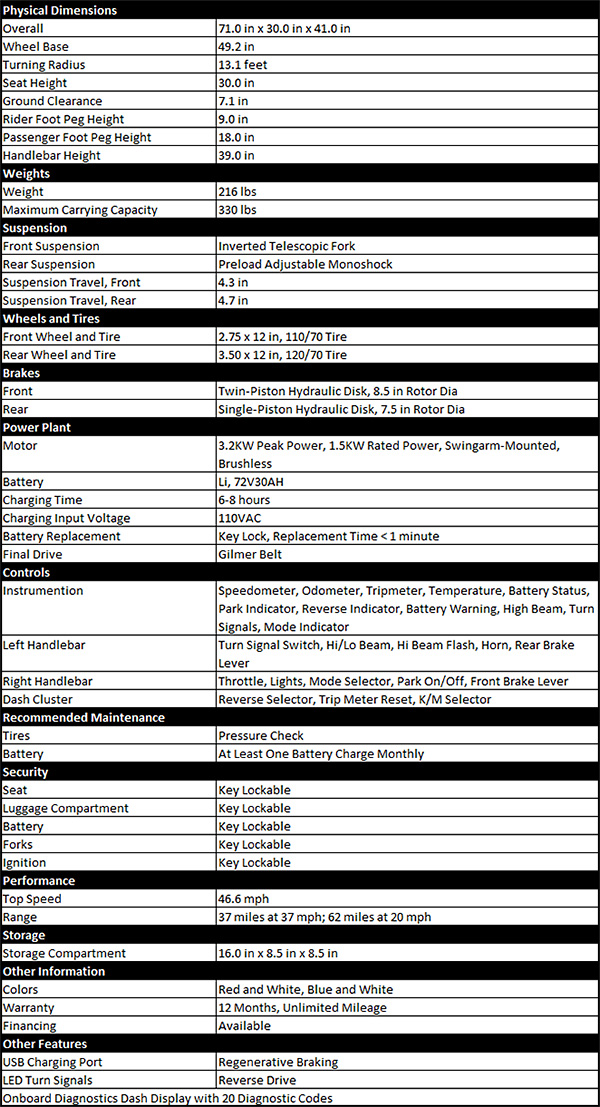
Slick specs…

I’ve been helping CSC in the last few days compile specifications for the new City Slicker electric motorcycle, and the bike is looking better and better the more I learn about it.  Here’s what’s going up on the CSC site in the near future…

Any questions?  Post them in the comments section, and I’ll see if I can get answers.
A draining experience…

I wrote a City Slicker press release for CSC Motorcycles last week and it lit up the Internet (you can read it here).  The word is out and a lot of people are asking a lot of good questions.  One is: How far will this thing go on a battery charge?

I had a lot of fun this morning getting the answer to that question. I was able to play engineer again. More on that in a bit.

Zongshen quotes two figures for the City Slicker’s range: One is a claimed 62 miles in the Eco mode at 20 mph, and the other is a claimed 37 miles at 37 mph in the Power mode. In the ebike world, range drops dramatically as speed increases. Go faster, don’t go as far. Go slower, go further. Hence the two figures.

Today was Phase I of my testing, and it focused on the City Slicker’s Eco mode.

Eco vs Power mode is controlled from a right-handlebar switch.

Bottom line first: In the Eco mode, I was able to get 55 miles out of the battery, with the dashboard charge indicator showing 6% charge remaining when the bike shut itself off. I think that’s pretty damn good, even though it didn’t meet the Zongshen claim of 62 miles. I’ll explain why in a bit, but first let me tell you how I ran the test, and before I get to that, let me tell you a bit about charging this puppy.

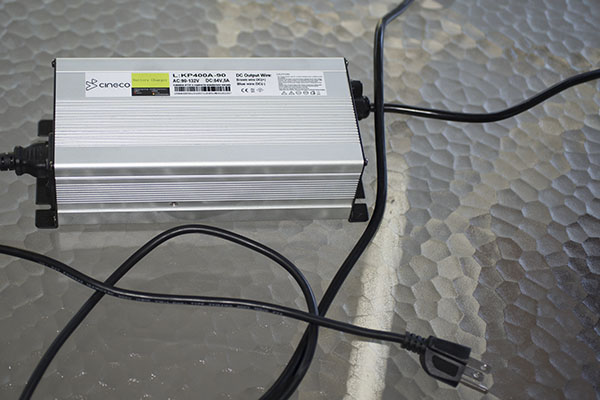
The City Slicker charger.

The bike comes with a charger. It’s a big dude, it plugs into a standard 110 VAC outlet, and it takes about 6 to 8 hours to fully charge the battery.

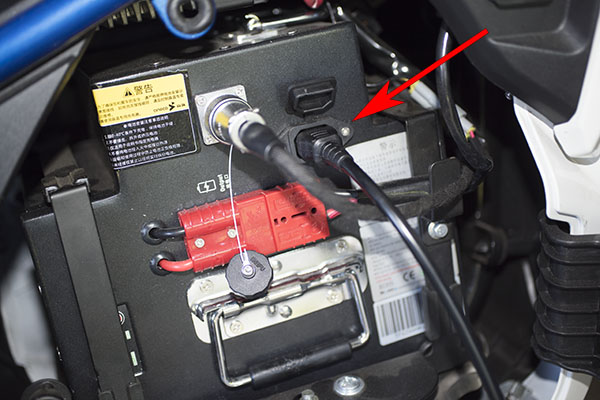
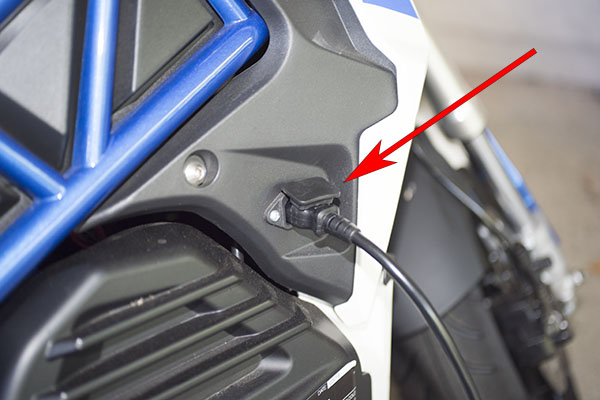
You can plug the charger into the bike on the bike’s battery access cover…
Or, you can open the access cover and plug the charger directly into the battery.

I guess at this point I should tell you that 6 to 8 hours is the right number for a full battery charge.  There are folks quoting some clown who said it only took 4 hours to charge the battery (uh, that clown would be me, when I stupidly accepted what someone told me without verifying it myself).   My bike’s been on the charger for a little over 3 1/2 hours since I ran the battery all the way down earlier today, and it’s only up to 63%.  6 to 8 hours is the correct answer to this question, folks.

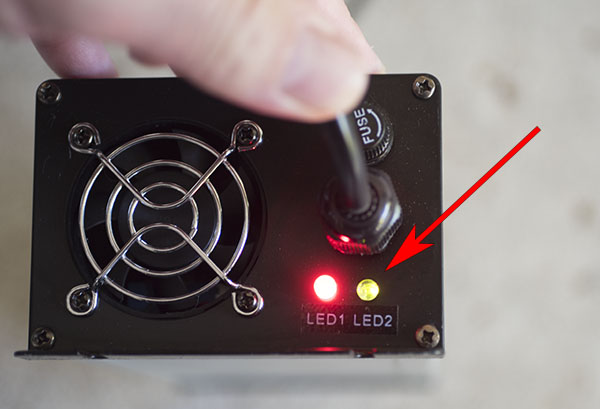
The City Slicker charger has a couple of LEDs on it. One tells you it’s charging and the other tells you the state of the battery charge. If the battery’s not fully charged, that second LED stays red. When it’s fully charged, it turns green.

The green LED means the bike is fully charged.

When you disconnect the charger when the full charge LED light turns green, the bike will indicate a 100% charge on the dash, and it stays that way for a day or two before it starts to drop (if you don’t use the bike). If you leave the charger connected after the LED turns green, it shuts off but it doesn’t keep the battery at 100% until the charger turns itself on again. I think the thing allows the battery to drop to something below 99% before it starts charging again.

I had planned to start my test with a 100% fully charged battery, but it was at 99% on the dash indicator this morning. It was already getting hot here in So Cal and I didn’t want to wait for the battery to get back up to 100%. I started riding with the battery at 99%. Like we used to say in the bomb business: Close enough for government work.

The dashboard battery charge indicator. The red plug is lit when the bike is being charged by the external charger. It will start flashing when the charge level gets down to 30% while you are riding the motorcycle.

On to the test: I recorded miles traveled at each 1% decrease on the battery charge dash indicator. I wanted to simulate a real world City Slicker scenario, and the course I ran was a 2.8 mile loop around my home. Part of it is slightly downhill, parts of it are steep climbs, and there are 6 stop signs. It’s uphill and downhill, with lots of stop and go in the process. I tried to stick to 20 mph the entire time. It was a good city riding simulation, I think.

My fancy data logging system, scotch-taped to the top of the City Slicker luggage compartment. I dropped my pen twice during my 3-hour ride this morning.

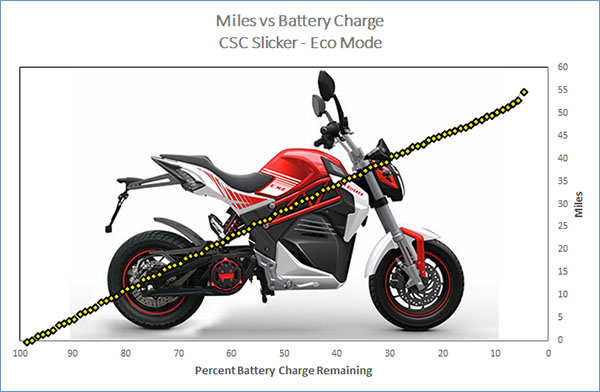
When I finished the run (it took a good 3 hours in 100-degree weather), I then plotted the data.  Here’s what it looks like:

City Slicker range test results.  Slick, huh?

My observations and comments follow.

Power consumption as a function of distance traveled was very repeatable. On the uphill portions of the test course, the bike got about 0.4 miles for each 1% of battery charge; on the downhill portions it got about 0.9 to 1.0 miles for each 1% of battery charge.  This was very consistent; after a few laps I could predict when the bike would drop a percent on the charge indicator by house number.

I tried to hold my speed at 20 mph, consistent with the Zongshen prediction for the City Slicker’s range in the Eco mode (62 miles at 20 mph). I had a tendency to speed, though, and I was above 20 mph more than I wanted to be.

When the battery charge indicator (on the bike’s dash) hit 30%, the charge plug indicator (on the dash) started flashing red. The concept is similar to the low fuel light on an internal combustion engine motorcycle. It’s telling you that it’s time to start thinking about topping off.

The bike felt like it had normal power levels until the battery charge indicator hit 20%. Below that point, the bike felt like it needed more “throttle” to maintain 20 mph.

At 16% battery charge, things changed. Responsiveness diminished perceptibly. It was in a “limp home” mode, and it would not go much above 15 mph.

The bike became more efficient in the limp home mode. It was going a little further with each 1% battery charge decrease than it had before.   Thinking about it now, that’s not surprising, but it surprised me when it occurred.

At 6% indicated charge, the motorcycle had traveled 52.3 miles. It then traveled another 2.7 miles to reach a total of 55.0 miles, where the bike shut down completely. The battery charge indicator was still showing a 6% charge level prior to shutdown. I was thinking maybe I’d get to use that last 6%, but somewhere in that 6% indicated charge level range, it was lights out. Zip. Nada. Nothing left.

My earlier GPS speedometer accuracy testing showed that Slick’s speedometer is about 7% to 10% optimistic (the bike’s speedometer shows the speed to be higher than the GPS showed, which is something I’ve also observed on Zongshen’s internal-combustion-engined motorcycles).

I found the opposite to be true for the odometer. I have a measured mile by my house, and when I covered that distance on the City Slicker, the odometer showed 0.9 miles. I traveled approximately another 250 feet after the end of that measured mile before the odo clicked over to 1.0 miles, so I’m estimating the odometer reading to be about 5% low.

Based on all of the above, I was impressed with the City Slicker’s performance. Zongshen claims a 62 mile range in the Eco mode; I was able to ride 55.0 miles before the battery called it a day.  There were several reasons I was slightly under the Zongshen estimated range:

I started with a 99% charge. If I had been at 100%, I would have picked up another 0.4 to 1.0 miles.

As explained above, the odometer registers less than actual mileage. Applying a 5% correction factor, I actually traveled 57.75 miles.

My course had 6 stop signs every 2.8 miles, and I stopped at every one. Accelerating to 20 mph from a dead stop uses more energy than simply riding a constant 20 mph. I stopped and accelerated from 0 to 20 mph 117 times during this test.  If the stops signs hadn’t been there, I would have gone further.

My course was uphill and downhill. I’m guessing that this adversely affected power consumption. If I was on a perfectly flat course, I would have gone further.

I’m a full-figured 198 lbs. With my motorcycle gear on, I’m probably pushing 210 to 215. I’ve been to the Mount (that’s Zongshen, in Chongqing) and I’ve seen the Zongshen test riders; they weigh maybe 130 lbs soaking wet. Fat guys soak up the go juice more quickly. With a lighter rider, Slick would have a longer range.

On the other hand, I didn’t have the bike’s lights on. When we get our US-configuration Slickers, the LED running lights on either side of the headlight will be on all the time. That will drop the range a bit. How much is TBD, but when I find out, I’ll let you know.

My next test will be in the Power mode. I guess I’ll be a Power Commander. Stay tuned.

I’m having fun and I’m learning a lot more about electric bikes.  You might think riding in circles for three hours would be kind of boring, but I enjoyed it.  Folks who saw the bike knew it was something different, which is what I’m getting a lot of every time I ride the City Slicker.  The silent riding experience is kind of cool, too.  It’s a different kind of riding, and it’s fun.  I like the bike.  A lot.

If you have questions about the City Slicker, please post them in the Comments section here on the ExhaustNotes blog.  I’ll do my best to get answers for you.

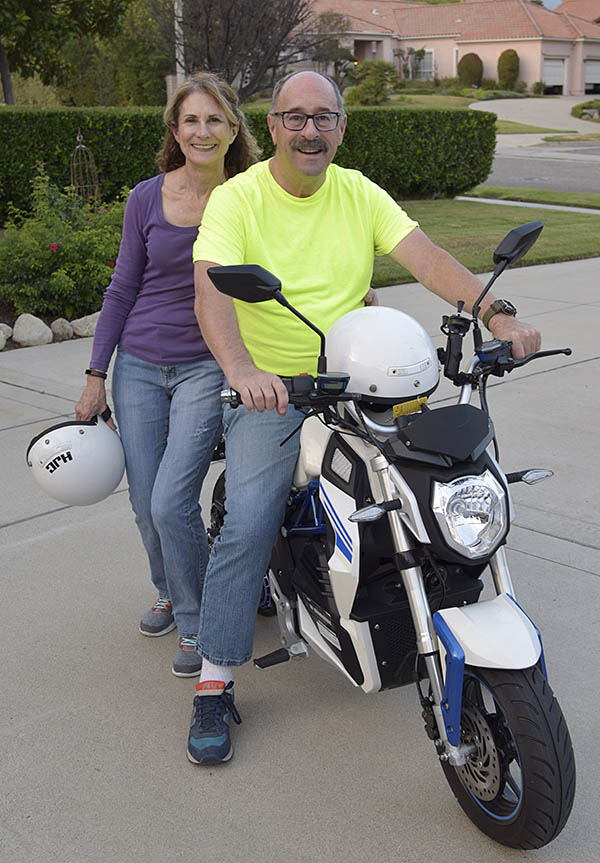
Slick, two up…

A mid-summer night’s dream, as the saying goes…

So what’s it like riding the new City Slicker?

For starters, you can’t be shy. The bike is a conversation starter. Even people who aren’t into motorcycles recognize it’s something different. Stop at a light and people crossing the street look, then they look again, and then they realize: It’s silent.

“Is that electric?” is always the next question, followed by my affirmative answer, followed by their response:

“Cool!”

Sue and I took the bike out for a ride around the neighborhood. Surprisingly, even at its welterweight 216 lbs, Slick rides well two up. I think the battery life might be marginally shortened a bit two up (the bike is hauling more weight), but I haven’t done anything quantitative yet to confirm that.

Another surprise from our after-hours ride: The headlight does a good job. In fact, I think it does a better job than my RX3. I switched it on and off, accelerating under both scenarios, to see if I could feel a difference in the bike’s response, and I couldn’t.

I’m finding the riding experience is different. The handling is considerably crisper, a natural result of the City Slicker’s light weight and its crisper 12-inch wheels (I’ll write more about the 12-inch wheels and the resulting crisper handling in a future blog). I found I had to concentrate when stopping. The brakes are great, but there’s no brake pedal for the rear wheel (the rear brake is activated by the left handlebar lever).  At more than a few stops, I found my right foot dabbing into thin air, and I chirped the rear tire twice attempting to pull in the “clutch” when rolling to a stop sign. And I found my left foot similarly dabbing up and down at stop signs, trying to find neutral, and then I would remember: There is no neutral, because there is no gearbox. You simply use the brakes to stop, and the “throttle” to go. Scooter lovers will feel right at home on a City Slicker because the controls are identical.

And then there’s this: I found myself frequently looking at the tripmeter and the battery charge indicator, thinking about how much of the charge we had used, how many miles we covered, and then doing the mental math to project the range. There’s more to follow on that, too, folks.

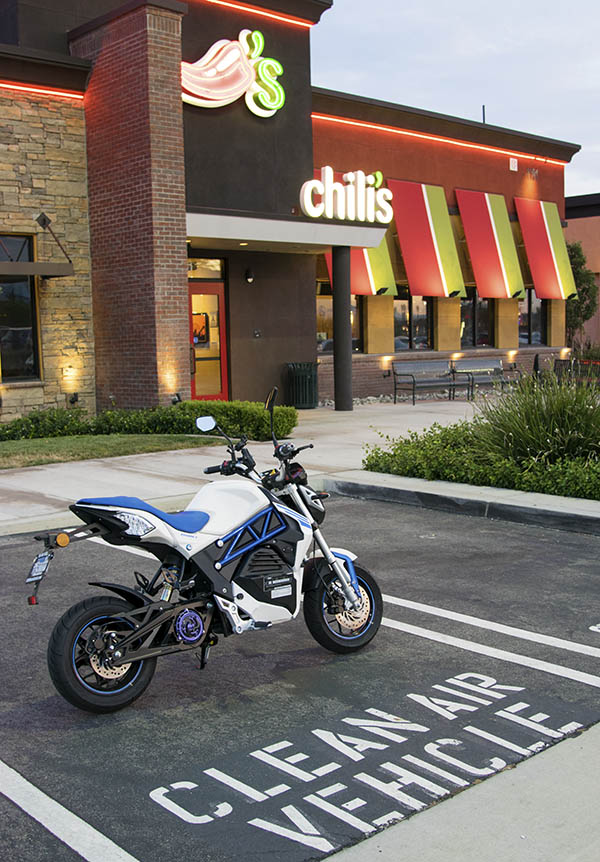
One more nice touch…our dinner stop even had reserved parking.

Stay tuned.

No valet necessary…