Patagonia Part 3: Conquering the W Trek

By Bobbie Surber

Our Patagonia adventure continues.  If you’re entering in the middle of the movie, you can catch up here:

Patagonia Part 1
Patagonia Part 2


We had a deep sleep that night, the kind you only find after many days on the trail, your body surrendering to exhaustion. As morning broke the wind picked up with a force that relentlessly battered our tent. The wind reminded me of sleeping aboard my sister’s sailboat with the waves crashing against the bow. I eased out of the tent, stretched, and honestly took stock of my injured knee, questioning if I had one more day in me. There was a boat in the harbor waiting to take the first group of hikers back to Puerto Natales. Should I call it quits and board, ending my time on the trail?

As I contemplated my choices, another small miracle took place, a sweet young girl who worked at the Refugio offered to carry my pack for the day. Hallelujah with minimal effort a solution had found me.

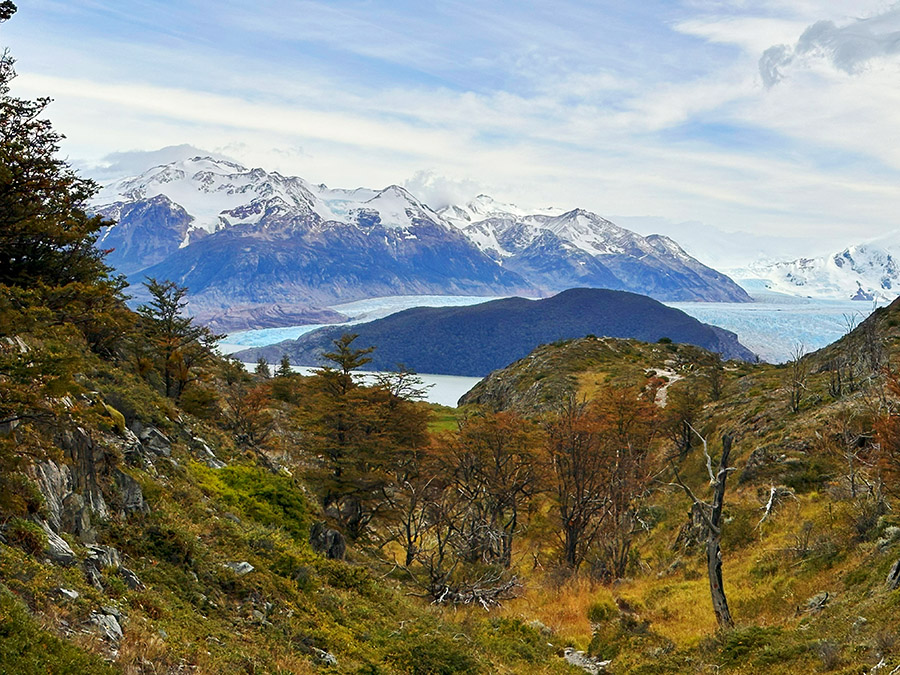
After breakfast and a quick repack, we hit the trail for the day climbing away from the bay up to the wind-swept ridgelines. The protruding rocky ledges crumpling their way to Lago Grey demanding your full attention, yet our reward was looking over the lake seeing our first icebergs bobbing along the shore. The intensity and range of colors and hues of blue, in the ice challenge you to bring their magnificence to life. giving up and surrendering to the simple joy of looking over the lake with Tom beside me.

I managed the last final scramble down the path that was more waterfall than actual trail. Just as my knee was screaming for relief, ready to abandon me for good, we hit a gentle portion through a forest protected from the Patagonian winds and leading us to our night’s destination.

Refugio Grey

We arrived at the Refugio with sore legs and near dying for a cold beer. A staff member who greeted us like long lost pilgrims, pointed us in the direction of the bar. Our packs abandoned, we hastily secured our first icy beverage and toasted each other for the completion of our grand adventure along the W trail.

The night’s lodging was a simple tent set up in a field with thick mats to protect us from the cold. Before a hearty meal and our first long hot shower of the trail we settled into chairs to watch the fading light capture the distant peaks of ice. That final sunset rewarded us with soft shades of pinks and pale purple gently fading as the sun dipped below the horizon.

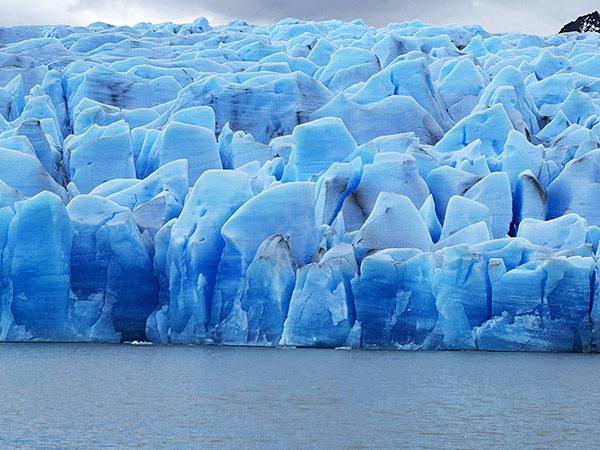
We left camp after a hasty breakfast making our way down to the water’s edge. Just a few hardy trekkers leaning into the wind, patiently waiting for the catamaran that would take us to the glacier’s face. As we pulled from the shore, we witnessed icebergs, some small like delicate flowers, and others large abstract sculptures reaching for the sky. It was an ice field floating museum of art, each bend of the lake showing you her rare gifts.

I still struggle to describe a mass so large, ice reaching back through the ages. Colors that frustrate my ability to describe with a glow seem to start deep within the center, with more shades of blue that an artist can capture on canvas. You could feel the impact on everyone on the boat as a hushed silence momentarily captured us as we stood in awe.

Our time had ended in Torres del Paine as we departed the catamaran at Hotel Grey. We found our way to our driver and as we surrendered to the ease of the back seat I looked over my shoulder trying to will every moment into my memory.

Reflection

Patagonia is protected by two countries that have dedicated themselves as stewards of this unique wilderness. I feel incredibly lucky, honored to have spent this time walking her paths. I cried with equal parts pain and wonder at the beauty of the trail, the towers on our second day, with their peaks drifting in and out of the clouds, The grandeur of the French Valley and that unforgettable sound of a distant avalanche like the sound of roaring thunder. The beauty of Grey Glacier, with the gentle reminder of how short our time on earth is when looking at a body of ancient ice formed by the power of nature.  We experienced it all on this journey of mountains, forest, peaks and towers together, my love and appreciation for Tom growing with each hard-earned mile.


Our Patagonia adventure is far from over.  Here’s what I’ll write about next.

    • In Part 4, I’ll share our time in El Calafate and the unforgettable stay at Estancia Nibepo Aike, a place where history, hospitality, and the Patagonian steppe come alive in a way that feels both timeless and deeply grounding.
    • Part 5 will describe our trek to Fitz Roy, the iconic granite spires that have lived in my dreams for years, a landscape both fierce and breathtaking.
    • Part 6 will take us to Ushuaia, the end of the world, where the wild meets the sea and every moment feels charged with the magic of Patagonia’s farthest reaches.

I hope you will continue to follow along as this journey unfolds.


Join our Facebook ExNotes page!


Never miss an ExNotes blog:


Help us keep the lights on:


Don’t forget: Visit our advertisers!


Patagonia Part 2: Conquering the W Trek

By Bobbie Surber

Day 1: The Adventure Begins

The morning light over Puerto Natales was soft and silver, with a misty rain that whispered rather than shouted. Tom and I shouldered our packs, my heart fluttering with a mix of nerves and anticipation as we stepped into the unknown.  We boarded the early bus from Puerto Natales, joining a mix of wide-eyed trekkers and seasoned hikers, all bound for Torres del Paine National Park. The drive itself felt like a quiet ritual — the final stretch of comfort before the wild began. As we moved deeper into Patagonia, the land shifted again: golden steppes gave way to alpine slopes, windswept plateaus, and glimpses of distant glaciers.  At the park entrance, we checked in with our reservations and caught the connecting shuttle to the Central/Torres sector, arriving at Refugio Chileno, our gateway to the trek’s first challenge.

We hiked for several hours along the Río Ascencio, winding through lenga forests – native beech trees with leaves that whispered in the wind — crossing footbridges, and climbing switchbacks softened by moss and whipped by gusts. The relentless Patagonian wind pushed against our packs, howling around bends – a constant reminder that nothing in Patagonia is guaranteed.
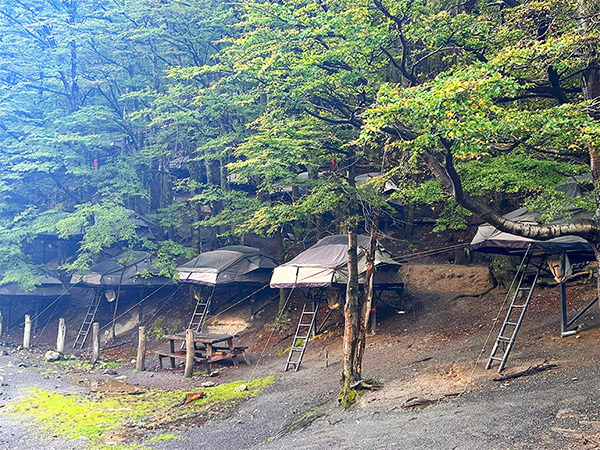
By late afternoon, we reached Refugio Chileno, perched at the edge of a forested valley. For the next two nights, this would be our home: a reserved tent platform with meals provided by the Refugio. The food here was the best of the entire trek, and the staff radiated warmth and kindness. Though the quarters were small and cramped — especially with day hikers seeking shelter — the atmosphere remained joyful and welcoming.

The setting was raw and beautiful — the kind of place where you arrive dusty, tired, and utterly alive. We laid out our gear, adjusted our layers, and walked down to the river to watch the sunset light up the granite towers in hues of copper and rose. Our bellies full of fresh salmon, brought in by horseback, and some much-needed vino Tinto, we climbed the stairs to our tent platform surrendering to the exhaustion of the day.

Day 2: Mirador del Torre – The Towers

Despite the wind and rain keeping frustrated hikers at bay through the morning, we kept a close eye on the forecast. Around 1 p.m., the clouds began to lift – just enough to give us hope that the iconic granite spires we had come to see might finally reveal themselves.
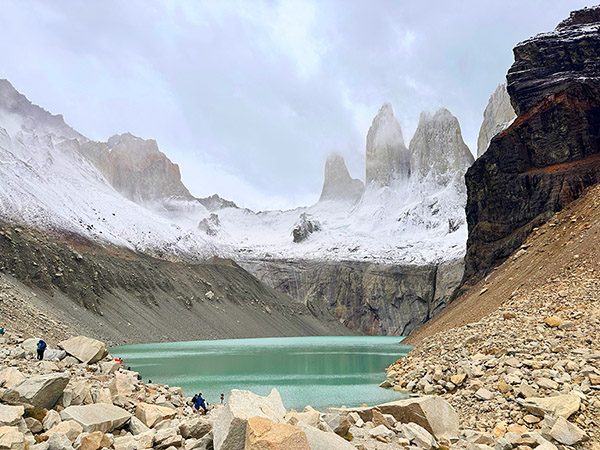
The climb was tough: wind whipping, rain falling, slippery, rocky switchbacks slowing our pace. But the moment we reached Mirador Torres, the clouds cleared fully, unveiling the full glory of the towers rising sharply against the sky.  Seeing the towers for the first time stopped me in my tracks. I had dreamed of this moment, one of the most iconic sights in Patagonia, and now I had arrived.  After the long, grueling climb, standing at the base of those towering granite spires was nothing short of humbling. They rose with such raw power and timelessness, carved by ice and wind over millennia, that I felt both incredibly small and deeply connected to something far greater than myself.  That glimpse, brief and breathtaking, was worth every bone-weary step.

Day 3: Humbling Miles Along Lake Nordenskjöld

We woke up in our tent excited to see what day three would bring. It wasn’t until I climbed down the stairs of the tent that I came to terms with smoked legs and aching knees. Oh lord, I felt old! We had heard this would be the “easy” day, relatively flat, a chance to recover. That turned out to be not exactly accurate!  The trail stretched endlessly in rocky, uneven waves, one steep climb after another, each followed by a jarring descent. The ups and downs felt cruel, especially on sore joints and tender muscles.  The wind rarely left us. It pushed against our packs, howled around bends, and made balance tricky over exposed rock sections.
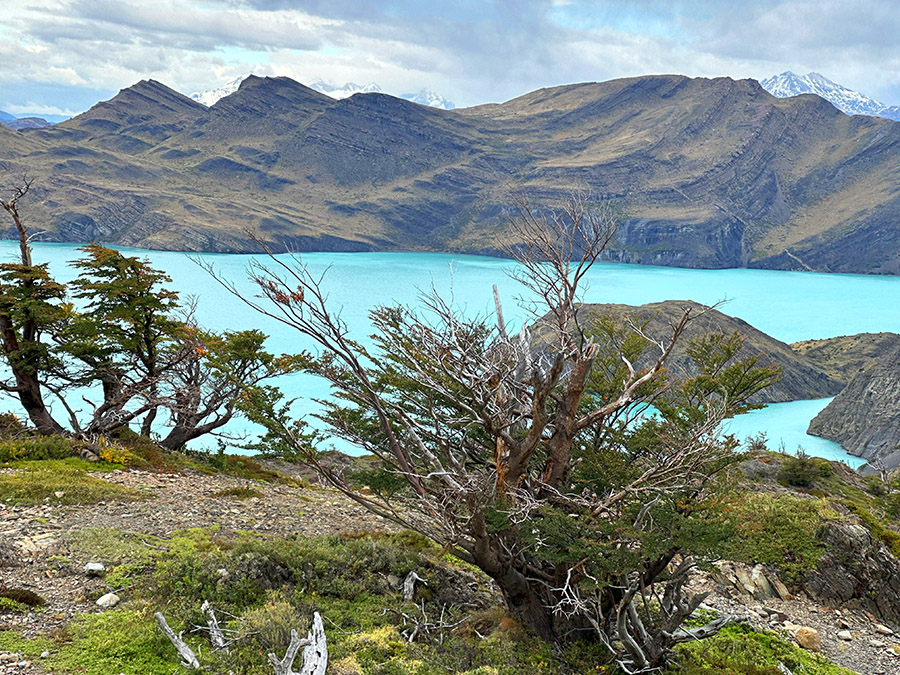
We traced the shoreline of Lake Nordenskjöld for most of the day, its slate-blue water glinting beneath a thick ceiling of clouds that later broke open to brilliant blue. The views were stunning, even through the fog of physical discomfort: sprawling valleys, snow-dusted peaks, and the icy blue lake curving endlessly at our side. It was wild and cinematic — just enough magic to keep us moving.  A family from the East Coast crossed paths with us several times throughout the day. Each time, we shared a moment of mutual misery, cheering each other on with dark humor and tired smiles.

By the final stretch, the fatigue wore thin on both of us. Tom, usually my steady, optimistic hiking partner, hit a wall. Frustrated, he picked up his pace and took off ahead, muttering curses at the unknown trail gods. Too tired to keep up and trying my best to hide my giggles at Tom’s colorful curses. I soldiered slowly up and down the trail ever longing for the day to end and preferably ending with a pisco sour or glass of wine.

And then it happened: A section of trail gave out underfoot – loose rock, bad timing, tired legs. I tumbled hard, unable to catch myself. When I landed, I knew instantly my left knee was in trouble. The pain was sharp and deep. Sitting in the dirt, stunned, breathing through the sting.  Alone, I took slow, careful steps, stopping often. My knee buckled repeatedly. Doubt crept in as to whether I would even make it to camp. The trail seemed to stretch forever.

Then, finally, just as the trail descended toward Refugio Los Cuernos, I saw Tom waiting, his earlier frustration replaced by quiet concern. He took my pack without a word and helped me down the final stretch. I was still upright, still walking, but just barely. The relief of seeing him was immense.  We reached the Refugio together, subdued, exhausted, and deeply relieved.
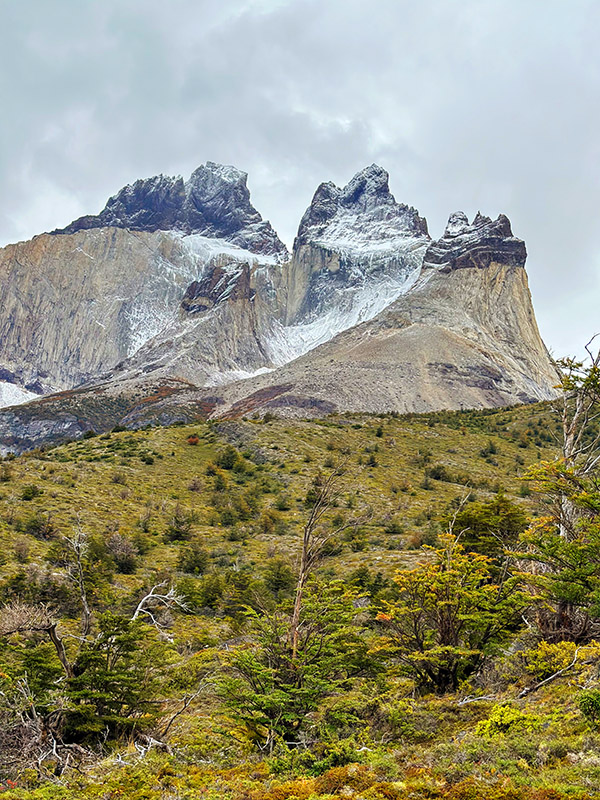
Refugio Los Cuernos sits tucked beneath the jagged black horns of the Cuernos del Paine, towering, wind-carved peaks that look like something from a dream.  The setting is spectacular: to one side, the deep turquoise waters of Lake Nordenskjöld; to the other, the dramatic silhouettes of the horned mountains looming above like ancient guardians.
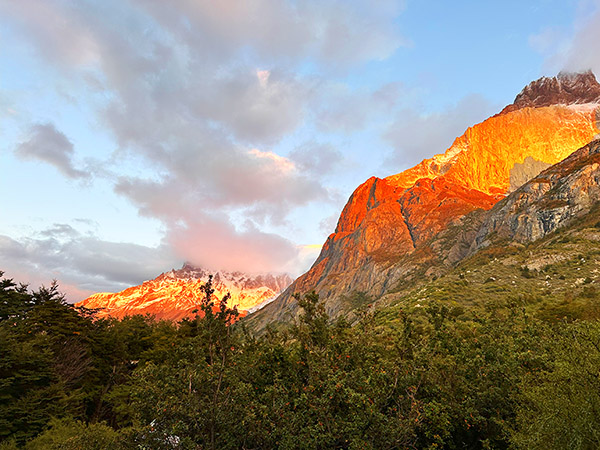
The Refugio itself is small and charming, wooden cabins scattered along a rocky slope, connected by boardwalks. Our tent platform was nestled into a gentle rise just a short distance from the bar and dining hall. The communal area buzzed with tired hikers sharing meals, comparing stories, and soaking up the fading golden light.

That night, we ate with our boots still on, grateful for the hot food, a precious ice pack provided by the staff, and a warm place to sit. The staff, kind, and patient despite their long day, served up hearty portions and laughter with our meals.   As the wind howled outside and the peaks turned dusky purple, we sipped wine and leaned into the warmth of it all.  We were sore and injured in new places, but also held, somehow, by the land and by each other.

Day 4: The French Valley

The morning started slowly as Tom checked on my knee, confirming that I tore my meniscus already compromised years earlier. We talked through how best to continue the trail. The staff at Los Cuernos kindly offered, for a fee, to transport my backpack to the next Refugio. I gratefully accepted. Shedding 20-plus pounds gave me the best shot at finishing the day ahead.

I set out earlier than Tom, knowing he would catch up quickly. I often joke he is part man and part mountain goat, thanks to years of summiting peaks across North America and, more recently, 26 nights of hiking in Nepal. My pace would be slower, and we both knew it.

I arrived at Refugio Francés mid-morning and took a welcome break. With sweeping views and a patch of sun warming me, I indulged in a second breakfast while waiting for Tom to catch up.
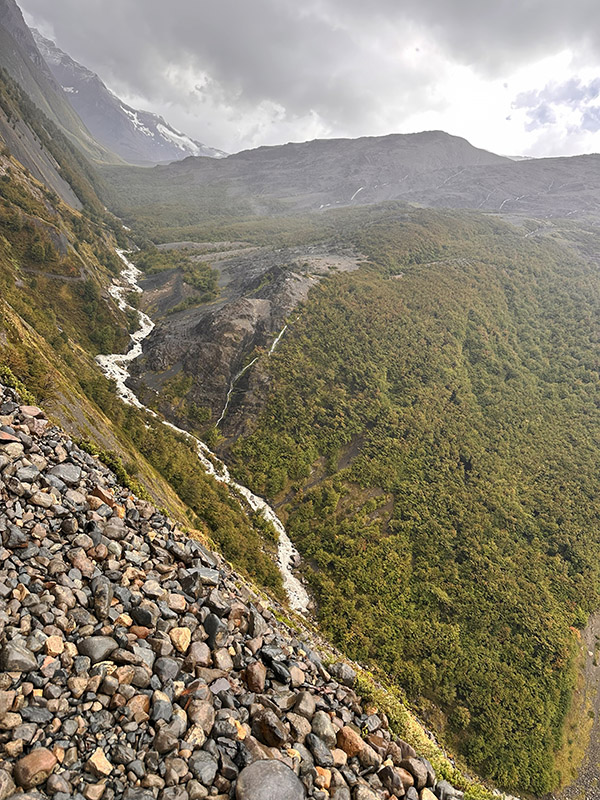
Before reaching Campamento Italiano that afternoon, we paused on a narrow ledge, the forest thick around us, wind whispering through the trees.  Below us, the French Valley unfolded like a hidden cathedral: raw, vast, and breathtaking.  I dropped my trekking poles and leaned back against Tom, my heart pounding as I looked up.   For a moment, I simply forgot to breathe, overwhelmed by the sheer scale and silence.  Jagged granite peaks rose like spires; their faces streaked with snow. Glaciers spilled down cliffs like frozen waterfalls, suspended in time.   Somewhere high above, an avalanche cracked like distant thunder, echoing through the stillness.

It was not just the view. It was everything it meant, that we had made it here, injured, and uncertain, every step hard-earned. I stood there, breath finally returning, feeling both insignificant and fiercely alive.   We rested for a while, watching clouds drift low over the valley walls, the wind tugging gently at our jackets.  Many hikers dropped their bags and headed up the trail to Mirador Británico, a high lookout deep within the valley. That had been our original plan too.

But my knee had its own truth to tell. We knew that if I pushed too far, I might not be able to walk the next day. So, with a bittersweet kind of grace, we turned west toward Refugio Paine Grande, skipping the deeper valley climb.

The trail to Paine Grande offered long, sweeping views of Lago Skottsberg, the wind carving whitecaps on its slate-blue surface. We followed the ridgeline, battered by gusts but buoyed by the promise of shelter, and a hot meal at the end.

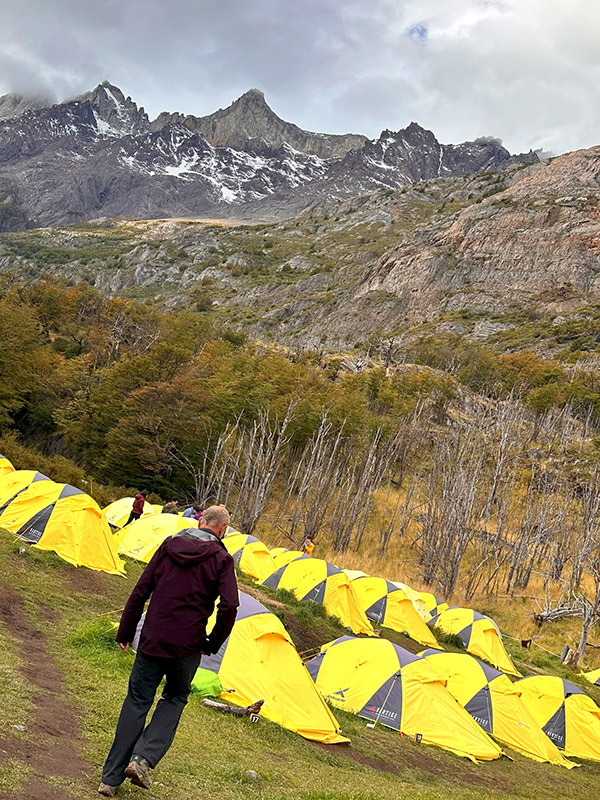
When we arrived, Paine Grande felt massive. Easily the largest Refugio we had seen, it sprawled at the base of the mountains, surrounded by a wide field dotted with rows of identical lemon-yellow tents, each fluttering in the wind like wildflowers stitched into the grass.  The bright, bold color was almost joyful, defiant against the gray sky and rugged peaks surrounding it.

Inside, the Refugio was warm and bustling. Hikers shuffled in camp slippers and fleece layers, swapping stories and queuing in the cafeteria-style restaurant, trays in hand, hungry in that special way only trail days create.  We claimed our assigned table, plates piled with pasta and warm bread, our bodies already loosening in the glow of arrival.

After dinner, like every night on the W, we headed to the Refugio bar. It had quickly become our ritual: wine, cold Patagonian beer, or a celebratory pisco sour, frothy, citrus-bright, the perfect end to the day.  That night, sipping wine with my knee gingerly stretched beneath the table, something in me settled.  I was in a place that felt unreal, wild, remote, and somehow tender, with a man whose gaze held warmth and love.  This shared journey deepened our understanding of each other and quietly strengthened our bond.  Gratitude settled beside me, humbled by the magic of the moment.


Join our Facebook ExNotes page!


Never miss an ExNotes blog:


Help us keep the lights on:


Don’t forget: Visit our advertisers!


Patagonia, Part 1: Southbound

By Bobbie Surber

Some trips are booked on a whim. Others are slow-brewing obsessions. For me, Patagonia was both myth and magnet—pulling at me for over a decade until, finally, I said yes.

From the rhythm of Santiago to the wild edge of Torres del Paine, onward to the granite spires of Fitz Roy, and finally to the end of the world in Ushuaia – this journey began long before the first step.

Some dreams grow slowly, quiet things that live inside you for years, waiting for the right season. In the spring of 2025, I finally answered Patagonia, a land that had lived in my imagination for over a decade.

This five-part series is a love letter to that journey: the W Trek in Torres del Paine, the trail to Fitz Roy, epic glaciers, the emotional and raw beauty of our stay in a turn-of-the-century estancia, and the weeks of awe, grit, and the stillness in between. But before it began, it started here—with four grounding, soul-resetting days in Santiago.

Santiago: A Soft Landing in the South

We arrived on a warm March evening, a little weary from 24 hours of travel. It was our first time traveling in the southern hemisphere together, and the city welcomed us with a gentle kind of grandeur – equal parts aged colonial elegance, unique barrios, and the Andes rising in the distance like a promise.

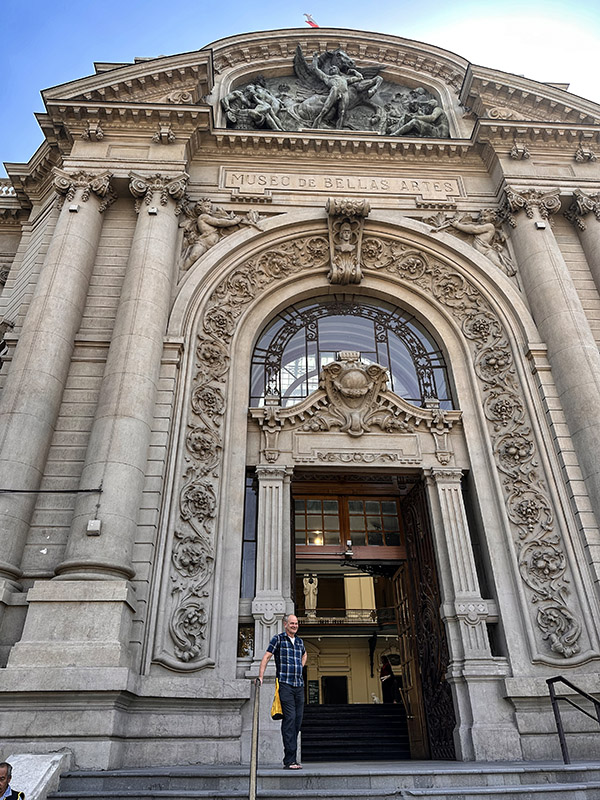
Santiago surprised me. I expected a pleasant stopover in a city I had yet to explore, but what we found was something deeper: a soulful pause. The city is a seamless blend of past and present – where the Metropolitan Cathedral anchors Plaza de Armas with 18th-century dignity, and just a few blocks away, the creative heartbeat of Barrio Lastarria pulses through cobbled streets lined with wine bars, coffee shops, pisco bars, bookstores, and tucked-away galleries.

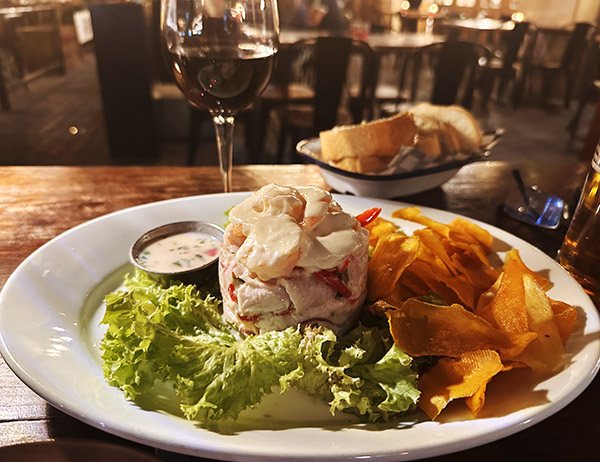
We gave ourselves four full days to settle in, slow down, and breathe before the hard miles ahead. We wandered without a plan through Santiago’s romantic, tree-lined streets, lingered over café con leche, and sampled seafood so fresh it felt like the ocean hadn’t even noticed it was missing yet.

We ate slowly, laughed easily, and always – always – had room for a round (or two, or three) of Pisco Sours. There’s something about their sharp, citrusy kick and frothy top that made us pause mid-conversation just to savor. We debated in earnest the merits of Chilean vs. Argentine piscos – aged in sherry flasks vs. clear and youthful expressions. They became a little ritual we both looked forward to at the end of each day.

At night, Barrio Lastarria – our temporary home – transformed. Crowds gathered in the streets as fire dancers performed to the rhythm of drums, laughter, and clapping hands. It felt like a celebration – not just of the city, but of being alive, present, and open to whatever might come next.

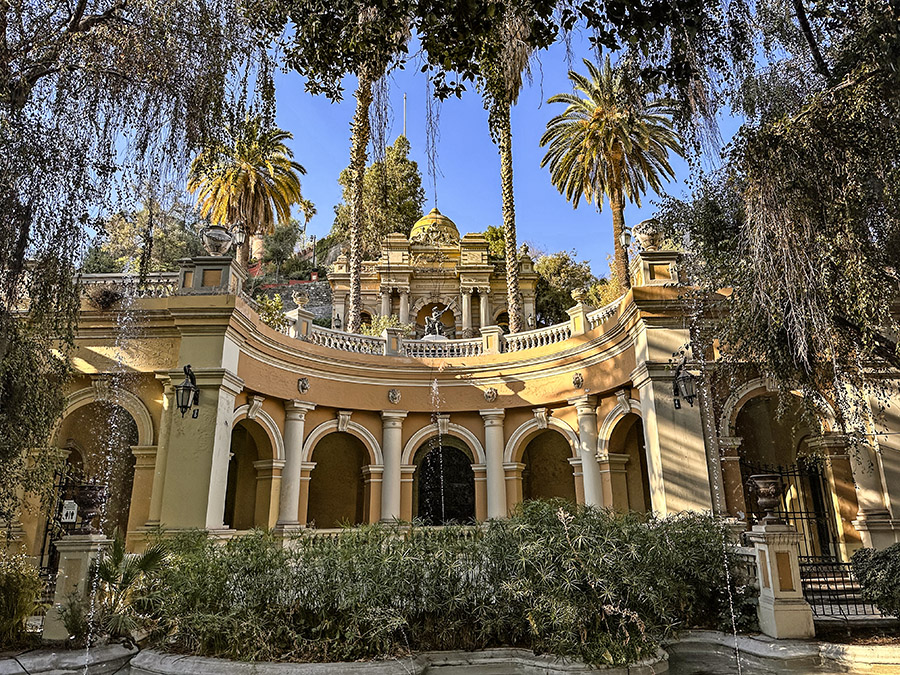
One golden afternoon, after a locals’ lunch from the nearby green market, we climbed Cerro Santa Lucía, the small hill where Santiago was founded. From the top, the view stretched beyond colonial rooftops and high-rise towers to the distant edge of the Andes. The wind caught my hair, and I stood quietly, thinking: It’s all really happening.

Santiago didn’t rush us. She cradled us in her warmth and rhythm – and without even trying, helped me remember why we came. She held the silence between what I was leaving behind and the transformative journey ahead.

Packing, Repacking, and Trusting the Journey

When we weren’t exploring the city, I was sprawled across the Airbnb floor, turning our room into a staging ground for our gear. Santiago’s quiet charm and youthful energy balanced the task at hand: preparing for the wilderness ahead.

I repacked my backpack more times than I want to admit – agonizing over every ounce.

Do I really need a second base layer?
Will this hold up to Patagonia’s infamous wind?
Are we actually ready for what’s coming?

Eventually, I stopped trying to pack perfectly and started packing with intention – and trust. The truth is nothing can fully prepare you for Patagonia’s rawness. At some point, you just have to take a leap of faith and go.

Flying South: The Landscape Begins to Shift

From Santiago, we boarded a flight to Puerto Natales, Chile – the gateway to Torres del Paine National Park. As the plane sliced its way southward, the landscape shifted – flat plains giving way to jagged peaks, glacier-fed rivers, and a coastline shaped by wind and time.

Puerto Natales welcomed us with its signature mix of remoteness and warmth. It’s a small, rugged town perched along the edge of Seno Última Esperanza – the Last Hope Sound, a stunning fjord that reaches inland from the Pacific Ocean. With snow-dusted peaks in the distance and steel-gray water stretching out before us, it felt like we had reached the last outpost before stepping off the map.

Colorful corrugated metal buildings lined the streets, most weatherworn but vibrant, standing defiant against Patagonia’s legendary wind. The town is modest but full of charm – local cafés, gear shops, friendly bakeries, and hostels nestled between homes and small restaurants. Everything feels like it belongs here – resilient, practical, but with soft edges.

After a 30-minute shuttle journey from the airport, we checked into our hotel for the next two nights. Our room sat just a short walk from the water’s edge, where fishing boats rocked gently in the inlet and clouds drifted low across the mountains beyond. The cold air felt cleaner, sharper – like the world had been distilled to its purest elements: rock, wind, water, sky.

That evening, Tom and I bundled up and walked along the costanera, the long waterfront promenade that hugs the fjord. The sky was moody and low with clouds, the wind tugging at our jackets. Seabirds dipped low over the water. In the distance, the silhouette of the mountains we came for was just barely visible, blurred and waiting.

We didn’t speak much. We didn’t need to. We were here. The adventure was about to start.

What’s Next: Hiking the W Trek

In Part 2, I’ll take you inside our six-day trek through Torres del Paine: past hanging glaciers, through lenga forests, clomping up to the famous Towers – a dream I’ve held so long come true – ending along the windswept shores of Lago Grey. It was a hike that tested us, shaped us, and left us completely in awe.

If you’ve ever dreamed of Patagonia – or are planning your own trek – drop a comment or question below. I’d love to hear from you.

Patagonia Prep Tips

If Patagonia is on your list – or already on your calendar – here are a few tips from our experience that might help you prepare, both practically and mentally:

      1. Ease into it with Santiago.  Give yourself 2–3 days in Santiago to rest, adjust to the time zone, and mentally downshift. Patagonia can be physically demanding, so it’s worth arriving grounded. Plus, Santiago is a beautiful, underrated city full of soul, food, and architecture.
      2. Pack for all four seasons.  The weather in Patagonia is famously unpredictable – you can experience sun, sleet, hail, and 50mph winds all in a single day. Prioritize a quality waterproof shell (jacket and pants), a layering system (base layers, fleece, insulated puffy), windproof gloves and a beanie, and trail runners or hiking boots that are well broken-in.
      3. Repack with intention, not perfection. You will overthink your gear (everyone does). Don’t aim for flawless – aim for flexibility. Trust that you’ll adapt on the trail. Patagonia will shake loose whatever you didn’t need anyway.
      4. Download maps and offline essentials. Many areas in Patagonia have little to no cell service. Download maps on Maps.me or Gaia GPS, as well as offline translations (Spanish), weather apps, and your itinerary. Print any confirmations – especially for Refugio’s or border crossings.
      5. Carry both cash and cards.  While larger towns accept credit cards, many places in Patagonia – including transport, markets, and smaller cafés – prefer Chilean or Argentine pesos in cash. ATMs can be unreliable, so plan ahead.
      6. Train your body for multi-day hikes. If you’re doing the W Trek or Fitz Roy trails, it helps to prepare with at least a few local hikes beforehand, especially back-to-back days. Work on carrying a loaded pack for long distances.
      7. Prepare mentally for the elements.  Patagonia rewards patience, grit, and presence. Some days are full of awe. Others are full of wind and sore feet. You may not always get postcard views – but the rawness is part of what makes it unforgettable.
      8. Early Reservations.  For Torres Del Paine Park you will need to make early reservations  for your camping or lodging. You cannot enter the park without showing your lodging confirmation.

Join our Facebook ExNotes page!


Never miss an ExNotes blog:


Help us keep the lights on:


Don’t forget: Visit our advertisers!