
By Joe Berk
In the early days of the COVID pandemic, I bought a box of 500 240-grain cast lead .44 bullets from a reputable bullet supplier.
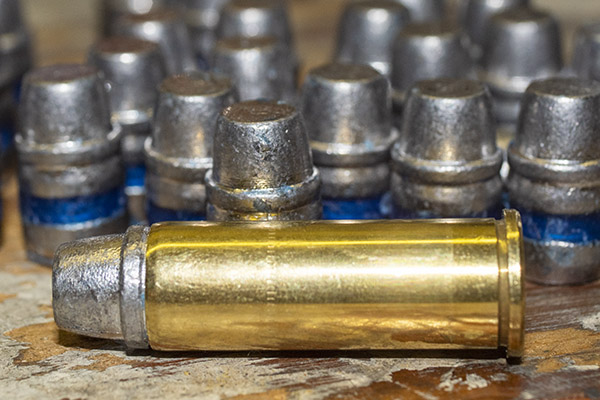
When I opened the box to start loading these bullets, I was dismayed to see that the bullet bases were not clean. Most were plagued by excess lead that had flowed beyond the bullet’s beveled base. The conventional wisdom has always been that any deformations to a bullet’s base will degrade accuracy, so I was disappointed when I saw these.
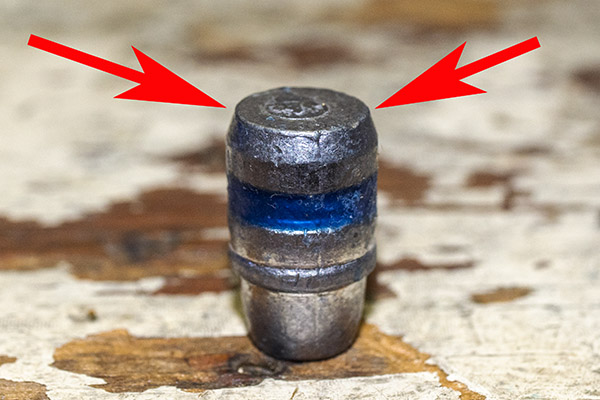
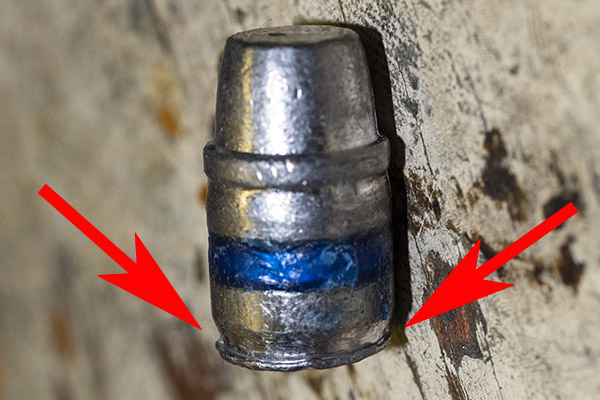
I contacted the manufacturer (whose bullets I had been using for many years) by email and asked if such bullets met their quality requirements. I included a picture of one of the deformed bullets. The manufacturer’s response was immediate: No, those bullets were not acceptable. They do not meet our quality requirements.
The manufacturer then went on to say they had previously been aware of this lot escaping, they had traced it to a particular inspector, and he was no longer with the company. I probably would have jacked up the inspector a bit, and I would have seriously jacked up the operator instead. After all, it was the operator who made the bad product. The manufacturer also promised to send me a new box of bullets, and shortly thereafter, they arrived.
I put the box of defective bullets on a shelf under my reloading bench and forgot about them for the next several years. Recently, while poking around under the bench, I came across them again. It’s always exciting to find forgotten stuff down there, and I half expect to come across Jimmy Hoffa someday hiding behind a coffee can full of .45 ACP brass. As I looked at the box of bullets, I wondered: Are they really defective? Would they shoot well enough for my purposes?
You can guess where this story is going. I decided to test good versus bad bullets. While I was at it, I decided to also test the effects of powder position within the cartridge case on velocity and accuracy (more about this a bit further down).
Deformed Bullet Base Accuracy and Velocity Testing
The first step involved sorting good bullets from bad. Most of the 500 bullets had deformed bases, but I was able to find 20 bullets with relatively clean (i.e., no excess lead flow) bases. I then selected the worst of the deformed bullets. I loaded 40 cartridges with 5.9 grains of Alliant’s Red Dot propellant (it was what I found to be a good load for the .45 Colt, it was in the range of propellant weight my manuals suggested for Red Dot in the .44 magnum, and I already had the powder dispenser adjusted to drop 5.9 grain from a batch of .45 Colt I had just finished loading). This would allow for firing four groups of five shots each with the deformed bullets, and another four groups of five shots each with the good bullets. It was a large enough sample size to allow making a quantified comparison of good versus bad bullets’ effects on accuracy.
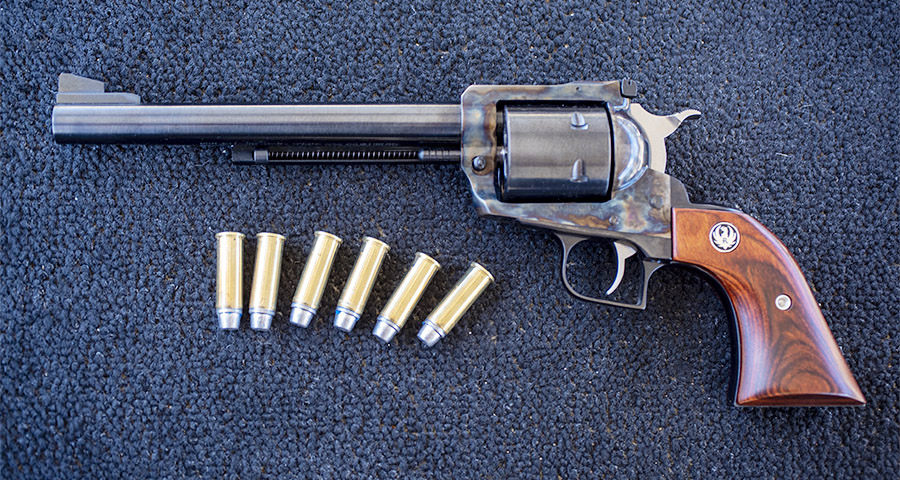
For this testing, I used mini-silhouette Alco targets at distance of 50 feet (you’ve seen me use these targets for other handgun accuracy testing). I shot my Turnbull Super Blackhawk, a superb and elegant .44 Magnum revolver (it’s the handgun you see at the top of this blog). I captured velocity information with my Garmin chronograph. All loads used once-fired Remington brass and the CCI 300 primer, and all were loading using Lee’s superb Classic Turret Press and Lee dies.
Here’s a typical target:
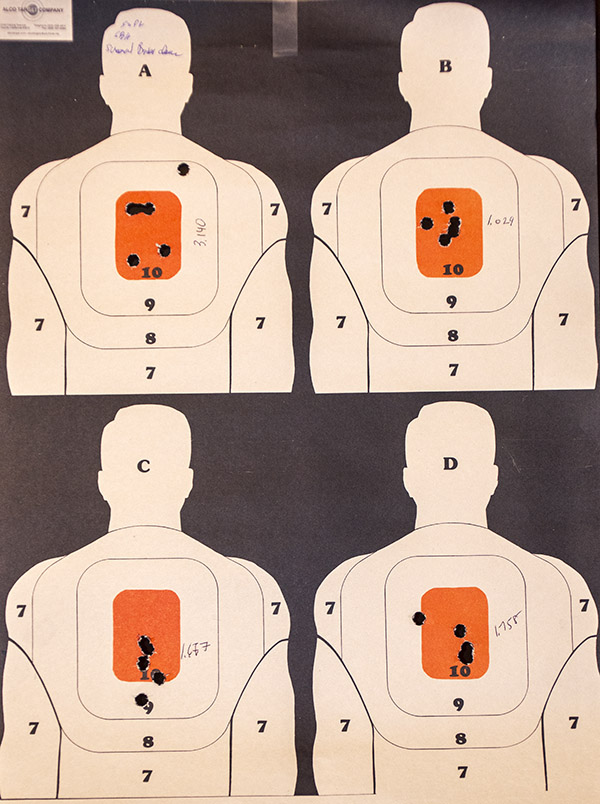
So what were the results? Here’s what I found assessing the bullets with defective bases versus those with relatively clean bases:

Based on the average group size comparison between the good bullets versus the defective base bullets, the good ones group better than the bad ones (even at the short test distance of 50 feet). The good bullets grouped, on average, 1.901 inches; the ones with defective bases had an average group size of 2.432 inches. That’s a 28% accuracy degradation for the bullets with defective bases.
The muzzle velocity difference between the two groups of bullets is not very significant, with an average velocity in the 970 feet per second range and a relatively small standard deviation of only around 19 feet per second. This is a good load.
Powder Position Accuracy and Velocity Test
There’s a concern that powder position within the case will affect both accuracy and velocity. The conventional wisdom holds that if the powder is close to the bullet (instead of the primer), the cartridge will behave differently than if the powder is close to the primer (or so the theory goes). It is thought this affects both accuracy and velocity. I tested this parameter, too.
I had another 40 rounds to do the same kind of testing as described above for the bullet base testing. I did not sort the bullets this time. For the first 20 rounds, I pointed the muzzle down (to position the powder more near the bullet) prior to firing. For the second 20 rounds, I pointed the muzzle up (to position the powder more near the primer) prior to firing. I did this to assess both accuracy and velocity.
5.9 grains of Red Dot does not fill a .44 magnum case; it instead occupies about 70% of the case volume. When the bullet is seated in the case, that 5.9 grains fills even more of the available case volume because the bullet occupies a portion of the case above the powder.
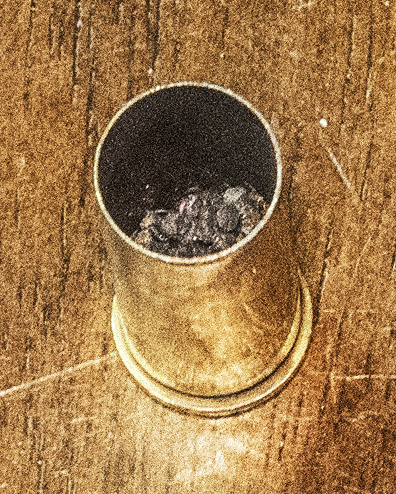
There is a little space available (5.9 grains is not a compressed load), and the powder in the case can be biased toward the bullet or toward the primer. Would this make a difference in either accuracy or velocity? The test results here show positioning doesn’t make much of a difference:

As you can see from examining the above data, the group size difference between the two approaches is not very large, and can probably be accounted for by variability in my shooting. There is a small difference in average velocities, but it’s probably insignificant.
I think what’s going on is that because Red Dot is a somewhat fluffy powder, it occupies enough of the case volume that it doesn’t make any difference which way the powder is situation in the case when it fires. It might make more sense to repeat this experiment with a denser powder like Bullseye, which occupies much less of the case volume. I may get around to that one of these days. What this test says to me is that 5.9 grains of Red Dot behind a 240-grain cast semi-wadcutter bullet is a good load in the .44 Magnum. It’s even better when the bullet bases are not deformed.
More gun stuff? You bet. Buy yourself (or a friend) a copy of The Gatling Gun.

Join our Facebook ExNotes page!
Never miss an ExNotes blog: