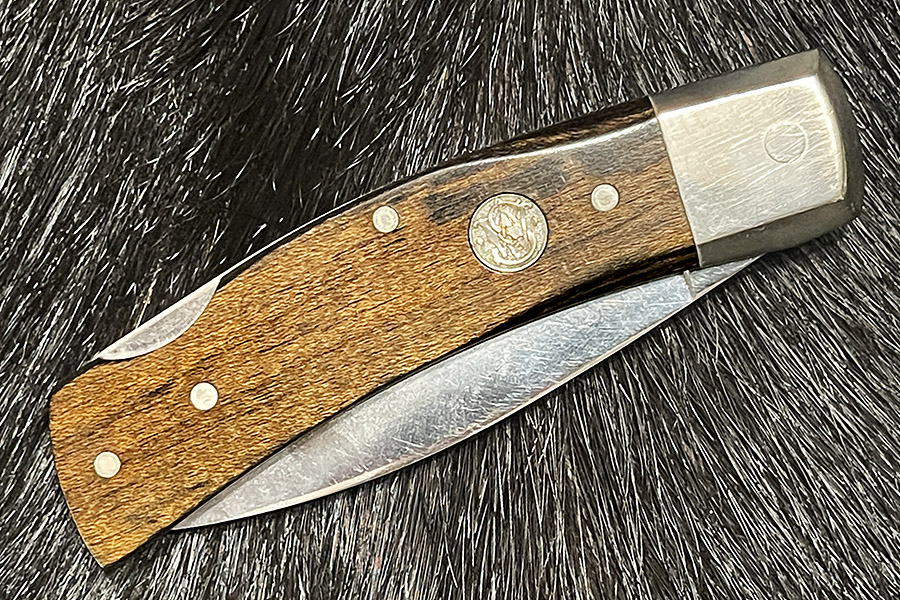
S&W Model 6060 Folding Hunter

By Joe Berk

One of the more interesting folding hunter knives I own is a Smith and Wesson Model 6060.
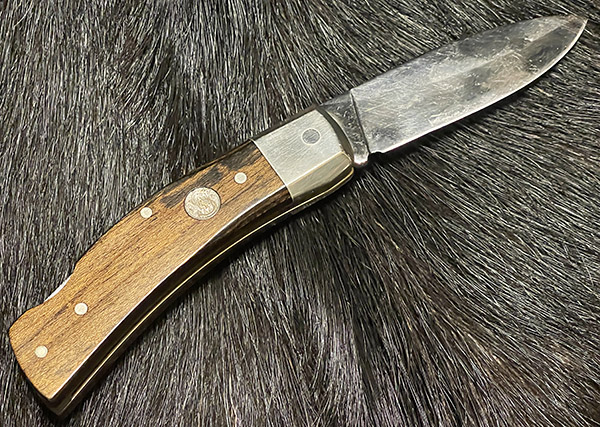
My Model 6060 Smith and Wesson folding hunter. My father gave it to me in 1974.

The Smith and Wesson 6060 entered production in 1974.  It’s been out of production for decades.  An interesting fact is that it was never manufactured by Smith and Wesson (more on that in a minute).

I’ve been a bad influence most of my life, and one of the guys I influenced most was my father.  As a kid and as a young man, I’d get an interest in something and then Dad would, too.  The list is long:  Slot cars, Lionel trains, archery, motorcycles, handguns, VW Beetles, CB radios, and probably a few other things.  Don’t get me wrong; the influence thing was not a one-way street.  Marty Berk influenced me a lot, too, and in many different areas (if you doubt this, take a look at the 1,800+ blogs that preceded this one).

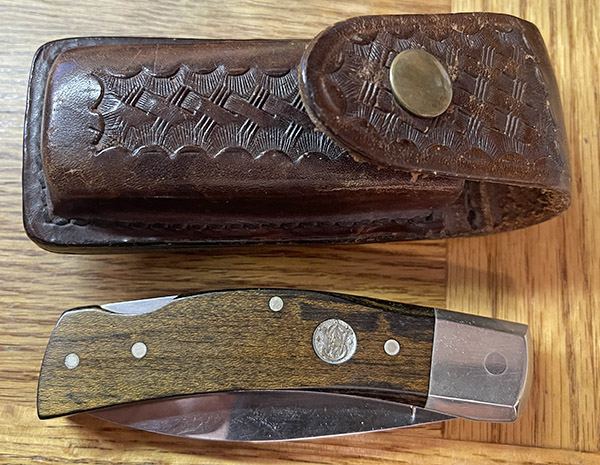
In the summer of 1974 I was in the U.S. Army and I had orders to Korea. I was on a Smith and Wesson kick, and my brand loyalty more or less drifted over to my father.  Dad had friends in high places in the gun world (he was a world class trapshooter), and one of those friends included a firearms distributor.  That gave us access to a lot of the hard-to-obtain Smith and Wessons, such as uber-cool Model 29s (in the wake of Dirty Harry, they were just about impossible to get; we bought three of them).  The Smith and Wesson magic dust fell upon us, and in addition to those big revolvers, we picked up a lot of Smith and Wesson branded merchandise.  Dad bought a Smith and Wesson folding knife (their Model 6060), and he gave it to me before I shipped out for Korea.  It was a nice knife.  It came with an embossed leather sheath. I think I still have the original Smith and Wesson box and papers, too (they are around here somewhere, although it would probably take me a day to find them).
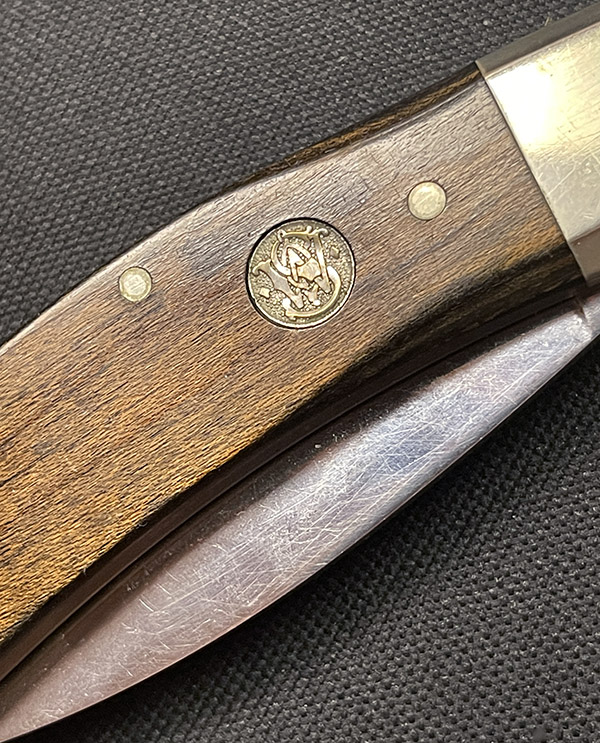
Wesson wood scales (as they were called), and that beautiful nickel-plated S&W grip medallion.
The Model 6060 and its original sheath, which is still in excellent condition.

Smith and Wesson’s Model 6060 Folding Hunter knife was designed by Blackie Collins in 1972.  Walter Wells “Blackie” Collins (1939 – July 20, 2011) was a prolific knife designer who was killed in a single-vehicle North Carolina motorcycle accident.   He was an icon in the knife world.
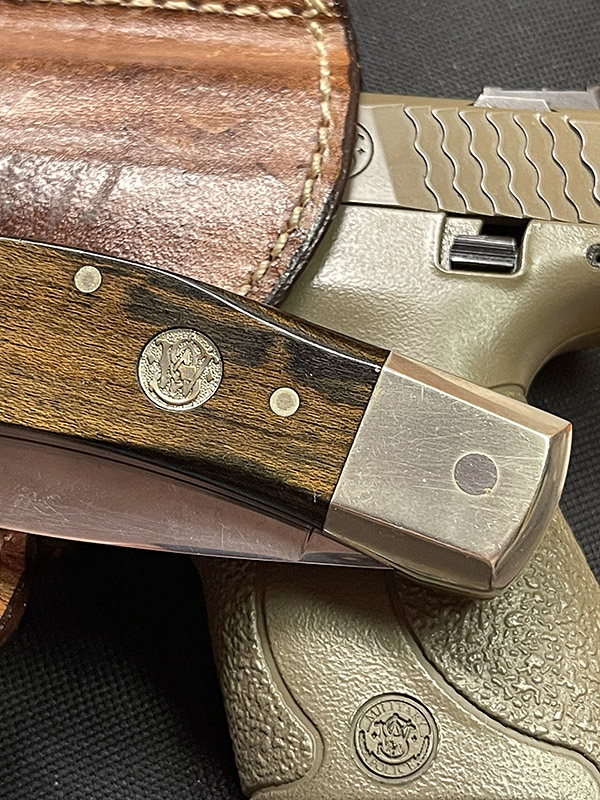
Two Smith and Wessons; two grip medallions two generations apart. The world was a better place in the 1970s, I think.

Smith and Wesson wasn’t set up to make knives and they had no intention of ever doing so (in fact, they couldn’t keep up with demand for their revolvers), so they contracted with three different knife manufacturers to make the Model 6060: Alcas, Bowen, and the Carolina Knife Company.  Most of the Model 6060s were made by Alcas, a knife company formed by Alcoa and Case (hence the name, Alcas).  I believe my knife was most likely manufactured by Alcas, as the Carolina Knife Company produced only 35 custom knives (with special scale materials, like ivory and such).  A few of the standard Model 6060s were made by Bowen, but it would take an expert to determine if mine was (there were differences in the finish of some internal components between Bowen-manufactured knives versus Alcas knives).  Bowen didn’t make nearly as many Model 6060s as did Alcas, so  I’m sticking with my conclusion that Alcas made my knife.

The Model 6060 went out of production in 1979, after a production run of approximately 35,000 knives.  To put that in perspective, Buck has manufactured approximately 15 million Buck 110 knives since it started making them in 1964.
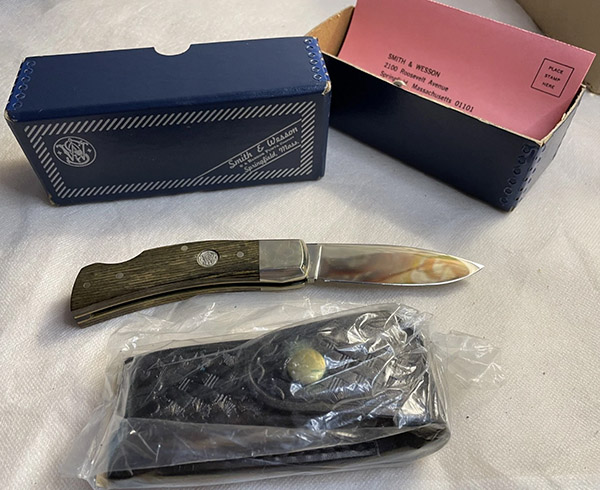
A photo from the Ebay Model 6060. I pulled the trigger on it while writing this blog.

The Model 6060 retailed for a surprisingly high $200 when new, and in the 1970s that was the price was for an N-frame Smith and Wesson revolver (in other words, it was a lot of money).  Smith was cruising on their Dirty Harry exclusivity and brand recognition.  You can still buy a used Model 6060 on Ebay and from other outlets, with prices starting at $95.  I saw a new one listed with the original box and all the papers for $149 while researching the Model 6060 for this blog.  Even though I already have a Model 6060, that was too tempting to let go by.  Yep, I bought it, and now I have two.

My Model 6060, as explained above, was a gift from Dad.  I wore it during most of my tour in Korea.  I have an emotional attachment to my Model 6060 and I’ll never part with it.

The Smith and Wesson Model 6060 knives are good; I think every bit as good as a Buck 110 used to be, and better than what is coming off the Buck line today.  Owning the Model 6060 has a certain coolness associated with it, but most folks probably don’t know that.  I sure do, and now you do, too.

Buck, Cold Steel, and Chinese vs US Quality

By Joe Berk

The pocketknife craze continues unabated, and I am finding that in my collecting I am stabilizing around the idea of the large folding hunter style knife.  These are commonly referred to as a Buck knife, even though many similar available knives are not manufactured by Buck.

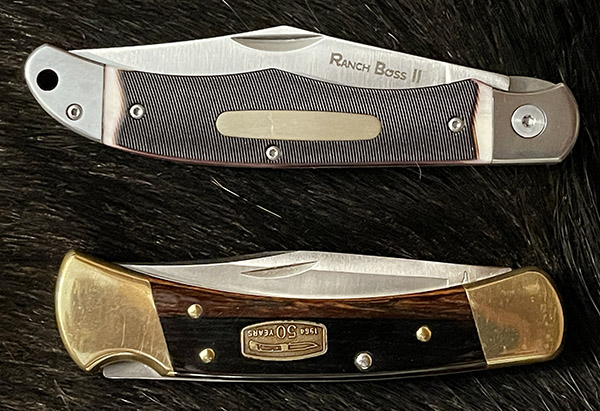
A Cold Steel Ranch Boss II (top) and a Buck 110 (bottom). The Cold Steel is a big knife.

Don’t get the word Buck confused with deer hunting, as if someone armed with a Buck knife is going to chase down Bambi for a knife fight.  The “Buck” in Buck Knife is actually the name of the man who founded the company, and that company is in Post Falls, Idaho (a stone’s throw from the Canadian border).  I know that because I recently chatted with a guy there.

What most of us think of when we think of a Buck knife is the Buck 110, the classic folding hunter knife style.   The idea Buck had back in the early 1960s was to create a folding knife (like a pocketknife) that could do the same thing as a fixed blade hunting knife.  Buck envisioned a folder with a thicker 3.75-inch-long blade that locked securely in place when opened.  The concept was that it would be able to do things a hunting knife could do (like skin and dress game animals).  The Buck 110 style (the large folding hunter) has been widely copied and the term “Buck knife” is often used describe any large folding knife (like Kleenex is used for tissues and Xerox means making a copy).

I like the Buck 110 a lot and I’ve written about my custom Buck before, so when I recently saw an ad for an “automatic” Buck 110, I was hooked.  An automatic knife is what we used to call a switchblade.  You know, like in West Side Story.  That would be cool.  I liked that movie and I always wanted a switchblade.  The automatic Buck 110 would scratch that itch.   When I received an email from Chicago Knife Works offering the Buck 110 automatic for a measly $153, I was in.

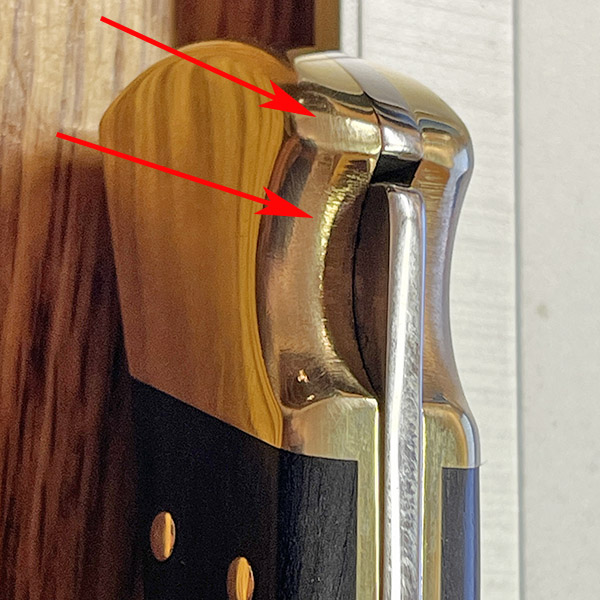
A week later my switchblade arrived.  I wasn’t happy with it.  The bolster cutouts around the blade lock had tool marks.  They weren’t mirror polished like they are on my other Bucks.  It bothered me, so I called Buck Knife’s customer service.

Tool marks on the Buck 110 automatic. You might expect this on a cheap knife, but not on a Buck.

The guy I spoke to at Buck knew exactly what I was talking about.  Buck changed their manufacturing process to remove cost and that’s why the tool marks were there (evidently, I wasn’t the first guy to call with this concern).  I get it.  I’m a guy who spent a career finding ways to reduce manufacturing costs in products ranging from bombs to biomedical devices, so I understood.  But there was still this nagging problem:  I spent $153 on the Buck and I wasn’t happy.  The Buck guy understood that completely without my being a dick about it.  “Send it back in to us,” he said, “and I’ll get it polished out.”  They’re going to engrave my initials on the blade, too.  That’s cool.  A personalized switchblade.  I felt even better when I went on the Chicago Knife website later that day and learned they had bumped the price of the knife I just bought from $153 to $199.  Wow.  It’s those Idaho tariffs, I guess.

The fact that I like pocketknives is out there now.  Siri has been listening and I’ve been on a lot of knife websites.  I get emails every day from companies selling knives.

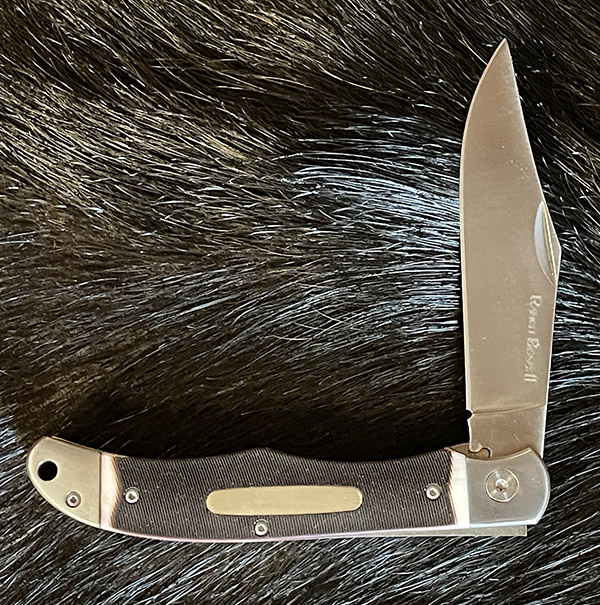
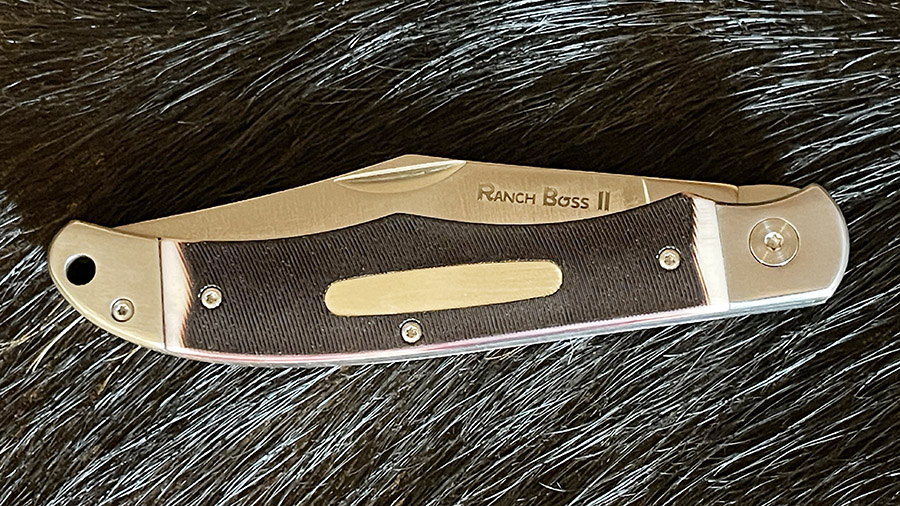
The Ranch Boss II knife. It has a nice look and feel. I like it.

One of the emails that caught my attention was from good buddy Jeff Bezos.  It was for a Cold Steel Ranch Boss II that looked a lot like a Buck.  I guess I missed the Ranch Boss I (I came to the pocketknife craze late in life).  The Ranch Boss.  I like the name.  I especially like the price: $39.   Cold Steel.  I like that name, too.  There is a unit in the US Army (Charlie Company, 1st Battalion, 6th Infantry Regiment) called Cold Steel Charlie, so named for their heroism and lethality.  The marketing guys at Cold Steel ought to get a raise for that bit of branding genius.  It sure worked its magic on me.

Amazon didn’t try to hide that the Cold Steel Ranch Boss II is manufactured in China.  That didn’t bother me.  I know from my CSC days and my many visits to Zongshen, Zebra, and other Chinese companies that there are companies in China making good products.  The Ranch Boss.  It has a John Wayne vibe.  I could be a Ranch Boss.  The Marlboro Man theme song played in my head.  Ranch Boss.  Yep, that’s me.

In the email and on Amazon, the Ranch Boss looked like a big, heavy folding hunter.  $39.  Complete with holster.  Man, $39.  That’s a sandwich with a beer these days.  Buy now, and I could have it the next day.  Yeah, it’s Chinese, and a real Buck is made in Idaho, but hey: $39.  Buy now, Baby!

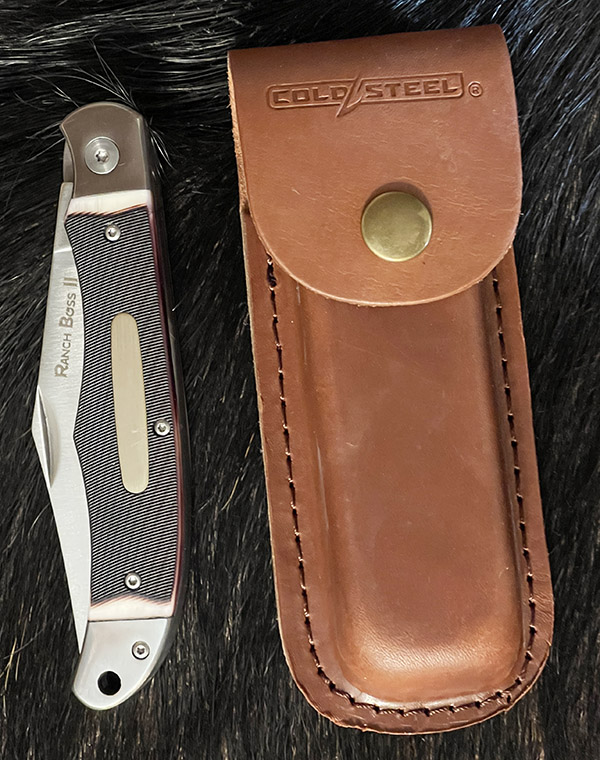
The Ranch Boss II knife is sold with and without the case. When I bought mine, the price with the case was a few bucks cheaper than the one without the case.

My Cold Steel Ranch Boss folding hunter was on my doorstep when Susie and I returned after our Jameson Motorcycle Museum 800-mile weekend.  That’s one the porch pirates missed.

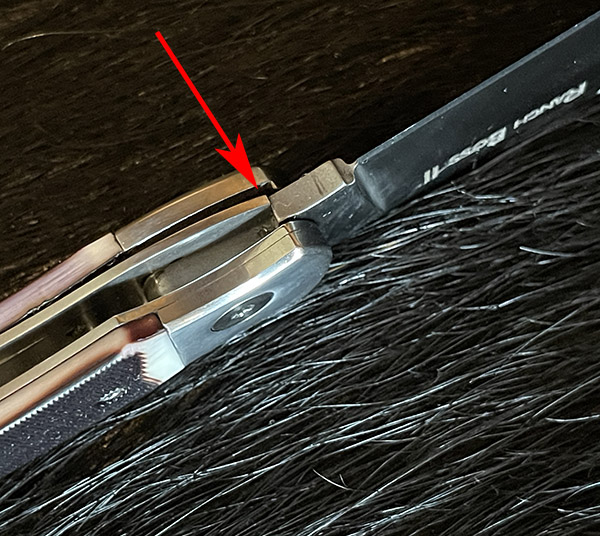
The spring-loaded liner lock. When the blade is opened, the liner lock moves over to prevent it from closing. To close the knife, the liner lock is pushed out of the blade’s way. You need to be careful when doing this.

You know, the Ranch Boss is a nice knife.  It looks and feels good.  It’s actually slightly larger than the Buck 110.  It uses a liner lock instead of the Buck 110 lock design.  The thing is sharp, as in razor sharp.  I like the looks of it.

The finish on both the Buck and the Ranch Boss is brushed stainless steel.  I like that look.  The Buck has polished brass bolsters; the Ranch Boss bolsters are the same brushed stainless steel as the rest of the knife.

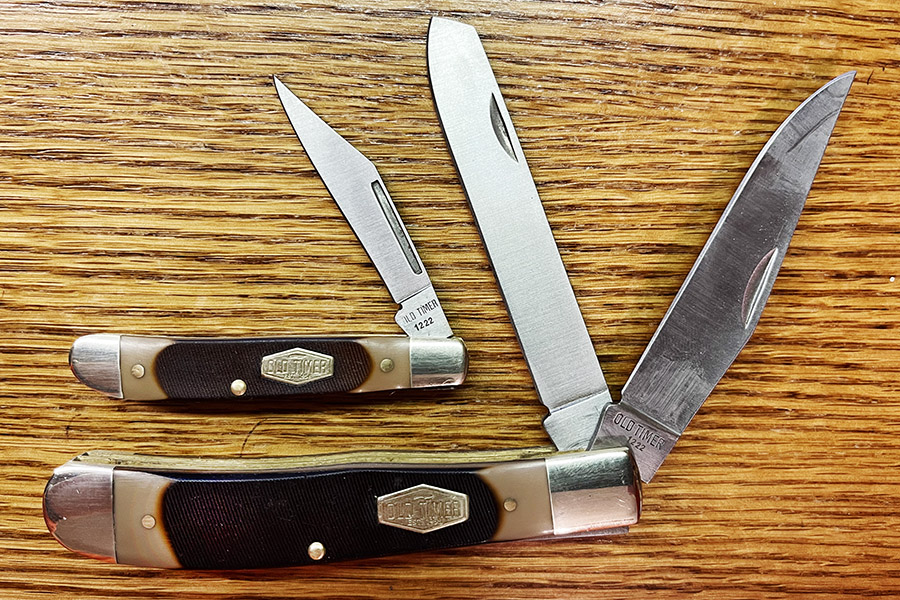
The Buck 110 scales are real ebony wood.  They are riveted in place with brass rivets.   The Ranch Boss scales are fake sawn bone.  I imagine there’s a single supplier providing this material to several knife makers.  I recently picked up an ultra-inexpensive pair of Old Timer Chinese-manufactured pocketknives at (where else?) Walmart.  They were only $25, and the scales on those two knives look identical to those on the Ranch Boss.

Walmart Old Timer pocketknives, sold as a set for around $25. That little one is in my pocket all the time now.  The scales are identical to the Ranch Boss.

I like that the Ranch Boss scales are secured with little Allen bolts instead of rivets.  If I want to craft a set of custom scales of maple or walnut to match one of my six shooters, it will be easier to do than on the Buck.  A real Ranch Boss has to be properly attired, you know.

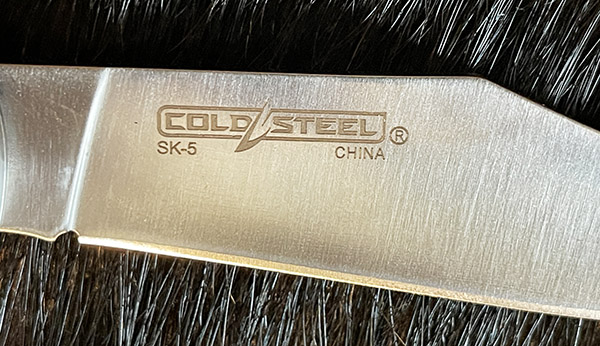
Cold Steel’s SK-5 blade material. The steel is Japanese; the knife is Chinese.

Buck’s standard blade material is 420HC, a tough, corrosion resistant steel that takes a good edge and is easy to sharpen.  The Ranch Boss knife blade is SK-5 steel, a Japanese steel that is well suited (or so I’ve read) for knife blades.  It has good durability and abrasion resistance, and is generally corrosion resistant.  The SK in the designation stands for steel kougu, which translates from the Japanese to “tool steel.”  For my purposes, the differences in steels between the Ranch Boss and the Buck are moot.  I just like looking at the things.

Both the Buck 110 and the Ranch Boss are big knives, with the Ranch Boss being a bit larger than the Buck.   These are not really knives you carry around in your pocket.  They’re cool.

The bottom line here is that I like both knives.  The Cold Steel Ranch Boss II, at $39, is a lot of knife for not a lot of money.  The quality of the Ranch Boss is better, in my opinion, than the Buck.  But Buck is standing behind their product.  I’m eager to see what my Buck 110 Automatic looks like when it is returned from the factory.  I’ll let you know.


Join our Facebook ExNotes page!


Never miss an ExNotes blog:


Help us keep the lights on:


Don’t forget: Visit our advertisers!


The Buck Stopped Here

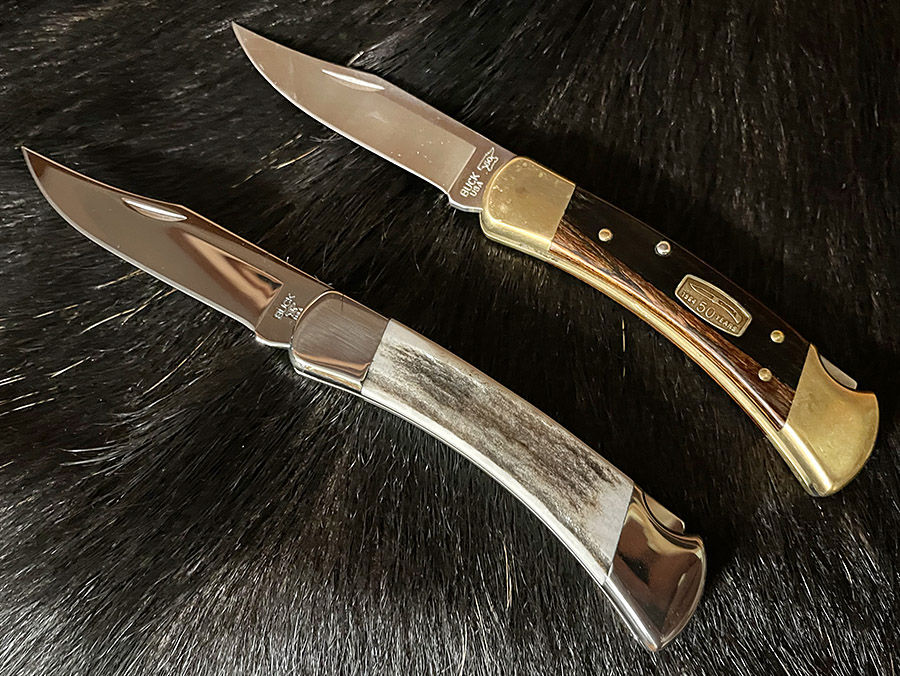
Some time ago I wrote about ordering a custom Buck folding knife.  I’m not a knife guy (many of my friends are).  The hook for me was an ad that floated into my inbox.  I have a regular Buck 110 (an anniversary edition I bought on sale; it’s the other knife you see in the photo above), but I am the guy that marketing types dream about:  Offer a custom feature or two, hit me with an email, and I’m in.

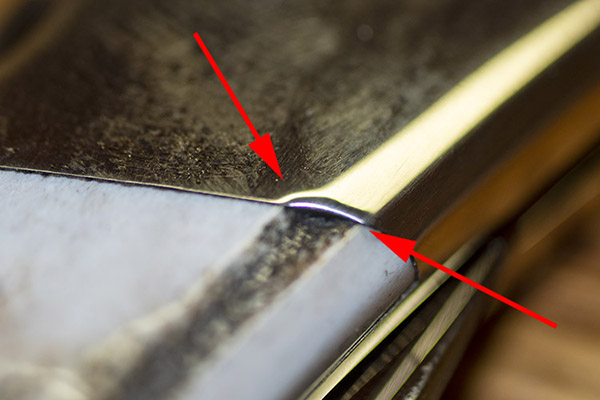
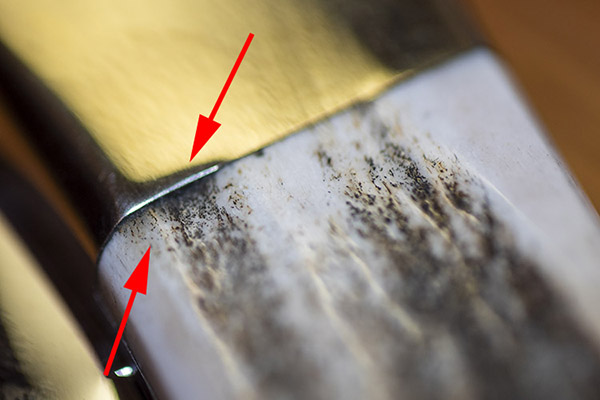
As promised, the lead time was a few weeks.  When it arrived, all was not well.  All priced out, I was into the custom Buck (complete with elk horn grips) for a little under $200.  I liked the look of the elk horn grips, but on my knife the interface between the elk horn natural bark and the bolsters was not good.  Some of the undulations in the horn butted up against the bolsters and it looked cheap.  I realize the grips are a natural material, but I still didn’t like the fit.

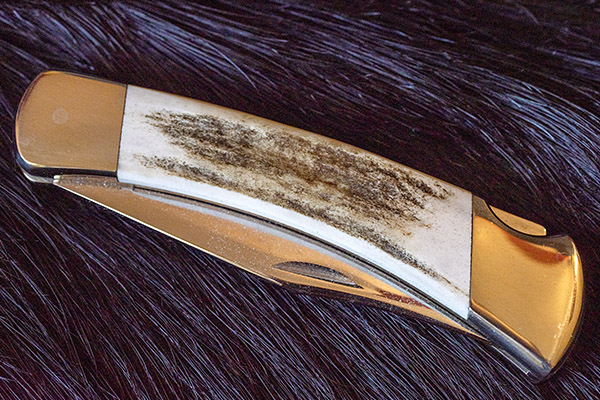
I wrote to Buck, expecting to hear the above as an explanation (i.e., that the grips are natural material), but that wasn’t the case at all.  Buck responded the next day.  Send the knife back, they said, and we’ll make it right.  I did, I had a new knife in about two weeks, and it was perfect.  Buck selected a set of grips that had no bark interfacing with the bolsters, and the intersection was line-to-line everywhere on the knife.  It is a thing of great beauty.

My custom Buck features included a mirror-polished blade, nickel (instead of brass) bolsters, and the elk horn grips I mentioned.  And that blade…wow, it is razor sharp.  The first time I closed it, when the blade completed its arc into the handle the tip caught my finger.  It was so sharp I didn’t even realize it had cut me.  The cut was so clean it healed in only a few days.

There’s more good news to the story.  When you get a custom knife like this from Buck, you also get an official-looking certificate of authenticity, a knife case, and a holster.  Somehow when I returned the knife for the new grips, I accidentally put all that stuff into the trash (which I only realized after Buck returned my knife).  I called Buck and told them what I had done.  I wanted the complete Buck custom knife experience, I told the nice lady on the phone, and she told me “no problem.”  She shipped another set and it arrived a couple of days later, all at no charge.

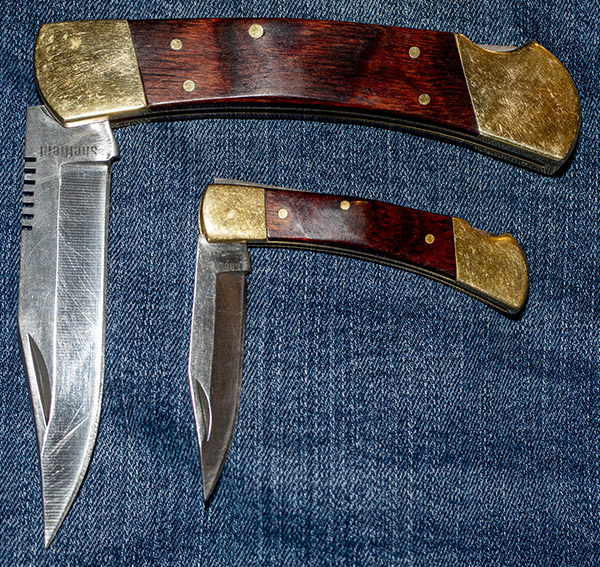
All the above notwithstanding, like I said above, I’m not really a knife guy.  Even though I have the two Bucks shown in the photos above, I don’t carry either one of them.  I have a cheap Chinese copy (and its little brother) I bought at Lowe’s that is the same size and looks almost exactly like the standard Buck 110 folder.  Sacrilege, I know.

The Sheffield name is laser engraved on the Chinese copies, but trust me, they are not from England.  I think I paid $20 for both of them in a bubble-wrap package a few years ago.  Once in a great while I’ll put the smaller one it in my pocket and carry it (even though the package included leather holsters for both), but I can’t remember a single time when I needed it and it was in my pocket.  The big one?  Its primary duty is opening letters.

If you’re thinking of getting a Buck knife, Amazon is a good place to go.  If you’re thinking of an inexpensive Chinese copy, check out Lowe’s.


More product reviews are here.


Never miss an ExNotes blog:


Help us stay sharp:  Please click on those popup ads!