Minnesota’s Split Rock Lighthouse

By Joe Berk

When driving around Lake Superior (and all the Great Lakes), the waters appear to be calm.  At least they do to me, and it feels kind of odd, because  each of the Great Lakes are so big you can’t see the other side.  In other words, from the shore they appear to be as big as the ocean, except there are no waves.   But that’s not always the case.   In stormy weather, the Great Lakes can get rough.  In 1905, just one storm damaged 29 vessels.   You might wonder:  Is there that much shipping on the Great Lakes?  The short answer is yes, and in particular, a lot of iron ore mined in Minnesota went by ship to Wisconsin and other locations.  U.S. Steel alone had 112 ore-carrying ships in 1901.
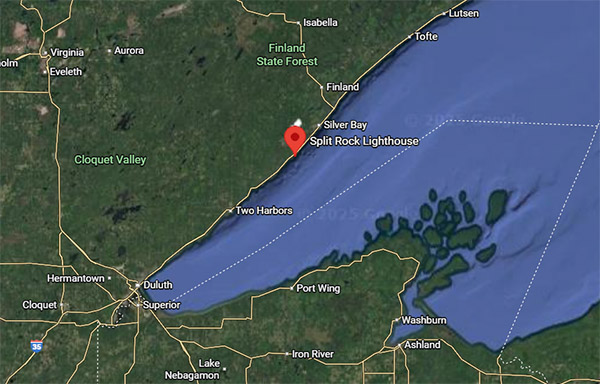
Split Rock’s location along Lake Superior. We rode there from Duluth.

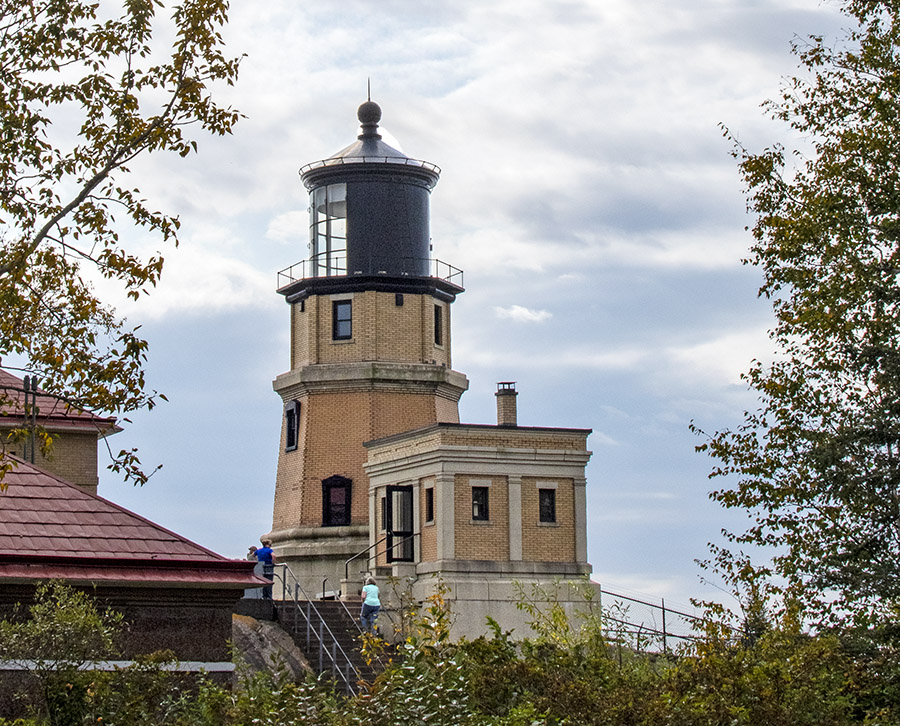
The U.S. Steel president lobbied Washington for a lighthouse along Minnesota’s rocky shoreline, and in 1907 Congress allocated $75,000 to build one.  It became known as the Split Rock Lighthouse because the huge rock upon which it sits has a large vertical cleave.
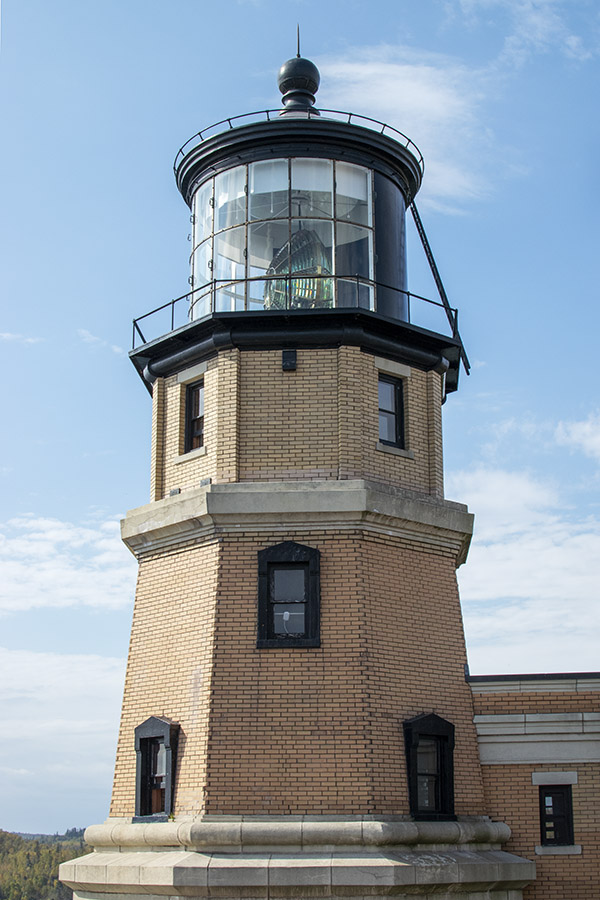
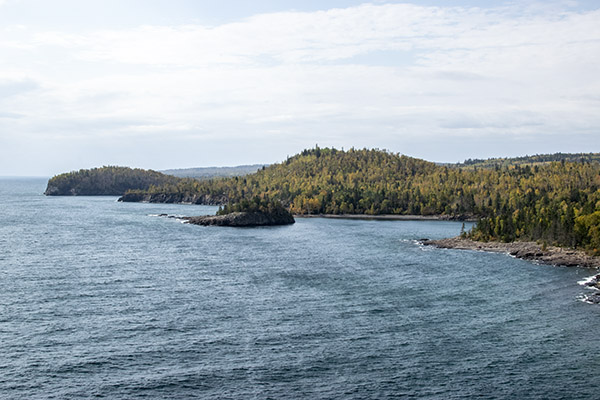
The Split Rock Lighthouse.
A view of the Lake Superior shoreline from atop Split Rock.

Construction started in 1907 and finished in 1910, when the lighthouse was commissioned.   The U.S. Lighthouse Service operated it until 1939, when all U.S. lighthouses came under U.S. Coast Guard.  The Coast Guard is responsible for all lighthouses, but that no longer includes Split Rock.  Split Rock shut down as a navigational aid in 1969.  Other navigation systems such as Long Range Navigation (LORAN) and the Global Positioning System (GPS) now meet that role.  Only five staffed U.S. lighthouses remain in service today; all others have been decommissioned or operate under automated control.
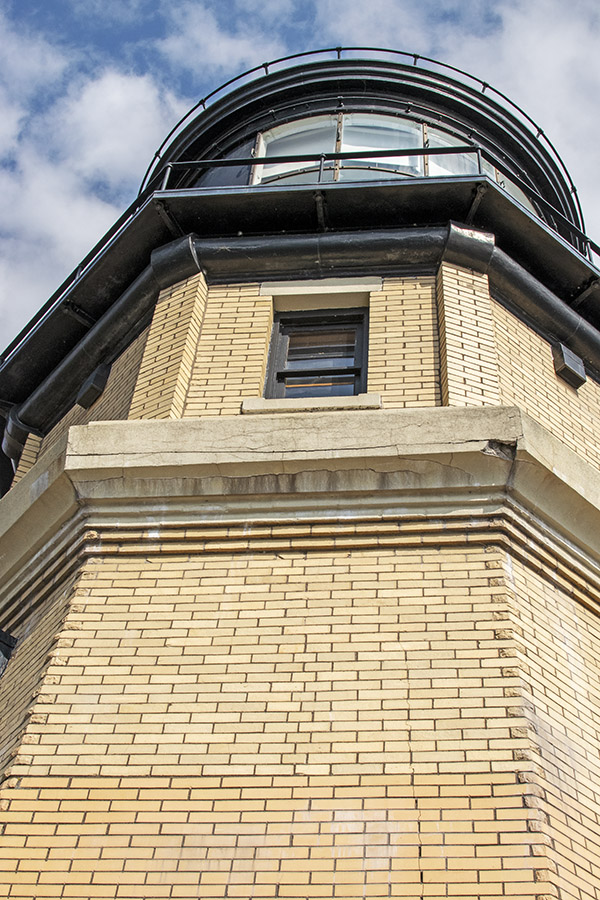
Looking up at the lighthouse tower from its base. I was armed only with my D3300 Nikon and a 35mm 1.8 prime lens. It’s a system you zoom with your feet (i.e., moving closer to or away from the subject). Sometimes there’s not enough room to move around.
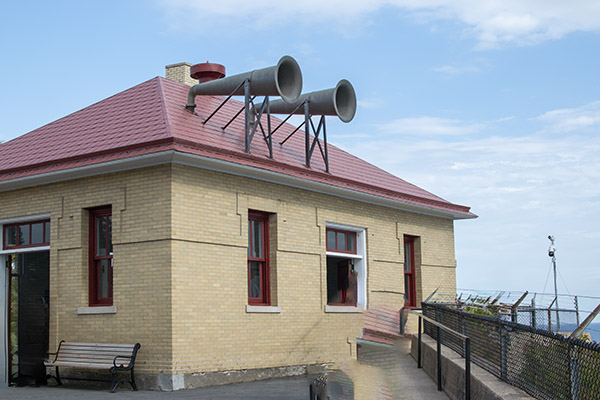
Foghorns atop the foghorn building. When they were operational, they sounded a 2-second blast every 18 seconds. They went out of service in the 1960s. The horns are activated once a year now.
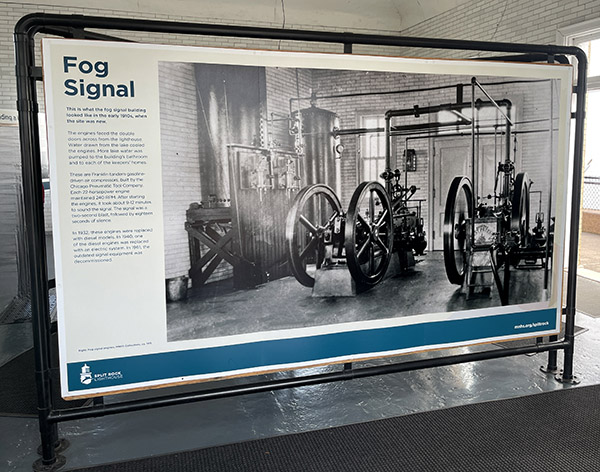
The foghorns were initially powered by two compressors driven by internal combustion engines. Cooling water for the engines was drawn from Lake Superior.

The site transferred to the State of Minnesota in 1971, and in 1976 control shifted to the Minnesota Historical Society.  In 2011, it was designated a National Historic Landmark.
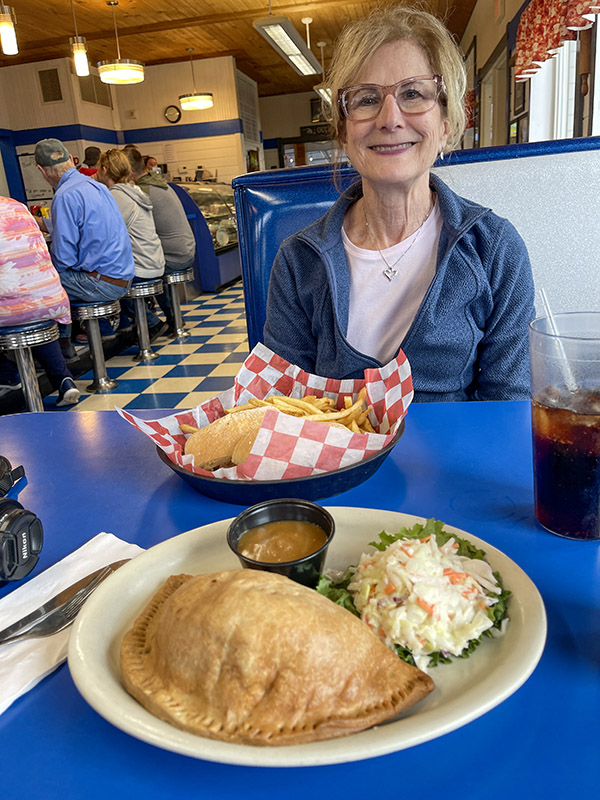
Susie had Betty’s fish and chips; I opted for the caribou chicken pasty. Both were excellent.
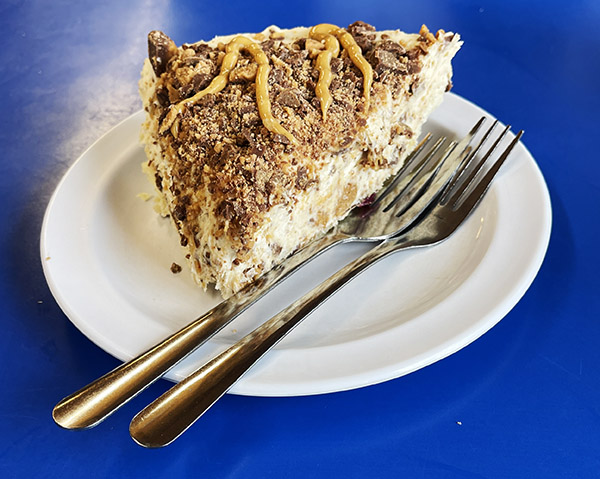
We split a slice of Betty’s toffee cream pie for dessert. It was awesome.

The ride out to the lighthouse from Duluth (where we stayed for a couple of days) was beautiful.  We followed Minnesota 61 north for 47 miles.  It was a beautiful ride along the Lake Superior shoreline.  On the trip north, we notice Betty’s Pies (a restaurant), and we stopped there for dinner on the way back.  There was an hour wait to get in, but it was worth it.

After our dinner, there was a young couple parked next to us on a pair of sports bikes.  The gal was on a nondescript Japanese bike; the guy was on a Triumph Speed Triple (and that definitely caught my attention).    We followed them back along Minnesota Highway 61, and after a few miles they veered left on Scenic Drive (which follows the Lake Superior shoreline much more closely).   That is an appropriate name.  Scenic Drive took us directly into Duluth and our hotel. It was a fun day.


Looking for a great place to ride?   Hey, that’s our specialty.  I write about great Destinations regularly for Motorcycle Classics magazine.  You can read about my favorites here:

Join our Facebook ExNotes page!


Help us keep the lights on:


Don’t forget: Visit our advertisers!


A Frank Lloyd Wright Gas Station

By Joe Berk

Sue and I recently flew to Minnesota as part of Sue’s quest to visit all 50 states. I’d been there a few years ago for a business trip when I worked in the bomb business. We were having problems with a booster for one of munitions, and I visited the factory in Edina to seek assistance in finding the root cause. The factory was underground in an old Nike Hercules missile command center. It was a bit scary, being around all those explosives and the intermittent hisses from the air moisturizers (if the humidity dropped below a certain level, electrostatic discharges could induce inadvertent ignitions, hence the moisturizers).

This trip would involve no such scary bomb factory visits. In fact, there were a lot of cool things we saw in Minnesota. One was a Frank Lloyd Wright gas station.

Without setting out to do so, we’ve become a bit of a Frank Lloyd Wright website. We featured his architecture a couple of times already, once with an article by yours truly about the Fallingwater home in western Pennsylvania, and more recently with Joe Gresh’s recent piece on Taliesen West, the Frank Lloyd Wright desert home in Arizona. Architectural Digest magazine is not looking over its shoulder at ExhaustNotes, but it’s interesting that Mr. Wright’s genius has found its way into a motorcycle and gun blog.

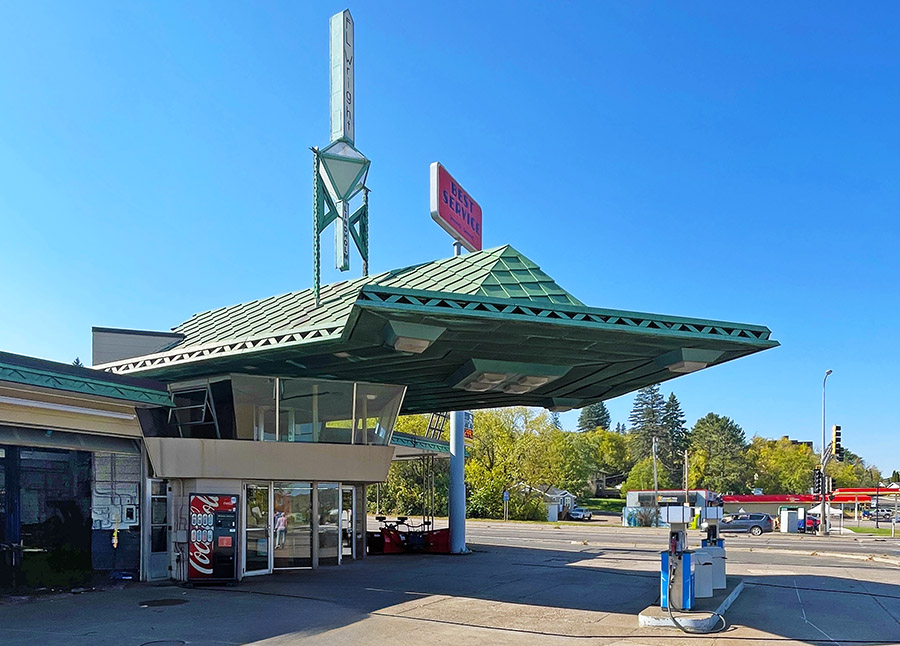
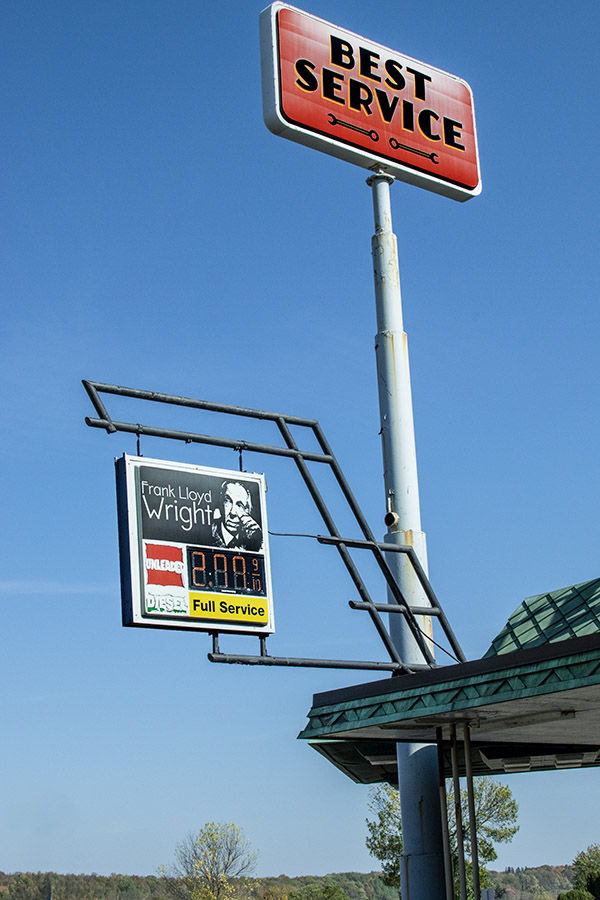
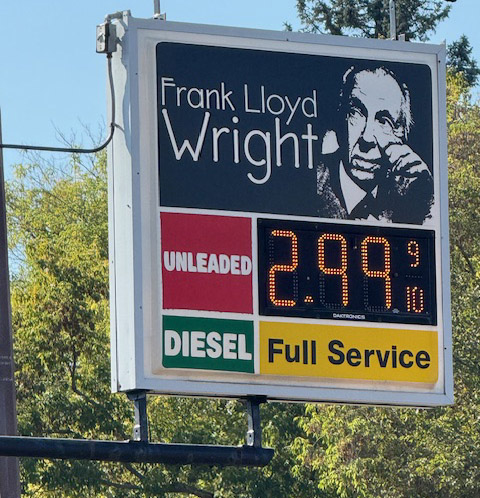
So, about that Frank Lloyd Wright gas station: Sue found it while researching cool things to see in Minnesota. It’s a little out of character for Mr. Wright, you know, designing a gas station. It’s located in the small town of Cloquet. It came about when a guy who worked in the oil biz (a guy with evidently lots of money), one R.W. Lindholm, had Wright design a home in 1952. Lindholm liked it. In fact, he liked it so much that when Wright approached him about designing a gas station, Lindholm agreed. Lindholm wanted to beautify gas station design; Wright wanted to create a gas station that could be used as a community center and gathering place.

If that sounds goofy to you (and it did to me when I first read about it), think again. When I was a teenager with a GTO (a decidedly dangerous combination), I and all of my gearhead buddies used to hang out at Herbie Eckert’s gas station.  Herbie was a kid in my high school class who’s Dad owned an Empire gas station in New Jersey.  I hung out there most of the time with my GTO, Ralph Voorhees was there with his GTO, Bobby O’Connell was there with his Hemi Road Runner, Vernie Frantz was there with his 409 Chevy, and, well, you get the idea. It sort of seemed natural back then in the late 1960s. Yeah, the concept works: A gas station as a community center.  Especially if you’re a community of gearheads.  I don’t think that’s quite what Frank Lloyd Wright or Mr. Lindholm had in mind, but hey, it worked for us.

Wright’s gas station design was built in 1958. It was the only gas station ever designed by Frank Lloyd Wright, and it’s still in use today. It’s listed on the National Register of Historic Places. When we visited, the gas station was open, but the place was pretty much empty other than one other car that had stopped for the same reason we did: To take pictures. Frank Lloyd Wright’s design was a success in that his $20,000 gas station (four times the cost of a typical gas station in 1958), came into being, but it never realized Wright’s vision in becoming a community center. Maybe it’s because there were too many people like me, Vernie, Bobby, and Ralph hanging around the place.  We must have scared them all away.


Join our Facebook ExNotes page!


Never miss an ExNotes blog:


Help us keep the lights on:


Don’t forget: Visit our advertisers!