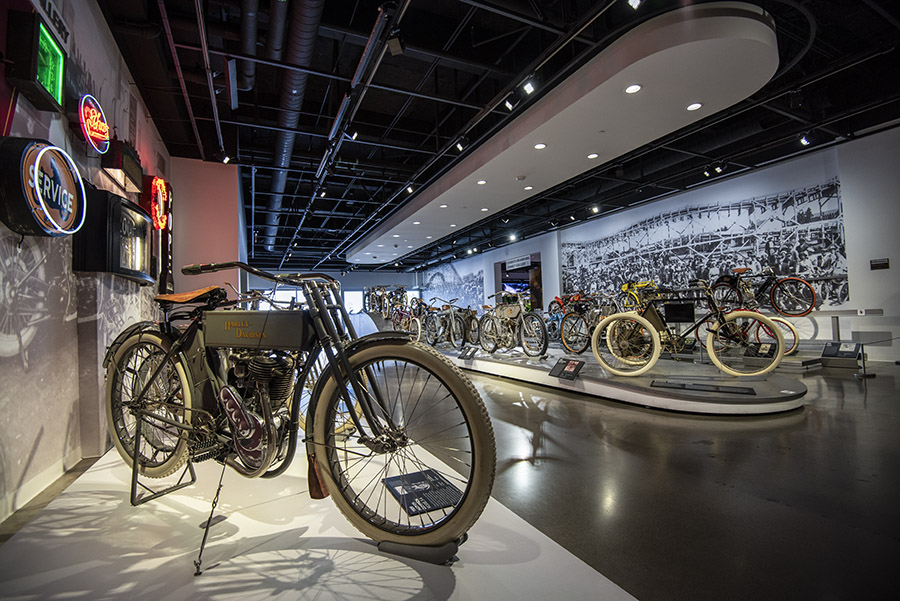
That shot above is a nice one, I think. It shows the subject of today’s blog, the 1909 Harley Model 5-A, with the rest of the Petersen’s Bunch exhibit in the background.
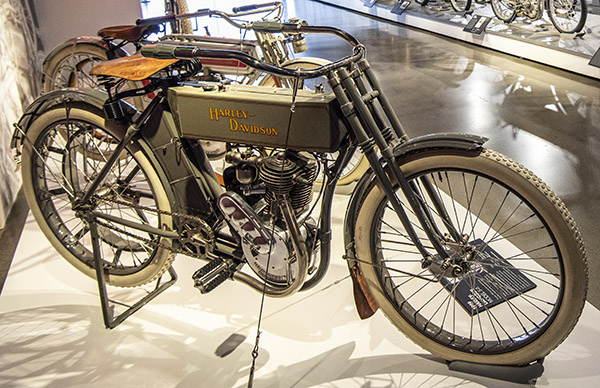
A 1909 Harley-Davidson Model 5-A. The Single was a better motorcycle than that year’s V-twin.
1909 was a good year for Harley. It was the first year they made more than a thousand motorcycles, and it was their fifth year of production (hence this motorcycle’s name, the Model 5). The Model 5 had several variants. The 5 and the 5-A had 28-inch wheels and either magneto or battery ignition. The 5-B and 5-C had 26-inch wheels with the same electrical system options. And (pay attention here, folks) the Model 5-D had a V-twin engine as an option. The V-twin was a bust. It was cancelled after Harley had manufactured only 27 of the V-twin engines.
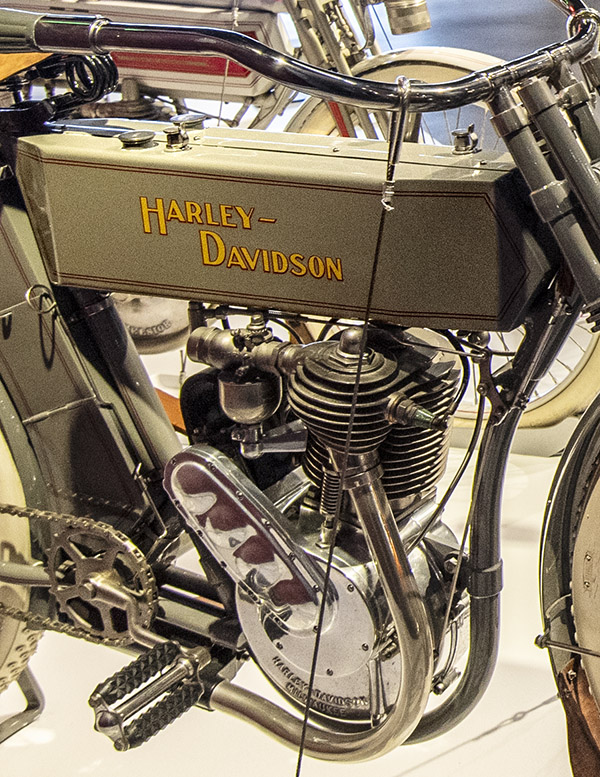
The Model 5-A’s 495cc engine. Check out the bicycle pedal arrangement.
Harley’s single-cylinder Model 5 motorcycles had a 4.3-horsepower, 495cc engine. That engine could propel the Model 5 to an estimated top speed of 40 mph.
Did you ever wonder about the bicycle pedals and crankshaft you see on these motorcycles? Yeah, me, too, until I wrote a piece on a Thor motorcycle a few years ago and deduced how it all operated. The way a rider started these old bikes back in the day was, in a word, complicated. It went something like this:
You made sure the oil line was switched open.
You made sure the gasoline line was switched open.
You put the bike on the center stand, which held the rear wheel off the ground.
You retarded the ignition.
You primed the engine.
You pulled in the clutch.
You switched the ignition on (if the bike had an ignition switch).
You pedaled furiously, until the rear wheel, tire, sprocket, etc. had attained sufficient rotational inertia.
You let the clutch out, which transferred the rear wheel’s inertia to the crankshaft.
You said a little prayer and, if the Good Lord was listening, the engine caught and started.
Today, we don’t even need to insert an ignition switch (some new bikes feature keyless ignition, like cars). We just press the starter and go. And we count ourselve lucky. Until something breaks. Then, we are at the mercy of modern motorcycle maintenance shops. And they ain’t too merciful.
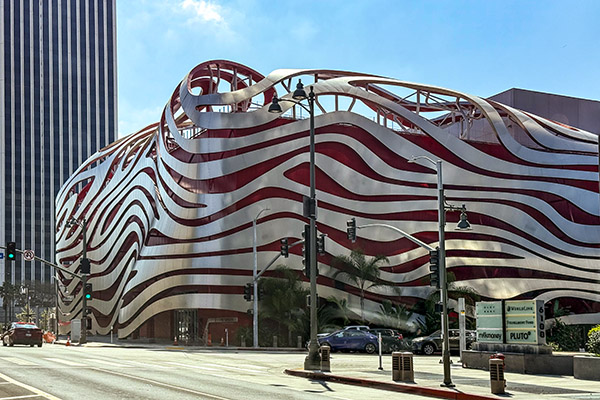
The architecture is visually arresting, riveting our attention as soon we spot the Petersen Automotive Museum. It had a been a few years since I visited the place, I had not expected what I saw, but I knew it was the Petersen as soon as it came into view. Located on Wilshire Boulevard’s Miracle Mile (home to several museums, surrounded by incredible wealth, and one of LA’s toniest neighborhoods), the Petersen is a distinctive Los Angeles landmark.
The Petersen Automotive Museum. This cell phone photo through my Subie’s window doesn’t do the architecture justice. It is a magnificent building. I’d like to come back at night and photograph it again.
On my earlier visits to the Petersen Museum, the building that housed it positively boring from the outside. Built in 1962 as a department store, it was a big block of nearly windowless concrete. The size and the windowless aspect appealed to billionaire publisher Robert E. Petersen. It was big enough to house Petersen’s collection, and the lack of windows would protect the sensitive finishes of classic and custom automobiles from the harsh southern California sun.
Our visit to the Petersen this day was to be a quick one, as I was on a mission. With an assignment for a Motorcycle Classics magazine “Destinations” piece featuring the Bunch motorcycle collection (on display at the Petersen through the end of March), I wanted to get in early before the Museum became too crowded, grab a bunch of photos, and be on my way. We succeeded. We were in and out in exactly 25 minutes. Click, click, and click again went the Nikon D810 and its boat anchor 16-35mm lens. Click a bunch more times, and we were on our way to lunch at Canter’s Deli (more on that in a bit).
The Petersen Museum underwent an extensive $125 million remodeling in 2015, which treated the existing building as a chassis and created a stunning stainless steel ribbon body over it. The flowing ribbons and their brilliant bright red background create an impression of wind tunnel airflow over a streamlined automobile. As I read those words, my description sounds kind of over the top and maybe a bit hokey, but let me tell you: the architecture works. The unmistakable and instant impression is one of power and speed. I couldn’t wait to get inside.
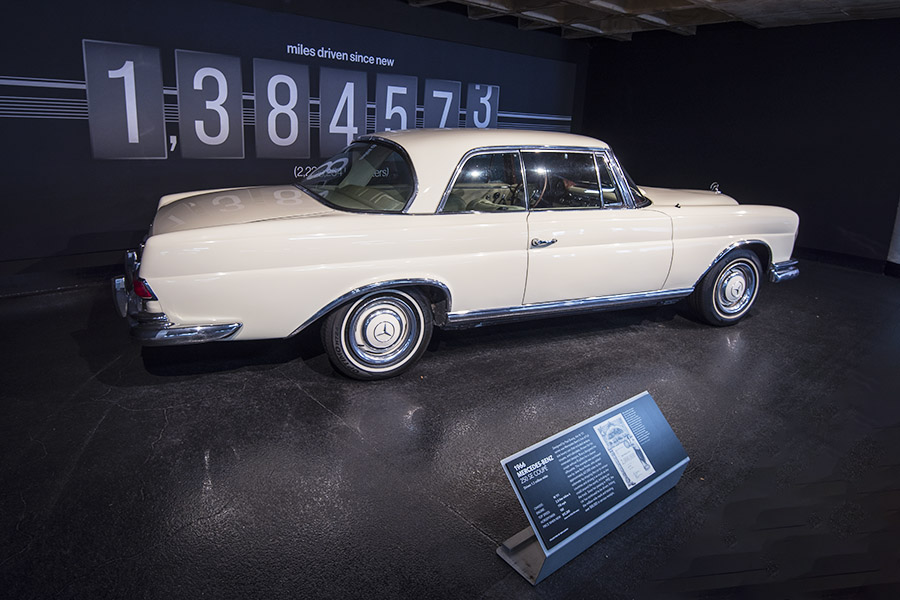
The wonderment began even before we entered the building. We spotted a neo-vintage ’66 ivory white Mercedes displayed near the entrance. It’s a gasoline (not diesel) powered 250 SE Coupe with an incredible 1,384,563 miles on the clock. The late original owner, Jane Rice Pinner, drove it everywhere, and you can take that “everywhere” adjective literally. Ms. Pinner, you see, was a world traveler. She shipped the car to the different countries she visited, and drove it wherever she went when she arrived. It’s a cool approach to adventure, and it’s probably one that required big bucks. But Wilshire Avenue’s Miracle Mile is dripping in big bucks ambience. We were impressed, and we hadn’t made it into the Museum yet.
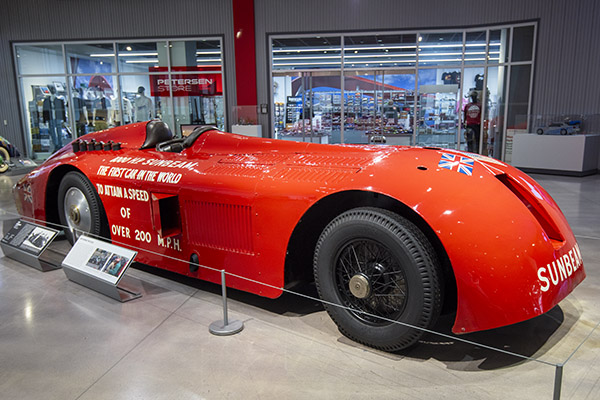
1000-horsepower, 44.8 liters of aircraft engine, and 200+mph in 1927. The Sunbeam Slug is drop- dead gorgeous technoir engineering.
Once inside, a stunning Sunbeam land speed record machine again riveted our attention. It’s a 1000-horsepower monster, nicknamed “the Slug,” and it’s powered by two humongous 22.4-liter Matabele V12 aircraft engines (one in the front, and one in the rear). With the two V12’s combined 1000 horsepower, the Slug was designed to hit 200 mph, and in 1927, it did so on the sands of Daytona Beach. The Slug touched 203.79 mph under the skillful touch of Sir Henry Segrave in (get this) 1927. Oh, boy, do they ever have cool things at the Petersen.
But our focus was on motorcycles, and specifically, the Bunch collection. It was up to the second floor for us, and wow, there they were. About 25 early 1900s motorcycles (I’ll provide an exact count in the next blog) had me in digital photography heaven. I’m going to portray these in the ExNotes blog in a different way. We’ll feature one motorcycle per blog and run the blogs around others currently scheduled for publication. They’ll start sometime next year.
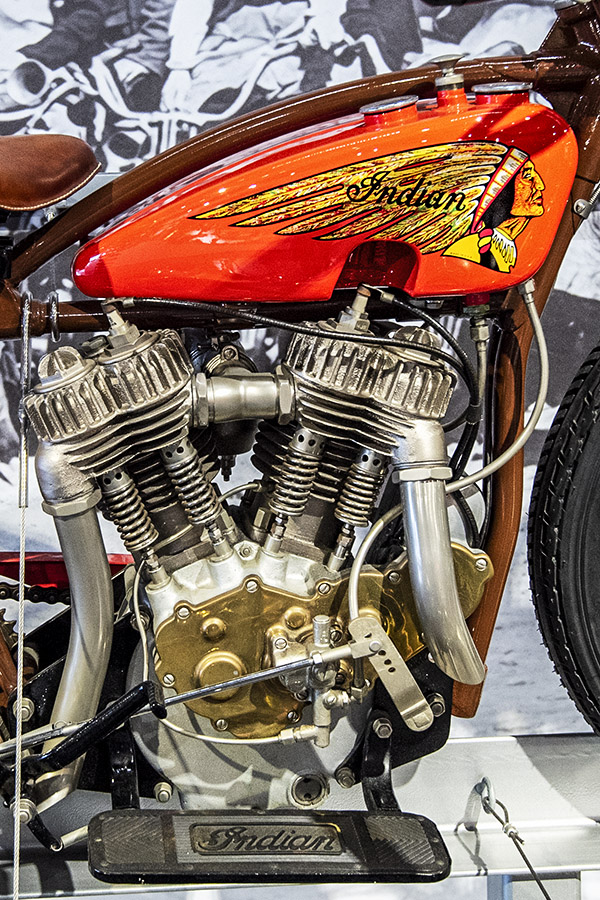
The engine room of an extremely rare Indian V-twin hill climb motorcycle. Watch for more on this magnificent moto in our next Petersen blog.
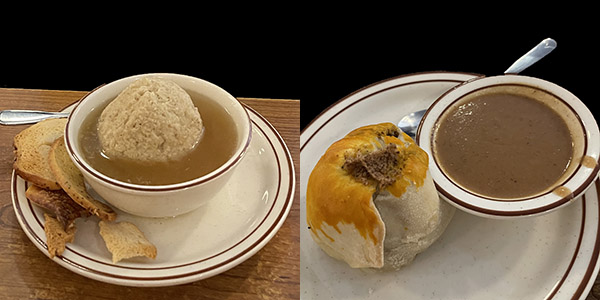
After our quick stop at the Petersen, we drove north another mile on Fairfax Avenue to one of my favorite LA restaurants: Canter’s Deli. Matzo ball soup, a kasha knish, a corned beef Reuben, and I was in heaven.
Canter’s delights. Matzo ball soup and a kasha knish. If you know, you know.
Stay tuned, my friends. There are more Bunch stories and more stunning photos inbound.