
By Joe Berk
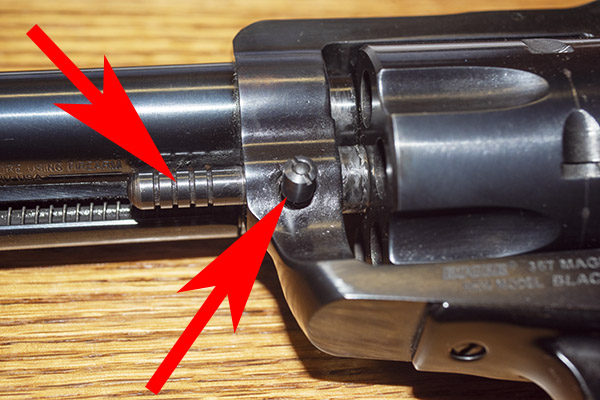
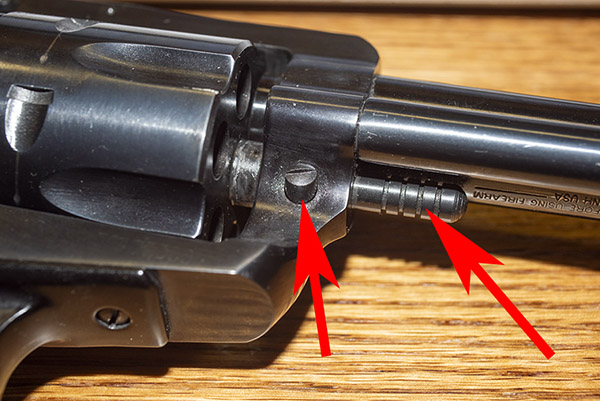
This blog addresses the Ruger Blackhawk base pin slippage issue. The base pin is the axle on which the revolver’s cylinder rotates. It is held in place by the base pin latch, which consists of a screw, a spring, and a nut with an interrupted slot. Here’s what the revolver looks like with the base pin in place:
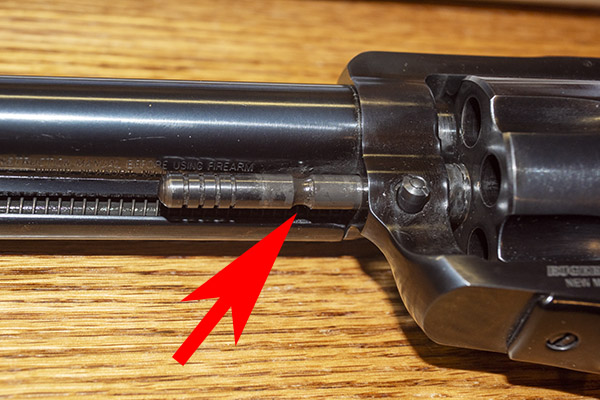
What happens is that with heavy loads the base pin latch displaces laterally, and the base pin latch moves forward under recoil. This is what it looks like when that occurs:
I previously tried a new Power Custom base pin on my .45 Colt Ruger Blackhawk (I blogged about that earlier). It didn’t work as a fix for preventing base pin movement under recoil. After an online search, I found that Wolff Springs stronger base pin latch springs are available to address the base pin recoil-induced movement issue. I ordered a set from Midway USA (Midway provides three of the Wolff springs in a set for $5.99). Nobody else (including Wolff) had the springs in stock. I was shocked to learn that Midway wanted $22 for shipping these parts, as they would easily fit in an envelope. I also had to confirm (by checking a pop-up approval form) that I was 21 (I suspect this was a bit of California legislation-induced silliness), and I had to sign for the parts when they arrived. All that’s the bad news; the good news is that Midway ships for free when an order exceeds $100, so I did what the Midway marketing gurus wanted and ordered $100 of Hornady .357 bullets to get the free shipping (for what started out as a $5.99 order).
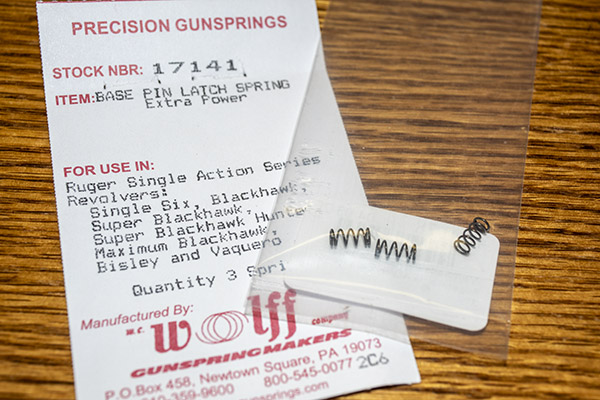
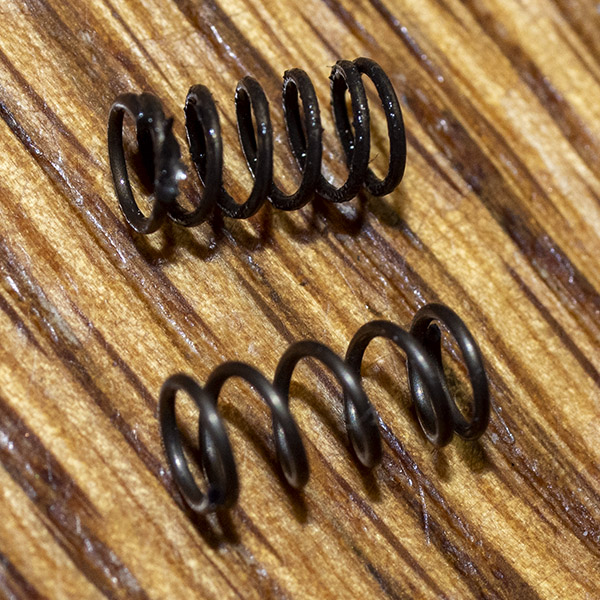
The new base pin latch screws were perceptibly stronger (squeezing them by hand) than the stock base pin latch screw.
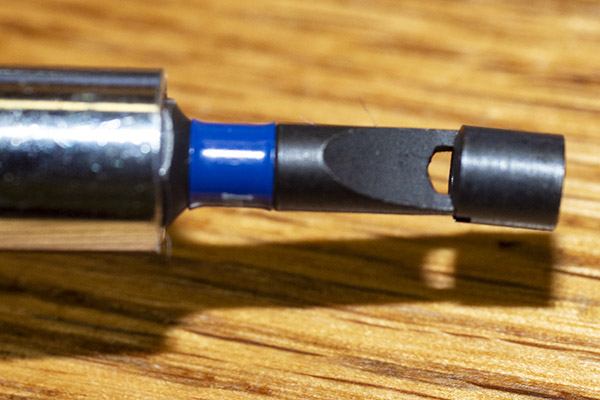
I also had to order a pin spanner screwdriver bit to work with the nut opposite the base pin latch screw. I ordered a set of pin spanners from Amazon not knowing the base pin latch nut size. They were inexpensive ($5.99). I could have filed a slot in an existing screwdriver blade, but I thought it would be a good idea to have a set of pin spanners in the tool chest. Gresh is having an influence on me.
The photo below shows the base pin latch with the nut removed. Ruger had applied a tiny amount of red Loctite (visible in the photo below) to prevent it from unscrewing. I’ll apply blue Loctite later after degreasing the parts.
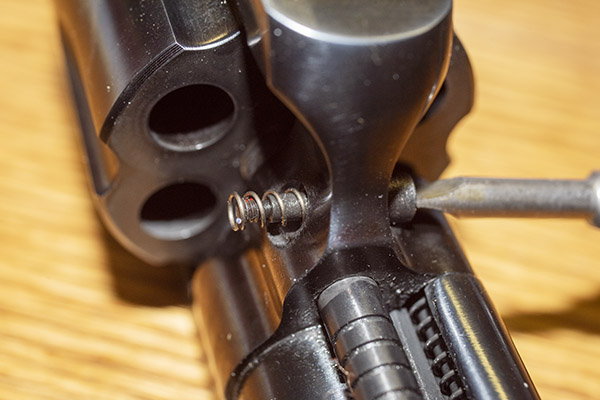
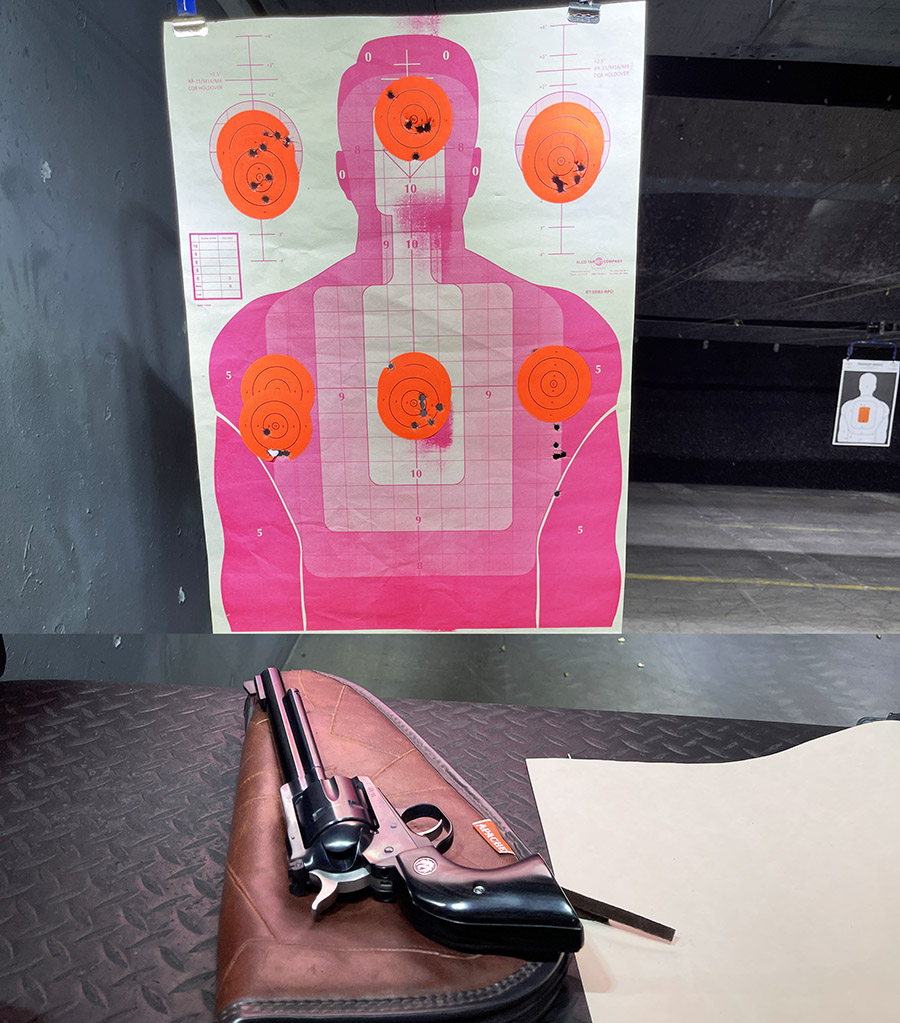
When I reassembled everything, I made a quick trip to the indoor pistol range with some very heavy .357 Magnum loads to see if the stronger Wolff spring fixed the base pin retention issue. I’m happy to report that it did, even with my 180-grain retina-detaching, ballbuster loads. I’m going to blog about the velocities and accuracy of loads with the Missouri cast .357 180-grain bullets in the near future, and I’ll share what worked well in the Blackhawk, the Bisley, and the Colt Python.
When I got home, however, I sort of found out that the joke was on me. When I attempted to remove the cylinder, I found that I could not. The thicker coils of the Wolff spring prevent compressing it enough to allow adequate base pin latch movement. I’ll have to unscrew its two halves to remove the cylinder. Win some, lose some, I guess. I’m keeping the Wolff spring in place, though. Having to unscrew the base pin latch to remove the cylinder is an annoyance, but one I’ll live with to prevent the base pin from backing out under recoil.
In the past, this issue of Ruger Blackhawk base pin slippage has been hit or miss (pardon the shooting pun). I’ve never experienced it with the much-heavier-recoiling .44 Magnum Super Blackhawks, but I have experienced it with my blue steel .357 Mag and .45 Colt Blackhawks. The base pins haven’t moved (at least in my hands) with stainless steel .357 Mag and .45 Colt Blackhawks, perhaps because stainless steel grips the base pin latch better, or perhaps because those revolvers had slightly stronger base pin latch springs.
Subscribe to ExNotes for free!
We need your support! Do what you can to help ExNotes stay in the black!

More Huber? Check out A Trip Into The Moment.

More Gresh and Berk? You bet! Check out A Cup O’ Joes!

Join our Facebook ExNotes page!