I’ve been using Patch-Out and sometimes its accompanying Patch-Out Accelerator for the last year and I’ve been pleased with it. Hoppes No. 9 wasn’t cutting it for me, as I found out when using my borescope. No matter how may times I ran a patch with Hoppes through a rifle bore after firing jacketed bullets, I found a whole bunch of copper streaking remained in the bore. In casting about on the Internet, I learned bench rest shooters were using Patch-Out, so I thought I would give it a try.
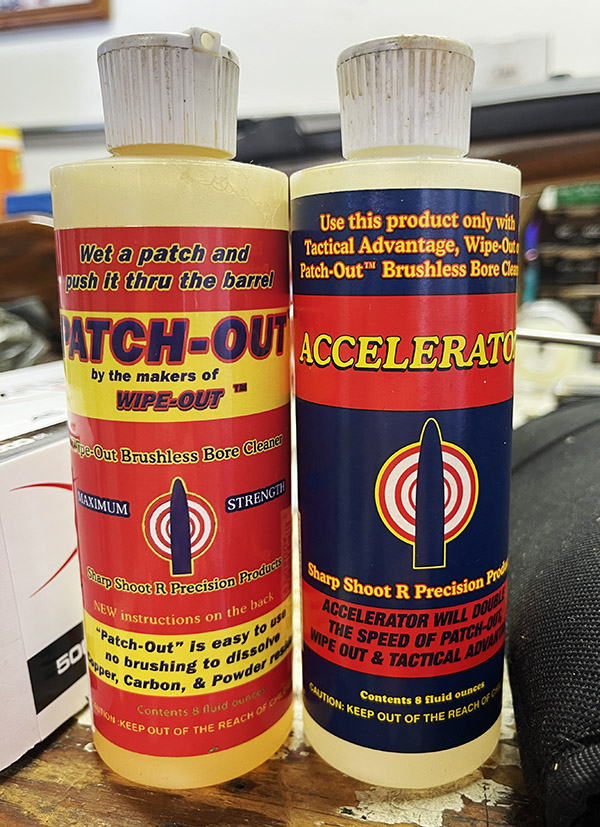
Patch-Out offers two products for removing copper fouling: Patch-Out (shown above on the left) and the associated Accelerator (shown above on the right). You don’t really need the Accelerator unless you are in a hurry, and most of the time I am not (my hurrying days are in the rearview mirror).
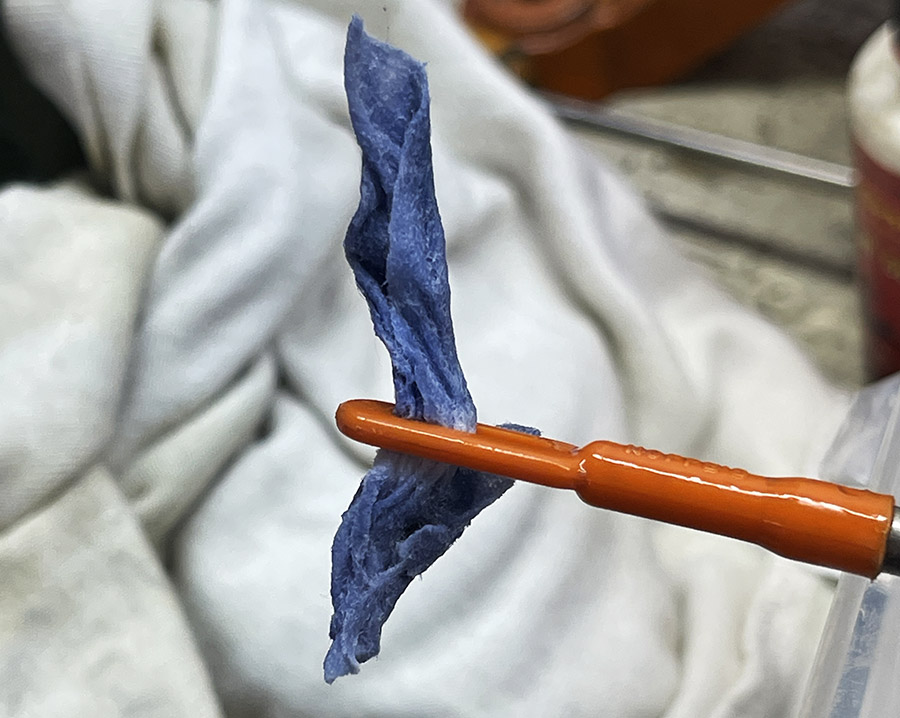
The idea behind Patch-Out is to wet a patch with it and run it through the bore. If you’ve got the time, wait a few hours hours and repeat. The first patch that comes out of the bore will be black, which is mostly carbon fouling. Subsequent patches (after waiting a few hours between each swipe) will be blue (as seen in the photo above). After doing this several times, the patches will become less and less blue. The blue color is due to a reaction between the Patch-Out liquid and the copper in the bore. As the patches come out lighter, it’s telling you that the copper is just about gone. I’ve not had a patch come out completely white (there’s always a hint of blue), but I suspect that’s due to minute bits of copper that have worked their way deep into the bore’s microscopic cavities.
If you run a second patch wetted with the Accelerator right after running a Patch-Out patch through the bore, the Accelerator accelerates the chemical reaction between the Patch-Out liquid and bore copper. You can doe this every 15 minutes and cut the bore cleaning time considerably. Sometimes I’ll do that; most of the time I just wait a few hours between Patch-Out patches and take a day or two to thoroughly clean a bore.
One caveat: Patch-Out doesn’t work on lead (nor does Hoppes). In fact, nothing (other than a stiff bore brush) will take out lead. Lead has to be physically scraped from the bore, which is what a stiff bore brush does. For copper fouling, though, Patch-Out works. It’s all I use anymore, and when I’m done, I’ll run an oiled patch through the bore to protect against rust.
No matter how much I scrub a bore with patches and solvent, I can’t get all the copper fouling out. For that, I need to turn to a bore brush, and the general rule of thumb seems to be one complete back and forth stroke for each round fired. 50 rounds fired (which I sometimes will do), and it’s 50 back and forth strokes with a bore brush. The copper literally has to be scraped out of the barrel.
The problem with this, of course, is that a new bore brush takes a lot of force to drive through the bore, and in doing so, the cleaning rod I’m pushing it with flexes if it is not supported while the bore brush is in the bore. That can cause the rod to bear on the chamber entrance or the leade in the chamber, and that can damage the chamber.
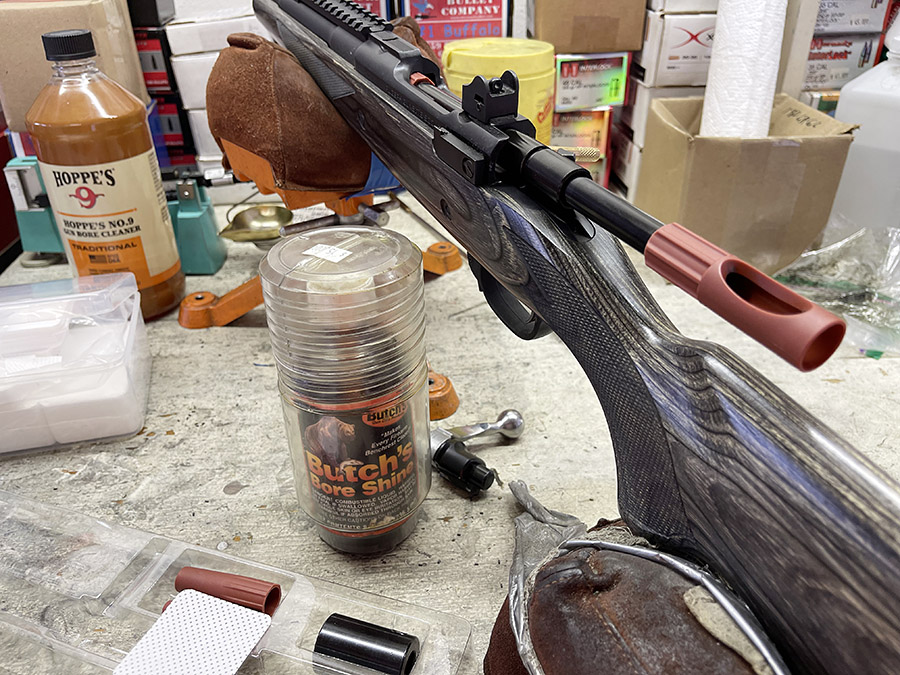
The Tipton Universal Bore Guide Kit is a contraption that allows you to protect a bolt action rifle’s chamber from the cleaning rod. An added benefit is that it prevents solvent or oil from dripping into the action. The concept is good; the execution is slightly flawed for some firearms in my opinion. That said, I’ll continue to use it on my bolt action rifles.
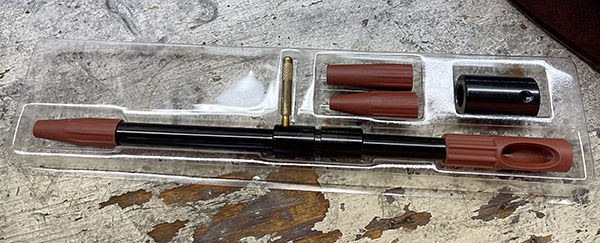
The pieces include a tube, an end piece with a slot for adding solvent, a sleeve that includes a combination bolt/set screw, an optional bore guide for an AR-15, and three different rubber funnels (for lack of a better word) based on the caliber.
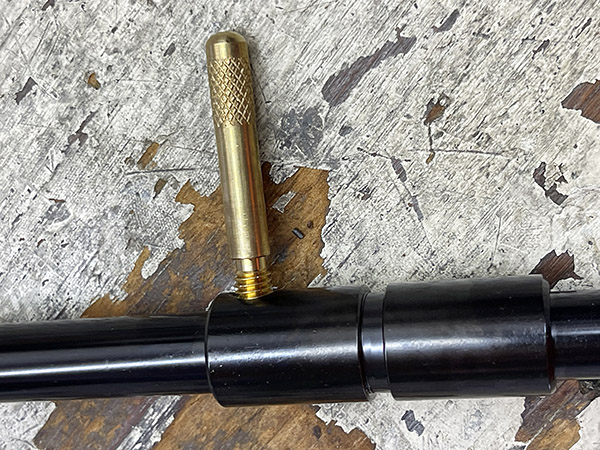
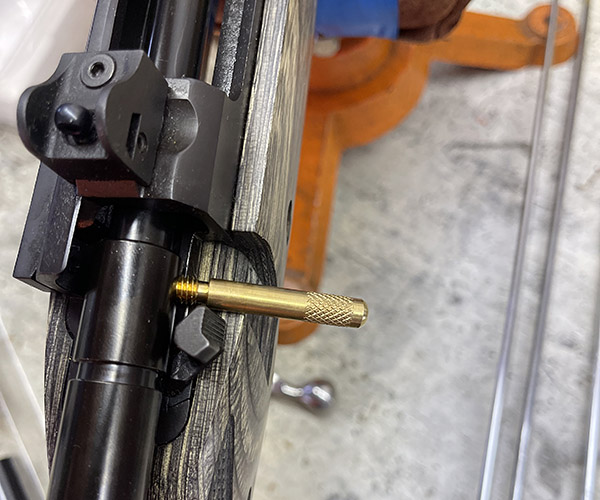
In the photo above, the bore funnel is the red rubber piece on the left end of tube. Its purpose is to align the tube to the barrel. The two red rubber pieces above the tube in the photo above are for different size bores. The brass piece above the tube is the combination set screw/bolt (its use will become clear in another photo below). The stubby black at the top right of the photo above is the AR-15 chamber adaptor. The red rubber piece on the right in the photo above is guide that guides the cleaning rod into the tube. You’ll notice an elliptical cutout in it. The elliptical cutout’s purpose is to allow you to add solvent or oil to the cleaning patch at that point. The idea is to not insert a cleaning rod into the rifle with a solvent or oil soaked patch. This is to prevent the solvent or oil from dripping into the action as the cleaning rod and patch are inserted into the gun.
The first is that the red rubber guide fits into the chamber will not withdraw from the action when the Tipton Universal Bore Guide Kit is pulled out. The rubber chamber guide hangs up on the rear of the action. It’s not a big deal. I just pulled on the tube, the guide falls off, and I reinstalled it. I only needed to do this when I was finished using the Tipton Universal Bore Guide Kit and I wanted to remove the thing.
The feature that allows you to add solvent through a port in the rear red rubber guide is something I didn’t need for applying the solvent. I just dipped the cleaning rod tip (with patch) into the solvent bottle and ran it through the bore. The same is true with the oiled patch after I’m done cleaning. That extra port solves a solvent or oil application problem that doesn’t exist. But it sure came in handy when I encountered the next problem.
The Tipton Universal Bore Guide Kit doesn’t work with a long action and a 26-inch barrel as the kit is configured. I tried working a new bore brush through my .30 06 Mark V Weatherby, and the cleaning rod handle butted up against the rubber guide at the Tipton bore guide’s rear end with the tip of the bore brush just showing at the end of the muzzle. That was a real “uh oh” moment. There’s no way to back the bore brush out (especially when the brush is new). The bore brush, the bore brush rod, and the Tipton were locked in place. That’s when the opening in the rear guide came in handy. I was able to grasp the cleaning rod with a pair of needlenosed pliers and turn it about an eighth of a turn at a time (my cleaning rod handle allows the rod to rotate, a feature intended to prevent the cleaning rod from unscrewing). Then I’d release the pliers’ grip, move it around the section of cleaning rod visible through the red rubber rear guide, and turn the rod another eighth of a turn. I did this for several minutes until I could get the rod unscrewed from the bore brush, and after that, I put an extension on the rod. It was a real pan in the ass. I’ll cut the length of the Tipton bore guide down to prevent this from occurring again. I feel the Tipton’s bore guide instructions should have a warning about this.
The above notwithstanding, I think the Tipton Universal Bore Guide Kit is still a good purchase. It seems to work well, and it prevents cleaning rod flex when running a tight-fitting bore brush through a rifle barrel, so it does what I want it to do. I paid $13.01 for mine when I bought it on Amazon. For $13, it’s a decent deal.