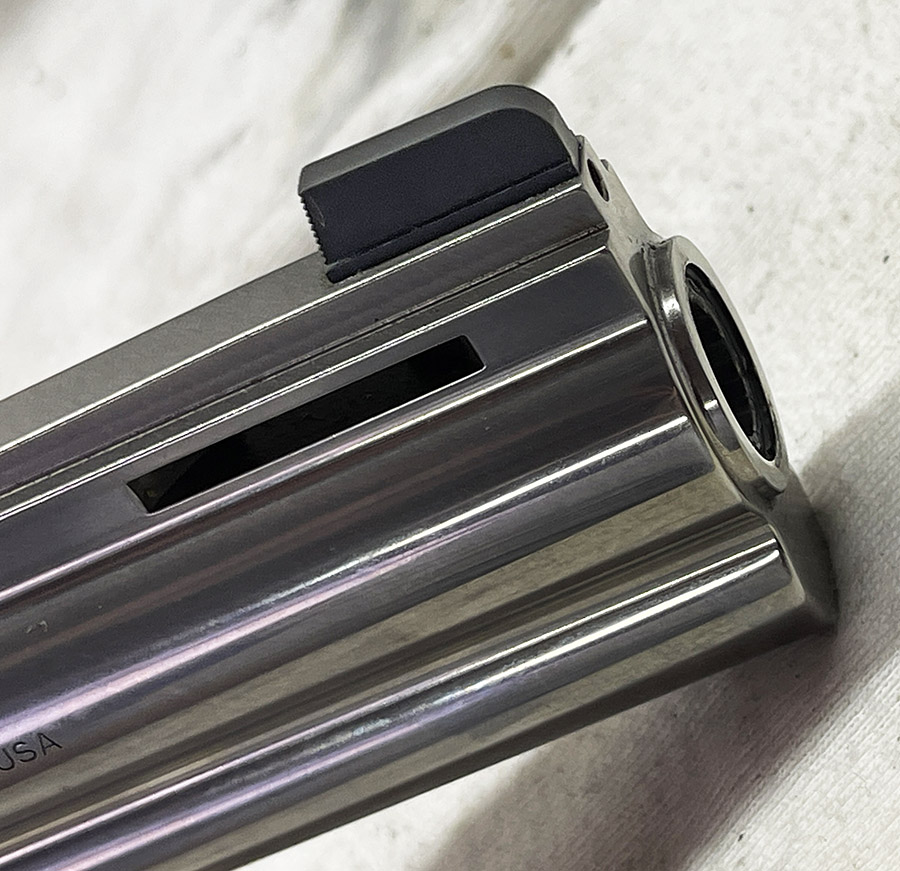
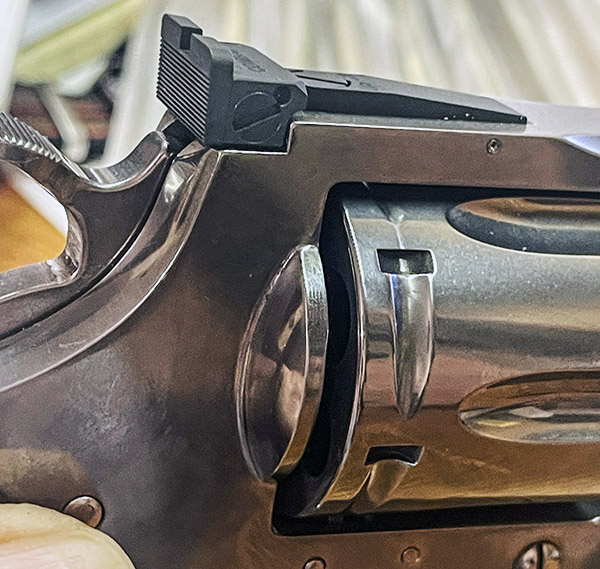
I am enjoying my Colt Python more and more every time I shoot it. The latest improvement is the Harrison Design front sight, as seen in the photo above. Just prior to installing it, I had installed the Wilson Combat rear sight, as seen in the photo below. I covered the Wilson Combat rear sight in my previous blog.
The Wilson Combat Python rear sight. It’s much sturdier than the stock rear sight.
The Wilson Combat rear sight is a solidly built affair, but it sits higher than the stock Python rear sight. That caused my shots to hit high.
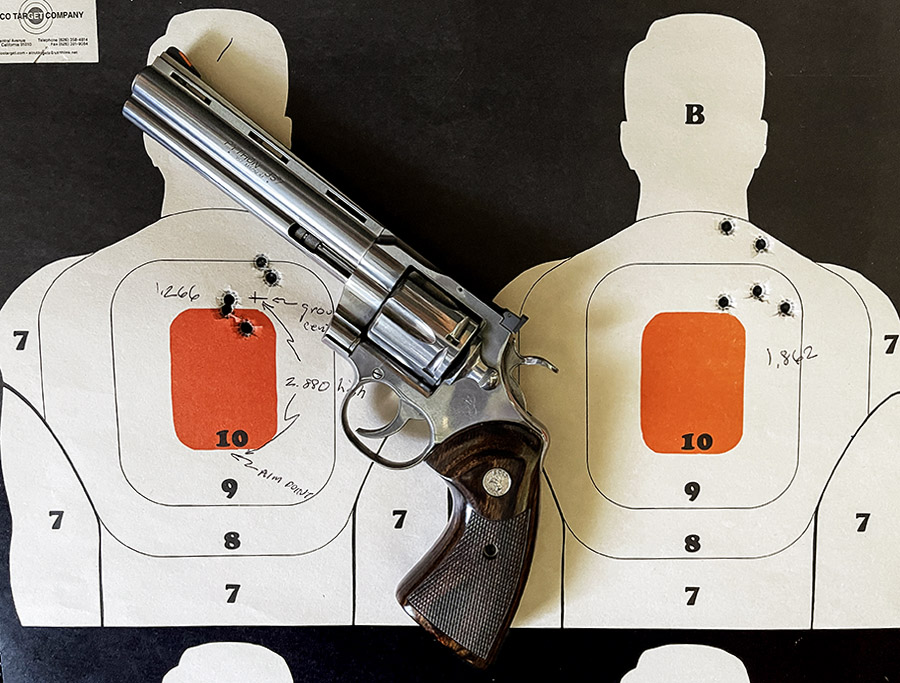
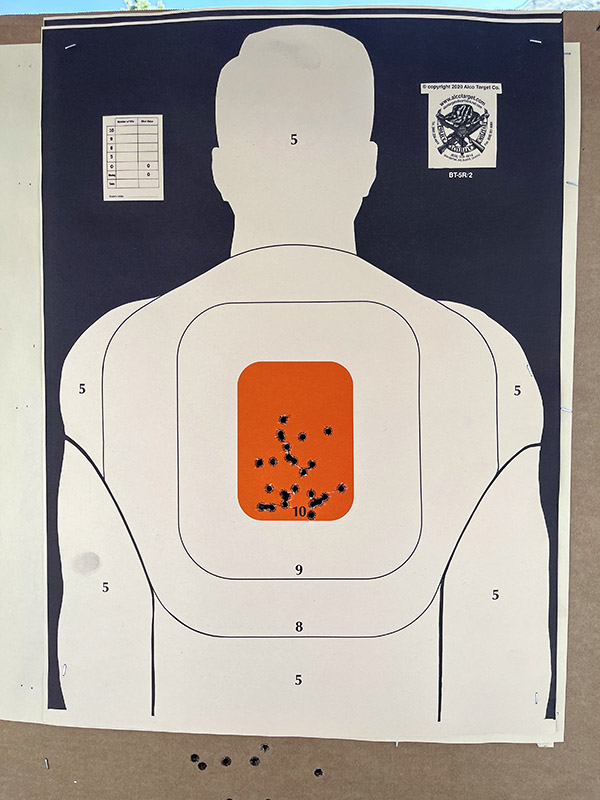
Typical targets fired with the Wilson Combat rear sight. These targets were shot at 15 yards, or 45 feet.
I needed a taller front sight to work with the Wilson Combat rear sight. I researched this issue, and apparently I was not alone. Numerous comments appear on various forums identifying the Python shooting high issue with the Wilson Combat rear sight. Harrison Design did something to address it: They offer taller Python front sights.
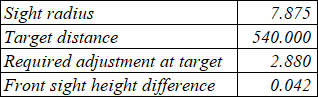
Turning to my junior high school geometry, I calculated the required front sight height based on where my shots were hitting, and the following formula:
The stock Python front sight height is 0.180 inches, the distance to the target is 45 feet, and the distance from the front sight to the rear sight (the sight radius) is 7.875 inches. Plugging those values into an Excel table based on the above formula, I found the front sight height increase I needed.
To go up 2.88 inches at 45 feet, I needed a 0.042-inch taller front sight (the front sight would have to be 0.222 inches high, which is obtained by adding the 0.042-inch additional required front sight height to the stock 0.180-inch stock front sight height). Harrison Design offers taller Python front sight heights of 0.200 inches and 0.230 inches. I chose the 0.230 Harrison Design front sight, as it was closer to the calculated front sight height I needed. I knew I could account for the small difference between the calculated required front sight height increase by simply raising the rear sight.
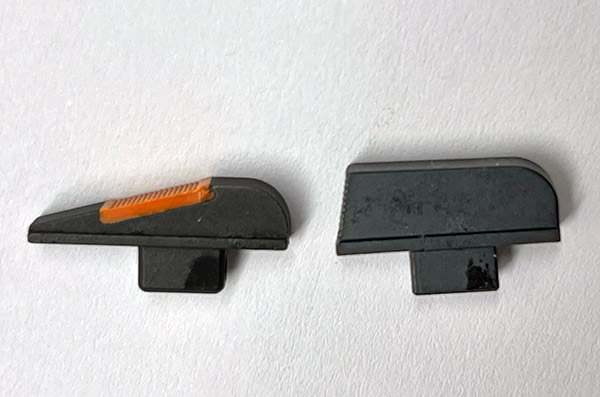
Colt Python stock front sight (left) and the replacement taller Harrison Design front sight. I prefer a plain black front sight as it makes for a clearer sight picture.
I opted for a plain post front sight, as seen in the above photo on the right. Harrison Design offers high visibility front sights (ones with a translucent plastic cord within the sight), gold dot front sights, and perhaps others. For precision work, I’m old school. I greatly prefer a plain post. For me, it’s harder to focus on the top of a red ramp (like the original Colt front sight, shown on the left) or on a gold dot front sight. The gold dots have another issue for me: My point of impact on the target moves around when the lighting changes. I’m not a fan of “gee whiz” front sights. I learned from a master (Sergeant Major Emory Hickman) and I learned on a plain black post front sight. Your mileage may vary.
Harrison Design does a nice job in what they include. In addition to the taller front sight, they provided a separate set screw (not necessary, as I could reuse the original one), a tiny Allen wrench for the set screw (also not necessary, as I already had one), and a set of installation instructions (not necessary for me, as how it all goes together is obvious). But I thought it was nice Harrison Design included all these things. The new front sight slipped right into place. Replacing the original Colt front sight with the taller Harrison Design front sight took less than a minute.
So how did it all work on the range? Pretty much just like the numbers said it should.
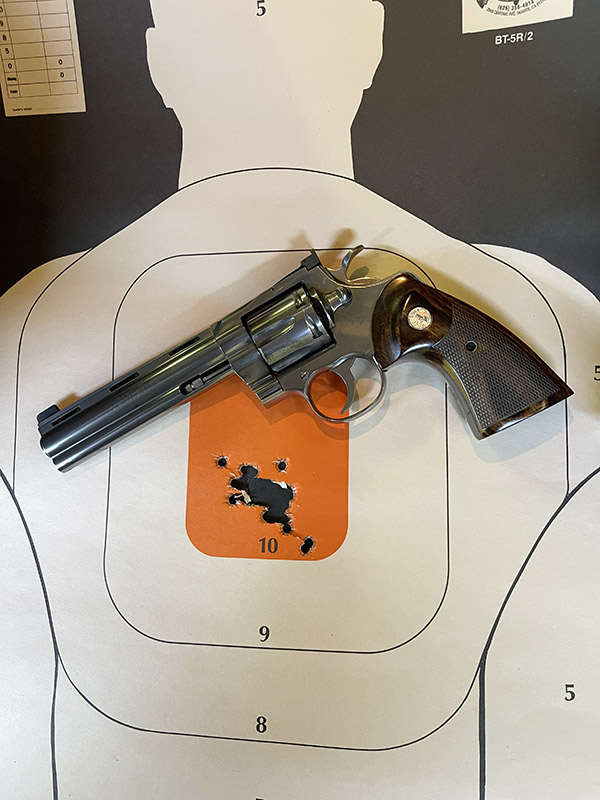
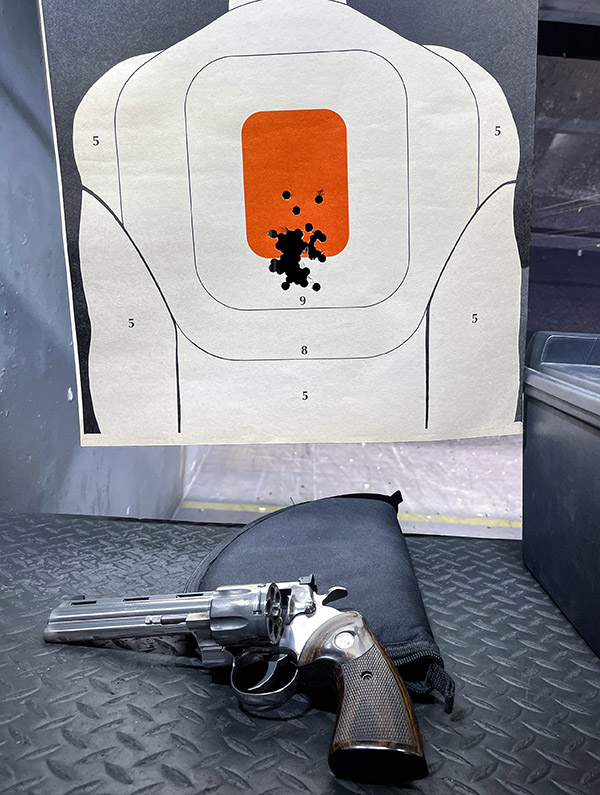
A 50-foot target shot with the new Harrison Design front sight and the Wilson Combat rear sight. Point of aim was at 6:00 on the orange bullseye. The load I used for this target was Missouri Bullets’ 180-grain truncated roundnose cast bullet and 14.0 grains of IMR 4227 (a max load).Same as above, but with 148-grain wadcutter, 2.7-grains of Bullseye target loads, fired at 50 feet.A “first look” type of target at 25 yards. The load was Missouri Bullets’ 180-grain truncated roundnose cast bullet and 14.0 grains of IMR 4227 (a max load). There’s a little more spread than I find acceptable, but I attribute that to bullet casting defects I’ll cover in a subsequent blog.
The bottom line is I am a satisfied customer. Harrison Design makes a good product.
Coming up? I’m going to run another set of Python tests assessing cast bullet base imperfections and their effect on accuracy, and then yet another assessing accuracy at 25, 50, and 100 yards. Then I’m going pig hunting with the Python.
Stay tuned.
Subscribe to ExNotes for free!
We need your support! Do what you can to help ExNotes stay in the black!
In a previous blog comparing Ruger’s .357 Bisley, the Ruger Blackhawk, and the Colt Python with the Missouri 180-grain bullet and IMR 4227 propellant, I mentioned that the Colt Python rear sight is a real rinky dink design. Specifically, the set screw that holds the windage adjustment in place is not up to the job. Mine wouldn’t secure the windage blade, and when I tried to tighten it, the set screw’s Allen socket surrendered. Surrender would be good for the IRGC; on a high-priced revolver component, not so much.
The stock Python rear sight. The windage blade is secured in place with a tiny set screw denoted by the red arrow.
Faced with this situation, I did what Wilson Combat wanted me to do: I ordered their upgraded, more robust rear sight. At $119, it’s not cheap. It probably cost less than $3 to manufacture. The high price was undoubtedly due to the nonrecurring engineering that went into it, but based on my results on the range, I don’t think Wilson got what they paid for from their engineering department. I sure didn’t (more on that in a second). I bought the Wilson Combat rear sight on Amazon Prime, so I saved a few bucks on shipping and that was good. I received the part the next morning, and that was good, too.
The Wilson Combat Colt Python Adjustable Battlesight.A look at the Wilson Combat Python rear sight components.
The Wilson upgrade comes in a nice plastic display package, and it includes everything needed: A complete rear sight assembly, a spring, the elevation adjustment screw, and installation instructions (although the thing is so basic the instructions aren’t really needed).
A set of brass punches. Using these helps to prevent marring the stainless steel Python.The Universal Gun Bench Block. Everyone who tinkers with guns needs one of these.The Universal Gun Black out of the box. I’ve had this one for years. It is a very handle tool.A small gunsmithing hammer. One side is brass; the other is rubber.
I installed my Wilson Combat replacement sight the day I received it, using simple gunsmithing tools I had previously purchased: A set of brass punches, a universal bench block, and a small brass hammer. The brass tools are necessary because the Python is made of stainless steel, and I didn’t want to mar any of the revolver’s polished surfaces.
The Python’s rear sight roll pin must be removed to remove the rear sight. On firearms, removal is always from left to right. Installation is always from right to left.
The first step was to tap out the stock rear sight’s roll pin. Colt uses a roll pin instead of a simple pin, and that’s a good thing. Roll pins stay put. Other manufacturers use simple pins, and my experience has been that they constantly back out under recoil.
Once I had removed the Python’s stock rear sight, I compared it to the Wilson Combat replacement.
The Python stock rear sight (top) and the Wilson Combat rear sight (bottom). Note the heavier spring in the Wilson Combat rear right. I used the stock Python spring with the new Wilson Combat sight.The two rear sights side by side.Another look at the stock rear sight (top) and the Wilson Combat rear sight (bottom). Both use screws for windage adjustment, but the stock rear sight requires locking the rear sight blade in place with a very tiny set screw. The Wilson Combat rear sight uses a click-detented windage adjustment screw. It’s a better setup for windage adjustment.A view from the driver’s seat. The stock rear sight is on the left; the Wilson Combat rear sight is on the right.
I like the Wilson Combat’s clean look, it’s slightly longer sighting radius (i.e., distance from the front sight), and the serrated rear sight blade. The theory behind a serrated rear sight blade is that it cuts down on reflections (although I think that’s more a marketing shtick than a real advantage). I like the look better, though. The width of the rear sight slot appeared to be about the same as the stock Python rear sight. The notch’s depth was greater, so that’s good. What wasn’t good, though, was that the Wilson Combat rear sight appeared to be taller than the stock part. That would make the gun shoot high. I hoped I was wrong about that, and that once I had new sight installed, it would not be any taller. As I had that thought, I was reminded of the old saying: Poop in one hand, hope in the other, and see which one fills up first.
The Wilson Combat rear sight spring is way stronger than the stock spring, and I had a hard time attempting to get everything aligned so that I could tap in the roll pin. I gave up and used the stock spring (the one that was originally under the stock rear sight).
When I had the gun reassembled, I examined it. The rear sight was indeed taller than the original equipment Colt sight, even with the elevation adjustment lowered as far as it would go.
The Wilson Combat rear sight installed on my Colt Python. It is all the way down; it cannot be lowered further.Another view of the fully-lowered Wilson Combat rear sight. It’s taller than the stock rear sight, which causes the revolver to shoot high.
I went to the range the next day, and shooting my 180-grain Missouri bullet load (with 14.0 grains of IMR 4227), I found that the Wilson sight absolutely did shoot high. As can be seen from the photo at the top of this blog, the Python now shoots about 2.880 inches high with the rear sight in its lowest position. Hmmm. I looked at both my hands. Neither contained any hope.
I tried another load I like (a 158-grain jacketed hollowpoint with 15.0 grains of IMR 4227). It, too, was high at 45 feet. I expected it to be slightly higher than the 180-grain bullet load. It was about the same, which is to say it, too, shot too high.
The Wilson rear sight has no wobble; the stock Colt rear sight can be wiggled around quite a bit. Because of that, I think the Wilson sight will group better, although I have no data that proves this. Unlike the stock Colt rear sight, the Wilson rear sight has positive clicks for windage adjustment. That is a definite improvement. There’s no more Mickey Mousing around with a microscopic set screw. I think the Wilson rear sight presents a cleaner sight picture than the stock Colt rear sight. That’s subjective on my part, but it was definitely there for me.
Overall, I was disappointed with the Wilson Combat rear sight. For a part that costs $120, I expected more. It’s not beyond the state of the art to engineer a rear sight that will work with the stock front sight. It’s ludicrous to offer a “replacement” rear sight that makes the revolver shoot high.
On this business of shooting too high, and just for grins, I took a few shots at a rock about 130 yards out. With the Wilson sight, the Python and I were hitting it consistently. But that’s with the sight adjusted as low as it will go. I guess the good news is that I can now adjust the Python to hit targets in the next county (sarcasm alert here, folks).
Given the current design, the answer is a taller front sight, and that will become the topic of a future blog. Not surprisingly, there are outfits out there selling those, too. Maybe that was the plan all along, and on this issue of a better set of Colt Python sights, I’m not done yet.
Stay tuned, my friends.
A Few Thoughts On “Windage”
The left-t0-right (or right-to-left) windage adjustment on a firearm’s rear sight is seldom used to compensate for wind. It’s used to account for a firearm’s printing to the left or the right of the shooter’s aim point. A shooter moves the rear sight’s windage adjustment to the right or to the left to bring the center of the group in line with the aim point (the spot where the shooter aligns the front and rear sights on the target). Usually, once this “windage” adjustment is made for a particular load or brand of ammunition, it is left there. We don’t move the windage adjustment to compensate for the wind blowing; if the wind is blowing, we simply hold to the left or the right of the target to compensate for the wind moving the bullet.
You might think that if there’s no wind blowing, a gun’s rear sight could be placed exactly along the centerline of the firearm to hit the target. That’s seldom the case, though. The bullets’ impact on the target will be biased to the left or the right due to factors built into the gun and the way the gun recoils in the shooter’s hand (which varies from shooter to shooter). We compensate for this left or right bias by adjusting the rear sight’s “windage.”
Subscribe to ExNotes for free!
We need your support! Do what you can to help ExNotes stay in the black!