
By Joe Berk
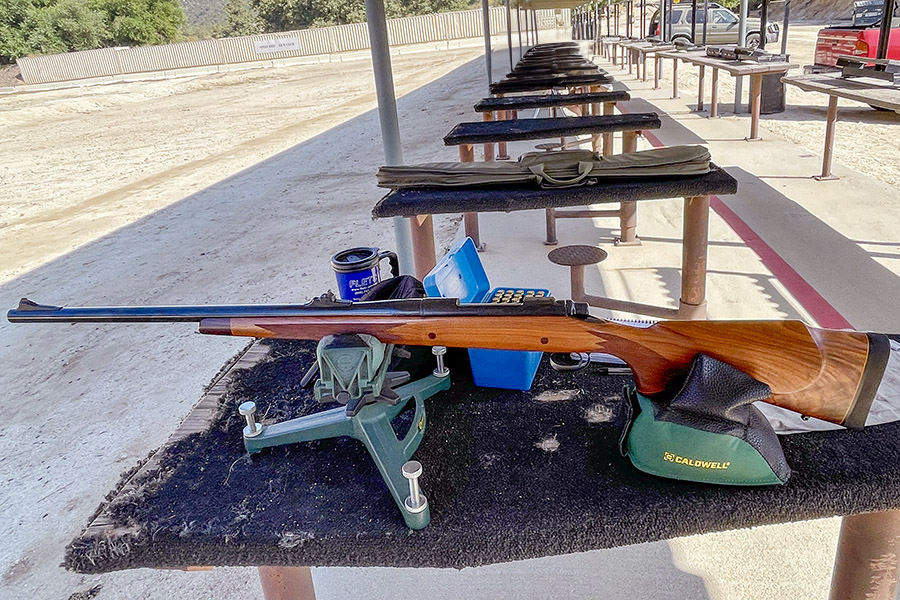
I’m not as good as I used to be. That point was brought home during a recent session with my Remington .375 H&H Safari Grade rifle. I can tell by reviewing a few blogs I did earlier on this rifle. The groups were better. Way better. I just don’t have the visual acuity I used to. I’ve written about this rifle before, and I’ll give you the links for those earlier blogs at the end of this one.
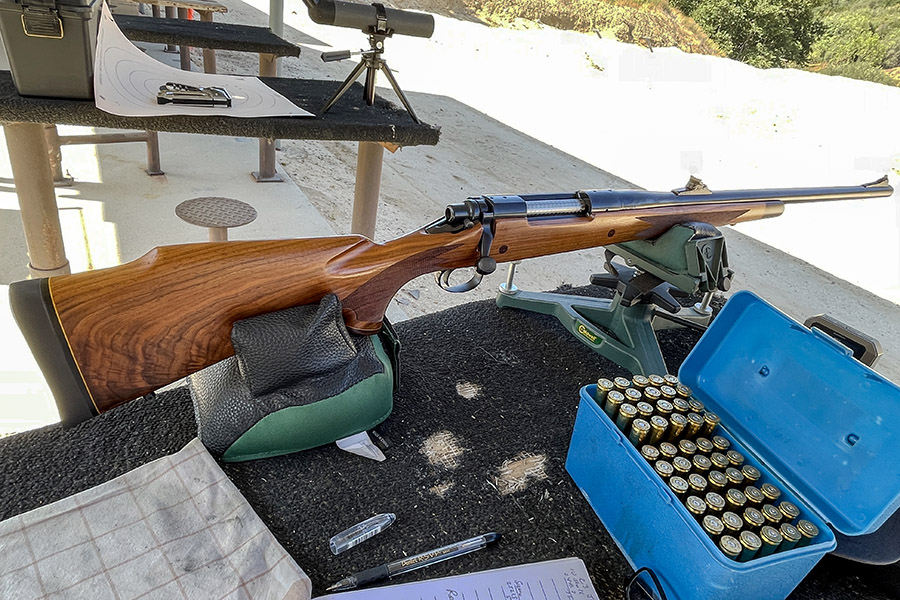
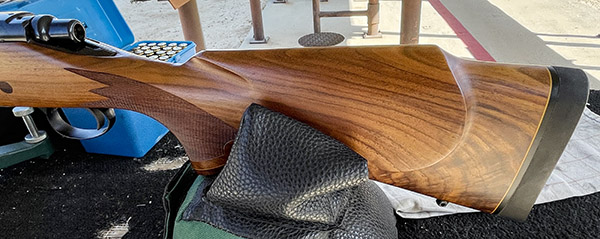
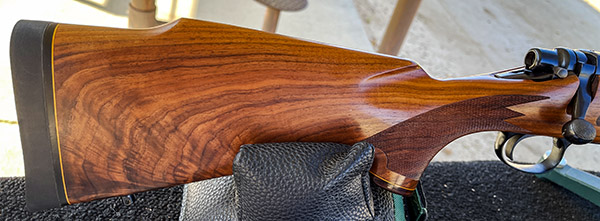
I’ve owned the Safari rifle for five decades now. I’ve never been on a safari with it, and at this point in my life, I probably never will be. But I can still dream. Capstick, Corbett, Bell, and other professional hunters wrote about their adventures going after things that could gore, stomp, or bite you to death. I like reading those stories. Like I said, I can still dream.
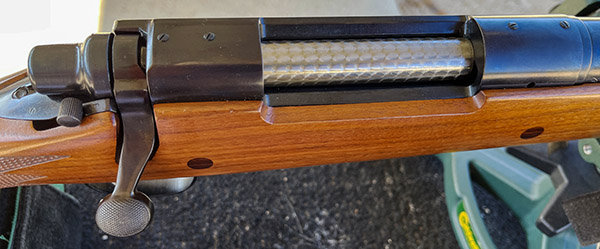
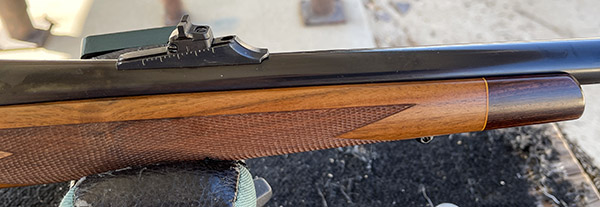
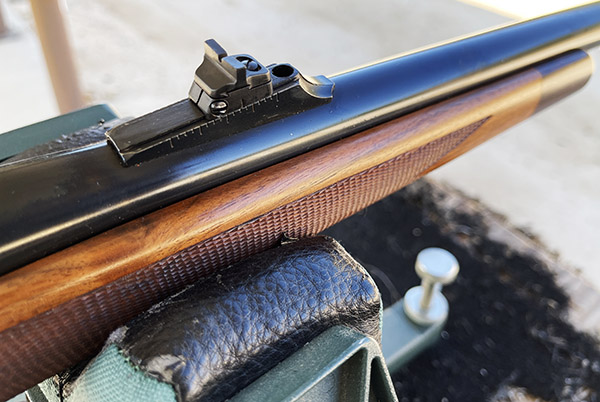
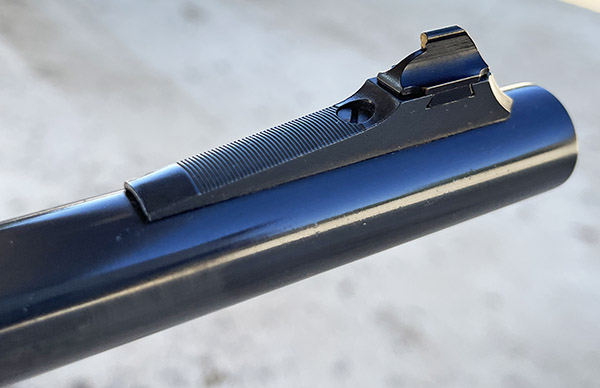
I first became interested in big bore rifles when a group of guys I hung around with in El Paso 50 years ago cooked up a cast bullet bench rest competition. They all bought big bore rifles, with the understanding that minor casting imperfections wouldn’t affect the bigger .458 or .375 cast bullets very much. I never lost interest in that concept, although the bullets I’ll write about here are of the jacketed variety.
The weather at the West End Gun Club was perfect: No wind, moderate temperatures, and the horseflies weren’t out. I set up my gear, put my targets out during a line break, and chatted with my geezer buddies for a bit (being retired is fun). Then I pulled the big Remington from its case, placed it in the rifle rest, set up my Garmin chronograph, chambered a round, and searched diligently for the front sight as I settled in behind the rifle. As the front sight danced in and out of focus, I did my best to hold it at the base of the bullseye (barely visible 100 yards away), and gently put pressure on the trigger. I did the same nine more times, each time remembering the marksmanship fundamentals I learned in the Army.
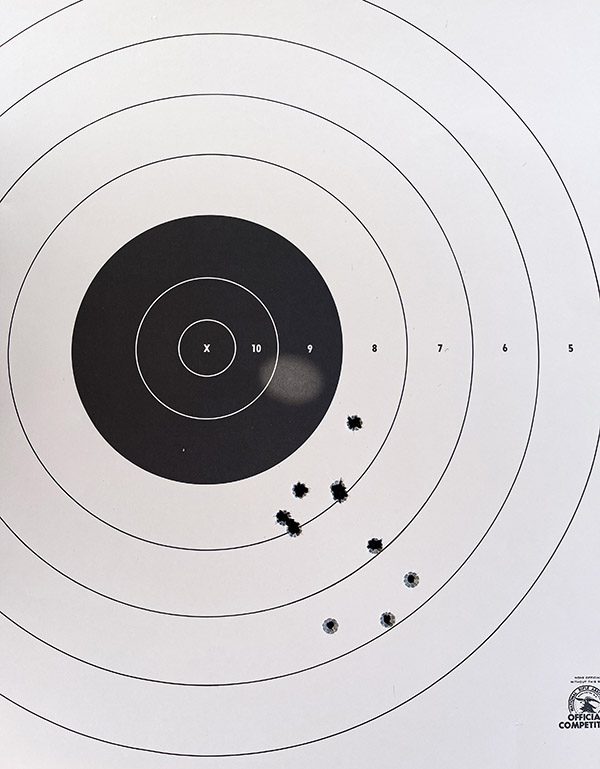
I shot at 100 yards from the bench, and as has been the case in prior outings, the rifle printed a little low and a little to the right (I had to use my spotting scope to see it; there’s no way those little .375 holes would be visible to the naked eye). I thought I would adjust the rear sight to compensate for this, but I had my contact lenses in on this outing and I couldn’t see the screws that lock the rear sight in position well enough to take a chance on loosening them and moving the sight. I’ll do that when I get home. I had my contacts in because I thought I might be able to see the front sight a bit better. Hope springs eternal, but it wasn’t in the cards for me. I shoot open sights pretty much the same whether I’m wearing my glasses or my contacts.
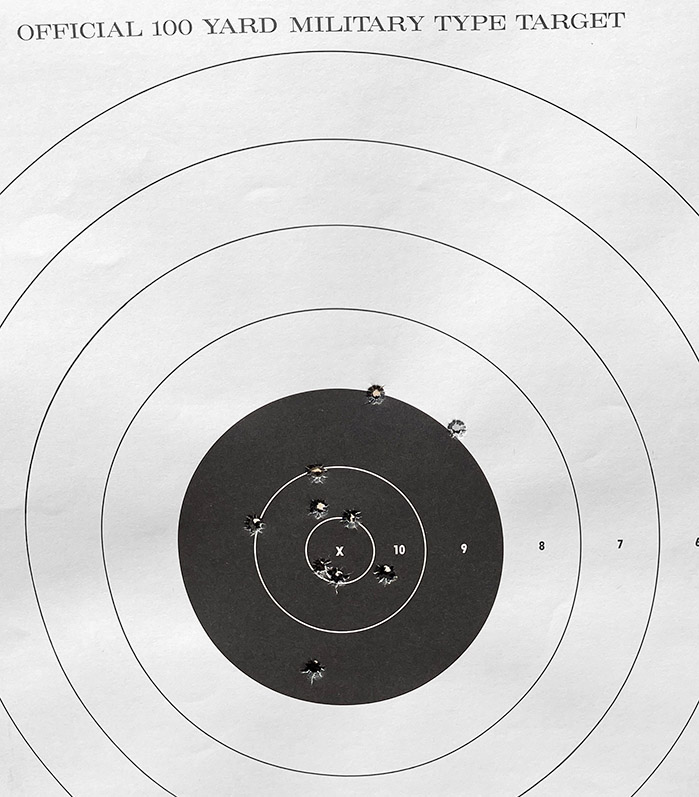
On the next target, I threw in a little Kentucky windage, doing my best to hold the front sight at 9:00 on the black bullseye. It worked. The next 10 shots were mostly in the bullseye, but I had to struggle even more to see the front sight with it partially over the black bullseye. Normally I would hold at 6:00, where the front sight is still tough to see but the contrast against the white background surrounding the bullseye is better. Trying to hold it at 9:00, with the front sight’s little bead half in and half out of the bullseye, was like trying to have a discussion with a left winger. But when I looked through the spotting scope, I could see that I did okay.
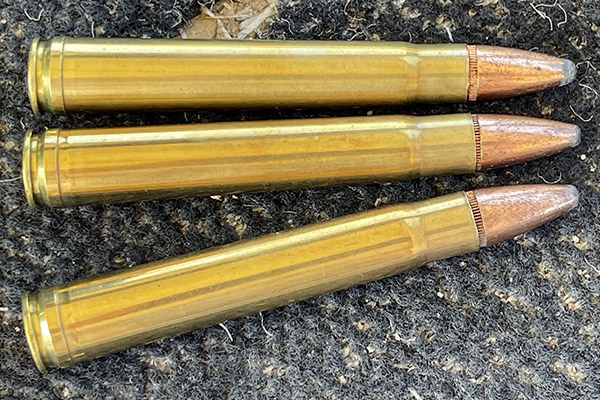
My load is mild compared to where you can go with this cartridge. I shoot a reduced load using Hornady 270-grain jacketed softpoint factory second bullets, 33.0 grains of SR 4759 propellant, Remington brass, a CCI 200 primer, an overall cartridge length of 3.570 inches, and no crimp. Recoil is mild for a .375 H&H.
The group size and chrono results, along with those from a single group fired a week or so earlier, are provided below.
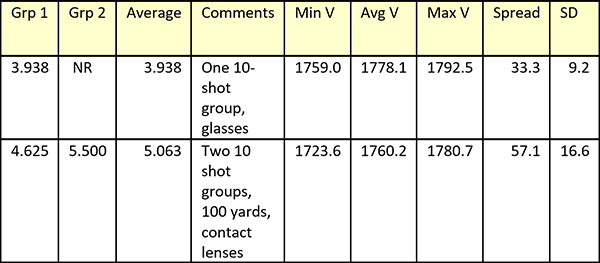
It looks like I did a little better wearing glasses than I did with my contact lenses. I think I see better with my contacts, but I guess the results don’t lie. It was a little bit cooler on this second outing than it was on the day I shot previously, and that shows up in the velocity results.
One of my buddies chided me about the Remington needing a scope. I would do better with a scope, but I like the challenge of hitting a distant target with iron sights.
You might be wondering about the factory second bullets. They are usually available from MidwayUSA. I don’t know what makes them factory seconds. It might be the cannelure location on the bullet shank, it might be slight tarnishing, or it might be something else. The factory second bullets are about half the price of the standard (presumably higher quality) Hornady bullets. For my purposes, these are good enough. Maybe I’d get smaller groups with first quality bullets. Maybe not. Someday maybe I’ll test to see if there’s an accuracy difference.
As promised, here’s a set of links for my earlier .375 H&H blogs:
The 375 H&H at 100 Yards
375 H&H Loads
The Remington 375 H&H Safari Grade Rifle
You might recall that we also wrote a few blogs on a cartridge that improves upon the .375 H&H (and that would be the .375 Ruger). Those blogs are here:
A Custom 375 Ruger
A Day at the Range
And to wrap up this blog, while I was on the Midway site I came across a Youtube video about the .375 H&H by my good buddy Larry Potterfield. I enjoyed it and I thought you might, too.
Join our Facebook ExNotes page!
Never miss an ExNotes blog:
Help us keep the lights on:
Don’t forget: Visit our advertisers!