By Joe Berk
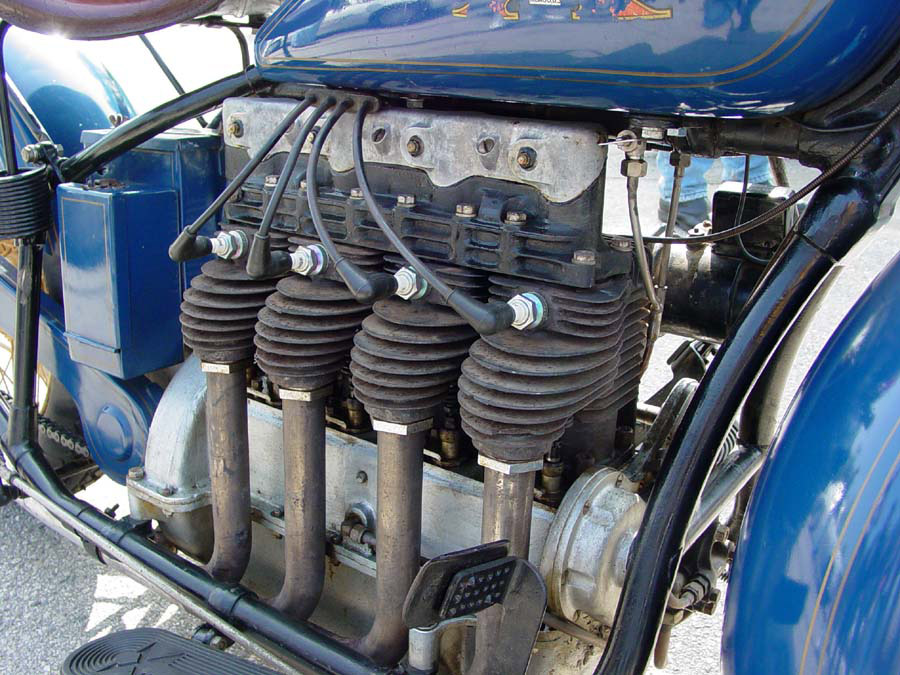
Fours? I’ve owned a few, and Lord knows I’ve sure seen a bunch of them. For starters, there’s the 1931 Excelsior-Henderson at the top of this blog (a photo that graces every one of our ¿Quantos Pistones? blogs). It’s not mine and I didn’t ride it. I was so interested in photographing that motorcycle, I didn’t realize I was standing next to Jay Leno until he took his helmet off. I’ve written about that encounter before.
Honda CB 750
When the Honda CB 750 Four came on the scene in 1969, it turned the motorcycle world upside down. I thought the bike was interesting before I saw one, but I also thought I was a 650 twin kind of guy (you know, Triumphs and BSAs). The first 750 Four I ever saw accelerated past my house when I was way younger. It was a gloriously visceral and symphonic four. To a guy used to lopey Harleys and throaty Triumphs, the CB 750 sounded like an Indy Offenhauser. When I heard that high performance four-cylinder yowl, it was like walking through the jungle on a moonless night and having an unseen leopard suddenly scream a short distance away. It reached deep, took hold, and shook me mightily. I remember it like it happened yesterday. At that instant, I knew I would own a 750 Four someday soon. And I did.
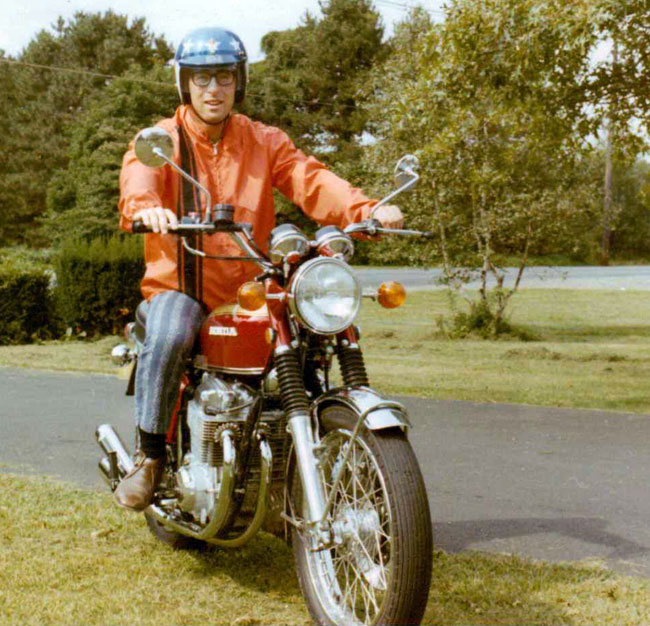
Our family bought our motorcycles from Cooper’s Cycle Ranch in Hamilton, New Jersey. The CB 750 was $1539 out the door (I can’t remember what I had for lunch earlier today, but I remember that number), and my 750 was the color I wanted. Honda offered the 750 Four in four colors in 1971 (brown, green, gold, and candy apple red). I wanted a red one, and Sherm Cooper made it happen. It was a glorious bike. I rode it to Canada with a fellow Rutgers student (Keith Hediger, who had a white Kawasaki 500cc triple). That was my first international motorcycle trip. I rode it a lot of other places, too. It was a wonderful motorcycle. I wish I still had it.
Honda CB 500
I owned two Honda CB 500 Fours. I bought one from good buddy John who was a high school and college classmate. I only put a few miles on before putting it on my front lawn with a for sale sign. It sold quickly. I liked the bike (it was very smooth), but I needed the cash for something else (I can’t remember what).
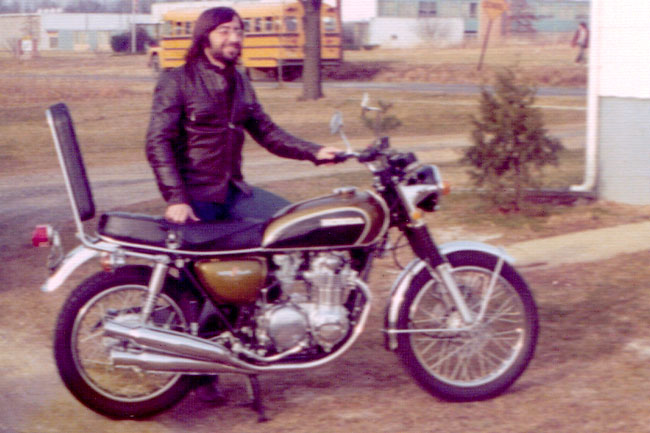
A similar opportunity popped up decades later when a guy at work had a metalflake orange CB500 for sale at Sargent Fletcher (an aerospace plant I ran in the 1990s). Metalflake orange was a factory color on the CB 500 Honda. At $500, I figured I could take a chance. I bought it, rode it a little bit, never registered the bike, and sold it with a Cycle Trade ad a couple of weeks later.
Suzuki Katana
This was a bike way ahead of its time. Wow, was it ever fast. In 1982, the performance was incredible. It would probably be tame by today’s hyperbikes, but back in the early ’80s, it was something else.
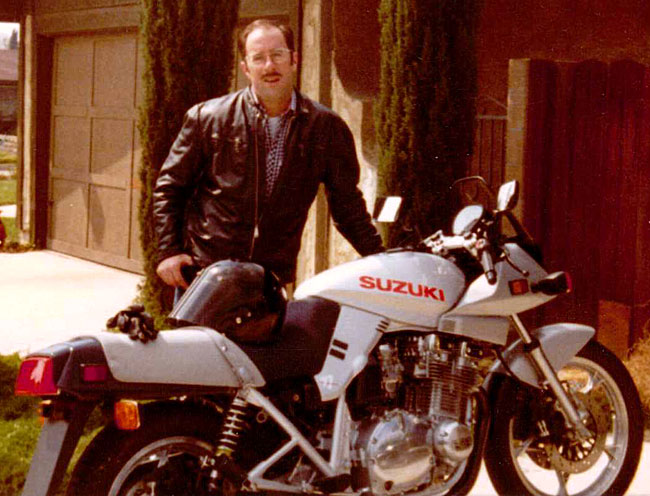
Take a good look at that photo. The ’82 Katana you see above is the only vehicle (car or motorcycle) for which I ever paid over list price. When it first came out, it was pure unobtanium. Suzuki only made 500 initially. I think mine was No. 241. I paid $5500 for it, which was way over list price in 1982, and I had to go all the way to Victorville to find one.
I thought I had something special, but that only lasted a month or two. After the initial limited release, Suzuki made another 500, bringing the total number to 1,000. I found that troubling, and I felt cheated. Those sold quickly, too, so Suzuki went ahead and produced yet another 500. Those last 500 didn’t sell well at all (Suzuki had reached all the fools like me by then and the market for a bike like the Katana had been saturated). Suzuki had to discount the remaining bikes heavily to move them. That really pissed me off. It would be another 15 years before I would buy another Suzuki (that was my ’97 TL1000S). The way I was buying and selling bikes in those days, that was a long time.
The Katana was my first ever superbike. It was scary fast in 1982, and it would probably still be scary fast today. Thanks to Joan Claybrook and Jiminy Carter (remember those two?), the speedo maxed out at 85 mph (as if that would somehow slow anyone down).
The pipes were one of the coolest things on the Katana. They were what Suzuki called black chrome and they looked great. The instrument pod was cool, too. The tach and speedo needles moved in opposite directions, which made it seemed like the two needles were unwinding as you rowed through the gears. This was my first ever bike with low bars. I didn’t like them, but the rest of the bike was very, very cool. I sold the Katana when my first daughter was born. A fat lady knocked it over in a shopping mall pulling her car out of its parking space. I took that as an omen. Time to step away from riding for a bit. I wish I still had that motorcycle.
Suzuki went on to use the Katana name (a Katana is a Japanese Samurai sword) on other models, but they were never the same at that first 1982 Katana.
Triumph 1200 Daytona
This was a fun machine. I bought when it was still brand new (but already 7 years old) on Ebay, thanks to an alert from my buddy Marty. It was $7,000. As soon as I won the auction, the next highest bidder contacted me and offered to buy it, but I turned it down.
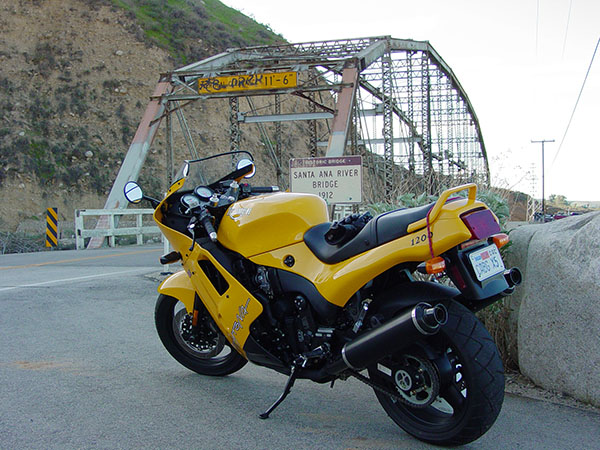
I’ve written about the Daytona before, and rather than reinvent the wheel, I invite you to read the more complete Daytona story here.
Honda Gold Wing
Back in the day, the initial Honda Gold Wing was a four, as they continued to be for several years. I thought I wanted one when the Gold Wing was first introduced (I was in Korea at the time and I saw the new Gold Wing in a Cycle World magazine). But I never acted on the urge to buy one and that was a good thing. I rode a friend’s a few years later and the bike had no soul whatsoever. It was boring beyond belief; I would not have thought any motorcycle could be that boring. But it was and it made me glad I never bought one.
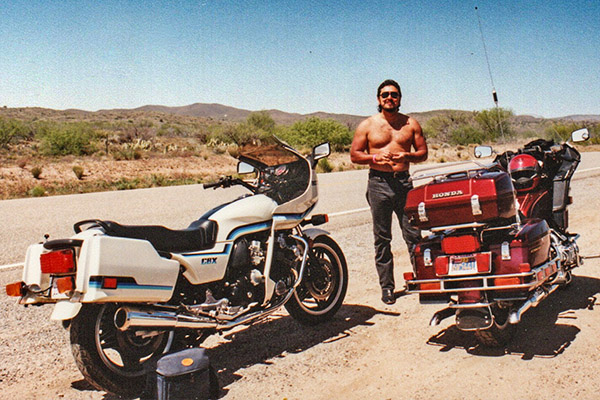
Guys who have Gold Wings seem to love them. Emilio Scotto rode one around the world and wrote a great book about it. Today, of course, Gold Wings are sixes. I’ve read that the handling on the new ones is great for a big bike. But they’re not my cup of tea. You may feel different about Wings, and that’s okay.
So there you go: My experiences with four-cylinder motorcycles. The configuration makes sense from a lot of perspectives. They can be powerful and they are an almost universal configuration on Japanese motorcycles. But they’ve grown too big for my liking. I know there have been smaller fours out there (the Honda CB350 Four comes to mind), but as I’ve matured (read: become a geezer), I like smaller bikes better. As always, your mileage may vary.
Missed our earlier ¿Quantos Pistones? stories on the Singles, the Twins, and the Triples? Hey, no problemo! Here they are:
¿Quantos Pistones? (The Triples)
¿Quantos Pistones? (The Twins)
¿Quantos Pistones? (The Singles)
Join our Facebook ExNotes page!
Never miss an ExNotes blog:
Help us keep the lights on:
Don’t forget: Visit our advertisers!