By Lew Ballard
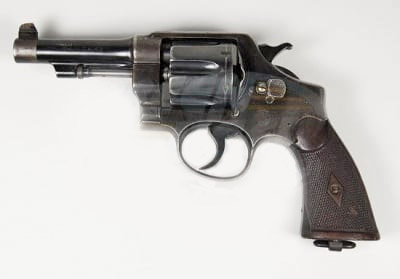
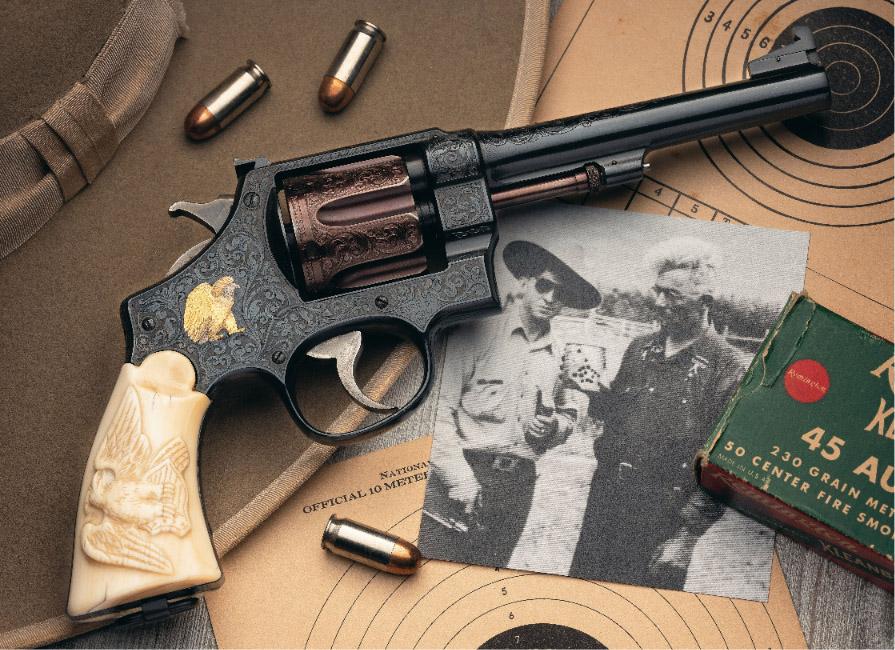
Editor’s Note: Lew Ballard posted the text of this story on a Facebook page I manage on .45 ACP revolvers. It was so good I asked Lew if I could publish it on ExNotes, and he graciously agreed. Lew apologized for not having kept photos of his custom 1917 (the subject of this story). A Google search turned up a number of custom 1917 revolvers, including Elmer Keith’s personal 1917. It’s the one you see above, which sold at auction in December 2023 (rather appropriately, for over $17K). I love anything about 1917 revolvers, and I’m guessing you do, too.
With that as a backdrop, here’s Lew’s story.
Over the years, now decades, that I’ve been not only shooting, but also interested in guns, I’ve put together a number of custom firearms. Generally, I hire the work out to people who are qualified, although at times I’ve proceeded, through main strength and awkwardness, with some custom modifications on my own.
I still remember the first custom gun I commissioned, and even after all this time, looking back at how young I was, and how little I really understood at the time, I think I did pretty well.
Allow me to set the stage, with a little background. Although I had a little shooting experience growing up, I didn’t have all that much, but when I turned 21 I decided it was time to buy a gun. Particularly, a pistol. In early 1988, shortly after turning 21, I started looking, and I found a pistol that I’d buy again today. It was a 1911 in .45 ACP. More particularly, it was a Colt Mk IV Series 70 Government Model in Colt’s electroless nickel finish. Coltguard?
The Mk IV Series 70 Government Model was, for all intents and purposes, a 1911A1 fitted with a collet bushing instead of the solid bushing John Moses Browning had designed originally. This was intended to enhance accuracy, although I think they reverted to the solid bushing later on, for parts breakage issues.
Now, this was so long ago that gun writers, in gun magazines, only recommended a few places that could do a proper feed job so that a 1911 would cycle any ammunition other than hardball. Man that was a different world, wasn’t it?
I was living in Houston, or at least commuting back to Houston from Sherman TX where I was attending college, and I nervously went to a local retailer, Carter’s Country, right there on the Katy Freeway in Houston, to see if they could do a feed job. They said they could, and for some reasonable sum they did it, and afterwards I shot a bunch of 200 SWC .45 ACP loads through that Colt. Along with a bunch of Blazer 200 grain JHP ammo—the old “flying ashtray.”
And I wore an onion at my belt, which was the style at the time.
I had chosen a 1911 in part for pragmatic reasons, but I am honest enough to admit that there were also “vibe” reasons. I’d been reading Mickey Spillane for five or six years by that point, and Spillane’s characters almost always packed a .45—whether we’re talking Mike Hammer, Tiger Mann, or other one-off protagonists. The Shadow, as drawn by Mike Kaluta, packed TWIN .45s. Robert E. Howard’s El Borak—the Texas gunslinger in Central Asia/Afghanistan, well he packed a big .45 automatic as well, even if he generally ended up doing most of his fighting with cold steel. Should I mention “two world wars” while I’m at it?
In those dim, distant days of yore, I also read gun writers. I read Jack O’Connor and Elmer Keith and Ross Seyfried and “primus inter pares” Jeff Cooper. Jeff Cooper made a profound impression on me. I was, in effect, a Cooper Trooper. Jeff Cooper was a big fan of the .45 ACP. Man, I thought that Colt Government Model was the bee’s knees. But this is all just introduction, because I don’t think a feed job, a polishing of the feed ramp, really qualifies as a custom gun.
Essentially, around this time, I got interested in revolvers. Sigh, looking back, I can remember going to gun shows with tables positively groaning with service .38 Specials and .357 Magnums that were being surplused out by police departments, during the drive towards the wondernine. Is “wondernine” even a term, anymore? Probably not. A “wondernine” was a double stack, double action 9mm. In my mind, the term came about with the US military trials to adopt a new service pistol, which turned out to be the Beretta 92, as the M9. At this point in time, I just thought the whole idea was silly.
I needed a big bore revolver.
I’ve never really been a big Magnum cartridge fan. I’ve always liked moderate cartridges. I have shot and enjoyed .44 Magnums, but I always kept coming back to the mild, sedate, staid ballistics of “230 grains, at 850 fps.”
I still feel that way. When we talk about revolver cartridges, whether it’s a .44 Special, or a .45 Colt, or a .45 ACP, or a .41 Special, I tend to think “200 to 250 grains, between 850 and 1000 fps” as a sweet spot. Plenty of power, not too much recoil, not too much blast and flash. Easy to shoot quickly—certainly compared to “hotter” loads.
So I thought I needed a big bore revolver, and at this point I was thinking of a double action revolver—and this was a good time for big bore double action revolvers. I considered the .44 Special and .45 Colt, but I kept coming back to the .45 ACP, especially once I discovered the Smith and Wesson model of 1917.
Historical sidenote: during WW1, the US realized that 1911 production was limited, and so contracted with both Colt and Smith and Wesson to produce revolvers chambering the .45 ACP, using half moon clips to adapt the rimless .45 ACP design to a traditional revolver. I really have no experience with any Colt New Service revolvers, as they felt awkward in my hand. Ah, but the Smith N-frame, now that was a different matter!
The Smith and Wesson 1917 was a fixed sight N frame revolver, with a tapered 5 ½” barrel, chambered in .45 ACP. It had a square butt and a lanyard loop.
And about that time, several American companies started to reimport Brazilian contract S&W 1917s. Hazy memory says they were sold to the Brazilian Navy in 1937. I don’t remember which company imported the two I bought. Navy Arms? Century International Arms? International Arms Company? If I had to guess, I’d say it was Navy Arms.
I went to a gun shop in Sherman, TX and offered them a deal. I’d trade my Colt to them if they’d order two of the S&W Brazilian contract 1917s for me. They agreed, and a couple of weeks later, I did the swap.
I shot them as they were, for a while. I don’t think I ever used the half moon clips, which held three rounds, since the full moon clips had come out, holding six rounds. They were . . . very nice. They were also surprisingly light and handy! At that time, the trend was towards untapered barrels in production revolvers, and full underlugs. We could call that the Python influence? Let’s just put it this way. Compared to a 6” 29 with a heavy barrel, the 5.5” 1917 felt super light. I’m not sure I’d want to launch any Elmer Keith memorial .44 Magnum loads through a sixgun of that weight, but then again, I wanted the mild, sedate ballistics of the .45 ACP.
Then I got to thinking, “Gosh, a little long, when one ponders on it, aren’t they?” And I ran across an article by Masaad Ayoob, in one of the many gun magazines that were out at the time. Combat Handguns, maybe? I don’t know. Mas had had a 1917 customized: barrel chopped, somewhat refined. Well, that gave me an itch I just had to scratch. I wasn’t even sure if it was possible, in my area, to have something similar done.
A little investigation, however, revealed that Briley Manufacturing was in the Houston neighborhood I lived in, when I lived in Houston. I photocopied the Mas Ayoob article and headed that way, together with one of the 1917s.
I explained what I wanted to have done, and they thought about it and said, “Sure, we can do that.”
This is what they did for me. They bobbed the barrel. I remember I wanted something less than 4”, but only a little less. They cut it just far enough ahead of the ejector rod lug to look right. Three and a half inches? Three and three quarters? Something like that. Recrowned the barrel. Fitted a ball detent in the crane, for an improvised “triple lock” thing. Manufactured a new half moon front sight, serrated “like it was a silver dime” and widened the rear sight notch a bit. Action job. A general “go through it and make everything right” approach. They bobbed the hammer spur but then serrated the top of the hammer for easier thumb cocking. (Yes, I retained the single action capability.) Then they refinished the whole thing with Parkerizing.
I ran it with the service stocks, and kept the lanyard loop in place, and put a black finished aluminum Tyler T-grip on it.
Whee doggies!
I was as happy as a fellow could be. It was light, it was handy, it had a great trigger, it was as accurate as I was (if not more). The new front sight and the opened up rear notch gave it a really good sight picture. It had aura and drip and rizz, to use modern terms. I kept it in an Uncle Mike’s nylon holster that I’d originally got for a 3” Ruger GP100 until shame got the better of me and I bought an El Paso Saddlery 1920 Austin holster for it.
I shot a bunch of Remington hardball through it. I shot a fair amount of Blazer 200 grain through it, although I remember the aluminum cases being a bear to bust loose from the moon clips. Then one day I found a closeout deal on a case of Remington AutoRim ammunition. The AutoRim was a .45 ACP case, fitted with a very thick rim so it would work without moon clips, loaded with a 230 grain lead round nose bullet. I think I got that case of ammunition for under half the price I was paying for new commercial hardball.
Such vibes! Much rizz! So drip!
It’s gone now. I didn’t sell it. I’d like to think I’d never have sold it, although I can’t swear I wouldn’t have. When I joined the USMC, I handed my guns over to a friend to look after while I was away, and when I got them back, this custom revolver wasn’t there. Story I got was that John had been out boating at Lake Houston, and it, umm, fell into the water.
Oh well. It was just a thing, even though it was a very nice thing. Also, that was pretty much the end of me and John hanging out and doing things. As I look back, though, from this vast span of time, I still think that my first custom gun was a dang nice custom gun. It felt like I was carrying or shooting a chunk of Americana while I had it. And I miss it to this day.