
By Joe Berk
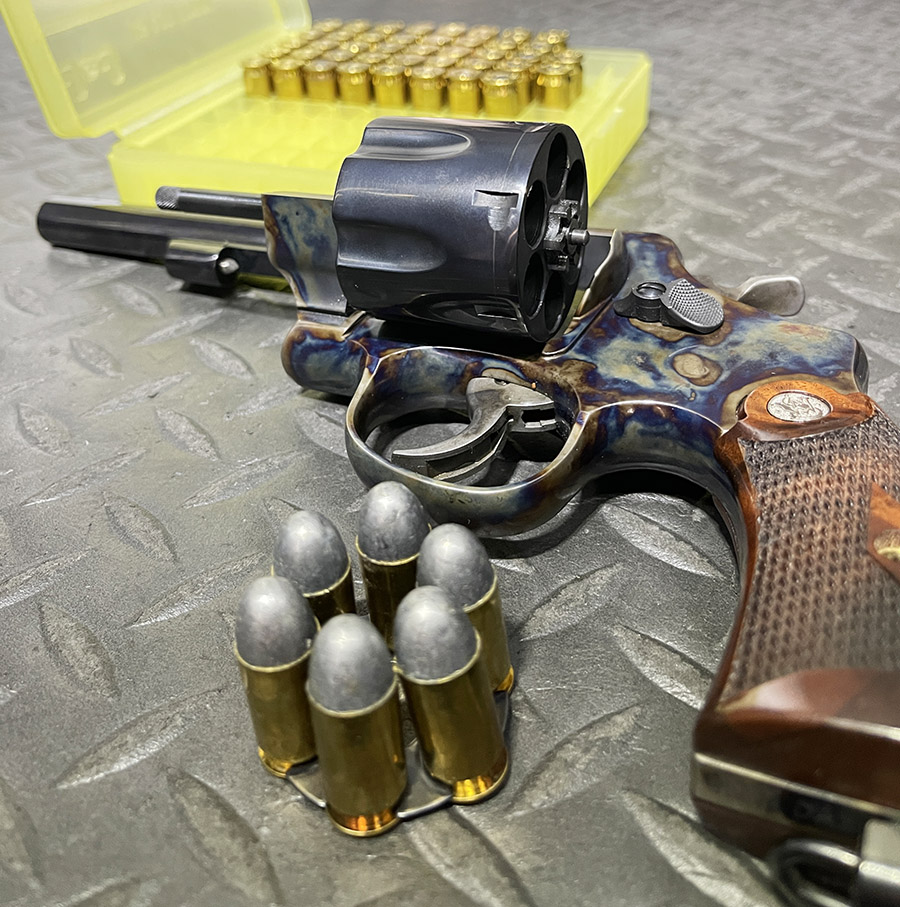
The revolver du jour is a Smith and Wesson Model 22, which is one of a limited run Smith sent to Turnbull for their signature color case hardening. It is a repop of the famed World War I Model of 1917 Smith and Wesson, a revolver we’ve written about in these pages before. This revolver is beautiful, with Altamont grips, high polish bluing, and mesmerizing color case hardening.
I have a big bottle of Red Dot powder and I’ve been using it for reloading 9mm ammo. I wanted to try it in .45 ACP. I thought I would try it in my 1911A1 .45 Auto until I realized I’m not supposed to bend at the waist for another couple of weeks (a consequence of my back surgery), and that meant I couldn’t pick up my brass. So I decided to shoot it in one of my .45 ACP revolvers (so I wouldn’t have to chase my brass).
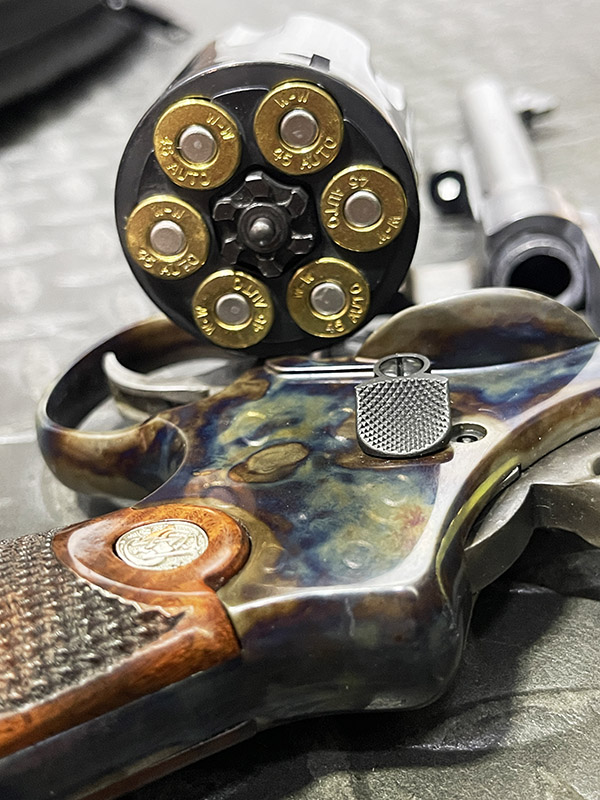
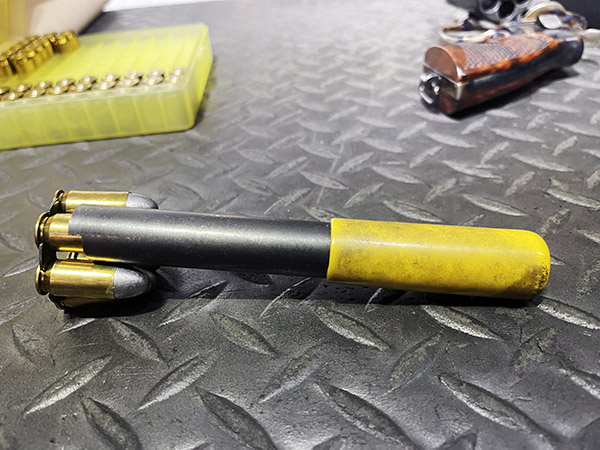
When you shoot .45 ACP ammo in a 1917 revolver, you have to use a clip to provide the right headspace, and to allow the ejector rod to eject the cartridges. Putting each cartridge into the clips is kind of a pain in the you-know-what, but it’s an elegant and simple solution to the problem the Army faced in both World Wars when there weren’t enough 1911A1s to go around. After firing, you also need to extract the empty brass cases from the clip. I used a Brownell’s tool for both inserting the ammo into the clip and for removing the empty cases after shooting.
After my first few shots, I realized again that my 1917 shoots low (I knew this previously but had forgotten it). On my first target, I held at 6:00 on the orange bullseye, and at 10 yards my shots were 3 inches low. Not a problem; I simply held at 12:00 on the bullseye, and I shot the multi-round group you see below. I shot that group standing up. I’ve done better in the past, but this wasn’t too bad for an old guy.
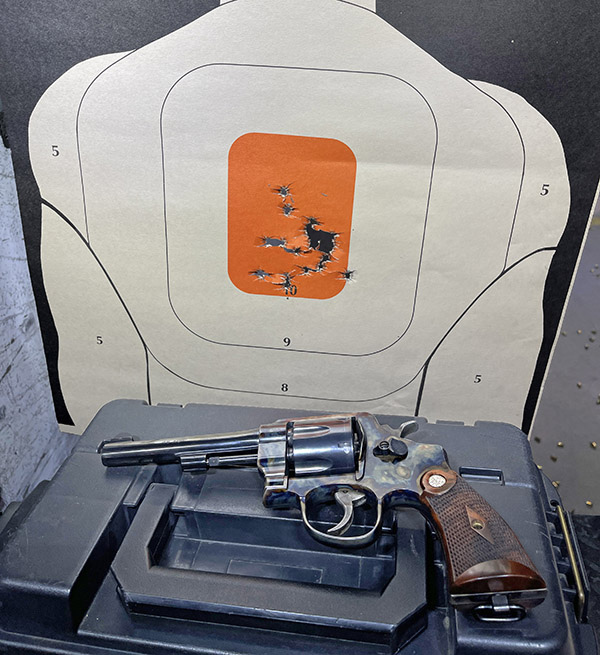
The group was not great, but it was not terrible, either. I went home and started wondering…could I get a replacement front sight that wasn’t quite as tall?
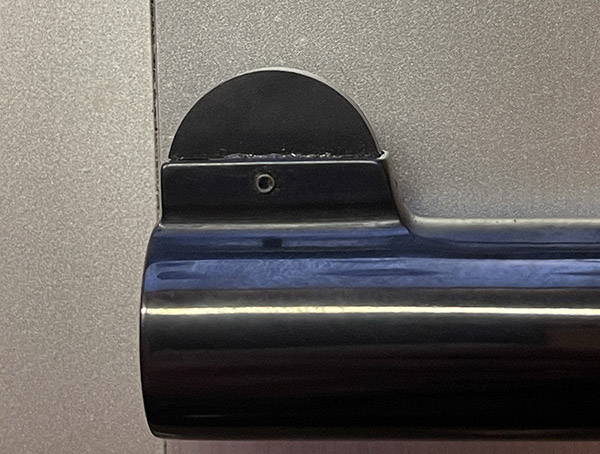
I searched the Internet, and what I found is that on these guns the front sight being too tall (which causes the gun to shoot low) is a known problem. I had called Smith and Wesson’s customer support a few years ago to discuss this, but they told me the gun was too old for them to do anything (this particular revolver was manufactured in June of 2007). In my recent Internet sleuthing, I found that Smith had owned up to the problem and were replacing the front sights at no charge, but that was nearly 20 years ago. When I called a few days ago, the nice lady at Smith and told me they no longer stock the part (I should have been more persistent in the first call to Smith and Wesson). She also told me that because I live in California, even if they had the part, they could only ship it to an FFL. Our California legislature and our Brylcreem governor had struck again.
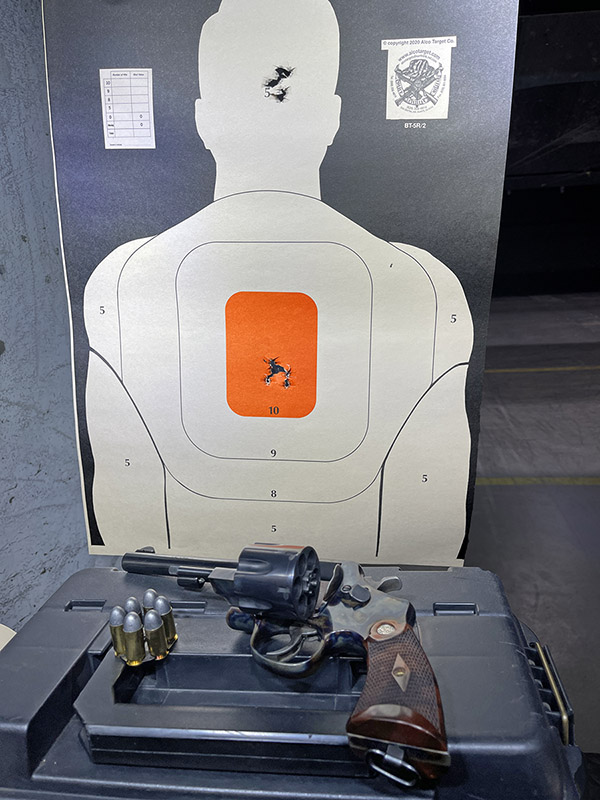
I loaded another batch of ammo identical to the recipe described above, except this time I used 4.2 grains of Bullseye propellant (the first load had 4.5 grains of Red Dot). I had the same issue with the gun shooting too low, but wowee, did the groups ever tighten up. The photo below shows two groups. On the head shots, I held at the top of the target’s head; on the bullseye shots, I held at the top of the bullseye. Both are six-shot groups, and both were with me resting my elbows on the bench. Once again, I realized why I love reloading so much. And Bullseye powder, too. There’s a reason they call it Bullseye.
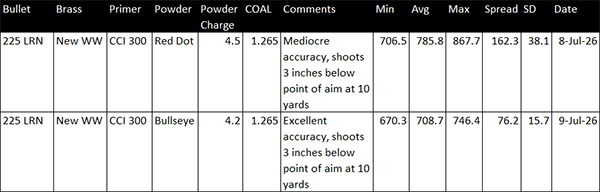
Here’s the chronograph data for the above two loads:
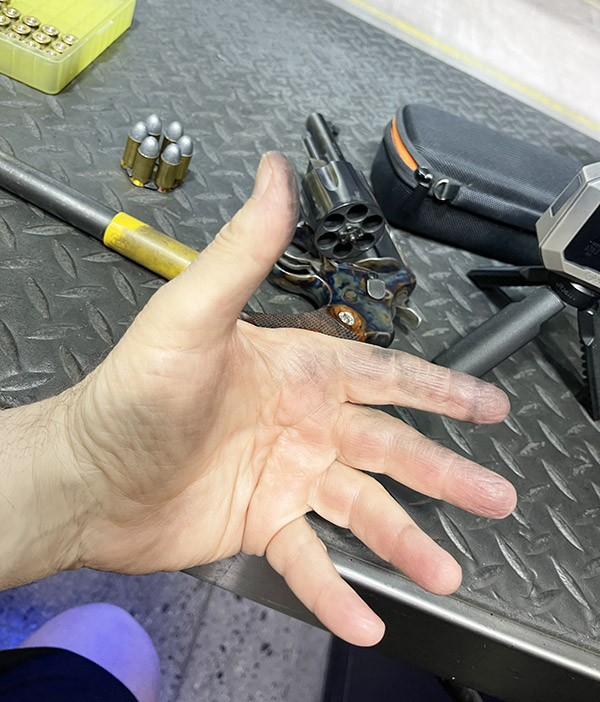
One thing about the Bullseye and Red Dot loads in a revolver: They sure get your hands dirty.
I didn’t do any load development for the two recipes above. I already had the Bullseye ammo loaded and it had proved to be very accurate in the 1911A1. There’s not a ton of published data for Red Dot, so when I found a source with this data, I just picked a load (4.5 grains) and went with it. This was intended to be a quick look and not an exhaustive assessment, and it was. For the two loads I used, and as you can see from the table above, the Bullseye load has a much lower standard deviation than does the Red Dot load. The Red Dot load’s average velocity, though, is closer to factory ball ammo. I probably could have increased the Bullseye load to bring it up to factory levels, but it is so accurate I’m going to leave it alone.
As a follow up check on this front sight business, the next day I grabbed some .45 ammo I had loaded a couple of years ago with AutoRim brass and Jim Gardner’s excellent 230-grain powder coated bullets. I had loaded that ammo with 5.6 grains of Unique, which has been my accuracy load for the .45 ACP in a 1911 for literally decades.
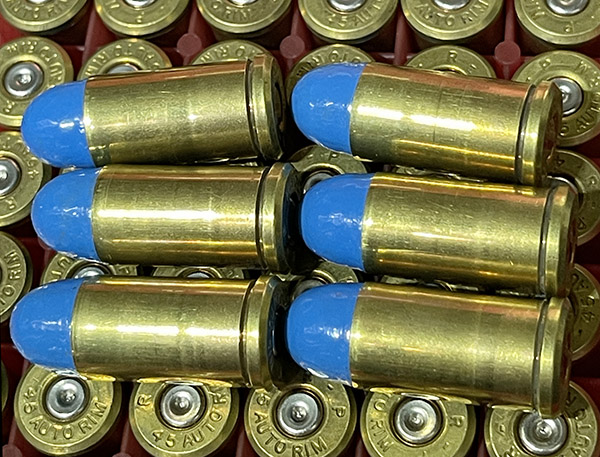
I knew the velocity would be a little higher than what I was seeing with the Bullseye load described above, and I expected the load to print a little higher on the target. I was right on both counts.

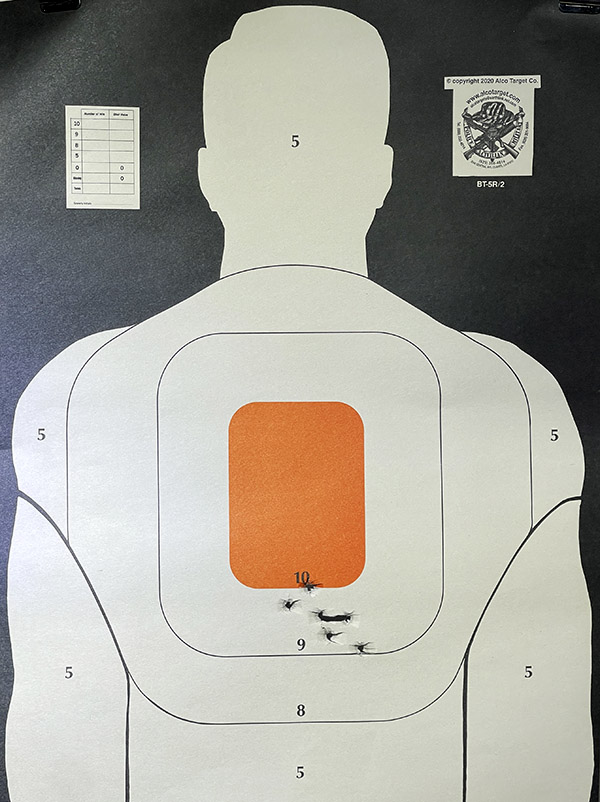
I liked what I saw on the target above. The 1917 was still shooting a bit low, but not by as much as it had with the Bullseye load. I proceeded to put the rest of the 5.6-grain Unique load into the orange bullseye, this time with my aimpoint being the center of the bullseye. Just for good measure, and to make sure this zombie wouldn’t be getting up again, I put my last three rounds into its head.
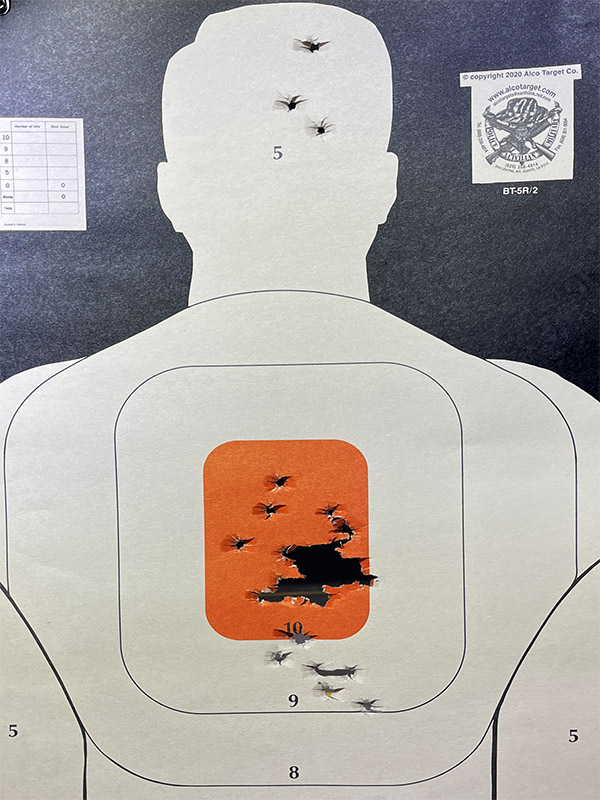
Unfortunately, I think Jim Gardner is out of business. I liked his bullets because of the extra thick powder coating and because they shot so well. These were the last of the 230-grain Gardner bullets I had in my stash, so I will start hunting around for a new source.
So there you have it. I may poke around a bit and do something with the front sight, or I may leave it as is and simply remember to hold high on the target. I could go a little hotter with the Unique/230-grain-bullet load (the online Alliant guide shows I could do so), and that would probably bring the point of impact to the point of aim. I like the way the 5.6 grain load handles, though, and as I said above, it hits close enough for government work. I want to shoot the 1917 with it at 25 yards and see where it groups (above or below point of aim, and by how much). I may try a few more loads in the 1917; these will be topics for future blogs.
How about an original 1917 Colt? That story is here.