
By Joe Berk
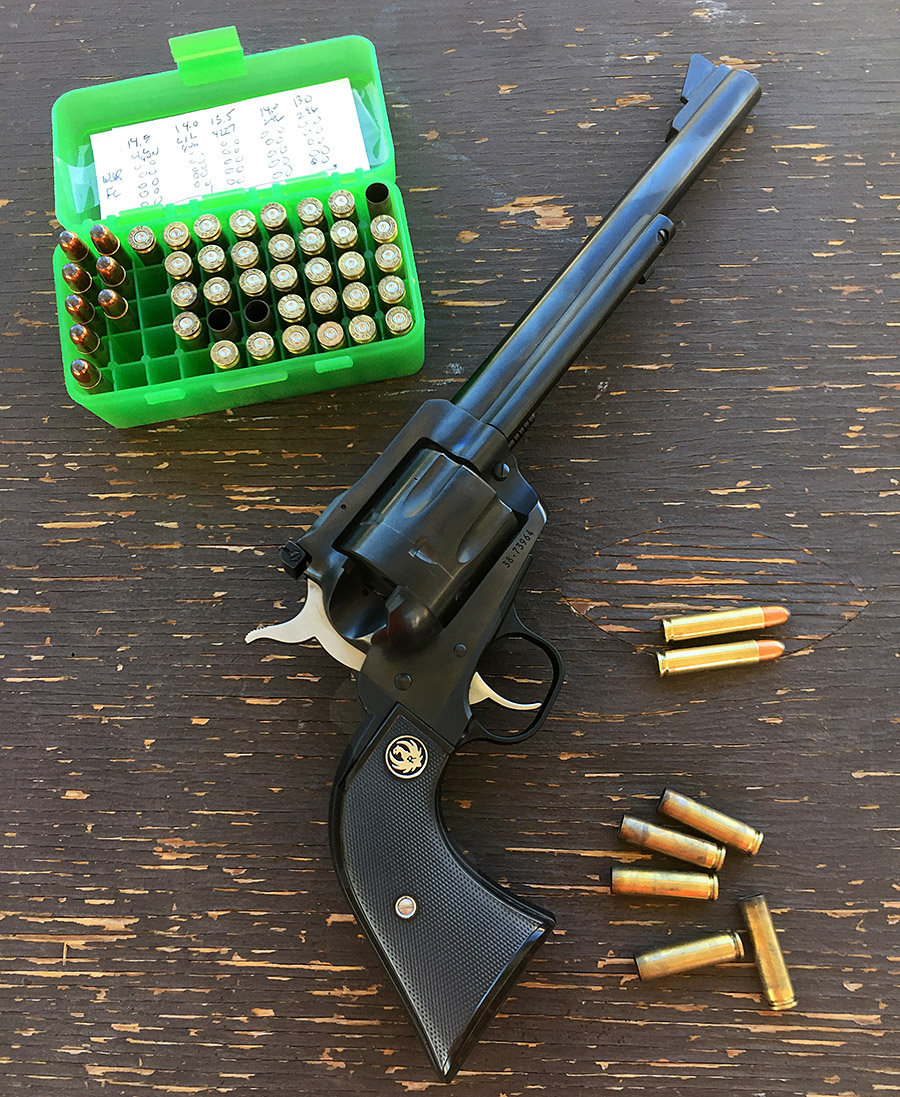
We’ve written a lot about .30 Carbine Ruger Blackhawks here on ExhaustNotes, and with some justification: I’ve owned three of the things. I still have two; one went back to Ruger and stayed there, a victim of my own stupidity. I’ll get to that a few paragraphs down.
.30 Carbine Blackhawk No. 1
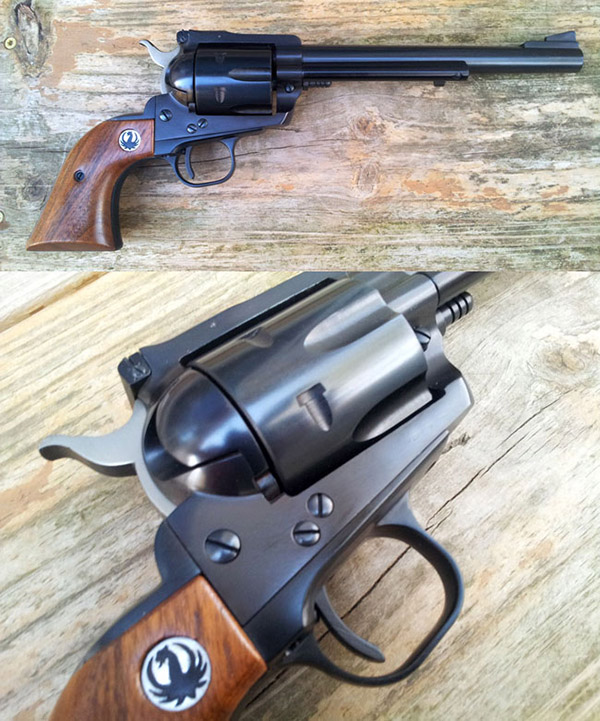
My first .30 Carbine Blackhawk is one of the earliest ones ever made; a three digit, three screw Old Model. It is unfired (other than test firing at the factory), it has a very low non-prefix three-digit serial number, and it has the original box and all of the original paperwork. It’s one of the coolest Rugers I’ve ever owned. It will be one of the guns my heirs will have to sell (or keep; it will be their call) when I go to that big server in the sky and my blogging days are over. I spotted this one on Gunbroker, I bought it, and I’ve had no regrets.
Well, almost no regrets. When I bought that first .30 Carbine I had it shipped to my FFL buddy Bryan, and when he saw it, he spoke at length at how cool it was and how much fun it was to shoot a .30 Carbine revolver. I had never done so, and this one will remain in its unfired condition for as long as I own it.
.30 Carbine Blackhawk No. 2
Bryan’s comments got me thinking that I needed another .30 Carbine Blackhawk I could shoot, and a week or two later, .30 Carbine Blackhawk No. 2 (also an Old Model), came floating in from another Gunbroker ad. The thought was a good one, but the reality was not. That second .30 Carbine Blackhawk was anything but fun to shoot. Every cartridge case stuck in the cylinder (they were extremely difficult to eject), and the cases of my reloaded ammo dragged on the revolver’s backplate.
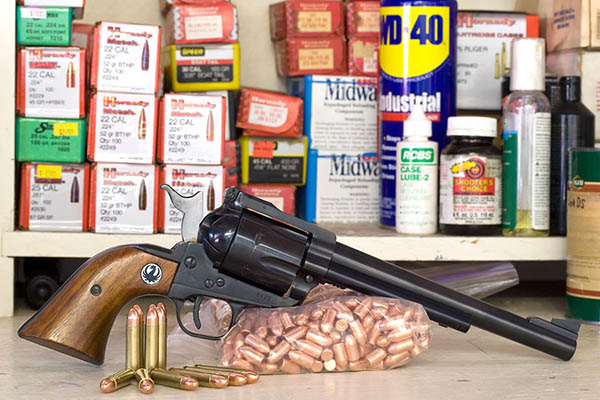
I doped out the cylinder drag issue fairly quickly. I had to trim the brass after nearly ever firing, and I had to make absolutely certain the primer was below flush after seating. .30 Carbine cases shrink in length when fired, and they grow in length when resized. The cartridge headspaces on the case mouth, so case length is critical.
To address the extraction issue, I tried polishing the chambers and I swabbed them with alcohol to remove any traces of oil, but I still had the problem. So I tried lighter loads with Trail Boss (a powder known for working well with lighter loads), and that’s how I got in trouble. The Trail Boss guidance is to load to the base of the bullet for a max load, and not less than 70% of that amount as a minimum load. I loaded at just under the max load and I thought I was doing well when I fired the first Trail Boss load. The case extracted easily. This is progress, I remember thinking, and I fired four more rounds. They all felt okay, with essentially no recoil (that should have been a clue).
I had stuck a bullet in the bore with that first shot and I didn’t realize it. Then I had fired another, and another, and another, and another. I felt even worse when I ran my fingers along the length of the barrel. I could feel the swells along the barrel from each bullet. I didn’t recognize what was happening. Stupid is as stupid does (Forrest Gump, 1994).
.30 Carbine Blackhawk No. 3
After the above debacle, I called Ruger. I told them my story and the nice lady on the other end told me I wasn’t the first one to call with stuck bullets. I asked if they could re-barrel my Blackhawk. Sure, she said, and off the revolver went, on its way back to the mothership.
A few days later Ruger called. A new barrel would be $400.48, they told me, but they weren’t too sure about the gun’s structural integrity. Or, they could sell me a new Blackhawk. How much would that be, I asked. $400.48, she said. Ah, I understood. What they were really telling me is to buy the new gun at the steeply-discounted price (MSRP on a new .30 Carbine Blackhawk at the time was $669; it’s more today). I was in. It wouldn’t be an Old Model, but by that time I didn’t care.
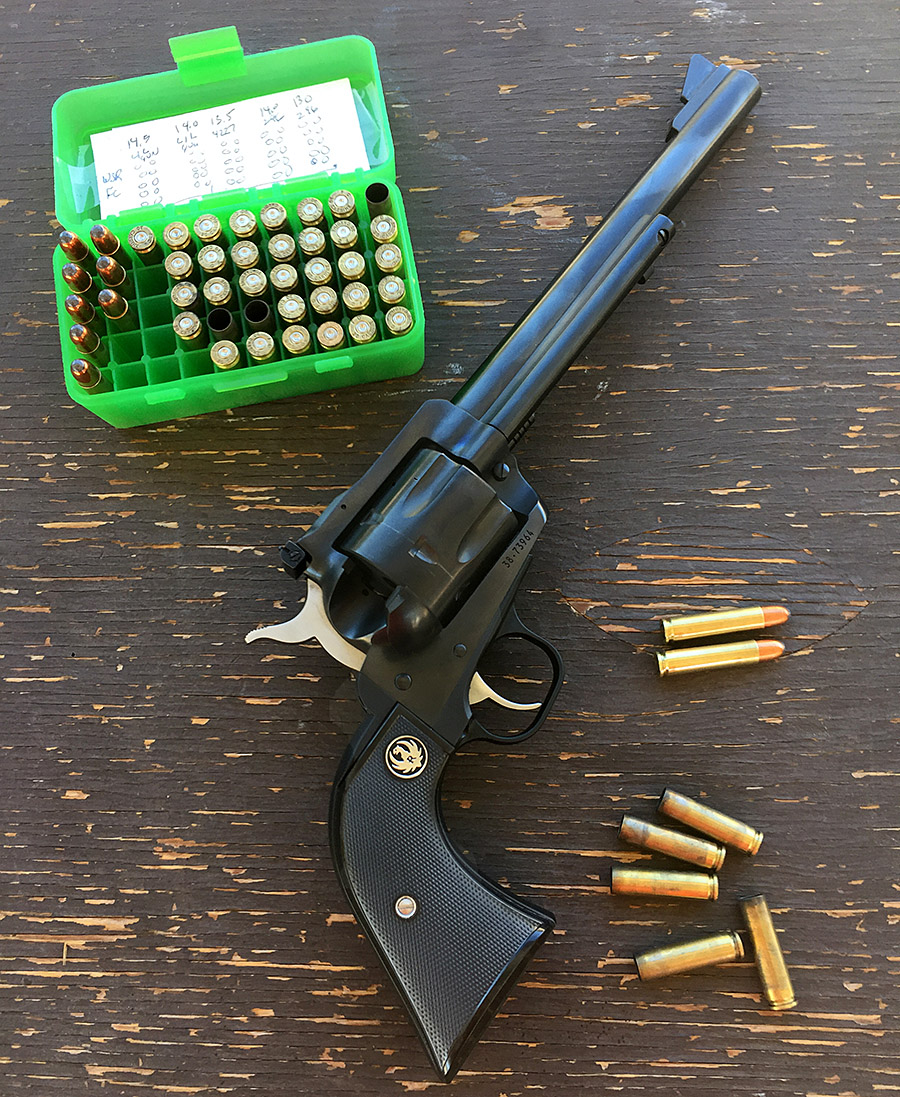
When I received the new Blackhawk, I loaded ammo in different flavors to test what worked best. How did it go? In a word, the new .30 Carbine Blackhawk is awesome. Take a look:
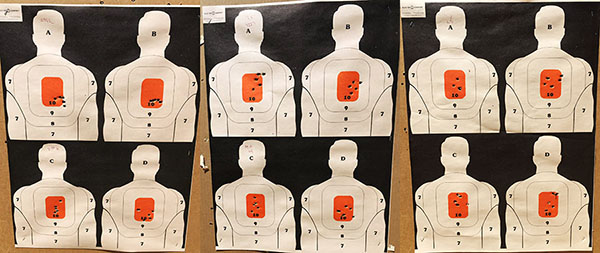
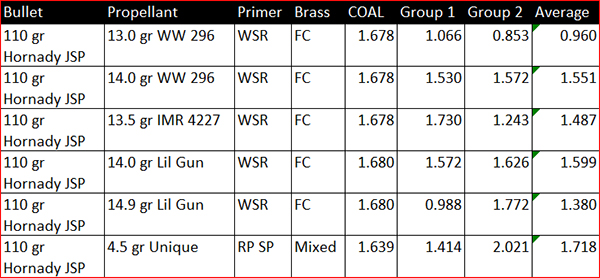
This new .30 Carbine Ruger Blackhawk revolver liked every load I tested. One was exceptional:
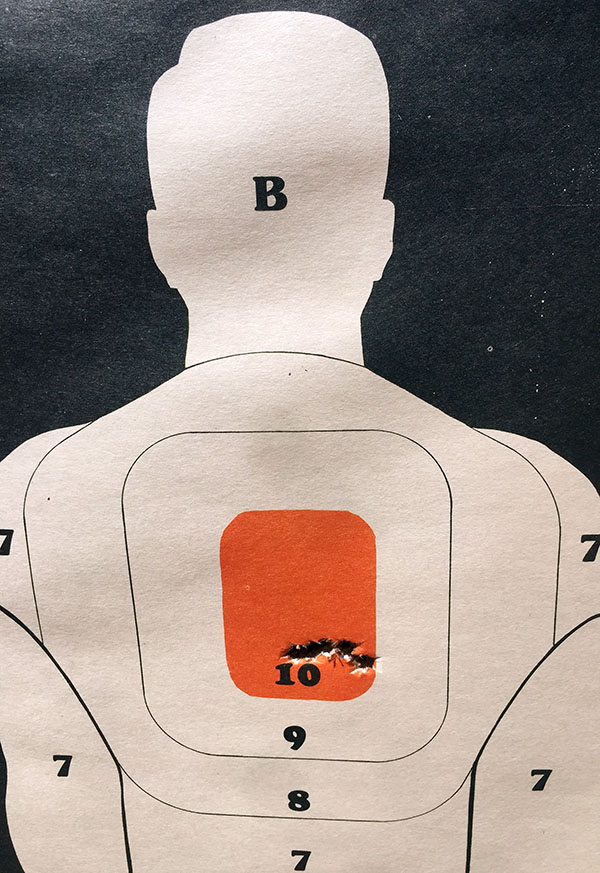
Shooting a .30 Carbine Blackhawk is fun. It’s 7 1/2-inch barrel and long sight radius make for great accuracy. There’s massive muzzle blast, a huge muzzle flash, and major noise (hey, 40,000 psi is 40,000 psi), but little recoil. As mentioned above, it’s accurate. The spent brass practically fell out of the cylinder. This New Model Blackhawk is a honey.
A bit about the gear I use in my .30 Carbine reloading activities. I use Lee dies, although just about .30 Carbine reloading dies
Keep us in components!
More Tales of the Gun? You bet!
Joe, two questions:
1) how do your handloads compare to military FMJ ball? Hotter? More mild?
2) what velocity are you getting from that 7.5 inch barrel?
Regards,
Alan
Alan:
Great question. I haven’t chronographed my .30 carbine loads, so what I will share here is based on what the propellant companies and reloading manuals tell me I should be getting with the Hornady 110 gr jacketed soft point bullet in a 7.5 inch Blackhawk.
I’ve never fired military ball ammo in my Blackhawks, so I’ve never chronographed that ammo. Google tells me that fired from a Ruger Blackhawk with a 7.5-inch barrel, standard FMJ (Full Metal Jacket) military ball .30 Carbine ammunition (typically a 110-grain bullet) produces a muzzle velocity between 1,450 fps and 1,600 fps.
With my 296 load (I tried 13.0 gr and 14.0 gr of 296), the Hodgdon website data tells me I should get 1605 fps with 14.0 gr, which is right in line with what Google specifies for military ball ammo. I didn’t try 15.0 gr, as the 14.0 gr load already seemed plenty hot enough, and the 13.0 gr load returned good accuracy.
The Hornady manual shows 12.8 gr as the max H110 load (H110 is the same powder as 296). I suspect the manual didn’t go any higher because there isn’t enough barrel length to consume all the powder. Hard to say what they were thinking.
I couldn’t find sources for the other powders listed in this blog, primarily because some of the references have disappeared and I wrote this a few years ago. For example, I was surprised to find that in checking my recent Lyman manual, it no longer lists loads for .30 Carbine in a handgun. That’s probably because Ruger had not manufactured the .30 Carbine for a period, and AMT has been out of business for decades (they made a .30 Carbine semi-auto pistol). Ruger did start making the Blackhawk again, but I don’t know if they are currently making it. The quality on one that a friend of mine bought last year was terrible. My .30 Carbine purchased a few years ago is superb. A recent .357 Blackhawk was terrible. Ruger has been all over the map with their quality. I wouldn’t buy a new one without seeing it.
All the above said, my go to powder with this bullet and for this load is 296, and I will load with 13.0 grains of it.
I will never use Trail Boss in the .30 Carbine again.
So, to answer your question, I believe my velocities are comparable to military ball ammo.
Thanks for commenting.
Joe