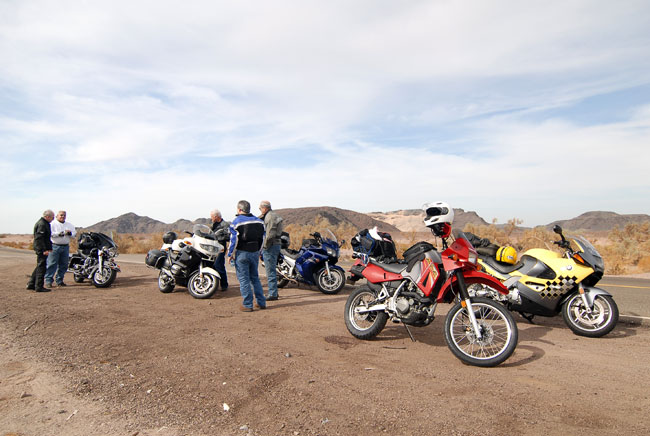
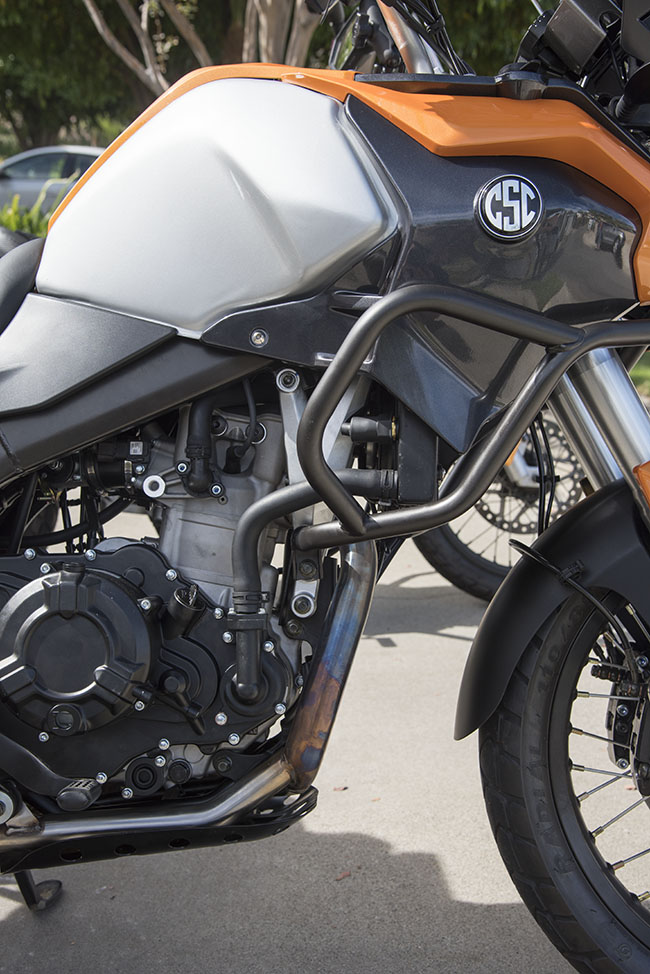
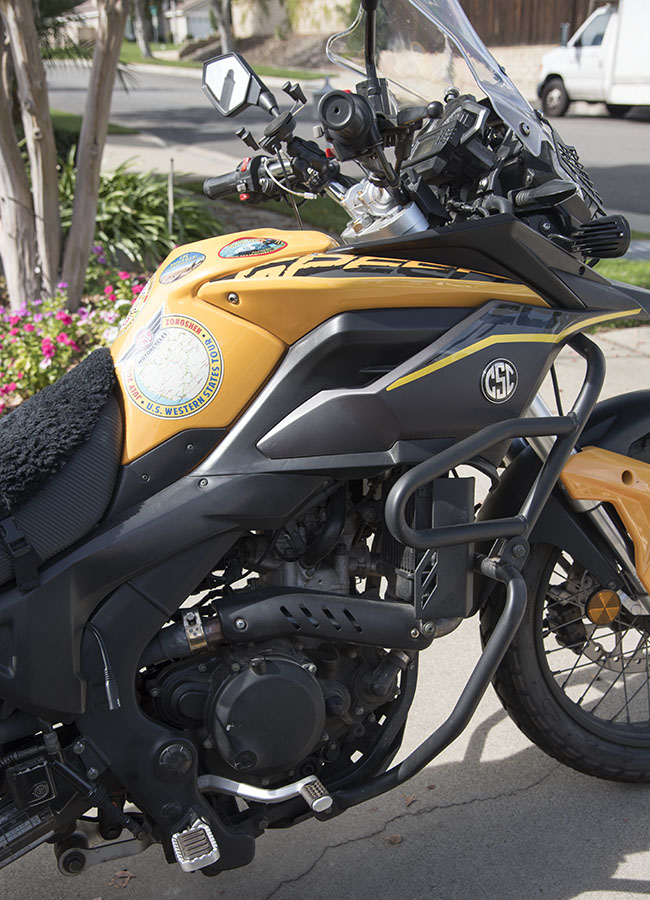
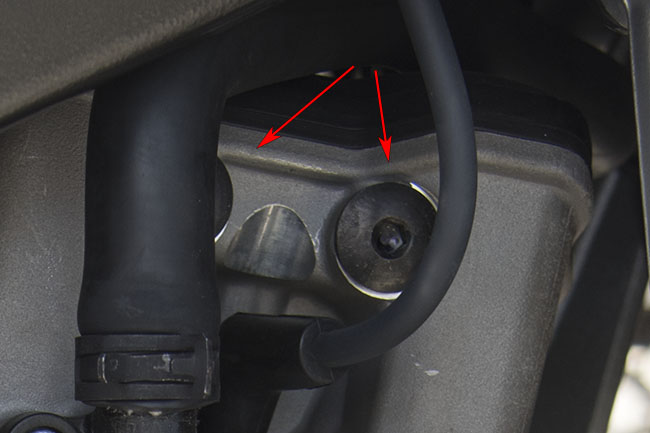
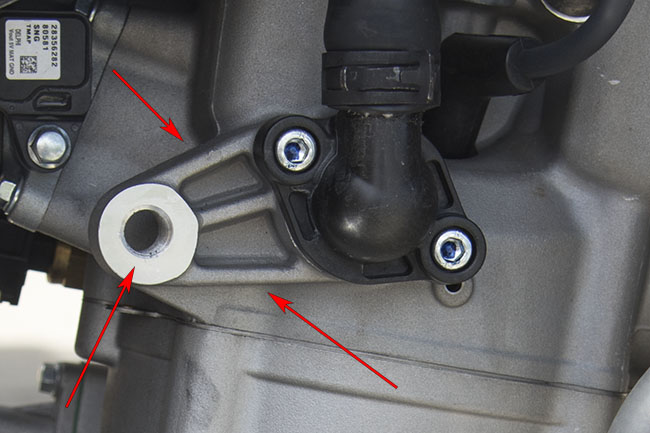
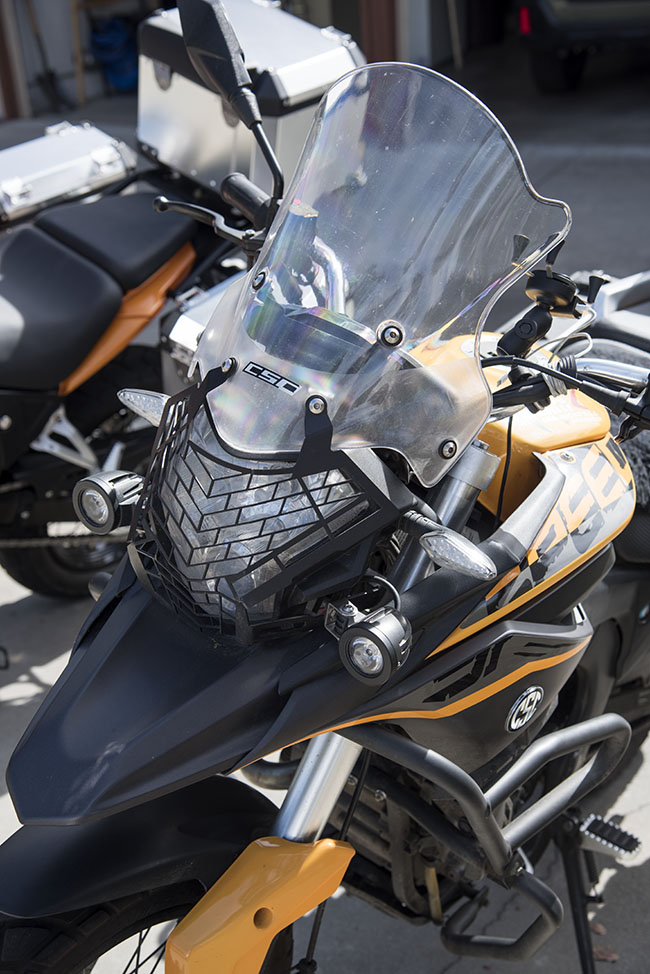
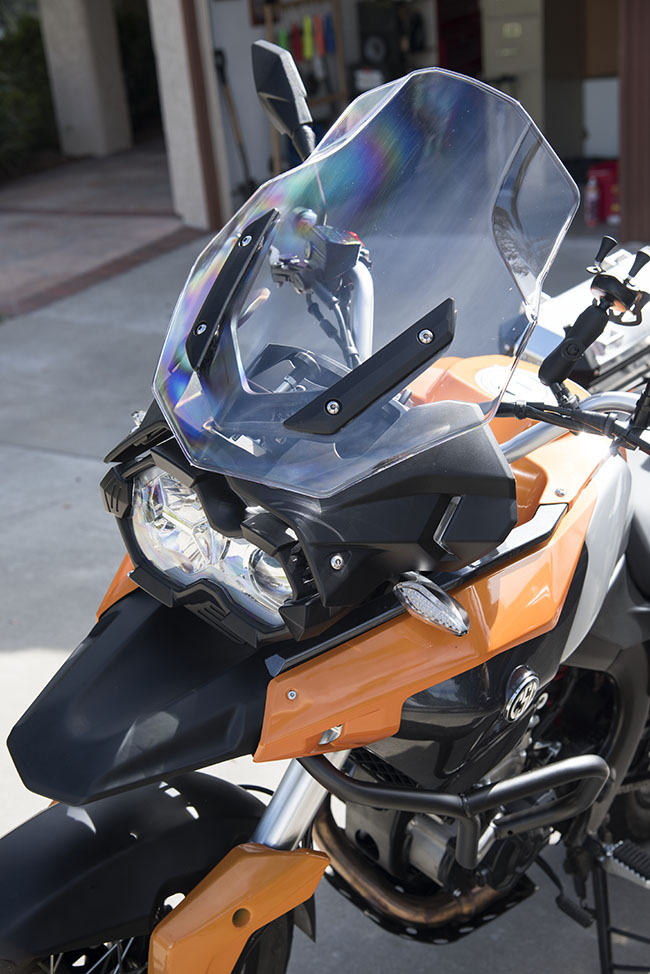
You guys and gals will remember my good buddy Baja John, a guy with whom I’ve been exploring Baja for close to three decades now…
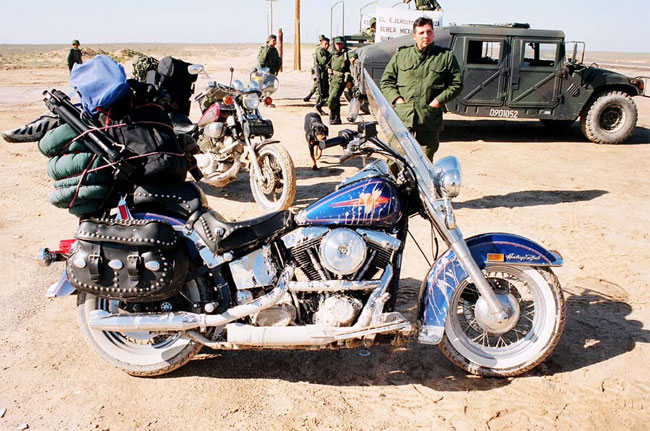
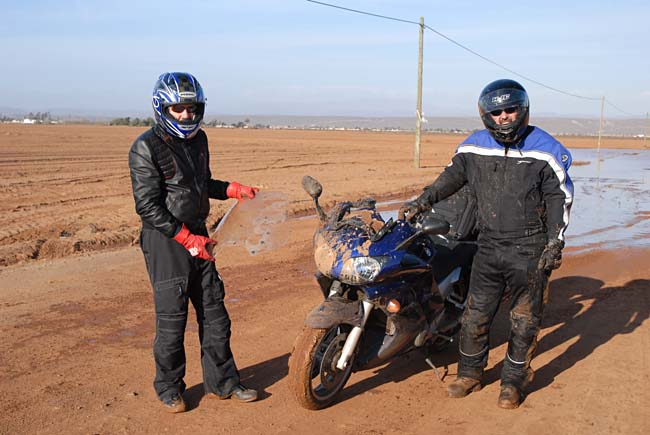
Baja John back in the mid-’90s. Big V-twins and black leather were all the rage. I shot this photo at La Bufadora during a break in the El Nino rains.
John sent an invitation to me to ride with him in Baja this month, but I couldn’t make it (I’ve been in northern California this week). I suggested to John that our ExNotes readers sure would appreciate it, though, if he could send photos from his trip, though, and here’s an email I just received from him…
Joe,
I was originally going to send you just the pictures when you mentioned putting pictures in the blog, so I thought that you might want a story to go with them. I’ve attached a Word document with a story just in case. For some reason, I cannot transfer the pictures to my laptop, so I left places within the document to place the pictures. I will try again to upload the pictures from my phone to my email. Hopefully it works this time. It should be easy to figure out which picture goes where. If you don’t want the story, just enjoy the pictures. BTW, I just finished two fish tacos and two shrimp tacos at Antonio’s. I may go back and eat another one for you before I leave town.
John
That sounds awesome, John. Tell Tony hi for me when you see him again, and tell him I’ll be down there soon enough! We sure appreciate the story and the photos. And folks, without further ado, here’s Baja John’s most recent Baja adventure…
In early 2002, I bought a house in Bahia de Los Angeles on the Baja Peninsula with thoughts of retiring there someday. Over the ensuing years, I continued to ride motorcycles to and from Mexico, anxious for the day when I could leave from my house in Mexico instead of riding 600 miles just to get there, and then begin my ride. Well, that day finally arrived, and I decided to take a ride to Jardines in San Quintin for lunch. I’d heard a number of positive remarks from fellow Americans who had stayed there and who had eaten there. It was time to give the place a personal assessment.
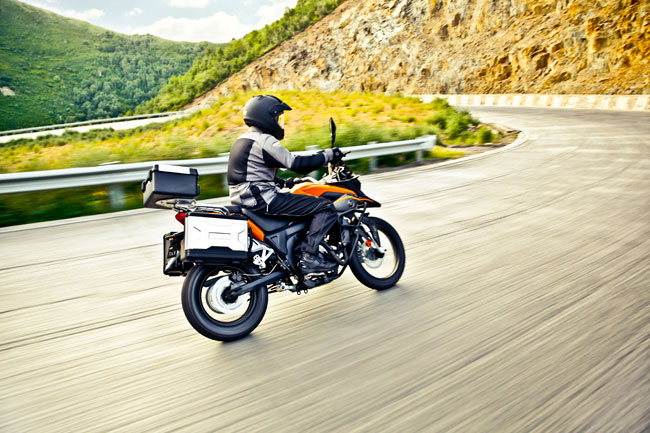
I packed some snacks and water in my tank bag in preparation for my trip. The morning was cool and crisp when I left. It was within a couple of days of the winter solstice and the days were short, so my plan was to leave at sunup, hoping to complete the 450-mile roundtrip before dark. This picture was taken about 20 miles out of town.
The fog nestled so close to the ground made it appear as though I was looking at a forest of cacti poking their heads through the clouds. For some unknown reason, I took that as an omen of good things to come. I passed one truck on that 40 mile stretch to the main highway.
When I reached the junction at Highway 1, my fuel gauge read 3/4 full. I turned to the north, and immediately saw this sign.
I wasn’t yet familiar with my CSC TT250, but I had read reviews of 65 mpg, and since I didn’t yet know what 3/4 full meant on my bike, I decided to press on, optimistic that I would find gas somewhere on the way.
Traffic increased on Highway 1. I guess that’s to be expected since it’s the only paved highway that travels the entire length of the peninsula. After passing 6 vehicles within the first 30 minutes, I decided that traffic probably wasn’t going to be bad enough to have a negative impact on my ride, so I continued north, enjoying the solitude and watching the highway twist its way through the desert as I came down yet another mountain.
As I continued north, I noticed my gas gauge reaching 1/2 full at Chapala. I still had 63 miles to go to Catavina, which was the only place that I thought may have gas. Hoping that the gauge accuracy was a bit on the conservative side, I continued on. Running the numbers in my head, I concluded that I should make it to Catavina, even if my actual fuel level was a little less than indicated. However, if Catavina didn’t have gas, then I was going to either have to stay there until I could find someone passing through with extra gas, or try to locate a rancho that might have a couple of gallons to spare. Fortunately, in Catavina I came across a small sign stuck in the dirt on the left side of the highway that said Pemex. The arrow pointed to the right side of the road, and as my eyes scanned the opposite side of the highway, I saw a pickup truck with a couple of 55 gal drums and a few one gallon plastic containers. By this time I had travelled about half the distance to San Quintin, and although my low fuel light was already flashing, I still had not gone on reserve
I figured the price would be astronomical, but that was ok since I would only need a couple of gallons. Surprisingly, it was only $1 per gallon higher than the Pemex station where I had filled up in my town the day before. Confident that I could now make it the rest of the way to San Quintin, I pressed on north, maintaining between 60 and 65 mph indicated.
The desert continued to get greener as I closed in on the town of El Rosario where Mama Espinoza’s famous restaurant is located. I passed by knowing that I had a meal waiting for me in less than an hour at Jardine’s. Traffic remained consistent through the remainder of my trip, and I reached my destination at 11 a.m.
Jardines was like an oasis in the middle of the desert. There were no signs indicating its presence, and as I turned off the main highway just south of town, I thought the place must really be nice since it appeared that they relied on word of mouth for advertisement. Making the turn onto the final dirt road, I still didn’t see it, and there was no indication that a hotel existed anywhere ahead.
After a 1/2 mile, a beautiful hotel, restaurant, and gardens appeared on the right through the trees.
I pulled into the empty parking lot of the restaurant, dismounted, and approached the door. It was locked. Fortunately the hours were posted. Another hour before they opened. That wasn’t good. If I waited around until they opened, got seated and served, I wouldn’t get back on the road until after 1 p.m. That would make it difficult to make it home before dark. Hmmm! Better check the hotel. I had heard the rates were good, but I was pleasantly surprised that a single room was only $31. A two bedroom-suite was a bit steeper at $45. It didn’t take me long to decide to take advantage of one of the perks of retirement – unscheduled time. I quickly pulled out my wallet, checked in, walked around the grounds for a few minutes, and then waited outside the restaurant until they opened.
I opted for the Mediterranean Shrimp at $8.40.
It was fantastic. I was seriously glad that I decided to stay. I kept occupied throughout the day by reading my kindle and talking to Anna, the hotel manager that day. She had spent several years in Wichita, KS, so she spoke English quite well. That night I paid a whopping $4.00 for some Fish and Chips. Another great meal.
The next morning I took my time riding around the area before heading home. I finally left town at 11 a.m. Traffic was the same as the previous day, and I made it home at 3:30 p.m. I stopped for a moment, looking at the moon over the bay before winding my way down the mountain toward home.
Hard to believe; for less than $100 I had a wonderful two days of riding, great food, a good night’s sleep and not one stop light. I feel truly blessed.
Just awesome, John! I had never heard of Jardines, but you can bet it’s on the list for my next visit. Thanks again.
Folks, if you’d like to know more about Baja and our moto adventures down there (and our recommended insurance company, BajaBound), just click here! And if you’d like a more in-depth discussion of what is arguably the greatest adventure riding spot on the planet, why not pick up a copy of Moto Baja!
This is a blog I originally posted on the CSC blog, and I like it so much I want to include it here on ExNotes. The topic is, as the title implies, the ebike scene in China.
I encountered electric bikes in a major way on my RX3 ride across China (you can read that great story in Riding China). Electric scooters and other vehicles are everywhere in China. Quite simply, electric vehicles are a way of life over there. Rather than babble on about that, I thought I would include an excerpt from a Riding China chapter. The locale is Beijing, where I was struggling with the heat and a minor injury…I had been nailed in the eye by a bug the night before, and…well, let me get to the pages I’m talking about…
The next day we took the subway into Beijing. We already were in Beijing when we got on the subway, but Beijing is a megacity and you can’t simply drive into the center of it. We rode the subway for a good 45 minutes, and when we emerged, we visited the Forbidden City and Tien An Men Square. It was all grand. It was touristy, but it’s something that should be on any China visitor’s bucket list.
At the entrance to the Forbidden City.In the Forbidden City. It’s an amazing thing to see.A glimpse of ancient Chinese architecture in the Forbidden City.
After seeing the Forbidden City, we walked around downtown Beijing for a while. I told Tracy (note: Tracy was our translator on this trip) my eye was getting worse and I wanted to get antibiotic eye drops for it. It was Sunday afternoon, but there was a large pharmacy right in front of us and it was open. Tracy went in with me and he told one of the young pharmacists what I wanted. She responded and it didn’t sound good.
“She cannot sell it to you without a prescription,” he told me.
“Well, shoot, Tracy, it’s Sunday afternoon,” I said. “We’re not going to find a doctor. I’ll be okay. Let’s just go.”
“No, it is okay, Dajiu,” he said. “We are China and we have a bureaucracy. It is my bad.”
Good old Tracy, I thought. The guy felt responsible for everything. I was resigned to the fact that my eye was going to take a while to get better. Tracy, in the meantime, had walked not more than 8 feet away to an elderly woman sitting at a wooden table. He spoke to her in Chinese and pointed to me. She never looked at me, nor did she look up. She simply pulled out a white pad with a big “R” at the top. Nah, this can’t be, I thought. She wrote something in Chinese characters and handed the slip to Tracy.
“Our prescription,” Tracy said. “Such a bureaucracy.” He walked the three steps back to the pharmacist, Tracy handed her the prescription, and 30 seconds (and 24 yuan, or about $4) later, I had my antibiotic eye drops. I put two drops in my eye.
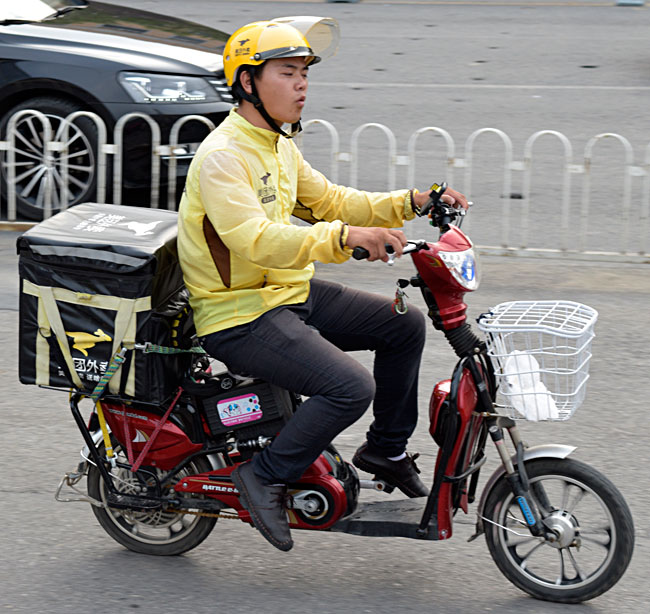
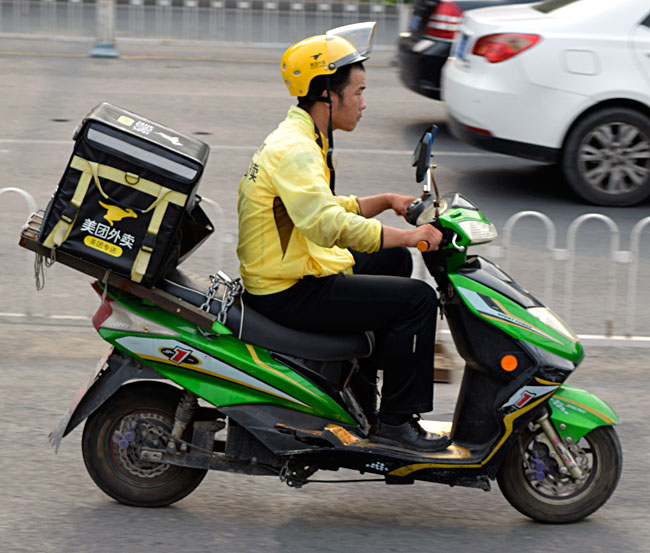
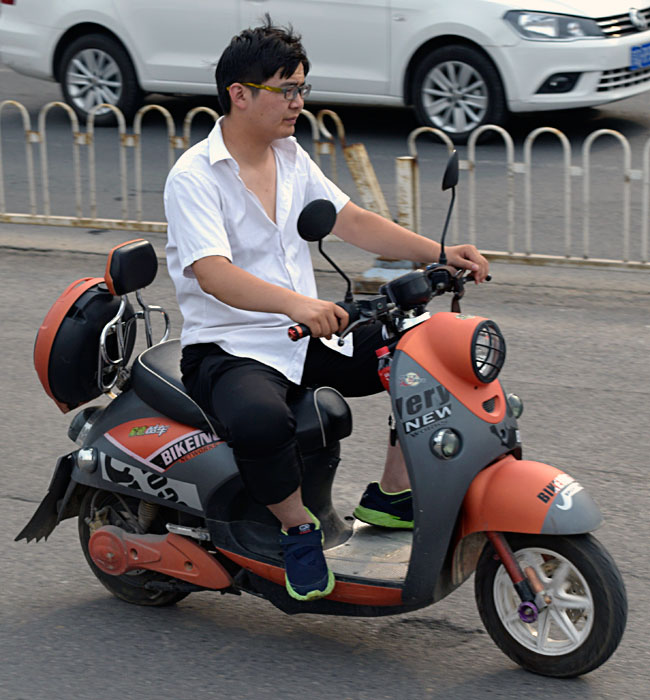
When we got off the subway after visiting The Forbidden City and the center of Beijing, we waited on a street corner for our Uber ride back to the hotel. I watched the scooters and small utility vehicles rolling by, and I realized that nearly every one of them was electric. I must have seen 200 scooters during the 20 minutes we waited, and perhaps 2 had gasoline engines. This wholesale adaption of electric scooters and small utility vehicles in China is nothing short of amazing.
One of many, many electric bikes and scooters in Beijing.Another electric scooter……and another……and another……and another……and another……and another……and another. They were all over. I’d never seen anything like it.
Sean (our guide) explained to me that the transition to electric vehicles started about 15 years ago, and the government has done a number of things to encourage people to convert to electricity. For starters (once again, pardon my pun), many of the larger cities in China now prohibit motorcycles and scooters unless the vehicle is electric. Electric scooters are allowed where gasoline-powered bikes are not. That alone is an enormous incentive. The next incentive is that you don’t need a driver’s license to take an electric vehicle on the street. You just buy one and go. And finally, as I’ve mentioned before, electricity is cheap in China. There are windfarms, solar panel farms, coal plants, nuclear power plants, and hydroelectric power plants all over the country. We saw scooters parked on the sidewalk and plugged into extension cords running into small stores everywhere. People charge them like iPhones; they didn’t miss any opportunity to top off the batteries on these things.
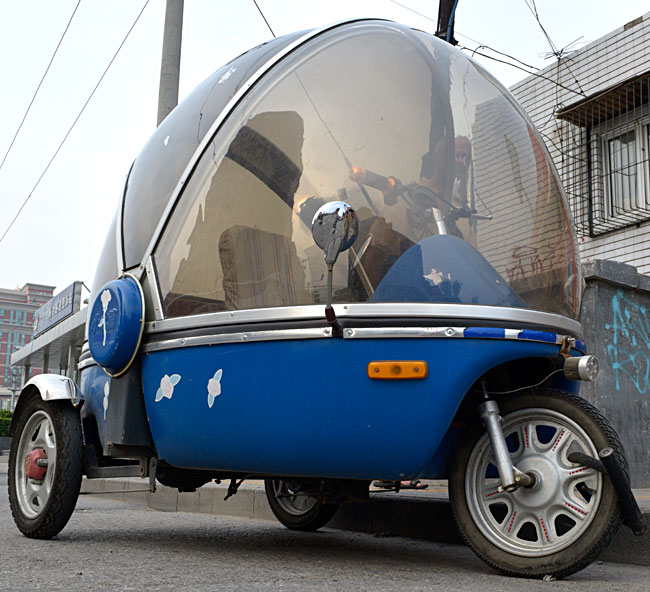
An unusual electric trike in Beijing. We saw many unusual electric vehicles in China.
That night was a great night. The Zongshen dealer took us to a restaurant that specialized in Peking duck. The guys were excited about this development, but I was initially leery. I thought I didn’t like Peking duck. Boy, was I ever wrong! I tried Peking duck 25 years ago when I visited Beijing with Sue. We both thought the duck was awful. That’s because we went to a restaurant that served tourists. The food at that place didn’t have to be good. They knew they would never see us again, and Yelp hadn’t been invented yet.
This night in Beijing with the Zongshen dealer and the RX3 owners club was different. The Peking duck was incredible. The chef sliced it paper thin right at our table. They had thin tofu (almost like a crepe), and the guys taught me how to eat duck properly. The deal is you put a few fresh vegetables on the tofu, you add a slice or two of duck, you add this amazing brown gravy, and then you roll the affair up like a burrito. Wow, it was delicious!
We had several rounds of toasts at dinner that night and the liquor flowed freely. I got lucky. Kong sat next to me and he schooled me in the proper way to make a Chinese toast. To show respect, you clink your glass against the other guy’s glass, but you hold your glass at a lower level so that when the two glasses meet, the rim of yours is lower than the other person’s. When the Zongshen dealer toasted me, I followed Kong’s advice, and the Chinese riders all nodded approvingly. Ah, Dajiu knows.
It was funny. Sergeant Zuo and I had made several toasts to each other, and when we touched glasses, we both tried frantically to get our glasses lower than the other, so much so that we usually crashed the bottoms of both on the table (to a hearty laugh and round of applause from everyone). Zuo was being polite; I was being completely serious (I have enormous respect for him).
It was a great night, and the next morning was even better. Those eye drops Tracy had helped me secure a prescription for did the trick. When we rode out of Beijing the next morning, my eye was good as new.
So there you have it. It was in China that I realized this electric bike thing is for real. It’s not just a fad. I think it’s going to be for real in the rest of the world, too. It is the future.
You can read our other ebike materials here, and check back here on the ExNotes site regularly.
We hope you have a great Christmas, folks! Three years ago I was in Colombia for a motorcycle ride through the Andes Mountains, and one of the high points of that fabulous adventure was our visit to a little town called La Playa de Belem. It was a grand evening, as you can see here…
Enjoy the holidays…ride safe, shoot straight, and keep your powder dry!
This is a blog I wrote for CSC Motorcycles a little more than 4 years ago (time sure flies when you’re having fun). The topic was as timely then as it is today. I like big bikes, but I like small bikes more, and I’m convinced that a small bike makes way more sense than a big bike for real world adventure touring. I thought I would post the blog again, as we are having way too much fun with CSC, BMW, Janus, and other companies who have seen the light. Here’s the blog from back in September 2014…
A 250cc bike seems too small to many riders. Is it?
The 250cc CSC Cyclone.
The motorcycle craze in the US really started in the mid-1960s. I know motorcycling goes back way before that, but motorcycling was essentially a fringe endeavor until Honda came on the scene. We met the nicest people on Hondas, if you remember, and that ad tagline was a winner (so is “Don’t Miss The Boat,” by the way). (Note: “Don’t Miss The Boat” was CSC’s tagline for the US RX3 introduction, and those who didn’t miss the boat participated in one of the best deals in the history of motorcycling.)
Honda’s sales model was a good one. They pulled us in with small bikes and then convinced us we needed larger and larger bikes. Many of us started with a Honda Cub (the 50cc step-through), we progressed to the Super 90 (that was my jump in), then the 160cc baby Super Hawk, then the 305cc Super Hawk, and at that point in about 1967 that was it for Honda. They didn’t have anything bigger (yet). After the 305cc Super Hawk, the next step for most folks was either a Harley or a Triumph.
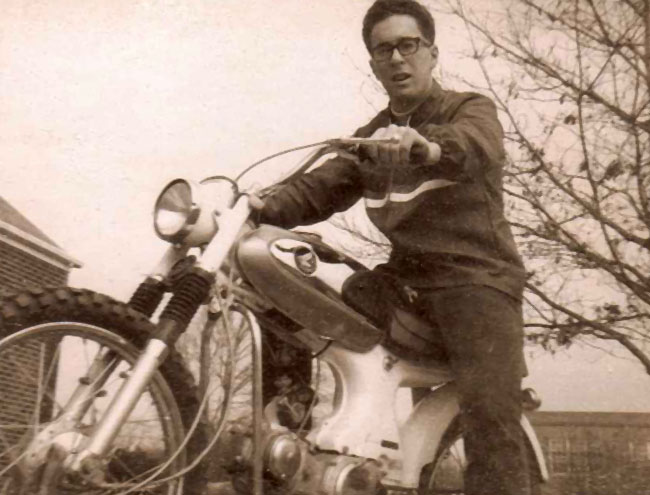
Yours Truly, on a Honda Super 90 in the mid-’60s.
You know, back in those days, a 650cc motorcycle was a BIG motorcycle. And it was.
But Honda kept on trucking…they offered a 450 that sort of flopped, and then in 1969 they delivered the CB-750. That bike was so far out in front of everyone else it killed the British motorcycle industry and (with a lot of self-inflicted wounds) it almost killed Harley.
The Japanese manufacturers piled on. Kawasaki one-upped Honda with a 900. (Another note…it’s one of those early Kawi 900s that Gobi Gresh is restoring in the Zed’s Not Dead series.) Honda came back with a 1000cc Gold Wing (which subsequently grew to 1100cc, then 1500cc, and is now an 1800cc). Triumph has a 2300cc road bike. Harley gave up on cubic centimeters and now describes their bikes with cubic inches. And on and on it went. It seems to keep on going. The bikes keep on getting bigger. And bigger. And bigger. And taller. And heavier. And bigger. In a society where everything was being supersized (burgers, bikes, and unfortunately, our beltlines), bigger bikes have ruled the roost for a long time. Too long, in my opinion.
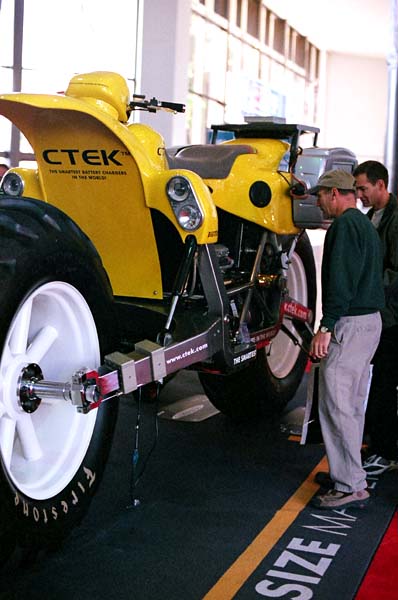
Is this where it’s going? (Note: I shot this photo at the Long Beach International Motorcycle Show about 15 years ago.)
Weirdly, today many folks think of a 750 as a small bike. It’s a world gone nuts. But I digress…
I’ve done a lot of riding. Real riding. My bikes get used. A lot. I don’t much care for the idea of bikes as driveway jewelry, and on a lot of my rides in the US, Mexico, and Canada, I kind of realized that this “bigger is better” mentality is just flat wrong. It worked as a motorcycle marketing strategy for a while, but when you’re wrestling with a 700-lb bike in the soft stuff, you realize it doesn’t make any sense.
Really?
I’ve had some killer big bikes. A Triumph Daytona 1200. A Harley Softail. A TL1000S Suzuki. A Triumph Speed Triple (often called the Speed Cripple, which in my case sort of turned out to be true). All the while I was riding these monsters, I’d see guys on Gold Wings and other 2-liter leviathans and wonder…what are these folks thinking?
I’d always wanted a KLR-650 for a lot of reasons. The biggest reasons were the bikes were inexpensive back then and they were lighter than the armored vehicles I had been riding. I liked the idea of a bike I could travel on, take off road, and lift by myself if I dropped it. To make a long story short, I bought the KLR and I liked it. I still have it. But it’s tall, and it’s heavy (well over 500 lbs fully fueled). But it was a better deal than the bigger bikes for real world riding. Nobody buys a KLR to be a poser, nobody chromes out a KLR, and nobody buys leather fringe for a KLR, but if that’s what you want in a motorcycle, hey, more power to you.
More background…if you’ve been on this blog for more than 10 minutes you know I love riding in Baja. I talk about it all the time. My friends tell me I should be on the Baja Tourism Board. Whatever. It is some of the best riding in the world. I’ll get down there the first week I take delivery on my CSC Cyclone, and if you want to ride with me, you’re more than welcome. (Note: And I did. We did a lot of CSC Baja tours, and CSC introduced a lot of folks to riding and to Baja. That one innocent little sentence became a cornerstone of CSC’s marketing strategy.)
I was talking up Baja one day at the First Church of Bob (the BMW dealership where me and some of my buddies hang out on Saturday mornings). There I was, talking about the road to San Felipe through Tecate, when my good buddy Bob said “let’s do it.” Baja it was…the other guys were on their Harleys and uber-Beemers, and I was on my “small bore” KLR. The next weekend we pointed the bars south, wicked it up, and rode to San Felipe.
The Boys…bound for San Felipe with my KLR leading the pack
That was a fun trip. I took a lot of ribbing about the KLR, but the funny thing was I had no problem keeping up with the monster motos. In fact, most of the time, I was in the lead. And Bob? Well, he just kept studying the KLR. On Saturday night, he opened up a bit. Bob is the real deal…he rode the length of Baja before there was a road. That’s why he was enjoying this trip so much, and it’s why he was so interested in my smaller bike. In fact, he announced his intent to buy a smaller bike, which surprised everybody at the table.
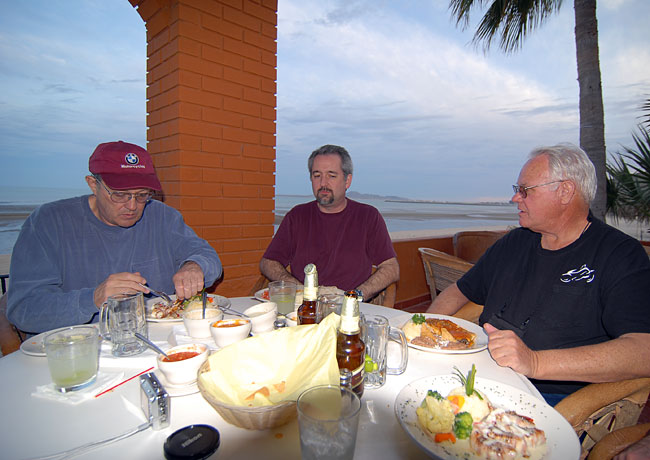
Holding court on the Sea of Cortez. That’s Bob on the right.
Bob told us about a months-long moto trip he made to Alaska decades ago, and his dream about someday riding to Tierra del Fuego. That’s the southernmost tip of South America. He’d been to the Arctic Circle, and he wanted to be able to say that he’d been all the way south, too.
I thought all of this was incredibly interesting. Bob is usually a very quiet guy. He’s the best rider I’ve ever known, and I’ve watched him smoke Ricky Racers on the Angeles Crest Highway with what appeared to be no effort whatsoever. Sometimes he’d do it on a BMW trade-in police bike standing straight up on the pegs passing youngsters on Gixxers and Ducksters. Those kids had bikes with twice the horsepower and two-thirds the weight of Bob’s bike, and he could still out ride them. Awesome stuff. Anyway, Bob usually doesn’t talk much, but during dinner that night on the Sea of Cortez he was opening up about some of his epic rides. It was good stuff.
Finally, I asked: Bob, what bike would you use for a trip through South America?
Bob’s answer was immediate: A 250.
That surprised me, but only for an instant. I asked why and he told me, but I kind of knew the answer already. Bob’s take on why a 250: It’s light, it’s fast enough, it’s small enough that you can pick it up when it falls, you can change tires on it easily, you can take it off road, you can get across streams, and it gets good gas mileage.
Bob’s answer about a 250 really stuck in my mind. This guy knows more about motorcycles than I ever will, he is the best rider I’ve ever known, and he didn’t blink an eye before immediately answering that a 250 is the best bike for serious world travel.
It all made a lot of sense to me. I had ridden my liter-sized Triumph Tiger in Mexico, but when I took it off road the thing was terrifying. The bike weighed north of 600 lbs, it was way too tall, and I had nearly dropped it several times in soft sand. It was not fun. I remembered another ride with my friend Dave when he dropped his FJR in an ocean-sized puddle. It took three of us to get the thing upright, and we dropped it a couple of more times in our attempt to do so. John and I had taken my Harley and his Virago on some fun trips, but folks, those bikes made no sense at all for the kind of riding we did.
Upright in this photo, but it was like wrestling a pig in mud a few minutes earlier.
You might be wondering…what about the other so-called adventure bikes, like the BMW GS series, the Yamaha Tenere, or the Triumph Tiger? Good bikes, to be sure, but truth be told, they’re really street bikes dressed up like dirt bikes. Big street bikes dressed up like dirt bikes. Two things to keep in mind…seat height and weight. I can’t touch the ground when I get on a BMW GS, and as you’ve heard me say before, my days of spending $20K or $30K on a motorcycle are over. Nice bikes and super nice for freeway travel, but for around town or off road or long trips into unknown territory, these bikes are just too big, too heavy, and too tall.
There’s one other benefit to a small bike. Remember that stuff above about Honda’s 1960s marketing strategy? You know, starting on smaller bikes? Call me crazy, but when I get on bikes this size, I feel like a kid again. It’s fun.
I’ve thought about this long and hard. For my kind of riding, a 250 makes perfect sense. My invitation to you is to do the same kind of thinking.
So there you have it. That was the blog that helped to get the RX3 rolling, and CSC sold a lot of RX3 motorcycles. Back in the day, CSC was way out in front of everybody on the Internet publicizing the Zongshen 250cc ADV bikes, and other countries took notice. Colombia ordered several thousand RX3s based on what they CSC doing, other countries followed, and things just kept getting better and better. The central premise is still there, and it still makes sense. A 250 may well be the perfect motorcycle.
Never miss an ExNotes blog…subscribe here for free!
As you know, we published a series of blogs comparing the RX3 and RX4 motorcycles. Those have been widely read and we’ve received many comments from you, our readers. Thanks for that, folks.
My good buddy Chris offered a brilliant suggestion a week or so ago: We ought to compare the RX4 to the Kawasaki KLR 650, he said. That’s an idea that’s so good I’m embarrassed I didn’t think of it. Chris pointed out that I had owned a KLR 650, I rode it extensively both on and offroad in Baja and here in the US, and I was in a position to make the comparison. That makes sense. It also makes sense because since the RX3’s introduction, a constant refrain from the China-bashers was that you could buy a used KLR for what a new RX3 cost. That’s not true; used KLRs generally cost less than a new RX3, but that’s neither here nor there. It might become more relevant now that the KLR has been discontinued, because it won’t be long before the only kind of KLR you can buy will be a used one.
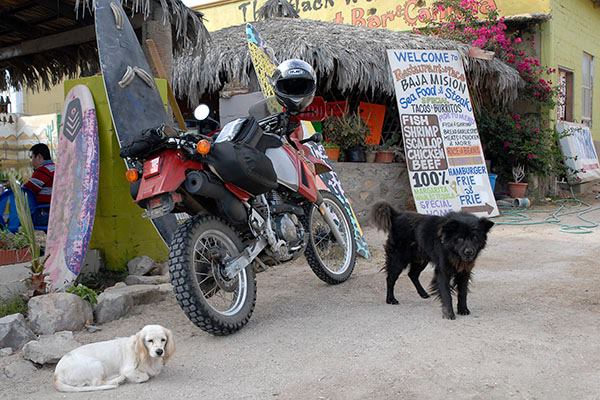
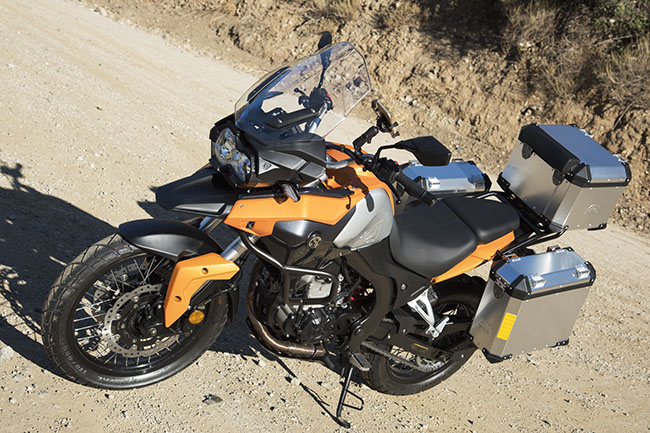
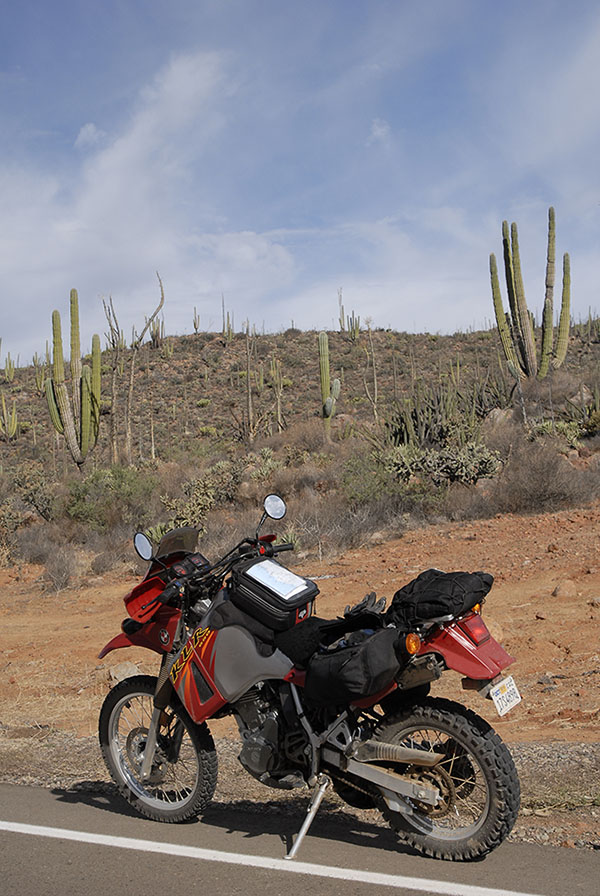
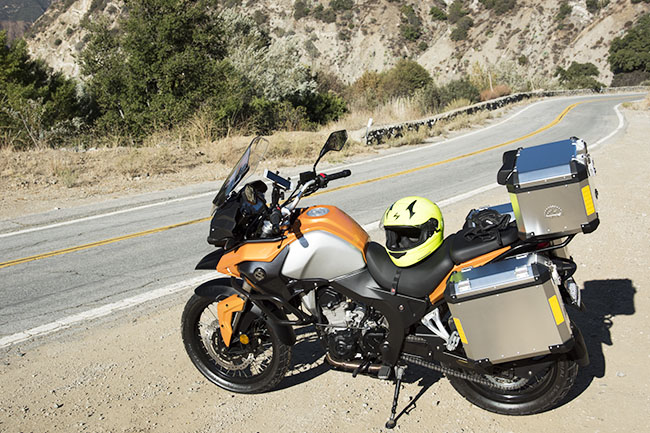
My KLR in Guerrero Negro, with the only two dogs in Mexico that did not want a piece of me.The RX4 in the San Gabriel Mountains. It’s a magnificent motorcycle
First, a bit of background. I bought a new KLR in 2006 and I rode it for roughly 10 years before selling it with 15,000 miles on the clock. That may not seem like a lot of miles for 10 years, but there were times during that period when I owned as many as six motorcycles, somewhere in there I took a year off to recuperate from a bad motorcycle accident, and after 2009 I was spending most of my seat time on other bikes as a consequence of my CSC association. But before that, a lot of my KLR time was in Baja and a good chunk of that was spent in the soft stuff.
Somewhere in Baja along the Transpeninsular Highway.
Another bit a trivia you should know: I’m a big fan of the KLR 650. Kawasaki didn’t keep that bike in production for 30+ years because it was a turkey. The KLR 650 was (and still is) a great motorcycle. It makes way more sense for serious adventure riding than do any of the liter-plus/full-figured/stratospheric-seat-height litter of current offerings from Japan, Germany, Austria, and Italy. I say that with great confidence because when I was writing the CSC blog, I watched CSC sell boatloads of RX3 motorcycles (literally, boatloads) to guys who owned monster ADV bikes but were afraid to ride them off road. Big bikes off road just don’t make a lot of sense. Not to me, anyway.
Like I said above, my KLR was a 2006 model, which made it a First Gen KLR. There were basically two KLR iterations: Ones that burned a lot of oil, and ones that did not. Well, okay, I’m being a little sarcastic. The First Gen KLRs went from the mid-‘80s to 2007, and they ran well. In 2008, the great green Good Times Folks introduced a restyled KLR with a slightly-tweaked engine (those were the Gen II bikes, for which production concluded this year). A serious oil consumption problem ensued with the 2008 Gen II engine tweaks, which was subsequently corrected by Kawasaki. There were other minor differences: Reduced fork travel, a new dash, and the aforementioned-styling changes. And, the Big K claimed a fix for the doohickey issue (more on that in a bit). Other than that, the Gen I and Gen II KLRs are essentially the same motorcycle.
Don’t take my snarkiness as a dart aimed at the KLR. Like I said above, it was (and still is) a great motorcycle. I loved mine. And like I also said above, the KLR didn’t have a three-decade production run because it was a bad motorcycle. They are, in fact, great motorcycles. The question here is not whether or not the KLR is a good bike (it is); rather, the question is: How does the RX4 compare to the KLR? We’re getting there, folks, but let me go tangential a bit first.
So why did Kawasaki discontinue the KLR? Gresh and I wrote a couple of blogs about that and what might follow the KLR (see here and here). In my opinion, Kawasaki’s decision was most likely based on sales and profitability. Manufacturers don’t discontinue products when they are selling well and making money. Some of the self-appointed keyboard commandos filled the forums with opinions, one of which was that Kawasaki killed the KLR because it was carbureted. That’s pure Bandini, folks. CSC Motorcycles, Janus Motorcycles, and others get carbed bikes approved by EPA and CARB on a regular basis. Carbs are fine as long as the bike meets Uncle Sam’s and the Peoples Republik’s emissions requirements.
Okay, I guess that’s enough background. Let’s get to the main attraction of this piece, which is how the KLR and the RX4 compare.
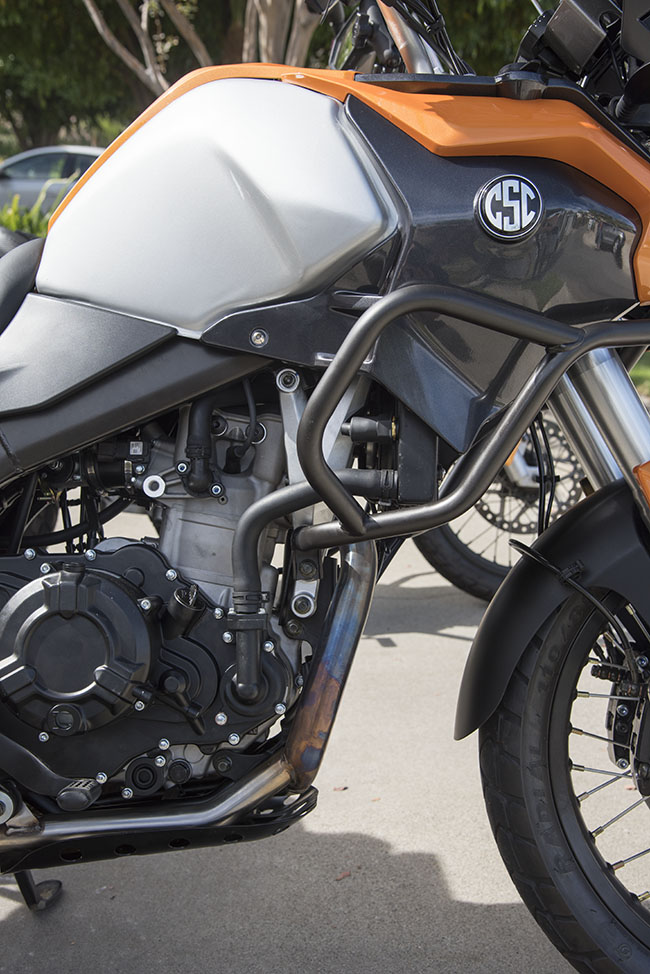
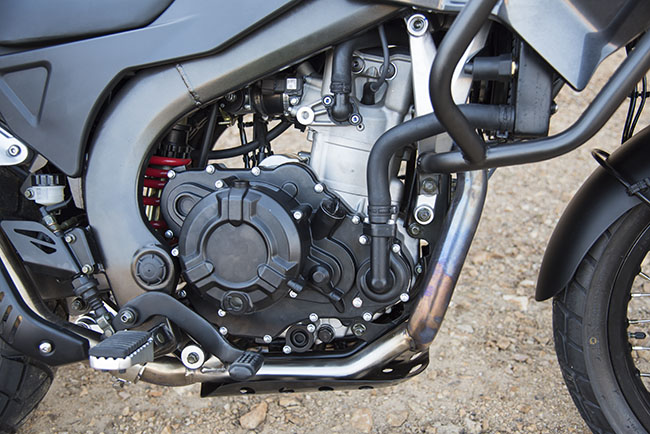
The RX4 450cc fuel-injected engine. It has more horsepower but less torque than the KLR 650.
As good as place to start as any is speed and acceleration. The KLR 650 and the 450cc RX4 have essentially the same top speed, which is approximately 100 mph. Handling at top speed is another topic, and I’ll get to that in a second. From an acceleration perspective (and this is all from Berk-butt-based impressions not involving the use of a stopwatch), the KLR has a bit more grunt on the bottom end, and the RX4 pulls a little stronger near the top end. The KLR, to me, felt more torquey at low rpm (and I liked that). When you consider the two bikes’ horsepower and torque specs (assuming what the manufacturers are telling us is accurate), the reason becomes apparent. The 450cc RX4 has 40.2 horsepower and 27.3 ft-lb torque, the 650cc KLR has 36 horsepower and 33.4 ft-lb torque. More torque means more bottom end (the KLR has more torque and a stronger bottom end pull), more horsepower means more of a top end rush (the RX4 has more horsepower and feels substantially stronger than the KLR above 70 mph; much of that is also due to the RX4’s better high-speed handling).
Okay, let’s talk about, and that bring us to the doohickey business. The doohickey is the KLR 650’s spring-loaded counterbalancer drive chain tensioner (a mouthful, I know). The Gen I KLR part was a cheap stamped weldment, and it had a tendency to fail (taking the engine with it). Kawasaki never admitted it was a problem, but they improved the part for the Gen II KLR engine. Folks who were serious about their KLRs replaced the stock doohickey with a much better machined part from Eagle Mike (a great guy who is a legend in the KLR community). I replaced the doohickey at the 500-mile service on my KLR (which I did myself).
It bothered me that Kawasaki became the Good Times Ostrich on this doohickey business. I have no doubt it was a genuine weakness. There are no known comparable weaknesses on either the RX3 or the RX4 (although admittedly, the RX4 doesn’t have the miles yet to really know). What I do know is that where there were issues in the first shipment of RX3 motorcycles, CSC stepped up immediately (and publicly). I was one of the guys who communicated with CSC customers, and if you don’t believe that, read the CSC blog and buy a copy of 5000 Miles At 8000 RPM. Kawasaki ignored the doohickey issue the entire time it existed. In my book, that gives a clear advantage to CSC and Zongshen. Yeah, I’m biased toward CSC. I admit that. But facts are facts.
Back to the motorcycles…another difference is the transmission. The RX4 has a six-speed gearbox; the KLR has a five-speed. That’s perceived as a big deal, I guess, by most folks. The reality is that five gears were enough for me, but I suppose six are nicer. Back in the day I rode a lot of motorcycles with four-speed transmissions and I never felt like I was missing anything. But it’s a difference, and on this count, the nod goes to the RX4. Also, the RX4 has a gear indicator on the dash; the KLR does not. Is that a real issue? Not for me. Maybe I’m conceited, but I kind 0f know what gear I’m in all the time. But again, it’s something the RX4 has that the KLR does not. Where there is a transmission issue that’s worth noting is first gear. On the KLR it is a granny gear; it’s way lower than second. All of the gears on the RX4 (including first) are closely spaced. I would have liked the KLR better if its gears were similarly closely spaced. On the KLR, when you drop the bike into first, it’s really throwing out the anchor. On the RX4, it’s just one gear down.
As a fuel-injected bike with a smaller displacement engine, the RX4 is probably the winner from a fuel economy perspective. The Zongers tell me that the RX4 will get 65.3 mpg, but I haven’t verified that. I’m guessing I could do better (I usually do better than the manufacturer’s claims). My KLR returned a measured mid-50s mpg figure when I rode it at reasonable speeds. From a range perspective, I expect the two bikes are about the same. I could get an honest 250-miles out of a tank on the KLR. The RX4 has a 0.7-gallon smaller tank than the KLR (but it’s bigger than the RX3’s tank by one gallon), and as mentioned above it will probably get better fuel economy. There’s that business about how much fuel the RX4’s tank will actually hold when you delete the volume occupied by the fuel pump. From my perspective, if a bike can go 200 miles, that’s good enough for me (that’s the stretch south from El Rosario to the next Pemex, just north of Guerrero Negro). I’m pretty confident the RX4 will do 250 miles, and I know the KLR will.
Let’s talk handling. On the street, in the twisties, and at highway speeds and above the RX4 is the clear winner. The KLR gets very light and drifty at anything over an indicated 75 mph, and it’s downright gangly when pushed hard in the twisties. You can go faster than 75 mph on a KLR, but I didn’t feel comfortable on my KLR doing that. The RX4, on the other hand, feels rock solid up to indicated 99 mph (and it had more left at that speed; I just ran out of room). In the twisties, the RX4 is in its element. The RX4’s stock CST tires are great, and the RX4 frame, forks, rear suspension, and geometry are modern. The RX4 feels way more planted and secure in the twisties and at high speed than does the KLR (so does the RX3). The RX4’s design is nearly four decades more advanced than the KLR’s. What I’m saying here is not a slam on the KLR; that old bike did pretty well for its 30-year run.
On the tire issue, I like the CSTs that come with the RX3 and the RX4. I get great life out of the CST tires on my RX3 (usually, 6000 miles on a rear tire). The Kendas that come on the KLR are, at best, 2500-mile tires. They hook up okay, but they don’t last long. I replaced my KLR tires with Shinkos and never looked back.
On the issue of consumables, I got good life on my KLR’s chain. I had good buddy Gerry throw a new chain on the KLR at 14,000 miles, but it didn’t really need it. I don’t know about the stock chain’s life on the RX4, but the stock chain on the RX3 is a substandard component that is toast after about 5000 miles (and that, to borrow a word made popular two years ago, is deplorable). Like I said, I don’t know if Zongshen addressed this on the RX4, but if the chain is from the same company that provides the chain on the RX3, I’d expect to replace it with a real chain either immediately or after just a few thousand miles. The KLR gets my nod for stock chain life unless Zongshen has addressed this issue.
One more note on the Kawasaki’s road manners. My Gen I had this monstrous Tupperware fender that was attached high and wide on the forks. It caught any wind blowing from the side and that had a tendency to steer the bike. I think it was also one of the things that made the KLR’s high-speed handling flighty. The Gen II design changed the front fender, but I haven’t ridden a Gen II bike. I don’t know if the Gen II’s redesigned fender made the problem go away. As I said earlier, the RX4 is much better behaved at high speed.
I have not yet ridden the RX4 off road, so a lot of what I’m going to say next is speculation on my part. But it’s informed speculation. I felt my KLR did very well in the dirt and soft sand. The KLR is heavy, but it has good bottom end grunt and more torque than the RX4. That allowed me to get up to speed and on top of soft sand quickly. The KLR’s 21-inch front wheel helps, too (the RX4 has a 19-inch front wheel, and in anticipation of the obvious question, I don’t know if a 21-inch front wheel can be fitted to the RX4). The offroad keyboard commandos say the KLR is a pig in the dirt. Hey, what do I know? I thought it did well when I was tear-assing around Baja. I don’t know the suspension travel on the RX4, but I’m pretty sure it’s going to be less than the KLR. The bottom line: I think the KLR is the better choice if you are going to ride exclusively in the dirt. But then if you were going to do that you probably would not buy a KLR (there are other, better choices for dirt bikes).
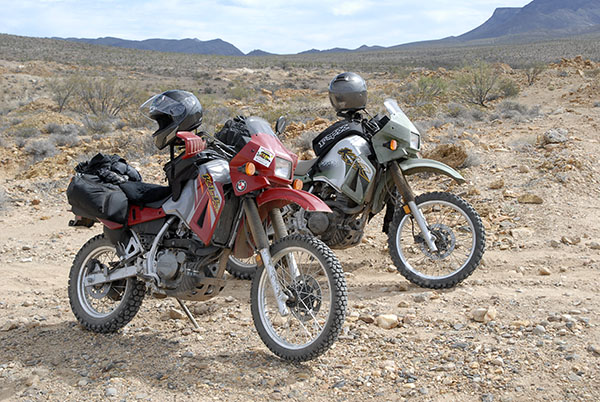
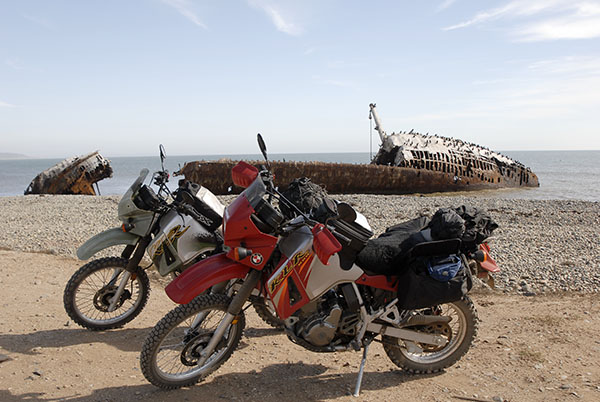
I went a lot of places off road in Mexico. This is near El Marmol. I was with good buddy Baja John, who also rode a KLR.Another KLR Baja boonies photo, near a Pacific coast shipwreck.
With regard to standard equipment, there’s no comparison. The RX4 is equipped with luggage, better instrumentation, dual front disks, adjustable suspension, adjustable windshield, engine guards, 300-watt alternator, accessory outlets, switchable ABS, fuel injection, and that six-speed transmission. The KLR 650 has none of these things.
I had soft luggage on my KLR, which worked well enough, but I couldn’t lock it and it gave the bike a Beverly Hillbillies kind of look (not that there’s anything wrong with hillbillies). Some people like that look. I did at the time because it was a step up from bungee cords and gym bags. But that’s old school. The RX4 luggage is a huge improvement (both the stock bags and the optional aluminum bags).
From a maintenance perspective, the RX4 gets the nod. For starters, if CSC does what they have done for all their other bikes, you’ll get a shop manual and online maintenance tutorials for free. You won’t get that with a used KLR (and you didn’t get it with a new KLR, either). That means if you own a KLR you either bought a shop manual to do the work yourself, or you went to the dealer for maintenance. I’m not a big fan of dealer technicians for three reasons: Cost, competence, and honesty.
I believe the RX4 will be easier to maintain than the KLR. I don’t know this for a fact yet, but based on the RX3’s reliability and design I suspect it will be the case. The RX3 uses threaded adjustor nuts for adjusting the valves, and I’m guessing the RX4 will, too (I haven’t removed the valve covers on the RX4 yet). I know that the KLR uses shims and buckets; that approach greatly complicates the valve adjustment process. It involves removing both cams and it makes adjustments technically challenging and time consuming (which dealers and technicians love, because you get to pay for the time).
From a price perspective, a new RX4 will cost less than what a new KLR cost. And that’s before the typical Kawi dealer’s obscenely-bloated setup, freight, and documentation fees (it’s not unheard of for dealers to routinely add $1500 freight and setup fees). Folks, from the port to just about anywhere in the US, you can ship a bike for not more than $400, so the dealer shipping fees they put on their pricing sheets are twice (or more) actual cost. And their setup fees are pure, well, you know. Ask your dealer if they do the setup themselves or if they outsource it. Most dealers go with Door No. 2. Outsourced motorcycle setups typically cost between $35 and $50 per bike, and they are done by unskilled labor (not trained motorcycle techs). I know this because I’ve been an expert witness in motorcycle lawsuits, and this is what the dealers admit when they have to tell the truth during the discovery and deposition process. How much effort goes into setup and how well is it done? Let me explain it this way: When I bought my new KLR in 2006, the windshield fell off during the 5-mile ride home. It’s a ripoff of gargantuan proportions. I’ve never paid anywhere that much, but it’s what many of the dealers ask. It’s dishonest.
Back to that earlier keyboard commando statement: You can buy a used KLR for less than a new (fill in the blanks with any brand). Regarding used KLRs (which they all will be pretty soon), there’s no argument here: A used KLR will be less expensive than a new RX4. Duh. But then you’d have a used motorcycle with no warranty. If you want to go that route, someday in the near future you’ll be able to buy a used RX4, too. A used RX4 might be even less than a used KLR. I never understood the argument that posits you can buy something used for less money than new, particularly when it’s put forth by people with the same kind of conviction they might display if they had just discovered and announced that F=ma. It’s kind of like saying things fall when you drop them. The statement about new versus used is a dumb one. It’s obvious. Buy used, and it costs less. That’s true for just about everything on the planet (except maybe some guns). Like I said: Duh.
With regard to comfort, that’s a tough one. I’d say that’s a draw, with maybe the edge going to the RX4. I felt the ergos were perfect on my KLR. I also feel that way about the RX3 and the RX4. While I’m on that topic, I’ll briefly mention the RX3S (the 380cc twin from Zongshen with ADV styling and equipment comparable to the RX3 and the RX4). The RX3S had terrible ergos. My feet felt like they were scrunched up to my butt and my hips hurt as soon as I got on the RX3S. The RX3S might be a good bike, but with the current feet/butt/handlebars relationship, it was a nonstarter for me. To go tangential again for a second, I didn’t get the naming, either. The RX3S? Is that like a plural RX3?
Back to the KLR: The stock KLR seat is way too soft, which sounds like it would be a good thing, but that squishy seat gets uncomfortable quickly. I fixed that with a sheepskin seat pad, which I also use on RX3. The stock RX3 and RX4 seats (the two bikes use the same seat) won’t win any prizes for all-day comfort, but to me they are tolerable. The KLR 650 seat sits significantly higher than the RX4. When I rode my KLR, it was a tippy-toes affair at every stop (if you play for the Knicks, this won’t be a problem, but I don’t and for me it was an annoyance). The RX4 is not nearly as tall. I liked it better from a seat height perspective. It is slightly taller than the RX3 but lower than the KLR, and way lower than the GS1200 or those Special K giraffes from Austria.
Having said the above about seat height, I will tell you that the KLR was a bit easier for me to move around in the driveway than is the RX4. Kawasaki advertised the KLR’s weight at 432 lbs, which I know is baloney (mine tipped the scales well above that number). Zongshen advertises the RX4 at 450 lbs, and as you now from reading my previous blogs, I haven’t weighed the bike. Pushing the bike around in my driveway, though, the RX4 felt heavy. Maybe that’s just be the result of me being used to my RX3. But once I was moving on the RX4, it felt way more planted and it handled way better than the KLR (both in the twisties and at high speed), and it didn’t feel heavy at all. I can’t quantify the difference; I’m only giving you my impressions.
World class fit and finish are what the RX4 is all about. The RX4 is way ahead of the KLR in this area. I think it is as good or better than any motorcycle made anywhere, by anyone.
Fit and finish are unquestionably superior on the RX4. That’s not just compared to the KLR; that’s compared to any bike. Those of you who haven’t owned an RX3 may default to the typical China-bashing response. You know, the one that says: That-can’t-be-possible-it’s-made-in-China. But it is what it is. I think the finish on the RX4 is even better than the RX3. It’s very good. Little things stand out. The RX4 footpegs are nicely-cast aluminum affairs with rubber inserts; the KLR’s footpegs are cheap bent stampings with a rubber liner that wears out quickly. The RX4 has tapered handlebars and high-end switchgear; the KLR has a regular constant-diameter handlebars and cheap switches. The RX4 paint is world class (it’s deep and luxurious); the KLR used plastic with the colors molded in. The RX4 has a steel skid plate and engine guards as standard equipment; the KLR has no engine guards and a plastic skid plate. A plastic skid plate? Really, Kawasaki?
The windshield on the RX4 looks better finished, it’s adjustable, and it just flat works better than does the KLR windshield (and the RX4 windshield didn’t fall off on the way home). I know, I know, I keep coming back to that windshield falling off my KLR on the ride home from the dealer. It still pisses me off, even though I negotiated the Kawasaki dealer setup fee down from pure larceny to a much-more-modest profit contribution. What rubbed salt in that wound was that the KLR windshield mounting screws were lost when the windshield fell off, they were non-standard screws, and when I went back to the dealer they didn’t have them in stock. In my experience, that last part is a typical response from most dealers (you know, the not-in-stock thing). CSC stocks everything; that’s another plus for the RX4. While I’m on a windshield roll, there’s one more thing that I didn’t like about the KLR’s windshield. I went through five or six of the things over the life of the bike. They always developed cranks that migrated out from the mounting holes, mandating a replacement windscreen. My RX3 never did that, and I suspect the RX4 won’t, either.
Having said all of the above, I liked the looks of my First Gen KLR. Yeah, it was a Tupperware Titan, but I liked it. It was a tool that looked like a tool. It was utilitarian and honest. I think the Gen II KLR looked like Kawasaki was trying to put lipstick on a pig. I like my pigs to look like pigs. The Gen I KLR did and I liked that.
I already mentioned that the RX4 comes standard with USB and 12V power outlets, and underseat accessory plugs. The RX4 has a 300-watt alternator; the KLR alternator output is substantially lower. A funny story about CSC’s practice of putting 300-watt alternators on their ADV bikes: When I was looking at the RX3 in Chongqing back in 2014, I saw a police variant. I asked the Zongmen how the police versions handled the extra police equipment. A Zongshen engineer told me that they install 300-watt alternators on the police bikes to support the added lights, flashers, radio gear, siren, speakers, etc. Hmmmm, could CSC get that on all of its bikes? No problemo, they said. And thus the 300-watt CSC legend was born. The TT250 has a 300-watt alternator, too.
The RX4 instruments are the same as those on the RX3. While the info is more complete than on the KLR, lighting for the RX4 and RX3 indicator lights (the turn signal indicators, the high beam indicator, etc.) is too dim to read in the daytime. My good buddy Rob Morel has relatively simple fix for this problem; he removed the sort-of-translucent plastic layer between the lamps and the dash cover, and oila, now you can see the indicator lights. Zongshen ought to spec all of their bikes that way.
Neither the RX4 nor the KLR has a centerstand. Both bikes have tool kits, but both are laughable. The stock tool kits are the standard cheap items you get with most new bikes, if you get anything at all (my umpteen-thousand-dollar Harley Softail had no toolkit whatsoever, which is kind of funny if you think about it).
So there you have it. Chris, my apologies for the longwinded response to your question about the RX4 and the KLR. Thanks very much for the suggestion.
Having said all of the above, I guess the obvious question is: What would I buy? I wasn’t riding my KLR very much the last few years I owned it because I had my RX3 and TT250. I finally sold the KLR, but I miss the bike and like I said, I enjoyed it. If I had to make a choice, would I buy a new KLR or a new RX4? A motorcycle is an emotional purchase and an individual decision, and it’s a decision not usually based on logic. My belief is that most people buy a motorcycle that projects an image they want to see of themselves, which is why the industry has tended toward oversized, overpowered, and ridiculously-tall adventure bikes. KLR versus RX4? I don’t think it would be a mistake going with either bike. But I am convinced the RX4 is a much better motorcycle.
Want to see the RX3 versus RX4 comparisons? You can do so here.
Want to read about the RX3 and KLR adventures in Baja? Pick up a copy of Moto Baja!
This will be the final installment of the RX3 and RX4 comparisons. We’ve got one more coming up after this, and that’s the RX4-to-KLR 650 comparis0n. And then, another cool and quick review…the BMW GS 310. Yep, I rode one of those yesterday to get a feel for how it compares to the RX3. That will be in another review. For now, on to the RX3 and RX4 final comparison in this series…
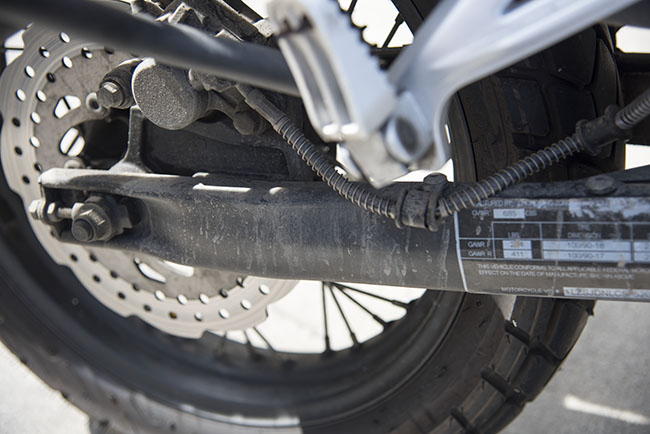
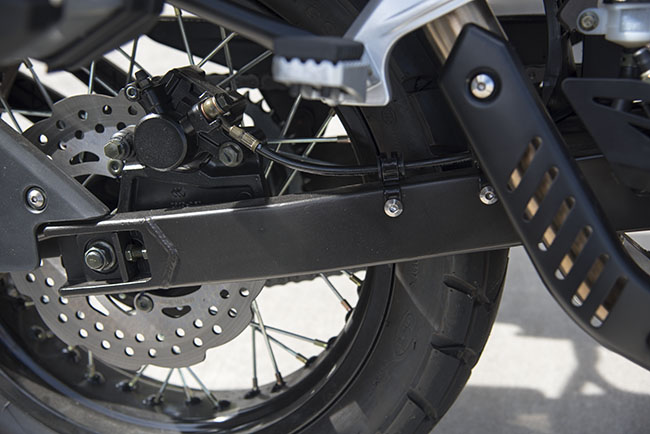
Take a look at the swingarms on the RX3 and the RX4. The RX4 has a much beefier unit, as you can see below.
The RX3 swingarm. Note how the end is formed to accept the rear axle mounting hardware.The RX4 swingarm. It appears to be a much stronger unit. Note the machined part that mounts the rear axle (compare this to the bent metal piece on the RX3). Also note the robotic weld quality.
Overall, the RX4 swingarm appears to be much better design than that on the RX3. The only aspect of the RX3’s swingarm that I think I like better is the axle adjustment design. On the RX3, the threaded adjusters can be used to move the rear wheel forward or backward. On the RX4, it looks like Zongshen took a more conventional approach, where the adjusters can be used to move the wheel rearward, but you have to manually push the wheel forward.
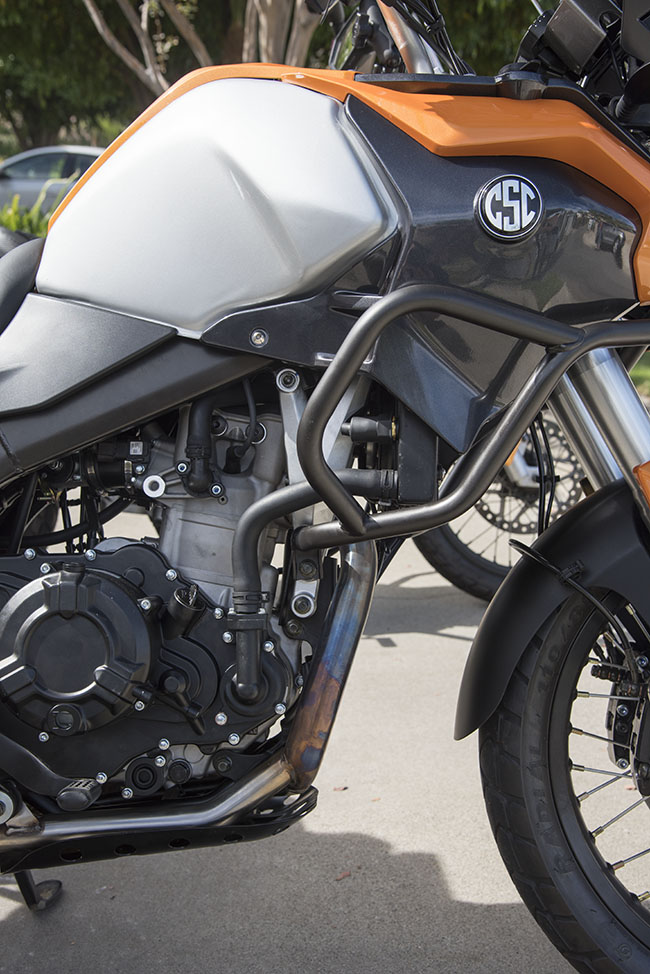
I may have already mentioned this next point in an earlier blog, but I’ll mention it again. On the RX4, the exhaust pipe sweeps down and under the engine, and then it sweeps up again to the muffler behind the engine. The RX3 has an upswept pipe.
The RX4 exhaust pipe. It goes under the engine.The RX3 uses an upswept exhaust pipe.
The purist will undoubtedly flood the forums with comments about the RX4’s downswept pipe. My reaction is: Meh. It’s the same approach as used on my Triumph Tiger. Upswept, downswept, six to one, half a dozen to the other. As the Germans say, machst nicht. That is, unless you’re changing the oil or adding oil. Then the RX4’s downswept pipe (and the improved access it offers to the oil fill ports) starts looking pretty good.
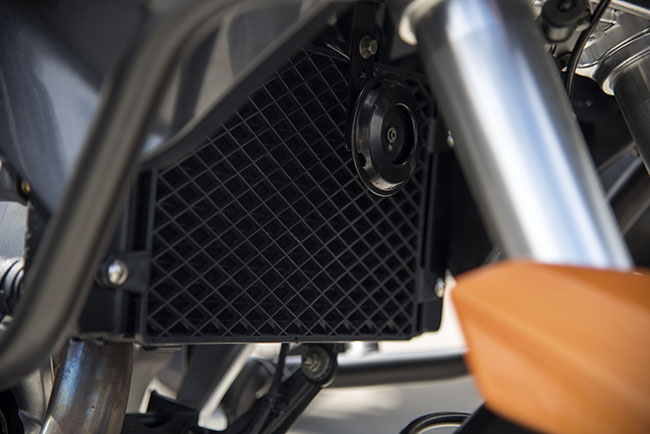
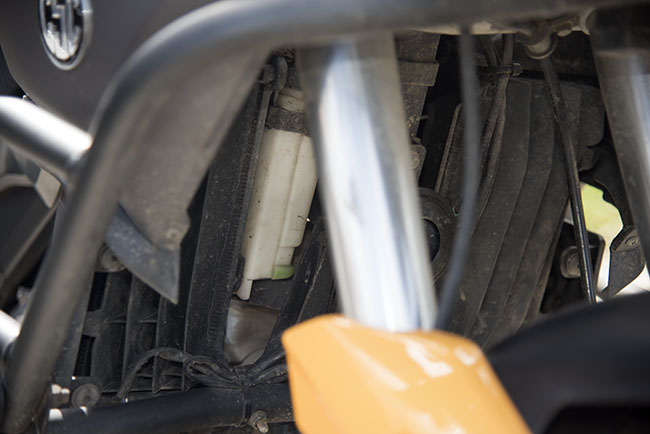
Here’s another significant difference: The radiator. The RX4 uses a single large radiator, compared to the RX3’s two smaller radiators.
The RX4 radiator. It comes with the shield you see here.Although they are hard to see in this photograph, the RX3 has two separate radiators. They are located behind the plastic grills.
I like the RX4 radiator approach better. Simple is better in the engineering world, and a single radiator makes a lot more sense to me.
Moving on, we’ll next take a look at the grips and controls on the RX3 and the RX4. The RX3 photos you see here are my RX3, which is a 2015 model. In 2015, the RX3 did not have bar end balancers, but Zongshen added these in 2016 and beyond. Also, the 2015 RX3 had chromed bars, all subsequent years had subdued silver paint on the bars.
When Zongshen made the RX3 handlebar change, I wondered why they messed with something that worked so well. There was more to the story than I knew at the time. It basically went like this: The Chinese motorcycle industry took a major hit and underwent a significant shakeout in recent years. The US motorcycle market did, too. Here at home, the market dropped to 50% of its former levels with the Great Recession of 2008, and it has never moved much beyond that point since. We had a double whammy here: Banks and lending companies stopped giving 4th, 5th, and 6th mortgages to folks wanting to buy motorcycles (I’m exaggerating, but only slightly), and our demographics changed. Older guys aren’t buying bikes like they used to (they’re aging out), and Millenials are more interested in cell phones and self-driving cars than they are in motorcycles. And while all of this was going on, the industry here in the US continued (and continues) to offer outsized and overpriced choices. In China, there has similarly been a double whammy, but the two strikes are of a different nature. China is concentrating its population in the cities, and (incredibly) China is outlawing motorcycles in its cities. I know, it’s nuts, but it is what it is.
Anyway, all of this caught up with the Chinese motorcycle industry, and a lot of lower level motorcycle component suppliers in China finally called it a day in 2015-2016. That’s what resulted in the need for a new RX3 handlebar supplier going into the 2016 model year. With that change, Zongshen included bar end weights, which I think were unnecessary. Nah, change that: I know they were unnecessary, because I have a 2015 RX3 with no bar end weights and a zillion miles on the clock, and I’ve never had an issue with vibration.
All righty then…to dial this back to today, the bottom line is that both the RX3 and the RX4 have bar end weights. But not mine, because it’s a 2015 RX3. With that in mind, here we go…
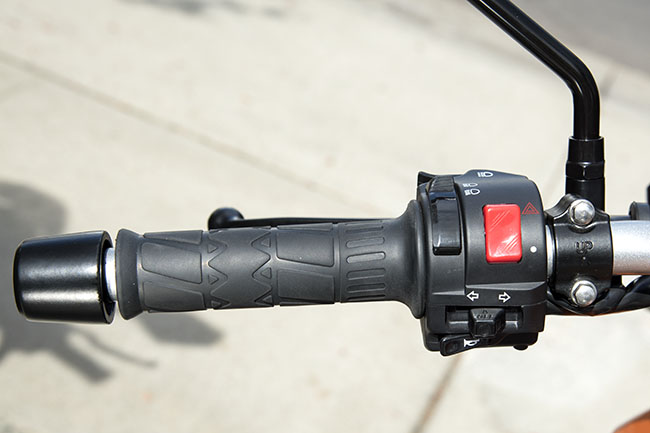
The left grip and controls on the 2015 RX3. The rocker switch you see on the right, just below the lever mounts, controls my spotlights. They are a one-off Colombian model, having been given to me by Enrique Vargas, General Manager of AKT Motos in Medellin.The left hand grip and controls on the RX4. The grip design is a little different than my 2015 RX3 design, but the left-side controls are identical to the RX3. Note the bar-end weight. I was disappointed when I saw this; there is an unsightly gap between the bar-end weight and the grip. I’m guessing this will be corrected for the production RX4 when Zongshen reads this comment. Overall, the bike is great. This is the only thing I could find to bitch about. That’s a pretty good showing, I think.
So, about that sloppy bar-end fit on the left side of the RX4 preproduction prototype: While I was disappointed in this minor detail, I have to point out that it was the only area on the motorcycle that was poorly fit. Every other aspect of the RX4 (and I mean literally every other bit related to fit and finish) was absolutely world class. The bike just screams quality. The paint, the fit, the finish, everything. Except that sloppy left side bar-end weight.
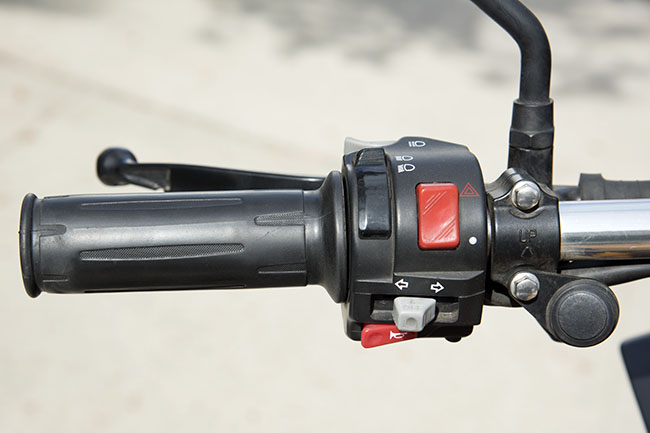
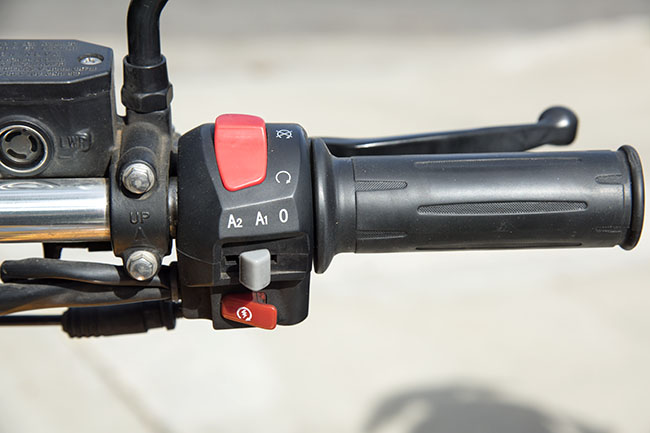
Moving on to the right side of the bike, here’s the right side grip and control area on my RX3. Note the A2, A1, and O switch; it controls the RX3’s underseat accessory plugs.
The RX3 right side grip and controls. This is on my 2015 RX3.
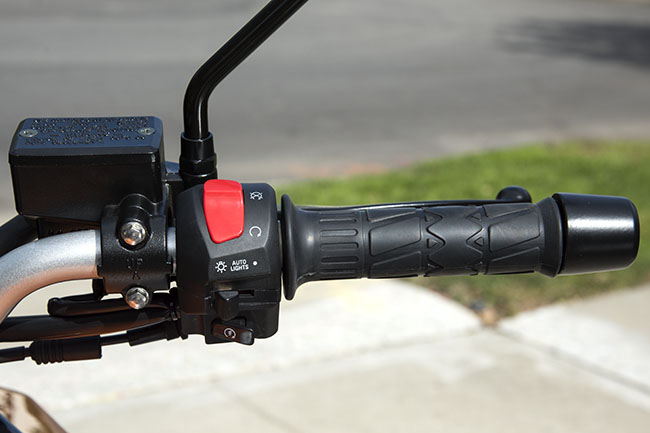
Here’s the same view of the RX4’s right side grip.
The RX4 right side grip and controls. Note the bar-end weight.
The photo above shows the RX4 preproduction bike, which has the headlight switch for on, auto, and off. I’m told the US configuration bikes will only have the on and auto positions. The on position turns on the headlight; the auto position leaves the LED headlight outline on all the time but only turns the headlight on when it senses it is dark. The A1 and A2 switch for the underseat accessory plugs will be controlled by an optional CSC-unique handlebar-mounted switch. At least that’s the plan as of this writing.
On this issue of bar-end weights: Like I said above, vibration is a non-issue on both bikes. If I concentrate on trying to feel it, I guess I would say the RX4 has a barely-detectable higher vibration level than the RX3, but you have to really focus on trying to tell the difference. I’d drop the bar-end weights on both bikes. But then, I don’t make a million motorcycles a year. Zongshen does.
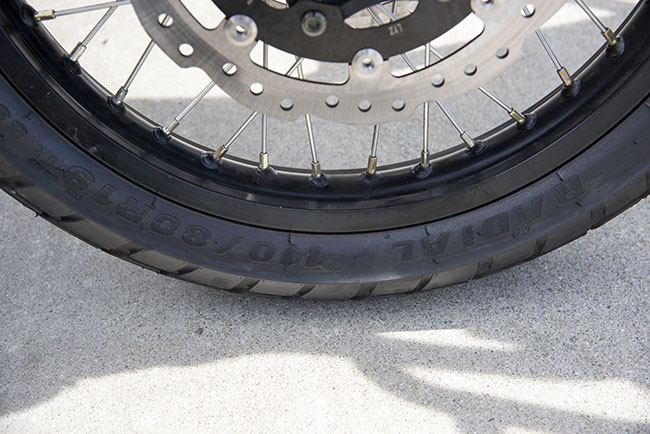
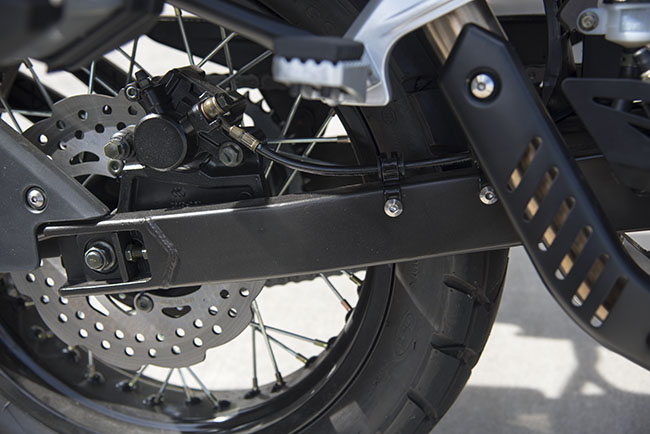
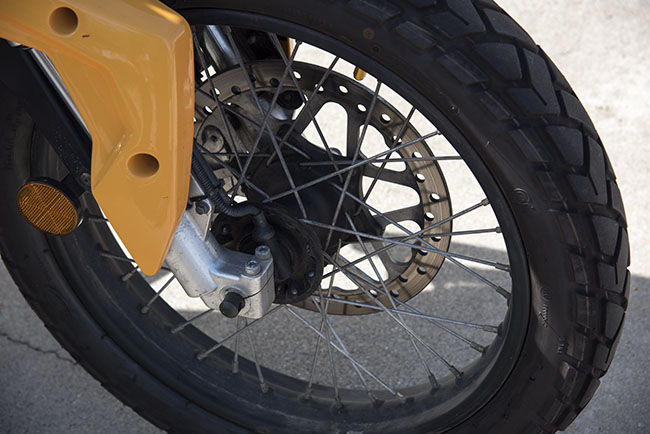
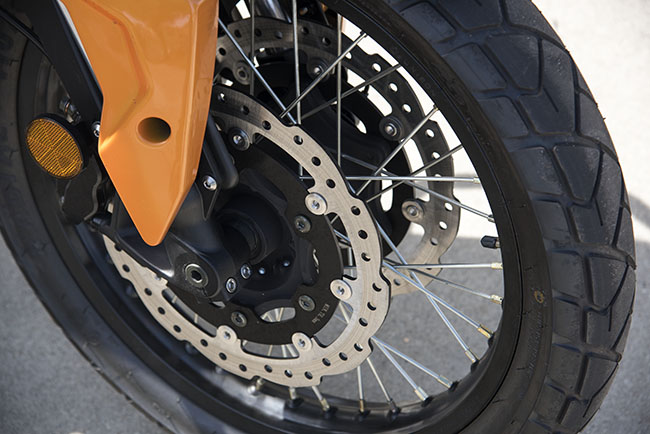
The big difference in the wheels between the RX4 and the RX3 is that the RX3 has spoked steel rims and cast wheels are not an option. On the RX4, the wheels are spoked aluminum rims, and cast aluminum wheels are an option.
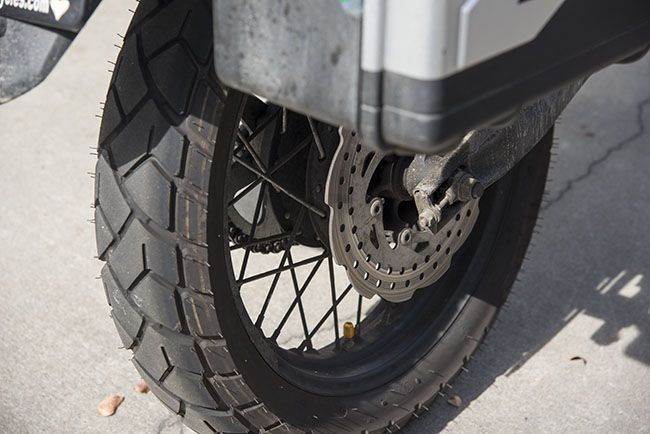
The RX4 front wheel and tire. Note the aluminum rim, radial tires, and 19-inch front wheel.The RX4 rear wheel. Note the larger rear tire, the aluminum rim, and the radial tire.
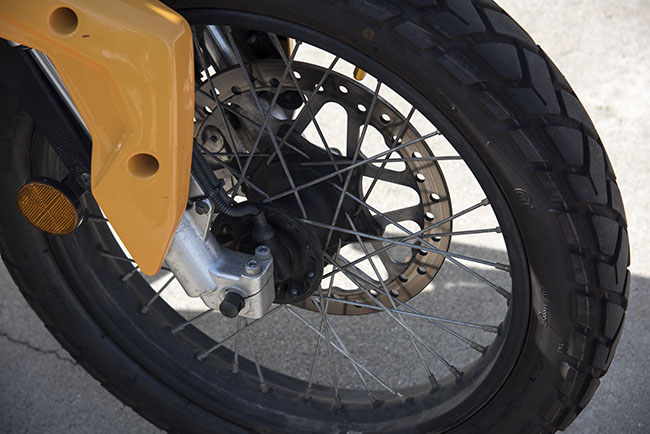
For comparison, here’s the wheel and tire on the front of my RX3.
The RX3 front wheel and tire. Steel rims, and non-radial tires.
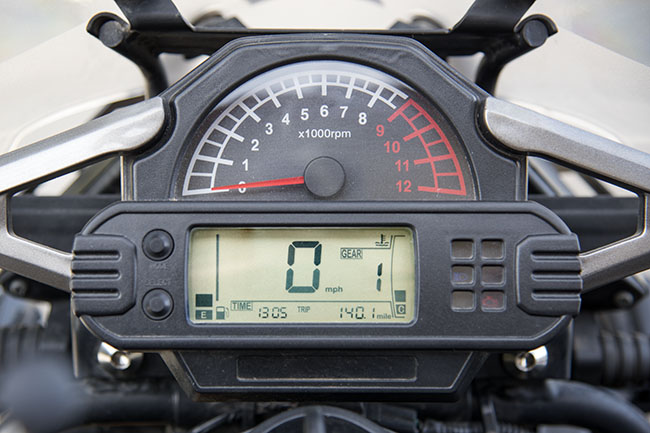
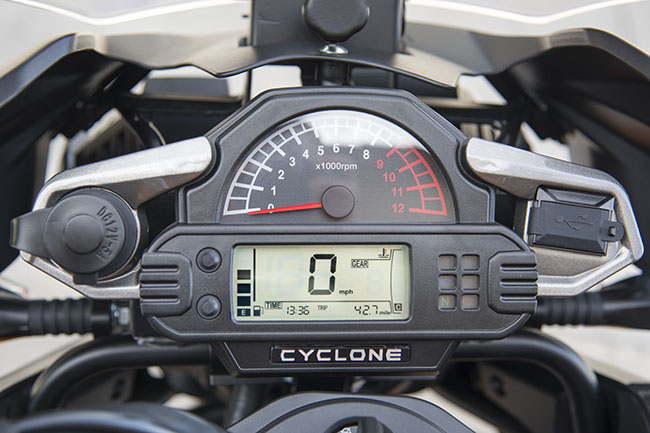
The last area I’ll describe is the dash and instrumentation, and that part is easy: They are identical. Well, almost. The instrumentation is the same. The dash is a little different in that on the RX3, the USB and 12V chargers are optional accessories; on the RX4, they are standard equipment.
The dash on my RX3. I did not get the optional USB and 12V charging outlets.The RX4 dash. Note the standard equipment accessory charging outlets.
The RX4 instruments, which are identical to the RX3’s (including the 10-12% optimistic speedometers). Note the standard-equipment USB and 12V accessory outlets to the left and right of the speedometer. And folks, that wraps it up on the RX3-versus-RX4 comparisons. It was fun, and it was really fun to be the first to evaluate the RX4 and publish these findings on it here on the ExhaustNotes blog. My overall take is that the RX4 is a quality machine. It’s a little heavier than the RX3, but I suppose that’s to be expected on a motorcycle with nearly twice the displacement of the RX3. The handling and freeway performance is a substantial notch above the RX3. I don’t believe anyone is offering a comparable, fully-equipped adventure touring package at any price in the 450cc class, and that makes this motorcycle noteworthy (especially in view of the fact that this displacement is so obviously perfect for a serious roadburner). CSC asked me to mention that they are taking deposits now, and here’s the page where you can do that.
If you’d like to read all of the RX3-to-RX4 comparisons, here’s the page to do that. Stay tuned, because we have an RX4-to-KLR comparison coming up soon, and (as mentioned above), we’ll also be publishing a quick ride review of the BMW GS 310. BMW has a significantly different path to market than does CSC, and that difference (to me) is even more interesting than is a comparison between the two motorcycles. We’ll talk about that, too.
Don’t forget to consider signing up for our email updates list. You can do that by entering your email address on the widget at the top right of this page (if you’re on a desktop) or at the bottom of this blog (if you’re using your smartphone to read this blog). We’re having a contest to give a away a free copy of one of our motobooks in December if your name is on our email list. And we won’t share you email address with anyone else.
Yesterday was a fun day. I was at Brown BMW in the morning for my GS 310 ride, and I got to chat with Bob Brown a bit while I was there. Then it was over to CSC to visit with the guys there. I’m happy to report that both places were hopping. This morning, I’m off to the rifle range to evaluate a few new loads, and tomorrow, it’s the International Motorcycle Show in Long Beach (watch for the photos here on the ExhaustNotes blog). Good times, folks.
The RX3-to-RX4 comparison continues. We’ll pick up several more areas in this blog. Note that we’ve added an RX4 page to the ExhaustNotes website, too. More on that in a bit; for now, on to the comparo!
Starting at the back of both bikes, the RX4 has a subfender behind the rear wheel. The RX3 does not. Take a look…
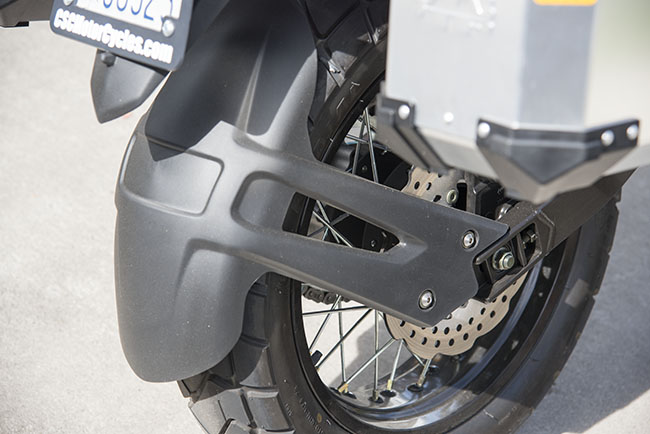
The RX3 rear wheel. Note that there’s no subfender.The RX4 subfender. This was something CSC could have added to the RX3, but chose not to (wisely, in my opinion)..
When CSC specified what they wanted on the RX3 a few years ago, they opted to leave the subfender off. I didn’t like the subfender, I thought it was ugly, and I didn’t see a need for it. I thought leaving it off was a good move.
You might think the RX3 subfender could have been added as an aftermarket accessory. It can, but it’s not easy. On the RX3, adding the subfender actually requires a different swingarm, so if you wanted to add a subfender you would have to replace the entire swingarm. That’s because the swingarm mounting points for the subfender are built into the swingarm (you can see that on the RX4 subfender photo, too). When CSC was defining the RX3 configuration, the question became why not just specify the swingarm that can accept the subfender, and offer the subfender later as an accessory? The reason is that because without the subfender, the swingarm looks goofy. It’s got this big mounting bracket at the rear on the right side, hanging out in space with nothing mounted on it.
Personally, I could do without the subfender on either bike. It just adds weight and I don’t care for the look. But that’s my preference. Your mileage may vary.
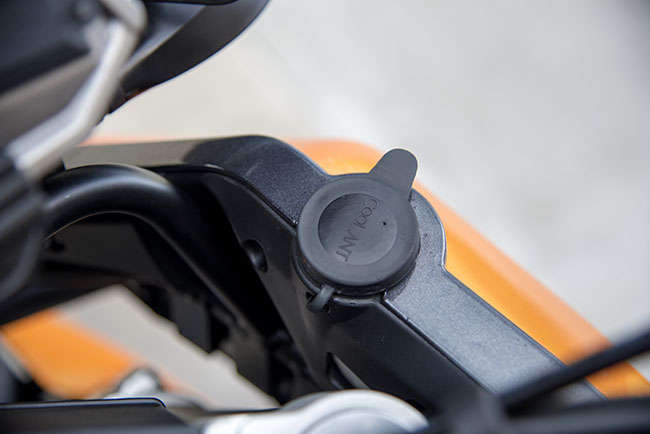
Moving back to the front of the bikes, the RX4 incorporates a radiator bottle fill port on the bodywork to the right of the fuel tank. It’s easily accessible (far more so than the radiator bottle fill port on the RX3, which is tucked under the fairing). This was a good way to go on the RX4. You know that if you have ever needed to add fluid on the RX3 it’s not easy to get the radiator bottle. Score one for the RX4. I like the RX4 approach better.
The RX4 radiator bottle fill port. It makes it a lot easier to add coolant.
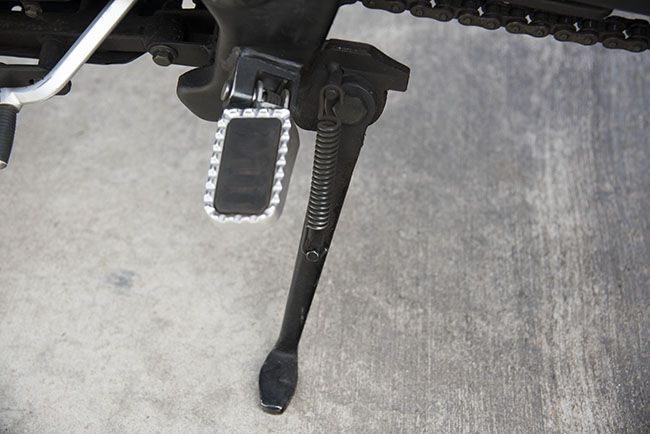
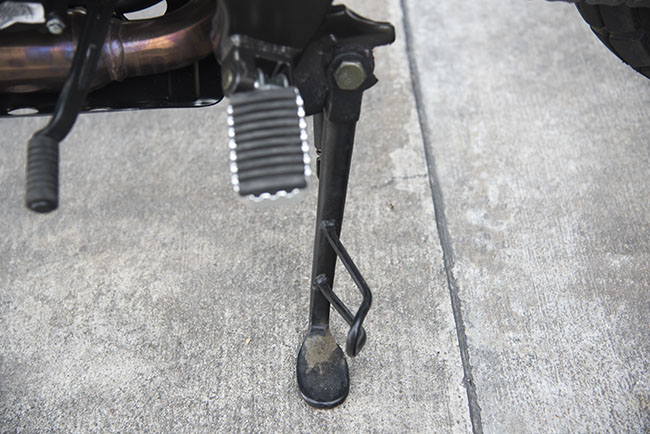
The sidestands (or kickstands) on the two bikes are similar…and in the two photos below, you can see that the two bikes use the same footpegs. These are good footpegs, I think, because you can remove the rubber inserts if you wish. I never have done that, but I suppose there are guys out there who think they need to do that.
The RX3 kickstand. I found it easier to reach than the kickstand on the RX4.The RX4 kickstand. Note the “wing” to make extension easier.
I find it very easy to reach the kickstand on my RX3; on the RX4 it was not as easy for me. That could just be me being used to the RX3.
Neither the RX3 nor the RX4 have a centerstand as standard equipment. It’s an option on the RX3 and I imagine it will become an option on the RX4, although it will be little harder for CSC to add a centerstand to the RX4. On the rear suspension linkage photos (they’re coming up next), you’ll notice that the RX3 has two mounting points that CSC uses for the bike’s optional centerstand. When I first saw those underframe mounting points on the RX3 in China, I assumed Zongshen added them because they anticipated adding a centerstand, but that wasn’t the reason. Zongshen uses the below-the-frame mounting points as an assembly aid during RX3 production as the bike is traveling down the assembly line.
Zongshen also has temporary centerstands (it takes two of these to lift the bike’s rear wheel off the ground) for use if you need to fix a flat tire, and I think CSC sells them if you want to buy a pair. I have a couple I carry around in my RX3, but (knock wood) I have never used them. I got a flat on the ride across China, though, and one of the RX3 clubmen we rode with in Beijing had the accessory maintenance centerstands with him. They work well, and that guy had my flat fixed in no time flat (pardon the pun).
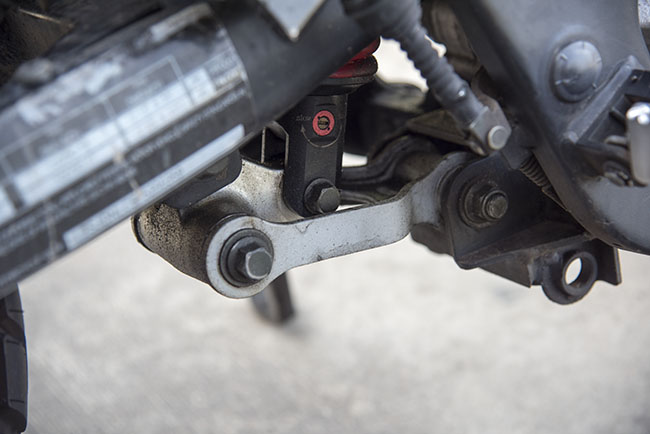
That said, let’s move on to the rear suspension comparison. Here’s the rear suspension linkage on the RX3. Note that the RX3 linkage is constructed of stamped metal pieces. This is the setup that CSC changes when you buy an RX3 lowering kit.
The RX3 rear suspension linkage. Note the stamped metal parts, the rear damping adjustment point, and the centerstand mounting points below the bike.
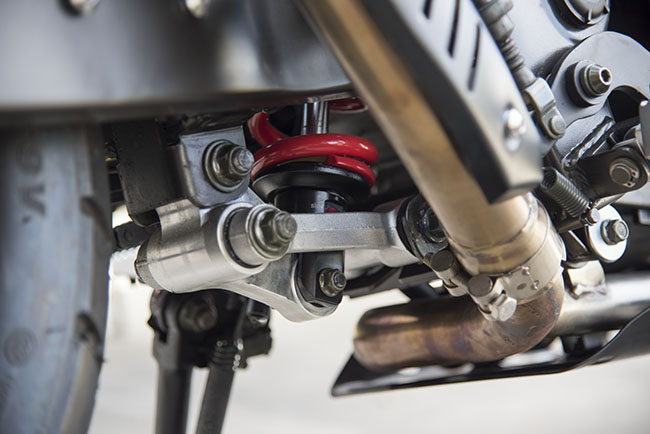
The RX4 rear suspension linkage is substantially beefier, and it uses cast metal bits instead of stampings. It’s one of the reasons why the RX4 is heavier than the RX3.
The RX4 rear suspension linkage. I don’t think the RX4’s rear damping adjuster is as easily accessible as is the RX3’s.
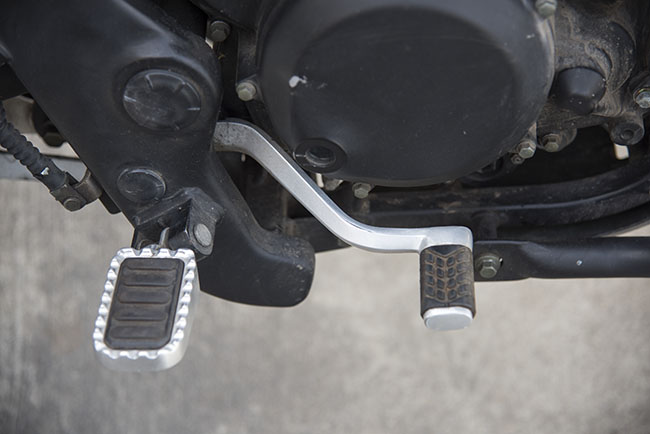
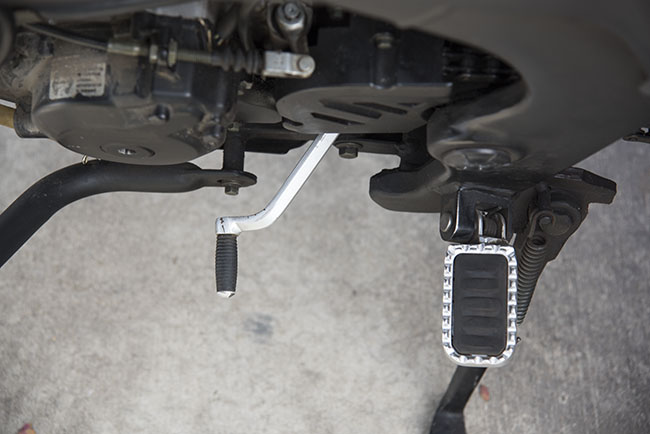
The shift levers and the rear brake levers are different on the two bikes. The RX3 uses cast parts; the RX4 uses what appear to be stamped weldments. The photos below show the shift and brake levers on the RX3. Note that they are cast bits, they are painted silver, and they have a nice look to them.
The RX3 rear brake lever. It’s a nicely-finished casting.The RX3 shift lever, another nicely-finished casting.
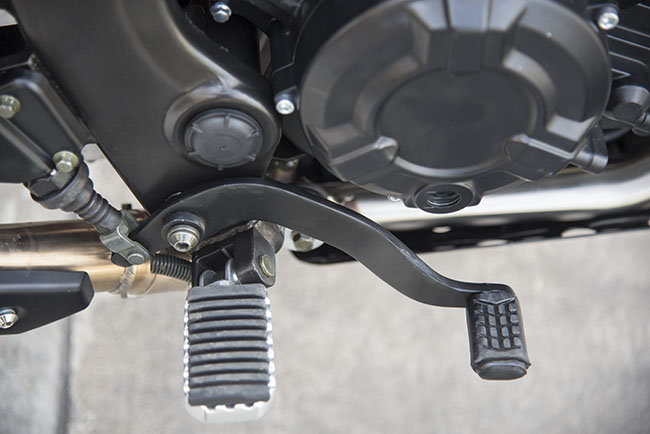
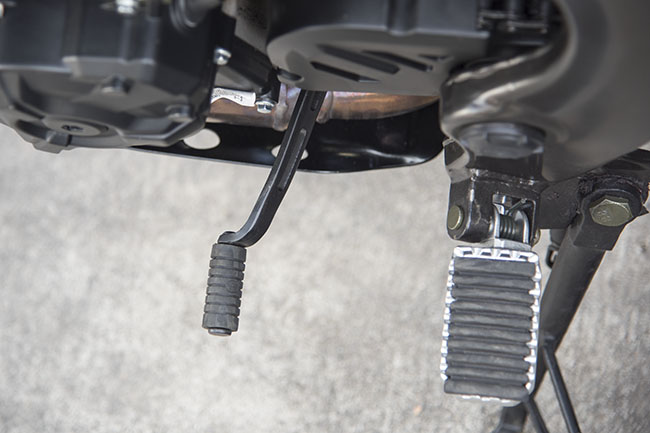
On the RX4, the shift and brake levers appear to be stamped weldments painted black to match the frame. In my opinion, they are not as nice looking as the ones on the RX3, but I suppose you could make the argument that if you bend the RX4 parts in a spill, the levers on the RX4 will be easier to fix than would be the RX3’s castings.
The RX4 rear brake lever. It’s fabricated from a stamped weldment.The RX4 shift lever.
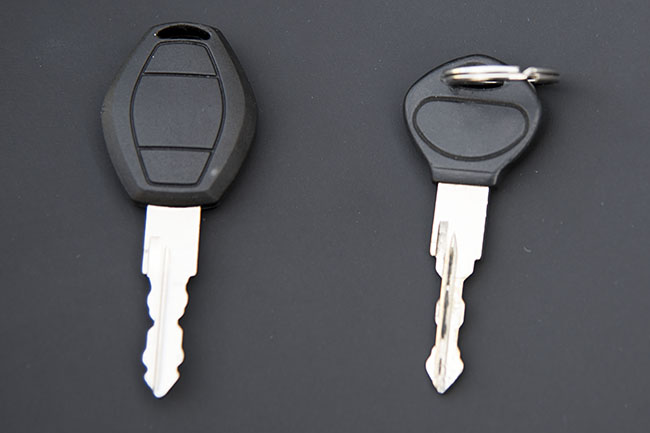
The RX4 I’ve been riding has two ignition keys. One looks like a regular ignition key, and it fits the ignition lock, the standard luggage, the gas cap, and the rear seat release (just like the RX3). The other key that comes with the RX4 has a smaller black plastic handle. I don’t know why the two RX4 keys are different. I had a similar two-key arrangement when I owned a 1997 Suzuki TL1000S. The regular key (with the larger black plastic handle) was for normal use, and the one with the smaller black handle was in case the bike had an electrical issue and the fuel injection didn’t work correctly. It was designed to put the TL into a “limp home” mode. I never had to use it. I don’t think that’s what’s going on here, but I don’t know for sure. It’s one of those things I’ll have to ask the wizards at Zongshen about.
The black plastic handle on the RX4 key is larger than is the one on the RX3 key. Here’s a photo showing the RX4 key and the RX3 key…
The RX4 (on the left) and RX3 (on the right) ignition keys.
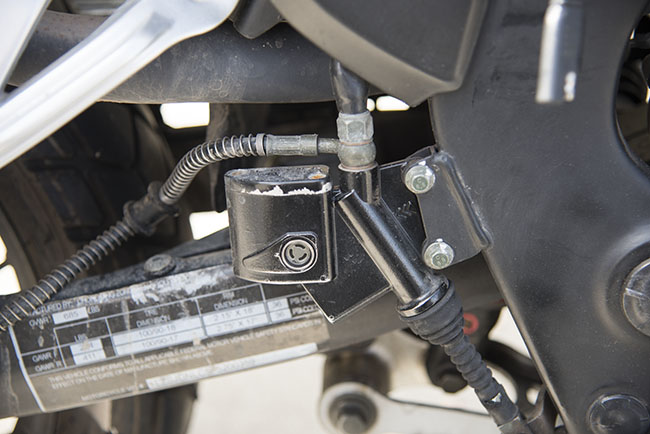
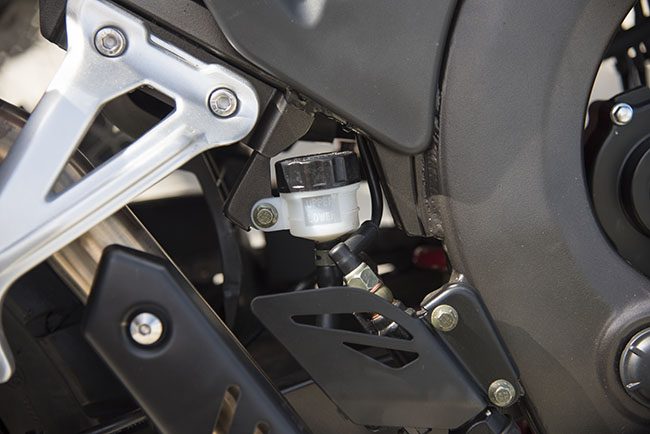
The rear brake master cylinders on the two motorcycles are also different. Here’s what they look like…
I like the rear master cylinder on the RX4 much more than the one on the RX3. You can just unscrew the RX4 cap to get to the reservoir, while on the RX3 rear master cylinder you need a Phillips head screwdriver and you have to remove two screws. The more-complicated RX3 design has a story behind it. Originally, the RX3 rear master cylinder was a much smaller affair. One of the CSC consultants advised that it was too small for its location near the exhaust pipe (the concern was that the master cylinder would be heated by the exhaust pipe and this could adversely affect brake performance). It never was an issue when riding the preproduction RX3 motorcycles or the RX3s we rode across China (both had the original design master cylinder), but I guess if you pay consultants you take their advice. On the RX3 I would have just gone with a conventional master cylinder like the one on the RX4 (which is similar to master cylinders on just about every other motorcycle on the planet). But Zongshen wanted to design a custom rear master cylinder for the RX3, and that’s how that strange-looking tapered affair on the RX3 came to be. In my opinion, the one on the RX4 is a better approach.
That’s enough for this blog, folks. Again, CSC asked me to mention that they are taking deposits now on the RX4, and if you want to get on board, here’s the link to do so.
Okay, okay….just two more things.
I’ve got a couple more blogs coming up on the RX4, including one I’m polishing now comparing the CSC RX4 to the Kawasaki KLR 650 (as my good buddy Chris suggested; it’s one that will probably draw lots of comments). You’ll want to keep an eye on the ExNotes site for the latest tech info on the RX4. And as promised, here’s the ExhaustNotes RX4 index page! Click on it and you’ll find an easy way to get to all of our RX4 articles.
And as mentioned before, please consider adding your email address for an auto-notify every time we post a blog (there’s a place do to that near the top of this page on the right). Do that and you’ll be eligible for our newest contest. On a quarterly basis, provided we get at least another 200 folks sign up each quarter, we’ll give away a copy of either Moto Colombia, Riding China, or 5000 Miles at 8000 RPM to a name drawn at random from our email database. The first winner will be announced sometime around Christmas this year. Please encourage your friends to sign up, too. If you’re already on the list, you’re eligible for the first drawing. We don’t give or sell our email list to anyone, so your address is safe with us.
The RX4 on the road. I wanted to get a shot at the truck scale, but conditions were not conducive to good photography.
The next two blogs (this one and the next) address more differences between the RX3 and the RX4, including the weight, the dash and instrumentation, the rear fender, tire sizes, the radiators, the radiator bottle fill port, the kickstand, the rear brake and gearshift levers, the rear wheel adjust mechanism, the swingarm, and the engine mounts. This blog will focus on the bike’s weight and the two bikes’ highway performance. I’ll sweep up the other differences mentioned above in the next blog.
Let’s talk about the 450-lb gorilla in the room first, and that’s the RX4’s weight. The RX4 is a heavier bike than the RX3, and I guess the question is: Is this a good thing or a bad thing? It’s all a question of perspective and intended purpose.
For starters, I still don’t have an accurate, measured weight on either bike. That’s a shame on me, although I will tell you that I tried.
My plan was to get the RX4 weighed first, and then return with my RX3 to do the same. I took the RX4 to our local certified truck scale, but the bike was too light to register on the scale and a loudspeaker-borne voice basically told me to get out of Dodge. It was a scary experience. There’s a monstrous Petro truck stop on the I-10 freeway about 10 miles from where I live, and I thought it would be a simple matter to roll the RX4 onto the scales and come back with The Number. That was my plan, anyway.
I entered the super-busy truck stop through an area teaming with idling 18-wheelers, engines barking and belching, crammed together weighting (or is that waiting?) to funnel onto the Petro parking lot scales. On my RX4, I was acutely aware of three things: The guys driving these monsters couldn’t see me, the engine noise and fumes were overwhelming, and the RX4’s fat rear end (those Tourfella bags are wider than the bike’s handlebars) made maneuvering through the 18-wheeler maze a dicey proposition. The pucker factor was elevated, folks. Big time.
I made it through, though, and I was finally on a scale with a platform as long as, well, an 18-wheeler. There was this elevated control house sort of thing next to the platform. It wasn’t clear to me what was supposed to happen next, as I couldn’t see anybody running the operation, and there was no digital or analog readout telling me the weight. I stopped the bike and dismounted, and I walked toward the elevated control house when an electronic voice from the Heavens boomed. It was way louder then the idling diesel engines surrounding me and I could tell: It was pissed. At me.
“Can I help you?” It didn’t come across as a request that implied an intent to be helpful. It implied anger. Seething anger. Directed at me. As a two-wheeler, I was but one-ninth the vehicle I was supposed to be.
Well, yeah, I want to weigh my bike. I mean, why else would a normal person be here?
“You’re setting off my alarms.”
Sorry about that, dude. What alarms?
“You’re too light and my alarms are going off!”
I want to weigh my bike (sometimes repetition helps, I thought).
“You need to get out!” There it was. No more implying or inferring. It was out in the open now. It was as if I was wearing a MAGA hat on the Harvard campus. I was not welcome.
Okay, I can take a hint. Hell, a weight is just a number anyway.
Which brings me to my next point. What’s in a number?
Whatever the answer is to that question, I can tell you these three things: One, the RX4’s official number from Zongshen is 450 lbs. As I said before, I don’t know if that is the right number, but I suspect it is not. Two, the RX4 is substantially heavier than my RX3, and weigh heavier (or should that be way heavier?) than my TT250. It feels it, and it feels to me like the weight rides higher. Three, the RX4 is a substantially better road bike than the RX3, and the bike’s added heft and longer wheelbase (along with that marvelous 450cc motor) probably plays a role here. Anyway, the bottom line here is this: There’s no Joe Berk official weight yet (read that to mean a weight actually measured on a scale).
Like I said, I can feel the difference in heft between the RX3 and the RX4. It’s enough to make me wonder: Am I man enough to take this puppy off road? I suppose I could be. I know there are a few guys who actually take GS 1200 BMWs off road, and those things have seat heights and weights that require altimeters and maybe truck scales to measure. But would I want to go off road?
The short answer, I think, is this: If your main objective is off-road riding, there are other choices. I’d go for my TT250 or something else. If you are primarily a road rider, though, with the occasional off-road excursion, then the RX4 is a good choice. In my opinion, the RX3 would be better off road, but that’s just what I said it was: My opinion. Your mileage may vary, as they say. I was thinking about the stretch to the Sierra San Francisco cave paintings in Baja, and to me, I’m right at the limits of what I feel comfortable with on that gnarly stretch on my RX3. It’s heavily rutted, there are big boulders, and it’s a challenge. But then, I freely admit I’m not a dirt biker. I know there are guys reading this who are thinking they would have no problem taking the RX4 off road. If you’re one of them, you’re probably right.
If you are primarily a road rider, though, the RX4 is the better choice. I put about 100 miles on the RX4 on freeways and surface streets here in So Cal, and I can tell you this: The RX4 is clearly a more capable road machine than is the RX3, especially at freeway speeds. I didn’t get a long enough stretch to measure the RX4’s top speed, but I can tell you there were spurts where I cranked it up to an indicated 99 mph and there was still more left. That’s indicated (not actual) top speed, and the speedo is 10-12% optimistic. Zongshen claims a top speed of 97.5 mph for the RX4, and that’s probably accurate. The RX4 is a bike that can cruise comfortably at 80+ mph all day long; the RX3 has essentially run out of steam at that speed. The RX4 makes running with the big dogs seem easy. It is rock steady at high speeds, and it’s comfortable. It feels secure.
That magnificent 450cc motor…
In many ways, the RX4 reminded me more of my Triumph Tiger than it reminded me of my RX3. The Triumph was essentially a touring machine/sports bike styled like an off-roader with saddlebags. The Triumph was heavy and I only took it off road once on purpose (and that was enough). I rode the Triumph off road a few more times when I had to in Mexico, but it really was not an off-road bike. I know there are guys who ride the big Tigers off road, but it’s not where the bike wants to be. It wants to be headed to the next state, or maybe the next international border. That’s what the RX4 wants, too.
My Triumph Tiger. In many ways, the RX4 is quite similar to the Tiger. It was a stellar long-distance touring machine; I think the RX4 is, too.
I’ll make a prediction: Within the next two years, someone (perhaps several someones) will do the Iron Butt on the RX4. I don’t mean a single 1000-mile Baby Butt day (good buddy Rob Morel has already done that on his RX3). I’m talking the full-tilt boogie here: The 11,000-mile, 11-day Iron Butt. I think that’s going to happen. And I think the RX4 is the bike that will do it.
I was talking to Steve Seidner about this a day or two ago, and he asked me to mention to you that CSC is taking deposits now on the RX4 (here’s a link to get to their page for placing your deposit). CSC will sell a lot of RX4s. The bike is that good.
This is a continuation of the preceding blog comparing the new CSC RX4 to the RX3 motorcycle. I probably should have waited until I had taken all of the photos and organized the comparison into discrete areas (like wheels, tires, brakes, and so on), but you’re going to have to deal with the ramblings of a disorganized mind (and that would be mine). With apologies in advance, my ramblings will ramble on in no particular order.
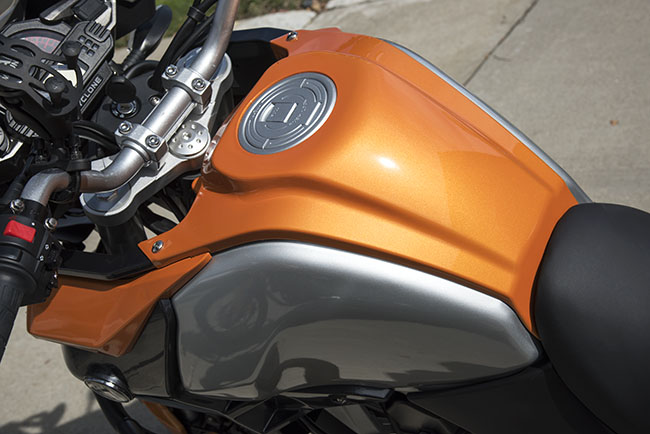
With that as a preface, let’s take a look at the fuel tanks. First up is the RX4 tank, and the big news is that it holds 5.3 gallons instead of the RX3’s 4.2 gallons. Here’s the RX4 tank…
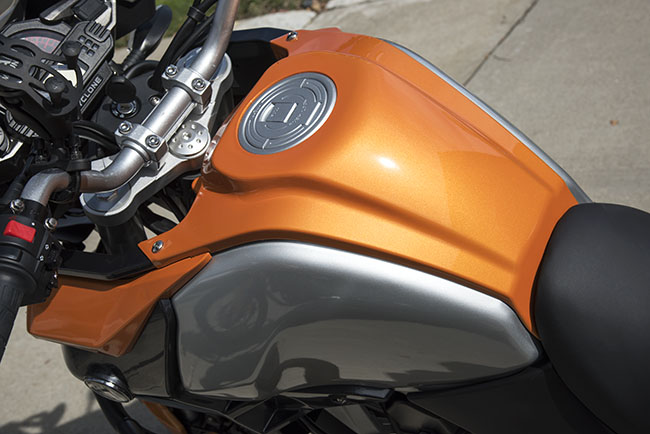
The RX4 fuel tank. The colors are stunning. It holds 5.3 gallons.
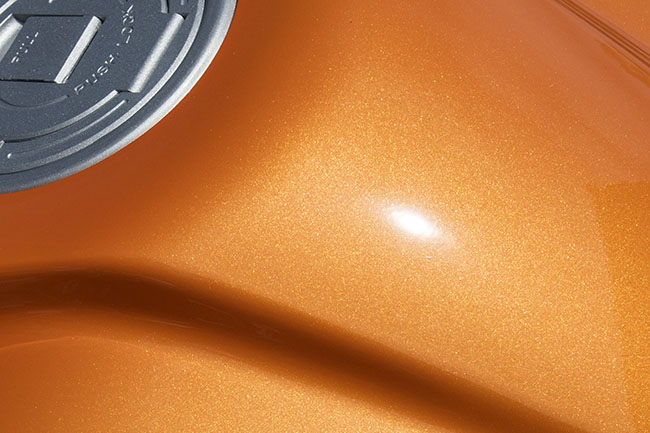
You can’t help but notice the paint on this motorcycle. CSC received three bikes for the U.S. certification effort…one in silver, one in red, and one in orange. My bike has the metalflake orange color and it’s visually arresting (it will stop you in your tracks when you see it). Here’s a close up…
Metalflake orange. It’s beautiful. It’s the new fastest color.
There are really three or four colors going on here. One is the metalflake orange. Another is the metallic silver on the tank’s side panels. A third is the even darker metallic gray on yet another side panel (you’ll see that in another photo below). And the fourth is the black of the frame and the molded plastic body bits. It all comes together nicely.
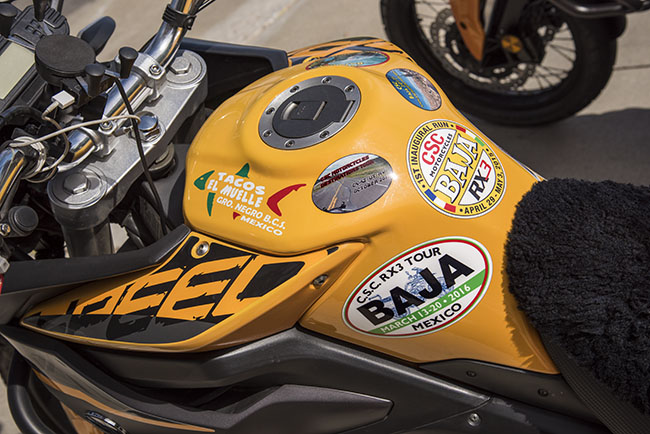
You can compare that to the orange on my 2015 RX3…
My orange RX3. This is the 2015 model, which is little bit different than the later CSC orange on newer RX3 motorcycles.
I mentioned the RX4’s 5.3 gallon capacity. Okay, let me explain a bit more. I haven’t attempted to actually run the thing dry and put 5.3 gallons of gasolina in the tank. 5.3 gallons is the figure Zongshen provided. The RX3’s spec is 4.2 gallons, but that’s not the right number. The RX3’s tank would hold 4.2 gallons if there was nothing else in it, but the tank is also occupied by the float for the sending unit and the fuel pump, and they both take up space. Gerry and I once took a bone dry RX3 tank with the fuel pump and sending unit in it to a gas station, and after really finessing the gas station pump, we were able to coax 3.9 gallons into the RX3 tank. I don’t know if the same situation applies to the RX4 tank. Maybe that 5.3 gallon statistic is really 5.o gallons.
The other thing going on in the RX3 is that the fuel gage and the fuel warning light indicate you are out of fuel when there’s still something close to a gallon left in the tank. As it was explained to me by the guys in Chongqing, that’s to make sure the fuel pump is always surrounded by fuel (it’s how the fuel pump is cooled). I don’t know if the same situation applies to the RX4 fuel tank. I have to get more miles on the bike to let you know.
So, let me do what I have a bad habit of doing, and that’s go tangential for a bit to tell you a little bit more about the RX3 tank, and in particular, the tank on my RX3. You’ll notice that my tank has a panel with a decal that says “Speed” on it. That was the first year of the RX3, and I guess it was Zongshen’s idea of making the motorcycle convey a fast image. The Internet weenies had a lot of fun with that. When they cornered me on it, I told them that CSC originally asked that the bike’s name be “Methamphetamine,” but we would have had to make the font so small you couldn’t read it. That got a laugh and the Speed teasing ended. Mercifully, CSC changed the name to “Adventure” the following year. There’s no such name label or decal on the RX4. I think that’s a good thing.
You probably notice all of the other decals on my RX3’s fuel tank. I like to think of them as campaign ribbons. We put one on their for each of the Baja runs, the 5000-mile Western America Adventure Run, and the Destinations Deal tour. I like them.
Moving right along, here’s a side view of the RX4 showing the engine and fuel tank, and then a similar photo of the RX3…
Right side engine and fuel tank view of the RX4. Note the four colors, the engine guards, the engine cylinder head casting, the crank position windows (on the cylinder head), and the oil accoutrements.The RX3 fuel tank and engine viewed from the right side of the motorcycle.
There’s a lot to take in on those two right side views. Here we go, folks.
I guess the first thing to notice are the engine guards. In the old days, we used to call them crash guards, but these days it’s more correct to say engine guards. Whatever. Anyway, on the RX3, the engine guards extend all the way to the bottom of the engine. On the RX4, they only cover the upper portion of the bike. I don’t know why that is. It might be that if you drop the RX4 on its side, the upper portion is enough. But I don’t know this, and I’m not going to drop both bikes on their sides to find out.
On the RX4, the crank position windows are on the right side of the engine. You can see them just behind the spark plug on the cylinder on the right side. On the RX3, those viewing ports are on the left side of the engine.
The crank position viewing windows. On the RX3, they are on the left side of the engine. One the RX4, they are on the right side of the engine.
The RX3 has an upswept exhaust pipe; on the RX4, the exhaust pipe heads south to run underneath the engine, and then heads north again to an upswept exhaust pipe (you can’t see that in the above photo). While some might view the RX4 exhaust routing as less than desirable from an offroad perspective, I’m okay with it. The RX4 has a steel engine skid plate, and the RX4’s exhaust routing makes getting to the oil fill port a lot easier (it’s just aft of the water pump).
You’ll notice that the cylinder, cylinder head, and upper engine mount castings are all much heftier than are those on the RX3. If you look at the cylinder head casting just aft of the cylinder head, you’ll see a weird-looking ribbed triangular extension with a threaded hole in it. It’s on both sides of the engine.
A fixturing attach point, or perhaps to mount the engine in another bike?
With that threaded hole, it looks like Zongshen left a part off the bike (there’s nothing there). My guess is that this feature is either used to support the engine when it is moving down the assembly line, or that it is there for mounting the engine in another frame (perhaps one of the Dakar rally bikes). I’d like to see Zongshen remove that part of the casting on the RX4 engine; it serves no purpose on the RX4 other than to add weight to a bike that doesn’t need to take on ballast.
The RX4 appears to have the same arrangement for the oil filter and the oil strainers as does the RX3. One strainer is accessible via a threaded cover on both sides of the crankcase; the oil filter is located beneath a cover on the right side of the engine.
Clockwise from 10:00: Small oil filler access hole and large oil filler access hole (just like the RX3), oil strainer cap (just like the RX3; there’s another on the other side of the engine), oil filter cover (just like the RX3), and oil view port (just like the RX3).
That’s enough for today, my friends. We’ll have another RX3 and RX4 micro-comparison posted tomorrow. I’m going to take a break and get out and ride the RX4 for awhile…
Wow, where to begin? I thought I would do this in a single blog, but I quickly realized it’s going to take more than a few.
Joe Gresh thought it would be a good idea to do a comparison between the RX3 and the RX4, and since he’s the brains in this outfit (I’m the good looks), I started the photos for the comparo earlier today. There’s a lot to discuss, and I don’t want to try to cram it all into a “Gone With The Wind” single blog.
So, here we go with the first set of comparisons, and I guess as good a place to get started as any is with a shot from the rear of both bikes…
My RX3 on the left, and the new RX4 on the right. The RX4 has a 19-inch front wheel (the RX3 has an 18-inch front wheel). As a result, the RX4 leans a little bit more to the left than does the RX3 when on the sidestand.
You’ll notice that my RX3 has the stock plastic luggage and the RX4 has the optional Tourfella aluminum luggage. The RX4 will come stock with the same plastic panniers as the RX3, but it will have a taller tailbox than the current RX3 design. The current RX3 tailbox won’t close with a full face helmet, but the taller stock plastic tailbox to be provided on the RX4 will. I’m hoping the 2019 RX3 will have the taller tailbox, too.
The Tourfella luggage is a great option. Both sets of luggage are lockable; the stock plastic bags use the bike’s ignition key. The Tourfella luggage has a separate key. The Tourfella bags have considerably more capacity than the stock plastic bags, and when I rode in Colombia with good buddies Juan and Carlos, my AKT RS3 (a carbureted RX3) had the Tourfella bags. You get a huge increase in capacity (which is nice), but the aluminum bags are wider and I’m guessing they are heavier. You’ll see a slight decrease in fuel economy and top speed with the larger bags on an RX3; I don’t know what they’ll do to both stats on an RX4.
I like the looks of both sets of luggage. I’m a guy who travels light, so the stock bags have been good enough for me on my adventure tours. One other minor disadvantage of the Tourfellas is they are wide. I scraped a taxi splitting lanes when debarking from a ferry ride down the Magdalena River in Colombia. Joe Gresh’s RX3 had the Tourfellas in China, and I watched him have the same problem a couple of times when splitting traffic there. But those big aluminum Tourfellas sure are nice. They are a high quality bit of kit, too. And like I said, you can carry a lot of stuff in those aluminum boxes.
Here are photos shot from the rear of each bike, starting with the new RX4…
The Tourfella luggage on the RX4. It’s 34-inches across those two aluminum panniers. That’s wider than the bike’s handlebars.
And here’s my RX3. It’s one of the very first delivered to the United States, and I’ve done some serious traveling with this motorcycle. It has the stock plastic luggage.
A dirty bike that’s seen a lot of miles…my kind of machine. The width across the stock RX3 panniers is 29 inches (they are 5 inches narrower than the Tourfellas in the above photo, and they are 2 inches narrower than the RX3’s handlebars). I don’t know what the width of the stock luggage will be on the RX4.
Next up are two photos of the exhaust outlets. On the RX4, the muffler has two openings, suggesting the bike is a twin (it’s not; it’s a single like the RX3).
The RX4 muffler. It’s stainless steel, and it contains the bike’s catalytic converter. Two openings aside, the bike is a single. The exhaust note is sweet. I’ll do a video in a future blog.The RX3 muffler, with its single outlet. It’s also a stainless steel muffler, and it has an awesome exhaust note.
As I mentioned in my earlier blog on the RX4, the new bike sounds like the RX3, but you can tell it has a bigger and stronger engine. Both bikes sound almost as if they have a custom pipe. They are both actually a little bit louder than I’d like, but the sound is great. Good ExhaustNotes, I’d say.
Moving to the other end of both motorcycles, let’s take a look at the front brakes. The RX4 has twin-piston calipers and dual disks…
Dual discs on the RX4. The braking is a bit stronger than an RX3 with the CSC larger single disk.
The RX3 has a single disk with a twin-piston caliper up front. My bike has the CSC larger diameter brake rotor. I think this is a worthwhile addition to the RX3, but I also think the stock RX3 brake is sufficient.
The larger diameter front disk rotor on my RX3. It works well.
If you look closely at both of the above photos, you’ll see the two front wheels are different. I’ve already mentioned the RX4’s 19-inch front wheel (the RX3 has a standard 18-inch diameter front wheel, with a 19-inch wheel available as an accessory from CSC). What is also shown (but maybe is not so obvious) is that the RX4 has aluminum rims, while the RX3 has steel rims. I think that might be what makes the RX4 handle so well. Aluminum wheels mean less unsprung weight, and they also make a motorcycle handle more crisply.
The production RX4 motorcycles will have anti-skid braking, and unlike the the 2018 RX3 ABS, you’ll be able to turn the ABS off on the RX4. That’s something you dirt denizens asked for, and your voices have been heard. The RX4 will come standard with wire wheels (like you see in these photos), and cast aluminum wheels with tubeless tires will be an option. The RX4 wire wheels require tubes.
Here are couple of tangential thoughts intended for the wizards at Zongshen (they read ExhaustNotes, too, you know). I’d like you guys to consider adding the dual discs, the aluminum-rimmed wire wheels, and the switchable anti-skid braking on the 2019 RX3. That would make an already great motorcycle even better, I think.
Both the RX3 and the RX4 have Cheng Shin (CST) tires. They’re bigger on the RX4 (more on that in the next blog). These are good tires. They hook up well and they last a long time. I get about 6,000 miles out of a rear tire on my RX3, and as is the case with most motorcycles, the front tires last about twice as long as the rear tires.
Staying at the front of the motorcycle, let’s now take a look at the face of both bikes. This is my RX3…
The iconic look of the RX3 motorcycle.
CSC changed the windshield and headlight design on the RX4. During my trips to Chongqing, I saw that Zongshen evaluated using the same RX3 windshield and headlight on the RX4. I thought keeping the windshield would have been a good idea, but hey, what do I know? The RX3 windshield has been universally praised by everyone who has ridden an RX3, including every magazine that tested the bike. It is a good design. It just works…there’s no turbulence, and it’s well below your line of sight. But like I said, who am I? I don’t make a million motorcycles a year. Zongshen does.
The RX3 headlight…well, that’s not the RX3’s strong point. Being charitable, I’d say it’s anemic. I don’t ride at night if I can avoid it, but I recognize that the stock headlight doesn’t light up the world the way I’d like it to. The spotlights you see on my bike are from AKT Motos in Colombia. I had them on the RS3 I rode there, and I liked them so much that my good buddy Enrique Vargas gave a pair to me when I left his beautiful country. CSC sells accessory spotlights, too, but I kept the AKT Motos lamps on my bike. I use the spotlights as headlights on my RX3 when I ride at night. Many folks who buy an RX3 put a brighter bulb in the headlight, and that works well. I have one that my good buddy TK gave to me, but I haven’t put it on my bike yet.
You’ll also notice the very cool headlight guard on my bike. That was another gift from Enrique in Colombia. CSC now sells a similar headlight guard. Mine is Colombian, and I’ve kept it instead of the CSC headlight guard because it was a gift and I like it.
Onward and upward…here’s the front end of the new RX4…
A clean, modern look: The RX4 front end.
The RX4 headlight and windshield design are much changed from the RX3. Like I said above, CSC could have gone with a front end look identical to the RX4, but they opted instead for the new look. It’s grown on me. I would be okay with either one, and at first I recommended staying with the RX3 look because I feel it is an iconic Zongshen motorcycle face, but I like the new look, too. The new RX4 windshield is adjustable (the RX3 one is not). The headlight is a completely different design, and later tonight, I’m going to move both bikes onto the street to see how the headlight illumination patterns compare. I’ll try to get some photos so you can see the difference.
I’ll write more comparing the two bikes in the next several blogs. This blog is already longer than I intended, and there’s a lot more to cover in these comparisons.
You know it’s coming, folks. Like I always say: Stay tuned.

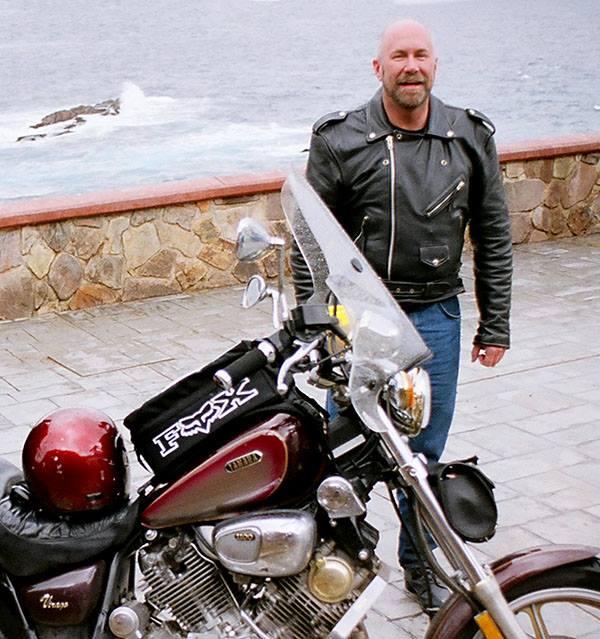
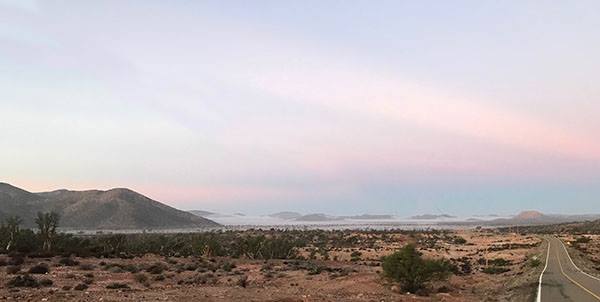 The fog nestled so close to the ground made it appear as though I was looking at a forest of cacti poking their heads through the clouds. For some unknown reason, I took that as an omen of good things to come. I passed one truck on that 40 mile stretch to the main highway.
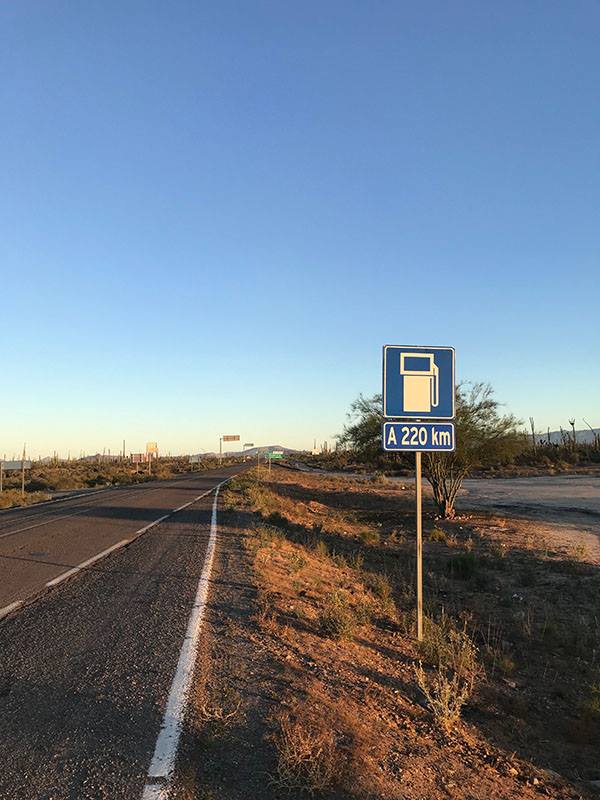 I wasn’t yet familiar with my CSC TT250, but I had read reviews of 65 mpg, and since I didn’t yet know what 3/4 full meant on my bike, I decided to press on, optimistic that I would find gas somewhere on the way.
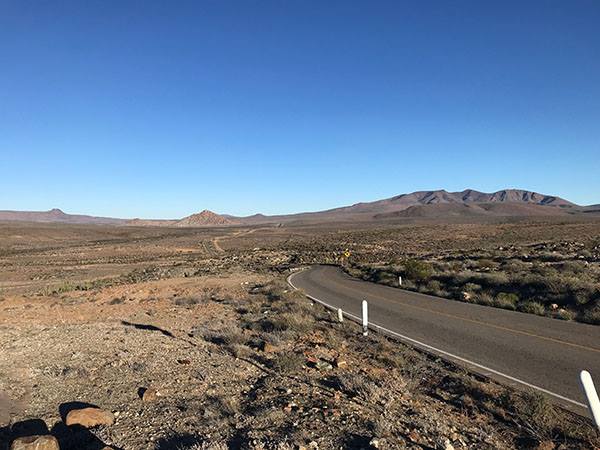 As I continued north, I noticed my gas gauge reaching 1/2 full at Chapala. I still had 63 miles to go to Catavina, which was the only place that I thought may have gas. Hoping that the gauge accuracy was a bit on the conservative side, I continued on. Running the numbers in my head, I concluded that I should make it to Catavina, even if my actual fuel level was a little less than indicated. However, if Catavina didn’t have gas, then I was going to either have to stay there until I could find someone passing through with extra gas, or try to locate a rancho that might have a couple of gallons to spare. Fortunately, in Catavina I came across a small sign stuck in the dirt on the left side of the highway that said Pemex. The arrow pointed to the right side of the road, and as my eyes scanned the opposite side of the highway, I saw a pickup truck with a couple of 55 gal drums and a few one gallon plastic containers. By this time I had travelled about half the distance to San Quintin, and although my low fuel light was already flashing, I still had not gone on reserve
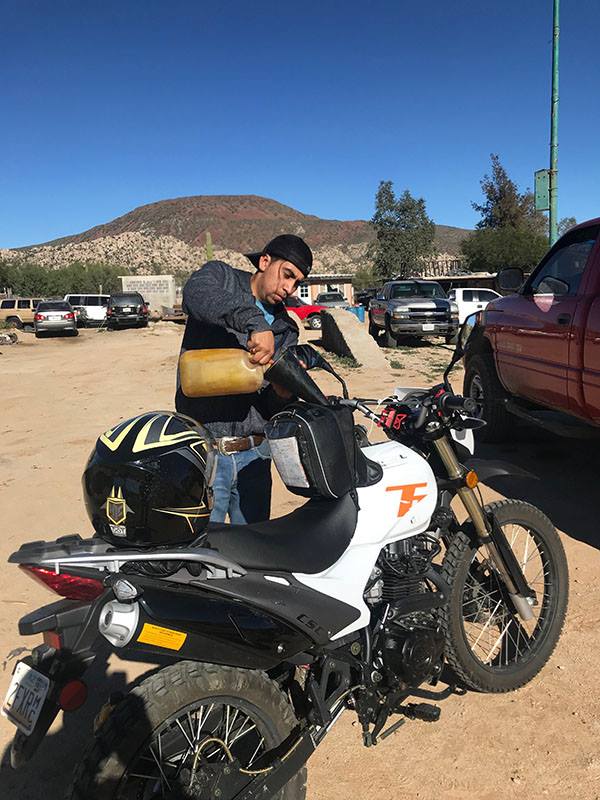 I figured the price would be astronomical, but that was ok since I would only need a couple of gallons. Surprisingly, it was only $1 per gallon higher than the Pemex station where I had filled up in my town the day before. Confident that I could now make it the rest of the way to San Quintin, I pressed on north, maintaining between 60 and 65 mph indicated.
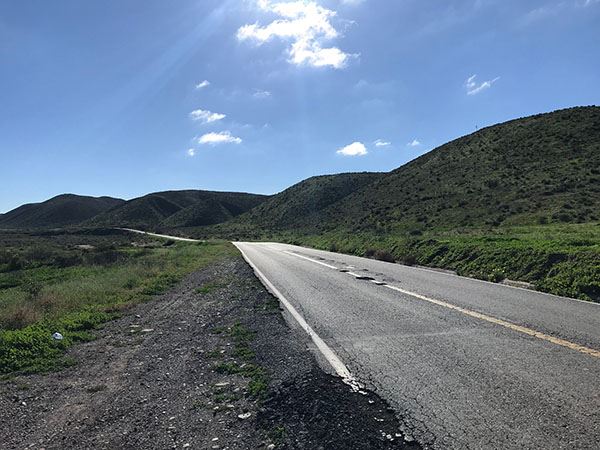 The desert continued to get greener as I closed in on the town of El Rosario where Mama Espinoza’s famous restaurant is located. I passed by knowing that I had a meal waiting for me in less than an hour at Jardine’s. Traffic remained consistent through the remainder of my trip, and I reached my destination at 11 a.m.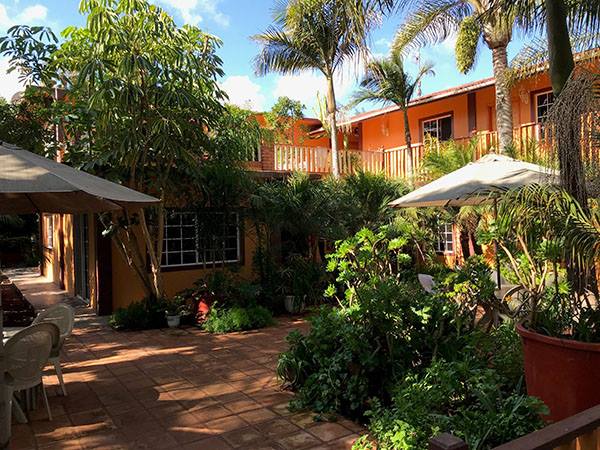
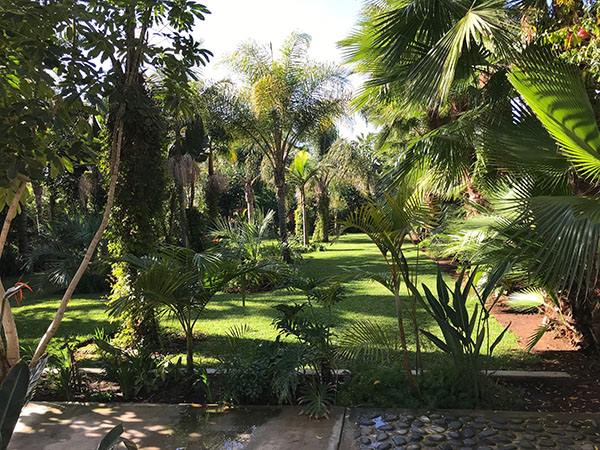 I pulled into the empty parking lot of the restaurant, dismounted, and approached the door. It was locked. Fortunately the hours were posted. Another hour before they opened. That wasn’t good. If I waited around until they opened, got seated and served, I wouldn’t get back on the road until after 1 p.m. That would make it difficult to make it home before dark. Hmmm! Better check the hotel. I had heard the rates were good, but I was pleasantly surprised that a single room was only $31. A two bedroom-suite was a bit steeper at $45. It didn’t take me long to decide to take advantage of one of the perks of retirement – unscheduled time. I quickly pulled out my wallet, checked in, walked around the grounds for a few minutes, and then waited outside the restaurant until they opened.
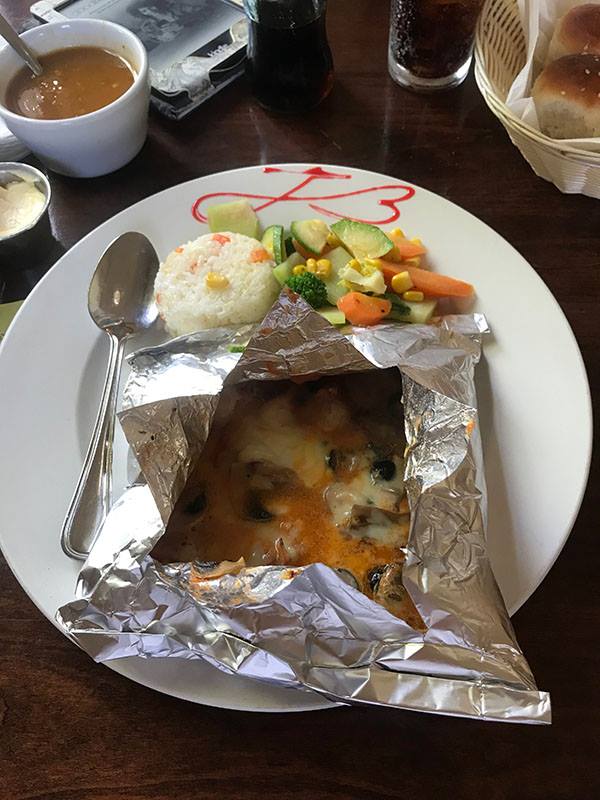 It was fantastic. I was seriously glad that I decided to stay. I kept occupied throughout the day by reading my kindle and talking to Anna, the hotel manager that day. She had spent several years in Wichita, KS, so she spoke English quite well. That night I paid a whopping $4.00 for some Fish and Chips. Another great meal.
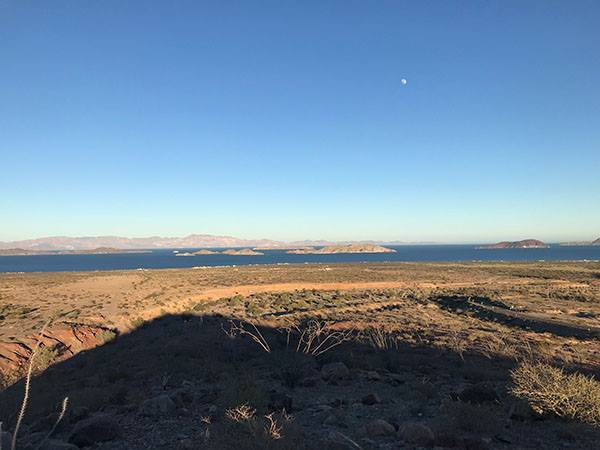 Hard to believe; for less than $100 I had a wonderful two days of riding, great food, a good night’s sleep and not one stop light. I feel truly blessed.