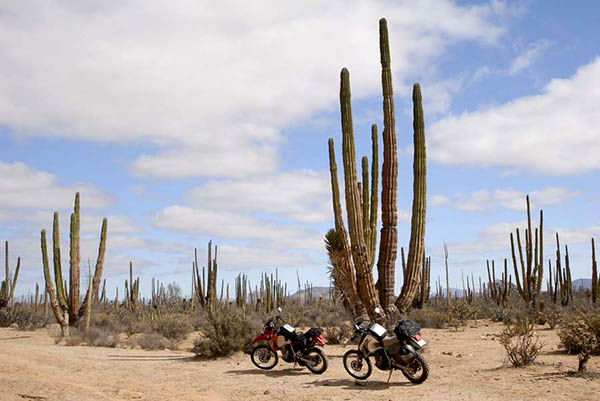
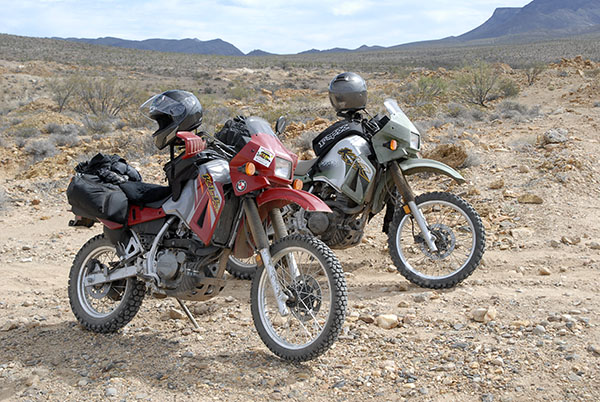
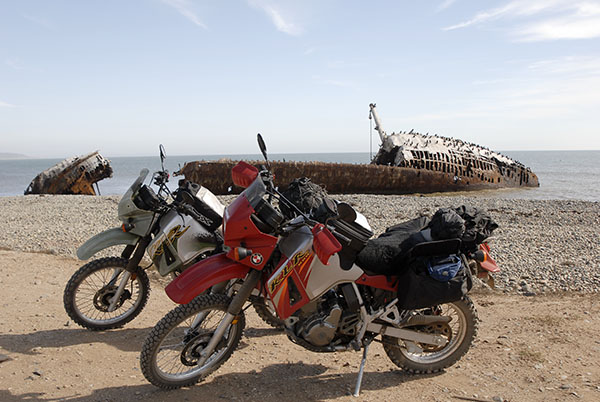
What this trip was all about. I grabbed this somewhere in the Vizcaino Desert. That’s my red KLR up front and John’s green one behind it. These are the perfect bikes in the perfect place.
In October 2009 it had been a year since my last motorcycle trip in Baja, and that was entirely too long. I was good to go, but most of the guys I hung out with here in So Cal were timid. They believed what they read in the LA Times. You know, about Mexico being dangerous. Me? I knew better. I needed to get my knees in the Baja breeze. My good buddy Baja John felt the same way.
My first journey into Baja was with John back in 1994, and it would be good to ride with him again. Our earlier trips were on cruisers…John on a Viagra (spelling intentional) and me on a Harley. We’d both be riding Kawasaki KLR 650s this time. I bought one, and after listening to me rave about it, so did John.
Don’t get me wrong. There’s nothing wrong with a Yamaha Virago, and if driveway jewelry is your thing, there’s nothing wrong with a Harley (Harleys are the world’s most efficient machines for converting gasoline to noise and self-perceived status upgrades, you know). But the KLR 650s…those were real motorcycles. No pretense, all business. I wish I had kept my KLR. I let the guy who bought it know that I’ll but it back. But that will be a story for another time.
The plan for this trip was to explore places off the Transpeninsular Highway. On previous trips, we’d seen signs pointing down rough dirt roads to the ruins of various abandoned Spanish missions, the marble quarry at El Marmol, and a few other places promising adventure. On those prior trips we quite appropriately opted not to take our cruisers down those gnarly dirt roads. This time, though, we had the right bikes and we would go wherever we wanted. Dirt? Soft sand? Mud? Banditos? Rabid dogs? Hey, bring it all on. We were ready.
So, here we go.
John rode south from Tehachapi to meet me near the Cal Poly campus, and we left late on a Thursday afternoon (John worked his job at Palmdale AFB, and I taught that day at Cal Poly).
We made it to Rosarito Beach Hotel that first night, my favorite hotel in that town. It’s a classy joint with a great restaurant, but the adverse publicity and overall economic climate in 2009 were killing the place. Think unending stories about drug wars and purported lawlessness in Mexico, and the worldwide Great Recession. My guess is that fewer than 10 rooms were occupied that evening.
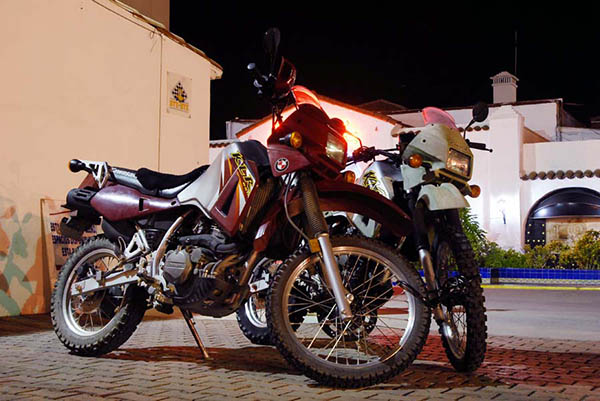
The KLRs, rode hard and put away wet that night in the Rosarito Beach Hotel.
Our plans for this trip were purposely vague, other than to head south and consume large quantities of Tecate after the bikes had been put away. We briefly talked about doing a banzai run all the way to Cabo San Lucas, but that would have been a push. It was already dark when we passed through Tijuana, and south of TJ, the Pacific Ocean mist was fogging my faceshield. I thought about Susanna’s restaurant in Rosarito (more on that in a bit), and all thoughts of Cabo vanished. For that night, Rosarito Beach was it. And that was a good thing. I love having dinner in Susanna’s. Susanna’s is the best restaurant in town, and maybe the best in all of Mexico. A stay in Rosarito Beach without dinner at Susanna’s would be a crime against nature and good judgment.
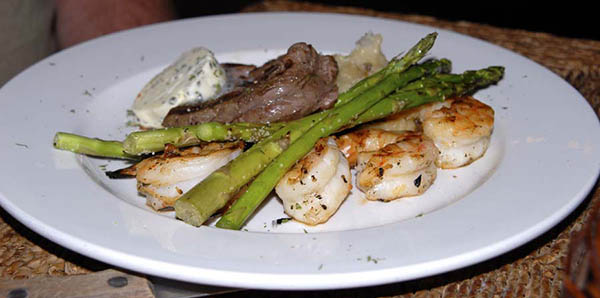
Susanna, don’t you cry for me. I’ll be back.Ah, yes. The perfect antidote for low cholesterol. The dining at Susanna’s is as close as you’ll get to Heaven without a one-way ticket.
After a five-star dinner, Baja John and I walked around downtown Rosarito Beach for a bit. It was deserted.
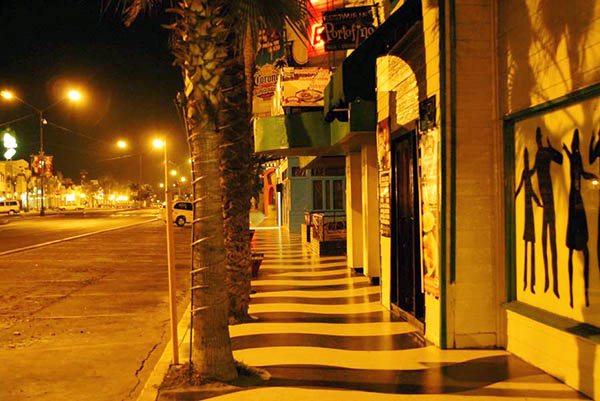
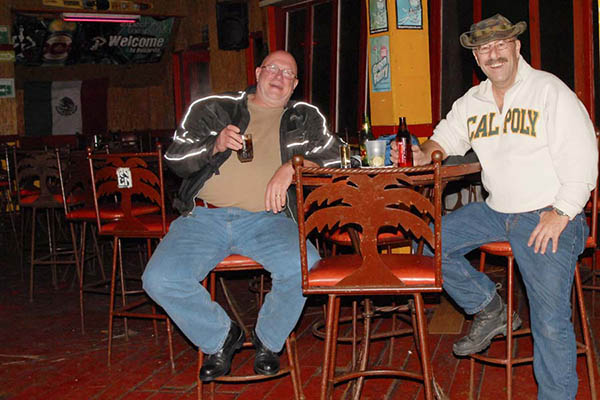
Rosarito Beach 2009. The LA Times was killing this place with its unending negative stories about Mexico. More than half the stores, restaurants, and other places were shuttered. Normally a hopping party town, in 2009 it was dead, and there was really no reason for it other than the US news media’s fixation on demonizing the place.At a club in Rosarito Beach. We were the only two people there. That’s Baja John on the left.
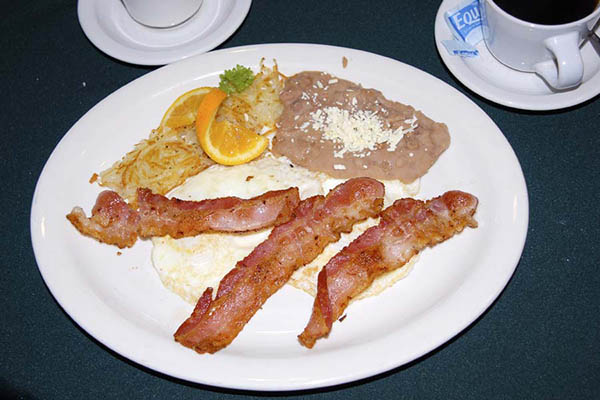
The next morning we rolled south along the Pacific coast to a great breakfast in Ensenada. Good God, we were packing on the calories. My favorite breakfast spot in Ensenada is Velero’s, a place near the ocean just behind the Corona Hotel. The clientele is mostly local business folks, the breakfasts are great, and it’s the hot ticket. They bring a large plate of light, delicious pastries as soon as you sit down. The coffee and the orange juice are superior. That’s followed by a tortilla with melted cheese and salsa. I could have (and should have) stopped at the pastries and the cheese tortilla, but I went for my customary two eggs over hard with the fixings you see below. It was as good as it looks.
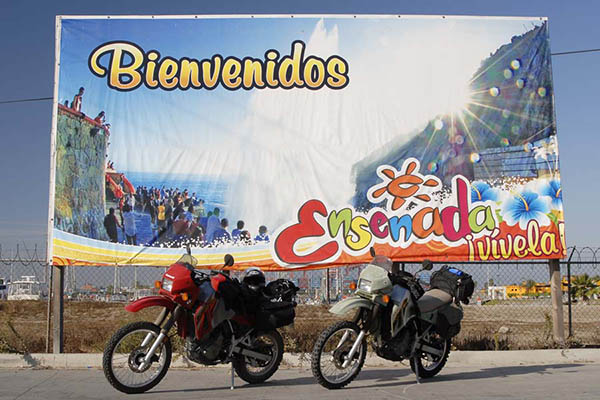
Simple, delicious, and filling. Velero’s is the breakfast spot in Ensenada.Velero’s is on a side street that juts off the road along the coast. The Ensenada sign is gone. A pity, as it made for a great photo.
After a great breakfast, we were on the road again, headed south out of Ensenada toward points south, including the aforementioned abandoned missions, a shipwreck on the Pacific coast, and more.
To be continued…
Hey, we have a couple of pages you should check out. One is our Baja page, which includes great info on taking a motorcycle into Baja. The other is our new Epic Motorcycle Rides page. Take a look and let us know what you think!
As you know, we published a series of blogs comparing the RX3 and RX4 motorcycles. Those have been widely read and we’ve received many comments from you, our readers. Thanks for that, folks.
My good buddy Chris offered a brilliant suggestion a week or so ago: We ought to compare the RX4 to the Kawasaki KLR 650, he said. That’s an idea that’s so good I’m embarrassed I didn’t think of it. Chris pointed out that I had owned a KLR 650, I rode it extensively both on and offroad in Baja and here in the US, and I was in a position to make the comparison. That makes sense. It also makes sense because since the RX3’s introduction, a constant refrain from the China-bashers was that you could buy a used KLR for what a new RX3 cost. That’s not true; used KLRs generally cost less than a new RX3, but that’s neither here nor there. It might become more relevant now that the KLR has been discontinued, because it won’t be long before the only kind of KLR you can buy will be a used one.
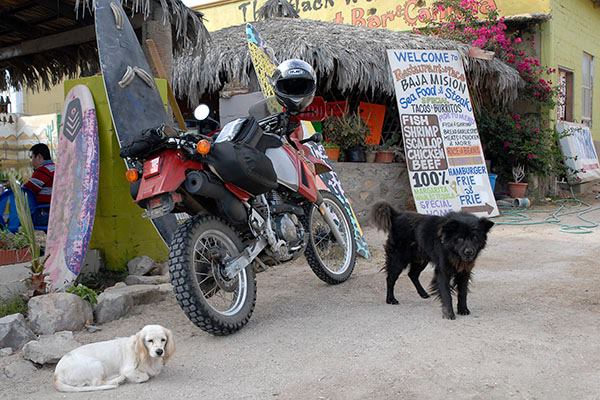
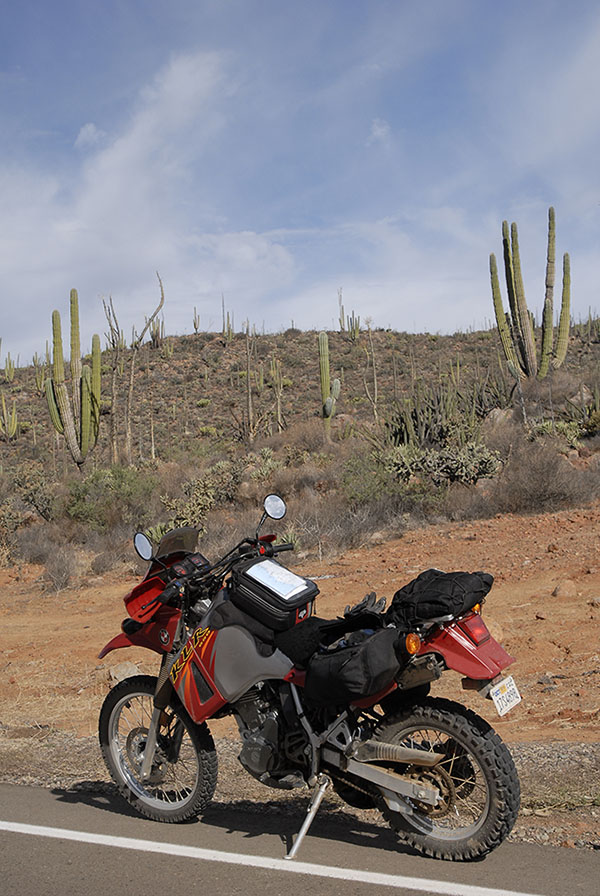
My KLR in Guerrero Negro, with the only two dogs in Mexico that did not want a piece of me.The RX4 in the San Gabriel Mountains. It’s a magnificent motorcycle
First, a bit of background. I bought a new KLR in 2006 and I rode it for roughly 10 years before selling it with 15,000 miles on the clock. That may not seem like a lot of miles for 10 years, but there were times during that period when I owned as many as six motorcycles, somewhere in there I took a year off to recuperate from a bad motorcycle accident, and after 2009 I was spending most of my seat time on other bikes as a consequence of my CSC association. But before that, a lot of my KLR time was in Baja and a good chunk of that was spent in the soft stuff.
Somewhere in Baja along the Transpeninsular Highway.
Another bit a trivia you should know: I’m a big fan of the KLR 650. Kawasaki didn’t keep that bike in production for 30+ years because it was a turkey. The KLR 650 was (and still is) a great motorcycle. It makes way more sense for serious adventure riding than do any of the liter-plus/full-figured/stratospheric-seat-height litter of current offerings from Japan, Germany, Austria, and Italy. I say that with great confidence because when I was writing the CSC blog, I watched CSC sell boatloads of RX3 motorcycles (literally, boatloads) to guys who owned monster ADV bikes but were afraid to ride them off road. Big bikes off road just don’t make a lot of sense. Not to me, anyway.
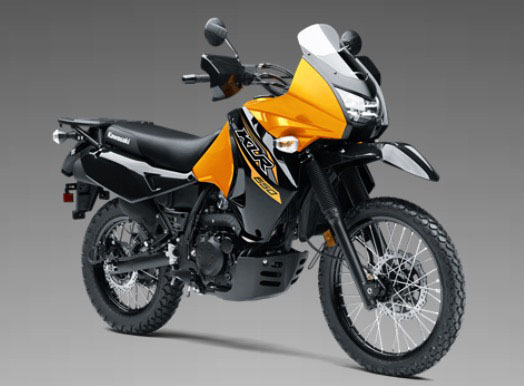
Like I said above, my KLR was a 2006 model, which made it a First Gen KLR. There were basically two KLR iterations: Ones that burned a lot of oil, and ones that did not. Well, okay, I’m being a little sarcastic. The First Gen KLRs went from the mid-‘80s to 2007, and they ran well. In 2008, the great green Good Times Folks introduced a restyled KLR with a slightly-tweaked engine (those were the Gen II bikes, for which production concluded this year). A serious oil consumption problem ensued with the 2008 Gen II engine tweaks, which was subsequently corrected by Kawasaki. There were other minor differences: Reduced fork travel, a new dash, and the aforementioned-styling changes. And, the Big K claimed a fix for the doohickey issue (more on that in a bit). Other than that, the Gen I and Gen II KLRs are essentially the same motorcycle.
Don’t take my snarkiness as a dart aimed at the KLR. Like I said above, it was (and still is) a great motorcycle. I loved mine. And like I also said above, the KLR didn’t have a three-decade production run because it was a bad motorcycle. They are, in fact, great motorcycles. The question here is not whether or not the KLR is a good bike (it is); rather, the question is: How does the RX4 compare to the KLR? We’re getting there, folks, but let me go tangential a bit first.
So why did Kawasaki discontinue the KLR? Gresh and I wrote a couple of blogs about that and what might follow the KLR (see here and here). In my opinion, Kawasaki’s decision was most likely based on sales and profitability. Manufacturers don’t discontinue products when they are selling well and making money. Some of the self-appointed keyboard commandos filled the forums with opinions, one of which was that Kawasaki killed the KLR because it was carbureted. That’s pure Bandini, folks. CSC Motorcycles, Janus Motorcycles, and others get carbed bikes approved by EPA and CARB on a regular basis. Carbs are fine as long as the bike meets Uncle Sam’s and the Peoples Republik’s emissions requirements.
Okay, I guess that’s enough background. Let’s get to the main attraction of this piece, which is how the KLR and the RX4 compare.
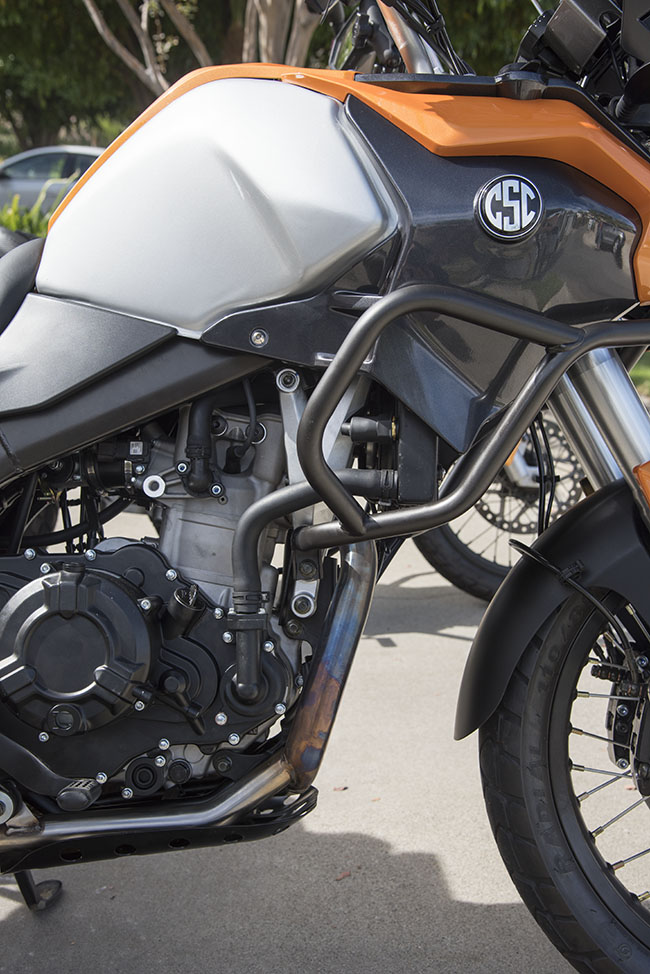
The RX4 450cc fuel-injected engine. It has more horsepower but less torque than the KLR 650.
As good as place to start as any is speed and acceleration. The KLR 650 and the 450cc RX4 have essentially the same top speed, which is approximately 100 mph. Handling at top speed is another topic, and I’ll get to that in a second. From an acceleration perspective (and this is all from Berk-butt-based impressions not involving the use of a stopwatch), the KLR has a bit more grunt on the bottom end, and the RX4 pulls a little stronger near the top end. The KLR, to me, felt more torquey at low rpm (and I liked that). When you consider the two bikes’ horsepower and torque specs (assuming what the manufacturers are telling us is accurate), the reason becomes apparent. The 450cc RX4 has 40.2 horsepower and 27.3 ft-lb torque, the 650cc KLR has 36 horsepower and 33.4 ft-lb torque. More torque means more bottom end (the KLR has more torque and a stronger bottom end pull), more horsepower means more of a top end rush (the RX4 has more horsepower and feels substantially stronger than the KLR above 70 mph; much of that is also due to the RX4’s better high-speed handling).
Okay, let’s talk about, and that bring us to the doohickey business. The doohickey is the KLR 650’s spring-loaded counterbalancer drive chain tensioner (a mouthful, I know). The Gen I KLR part was a cheap stamped weldment, and it had a tendency to fail (taking the engine with it). Kawasaki never admitted it was a problem, but they improved the part for the Gen II KLR engine. Folks who were serious about their KLRs replaced the stock doohickey with a much better machined part from Eagle Mike (a great guy who is a legend in the KLR community). I replaced the doohickey at the 500-mile service on my KLR (which I did myself).
It bothered me that Kawasaki became the Good Times Ostrich on this doohickey business. I have no doubt it was a genuine weakness. There are no known comparable weaknesses on either the RX3 or the RX4 (although admittedly, the RX4 doesn’t have the miles yet to really know). What I do know is that where there were issues in the first shipment of RX3 motorcycles, CSC stepped up immediately (and publicly). I was one of the guys who communicated with CSC customers, and if you don’t believe that, read the CSC blog and buy a copy of 5000 Miles At 8000 RPM. Kawasaki ignored the doohickey issue the entire time it existed. In my book, that gives a clear advantage to CSC and Zongshen. Yeah, I’m biased toward CSC. I admit that. But facts are facts.
Back to the motorcycles…another difference is the transmission. The RX4 has a six-speed gearbox; the KLR has a five-speed. That’s perceived as a big deal, I guess, by most folks. The reality is that five gears were enough for me, but I suppose six are nicer. Back in the day I rode a lot of motorcycles with four-speed transmissions and I never felt like I was missing anything. But it’s a difference, and on this count, the nod goes to the RX4. Also, the RX4 has a gear indicator on the dash; the KLR does not. Is that a real issue? Not for me. Maybe I’m conceited, but I kind 0f know what gear I’m in all the time. But again, it’s something the RX4 has that the KLR does not. Where there is a transmission issue that’s worth noting is first gear. On the KLR it is a granny gear; it’s way lower than second. All of the gears on the RX4 (including first) are closely spaced. I would have liked the KLR better if its gears were similarly closely spaced. On the KLR, when you drop the bike into first, it’s really throwing out the anchor. On the RX4, it’s just one gear down.
As a fuel-injected bike with a smaller displacement engine, the RX4 is probably the winner from a fuel economy perspective. The Zongers tell me that the RX4 will get 65.3 mpg, but I haven’t verified that. I’m guessing I could do better (I usually do better than the manufacturer’s claims). My KLR returned a measured mid-50s mpg figure when I rode it at reasonable speeds. From a range perspective, I expect the two bikes are about the same. I could get an honest 250-miles out of a tank on the KLR. The RX4 has a 0.7-gallon smaller tank than the KLR (but it’s bigger than the RX3’s tank by one gallon), and as mentioned above it will probably get better fuel economy. There’s that business about how much fuel the RX4’s tank will actually hold when you delete the volume occupied by the fuel pump. From my perspective, if a bike can go 200 miles, that’s good enough for me (that’s the stretch south from El Rosario to the next Pemex, just north of Guerrero Negro). I’m pretty confident the RX4 will do 250 miles, and I know the KLR will.
Let’s talk handling. On the street, in the twisties, and at highway speeds and above the RX4 is the clear winner. The KLR gets very light and drifty at anything over an indicated 75 mph, and it’s downright gangly when pushed hard in the twisties. You can go faster than 75 mph on a KLR, but I didn’t feel comfortable on my KLR doing that. The RX4, on the other hand, feels rock solid up to indicated 99 mph (and it had more left at that speed; I just ran out of room). In the twisties, the RX4 is in its element. The RX4’s stock CST tires are great, and the RX4 frame, forks, rear suspension, and geometry are modern. The RX4 feels way more planted and secure in the twisties and at high speed than does the KLR (so does the RX3). The RX4’s design is nearly four decades more advanced than the KLR’s. What I’m saying here is not a slam on the KLR; that old bike did pretty well for its 30-year run.
On the tire issue, I like the CSTs that come with the RX3 and the RX4. I get great life out of the CST tires on my RX3 (usually, 6000 miles on a rear tire). The Kendas that come on the KLR are, at best, 2500-mile tires. They hook up okay, but they don’t last long. I replaced my KLR tires with Shinkos and never looked back.
On the issue of consumables, I got good life on my KLR’s chain. I had good buddy Gerry throw a new chain on the KLR at 14,000 miles, but it didn’t really need it. I don’t know about the stock chain’s life on the RX4, but the stock chain on the RX3 is a substandard component that is toast after about 5000 miles (and that, to borrow a word made popular two years ago, is deplorable). Like I said, I don’t know if Zongshen addressed this on the RX4, but if the chain is from the same company that provides the chain on the RX3, I’d expect to replace it with a real chain either immediately or after just a few thousand miles. The KLR gets my nod for stock chain life unless Zongshen has addressed this issue.
One more note on the Kawasaki’s road manners. My Gen I had this monstrous Tupperware fender that was attached high and wide on the forks. It caught any wind blowing from the side and that had a tendency to steer the bike. I think it was also one of the things that made the KLR’s high-speed handling flighty. The Gen II design changed the front fender, but I haven’t ridden a Gen II bike. I don’t know if the Gen II’s redesigned fender made the problem go away. As I said earlier, the RX4 is much better behaved at high speed.
I have not yet ridden the RX4 off road, so a lot of what I’m going to say next is speculation on my part. But it’s informed speculation. I felt my KLR did very well in the dirt and soft sand. The KLR is heavy, but it has good bottom end grunt and more torque than the RX4. That allowed me to get up to speed and on top of soft sand quickly. The KLR’s 21-inch front wheel helps, too (the RX4 has a 19-inch front wheel, and in anticipation of the obvious question, I don’t know if a 21-inch front wheel can be fitted to the RX4). The offroad keyboard commandos say the KLR is a pig in the dirt. Hey, what do I know? I thought it did well when I was tear-assing around Baja. I don’t know the suspension travel on the RX4, but I’m pretty sure it’s going to be less than the KLR. The bottom line: I think the KLR is the better choice if you are going to ride exclusively in the dirt. But then if you were going to do that you probably would not buy a KLR (there are other, better choices for dirt bikes).
I went a lot of places off road in Mexico. This is near El Marmol. I was with good buddy Baja John, who also rode a KLR.Another KLR Baja boonies photo, near a Pacific coast shipwreck.
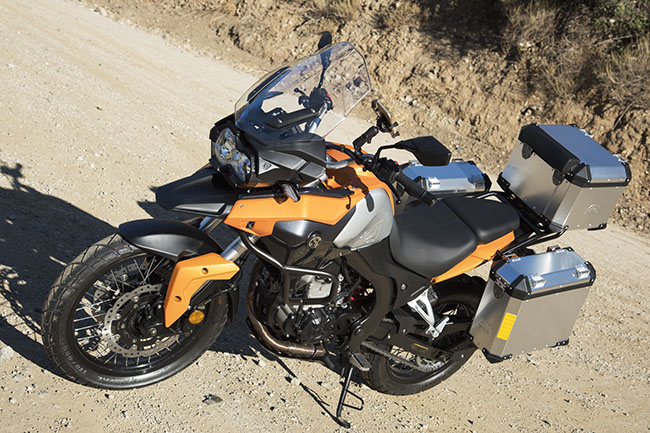
With regard to standard equipment, there’s no comparison. The RX4 is equipped with luggage, better instrumentation, dual front disks, adjustable suspension, adjustable windshield, engine guards, 300-watt alternator, accessory outlets, switchable ABS, fuel injection, and that six-speed transmission. The KLR 650 has none of these things.
I had soft luggage on my KLR, which worked well enough, but I couldn’t lock it and it gave the bike a Beverly Hillbillies kind of look (not that there’s anything wrong with hillbillies). Some people like that look. I did at the time because it was a step up from bungee cords and gym bags. But that’s old school. The RX4 luggage is a huge improvement (both the stock bags and the optional aluminum bags).
From a maintenance perspective, the RX4 gets the nod. For starters, if CSC does what they have done for all their other bikes, you’ll get a shop manual and online maintenance tutorials for free. You won’t get that with a used KLR (and you didn’t get it with a new KLR, either). That means if you own a KLR you either bought a shop manual to do the work yourself, or you went to the dealer for maintenance. I’m not a big fan of dealer technicians for three reasons: Cost, competence, and honesty.
I believe the RX4 will be easier to maintain than the KLR. I don’t know this for a fact yet, but based on the RX3’s reliability and design I suspect it will be the case. The RX3 uses threaded adjustor nuts for adjusting the valves, and I’m guessing the RX4 will, too (I haven’t removed the valve covers on the RX4 yet). I know that the KLR uses shims and buckets; that approach greatly complicates the valve adjustment process. It involves removing both cams and it makes adjustments technically challenging and time consuming (which dealers and technicians love, because you get to pay for the time).
From a price perspective, a new RX4 will cost less than what a new KLR cost. And that’s before the typical Kawi dealer’s obscenely-bloated setup, freight, and documentation fees (it’s not unheard of for dealers to routinely add $1500 freight and setup fees). Folks, from the port to just about anywhere in the US, you can ship a bike for not more than $400, so the dealer shipping fees they put on their pricing sheets are twice (or more) actual cost. And their setup fees are pure, well, you know. Ask your dealer if they do the setup themselves or if they outsource it. Most dealers go with Door No. 2. Outsourced motorcycle setups typically cost between $35 and $50 per bike, and they are done by unskilled labor (not trained motorcycle techs). I know this because I’ve been an expert witness in motorcycle lawsuits, and this is what the dealers admit when they have to tell the truth during the discovery and deposition process. How much effort goes into setup and how well is it done? Let me explain it this way: When I bought my new KLR in 2006, the windshield fell off during the 5-mile ride home. It’s a ripoff of gargantuan proportions. I’ve never paid anywhere that much, but it’s what many of the dealers ask. It’s dishonest.
Back to that earlier keyboard commando statement: You can buy a used KLR for less than a new (fill in the blanks with any brand). Regarding used KLRs (which they all will be pretty soon), there’s no argument here: A used KLR will be less expensive than a new RX4. Duh. But then you’d have a used motorcycle with no warranty. If you want to go that route, someday in the near future you’ll be able to buy a used RX4, too. A used RX4 might be even less than a used KLR. I never understood the argument that posits you can buy something used for less money than new, particularly when it’s put forth by people with the same kind of conviction they might display if they had just discovered and announced that F=ma. It’s kind of like saying things fall when you drop them. The statement about new versus used is a dumb one. It’s obvious. Buy used, and it costs less. That’s true for just about everything on the planet (except maybe some guns). Like I said: Duh.
With regard to comfort, that’s a tough one. I’d say that’s a draw, with maybe the edge going to the RX4. I felt the ergos were perfect on my KLR. I also feel that way about the RX3 and the RX4. While I’m on that topic, I’ll briefly mention the RX3S (the 380cc twin from Zongshen with ADV styling and equipment comparable to the RX3 and the RX4). The RX3S had terrible ergos. My feet felt like they were scrunched up to my butt and my hips hurt as soon as I got on the RX3S. The RX3S might be a good bike, but with the current feet/butt/handlebars relationship, it was a nonstarter for me. To go tangential again for a second, I didn’t get the naming, either. The RX3S? Is that like a plural RX3?
Back to the KLR: The stock KLR seat is way too soft, which sounds like it would be a good thing, but that squishy seat gets uncomfortable quickly. I fixed that with a sheepskin seat pad, which I also use on RX3. The stock RX3 and RX4 seats (the two bikes use the same seat) won’t win any prizes for all-day comfort, but to me they are tolerable. The KLR 650 seat sits significantly higher than the RX4. When I rode my KLR, it was a tippy-toes affair at every stop (if you play for the Knicks, this won’t be a problem, but I don’t and for me it was an annoyance). The RX4 is not nearly as tall. I liked it better from a seat height perspective. It is slightly taller than the RX3 but lower than the KLR, and way lower than the GS1200 or those Special K giraffes from Austria.
Having said the above about seat height, I will tell you that the KLR was a bit easier for me to move around in the driveway than is the RX4. Kawasaki advertised the KLR’s weight at 432 lbs, which I know is baloney (mine tipped the scales well above that number). Zongshen advertises the RX4 at 450 lbs, and as you now from reading my previous blogs, I haven’t weighed the bike. Pushing the bike around in my driveway, though, the RX4 felt heavy. Maybe that’s just be the result of me being used to my RX3. But once I was moving on the RX4, it felt way more planted and it handled way better than the KLR (both in the twisties and at high speed), and it didn’t feel heavy at all. I can’t quantify the difference; I’m only giving you my impressions.
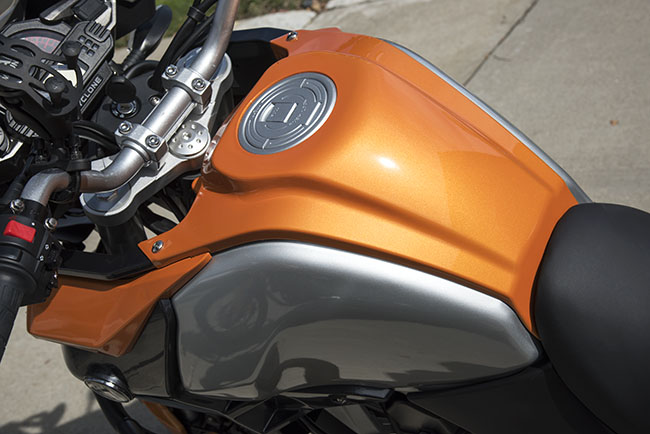
World class fit and finish are what the RX4 is all about. The RX4 is way ahead of the KLR in this area. I think it is as good or better than any motorcycle made anywhere, by anyone.
Fit and finish are unquestionably superior on the RX4. That’s not just compared to the KLR; that’s compared to any bike. Those of you who haven’t owned an RX3 may default to the typical China-bashing response. You know, the one that says: That-can’t-be-possible-it’s-made-in-China. But it is what it is. I think the finish on the RX4 is even better than the RX3. It’s very good. Little things stand out. The RX4 footpegs are nicely-cast aluminum affairs with rubber inserts; the KLR’s footpegs are cheap bent stampings with a rubber liner that wears out quickly. The RX4 has tapered handlebars and high-end switchgear; the KLR has a regular constant-diameter handlebars and cheap switches. The RX4 paint is world class (it’s deep and luxurious); the KLR used plastic with the colors molded in. The RX4 has a steel skid plate and engine guards as standard equipment; the KLR has no engine guards and a plastic skid plate. A plastic skid plate? Really, Kawasaki?
The windshield on the RX4 looks better finished, it’s adjustable, and it just flat works better than does the KLR windshield (and the RX4 windshield didn’t fall off on the way home). I know, I know, I keep coming back to that windshield falling off my KLR on the ride home from the dealer. It still pisses me off, even though I negotiated the Kawasaki dealer setup fee down from pure larceny to a much-more-modest profit contribution. What rubbed salt in that wound was that the KLR windshield mounting screws were lost when the windshield fell off, they were non-standard screws, and when I went back to the dealer they didn’t have them in stock. In my experience, that last part is a typical response from most dealers (you know, the not-in-stock thing). CSC stocks everything; that’s another plus for the RX4. While I’m on a windshield roll, there’s one more thing that I didn’t like about the KLR’s windshield. I went through five or six of the things over the life of the bike. They always developed cranks that migrated out from the mounting holes, mandating a replacement windscreen. My RX3 never did that, and I suspect the RX4 won’t, either.
Having said all of the above, I liked the looks of my First Gen KLR. Yeah, it was a Tupperware Titan, but I liked it. It was a tool that looked like a tool. It was utilitarian and honest. I think the Gen II KLR looked like Kawasaki was trying to put lipstick on a pig. I like my pigs to look like pigs. The Gen I KLR did and I liked that.
I already mentioned that the RX4 comes standard with USB and 12V power outlets, and underseat accessory plugs. The RX4 has a 300-watt alternator; the KLR alternator output is substantially lower. A funny story about CSC’s practice of putting 300-watt alternators on their ADV bikes: When I was looking at the RX3 in Chongqing back in 2014, I saw a police variant. I asked the Zongmen how the police versions handled the extra police equipment. A Zongshen engineer told me that they install 300-watt alternators on the police bikes to support the added lights, flashers, radio gear, siren, speakers, etc. Hmmmm, could CSC get that on all of its bikes? No problemo, they said. And thus the 300-watt CSC legend was born. The TT250 has a 300-watt alternator, too.
The RX4 instruments are the same as those on the RX3. While the info is more complete than on the KLR, lighting for the RX4 and RX3 indicator lights (the turn signal indicators, the high beam indicator, etc.) is too dim to read in the daytime. My good buddy Rob Morel has relatively simple fix for this problem; he removed the sort-of-translucent plastic layer between the lamps and the dash cover, and oila, now you can see the indicator lights. Zongshen ought to spec all of their bikes that way.
Neither the RX4 nor the KLR has a centerstand. Both bikes have tool kits, but both are laughable. The stock tool kits are the standard cheap items you get with most new bikes, if you get anything at all (my umpteen-thousand-dollar Harley Softail had no toolkit whatsoever, which is kind of funny if you think about it).
So there you have it. Chris, my apologies for the longwinded response to your question about the RX4 and the KLR. Thanks very much for the suggestion.
Having said all of the above, I guess the obvious question is: What would I buy? I wasn’t riding my KLR very much the last few years I owned it because I had my RX3 and TT250. I finally sold the KLR, but I miss the bike and like I said, I enjoyed it. If I had to make a choice, would I buy a new KLR or a new RX4? A motorcycle is an emotional purchase and an individual decision, and it’s a decision not usually based on logic. My belief is that most people buy a motorcycle that projects an image they want to see of themselves, which is why the industry has tended toward oversized, overpowered, and ridiculously-tall adventure bikes. KLR versus RX4? I don’t think it would be a mistake going with either bike. But I am convinced the RX4 is a much better motorcycle.
Want to see the RX3 versus RX4 comparisons? You can do so here.
Want to read about the RX3 and KLR adventures in Baja? Pick up a copy of Moto Baja!
One Million Years BC. Raquel Welch. Who was John Richardson?
I was laughing so hard reading Gresh’s piece on the KLR 650 it took me a few minutes to get that “One Million BC” designator, and then I started laughing even harder. For reasons reaching back to my teenage years, I had visions of Raquel Welch scantily clad in strategically-draped animal skins atop a KLR 650. Yeah, that could work.
Ah, the KLR. Nearly all of us have owned one at one time or another. I wanted a KLR for a long time and I waited too long to buy one (mostly because none of the dealers allowed test rides), but I finally pulled the trigger on a new one in 2006. The bike was $5250 out the door (I know, you did better on yours). That price included an obscenely-inflated-but-successfully-negotiated-lower dealer setup fee. The windshield fell off on the 4-mile ride home.
I loved my KLR and I kept it for 10 years. I’d heard, off and on, that it was Kawasaki’s best-selling motorcycle. It was a sensibly priced and simple motorcycle. Top heavy, yeah. Heavy, yeah. Well supported with tech days and a great online community, yeah. Fun to ride, yeah. Easy to maintain, yeah. A great adventure touring bike, absolutely yeah.
Even though I started on small bikes (I was one of those nicest people you met on a Honda; I only became mean later in life) the KLR was the first bike of my adult life that made me realize I’d been brainwashed: I did not need a big bike. I also owned a Harley Softail with an S&S 96-inch motor at the same time I owned the KLR, and one day after inadvertent back-to-back rides, I realized the KLR was faster, more comfortable, and handled better. I’d spent more for just the S&S motor than the entire KLR cost new. The Softail went on CycleTrader that same day and was gone by the weekend.
The US motorcycle market is in the crapper for a lot of different reasons (none of which current industry leadership has been able to address). Sales dropped by 50% with the onset of the Great Recession of 2008, and today (10 years later), sales are still essentially at that same 50% level. It’s a double or triple or quadruple (or more) whammy…banks aren’t giving 6th mortgages on homes to buy a Harley, millennials are more interested in iPhones and Instagram than motorcycles, folks who were buying motorcycles are increasingly interested in adult diapers, motorcycles are too big and too expensive, and more than a few dealers are still price gouging with fraudulent and flatulent setup and freight fees. And there hasn’t been a good motorcycle movie (think The Great Escape or Easy Rider) in years. The answer is obvious to all but those heavily-invested in heavy, large, overpriced motorcycles (i.e., the same current industry leadership mentioned at the beginning of this paragaph): Smaller, lighter, way less expensive bikes. And maybe a good movie or two would help prime the pump.
So what do I think will be the follow on to the iconic KLR 650?
I see two options, and maybe a third…
Option 1 is for Kawasaki not to do anything because they already have a KLR 650 replacement. That bike is the Versys 300. The Good Times people may have pulled a fast one on us, and introduced a replacement without telling us it was a replacement. Hell, the Versys basically costs the same as a KLR 650. From a price point perspective, it is the replacement.
Option 2 would be an entirely new Kawasaki. If the Big K goes this way, my guess is it will be something around 450cc, it will be a single, it will be too tall, it will be fuel injected, and it will be too expensive. It will not be manufactured in Japan; my guess is Thailand (where the KLR 650 has been manufactured for decades). Or maybe China. I think Kawasaki is mulling this one very carefully. Such a bike would have to go head to head with the new RX4 and RX3S to be offered by Zongshen (and in the US, CSC), the Royal Enfield 400cc Himalayan, and maybe others. That would be a tough competition. My guess is the Zongs will be a good $2,000 (probably more) less expensive than anything the Good Times People bring to us as a KLR 650 successor, and the Big 4 dealers will exacerbate the price problem by tacking on their ingrained and irrational $1500 freight and setup fees. Maybe Kawasaki realizes this, and if so, that makes a good argument for them to just pick up their marbles and go home (which they may have already done; see Option No. 1 above).
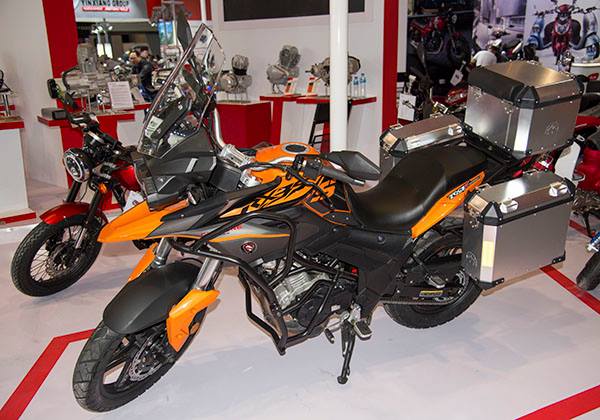
The Zongshen RX3S on display at the Canton Fair in Guangzhou. It’s hard to imagine how any KLR replacement can compete with this or the Zongshen RX4, given Kawasaki’s traditional path to market and dealer fees.
There is, of course, a third option, and that’s to just keep building the KLR 650. The tooling was paid for years ago and there’s no real expense in continuing the line. This makes a lot of sense, unless the bikes are just not selling, and that may be the case. As mentioned earlier, the US market is flat and outside the US, bikes over 250cc are viewed as freakishly huge. I don’t buy the argument that because the KLR 650 is carbureted it won’t meet emissions requirements; the bike has been carbureted its entire life and new carbureted bikes are being approved in the US all the time. If my last name was Kawasaki, I’d keep the KLR 650 on the market, drop the price dramatically, find a way to limit the dealer larceny that passes as freight and setup fees, and sell the hell out of that bike.
Rumors are circulating on the Internet that Kawasaki is finally ceasing production of their KLR650 dual-sport motorcycle. Wild Conjecture has no clue if this is true but uninformed rumors are close enough for us.
Created shortly after the discovery of lead, and mostly made from the stuff, The KLR 650 has been a somewhat reliable off-road partner for generations of thrifty, vinyl-pocket-protector wearing goofballs. Easily crashed yet hard to pick up, the KLR has spawned a huge aftermarket of widgets and freeze-dried gooseberries to remedy the built-in defects that Kawasaki never had time to address during the bike’s short, 437-year production run. Oval pistoned long before Honda claimed to invent it, the KLR suffered from excessive oil use, bad doohickeys, wonky thing-a-ma-bobs, and who’s on first anyway?
As a KLR owner I’ll be sad to see the “Killer” letter designation dropped. Given the history of the 650 maybe Kawasaki can use the iconic KLR combination on a rail-transported pipeline trencher or large bulk oil carrier.
What’s done is done, where does Kawasaki go from here? Wild Conjecture has it on good authority that Mama K is modernizing their big dual sport with a new model designated the 1M-BC. Extensive use of wood and stone will lighten the 1M-BC and chain tensioner issues will be forever solved with a Kawasaki-exclusive “shoe leather” drive system.
My source claims the new 1M-BC will prove it’s woodle by participating in the not-so-demanding Pike’s Peak Downhill Time Trial, a race the bike has a fair chance of winning as no one else is aware of the race and Kawasaki is keeping the event date close to its vest.
Whatever Kawasaki comes up with to replace the KLR650 you can be sure Honda and Suzuki will be watching the result closely. Those two guys have more than paid off the tooling and engineering costs on their 650cc offerings. Who knows (not us!), maybe Kawasaki’s KLR-delete will prompt a renewal of factory interest in the moribund 650 Enduro class?



 Rumors are circulating on the Internet that Kawasaki is finally ceasing production of their KLR650 dual-sport motorcycle. Wild Conjecture has no clue if this is true but uninformed rumors are close enough for us.
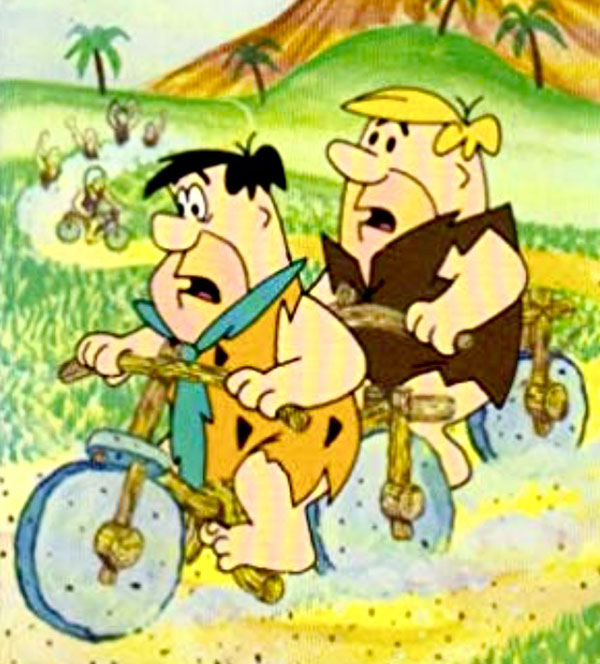 As a KLR owner I’ll be sad to see the “Killer” letter designation dropped. Given the history of the 650 maybe Kawasaki can use the iconic KLR combination on a rail-transported pipeline trencher or large bulk oil carrier.
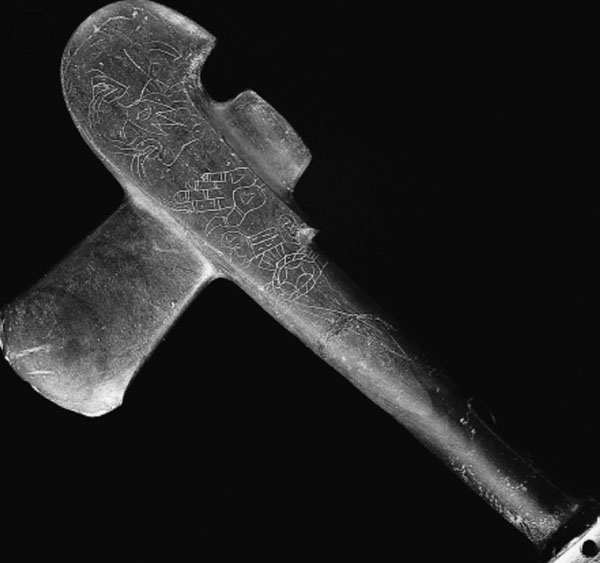 My source claims the new 1M-BC will prove it’s woodle by participating in the not-so-demanding Pike’s Peak Downhill Time Trial, a race the bike has a fair chance of winning as no one else is aware of the race and Kawasaki is keeping the event date close to its vest.