A Tale of Two Thumpers

By Joe Berk

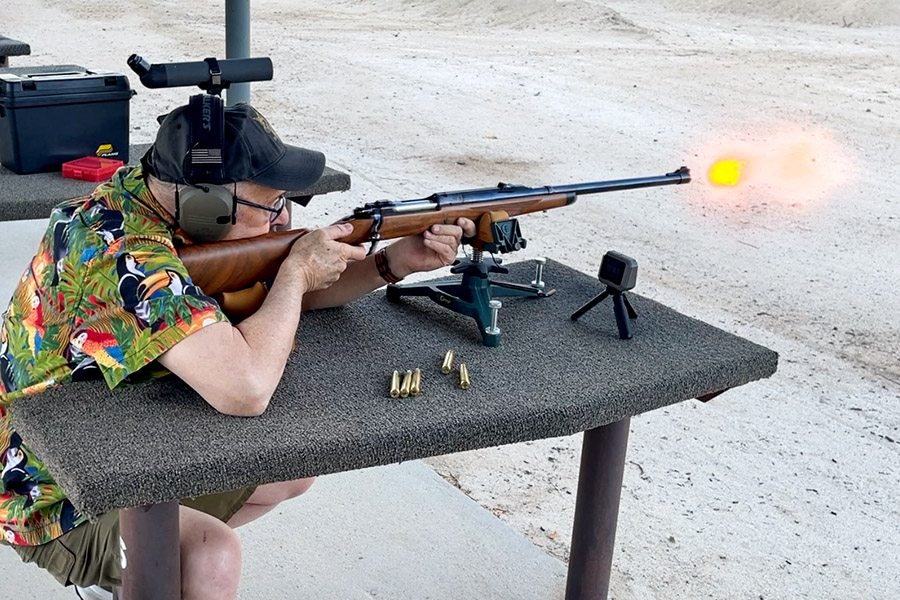
You have to be quick on the trigger, and Kevin was when he grabbed that shot above capturing the muzzle flash from my .416 Rigby.  It’s a good shot by a good shot. Me?  I’m just the male model in the photo above.

We’ve done blogs on ExNotes before about big bore rifles (.45 70, .458 Win Mag, .416 Rigby, .375 Ruger, and .375 H&H, to name but a few).  These are all what I would consider big. But they’re pipsqueaks to a toy good buddy Kevin has been playing with lately:  A custom .50-90 1896 Winchester High Wall.  By any measure, that rifle and its cartridge is a monster.  Originally designed as a buffalo gun, it is a real thumper.  The .50-90 almost needs to be a crew-served weapon.

Kevin and his Monster Rifle. Elephants? Piece of cake. Cape buffalo? You bet. T-Rex’s? No problem. Godzilla? Kevin’s got ya covered.

Kevin and I play around shooting for group size when we both bring guns of the same type to the West End Gun Club.  We’ve done it with handguns, small bore rifles, and more…sort of the thing I wrote about a few days ago in the Tale of Two Mini 14s.   This time, though, the bore diameters would be doubled.  Big stuff.  Guns designed to eradicate buffalo herds in America and dangerous game in Africa.  Or maybe prehistoric beasts in Jurassic Park.  The stuff of dreams, these guns are.
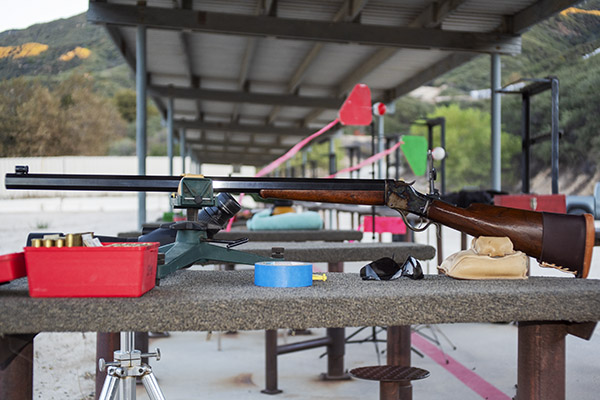
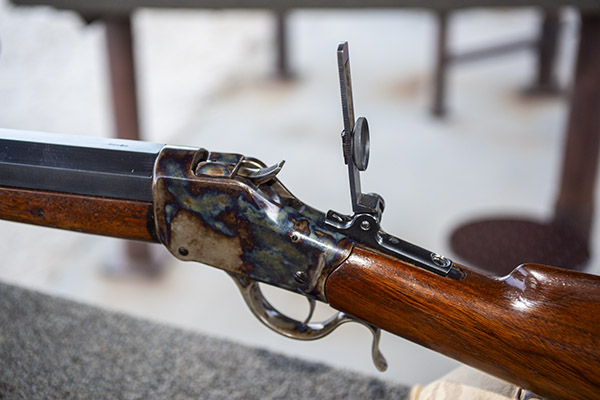
The .50-90 Winchester. It’s a custom rifle and it is beautiful.
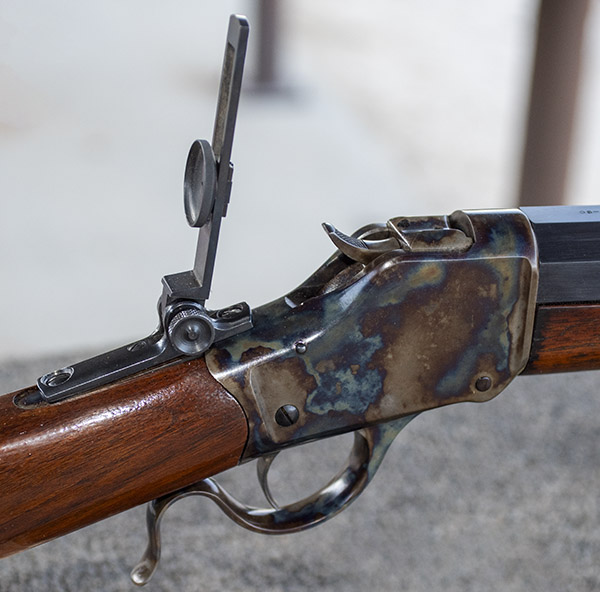
Note the exquisite color case hardening on the receiver and the tang aperture sight. Wow, this is a gorgeous rifle.
A .50-90 view from the right side.
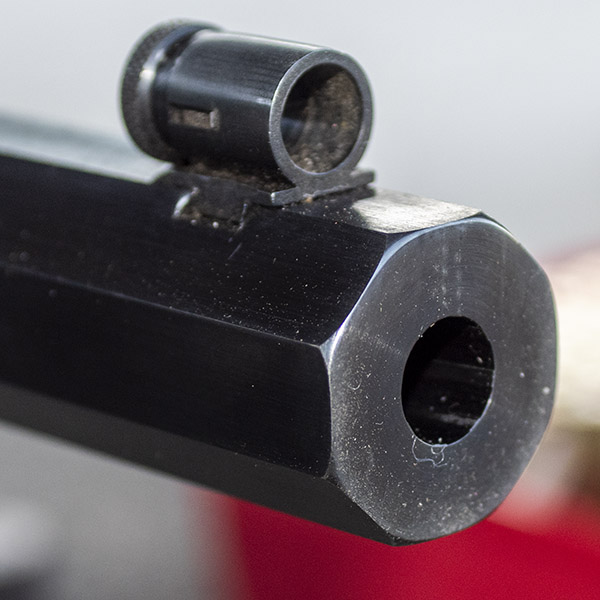
The .50-90’s muzzle on the rifle’s custom Green Mountain barrel. That’s a big hole!

Kevin and I thought it might be interesting to do the same (you know, an informal shootoff) with two of the grownup rifles:  My .416 Rigby (affectionately named Eleanor) and Kevin’s .50-90.  Ordinarily, in these informal matches, we’d shoot 20 rounds and look at group size.  I made a comment about 20 rounds from my .416 Rigby being a lot.  Kevin told me he didn’t know if he’d survive 20 rounds from the .50-90, and suggested 10 rounds instead.  When we got to the range early that morning (before sunup, actually), after further thought we both settled on a more sensible (and shoulder friendly) 5 rounds.
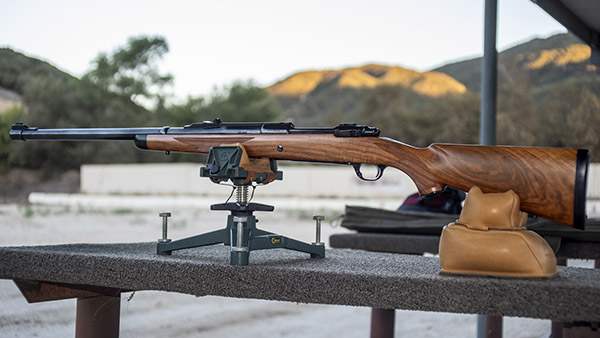
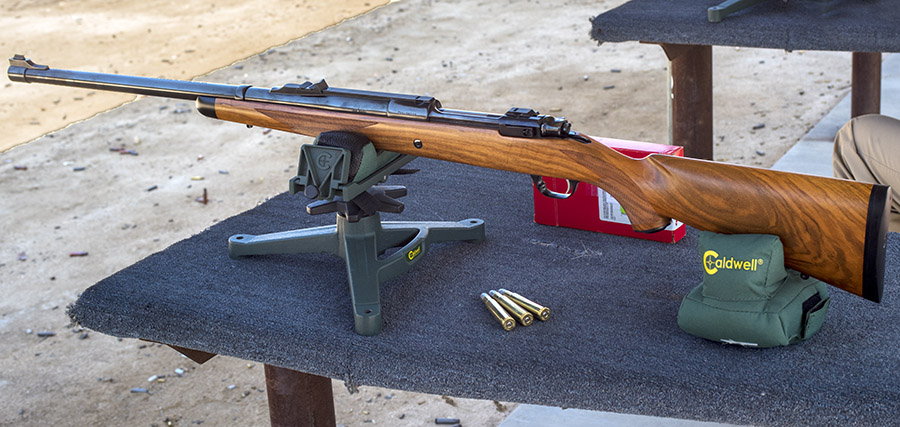
My Ruger RSM Model 77 Express rifle in .416 Rigby. Ruger quit making these some time ago. It cost too much to manufacture the rifle. Check out the stunning Circassian walnut on this rifle.
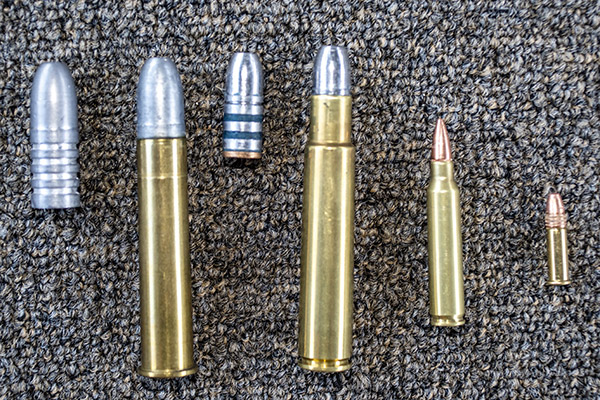
A visual comparison. From left to right: The .50-90’s 750-grain cast bullet, the .50-90 cartridge, the .416’s 350-grain cast bullet, the .416 Rigby cartridge, a 5.56 NATO cartridge with a 55-grain bullet, and a .22 Long Rifle cartridge with a 36-grain bullet.

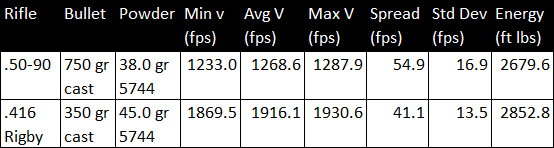
While we were shooting (and during the videoing of our shooting session), my Garmin chronograph was doing its thing.  Here’s how the velocities of the two cartridges shook out:
We also calculated the energy for each rifle based on the average velocity listed above for each cartridge.   The formula is:

Using the above formula, my .416 Rigby load had 2852.8 ft lbs of energy; Kevin’s .50-90 load had 2679.6 ft lbs of energy.  (I think the Garmin will calculate energy automatically, but being engineers, Kevin and I had to use the formula and calculate it ourselves).  It’s interesting.  My bullet weight in the .416 Rigby was just under half of Kevin’s in his .50-90 Winchester, but the .416 had higher energy than the .50-90.  Because energy increases as the square of velocity, the .416’s weight deficit (if the phrase “weight deficit” can even be used when referring to a 350-grain bullet) is overcome by its velocity.

The .416 Rigby had more muzzle energy than Kevin’s .50-90 Winchester, but the .50-90 Winchester’s recoil is absolutely horrendous compared to the Rigby.  You’ll see that in the video below.

So who did better on our 50-yard targets?  Kevin.  He shot a tighter group, and then, just for grins, he lobbed a round at a metal plate on his improvised target stand.  The first shot knocked the stand down like it was hit by a freight train.  That .50-90 is a powerful proposition.
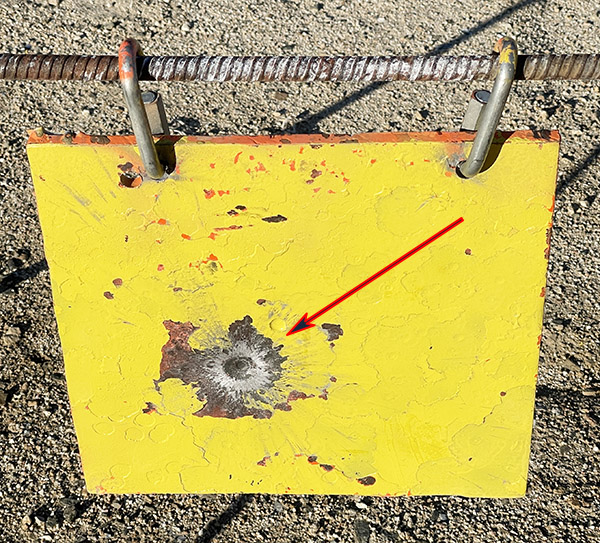
A shot from the .50-90 put a major-league dent in this 3/8-inch steel plate, and then took the target stand down with it.

An Eleanor Update

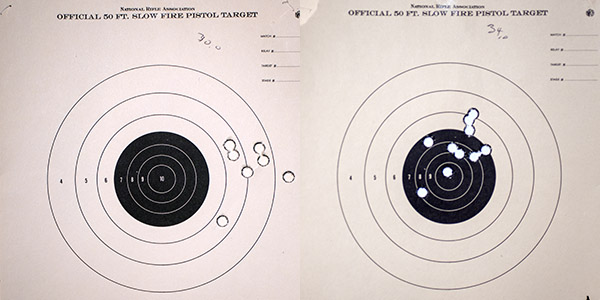
You’ll recall a recent blog where I waxed eloquent about Eleanor, my Ruger RSM .416 Rigby rifle.   In that blog, I talked about reduced loads using 350-grain cast Montana bullets and 5744 and Trail Boss propellant.  It was fun…the Trail Boss loads had milder recoil and “good enough” (but not stellar) accuracy.  Take a look at these 50-yard targets:

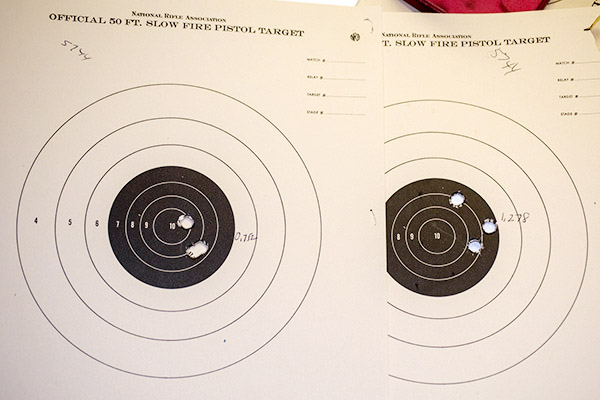
The above target on the left was with 30.0 grains of Trail Boss; the one on the right was with 34.0 grains of Trail Boss.  I could feel a tiny bit more recoil with the 34.0-grain load, but both were light loads with modest recoil.   Weirdly, the point of impact shifted sharply to the right with the lighter load, but it moved back to the center with the 34.0-grain load (and it was slightly higher).  The Trail Boss loads shot okay, but they weren’t running in the same league as the load I had shot the prior week with 5744 propellant and the same Montana Bullet Works 350-grain bullet, as you can see from the 50-yard targets below.

I could see what I was getting with the Trail Boss and I could see that it wasn’t grouping nearly as well as the 5744 loads at 50 yards, so that stopped my testing with Trail Boss (that, and the fact that I had used up all my Trail Boss cartridges).

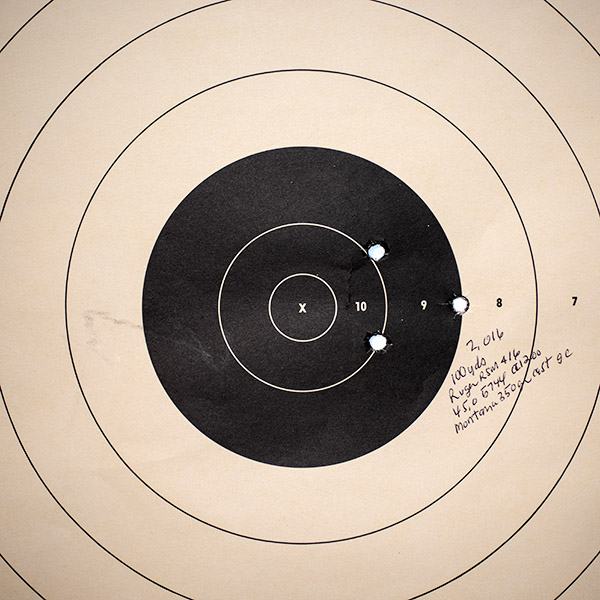
I was curious:  How would Eleanor do at 100 yards?  I still had some of the 5744 loads left, so I posted a couple of 100-yard targets and let Eleanor have her way.  I first fired a 3-shot group and after looking through my spotting scope, I was surprised to see how well they grouped.

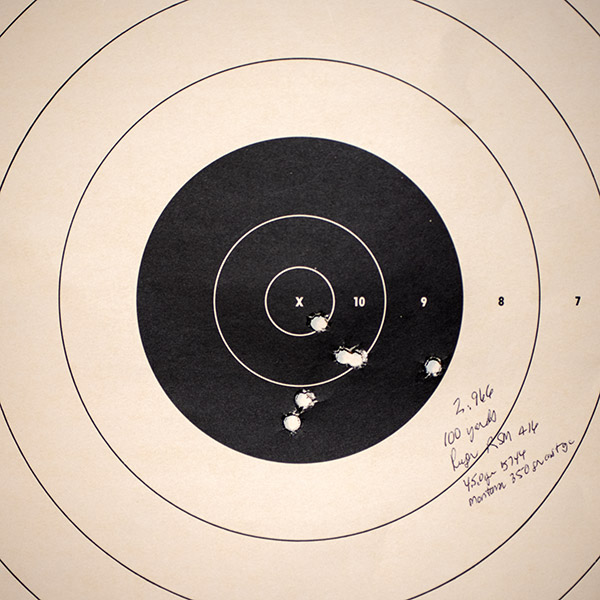
I thought maybe that target was a random success, and I didn’t want to ruin it by throwing more shots at it.  So I fired another 3-shot group at the second target, and then another three at that same target.  That’s the one you see below.

Before all you keyboard commandos start telling me that these results are nothing special, allow me to point out that these are 100-yard groups using  open sights on an elephant rifle.   I’m calling it good to go.  Like I said earlier, when the elephants become an invasive species here in So Cal, I’m ready.   The load is 45.0 grains of 5744 (it’s the load the Lyman Cast Bullet Handbook specified as the accuracy load, and they were right), the 350-grain Montana Bullet Works .416 bullet sized to .417 and crimped in the cannelure, Hornady brass, and a CCI-200 primer.  I didn’t weigh each charge; I just adjusted my RCBS powder dispenser and cranked them out.  If you were wondering, I use Lyman dies for this cartridge.

A bit more about Eleanor:  The rifle is a Ruger 77 that the good folks from New Hampshire call an Express or RSM model (I think RSM stood for Ruger Safari Magnum).  They made them in 375 H&H, 416 Rigby, and 458 Lott (kind of a magnum .458 Magnum).  Ruger also made a similar one in a few of the standard calibers (7mm Mag, 30 06, and 300 Win Mag, and maybe one or two others).  These rifles were a bit pricey when Ruger sold them in the late 1990s/early 2000s, but evidently not pricey enough.  They were too expensive to manufacture, so Ruger stopped making them.  When you see these rifles come up for sale today (which doesn’t happen very often), they command a premium.  I wish I had bought one in 30 06 when they were first offered; to me, that would be the perfect rifle.

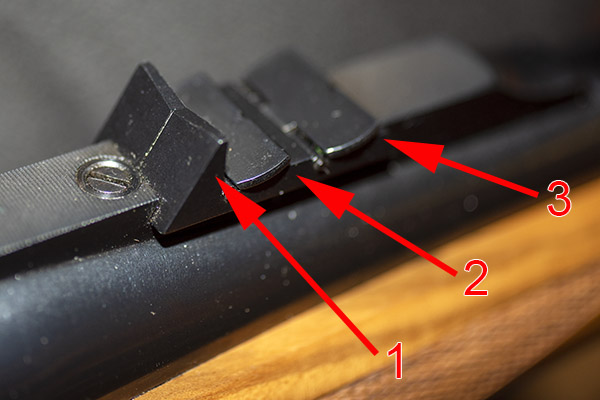
The rear sight on a Ruger RSM rifle is of the African “Express” style.  The elevation adjustment consists of a fixed and two flip-up blades, and they all have a very shallow V.  I guess the idea of that shallow V is that it lets you see more in case an elephant is charging.  The sight has two flip up blades behind the fixed blade; as range increases, you flip up the second blade, and if it is an even longer shot, you go for the third blade.  I got lucky, for me, the fixed rear sight blade is perfect with this load.  I made a minor adjustment for windage, and the elevation is spot on with a 6:00 hold at both 50 yards and 100 yards.

Incidentally, that rib the rear sight sits on?  It’s not a separate piece.  It and the barrel were turned and milled from one solid piece of steel.  It’s one of the reasons these rifles were too expensive to manufacture.

The front sight is the typical brass bead (you can sort of see it in the featured photo at the top of this blog), which I usually don’t like, but with these results I can’t complain.  I’ve shot better groups with two or three other open sight rifles using jacketed bullets at 100 yards; this is the best any cast bullet has ever done for me.


Want to see the first installment of the Eleanor story?  It’s right here.

Check out our other guns and reloading articles here.

Tough to get to a gunstore to buy targets?  Range fees for targets too high? Do what I do and order them online.  They’re delivered right to your door and they’re less expensive, too.

Need a calipers for measuring your group size?  This is a great place to find great calipers at a great price.

Want to check out Montana Bullets?   Here’s a link to their website.  Tell them Joe sent you.  Trust me on this:  These are best cast bullets I’ve ever used.


Never miss an ExNotes blog! Subscribe for free!