A Tale of Two Thumpers

By Joe Berk

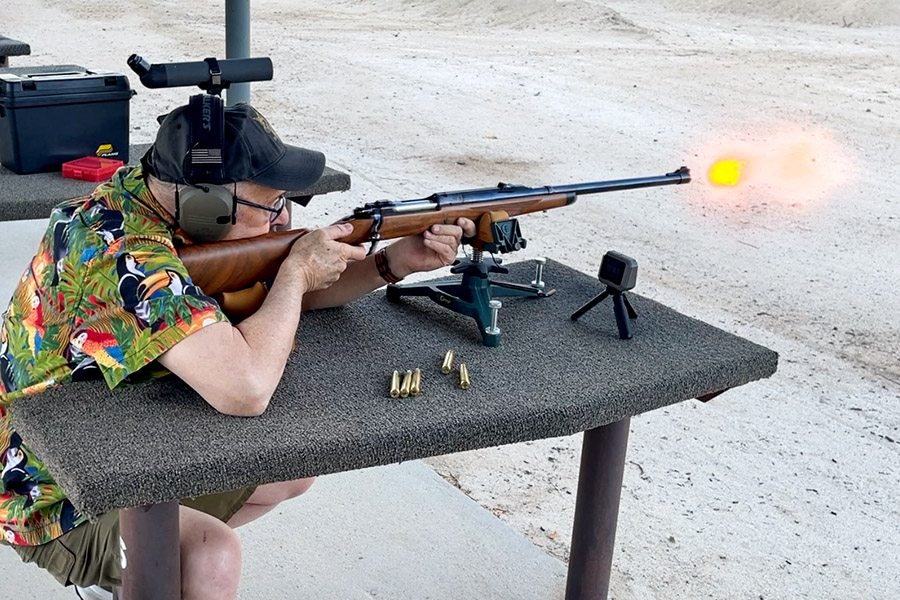
You have to be quick on the trigger, and Kevin was when he grabbed that shot above capturing the muzzle flash from my .416 Rigby.  It’s a good shot by a good shot. Me?  I’m just the male model in the photo above.

We’ve done blogs on ExNotes before about big bore rifles (.45 70, .458 Win Mag, .416 Rigby, .375 Ruger, and .375 H&H, to name but a few).  These are all what I would consider big. But they’re pipsqueaks to a toy good buddy Kevin has been playing with lately:  A custom .50-90 1896 Winchester High Wall.  By any measure, that rifle and its cartridge is a monster.  Originally designed as a buffalo gun, it is a real thumper.  The .50-90 almost needs to be a crew-served weapon.

Kevin and his Monster Rifle. Elephants? Piece of cake. Cape buffalo? You bet. T-Rex’s? No problem. Godzilla? Kevin’s got ya covered.

Kevin and I play around shooting for group size when we both bring guns of the same type to the West End Gun Club.  We’ve done it with handguns, small bore rifles, and more…sort of the thing I wrote about a few days ago in the Tale of Two Mini 14s.   This time, though, the bore diameters would be doubled.  Big stuff.  Guns designed to eradicate buffalo herds in America and dangerous game in Africa.  Or maybe prehistoric beasts in Jurassic Park.  The stuff of dreams, these guns are.
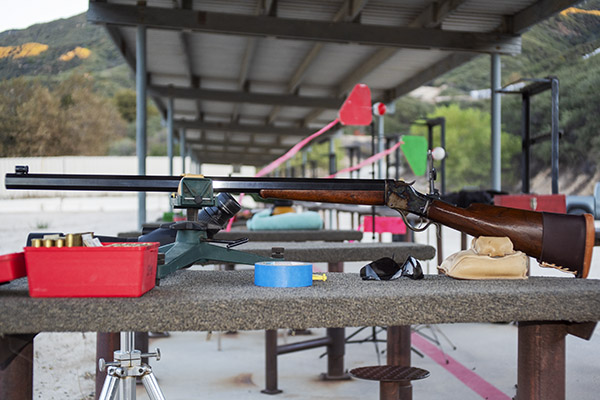
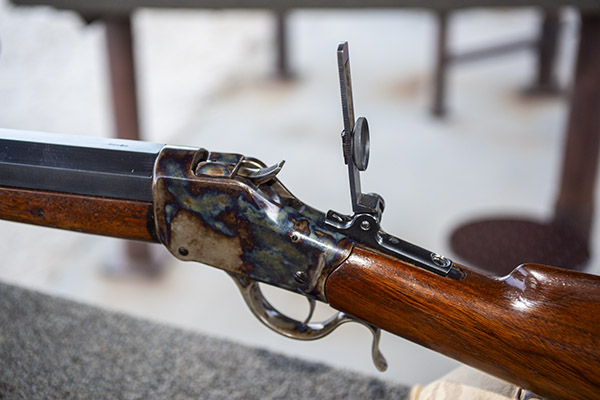
The .50-90 Winchester. It’s a custom rifle and it is beautiful.
Note the exquisite color case hardening on the receiver and the tang aperture sight. Wow, this is a gorgeous rifle.
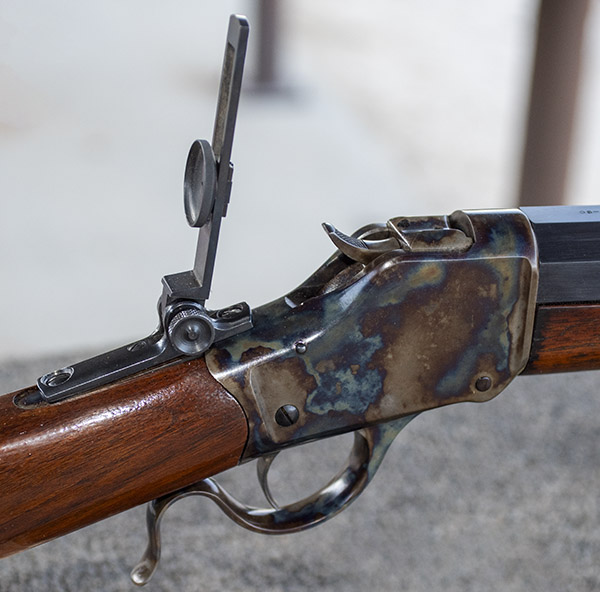
A .50-90 view from the right side.
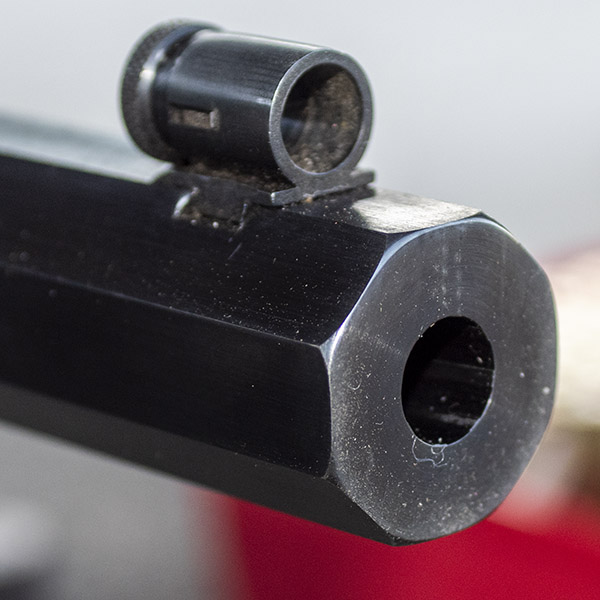
The .50-90’s muzzle on the rifle’s custom Green Mountain barrel. That’s a big hole!

Kevin and I thought it might be interesting to do the same (you know, an informal shootoff) with two of the grownup rifles:  My .416 Rigby (affectionately named Eleanor) and Kevin’s .50-90.  Ordinarily, in these informal matches, we’d shoot 20 rounds and look at group size.  I made a comment about 20 rounds from my .416 Rigby being a lot.  Kevin told me he didn’t know if he’d survive 20 rounds from the .50-90, and suggested 10 rounds instead.  When we got to the range early that morning (before sunup, actually), after further thought we both settled on a more sensible (and shoulder friendly) 5 rounds.
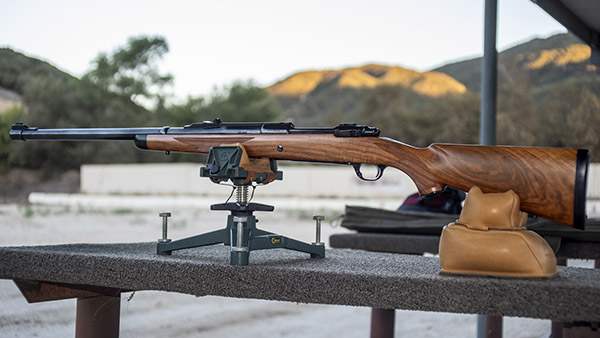
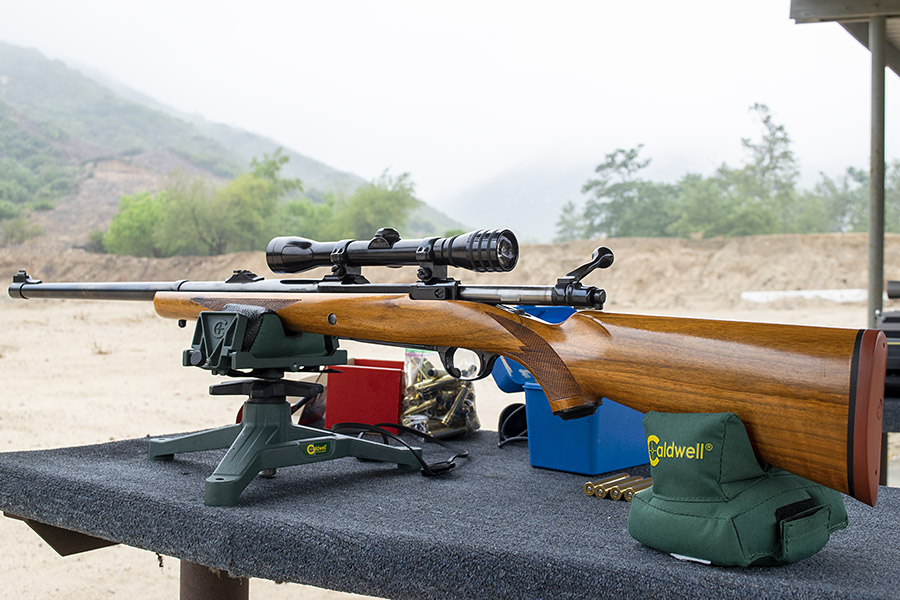
My Ruger RSM Model 77 Express rifle in .416 Rigby. Ruger quit making these some time ago. It cost too much to manufacture the rifle. Check out the stunning Circassian walnut on this rifle.
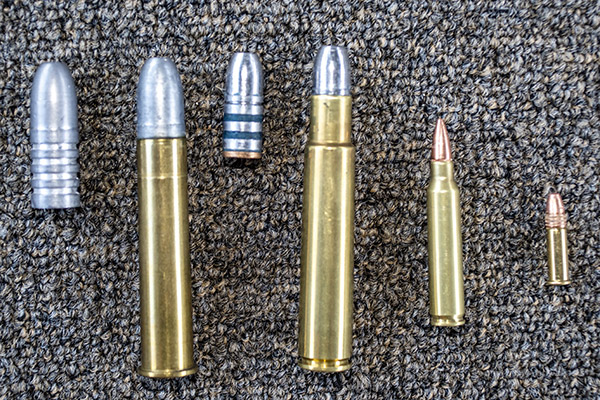
A visual comparison. From left to right: The .50-90’s 750-grain cast bullet, the .50-90 cartridge, the .416’s 350-grain cast bullet, the .416 Rigby cartridge, a 5.56 NATO cartridge with a 55-grain bullet, and a .22 Long Rifle cartridge with a 36-grain bullet.

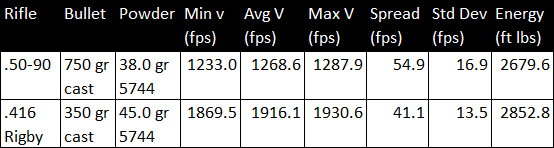
While we were shooting (and during the videoing of our shooting session), my Garmin chronograph was doing its thing.  Here’s how the velocities of the two cartridges shook out:
We also calculated the energy for each rifle based on the average velocity listed above for each cartridge.   The formula is:

Using the above formula, my .416 Rigby load had 2852.8 ft lbs of energy; Kevin’s .50-90 load had 2679.6 ft lbs of energy.  (I think the Garmin will calculate energy automatically, but being engineers, Kevin and I had to use the formula and calculate it ourselves).  It’s interesting.  My bullet weight in the .416 Rigby was just under half of Kevin’s in his .50-90 Winchester, but the .416 had higher energy than the .50-90.  Because energy increases as the square of velocity, the .416’s weight deficit (if the phrase “weight deficit” can even be used when referring to a 350-grain bullet) is overcome by its velocity.

The .416 Rigby had more muzzle energy than Kevin’s .50-90 Winchester, but the .50-90 Winchester’s recoil is absolutely horrendous compared to the Rigby.  You’ll see that in the video below.

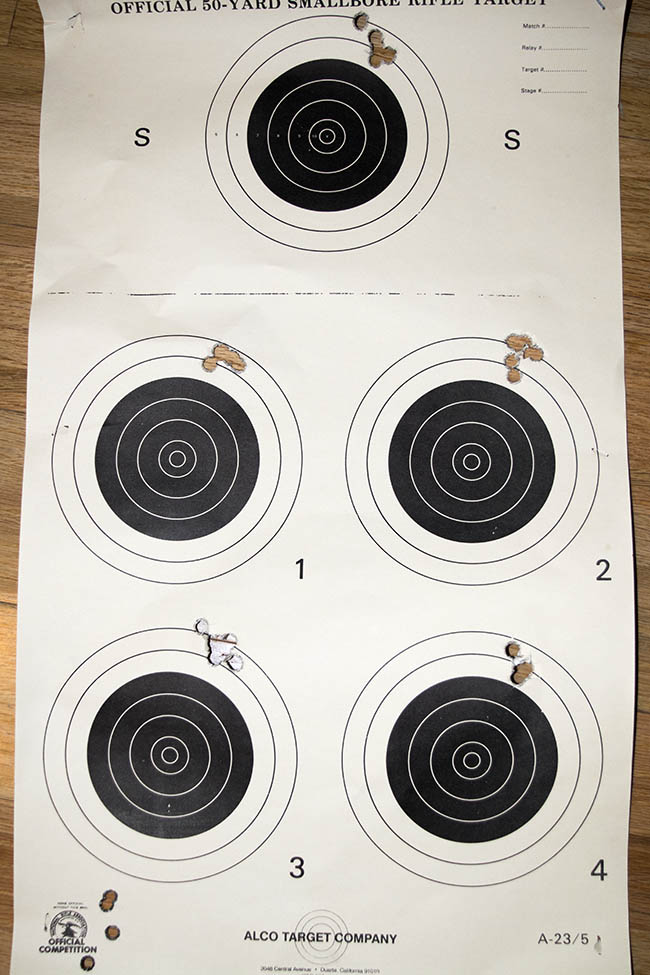
So who did better on our 50-yard targets?  Kevin.  He shot a tighter group, and then, just for grins, he lobbed a round at a metal plate on his improvised target stand.  The first shot knocked the stand down like it was hit by a freight train.  That .50-90 is a powerful proposition.
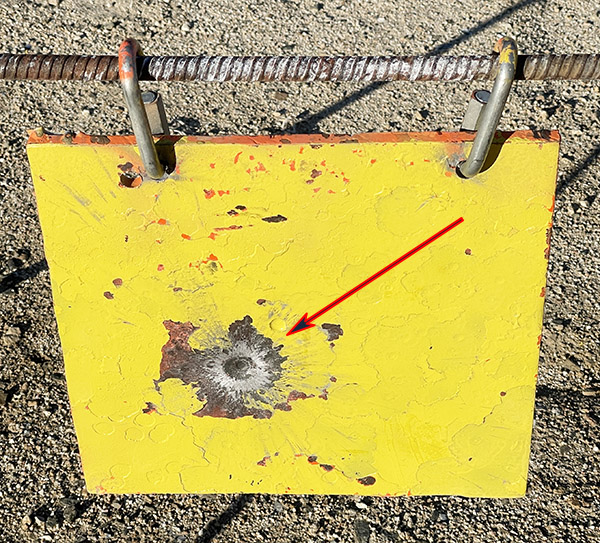
A shot from the .50-90 put a major-league dent in this 3/8-inch steel plate, and then took the target stand down with it.

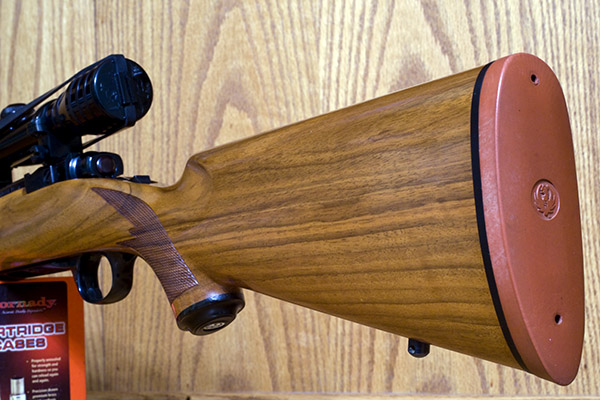
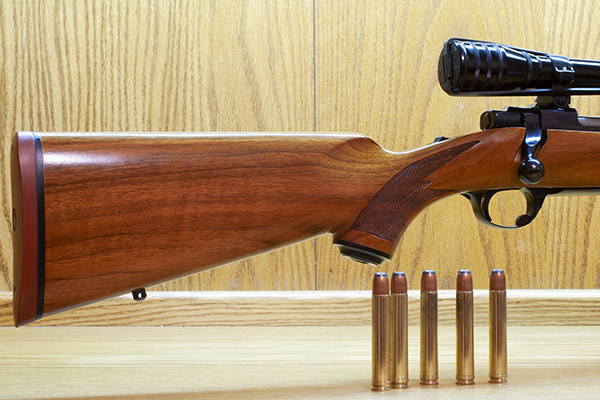
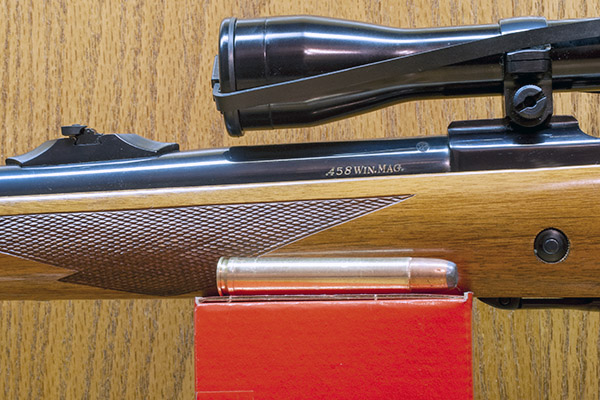
A 458 Ruger M77

The year was 1974.  I had just finished grad school and I was at Fort Bliss, Texas, for the Basic Course and the Chaparral/Vulcan Course, which is to say I was there for another five months of school before heading overseas.  There was no such thing as Gunbroker.com yet…in fact, there wasn’t a dotcom anything yet…this was all well before the Internet.  But we had The Shotgun News, a print publication that served much the same purpose.  I studied that newspaper like a Democrat looking for something new to tax.

Ruger did a very limited run of their Model 77 in .458 Winchester Magnum back in the early 1970s, and within that limited run, they did a few with Circassian walnut.  I might be wrong, but I think this was the first limited production anything Ruger did with Circassian walnut.  I read the ad and I immediately knew I had to have one.

Man, I was hooked.  I needed a .458 Mag elephant gun.  My Army gun was a 20mm Vulcan, and by comparison, the .458 didn’t seem so big.  The rifle was $340 from J&G Rifles in Prescott, Arizona (an outfit that I think still exists), and in those days it was as easy as picking up the phone, sending a check, and having them ship the rifle to a local dealer.  The amount seems laughably low today, but $340 was a big nut back in 1974.  I borrowed the money from my sister and the rifle was on its way to Barney’s Guns out in the west Texas town of El Paso.  God bless Marty Robbins and all that is west Texas.  I loved it out there.

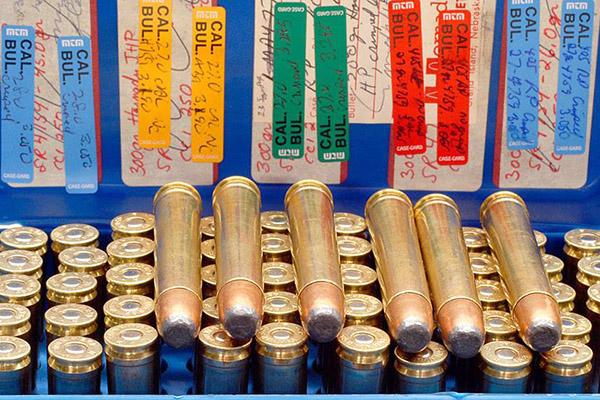
Not knowing too much about hunting elephants, I bought three boxes of .458 factory ammo with predictable results:  Today, nearly 50 years later, I still have most of that factory ammo in its original yellow Winchester boxes.   You see, there weren’t too many elephants in El Paso, and that ammo redefined recoil for me.  Just a few rounds of the 500-grain, 2100 feet per second factory fodder convinced me there had to be a better way, and there was.  I’ve loaded literally thousands of rounds in .458 Win Mag over the last 50 years, virtually all of it at .45-70 levels.   It’s actually a nice shooting rifle when you drop it from “elephant” to “buffalo” on the energy meter.  And that’s still plenty potent.  People used to kill buffalo with 400-grain pills at 1200 feet per second (they killed nearly all of them, actually).

I picked up a Redfield straight 4-power scope that is still putting the crosshairs where I want the bullets go (I think it was something like $30 at one of the K-Marts in El Paso).   Not surprisingly, the Circassian .458 is very accurate with both jacketed and cast bullets.  It can easily put five rounds into an inch at 100 yards.

Every once in a while I’ll go on a tear experimenting with new loads, and I suppose when I exhaust my supply of 405-grain Remington jacketed softpoint bullets and SR 4759 propellant I’ll get serious about that, but for now I have a good stash of the Remington bullets and SR 4759.  I’ll probably still be working my way through that stash when I ride off into the sunset.  And when I enter the Happy Hunting Grounds, I’ll rub elbows with Karamojo Bell, Frederick Courtney Selous, Peter Capstick, and others who chased elephants in Africa and we can compare notes.

My buddies and I hunted jack rabbits out in the desert east of El Paso near Fabens, and I had a lot of fun with the .458.  Yeah, it was massive overkill.  But some of those jacks were big, man.  Not that I needed a .458 Winchester Magnum elephant gun.  But who buys these things because they need them?


Keep us in components!


More Tales of the Gun!


Never miss an ExNotes blog!