
By Joe Berk
Here’s the bottom line upfront: Don’t expect stunning accuracy from DKC’s 9mm bullets.
I bought 1000 of them from Raven Rocks after watching a YouTube video about FBI handguns and ammunition, in which an FBI ballistics expert explained why the FBI uses 147-grain bullets in their 9mm Glocks. The YouTube fellow didn’t specify which 147-grain bullet the FBI uses, although a friend later told me it’s the Speer Gold Dot. The DKC bullets I bought were cheap at $98 per 1000, and my testing showed why. You get what you pay for. Sometimes.
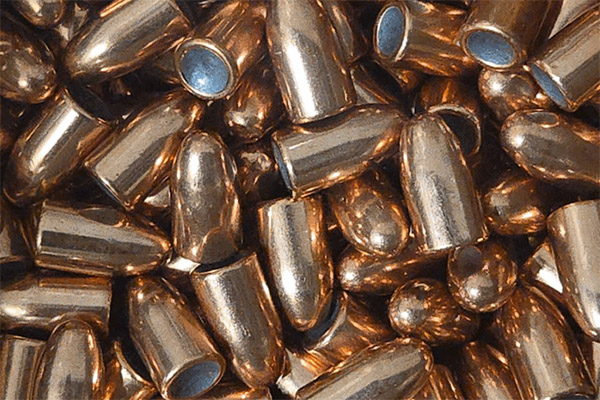
DKC is relatively young Turkish ammunition and reloading components manufacturer. One of their importers is Raven Rocks here in the US. I’ve ordered components from Raven Rocks before (in particular, their composite 9mm and .45 bullets) and I’ve been pleased with the results. I was hoping the same thing would happen with these 9mm full metal jacket bullets, but it was not to be. Win some, lose some.
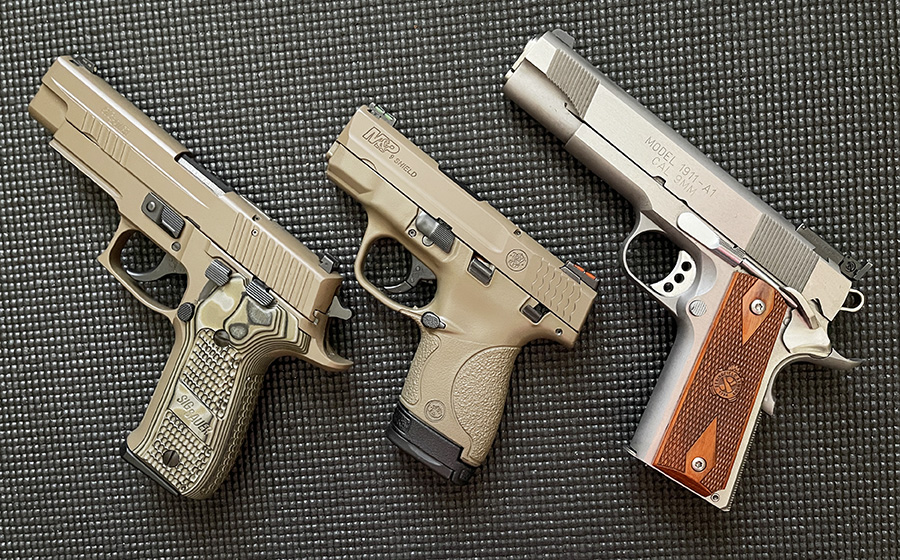
I fired my 9mm DKC bullet handloads at the West End Gun Club using the 147-grain full metal jacket bullets. I tested the bullets in three different handguns (a Springfield 1911, a SIG P226, and a S&W Shield), with a light load and a heavier load for each of four different propellants (Red Dot, Bullseye, Unique, and Power Pistol). For the initial accuracy testing, I shot two 5-shot groups at 50 feet for each configuration.
How did the new bullets do? All the 50-foot groups were disappointing from an accuracy perspective. A few of the groups dipped below 2 inches, but most were above (and some well above), and at 50 feet, that’s not the kind of accuracy I’m used to. Here’s how it shook out:
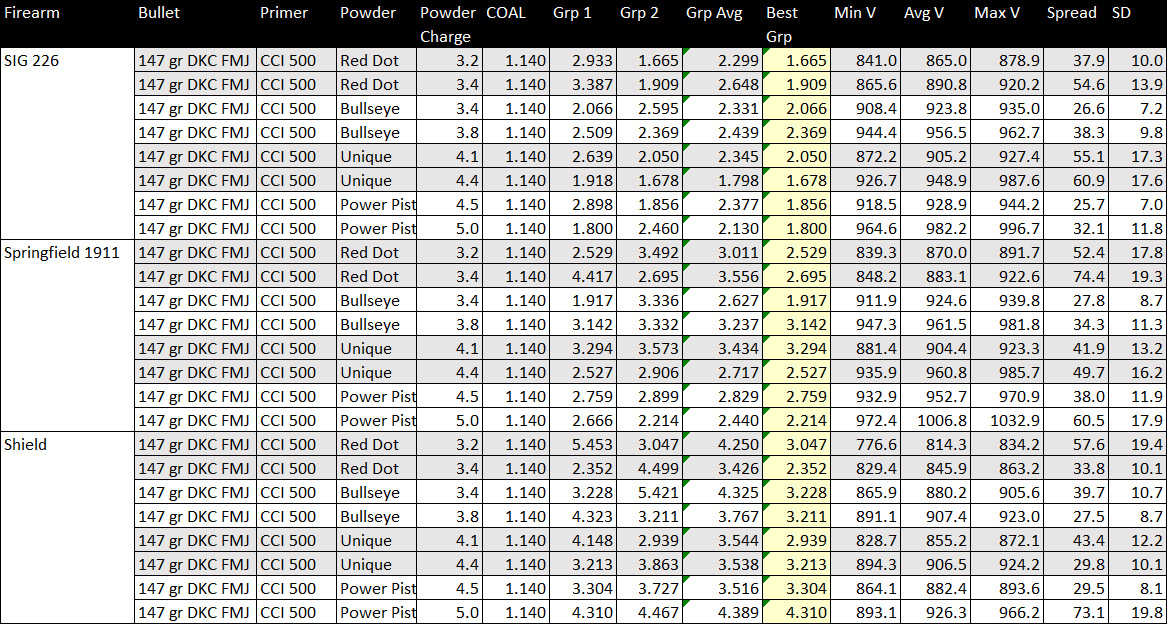
The above table is data intensive and correspondingly small (ah, if only my groups were the same). If you click on the table, it will open in a new window and be a little easier to read.
You can see from the above that the group sizes generally were mediocre to poor. As a point of reference, what I consider good is a group of an inch or less from a 9mm at that distance. None of the loads I tested met that threshold.
I added a column to show the best of the two groups fired for each load in each pistol (this is highlighted in yellow), thinking that maybe it was my shooting that returned the mediocre groups and this might give a better feel for what worked best. None of the groups met my 1-inch threshold. I had been h0ped that a few of them would, as had occurred when testing previous 9mm loads (see, for example, A Tale of Two Nines, A 9mm Comparo: Cast Bullets, and A 9mm Comparo: Jacketed Bullets). On the plus side, all the loads functioned all three handguns reliably. There were no failures to feed and no failures to extract. I guess that’s something.
Surprisingly (especially when considered in light of the mediocre accuracy), the velocity standard deviations were all relatively low, and in some combinations, surprisingly low. Bullseye was generally the winner from a standard deviation perspective, although its low standard deviation did not translate into superior accuracy.
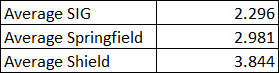
I averaged all groups for each handgun (both high and low loads and the different propellant loads). Predictably, the SIG returned the best groups overall, and the short-barreled Shield was the worst. The SIG has always been a stellar performer.
I then considered the results across the three pistols to try to select a powder that I could use for all three handguns. To do this, I averaged the three pistol’s performance with the light Red Dot load, the average performance with the heavy Red Dot load, etc. Nothing emerged as a significantly better accuracy load, as you can see below.
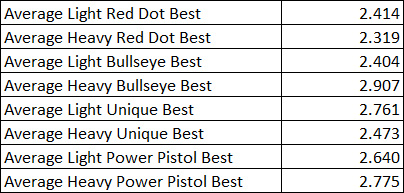
By this time, the data were confusing me. I was also feeling my age a bit, thinking maybe my old eyes just aren’t what they used to be.
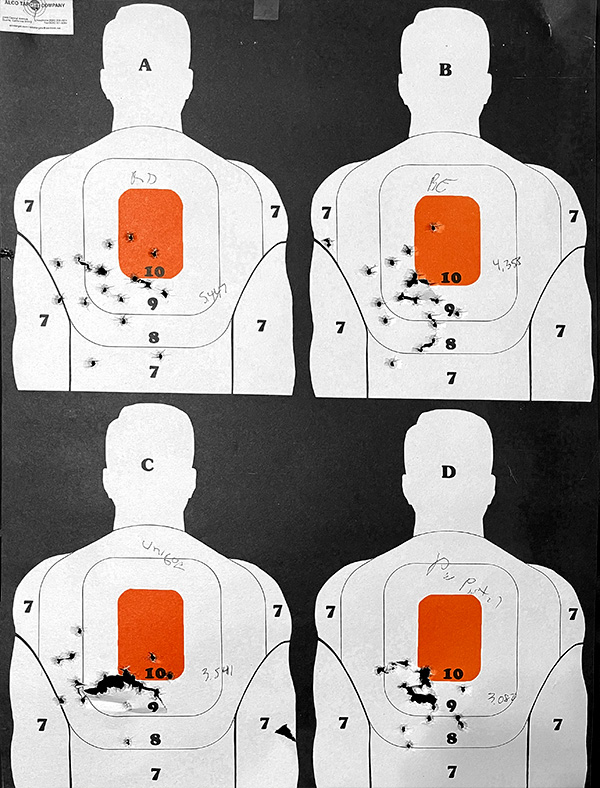
At the end of the session, I had 20 rounds left in each load combination. I fired the heavy loads (for each powder) into each of four targets at 50 feet using the SIG only. By this measure, the heavy Power Pistol load had maybe the best group. I didn’t do the same for the other two handguns. The Power Pistol load had perceptibly heavier recoil, and it averaged over 1000 fps (a lot, I think, in a 9mm 147-grain load). I don’t know if I want to subject an aluminum-framed handgun to a steady diet of this load (see my blog on the Smith and Wesson Model 59).
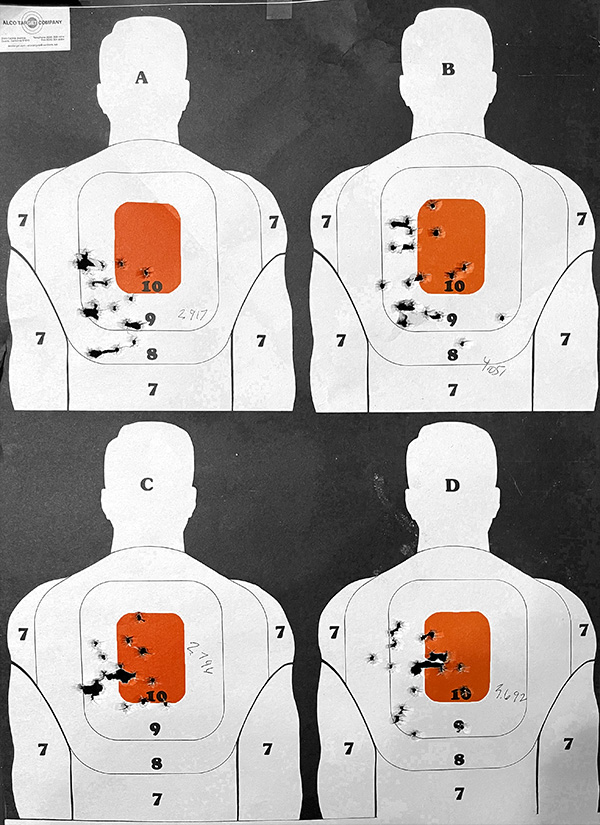
I also had 20 rounds left for each of the four loads at the lower end of the propellant charges. I took these 80 rounds and one of the Alco mini-4 silhouette targets to my indoor range. I again fired all rounds through the SIG, shooting the groups you see below at 10 yards. Here’s what that target looked like:
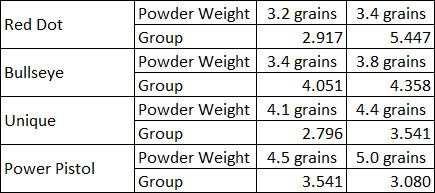
The experimental design for the lower and higher load comparisons with the SIG you see above would probably earn a failing grade from a competent statistics professor. The sample size is too small, I shot at different distances for the higher-level loads versus the lower-level loads, and I probably broke one or two other statistics rules. That notwithstanding, here’s a summary of what the group size data looks like:
Where’s all this going? The bottom line is none of the results were anything to write home about. Why, I wondered? Other 9mm loads had done significantly better.
To further assess why my results were as mediocre as they were (and recognizing but not fully accepting that 100% of the mediocrity could have been due to me, the shooter), I next evaluated the bullets themselves. The first parameter I measured was bullet weight. In a random weight sample of 20 DKC 147-grain 9mm bullets, here are the weights I recorded (all weights are in grains):
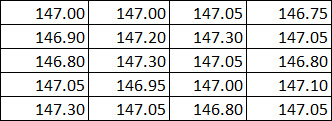
That first bullet was right on the money at 147.0 grains, so I thought these would prove to be good bullets from a weight variability perspective. But I was wrong, as the remaining measurements above showed. Here are the particulars on weight variability:
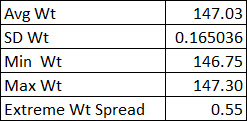
I think that half a grain weight variability (0.55 grain, to be exact) is a lot for a jacketed pistol bullet. I would have expected the weight to be within ±0.1 grain, so an extreme spread of 0.55-grain is not good. It’s also not likely that the weight variability is symmetric to the bullets’ axes, which further aggravates the problem. As the bullet spins, any weight asymmetry will induce larger group sizes.
That had me wondering about bullet diameter. After zeroing my calipers, I measured the diameter of 10 bullets. Note that these are stated by the supplier to be 0.355 inches, which is what I would expect on a 9mm jacketed bullet. Here’s what I found:
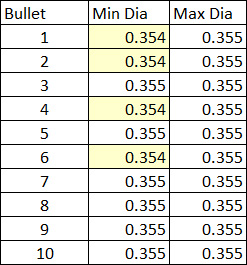
Damn! Four of the ten bullets I measured were out-of-round by 0.001 inch (these are Bullets 1, 2, 4, and 6), and where this occurs, they are undersized. Small wonder the group sizes were not that good. The undersized bullets would have rattled down the bore, with perhaps some propellant gas sneaking around their periphery. I think the reason the hotter Power Pistol loads did a little better is the higher chamber pressure probably deformed the bullet to fill the bore better.
Here’s the bottom line from an old ordnance engineer: These bullets are (ah, what’s that ordnance technical term again…oh yeah, I remember): MAB (or mediocre, at best). They are cheap at $98/1000, but in retrospect, they are at best plinkers, nothing more. Maybe I’m expecting too much. Maybe a 9mm handgun just won’t group that well with a 147-grain bullet. I don’t think that’s it, though. I’ve done better with other 9mm 147-grain bullets.
I relayed the above results to a few of my buddies and one of them asked me if he could have some of the DKC bullets because, as he put it, he is more of a plinker than a wannabe ballistics engineer (like yours truly). Done and done, I immediately answered. Then the question becomes: How should I load the rest of these bullets? I still have several hundred left.
I realized this would not be a decision based on accuracy, as none of the different recipes I tried resulted in impressive accuracy. I don’t need big time penetration and I don’t need high velocity, as I’m not an FBI agent preparing for a rerun of the Miami gunfight. I decided I would go with a load that offered:
-
-
- A low velocity standard deviation (which held at least a promise of better accuracy).
- Reliable performance.
- Lower recoil.
- A load that was adequate (if not stellar) across all three 9mm handguns.
-
Any of the loads I tested with the 147-grain DKC bullets meet the above criteria, so the choice came down to which powder I had the most of on hand. That made it easy. I’m going with the lower Red Dot load of 3.2 grains. That will give me just under 900 feet per second from the 1911 and the 226, and just over 800 feet per second in the Shield. That’s as good as or better than a .38 Special with a comparable weight bullet, and the .38 Special is a great cartridge. I’ll be flush with these 9mm handloads for a while, and then I won’t buy any more of the 147-grain DKC bullets.
More gun stuff? You bet!
We need your support! Do what you can to help ExNotes stay in the black!

More Huber? Check out A Trip Into The Moment.

More Gresh and Berk? You bet! Check out A Cup O’ Joes!

Join our Facebook ExNotes page!