DKC 147-grain 9mm Full Metal Jacket Bullets

By Joe Berk

Here’s the bottom line upfront: Don’t expect stunning accuracy from DKC’s  9mm bullets.

I bought 1000 of them from Raven Rocks after watching a YouTube video about FBI handguns and ammunition, in which an FBI ballistics expert explained why the FBI uses 147-grain bullets in their 9mm Glocks. The YouTube fellow didn’t specify which 147-grain bullet the FBI uses, although a friend later told me it’s the Speer Gold Dot. The DKC bullets I bought were cheap at $98 per 1000, and my testing showed why.  You get what you pay for.  Sometimes.
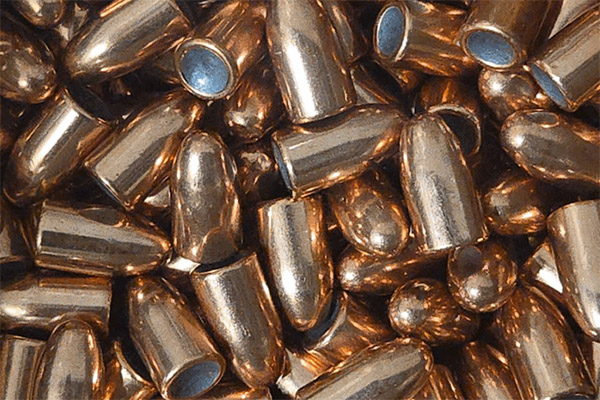
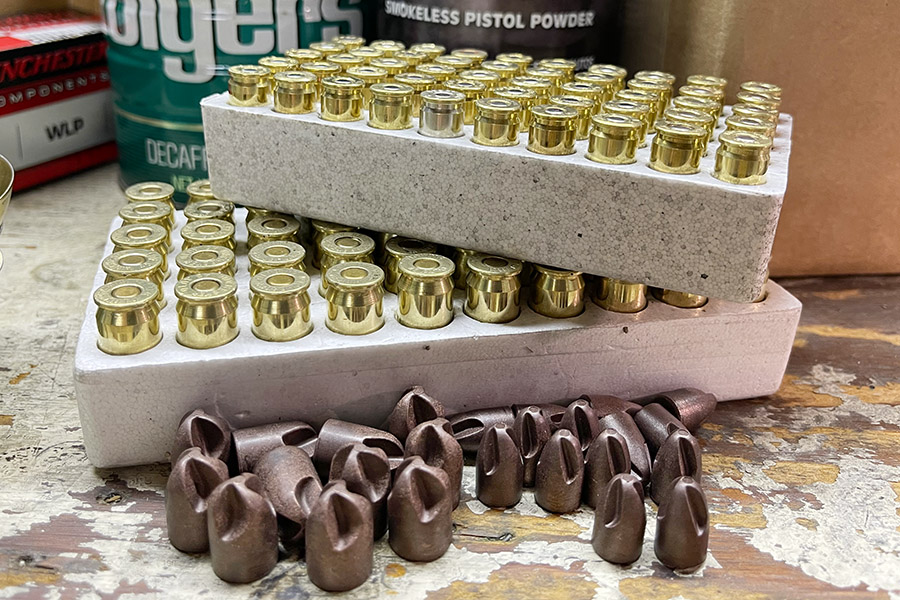
Full metal jacket, 147-grain, 9mm DKC bullets.

DKC is relatively young Turkish ammunition and reloading components manufacturer.  One of their importers is Raven Rocks here in the US.  I’ve ordered components from Raven Rocks before (in particular, their composite 9mm and .45 bullets) and I’ve been pleased with the results.  I was hoping the same thing would happen with these 9mm full metal jacket bullets, but it was not to be. Win some, lose some.

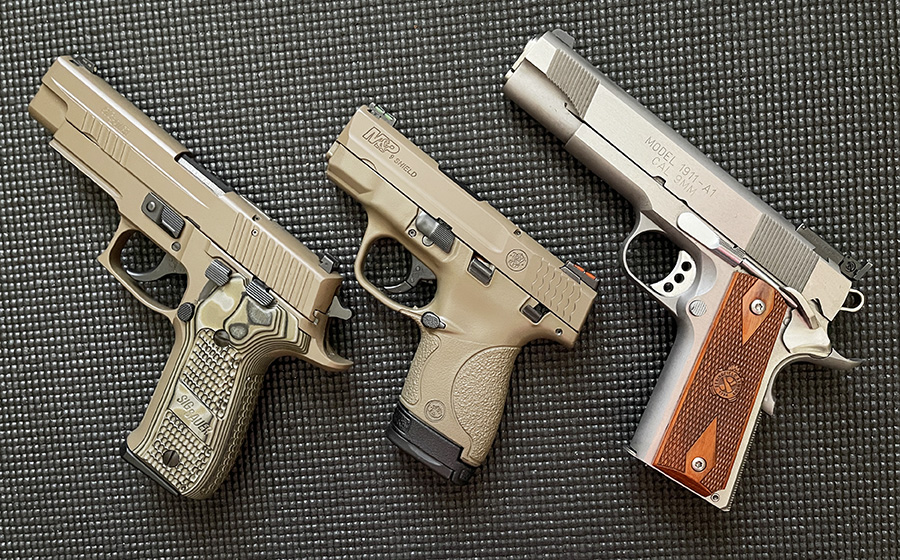
I fired my 9mm DKC bullet handloads at the West End Gun Club using the 147-grain full metal jacket bullets.  I tested the bullets in three different handguns (a Springfield 1911, a SIG P226, and a S&W Shield), with a light load and a heavier load for each of four different propellants (Red Dot, Bullseye, Unique, and Power Pistol).  For the initial accuracy testing, I shot two 5-shot groups at 50 feet for each configuration.

How did the new bullets do?  All the 50-foot groups were disappointing from an accuracy perspective. A few of the groups dipped below 2 inches, but most were above (and some well above), and at 50 feet, that’s not the kind of accuracy I’m used to.  Here’s how it shook out:
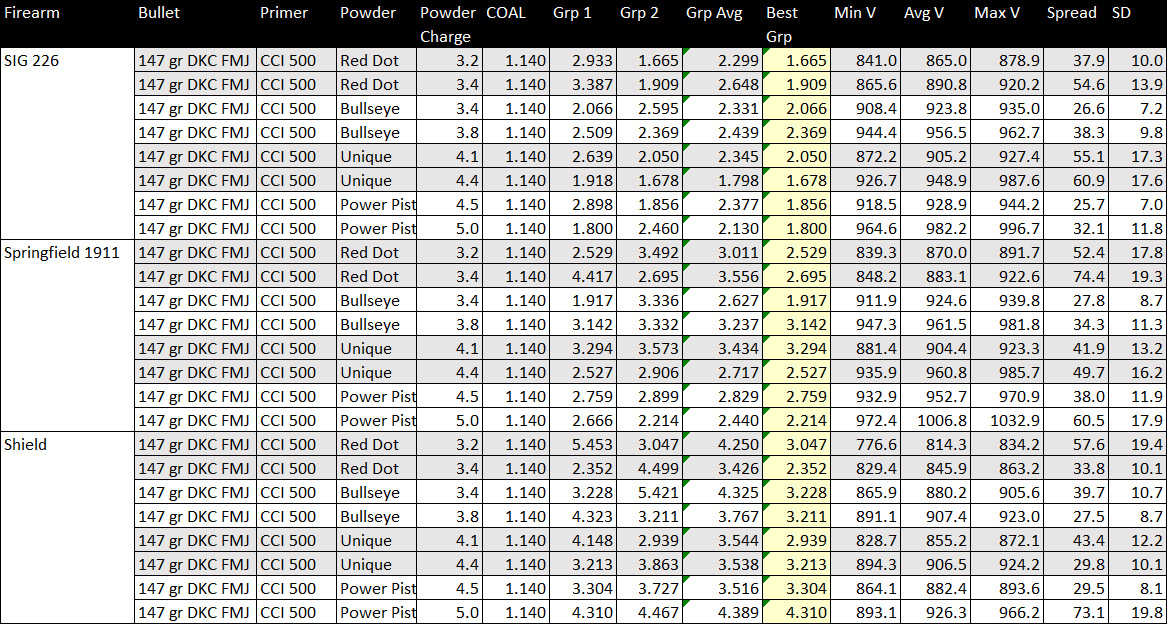
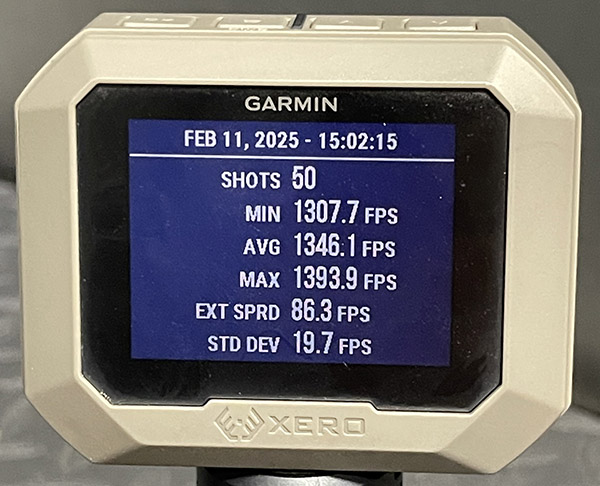
The results. I fired 400 shots in total for this blog’s test series. I used my Garmin Xero to chronograph the velocities.   Click on the table to make it bigger.

The above table is data intensive and correspondingly small (ah, if only my groups were the same).  If you click on the table, it will open in a new window and be a little easier to read.

You can see from the above that the group sizes generally were mediocre to poor. As a point of reference, what I consider good is a group of an inch or less from a 9mm at that distance.  None of the loads I tested met that threshold.

I added a column to show the best of the two groups fired for each load in each pistol (this is highlighted in yellow), thinking that maybe it was my shooting that returned the mediocre groups and this might give a better feel for what worked best.   None of the groups met my 1-inch threshold. I had been h0ped that a few of them would, as had occurred when testing previous 9mm loads (see, for example, A Tale of Two Nines, A 9mm Comparo:  Cast Bullets, and A 9mm Comparo:  Jacketed Bullets).  On the plus side, all the loads functioned all three handguns reliably. There were no failures to feed and no failures to extract.  I guess that’s something.

Surprisingly (especially when considered in light of the mediocre accuracy), the velocity standard deviations were all relatively low, and in some combinations, surprisingly low. Bullseye was generally the winner from a standard deviation perspective, although its low standard deviation did not translate into superior accuracy.

I averaged all groups for each handgun (both high and low loads and the different propellant loads).  Predictably, the SIG returned the best groups overall, and the short-barreled Shield was the worst.  The SIG has always been a stellar performer.
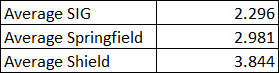
Average group sizes for all loads in each pistol.

I then considered the results across the three pistols to try to select a powder that I could use for all three handguns.  To do this, I averaged the three pistol’s performance with the light Red Dot load, the average performance with the heavy Red Dot load, etc.  Nothing emerged as a significantly better accuracy load, as you can see below.
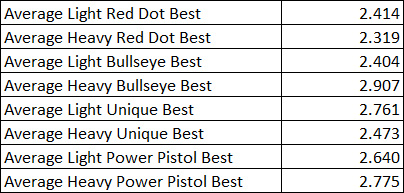
Average group size for different loads across all three handguns.

By this time, the data were confusing me. I was also feeling my age a bit, thinking maybe my old eyes just aren’t what they used to be.

At the end of the session, I had 20 rounds left in each load combination. I fired the heavy loads (for each powder) into each of four targets at 50 feet using the SIG only. By this measure, the heavy Power Pistol load had maybe the best group. I didn’t do the same for the other two handguns.  The Power Pistol load had perceptibly heavier recoil, and it averaged over 1000 fps (a lot, I think, in a 9mm 147-grain load). I don’t know if I want to subject an aluminum-framed handgun to a steady diet of this load (see my blog on the Smith and Wesson Model 59).
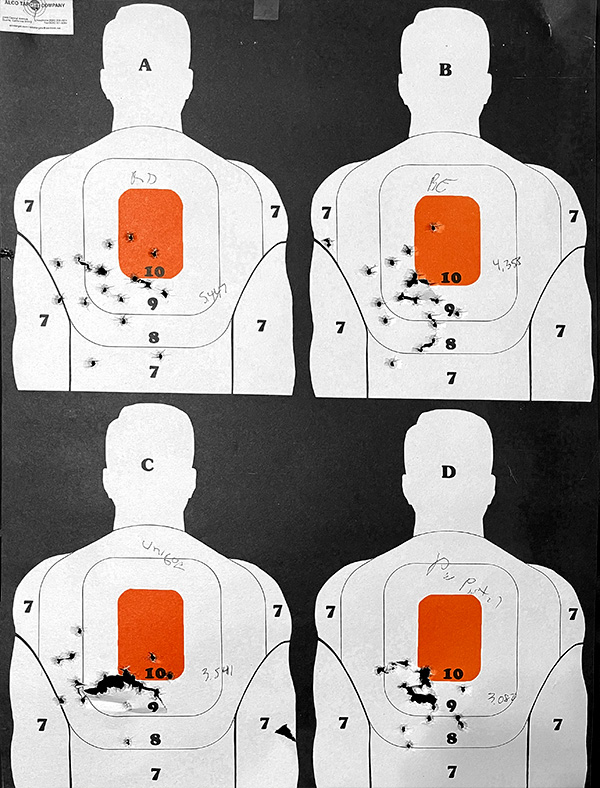
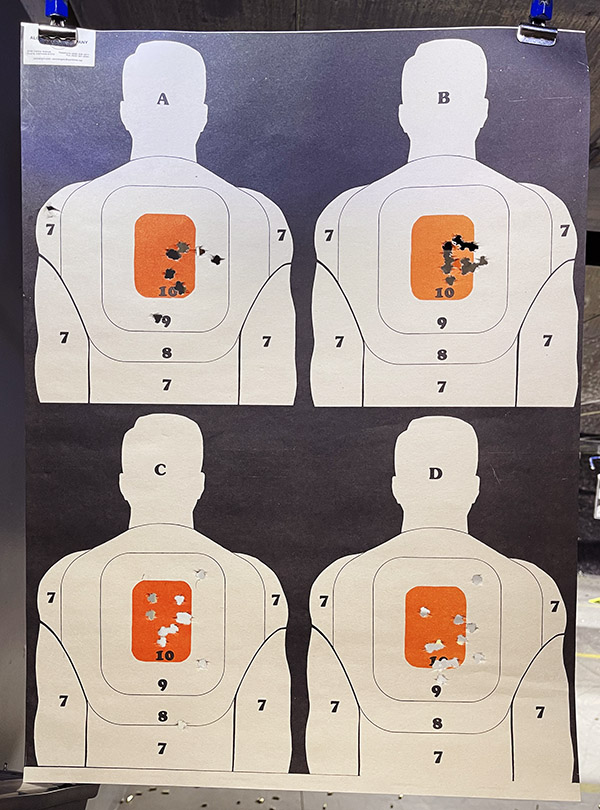
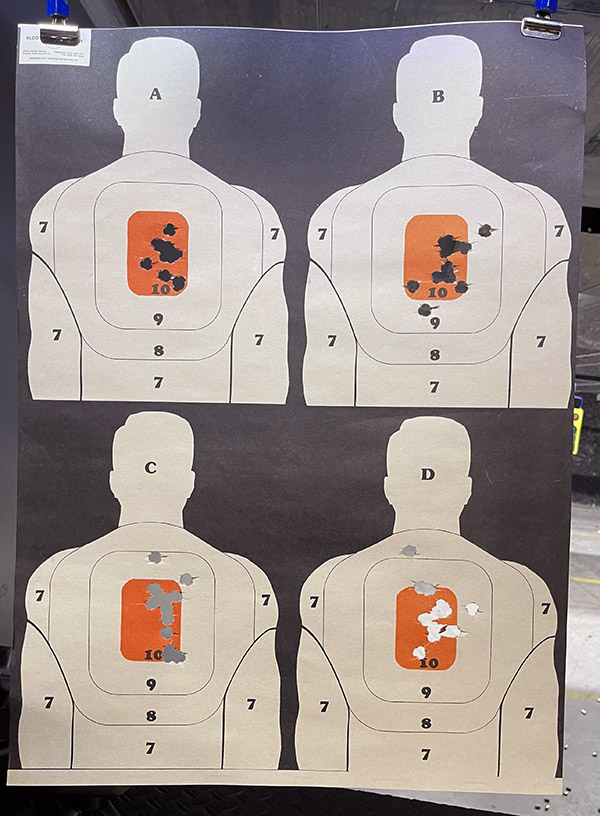
The targets you see above are (clockwise from top left), the heavier Red Dot load, the heavier Bullseye load, the heavier Unique load, and the heavier Power Pistol load. If you eliminate the one or two flyers in each group, there’s not a lot of difference between any of the heavier loads.

I also had 20 rounds left for each of the four loads at the lower end of the propellant charges.  I took these 80 rounds and one of the Alco mini-4  silhouette targets to my indoor range.   I again fired all rounds through the SIG, shooting the groups you see below at 10 yards.  Here’s what that target looked like:
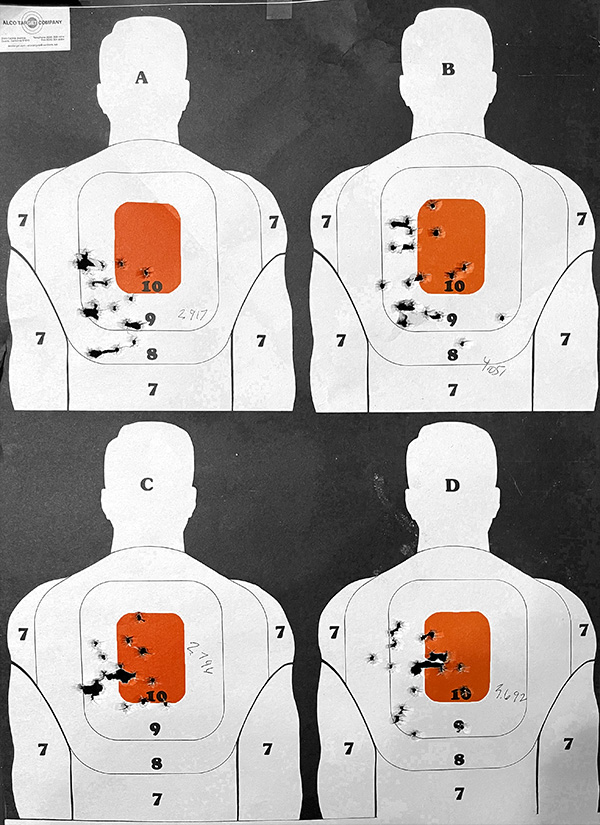
These are targets shot at 30 feet with 20 rounds each of the lighter loads. Clockwise from top left, these were shot with the lighter Red Dot load, the lighter Bullseye load, the lighter Unique load, and the lighter Power Pistol load.

The experimental design for the lower and higher load comparisons with the SIG you see above would probably earn a failing grade from a competent statistics professor.  The sample size is too small, I shot at different distances for the higher-level loads versus the lower-level loads, and I probably broke one or two other statistics rules.  That notwithstanding, here’s a summary of what the group size data looks like:
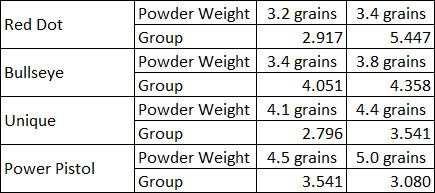
Data from the above two targets summarized in tabular form.

Where’s all this going?  The bottom line is none of the results were anything to write home about.  Why, I wondered?  Other 9mm loads had done significantly better.

To further assess why my results were as mediocre as they were (and recognizing but not fully accepting that 100% of the mediocrity could have been due to me, the shooter), I next evaluated the bullets themselves. The first parameter I measured was bullet weight. In a random weight sample of 20 DKC 147-grain 9mm bullets, here are the weights I recorded (all weights are in grains):
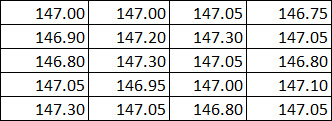
Weights for 20 of the DKC 147-grain 9mm bullets.

That first bullet was right on the money at 147.0 grains, so I thought these would prove to be good bullets from a weight variability perspective. But I was wrong, as the remaining measurements above showed. Here are the particulars on weight variability:
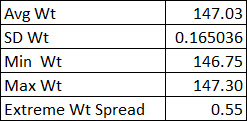
Bullet weight variability parameters.

I think that half a grain weight variability (0.55 grain, to be exact) is a lot for a jacketed pistol bullet.  I would have expected the weight to be within ±0.1 grain, so an extreme spread of 0.55-grain is not good.  It’s also not likely that the weight variability is symmetric to the bullets’ axes, which further aggravates the problem.  As the bullet spins, any weight asymmetry will induce larger group sizes.

That had me wondering about bullet diameter. After zeroing my calipers, I measured the diameter of 10 bullets. Note that these are stated by the supplier to be 0.355 inches, which is what I would expect on a 9mm jacketed bullet. Here’s what I found:
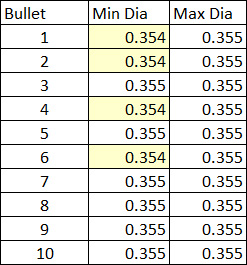
0.355 inches in diameter? Guess again, Bullet Boy!

Damn! Four of the ten bullets I measured were out-of-round by 0.001 inch (these are Bullets 1, 2, 4, and 6), and where this occurs, they are undersized. Small wonder the group sizes were not that good. The undersized bullets would have rattled down the bore, with perhaps some propellant gas sneaking around their periphery.   I think the reason the hotter Power Pistol loads did a little better is the higher chamber pressure probably deformed the bullet to fill the bore better.

Here’s the bottom line from an old ordnance engineer: These bullets are (ah, what’s that ordnance technical term again…oh yeah, I remember): MAB (or mediocre, at best). They are cheap at $98/1000, but in retrospect, they are at best plinkers, nothing more.   Maybe I’m expecting too much.  Maybe a 9mm handgun just won’t group that well with a 147-grain bullet.   I don’t think that’s it, though.  I’ve done better with other 9mm 147-grain bullets.

I relayed the above results to a few of my buddies and one of them asked me if he could have some of the DKC bullets because, as he put it, he is more of a plinker than a wannabe ballistics engineer (like yours truly).  Done and done, I immediately answered.  Then the question becomes:  How should I load the rest of these bullets?  I still have several hundred left.

I realized this would not be a decision based on accuracy, as none of the different recipes I tried resulted in impressive accuracy.  I don’t need big time penetration and I don’t need high velocity, as I’m not an FBI agent preparing for a rerun of the Miami gunfight.  I decided I would go with a load that offered:

      • A low velocity standard deviation (which held at least a promise of better accuracy).
      • Reliable performance.
      • Lower recoil.
      • A load that was adequate (if not stellar) across all three 9mm handguns.

Any of the loads I tested with the 147-grain DKC bullets meet the above criteria, so the choice came down to which powder I had the most of on hand.  That made it easy.  I’m going with the lower Red Dot load of 3.2 grains.  That will give me just under 900 feet per second from the 1911 and the 226, and just over 800 feet per second in the Shield.  That’s as good as or better than a .38 Special with a comparable weight bullet, and the .38 Special is a great cartridge.  I’ll be flush with these 9mm handloads for a while, and then I won’t buy any more of the 147-grain DKC bullets.


More gun stuff?  You bet!

We need your support!  Do what you can to help ExNotes stay in the black!



More Huber? Check out A Trip Into The Moment.

More Gresh and Berk?  You bet!  Check out A Cup O’ Joes!


Join our Facebook ExNotes page!

Help us keep the lights on:

.45 ACP ARX Bullets In Revolvers

By Joe Berk

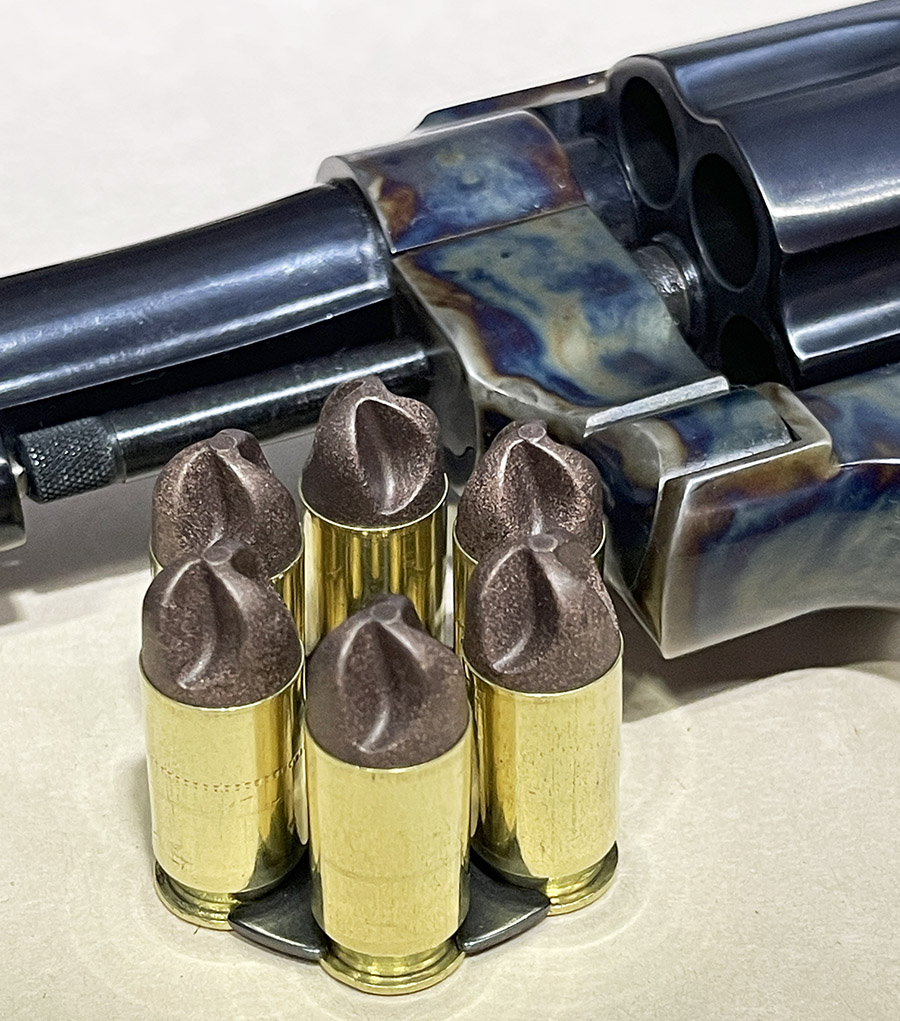
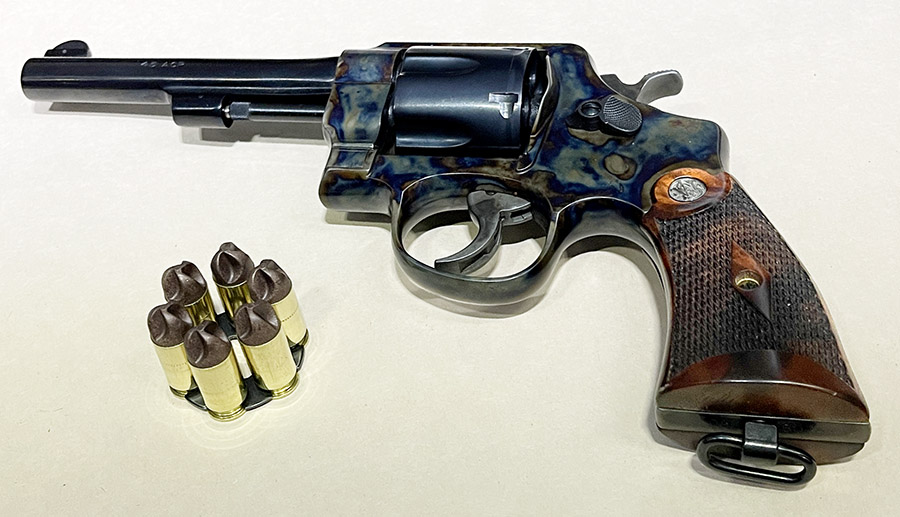
I went to my indoor handgun range to try the ARX bullets in two .45 ACP revolvers, my 1917 redo revolver and the 625 Performance Center Smith and Wesson.   The 1917 is the one you see at the top of this blog.  It’s a beautiful N-frame Smith styled to look like the 1917 US Army revolvers with a 5 1/2-inch barrel and a lanyard ring.  Smith also added a nice t0uch:  Turnbull color case hardening.  It really is a beautiful revolver.

6 ARX rounds in a star clip, ready for shooting in the 1917 Smith.

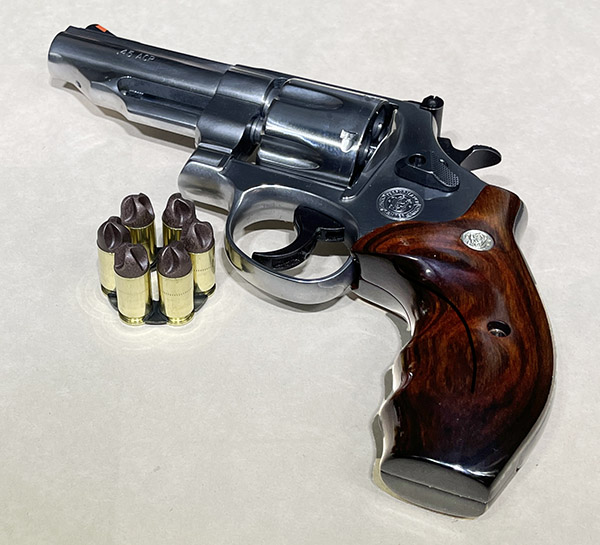
The 625 is a special number Smith offered about a decade or so ago.  It has a custom barrel profile, ostensibly a smoother action, and better sights.  It came from the Performance Center with a gold bead front sight, which I didn’t care for, so the revolver went back to Smith for a red ramp front and white outline rear sight.  I thought the red ramp and white outline would be like what came on Smiths in the 1970s, but it wasn’t.  The red isn’t nearly as vibrant, and the white outline is sort of a dull gray.  Live and learn, I guess.

The Smith and Wesson Performance Center Model 625. This one wears custom grips.

I also added custom grips to the 625 (which I refinished myself, as I didn’t care for the red, birch, and blue clown grips that came with the gun).  I know this Model 625 Performance Center gun to be an extremely accurate revolver.  With 200-grain semi-wadcutters and 6.0 grains of Unique, this is one of the most accurate revolvers I’ve ever shot.

But enough about the revolvers.  This blog focuses on how the .45 ACP ARX bullets performed in these two handguns.  Everything we’ve written about the ARX bullets has been, up to this blog, about how the bullets performed in semi-auto handguns.  I shoot .45 ACP in revolvers, too, and I was naturally curious about how the composite bullets would do in those.

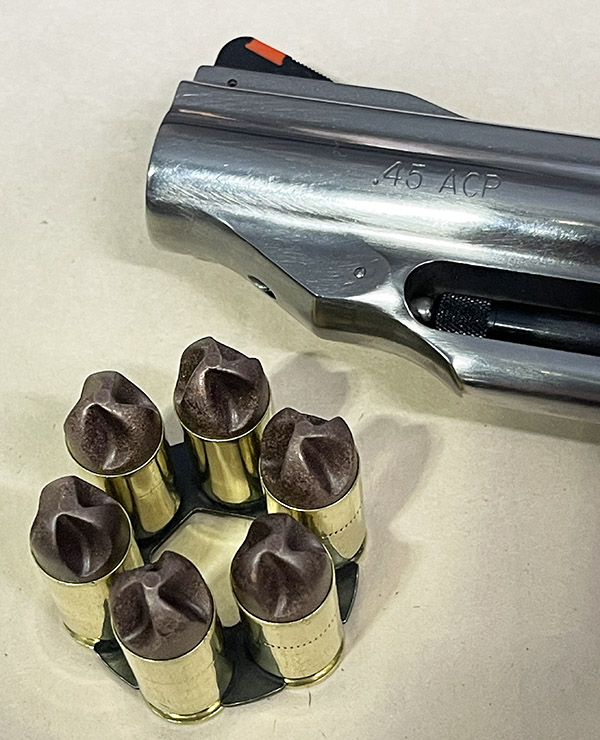
Another 6 ARX rounds in a star clip and the Model 625.

Here’s the bottom line:

      • The ARX composite bullets are not quite as accurate in my revolvers as they were in the 1911 with two different loads.  The groups were good (as you’ll see in the photos below), but they weren’t as good as they had been in the 1911.
      • Both revolvers shot low at 30 feet.  The 625 shot about 3 1/2 inches below the point of aim.  The 1917 shot about 5 inches below the point of aim.  In the 1911, the .45 ACP ARX load was spot on, putting the shots right where I aimed.

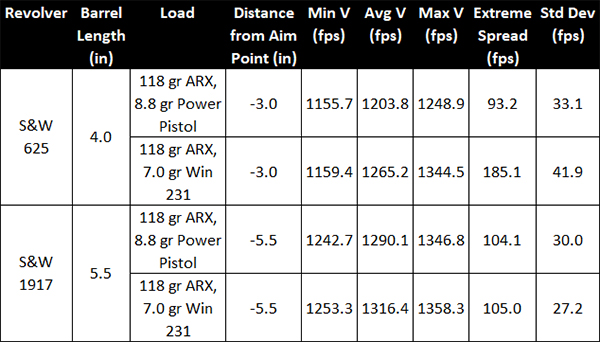
Here’s the relevant load and chrono data:

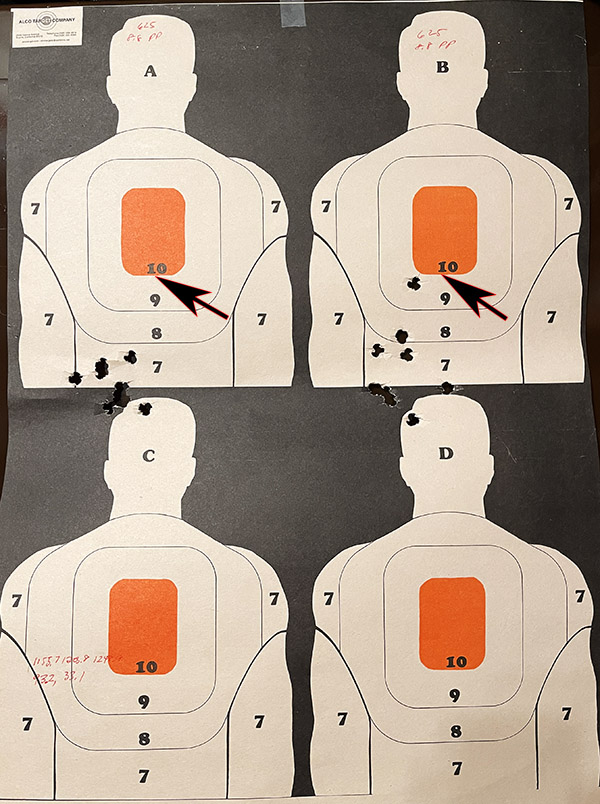
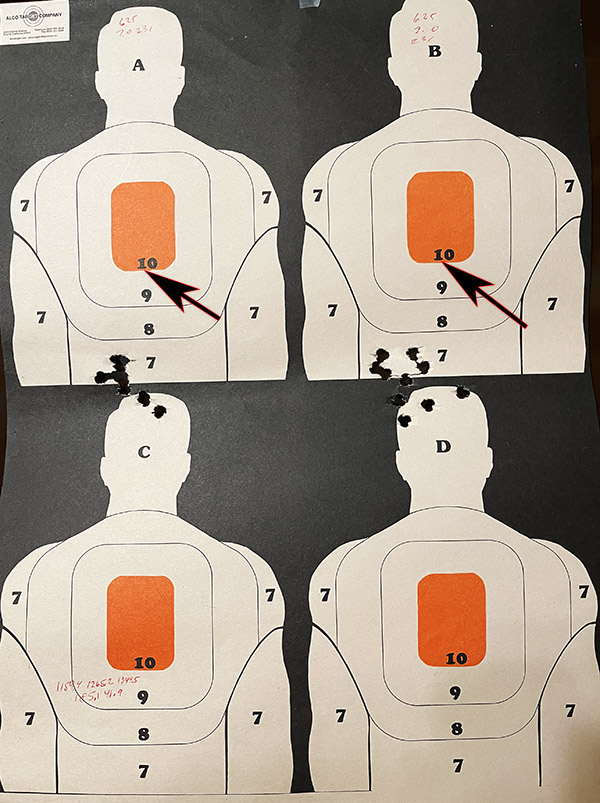
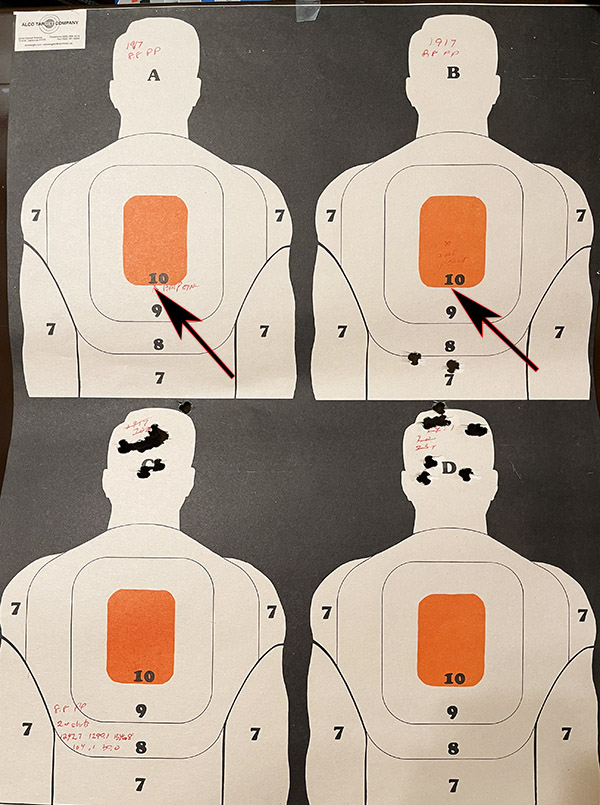
And here are the targets I shot with each revolver and the two different loads.  First, the Model 625 targets:

The aim point on this target was the 6:00 position on the upper orange bullseyes (as it was for all the targets shown here). The bullets hit 3 1/2 inches low. This is the target with the 8.8-grain Power Pistol load. The groups were nothing to write home about.
The Model 625 put the 7.0-grain Winchester 231 load in the same spot as the 8.8-grain Power Pistol load. The group sizes were about the same.

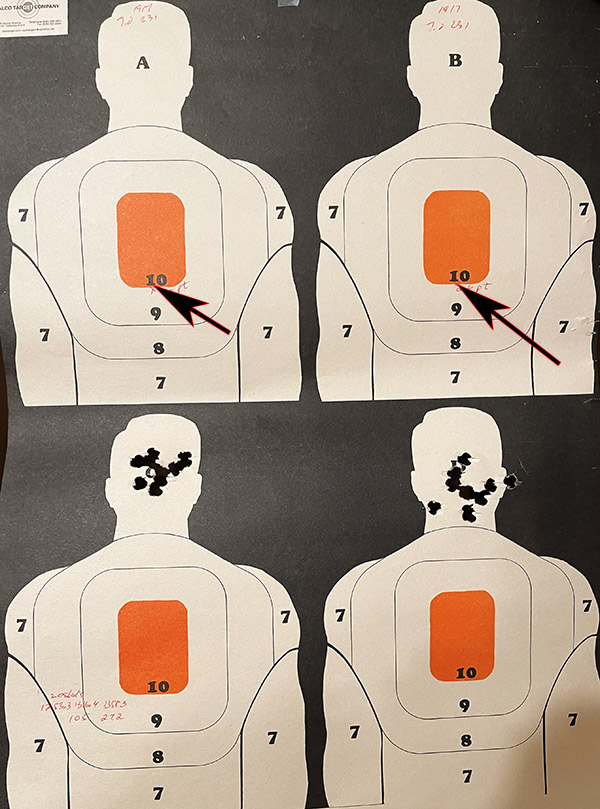
The next two photos show the 1917 targets:

The 1917 group with the 8.8-grain Power Pistol load was about 5 inches low.  I wasn’t trying for head shots.
The 1917 seemed to like the 7.0-grain Winchester 231 load a bit better, but the groups were still the same 5 inches low. As with the above targets, the aim point was at the 6:00 position on the upper bullseye.

As you can see from the above data, velocities from the 1917’s slightly longer 5 1/2-inch barrel were a bit higher than from the 625’s 4-inch barrel.  In the revolvers, the Winchester 231 velocities were higher than the Power Pistol loads (but not by much).  The opposite was true in the 1911.  Group sizes maybe were a bit better with Winchester 231 in both revolvers, but not as good as with the 1911.  The 1917 has fixed sights, so my only option there is to hold higher on the target.  The 625 had adjustable sights, but I don’t think there’s enough adjustment to make up for the 3 1/2-inch drop.

One more observation:  Winchester 231 is a much dirtier powder than Power Pistol.  I didn’t notice this with the 1911 comparisons I did earlier, but with a revolver, it’s quite noticeable.

One of the ARX bullets’ principal advantages is they keep the bore clean. There’s no lead or copper fouling.  When shooting any kind of bullet with Winchester 231 in a revolver, though, you’ll get plenty dirty.

In my opinion, the 118-grain ARX .45 ACP bullets are much better suited for the 1911 than they are for a .45 ACP revolver.    That’s my opinion only; your mileage may vary.


So there you have it.  This is our 6th blog on the ARX bullets, and I don’t have any more planned.   I think ExhaustNotes has the most comprehensive evaluation of these bullets you’ll find anywhere on the Internet or in any of the print pubs, and I feel good about that.  I like these bullets, and I really like them in my 9mm Springfield 1911, my 9mm S&W Shield, and my .45 ACP Springfield 1911.  I ordered a bunch of both the 9mm and .45 bullets, and they are what I’ll be shooting for the foreseeable future.

Prior ExNotes ARX bullet evaluations are here:

25 and 50 Yard ARX .45 ACP Results
Winchester 231 and Alliant Power Pistol .45 ACP ARX Results
Dialing In A .45 ACP ARX Load
9mm and .45 ACP ARX Load Testing
ARX Bullets In Two 9mm Pistols


Join our Facebook ExNotes page!

Never miss an ExNotes blog:


Help us keep the lights on:


Don’t forget: Visit our advertisers!


9mm and .45 ACP ARX Load Testing

By Joe Berk

I recently received my order of Inceptor ARX 118-grain .45 ACP bullets. I had previously loaded 9mm ammo with ARX 65-grain bullets and I was pleased with them, so I wanted to try the ARX bullets in the .45, too.

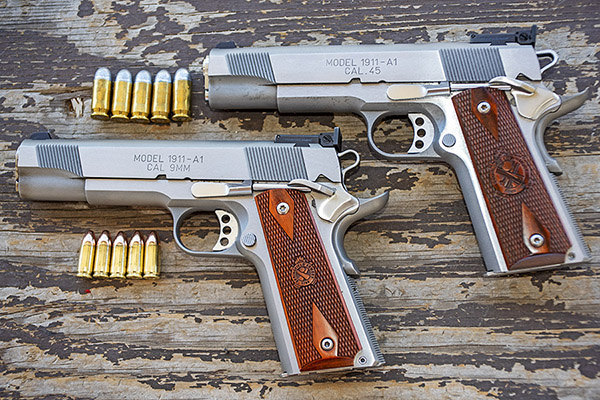
I compared how two 1911s performed on my local indoor pistol range, firing with a two-hand hold (but without a rest) at 10 yards. I used nearly identical 1911 Springfield target pistols, one in 9mm and the other in .45.  The .45 1911 is as it came from the factory; this gun has had no custom work done to it other than installing a one-piece guide rod.  The 9mm 1911 had the same one-piece guide rod, along with other custom touches by good buddy TJ at TJ’s Custom Gunworks.  The 9mm 1911 has a much crisper and lighter trigger, it is an absolute delight to shoot, and it is my favorite handgun.

The two Springfield 1911s used in this test., shown here with cast bullet loads. The testing described herein used ARX composite bullets, as shown in the photo at the top of this blog.

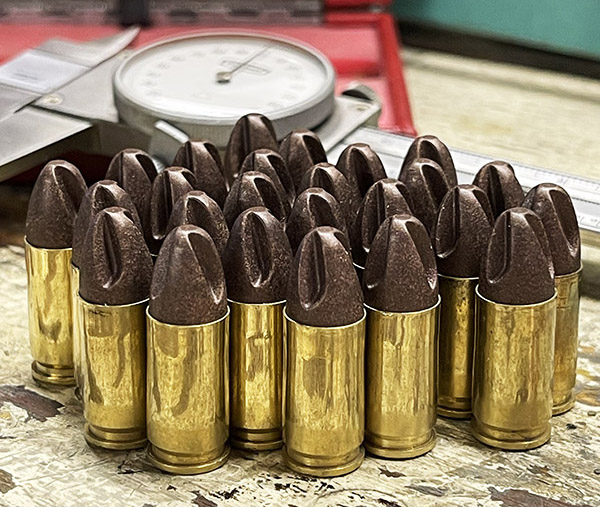
The ARX bullets are different than anything I’ve used before.  They are a mix of copper particles suspended in a polymer matrix.  The ARX bullets are much lighter than cast or jacketed bullets, with consequently dramatically higher muzzle velocities.  They are not marketed as frangible bullets.  They are intended to produce a larger wound cavity and I suppose because of that they could be considered a better defense round.  I’m not interested in any of that.  I’ll never hunt with either a 9mm or a .45, and although I sometimes carry a 1911 chambered in .45 ACP or my 9mm S&W Shield, when I do so it is always with factory ammunition.  Nope, my interested was a result of my buddy Robby gave me a few 9mm ARX bullets and I fell in love with them.  The ARX bullets are less expensive than cast or jacketed bullets and they are accurate.  For a range rat like me, that’s a good deal.

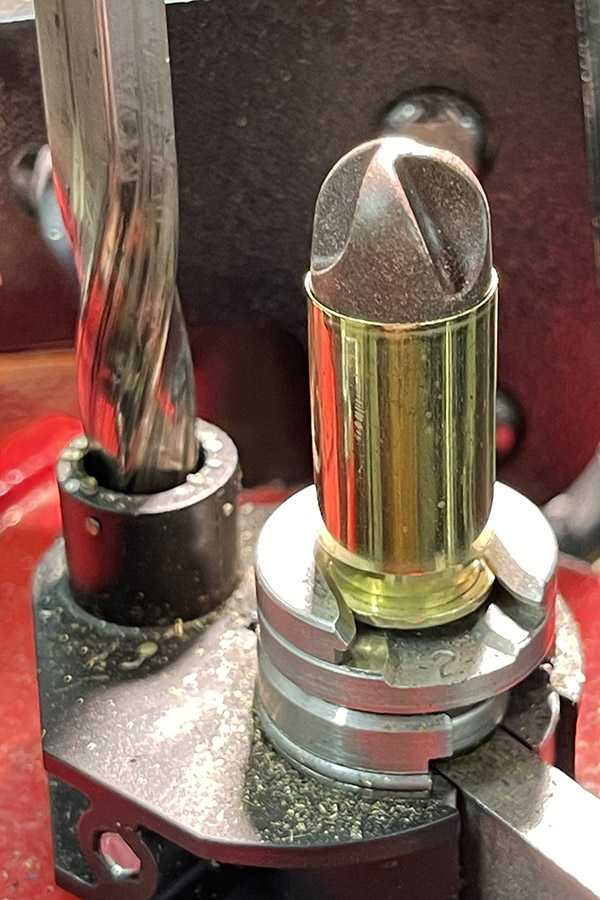
I reloaded all ammo used in this test series with my Lee turret press, a great setup that consistently produces superior ammo. This photo shows a completed ARX .45 ACP round.  Here’s our earlier review of the Lee gear.
9mm 1911 ARX Results

I wrote about my initial impressions with the 65-grain 9mm ARX bullets previously (they were all good), so for this first portion of the comparison there’s not too much that’s new other than this load’s attaining 100% reliability in holding the slide back after the last round.

9mm ammo loaded with the ARX 65-grain polymer composite bullet. After my first trial with these bullets, I ordered a bunch.
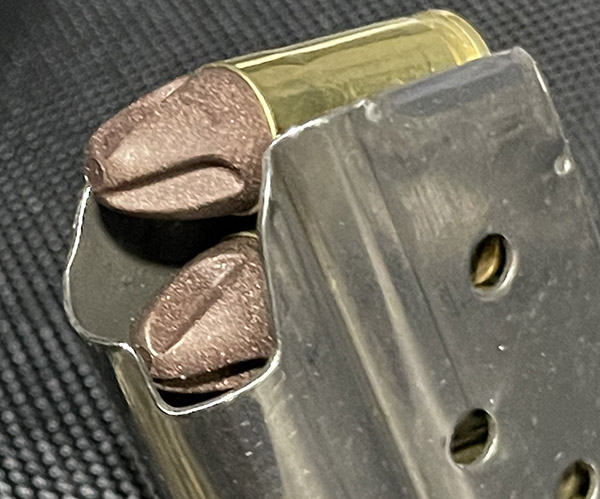
9mm ARX bullets loaded in my 1911’s magazine.

My 9mm load uses 5.2 grains of Winchester’s 231 propellant, with the bullets seated to an overall cartridge length of 1.135 inches. I used CCI 500 primers and mixed brass for the loads you see here (I am lazy and I didn’t want to sort the 9mm brass). I loaded these on my Lee turret press using Lee dies (including the factory crimp die). I took the load data directly from Inceptor’s website.  This load is a max load in their standard load listings (i.e., it is below the +P loads the Inceptor data also lists).

I shot at the Alco four-silhouette target (it has four quarter-sized silhouettes on each sheet), and I sent either 12 or 13 rounds downrange on each silhouette.  That made for a total of 50 rounds on each target.

The Alco Targets 4-silhouette target. I shot 12 rounds at the top left target ,13 rounds at the top right target, 12 rounds at the bottom left target, and 13 rounds at the bottom right target. That top right target is pretty sweet.

The 9mm ARX load functioned perfectly in my 1911. There were no failures to feed or eject and the pistol stayed open after the last shot fired.  This is an accurate load. The flyers are due to yours truly, not the gun or the load.  Maybe if I had sorted the brass they would be a little better, but these are good enough for my purposes.

These 9mm bullets only weigh 65 grains.  They step out sharply, but the recoil is low  (perceptibly lower than what I would feel with a 115 or 124-grain cast or jacketed bullet).  Velocities are high for a 9mm (which are typically in the 1100 fps range with cast or jacketed bullets).  The Inceptor data for my load showed that they achieved 1433fps with 5.2 grains of HP38 propellant (which is the same powder as Winchester 231).   Their results were with a 4-inch barrel.  My 1911 has a 5-inch barrel; I achieved an average velocity of 1626fps, or nearly 200fps faster than what Inceptor achieved in their testing.  To add a little more context to these findings, I previously tested this load in my S&W Shield (which has a 3.1-inch barrrel).  In the Shield, this load averaged 1364fps.  The bottom line?  My results are consistent with the Inceptor load data.

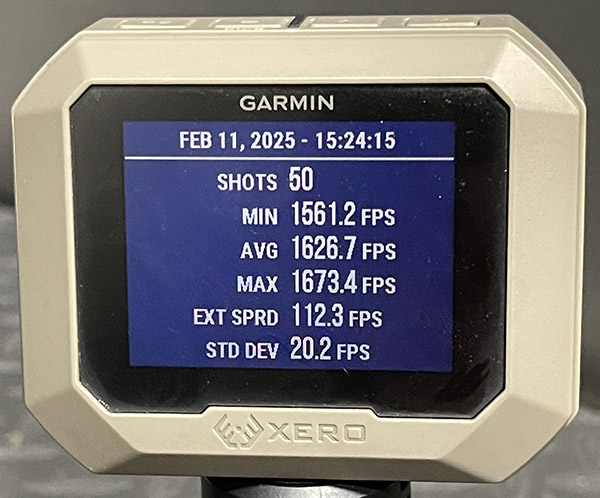
Take a look at the Garmin chrono data for this load in the 1911.

Yikes! These are smoking hot 9mm rounds!

In my prior test of this load in the Springfield 1911 and the S&W Shield, I found that the 1911 would not hold the slide back after the last shot (the Shield didn’t have that problem). In that earlier initial test, I used a two-hand hold and I rested my arms on the bench. I think that might have caused the 1911’s problem with holding the slide open after the last shot. In the range session yesterday, I used a two-hand hold, but I did not rest my arms on the bench (and the gun functioned perfectly, holding the slide open after the last shot on every 5-shot string). The 5.2-grain Winchester 231 load is a good one for the 9mm.  It’s accurate, the recoil is light, and reliability is superb.

.45 ACP ARX Bullet Testing

I next moved on to test the 118-grain ARX bullets in my .45 ACP Springfield 1911.

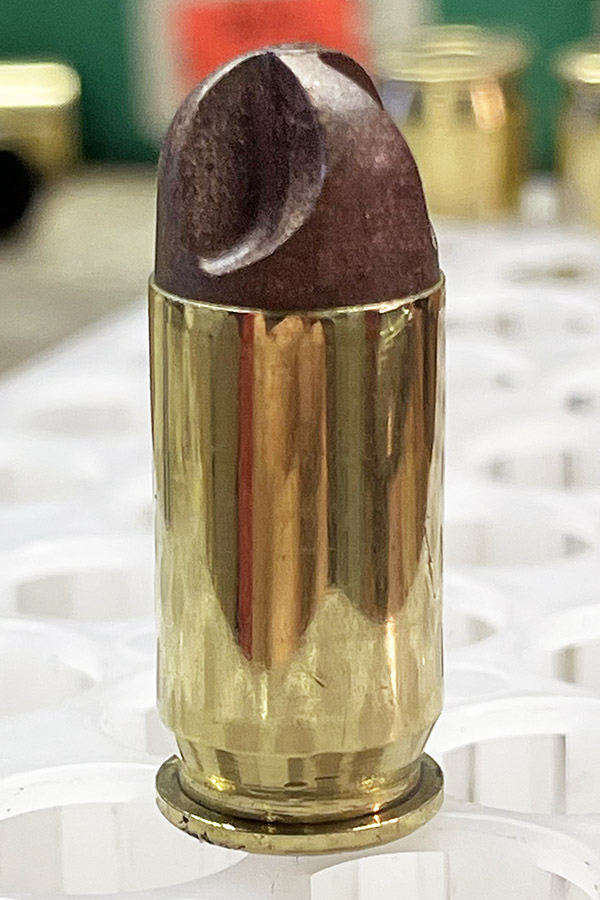
A cartridge that looks like a drill bit! ARX bullets in the .45 ACP make for an interesting and handsome round.

The .45 ACP load used the ARX 118-grain bullet with 9.1 grains of Power Pistol, a Winchester large pistol primer, and Winchester brass, all loaded on the Lee turret press with a Lee crimp die. The .45 ACP load data also came from the Inceptor site. The site lists three powders; the only one I had on hand was Power Pistol.  The 9.1 grains of Power Pistol is at the top of their non+P range. It is not a +P load.  Ordinarily I would not start testing at the top of the listed propellant weight range, and I probably shouldn’t have done so here (more on that a paragraph or two down).

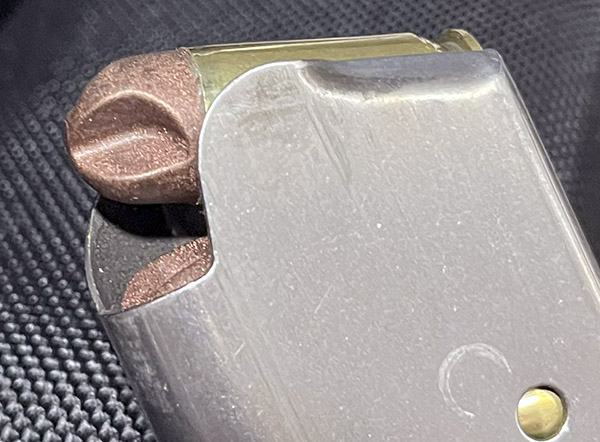
.45 ACP ARX bullets loaded in my 1911’s mag. Everything works. They look cool.

The Inceptor load recommended a cartridge overall length of 1.26 inches. I loaded with a cartridge overall length of 1.250 inches, which is what I have used in all my other .45 ACP loads. That length fits well in the magazine. I don’t think the additional 1/100 of an inch Inceptor specified would cause interference between the ammo and the forward inside magazine edge, but it’s close and in any event, I wanted to stick with the cartridge length that has always worked for me in the past.

The .45 loads felt hot to me. I think that’s primarily because I have been shooting my 9mm handguns lately. A few of the cartridge cases showed a little (very little) primer flattening.  I’m not sure if that was due to firing the round or if it was due to me putting extra effort into primer seating during the reloading process.  The .45 ACP is a powerful cartridge, and when I haven’t shot one in a while, it can seem even more powerful.

Same target, different cartridge. That top left target has 12 rounds through it and it is what I’d like to do all the time. When it happens, it’s its own reward.

Accuracy was about the same as with the 9mm. I thought both were good. There were occasional flyers, but that was undoubtedly me and not the gun or the load. Again, I shot offhand for all of these groups, so I wasn’t expecting one-hole results.

1346fps from a .45 Auto! The chrono tells the story!

Velocities were very much higher than what I’ve seen with other bullets in any .45 ACP.  I had previously loaded .45 ACP with all kinds of cast and jacketed bullets ranging from 185-grain wadcutters to 230-grain full metal jacket projectiles.  They would typically see velocities of 700fps to maybe 900fps.  Some folks load the .45 a little hotter than that with cast or jacketed bullets.  I’ve never felt a need to.  But those ARX 118-grain bullets!  Wow!  The Inceptor load data said I would see 1,317fps with 9.1 grains of Power Pistol propellant (and for their .45 ACP testing, Inceptor used a 5-inch barrel); my ammo averaged 1346fps.  Extreme spread and standard deviation were low; both extreme spread and standard deviation were similar to what my 9mm ARX loads achieved.

Feed and ejection were flawless in my Springfield 1911.  That said, I am going to drop the load down to 8.7 and 8.5 grains of Power Pistol and try that for the next load.  If I get good groups and reliable function, that’s where I’ll load in the future.

The Bottom Line

These are good bullets, and I think they represent a huge step forward.  They are the first really new thing to come along in the reloading game in a long time.

Surprisingly, both the 9mm and the .45 put the bullets where I wanted them, with no sight adjustments from my previous lead or jacketed bullet loads. I expected both the 9mm and .45 ACP ARX loads to shoot low, but they did not. The sights were right on the money.

I didn’t see any copper fouling from the bits of copper mixed in the ARX bullets’ copper/polymer matrix. There’s a tiny bit of blue/purple fouling from the bullet polymer, but it’s very minimal and it’s only in the grooves.  I had not cleaned either the 9mm or the .45 1911 after earlier range sessions with cast and plated bullets and the bores were dirty when I started shooting the ARX bullets.  Both guns were cleaner after shooting the ARX bullets than they are after shooting cast or jacketed bullets.  Bore cleanliness is a big plus here.

Price is another advantage; the 9mm bullets are $57/1000 and the .45 ACP bullets are $65/500 (I think the .45 bullet price at $65/100 is an increase from what I paid a couple of weeks ago). I’ve ordered ARX bullets three times now; on all three orders, they did not charge sales tax.  I guess the sales tax is included in the retail price already.  Whatever.  I’m an anti-tax guy.  Whether it’s real or imagined, not paying sales tax is plus in my book.

I’m not going to hunt with either my 9mm or my 1911, but here in California, these bullets should meet our lead-free bullet criteria. Similarly, the bullets are not hollow points.  Some places (San Francisco and all of New Jersey come to mind) have outlawed hollow point bullets.  These bullets should be okay in places where hollow points are outlawed.

I’ll be ready. Will you?

As mentioned near the start of this blog, the drill-bit-like bullet profile creates a much larger wound channel. The idea is that bullet spin allows the bullet to grab onto tissue and propel it outward. There are some YouTube videos that purport to show this in ballistic gelatin. I suppose if you were defending yourself against a bad guy made of ballistic gelatin (think Steve McQueen and the 1958 classic, The Blob) these would be the preferred bullet.  None of that matters to me, and from a defense perspective it’s probably moot (especially with the .45).   Dead is dead, and with a .45, I’m guessing a larger wound channel won’t make a bad guy any deader.  My interest is in how well the ARX bullets shoot on paper, and they do that extremely well.


Join our Facebook ExNotes page!

Never miss an ExNotes blog:


Help us keep the lights on:


Don’t forget: Visit our advertisers!