DKC 147-grain 9mm Full Metal Jacket Bullets

By Joe Berk

Here’s the bottom line upfront: Don’t expect stunning accuracy from DKC’s  9mm bullets.

I bought 1000 of them from Raven Rocks after watching a YouTube video about FBI handguns and ammunition, in which an FBI ballistics expert explained why the FBI uses 147-grain bullets in their 9mm Glocks. The YouTube fellow didn’t specify which 147-grain bullet the FBI uses, although a friend later told me it’s the Speer Gold Dot. The DKC bullets I bought were cheap at $98 per 1000, and my testing showed why.  You get what you pay for.  Sometimes.
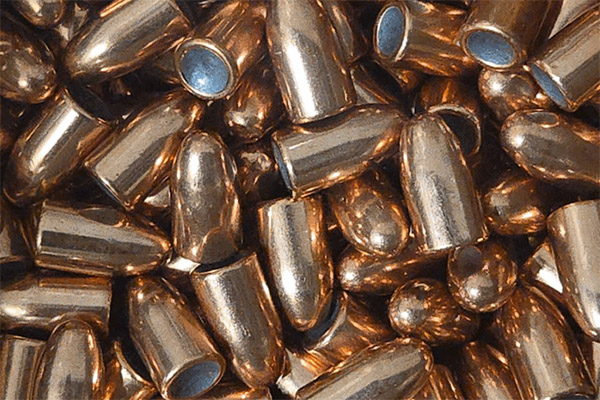
Full metal jacket, 147-grain, 9mm DKC bullets.

DKC is relatively young Turkish ammunition and reloading components manufacturer.  One of their importers is Raven Rocks here in the US.  I’ve ordered components from Raven Rocks before (in particular, their composite 9mm and .45 bullets) and I’ve been pleased with the results.  I was hoping the same thing would happen with these 9mm full metal jacket bullets, but it was not to be. Win some, lose some.

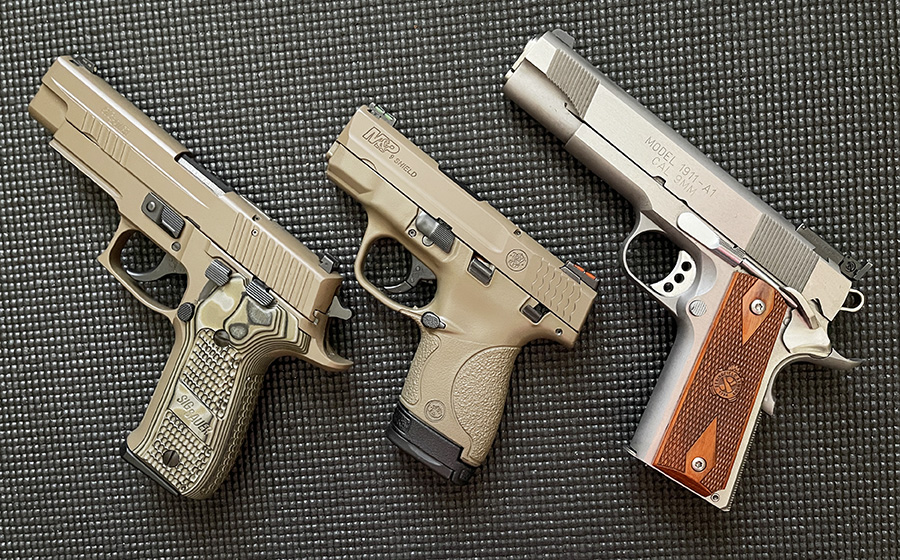
I fired my 9mm DKC bullet handloads at the West End Gun Club using the 147-grain full metal jacket bullets.  I tested the bullets in three different handguns (a Springfield 1911, a SIG P226, and a S&W Shield), with a light load and a heavier load for each of four different propellants (Red Dot, Bullseye, Unique, and Power Pistol).  For the initial accuracy testing, I shot two 5-shot groups at 50 feet for each configuration.

How did the new bullets do?  All the 50-foot groups were disappointing from an accuracy perspective. A few of the groups dipped below 2 inches, but most were above (and some well above), and at 50 feet, that’s not the kind of accuracy I’m used to.  Here’s how it shook out:
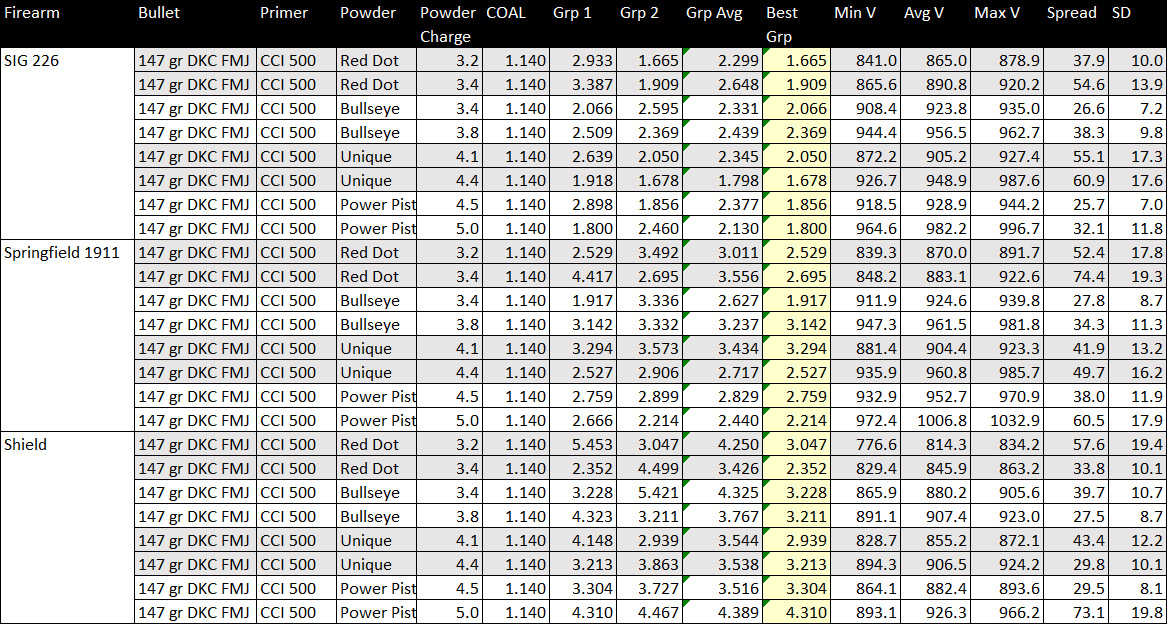
The results. I fired 400 shots in total for this blog’s test series. I used my Garmin Xero to chronograph the velocities.   Click on the table to make it bigger.

The above table is data intensive and correspondingly small (ah, if only my groups were the same).  If you click on the table, it will open in a new window and be a little easier to read.

You can see from the above that the group sizes generally were mediocre to poor. As a point of reference, what I consider good is a group of an inch or less from a 9mm at that distance.  None of the loads I tested met that threshold.

I added a column to show the best of the two groups fired for each load in each pistol (this is highlighted in yellow), thinking that maybe it was my shooting that returned the mediocre groups and this might give a better feel for what worked best.   None of the groups met my 1-inch threshold. I had been h0ped that a few of them would, as had occurred when testing previous 9mm loads (see, for example, A Tale of Two Nines, A 9mm Comparo:  Cast Bullets, and A 9mm Comparo:  Jacketed Bullets).  On the plus side, all the loads functioned all three handguns reliably. There were no failures to feed and no failures to extract.  I guess that’s something.

Surprisingly (especially when considered in light of the mediocre accuracy), the velocity standard deviations were all relatively low, and in some combinations, surprisingly low. Bullseye was generally the winner from a standard deviation perspective, although its low standard deviation did not translate into superior accuracy.

I averaged all groups for each handgun (both high and low loads and the different propellant loads).  Predictably, the SIG returned the best groups overall, and the short-barreled Shield was the worst.  The SIG has always been a stellar performer.
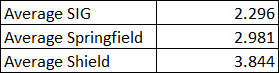
Average group sizes for all loads in each pistol.

I then considered the results across the three pistols to try to select a powder that I could use for all three handguns.  To do this, I averaged the three pistol’s performance with the light Red Dot load, the average performance with the heavy Red Dot load, etc.  Nothing emerged as a significantly better accuracy load, as you can see below.
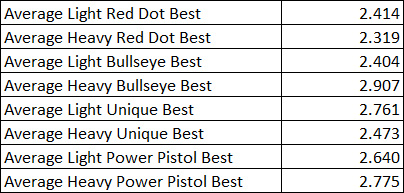
Average group size for different loads across all three handguns.

By this time, the data were confusing me. I was also feeling my age a bit, thinking maybe my old eyes just aren’t what they used to be.

At the end of the session, I had 20 rounds left in each load combination. I fired the heavy loads (for each powder) into each of four targets at 50 feet using the SIG only. By this measure, the heavy Power Pistol load had maybe the best group. I didn’t do the same for the other two handguns.  The Power Pistol load had perceptibly heavier recoil, and it averaged over 1000 fps (a lot, I think, in a 9mm 147-grain load). I don’t know if I want to subject an aluminum-framed handgun to a steady diet of this load (see my blog on the Smith and Wesson Model 59).
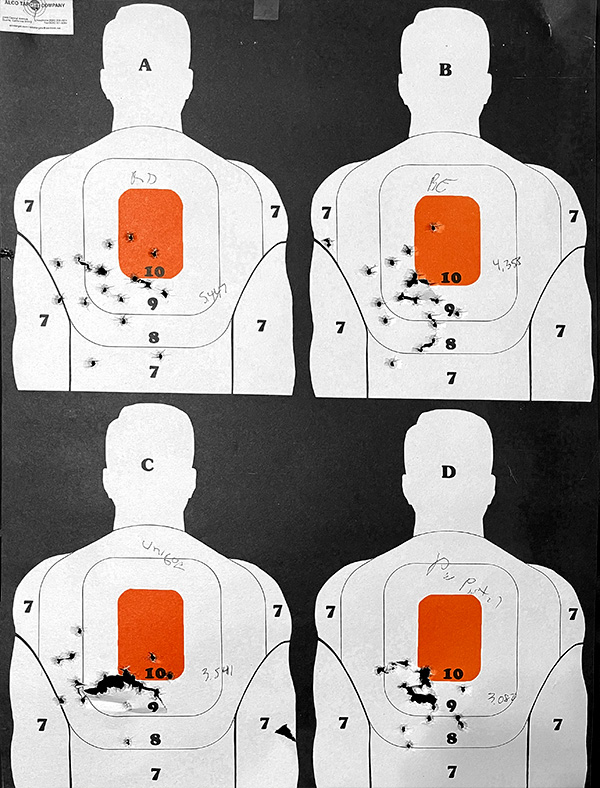
The targets you see above are (clockwise from top left), the heavier Red Dot load, the heavier Bullseye load, the heavier Unique load, and the heavier Power Pistol load. If you eliminate the one or two flyers in each group, there’s not a lot of difference between any of the heavier loads.

I also had 20 rounds left for each of the four loads at the lower end of the propellant charges.  I took these 80 rounds and one of the Alco mini-4  silhouette targets to my indoor range.   I again fired all rounds through the SIG, shooting the groups you see below at 10 yards.  Here’s what that target looked like:
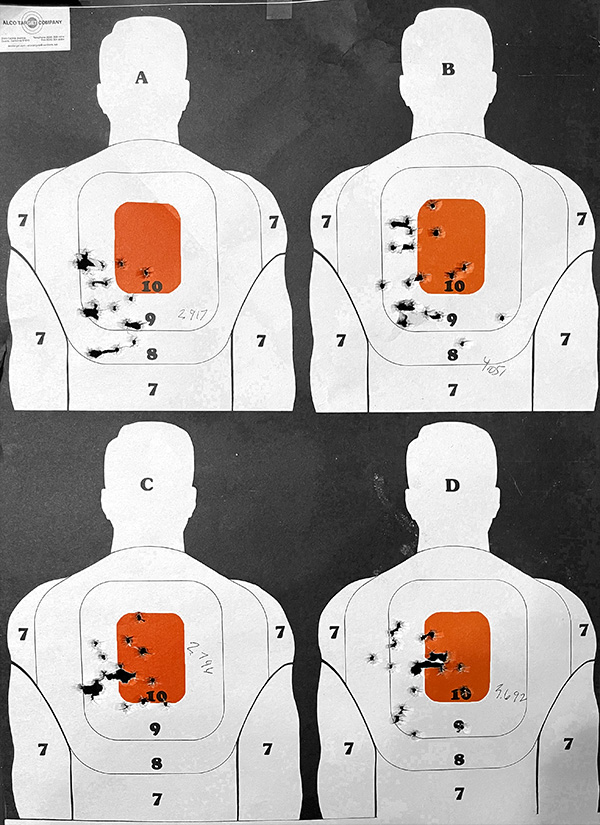
These are targets shot at 30 feet with 20 rounds each of the lighter loads. Clockwise from top left, these were shot with the lighter Red Dot load, the lighter Bullseye load, the lighter Unique load, and the lighter Power Pistol load.

The experimental design for the lower and higher load comparisons with the SIG you see above would probably earn a failing grade from a competent statistics professor.  The sample size is too small, I shot at different distances for the higher-level loads versus the lower-level loads, and I probably broke one or two other statistics rules.  That notwithstanding, here’s a summary of what the group size data looks like:
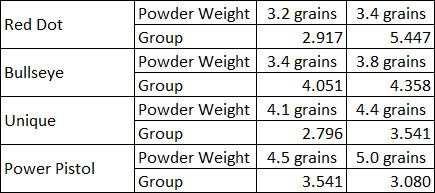
Data from the above two targets summarized in tabular form.

Where’s all this going?  The bottom line is none of the results were anything to write home about.  Why, I wondered?  Other 9mm loads had done significantly better.

To further assess why my results were as mediocre as they were (and recognizing but not fully accepting that 100% of the mediocrity could have been due to me, the shooter), I next evaluated the bullets themselves. The first parameter I measured was bullet weight. In a random weight sample of 20 DKC 147-grain 9mm bullets, here are the weights I recorded (all weights are in grains):
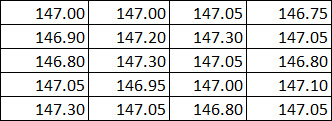
Weights for 20 of the DKC 147-grain 9mm bullets.

That first bullet was right on the money at 147.0 grains, so I thought these would prove to be good bullets from a weight variability perspective. But I was wrong, as the remaining measurements above showed. Here are the particulars on weight variability:
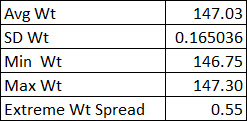
Bullet weight variability parameters.

I think that half a grain weight variability (0.55 grain, to be exact) is a lot for a jacketed pistol bullet.  I would have expected the weight to be within ±0.1 grain, so an extreme spread of 0.55-grain is not good.  It’s also not likely that the weight variability is symmetric to the bullets’ axes, which further aggravates the problem.  As the bullet spins, any weight asymmetry will induce larger group sizes.

That had me wondering about bullet diameter. After zeroing my calipers, I measured the diameter of 10 bullets. Note that these are stated by the supplier to be 0.355 inches, which is what I would expect on a 9mm jacketed bullet. Here’s what I found:
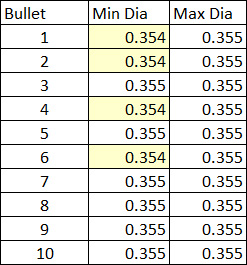
0.355 inches in diameter? Guess again, Bullet Boy!

Damn! Four of the ten bullets I measured were out-of-round by 0.001 inch (these are Bullets 1, 2, 4, and 6), and where this occurs, they are undersized. Small wonder the group sizes were not that good. The undersized bullets would have rattled down the bore, with perhaps some propellant gas sneaking around their periphery.   I think the reason the hotter Power Pistol loads did a little better is the higher chamber pressure probably deformed the bullet to fill the bore better.

Here’s the bottom line from an old ordnance engineer: These bullets are (ah, what’s that ordnance technical term again…oh yeah, I remember): MAB (or mediocre, at best). They are cheap at $98/1000, but in retrospect, they are at best plinkers, nothing more.   Maybe I’m expecting too much.  Maybe a 9mm handgun just won’t group that well with a 147-grain bullet.   I don’t think that’s it, though.  I’ve done better with other 9mm 147-grain bullets.

I relayed the above results to a few of my buddies and one of them asked me if he could have some of the DKC bullets because, as he put it, he is more of a plinker than a wannabe ballistics engineer (like yours truly).  Done and done, I immediately answered.  Then the question becomes:  How should I load the rest of these bullets?  I still have several hundred left.

I realized this would not be a decision based on accuracy, as none of the different recipes I tried resulted in impressive accuracy.  I don’t need big time penetration and I don’t need high velocity, as I’m not an FBI agent preparing for a rerun of the Miami gunfight.  I decided I would go with a load that offered:

      • A low velocity standard deviation (which held at least a promise of better accuracy).
      • Reliable performance.
      • Lower recoil.
      • A load that was adequate (if not stellar) across all three 9mm handguns.

Any of the loads I tested with the 147-grain DKC bullets meet the above criteria, so the choice came down to which powder I had the most of on hand.  That made it easy.  I’m going with the lower Red Dot load of 3.2 grains.  That will give me just under 900 feet per second from the 1911 and the 226, and just over 800 feet per second in the Shield.  That’s as good as or better than a .38 Special with a comparable weight bullet, and the .38 Special is a great cartridge.  I’ll be flush with these 9mm handloads for a while, and then I won’t buy any more of the 147-grain DKC bullets.


More gun stuff?  You bet!

We need your support!  Do what you can to help ExNotes stay in the black!



More Huber? Check out A Trip Into The Moment.

More Gresh and Berk?  You bet!  Check out A Cup O’ Joes!


Join our Facebook ExNotes page!

Help us keep the lights on:

Getting into Reloading

You’ve thought about reloading, you’ve read stuff from us and others about the benefits of reloading, and you want to do it.  But how?

Hey, I was born into it.  My Dad was a reloader and I had a pretty good idea what to do when I wanted to start, but the urge to do so didn’t hit until I was a young guy in the Army at Fort Bliss.  I was lucky.  The guy who ran the Fort Bliss Gun Club (Roy Johnson) had a room set up for just that purpose and he walked me through the process some 50 years ago.  But Roy has gone on to his reward, you’re probably not stationed at Fort Bliss, and you want to get into the game.   That’s what this blog focuses on, and in particular, the equipment you’ll need to get started.

Inside the Fort Bliss Gun Club. This is a fabulous place where I spent a lot of time as a young Army dude. Next time I’m in El Paso you can bet I’ll stop in again.

Reloading Advantages

There are three advantages to reloading:  Cost, accuracy, and availability.

Generally, reloaded ammo costs less than factory ammo, and in some cases (especially for more exotic rifle ammunition), the savings are huge.   For example, factory .416 Rigby ammo costs $170 for a box of 20 rounds; I can reload .416 Rigby ammo for well under a buck a round.

From an accuracy perspective, reloading is the only way to go.  You can tailor a load to a particular firearm by varying bullet type, bullet seating depth, crimp, powder type, powder charge, brass, and primers to arrive at a combination that delivers superior accuracy (and it’s fun doing this).  I have rifles that shoot 3-inch groups at 100 yards with factory ammo; with my custom reloads, I can get half-inch groups.

Today, if you reload and you’ve laid in a good stock of components, you can reload your way through any ammo shortages.  Nobody has .45 ACP, 9mm, or .223 ammo in stock right now; I have enough components on hand to reload thousands of rounds.  I’m on the range two or three times a week enjoying my shooting hobby while other folks are online whining about not being able to buy ammo.

What You Will Need

The things you will need to start reloading fall into two categories:  The reloading equipment, and the reloading components.  The reloading components are the things that combine to bring an empty brass cartridge case back to life (that includes the bullets, the propellant, and the primers).  The reloading equipment includes the gear you need to take the components and turn them into a ready-to-fire cartridge.

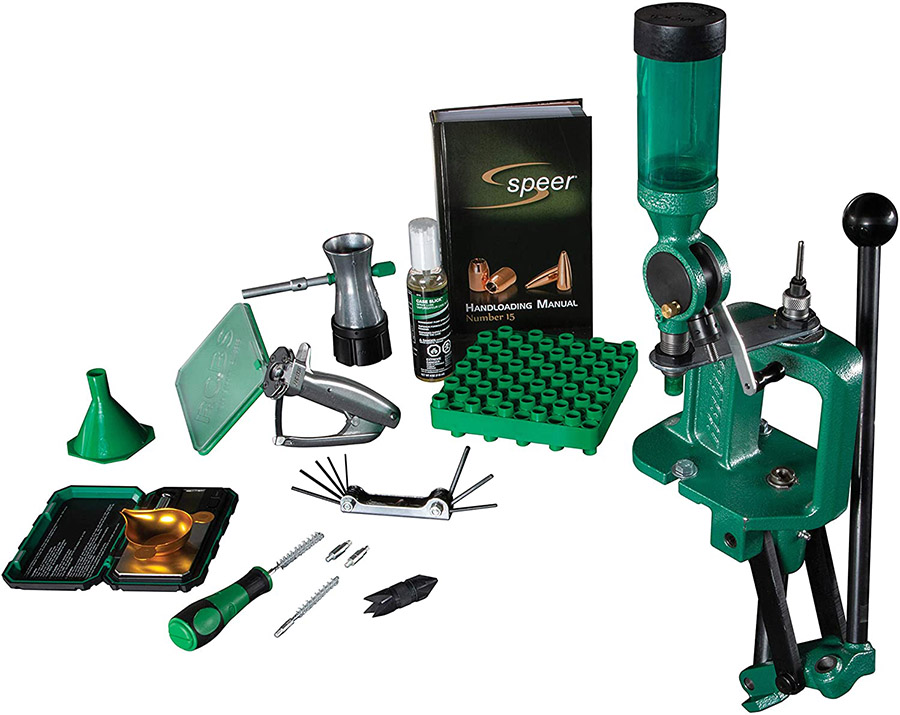
If you want to get into the reloading game, I believe the best way to do so is to buy a complete equipment reloading package from one of the suppliers like RCBS or Lee.  That’s the RCBS kit shown in the big photo above.  I’ll talk about it, the Lee kit, and a couple of others further down in this blog.   First, let’s review each bit of gear.

The Reloading Press

That’s the lever-operated press that accepts the dies (more on that in a second) for reloading your ammo, and sometimes the press includes a mechanism for seating primers in the cartridge case after the old primer has been removed.  In other cases, a separate priming tool is used.   Presses are offered by RCBS, Lee, Lyman, Hornady, and other companies.

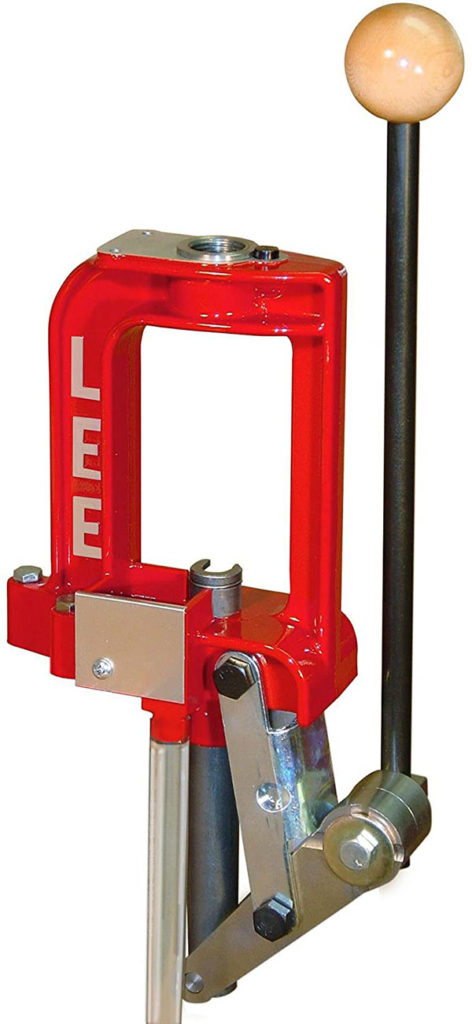
The Lee Challenger press. It’s a decent unit at a decent price, and an ideal way to get started in reloading.

Dies

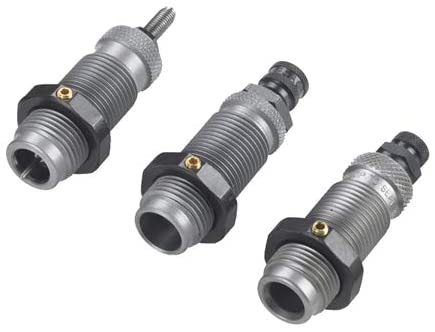
The dies are cartridge specific.  For handgun cartridges, the die set usually includes three dies; for rifle cartridges, the die set usually includes two dies.  The good news is that die threads are pretty much standardized, and every company’s dies will fit every company’s reloading press.  In other words, if you buy Lee dies, they’ll work on an RCBS press.  If you buy RCBS dies, they’ll work on a Lee press.  Dies are offered by several companies, with the most popular brands being Lee and RCBS.

A three-die pistol set from RCBS.  The first die knocks out the old primer and resizes the fired case.  The second die flares the case mouth to accept a new bullet. The third die seats the new bullet and, if you want, crimps the bullet in place.
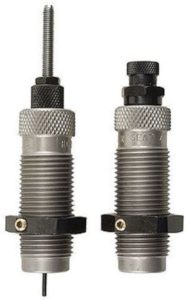
An RCBS two-die rifle set.  The first die knocks out the fired primer and returns the case to its original dimensions.  The second die seats the bullet and, if desired, crimps it in place.
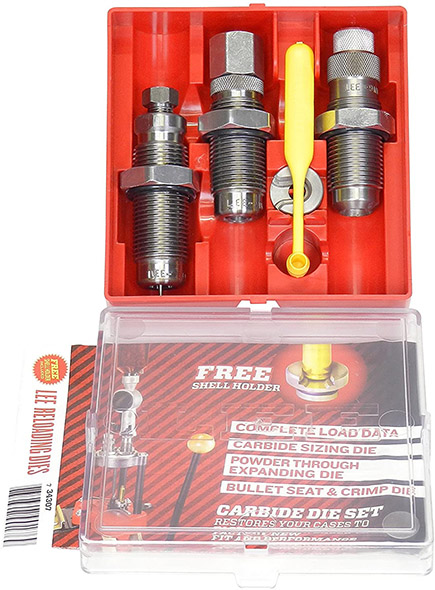
A three-die pistol cartridge set from Lee Precision. Lee includes the shell holder with their die sets.

Shell Holder

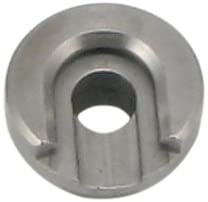
You will need a shell holder for the cartridges you wish to reload.  That’s the piece that holds the cartridge case in place so the press can push it up into the die and then extract it from the die.  RCBS does not include the shell holder with their die sets (so you’ll need to buy RCBS shell holders separately); just about all other die makers do (when you buy their dies, the die set includes a shell holder for that cartridge).

A shell holder. You need to buy these separately if you buy RCBS dies.

A Powder Dispenser

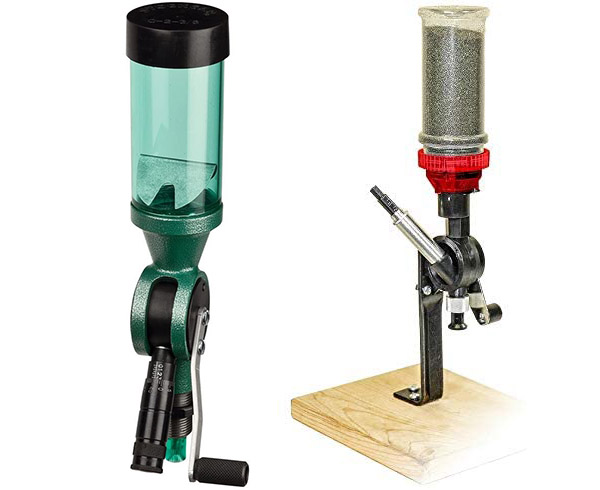
This is a device for dropping a precisely-metered powder charge into each cartridge case.   There are fancy (read: expensive) electronic powder dispensers, but you don’t need those to get started and a lot of folks (myself included) don’t like them.  A simple mechanical dispenser will work fine (as mine has been doing for 50 years).  Both RCBS and Lee offer good powder dispensers; the Lee is substantially less expensive.

An RCBS powder dispenser on the left, the Lee powder dispenser on the right.

A Powder Scale

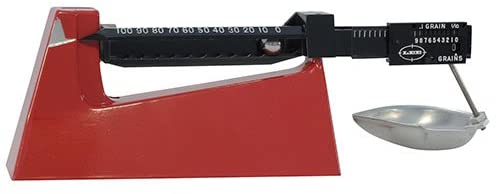
This is a simple balance beam scale to allow you to measure the weight of the propellant charge and adjust the powder dispenser to throw that charge.  There are electronic scales, too, but they add complexity and considerable expense where none is required.  Again, the dominant brands are Lee and RCBS.

A simple Lee balance beam reloading scale. These scales can measure to a tenth of a grain.

Cartridge Trays

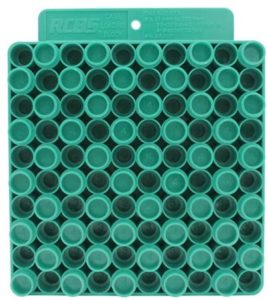
When we reload, we use a cartridge tray (to hold the cartridges as we work through the process of reloading).  A variety of manufacturers offer these.

An RCBS cartridge tray. These are available from several manufacturers. I’ve been using mine for nearly 50 years.

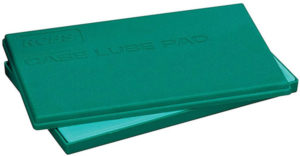
A Case Lube Pad

This is a simple foam pad.  You put case lube on the pad and roll the brass cases on it to lubricate the exterior prior to running them through the resizing die (the first die used in the reloading process).  If you have a straight wall pistol cartridge, you can buy tungsten carbide dies that don’t require lubing the cartridge cases.  If you’re going to reload 9mm, .38 Special/.357 Magnum, .45 Auto, or .45 Colt, my advice is to spend the few extra bucks and get the carbide dies.

An RCBS case lube pad. You put a bit of case lube on the pad and roll the brass on it to lube the cases prior to running them through the resizing die.

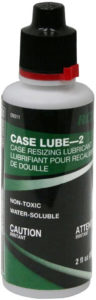
Case Lube

This is the lube used as described above.  To mention it again, if you’re going to reload straight wall pistol cartridges and you buy tungsten carbide dies, you won’t need case lube (or the case lube pad).

RCBS case lube.

Alternatively, you can buy spray-on case lubes, which eliminate the need for the case lube pad.  I’ve tried spray-on case lubes and I prefer using the pad and case lube instead.  Other reloaders like the spray-on approach better.

A Primer Seating Tool

Some reloading equipment companies incorporate a primer seating tool in their press; others offer separate primer seating tools.  I have an RCBS press that came with the primer seating tool, but I like using a manual hand priming tool instead.  Several manufacturers offer these; I use one from Lee.

The Lee hand priming tool. These work well. You can feel each primer seating and better control seating depth with these hand priming tools.

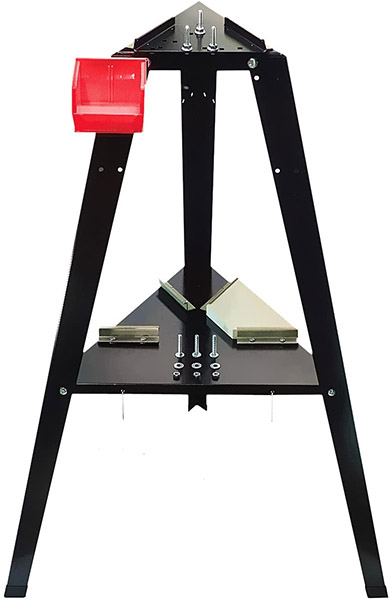
A Bench

You may already have a sturdy workbench where you can mount the reloading press; if not, there are reloading-specific benches available.

A Lee reloading bench. These work well if you don’t have a workbench for mounting your press.

A Reloading Manual

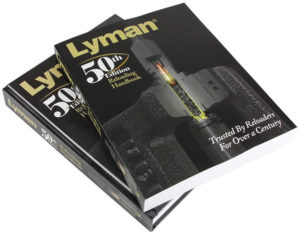
There are several available, including the excellent offerings from Sierra, Speer, Hornady, and Lyman.  Don’t think you can skip this; a good reloading manual is a must-have item for any reloader.  They all explain the reloading process at the beginning, and they include safe recommended load levels for nearly all cartridges.  I’ve acquired several reloading manuals over the years and they are all good; my favorites are the ones from Lyman.  Others are published by bullet manufacturers (these include the manuals from Hornady, Speer, and Sierra) and those manuals include loads only for their bullets.  The Lyman manual is more generic.  But like I said, they’re all good.

I have reloading manuals going back 50 years. The Lyman manuals are probably the best.

That’s the reloading equipment.  In addition to that, you’re going to need the ingredients for the cartridges you want to reload.  That includes the brass cases, the bullets, the powder, and the primers.

Brass Cartridge Cases

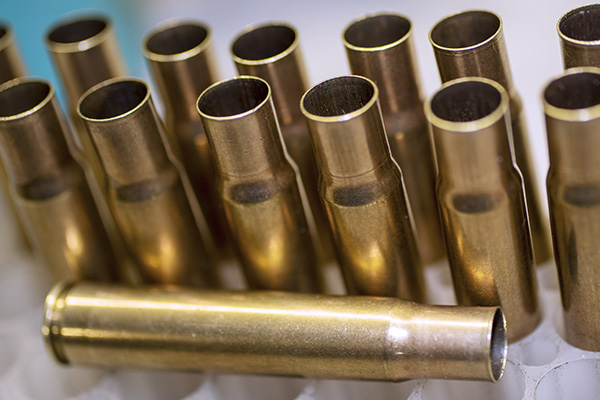
You can buy virgin brass online, you can buy once-fired brass at the range or at most gunstores, or you can do like most of us have done:  Save your brass when you shoot factory ammo and reload it.

.35 Whelen brass waiting to be charged with propellant.  This ammo costs $43 for a box of 20 factory rounds (and you can’t find anybody who has it in stock right now); I can reload it for under 50 cents a round.

Bullets

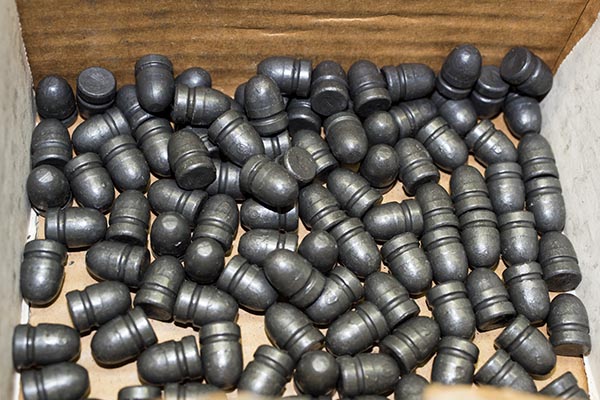
You’ll need bullets to reload your ammo.  There are lots of options here, and they basically break down into either cast or jacketed bullets.  I’m a big fan of cast bullets for handgun and reduced velocity rifle reloads, and I use jacketed bullets for full-bore factory level (high velocity) rifle loads.   Most folks these days order bullets online from reloading suppliers like MidwayUSA, Graf’s, MidSouth, Powder Valley, Natchez Shooting Supplies, and others.  Smaller gun stores are disappearing, and you usually don’t find decent prices at the big chain stores.

Cast bullets waiting to be loaded into .45 ACP cases.

Propellant

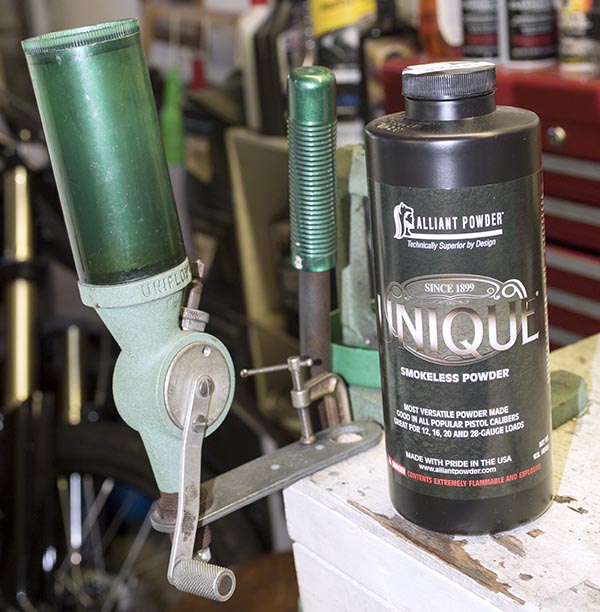
For lack of a better term, we usually call propellants “powder,” and there are a wide variety of powders available.  The reloading manuals show which powders work best for the cartridge you wish to reload.

Unique propellant and my RCBS powder dispenser. The reloading manuals will help you select the powder you need.  Unique is a good general purpose propellant I’ve used for a variety of handgun cartridges and a few cast bullet rifle loads.

Primers

The primer is the component that lights the candle when you pull the trigger.   There are several primer suppliers.  The trick today is finding them, as there has been a run on primers since the pandemic began.  If you can find primers in a local shop, buy them.  The same suppliers listed above for bullets also sell primers (they are all out of stock now, but that will change as supply catches up with demand).

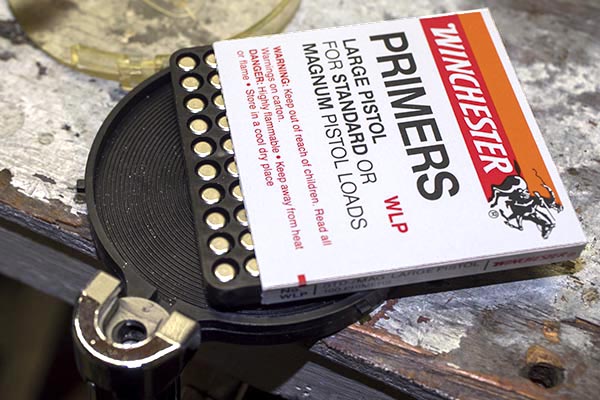
Winchester primers being loaded into my Lee hand priming tool. Other primer makes include Remington, CCI, Federal, and a few more.

The Best Equipment Approach:  A Complete Kit

As I mentioned at the start of this blog, I believe the best way to get into the game is to buy a complete equipment reloading package from one of the reloading equipment suppliers.   My advice if you are a new reloader is to go with the Lee package.  It’s the least expensive and if you decide that reloading is not for you, you’ve minimized your cash outlay.  I should add, however, that I don’t know anybody who ever tried reloading who didn’t get hooked on it.  It is a marvelous hobby, and I believe it is as much fun as shooting.

I’ve used reloading equipment over the years from all the manufacturers.  My personal setup is centered around an RCBS Rockchucker, but equipment from any of the suppliers is good.  Basically, you can’t go wrong in this game from an equipment perspective.  With that said, let’s take a look at what’s out there.

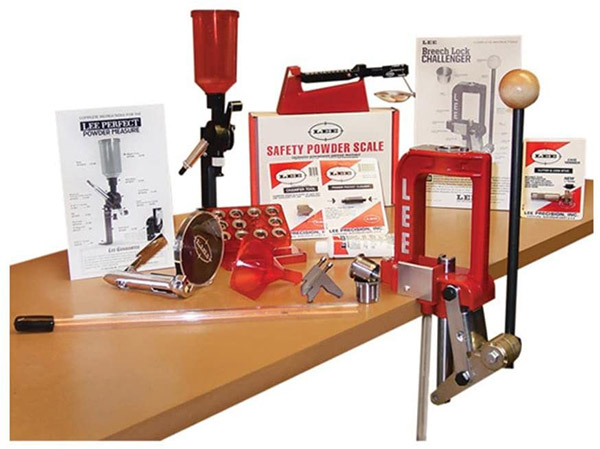
First, the Lee Challenger reloading kit:

The Lee Challenger reloading kit. These were sold out on Amazon (and everywhere else) when this blog was published. Keep an eye on the Amazon site; it’s a good place to order the kit.

There’s only one problem with the Lee Challenger reloading kit:  It’s such a good deal (well under $200 for the entire kit) that literally everyone is out of stock right now.  As you know, we’re going through unprecedented times in the shooting world (guns, ammo, and reloading components are sold out due to the civil insurrection in many large cities, a new anti-gun administration on the horizon, and the global pandemic).  That will change, but at this instant, no one I could find has the Lee kit in stock.

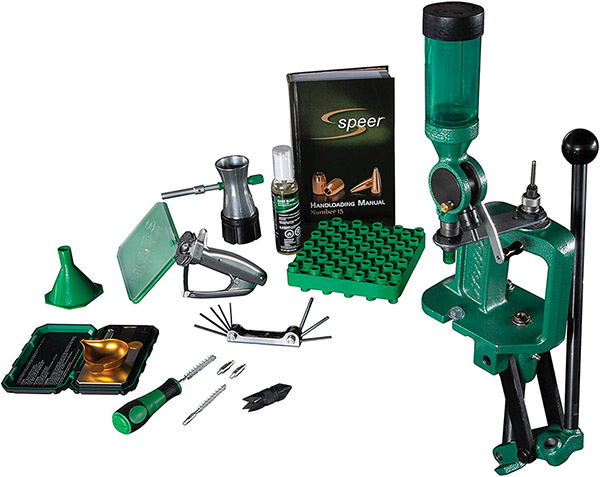
Next up is the RCBS kit:

The RCBS reloading kit. RCBS makes high quality equipment that will last a lifetime. It costs more, but it’s worth it.

I’ve been using RCBS equipment for the last 50 years, and I believe it to be the best.  It is built to last.  If I couldn’t get the Lee package as a newbie, or if your budget will allow it, I’d go with RCBS equipment.  At about $400, it’s just over twice the price of the Lee kit, but it’s still a great deal compared to buying all the different equipment items separately.  The RCBS package shown above includes an electronic scale instead of a beam scale, a powder trickler (it allows you to finesse adding individual powder kernels to attain a precise charge weight), and a couple of case preparation tools that the Lee kit doesn’t include.

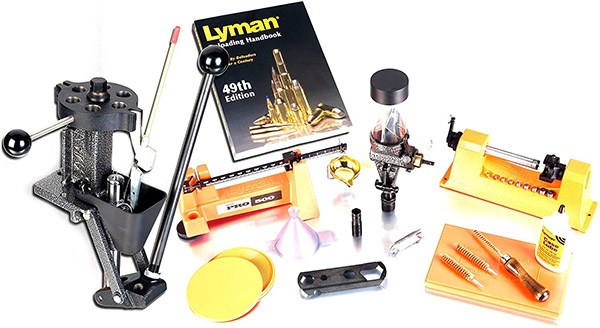
Lyman is another outfit offering a complete reloading kit:

Lyman’s reloading equipment package.

What’s a bit different about the Lyman kit is that it comes with a turret press, which allows you to mount all the dies in the press head and rotate them as you progress through the various reloading steps.  I’m not a big fan of this approach; other folks are.  The Lyman kit is just under $1000; the turret press and the inclusion of a case trimmer are what drive the price to that level.

And Hornady has a kit as well:

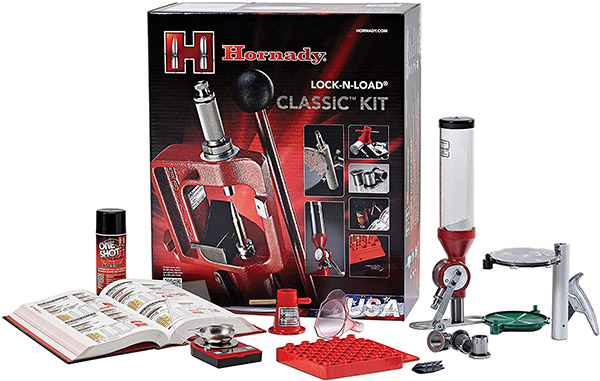
Hornady’s reloading package. I have the least experience with Hornady reloading gear, and I’m not wild about their dies. Hornady bullets are fantastic.

The Hornady kit is about $550.  That’s substantially less than the Lyman kit, but more than either the Lee or the RCBS kits.

So there you have it.  Remember that no matter which reloading kit you buy, you’ll still need dies and a shellholder specific to your cartridge.  You’ll probably want to purchase more equipment as your reloading interest develops, including more dies (so you can reload more calibers), case cleaning and polishing accessories, a micrometer, and more.  But what we’ve outlined here will get you started and keep you in the game for years.


In this blog we’ve covered the equipment you’ll need to get into reloading.  If you would like to read about how to use this equipment, we have you covered there, too.  We have a bunch of information on reloading various cartridges on our Tales of the Gun page, and a complete series on reloading handgun ammo that you can review here:

Reloading .45 ACP Ammo:  Part I
Reloading .45 ACP Ammo:  Part II
Reloading .45 ACP Ammo:  Part III
Reloading .45 ACP Ammo:  Part IV

If you would like to watch a quick video of yours truly reloading ammo with cast bullets for a Mosin-Nagant rifle, check this out:


Never miss an ExNotes blog!