DKC 147-grain 9mm Full Metal Jacket Bullets

By Joe Berk

Here’s the bottom line upfront: Don’t expect stunning accuracy from DKC’s  9mm bullets.

I bought 1000 of them from Raven Rocks after watching a YouTube video about FBI handguns and ammunition, in which an FBI ballistics expert explained why the FBI uses 147-grain bullets in their 9mm Glocks. The YouTube fellow didn’t specify which 147-grain bullet the FBI uses, although a friend later told me it’s the Speer Gold Dot. The DKC bullets I bought were cheap at $98 per 1000, and my testing showed why.  You get what you pay for.  Sometimes.
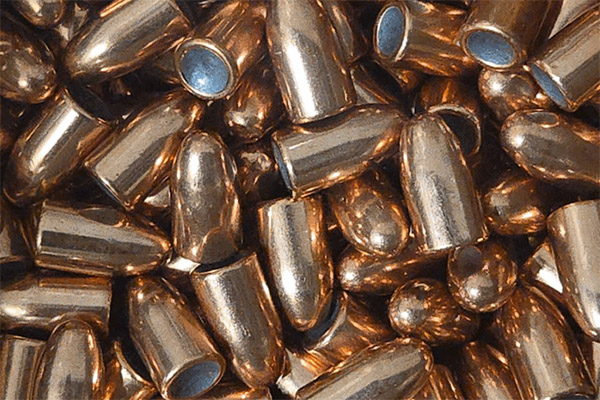
Full metal jacket, 147-grain, 9mm DKC bullets.

DKC is relatively young Turkish ammunition and reloading components manufacturer.  One of their importers is Raven Rocks here in the US.  I’ve ordered components from Raven Rocks before (in particular, their composite 9mm and .45 bullets) and I’ve been pleased with the results.  I was hoping the same thing would happen with these 9mm full metal jacket bullets, but it was not to be. Win some, lose some.

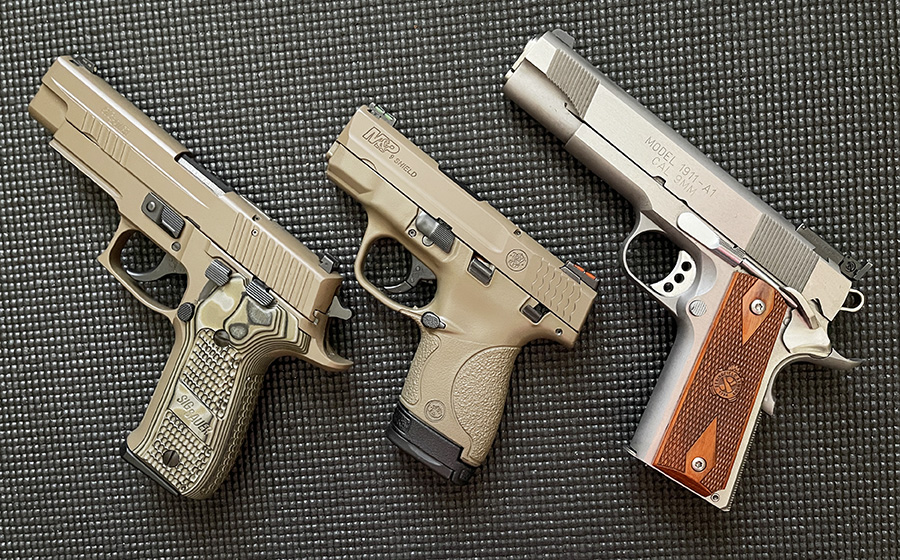
I fired my 9mm DKC bullet handloads at the West End Gun Club using the 147-grain full metal jacket bullets.  I tested the bullets in three different handguns (a Springfield 1911, a SIG P226, and a S&W Shield), with a light load and a heavier load for each of four different propellants (Red Dot, Bullseye, Unique, and Power Pistol).  For the initial accuracy testing, I shot two 5-shot groups at 50 feet for each configuration.

How did the new bullets do?  All the 50-foot groups were disappointing from an accuracy perspective. A few of the groups dipped below 2 inches, but most were above (and some well above), and at 50 feet, that’s not the kind of accuracy I’m used to.  Here’s how it shook out:
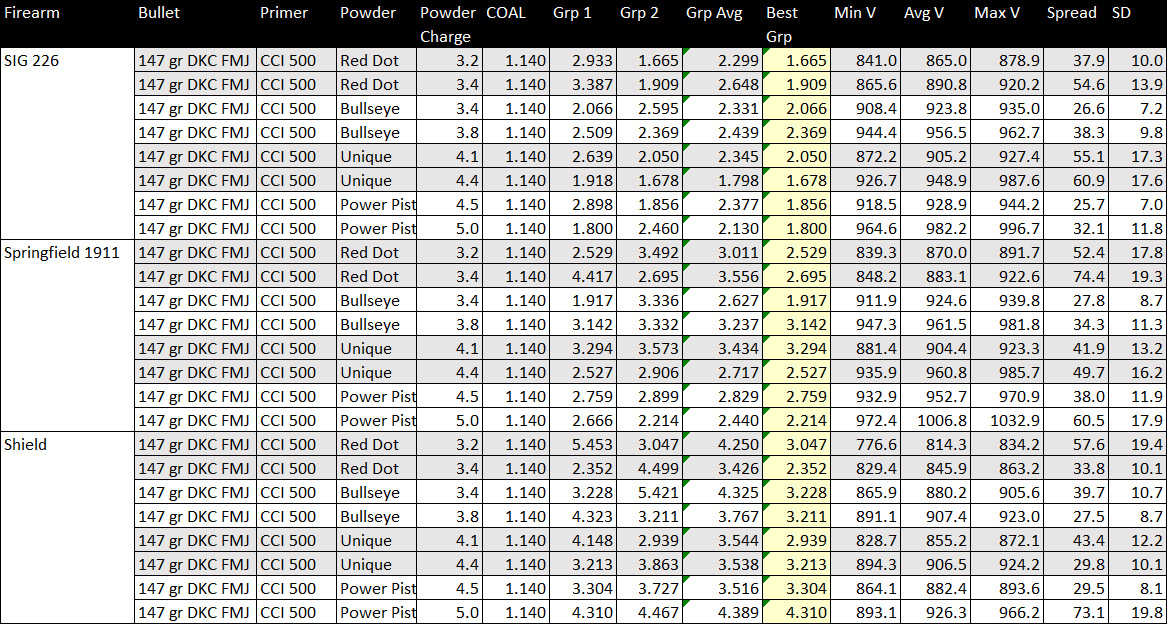
The results. I fired 400 shots in total for this blog’s test series. I used my Garmin Xero to chronograph the velocities.   Click on the table to make it bigger.

The above table is data intensive and correspondingly small (ah, if only my groups were the same).  If you click on the table, it will open in a new window and be a little easier to read.

You can see from the above that the group sizes generally were mediocre to poor. As a point of reference, what I consider good is a group of an inch or less from a 9mm at that distance.  None of the loads I tested met that threshold.

I added a column to show the best of the two groups fired for each load in each pistol (this is highlighted in yellow), thinking that maybe it was my shooting that returned the mediocre groups and this might give a better feel for what worked best.   None of the groups met my 1-inch threshold. I had been h0ped that a few of them would, as had occurred when testing previous 9mm loads (see, for example, A Tale of Two Nines, A 9mm Comparo:  Cast Bullets, and A 9mm Comparo:  Jacketed Bullets).  On the plus side, all the loads functioned all three handguns reliably. There were no failures to feed and no failures to extract.  I guess that’s something.

Surprisingly (especially when considered in light of the mediocre accuracy), the velocity standard deviations were all relatively low, and in some combinations, surprisingly low. Bullseye was generally the winner from a standard deviation perspective, although its low standard deviation did not translate into superior accuracy.

I averaged all groups for each handgun (both high and low loads and the different propellant loads).  Predictably, the SIG returned the best groups overall, and the short-barreled Shield was the worst.  The SIG has always been a stellar performer.
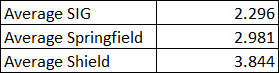
Average group sizes for all loads in each pistol.

I then considered the results across the three pistols to try to select a powder that I could use for all three handguns.  To do this, I averaged the three pistol’s performance with the light Red Dot load, the average performance with the heavy Red Dot load, etc.  Nothing emerged as a significantly better accuracy load, as you can see below.
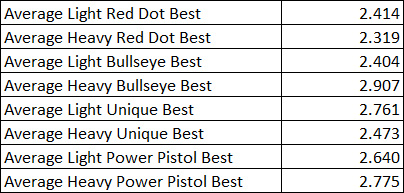
Average group size for different loads across all three handguns.

By this time, the data were confusing me. I was also feeling my age a bit, thinking maybe my old eyes just aren’t what they used to be.

At the end of the session, I had 20 rounds left in each load combination. I fired the heavy loads (for each powder) into each of four targets at 50 feet using the SIG only. By this measure, the heavy Power Pistol load had maybe the best group. I didn’t do the same for the other two handguns.  The Power Pistol load had perceptibly heavier recoil, and it averaged over 1000 fps (a lot, I think, in a 9mm 147-grain load). I don’t know if I want to subject an aluminum-framed handgun to a steady diet of this load (see my blog on the Smith and Wesson Model 59).
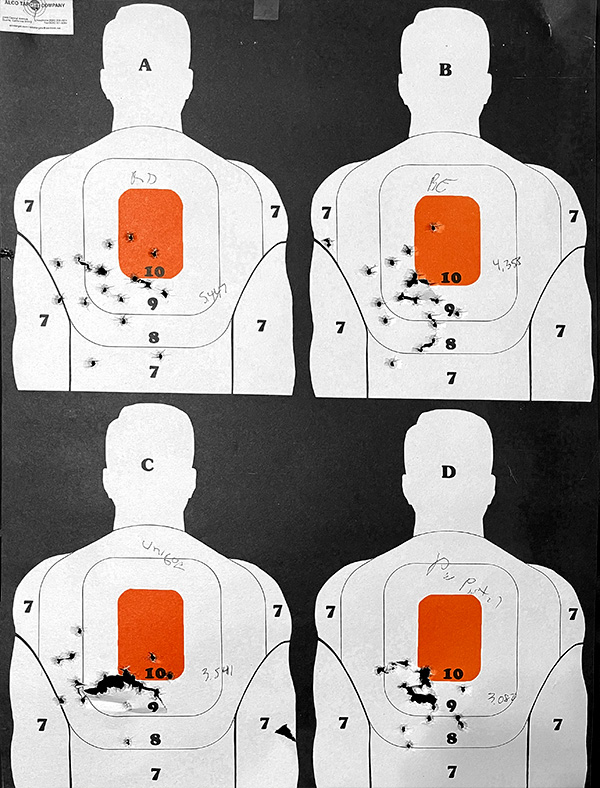
The targets you see above are (clockwise from top left), the heavier Red Dot load, the heavier Bullseye load, the heavier Unique load, and the heavier Power Pistol load. If you eliminate the one or two flyers in each group, there’s not a lot of difference between any of the heavier loads.

I also had 20 rounds left for each of the four loads at the lower end of the propellant charges.  I took these 80 rounds and one of the Alco mini-4  silhouette targets to my indoor range.   I again fired all rounds through the SIG, shooting the groups you see below at 10 yards.  Here’s what that target looked like:
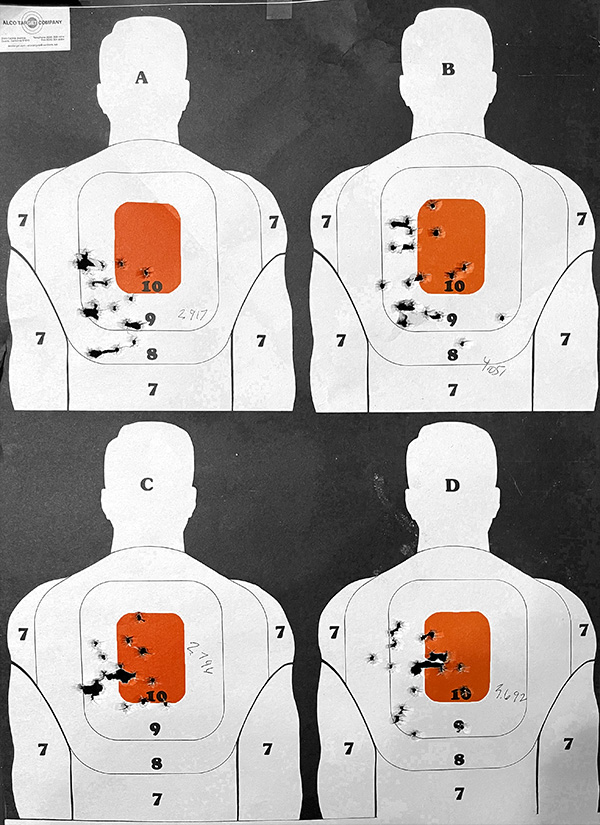
These are targets shot at 30 feet with 20 rounds each of the lighter loads. Clockwise from top left, these were shot with the lighter Red Dot load, the lighter Bullseye load, the lighter Unique load, and the lighter Power Pistol load.

The experimental design for the lower and higher load comparisons with the SIG you see above would probably earn a failing grade from a competent statistics professor.  The sample size is too small, I shot at different distances for the higher-level loads versus the lower-level loads, and I probably broke one or two other statistics rules.  That notwithstanding, here’s a summary of what the group size data looks like:
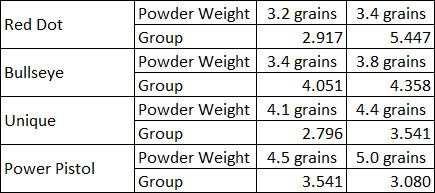
Data from the above two targets summarized in tabular form.

Where’s all this going?  The bottom line is none of the results were anything to write home about.  Why, I wondered?  Other 9mm loads had done significantly better.

To further assess why my results were as mediocre as they were (and recognizing but not fully accepting that 100% of the mediocrity could have been due to me, the shooter), I next evaluated the bullets themselves. The first parameter I measured was bullet weight. In a random weight sample of 20 DKC 147-grain 9mm bullets, here are the weights I recorded (all weights are in grains):
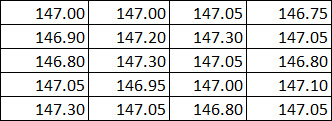
Weights for 20 of the DKC 147-grain 9mm bullets.

That first bullet was right on the money at 147.0 grains, so I thought these would prove to be good bullets from a weight variability perspective. But I was wrong, as the remaining measurements above showed. Here are the particulars on weight variability:
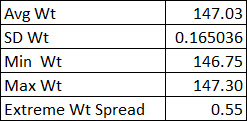
Bullet weight variability parameters.

I think that half a grain weight variability (0.55 grain, to be exact) is a lot for a jacketed pistol bullet.  I would have expected the weight to be within ±0.1 grain, so an extreme spread of 0.55-grain is not good.  It’s also not likely that the weight variability is symmetric to the bullets’ axes, which further aggravates the problem.  As the bullet spins, any weight asymmetry will induce larger group sizes.

That had me wondering about bullet diameter. After zeroing my calipers, I measured the diameter of 10 bullets. Note that these are stated by the supplier to be 0.355 inches, which is what I would expect on a 9mm jacketed bullet. Here’s what I found:
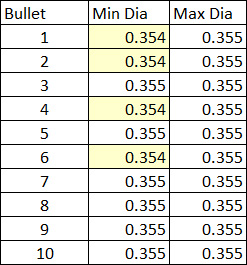
0.355 inches in diameter? Guess again, Bullet Boy!

Damn! Four of the ten bullets I measured were out-of-round by 0.001 inch (these are Bullets 1, 2, 4, and 6), and where this occurs, they are undersized. Small wonder the group sizes were not that good. The undersized bullets would have rattled down the bore, with perhaps some propellant gas sneaking around their periphery.   I think the reason the hotter Power Pistol loads did a little better is the higher chamber pressure probably deformed the bullet to fill the bore better.

Here’s the bottom line from an old ordnance engineer: These bullets are (ah, what’s that ordnance technical term again…oh yeah, I remember): MAB (or mediocre, at best). They are cheap at $98/1000, but in retrospect, they are at best plinkers, nothing more.   Maybe I’m expecting too much.  Maybe a 9mm handgun just won’t group that well with a 147-grain bullet.   I don’t think that’s it, though.  I’ve done better with other 9mm 147-grain bullets.

I relayed the above results to a few of my buddies and one of them asked me if he could have some of the DKC bullets because, as he put it, he is more of a plinker than a wannabe ballistics engineer (like yours truly).  Done and done, I immediately answered.  Then the question becomes:  How should I load the rest of these bullets?  I still have several hundred left.

I realized this would not be a decision based on accuracy, as none of the different recipes I tried resulted in impressive accuracy.  I don’t need big time penetration and I don’t need high velocity, as I’m not an FBI agent preparing for a rerun of the Miami gunfight.  I decided I would go with a load that offered:

      • A low velocity standard deviation (which held at least a promise of better accuracy).
      • Reliable performance.
      • Lower recoil.
      • A load that was adequate (if not stellar) across all three 9mm handguns.

Any of the loads I tested with the 147-grain DKC bullets meet the above criteria, so the choice came down to which powder I had the most of on hand.  That made it easy.  I’m going with the lower Red Dot load of 3.2 grains.  That will give me just under 900 feet per second from the 1911 and the 226, and just over 800 feet per second in the Shield.  That’s as good as or better than a .38 Special with a comparable weight bullet, and the .38 Special is a great cartridge.  I’ll be flush with these 9mm handloads for a while, and then I won’t buy any more of the 147-grain DKC bullets.


More gun stuff?  You bet!

We need your support!  Do what you can to help ExNotes stay in the black!



More Huber? Check out A Trip Into The Moment.

More Gresh and Berk?  You bet!  Check out A Cup O’ Joes!


Join our Facebook ExNotes page!


Help us keep the lights on:

A .45 Colt Six Shooter Trio

By Joe Berk

I tested four different .45 Colt loads in three different six shooters yesterday.  The revolvers were an 1873 Taylor-tuned Uberti SAA with a 5½ inch barrel, a stainless steel Ruger 4 5/8 inch Blackhawk, and a 200th Year Ruger 7½ inch Blackhawk. Conditions were way less than ideal: It was windy and I was there in the afternoon, which meant I was shooting into the sun on the West End Gun Club’s 50-foot handgun range.

My Uberti with a Schrade stag-handled large folding knife. Both are elegant.

Every time I shoot the Uberti, I’m reminded how elegant the 1873 design is. The Ruger Blackhawks look good and shoot well, but they are a bit “clunky” compared to the old Colt design.  The 1873 SAA just feels graceful.  It’s a delight to hold and to shoot.

Ruger’s stainless steel, 4 5/8 inch barreled Blackhawk chambered in .45 Colt. It’s a slick sixgun.
A 200th Year 7 1/2 inch Ruger Blackhawk, also chambered in .45 Colt. I bought it about 15 years ago; I fired it for the first time in this load evaluation.

As I was unlocking the gate to get into the range, a low-rent-gangbanger-looking, dirty, tattooed guy pulled up behind me in a beat up old white Honda.  He obviously had been waiting to follow me in.  Even though I’m armed, I’m always a little nervous when I get out of the car to unlock the gate because it’s desolate out there and it’s a good ambush spot.  The guy sure didn’t look like a Republican to me. I asked him to show his membership card and he went into his “no habla” routine. I told him I wouldn’t leave the gate open without seeing his membership card, and he suddenly had enough “habla” to understand that. He turned around and left. A recent WEGC email explained that these guys steal brass and other stuff from the range, so I’m guessing that’s what this dirtball wanted.

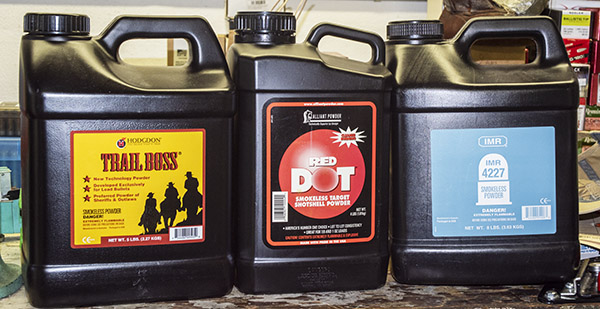
The three propellants used for this test series: Hodgdon Trail Boss, Hercules Red Dot, and IMR 4227.
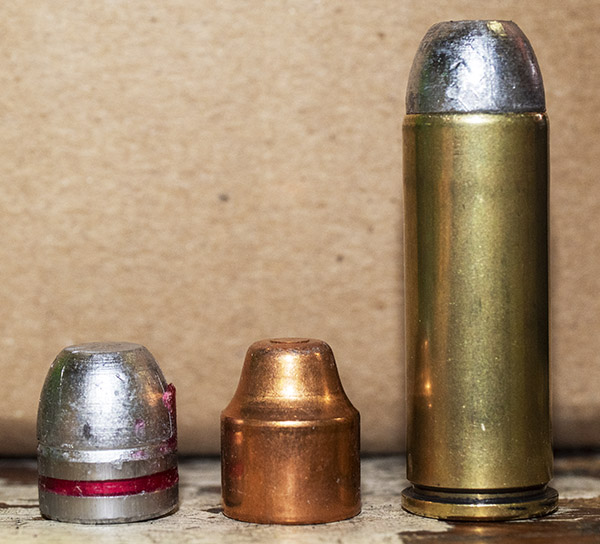
The 200-grain cast bullet, the 185-grain Winchester jacketed semiwadcutter, and a loaded .45 Colt cartridge.

The loads used Trail Boss, IMR 4227, and Red Dot powder. I had been loading .45 Colt with Trail Boss because it is what the Cowboy Action Shooters use and it was presumably a low velocity load. To my surprise, the Trail Boss velocities were only very slightly below the other powders’ velocities.  I loaded with two different bullets (Winchester’s 185-grain jacketed semiwadcutter and a 200-grain cast roundness bullet with a truncated ogive).

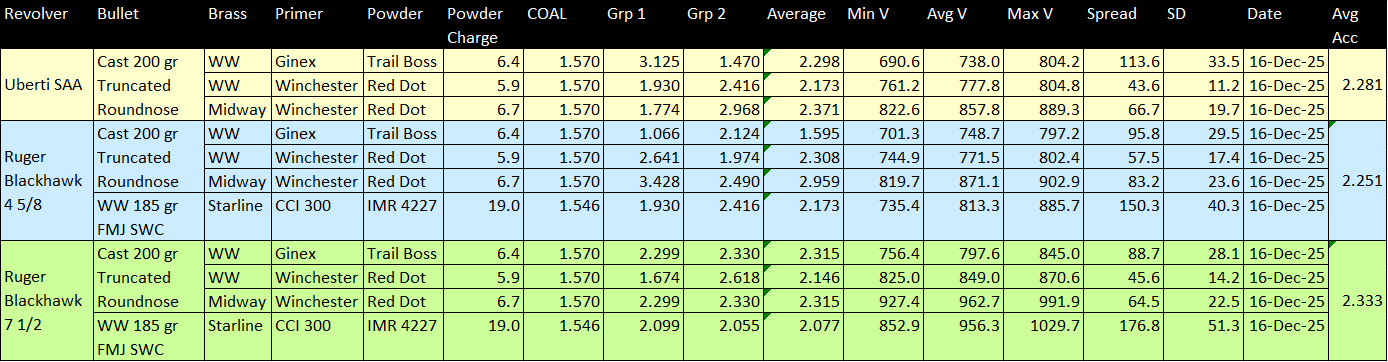
The results of my testing are in the table below.  The table’s font (as it appears in the blog) is tiny, but if you click on it, the table will open with a larger and more readable display.

Here are the inferences I make from the above data:

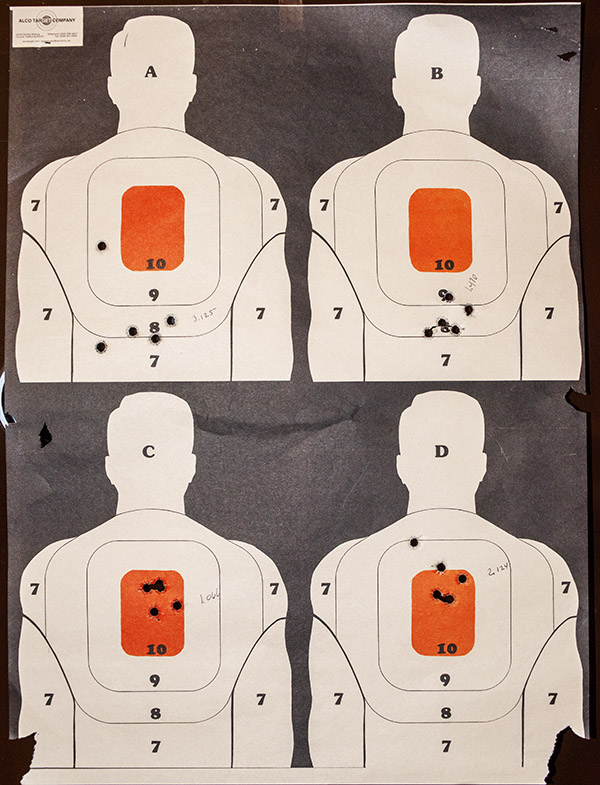
There are some large groups sprinkled in the above data (above 3 inches); that’s probably due to the poor shooting conditions and me. My first group was one of the worst; I attribute that to me settling down for subsequent groups.

I used Alco’s target with four mini-silhouettes. Shooting conditions were less than ideal.

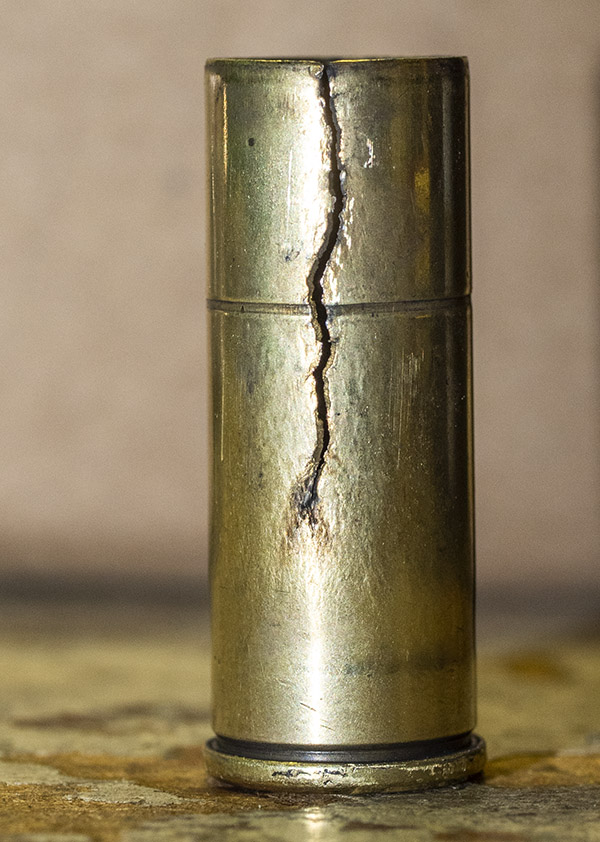
I also noticed that one of the cases had split, and the bullet from that case would have been a flyer.  With the exception of the one case that split, none of the cartridges exhibited any pressure signs.  All cases extracted easily (other than the one that split) and none had flattened primers.

It happens. This cartridge case had been loaded one too many times. When this occurs, it results in a flyer.

The Lee cast bullet reloading manual shows the 200-grain truncated roundnose bullet accuracy load to be 5.6 grains of Red Dot, which is at the very bottom end of the range. I went with 5.9 grains because the Red Dot loads don’t occupy much of the case volume and I felt uncomfortable with that. I might try the lower load of Red Dot (i.e., 5.6 grains) next time I’m reloading, but I think I’m going to just stick with 5.9 grains.  It works well enough in all three revolvers.

The Trail Boss spreads and standard deviations were large, which surprised me. I’ve had good accuracy at 50 feet with this powder, but the large standard deviations mean that at longer ranges the accuracy will be poor.  I could feel the difference in recoil with the Trail Boss load; one round would give a sharp crack back, and the next might be much lighter.  The Trail Boss chronograph data supports that subjective assessment.

I have a lot of Red Dot propellant, so I wanted to evaluate it in the .45 Colt. It did well. In general, the Red Dot velocity spreads and standard deviations were lower than those with Trail Boss or IMR 4227.  That was a surprise, too.

Overall average group size (all guns, all loads) with the cast 200-grain bullets was 2.275 inches. Overall average group size (all guns, all loads) with the full metal jacket semi-wadcutter Winchester bullets was 2.125 inches. That’s not much of a difference.

You might be wondering why I didn’t try the IMR 4227 loads in the Uberti SAA. I thought these would be a lot hotter loads because the load data was for Ruger revolvers. Turns out the velocities were in line with the Trail Boss and Red Dot loads. I could have shot the IMR 4227 in the Uberti, but I didn’t realize that when I was on the range. I was very surprised at the huge velocity spreads and standard deviations with IMR 4227.

Recoil for all the loads listed in the table above was not oppressive.   But I wouldn’t characterize the recoil as light, either.  The .45 Colt is a big cartridge.

As expected, the 7 ½ inch Blackhawk velocities were slightly higher than were those for the other two shorter-barreled revolvers. The longer sight radius on the 7 ½ Ruger didn’t make much difference in accuracy.  That’s counterintuitive.  It may just be that the wind and shooting into the sun masked any advantage the longer sight radius offered.

Overall accuracy for the revolvers with all loads was essentially the same (see the last column in the above table).  I could repeat this evaluation under better range conditions, but I think I have enough information to select a good load.  While the groups were not stellar (they were in the 2-inch+ range), the above convinces me that Red Dot is a good powder in .45 Colt. I’ll probably standardize at 5.9 grains of Red Dot with the 200-grain cast bullet.  The velocity is high enough for my purposes and I love that low standard deviation.


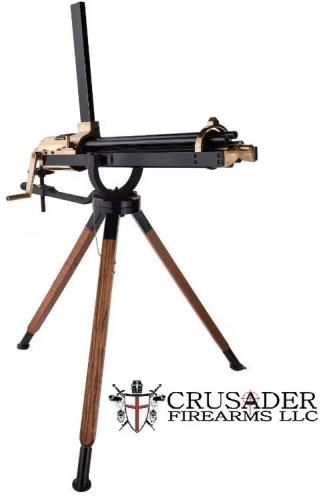
I’m a student of the Gatling gun and as you tell from reading this piece, I’m a big fan of the .45 Colt cartridge.  After finishing this blog, I briefly wondered: Were any of the original Gatlings chambered in .45 Colt?   The short answer is no.  Even though the .45 Colt was a prevalent cartridge during the era of the original Gatlings, none were built for this cartridge (they instead used the much more powerful .45 70 rifle cartridge).  That was then, though, and this is now.  You can buy a current reproduction of the Gatling chambered in .45 Colt.  That would be cool, but it would be expensive to keep such a beast fed.

Crusader’s .45 Colt Gatling Gun.  It’s only $8149.99.

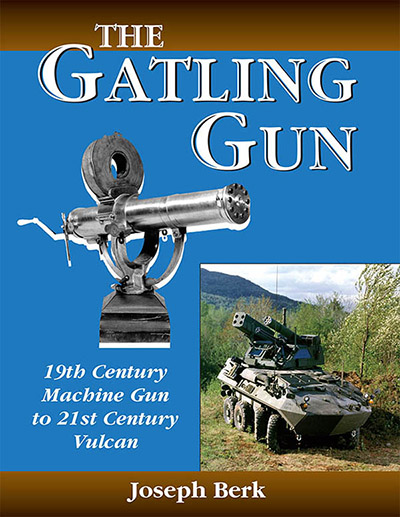
If you want to know more about Gatling guns (including their early history, the transition to modern weapon systems, and their current applications), pick up your copy of The Gatling Gun.


Join our Facebook ExNotes page!


Help us keep the lights on:


Don’t forget: Visit our advertisers!


Red Dot and The Load

By Joe Berk

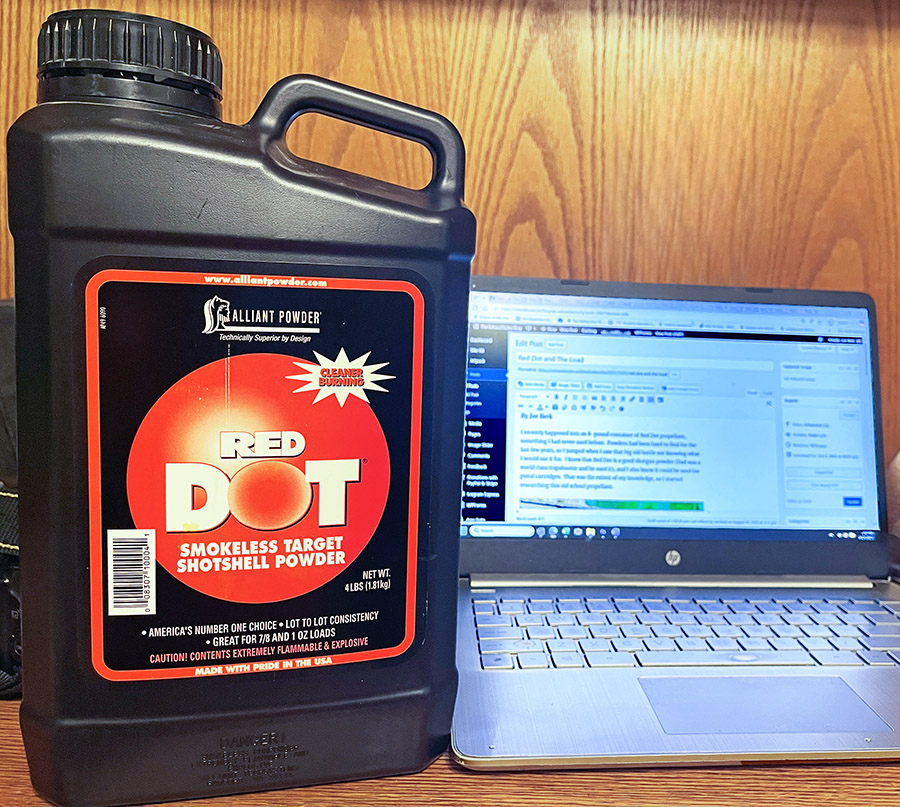
I recently happened into an 8-pound container of Red Dot propellant, something I had never used before.  Powders had been hard to find for the last few years, so I jumped when I saw the Red Dot (not knowing what I would use it for).  I knew that Red Dot is a good shotgun powder (Dad was a world class trapshooter and he used it), and I also knew it could be used for pistol cartridges.  That was the extent of my knowledge, so I started researching this old school propellant.

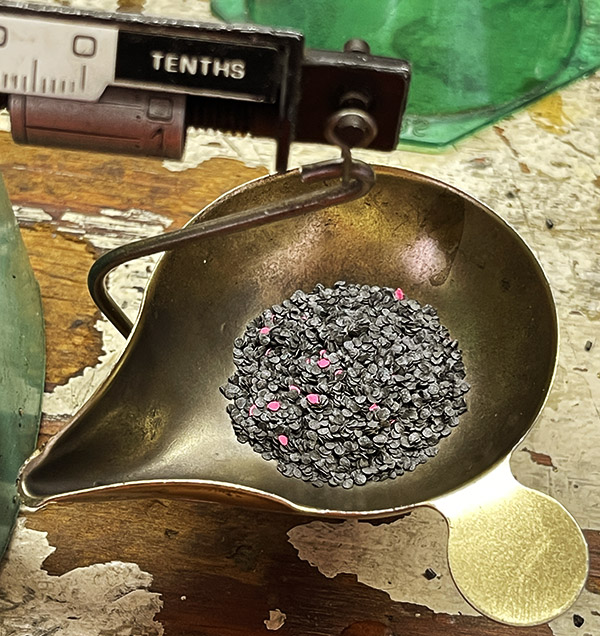
Red Dot propellant. My cell phone camera and fluorescent lighting would have you thinking this powder should be named “Purple Dot,” but trust me, the flakes that appear to be purple in the above photo are really bright red.

What I learned about Red Dot was interesting.  The Hercules powder company first released Red Dot in 1932, and it was primarily intended to be a shotshell powder for trap and skeet shooters.   It’s a flake powder and it’s distinguishable by the red-dyed flakes mixed in with the black ones.  It’s been updated at least a couple of times (one of the updates was to make it burn cleaner), but its kept its place as a relatively fast powder with a burn rate just slightly slower than Bullseye.  For that reason, it also makes a great pistol powder, and most load manuals include recipes for practically everything from .25 ACP up to .45 Colt.  I’m going to try it in .38 Special and .45 ACP, and maybe .44 Special.  I think I can use it my old Star reloader, which is set up to throw 2.7 grains of Bullseye.  I’ll check that out at some point in the future.

It turns out that among rifle cast bullet shooters (a space I inhabit), Red Dot is a preferred powder, so much so that 13.0 grains of it is informally (and apparently widely) known simply as “The Load.”  The conventional wisdom is that 13.0 grains of Red Dot behind any cast bullet in any .30 caliber rifle (.308, .30 06, 7.62×54 Russian, 7.65 Belgian, .303 British, and more), the .375 H&H, and the .45 70 is a reliable and accurate load.  With my 8-pound bottle of Red Dot and “The Load” (i..e, 13.0 grains of Red Dot), I should be good for something north of 4,307 rounds.   That should keep me busy for a while.  I’ll be playing with cast loads using “The Load” in a Mosin-Nagant, a Springfield 1903, a Modelo 1909 Argentinean Mauser, and probably the .45 70.  When I do, I’ll share the results here.


Join our Facebook Military Surplus Rifles page!


Join our Facebook ExNotes page!

Never miss an ExNotes blog:


Help us keep the lights on:


Don’t forget: Visit our advertisers!