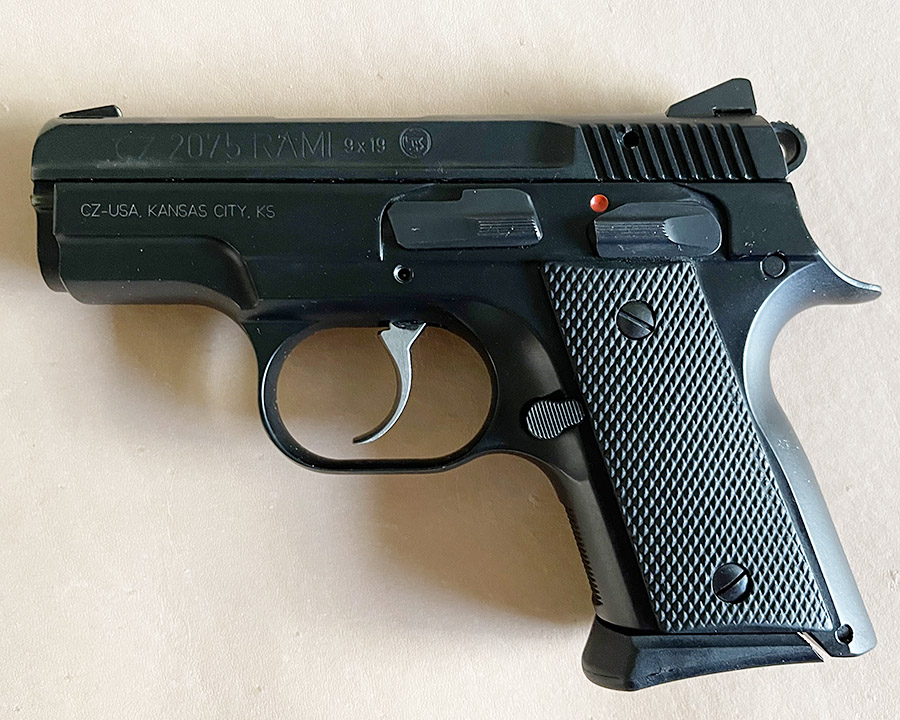
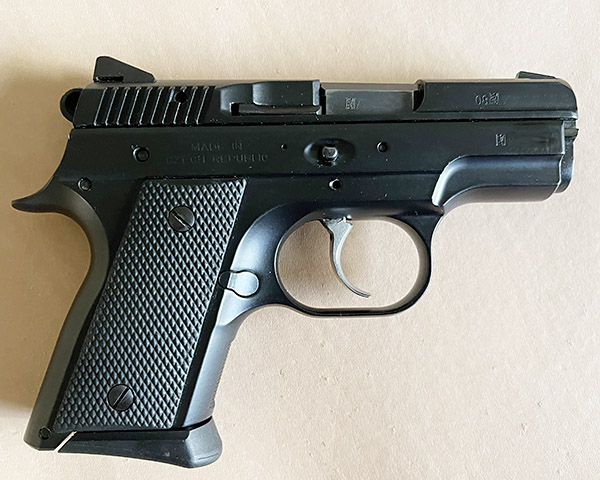
As concealed carry powerhouses go, it doesn’t get much better than the CZ 25 Rami. One of my good buddies owns one and I had an opportunity to play with it. I was impressed. On the plus side, it is an all-metal gun with a flat black finish, a hammer (greatly preferred by yours truly over a striker-fired pistol), great sights, and a marvelous trigger. My bud had a trigger job on his, and it was awesome (light and crisp, with zero creep, just like it should be).
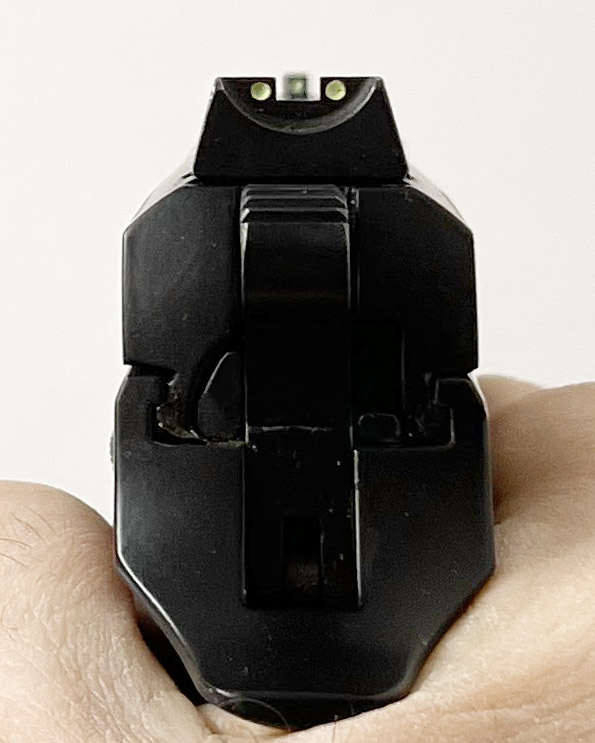
The three-dot sights on the CZ are crisp and non-gimmicky. There’s no glow-in-the-dark nonsense and they stand out. In the photo below, the sight picture is just the opposite of what it’s supposed to be (you want the front sight to be in sharp focus, and the rear sight to be a bit fuzzy, but I couldn’t get my iPhone camera to cooperate when I shot these photos).
I liked the feel of the CZ. I didn’t get to fire it, but I think I might have an opportunity at some point. The one you see here is chambered in 9mm. The Rami was also available in .40 S&W, which I think might be a bit much for a gun this small.
The Rami was discontinued in 202o with the introduction of newer CZ models. I haven’t seen the new handguns, but I can’t see how they can be any better than the CZ 2075. This pistol just feels right.
Good buddy Robby has been a friend for 30 years. I first met Robby on a consulting gig in Georgia. He’s a fellow engineer, a firearms aficionado, a reloader, and a hell of a shot. Robby and I see each other whenever our paths cross, and more often than not the talk is about guns and reloading. Robby is a competitive pistolero and a hunter, he enjoys a finely-figured bit of walnut as much as I do, and we both appreciate the finer points of Ruger No. 1 and bolt action rifles. Robby shared with me that he recently acquired an FN Hi Power. I asked him if he would do a guest blog for ExNotes and what follows is the well-crafted result.
My grandfather: The man who taught me basically everything I know. Hunting, fishing, archery, how to shoot, how to walk through the woods silently, how to approach anything that needed fixing. Everything. He grew up during the Great Depression, he was a highly decorated recon scout during WW II, he was a cop and a security guard and he retired as a postman. I saw my grandfather as the definition of a man. He owned two handguns, one centerfire rifle (a Model 70 Winchester), a .22 and a very illegal shotgun that he sawed off because his brother split the barrel.
I own one of his handguns (a Colt Detective Special) and I have the .22 and the Model 70. The Colt Detective Special is a fine little snubby with a black paint job because someone let it rust while I was in college. I painted it and took it into my possession.
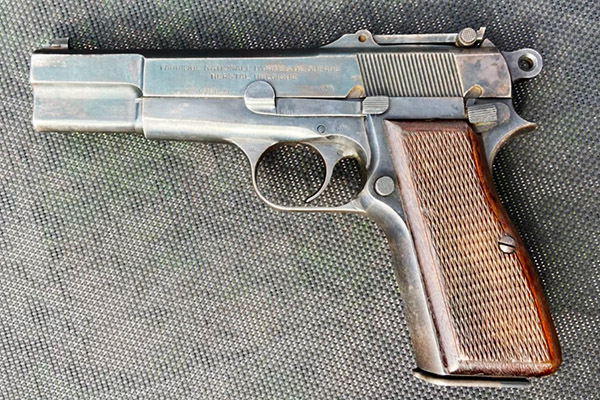
My grandfather’s Nazi war trophy with artillery sights.
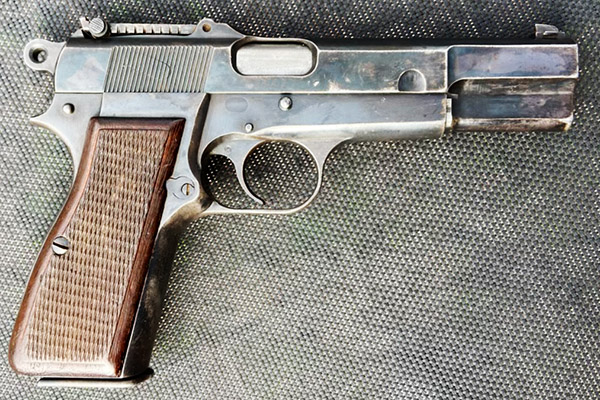
My younger brother has the other handgun. It is an automatic that my grandfather took from an SS officer after dispatching him in northern Italy. It is the first automatic that I ever saw, held or fired. My grandfather kept it in the car when he delivered mail on the rural route he ran, he took it on camping trips with my brother and me, and he kept it close everywhere he went. He kept it in a holster with the German’s name written on the flap. It was a mystical gun that seemed more like Excalibur to me than some manmade object. I had all of the other firearms, so I was fine with my brother hanging on to Excalibur.
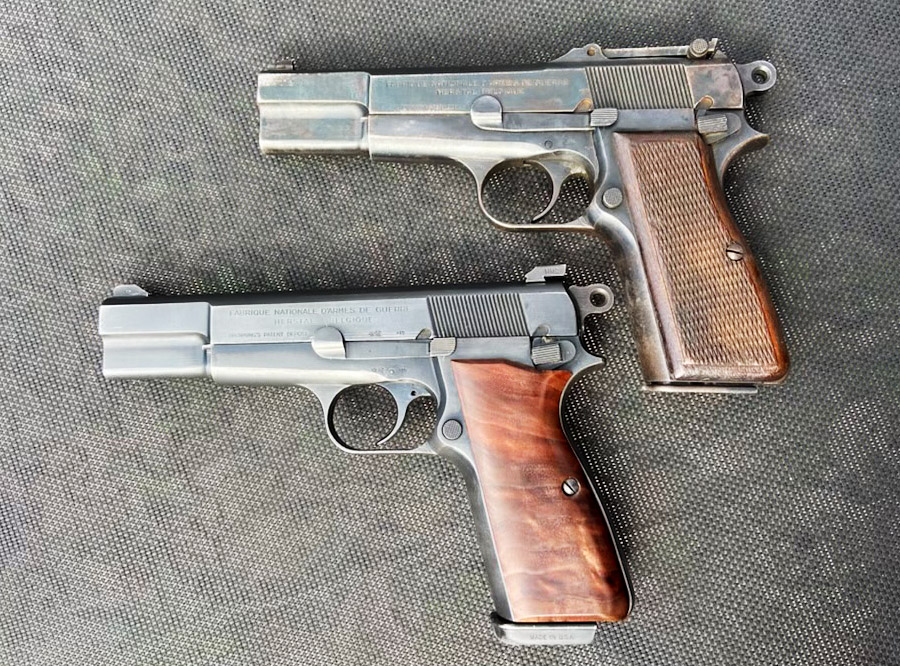
Another view of the World War II German Hi Power.
What was this mystical weapon, you ask? Just a fine Belgian copy of John Moses Browning’s “improvement” of the 1911. A 9mm Browning Hi Power, to be exact. The design was unfinished when JMB departed this mortal world, but a Belgian named Dieudonné Saive finished the design and after incorporating a few of Browning’s older patents, created the most widely-issued sidearm in history. Anyway, I am making a short story extremely long.
My brother possessed Excalibur and I needed one for myself. I bought lots of different pistols, including a couple of 1911s, and built a few custom polymer pistols with all the trimmings, but I still didn’t have a Hi Power. I was super excited when I saw Springfield and FN resurrecting the Hi Power, and I was determined to have my own.
Well, after looking for unicorn teeth in the retail shops and online, I was thinking my Hi Power was a pipe dream. The SA and the FN are made of unobtanium and the one I found online was priced accordingly. Before heading off to find The Lady of the Lake, I stopped by a local gun shop to see if I could find a 9mm AR lower. Yes, I have wide and varied tastes when it comes to things that go BANG. The owner and his minions were all tied up, so I decided to window shop a bit. I saw the Hi Power before I made it to the case. I pretended to look at everything else, hoping that no one would notice that Excalibur’s brother was RIGHT THERE in the open!
Once I got the attention of a person employed by this fine establishment, I asked to hold “that one.” “That one” had oversized, red, laminated wood grips that were apparently sized for Andre the Giant and looked much like lipstick on a large sow. I asked the owner if he knew the vintage and he replied that he thought it was a 1980s production gun. The tag affixed to the trigger guard said “consignment” and the price was $1199. That was a quick “nope” from me and I headed back to the truck with no AR lower and no Excalibur.
A week or so later, I ended up at the same shop again after dreaming up some other materials that I might need to finish the AR 9 I started. I asked to hold the Hi Power again. I noticed that it had been marked down $100 and the owner told me that it came with a spare mag and another grip. The red, behemoth handles needed to go, so I was glad to hear there was an immediate option. I still wasn’t keen on paying north of a grand, though. If it had been an actual Browning with that deep Browning bluing, that might have been much harder, but it was a well-worn FN with circus handles and non-OEM sights. It didn’t even have the “artillery” sights that my grandfather’s had. That’s what he called the adjustable-to-500-meter sights that Excalibur wore. I handed it back again and left.
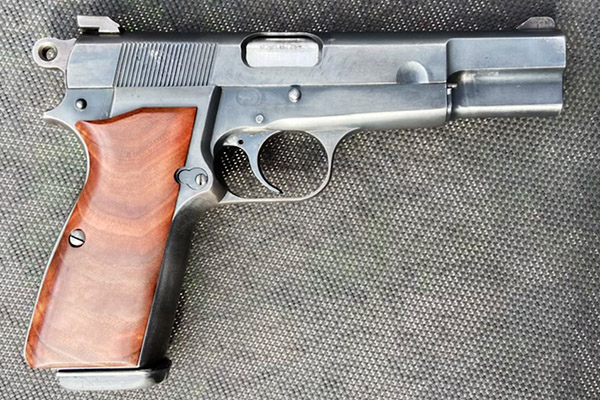
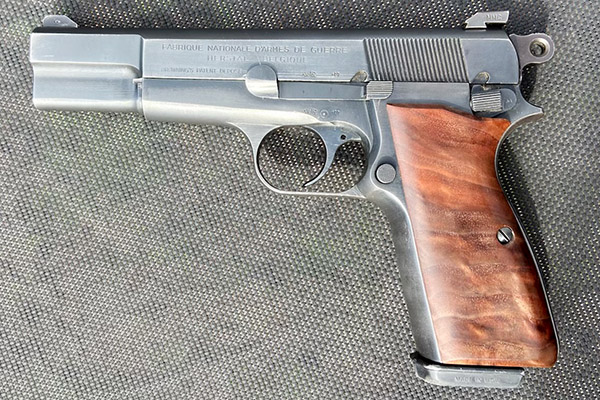
My 1952 Fabrique National (FN) Hi Power with Hogue grips.Viewed from either side, the Hi Power and its new grips look good.
A couple more weeks rocked on, I received my yearly bonus from work, I finished the AR 9, and I couldn’t get the Hi Power out of my head. We were headed that way to pick up one of my daughter’s friends and I decided to stop by and see if I could talk the guy down to $900. I walked in, eyeballed the cases and found it nestled between a couple of other pistols that I didn’t even look at long enough to identify. I asked the guy that offered to help me how much was being asked for the Hi Power this week. He yelled across the shop and asked the owner. $850 was the answer! I holstered my negotiating skills and said, “I’ll take it!”
When I made it back to the truck with it in a plastic grocery bag, I took it out and showed it to my very unimpressed better half. She said,”That is the “gun-est” looking gun I have ever seen…”
I responded, “Exactly, it is beautiful!” And off we went.
I got it home after a few hours of birthday shopping with my 15 year old, her friend and the wife and had to go straight to the yard and shoot my newest acquisition. It did not disappoint! The aftermarket sights are installed properly and are right on the target. The trigger breaks cleanly, there’s no hammer bite, and there were no failures or hiccups of any kind. Perfect…just like I hoped. Except for the furniture. I ordered a set of Hogue hardwood grips in Kingwood after a pretty thorough scouring of the internet in search of something fitting for my wooden desires.
I started my research on the serial number and completely struck out. Apparently, FN is pretty liberal and somewhat random with their numbering system, so I dug deeper. Thumb print on the right side, *S on a couple of parts, internal extractor and the five-digit serial number helped me narrow it down to a 1952 production run.
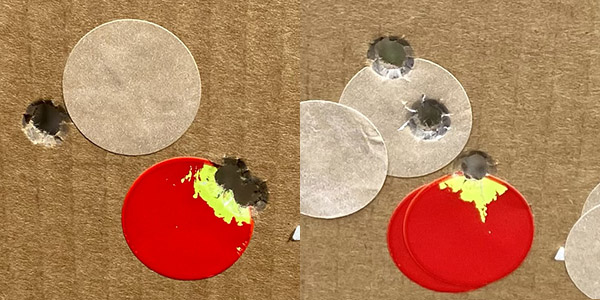
Both Hi Powers shoot well. These are 50-ft targets. My grandfather’s (and now my brother’s) Hi Power shot the group on the left; my FN Hi Power shot the group on the right.
I messaged my brother and asked him to drop Excalibur by so I could compare the two. I shot both and they are equal in all things. Except mystique. Hopefully, in time I will add a bit to mine.
Robby, that’s an awes0me story and a fine-looking pair of Hi Powers. Thanks so much for sharing it with us and our readers. You and your brother are a couple of lucky guys. Always a pleasure to hear from you, my friend, and our best to you and your family.
Help us keep the content coming: Please click on the popup ads!
Stay current with our latest articles on guns, motorcycles, watches, books, movies, reloading, bicycles, construction stuff, Jeeps, philosophical ramblings, rants, and more!
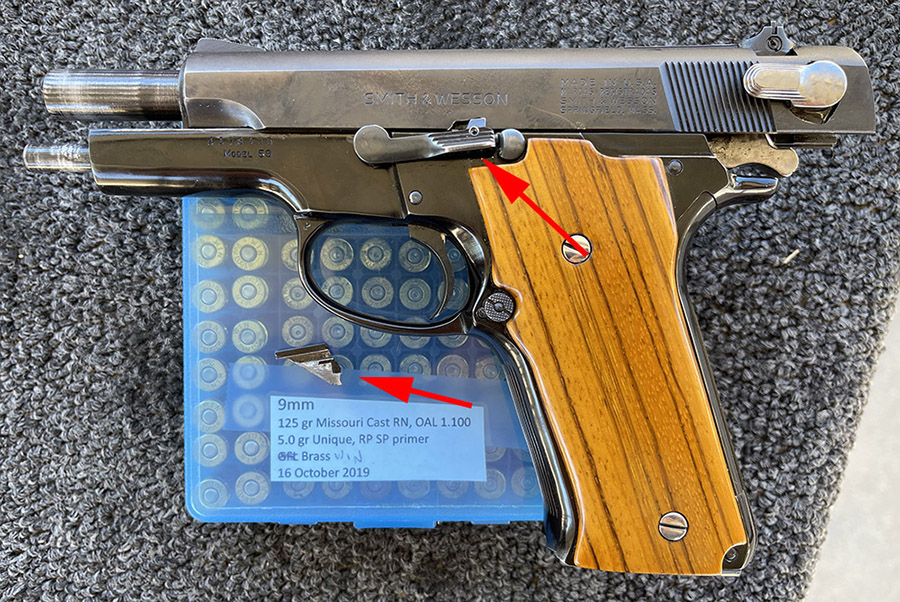
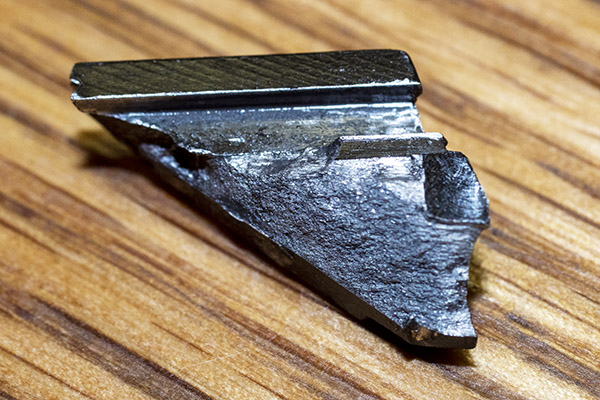
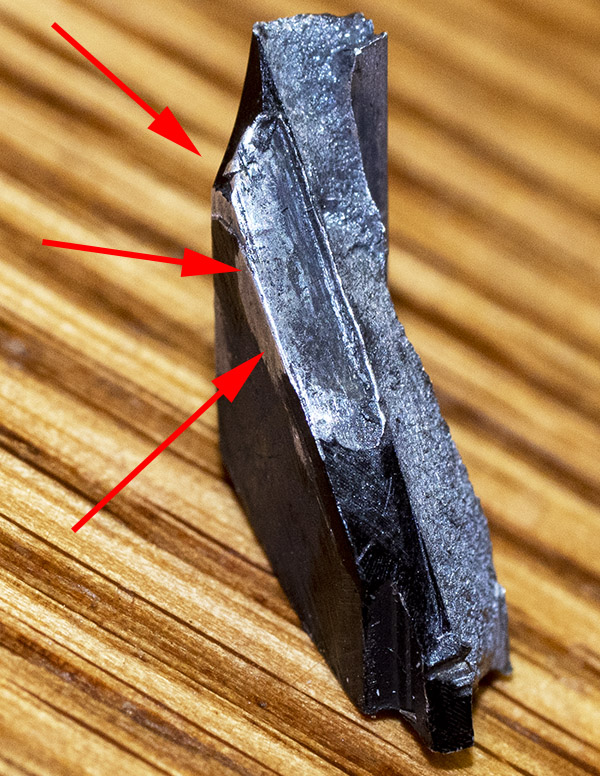
Well, I had a good day on the range until my Model 59 broke. It’s the gun my father bought for me before I went overseas and I’ve had it for 50 years. I was having fun and I’d just fired 80 rounds at a 25 yard target. I went to put the next magazine in and it wouldn’t seat. Uh oh. When I pulled it out, the piece you see above fell from the magazine well. I pulled the slide release, dropped the slide, and wowee. This wasn’t good. Or maybe it was (more on that in a second).
Please click on the popup ads…it’s what keeps the blog going!
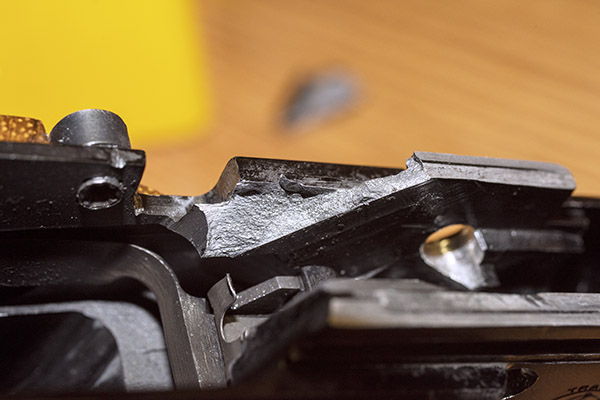
Ugly, ain’t it? Surprisingly, the surface fractography doesn’t look like a fatigue failure (there are no characteristic beach marks). I make it to be a brittle failure.
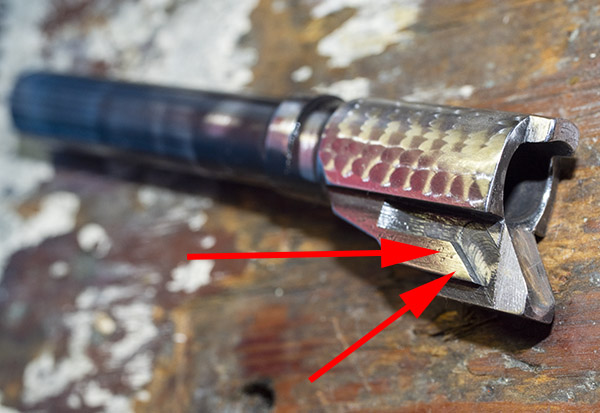
The photo below is my beautiful jeweled Model 59 barrel, all dressed up with no place to go. The arrows point to the ramps on either side of the chamber (the photo below shows the ramps on the left side). Those ramps are what smack into the aluminum frame with each shot.
The arrows in the next pic point to the matching right side of the Model 59 frame. Note the worn area. It’s where the barrel ramp contacts the frame ramp when the gun recoils. That ramp (along with the mating ramp on the barrel) drops the barrel slightly to disengage it from the slide when the slide moves to the rear. You can see this area took a beating over the last 50 years. The photo shows the opposite side of the frame, where it didn’t break.
You might think I’m mad at the gun, but I’m not. I have a good dose of mechanical empathy. Imagine you are that aluminum ramp on the Model 59 when a 9mm cartridge lights off and the barrel is recoiling toward you at speed. WHAM! Do that 20,000 or 30,000 times in a row and think about how you would feel. Nope, the Model 59 did its job for 50 years. I can’t be mad at it.
You read that right. I had 50 years of fun with my Model 59 on the range, carrying it on hunting trips, keeping it handy when I felt I needed to, and on one occasion, threatening a late night marsupial Sue thought was a burglar (the ‘possum was not impressed). I’ve fired between 20,000 and 30,000 rounds through my Model 59 (a guess based on how many boxes of 9mm I’ve reloaded). Very few of these (maybe none) were light loads, as the best 9mm accuracy is at the top of the spectrum. From what I’ve found in the endless stream of what passes for information on the Internet, semi-auto aluminum handgun frame life expectancy estimates are around 10,000-20,000 rounds, so I’m in the zone. Maybe I’m even ahead of the game.
I figure the cost of my reloaded 9mm ammo is about $.15 per round, so if I fired 20,000 rounds through this gun, that’s $3K in ammo. Dad paid something like $135 for the Model 59 back in 1972. Ignoring inflation, the ammo costs make the gun the least expensive part of the deal. Somehow that makes the fact that my Model 59 is toast slightly less bothersome. I probably could part it out (grips, slide, barrel, jeweled parts, etc.), but I don’t think I will. My buddies suggested putting it in a wooden frame and hanging it on the wall. That sounds like a good idea. I guess I can’t bitch too much. 50 years of service ain’t too shabby.
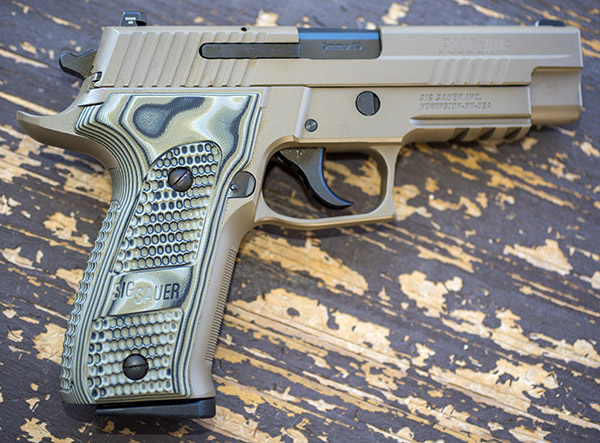
Some of you might be wondering why I don’t just get the gun repaired. It can’t be fixed; even Smith and Wesson told me it’s a goner. They didn’t offer to buy it back like Ruger did when I wore out a .357 Mag Blackhawk, but hey, Ruger is Ruger and Smith is Smith. One of my friends said I should buy a new 9, and I’m ahead of the curve on that, too. I bought a SIG P226 Scorpion a year or two ago. The SIG is the finest 9mm handgun I’ve ever owned, a worthy successor to the Model 59. If it lasts 50 years like the Model 59 did, I’ll be 120 years old and I’ll feel like I got my money’s worth with it, too.
My good buddy Bob, who enjoys playing with things that go bang as much as I do, followed the stories I’ve done on my TJ-modified revolvers and pistols. Bob wrote to ask if the guy really is that good. He is, I said. In fact, he’s better.
Bob took the plunge and had TJ refine several of his guns. Bob sent this note to me after he took his TJ-modified automatics to the range.
Joe,
I got my Berettas back from TJ. I initially took him a M-1951 and a 92 and when he was done with those I picked them up and dropped off another 92 for a Level 1 package and a Radom P-64 that I was having trouble with. Picked those up a few weeks ago and finally got to the range yesterday. Took the M-1951 and both 92s and what a difference. Just wonderful.
You were totally right about TJ. And I would like to do a guest blog at some point. Any tips?
Bob
Bob, thanks for the note and the photos, and the offer to write a guest blog. We always love receiving them. As for tips, if the question refers to writing, my advice is to just be yourself. If it refers to shooting, that’s easy: Focus on the front sight. And thanks again!
Hey, all of our gun stories are here on our Tales of the Gun page! Revolvers, autos, milsurps, lever guns, single shot rifles, reloading, and much, much more!
Colt has a custom shop, Remington has a custom shop, Winchester had a custom shop, Savage has a custom shop, Springfield Armory has a custom shop, CZ has a custom shop, and Smith and Wesson has a custom shop. It seemed Ruger was the only one of the big players that didn’t have a custom shop.
That’s changed. Ruger recently announced that they, too, now have a custom shop, except they do things differently. Rather than taking orders for custom features on their regular line of firearms, Ruger’s approach is to produce limited numbers of highly-customized guns. Stated differently, Ruger picks the features they want to add to their custom guns; your choice is to purchase it (or not). It’s not a bad way to go.
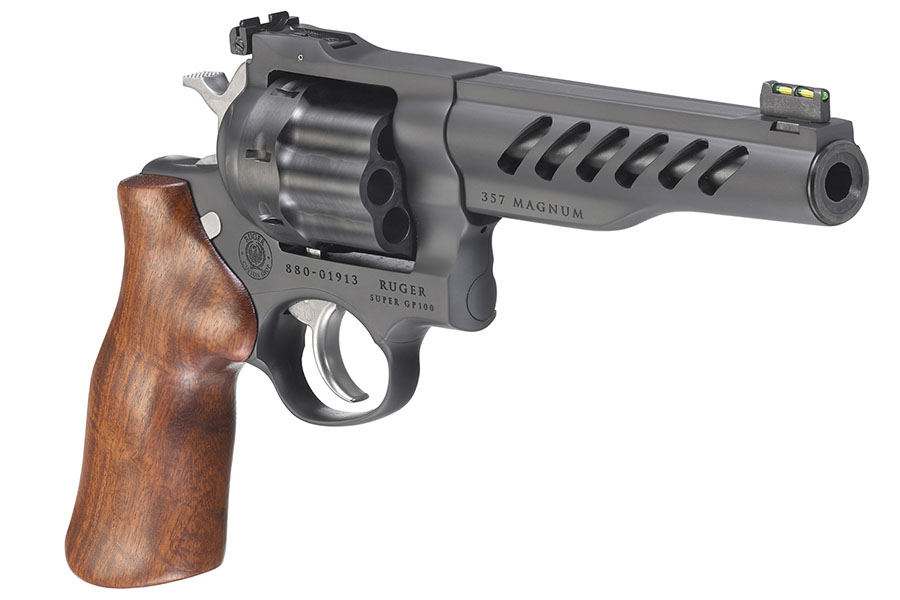
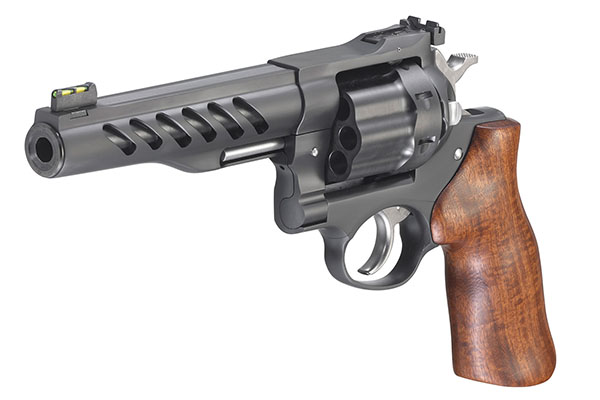
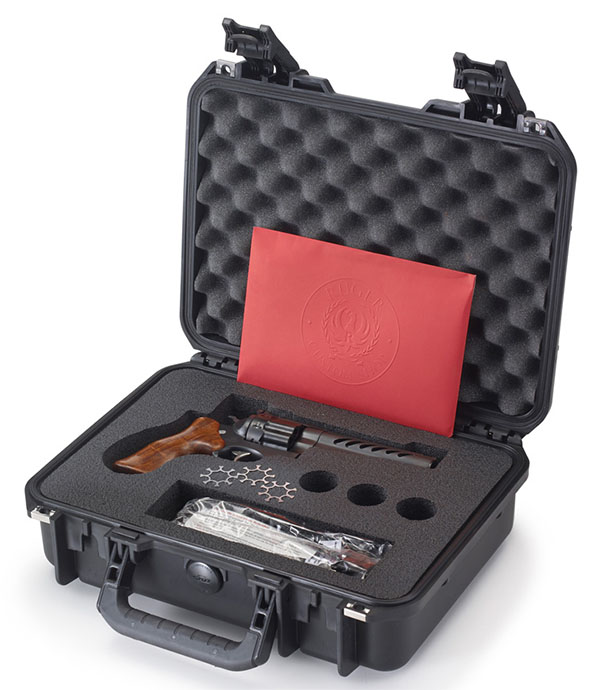
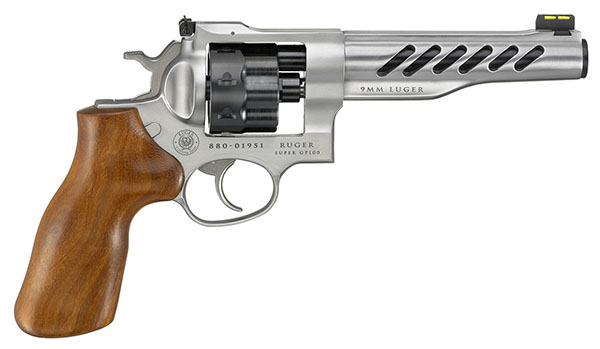
Note the new Super GP100’s dark PVD finish, the green fiber optic sight, the slotted barrel shroud, and other custom touches.
Ruger’s two most recent custom shop models are revolvers they call the Super GP100; one chambered in 9mm and the other chambered in .357 Magnum. These revolvers have a number of custom features, including a shrouded and vented barrel, 8-shot capacity and the ability to use star clips for speedy reloads, radically-fluted cylinder (I like the look), PVD (that’s physical vapor deposition) finish, polished and slicked up trigger and internal componentry, oversized Hogue hardwood grip, an 11-degree barrel crown (that’s supposed to enhance accuracy), and a fiber-optic front sight (never had one of those before; I’m eager to see if it really does anything for me).
Befitting its custom status, the Ruger Super GP100 comes with a higher-quality carrying case.
The Super GP is offered in two chamberings: .357 Magnum and 9mm Parabellum. The 9mm version is not approved here in the Peoples Republik of Kalifornia. That’s probably okay, as I would go for the .357 if given the choice. But that’s not a choice that’s going to be offered any time soon. Read on, and you’ll see what I mean.
The 9mm version of Ruger’s new Super GP100 revolver. It looks good. Note the shorter cylinder.
I like the way Ruger handled the 9mm Super GP100. The cylinder is shorter to match the 9mm cartridge, and the barrel extends back into the frame. This means the 9mm bullet has less of a jump to the rifling in the barrel, which should improve accuracy. It’s the same thing Smith and Wesson does on its .45 ACP revolvers.
Ruger doesn’t stock these guns. True to the custom shop concept, Ruger builds them as orders are taken. But it wouldn’t do any good to order one now, unless you just want to get a place in line. Due to the press of handgun orders induced by the election, the pandemic, and the recent civil rioting in major US cities, Ruger has its workforce focused elsewhere on meeting the unprecedented demand for its standard guns. As an aside, it’s tough to buy ammo right now, too, for the same reasons. That’s not bothering me, as I reload on my RCBS reloading gear and I’m well stocked.
I’m in the market for a .357 Mag revolver, but I’ll probably go with a more traditional handgun. Maybe a .357 Blackhawk or a S&W Model 27. I’ll keep you posted.
Revolvers, rifles, reloading, and more…check out our Tales of the Gun page!
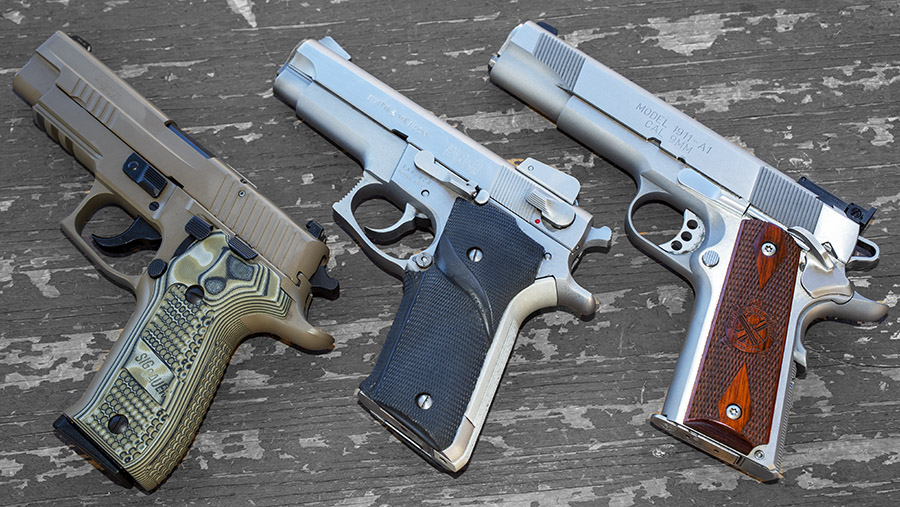
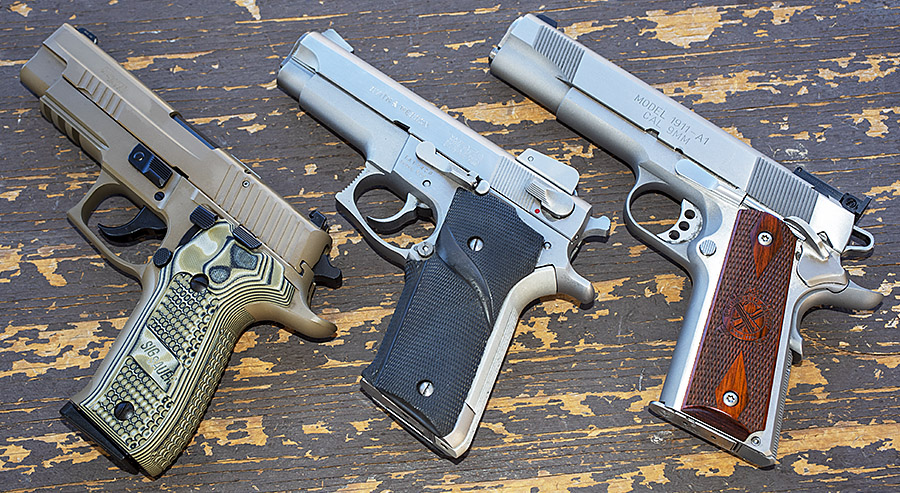
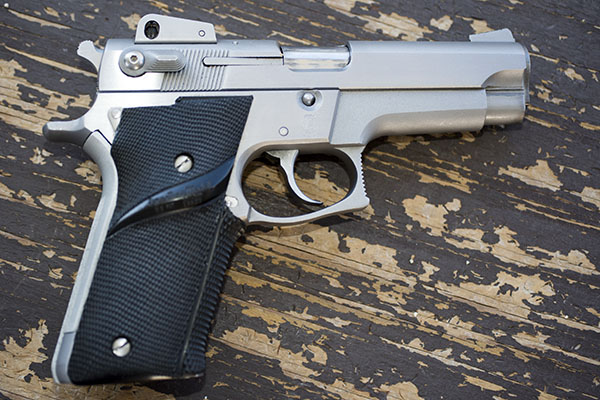
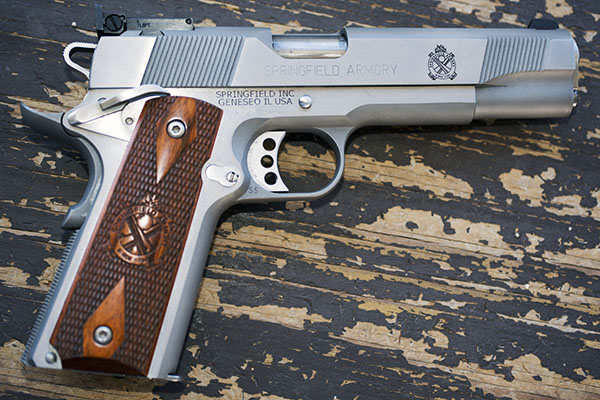
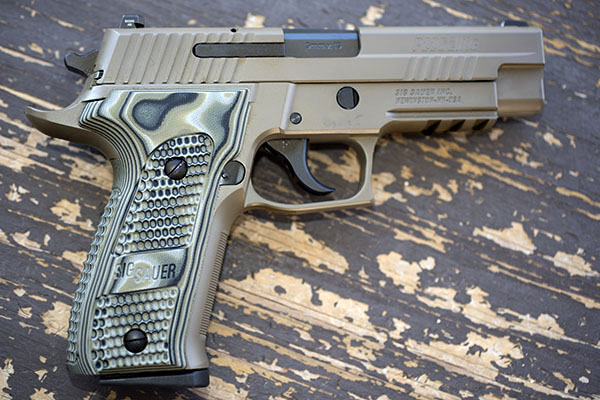
Back in January I tested a bunch of 9mm cast bullet loads in the three handguns you see above: A SIG P226 Scorpion, a Smith and Wesson Model 659, and the Springfield Armory 1911 Target. For that test series (you can read it here), all the loads used the Missouri 125-grain cast roundnose bullet with different powders and different charge weights. My cast bullet testing showed the SIG to be the most accurate, followed by the Springfield and then the Smith and Wesson Model 659.
I promised an update with jacketed bullets to assess accuracy and functionality of all three handguns (and to find favored accuracy loads for each). It took a while, but I finally got around to making good on that promise this past week. The six different loads I tested for the jacketed 9mm test series are summarized below:
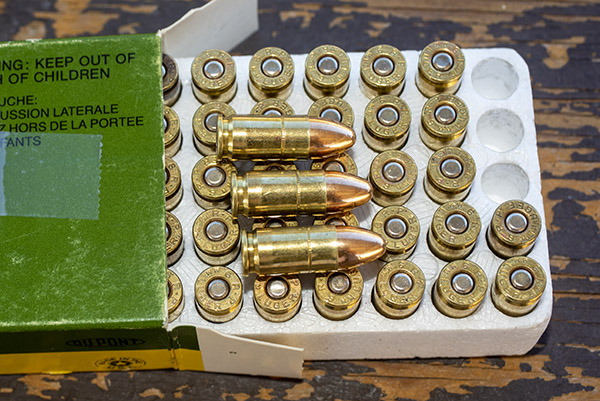
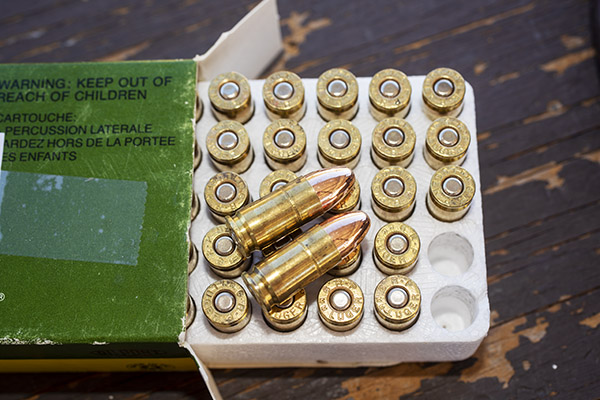
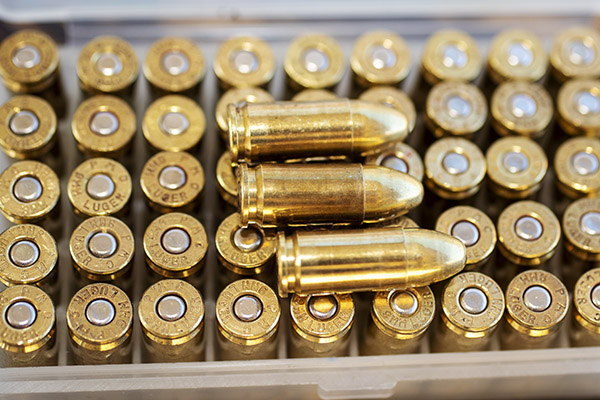
Actually, the term “jacketed” doesn’t really apply to the Xtreme bullets (they are copper plated, not copper jacketed). The Armscor bullets are brass jacketed. Both the Winchester and Speer bullets are copper jacketed bullets. As you can see from the table above and the photos below, the Xtreme, Armscor, and Winchester bullets were of the roundnose configuration. The Speer 147-grain bullets were jacketed flatnosed bullets. I didn’t try any hollow points in this test series; I prefer roundnose bullets in my 9mm handguns. They are reliable.
All groups were 5 shot groups. I shot a total of 360 rounds in the two test series (both the jacketed and cast bullet accuracy tests).
While I was shooting last week, I was a little disappointed. I thought I had done a lot better with the cast bullets back in January. I thought my jacketed groups were larger when I eyeballed the targets, but you never really know until you measure the groups.
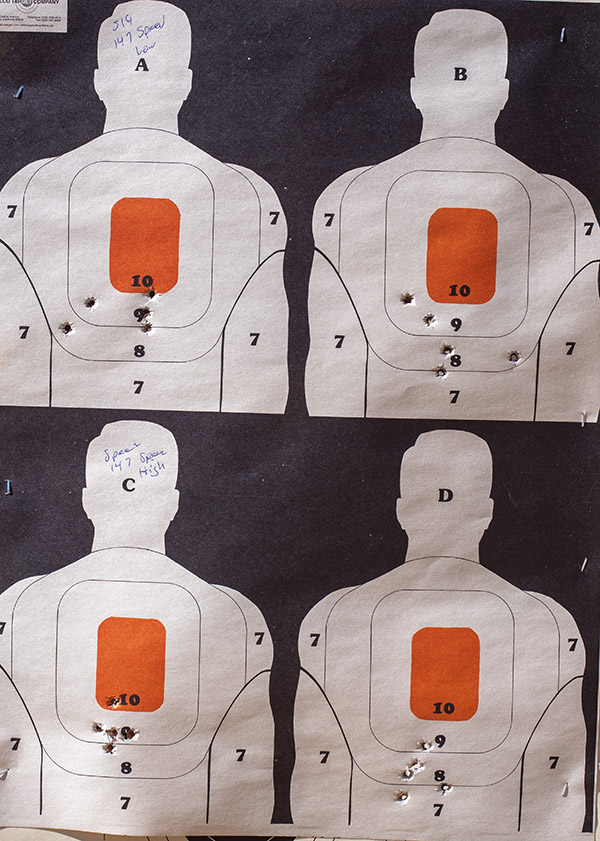
9mm jacketed bullets on an Alco target. I like using the Alco target that has four mini-silhouettes on a single target. All testing was at 50 feet.
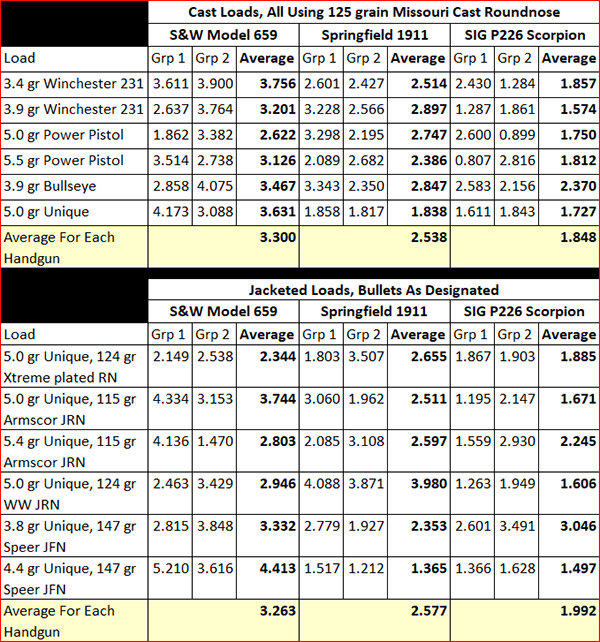
When I returned home, measured the group sizes, and tabulated the results, I was surprised. The results of the jacketed and plated bullets were not too different from what I had achieved with the cast bullets almost a year ago. Take a look:
The most surprising finding, for me, was that the average results with the jacketed bullets (versus the cast bullets) were almost identical. Here’s that data extracted from the above, shown in a table that makes it a little easier to make the comparison:
My testing showed essentially the same results for the three handguns I tested whether I used cast bullets or jacketed bullets: The SIG P226 Scorpion is the most accurate (it is a magnificent handgun), followed by the Springfield Armory 1911, followed by the Smith and Wesson 659. It doesn’t matter whether it’s with cast or jacketed bullets: The averages are eerily similar for each gun, with a very slight accuracy advantage going to the cast bullets for the SIG and the 1911, and a very slight accuracy advantage going to the jacketed bullets for the Smith 659. But the differences between jacketed and cast bullets are so small they can be ignored. Cast bullets are usually a lot less expensive than jacketed bullets, so this is good knowledge.
Help us continue to bring stories to you: Please click on the popup ads!
Bottom line first: The SIG P226 Scorpion can get ‘er done! This is a phenomenal handgun, one of the best I’ve ever shot.
This is Part I of the promised 9mm comparo, and after thinking about it for a bit, I thought I would focus on the cast bullet loads in the first installment, and then move on to the jacketed bullet loads in the next one (that will come a little later). There are a lot of ways I could have organized the comparo; this one made the most sense to me. There’s a lot of information here and I didn’t want it to be overwhelming. It also involves a lot of shooting (about a half day’s worth with just the cast bullets), and I wanted to clean the pistols after shooting the cast bullet loads before moving on to the jacketed loads.
I used three 9mm handguns for this test: A former police-issue Model 659 Smith and Wesson, a Springfield Armory 1911 Target, and a SIG P226 Scorpion. Let’s start with a few words about each.
Keep us in clover…please click on the popup ads!
The 659 S&W is a gun that’s been featured on the ExNotes blog before. It’s a police department trade-in that was manufactured in the 1980s. My good buddy Tom gave me a great deal on it, I refinished the brushed stainless steel slide and frame, I fixed the decocker (it wasn’t dropping the hammer when the safety was actuated), and I’ve been shooting it a lot in the last few months. My gun has Pachmayr checkered rubber grips (which I like a lot). It is a heavy gun at 40 ounces, mostly because it has a steel frame (many 9mm handguns have a polymer or aluminum frame).
The 659 Smith and Wesson. It’s a solid service pistol, one that was used widely when police agencies in the US switched from revolvers to autos 40 years ago.
I like the 659. Like I said above, it’s heavy (but that means it’s steady) and it seems to shoot everything well. What do I not like about it? It needs to be kept clean behind the extractor, or it will sometimes fail to fully extract and eject a fired cartridge. That’s due to the nature of the extractor, which is a hinged arm. When grit or powder reside gets behind the aft portion of the extractor, it can’t pivot and it doesn’t pull the cartridge all the way out so that it can be ejected. I think the squared-off trigger guard is goofy. I never wrap my left hand around the front of the trigger guard and I prefer the look of a rounded trigger guard. Like most double-action/single-action semi-auto handguns, this 659 has the Joe Biden trigger (it’s kind of creepy). The front sight is unfinished stainless steel, so it is hard to see on the target (I paint the front sight on my 659 flat black so I can get a good sight picture). The Pachmayr grips add to the 659’s bulky grip design, but they also allow a secure hold.
That’s a lot of bitching, I suppose, especially when it’s directed at a handgun I enjoy shooting enormously. None of the above would keep me from buying a 659 (and none of the above kept me from buying this one). I like my 659. If you get an opportunity to buy one and the price is right for you, take it from a guy who knows: You won’t regret pulling the trigger (literally and figuratively) on a used Model 659. That’s if you can even find one. The police departments have all traded them in, Smith and Wesson stopped making these guns decades ago, and the supply is drying up.
The next one up is a Springfield Armory Target model 9mm 1911. As handguns go, it doesn’t get any better than the 1911 (or so I thought up until this test, but more on that later), and having a 1911 chambered in 9mm seems to me to be a good idea.
Springfield Armory changed the name on this gun. It used to be called the “Loaded” model (as in loaded with all the options, including target sights and hand fitting here in the US), but they later changed the name to the Target model. That’s good. “Loaded” makes it sound like the gun is a stoner (i.e., a doper, not the weapons designer).
I’ve had my 9mm 1911 for about 5 years (I bought it new from my good buddy Brian at Bullet Barn Guns). I knew it was accurate, but I had not really played with it that much to find out what loads it liked best.
The Springfield Armory 1911 Target Model, with adjustable sights, a 5-inch barrel, and all stainless steel construction.
There’s not too much to dislike about the Springfield Armory 1911. Springfield makes a quality gun. The fit and finish on mine are superb. One thing I’ve noticed is that it has a tight chamber, and ammo loaded on a progressive reloader is prone to sometimes jam if the cartridge isn’t perfect (unlike the 659, which feeds anything). That doesn’t bother me because I load everything on a single-stage RCBS Rockchucker these days. I don’t need the speed of a progressive reloader, and my ammo quality and accuracy are better when I load on a single-stage press. The trigger on my 1911 is superb, as is the case on nearly every 1911 I’ve ever shot. I think that as 1911s go, Springfield Armory is one of the best. I’ve owned and shot several of them. They are accurate and they hold up well. Fit and finish are top drawer, too, on every Springfield Armory 1911 I’ve ever seen. It’s just a beautiful 1911.
The third handgun for this test series is my recently-acquired SIG P226 Scorpion. This is the first SIG I’ve ever owned. I’d heard so many good things about SIG handguns (and in particular, their accuracy) that I thought I would take the plunge and buy one. I bought mine at Turner’s here in southern California.
So how do I like the SIG? In a word, it’s awesome. I like the look of the Cerakote finish and the SIG grips, and gun just feels right in my hand. The grips fit like a glove, and the grip texture works. It is one seriously good-looking and good-handling handgun.
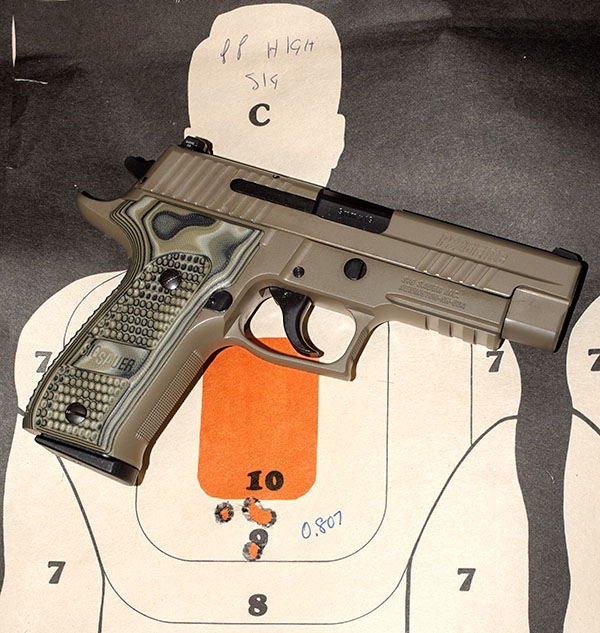
SIG’s P226 Scorpion. It has a Cerakote finish and an aluminum frame. This is a good-looking handgun, I think.
The SIG is the only pistol used in this test that does not have adjustable sights. The SIG literature told me they offer sights of different heights, and the rear sight can be drifted left or right in its dovetail, but none of that was necessary on my gun. My SIG shoots exactly to its point of aim at 50 feet (take a look at that target at the top of this blog again).
Speaking of sights, the SIG has what is evidently a fairly expensive set of Tritium sights that glow in the dark (I think they are about a hundred bucks if you buy them separately). The glow is not like the lume of a watch dial; instead, they have something else going on that makes them light up at night. You can see that in this photo I took in the dark:
There’s the sights. Where’s the target? Normally, you’d get the front and rear sights aligned; that is not the case in this photo. The only point of this photo is that the SIG glows in the dark.
I think the Tritium sights are kind of a Gee-Whiz deal, and I don’t think I need them. I’m an old guy and I shoot targets when I can see what I’m shooting at. If I was a lot younger and I was running around in a white Ferrari with Miami Vice music playing while chasing bad guys at night, maybe Tritium sights would do it for me. But even under those conditions, it would still be dark and I wouldn’t be able to see my target. I think the Tritium sights are gimmicky, and the little lenses (or whatever they are) for the Tritium inserts are distracting. Plain black sights work best for me. Your mileage may vary.
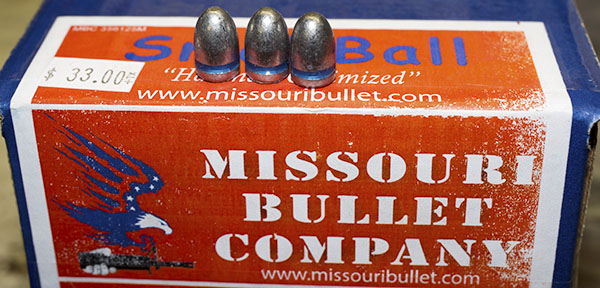
So, on to the main attraction: The 9mm loads and how they performed in each of the three handguns. I loaded everything for this first 9mm test series with a bullet I’ve known and loved for 50 years, and that’s the 124-grain cast roundnose. My particular flavor these days are the pills from Missouri Bullets. At $33 for a box of 500, they are inexpensive and the quality is good. A roundnose configuration bullet feeds well in just about any gun. Yeah, I know there are other cast bullet configurations and other cast bullet weights. I’ve always had my best results with the 124-grain bullets, though, and that’s what I used for this test.
124-grain cast roundnose bullets from the Missouri Bullet Company. They are relatively inexpensive and they shoot well.
I tested with four different propellants: Bullseye, Unique, 231, and Power Pistol. For the 231 and Power Pistol loads, I loaded near the lower end of the recommended charge range for one test set, and I loaded another test set near the upper end of the recommended charge range. With Unique, they were all loaded with 5.0 grains, which is a max charge in most reloading manuals. I had a bunch of these already loaded, and I knew from a past life that this was an accurate load. I tried one load with Bullseye, too. I had a box of 50 loaded and I grabbed those as I headed to the range a few days ago. I used Remington small pistol primers for everything, and I used several different brands of brass, but I used the same kind of brass for each load. Cartridge overall length was 1.112 inches for all loads.
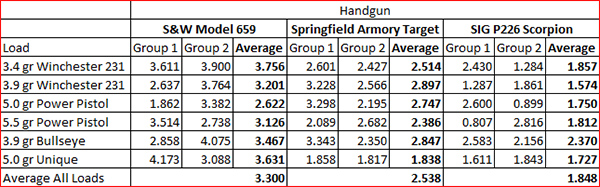
All loads were handheld at a distance of 50 feet. I shot two 5-shot groups with each load. I didn’t use a machine rest or a chronograph because I have neither. I shot from the bench, resting my arms (but not the gun) on the bench. Yes, a lot of the variability you see in the chart below is due to me. Hey, I’m what you get. My intent was to get an idea what worked best in each of these guns, and I think I succeeded.
That’s the background. Here are the results:
Clearly, the SIG is the most accurate of the three handguns. What I’d read and heard about SIG’s performance is true. Some of the SIG groups were amazing, putting 5-shots into under an inch at 50 feet. That’s about as good as I’ve ever done.
While the SIG was accurate with Winchester’s 231 propellant, the gun didn’t like it. On both of the 3.4 grain loads, the slide went forward after the last round (it didn’t lock open), and it did it again on one of the 3.9 grain magazines. While the 231 loads had enough poop to cycle the action, it wasn’t running the slide far enough back to lock open on the last round. This powder also did that on one of the Springfield Armory 1911 tests. Interestingly, the Smith and Wesson 659 worked okay with both the upper and lower 231 loads. These were light loads (I could see the slide moving back and forth with each shot, and it popped the brass out right next to the gun). My testing got me far enough along to decide Winchester 231 is not for me as a 9mm propellant.
The SIG really liked Power Pistol propellant, and from an accuracy perspective it performed similarly at both the low (5.0 grain) and high (5.5 grain) levels. There was perceptibly more recoil (but no pressure signs) with 5.5 grains of Power Pistol, so my load for the SIG with this bullet will be 5.0 grains. The SIG also did well with 5.0 grains of Unique. That’s a good thing, as I have a bunch of ammo loaded with this recipe. As I mentioned above, I found 5.0 grains of Unique did well in accuracy testing a long time ago, and it’s good to see this test supports those earlier findings. The 5.0 grains of Unique load also did very well in the Springfield 1911 (it was the Springfield’s most accurate load). With this load, the Springfield is as accurate as the SIG. But the SIG did well with all loads; the Springfield was pickier.
The 659 is a great gun, but from an accuracy perspective it can’t run with the big dogs. That’s okay; it’s still fun to shoot and I plan to continue shooting it a lot. And it only cost about a third what the others cost. Like I said earlier, if you get a chance to pick up a 659, don’t let it get away.
But that SIG. Wow!
So there you have it. Next up? I want to see how these same three pistols shoot jacketed bullets. Stay tuned.
One last comment…it’s time for the warnings and disclaimers. These are my loads in my guns. You should always consult a reloading manual published by one of the major sources (Hornady, Speer, Sierra, Lyman, Winchester, Alliant, you get the idea) and rely on the load data published there. Start low and work your way up, watching for any pressure signs along the way.
Help us keep the lights on: Please click on the popup ads!
My good buddy Paul, whom you’ve already read about on the ExNotes blog, is a retired aerospace engineer who has way more talent than me in the gun-tinkering arena. During one of our shooting expeditions, Paul brought along an interesting 1911…a .45 that he had re-barreled to shoot 9mm. There’s not a simple proposition, but hey, Paul’s good at this stuff and his 9mm conversion shot well. Then, a few months ago, we had a discussion about the merits of the .38 Super cartridge. That’s a round similar to the 9mm, but the case is longer, allowing for more propellant. The result? The .38 Super’s velocity is substantially higher than a 9mm (the .38 Super is roughly equivalent to a .357 Magnum).
Well, one thing led to another, I guess, and I received an interesting photo and email from Paul a few days ago…
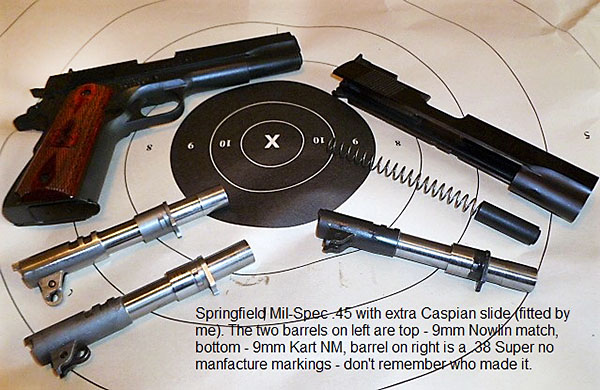
A four-fer, so to speak….a 1911 that can shoot .45 ACP, .38 Super, 9mm, and .22 Long Rifle.
Joe:
I started this project about 5 or 6 years ago. My intent originally was to buy a stainless steel Springfield 1911 9mm target pistol. At the time they were very scarce and wait time was close to a year at an inflated price. I then decided to purchase a mil spec .45 and buy a Caspian 9mm slide, barrel and slide components to convert the .45 to 9mm. I said to myself that if I was going this far with the project that I would buy a .38 Super barrel and have a pistol that will convert into a .45, 9mm, and .38 Super. I did the Caspian slide and 9mm Nowlin barrel fitting first, a few months after I originally purchased the pistol.
I shot the pistol in 9mm conversion at Joe’s range a few years back and it performed very well. The .38 Super conversion was put on hold until now. I purchased a new oversized bushing and three different barrel links to get the correct lockup, which arrived from Brownell’s a few days ago. I recontoured the barrel and fit the bushing to barrel, and then to the slide. This took 3+ hours to do with a 0.0005″ to 0.001″ tolerance fit on all surfaces. Link and lockup fitting were next.
When I fit the link to the barrel, a job that I thought would take 10 minutes, it actually took 1.5 hours. That barrel must have been a budget-manufactured barrel because the workmanship was poor in the link recess and not deep enough to allow the link to fully seat. I’m glad I have a milling machine. The lockup is now solid and everything cycles as it should.
I think it’s ready to test fire but first I have to reload some ammo for it. I’m going to do a Cerrosafe casting of the bore to see what the diameter is. The spec for the bullet diameter for the .38 Super is 0.356-inch and the 9mm it is 0.355-inch. I have some Berry’s plated bullets that are 0.356 but I’m not sure if they are 115 or 124 grains. I want to use 124 to 130 grain bullets. I do have a fair amount of 124 gr semi-wadcutter cast bullets that I did many years ago for my Colt 9mm target bullet experiment but I never sized or lubed them (looks like I’ll be bringing out the bullet sizer/luber). Not too sure that this style of bullet will cycle, but it’s worth a try.
I also purchased a .22 LR conversion kit for this pistol about four years ago, which I have also previously shot. So, now this 1911 Springfield Mil Spec will shoot .45 ACP, 9mm Luger, .38 Super, and .22 LR when it’s finally finished…how neat is that!
Paul
That’s awesome, Paul…and thanks for taking the time to explain your approach and for the photo. It’s a cool handgun and having that kind of versatility is a slick concept. I think it has to be especially satisfying knowing that you built it yourself.
We’ve found that folks who ride are frequently into guns, and vice versa (like good buddy Paul). It’s why we include interesting Tales of the Gun stories on the ExNotes blog. Want to see more?
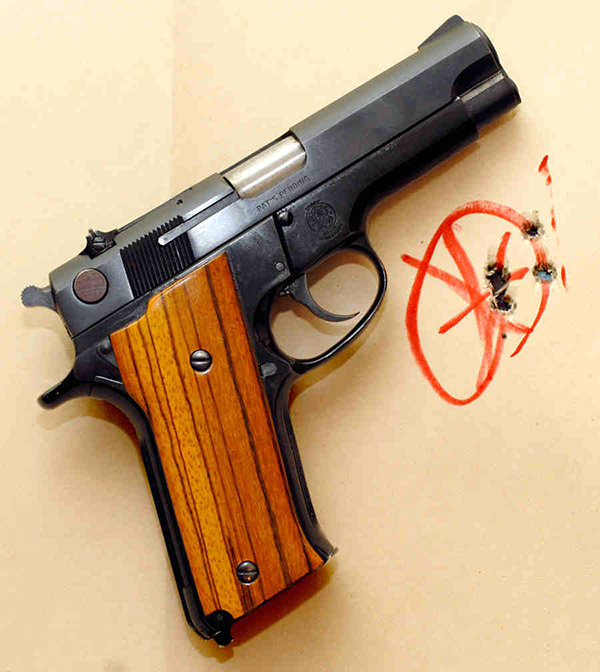
The Smith and Wesson Model 59. Mine is a very early one, with a serial number that puts it in the first year of production. These old guns can shoot!
Dial back the clock a cool 46 years (which would put us in 1972), and Smith and Wesson had only recently introduced its Model 59 9mm, double-stack, semi-auto handgun. The 59 was the latest and the greatest in ‘72…a high capacity 9mm with a double stack magazine (like the Browning Hi-Power, the only other gun of its day with this feature) and a double-action first shot (pulling the trigger both cocked and fired the weapon). It was cool. Nah, scratch that. It was super cool.
I first became acquainted with S&W semi-autos with their Model 39, the predecessor to the Model 59. Dick Larsen, a family friend, had a Model 39. Sergeant Larsen was on our local PD and to me he defined cool. I really looked up to Larsen and I loved talking guns with him. In one such discussion the conversation turned to the topic of the day: 9mm handguns versus the venerable .357 magnum revolver. I thought Larsen was a dyed-in-the-wool revolver man, until he showed me his off-duty Model 39. He had it on his belt under a Hawaiian print shirt. It was a cool thing…small and light. I wanted one. “The one to get today is the Model 59,” the good Sergeant said, “if you can find one.”
The Model 59 was a new limited-production item from Smith and Wesson in 1972, and they were tough to get. Rumor has it that S&W developed the 59 for the Navy SEALS (nobody outside S&W and the Navy knew this back then). That’s probably why they were so hard to get initially; nearly all the production was headed to Coronado Island. I was going in the Army and after that conversation with Sergeant Larsen, I wanted a Model 59. In those days, if you wanted to find a hard-to-get gun you either made a lot of phone calls or you visited a lot of gun shops (the Internet and Gunbroker.com did not yet exist). My Dad did both (plus, as a world-class trapshooter, he knew people). I got lucky. Dad found a distributer who could get a Model 59, and I had one before I shipped out for Korea.
I’ve had my Model 59 since 1973, and I’m guessing I’ve probably put something north of 30,000 rounds downrange with it. In my early days, I replaced the black plastic grips with cool tiger-striped exotic wood grips I bought at a Fort Worth gun show (who would want a gun with black plastic parts?), and I had to replace the safety once back in the ‘80s. Other than that, all I’ve done with my Model 59 is shoot the hell out of it and occasionally clean it. It’s surprisingly accurate, it feeds anything, and it’s just plain fun to shoot. It’s a gun I’ll never sell.
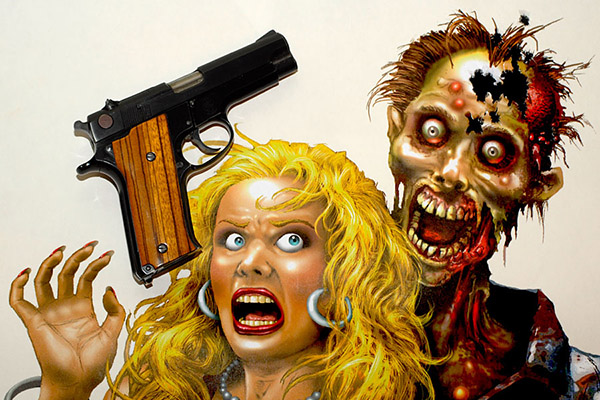
Zombies don’t stand a chance against the Model 59. My favorite 9mm load in the 59 is a 125 gr cast roundnose bullet over a max load of Unique propellant.
The good news is the Model 59 ultimately went into high rate production. More than a few police departments chose the 59 when the migration from revolvers to autos occurred in the 1980s. All of those PDs moved on to newer guns, and today you can still find used Model 59s for cheap.
Most folks today have either never heard of the Model 59, or they would smile quaintly at its mention and then tell you how great their plastic Glocks are. But don’t dismiss the Model 59. The 59 is a grand old handgun and I’ll bet you a dollar to a donut you’d love it. Mine just gets better with age (like a fine wine, I guess), and I love shooting it.

 The arrows in the next pic point to the matching right side of the Model 59 frame. Note the worn area. It’s where the barrel ramp contacts the frame ramp when the gun recoils. That ramp (along with the mating ramp on the barrel) drops the barrel slightly to disengage it from the slide when the slide moves to the rear. You can see this area took a beating over the last 50 years. The photo shows the opposite side of the frame, where it didn’t break.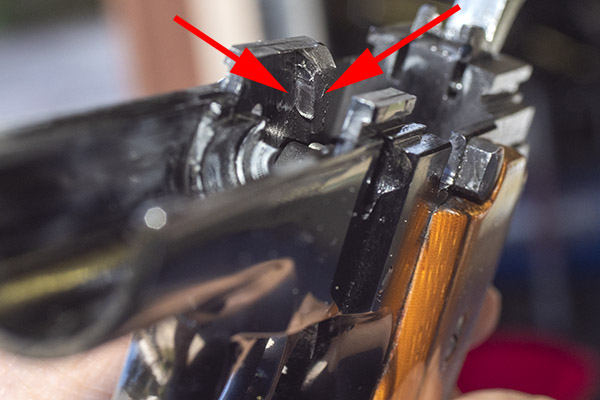
 and I’m well stocked.