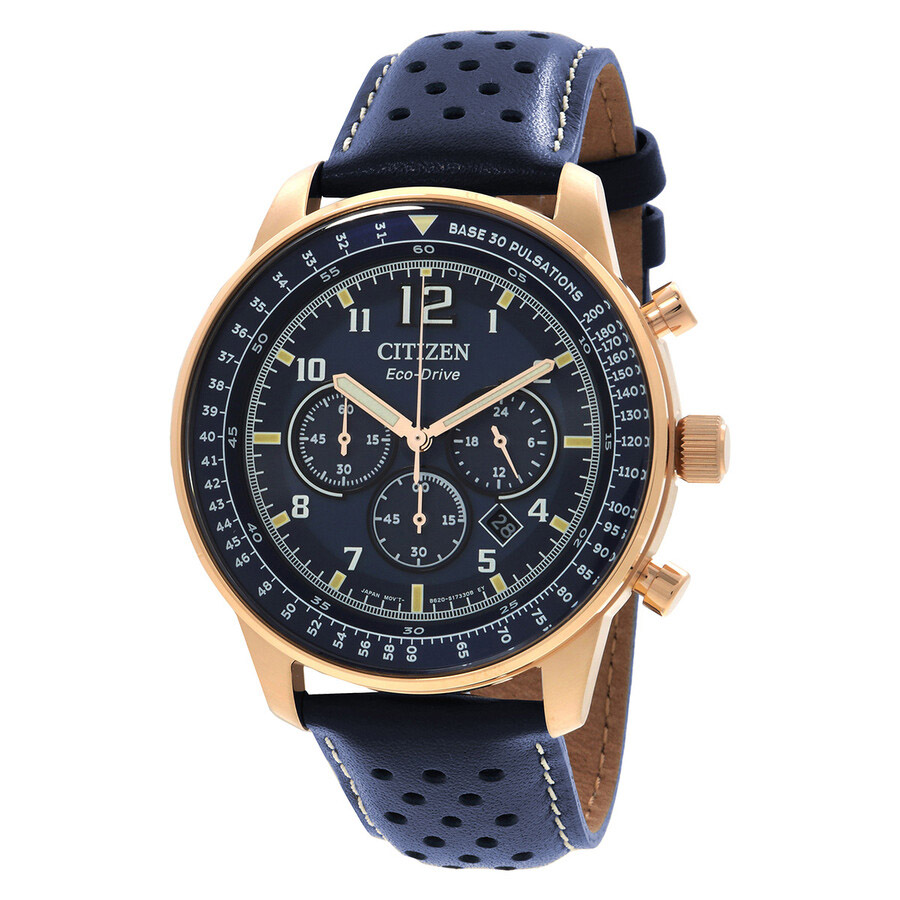
It was an impulse buy, the kind of purchase that folks who send out marketing emails hope to induce, and it my case, it worked spectacularly well. My new Citizen chronograph is rose gold (something I’m a sucker for), with a leather band (something else I’m a sucker for), and both the leather band and the watch face are Navy blue (something I’m…well, you know where this is going). As it was over $100, there was free shipping (something that always gets my attention). And finally, there was the sale price: $144, down from $395. I am a soft touch for great deals on wristwear, weapons, and other assorted toys that find their way into the ExNotes blog.
All that was cool, but after I clicked buy now and typed in my credit card info, I studied the chronograph bezel markings. I was intrigued by the notation “Base 30 Pulsations.” You can see it on the outer bezel between the 12:00 and 2:00 positions. As much as I like watches in general and chronometers in particular, I had never heard of such a thing before I bought the watch you see above.
It was off to Googleville, and like always, Google came through.
The Base 30 Pulsation system came about in the early days of watchdom as a tool for doctors to quickly measure a person’s pulse rate. The way it works is that you start the stopwatch (the chronometer) and count 30 heartbeats for whoever’s pulse you’re taking. When you hit 30 beats, you stop the chronometer. The chronometer’s second hand will point to the patient’s pulse rate. If the pulse rate is the normal 60 beats per minute, the second hand will point to 60 on the outer bezel, which makes sense because if you had 30 beats in 30 seconds, well, your pulse rate would be 6o beats per minute. This is cool stuff.
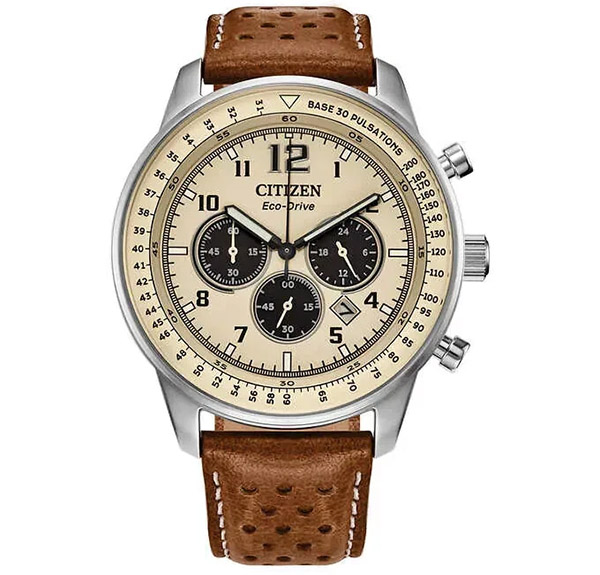
That got me to thinking: Are there other chronometers out there with bezels marked in the 30 Base system? Yep, and some are even by Citizen. They have an identical model to the one you see above in stainless steel with a brown leather band and an ivory face:
I’d seen the above watch (the ivory-faced one) in the display case at my local Costco, but I can’t remember what they were asking for it and I couldn’t find it on the Costco website. I’m pretty sure it’s still in the store. If you can’t find one at your local Costco, there are a bunch of retailers selling them on Ebay.
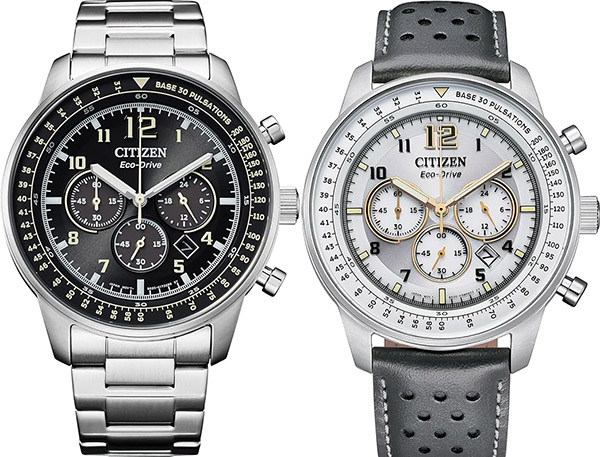
I also found a couple more stainless steel Base 30 versions of the Citizen in different colors on Amazon:
Amazon’s prices were in the $250 to $275 range for the above watches. Those might be decent prices, but Jomas (www.Jomashop.com) has them all beat at $144 (which is what I paid for mine).
A man with a watch knows what time it is. A man with two watches is never sure.
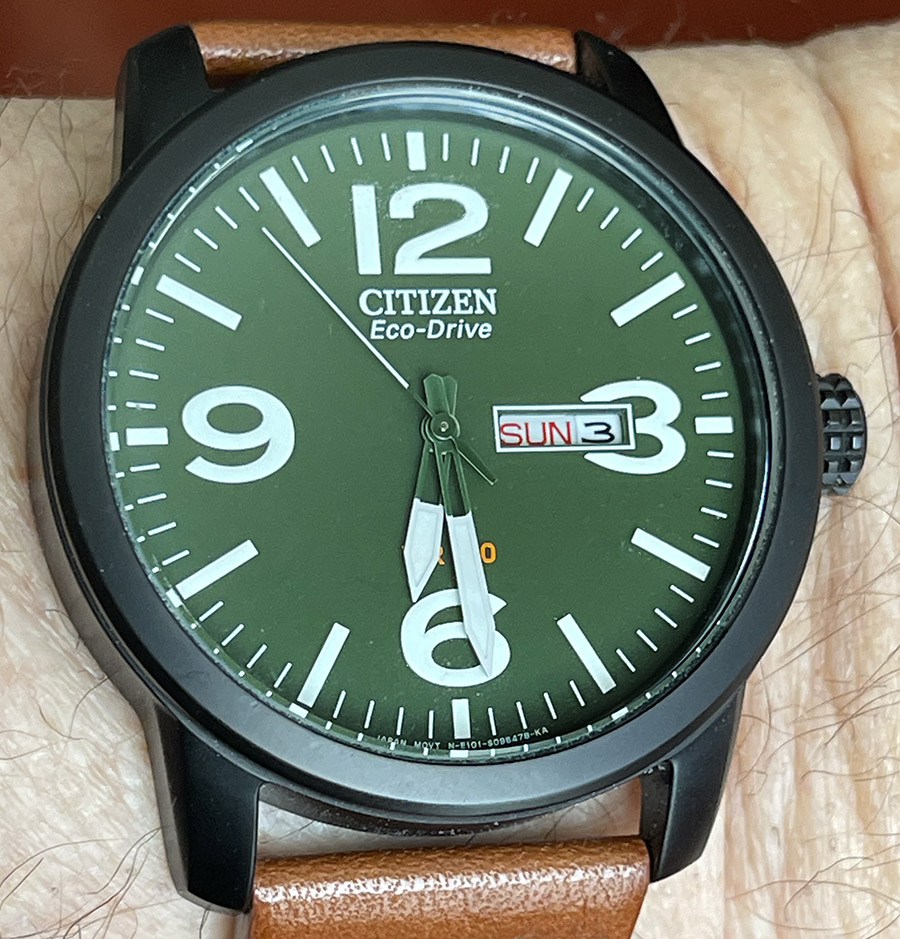
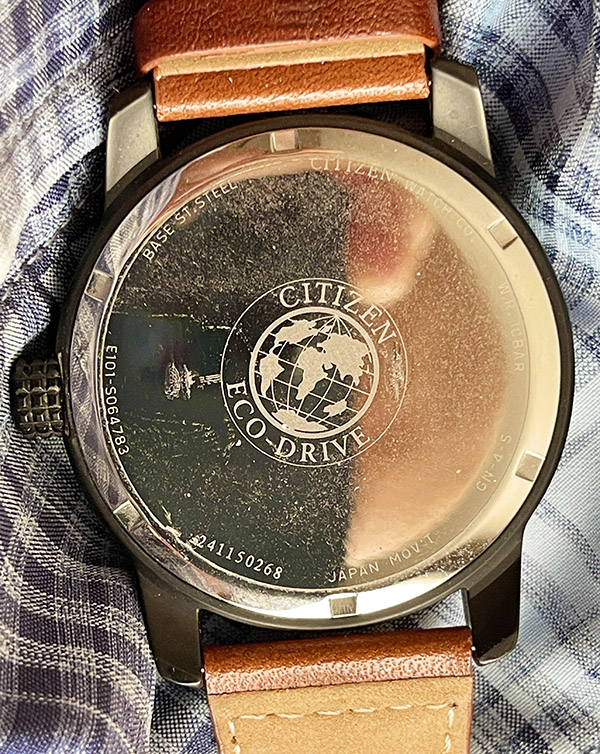
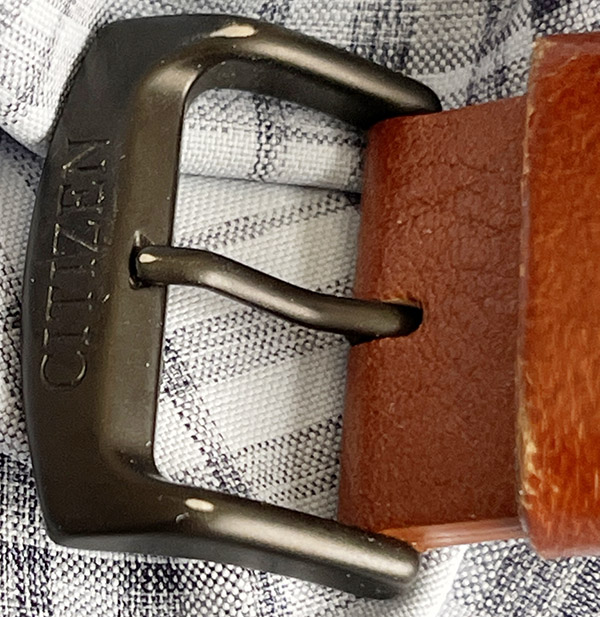
You’d think with my old-age eyesight and need for bigger letters and numbers I’d wear the Citizen watch you see above more often, but the fact is I don’t. I bought it years ago when I was a yuppie, and I wore it a little, but it just hasn’t had much wrist time in the last couple of decades. But it still works well, and it’s still got those big numbers. I need those now.
The Citizen uses their E101 solar-powered quartz movement and like all Citizens, Seikos, Casios, and Orients that use a quartz movement, it is phenomenally accurate. I’m talking in the range of seconds per month. I never thought I’d need a watch that accurate, and I probably don’t, but I enjoy having one. It’s one of the reasons I almost never wear an automatic (i.e., mechanical) watch anymore. They just don’t have the kind of accuracy I’ve become accustomed to.
Another feature on the watch you see here is the lume. It’s incredible. At night, the numbers and those big hands jump out at you. Other than having a backlit Casio or Timex, the lume on this watch makes it one of the easiest to read in darkness I’ve ever owned.
Once this watch is charged after being in the light, it keeps running for a long time. If I leave it on the shelf for months, it still keeps running. Evidently, room lighting is enough to keep it charged. When it does run down, it doesn’t take very long for it to come alive when it sees sunlight again.
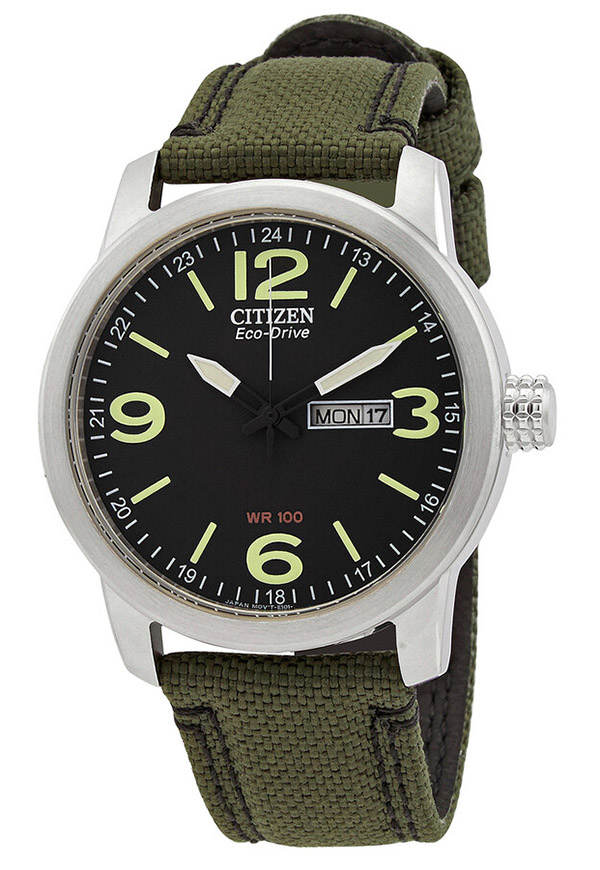
What surprised me is that even though I’ve owned this watch for more than 20 years (it’s probably closer to 30 years), you can still buy this model at a relatively modest price. The exact colors you see here are no longer available, but the basic watch design is, and to me the new colors are just as attractive as the old. Here’s the same watch in a brushed stainless finish with a canvas strap. I like this look a lot.
I’m tempted to buy the watch you see above, but I already have plenty of watches. You can buy the above watch on Amazon for $184, or better yet, from Jomashop for a paltry $124. That’s a hell of a deal.
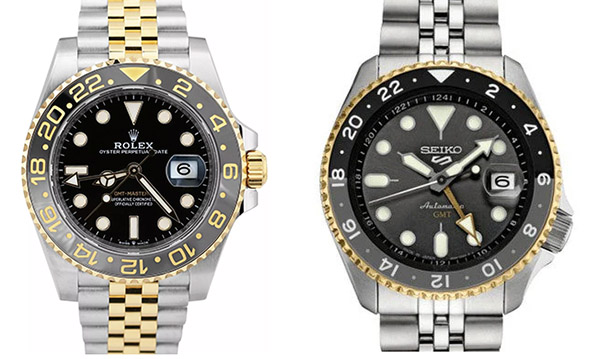
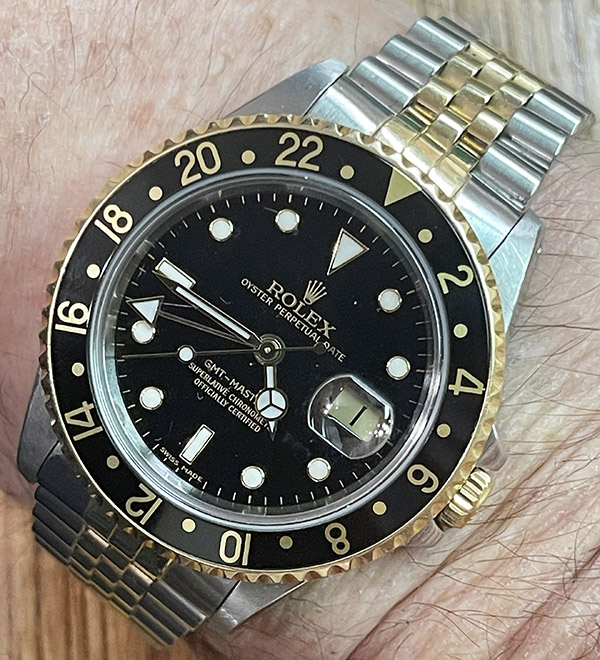
Some time ago, we wrote a blog comparing the Casio Marlin and Rolex Sea Dweller dive watches. This one is similar; it compares my nearly 40-year-old two-tone Rolex GMT II to a recently-released Seiko two-tone GMT.
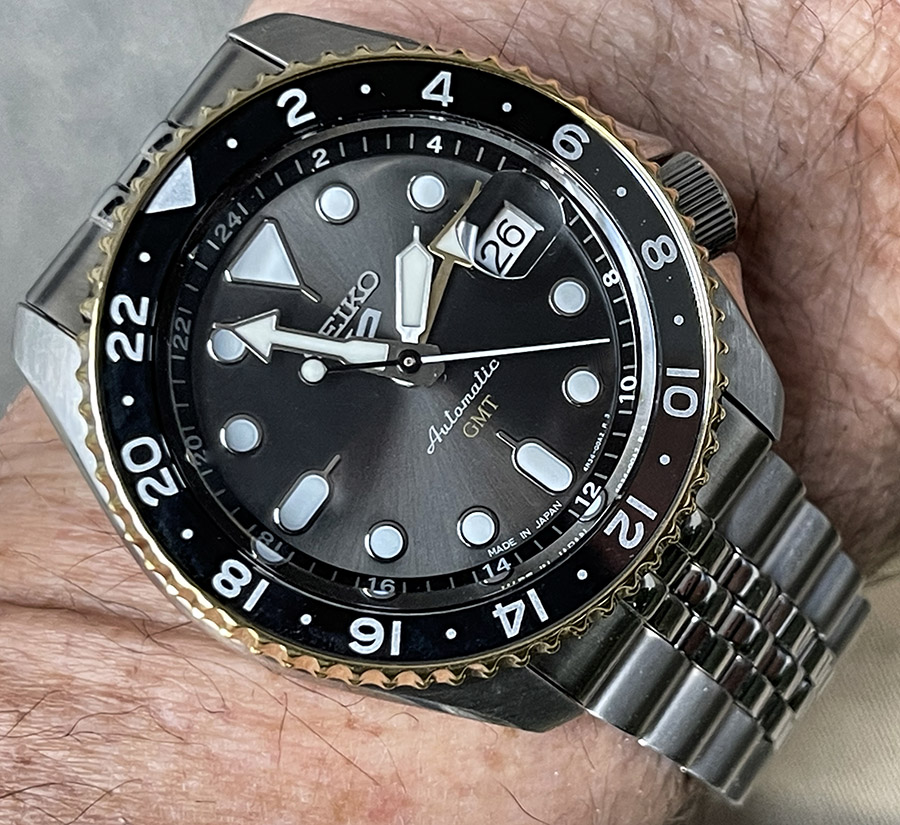
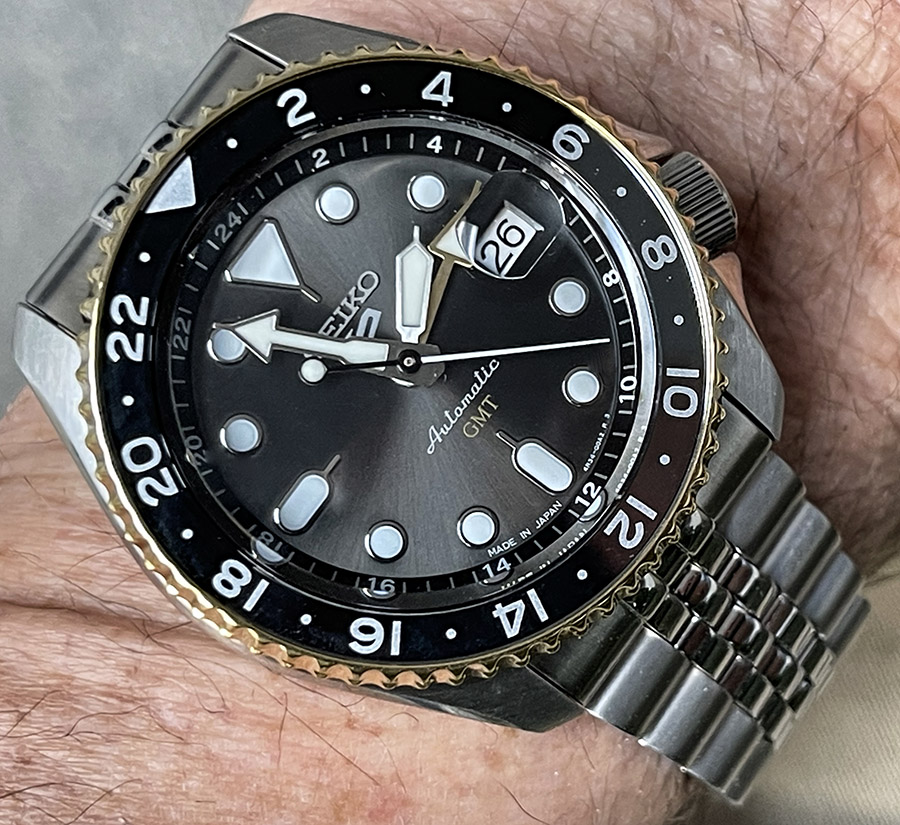
Two GMT watches: The Rolex GMT Master II (left) and the Seiko two-tone GMT (right). in the photos here, the Rolex has a much richer appearance; in real life, the Seiko looks just as good.A close up of my Rolex GMT Master II, purchased new in 1986 when I was still a yuppie. Note the cyclops lens over the date. It really works. The older I get, the better it works.The Seiko two-tone GMT, purchased a few days ago. The Seiko also has a cyclops lens over the date. It’s a cool and useful touch. This is a very nice watch.
I’m a sucker for a good-looking watch. Many of my retired friends take pride in not wearing a watch, and many young people don’t wear watches (they’re glued to their cell phones all day; they can get the time there). I always wear a watch.
The first watch I ever owned was a gift from my parents. It was an inexpensive Timex that was completely unexpected, I loved it, and I wore it for years. I first recognized watches as a status symbol and a cool thing to own when I was in the Army, and like all the other lieutenants overseas, I bought a Seiko chronograph at the Base Exchange. After the Army came the aerospace industry where a Rolex was the status symbol, and when I was back in D.C. lobbying Congress to buy Aerojet cluster bombs instead of Brand X (Honeywell was Brand X for us), a jewelry store had the Rolex GMT Master II you see here. I wore it full time for years after I first bought it, and then only intermittently after that. I felt the Rolex was pretentious around clients, and I was afraid it would reinforce a feeling that they were paying me too much (which they were). Now that I’m retired, the fear of being pretentious has been replaced by the fear of getting mugged, so I don’t wear it very often.
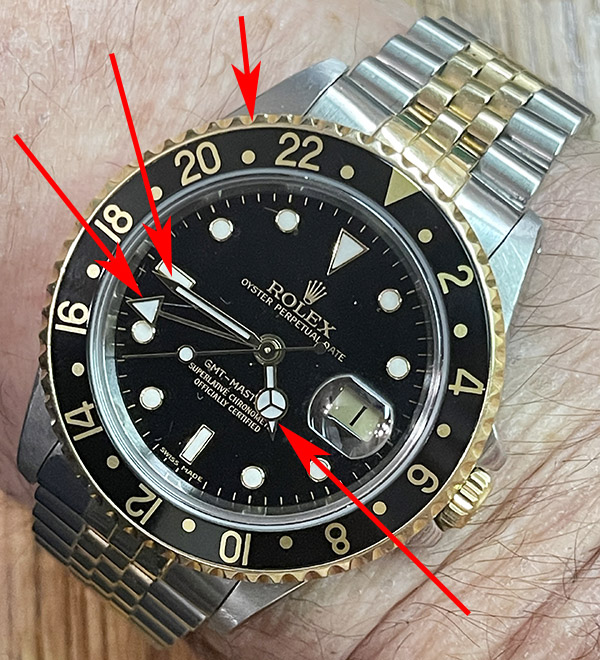
The hands of fate. The top arrow points to the bezel, which can be rotated in relation to the GMT hand (lower left arrow) to tell time on a 24-hour scale in a different time zone. The second-from-the-top red arrow points to the minute hand. The arrow on the right points to the conventional hour hand. If you look closely at the inverted diamond at 12:00, you can see the bezel is slightly off.
So what is a GMT watch? Basically, it is a watch that allows you to tell time in three time zones. If you wanted to, one of the time zones could be Greenwich Mean Time (GMT), which is the time at the Greenwich Observatory in England. Most of the time, I could care less what the time is in England, but that’s where the GMT descriptor originates.
Today, there are multiple approaches for time telling in different time zones, but the classic approach (and one followed by the Rolex and Seiko watches in this blog) is through the use of a third hand and a bezel with 24-hour numbering. The way it works is this:
The standard hour and minute hands tell the local time.
The third hand can be shifted to tell the time in a different time zone.
The bezel can be rotated to tell the time in a third time zone.
There are variations on the above (like switching local time with destination time, etc.). All of this may sound like a solution looking for a problem, but trust on this, when you travel to different time zones, it’s a very useful feature.
The Rolex GMT allows you to “step” the hour in one-hour increments by use of the winding knob when the knob is partially pulled out (some folks say this makes the Rolex a “true” GMT). On the Seiko, it doesn’t have the “step” function; use of the winding knob advances either the third hand or the conventional hour hand without the one-hour clicks (depending on which click you bring the stem out to). To me, either approach is acceptable.
The Rolex GMT Master II retails today for $14,050; the Seiko goes for $475. There’s a lot more to the pricing story, though. Prices on a Rolex are all over the map, and Rolexes sell for well above their suggested retail price. Some, even used, sell for three or four times their suggested retail price. I don’t know what my Rolex would sell for today as a used watch, and I’m not really interested because it’s not for sale. The Rolex will eventually go to one of my grandsons. I paid $3287 for it new in that Washington, D.C. jewelry store in 1986. I could easily get my money out of it if I wanted to, but like I said, that’s not going to happen.
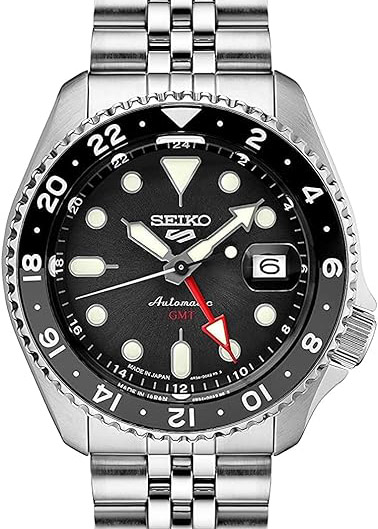
Staying on pricing for a minute, the two-tone Seiko GMT is a relatively new model, so I couldn’t find it discounted on Amazon. If the two-tone coloring is not important to you, you can get the all-stainless version on Amazon for $317, which is a smoking deal (it’s $158 less expensive than the two-tone version).
My Seiko GMT was an impulse buy. Sue and I went out for lunch and there was a small watch shop a couple of doors down. They had the two-tone model, which I had not seen before other than in online watch forums and Seiko’s website (I was in Tokyo last year, and I didn’t even see it there). I asked the shop about a veteran’s discount, the guy said “you bet,” and mine set me back $402. I like supporting local businesses, I like doing business with shops that offer a veteran’s discount, and I liked being able to see the watch in person before I pulled the trigger.
My Rolex runs fast, gaining about a minute a week. That’s adjustable and would no doubt be corrected if I took the watch in for service, but I’m probably not going to do that. I’ve had the Rolex serviced twice. The last time was 25 years ago at the Rolex service center in Beverly Hills (where else could it possibly be?). Rolex clipped me $1000 for the service. I wasn’t happy at all. After the servicing, the numbers on the click-detented bezel were offset from where they should have been, and when I bitched about that, they remounted the bezel. It was better, but it is still offset a bit. Within six months of that service (which included replacing the crystal), I noticed a gouge on the crystal. I had worn the Rolex for 10 years before that and never had a scratch on the original crystal, so I have to wonder if I really received the sapphire crystal I paid for. A servicing today will probably be about $1500 if I get the crystal replaced and the bezel numbers remounted. It’s not likely I’ll spring for that. Maybe I will. I don’t know. It’s something I think about now and then, but then I think about getting out on the range with a milsurp rifle or riding my motorcycle and I forget about it. So far, the Seiko is keeping perfect time. I’ll let you know if that changes.
The Seiko is a new watch, so I haven’t had it serviced yet. Poking around a bit revealed that a typical mechanical watch servicing costs from $200 to $250. I think my local guy would probably be less than that. It’s quite a bit lower than what a Rolex service costs.
Both the Seiko and the Rolex are automatics. That means they are mechanical, selfwinding timepieces. The good news is there are no batteries, and it doesn’t matter if I stay out in the sun long enough to charge the solar power source. The bad news is that if I don’t wear an automatic watch for a few days, it stops. When that happens, prior to the next time I wear it I need to wind it and set the time. The Seiko, fully wound, has a 41-hour power reserve. The Rolex has a 70-hour power reserve. Rolex gets the nod here.
Regarding cosmetics, the “gold” bezel on the Seiko isn’t really gold; it’s plated. The accents on the Seiko hands and the watchface are similarly gold colored (i.e., they are not real gold). The Seiko’s jubilee bracelet links center areas are left a natural stainless steel finish. On the Rolex, they are gold. Another thing to note: On any Rolex, wherever you see something gold, it’s real gold. Nothing is plated on a Rolex. The bezel, the watchface accents, the hands, the winder, and the jubilee bracelet are all solid gold. Both watches look great, in my opinion. The real gold obviously drives the cost of Rolex higher than a Seiko, but not enough to explain the $14,000 (or more) difference. Most of the price difference is prestige pricing (Rolex gets away with it because some folks think they need such a thing). I used to be one of them. I’m not anymore.
About that jubilee bracelet: What they refers to are the smaller links in the watchband’s center section. Non-jubilee watches have bigger, single links instead of the jubilee bracelet’s three smaller links. To me, the jubilee bracelet makes a real comfort difference. The non-jubilee bracelet just doesn’t feel as good.
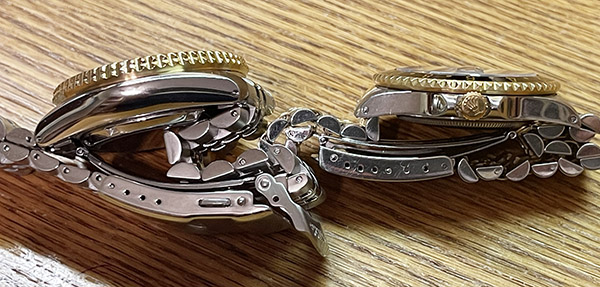
The Seiko is a much thicker case, and it sits higher on the wrist. It’s enough to be noticeable. The Rolex is thinner and I like the feel of it better for that reason.
Note the increased case thickness of the Seiko (on the right) compared to the downright thin Rolex. Rolex gets the nod here.
The Seiko’s stem winder is a push in/pull out affair. The Rolex stem winder unscrews, which theoretically makes it more waterproof. I don’t wear my watch in the shower any more (ever since I ruined a G-Shock by doing so), so the difference is meaningless to me.
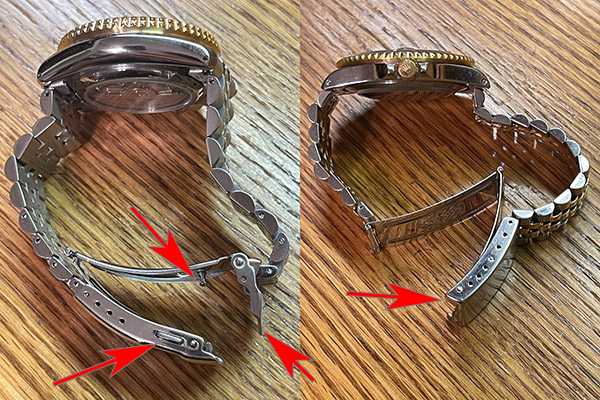
One last area I’ll touch on is the clasp design. Hands down (pardon the pun) the win here goes to Seiko. The Seiko’s clasp has three retaining features compared to the Rolex clasp. The fear, of course, is that the watch clasp comes undone and the watch slips off the wrist. It could be damaged by a fall onto, say, concrete, or worse, go unnoticed. The other fear is pickpockets. I don’t know how difficult it would be for a pickpocket to lift your watch. I once had a guy (a magician) remove a watch I was wearing without me noticing it. That watch had a leather band and I later learned there’s a trick to it. I don’t know if there’s a comparable trick for a metal bracelet, but if there is, I would think the Rolex would be more susceptible to such a thing.
The Seiko (on the left) clasp has three retaining features; the Rolex (on the right) has only one (which is a small dimensional difference between the outer clasp and the mating pin on the inner clasp). The Seiko design is better.
The bottom line to me is that the Seiko is a hell of a deal for under $500, and if you are looking for a watch that offers all the advantages of a GMT and is dressy, the Seiko is a good buy. I own both, and I think Seiko hit a home run here.
There are other approaches to a GMT watch. Citizen has a different dual time approach with their Nighthawk and Blue Angels models. Many digital watches (some identified as GMT watches and some not) can display the time in different time zones at the touch of a button. Casio has several cool models that do this. The Citizen and the Casio watches are reviewed on our Product Reviews page.
That Seiko watch you see on the right, known informally as “The Panda” in watch collector circles, is perhaps the best watch I’ve ever owned. I bought it at the Kunsan AFB Base Exchange when I was a young Army dude in 1975 for the princely sum of $76, which was a bit of a stretch for me. Oh, I had the bucks. The Army didn’t pay us much, but we didn’t have expenses, either, so $76 was eminently doable. In fact, I bought Seiko stainless steel chronographs from the Base Exchange for my Dad and my grandfather, too. Their watches were only $67, but the Panda had the day and the date on the face, and three timing features: Seconds on the main watch face, minutes on the lower subdial, and hours on the upper subdial. It was a beautiful thing and it was all mechanical. I wore it for about 10 years, and then when Ebay started to get popular I auctioned it away. I was quite pleased with the results. The watch that originally set me back $76 went for just north of $200 on Ebay 30 years ago. Today, though, that same watch brings around $2000. I sold too soon. Go figure.
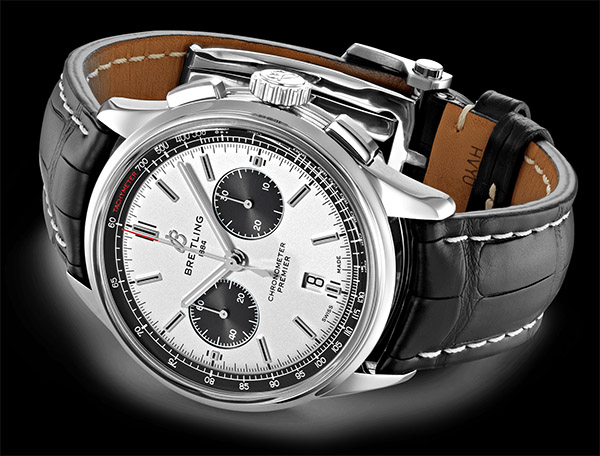
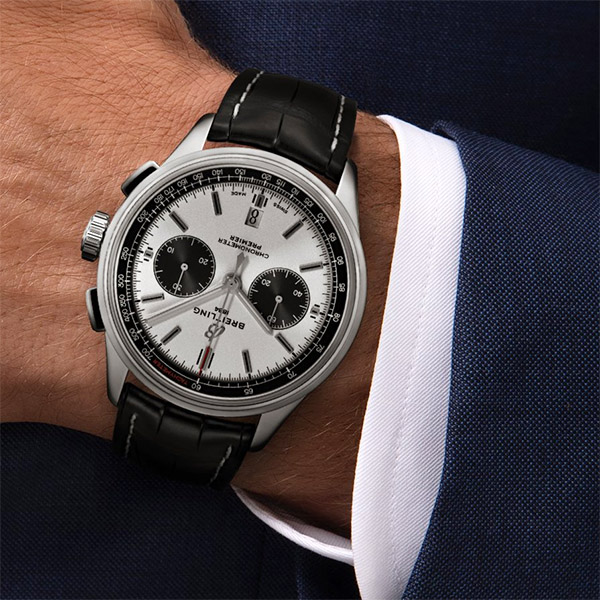
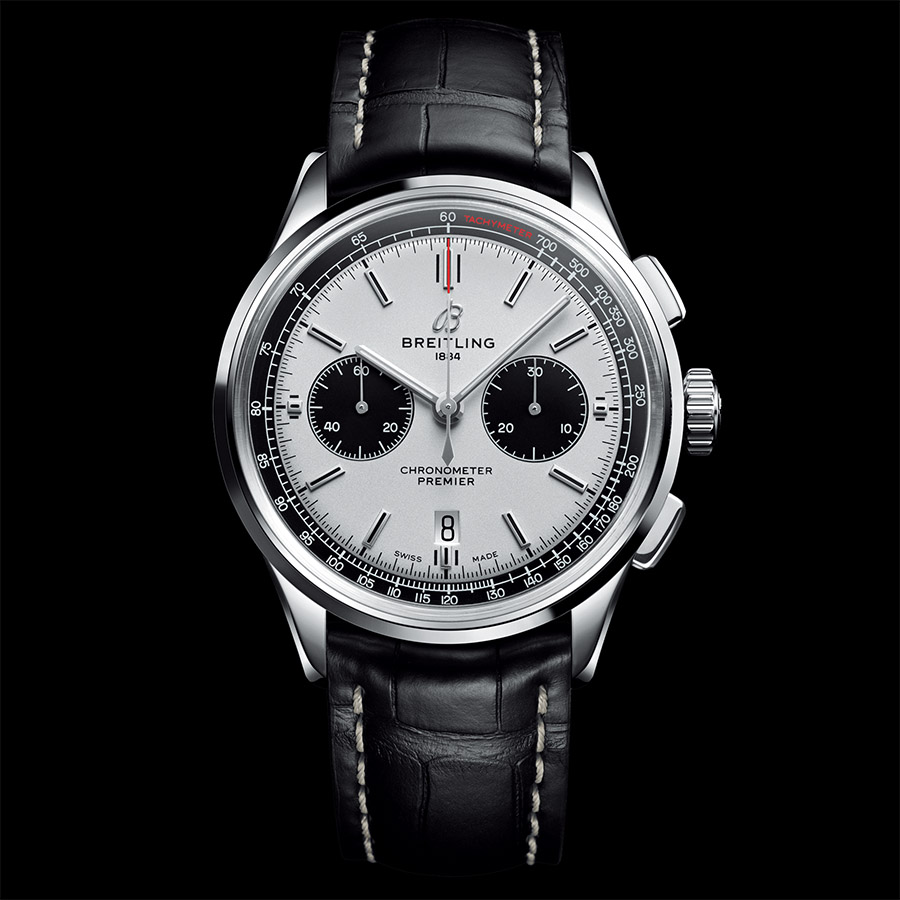
Anyway, being the watch junkie that I am, I was more than a little intrigued by a very similar watch now being offered by Breitling. It is also an all mechanical watch Breitling calls the “Premier.”
I’d call it a Panda, and I’d sure like to own one. But the Breitling MSRP is a lofty $8500. They are just over $6,000 on Amazon, but that’s still way above my pay grade.
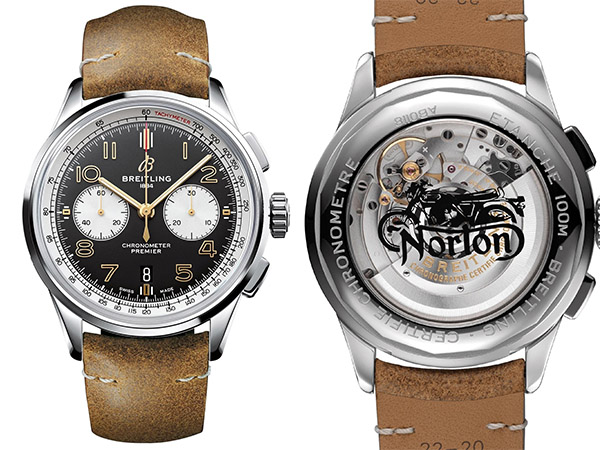
In poking around on the Internet looking at the Breitlings, I learned that they offer several versions of their Premier. One is a model that pays tribute to the Norton motorcycle, which has different colors, old school numbers on the face, and a band that, frankly, looks cheap to me. The colors don’t really work for me, either, but maybe that’s because I want my Panda to look like a panda. If I wanted a Norton motorcycle, I’d buy a Norton.
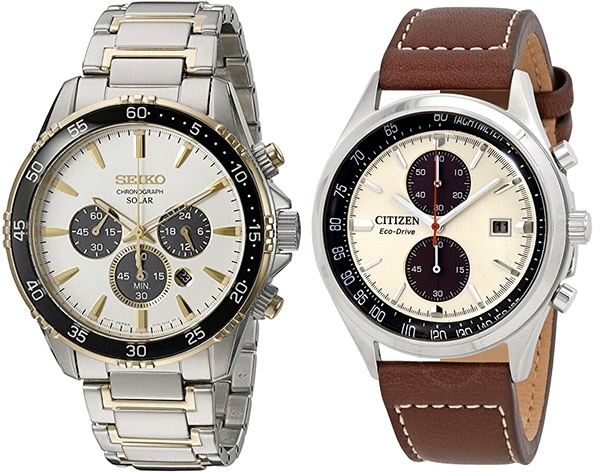
Seiko is back on the Panda wagon, too, as is Citizen and perhaps others with modern versions of this classic watch design. Their prices are way more reasonable, too, being in the $200 to $300 range. But the new Seiko and Citizen Pandas are solar-powered quartz watches.
There’s nothing wrong with electric watches (in fact, their accuracy is astounding), but I’m a mechanical guy. I own a few solar watches and several battery-powered watches. I like them all. But there’s a certain cachet (a fancy word for cool) associated with a mechanical watch, even if you give up a little accuracy. I would like to wear that Breitling just to pretend I’m still a yuppie, but it’s not gonna happen.



 I’m tempted to buy the watch you see above, but I already have plenty of watches. You can buy the above watch on Amazon for $184, or better yet, from
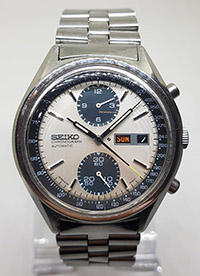 That Seiko watch you see on the right, known informally as “The Panda” in watch collector circles, is perhaps the best watch I’ve ever owned. I bought it at the Kunsan AFB Base Exchange when I was a young Army dude in 1975 for the princely sum of $76, which was a bit of a stretch for me. Oh, I had the bucks. The Army didn’t pay us much, but we didn’t have expenses, either, so $76 was eminently doable. In fact, I bought Seiko stainless steel chronographs from the Base Exchange for my Dad and my grandfather, too. Their watches were only $67, but the Panda had the day and the date on the face, and three timing features: Seconds on the main watch face, minutes on the lower subdial, and hours on the upper subdial. It was a beautiful thing and it was all mechanical. I wore it for about 10 years, and then when Ebay started to get popular I auctioned it away. I was quite pleased with the results. The watch that originally set me back $76 went for just north of $200 on Ebay 30 years ago. Today, though, that same watch brings around $2000. I sold too soon. Go figure.