I’m a big fan of GMT watches, and in that world, the Pepsi Rolex is perhaps the most desirable. This video (mentioned in my previous blog) tells the story better than I ever could, so I’ll let it do the talking:
The video is good from the perspective of the watch’s history and it is good in telling the story behind Rolex’s masterful control of supply and demand.
Back in the 1970s and 1980s, any Rolex was a status symbol. I know it sure was in the US defense industry. The most commonly-worn one was the Pepsi with an aluminum bezel (the ceramic bezel was still a few decades into the future). One of my fellow Yuppies in the Aerojet heirarchy explained to me that Pepsi with a worn aluminum bezel (like his, with a scratch or two, and faded colors) was even more of a status symbol, as the worn bezel implied that the wearer had been successful for a while. I don’t think that was true, but hey, it was his watch, he believed it, and it made him happy.
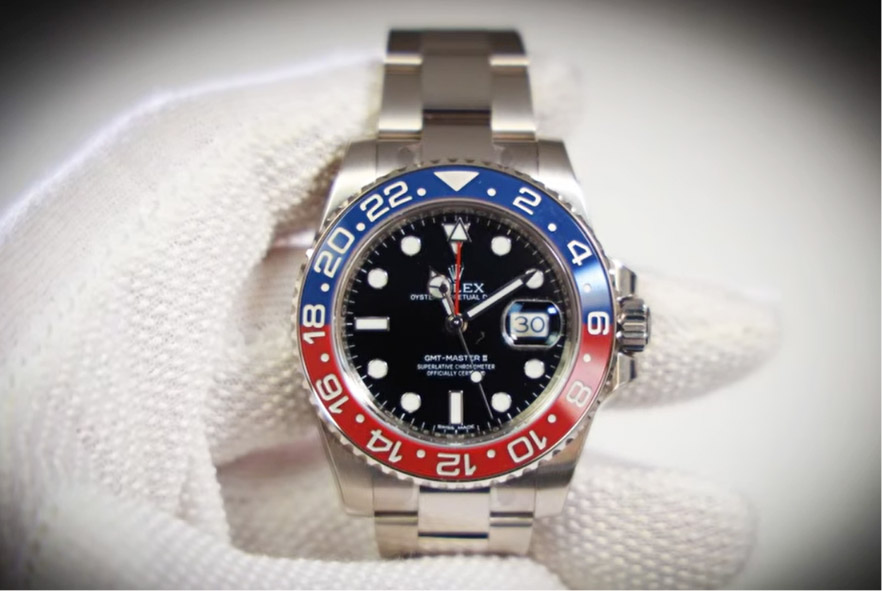
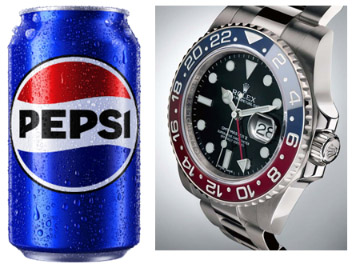
Most of the the Rolex GMT watches have bezels with two different colors, one for the a.m. hours and one for the p.m. hours. On the Rolex “Pepsi,” the p.m. bezel hours are blue, and the a.m. hours are red. The red and blue colors are similar to those on a can of Pepsi, hence the name. There’s also a Batman nickname, for bezels with blue and black, and a Coke nickname, for bezels in red and black. There are a few others, but I don’t know them all.
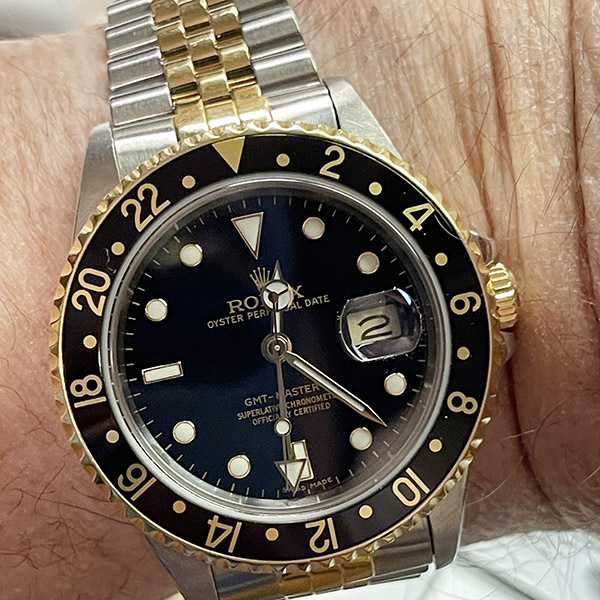
My Rolex is a two-tone watch (stainless steel and gold, as you see above). I just had mine serviced by the wizards at LA Watchworks in Pasadena and they did a great job. It wasn’t cheap, but hey, what is anymore?
Well, that’s a good question. I thought it might be cool to own a Pepsi, but I didn’t feel like shelling out $40K for a Rolex Pepsi. So I did the next best thing.
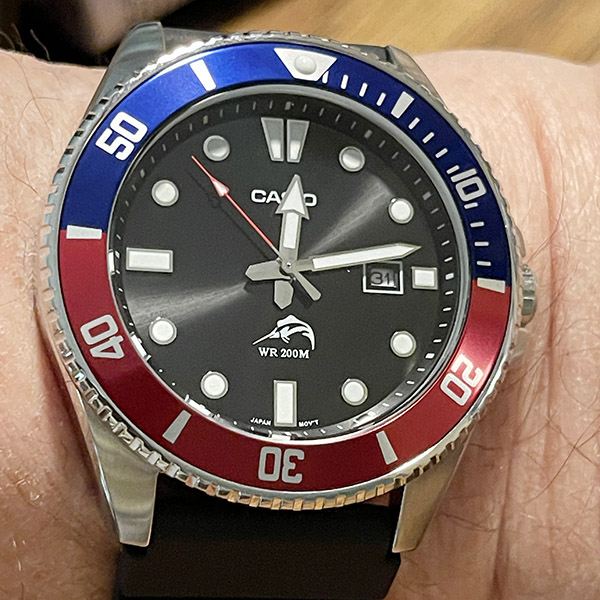
The Casio Pepsi dive watch above was on sale on Amazon for $53 a few weeks ago, and I couldn’t let that get away. And you know what? I am enjoying the Casio just as much. It actually keeps better time than the Rolex, too.
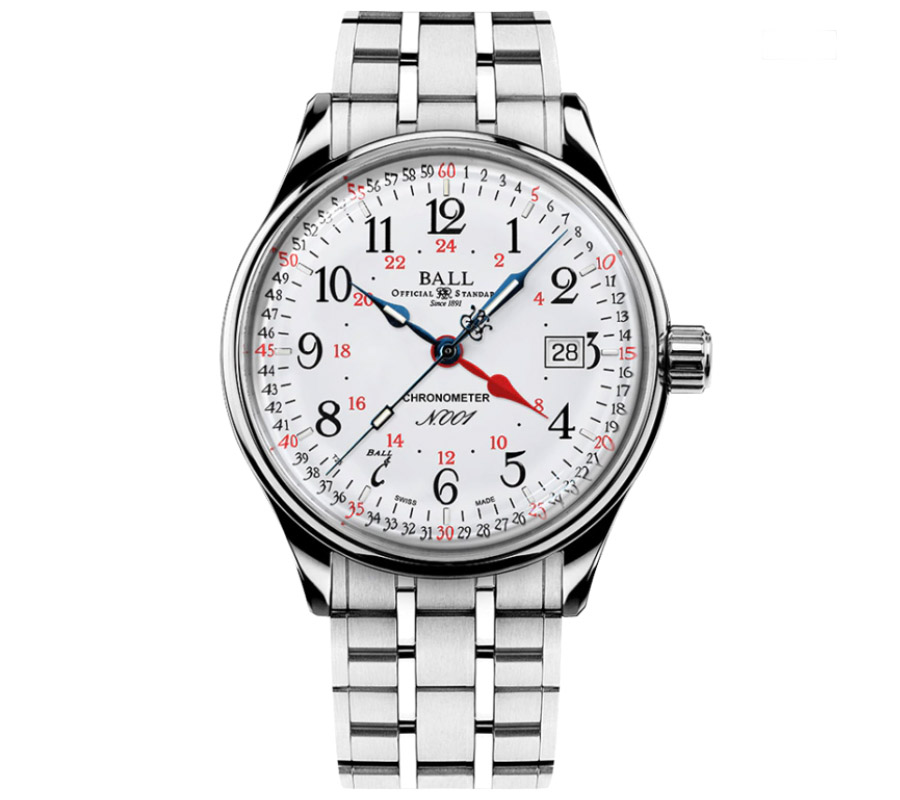
A disclaimer up front: I don’t own the Ball Watch Trainmaster GMT you see above, and I don’t actually have one to review. In fact, I’ve never seen one in person. But I sure want one. Sometimes it’s fun to think about buying something for a while without actually pulling the trigger. One such item for me is the Ball Trainmaster GMT watch, as seen in the photo above. Part of the desire is the watch’s design, and part of it is the Ball Watch heritage.
I like the Trainmaster’s bold face and big numbers. Some have criticized the watch’s wonky font, but I like it. If you look closely at the numeral 7, you’ll see the Ball designers did a cool thing there. The sharp contrast between the blue hands and the white face works well, and the GMT red hand stands out, too. It’s just a cool face; one I know I wouldn’t get tired of checking.
The appeal of a GMT is real for me. I used to need one when working for CSC and when I was in the defense industry. I’ve had projects in Chongqing, Kayseri, Tel Aviv, Haifa, Athens, Mexico, Glasgow, and Medellin, and knowing the local times instantly with a simple glance at my watch was a good thing. It kept me from waking people up in the middle of their night and it let me know when they should be at their workstations. These days I don’t have any overseas activities, but I still like the idea of a good GMT watch. They’re just cool.
About that name: The Trainmaster. Ball has a history rooted in the railroad industry. You’ll see it on every Ball watch with the letters RR (which stand for railroad). It started 135 years ago with Webb C. Ball and a deadly railroad disaster.
Back in the day, trains used to coordinate their travel such that one would pull off onto a siding (a parallel track) so another (going in the opposite direction) could pass. You can guess where this story was going. In the Great Tipton Train Wreck (as it came to be known), one of the conductor’s watches lost four minutes and it didn’t coordinate correctly with the train going in the opposite direction. Webb Ball, a Cleveland jeweler, investigated the two watches used by the conductors on the two trains and found a 4-minute discrepancy. After that, Ball became the go-to guy for all railroad time-keeping issues He started a watch company and Ball watches became the standard for all US rail activities. It’s where the expression “on the ball” comes from. If you were running on schedule, you were “on the Ball” (meaning you were on time).
Today’s Ball watches (including the Trainmaster) have a unique feature: Their illuminated hands and time indicators. The conventional luminosity approach other watches use is to incorporate photoluminescent pigments on the watch hands and numbers (or markers near the numbers). The luminescent pigments absorb photons from exterior light sources like the sun or other strong lights. The problem with this conventional lume approach is that it loses luminescence relatively quickly, and the lume doesn’t glow as brightly as the watch ages.
Ball’s approach is different. Instead of using conventional watch lume materials, Ball incorporates what they refer to as micro gas tubes that stay bright. These are tiny phosphor-coated glass tubes located in the watch hands and the numbers (or watch face markers) that contain tritium gas. The micro gas tubes stay bright with no intensity diminishment. They’re said to be good for 25 years. Different Ball watches place the micro gas tubes in different locations. On the Trainmaster, they are in the hour, minute, and second hands, and in markers by each number on the face. There’s no marker in the GMT hand (I guess Ball thinks you don’t need to know the time elsewhere in the world at night).
Ball offers a couple of relatively unique options on this watch. They will engrave your name for free. You can also select your own serial number that goes on the watch face (if someone else hasn’t already selected it). When Ball first announced these, I checked, and 007 was available. Today, though, it’s not. I guess James Bond already ordered his.
As I said at the start of this blog, I’d like to own a Trainmaster, but not badly enough to actually shell out the cash owning one would require. The Trainmaster retails for something north of $3,000. Poking around a bit on the Internet, I found places that sell the Trainmaster in the $2500 to $2600 range, but that’s still pretty rarefied air for a watch I don’t need.
Greenwich Mean Time. In case you were wondering, that’s what GMT means, and I thought I would introduce this blog with a simple definition of what Greenwich Mean Time actually means, only it’s not that simple. Here’s the first part of a long explanation from Wikipedia:
Greenwich Mean Time (GMT) is the local mean time at the Royal Observatory in Greenwich, London, counted from midnight. At different times in the past, it has been calculated in different ways, including being calculated from noon; as a consequence, it cannot be used to specify a particular time unless a context is given. The term “GMT” is also used as one of the names for the time zone UTC+00:00 and, in UK law, is the basis for civil time in the United Kingdom.
It gets more complicated from there, with considerations given for the historical differences between the day starting at noon (versus midnight), variations in the time at which the sun crosses directly over London’s Greenwich Observatory (it can vary by 16 minutes either way), and other factors I’m not going to go into here. After reading through the Wikipedia definition, I’m going to settle on GMT standing for Greenwich Mean Time and leave it at that.
In my watch-centric context, GMT means a watch that can be used for showing the time in two time zones simultaneously. There’s a lot of ways to do this and the watchmaking world has numerous different approaches. It’s perhaps easiest with a digital watch that can switch between cities (Casio has a number of watches that can do this and we’ve blogged about them before). Within the analog world, there are also different approaches, and we’ve also written about those before (see our blogs on the Citizen Blue Angels and the Citizen Night Hawk).
The more conventional GMT approach in the analog watch world is to add a fourth hand and a separate 24-hour set of markings, with the fourth GMT hand or the hour hand used to designate the second time zone. Last year, I bought a two-tone Seiko GMT watch because I thought it was cool and it compared favorably to my Rolex GMT Master II (and that blog is here).
So where’s this story going?
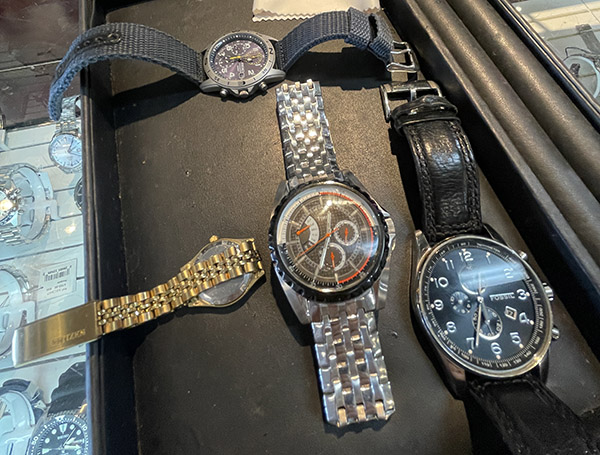
Several watches needed new batteries. The one at the top is a Seiko military-styled chrono in blue. The one at lower left is Sue’s Citizen. The one in the middle is a Timex flyback day-date I bought several years ago. I hardly ever wear that one, but I like it. The one in the lower right is a Fossil I admired when moto-buddy Joseph Lee wore it one day. To my surprise, he took it off and gave it to me.
A few days ago, I noticed several of my quartz watches had stopped running. One of Sue’s quartz watches had, too. Dead batteries. It happens on an irregular basis. But that’s okay, because it gives me an excuse to swing by my favorite watch shop, Golden Times Jewelry, in nearby Pomona. They’re nice people and they only charge $3.25 to install a new battery. And while I’m waiting, I can peruse their selection of new Citizen and Seiko watches.
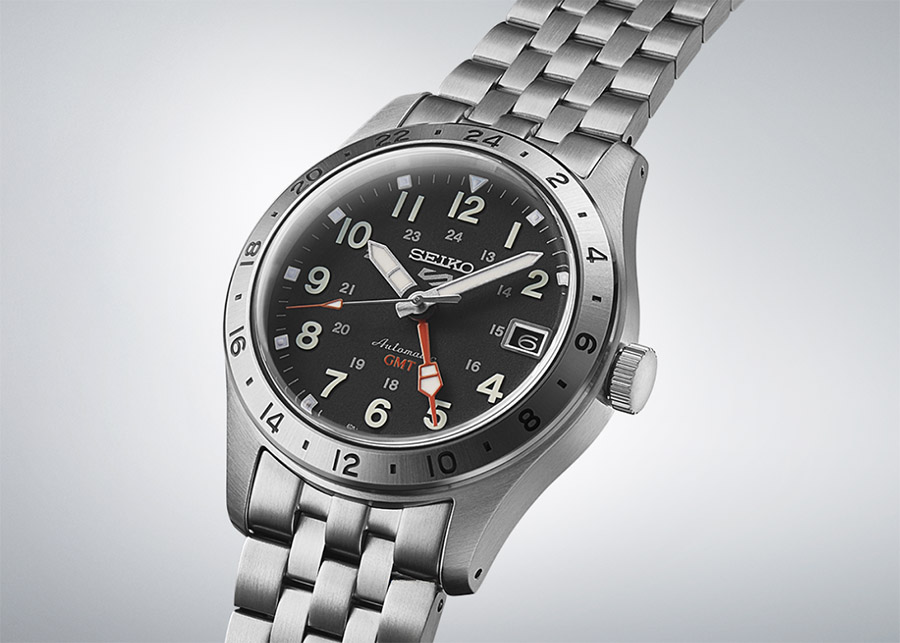
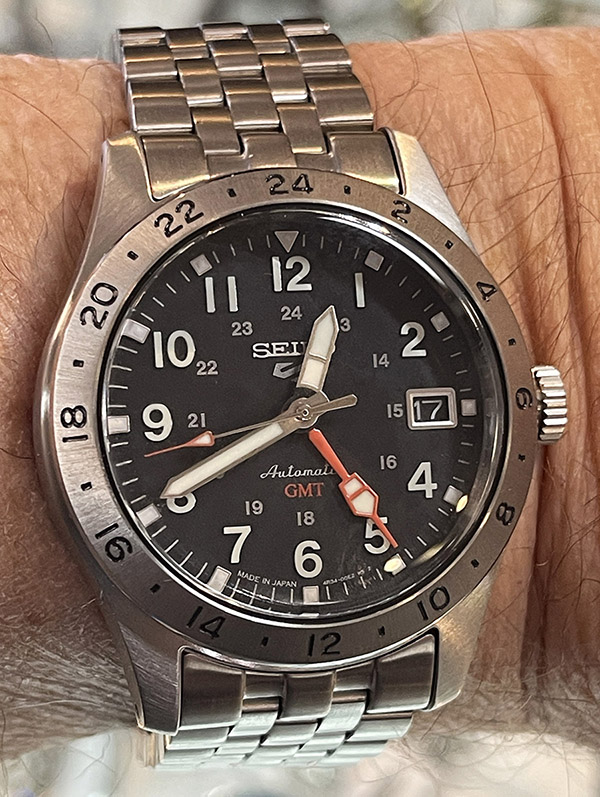
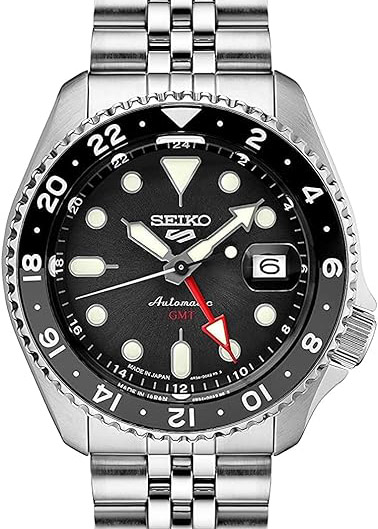
My new Seiko Field Series 5 GMT. This is a good-looking and accurate watch.
I was doing that when I noticed a Seiko I had not seen previously. It was the Seiko 5 Field Series GMT. It had all the features that appealed to me, including big numbers (my eyes aren’t what they used to be), a black face, strong contrast between the hands and the face, a stainless steel case and bracelet, it was not hideously huge (why do watchmakers make watches so unnecessarily big these days?), and an overall appearance that, to me, looked good. I asked to see it, and Stephanie (the nice lady who manages the shop) lopped 35% off Seiko’s suggested list price. That was a superb deal.
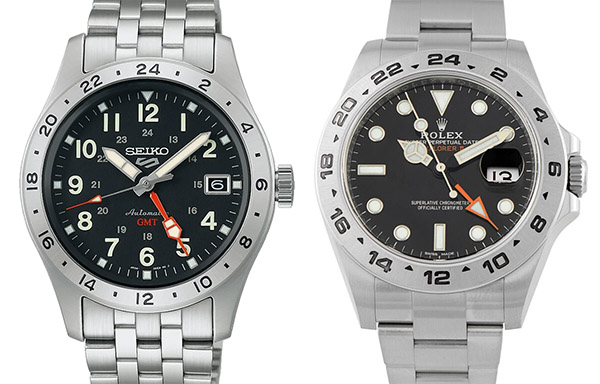
The Seiko 5 Field Series GMT and the Rolex Explorer II. The Rolex’s street price is around $11,000. The Seiko’s MSRP is about $450, but you can get it for less. I think the Seiko is better looking than the Rolex.
The new Seiko reminds me of Rolex’s Explorer II GMT. I tried it on and asked Stephanie if it made me look fat. She smiled. I pulled the trigger and I’m glad I did.
When I got home, I navigated to the official US time site (www.time.gov) and set the new Seiko to the exact time on it. I’ve been wearing the new Seiko for several days now and the watch is tracking to the official government time exactly. That’s awesome from a mechanical automatic (i.e., self-winding) watch. A new Rolex (or one that’s been appropriately serviced) is accurate to about 5 seconds per day. The Seiko is keeping better time.
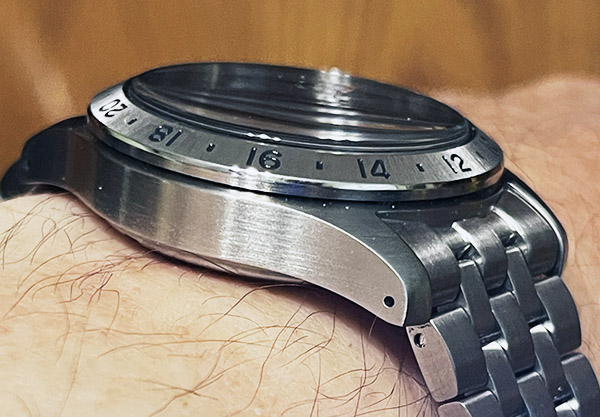
The new Seiko sits lower on the wrist than my other Seiko Series 5 watches.The Seiko 5 Field Series GMT window. I like it.
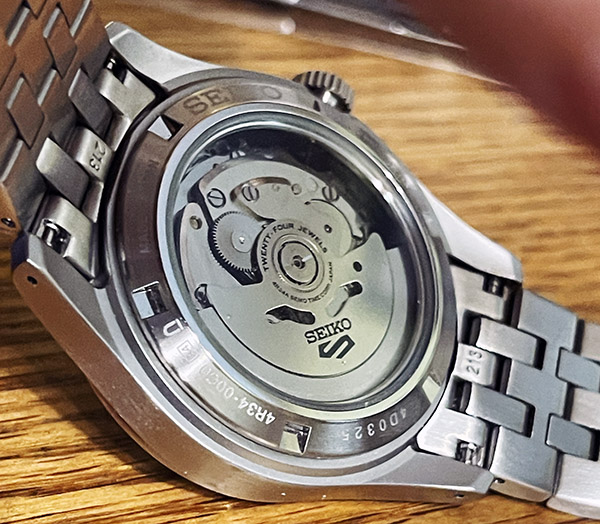
There are several things I like about this new Seiko. It sits lower on my wrist than most of my watches. That’s good. Like the other Seiko 5 watches, the watch has a window that allows you to see the movement and the self-winder. That’s a feature I like. The Seiko has a 41-hour reserve (if you take it off when it is fully wound, it will keep running for another 41 hours). That’s less than a Rolex’s 70-hour reserve, but in the real world, it’s kind of a pointless advantage (in my opinion). If I take the watch off, it’s only going to be for an hour or so. If I’m going to wear a different watch, it will usually be for a week or more (so neither a 41-hour reserve or a 70-hour reserve will keep it going).
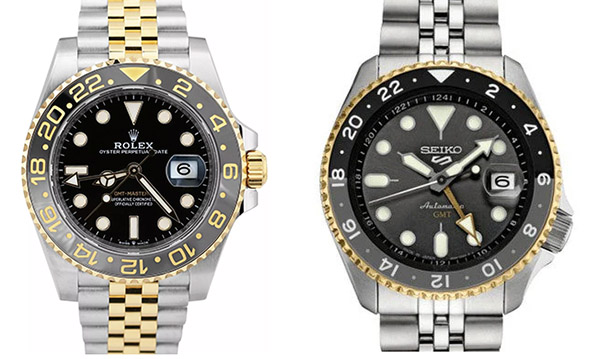
Some time ago, we wrote a blog comparing the Casio Marlin and Rolex Sea Dweller dive watches. This one is similar; it compares my nearly 40-year-old two-tone Rolex GMT II to a recently-released Seiko two-tone GMT.
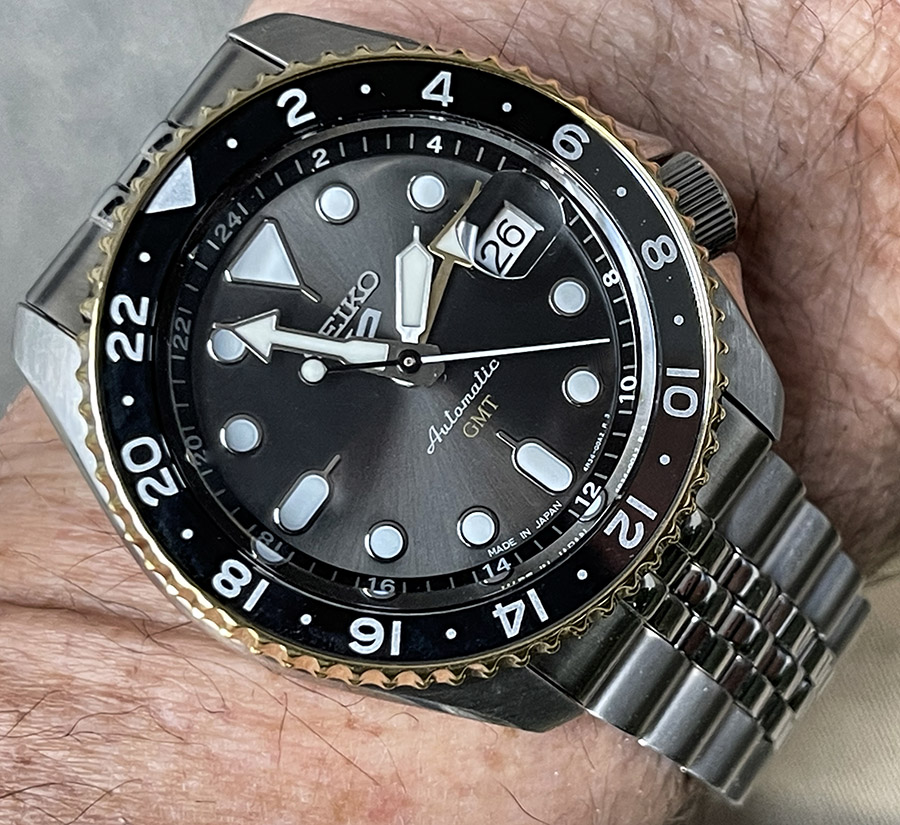
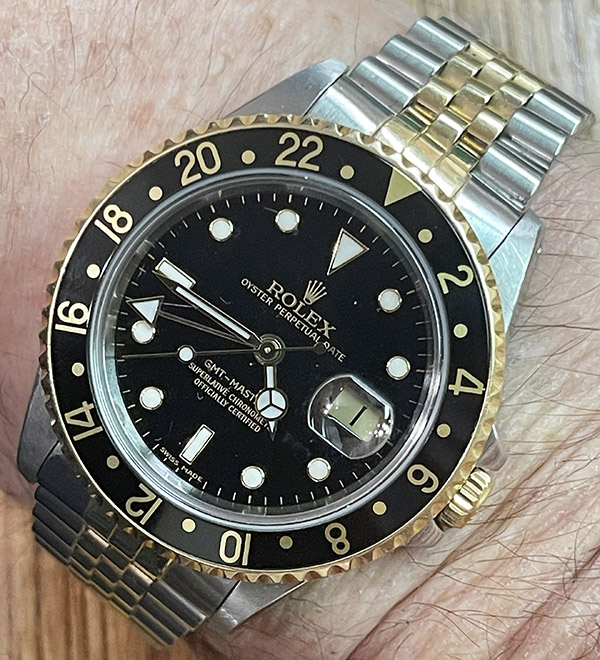
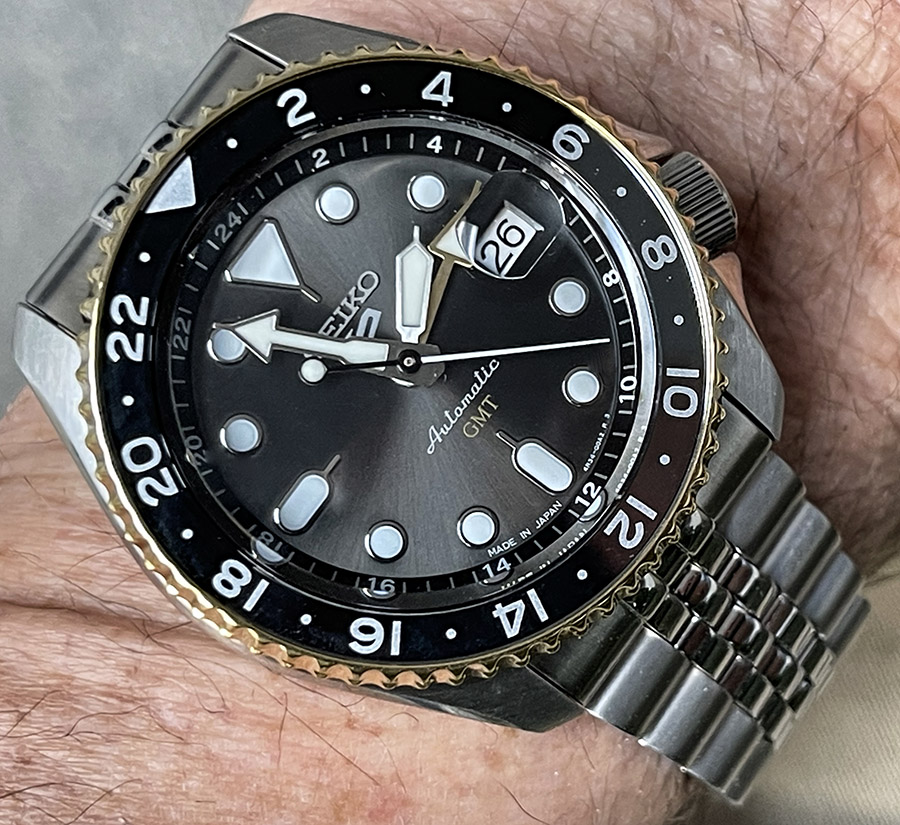
Two GMT watches: The Rolex GMT Master II (left) and the Seiko two-tone GMT (right). in the photos here, the Rolex has a much richer appearance; in real life, the Seiko looks just as good.A close up of my Rolex GMT Master II, purchased new in 1986 when I was still a yuppie. Note the cyclops lens over the date. It really works. The older I get, the better it works.The Seiko two-tone GMT, purchased a few days ago. The Seiko also has a cyclops lens over the date. It’s a cool and useful touch. This is a very nice watch.
I’m a sucker for a good-looking watch. Many of my retired friends take pride in not wearing a watch, and many young people don’t wear watches (they’re glued to their cell phones all day; they can get the time there). I always wear a watch.
The first watch I ever owned was a gift from my parents. It was an inexpensive Timex that was completely unexpected, I loved it, and I wore it for years. I first recognized watches as a status symbol and a cool thing to own when I was in the Army, and like all the other lieutenants overseas, I bought a Seiko chronograph at the Base Exchange. After the Army came the aerospace industry where a Rolex was the status symbol, and when I was back in D.C. lobbying Congress to buy Aerojet cluster bombs instead of Brand X (Honeywell was Brand X for us), a jewelry store had the Rolex GMT Master II you see here. I wore it full time for years after I first bought it, and then only intermittently after that. I felt the Rolex was pretentious around clients, and I was afraid it would reinforce a feeling that they were paying me too much (which they were). Now that I’m retired, the fear of being pretentious has been replaced by the fear of getting mugged, so I don’t wear it very often.
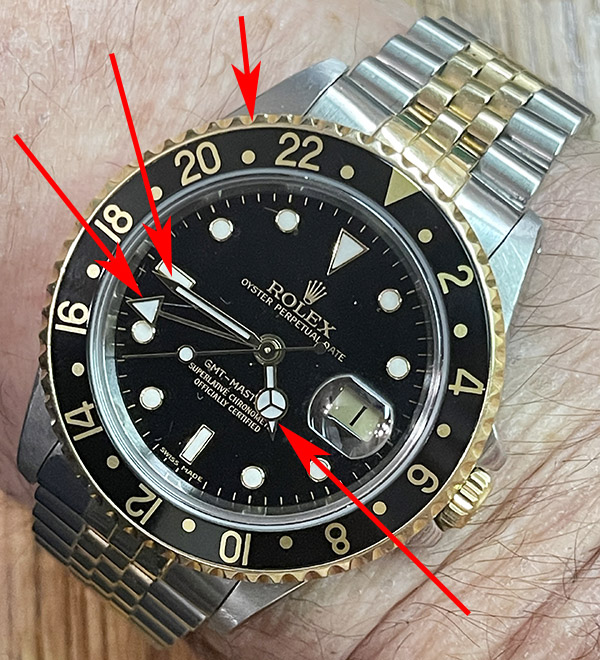
The hands of fate. The top arrow points to the bezel, which can be rotated in relation to the GMT hand (lower left arrow) to tell time on a 24-hour scale in a different time zone. The second-from-the-top red arrow points to the minute hand. The arrow on the right points to the conventional hour hand. If you look closely at the inverted diamond at 12:00, you can see the bezel is slightly off.
So what is a GMT watch? Basically, it is a watch that allows you to tell time in three time zones. If you wanted to, one of the time zones could be Greenwich Mean Time (GMT), which is the time at the Greenwich Observatory in England. Most of the time, I could care less what the time is in England, but that’s where the GMT descriptor originates.
Today, there are multiple approaches for time telling in different time zones, but the classic approach (and one followed by the Rolex and Seiko watches in this blog) is through the use of a third hand and a bezel with 24-hour numbering. The way it works is this:
The standard hour and minute hands tell the local time.
The third hand can be shifted to tell the time in a different time zone.
The bezel can be rotated to tell the time in a third time zone.
There are variations on the above (like switching local time with destination time, etc.). All of this may sound like a solution looking for a problem, but trust on this, when you travel to different time zones, it’s a very useful feature.
The Rolex GMT allows you to “step” the hour in one-hour increments by use of the winding knob when the knob is partially pulled out (some folks say this makes the Rolex a “true” GMT). On the Seiko, it doesn’t have the “step” function; use of the winding knob advances either the third hand or the conventional hour hand without the one-hour clicks (depending on which click you bring the stem out to). To me, either approach is acceptable.
The Rolex GMT Master II retails today for $14,050; the Seiko goes for $475. There’s a lot more to the pricing story, though. Prices on a Rolex are all over the map, and Rolexes sell for well above their suggested retail price. Some, even used, sell for three or four times their suggested retail price. I don’t know what my Rolex would sell for today as a used watch, and I’m not really interested because it’s not for sale. The Rolex will eventually go to one of my grandsons. I paid $3287 for it new in that Washington, D.C. jewelry store in 1986. I could easily get my money out of it if I wanted to, but like I said, that’s not going to happen.
Staying on pricing for a minute, the two-tone Seiko GMT is a relatively new model, so I couldn’t find it discounted on Amazon. If the two-tone coloring is not important to you, you can get the all-stainless version on Amazon for $317, which is a smoking deal (it’s $158 less expensive than the two-tone version).
My Seiko GMT was an impulse buy. Sue and I went out for lunch and there was a small watch shop a couple of doors down. They had the two-tone model, which I had not seen before other than in online watch forums and Seiko’s website (I was in Tokyo last year, and I didn’t even see it there). I asked the shop about a veteran’s discount, the guy said “you bet,” and mine set me back $402. I like supporting local businesses, I like doing business with shops that offer a veteran’s discount, and I liked being able to see the watch in person before I pulled the trigger.
My Rolex runs fast, gaining about a minute a week. That’s adjustable and would no doubt be corrected if I took the watch in for service, but I’m probably not going to do that. I’ve had the Rolex serviced twice. The last time was 25 years ago at the Rolex service center in Beverly Hills (where else could it possibly be?). Rolex clipped me $1000 for the service. I wasn’t happy at all. After the servicing, the numbers on the click-detented bezel were offset from where they should have been, and when I bitched about that, they remounted the bezel. It was better, but it is still offset a bit. Within six months of that service (which included replacing the crystal), I noticed a gouge on the crystal. I had worn the Rolex for 10 years before that and never had a scratch on the original crystal, so I have to wonder if I really received the sapphire crystal I paid for. A servicing today will probably be about $1500 if I get the crystal replaced and the bezel numbers remounted. It’s not likely I’ll spring for that. Maybe I will. I don’t know. It’s something I think about now and then, but then I think about getting out on the range with a milsurp rifle or riding my motorcycle and I forget about it. So far, the Seiko is keeping perfect time. I’ll let you know if that changes.
The Seiko is a new watch, so I haven’t had it serviced yet. Poking around a bit revealed that a typical mechanical watch servicing costs from $200 to $250. I think my local guy would probably be less than that. It’s quite a bit lower than what a Rolex service costs.
Both the Seiko and the Rolex are automatics. That means they are mechanical, selfwinding timepieces. The good news is there are no batteries, and it doesn’t matter if I stay out in the sun long enough to charge the solar power source. The bad news is that if I don’t wear an automatic watch for a few days, it stops. When that happens, prior to the next time I wear it I need to wind it and set the time. The Seiko, fully wound, has a 41-hour power reserve. The Rolex has a 70-hour power reserve. Rolex gets the nod here.
Regarding cosmetics, the “gold” bezel on the Seiko isn’t really gold; it’s plated. The accents on the Seiko hands and the watchface are similarly gold colored (i.e., they are not real gold). The Seiko’s jubilee bracelet links center areas are left a natural stainless steel finish. On the Rolex, they are gold. Another thing to note: On any Rolex, wherever you see something gold, it’s real gold. Nothing is plated on a Rolex. The bezel, the watchface accents, the hands, the winder, and the jubilee bracelet are all solid gold. Both watches look great, in my opinion. The real gold obviously drives the cost of Rolex higher than a Seiko, but not enough to explain the $14,000 (or more) difference. Most of the price difference is prestige pricing (Rolex gets away with it because some folks think they need such a thing). I used to be one of them. I’m not anymore.
About that jubilee bracelet: What they refers to are the smaller links in the watchband’s center section. Non-jubilee watches have bigger, single links instead of the jubilee bracelet’s three smaller links. To me, the jubilee bracelet makes a real comfort difference. The non-jubilee bracelet just doesn’t feel as good.
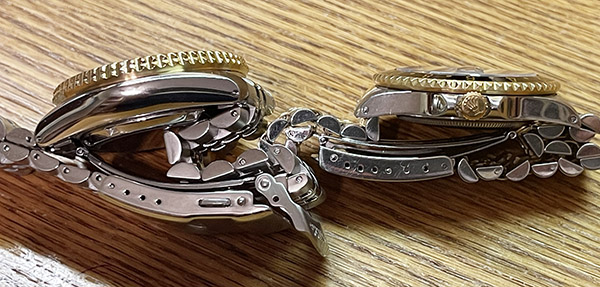
The Seiko is a much thicker case, and it sits higher on the wrist. It’s enough to be noticeable. The Rolex is thinner and I like the feel of it better for that reason.
Note the increased case thickness of the Seiko (on the right) compared to the downright thin Rolex. Rolex gets the nod here.
The Seiko’s stem winder is a push in/pull out affair. The Rolex stem winder unscrews, which theoretically makes it more waterproof. I don’t wear my watch in the shower any more (ever since I ruined a G-Shock by doing so), so the difference is meaningless to me.
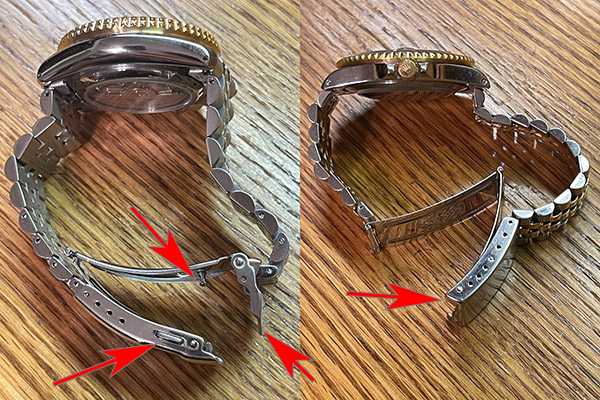
One last area I’ll touch on is the clasp design. Hands down (pardon the pun) the win here goes to Seiko. The Seiko’s clasp has three retaining features compared to the Rolex clasp. The fear, of course, is that the watch clasp comes undone and the watch slips off the wrist. It could be damaged by a fall onto, say, concrete, or worse, go unnoticed. The other fear is pickpockets. I don’t know how difficult it would be for a pickpocket to lift your watch. I once had a guy (a magician) remove a watch I was wearing without me noticing it. That watch had a leather band and I later learned there’s a trick to it. I don’t know if there’s a comparable trick for a metal bracelet, but if there is, I would think the Rolex would be more susceptible to such a thing.
The Seiko (on the left) clasp has three retaining features; the Rolex (on the right) has only one (which is a small dimensional difference between the outer clasp and the mating pin on the inner clasp). The Seiko design is better.
The bottom line to me is that the Seiko is a hell of a deal for under $500, and if you are looking for a watch that offers all the advantages of a GMT and is dressy, the Seiko is a good buy. I own both, and I think Seiko hit a home run here.
There are other approaches to a GMT watch. Citizen has a different dual time approach with their Nighthawk and Blue Angels models. Many digital watches (some identified as GMT watches and some not) can display the time in different time zones at the touch of a button. Casio has several cool models that do this. The Citizen and the Casio watches are reviewed on our Product Reviews page.


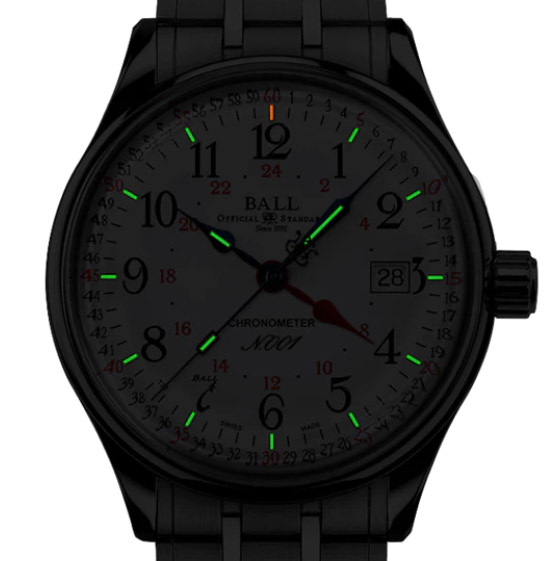
 hour, minute, and second hands, and in markers by each number on the face. There’s no marker in the GMT hand (I guess Ball thinks you don’t need to know the time elsewhere in the world at night).