By Joe Berk
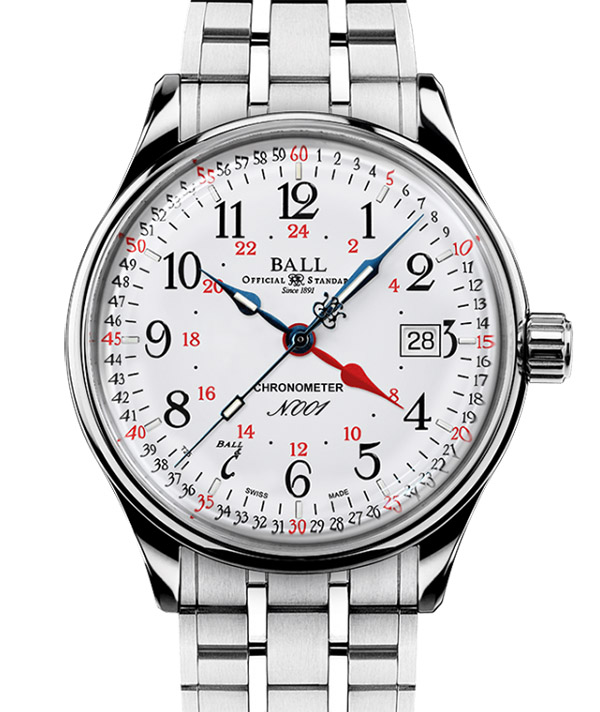
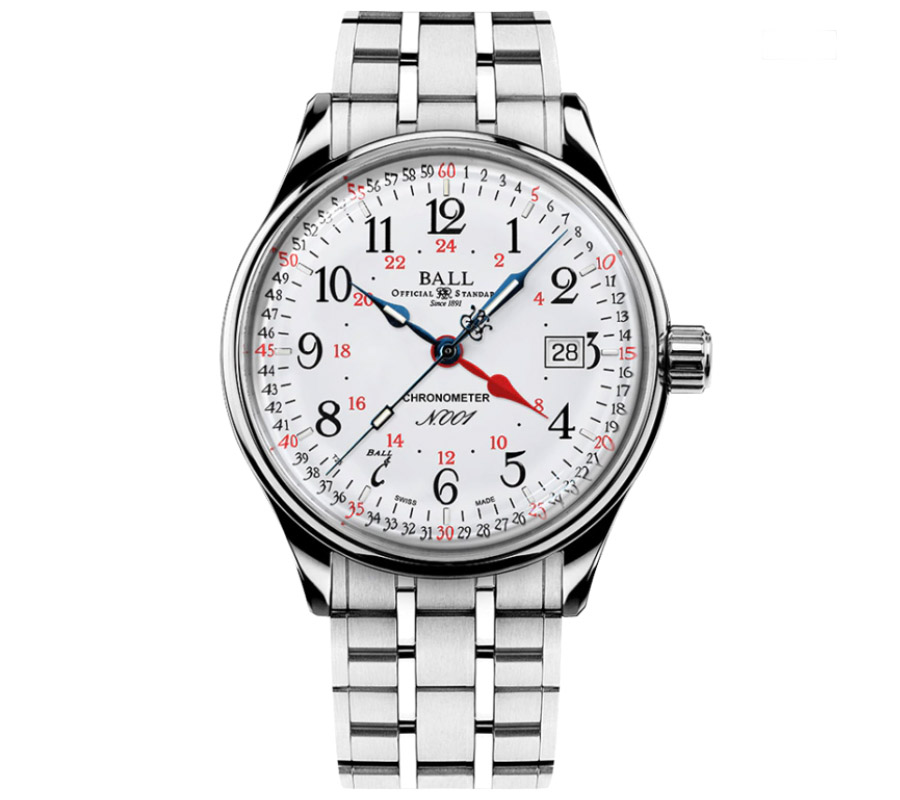
A disclaimer up front: I don’t own the Ball Watch Trainmaster GMT you see above, and I don’t actually have one to review. In fact, I’ve never seen one in person. But I sure want one. Sometimes it’s fun to think about buying something for a while without actually pulling the trigger. One such item for me is the Ball Trainmaster GMT watch, as seen in the photo above. Part of the desire is the watch’s design, and part of it is the Ball Watch heritage.
I like the Trainmaster’s bold face and big numbers. Some have criticized the watch’s wonky font, but I like it. If you look closely at the numeral 7, you’ll see the Ball designers did a cool thing there. The sharp contrast between the blue hands and the white face works well, and the GMT red hand stands out, too. It’s just a cool face; one I know I wouldn’t get tired of checking.
The appeal of a GMT is real for me. I used to need one when working for CSC and when I was in the defense industry. I’ve had projects in Chongqing, Kayseri, Tel Aviv, Haifa, Athens, Mexico, Glasgow, and Medellin, and knowing the local times instantly with a simple glance at my watch was a good thing. It kept me from waking people up in the middle of their night and it let me know when they should be at their workstations. These days I don’t have any overseas activities, but I still like the idea of a good GMT watch. They’re just cool.
About that name: The Trainmaster. Ball has a history rooted in the railroad industry. You’ll see it on every Ball watch with the letters RR (which stand for railroad). It started 135 years ago with Webb C. Ball and a deadly railroad disaster.
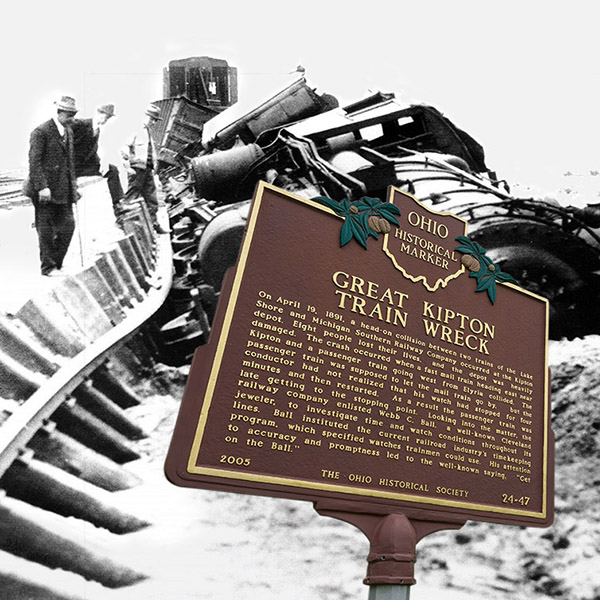
Back in the day, trains used to coordinate their travel such that one would pull off onto a siding (a parallel track) so another (going in the opposite direction) could pass. You can guess where this story was going. In the Great Tipton Train Wreck (as it came to be known), one of the conductor’s watches lost four minutes and it didn’t coordinate correctly with the train going in the opposite direction. Webb Ball, a Cleveland jeweler, investigated the two watches used by the conductors on the two trains and found a 4-minute discrepancy. After that, Ball became the go-to guy for all railroad time-keeping issues He started a watch company and Ball watches became the standard for all US rail activities. It’s where the expression “on the ball” comes from. If you were running on schedule, you were “on the Ball” (meaning you were on time).
Today’s Ball watches (including the Trainmaster) have a unique feature: Their illuminated hands and time indicators. The conventional luminosity approach other watches use is to incorporate photoluminescent pigments on the watch hands and numbers (or markers near the numbers). The luminescent pigments absorb photons from exterior light sources like the sun or other strong lights. The problem with this conventional lume approach is that it loses luminescence relatively quickly, and the lume doesn’t glow as brightly as the watch ages.
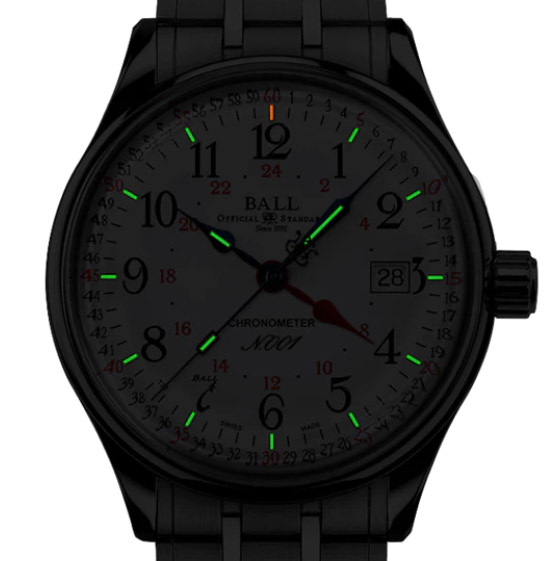
Ball’s approach is different. Instead of using conventional watch lume materials, Ball incorporates what they refer to as micro gas tubes that stay bright. These are tiny phosphor-coated glass tubes located in the watch hands and the numbers (or watch face markers) that contain tritium gas. The micro gas tubes stay bright with no intensity diminishment. They’re said to be good for 25 years. Different Ball watches place the micro gas tubes in different locations. On the Trainmaster, they are in the hour, minute, and second hands, and in markers by each number on the face. There’s no marker in the GMT hand (I guess Ball thinks you don’t need to know the time elsewhere in the world at night).
 hour, minute, and second hands, and in markers by each number on the face. There’s no marker in the GMT hand (I guess Ball thinks you don’t need to know the time elsewhere in the world at night).
Ball offers a couple of relatively unique options on this watch. They will engrave your name for free. You can also select your own serial number that goes on the watch face (if someone else hasn’t already selected it). When Ball first announced these, I checked, and 007 was available. Today, though, it’s not. I guess James Bond already ordered his.
As I said at the start of this blog, I’d like to own a Trainmaster, but not badly enough to actually shell out the cash owning one would require. The Trainmaster retails for something north of $3,000. Poking around a bit on the Internet, I found places that sell the Trainmaster in the $2500 to $2600 range, but that’s still pretty rarefied air for a watch I don’t need.
More gun stuff? You bet!
Join our Facebook ExNotes page!