
By Joe Berk
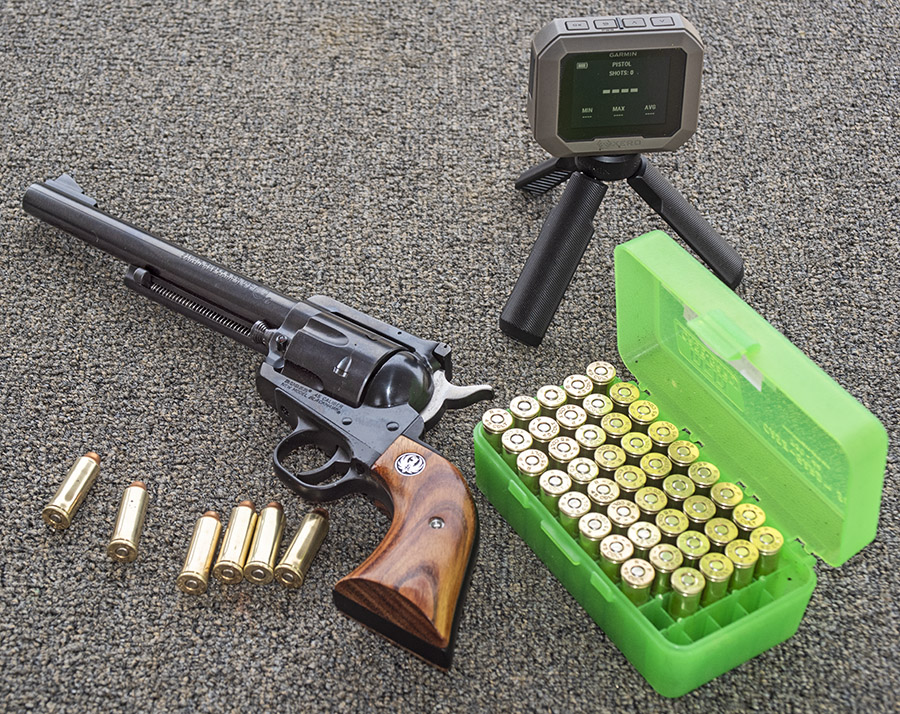
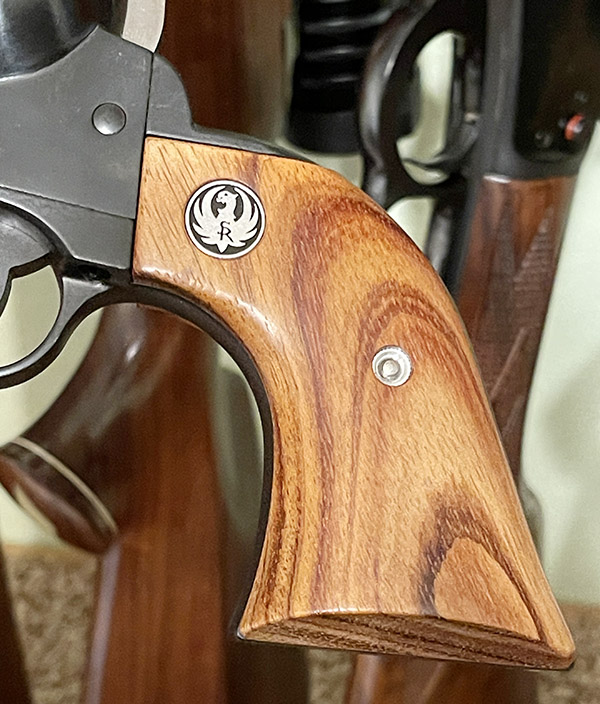
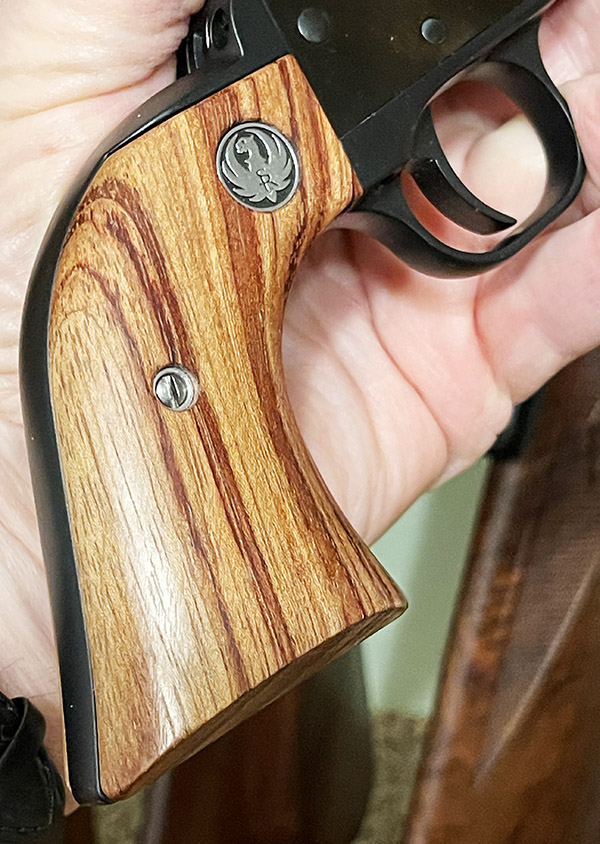
I saw the Ruger Blackhawk you see above in a forum post several years ago and wrote to ask if the owner if he would sell it. The answer was yes, and after navigating all the California hurdles, the revolver found a home in my gun safe. Several things attracted me to it. It is a 200th Year Ruger, it is in as new condition, the cylinder throats had already been reamed to their correct dimensions (several .45 Colt Blackhawks left the factory in 1976 with undersized throats), and the grips are nice (much nicer than normally seen on a Ruger Blackhawk). The grips have great figure and the wood-to-metal fit is superb (something rarely seen on a new Blackhawk these days).
You saw my previous post 0n fitting the Power Custom base pin to this revolver, and another in which I compared this handgun to two other .45 Colt handguns (a 4 5/8-inch stainless Blackhawk and a tuned Taylor Uberti Single Action Army replica). I had not really done any load development for the Blackhawk you see in this blog, and I wanted to start doing so this week. I grabbed some ammo and headed to the range.
Getting out to the West End Gun Club has been a bit dicey over the last month or so. With our heavy rains, Lytle Creek has been running high. My Subie came through, though, like it almost always does.
I say “almost” because a couple of years ago under similar circumstances, I almost became a U-boat commander. You may have read that blog before.
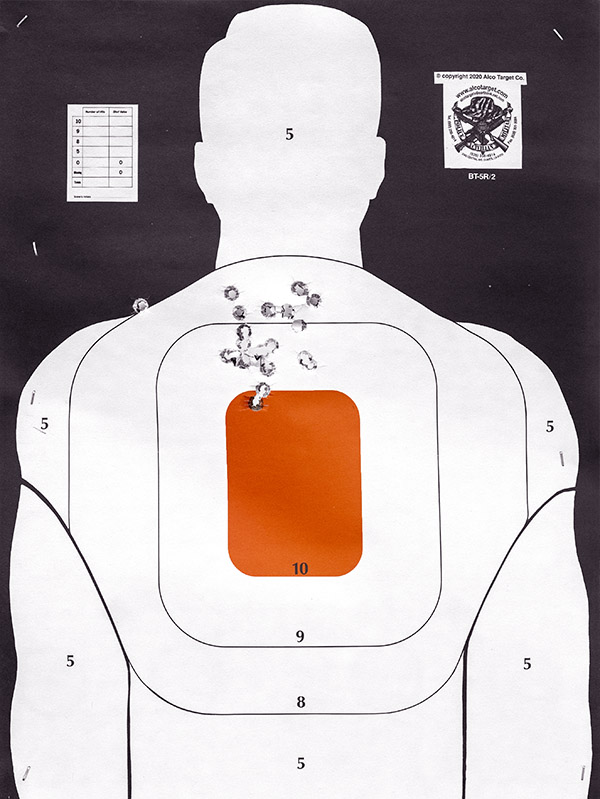
My first target at 25 yards with the 5.9-grain Red Dot load I had previously evaluated at 10 yards was mediocre. The group was high and big. Ordinarily (and with an accurate revolver), I can put a box of ammo into a 25-yard group you could cover with a silver dollar. That wasn’t happening with this load.
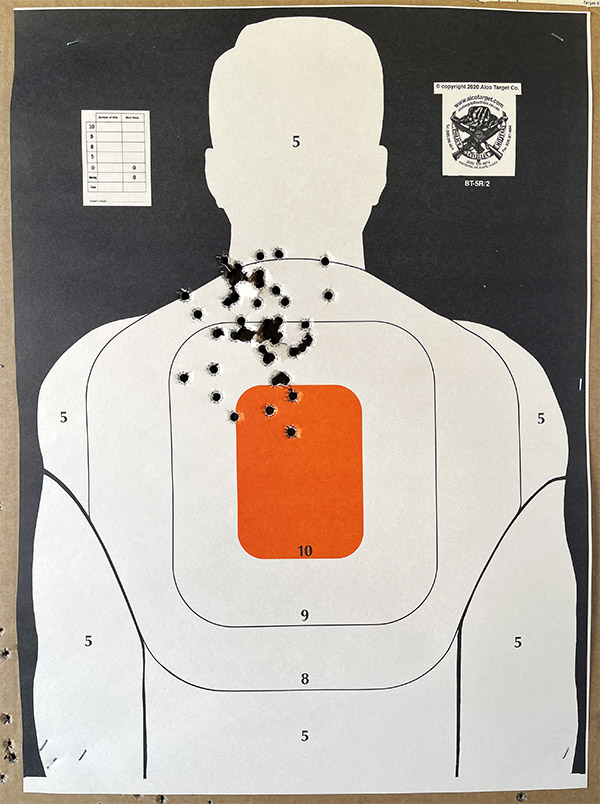
When my buddy Kevin saw the above target, he asked if I was using a shotgun. I understood his point. So I set up another target, again at 25 yards and with the same load, figuring I’d do better the next time. The results were the same.
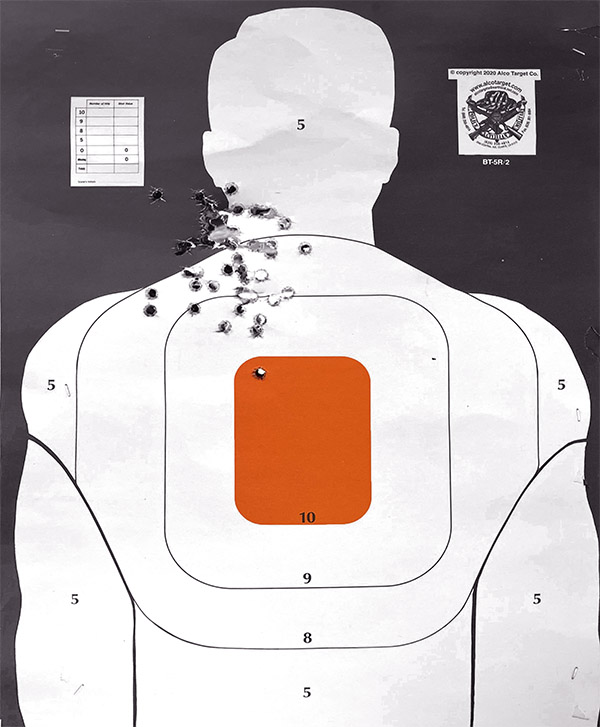
Must be the load, I thought. I switched to the last box of .45 Colt loaded with Trail Boss powder (it was 6.4 grains of Trail Boss under the same 200-grain roundnose, flatpoint, cast bullet used above). That’s a load that’s done well in other guns chambered for this cartridge. The results were almost identical to the Red Dot load.
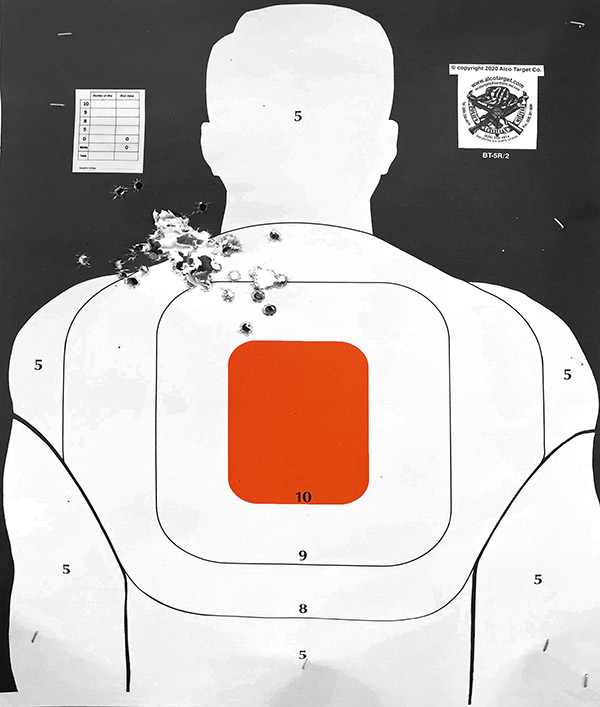
So far, the .45 Blackhawk results with Red Dot were disappointing. The groups were too big and too high. My Blackhawk’s rear sight is all the way down, so it I knew it was time to try something different. I had some 230-grain roundnose Missouri bullets hiding somewhere under the reloading bench, along with another box of 200-grain Speer swaged bullets, but I didn’t think either of those would be the answer here. A heavier bullet (like the 230-grain cast roundnose bullet) would shoot higher. That’s what heavier handgun bullets do because they generate more recoil and have a slower muzzle velocity (and that causes the bullet to spend more time in the barrel as it rises), giving a higher point of impact. I also had some 185-grain full metal jacket bullets (a little lighter than the ones I shot here), so I tried them. Maybe they would be the answer. I went home and loaded some of those to try the next time I visited the range.
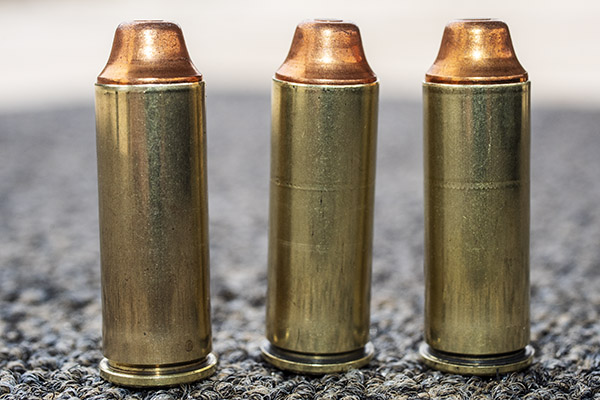
I prepared 20 .45 Colt reloaded rounds with the 185-grain Winchester jacketed semi-wadcutters with the same Red Dot propellant charge as previously used (5.9 grains), and then I reloaded another 20 rounds with that Winchester bullets and a heavier charge (6.7 grains of Red Dot).
The first group (loaded with 5.9 grains of Red Dot and the 185-grain Winchesters) printed high and to the left. The group was a little tighter, at least with respect to lateral dispersion.
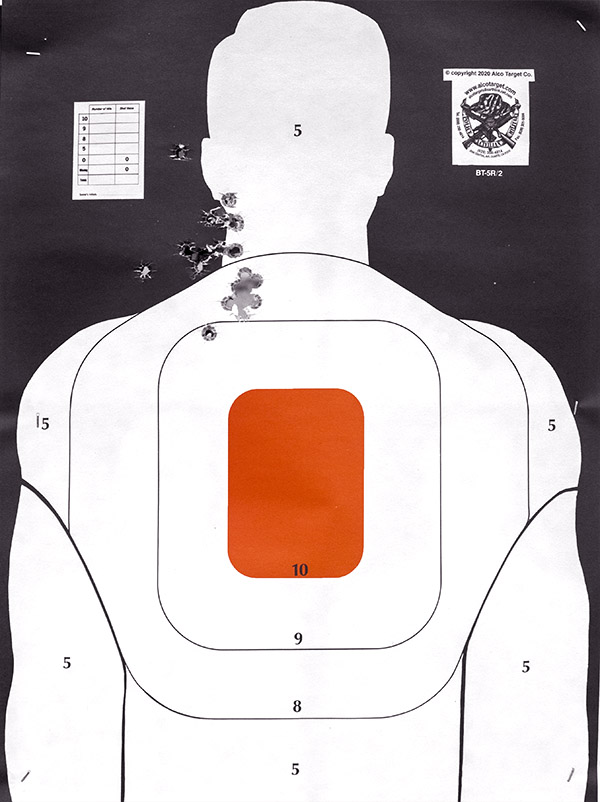
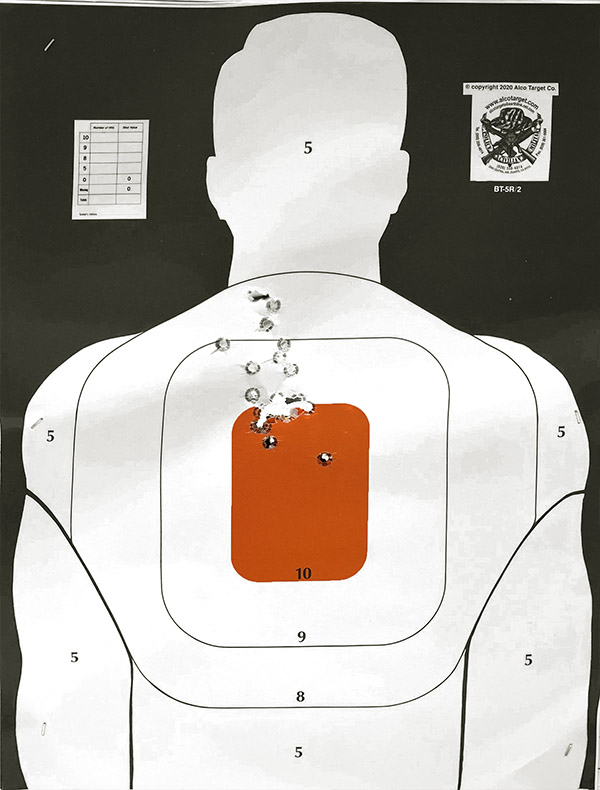
I next shot a group with a higher Red Dot charge (6.7 grains). It moved the group down substantially (a hoped-for result) and the group was tighter. Ah, progress. It comes in many forms.
A quick check of the fired cartridges confirmed what I was experiencing when extracting the above rounds. There were no pressure signs, and extraction was easy.
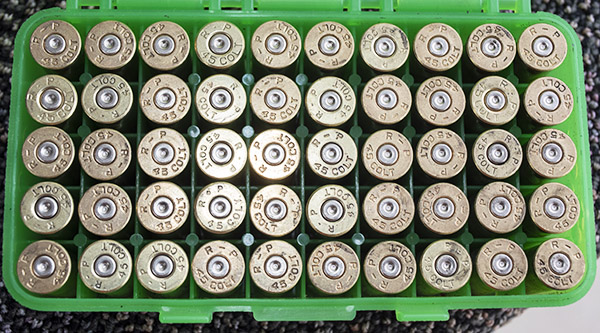
I went home and reloaded more .45 Colt cartridges, this time with even higher charges. The recipes this time were the same 185-grain Winchester jacketed semi-wadcutters, but with 7.0 grains and 7.3 grains of Red Dot.
While all this was going on, I continued to cruise the Internet, looking for more information on Red Dot and its reloading peculiarities. A found a few places where folks mentioned that the powder didn’t meter well. Usually, my Lee powder dispenser has a consistent drop, so I thought I would weigh a few after I had the dispenser adjuster. Wow. Those guys were right. I was seeing variation of as much as 0.5-grain from charge to charge. Hmmm. I was experimenting with charge weight differences as small as 0.3 grains, while the dispenser was throwing in variability of 0.5 grains. That’s not good. I filled the powder dispenser, rapped it a few times to settle the Red Dot, and I managed to get the variability down to not more than 0.2 grains. It was 0.0 grains, which is what I had experienced with other powders, but it was better than the 0.5 grains I first encountered. Like Donald Rumsfeld used to say, you go to war with the Army you have. My Army had 0.2 grains powder-drop-to-powder-drop variability, and that’s what I was going to war with.
The next day at the range, I fired 20 rounds at a 25-yard target using a my 7.0-grains-of-Red-Dot load. It shot a little bit better group, and it had a little bit lower point of impact. More progress.
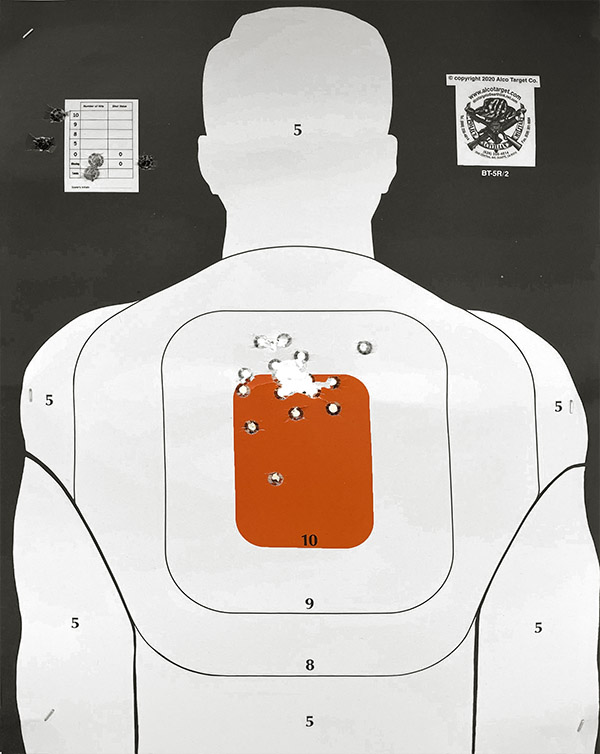
Then I tried the last group I had loaded, this time with 7.3 grains of Red Dot. I had a few stray shots, but I also had the makings of a better group, and it was lower yet on the target.
At that point, I decided to call it a day with this test series and with this revolver. Here’s what I concluded from the above:
-
-
- Red Dot is not the best propellant for the .45 Colt cartridge, which is probably why you almost never see it listed in any of today’s reloading manuals. The above notwithstanding, Red Dot can work for .45 Colt cartridges, as this test series found.
- Higher charge weights are better, probably because they occupy more of the case volume (the .45 Colt is a big handgun cartridge). My tests showed that the average velocity, the extreme spread, and the standard deviation all improved with higher Red Dot charge weights.
- With my 7.3-grain Red Dot load, the average velocity is 980.0 feet per second, the extreme spread is 76.5 feet per second, and the standard deviation is 21.1 feet per second. These are not the best numbers I’ve ever seen in a handgun, but they are not the worst, either, and a 185-grain, .45 caliber bullet smoking along at nearly 1000 feet per second is nothing to sneeze at. Other powders would do better in this cartridge (IMR 4227 comes to mind), and future efforts will focus on that.
- Regarding my .45 Colt Blackhawk shooting high at 25 yards, I don’t know if it’s the load or the gun. I have another Ruger Blackhawk that shoots high at 25 yards (my .357 Blackhawk). I have a lower rear sight blade from Ruger laying around here somewhere. I will try to find it and, after confirming it is lower than the blade currently in the gun, I’ll see how much that helps.
-
So there you have it: Red Dot propellant reloads in a Ruger .45 Colt Blackhawk. If you have a comment, we’d love to hear it.
More gun stories? You bet! There’s good stuff on our Guns page on the three Rs (Rugers, revolvers, and rel0ading)!
Buy one for yourself (or for a friend): Get The Gatling Gun!

Join our Facebook ExNotes page!
Never miss an ExNotes blog: