Over the years, Marlin has offered more than a few variations of their venerable 336 lever action rifle in a variety of chamberings, with the most prolific cartridge being the tried and true .30-30. I’m a true believer in Marlin lever guns, as you know from reading the blog about the Marlin 336 Octagon earlier (it’s one of the super rare variants of this fine rifle). The Marlin boys (formerly of New Haven, now out of Ilion, NY) had versions of the 336 with long barrels, short barrels, in-between barrels, commemoratives of various flavors, straight grip stocks, pistol grip stocks, walnut stocks, birch stocks, laminated stocks, blued carbon steel, stainless steel, standard levers, big loop levers, and more. People have focused entire collecti0ns on (and written books about) Marlins.
One of the more graceful versions of the 336 Marlin rifle was the Texan, an earlier straight-grip, walnut-stocked number that to my eye just looked right. I like a straight-gripped stock, and to me blue steel and walnut is the Holy Grail. The older Marlin Texans are not super rare, but they’re not common, either, and when a used Texan comes up for sale it commands a premium price. As is the case with most guns, a used Texan today would sell for many multiples of its original price. That’s kind of the justification I’ve used whenever I’ve purchased any gun, but in the Marlin Texan’s case, it’s actually true. As an aside, guns of any flavor generally go up in value (they are one of the few things in life that do). And as an aside to that, most of us who play with these things generally tell our significant others that we paid less than we actually did, secure in the knowledge that the value is going to go up anyway. (We don’t spend too much; we just buy too soon sometimes.) It brings to mind the Gun Collector’s Prayer:
Lord, when I go, please don’t let my wife sell my guns for what I told her I paid for them…
So, to get back on topic: Several months ago, Marlin reintroduced the Texan. To back up a bit, I mentioned in an earlier blog that Marlin was acquired by Remington, and Remington moved the Marlin production equipment from New Haven (the old Marlin plant) to their plant in Ilion, New York. And as I explained in that earlier blog, there was a feeling that quality dipped during the transition. Well, you can rest easy, folks: Marlin quality is most definitely back now. In fact, I think the new Marlins are of even better quality than the rifles produced in New Haven. I know a little bit about quality and I know a little bit about guns, and unlike most of the people expressing opinions on the Internet, I actually own rifles made in both places.
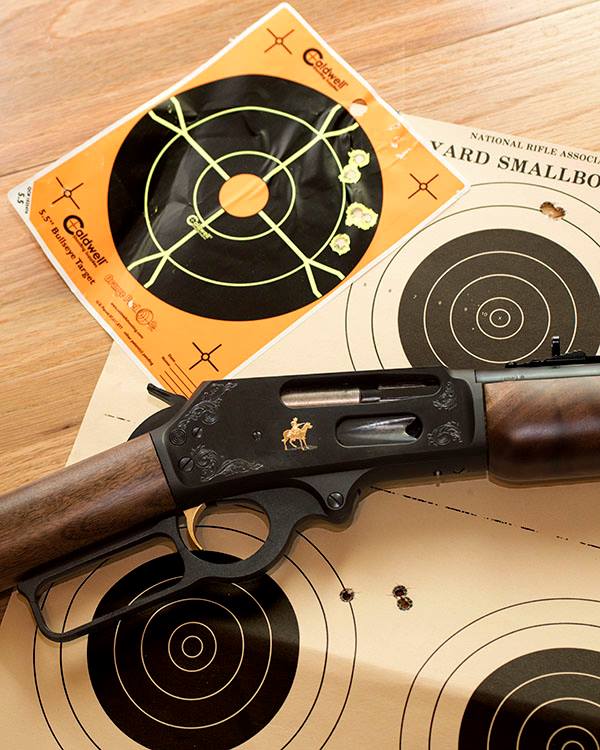
Marlin is calling their new model the Texan Deluxe. The concept had my interest immediately. A new Texan, I knew, would be something special, and this one sure is. It has light engraving, a gold inlay of the Marlin ranger, and what Marlin is calling B-grade walnut. B-grade should indicate walnut with a bit of figure, but in following the auctions and sales on Gunbroker.com, everything I saw had plain, straight-grained wood. They were good-looking rifles, but I wanted something with fancier wood and I just had not seen anything online that met my expectations. In fact, I had not seen any of the new Texans in any of the gun stores I visited (I only saw these rifles on the Internet). But that all changed recently.
Fast forward to one month ago. I had taken my Subie in for an oil change. There’s a gun store not too far from the Subaru dealer (Ammo Brothers, a California chain). When I left, it was raining cats and dogs, traffic was terrible, and I thought I would kill some time by seeing what the Bros (as in the aforementioned Ammo Brothers) had in stock.
You can guess where this story is going.
I checked the handguns, the reloading components, and more. Reasonable prices, reasonable inventory, and then before I left, I did a quick scan of the rifles they had on display. To my great surprise, Ammo Brothers had a new Texan Deluxe in the rack. And, it had stunning wood. I asked to see it. The young dude behind the counter handed the rifle to me. It was flawless. No nicks, no dings, perfect wood-to-metal fit, and wow, the walnut was exquisite.
“Do you have any more in stock?” I asked. I always ask. They might have one in back with even nicer wood, although I knew the one I was holding would be impossible to beat. The guy checked; the one in my hands was the only one they had. “Can you knock anything off the price?” Nope, it was what it was. He told me they were hard to get. Tell me about it, I thought.
“I’ll take it,” I said. And as Forrest Gump would say, just like that I had me a new Marlin 336 Texan Deluxe. One with walnut I thought was way better than B-grade wood.
Well, not quite just like that. I had to wait my 10-day Peoples Republik of Kalifornia kooling-off period. You know, so I wouldn’t run out and rob a liquor store or stick up a gas station. You never know.
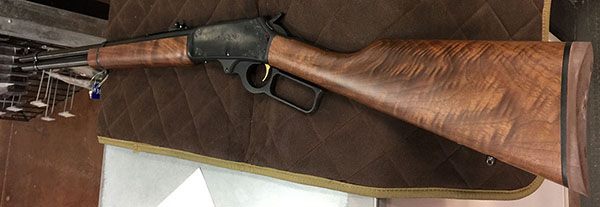
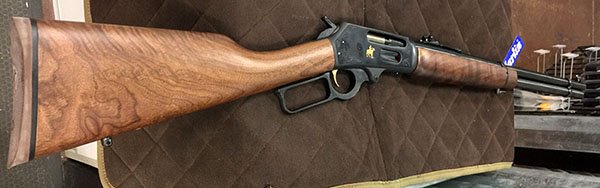
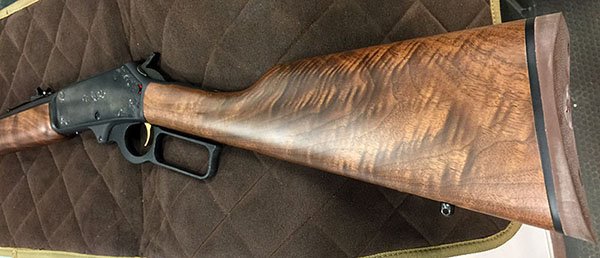
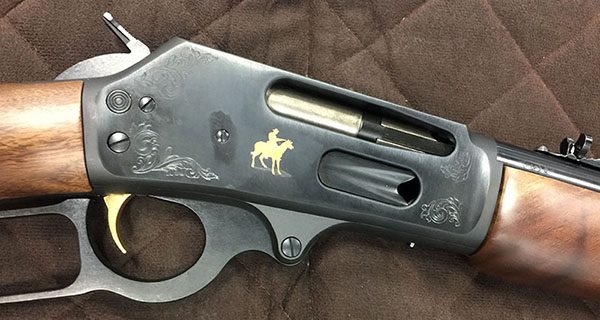
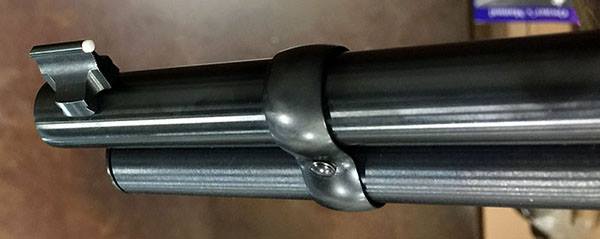
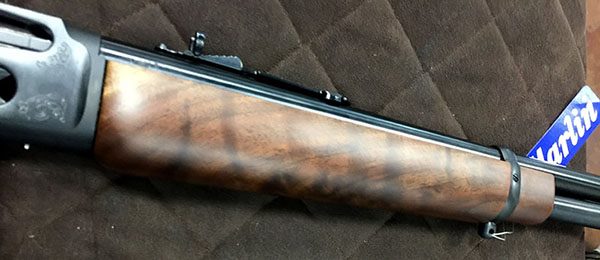
Two weeks later, I had the new Texan on the range, and I have to tell you, it is a honey. The trigger is only slightly on the heavy side, and it is crisp. It has a white bead front sight, and I really like that (I don’t like a brass bead front sight, as that tends to shoot to a variable point of impact depending on where the sun is). The new Marlin shot to the right, but that’s something easily corrected with a brass drift, and it’s a normal part of zeroing in a rifle. Good buddy Paul made a brass drift for me and the sight has already been put where it needs to be.
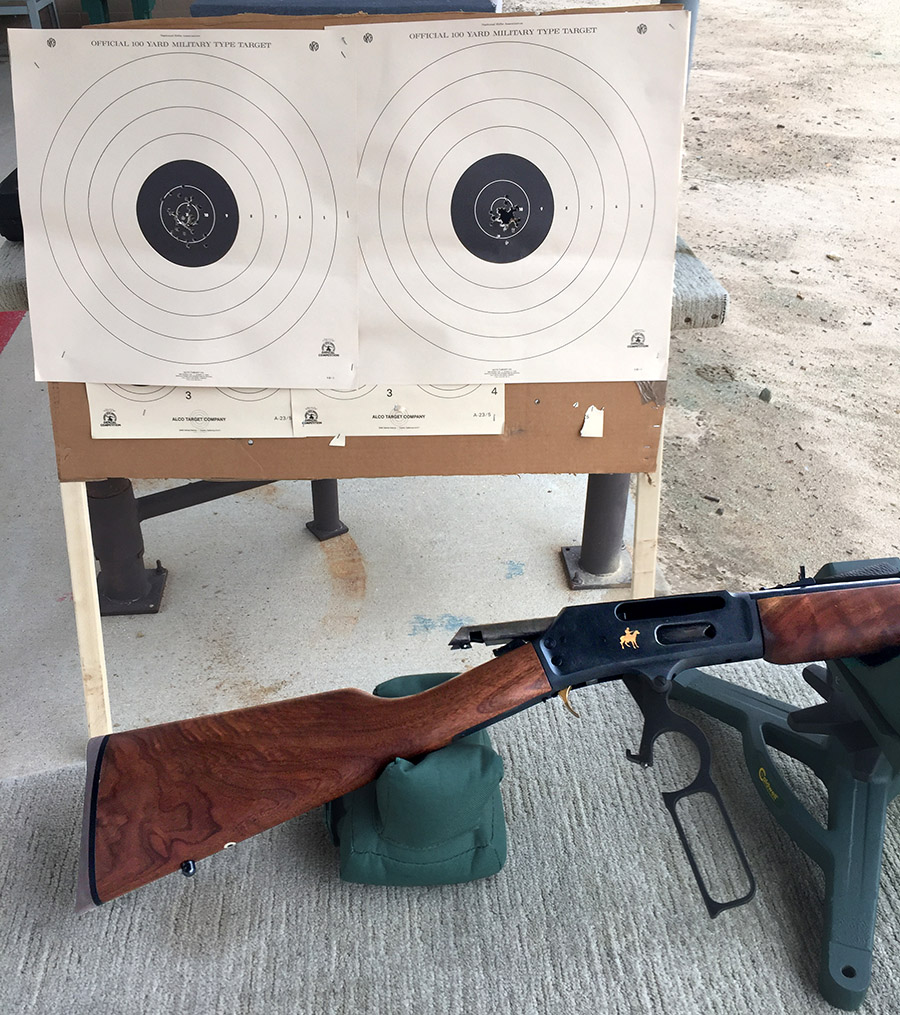
What’s really nice about the new Marlin is that it groups well. You can see that in the photo at the top of this blog. I tried four different loads and all grouped well, including a reduced load with cast bullets and Trail Boss powder (that combo recoils and sounds about like a .22, and that’s really cool). Here are the results…
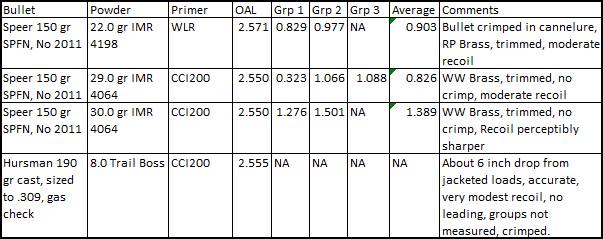
I didn’t measure the cast loads because I shot a bunch of them (not my usual three-shot groups) and I used a non-distinct aim point. The cast bullets shot about 6 inches low at 50 yards compared to a full-power jacketed bullet load. But the cast bullet group (using a flaky aim point) was relatively tight. Good stuff, and I’ll shoot more of those on my next visit to the range. I’m going to load some up today.
The other surprise was how easy the Marlin was to clean. Marlins break down for cleaning far easier than the Winchester 94 (I knew that going in). On a Marlin, you remove the lever pivot screw, and that allows withdrawing the lever, the bolt, and the ejector, and that in turn allows clearing the rifle’s barrel from the breech (rather than the muzzle). On a Winchester 94, it’s quite a bit more complicated (so much so that I’ve never kept a Winchester 94 for very long). Marlin builds a better mousetrap.
What I didn’t realize is how well Marlin is making these barrels. Marlin uses their micro-groove approach on the .30-30 336, which means there are a dozen relatively shallow lands and grooves in the bore. That makes for less bullet deformation, and the theory is the things are more accurate than a conventional rifle with Ballard lands and grooves (which are deeper than micro-grooves). Accuracy aside, micro-grooving also makes the bore much easier to clean. The bore in my new Texan is super polished, and it’s actually blued in there, too. Some folks think that micro-groove rifling doesn’t allow a rifle to shoot cast bullets, but I didn’t find that to be the case at all. My rifle handled cast 190-grain bullets with no problems, great accuracy, and no leading.
The bottom line: This new Texan is stunning. Marlin is back, folks.
Want to read more Tales of the Gun? Click here and we’ll take you there!

 The fog nestled so close to the ground made it appear as though I was looking at a forest of cacti poking their heads through the clouds. For some unknown reason, I took that as an omen of good things to come. I passed one truck on that 40 mile stretch to the main highway.
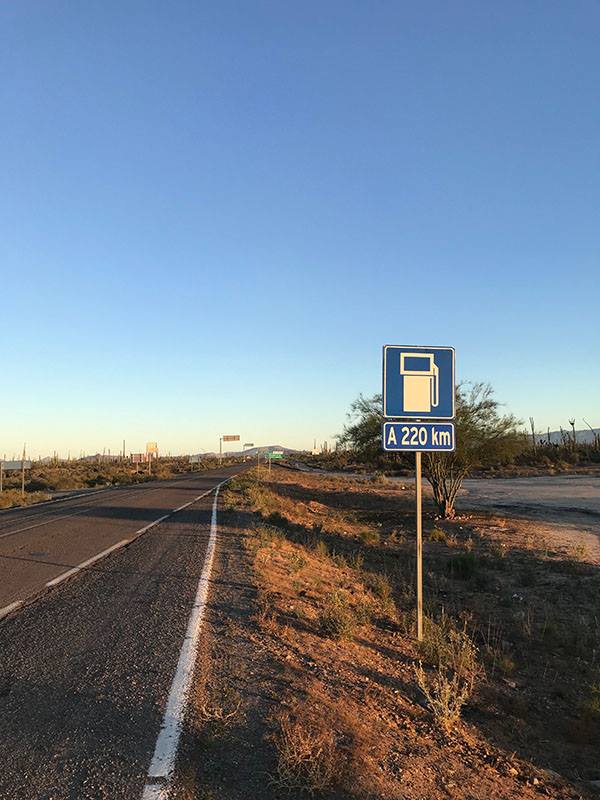 I wasn’t yet familiar with my CSC TT250, but I had read reviews of 65 mpg, and since I didn’t yet know what 3/4 full meant on my bike, I decided to press on, optimistic that I would find gas somewhere on the way.
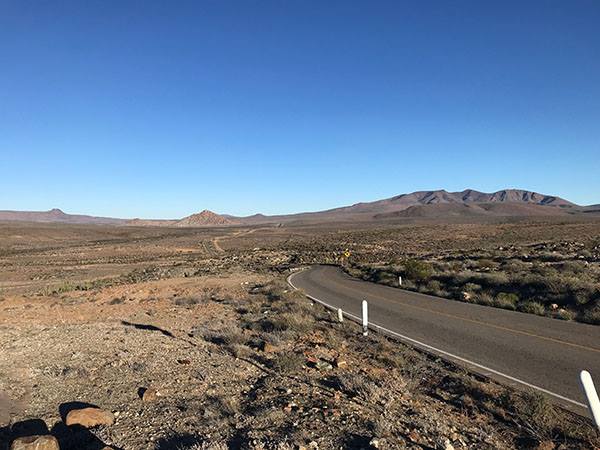 As I continued north, I noticed my gas gauge reaching 1/2 full at Chapala. I still had 63 miles to go to Catavina, which was the only place that I thought may have gas. Hoping that the gauge accuracy was a bit on the conservative side, I continued on. Running the numbers in my head, I concluded that I should make it to Catavina, even if my actual fuel level was a little less than indicated. However, if Catavina didn’t have gas, then I was going to either have to stay there until I could find someone passing through with extra gas, or try to locate a rancho that might have a couple of gallons to spare. Fortunately, in Catavina I came across a small sign stuck in the dirt on the left side of the highway that said Pemex. The arrow pointed to the right side of the road, and as my eyes scanned the opposite side of the highway, I saw a pickup truck with a couple of 55 gal drums and a few one gallon plastic containers. By this time I had travelled about half the distance to San Quintin, and although my low fuel light was already flashing, I still had not gone on reserve
 I figured the price would be astronomical, but that was ok since I would only need a couple of gallons. Surprisingly, it was only $1 per gallon higher than the Pemex station where I had filled up in my town the day before. Confident that I could now make it the rest of the way to San Quintin, I pressed on north, maintaining between 60 and 65 mph indicated.
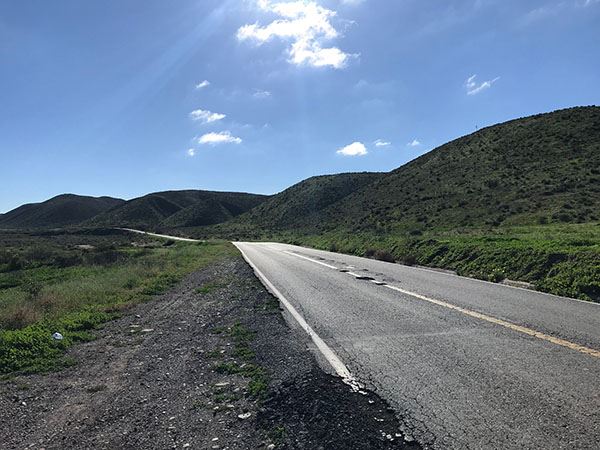 The desert continued to get greener as I closed in on the town of El Rosario where Mama Espinoza’s famous restaurant is located. I passed by knowing that I had a meal waiting for me in less than an hour at Jardine’s. Traffic remained consistent through the remainder of my trip, and I reached my destination at 11 a.m.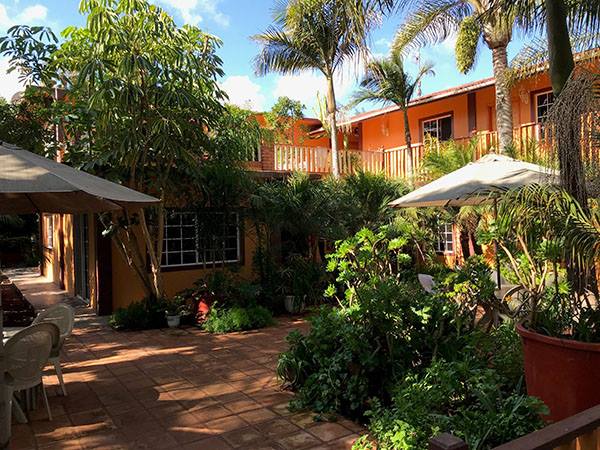
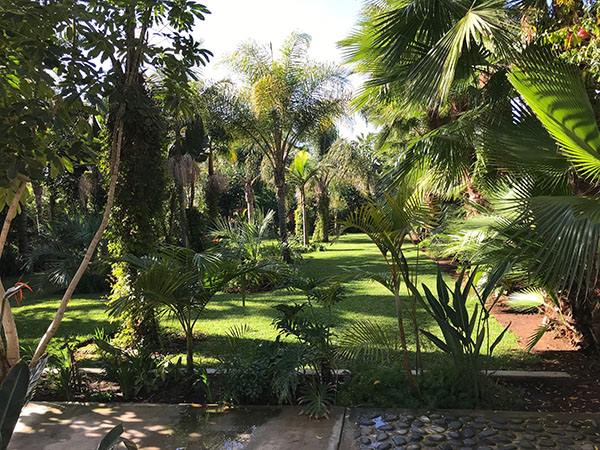 I pulled into the empty parking lot of the restaurant, dismounted, and approached the door. It was locked. Fortunately the hours were posted. Another hour before they opened. That wasn’t good. If I waited around until they opened, got seated and served, I wouldn’t get back on the road until after 1 p.m. That would make it difficult to make it home before dark. Hmmm! Better check the hotel. I had heard the rates were good, but I was pleasantly surprised that a single room was only $31. A two bedroom-suite was a bit steeper at $45. It didn’t take me long to decide to take advantage of one of the perks of retirement – unscheduled time. I quickly pulled out my wallet, checked in, walked around the grounds for a few minutes, and then waited outside the restaurant until they opened.
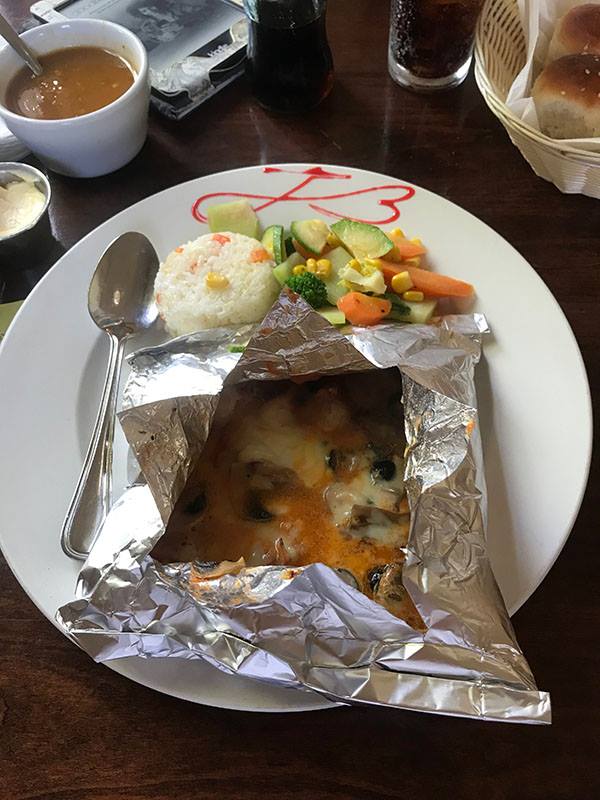 It was fantastic. I was seriously glad that I decided to stay. I kept occupied throughout the day by reading my kindle and talking to Anna, the hotel manager that day. She had spent several years in Wichita, KS, so she spoke English quite well. That night I paid a whopping $4.00 for some Fish and Chips. Another great meal.
 Hard to believe; for less than $100 I had a wonderful two days of riding, great food, a good night’s sleep and not one stop light. I feel truly blessed.