
By Joe Berk
I’m learning a new video program (new to me, at least) called Premiere Pro. It’s part of the Adobe Creative Studio suite, and it is way more complicated than anything I’ve ever used before. Well, maybe that’s not fair: The only video program I ever used in the past was something called Pinnacle. It was a low-bucks affair at Best Buy 16 or 17 years ago. I bought it because I was doing a lot of videos for CSC Motorcycles and the kid at Best Buy said even an old guy could use it. You can see many of those videos (along with the excellent ones Joe Gresh created) on our YouTubby page.
About that YouTubby thing: The Chinese marketing guys at Zongshen were following the CSC blog closely back in those days, and they knew me from the videos before I went there and met them for the first time. When they saw me, they pointed and exclaimed, “Youtubby, Youtubby!” They didn’t realize the “e” in YouTube was silent. I didn’t realize what they didn’t realize, and my first thought was “yeah, I guess I am carrying a few extra pounds.” My second thought was that the Chinese don’t hold back (I later learned that they do; in fact, as a group the Chinese are the most polite people I’ve ever known).
To get back on topic, when good buddy Greg shot a video of me doing my thing with the Mini 14, I decided it was time to learn Premiere Pro. I’ve been paying for that program for years because it is in the Adobe package, which you have to buy as a subscription. Sometimes, you just have to set your mind to doing something, and that’s what I did. Between my firm commitment to learning Premiere Pro, Google’s help (I asked it a ton of questions, because the program is anything but intuitive and the Adobe tutorials are close to useless), and a lot of trial and error, I was able to create the Mini 14 video.
Then I did the one on the Monster Guns a few days ago.
I like both the above videos. In creating them, I used maybe 1% of what Premiere Pro can do. It is an intricate software package and I have a lot to learn. It keeps my mind going, as does writing this blog. I guess that’s the good news.
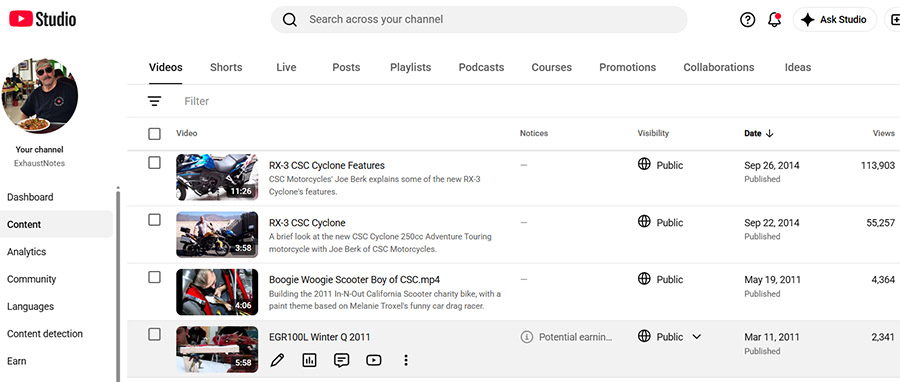
I never made any money off YouTube. I’ve heard of folks having insanely high view counts and making maybe 37 cents. Nope, I’m not in it for the money. But the two gun videos above got me thinking: Maybe I should do more gun videos. Then came another surprise: I already have. In reviewing my videos on YouTube’s summary page, I found several gun videos I had forgotten. These were all uploaded either directly from the camera, or I assembled them using the old, cheap, easy-to-use Pinnacle program. I thought I’d post them here in case any of you had nothing else to do or you have insomnia. Enjoy.
Here’s one that’s a little unusual. I have a 50-year-old Weatherby Mark V chambered in .30 06 and sometimes I can sometimes coax a 1-inch group from it. I bought a borescope and, surprisingly, you can make a video with the borescope as you run the fiber optic cable through the rifle. The marks you see in the bore are pretty typical machining marks made during the rifle barrel fabrication process. Most folks are alarmed when they first use a bore scope and see this sort of thing. I was. But hey, the thing groups pretty well for a glamour gun.
Here’s one that’s pretty cool. My buddy Mike, a retired chief of police, goes to the International Association of Chiefs of Police convention and when it’s on the west coast, I go along as his assistant (I got a badge out of the deal, but no gun). One of the exhibitors had a video/handgun-based training system. Mike and I both tried it. It was awesome.
Here’s one from long ago that could use Premiere Pro’s lighting adjustment tool. It’s my buddy Duane shooting reduced loads in his World War II bring-home Mauser 98.
I recently mentioned my Model 52 Smith and Wesson here on ExNotes. It’s an amazing pistol. What’s part of the wow factor is how well it feeds wadcutter ammo; in fact, it’s so good it will feed an empty case.
I have a Weatherby that has a custom Douglas .300 H&H barrel on it. The .300 H&H is an amazing cartridge with plenty of energy. Here’s a video of a couple of shots on the gongs at 100 yards. That .300 H&H energy really makes them jump around.
My buddy Paul is a serious black powder shooter and collector, and his enthusiasm (along with watching Lonesome Dove about a hundred times) convinced me my life wouldn’t be complete unless I owned a Colt Walker. I ordered one and created a video unboxing it. It’s a thing people do. So I did it, too.
When I resurrected the Star progressive reloader, I shot a series of short videos on its operation.
Back in the day, a watch company (Gear’d; I don’t know if they’re still around) sent a couple of watches to Gresh and me so we could review them on the blog. I thought it would be a good idea to see how mine would stand up to the recoil after firing a hundred shots of .45 ACP hardball.
I always wanted an 1886 with fancy walnut, but I didn’t want to mortgage the house to get one. So I bought a Chiappa (an Italian copy). This is another video that could have been helped by Premiere Pro’s advanced features.
Some of my friends think I’m fast. The rest know that I’m just half fast.
Here’s one I did years ago on loading cast bullet ammo for the Mosin-Nagant rifle, with accompanying music from the movie, Enemy at the Gates. I used Pinnacle on this one, and I think I exercised all its capabilities.
I guess I had more gun videos than I realized. Maybe I’ll become an influencer (whatever that is). I’ll keep plugging away polishing my very meager Premiere Pro skills, and you’ll see the results in future blogs.


