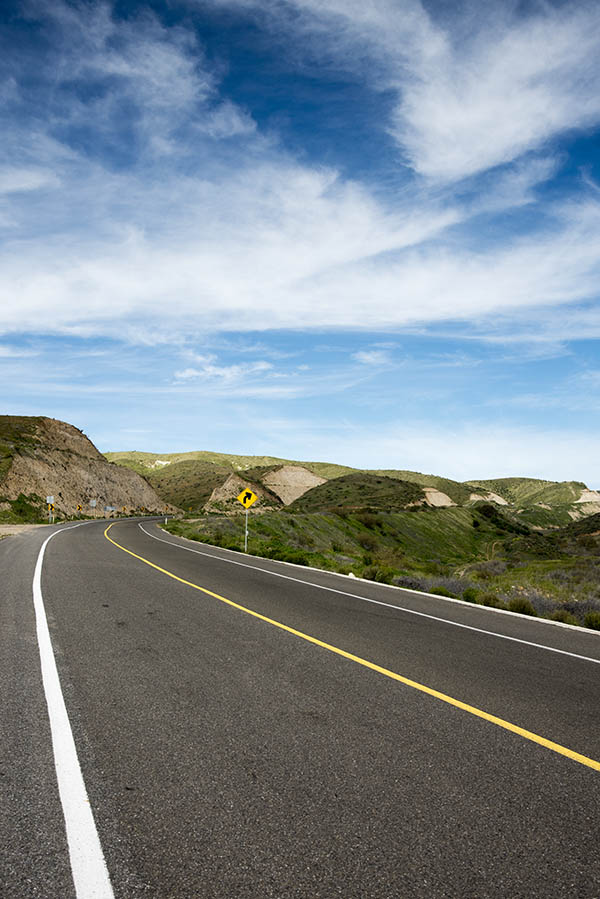
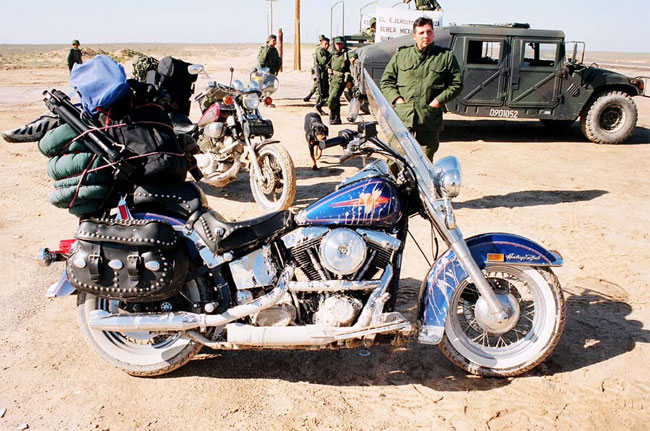
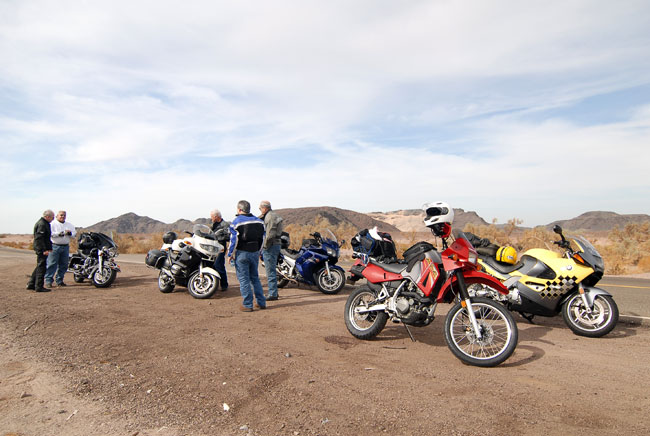
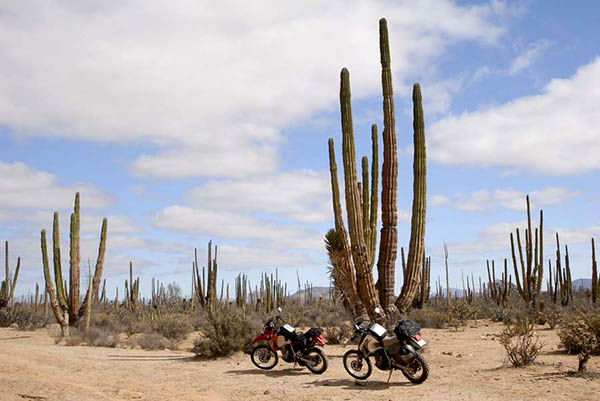
What this trip was all about. I grabbed this somewhere in the Vizcaino Desert. That’s my red KLR up front and John’s green one behind it. These are the perfect bikes in the perfect place.
In October 2009 it had been a year since my last motorcycle trip in Baja, and that was entirely too long. I was good to go, but most of the guys I hung out with here in So Cal were timid. They believed what they read in the LA Times. You know, about Mexico being dangerous. Me? I knew better. I needed to get my knees in the Baja breeze. My good buddy Baja John felt the same way.
My first journey into Baja was with John back in 1994, and it would be good to ride with him again. Our earlier trips were on cruisers…John on a Viagra (spelling intentional) and me on a Harley. We’d both be riding Kawasaki KLR 650s this time. I bought one, and after listening to me rave about it, so did John.
Don’t get me wrong. There’s nothing wrong with a Yamaha Virago, and if driveway jewelry is your thing, there’s nothing wrong with a Harley (Harleys are the world’s most efficient machines for converting gasoline to noise and self-perceived status upgrades, you know). But the KLR 650s…those were real motorcycles. No pretense, all business. I wish I had kept my KLR. I let the guy who bought it know that I’ll but it back. But that will be a story for another time.
The plan for this trip was to explore places off the Transpeninsular Highway. On previous trips, we’d seen signs pointing down rough dirt roads to the ruins of various abandoned Spanish missions, the marble quarry at El Marmol, and a few other places promising adventure. On those prior trips we quite appropriately opted not to take our cruisers down those gnarly dirt roads. This time, though, we had the right bikes and we would go wherever we wanted. Dirt? Soft sand? Mud? Banditos? Rabid dogs? Hey, bring it all on. We were ready.
So, here we go.
John rode south from Tehachapi to meet me near the Cal Poly campus, and we left late on a Thursday afternoon (John worked his job at Palmdale AFB, and I taught that day at Cal Poly).
We made it to Rosarito Beach Hotel that first night, my favorite hotel in that town. It’s a classy joint with a great restaurant, but the adverse publicity and overall economic climate in 2009 were killing the place. Think unending stories about drug wars and purported lawlessness in Mexico, and the worldwide Great Recession. My guess is that fewer than 10 rooms were occupied that evening.
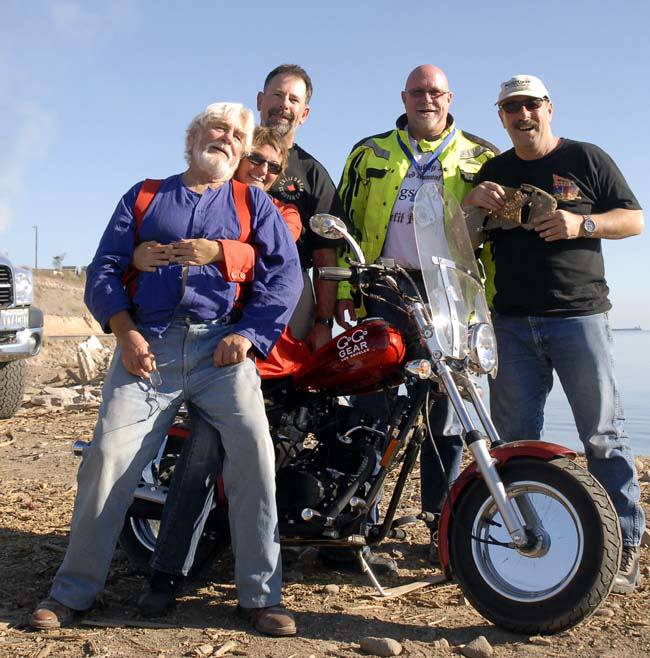
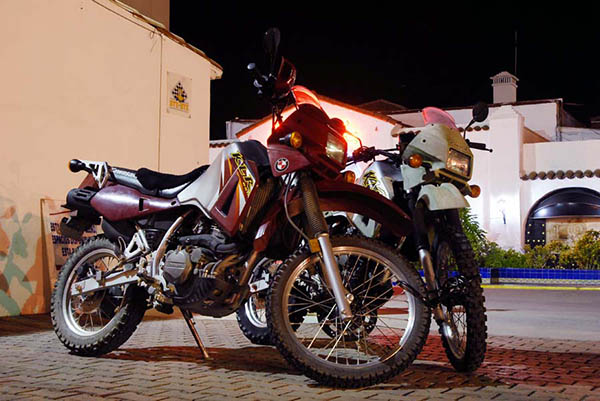
The KLRs, rode hard and put away wet that night in the Rosarito Beach Hotel.
Our plans for this trip were purposely vague, other than to head south and consume large quantities of Tecate after the bikes had been put away. We briefly talked about doing a banzai run all the way to Cabo San Lucas, but that would have been a push. It was already dark when we passed through Tijuana, and south of TJ, the Pacific Ocean mist was fogging my faceshield. I thought about Susanna’s restaurant in Rosarito (more on that in a bit), and all thoughts of Cabo vanished. For that night, Rosarito Beach was it. And that was a good thing. I love having dinner in Susanna’s. Susanna’s is the best restaurant in town, and maybe the best in all of Mexico. A stay in Rosarito Beach without dinner at Susanna’s would be a crime against nature and good judgment.
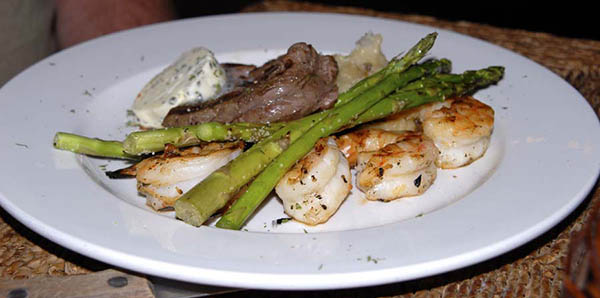
Susanna, don’t you cry for me. I’ll be back.Ah, yes. The perfect antidote for low cholesterol. The dining at Susanna’s is as close as you’ll get to Heaven without a one-way ticket.
After a five-star dinner, Baja John and I walked around downtown Rosarito Beach for a bit. It was deserted.
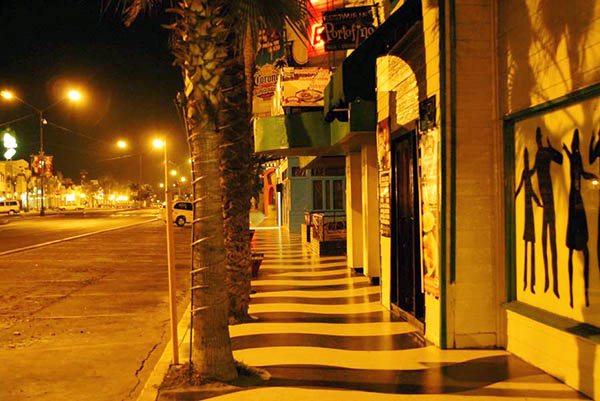
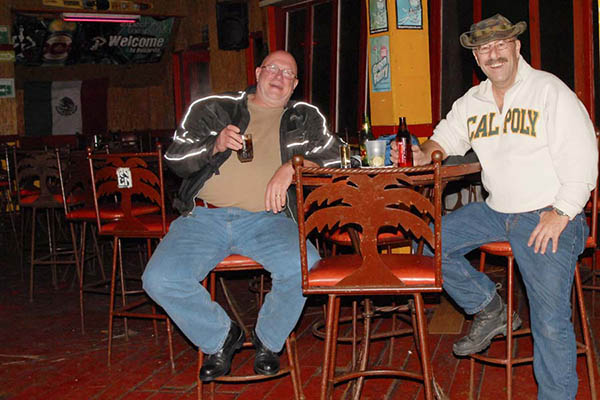
Rosarito Beach 2009. The LA Times was killing this place with its unending negative stories about Mexico. More than half the stores, restaurants, and other places were shuttered. Normally a hopping party town, in 2009 it was dead, and there was really no reason for it other than the US news media’s fixation on demonizing the place.At a club in Rosarito Beach. We were the only two people there. That’s Baja John on the left.
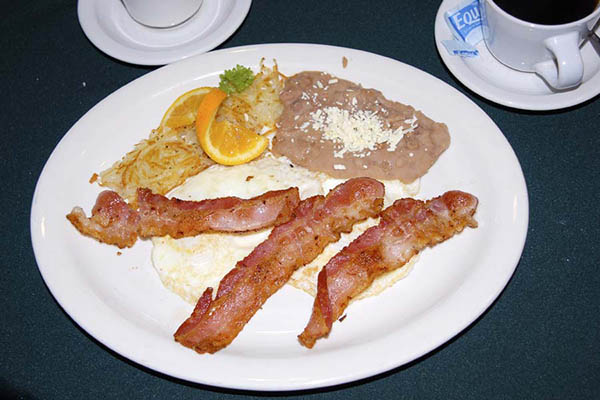
The next morning we rolled south along the Pacific coast to a great breakfast in Ensenada. Good God, we were packing on the calories. My favorite breakfast spot in Ensenada is Velero’s, a place near the ocean just behind the Corona Hotel. The clientele is mostly local business folks, the breakfasts are great, and it’s the hot ticket. They bring a large plate of light, delicious pastries as soon as you sit down. The coffee and the orange juice are superior. That’s followed by a tortilla with melted cheese and salsa. I could have (and should have) stopped at the pastries and the cheese tortilla, but I went for my customary two eggs over hard with the fixings you see below. It was as good as it looks.
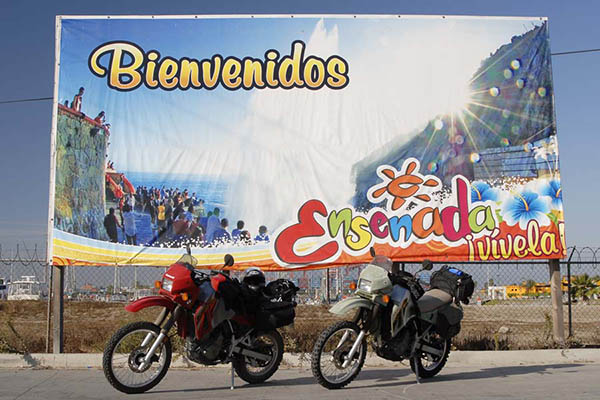
Simple, delicious, and filling. Velero’s is the breakfast spot in Ensenada.Velero’s is on a side street that juts off the road along the coast. The Ensenada sign is gone. A pity, as it made for a great photo.
After a great breakfast, we were on the road again, headed south out of Ensenada toward points south, including the aforementioned abandoned missions, a shipwreck on the Pacific coast, and more.
To be continued…
Hey, we have a couple of pages you should check out. One is our Baja page, which includes great info on taking a motorcycle into Baja. The other is our new Epic Motorcycle Rides page. Take a look and let us know what you think!
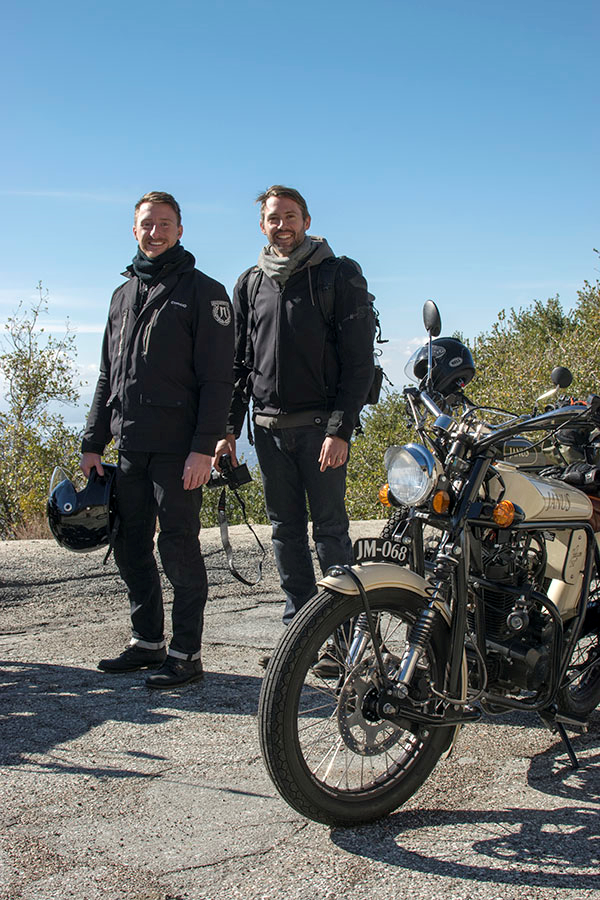
Brrrrr. It was cold that day! That’s Devin Biek on the left, one of the two Janus founders (Richard Worsham is the other one). The guy on the right is Jordan Swartzendruber, the Janus video and photo guy.
Yep, you read it right. This is a blog about a blog about a blog. The blog I’m referring to is this one, which is on the Janus Motorcycles site…
With my permission, the good guys at Janus Motorcycles reprinted one of the blogs I did on the Baja trip. It’s cool. I especially like the way they selected and highlighted quotes throughout the piece…
Cool. So this blog? It’s about the Janus blog, which is about the ExNotes blog. A blog about a blog about a blog. I love it! Incidentally, if you want to get to the Janus blog, it’s right here.
And check out this latest video from Janus…it has more than a few scenes from the Baja ride…
That word above (ballenos) converts to “whales” and wow, the whale watching in Scammon’s Lagoon today was as good as it gets!
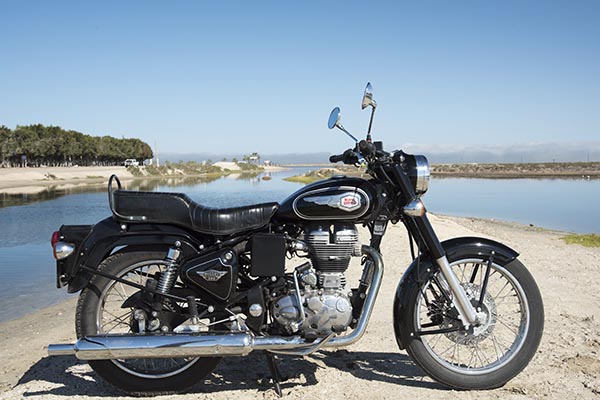
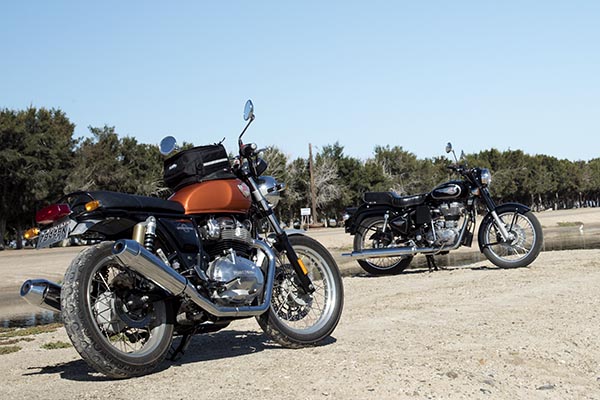
First, a couple of motorcycle beauty shots…the Bullet and the 650 in Guerrero Negro…
…and next, some of the photos from our whale watching expedition earlier today…
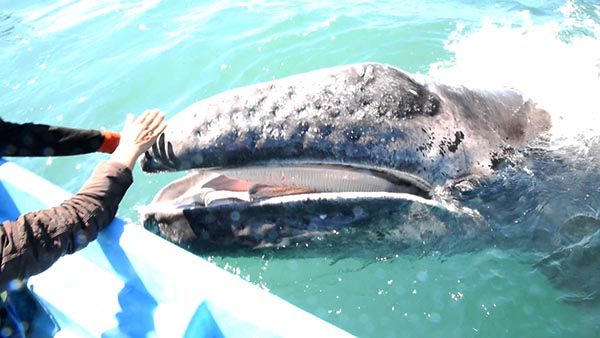
At one point, we had four whales up against our little boat, all wanting to be petted like giant puppies. One even smiled for us…
Joe and I had a great time.
After we returned, we had a couple of fish tacos at good buddy Tony’s Tacos El Muelle, and tonight, we’re trying a new restaurant in Guerrero Negro. Tomorrow we’re pointing the bikes north as we head back to California, and most likely we’ll stay in the El Rosario/San Quintin area again.
Lawrence of Suburbia. I love it. Gresh thinks he’s riding the Bullet tomorrow. We’ll see…
Getting into Mexico through Tecate is about as easy as it gets. All you need to do is find your way to California Highway 94, which twistiliciously parallels the border below Interstate 8 (the mind-numbingly boring slab that runs from San Diego into Arizona). Roughly 25 miles east of where 94 originates near San Diego, you’ll see Highway 188. Highway 188 is only a mile long, it turns due south off 94, and it runs right into Tecate.
On the US side, Tecate is little more than the US Customs and Immigration station with a couple of buildings scattered along the road. Just keep riding south. You’ll see the signs warning you not to bring guns into Mexico (duh), and suddenly, you’ve entered Mexico. There is no Mexican border control officer. You just ride right in. You can do that going south. Don’t try it in the other direction, though.
I guess I should mention, too, that you’ll need your US passport. You can get into Mexico without showing your passport, but if you want to get back into the Estados Unidos, well, you get the idea.
The place to get your Mexican tourist visa is a bit complicated to get to. Well, sort of. It’s right there as you enter Mexico, the first building on the right, once you’ve crossed the border. You’ll bounce over a couple rows of Bots Dots (those annoying grapefruit-sized metal domes). The drill is to park (but there’s no place to park), walk across the road you just rode in on, hoof it back to the Mexican customs building (but there’s no sign on it), walk around the road through a gate as if you were walking out of Mexico, cross back again, and, if you’re like me, wonder what you’re supposed to do next. Look for the steps, go up a half a flight, and then enter the Mexican immigration area. There are no signs. Just wander around looking like you’re lost (you won’t have to act, because you will be), and ultimately, somebody will ask if you need help. I get the feeling not too many people actually get a visa when they enter Mexico. But you’re supposed to. There. I’ve said what I’m supposed to.
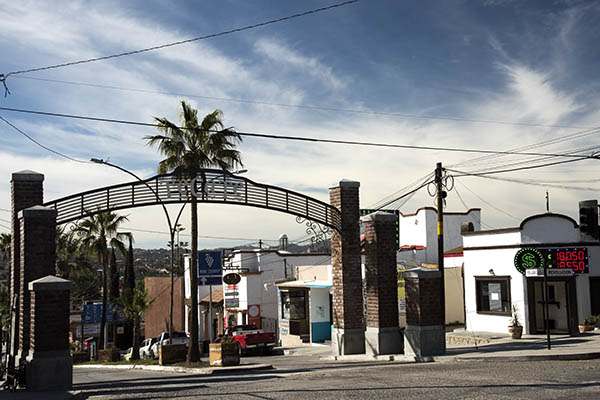
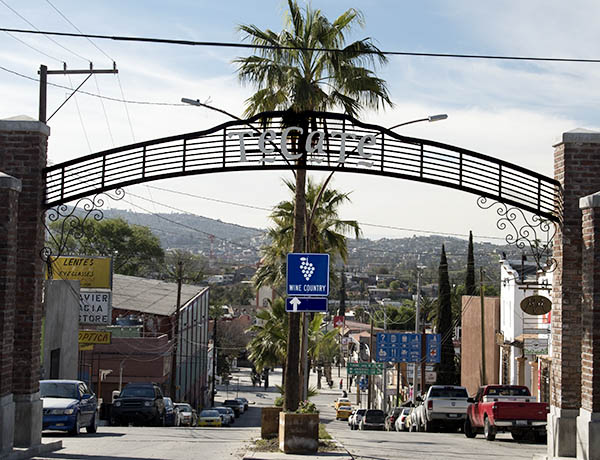
When you get back on your bike (or in your car), continue south on the street you came in on, and you’ll immediately see the sign telling you yep, you’re here…
A better view of the sign welcoming you to Tecate. Note the sign below…the wine country is straight ahead. Baja wines are quite good. We’re pointed due south in this photo.
Tecate is laid out kind of like a T, with the top of the T following the border to the east and the west, and the long part of the T heading south toward the Ruta del Vino wine country. The drill here is to go a block or so past the Tecate welcoming banner you see in the photos above until you T into Avenida Revolución, and then turn right. If you go about a mile or so, you’ll see one of the two places I stay when I’m Tecate. It’s the Hotel El Dorado. It’s okay and it’s not expensive. My preferred place to stay, though, is the Hotel Hacienda, which is another mile east on the same Avenida Revolución. The Hacienda has that amazing Malinalli Sabores Autóctonos restaurant I wrote about in the ExNotes blog yesterday in a connected building. The Hacienda also has more secure parking (they lock up the parking lot at night). I think the rooms at the Hacienda are a wee bit nicer, too. The price at both places is about the same, and they are both on the right side of the road as you continue west.
Hey, one thing I ought to mention is that Mexico has stop signs that look exactly like ours, but somehow they are way harder to see. If you’re approaching an intersection, start looking for a stop sign. They won’t jump out at you.
You’ll see plenty of gas stations, and in Tecate the gas stations take credit cards (that’s not always the case further into Baja). Until recently, Pemex was the only gas you could buy in Mexico. Being a government company, though, Pemex ran out of money for exploration (and then they started to run out of gas), so the Mexican government now allows other oil companies. We saw BP, Chevron, and ARCO stations in Tecate.
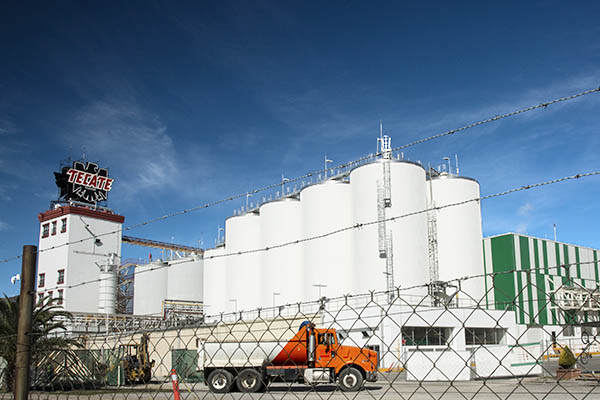
Tecate is dominated by the Tecate Brewery, which is the tallest thing in town. The brewery is smack dab in the center of town, and you literally can see it from just about anywhere. They used to offer brewery tours, but alas, I was unable to book one. Maybe they still do, but neither the phone number nor the email address on the Tecate website worked for me. I wandered onto the Tecate factory grounds to try to get a tour, but I struck out. A worker told me the Tecate Beer Garden is still open, but there were no tours. He said the Beer Garden was well hidden between two iron-grated doors. He was right. We couldn’t find it.
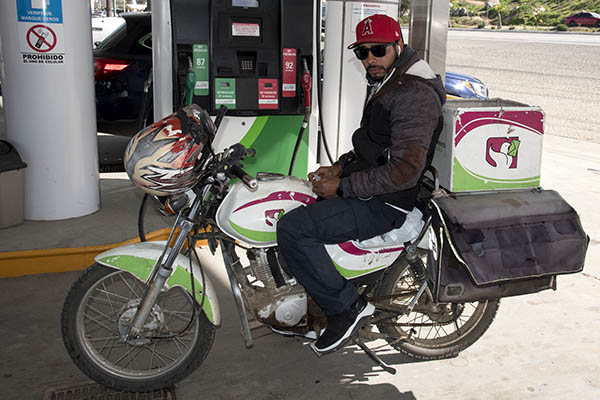
The Tecate brewery dominates the Tecate skyline. You can see the plant from anywhere in town.Mexico’s post office uses motorcycles for delivery. The bikes we saw were CG clones offered by Italika. It looks like a cool job.
So, imagine you’ve just crossed the border into Mexico and you are at the apex of that T described earlier (the T that is Tecate). If you turn right and head west on Mexico Highway 2, you’ll eventually run into Tijuana (although why anyone would ever want to do that is beyond me). If you turn left and head east on Mexico Highway 2, you’ll eventually run into the Rumarosa Grade (a very scenic place described earlier in our blogs about the Janus trip) and then Mexicali. If you go straight and head south on Mexico Highway 3, you’ll leave Tecate and dive deeper into Baja. Highway 3 becomes the Ruta del Vino and it is a fabulous ride through the northern Baja wine country. Highway 3 ultimately intersects Mexico Highway 1 (Baja’s Transpeninsular Highway) and the Pacific Ocean at the northern edge of Ensenada.
We’ll pick up with the Ruta del Vino in tomorrow’s blog, so stay tuned!
The Ruta del Vino…a fabulous ride through northern Baja from Tecate to Ensenada.
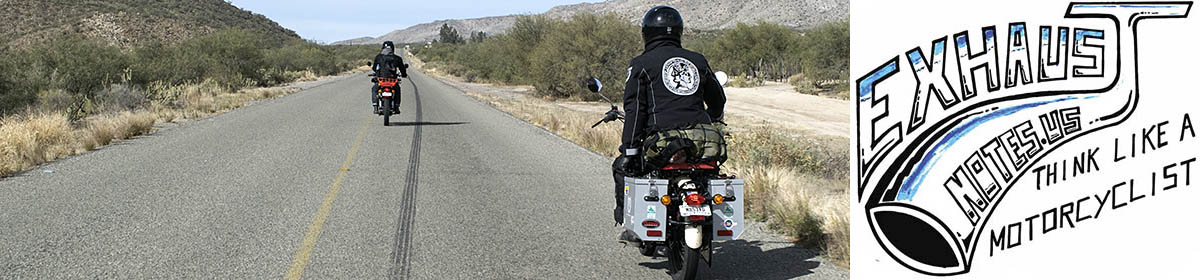
Hey, maybe you noticed, maybe you didn’t…but we’ve added a few new header images at the top of our blog. Gresh suggested we needed more motorcycle oriented pictures, and I agree with him. Gresh is smart that way. I never claimed to be the brains in this outfit; I’m just the good looks.
I’ll be adding more header images in the coming weeks, too. We’ve got tons of photos from our travels, and yeah, I like to show them off. The photos have to be ones that will crop to a 1200×280 pixel format, which eliminates most almost immediately. But I have a few that will work.
The way this header thing works is every time you visit the blog, one of six images randomly pops up. I could have set the header up so the images would scroll, but I did that when I wrote the CSC blog and I found it distracting (while you’re reading the blog, the header image keeps changing, drawing your attention away from the blog du jour). And I didn’t want to put a description directly on the image because I didn’t want it to take away from the photo, so I thought I would add a description here.
So, to get to the point, these are smaller versions of the header images, along with a brief explanation of each.
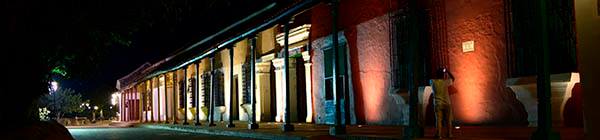
This is the original ExNotes blog header image, which will still pop up from time to time. I love this photo. I took it on the ride through Colombia in Mompox, a mystical town tucked away in a magic land. I’d like to invite you to read the blog I wrote on Mompox a few months ago. If you look real close, you’ll see my good buddy Juan, who I rode with in Colombia and on the CSC Western American Adventure Ride.
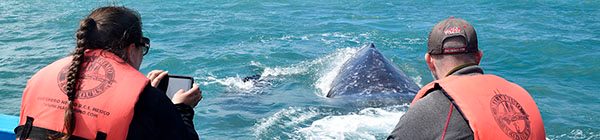
Ah, the whales Scammon’s Lagoon, Guerrero Negro, Baja California Sur. Gresh and I are going to ride there in March. It’s one of life’s real treats. We’ll be blogging the entire trip, and we’ll be insured with BajaBound Insurance (the best there is).
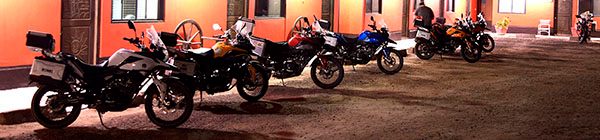
Wow, another Guerrero Negro photo, this time after the bikes had been put away for the evening at the Don Gus Hotel. I love the hotel and the restaurant (and the bar, too!) at the Don Gus Hotel. This was on one of the CSC Motorcycles Baja adventure rides.
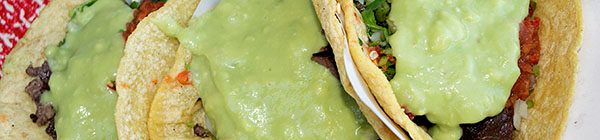
One of the best parts of any Baja adventure ride is the cuisine. These are tacos we enjoyed on the recent ride with Janus Motorcycles. The food down there is fantastic!
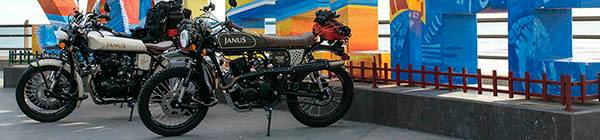
Janus Motorcycles parked along the Malecon in San Felipe. This was a great Baja ride, and the Janus machines performed perfectly. It was a grand adventure. Hell, they all are!
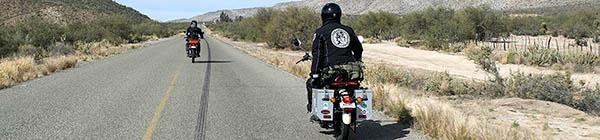
A photo of Jordan Swartzendruber (on the left, hugging the center line) and Devin Biek (on the right), both on Janus Motorcycles. We did about a thousand miles in 4 days on these 250cc motorcycles. It was one of the coldest rides I’ve ever done, but we had a grand time!
And there you have it. Like I said, we’ll be adding more header photos in the future, and we’ll tell you about each one as we do so. I shot all of these photos with my Nikon D3300 digital single lens reflex camera and its 18-55 lens, which is a very reasonably priced, entry-level DSLR outfit. I find the photos refresh my memory of the great times I’ve had on each of these rides. In fact, those pictures above are making me feel like getting out on an adventure ride again. Soon, folks, soon…
Back in So Cal on a rainy and cold day, after a Janus ride through Baja. Good times!
Jordan, Devin, and I made it home safe and sound today after four awesome days on the road. I’m beat. It’s been a fun ride. I have much to tell you about the grand time we had on these amazing machines, but I don’t want to do a half-baked job trying to write well when I can barely stay awake. It’s time to invoke the greatest labor saving device ever created…that concept we know as “tomorrow.” Wait for it, folks. It will be good, I promise. Thanks for riding along with us.
Want to read the rest of the story? Please visit our Baja page for an index to all of the Janus Baja blog posts!
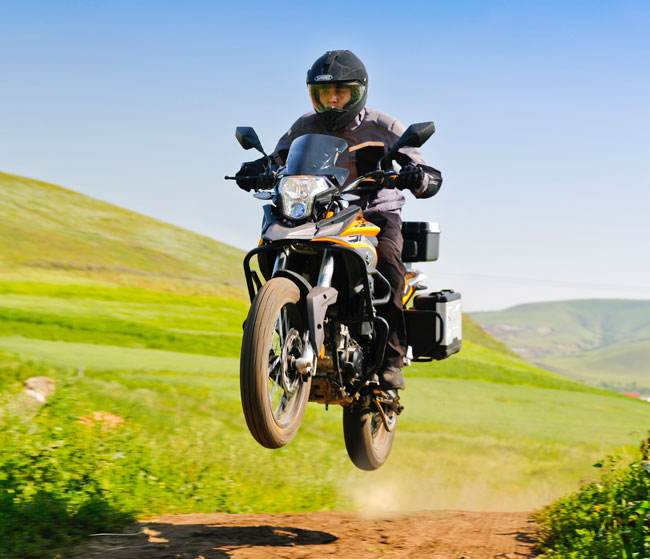
This is a blog I wrote for CSC Motorcycles a little more than 4 years ago (time sure flies when you’re having fun). The topic was as timely then as it is today. I like big bikes, but I like small bikes more, and I’m convinced that a small bike makes way more sense than a big bike for real world adventure touring. I thought I would post the blog again, as we are having way too much fun with CSC, BMW, Janus, and other companies who have seen the light. Here’s the blog from back in September 2014…
A 250cc bike seems too small to many riders. Is it?
The 250cc CSC Cyclone.
The motorcycle craze in the US really started in the mid-1960s. I know motorcycling goes back way before that, but motorcycling was essentially a fringe endeavor until Honda came on the scene. We met the nicest people on Hondas, if you remember, and that ad tagline was a winner (so is “Don’t Miss The Boat,” by the way). (Note: “Don’t Miss The Boat” was CSC’s tagline for the US RX3 introduction, and those who didn’t miss the boat participated in one of the best deals in the history of motorcycling.)
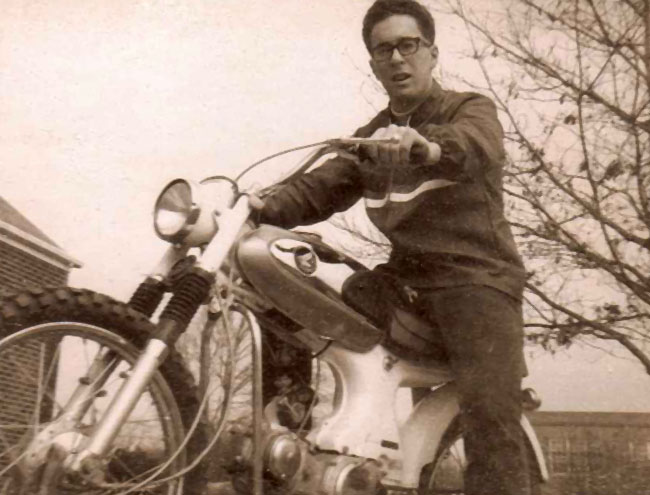
Honda’s sales model was a good one. They pulled us in with small bikes and then convinced us we needed larger and larger bikes. Many of us started with a Honda Cub (the 50cc step-through), we progressed to the Super 90 (that was my jump in), then the 160cc baby Super Hawk, then the 305cc Super Hawk, and at that point in about 1967 that was it for Honda. They didn’t have anything bigger (yet). After the 305cc Super Hawk, the next step for most folks was either a Harley or a Triumph.
Yours Truly, on a Honda Super 90 in the mid-’60s.
You know, back in those days, a 650cc motorcycle was a BIG motorcycle. And it was.
But Honda kept on trucking…they offered a 450 that sort of flopped, and then in 1969 they delivered the CB-750. That bike was so far out in front of everyone else it killed the British motorcycle industry and (with a lot of self-inflicted wounds) it almost killed Harley.
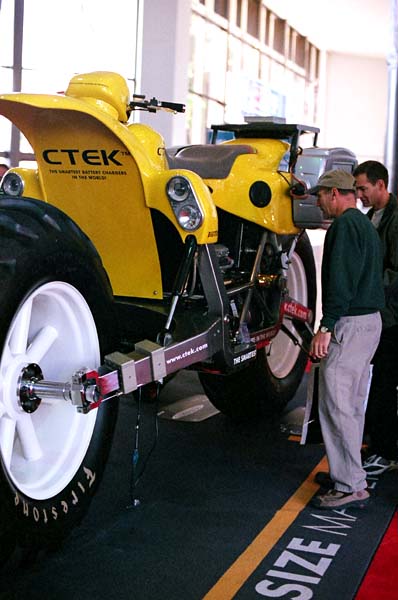
The Japanese manufacturers piled on. Kawasaki one-upped Honda with a 900. (Another note…it’s one of those early Kawi 900s that Gobi Gresh is restoring in the Zed’s Not Dead series.) Honda came back with a 1000cc Gold Wing (which subsequently grew to 1100cc, then 1500cc, and is now an 1800cc). Triumph has a 2300cc road bike. Harley gave up on cubic centimeters and now describes their bikes with cubic inches. And on and on it went. It seems to keep on going. The bikes keep on getting bigger. And bigger. And bigger. And taller. And heavier. And bigger. In a society where everything was being supersized (burgers, bikes, and unfortunately, our beltlines), bigger bikes have ruled the roost for a long time. Too long, in my opinion.
Is this where it’s going? (Note: I shot this photo at the Long Beach International Motorcycle Show about 15 years ago.)
Weirdly, today many folks think of a 750 as a small bike. It’s a world gone nuts. But I digress…
I’ve done a lot of riding. Real riding. My bikes get used. A lot. I don’t much care for the idea of bikes as driveway jewelry, and on a lot of my rides in the US, Mexico, and Canada, I kind of realized that this “bigger is better” mentality is just flat wrong. It worked as a motorcycle marketing strategy for a while, but when you’re wrestling with a 700-lb bike in the soft stuff, you realize it doesn’t make any sense.
Really?
I’ve had some killer big bikes. A Triumph Daytona 1200. A Harley Softail. A TL1000S Suzuki. A Triumph Speed Triple (often called the Speed Cripple, which in my case sort of turned out to be true). All the while I was riding these monsters, I’d see guys on Gold Wings and other 2-liter leviathans and wonder…what are these folks thinking?
I’d always wanted a KLR-650 for a lot of reasons. The biggest reasons were the bikes were inexpensive back then and they were lighter than the armored vehicles I had been riding. I liked the idea of a bike I could travel on, take off road, and lift by myself if I dropped it. To make a long story short, I bought the KLR and I liked it. I still have it. But it’s tall, and it’s heavy (well over 500 lbs fully fueled). But it was a better deal than the bigger bikes for real world riding. Nobody buys a KLR to be a poser, nobody chromes out a KLR, and nobody buys leather fringe for a KLR, but if that’s what you want in a motorcycle, hey, more power to you.
More background…if you’ve been on this blog for more than 10 minutes you know I love riding in Baja. I talk about it all the time. My friends tell me I should be on the Baja Tourism Board. Whatever. It is some of the best riding in the world. I’ll get down there the first week I take delivery on my CSC Cyclone, and if you want to ride with me, you’re more than welcome. (Note: And I did. We did a lot of CSC Baja tours, and CSC introduced a lot of folks to riding and to Baja. That one innocent little sentence became a cornerstone of CSC’s marketing strategy.)
I was talking up Baja one day at the First Church of Bob (the BMW dealership where me and some of my buddies hang out on Saturday mornings). There I was, talking about the road to San Felipe through Tecate, when my good buddy Bob said “let’s do it.” Baja it was…the other guys were on their Harleys and uber-Beemers, and I was on my “small bore” KLR. The next weekend we pointed the bars south, wicked it up, and rode to San Felipe.
The Boys…bound for San Felipe with my KLR leading the pack
That was a fun trip. I took a lot of ribbing about the KLR, but the funny thing was I had no problem keeping up with the monster motos. In fact, most of the time, I was in the lead. And Bob? Well, he just kept studying the KLR. On Saturday night, he opened up a bit. Bob is the real deal…he rode the length of Baja before there was a road. That’s why he was enjoying this trip so much, and it’s why he was so interested in my smaller bike. In fact, he announced his intent to buy a smaller bike, which surprised everybody at the table.
Holding court on the Sea of Cortez. That’s Bob on the right.
Bob told us about a months-long moto trip he made to Alaska decades ago, and his dream about someday riding to Tierra del Fuego. That’s the southernmost tip of South America. He’d been to the Arctic Circle, and he wanted to be able to say that he’d been all the way south, too.
I thought all of this was incredibly interesting. Bob is usually a very quiet guy. He’s the best rider I’ve ever known, and I’ve watched him smoke Ricky Racers on the Angeles Crest Highway with what appeared to be no effort whatsoever. Sometimes he’d do it on a BMW trade-in police bike standing straight up on the pegs passing youngsters on Gixxers and Ducksters. Those kids had bikes with twice the horsepower and two-thirds the weight of Bob’s bike, and he could still out ride them. Awesome stuff. Anyway, Bob usually doesn’t talk much, but during dinner that night on the Sea of Cortez he was opening up about some of his epic rides. It was good stuff.
Finally, I asked: Bob, what bike would you use for a trip through South America?
Bob’s answer was immediate: A 250.
That surprised me, but only for an instant. I asked why and he told me, but I kind of knew the answer already. Bob’s take on why a 250: It’s light, it’s fast enough, it’s small enough that you can pick it up when it falls, you can change tires on it easily, you can take it off road, you can get across streams, and it gets good gas mileage.
Bob’s answer about a 250 really stuck in my mind. This guy knows more about motorcycles than I ever will, he is the best rider I’ve ever known, and he didn’t blink an eye before immediately answering that a 250 is the best bike for serious world travel.
It all made a lot of sense to me. I had ridden my liter-sized Triumph Tiger in Mexico, but when I took it off road the thing was terrifying. The bike weighed north of 600 lbs, it was way too tall, and I had nearly dropped it several times in soft sand. It was not fun. I remembered another ride with my friend Dave when he dropped his FJR in an ocean-sized puddle. It took three of us to get the thing upright, and we dropped it a couple of more times in our attempt to do so. John and I had taken my Harley and his Virago on some fun trips, but folks, those bikes made no sense at all for the kind of riding we did.
Upright in this photo, but it was like wrestling a pig in mud a few minutes earlier.
You might be wondering…what about the other so-called adventure bikes, like the BMW GS series, the Yamaha Tenere, or the Triumph Tiger? Good bikes, to be sure, but truth be told, they’re really street bikes dressed up like dirt bikes. Big street bikes dressed up like dirt bikes. Two things to keep in mind…seat height and weight. I can’t touch the ground when I get on a BMW GS, and as you’ve heard me say before, my days of spending $20K or $30K on a motorcycle are over. Nice bikes and super nice for freeway travel, but for around town or off road or long trips into unknown territory, these bikes are just too big, too heavy, and too tall.
There’s one other benefit to a small bike. Remember that stuff above about Honda’s 1960s marketing strategy? You know, starting on smaller bikes? Call me crazy, but when I get on bikes this size, I feel like a kid again. It’s fun.
I’ve thought about this long and hard. For my kind of riding, a 250 makes perfect sense. My invitation to you is to do the same kind of thinking.
So there you have it. That was the blog that helped to get the RX3 rolling, and CSC sold a lot of RX3 motorcycles. Back in the day, CSC was way out in front of everybody on the Internet publicizing the Zongshen 250cc ADV bikes, and other countries took notice. Colombia ordered several thousand RX3s based on what they CSC doing, other countries followed, and things just kept getting better and better. The central premise is still there, and it still makes sense. A 250 may well be the perfect motorcycle.
Never miss an ExNotes blog…subscribe here for free!
The trek south on our 150cc California Scooter Mustang replicas continues…
If you are coming into this adventure in the middle of the movie, you might want to take a minute or two and get caught up with our first three installments…
After the spending the night at the Desert Inn in Catavina, fueling the bikes and checking that everything was tight the next morning, we were ready to continue south. We had agreed that if the group separated (which happens on these trips), our next rally point would be Chapala. Sure enough, that’s what happened, and Arlene and I waited for John and Simon to catch up to us near Chapala. We had a soft drink and after waiting a bit, we pushed on. We’d catch John and Simon later.
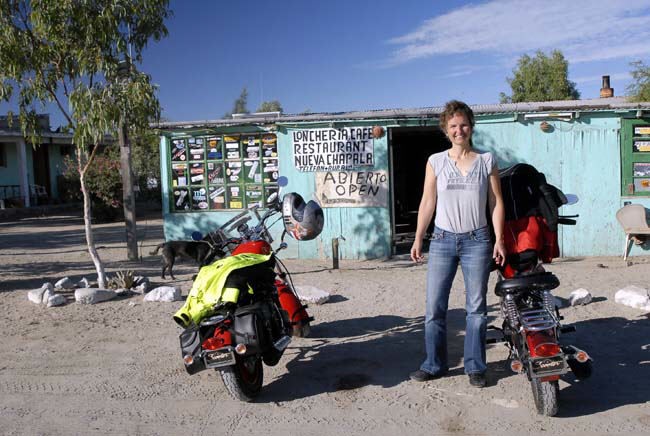
Arlene and I at the only loncheria in Chapala…
We had left early that morning and the weather was tolerable, but it soon became a brutally hot. September is the hottest month of the year in Baja, and we were feeling it.
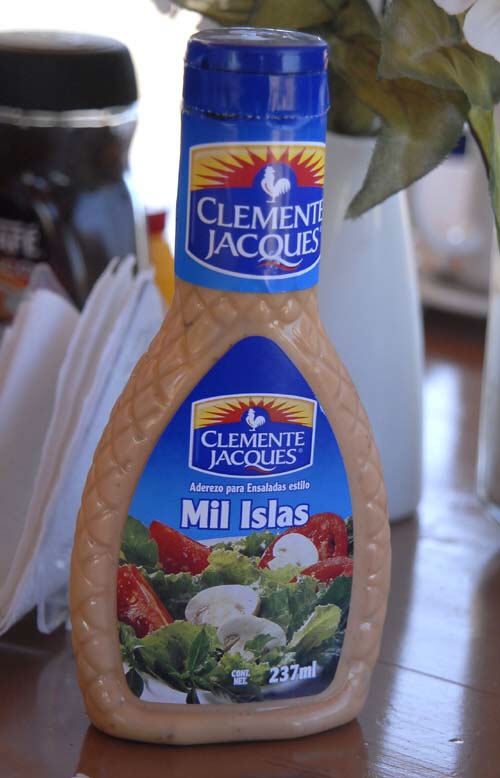
1000 Island. What else?
When we hooked up with Simon and John, they were eating a morning snack…a salad with 1000 Island dressing. We continued down Mexico’s Transpeninsular Highway, and I grabbed this shot of Simon and Arlene headed toward Guerrero Negro…
On the road, on 150cc bikes, headed south in Baja.
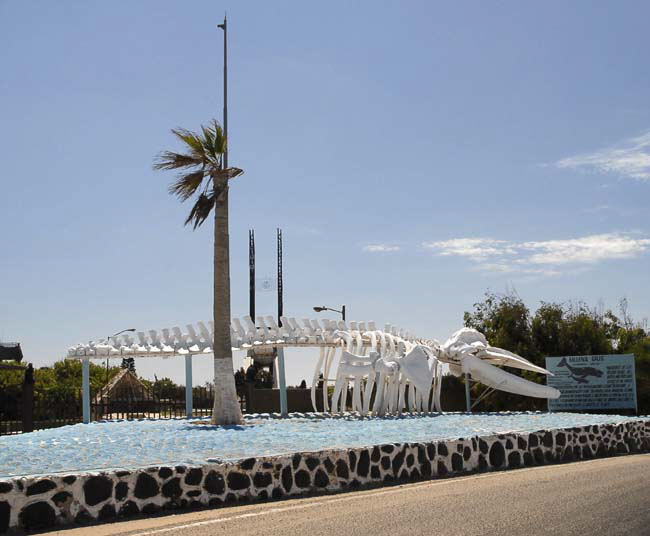
Guerrero Negro means “Black Warrior” in Spanish. It is the name of a ship that sank near there in the 1800s. Guerrero Negro is right on Parallelo 28 (the 28th Parallel), which separates the states of Baja California and Baja California Sur. The town is also a good spot in the winter months for whale-watching tours. There’s a Mexican Army compound on the highway, and they have this cool whale skeleton right next to the highway.
Balleno!
From Guerrero Negro, the highway cuts southeasterly across the Baja peninsula, and we moved from the Pacific side to the Sea of Cortez side of Baja.
Going across the Baja peninsula was a fun ride, especially the last few miles into Santa Rosalia. It’s a 2,000-foot descent in just a few miles, and it’s wild. The name of this stretch is La Cuesta del Infierno. There are no guard rails and nightmarish drops if you let things get away from you. I didn’t grab any photos on the way down. When we arrived on eastern shore of the peninsula, we stopped for a few photos.
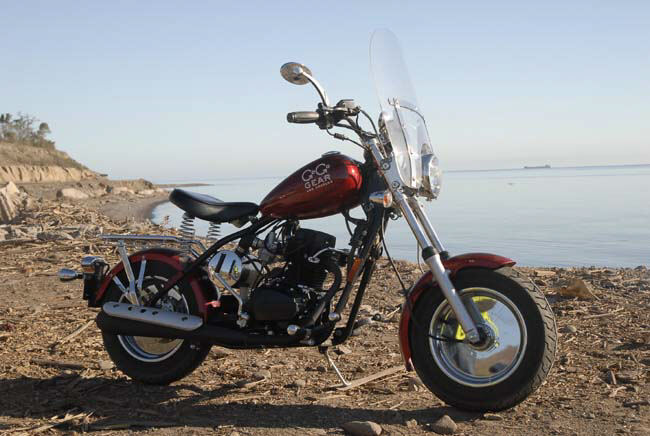
Arlene Battishill, Go Go Gear riding apparel, a custom California Scooter, and the Sea of Cortez.
Arlene’s CSC 150 had a custom paint job with the Go Go logo. John Esposito, who was with CSC at the time, did the painting. He is easily the most gifted custom painter I’ve ever known.
The crew, and one of my favorite photos from this trip. From left to right, it’s Simon Gandolfi, Arlene Battishill, J Brandon, John Welker, and Joe Berk.
We ate in Santa Rosalia, and by now, the temperature and humidity were beyond oppressive. That didn’t kill our spirits, but it came close. We were in heavy traffic, we were fully suited up, and it was a steam bath. We were close to the Tropic of Cancer, and it was about as miserable a set of riding conditions as I’ve ever experienced. Something was going on but I didn’t know what, and then traffic stopped altogether. As we sat in our riding gear and sweltered, a heavily-armed military parade marched by, music and all. Right in front of us. Had a revolution started? We didn’t know it yet, but we soon found out that Mexico was celebrating the bicentennial of the Mexican Revolution! John and I looked at each other and starting laughing. This was perfect!
John and I have been exploring Baja on motorcycles for close to 20 years now. He’s an easy guy to travel with, and he always laughs at my jokes (so I naturally like the guy). We’ve done the cruiser thing, we’ve both owned KLR 650 Kawasakis, and we’ve both owned CSC RX3 motorcycles. John was a great guy on this (and many other) trips…he’s a guy that just doesn’t let the small stuff bother him. A flat tire in the middle of the jungle? Hey, no problemo! That’s John in a nutshell, and it’s why I like traveling with him.
My good friend John Welker.
You may recall that part of the reason we making this trek was to road test the CSC 150 Mustang replicas under harsh conditions. Our intent on this trip was to beat the heck out of our California Scooters and find issues offering improvement opportunities. Baja is a proving ground…there’s no question about that. When I was a kid, American Motors came out with a new car that they entered in the Baja 1000 (I think it was their AMX model). Their commercials had a race car driver explaining to a Bajaeno that they were entering the car in the Baja race. The Bajaeno responded with “You’re going to enter theese hunk of tin in the Baja? Ha ha!” It was an image that stuck in my mind. Our direction from Steve Seidner, the CSC CEO, was to try to break the bikes, and Baja would be the place to do it.
And try we did…the trip would be 2200 miles through Baja. Simon commented that what we were doing with these bikes was probably something no other owner would ever do with their California Scooters, and time proved him right. It’s been nearly 10 years, and no one repeated what we did. Rough asphalt. Dirt roads. Hundreds of miles a day with wide open throttles. 100+ degree temperatures. High humidity. Up and down mountain passes. Long straights through the desert. You get the idea.
So, what broke?
I expected to have lots of light bulb failures, as I’ve had those on virtually any motorcycle I’d ever taken through Baja. I bought a bunch of 1157s for the tail lights, and a half dozen headlight bulbs. As it turned out, that was massive overkill. We had one headlight failure (Arlene’s conked out just before we reached Cabo San Lucas), and I had two tail light failures on my bike. Part of what caused my tail light failures might have been my defective rear tire…it was unbalanced due to the rip I put in it (I’ll get to that later in this saga) and that made the rear end on my bike vibrate a lot. Nobody else needed a bulb replacement, and I was surprised at how few bulb failures we had.
I guess I should point out that we had two preproduction bikes and two production bikes on this trip. Part of the test was to gage CSC’s success with improvements made when the company went from the preproduction to the production configuration. We wanted to see the same failures on the preproduction bikes as we had seen earlier, and we didn’t want to see those failures on the production bikes.
One of the problems CSC had experienced on the preproduction bikes was an occasional failure of the welded frame tab to which the muffler attaches. CSC strengthened that tab and its weld joint on the production bikes. Both tabs failed on the preproduction bikes within the first two days of riding in Baja; neither of the production bike muffler mounting tabs failed during the entire trip. I found a welder somewhere south of Guerrero Negro (my new buddy Umberto). I asked Umberto to fabricate new tabs identical to those on the production bikes, and to weld the new tabs on the preproduction bikes using the same weld pattern as the production bikes. Umberto did so, and the welds on the preproduction bike held for the remainder of the trip.
My new buddy Umberto upgrading a preproduction muffler tab to the production configuration, while simultaneously demonstrating proper personal protective equipment use. Welker is pulling fire guard duty.
We had two battery failures on the entire trip, and both occurred on the preproduction bikes. Neither of the production bikes had any battery problems. There was nothing different between the preproduction bikes’ batteries or charging systems and those on the production bikes, and at first, I was a little nervous about having a similar problem on the production bikes. Then, as the miles rolled by, I realized that the preprod bikes had old batteries. The batteries in both preprod bikes had been in those bikes for at least a year and a half, and who knows how old the batteries were before that. When we got back to the CSC plant, the boys put new batteries in both preproduction bikes, and they fired right up. The lesson here: Don’t leave on a long trip through Baja with an old battery. Duh.
The weather conditions – high heat and humidity – were tough on batteries…even J’s big Dodge Power Wagon (our chase vehicle) had a dead battery one morning. One thing about this battery business that was interesting was that Simon’s preproduction bike battery failed and his bike wouldn’t start at all. John’s preproduction bike battery failed and his bike could be kick started. John rode that preproduction bike for 9 days and 2200 miles, kick starting it all the way.
I tore up a tire on the way back from Cabo (I’ll tell you more about that in a subsequent installment). I noticed one afternoon that the tire was bald in just one spot, almost as if the rear wheel had been skidded for a long distance. I know I didn’t do that; maybe someone who rode my bike did (we swapped bikes a lot on this trip). Or maybe I hit something in the road that damaged it. Whatever the cause, I opted not to change the tire until later that day, and sometime in the next 150 miles, the tread split down to the cord in that bald spot. This caused a lot of vibration, but I took a chance on reaching San Ignacio before replacing it and it worked out okay. One thing about 12-inch tires…they were out quickly. It’s a common issue on scooters of all kinds. Well, maybe not an issue. You just need to know about it. A smaller diameter tire rotates a lot more than a bigger diameter tire, and the natural result is that the tires wear faster.
We also learned which nuts and bolts you have to keep an eye on our bikes. Nothing new there…I’ve gone through this with every motorcycle I’ve ever owned. On my KLR 650 it was the lower fairing bolts, the muffler heat shield, the muffler mounts, and the steering stem. On my Triumph Tiger it was the right foot peg and the saddlebag acorn nuts. On my Harley Softail it was nearly everything. On the California Scooter I soon learned it was the two 10mm exhaust clamp bolts at the cylinder head, and the 12mm elongated bolt at the bottom of the muffler. It became part of our ritual to check these bolts on our California Scooters each morning.
And the engine? Well, as far as I’m concerned, that old CG design was bulletproof. We flogged the bikes (we ran wide open for the last 500 miles), and we didn’t have a single engine problem. The CG engines are good, solid, reliable motors.
So, I digressed a little bit to tell you about the tech issues on the bikes. Now, it’s back to the main attraction…our ride. So where were we? Oh, yeah…I left off in Santa Rosalia. After having lunch and celebrating the Mexican Revolution in that fair city, we continued south. Mulege, a city about 40 miles south of Santa Rosalia, was to be our destination that evening.
It’s as good as it gets, folks. Whale watching, Baja style. It’s the only place in the world were you can get up close and personal, and actually touch the whales. Combined with a motorcycle ride, it makes Baja even more special…
Figure on two days from the Los Angeles area to get down to Guerrero Negro. I’ve done it in one day, but that involves getting up at 4:00 a.m. to leave LA and riding hard for 700 miles…it’s not the best way to do it.
The ride south is awesome, especially once you get south of Ensenada. You could make this an easy 5-day run if seeing the whales was your main objective, and hey, I’m here to suggest it should be. We’ll talk more about that in just a bit.
The deal is this…the California gray whale herd spends its time migrating north in the summer (all the way to Alaska) and south in the winter (down to two major lagoons on Baja’s Pacific side). It’s the longest mammal migration in the world. The two lagoons where you can see the whales are Scammon’s Lagoon near Guerrero Negro, and San Ignacio Lagoon about an hour west of San Ignacio via a gnarly dirt road.
Let’s go see the whales.
My preference (and my recommendation) is to do Scammon’s Lagoon from Guerrero Negro, as getting to the little boats only takes about 10 minutes. If you want to do San Ignacio Lagoon, you have to go with a service that picks you up in San Ignacio and takes you for a one-hour van ride to the lagoon. There are several whale watching services in Guerrero Negro; my favorite is Malarimmo’s or my good buddy Martin’s whale watching tour. It’s $50 per person, it includes a box lunch, and it’s literally a life-altering experience. Nobody does this who doesn’t come away moved by the experience. I know it’s hard to accept that reading a blog, but trust me, it’s what will happen.
The whales are cool. They’re longer than the boats we’re in. And like I said earlier, you actually get to touch them. Ever been kissed by a 45-foot California gray whale?
The whales are only in town (i.e., in Baja) from January through April, and then they’re back on the road headed north to Alaska. I like to visit with them in March; it’s when I think the whales are most friendly. This is a really cool thing to do.
I used to do these tours for CSC, and we’re thinking of opening it up for anybody in the ExhaustNotes crowd who wants to ride with us. You can be on any kind of bike, with a maximum number of people we’ll define at some point in the future. There won’t be any charge for this, folks, but you will have to sign up for our automatic ExhaustNotes email blog notifications to ride with us, and basically you’ll have to pass the personality test (that means you can’t be a jerk if you want to ride with us).
If you’re interested, let us know at info@ExhaustNotes.us (but only let us know if you’re serious; we not interested in a lot of “if” pre-qualifiers…you know, if I can get the time off, it my wife says it’s okay, if I can get my bike running, etc.).
Follow the ExhaustNotes blog if you want to know more about our planned Baja whale watching adventure ride. You should be reading the blog at least once every day, anyway (it will make you taller, thinner, better looking, and a better rider). Get your bike insured with BajaBound. We’ve got a lot of good info on Baja on our Baja page, and there’s more coming.
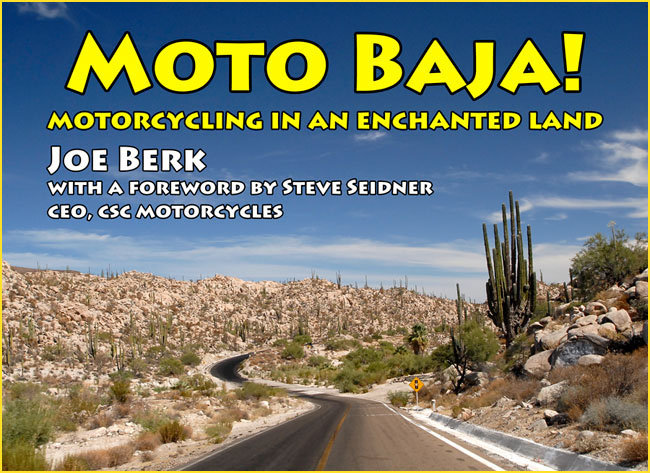
Stay tuned…there’s lots more to follow, but in the meantime, if you want to get a feel for what it’s like riding in Baja and seeing the whales, check out Moto Baja!
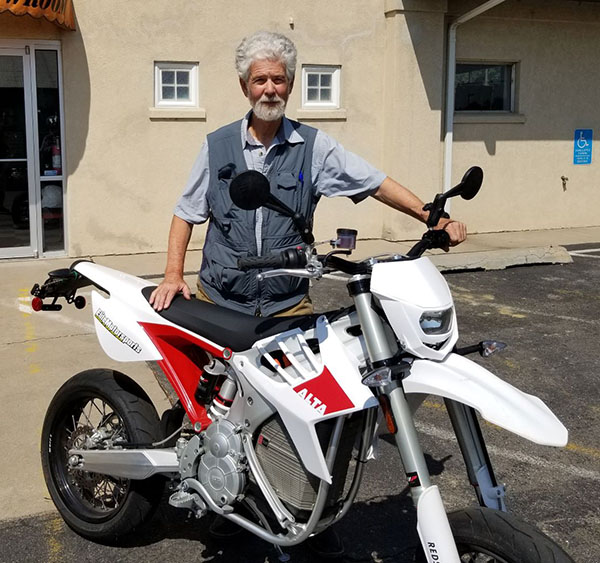
There’s a third streetable electric motorcycle out there, and it’s the Alta. My good buddy Danny, with whom I’ve ridden Baja several times (both of us own CSC RX3 and TT250 motorcycles), recently sent this note to me after he read the ExhaustNotes blogs about the City Slicker and Zero motorcycles…
Joe,
Interesting timing; I took this photo yesterday to send to you, taken before I suited up. This is what I rode:
And what a ride. Mode one would smoke my RX3, and probably the Guzzi. Mode two – it was fun. Mode three – OMG, hold on tight. I didn’t try mode four, two was enough.
I was impressed with the performance. The bike itself was not my type. I have been following Red Shift since their early days. Impressive design and engineering.
Dan
Thanks for the photo and the report, Dan. I’ve got to get a ride on an Alta, too. I know what you mean about the acceleration; it was the same thing I experienced on the Zero. It’s almost too much, although I never thought I would ever say that about any motorcycle.
Folks, I’m headed to Tinfiny Ranch later this morning. Watch for the report!


 …and next, some of the photos from our whale watching expedition earlier today…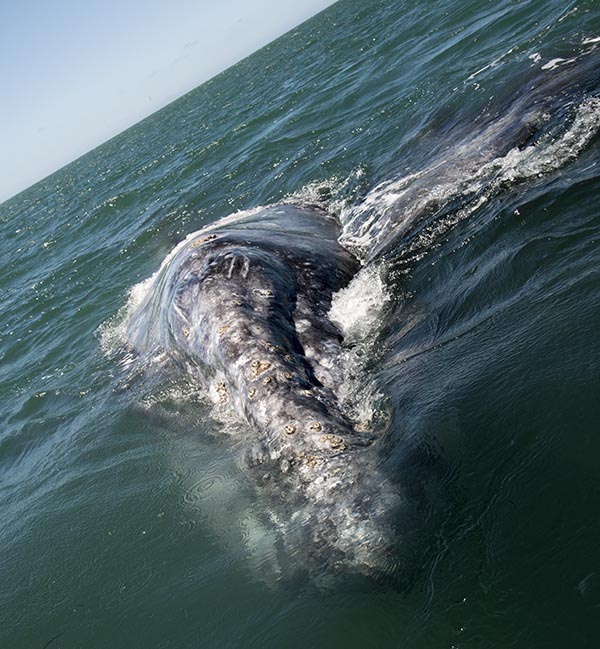
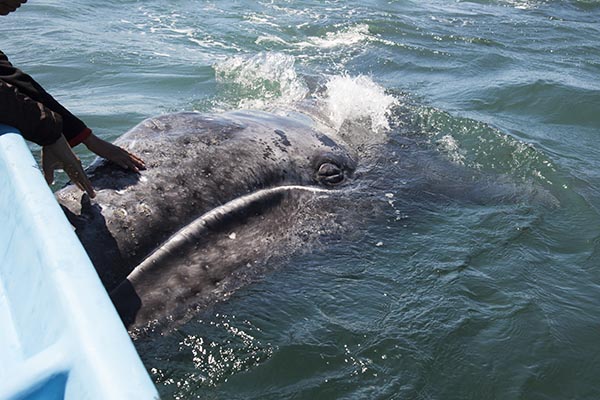


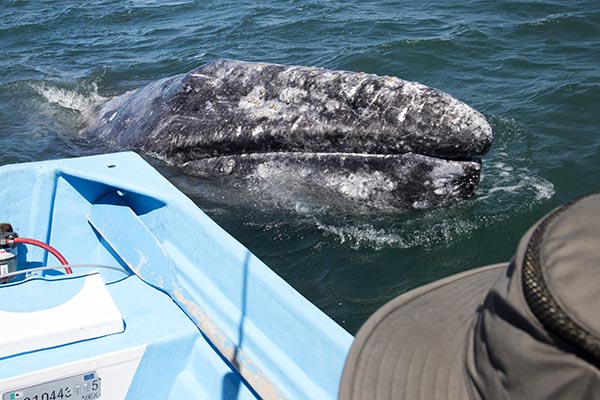
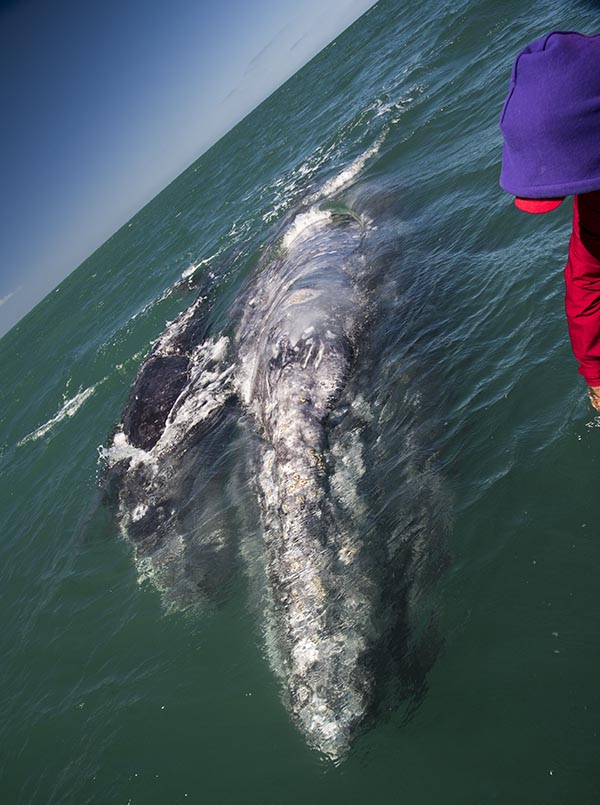
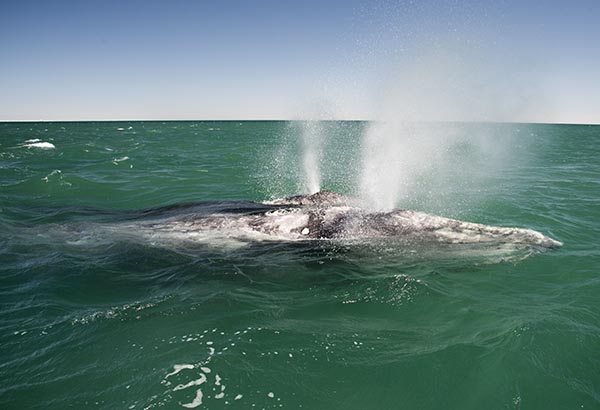 At one point, we had four whales up against our little boat, all wanting to be petted like giant puppies. One even smiled for us…
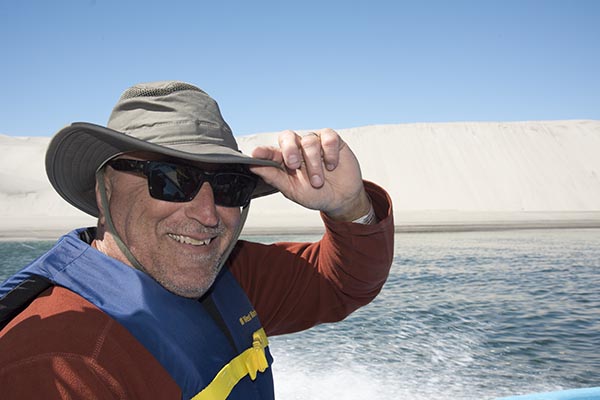
 Joe and I had a great time.
 After we returned, we had a couple of fish tacos at good buddy Tony’s Tacos El Muelle, and tonight, we’re trying a new restaurant in Guerrero Negro. Tomorrow we’re pointing the bikes north as we head back to California, and most likely we’ll stay in the El Rosario/San Quintin area again.