The Wayback Machine: Applying Taguchi to Load Development

By Joe Berk

People reload ammunition for different reasons.   It used to be you could save money by reloading, and I suppose for the more exotic cartridges (any Weatherby ammo, the big elephant rounds like .458 Win Mag, the .416 Rigby, etc.) that’s still the case.  It’s not the case for the more common rounds like 9mm, .45 ACP, and .223 Remington; bulk ammo for those is so inexpensive you’d be hard pressed to reload for as little as that ammo costs.  Sometimes people reload because factory ammo is no longer available or it’s very tough to find.  But most of us reload for accuracy.  We can experiment with different combinations of components and tailor a combo to a particular firearm to find the sweet spot…that combination of components that provides the tightest groups.  I’m in that category; it’s why I reload.

When I’m testing for accuracy and I get a tight group, I always wonder:  Is it because of the combination of components, or is it just a random event?  Usually, if the group size is repeatable, we conclude that it is the component combination, and not just a random good group that results from all the planets coming into alignment.  But is there a better way?   You know, one that shows with more certainty that it’s the component combination, and not just a fluke?

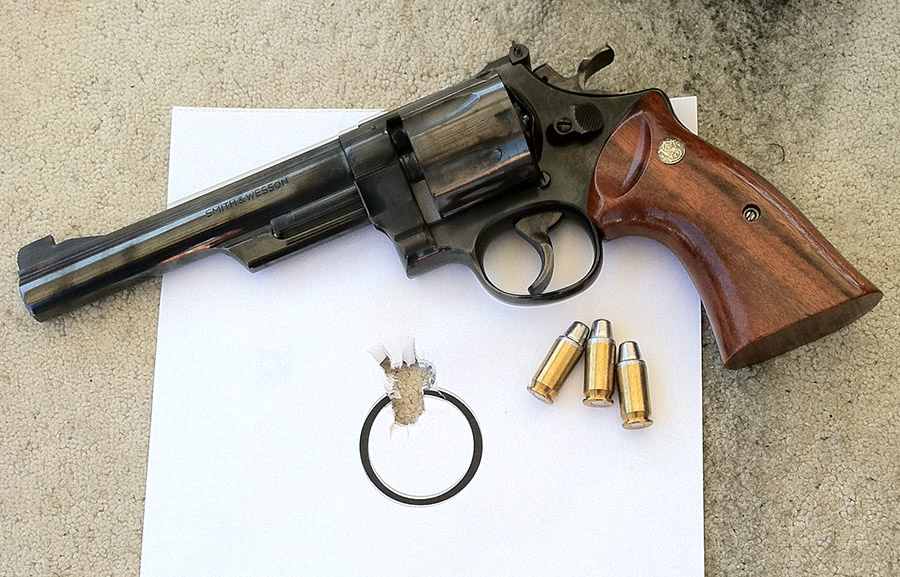
This article is a bit different.  It’s not just a story about a gun or about reloading ammunition.  It includes those things, but it’s more.  This story is about applying the Taguchi design of experiments technique to .45 ACP load development for ammo to be used in a Smith and Wesson Model 25 revolver (the one you see in the photo above).

I’m guessing you probably never heard of Taguchi.  That’s okay; most folks have not.  Taguchi testing is a statistical design of experiments approach that allows evaluating the impact of several variables simultaneously while minimizing sample size.  The technique is often used in engineering development activities, and I used it regularly when I was in the aerospace world.  The technique was pioneered by Genichi Taguchi in Japan after World War II, and made its way to the US in the mid-1980s.  I used the Taguchi technique when I ran engineering and manufacturing groups in Aerojet Ordnance (a munitions developer and manufacturer) and Sargent Fletcher Company (a fuel tank and aerial refueling company).

Taguchi testing is a powerful technique because it allows identifying which variables are significant and which are not.   Engineers are interested in both.  It lets you know which variables you need to control tightly during production (that is, which tolerances have to be tight), and it identifies the others that are not so critical.  Both are good things to know. If we know which variables are significant and where they need to be, we can change nominal values, tighten tolerances, and maybe do other things to achieve a desired output. If we know which variables are not significant, it means they require less control.   We can loosen tolerances on these variables, and most of the time, that means costs go down.

Like I said above, I used Taguchi testing in an engineering and manufacturing environment with great success.  The Taguchi approach did great things for us.  When I worked in the cluster bomb business, it allowed us to get the reliability of our munitions close to 100%.   When I worked in a company that designed and manufactured aerial refueling equipment (think the refueling scene in the movie, Top Gun), it helped us to identify and control factors influencing filament-wound F-18 drop tanks.  In that same company, it helped us fix a 20-year-old reliability problem on a guillotine system designed to cut and clamp aerial refueling hoses if failures elsewhere in the refueling system prevented rewinding the hose.  You don’t want to land in an airplane trailing a hose filled with JP4 jet fuel.  Good stuff, Taguchi testing is.

As you know from reading our other Tales of the Gun stories, the idea in reloading is to find the secret sauce…the perfect recipe of bullet weight, propellant, brass case manufacturer, and more, to find the best accuracy for a given firearm.   Hey, I thought…I could apply the Taguchi technique to this challenge.

When you do a Taguchi experiment, you need to define a quantifiable output variable, and you need to identify the factors that might influence it.  The output variable here is obvious:  It’s group size on the target.  The input variables are obvious, too.  They would include propellant type, propellant charge, primer type, bullet weight, brass type, bullet seating depth, and bullet crimp.  We’re trying to find which of these factors provides the best accuracy.  I wanted to turn my Model 25 Smith and Wesson into a hand-held tack driver.
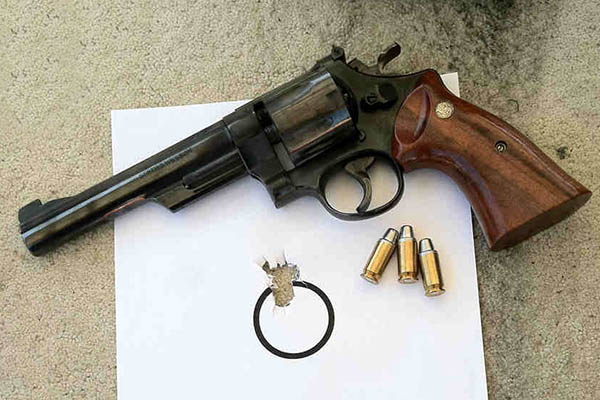
The Model 25 is an N-frame Smith and Wesson revolver chambered for the .45 ACP pistol cartridge. It is a superbly accurate handgun, as attested to by the target above.

When Taguchi developed his testing approach, he made it simple for his followers.   One of the things he did was define a simple test matrix, which he called an L8 orthogonal array.  It sounds complicated, but it’s not.  It just means you can evaluate up to seven different input variables with each at two different levels.  That’s a bit complicated, but understanding it is a little easier if you see an example.   Here’s what the standard Taguchi L8 orthogonal array  (along with the results) looked like for my Model 25 load development testing:
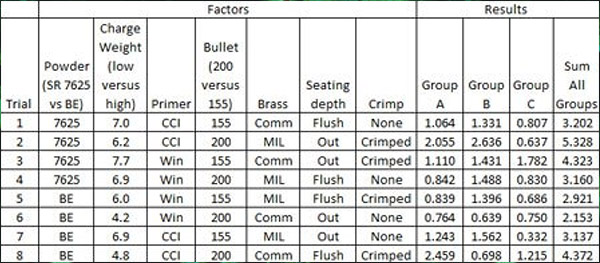
As the above table shows, three sets of data were collected.  I tested each load configuration three times (Groups A, B, and C), and I measured the group size of each 3-shot group.  Those group sizes became the output variables.

The next step involved taking the above data and doing a standard Taguchi ANOVA (that’s an acronym for analysis of variance).  ANOVA is the statistical method used for evaluating the output data (in our case, the group sizes) to assess which of the above input variables most influenced accuracy.  That’s a complex set of calcs greatly simplified by using Excel.   The idea here is to find the factor with the largest ANOVA result.   You see, any time you measure a set of results, there’s going to be variation in the results.  Where it gets complicated is the variation can be due to randomness (the variation in the results that would occur if you left all of the inputs the same).  Or, the variation can be due to something we changed.  We want to know if the differences are due to something we did (like changing or adjusting a component) or if they are due to randomness alone.   I cranked through the ANOVA calcs with Excel, and here’s what I obtained…
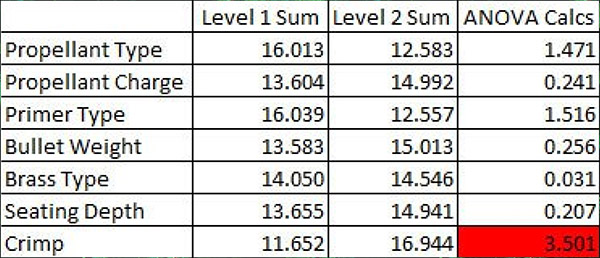
The above results suggest that crimping (squeezing the bullet by slightly deforming the case mouth inward) has the greatest effect on accuracy (it had the largest ANOVA calculated result).  The results suggest that cartridges with no crimp are more accurate than rounds with the bullet crimped.  But it’s a suggestion only; it doesn’t mean it’s true.   The next step is to evaluate if the differences are statistically significant, and doing that requires the next step in the ANOVA process.  This gets really complicated (hey, I’m an engineer), but the bottom line is that we’re going to calculate a number called the f-ratio, and then compare our calculated f-ratio to a reference f-ratio.  If the calculated f-ratio (the one based on the test results above) exceeds the reference f-ratio, it means that crimping versus no crimping makes a statistically significant difference in accuracy.  If it not not exceed the reference f-ratio, it means the difference is due to randomness.   Using Excel’s data analysis feature (the f-test for two samples, for you engineers out there) on the crimp-vs-no-crimp results shows the following:
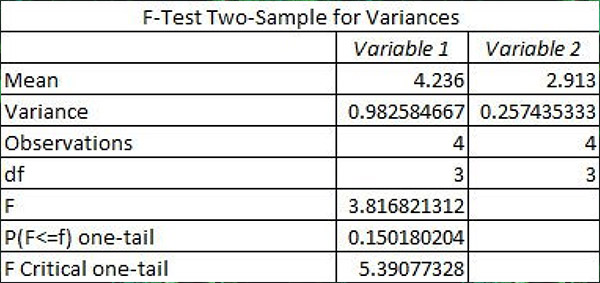
Since the calculated f-ratio (3.817) does not exceed the critical f-ratio (5.391), I could not conclude that the findings are statistically significant.  What that means is that the difference in accuracy for the crimped versus uncrimped rounds is due to randomness alone.

Whew!  So what does all the above mean?

All right, here we go.  This particular revolver shot all of the loads extremely well. Many of the groups (all fired at a range of 50 feet) were well under an inch.  Operator error (i.e., inaccuracies resulting from my unsteadiness) overpowered any of the factors evaluated in this experiment.  In other words, my unsteadiness was making a far bigger difference than any change in the reloading recipe.

Although the test shows that accuracy results were not significantly different, this is good information to know. What it means is that all of the test loads (the different reloading recipes) are reasonably accurate.  If I had used a machine rest, I might have seen a statistically significant difference.  Stated differently, the test told me that I needed to use a machine rest with this gun to see which load parameters were really playing a role in accuracy.  Without it, my flaky shooting skills (or as the statisticians like to say, my randomness) overpowered any accuracy gains to be realized by playing with component  factors.

That said, though, I like that 4.2 grains of Bullseye load with the 200 grain semi-wadcutter bullet, and it’s what I load for my Model 25.  But I now know…the gun shoots any of these loads well, and crimping versus no crimping doesn’t really make a difference.


Check out our other Tales of the Gun stories here.


Join our Facebook ExNotes page!


Never miss an ExNotes blog:


Help us keep the lights on:


Don’t forget: Visit our advertisers!


1903 Springfield Cast and Jacketed Loads

This is an update on my latest 1903 Springfield load development work.

I purchased this rifle about three years ago assuming the headspace was correct, but it wasn’t.  That’s a risk associated with old military rifles.  Rifle parts are often mixed through the years, and when doing so with the bolt and the barreled action, it’s easy to induce an excess headspace condition.  That’s what I encountered on my rifle, so I had the Civilian Marksmanship Program (CMP) in Anniston, Alabama install a new 1903 barrel and rechamber the rifle.  Live and learn, I guess.  Always check the headspace when purchasing a milsurp rifle.

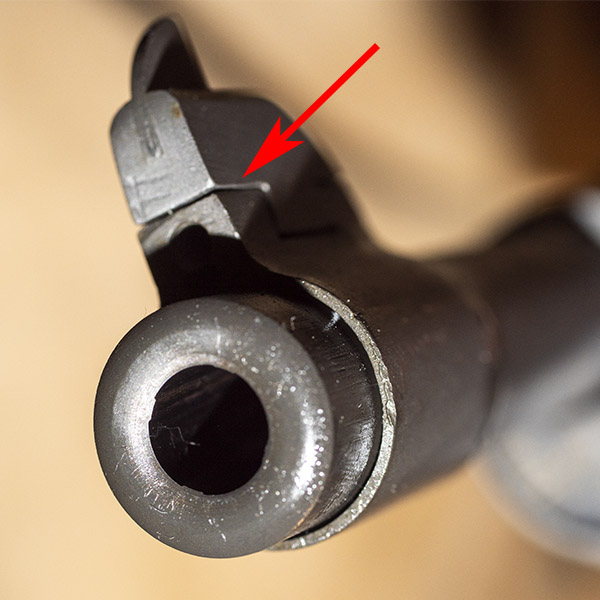
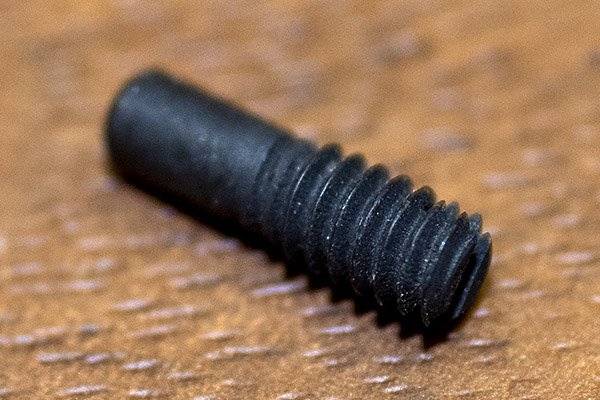
As it was returned to me from the CMP the rifle shot to the right and jacketed bullets shot way too high (at least I thought it shot way too high, but I was wrong…more on that in a bit).  I  noticed that the front sight was biased to the left (which made the rifle shoot to the right).  I drifted the front sight in its base (it’s a dovetail fitting).  The front sight takes a retaining screw that secures it to the barrel mount, and on my rifle that screw was missing.  It might have shipped that way from the CMP or it might have fallen out.

When the Springfield was returned to me from the CMP, the front sight was biased to the left, as you see here.  I didn’t notice it at first.
A replacement front sight screw.

I wrote to the CMP regarding the missing front sight screw, but I haven’t heard from them and I found a replacement front sight screw on the Sarco website.  I haven’t installed it yet (that will come later).  I drifted the front sight in its dovetail to the right, and that brought the point of impact closer to the point of aim.

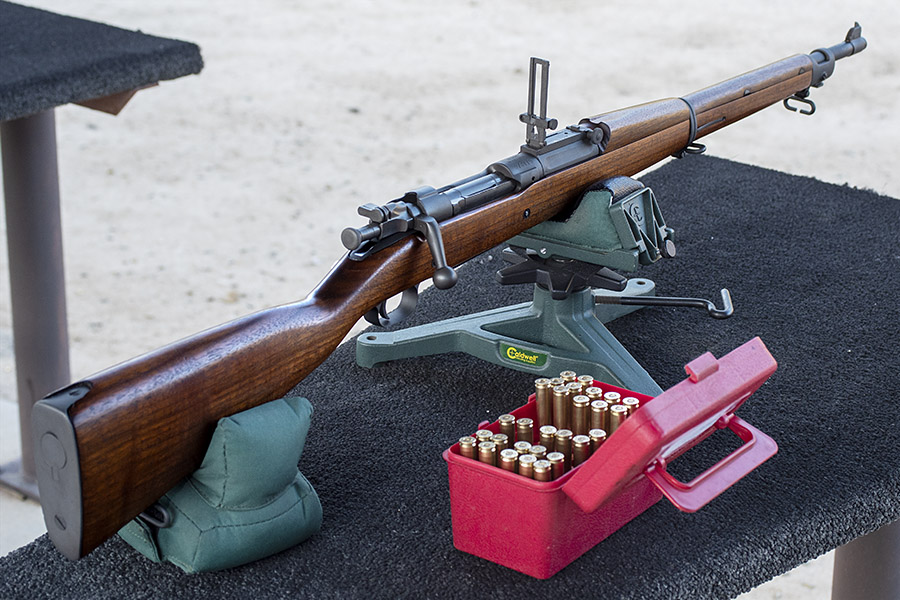
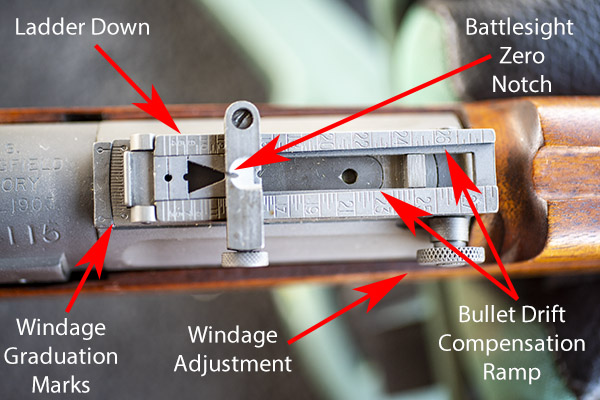
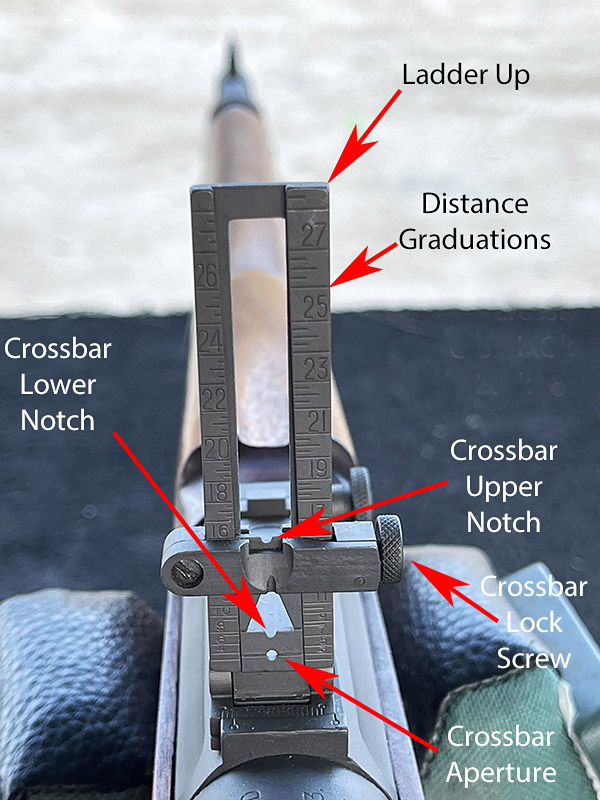
Before I get into the reloading specifics, I should explain a bit about the rear sight.  The rear sight on the 1903 Springfield rifle is a complicated device.  It’s called the M1905 rear sight, and it is designed and calibrated for standard military ball ammo (back in the day when the Army used .30 06 ball ammo).   The sight is a ladder type rear sight and it has four aiming methods.  One is the battlesight zero (it’s with the ladder down); the other three are with the ladder up which allows adjusting for various distances.  In the big photo at the top of this blog, you see the rear sight with the ladder up.  In the photo below, you see the rear sight with the ladder down.

The M1905 rear sight assembly on the 1903 Springfield rifle. The sight ladder is in the down, or battlesight zero position. Wow, there’s a lot going on there.

This first aiming method is through the battlesight zero notch with the ladder down. Battlesight zero means the bullet will coincide with the point of aim at 547 yards.  The thought is that if you hold center of mass on a man-sized target at any distance up to 547 yards, you’ll hit the target.  At 100 yards the rifle will shoot way high with the ladder down using the battlesight zero, which is what I experienced.  I did not understand this was a normal occurrence when using the battlesight zero rear sight notch.

The 1903 Springfield’s rear sight in the raised position.  Note that the sides of the rear sight force the crossbar to the left as distance to the target increases.  That’s a built-in feature to compensate for bullet drift to the right at longer distances.  Clever people, those Army engineers were.  This rifle is over 100 years old.

The other three aiming methods all involve shooting with the ladder up (as you see in the above photo).   You can adjust for various ranges from 100 yards out to 2800 yards (which is roughly a mile and a half) by loosening the crossbar lock screw and sliding the crossbar up or down to various indicated ranges on the ladder.  One sighing method uses the crossbar upper notch.  You simply slide the crossbar up or down so that the top of the notch aligns with the estimated distance to the target (in yards) on the ladder’s distance graduations.  Another sighting method uses the crossbar lower notch.  In this case, you slide the crossbar up or down so that the top of this lower notch aligns with the estimated distance to the target.  The last sighting method involves using the crossbar aperture. There’s a horizonal scribe line across the plate containing this aperture, and when using the aperture, you align that scribe line with the estimated distance to the target.  The aperture allows zeroing the rifle for ranges as close at 100 yards, which is where I do most of my shooting.

All the above is calibrated for standard military .30 06 ball ammo.  If you’re shooting cast bullet ammo, or jacketed ammo with bullet weights or velocities other than standard ball ammo, you have to zero your rifle for your specific load.

There’s one other bit of coolness incorporated into the design of this rear sight.  The sight ladder is designed so that as you raise the crossbar, the sighting notches and aperture move to the left.  That’s to compensate for the bullet’s natural drift to the right as distances increase.

It’s all very clever, but in my opinion the Army made it too complicated. The rear sight was probably designed by an engineer who never had to carry or use a rifle in the field or train recruits to do so.  I think most of the guys I served with in the Army would have a hard time remembering all this (I’m an engineer and I struggled to understand it).  Apparently the Army agreed:  They simplified the rear sight on the later 1903A3 rifle.  The 1903A3 rear sight is much better for an infantry rifle.

That’s enough background on the 1903 Springfield sights.  Let’s get to the reloading variables and which loads the Springfield likes.  I prepped several, and I also grabbed some of the ammo I had previously loaded for the M1 Garand.

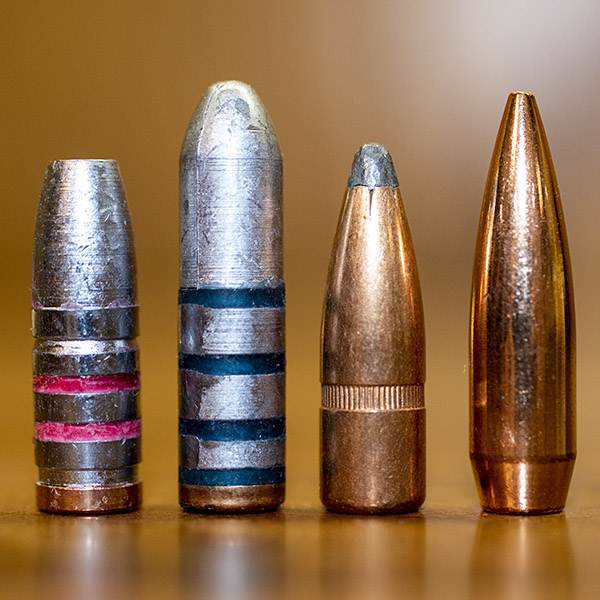
Four bullets used in this testing. From left to right: The Hursman 173-grain cast bullet, the Montana 210-grain cast bullet, the Winchester 150 grain jacketed soft point bullet, and the jacketed Speer 168-grain Match bullet.
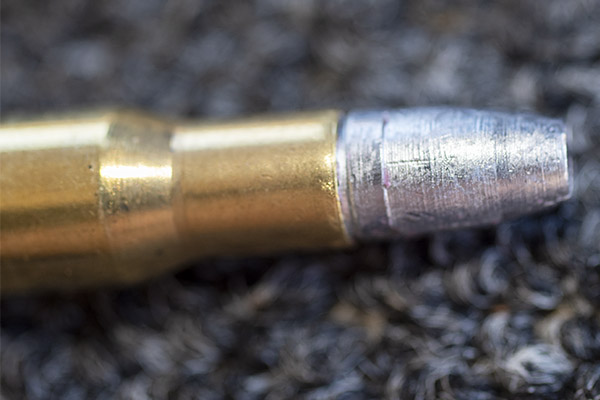
The Hursman cast bullet loaded in a .30 06 cartridge.

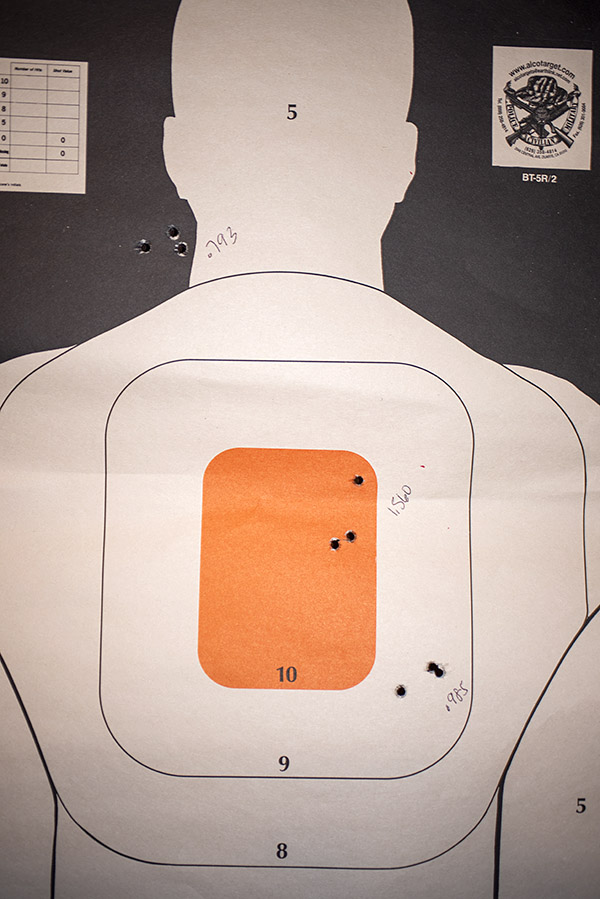
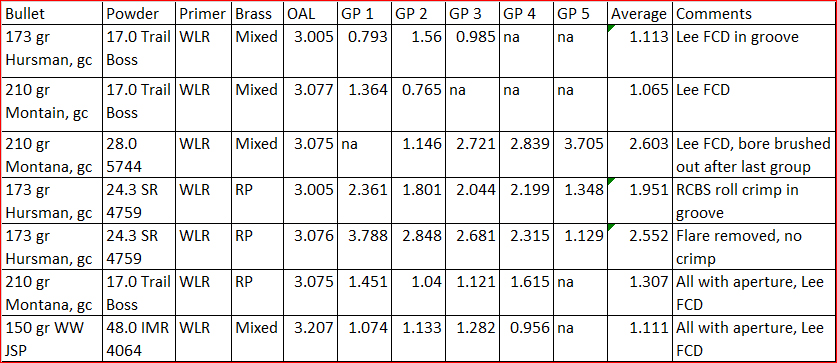
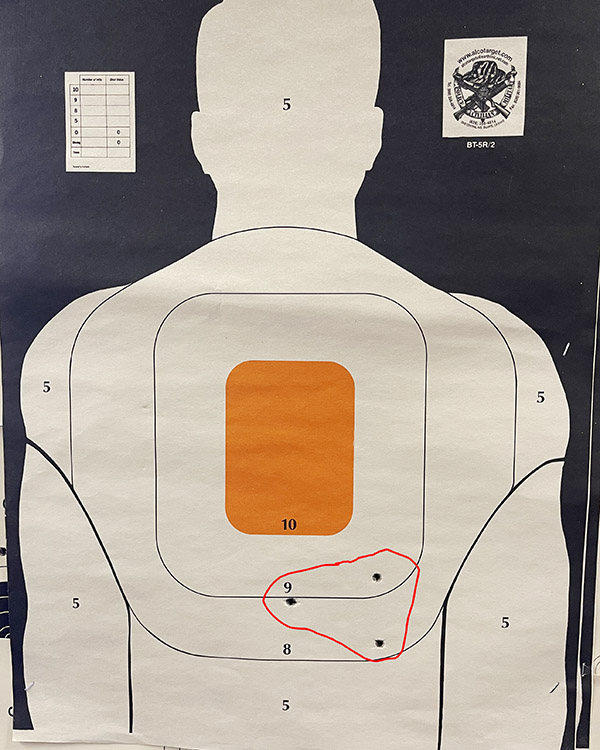
I first fired at a 5o-yard silhouette target to see where the bullets were hitting (there’s lots of real estate on that target).  With the ladder down, the point of impact was to the right and low using the 17.0-grain Trail Boss and 173-grain Hursman bullet load.  With the ladder up, it moved left a little and printed higher using the higher rear sight notch.  For that 0.793 group up top, I used the bottom edge of the upper left box as the aimpoint.  For the other two groups, it was the bottom of the orange bullseye.

An initial target shot with cast bullets and Trail Boss powder. There’s a lot of real estate on this target, so I could see where the rifle was shooting.

I shot groups at 50 yards with several different loads using combinations of the bullets shown above and SR 4759, Trail Boss, 5744, and IMR 4064 propellants, all at 50 yards, and all with neck-sized-only .30 06 brass.  Then I returned a week later and fired groups with the 150-grain jacketed Winchester bullets (again at 50 yards).

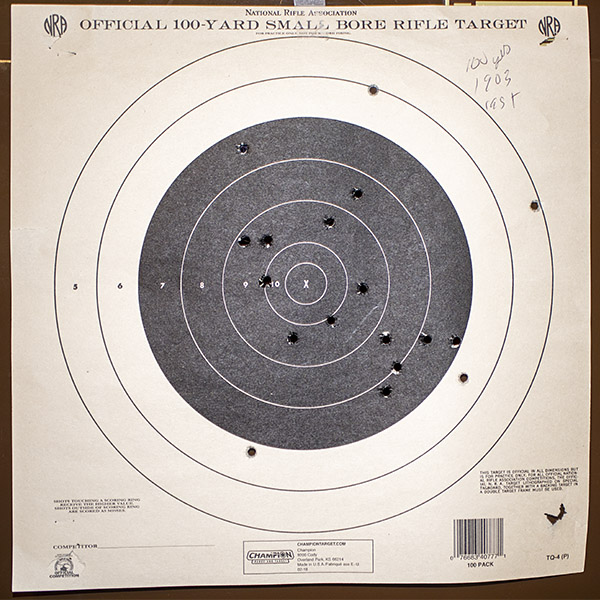
After shooting the above groups, I had 20 rounds left with the Trail Boss,  Hursman bullet, and SR 4759 load.  I shot two of them at a clump of dirt at about 80 yards and hit it (I think) both times.   Then I put a 100-yard small bore rifle target up at 100 yards and shot at it with the 173-grain cast bullet SR 4759 load (8 rounds were crimped, and 10 rounds were not).  To my surprise, all 18 rounds were on the paper and 14 of the 18 were in the black.  It’s not that great a 100-yard group, but it shows potential.  All this was with the ladder down using  the battlesight zero sighting approach, so with cast bullets this rifle (at least with the SR 4759 load) is pretty much in the ballpark.

Cast bullets at 100 yards using the battlesight zero rear sight.

For the jacketed loads, I used the 150-grain Winchester jacketed soft point bullet (I bought a bunch of these a few years ago when somebody had them on sale) and 48.0 grains of IMR 4064.  This is the accuracy load in the Lyman reloading manual with a 150-grain jacketed bullet, and I know from prior development work it is superbly accurate in my Model 70.  It is also a minimum load, which is nice given the 1903’s steel buttplate.  The 1903 did well at 50 yards with the Winchester bullets, so I posted another silhouette target at 100 yards.  I fired three rounds and it was rough shooting at that target.  Using the aperture, I literally could not see the orange bullseye at 100 yards when I focused on the front sight.  The orange bullseye disappeared until I shifted my focus to the target.  I’d acquire the bullseye, then rapidly shift my focus to the front sight and squeeze the trigger.  I did that three times, literally firing blind, and managed to get a 3.050-inch 3-shot group.

The 150-grain jacketed Winchester bullet load at 100 yards. I couldn’t keep the orange bullseye visible using the aperture at 100 yards.

I figured it was time to quit while I was ahead.  I didn’t have any more black bullseye targets with me.  I knew I would be able to see those focusing on the 1903’s front post while sighting with the aperture.  But with the orange bullseyes (like you see in the target above), I might as well have been shooting at night.  I returned to the range a few days later and shot at 100 yards with the jacketed 150-grain Winchester bullets (with the 48.0-grain IMR 4064 load), the 210-grain cast Montana bullets (with the 17.0-grain Trail Boss load), and the 168-grain Speer match bullets (with a 48.0 grain IMR 4064 load).

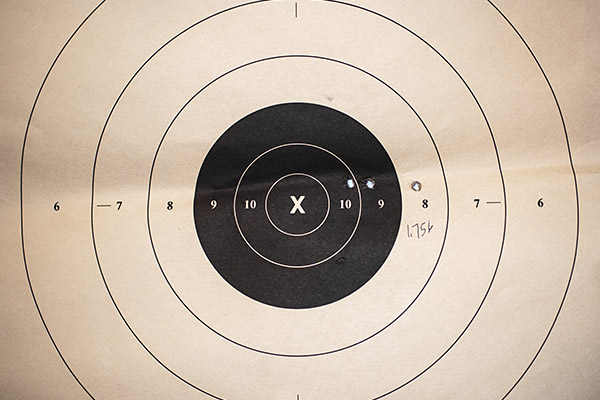
Using the rear sight aperture, I shot the target below at 100 yards with the 150-grain Winchester jacketed bullet and 48.0 grains of IMR 4064.  I was pleased with the results and I quit after 3 shots (I didn’t want to screw up the group).

Three shots into an inch and three quarters at 100 yards. The load was 48.0 grains of IMR 4064 and the Winchester 150-grain jacketed soft point bullet.  Old eyes and an even older rifle sometimes do great things.  My rifle was manufactured in 1918; I was born in 1951.

I then shot at another 100-yard target with the 210-grain Montana cast bullet (these were loaded with 17.0 grains of Trail Boss).  I used the rear sight’s lower notch for this target.  Hmm, what do you know…the elevation was about perfect without moving anything on the rear sight.

Another 100 yard target, this time with the Montana 210-grain cast bullet and 17.0 grains of Trail Boss. I used the rear sight notch immediately above the aperture without making any adjustments. This is a real sweetheart load with minimal muzzle blast, almost no recoil, and no leading. The cast bullets are not as accurate at 100 yards as are the jacketed bullets, but they are still pretty good.

Finally, I fired eight rounds originally loaded for the Garand (I reload for the Garand in multiples of eight, as that’s what a clip holds), returning again to the rear sight aperture. This load used the 168-grain Speer jacketed boattail hollowpoint bullet and 48.0 grains of IMR 4064 propellant.  The Speer bullets are almost identical to the Sierra match bullet, but the Speer’s ogive is slighly different and it has less bearing area in the barrel.  I called the wizards at Speer about that and they recommended going to a heavier charge than would be used with the comparable Sierra bullet (they specifically recommended 48.0 grains of IMR 4064 for the Garand).  That load was a little warm in the 1903 (the recoil was significantly more than the 150-grain Winchester bullet and the primers had slight flattening).  But it was reasonably accurate.

Eight rounds of .30 06 ammo loaded for the Garand, using the 1903 rear sight aperture, at 100 yards. The astute blogophile will note there appears to be only seven holes; the hole just outside the 10-ring had two bullets pass through it.

My observations and conclusions from the above are:

    • The 1903 Springfield rear sight is needlessly complex for an infantry rifle.  You may feel differently.  Hey, go start your own blog.
    • With my cast bullet loads, there was no leading.   My cast bullets had gas checks (the little copper cup on the bullet base), which helps to prevent leading.
    • The Lyman cast bullet book showed a minimal 5744 load to be the accuracy load for the 210-grain Montana cast bullet.  I did not find that to be the case.
    • Both the Hursman 173-grain and the Montana 210-grain cast bullets were extremely accurate with 17.0 grains of Trail Boss, at least at 50 yards.
    • The Winchester 150-grain jacketed bullet accuracy load, per the Lyman manual, was with 48.0 grains of IMR 4064.  I found this to be a very accurate load.  I didn’t do a lot of work developing a jacketed bullet load.  I’m going to stick with this one for this rifle.
    • Orange bullseyes and aperture rear sights don’t work with my old eyes at 100 yards.  They are okay at 50 yards, but not 100 yards.
    • Both of the jacketed bullet loads I tried (the Speer Garand load and the Lyman 150-grain accuracy load) are accurate.  Without adjusting the rear sight from the 150-grain jacketed bullet setting, the Garand load shoots a little high and to the right, but the group size would fit into the bullseye if the sights were adjusted.
    • The cast bullets are not as accurate as the jacketed bullets at 100 yards.  The cast bullets are comparabily accurate to jacketed bullets at 50 yards, but not at 100.

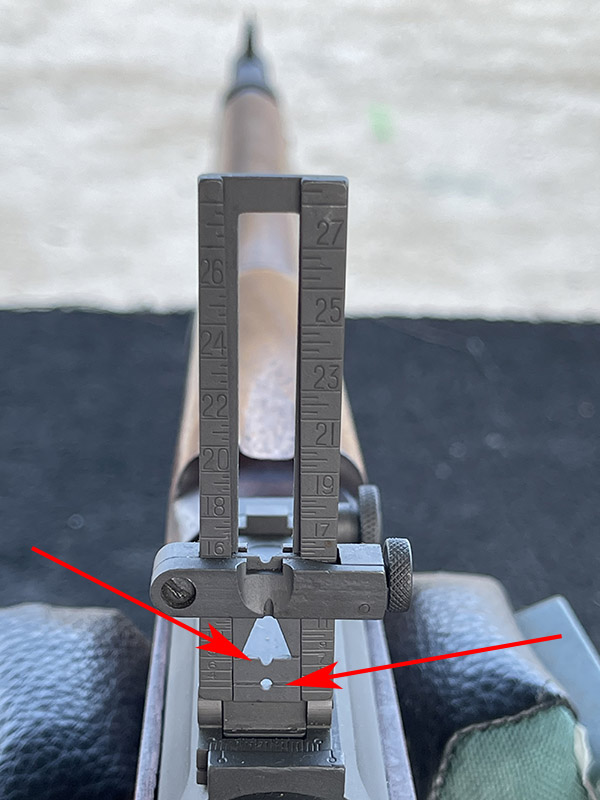
With regard to shooting both cast and jacketed bullets in the same rifle, I got lucky:  As complicated as that 1903 Springfield rear sight is, I found that one rear sight position shoots to the same point of impact at 100 yards for both my cast bullet accuracy load and my jacketed bullet accuracy load.  Yep, you read that right.  With the rear sight crossbar secured as you see in the photo below, I can use the aperture (denoted by the right arrow) with the 150-grain jacketed bullet load.  Or, I can use the lower crossbar notch (denoted by the left arrow) with the 210-grain cast bullet, 17.0 grains of Trail Boss load.  Both will shoot to the same point of impact at 100 yards.  A friend asked if I tuned the loads to do this.  I wish I could say I had that kind of load development expertise.  Nope, I just got lucky.

One size fits all (sort of). With the 1903’s rear sight in the raised position, I use the notch denoted by the arrow on the left for my cast bullet accuracy load at 100 yards. I use the aperature denoted by the arrow on the right for the 150-grain jacketed bullet load at 100 yards. I don’t need to move the rear sight cross bar up or down.  Sometimes you just get lucky.

One final note that’s sure to set the Internet on fire:  I know this is heresy.  As much as I like my 1903, I think the 91/30 Mosin Nagant is a better rifle. My Mosin groups better at 1oo yards.  But that’s a story for another blog.


Never miss an ExNotes blog:


Tales of the Gun: 1911s, revolvers, 9mm semi-autos, bolt action sporters, milsurps, reloading, big bore rifles, and more.  It’s all right here!


Click on those popups, folks!  It’s what pays the rent!