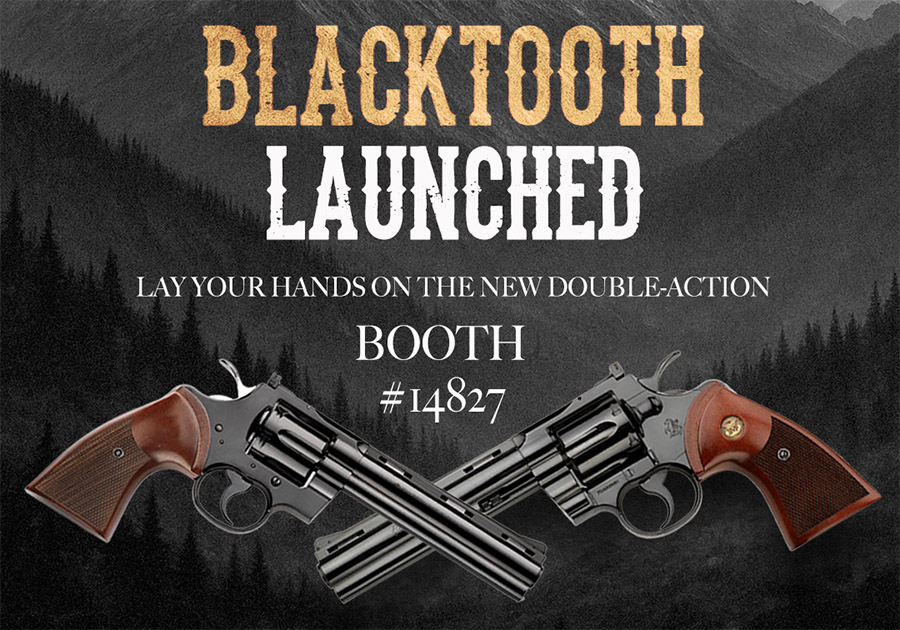
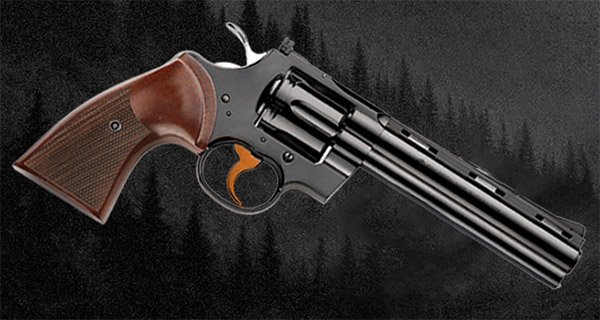
This is really cool: Pietta is coming out with a reproduction of the original Colt Python, and rumor has it that it will sell for about half what a new Python costs. That puts the pre-tariff price at $750. Pietta plans to call it the Blacktooth. I don’t know about that name, but I don’t make thousands of guns like Pietta does. I’m thinking something like Copperhead would be a good name for this handgun. Copperhead would make an obvious connection with Python and Colt’s serpent-themed sixguns, and it sort of ties in with copper-jacketed bullets. Maybe put a touch of copper plating on the gun, too, to complete the copper connection (the trigger or the hammer, the grip medallions, or maybe the screws). Maybe even offer a tuned version with an action job, and call it the Competition Copperhead? Eh, what do I know?
A Pietta Copperhead?
The Python story goes like this: Colt originally produced the Python in 1955 as a premium double action revolver, and then it was discontinued in 1999. The original Pythons had hand-fitted components, and it just got too expensive to make. I’ve heard it said that they went out of time quickly, and the frames tended to stretch with full bore .357 Mag loads. I owned a couple of these original Pythons, and they were beautiful guns, but they both went down the road when in my youthful ignorance I decided I needed something else more. Colt reintroduced the new Python with redesigned internals and frames in 2020, and I quickly snapped up one. It’s a beautiful handgun, and I’ve written about it a lot on these pages (I’ll provide links at the end of this blog).
How is it that Pietta, an Italian gunmaker known for producing copies of Old West sixguns, is able to copy the original Colt Python? Well, Partner, I don’t know, but I’m guessing Colt’s patent on the original Python expired and Pietta picked it up. That’s what happened on the Colt 1911 (the .45 Auto) and why so many companies are now producing the 1911.
I’m guessing that the Pietta Python won’t be available in California (at least initially) for a while (or maybe ever) due to our nutty gun laws, but who knows…maybe Pietta will succeed in getting the thing California approved. I sure hope so. Or maybe I’ll buy a house and live part time in a state that respects the U.S. Constitution so I can have access to the guns California prohibits. Texas or Tennessee come to mind.
More Python? You bet. Here are our earlier Python related posts:
I’m thinking of doing another book on guns. It would be a two-volume series. What I have in mind is a compendium of expanded articles based on our firearms-related blogs, with a working title of Tales of a Gun Collector. Volume 1 would be rifles; Volume II would be handguns. What do you think? Let us know by leaving a comment below, and thanks in advance for your inputs.
Speaking of Colt…did you know that the original Gatling guns were manufactured by Colt in Hartford, Connecticut? All that and more is in The Gatling Gun.
My “new” in the box never fired Colt 1860 Army clone was imported by Navy Arms some 45 or so years ago. It hasn’t arrived yet but should be in the mail any day now.
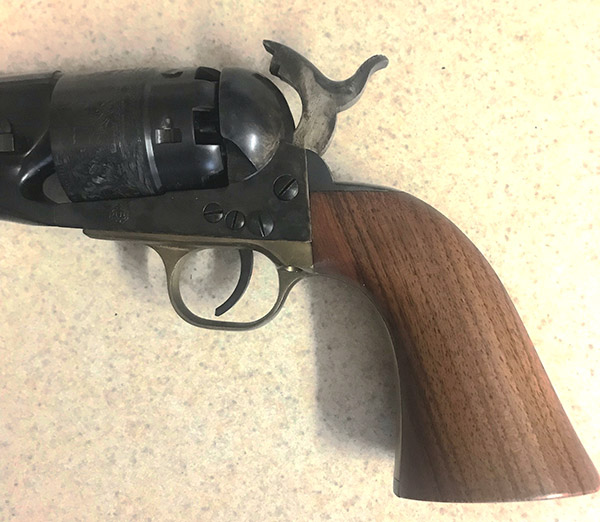
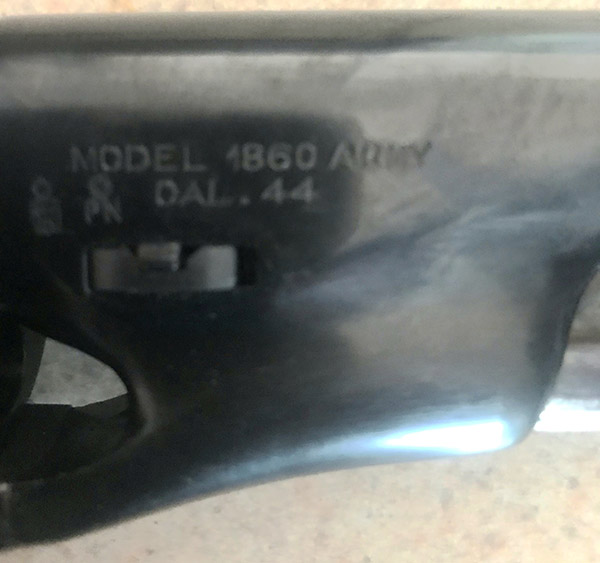
After purchasing it, I was looking more carefully at the photos and I am a bit perplexed. It definitely had four screws. The barrel is stamped “Model 1860 Army Cal 44.” This one appears to be by Uberti.
I had never heard of a four screw Colt 1860 Army before, but I had seen online photos of what I believe was described as a four screw Colt 1861 Navy.
These are the only photos I have for now and they are not really all that clear. The guy says it’s still covered in packing grease and he’s only had it out of the plastic bag twice in the 40-some years since he bought it, including last week to take these photos. It looks like it might have some sort of cylinder engraving, but wouldn’t that be a Navy and not the Army model?
Does anyone know what we have here? Did Navy Arms import a lot of these four screw early Army versions, or more of the standard three screw guns? Was this gun made by Gregoreli & Uberti, Uberti, or is it something else?
Were these guns good shooters? I’m not expecting too much out of it as I know it won’t be anywhere near as nice as my Uberti 1858 New Army (which is shown above), but heck, it was almost free. I never pass up the opportunity to buy interesting and unique guns at bargain prices.
Stay tuned for Part 2 when I finally see what it is I bought.
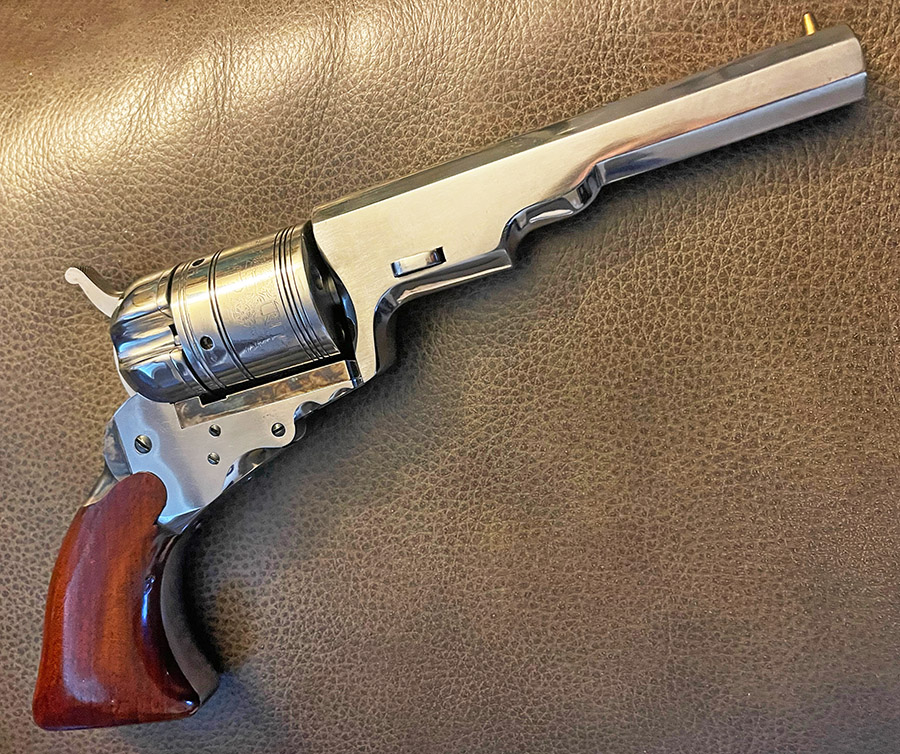
Here’s another fascinating custom revolver that showed up in our Uberti Facebook page. It’s from good buddy Steve, who sent additional photos and is allowing us to use the story here on ExNotes. Here’s what Steve shared with me:
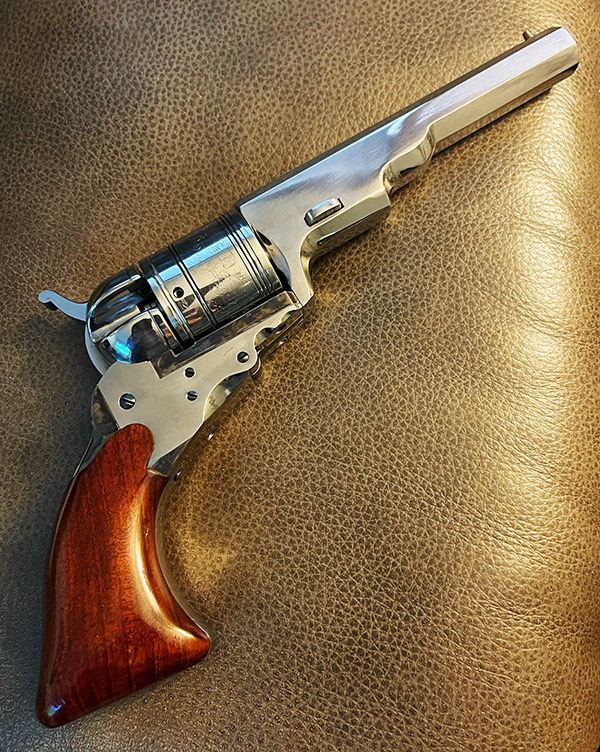
I have an original Paterson in its original configuration of .36 caliber (I mean an original Uberti Paterson, of course). I searched for years for a way to buy a conversion cylinder for it. I stumbled across this and could not pass it up.
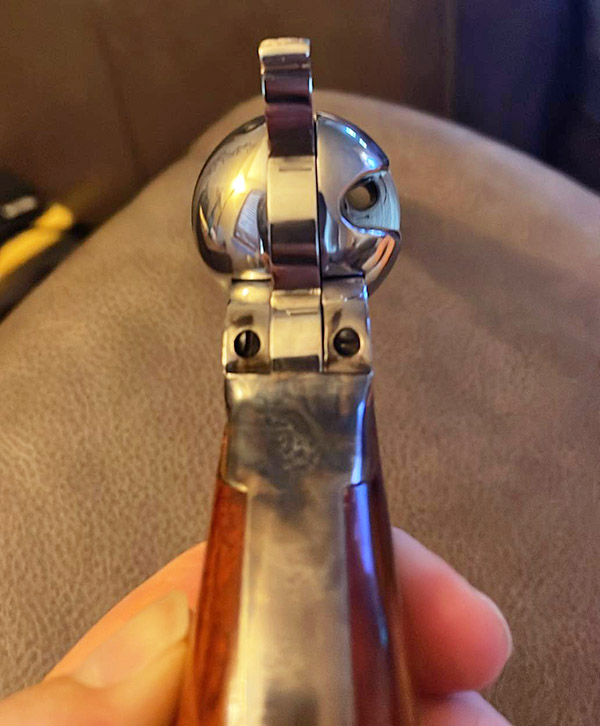
A little history on this one…the way it was converted was the gunsmith milled down a Harrington and Richardson .22 barrel and sleeved it into the Paterson barrel. Then he used standard .22 Magnum sleeves in the cylinder The loading ramp was milled such that it pins the base of the round in, so there was no need for a loading gate.
The barrel and frame are actually the original blue steel. The gunsmith dip stripped the parts then meticulously polished them to a bright shine. I just keep it well oiled.
Steve, your .22 Magnum Paterson is a great looking gun. Thanks for allowing us to share it here. For our ExNotes readers, the Paterson was the original Colt revolver patented by Samuel Colt in 1836. The revolvers are called Patersons because they were manufactured in Paterson, New Jersey. Colt built these and then went bankrupt and shut the gun business down. He unsuccessfully pursued other business interests and then was contacted by Captain Samuel Walker of the Texas Rangers, who had used Colt Patersons against the Comanches to great effect. Captain Walker told Samuel Colt about that and how he thought the revolver was a very effective weapon, and the two Sams (Colt and Walker) designed the 1847 Colt Walker, which we’ve written about before.
If you’re wondering why Steve’s Uberti Colt Paterson replica appears to have no trigger, it’s because the trigger retracts into the frame. It extends when the revolver is cocked. That design was eliminated on the Colt Walkers, which had what we now view as a normal trigger and trigger guard. The Paterson did not have the loading lever common to later Colt blackpowder revolvers, which greatly slows the Paterson loading process.
Uberti no longer lists the Paterson in its menu of reproductions (I’ve already checked, as posting this blog whet my appetite for a Paterson reproduction). Pietta (another reproduction revolver Italian manufacturer) does, but they show the Paterson as out of stock. These replicas sell for big bucks when they come on the market (typically for something in the $750 to $1000 range), but that’s trivial to what an original Colt Paterson would bring. Those have fetched a million bucks.
Another bit of trivia…you may think you’ve never seen Paterson, New Jersey, but if you watched The Sopranos (an HBO crime drama TV series currently available on MAX and set in New Jersey), you’ve probably seen Paterson a few times and not known it. There are at least a couple of Sopranos scenes at the falls in Paterson (one in which Mikey Palmici throws a guy off a bridge, and another where Hesh threatens to do the same). Ah, New Jersey…I’ve never been to Paterson, but the next time I’m back in the Garden State I’m going to hit some of the spots featured on The Sopranos. When I do, I’ll post it here on ExNotes.
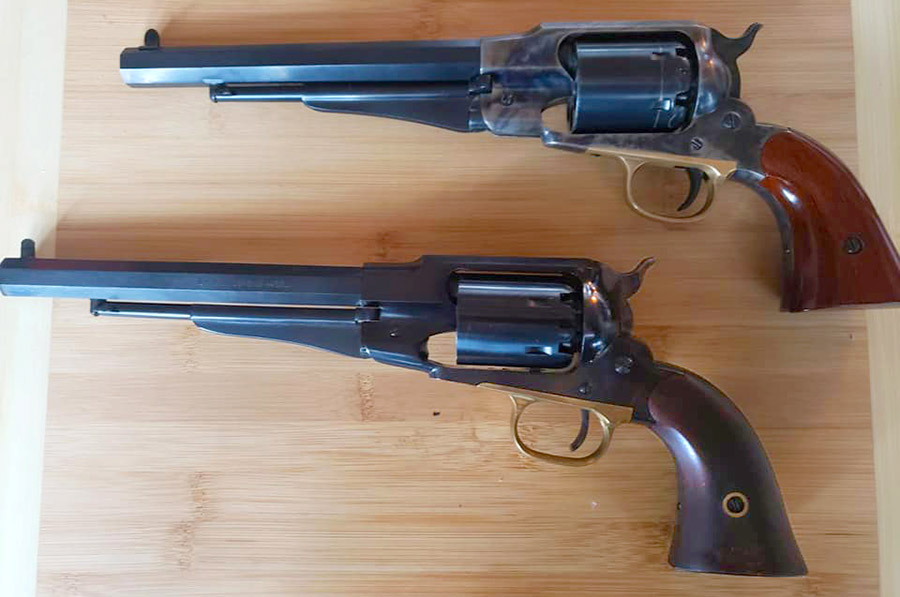
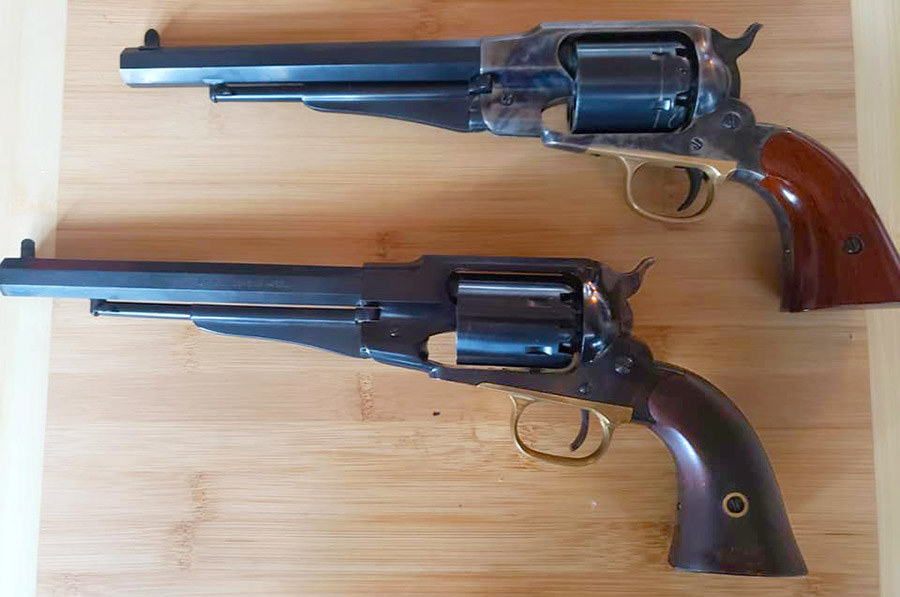
This blog compares two modern Italian reproductions of the famed .44 caliber 1858 Remington New Model Army revolver. One is manufactured by A. Uberti S.p.A. (it’s the one on top in the big photo above); the other is by F.LLI Pietta (the revolver on the bottom). Here’s another shot of the two:
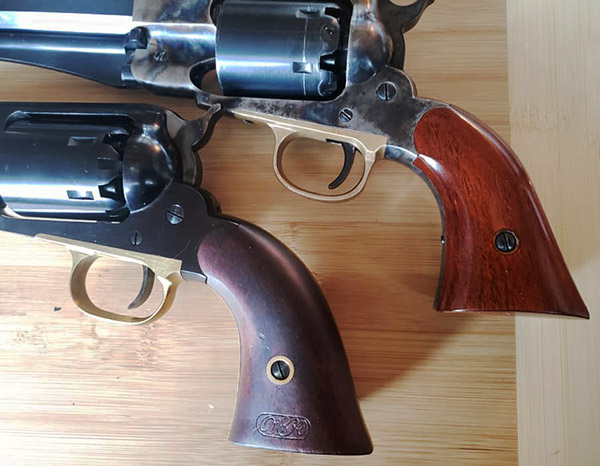
The Uberti in on top right, the Pietta is on lower left.
The 1858 Remington New Model Army was a competitor to Colt’s blackpowder percussion sidearm. The Army went with both versions but primarily bought the Colt (it was 50 cents cheaper than the Remington). Then the Colt factory had a fire in 1864. At that point, the Army starting buying Remingtons in quantity. The Remington was considered to be the stronger revolver because it has a top strap over the cylinder (the Colt does not), and some folks feel the Remington is easier to aim because the rear sight is cut into the frame (instead of the hammer, as on the Colt). And there are other advantages to the Remington, which Jose covers. With that as a background, here’s Jose’s article on the modern Uberti and Pietta reproductions. All photos in this blog are by Jose.
Help us publish: Please click on the popup ads!
If you’ve never fired a percussion revolver you’re really missing out on huge part of firearms history. But maybe you didn’t know that even here in California you can order one of these fine blackpowder revolvers online or over the phone with a credit card and have it shipped to your doorstep without background check or going through an FFL. Your state rules may vary.
Cap and ball packpowder sidearms were a huge part of arms on both sides during the American Civil War. The Union Army had a contract for the Colt 1860 Army, but when Colt could not keep up with demand Remington Model 1858’s were ordered. Many troops preferred the Remington over the Colt for a number of reasons. The Remington has a top strap making it stronger, and the Colt was prone to having loose percussion caps jam the cylinder.
Uberti 1858 Remington Revolver
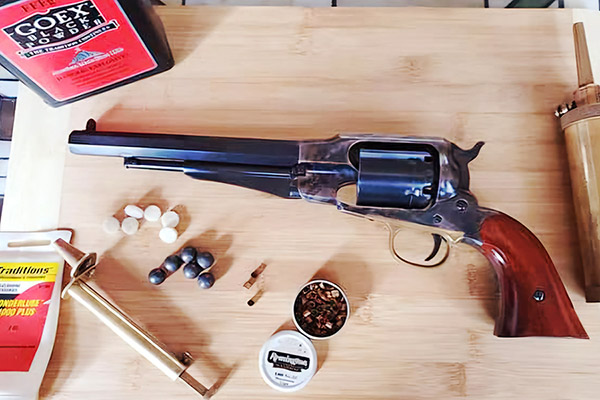
I’ve had the Uberti for about 10 years. It’s an awesome piece of fine craftsmanship. There is nothing cheap about this revolver, the fit and finish are supurb. The cylinder and barrel are a deep blue, the steel frame is color case hardened, and the trigger guard is polished brass, ans walnut stocks, giving it a very classy look. The gun is a six shot .44 cal, rifled 8-inch barrel with 1:18 LH twist, and weighs in at 2.7 pounds.
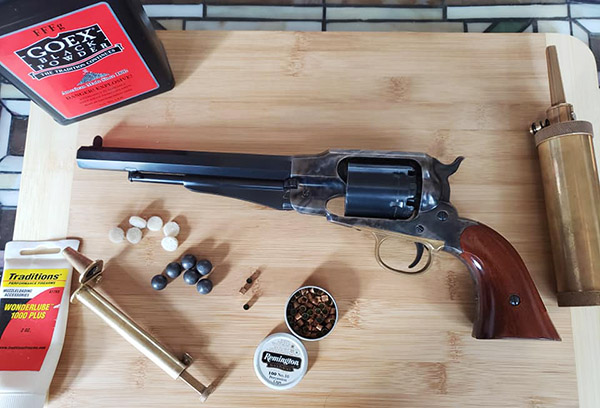
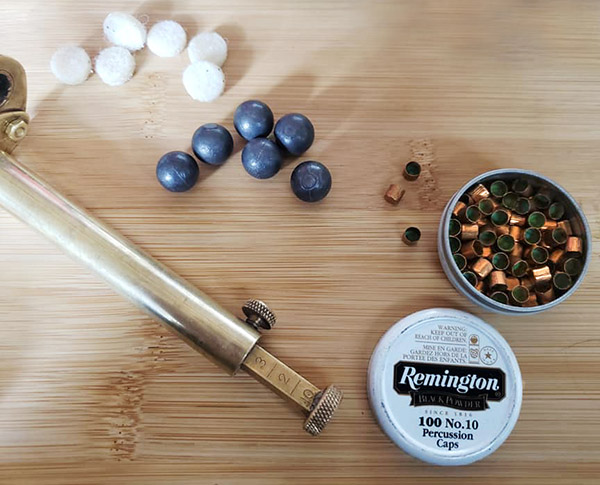
454 cal pure lead balls, Remington #10 percussion caps, waxed felt wads, and the Uberti 1858 New Army.Powder measure, balls, waxed felt wads, and caps.
I use .454-inch diameter balls cast from pure soft lead (stick on wheel weights or plumbers lead, BRN 7) weighing in at 143 grains. It fires best when loaded with 35 grains of FFF blackpowder (I don’t like substitute synthetics), a felt pad soaked in bore butter over the powder, and the ball over the top. The felt over the powder charge prevents a chain fire from jumping between cylinders, and also adds some lube to the barrel between rounds helping prevent a buildup of powder. Either Remington or CCI #10 percussion caps provide the spark.
The color case hardened steel frame on this model Uberti is off set nicely by its polished brass trigger guard.The loading lever on the Remington 1858 is used to ram the ball into each cylinder, after loading powder and waxed wad. The percussion caps are placed on the cylinder nipples only after all cylinders have been loaded.The cylinder doesn’t require removal between loadings, only for cleaning.
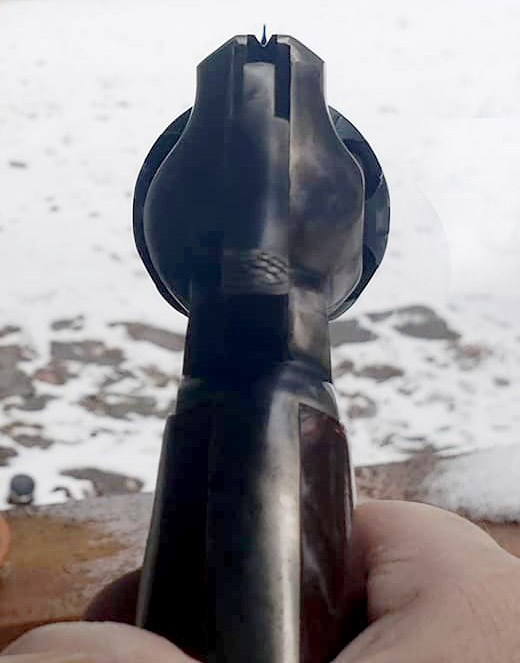
The Uberti is very well balanced and feels good in the hand. The cylinder locks up very tightly. There are noches between the cylinder nipples to rest the hammer on making it safe to carry with all six cylinders loaded. The rear sight is a V-notch on the top strap, unlike the Colt 1860 which has the notch on the hammer because the 1860 lacks a top strap. It’s no exaggeration that out to 40 yards my the Uberti 1858 holds about as tight a group as my Ruger Super Blackhawk .44 mag!
The Remington 1858 has a top strap over the cylinder making it stronger than the Colt 1860 and older firearms. It also allows for placement of a stable V-notch rear sight as opposed to the Colt’s rear site which is a simple notch filed on the back of the hammer.Nice sight picture. This Uberti has a 1:18 barrel groove twist and holds groups as tight as my Ruger Super Blackhawk out to about 40 yards.
Properly cleaning and blackpowder revolver after a day in the field is a good exercise in gunsmithing. The revolver should be entirely disassembled, down to the Springs, removing hammer from the frame, cylinder pin, loading lever, trigger, mainspring, nipples from the cylinder – everything except for removing the barrel from the frame and front sight.
The notchs between the nipples are for the hammer to rest, allowing the six-gun to be safely carried with all cylinders loaded.
A good set of gunsmithing drivers and properly fittjng nipple wrench are mandatory to keep from damaging the screws. Owning a blackpowder revolver will help anyone gain confidence to start Barking simple dunsmithing repairs and parts replacements on other types of firearms. If you don’t already have a blackpowder gun order one today! They are a blast.
Pietta 1858 Remington Revolver
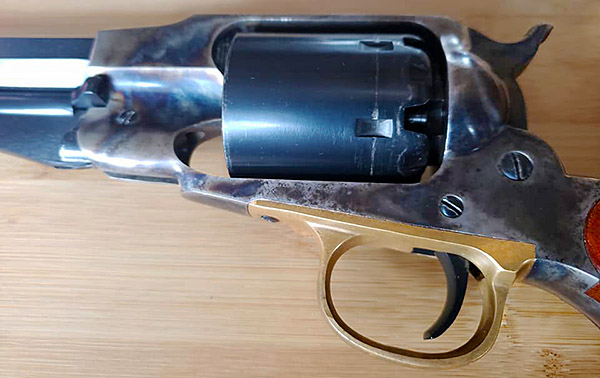
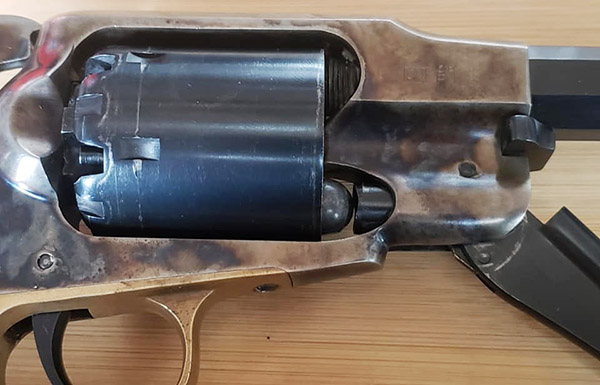
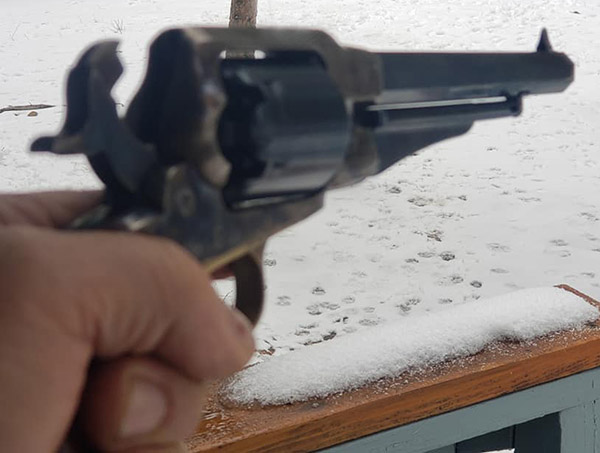
This one was recently purchased because the price was right. It looks like it has never been fired, and I’ve not fired it yet, either. The specs are essentially the same as the Uberti; however, the claimed weight of the Pietta is only 2.4 pounds compared to Uberti’s 2.7 pounds. For whatever reason the Uberti feels much lighter and more well balanced. The Pietta is noticeably front heavy. The Pietta has a little play at cylinder lockup. The hammer pull and trigger feel smooth and crisp, similar to the Uberti.
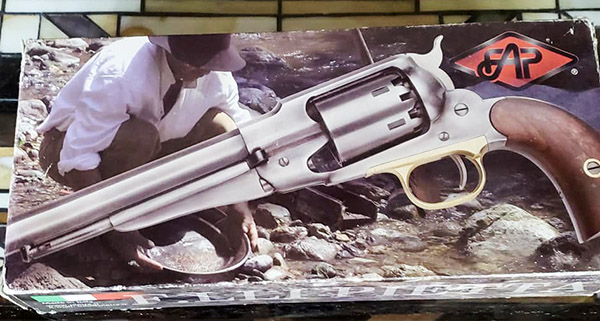
The Pietta, another quality Italian replica in a slightly lower price range.
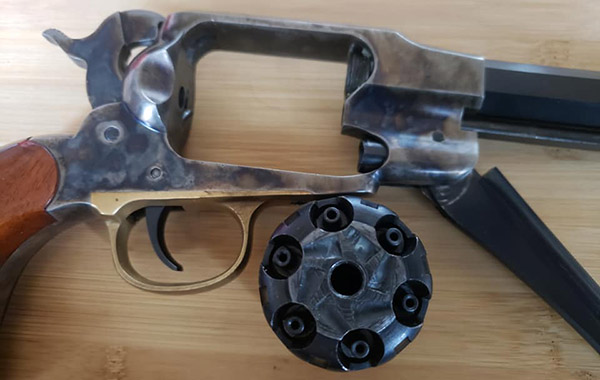
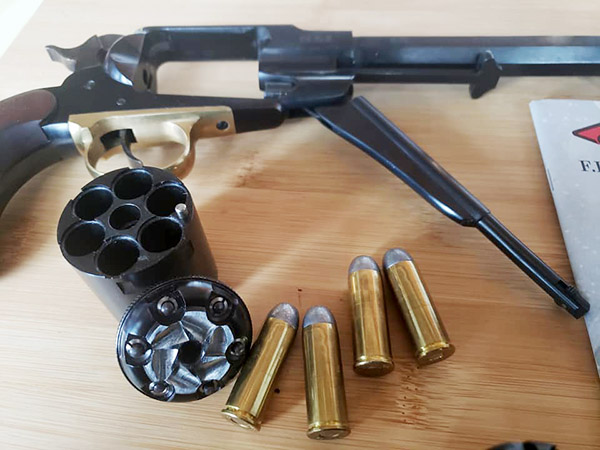
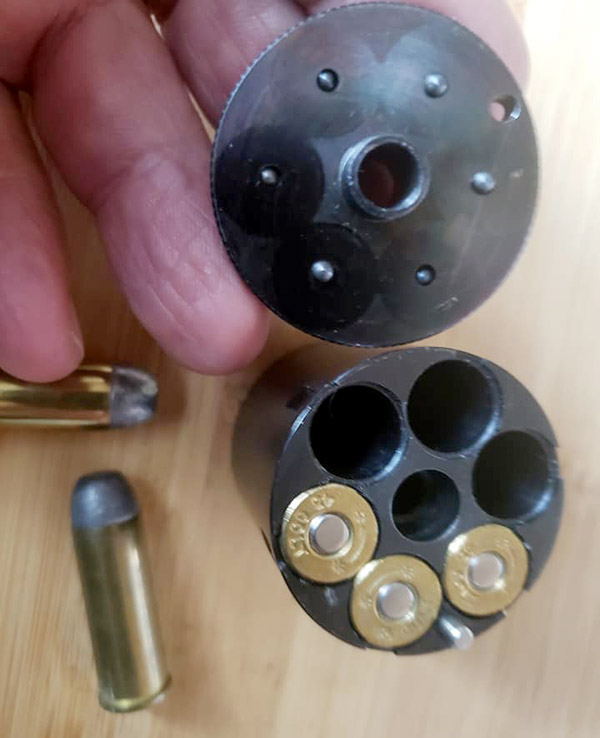
The really nice thing about the Pietta is that it came with an optional .45 Colt conversion cylinder. I’ve always wanted to get a conversion cylinder for my Uberti but they are very expensive, about 2/3 what I paid for the gun, and they always seem to be out of stock.
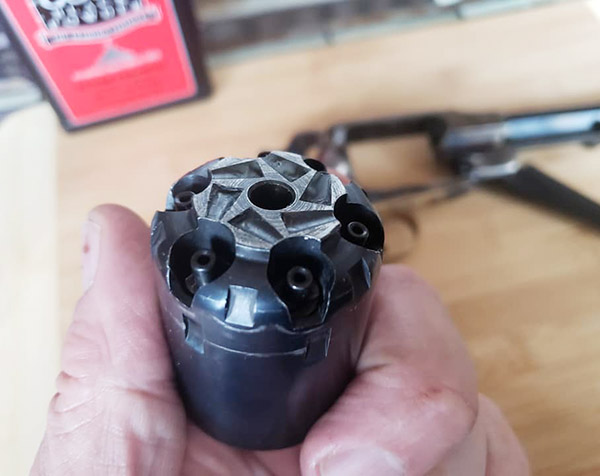
This Pietta came with a .45 Colt conversion cylinder.The conversion cylinder has an upper plate that holds a separate firing pin for each cylinder.
The conversion cylinder for the Pietta fits very nice, locks up tightly, and came with a box and a half of .45 Colt ammo which I have no intentions of using. Remington first started converting Model 1858 revolvers to .46 cal rimfire metallc cartridges in 1868. These were still blackpowder cartridges as smokless powder hadn’t yet been developed. So I will hand load .45 cartridges for the Pietta using blackpowder to stay traditional.
I’m looking forward to shooting these two together on a side-by-side comparison soon. For now, I hope you enjoy the photos.
This is a guest blog by good buddy Jose, and it compares two modern Italian reproductions of the famed .44 caliber 1858 Remington New Model Army revolver. One is manufactured by A. Uberti S.p.A. (it’s the one on top in the big photo above); the other is by F.LLI Pietta (the revolver on the bottom). Here’s another shot of the two:
The Uberti in on top right, the Pietta is on lower left.
The 1858 Remington New Model Army was a competitor to Colt’s blackpowder percussion sidearm. The Army went with both versions but primarily bought the Colt (it was 50 cents cheaper than the Remington). Then the Colt factory had a fire in 1864. At that point, the Army starting buying Remingtons in quantity. The Remington was considered to be the stronger revolver because it has a top strap over the cylinder (the Colt does not), and some folks feel the Remington is easier to aim because the rear sight is cut into the frame (instead of the hammer, as on the Colt). And there are other advantages to the Remington, which Jose covers. With that as a background, here’s Jose’s article on the modern Uberti and Pietta reproductions. All photos in this blog are by Jose.
Help us publish: Please click on the popup ads!
If you’ve never fired a percussion revolver you’re really missing out on huge part of firearms history. But maybe you didn’t know that even here in California you can order one of these fine blackpowder revolvers online or over the phone with a credit card and have it shipped to your doorstep without background check or going through an FFL. Your state rules may vary.
Cap and ball packpowder sidearms were a huge part of arms on both sides during the American Civil War. The Union Army had a contract for the Colt 1860 Army, but when Colt could not keep up with demand Remington Model 1858’s were ordered. Many troops preferred the Remington over the Colt for a number of reasons. The Remington has a top strap making it stronger, and the Colt was prone to having loose percussion caps jam the cylinder.
Uberti 1858 Remington Revolver
I’ve had the Uberti for about 10 years. It’s an awesome piece of fine craftsmanship. There is nothing cheap about this revolver, the fit and finish are supurb. The cylinder and barrel are a deep blue, the steel frame is color case hardened, and the trigger guard is polished brass, ans walnut stocks, giving it a very classy look. The gun is a six shot .44 cal, rifled 8-inch barrel with 1:18 LH twist, and weighs in at 2.7 pounds.
454 cal pure lead balls, Remington #10 percussion caps, waxed felt wads, and the Uberti 1858 New Army.Powder measure, balls, waxed felt wads, and caps.
I use .454-inch diameter balls cast from pure soft lead (stick on wheel weights or plumbers lead, BRN 7) weighing in at 143 grains. It fires best when loaded with 35 grains of FFF blackpowder (I don’t like substitute synthetics), a felt pad soaked in bore butter over the powder, and the ball over the top. The felt over the powder charge prevents a chain fire from jumping between cylinders, and also adds some lube to the barrel between rounds helping prevent a buildup of powder. Either Remington or CCI #10 percussion caps provide the spark.
The color case hardened steel frame on this model Uberti is off set nicely by its polished brass trigger guard.The loading lever on the Remington 1858 is used to ram the ball into each cylinder, after loading powder and waxed wad. The percussion caps are placed on the cylinder nipples only after all cylinders have been loaded.The cylinder doesn’t require removal between loadings, only for cleaning.
The Uberti is very well balanced and feels good in the hand. The cylinder locks up very tightly. There are noches between the cylinder nipples to rest the hammer on making it safe to carry with all six cylinders loaded. The rear sight is a V-notch on the top strap, unlike the Colt 1860 which has the notch on the hammer because the 1860 lacks a top strap. It’s no exaggeration that out to 40 yards my the Uberti 1858 holds about as tight a group as my Ruger Super Blackhawk .44 mag!
The Remington 1858 has a top strap over the cylinder making it stronger than the Colt 1860 and older firearms. It also allows for placement of a stable V-notch rear sight as opposed to the Colt’s rear site which is a simple notch filed on the back of the hammer.Nice sight picture. This Uberti has a 1:18 barrel groove twist and holds groups as tight as my Ruger Super Blackhawk out to about 40 yards.
Properly cleaning and blackpowder revolver after a day in the field is a good exercise in gunsmithing. The revolver should be entirely disassembled, down to the Springs, removing hammer from the frame, cylinder pin, loading lever, trigger, mainspring, nipples from the cylinder – everything except for removing the barrel from the frame and front sight.
The notchs between the nipples are for the hammer to rest, allowing the six-gun to be safely carried with all cylinders loaded.
A good set of gunsmithing drivers and properly fittjng nipple wrench are mandatory to keep from damaging the screws. Owning a blackpowder revolver will help anyone gain confidence to start Barking simple dunsmithing repairs and parts replacements on other types of firearms. If you don’t already have a blackpowder gun order one today! They are a blast.
Pietta 1858 Remington Revolver
This one was recently purchased because the price was right. It looks like it has never been fired, and I’ve not fired it yet, either. The specs are essentially the same as the Uberti; however, the claimed weight of the Pietta is only 2.4 pounds compared to Uberti’s 2.7 pounds. For whatever reason the Uberti feels much lighter and more well balanced. The Pietta is noticeably front heavy. The Pietta has a little play at cylinder lockup. The hammer pull and trigger feel smooth and crisp, similar to the Uberti.
The Pietta, another quality Italian replica in a slightly lower price range.
The really nice thing about the Pietta is that it came with an optional .45 Colt conversion cylinder. I’ve always wanted to get a conversion cylinder for my Uberti but they are very expensive, about 2/3 what I paid for the gun, and they always seem to be out of stock.
This Pietta came with a .45 Colt conversion cylinder.The conversion cylinder has an upper plate that holds a separate firing pin for each cylinder.
The conversion cylinder for the Pietta fits very nice, locks up tightly, and came with a box and a half of .45 Colt ammo which I have no intentions of using. Remington first started converting Model 1858 revolvers to .46 cal rimfire metallc cartridges in 1868. These were still blackpowder cartridges as smokless powder hadn’t yet been developed. So I will hand load .45 cartridges for the Pietta using blackpowder to stay traditional.
I’m looking forward to shooting these two together on a side-by-side comparison soon. For now, I hope you enjoy the photos.
That’s an awesome article, Jose. Thanks very much for sharing it with us here on the ExNotes blog.
I asked Jose to tell us a bit about himself, and he did. Jose is a geologist, an offroad racer, a fly fisherman, an upland game hunter, a handloader, and he likes to teach outdoor sports to young people. He lives on the banks of the Henry’s Fork River in Idaho in the spring and summer months and he spends the winter months in Big Bear Lake, California. Most of Jose’s offroad racing adventures are in Baja. Jose’s other hobbies include taekwando, and cumbia and bachata dancing. An interesting man, to be sure!
Never miss an ExNotes blog. Subscribe here for free!





 is right here!