Quite a Week…

By Joe Berk

As the title implies, last week was quite a week, and a lot of it focused on Moto Guzzi stuff.  The Roman gods are sending me a message, I think, but old age and big bucks will most likely keep my desire to own a vintage Guzzi suppressed.  And there’s been some pocketknife stuff, too, leading into the age-old Chinese quality discussion.  I’ll get to that in a minute.
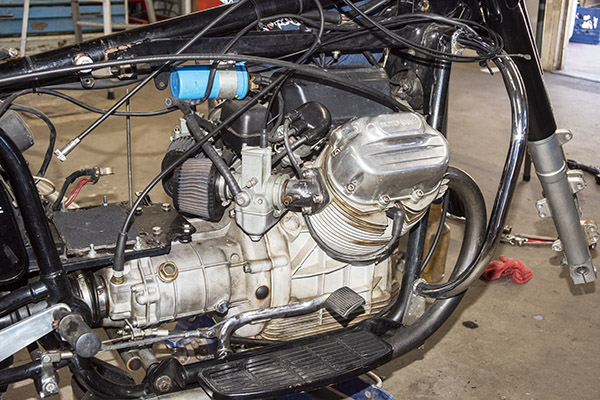
The guts of a Guzzi in the Cycle Garden shop. This is a cool place in a hot locale (temperatures sometimes approach 120 degrees in Indio).

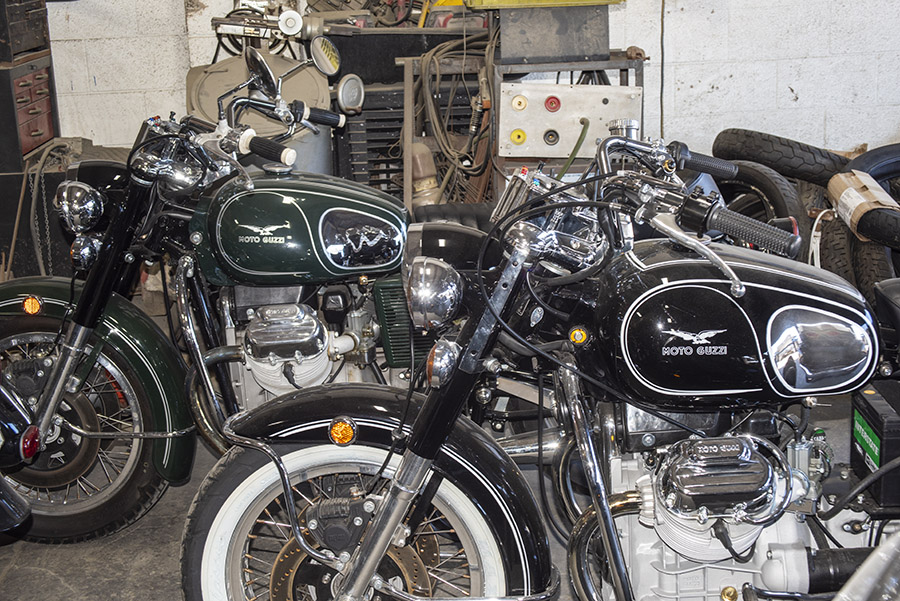
I spent Monday morning at Cycle Garden in Indio, California, getting tutored by good buddy Steve on the finer points of Guzzi fork rebuilding.  It’s for a piece I’m doing on that topic, and the folks at Cycle Garden couldn’t have been more welcoming.  These guys know their stuff, as well they should: They are the largest, busiest, and probably the best in the world at concours-level Guzzi restorations.  I developed a bad case of the “I wants” for a restored Guzzi after seeing some of the bikes at the top of this blog, but it’s probably not in the cards.
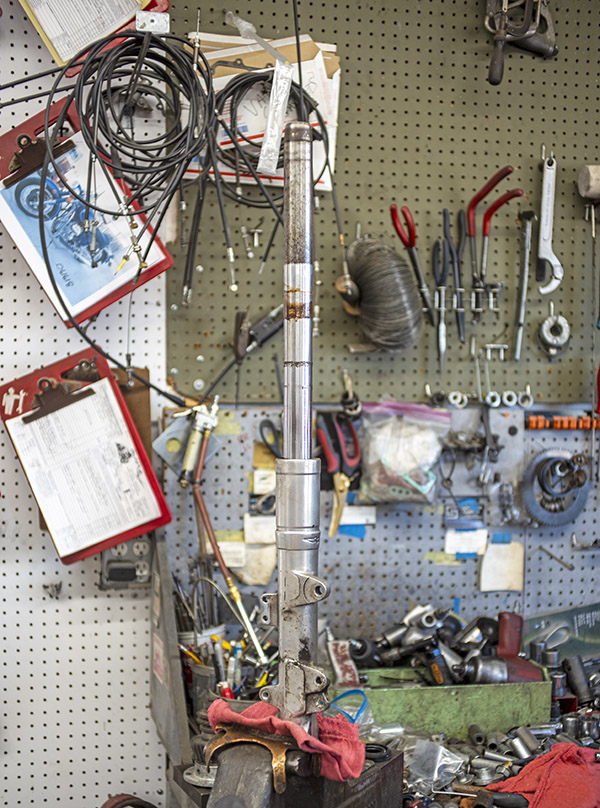
Just forking around out in the desert…

After treating me to a cup of his famous home-roasted and ground coffee, Steve showed some of the bikes to me.  There’s not a single part on a Cycle Gardens restoration Guzzi that isn’t touched during the restoration (both 0n the motorcycle and in the engine).   How much?  Somewhere in the neighborhood of $40,000 to $50,000.  A look at any of the Cycle Garden bikes easily confirms the value is there.  But my wallet is light enough already.  Watch for more on the Cycle Garden shop; it’s amazing.

The man, the Moto Guzzi, and the legend: Chris Donaldson sitting across the table from yours truly. Buy the book on Amazon. Buy mine, too!

On Friday, I visited another Guzzi shop 130 miles to the west, this time to meet with and interview Chris Donaldson.  Chris wrote Going the Wrong Way, the story of his ride around the world on a Moto Guzzi.  He just flew into Los Angeles from Ireland to ride across the US.  We had a nice meeting, and you’ll be hearing more about Chris in a subsequent blog.

One the pocketknife front, it’s been mostly good (and the good will be featured in upcoming blogs) with several new additions to the collection.  But there’s been a couple of bad apples, and that’s increased my smarts about what to look for in a pocketknife.
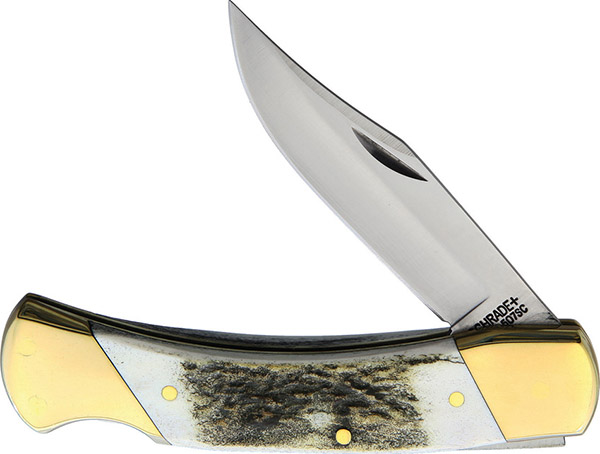
The Schrade stag-handled folding hunter. The blade wobbled in the knife body when closed. Back it went. I’m still waiting for a replacement.  It’s made in China.

The first was a large Buck-110-style Schrade folding hunter with stunning stag grips.  The knife arrived and I loved the look of it, but it had a defect.  With the blade closed, it wobbled inside the knife body.  In my opinion, it should have no side-to-side play, so back it went.  I don’t want my money back; I just want a good knife.  We’ll see what happens.
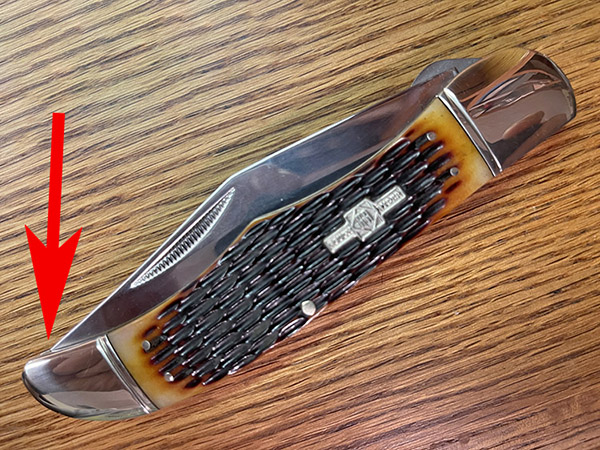
The Rough Rider Large Hunter. I love the design, but the knife is no good. The tip lies above the line of the knife body when the knife is closed. Muey malo, mi amigo. This is also a Chinese knife.

The next was another beautiful large hunter, this time from Rough Rider. It’s a beautiful knife, but it arrived with a different problem.  On this one, when the knife is closed the tip of the blade sits slightly proud of the knife body, and that means you can catch your hand on it.   Who would think to check for this?  Apparently, not the folks who manufacture the knife, and not the folks who sell them, either.  I bought one from Amazon, and I returned it the next day.  I wanted the knife, though, so I ordered it again from Chicago Knife Works.  Wouldn’t you know it?  The replacement knife had the same problem. Size notwithstanding, it’s an inexpensive knife, but apparently they’re all bad (at least based on my sample of two).
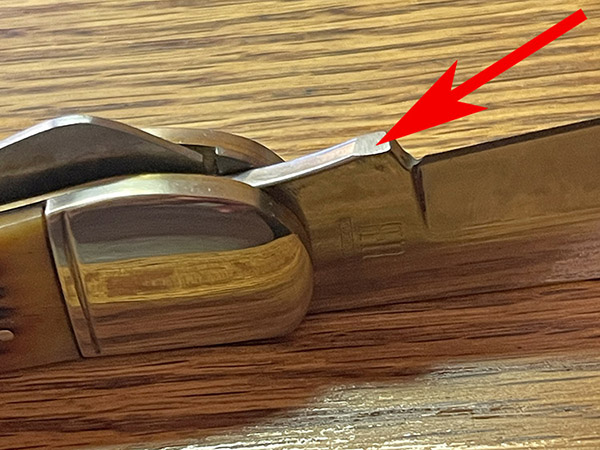
The Rough Rider’s kick. Grinding it down didn’t fix the problem.

I tried grinding down the Rough Rider’s kick (the part of the blade that controls how far it goes into the knife body when it closes), but that didn’t fix the problem.  It’s an inexpensive knife (only about $15) and I’m not going to bother returning it.  I’ll just look at it from time to time.  It will remind me that I’m not as smart as I sometimes think I am.

Stay tuned, my friends.  There’s more coming your way.


Join our Facebook ExNotes page!


Never miss an ExNotes blog:


Help us keep the lights on:


Don’t forget: Visit our advertisers!


Two Kool Kamp Kings

By Joe Berk

Sue and I were in Reno last month to visit the National Automobile Museum.  Like most places, Reno isn’t what it used to be.  The downtown area is a bit sketchy and I didn’t feel comfortable at all walking around.  That said, we had a good time at the Auto Museum and a good time in Reno.  As is my habit, I checked online to see if there were any interesting gunstores in town, and the online info for one in particular caught my eye: Willey Brothers Firearms.  Unlike the others, Willey’s ad emphasized the kind of guns I’m interested in (blue steel and walnut, not the black plastic tactical junk one mostly sees in gun stores these days).  Willey Brothers lived up to its ad:  The firearms were interesting, including the used guns.

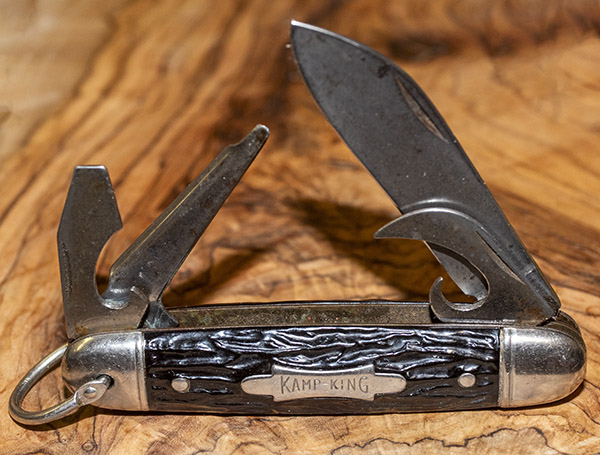
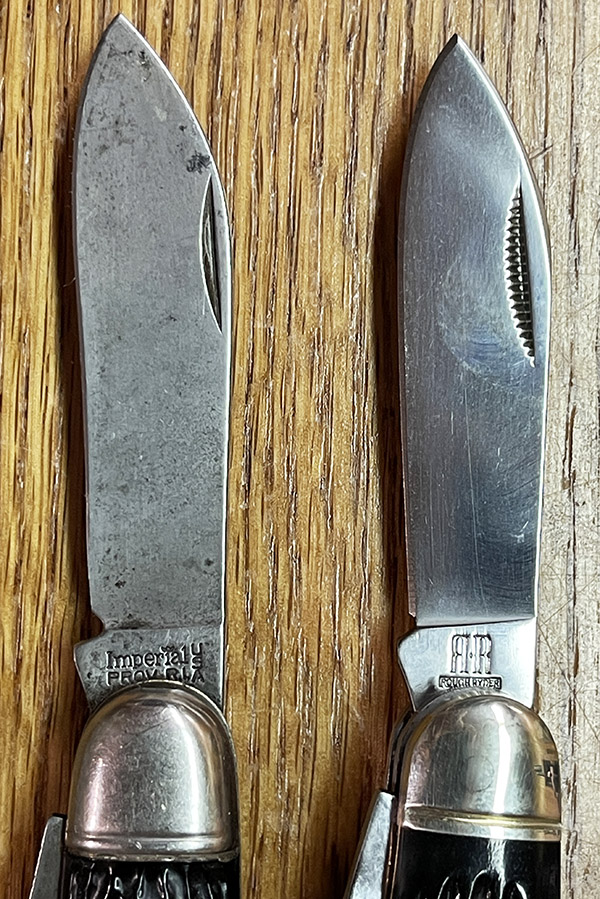
The old Imperial Kamp King knife I bought at a gun store in Reno, Nevada. It has a combination bottle opener/scredriver, an awl for punching holes and undoing knots, a can opener, and a main blade. This one is about 50 years old, and it is in great shape.

Nothing in the gun offerings was interesting enough, though, to make me want to go to the bother of shipping it to the Peoples Republik of Kalifornia, but I noticed the store had a few used pocketknives for sale.  One in particular caught my eye:  An old Imperial Kamp King that was in nice shape.  I was interested in it because it has the same four-bladed configuration as my old Cub Scout knife.   At $25, it looked like a good deal, so I paid the asking price and Sue and I were on our way.  When I got home, I cleaned it up with a bit of Kroil penetrating oil and 0000 steel wool. I think it was made in the 1950s or 1960s (that’s a guess on my part, although if I studied the video included below, I’d probably be able to narrow it down more).

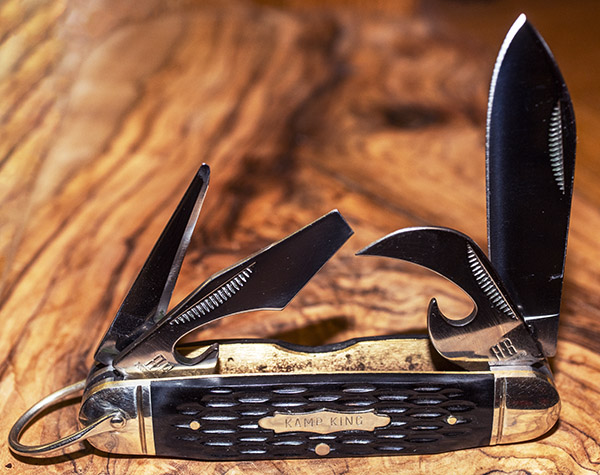
The new Rough Rider Kamp King, with the same blades as the original. This is a very high-quality knife, and I can tell you that the main blade is razor sharp (don’t ask me how I found out).

That got me thinking.  There’s a company called Rough Rider (not the condom company) that makes a current version of the Kamp King.  I recalled seeing that knife when scrolling through the offerings from Chicago Knife Works (which is actually located in Marion, Virginia).  The CKW Kamp King was only $16.94, and the more I thought about it, the more I knew I had to have it (admittedly, the thought process did not take long).  Move to cart, buy now, and in went my credit card number.

Chicago Knife Works has great prices and terrible shipping.   It takes 10 to 12 days from the time I’ve placed orders with these guys until whatever I order actually ships.  I don’t mean until it gets here; I mean until it actually leaves the CKW facility.  I don’t know if that’s because CKW is just pokey, or if they don’t keep much in stock and they order their knives from China when I place an order.  I suspect it’s the former, as every time it’s taken an inordinate amount of time to ship and I send them an email to complain (I did that every time I’ve ordered anything from them).  Then I’ll get an automated response from Chicago Knife Works telling me they’re sorry (which I already knew) and they have so many orders they just can’t get to them all in a reasonable amount of time.  And every time when I wrote to complain about taking to long to ship, well, CKW ships my order the very next day.  I should get smart and complain about the shipping delay as soon as I place an order, I guess.

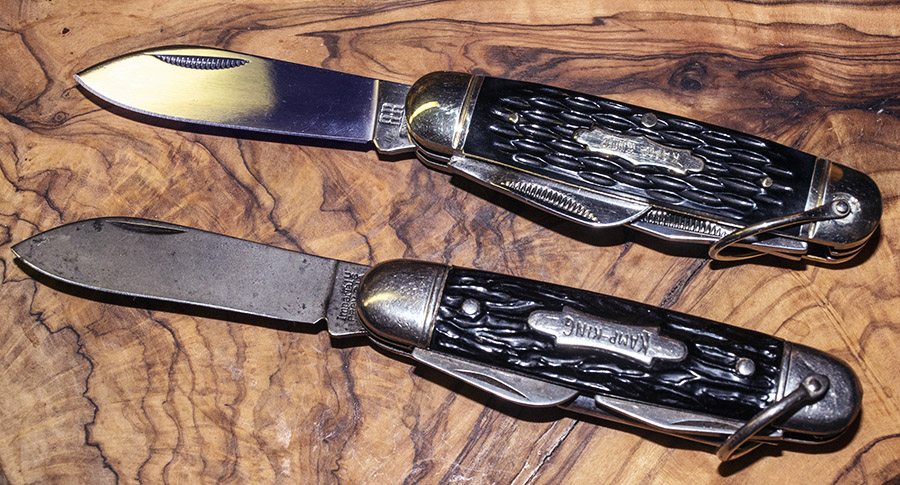
My new Rough Rider Kamp King arrived a few days ago and I’m impressed.  It is a really nice knife that dimensionally is pretty true to the older ones that were manufactured in America.  The quality on the new Chinese Kamp King is really good.  The fit and finish are superb, and it just doesn’t look or feel like a cheap knife.

The old Kamp King (top), and the newer one (bottom). The dimensions are the same. For $16.94, the new one is a great buy.

The other reason I ordered the new Kamp King is that I wanted to compare it to a Marbles Scout King I had purchased from Chicago Knife Works about six months ago.  I thought it might be the same knife as the Marbles, but it is not.  The Marbles knife is a bigger, heftier version of the Kamp King.  I suspect they are both manufactured by the same knife company in China, but I don’t know this.  The appearance of the two new knives (even though the dimensions and the scales are different) is so similar that I’d bet both come out of the same factory somewhere in the Peoples’ Republic (and I’m talking about China now, not Kalifornia).

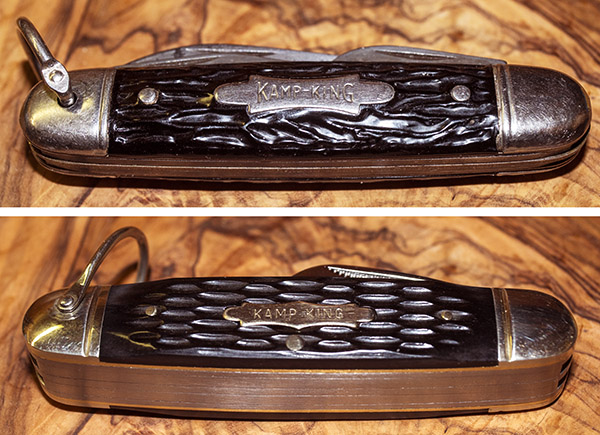
The original Kamp King was manufactured by Imperial in Providence, Rhode Island. The new one is produced somewhere in China; most likely in Yangjiang City, China’s knife-making capital.

I Googled the topic and although I couldn’t find the specific Chinese company that makes these knives, I learned that China’s primary knife-manufacturing region is Yangjiang City in Guangdong Province.  It’s been China’s knife-making center for more than 1,400 years and is home to several knife companies.  I’d sure like to visit that area someday.  I’ve been to Providence, Rhode Island (where the original Kamp Kings were manufactured).  A visit to Yangjiang City would be interesting. I’d probably come home with a suitcase full of interesting and inexpensive knives.


Join our Facebook ExNotes page!


Never miss an ExNotes blog:


Help us keep the lights on:


Don’t forget: Visit our advertisers!