Pigs and Poison Oak

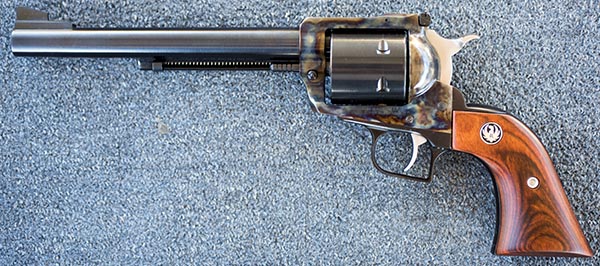
A stunning, Turnbull color case hardened Ruger Super Blackhawk in .44 Magnum.
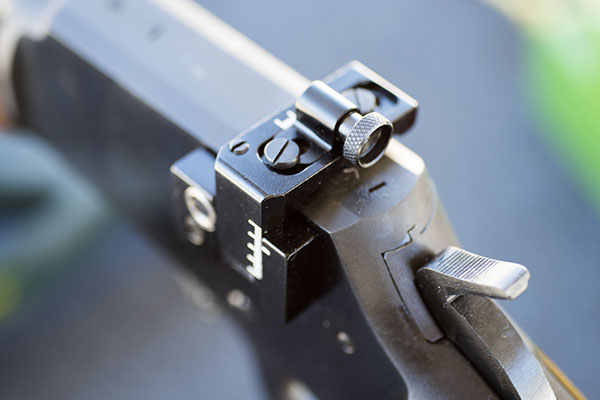
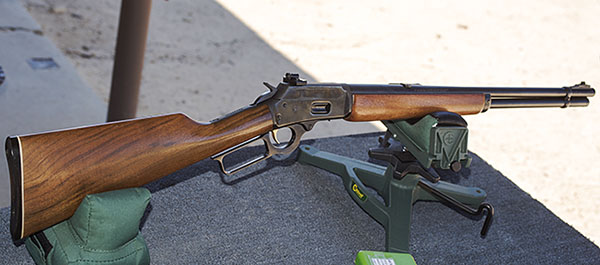
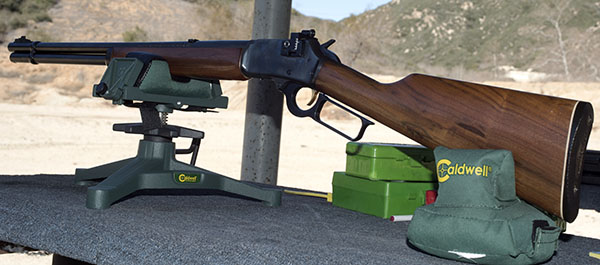
Another beautiful .44 Magnum…this one is a 1970s Marlin Model 1894 with a Williams aperture rear sight.

Friday was a good day, as is any day spent on the range, and for me, Friday last week meant a visit to the West End Gun Club.  Hey, I’m retired.   Ride the motorcycle, or head to the range?  Life is good either way.  This past Friday, the range got the nod.

I took two guns with me.  One was a new Ruger Turnbull Super Blackhawk I recently picked up from a Gunbroker auction at a decent price.  The other was Marlin 1894 lever action rifle that I’ve owned too long and shot too little.  Both are chambered in .44 Magnum.   The idea here is that you have two guns both chambered for the same cartridge, and it makes for a good combination to carry afield.  Mind you, I’m  not too sure where “afield” is actually located, but I kind of get the idea…it’s a place that frequently appears in gun ads and Western novels, a place where manly men hang out. The thought is that you only have to carry one cartridge, so you can save your manliness for other endeavors.

My take on the concept?  I think it’s a solution to a problem that doesn’t exist.  I had opportunities to carry both a rifle and a handgun at the same time when I was in the Army, but I thought doing so was just dumb.  I didn’t want the added weight, so I always went for either an M-16 or a 1911 (but never both) depending on what I was doing that day.   On a hunting trip, I think it’s an absolute bust.  When I was a lot younger, one time chasing hogs I carried a 9mm handgun and a .300 H&H Mag custom Weatherby rifle (I know, .300 H&H was massive overkill for hogs).   The first day of that adventure was enough to convince me that carrying both a handgun and a rifle was silly, and I left the handgun home after that (I spent that entire first day walking through the woods trying to not scratch the rifle on the handgun).  And in case you were wondering, the only thing I came home with on that trip was the worst case of poison oak I ever had.

That said, the idea of a lever gun and a sixgun both chambered for the same cartridge maybe made sense when the .44-40 was winning the West.  In those days, you could get a Colt six-shooter and a Winchester lever gun that both used the .44-40 cartridge.  Or maybe I’ve just been reading too many Zane Grey novels.  But the idea has had a following stimulated by rifle and handgun marketing types for years.  Like I said, unless you are transported back in time and you get around on a horse, I think carrying a rifle and a handgun is wacky.   But I own a rifle and a handgun that shoot the same cartridge (the two firearms you see in the above photos), and just for grins I wanted to see if I could find a load that is superbly accurate in both.

To cut to the chase, the answer so far is no.  But I’m getting ahead of myself.

I’ve been shooting .44 Mag since shortly after Dirty Harry adorned the silver screen, and I’ve been reloading the round for about that long, too.   I haven’t shot .44 Mag in a handgun much in the last few years (the recoil can only be described as brutal and Lord knows I’m no spring chicken), and I had not shot the .44 Mag Marlin rifle hardly at all.   It was time to address both character deficiencies, I thought, and last Friday was as good a day as any to do so.
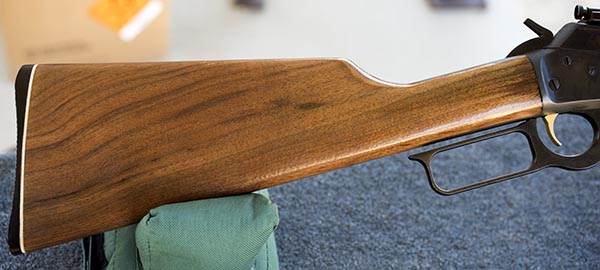
I’m a sucker for lever actions with pretty wood, and the Marlin checked all the boxes for me.
See what I mean? It’s not bad. Not exceptional, but above average, and the price was right.
The Williams aftermarket aperture sight on the 1894 Marlin. The theory is that an aperture sight is more accurate than a simple notch rear sight. I prefer the plain notch sight.

I bought the Marlin when Reagan was in the White House.  I’m not sure why.  It was one of those guns you buy and then just never shoot much.  I felt guilty about that.   And the Turnbull was one I wanted to use.  Yeah, it’s almost too pretty to shoot.  Almost.  Like I said, I hit the Gunbroker “bid again”  button a sufficient number of times to take it home.  It’s beautiful, and like you’ve read on these pages before, I am a big fan of Turnbull-finished firearms.
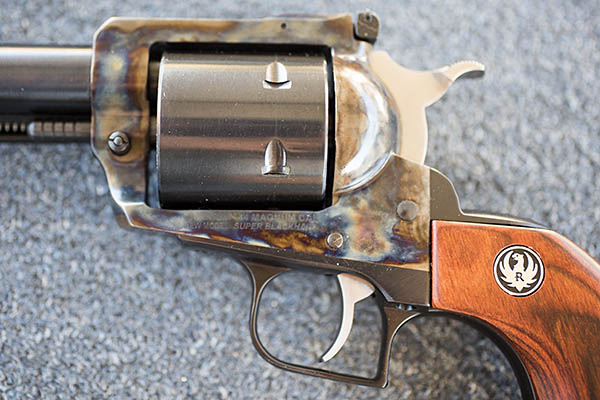
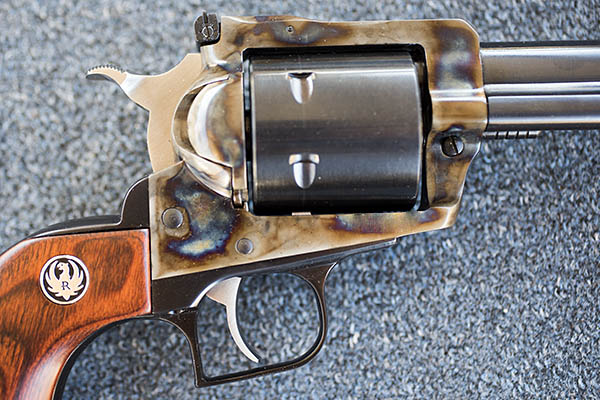
Turnbull color case hardening.  Gresh talked about what constitutes art in his most recent blog. To me, this is it.
The starboard side of the Turnbull Ruger.  Pretty, huh?

Even though I had not shot much .44 Magnum in recent years, I had a half-dozen different loads in .44 Mag squirreled away in my ammo locker:  One box of factory ammo that’s been there for a decade or more (I can’t remember where I picked it up, one I reloaded with Hornady jacketed bullets, and the rest I had reloaded with various cast or swaged lead bullets.  My intent was to find the magic load that shot well in both the Marlin 1894 rifle and the Ruger revolver.  There was nothing scientific in any of this; I just had a bunch of different loads and I thought I would try them all.

So, back to the range.  It was a beautiful day, but it was windy as hell out at the West End Gun Club last Friday and I’m sure that affected my results.  But, sometimes it’s windy.  What are you going to do?  I shoot when I can.  And I just wanted to get an idea what my six different loads would do in the rifle and the handgun.

So, here’s the bottom line…
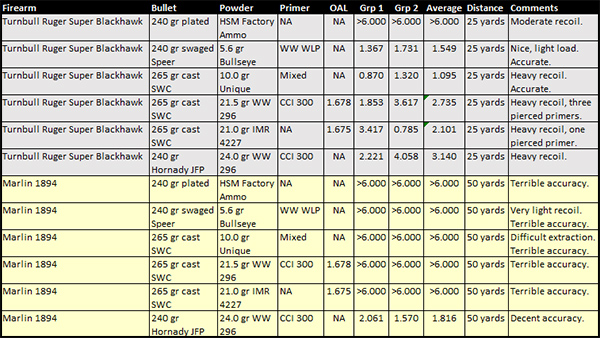
Revolver and rifle load testing results with the Ruger Super Blackhawk and the Marlin 1894.  These are my loads only; you should start lower and develop your own to make sure any load is safe in your gun.

None of my cast or swaged loads had acceptable accuracy in the rifle.  That’s probably because of the Marlin microgroove bore and the diameter to which my cast bullets had been sized.  I don’t think Marlin uses microgroove rifling any more in their .44 Magnum lever guns.  Microgroove rifling is a very shallow rifling technique; current Marlins use more conventional (and deeper) Ballard-type rifling.  I’d read online that to get a .44 Magnum cast bullet to shoot in the Marlin microgroove barrel, you had to size the bullets to 0.433 inch. All of my cast stuff is sized smaller than that around the standard 0.429 or 0.430 inch (yep, that’s right, a .44 Mag is actually not 0.44 inch in diameter; it’s only 0.429 inch…not that it would matter to anything struck by one of these monstrous high velocity slugs).   Oh, and that factory ammo?  My box of old HSM factory .44 Magnum was terrible in the Marlin.

It wasn’t all bad news with the Marlin, though.   The load with Hornady jacketed flatpoint bullets and Winchester’s 296 propellant shot well in the rifle, as you can see in the chart above.  That’s good to know.  Interestingly, those bullets are 0.429 inch in diameter.  But they shot well.  Go figure.

With the Turnbull revolver results varied, but they were generally way better than with the Marlin rifle.  All of my cast loads shot reasonably well, although the recoil was horrendous with all of them (except for the one light Bullseye load).  The Hornady jacketed bullet load with 296 powder shot well.   I’ve always had good luck with 296 powder in both the .357 and .44 Magnum.   The HSM factory load?   It shot the same in the Ruger as it did in the Marlin, which is to say it was terrible.

Chasing a load that shoots well in both a rifle and a handgun may be a fool’s errand (like I said ealier, I may be reading too much Zane Grey), but it was something I wanted to play around with.  The Marlin liked those Hornady jacketed bullets with 296 and they did well in the Ruger, too, so I think the next round of testing will involve using just those bullets with different levels of 296.   It may be I need a different loads for the Marlin and the Ruger, but that’s okay.  The next time I go “afield” I’ll only be carrying one gun, and you can bet I’ll be keeping a sharp eye out for pigs and poison oak.


Want to make sure you never miss an ExNotes blog post?   Sign up for our email updates in the widget you see to the right (if you’re on a laptop) or at the bottom of this post (if you’re on a smartphone).  We’ll never give your email to anyone else, and you’ll automatically be entered in our quarterly moto-adventure book giveaway!


Want to see our other Tales of the Gun stories? Just click here!
Buffalo Guns!

The 45 70 is a cartridge that’s been around since 1873, and it’s a whopper. Its designation was originally the 45 70 500 (a .45 caliber, 500 grain bullet, packed with 70 grains of powder). It was an Army cartridge used in the 1873 Springfield rifle, and the recoil was fierce enough that Uncle Sam soon cut the bullet weight to 405 grains. The cartridge was also used in Sharps and other rifles, and the early Gatling guns.

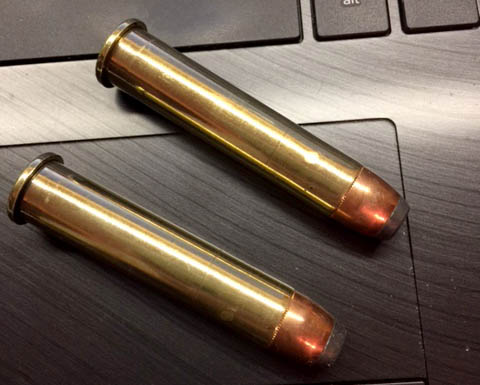
Reloaded 45 70 cartridges, with the 300-grain Hornady bullet. This is a big cartridge. It’s what buffalo hunters and Gatling guns used.

After the Army went to the 30 06 cartridge (in, of course, 1906), the 45 70  just about went belly up.   But then Ruger re-introduced the 45 70 in their No. 1 single shot rifle in the early 1970s, and Marlin reintroduced their 1895 rifle shortly after that. The fun started all over again. That’s when I got in the game (back in the 1970s), and I’ve been happily sending those big .45 slugs downrange ever since.

I’m a big fan of the 45 70 and I’ve been told I’m a bad influence, as I’ve had several friends buy 45 70 rifles after hanging around me. It’s been fun, especially reloading the 45 70 and comparing recipes (more on that in a second).

As mentioned above, the Ruger No. 1 was the first of the modern rifles chambered in 45 70, and it’s a beautiful firearm. The Ruger No. 3 was an economy version of the No. 1 that Ruger only made for a few years. The No. 3 rifles were substantially less than a No. 1 when new, but because they’ve been discontinued, No. 3 rifles often sell for as much as a No. 1 (and sometimes more).   The Marlin is less than either Ruger, but don’t confuse price with quality (or fun).  The Marlin is a hoot to shoot, too.

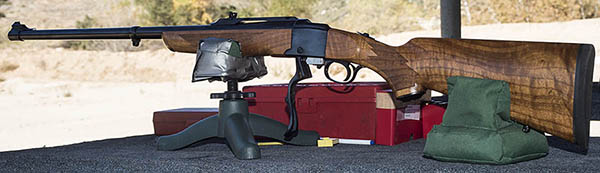
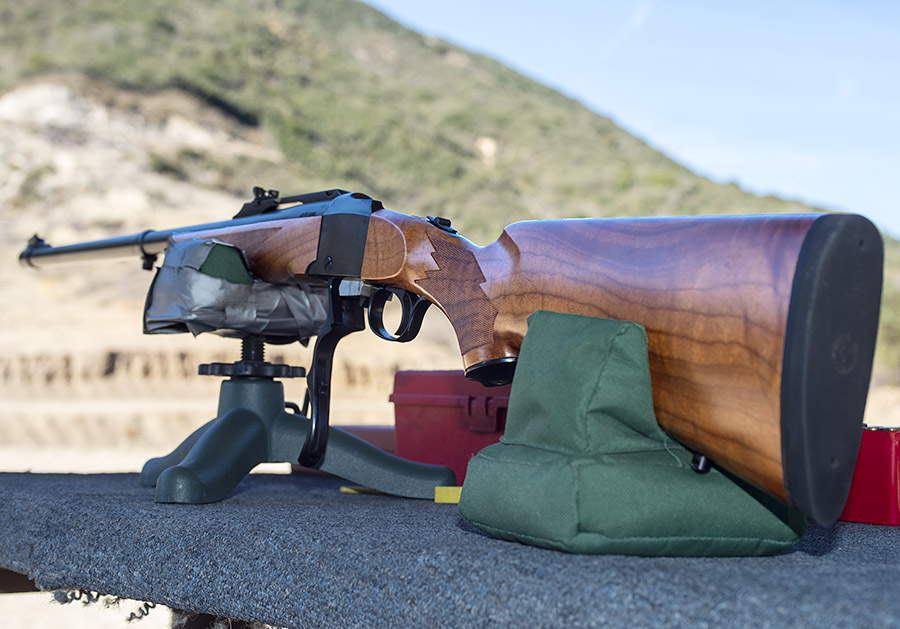
A 45 70 Ruger No. 1, with Circassian walnut furniture and a 26-inch barrel.
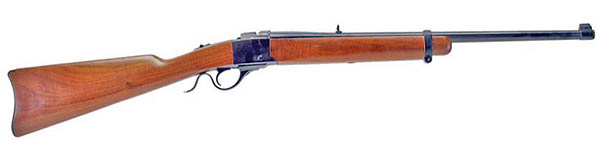
The Ruger No. 3, also in 45 70. These rifles sold for about $139 when new. Today they can sell for as much as $1000 in pristine condition.
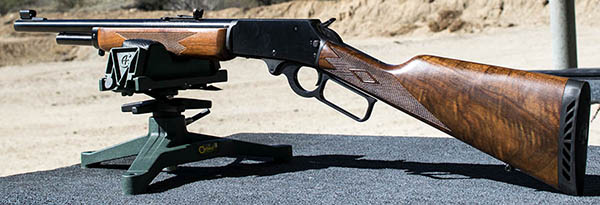
A Marlin 1895 45 70 Guide Gun. I bought this rifle because of its wood. It’s a good shooter, too.

I mentioned that my several of my friends now have 45 70 rifles, and we all reload 45 70 ammo. The idea is that we want to find the most accurate load for our rifles, and every rifle (even the same model) has its preferences. No two guns shoot the same.

Here’s where all this going. One of my buddies tested a load that looked promising in his 45 70 (a load using Trail Boss gunpowder with a 300 grain jacketed hollow point bullet), so I tried his load along with one other, all in the above three rifles, to see how they would do.

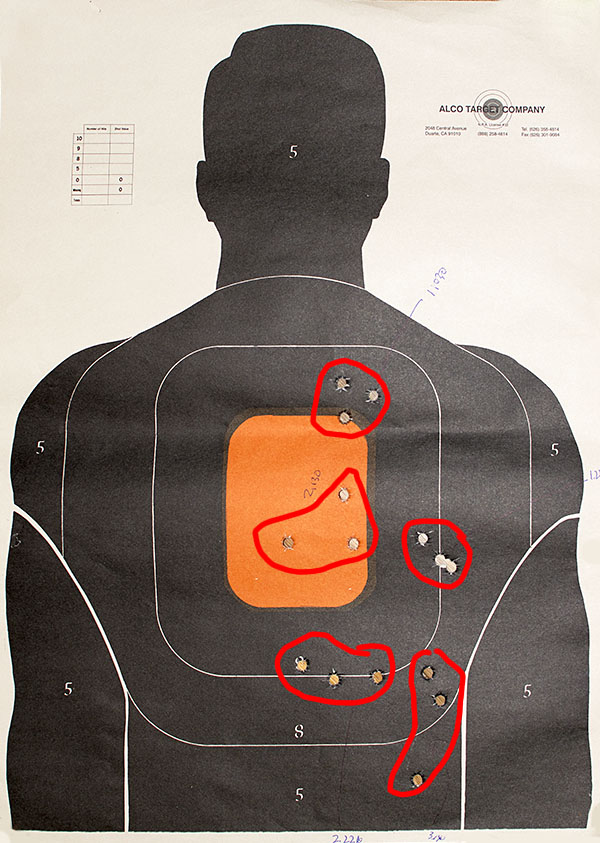
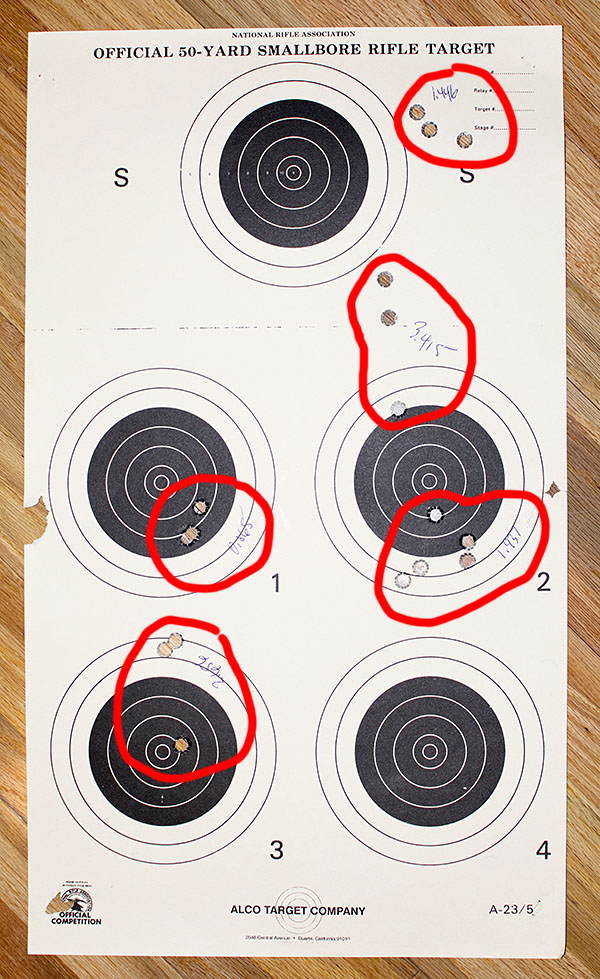
I shot at two targets for this test (a standard silhouette target and a 5-bullseye target).  I shot each rifle at the silhouette’s orange center first (my aim point) because I didn’t know where the rounds would hit and I wanted to make sure I was on paper. Then I shot a second group from each rifle at the bullseye targets. I shot 3-shot groups except for one, as noted in my results in the table below.  Note that all targets were fired at a distance of 50 yards.

First, the targets…

There are five different groups on this target. My point of aim was the bottom of the orange rectangle.
The bullseye targets. I wasn’t worried about each group’s location; at this point, only group size was of interest. After picking the best load, I’ll adjust the rifle’s sights.

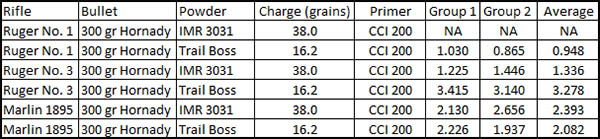
And finally, my tabulated results….

The first load tested would not chamber in the Ruger No. 1 because the bullets were seated too far forward in the brass cartridge case; better to find this out at the range than on a hunting trip!

The Ruger No. 1 really liked that 16.2 grain Trail Boss load (it was my buddie’s favored load). It delivered a 1-inch group. This load was also good in the Marlin, but not nearly as good as others I have shot in that rifle (the Marlin shoots into 0.6-inch with the right load). The No. 3 Ruger seemed to like the 3031 powder load with the 300 grain jacketed hollow point bullets.

As I mentioned above, every rifle responds differently to a given load, and that’s what we try to find…the best load for the best rifle.


Want to see our other Tales of the Gun?  Just click here!

All spun up…a real hot tamale!

A Ruger No. 1 in .257 Weatherby.

I experienced something recently I had heard and read about in years past, but I had never personally experienced. I’d been wanting a .257 Weatherby No. 1 ever since they became available.   To understand what that means if you’re not a single-shot rifle aficionado like I am, I need to start with a bit of background.

Roy Weatherby was a southern California entrepreneur who developed a line of ultra-high-velocity rifle cartridges in the 1940s and beyond.  Weatherby built a rifle company around his proprietary cartridges, and they are fine firearms.  Roy has gone to his reward, and he was one hell of a man while he was with us.  I met Weatherby in the early 1980s and I know of what I speak, but that’s a story for another time.

Next bit of information:  Of the several cartridges that Mr. Weatherby developed, his personal favorite was the .257 Weatherby.  It’s a very, very fast quarter-bore (a .25-caliber cartridge) that has a huge brass case holding a lot of propellant, which vents all its fury on that little bullet when, as they say, the hammer falls.  The cartridge is wicked looking.  The thing resembles a hypodermic needle, and if you’re shooter and a reloader like me, you get all gaga over such things.   The .257 Weatherby has muzzle velocities approaching 4,000 feet per second.  To put that in perspective, consider that the 5.56mm NATO round, the one used in the so-called assault rifles and our US Army M-16, is “only” a 3,100 fps cartridge.   The .257 Weatherby is super fast.  It’s the fastest .25-caliber cartridge there is.  In that caliber, there’s nothing faster.

Next bit of gun info:  One of the most desirable and beautiful rifles in the world is the Ruger No. 1.  It’s a single-shot rifle, which means you load one round at time.  When I hear my gun buddies get their shorts in a knot about the “gubmint” limiting us to 10-round magazines, I have to laugh.  That’s nine more than a real rifleman needs.  One shot, if you’re doing things right, is all it takes.

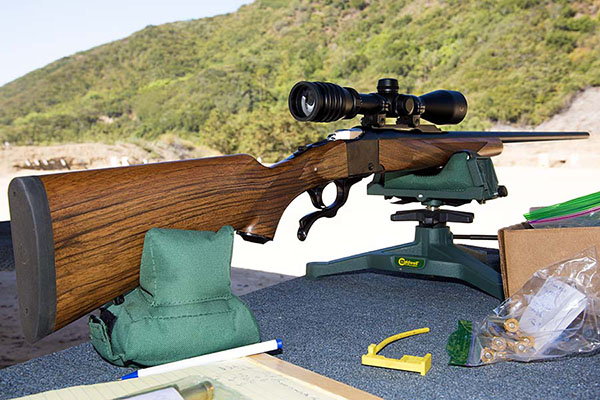
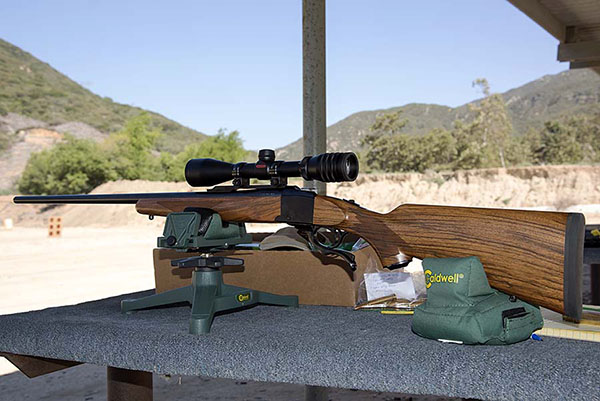
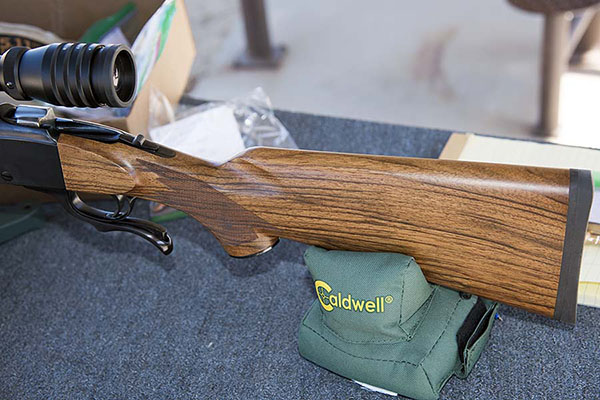
Next point…last year, Ruger offered their No. 1 single-shot rifle in a very limited run chambered for the .257 Weatherby cartridge.  I love the Ruger No. 1 and I always wanted something in chambered for the .257 Weatherby cartridge.   For me, it was a no-brainer.  I had to have that rifle, and I finally found one (at a good price, and with nice wood).  It’s the one you see in the photo at the top of this blog.  It’s awesome.  Circassian walnut with nice horizontal streaks, a 28-inch barrel, and chambered for the ultimate round.  The stock looks good from both sides, too.  Take a look…

The view from the driver’s side.
Another shot of Circassian splendor.

The excitement with a new rifle like this (beyond the pride of ownership and the dreams of distant hunting trips) is developing a load that groups tightly.   Usually, I can get a rifle to shoot into an inch at 100 yards with the right combination of powder, powder charge, bullet, primer, seating depth, and the other variables in cartridge development.  It’s a mini-engineering development program, and finding the right recipe is a big part of the fun.  Maybe someday I’ll do a blog on that, too.

So I started with my first load, which consisted of 87 gr Hornady bullets, and varying loads of IMR 4350 propellant (what most folks would call the gunpowder, but we reloaders call it propellant).  The rifle was grouping okay (nothing great; I haven’t found the perfect load yet), when I got to the last load to be tested. It was a max load, which means it had the highest propellant charge I was testing that day.

None of the loads showed any pressure signs (like flattened primers or difficulty opening the action).  That’s what you watch for, to make sure you don’t create loads with excessive pressure.

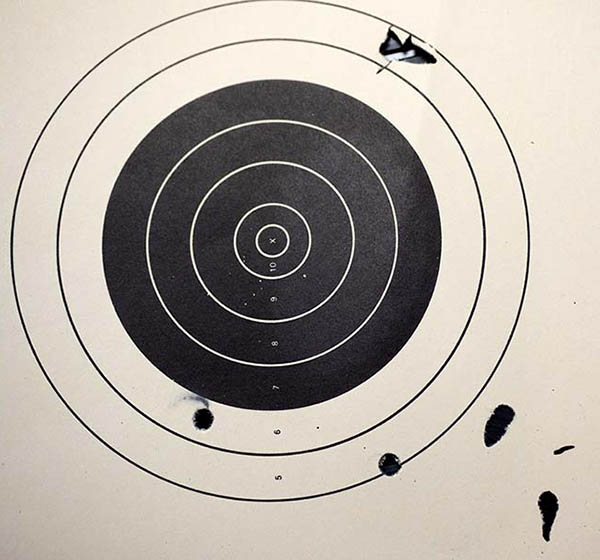
Even the max load seemed okay, but when I fired the first shot I saw from the hole it made on the target that it was tumbling. After firing the next four, two more tumbled and, not surprisingly, the group had opened up significantly.

It was a lousy load from an accuracy perspective, but here’s where we get to the “never seen this before” before part of the story.

Here’s what the target looked like…

Tumblers!

Now, for the really interesting part.   Check out the bullet hole at the 7:00 position…the one at the lower left (the target was mounted on its side).

Here’s a closeup of that bullet hole…

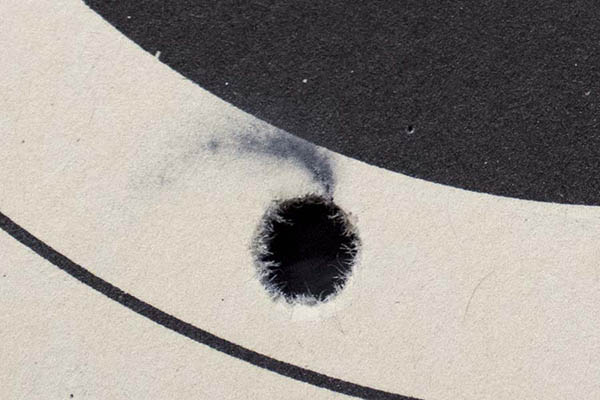
Check out the comet-like trail starting at the top of this bullet hole…

The dark roostertail you see above is the lead spraying out of the bullet’s copper jacket as the bullet disintegrated in flight. Some of the bullets disintegrated sooner and started tumbling before they hit the target.  This one was breaking up as it went through the target!

Like I said, I had heard of this phenomenon before, but I never actually experienced it firsthand. The muzzle velocity, according to my reloading manual, was just under 4000 fps. Just for grins, I calculated the bullet rpm at that velocity, and by my reckoning, it works out to something approaching 300,000 rpm.  That little puppy was spinning, and between the centrifugal forces the bullets were experiencing at that rpm and the aerodynamic heating at those speeds, they were breaking up in flight.  That’s fast!

Interesting stuff, to be sure.