The Road to Pai, Thailand

By Mike Huber

After spending a couple months freezing in Nepal I was more than ready for a restful month (or three, as it turned out).  I was craving warmth, a steak, and some scuba diving, and southern Thailand quenched my thirst for all three.
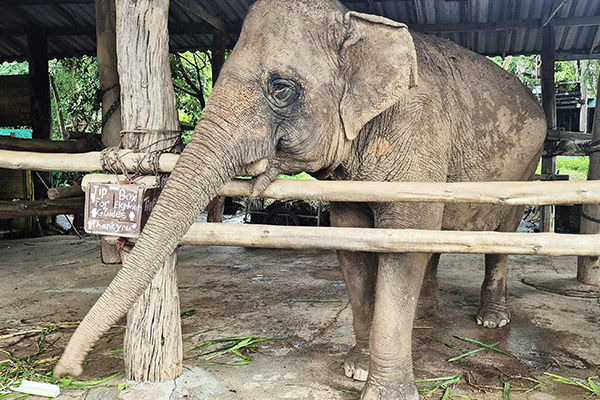
After a month or two in southern Thailand spending the days scuba diving and embracing the sun it was time to head north. The previous year when I was in Chaing Mai I got sick off eating elephant poop, not intentionally but it had me leashed to a toilet for four or five days and ruined my entire itinerary. It was now time to return to Chaing Mai and steer clear of the elephants.
Everywhere in Thailand there are a ton of Temples to visit and northern Thailand was no different. After a few tours and meeting a ton of new friends the road to Pai kept coming up as one of the best roads to motorcycle in Asia. I located a rental shop in Chaing Mai and rented a bike for seven days.  This was a rather long time as the road to Pai roundtrip only took two or three days.  I figured with the added days I may do a layover day somewhere and just blast around the northern tip of Thailand to some less frequented parts of the country and have some shorter days on the bike.

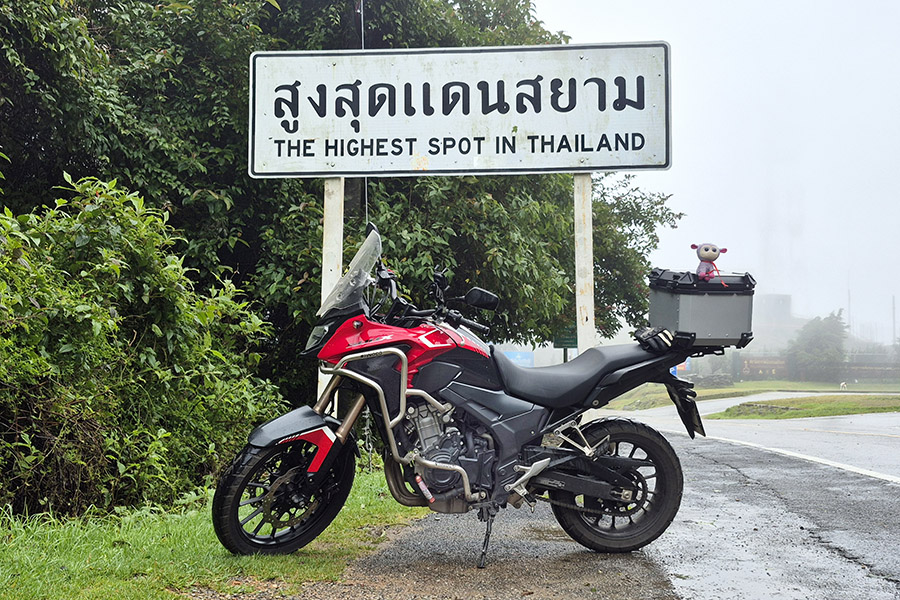
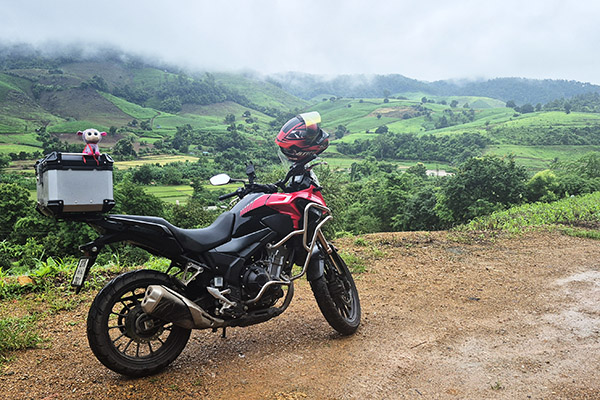
My trip to Pai ended up being delayed two days as there was a massive monsoon that blew through and needless to say it wasn’t good riding weather.  Once the storm cleared I left on a Honda 500cc motorcycle ready to tear these roads up.  Although it rained usually once a day at one time or another it was tolerable and outside some wet roads my first few days were going well. The roads were incredible and it was quite similar to motorcycling in Vermont, outside of driving on the left hand side of the road. There were beautiful twisties and colorful canopies of vegetation that provided a kaleidoscope of colors when the sun made it through the foliage.
As I stated most the times the roads were wet and I adjusted my speed with the ever-changing road conditions. What I didn’t factor in was an oil spill on one of the corners as I approached Pai.  All I remember is “boy that slid out from under me really smoothly” and the next moment I was floating through the air.  Prior to being a paratrooper is I am very proficient at playing patty cake with the earth.  I executed the perfect PLF (parachute landing fall) and as I slid down the road after that execution I couldn’t stop laughing as the bike was spinning like a 600-pound fidget spinner and went off the road and settled into the grass.
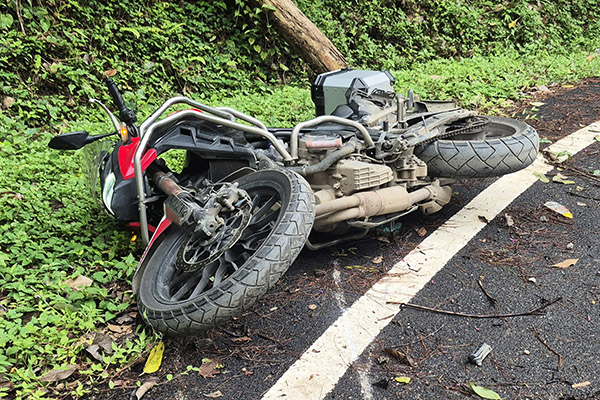
As I stood up I performed a self-assessment of the damage to myself. I was very fortunate. Just a few scrapes and bruises.  My shirt and pants were pretty tore up I noticed a very sharp pain in my ribs.  I definitely cracked, broke, or fractured a rib. I picked up the bike and noticed one mirror was destroyed and my right foot peg was snapped off.  Also my front brake handle outside of a 2-inch piece was snapped off.  I had about four days left with the motorcycle so I would just use one finger on the front brake and move my leg from the rear peg to tap the rear brake as needed for the remainder of my trip.  My tourism layover days were now replaced with staying in bed to nurse my injuries with Chang beers.

I ended up completing all the roads I had planned on and it was now time to return the motorcycle to Chang Mai and continue to rest the cracked rib.  I am certain if this accident had happened in the United States the bill to the damaged motorcycle would have been over 1,000USD, but in Thailand it was under 100USD and I threw in a few Chang beers for a tip. The road to Pai is really one of the better roads I have ridden on, outside of the oil slick of course.  Still, it was a great way to explore northern Thailand.


Join our Facebook ExNotes page!


Help us keep the lights on:


Don’t forget: Visit our advertisers!


Buell Fever Part 1: Give Me More Cowbell!

By Joe Gresh

As my age keeps creeping up and I slowly fall apart like Jeff Goldblum in the movie, The Fly, there is an urgency, a panic lying just below my normally placid exterior. Time is running short for all of us and if you have unfulfilled dreams, it’s best to get a move on.

The ill -fated VR1000, inspiration for my Buell’s paint.

Owning a tube frame Buell has been on my wish list since the S2 model came out in the mid 90’s. The combination of modern sport bike and 1957 lawnmower engine had a strange appeal to me and let’s face it: everyone should own a Sportster.

The dawn of 2026 found me frantically searching the internet for a 2000+ Buell Cyclone and I found a few. Several were pretty beat up all were reasonably priced but far away.

The deal I missed due to my inherent thriftiness.

I happened upon Iconic Motorbike Auctions and they had a pile of Buells from a private collection. The crown jewel was a Cyclone with only 6 total miles. It was a brand new, 25-year-old motorcycle.  I bid on the bike and it made reserve at $4,000. What a deal! $4K was out of my self-imposed Buell budget so I stopped bidding. Someone got a hell of a deal.

Next up at Iconic was a clean, Buell Ulysses complete with Buell saddle bags. It was a gas-in-frame model. I prefer a tube-framed Buell but bid on the Ulysses anyway. It sold for $3,250! I didn’t bid anymore on it because it just wasn’t the bike I wanted. Although if I got it for $2K I would have learned to love it.  After that, Iconic had an S3 with saddlebags that went for over $5,000. Now I was starting to freak out. I had Buell Fever bad-like. What if I was witnessing a Buell market correction in real time?

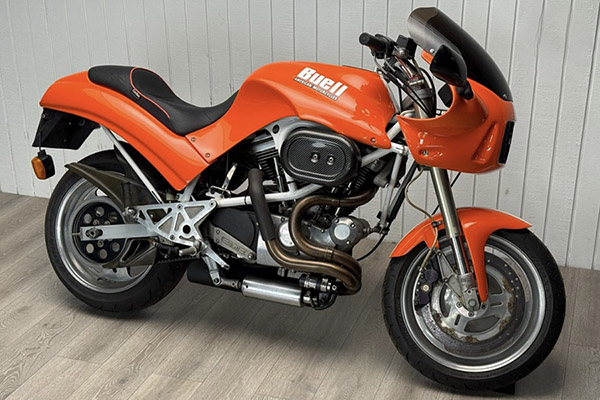
It’s like getting two bikes in one! Orange on the right.
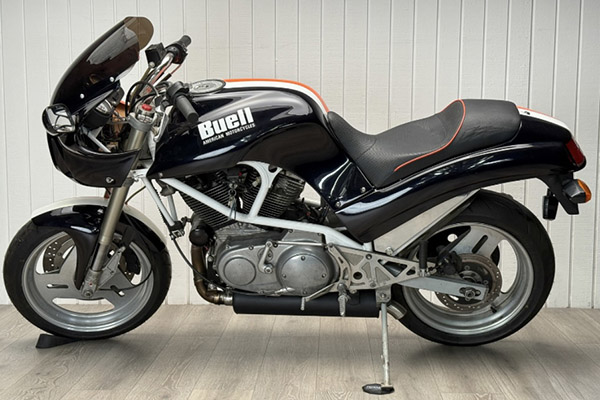
And black on the left.

Iconic has a buy-it-now section for motorcycles that don’t make their auction reserve. I plundered around in buy-it-now and found a beautiful 1995 Thunderbolt with only 13,000 miles for $3,000. It has a few minor issues to sort out like any 30-year-old motorcycle but what really got to me was the Harley VR1000-tribute paint scheme . It looked cool as hell. I loved the paint job. I pushed the button.

It’s not an actual Cyclone, but it mostly is a Cyclone. The main cosmetic difference is the front forks and faring. Also the 1995 Thunderbolt used a bone-stock Sportster engine that Cycle World dynoed at 65-ish horsepower. Later Buell’s were pumped up a lot with Buell-specific heads and other parts churning out 100 horsepower.

While I wouldn’t mind another 35 horsepower, the truth is I just putt around on bikes. My go-fast days are behind me much like the strange growth I had cut out of my back a few months ago (see The Fly with Jeff Goldblum).

One advantage to the Sportster engine is that parts availability should be excellent for the remainder of my life and beyond. If I truly need more oomph there are tons of Sportster hop-up parts and 60 years of institutional knowledge on the Internet. 75 horsepower is a pipe and cams away.

But I probably won’t do anything to the Thunderbolt except ride it and look at it. I’ll be fixing the minor issues right here on ExhaustNotes so you’ll be able to follow along with this Buellishness.

Got to go. Driving out to Panorama City in California to pick up my dream bike from Iconic motorbikes.


Want more Joe Gresh?


Join our Facebook ExNotes page!


Help us keep the lights on:


Don’t forget: Visit our advertisers!


ExhaustNotes Review: Kemimoto Heated Grips

By Joe Gresh

Old Man Winter is taking his sweet time here in New Mexico. It is late December, 70 degrees and the frozen old git still hasn’t made much of a dent. But he will arrive and I’ll be ready with my new Kemimoto heated grips.

I’ve set up the Kawasaki ZRX as my cold weather bike with a 12-volt receptacle for an Aerostitch heated vest and these grips will complete my preparations for the cold. If it ever gets here.

Installation would normally be simple as the wiring connects directly to the host bike’s battery. The main problem with this setup is if you accidentally leave the grips on and drain your battery. In the cold.

I couldn’t find an unused, switched power connection on the factory harness so I rigged a cube-type relay under the headlight faring that energizes from the instrument light circuit. This ensures the grips are off when the key is off. Power for the grips comes from the Areostitch vest power lead and runs up to the relay.

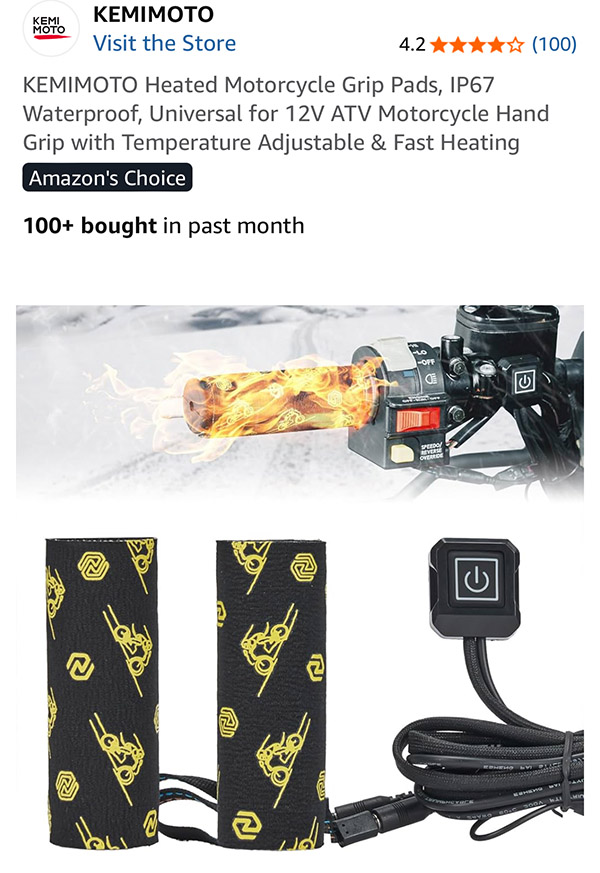
The heating elements just wrap around your existing grips and a 3-power level switch needs to go somewhere. I used a fairing mount bolt to secure the included switch bracket on the right side of the gauge cluster. It’s not a great location but it was easy.

Heat-wise these grips crank it out. On high you can feel the burn. This setting would be good for freezing weather. Low was still too hot during my 60-degree test ride so it should be good for average New Mexico winter conditions.

That wrap around heating element never really gets very tight on the grips so you’ll need to reset its position as it slowly creeps around the throttle. Or squeeze tighter.

The on-off switch is dimly lit so in sunlight it’s hard to tell what power level the thing is set at (red=high, blue=medium, green=low) I had to stop and cup my hand over the switch to see the illumination.

While I haven’t tested the grips in truly cold weather I’m sure they will help. It’s nice to pop the switch on when the elevation climbs over 7000 feet. Cuddly and warm best describes the feeling.

How long the grips will last is anyone’s guess but they’re easily unwrapped, unplugged and stored for the 10 months a year they are unnecessary in sunny, warm New Mexico. The harness, relay and switch remain on the bike full time.

I’m satisfied with the Kemimoto heated grips and give them a solid 3-star rating, a rating that could be improved if they fit the grips tighter and the switch was brighter. Maybe a section of elastic would help hold the grips better but what do I know. Now if Old Man Winter would get off his butt I could try them out in proper conditions.


Join our Facebook ExNotes page!


More Joe Gresh?   It’s right here:


Help us keep the lights on:


Don’t forget: Visit our advertisers!


¿Quantos Pistones? (The Eights)

By Joe Berk

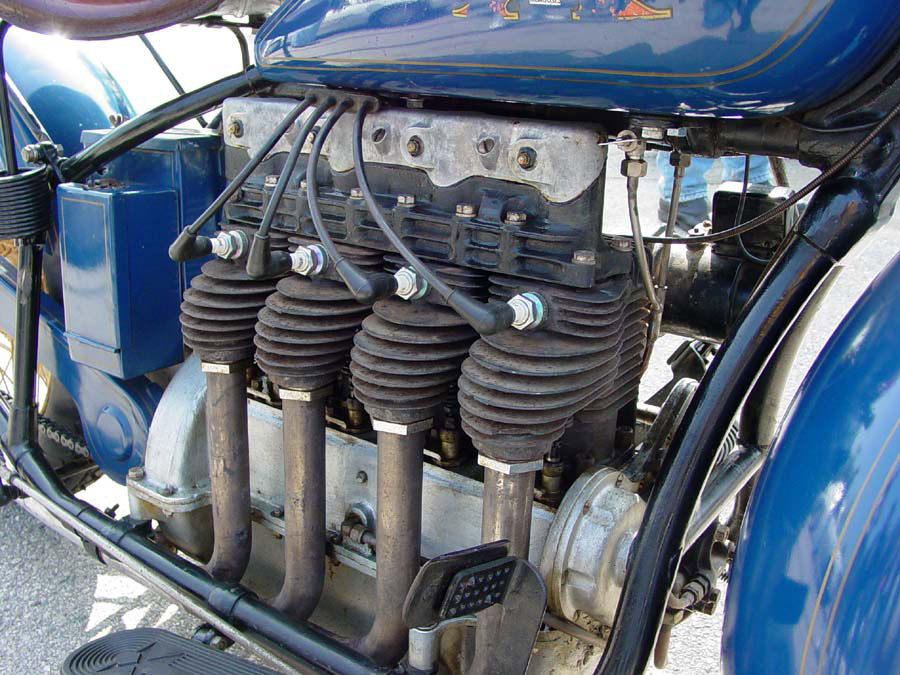
Eight-cylinder motorcycles are rare.  The first was the 1907 Curtiss V8, another early one was the 1950s Moto Guzzi V8 racing bike, there’s the the Chevy V8-powered motorcycles made by Boss Hoss, and the Morbidelli V8.  Most recently, there’s the new Chinese Great Wall Souo S2000 GL (it has a 2000cc flat-eight engine).

The Curtiss V8 motorcycle was the first eight-cylinder motorcycle.  It dates to 1907.  If you want to see an original Curtiss V8, get yourself a ticket to the Smithsonian.  If you want to see a reproduction of one of the Curtiss V8s, look no further than Jay Leno’s collection:

The Moto Guzzi V8 was built for the 1955-57 racing season; it was never a street motorcycle.  I didn’t know too much about that bike (other than that a drawing of it adorned the cover of Melissa Pearson’s outstanding motorcycle book, The Perfect Vehicle : What It Is About Motorcycles).  I found a YouTube video that tells us a bit about the Guzzi V8:

My first exposure to an 8-cylinder motorcycle was the Boss Hoss.  I saw these bikes at one of the Laughlin River Runs back in the 1990s.  The Boss Hoss company had two or three of these bikes on display in the parking lot outside one of the casinos.  I sat on one at lifted it off the sidestand.  That was enough for me.  I’ll bet that bike weighed a thousand pounds.  It was an absurd approach to motorcycling, and my 10 or 15 seconds of stationary seat time convinced I could easily live without one.  Somewhere I have a photo my friend Dick Scott took of me on the thing, but I didn’t think enough of the bike to bother looking for it for inclusion in this blog.   These bikes go for around $70K (maybe less if you can find one used).  Boss Hoss offers these in both a small block Chevy version, and a big block  Chevy model. Save your money, folks.  But if you want to see more, here’s a video on these ridiculous machines:

The short-lived Morbidelli V8 motorcycle was offered in the mid-1990s.  Even though I’d see some of the world’s most exotic sports bikes here in southern California (especially on the Angeles Crest Highway), I’ve never seen one of these bikes in person.  To me, the name is of-putting enough, and it was billed as the world’s most expensive motorcycles.  Thanks, but I’ll take a pass.  I found a YouTube video on the Morbidelli.  Check this out:

And finally, there’s the the Chinese Great Wall SOUO S2000 flat eight, a bike that takes the boxer engine concept to octopusian extremes.  I’ve never seen one of these, either, but in keeping with my approach to his blog, here’s yet another video:

My take on all of the above?  Too much of a good thing is just that: Too much.  I’ll never own an 8-cylinder motorcycle, and that’s okay by me.


Missed our other ¿Quantos Pistones? stories?  Here they are:

¿Quantos Pistones? (The Sevens)
¿Quantos Pistones? (The Sixes)
¿Quantos Pistones? (The Fives)
¿Quantos Pistones? (The Fours)
¿Quantos Pistones? (The Triples)
¿Quantos Pistones? (The Twins)
¿Quantos Pistones? (The Singles)

You might be wondering:  Are there any left?  Yep, there’s one more:  The Tens.  Stay tuned.


Join our Facebook ExNotes page!


Never miss an ExNotes blog:


Help us keep the lights on:


Don’t forget: Visit our advertisers!


Lukla Airport, Nepal

By Mike Huber

Yet again apologies for the prolonged hiatus from writing.  I think five or six countries have passed since my previous blogs and I have just been caught up in the moment and dealing with life in my own way (is there any other way to deal with it?).  Having a bit of downtime over the holidays I thought I would try to pick up where I believe I left off.

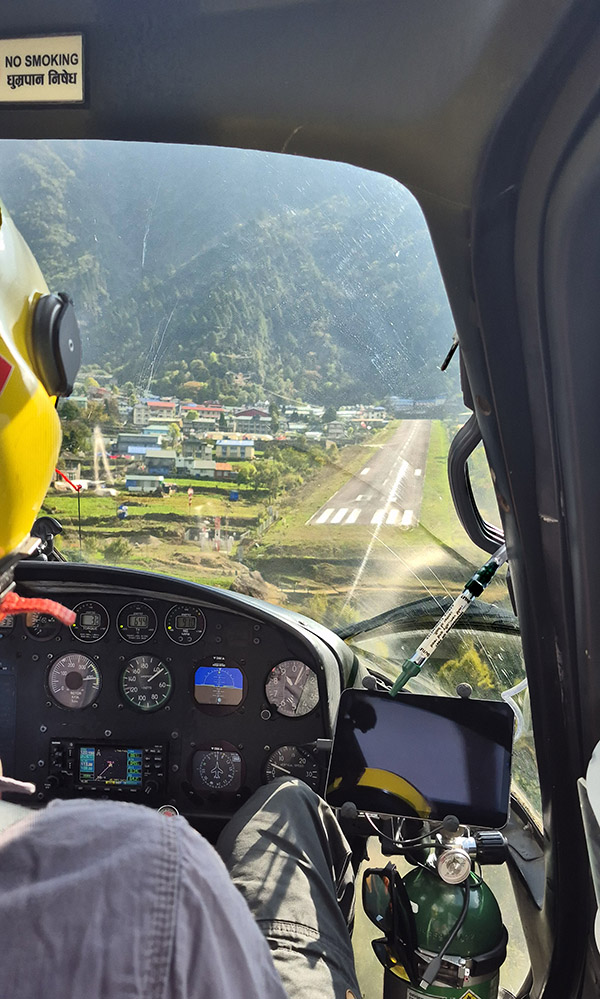
In April I was scheduled for a 0700 flight from Ramechhap Airport in Nepal into Lukla Airport, which is the gateway to Everest Base Camp.  It is only a 20-minute flight between the two airports and as I stated in my previous blog after three days of delays forced me to scrap the Everest Base Camp trek originally. This was due to constant cancellations e to weather conditions.  As you can imagine the weather patterns in the Himalayan Mountains aren’t always smooth. There is nothing more demoralizing then boarding a flight and having the props fire up and then have the flight scratched and having to deplane.  Actually, there is.  That being if you fly halfway to Lukla and then are forced to return to Ramechhap due to winds.  This isn’t the best way to start off your journey to the rooftop of the world.

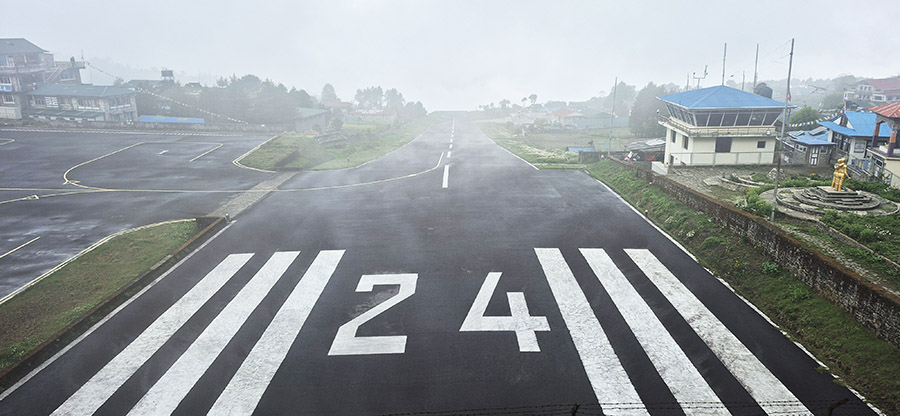
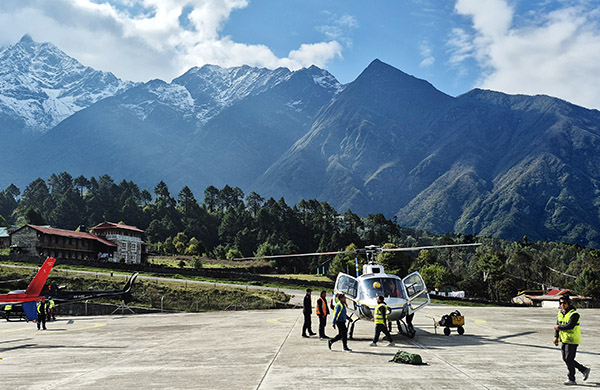
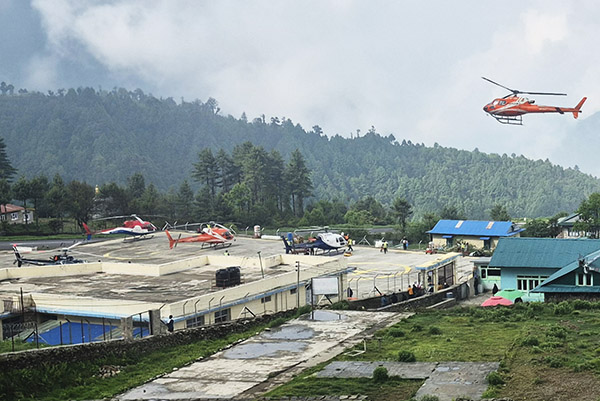
Lukla Airport is the world’s most dangerous airport.  Nature is brutal in these mountains and add in the dramatic runway at a 45-degree angle which ends abruptly and drops off 2,000 feet into some foggy abyss becomes a recipe for either numerous cancelled flights, or worse yet, a disaster.  When the Airport is up and running it is quite a sight.  Helicopters in and out constantly in-between fixed wing aircraft landing and gear and supplies being wheeled all over the tarmac.  It’s probably not only the most dangerous airport in the world but the busiest one for having only a single runway.

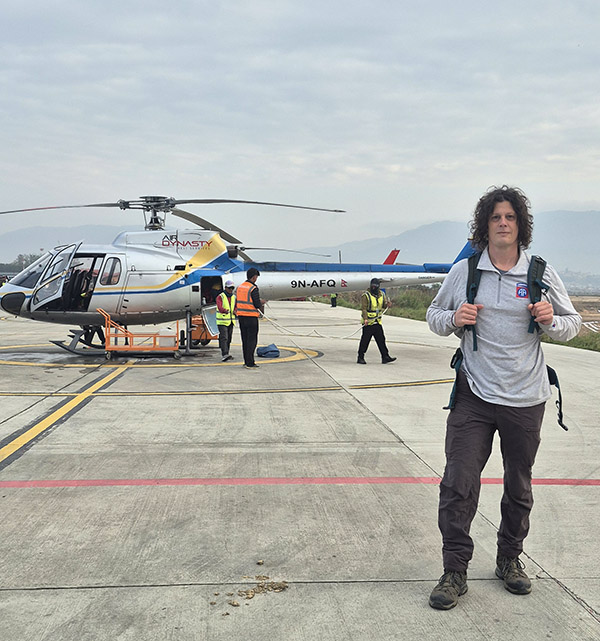
The other thing that I was to learn was even though it took four days to obtain a successful flight into the airport (I ended up opting for a helicopter to improve my odds of making it to Everest Base Camp) was that leaving Lukla airport is just as difficult. After two days of cancelled flights to return to Katmandu I once again chose to take a helicopter.

I was fortunate that I was in no rush, that and having the foresight to obtain a 90-day visa for Nepal almost assured me that I would eventually make it in and out of Lukla with minimal stress.  Having both time and patience was required for this as five full days of my two months in Nepal were spent gaining access and leaving Everest Base Camp through Lukla Airport.  I knew this time spent sitting in the airport making new friends would pay off once I began the trek to Everest Base Camp.

Another great asset was having my tour guide Kiran from www.theholidaytrek.com make the layovers much more tolerable as all I had to do was show up and hope the flight would be a go.  He took care of all the bookings, rebookings, and hotel accommodation setups.  I am not one to plug companies and I rarely am on tours but Kiran made being stranded for five days almost fun.  There also was another positive out of it.  While having a captive audience in Lukla I became friends with another trekker and we are going to be neighbors in the next country I travel to in a week.  Colombia!


Join our Facebook ExNotes page!


Help us keep the lights on:


Don’t forget: Visit our advertisers!