From time to time, I hear this question: How much cash should I take to Baja? Costs have gone up in Baja (like everywhere else), but Baja is still a cheap date. How much you’ll need will depend on your tastes, how much you drink, and where you stay. To cut to the chase, when I ride in Baja, I’ll take a thousand bucks with me if I’m going to be there for a week, and I always come home with money in my pocket. You can bring a credit card to Baja, but once you get out of the tourist spots (Ensenada, San Felipe, Loreto, La Paz, and Cabo), Baja is mostly a cash proposition. In these tourist spots, costs will be more in line with what you’d pay in the US for food and lodging, too. You can’t depend on being able to use your credit in the smaller towns and at the more remote gas stations.
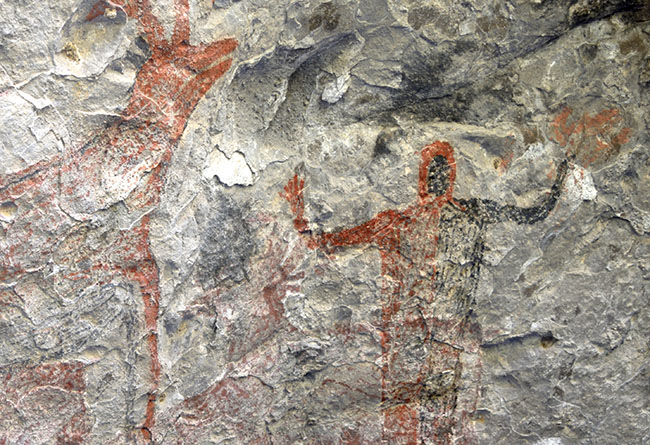
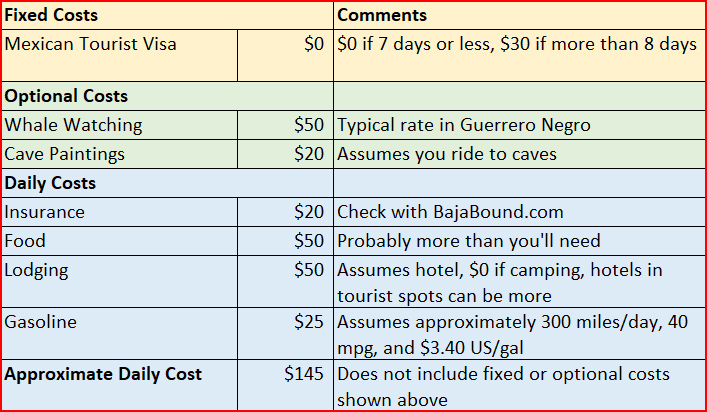
Expenses in Baja will include food, gasolina, lodging, and if you’re going to see the whales or the cave paintings, the cost of admission for those things. Figure on $50 for a half-day whale-watching tour (it’s worth every penny, in my opinion); the cave paintings a little less. Both are great things to see (many folks describe them as life-changing, and I’m in that category). If you plan to have a drink or two at night, you’ll need a bit for that, too.
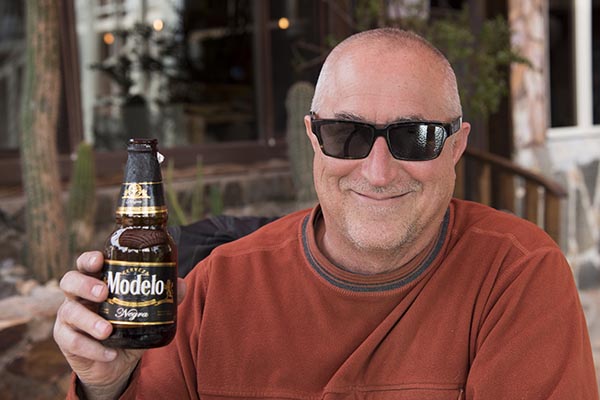
Gasoline prices in Baja are usually about the same as they are in California. That’s usually works out to something north of $3 per gallon. They sell it by the liter and it’s easier to pay in pesos, but they’ll take dollars at an exchange rate that is not usually in your favor. It’s best to have pesos and pay in the native currency. You can see our earlier blog on fuel in Baja for more information.
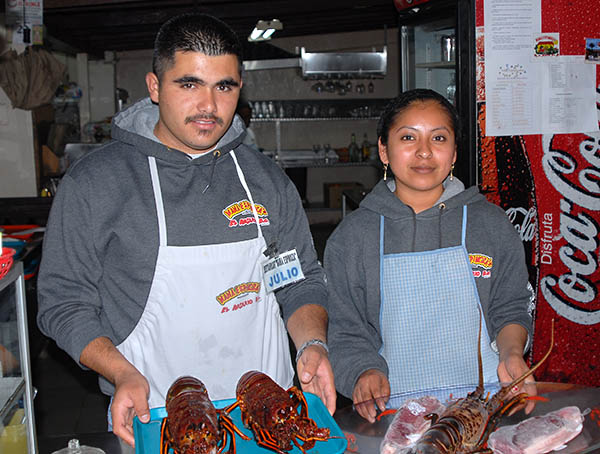
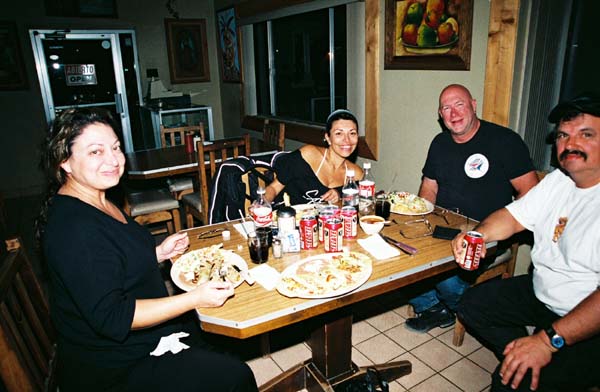
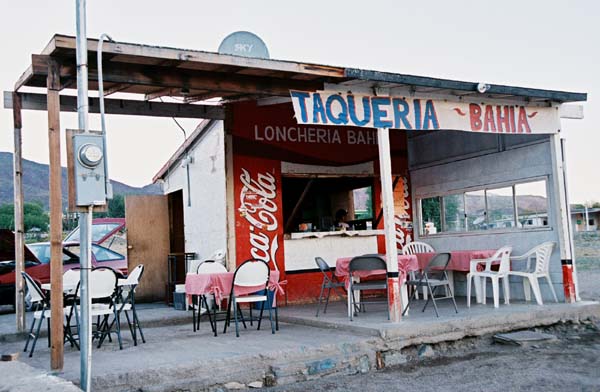
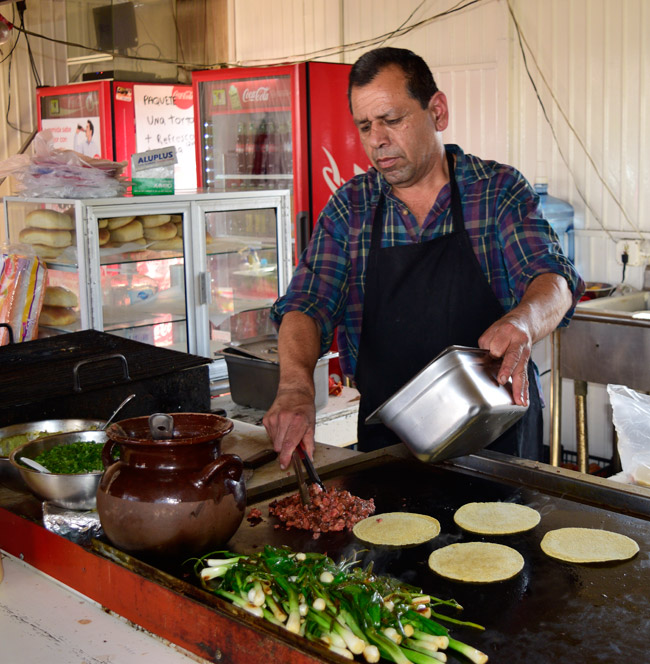
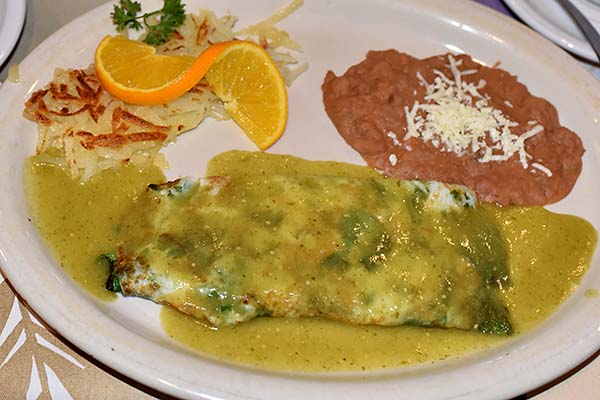
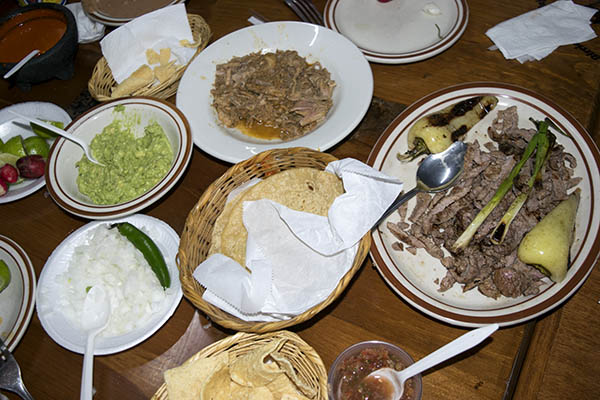
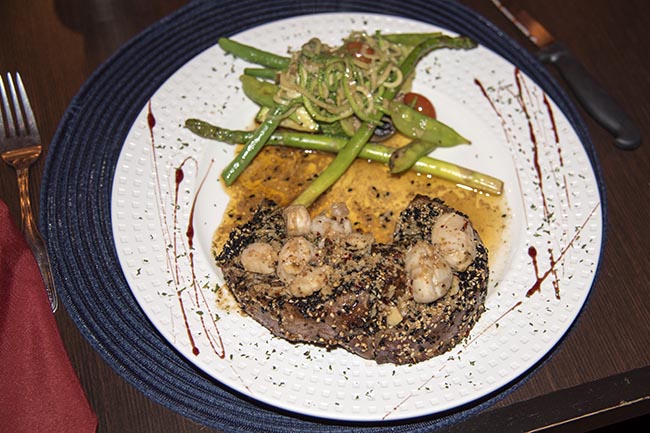
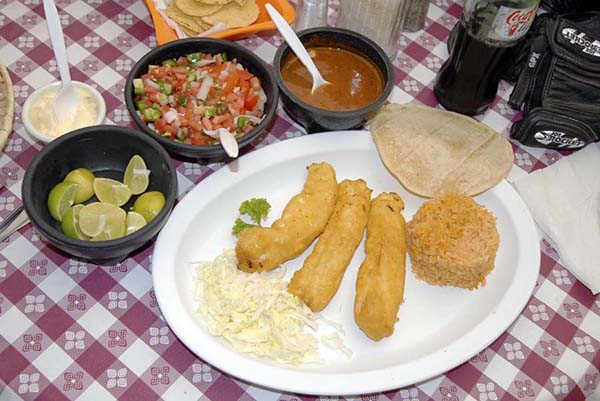
Food is inexpensive if you eat in other than touristy restaurants. My friends think I’m a genius at finding good spots to eat in Baja, but my secret is simple: I just look for the spots with lots of cars and pickups parked in front. It works every time. I’ll usually budget $25 US a day for food. It’s easier to pay in pesos, but most restaurants will also take dollars. I might add this: I’ve never had a bad meal in Baja. I could write a book just about the restaurants down there. There are many hidden treasures. We’ve listed a few on our Baja page.
Hotels are typically between $25 and $70 per night outside of the tourist towns. In the smaller spots, $25 seems to be the norm. In the more well known hotels (like Malarrimo’s in Guerrero Negro), it’s going to be more like $70 per night. The rooms won’t be fancy, but they will be clean, and if you’re like me, you’re not going to be riding Baja as a hotel critic.
Don’t forget your Baja insurance. You have to get a separate insurance policy for your motorcycle when you go into Baja, and based on my 30-plus years of riding south of the border, BajaBound Insurance is the best. You should purchase it online before you cross into Mexico, and the BajaBound website makes that easy to do.
If your stay is going to be longer than a week, you’ll need to pay for a Mexican tourist visa (a week or less is free). The cost for a tourist visa is $30. You can (and should) pick up your tourist visa as soon as you cross into Mexico.
Here’s a summary of how the above stacks up (all amounts are in US dollars):
As I mentioned at the start of this blog, when I go into Baja for a weeklong trip, I’ll usually start with $1000 in my wallet and I usually return with money left over. In the event you do need more cash, there are banks in the larger towns with ATMs, and they’ve always worked for me.
We have much more information, including suggested riding itineraries, on our Baja page. You can read about some of our great rides in Baja here.
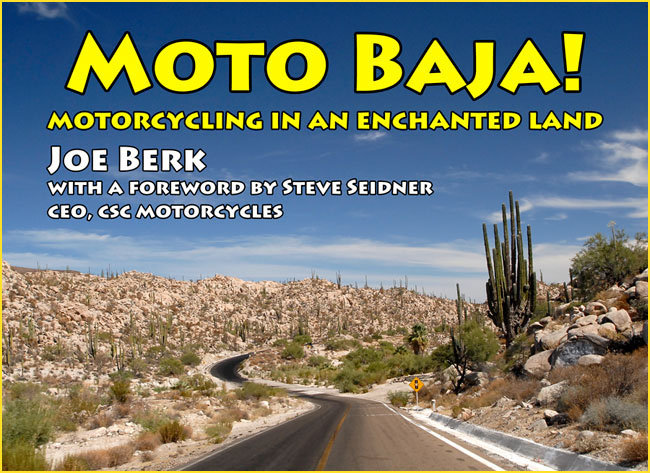
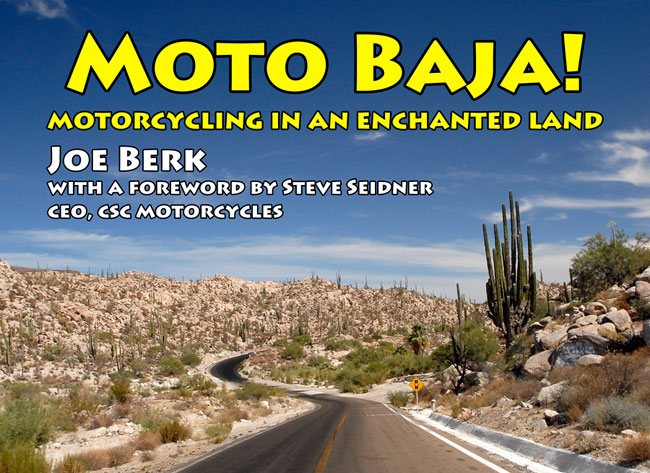
Want more info on exploring Baja on a motorcycle? Pick up a copy of Moto Baja!
You’ll remember our intrepid troopers and guest bloggers Mike and Bobbie. Well, they managed to exit beautiful Baja after an extended stay of nearly 10 weeks. Here’s the wrap-up to that adventure. Mike, we appreciate your blogs. Ride safe and stay in touch.
Preface: When we last left our heroes (the description probably suits my girlfriend Bobbie more than myself) we were in staying in with a new friend at her house in San Felipe, Baja, Mexico to see what comes next with the COVID19 updates in the USA before deciding when to return.
San Felipe seemed the perfect place to ride out the COVID storm. We were in a safe location, plenty of supplies at local stores and the residents seemed to take the warning seriously and were wearing masks, using hand sanitizer, etc. It didn’t take long, however, for most public beaches and really everything to be shut down. Traveling too far outside the city became impossible due to Mexican Army checkpoints turning people around, so it wasn’t worth the risk to be actually “locked out abroad.”
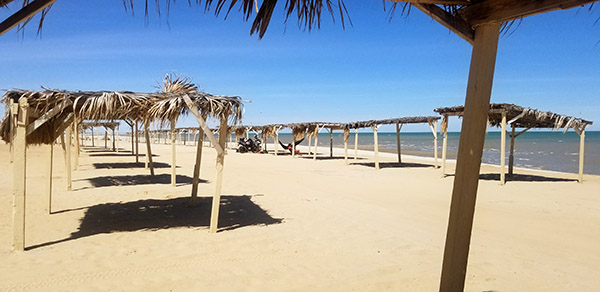
There was one private beach that remained open that we were able to use and moto camp in, and that was Pete’s camp. We had camped here 6 weeks prior when the world was quite different and the camp was about 70% full with campers, with side-by-sides roaring up and down the beach playing Van Halen at an uncomfortable decibel level (and I love Van Halen loud), and everyone was carefree enjoying their vacations. Now, however, the scene was completely different. The beach was abandoned, it was eerily silent with nothing but us and approximately a hundred empty palapas on the beach for miles in both directions. We frequented this beach a few times a week as it was a short 4-mile ride and was our only opportunity to really get out as we cut back on our off-roading in the event we should get injured.
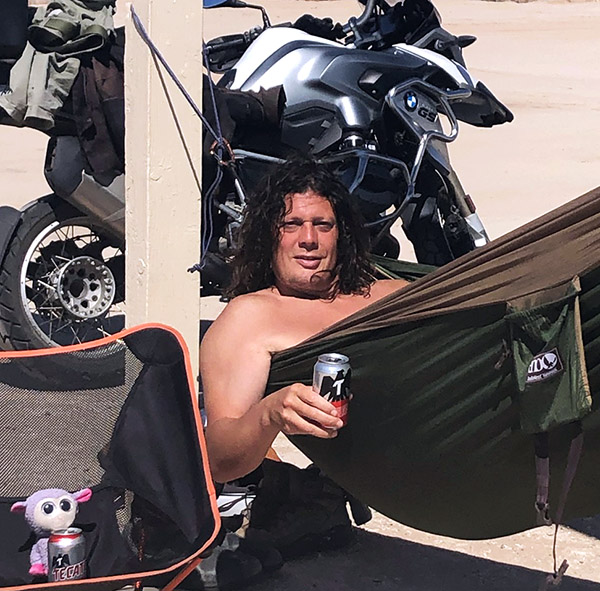
We fully understood how fortunate we were to be lying in hammocks, soaking up the sun on a beautiful beach that kissed the Sea of Cortez while we watched the surreal news that was coming in from America. We held weekly touch points on when and where we should go, if anywhere. Wednesday was an optimal day for these touch points since our plans would have us leave on a Friday thus allowing us 3 days to return to Arizona.
After a month we decided it was time to return as it seemed the supplies (toilet paper, etc.) were being replenished in America while the COVID fatalities seemed to be lowering and our concern that the bubble we were living in would burst quickly if (or when) the virus would make its way to Baja. More importantly, it gave us a solid excuse to get a great weekend of riding in.
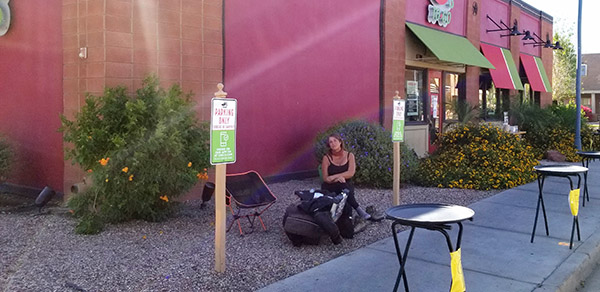
We left on a Thursday afternoon to return to the United States. The ride was beautiful. There was NO line at the border to the point I almost didn’t even place the moto in neutral when going through, whereas normally there is a 1 to 3 hour line. Once inside the United States we were a bit hungry and noticed only drive thrus were open, so we got creative and set up our camping gear outside a Chili’s and had several margaritas (probably not legal, but there’s a pandemic; act accordingly!) and a burger in the parking lot.
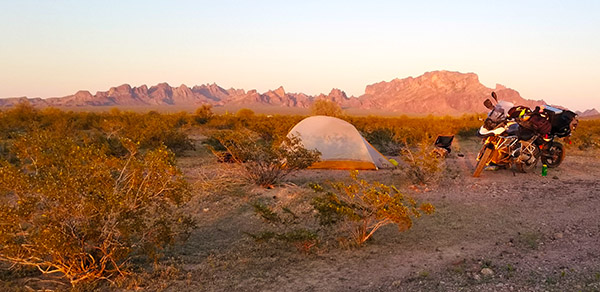
We had eyed Kofa National Forest as a decent place to camp, and I had always wanted to visit this area so this was a perfect time since it was extremely isolated. This ensured there’d be no temptations to break social distancing. We were not disappointed in choosing this location. It was a beautiful desert landscape with the setting sun lighting up the mountains surrounding our campsite. The weather was perfect and we could take a moment to gather ourselves with it being our 1st night back in our home country in some time.
The following day after getting McDonald’s for breakfast (don’t judge; I couldn’t find a Starbucks open for my BMW to get its fix) Bobbie came up with a different route then just the boring I-10 to I-17 we normally take. Great call! It made what would have been a drab highway drive into a longer, but much more scenic ride through little towns and National Forests, where we could really enjoy the break from everything and just be in that moment fully present and enjoying each moment as we lowered off the mountain passes returning to Sedona, and for a few hours forget about the rest of the world as we returned safely home after our nearly 10-week Baja adventure.
So these two adventure riders are on the road, and at last sighting, they were camping in Colorado’s beautiful Mesa Verde National Park. Our two troopers are living the good life. I’m looking forward to their next blog.
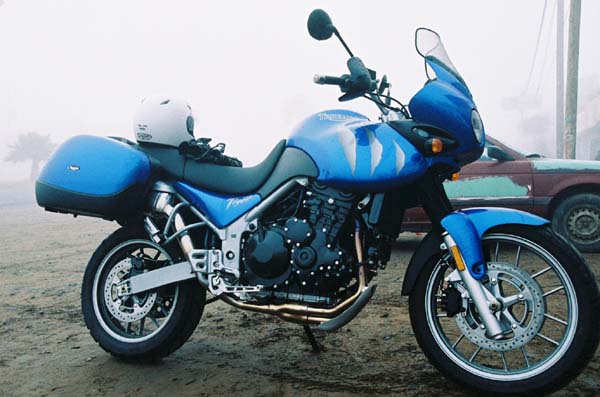
Yours truly with my Triumph Tiger in Palomar, about 200 miles south of the border along Baja’s Transpeninsular Highway. I had a little bit of hair back in the day, and it was still brown. What’s left now is mostly gray.
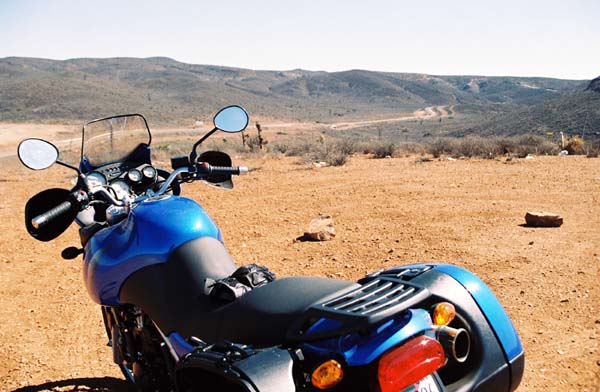
Wow, here’s a find…a bunch of older print photos from a Baja trip my old Baja buddy John Welker and I did back in 2006. Man, times were different back then. We both rode big road bikes and we were both working for a living. What a difference 14 years can make. It was a quick 1100-mile weekend ride to Bahia de Los Angeles in the Baja peninsula. John has a house on the Sea of Cortez down there. He still owns it, and he spends several months each year in Mexico. I took my Triumph Tiger for its first long ride, John took his Yamaha Virago, and we had a great time. I guess that goes without saying. Any motorcycle trip to Baja is going to be great.
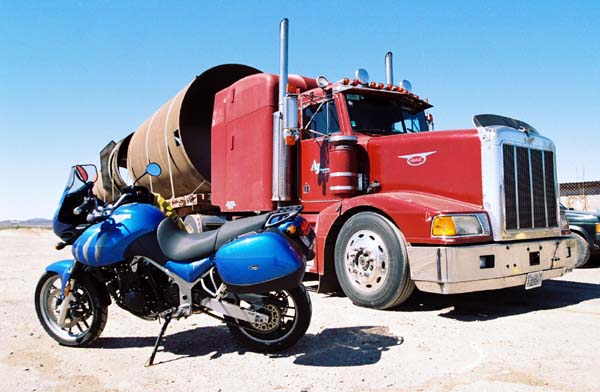
A Mexican truck driver on the Transpeninsular Highway, who was actually pretty friendly.
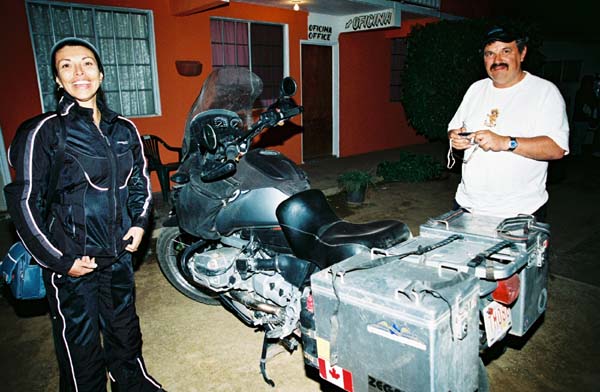
We stayed in San Vincente on the way down. It’s a cool little agricultural town along the Transpeninsular Highway, one of many in the agricultural district north of El Rosario. We saw a guy trying to buy beer in the restaurant in San Vincente that Friday night. There was a BMW GS in the hotel parking lot and I asked if it was his. Yep, it was, and Peter introduced himself to me. The restaurant didn’t serve beer, but I went across the street to pick up a couple of sixpacks of Tecate. I asked Peter to join us for dinner, and he did. He’s from Canada (eh?), and he was touring Mexico and the US for a month or two.
Our new GS-mounted good buddy Peter in San Vincente, along with good buddy Annie. Peter said he was looking for a Starbuck’s and got lost. I think there may be a Starbuck’s down there now.That’s Deema, Annie, John, and Peter. It was a grand dinner. Deema and Annie drove down in Annie’s car on this trip.
On Saturday, the next morning, John and I ran into a fog bank about 250 miles south of the border. Visibility was so bad I couldn’t see the ground beneath me, so I pulled over to wait it out.
I grabbed this shot of my Triumph in the fog.And another. There was nothing else to do until the fog lifted. The Tiger was a very photogenic motorcycle.
Mexico’s Highway 1 (the Transpeninsular Highway) follows the Pacific coast and then turns inland at El Rosario. Mama Espinoza’s is a classic Mexican restaurant known for their lobster burritos. I had a chicken burrito for lunch and, as always, it was the best one I ever had. I made it a point to stop there on the way back the next day and I had the same thing.
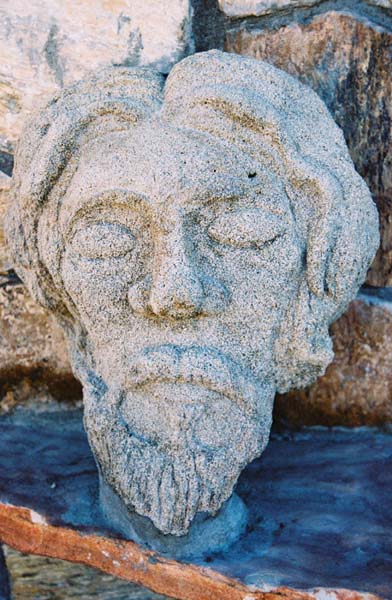
We always feel welcome at Mama Espinoza’s.A sculpture outside Mama Espinoza’s.
South of El Rosario, it gets real desolate real fast. That’s the Valle de los Cirios, and it’s one of the prettiest spots on the peninsula. The roads are spectacular. Fast sweepers, long straights, and no traffic. There’s just the odd cow or wild burro in the road.
A typical view in the Valle de los Cirios.Another stop along the Transpeninsular Highway. The Triumph Tiger was a great machine for this kind of riding, especially with its comfortable riding position and a range exceeding 200 miles.
After the Valle de Los Cirios, it was desert down to Catavina and beyond. There are remote truck stops, lots of desert, and just great riding. I’ve got to get back down there again sometime soon.
A truck stop out in the middle of nowhere.We stopped briefly in Catavina, where John couldn’t tear himself away from this rather talkative guy. John and I have put a lot of miles on our motorcycles in Mexico. The scenery is great. The people you might are even more fun.
At Punta Prieta, after traveling on Highway 1 for about 360 miles, we made a left turn and headed east across the Baja peninsula.
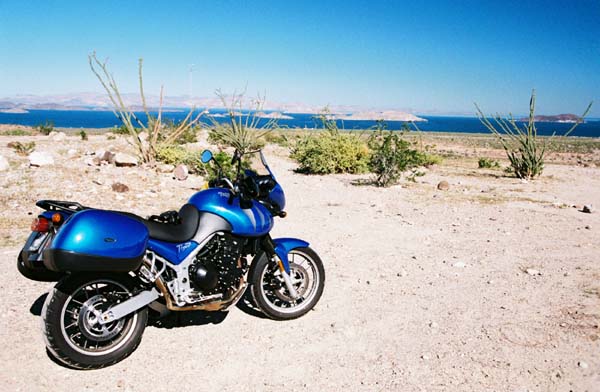
This was our destination…Bahia de Los Angeles.Triumph called the Tiger’s color Caspian Blue, presumably named after the Caspian Sea. This wasn’t the Caspian Sea (it’s the Sea of Cortez), but I’d say the color match is pretty good.
John’s house on the Sea of Cortez. John picked a moonless weekend so that we could take in the stars, and the night sky was awesome.
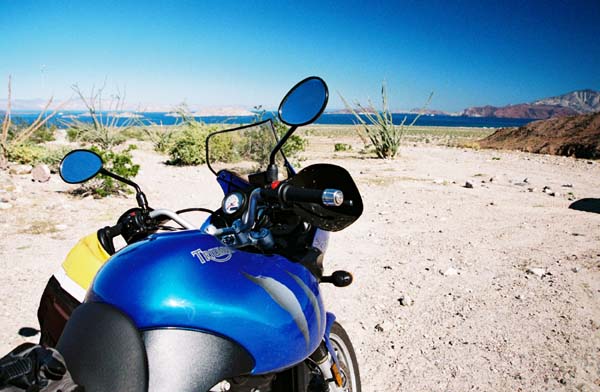
Every motorcycle trip needs an obligatory artsy fartsy shot. This was mine from our 2006 Bahia de Los Angeles ride.
John’s house is literally right on the Sea of Cortez. It’s a pretty cool place.
Casa de Welker, on Bahia de Los Angeles.John telling a fish story in his front yard.Our dinner choice that Saturday night. The fish tacos were impressive, as was the Tecate. Life is good down there in Baja.
John keeps an old VW microbus in Bahia de Los Angeles that came with the house when he bought it. The lights on the VW didn’t work back in 2006 (I imagine John has them working now). We had dinner in town and realized the sun had set. No lights. No moon. Dirt roads through the Baja desert. We realized we were in a pickle. But, John had an idea. And a flashlight. Annie hung out the window with that flashlight and sort of lit the way. It was an old flashlight with a limp battery, and it didn’t really light up anything. But we didn’t care. It was a fun evening.
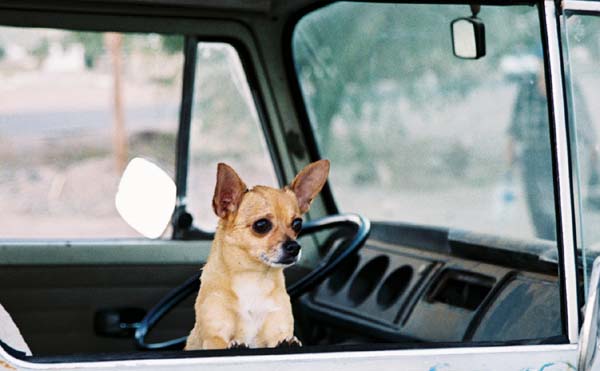
The original Baja bug. LIghts? We don’t need no stinkin’ lights!Candy, the Chihuaha from Peru. In Mexico. That little pup ran the show.A sculpture on John’s house.
There’s no light pollution down there in Bahia de Los Angeles. I slept on the roof and it was magnificent. I’ve never seen stars as vivid nor as plentiful as they were that night. And the next morning, I was up before sunrise, so I was able to set up my camera and get a cool photo of the sun rising over the Sea of Cortez.
A shot from John’s roof looking east over the Sea of Cortez.
I rode back the next morning by myself…John was staying at his place a couple of extra days, but I had to get back for work. Work. Man, those days seem so far in the past now.
The ride back was a good one. It’s nice to ride with friends; it’s also nice to ride on your own. I do some of my best thinking when I’m riding by myself. I need to do more of it.
I grabbed this shot in one of the agricultural towns along Highway 1 on the way back to the US.
I shot all of the photos on this page with my F5 Nikon, and the 24-120 Nikon and 17-35 Sigma lenses. Back in the day, as film cameras went the Nikon F5 was a good as it ever got, and I got a lot of great shots with that camera. The thing was a tank and I don’t think I would want to lug it around today, but back then it was really something.
So there you have it. I’ve got a standing invitation from Baja John to ride down to Bahia de Los Angeles, and as I put this blog together and looked at these photos again, I think that’s what I’m going to do.
Thanksgiving is right around the corner, and I remember saying that prayer whenever it was my turn to say grace before a family dinner. It was always good for a laugh. Thinking about those big turkey dinners turned my thoughts to the best parts of any motorcycle adventure, and that’s the food. I’ve enjoyed some fantastic meals on the road, and you know what? People tell me the photos have been the best part of any writing I did along the way. I like photos of scenery and people on our adventures, but readers consistently tell me the food photos are the most interesting. Allow me to share with you some of my favorites.
Colombia
Wow, was Colombia ever an adventure. Everything about that ride was absolutely world class, including the dining. Take a look.
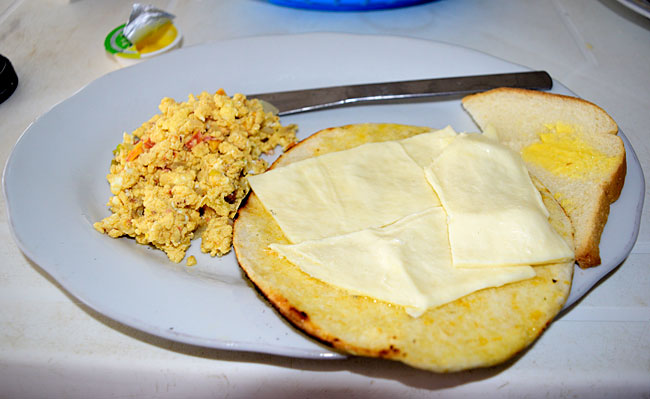
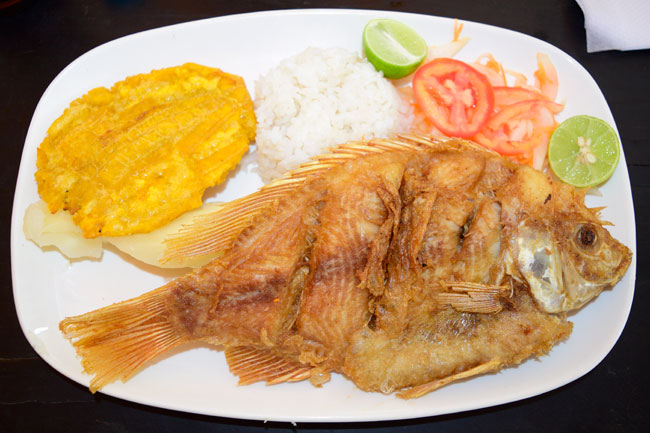
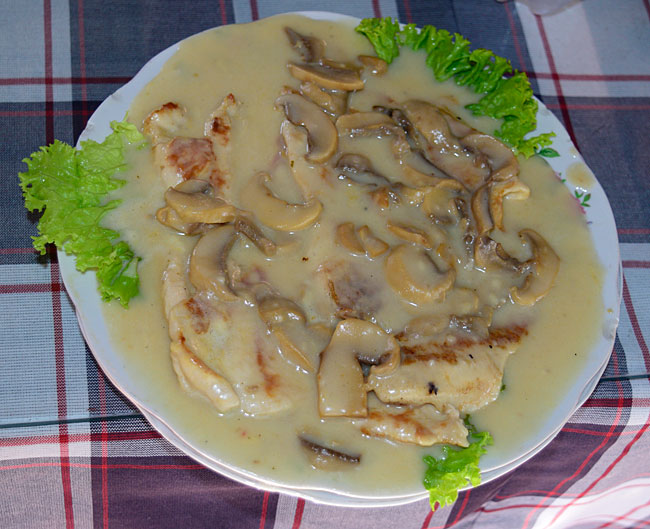
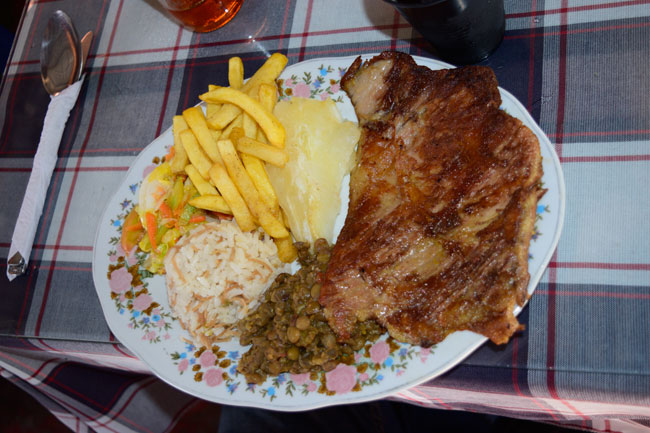
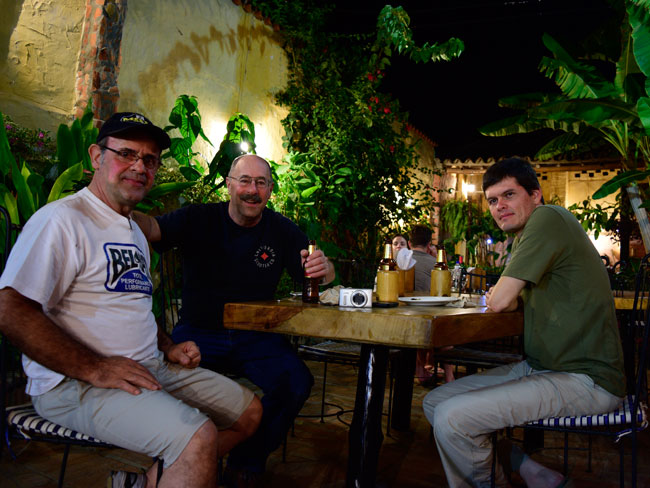
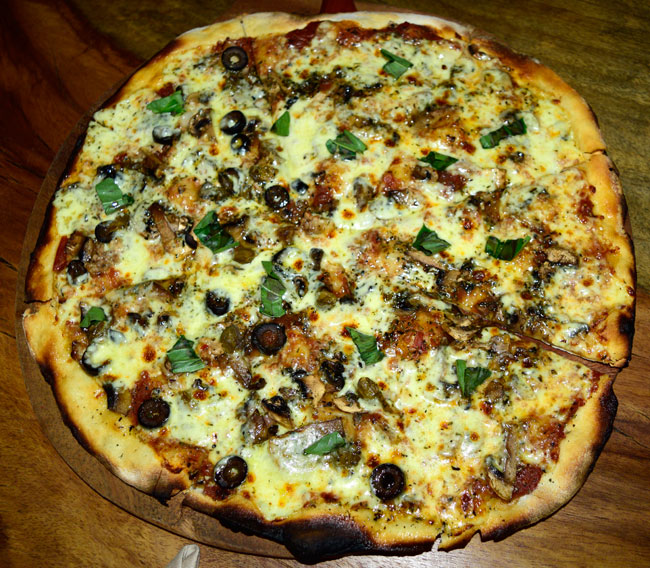
A simple Colombian breakfast…scrambled eggs, arepa, and those incredible Colombian cheeses!A fish lunch along the Chicamocha River. Good Lord, it was fabulous!Chicken and mushrooms. It was way more than I could eat.Beef? Pork? Nope, neither. It was pig stomach lining. Very tasty, I’m told.Carlos, yours truly, and Juan at dinner in Mompos. It’s the oldest town in Colombia, and to say it is off the beaten path would be an understatement.We had dinner that night in Mompas in a restaurant run by an Austrian, where I had the best pizza I’ve ever had in my life. The beer helped, too!
China
What can I say? The ride across China was amazing in every way, and the food was one of the best parts of it.
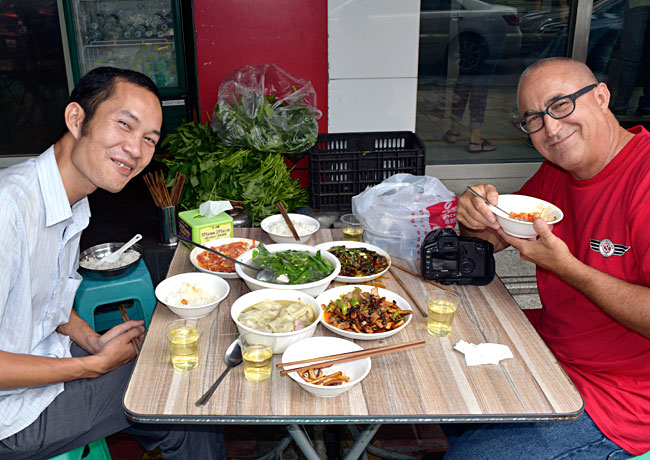
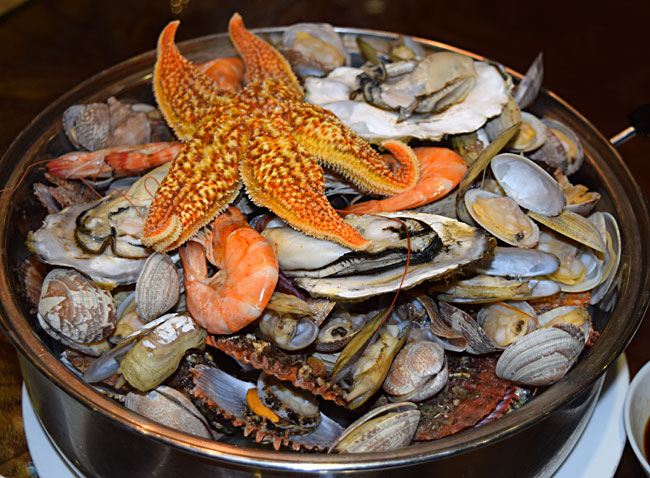
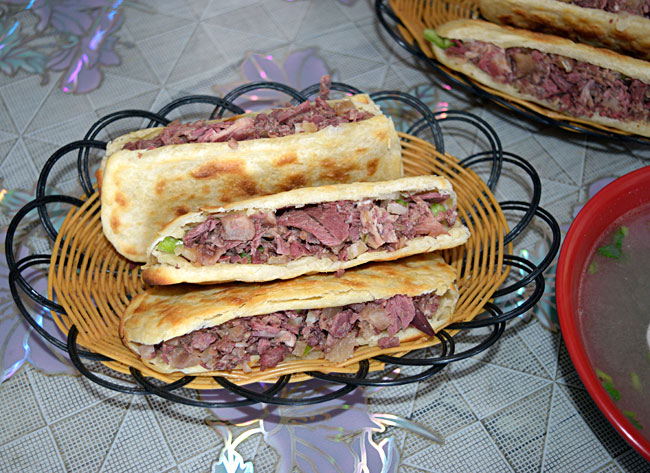
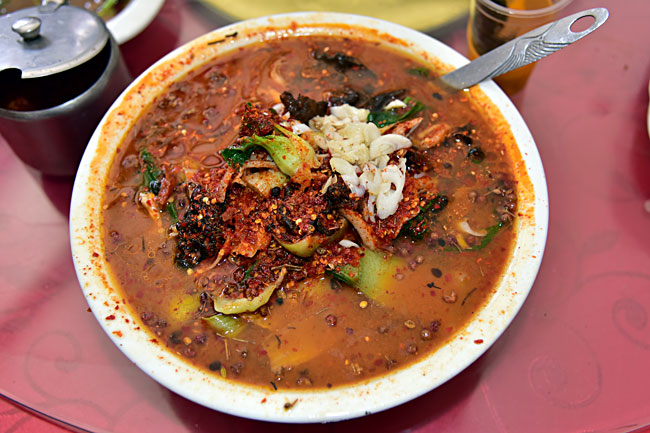
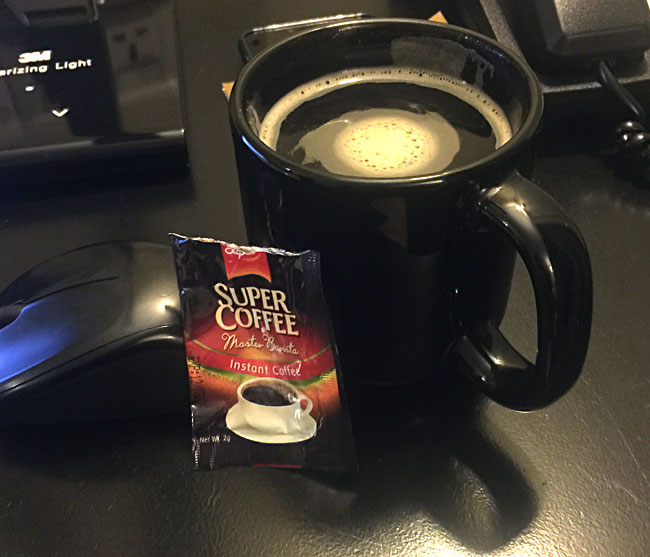
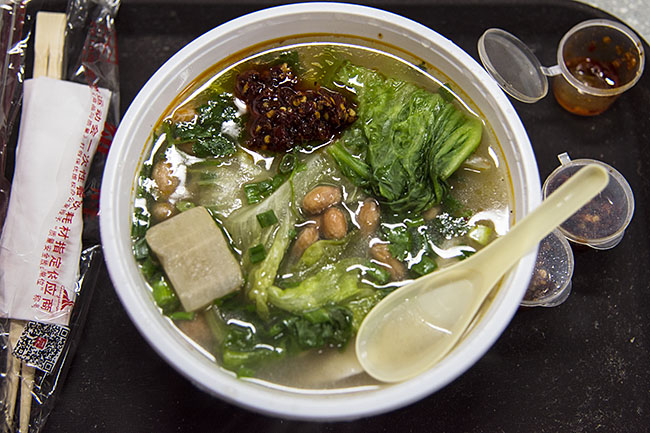
Sean took Gresh and me to a hole-in-the-wall place for lunch on the main drag just outside the entrance to Zongshen’s 100-acre manufacturing campus. It was one of those places I would have looked at and thought “who would ever eat here?” The food was amazing.Fried lotus with pork in Shandong Province. I could do a book about eating my way through China.A seafood selection, including a starfish, outside of Qingdao. I’d never heard of eating a starfish before the ride across China.Donkey burgers in Hebei Province. Kong, one of the Chinese riders, told me there’s an old Chinese saying that goes something like “people in heaven eat dragon burgers, and people on earth eat donkey burgers.” Cue in the music from Indiana Jones.I was leery of the super spicy stuff in China at first. Then I developed a taste for it. It was exquisite.Except for the tourist hotels in the big cities, folks don’t drink coffee in China. Gresh had a Nescafe stash, which he graciously shared with me each morning.The Canton Fair has a restaurant row that must have 100 restaurants. This delicious beef dumpling soup was a whopping 25 RMB (that’s $3.96 in US dollars), and it was delicious.
Baja
Hey, no discussion related to adventure riding and food would be complete without touching on Baja!
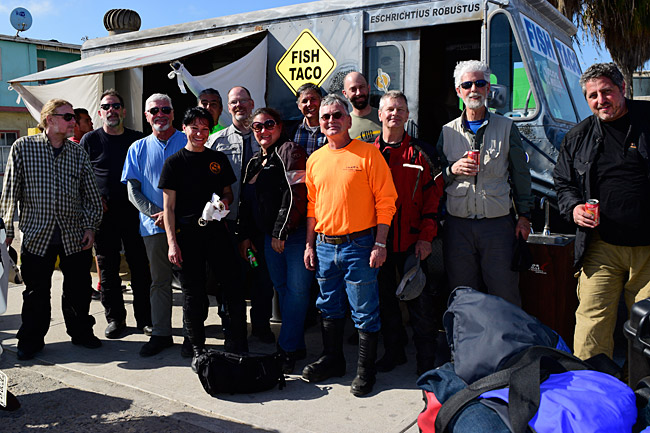
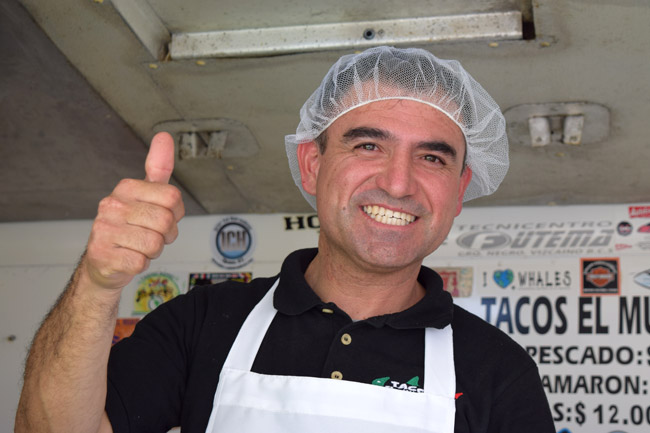
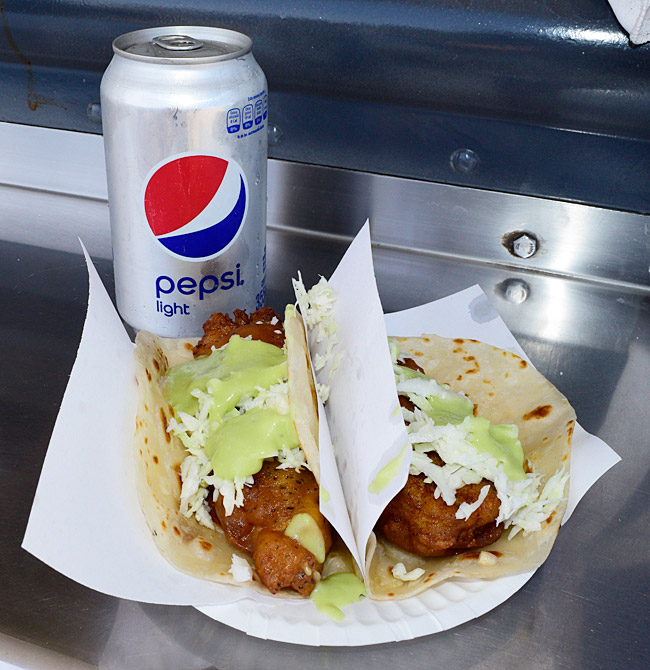
The best fish tacos on the planet are served up by good buddy Tony in Guerrero Negro, about halfway down the Baja peninsula. These are guys in one of the CSC groups I took down there a few years ago.The man, the mystery, the legend: Tony, fish taco chef extraordinaire!Tony’s fish tacos, worth a ride south all by themselves.Street tacos in Ensenada. It’s hard to go wrong with just about any kind of food in Baja.
The above is just a small sampling of delicacies I’ve enjoyed on the road. You can find more by reading about our other rides, and you can get to those on our Epic Rides page.
That’s it for now. For some reason, I’m hungry. Later, my friends.
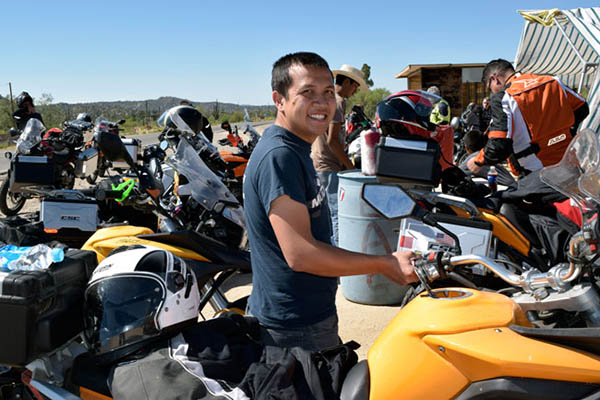
Good buddy Tuan asked me for a suggested 4-day itinerary for Baja, and I referred him to our Baja page and its included suggested Baja rides. Here’s another 4-day ride that would make for a great 4-day Baja visit: Tecate, Ensenada, San Quintin, and home again.
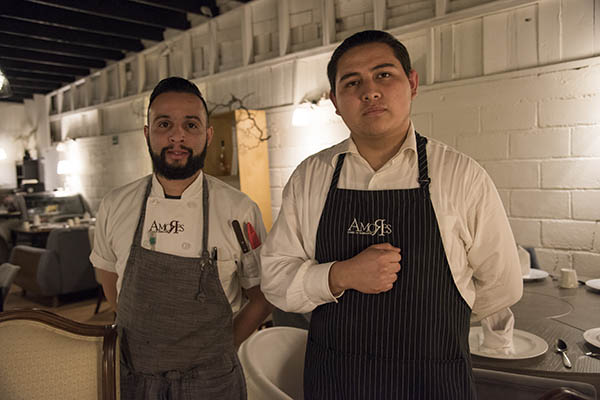
Tecate is one of the better best-kept secrets in Baja, and it’s one of my favorite towns. It’s about 150 miles south of the Los Angeles area and getting there is an easy ride. I like to stay at the El Dorado Hotel, have dinner at the Amores restaurant, and then breakfast at Malinalli’s, which is right next door to the El Dorado.
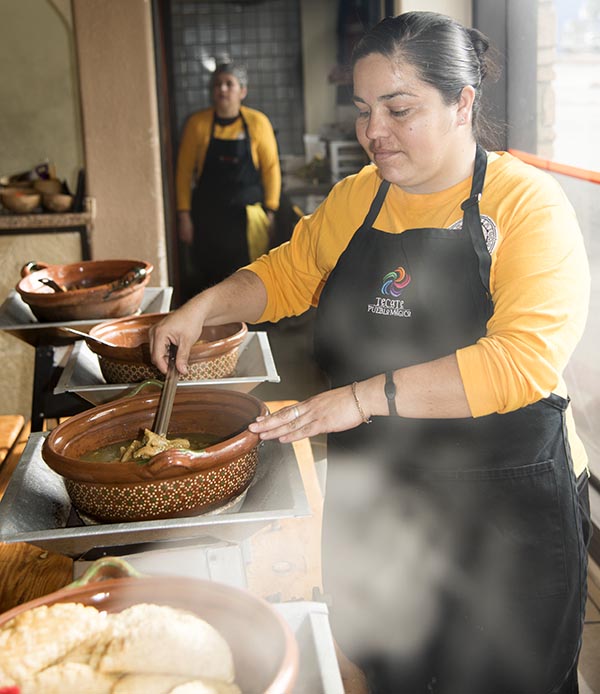
Jonathan and Pablo at Amores. It’s world class dining in downtown Tecate, and it is amazing.Maria, one of the friendly folks who took care of us in the Malinalli Sabores Autóctonos restaurant in Tecate.
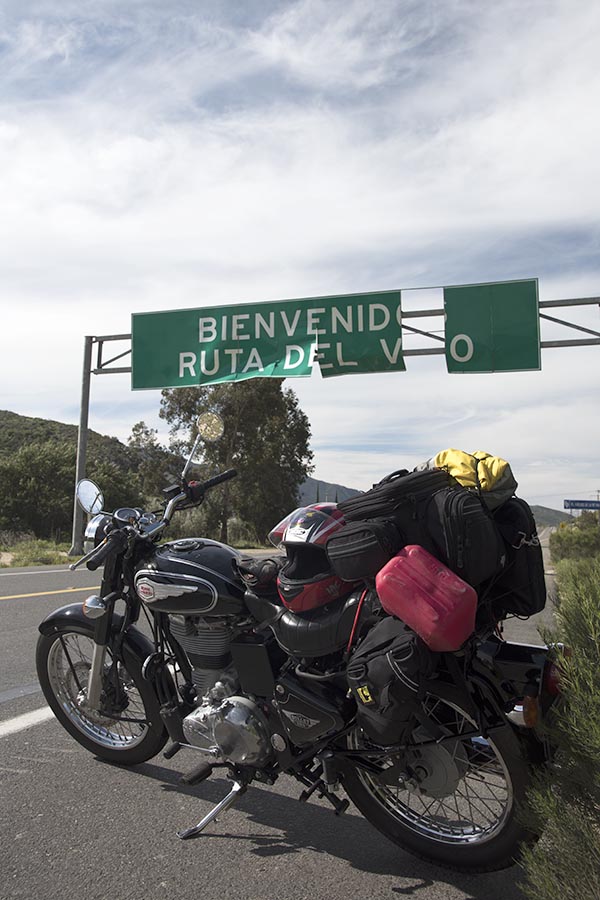
After breakfast, it’s an easy run through Tecate to Ensenada along the Ruta Del Vino, maybe with a stop at El Naranjo’s for lunch. It’s about an 80-mile ride and it’s quite scenic. Ensenada is touristy, but I like the place. You can get fish tacos at any of several taco spots along the embarcadero and have breakfast at Velero’s (world-class dining; it’s where knowledgeable Ensenada business folks take their morning meal). I’d stay in the Best Western and have dinner at Birrieria La Guadalajara. It’s a family style place my good buddy Tim introduced me to, and it’s great.
Breakfast at Velero’s. The place is amazing.A veritable feast at Birrieria La Guadalajara in Ensenada. Bring an appetite!
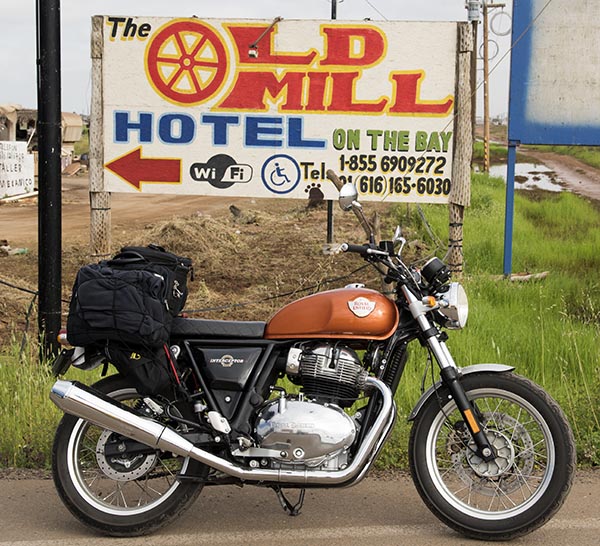
From Ensenada, it’s another easy run through northern Baja’s wine country and the agricultural region down to San Quintin. There are two great hotels in San Quintin. One is the more modern Mision Santa Maria. The other is the Old Mill Hotel right on Bahia San Quintin, which is the one I prefer. The Old Mill has a new restaurant called Eucalypto’s, and it’s world class.
The good folks at the Old Mill give you a beer when you check in. Here’s Uncle Joe, hard at work after a long day’s ride.Watch for the sign pointing to the Old Mill Hotel in San Quintin. It’s a classic Baja stop.Seared Tuna at the Eucalypto. Man, was it ever delicious!
After San Quintin, it’s about a 300-mile run home to get back to the Los Angeles area. It’s a long stretch, but it’s doable in a day, and it would nicely wrap up a great 4-day run.
If you do a ride like the one I describe, or any other, don’t forget to pick up your Mexican insurance, and for that, BajaBound is the best there is.
BajaBound Insurance for travel through an enchanted land. It’s the best there is!
Want to learn more about traveling through Baja? Check out Moto Baja!
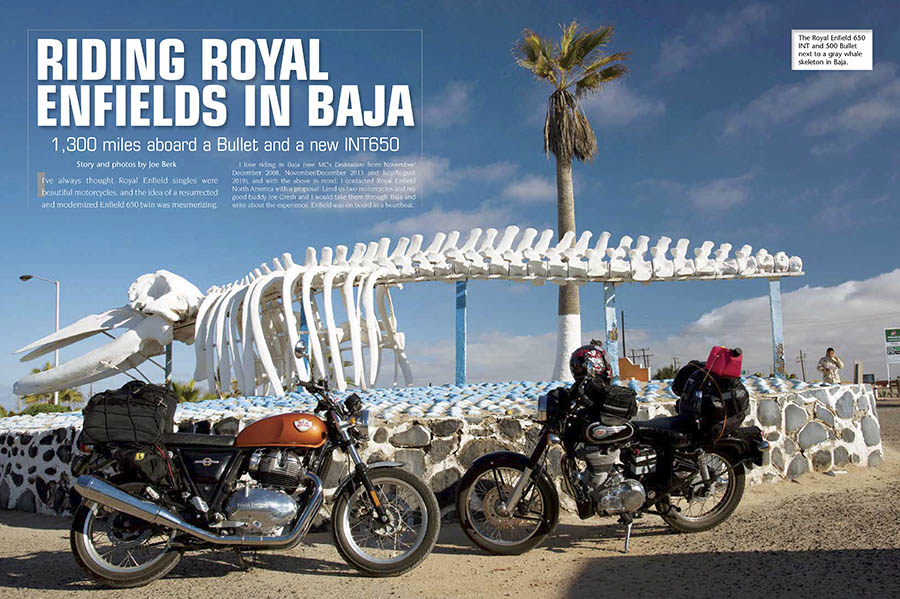
The Bullet in Baja. The new 650 Interceptor was a strong and reliable motorcycle. The Bullet, not so much, but it wasn’t the bike’s fault. Read the article, and learn more…
Some say the adventure doesn’t start until something goes wrong; by that measure, the Bullet was every inch an adventure bike…
Ah, quoted again. That’s my line, and you can read it online in the latest issue of Motorcycle Classics magazine.
Good times and great bikes in Baja, and the story is in the current issue of Motorcycle Classics magazine.
Our story of the Baja Enfield adventure is now available online, and you can read it here. Joe Gresh and I rode the new 650 Interceptor and an older Bullet, and we had a blast. Great food, great riding, beautiful people, and we said hi to the whales. It was awesome!
I thought it might make for a nice change of pace if I actually posted something about motorcycles on this here motorcycle blog, so yesterday I fired up my faithful old RX3 and rode over to CSC Motorcycles. Steve has a very cool 1982 Yamaha Seca that he said I could ride, and I wanted to experience what it’s like to ride a nearly-40-year-old motorcycle, built during the Reagan Administration, with only 1700 miles on the clock. I’ll have a story on that later (Spoiler Alert: The RX3 is a nicer motorcycle). For today, I grabbed a few photos of my RX3 and I wanted to talk about my bike and its decals a bit.
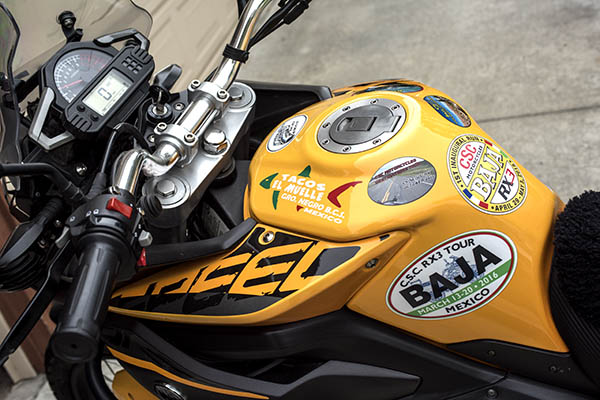
Restaurants, Baja Runs, and more…my RX3 wears its decals like campaign ribbons. In a very real sense, that’s exactly what they are.
My RX3 is one of the very first ones delivered to America when CSC starting importing the bikes, and the story behind that is well told (if I do say so myself) in 5000 Miles at 8000 RPM. It’s orange, which became sort of a nice orange-yellow over the years, and I like the look. I also like the look of a lot of decals. I always thought that was a cool aspect of the whole ADV thing, telling folks where you’ve been and (with the help of a little artwork and adhesive) bragging about it a bit. And my RX3 and I have covered a few miles.
My first big RX3 ride, and one of the things that I think put CSC and the RX3 on the map was the 2015 Baja Run (our first, and maybe a first in the motorcycle industry for a new bike introduction). I didn’t know how that would go, I was nervous as hell that the bikes wouldn’t fare well, but my fears were unfounded. It was an incredible ride. And, it was our first decal. That’s the big round one you see just above the my saddle in the photo above.
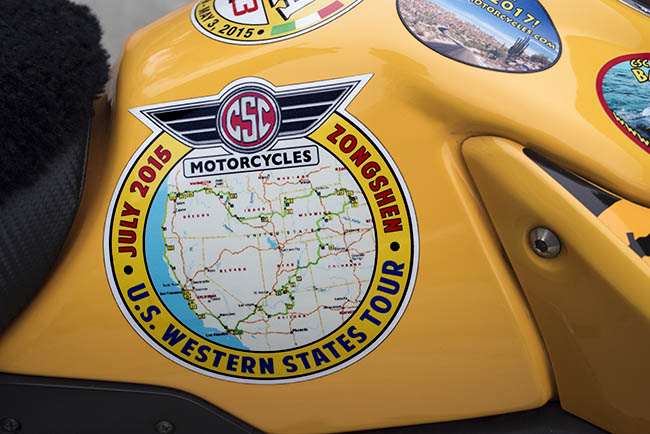
Next up: The Chinese and a couple of cool guys from Colombia wanted to come to the US and ride with us. And I got to meet a cool guy named Joe Gresh, who Motorcyclist magazine sent to ride with us. You need to read 5000 Miles At 5000 RPM to get the full story on that adventure tour, too. It was grand. Azusa to Mt. Rushmore in South Dakota, ride west across Wyoming, Idaho, and Washington, and then a turn left at the ocean to ride the western US coast back to So Cal. The relevant point here is that ride made for a bitchin’ decal, which you can see in the photo below.
The Western America Adventure Ride. It was grand. 5000 miles, lots of bikes, and not a single breakdown. Gresh staged a burnout with his RX3 in Port Orford, Oregon…the burnout heard around the world. John Welker planned our stops and navigated for us. It was a magnificent ride.
Then we did a bunch more CSC Baja rides, and with each one came another decal. Then I did a ride across China with Gresh on a couple of RX3s we borrowed from Zongshen (I wrote a book about that one, too). Then it was a ride around the Andes Mountains in Colombia with my good buddies Juan (who was on ride across America with us) and Carlos, both supercool guys who took great care of me in Medellin, Barichara, Mompos, and a whole bunch of other magnificent Colombian destinations. Yep, that resulted in yet another book.
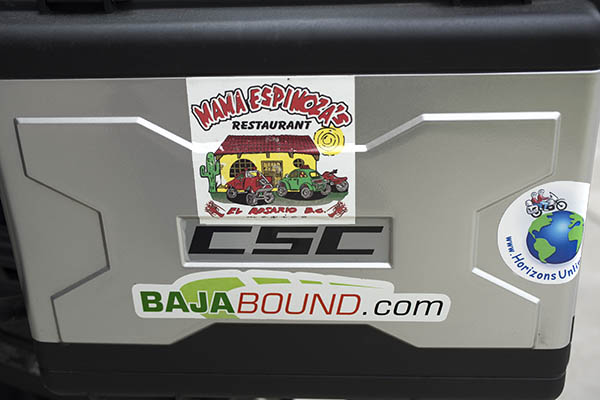
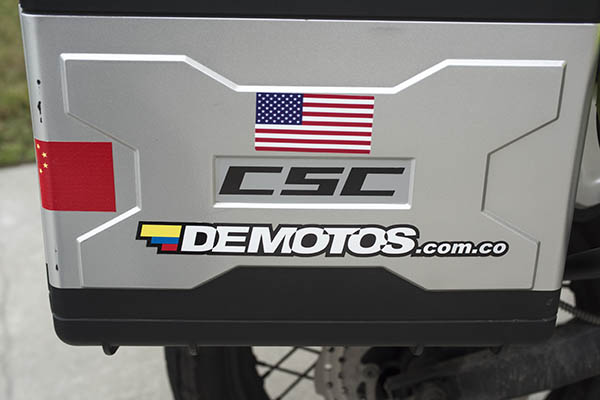
Luggage decals…Mama Espinoza’s in El Rosario (incredible lobster burritos), BajaBound Mexican insurance (the best), and the Horizons Unlimited Rally in northern California.My Chinese buddies gave me a Chinese flag to put on my bike, I had to add a US flag to show where my loyalties lie, and a decal good buddy Juan’s Colombian motorcycle magazine, DeMotos.com.co.
I could ask if you knew how many RX3 breakdowns I experienced in all those miles, but I know you already know the answer: Zero.
Yep, that little 250 has taken me to hell and back, and my RX3 just keeps running and running and running. An added benefit? Mine is orange (it’s the fastest color, Orlando).
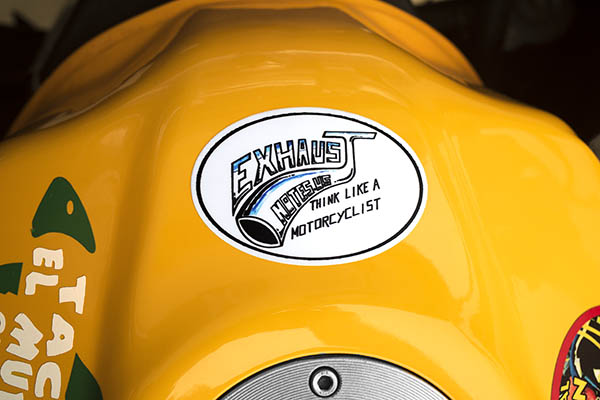
And that brings us to now, and the latest decal to adorn my well-broken-in, trusty, faithful and fearless companion. It’s the supercool ExhaustNotes.us decal, and it’s perfect on my RX3.
Joe Gresh had a magnificent idea in creating an ExhaustNotes.us decal. I had just enough real estate to add it to my RX3!
So there you have it. Imagine that: A motorcycle story on a motorcycle blog! And there’s more motorcycle stuff in the pipeline. Truth be told, I enjoyed my RX3 sprint this morning, and it helped me realize I need to ride it more. Welker called me about Sturgis a couple of says ago. That might be fun. If I go, I’d do it on the RX3. I’d forgotten just how magnificent a motorcycle the RX3 is.
Stay tuned, folks…there’s more coming!
Would you like your very own ExNotes decal? Hey, sign up for our automatic email updates, and we’ll shoot a couple out to you!
Hey, Motorcycle Classics magazine is running my story on Tecate in the next issue! You can read it here. More good news: I have another story in that same issue. Buy a copy if you’re not already a subscriber!
Our planned stop for the evening (and our turnaround point) was Guerrero Negro. It’s a town just south of the 28th Parallel, which forms the border between Baja California and Baja California Sur, the two states in Baja. It’s about halfway down the Baja peninsula.
Guerrero Negro is an interesting town. It’s named for the Black Warrior (Guerrero Negro in Spanish), a sailing ship that sank off the Baja coast a long time ago. It’s one of the best spots to see the whales in Mexico (you can read about that here). The whales hang out in Laguna de Ojo Liebre (the Eye of the Jackrabbit), also known as Scammon’s Lagoon. I’ve been down there many times to see the whales, and it is one of life’s main events. That’s a strong statement, and if you’ve never seen the whales in Baja, you’ll think I’m exaggerating. If you’ve seen them, though, you’ll know I’m not. It’s a surreal and awe-inspiring experience. The whales are in town from January through March, so we wouldn’t be seeing them on this visit.
We usually stay at Malarrimo’s in Guerrero Negro. It’s a great hotel with a great restaurant. I had a cup of coffee that morning that was just perfect.
The little town of Guerrero Negro has another distinction: It’s one of the biggest salt producing regions in the world. The area has hundreds of square miles of shallow flats that the Mexicans flood with sea water. They let the water evaporate and then they bulldoze up the salt. Mitsubishi owns 49% of the production operation; the Mexican government owns the other 51%.
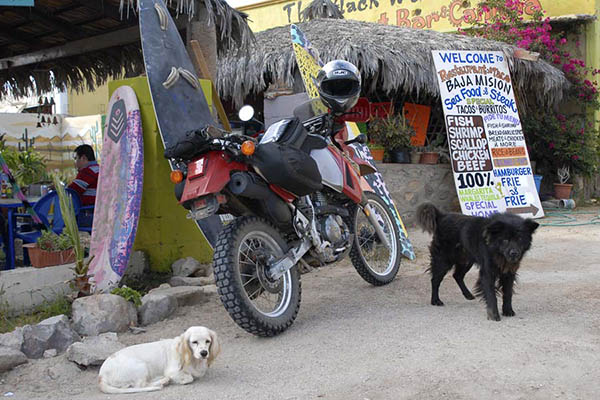
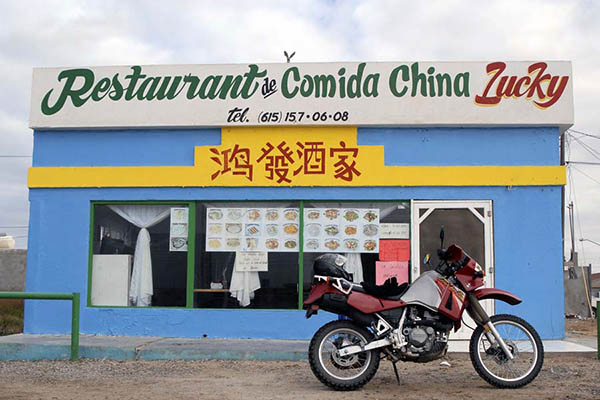
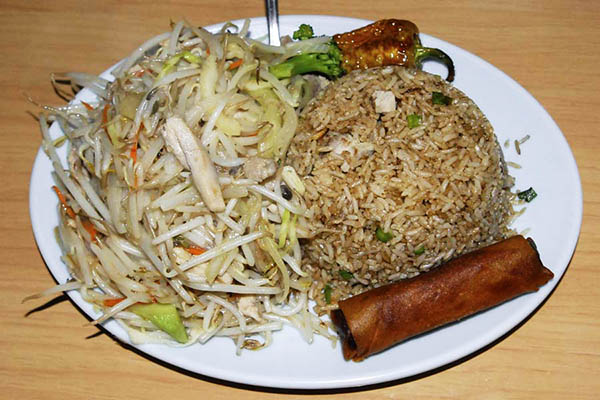
We stopped for fish tacos in Guerrero Negro’s Baja Mision restaurant. These were the only two dogs we saw on this trip that didn’t chase us.Laura, our waitress in Guerrero Negro when we ate at the restaurant in the above photo.John saw this Chinese restaurant in Guerrero Negro, which seems kind of funny. We had dinner there.Chicken chow mein in Guerrero Negro. It was great.
I got up early the next morning and rode around for a bit, exploring Guerrero Negro. With all of the luggage off the KLR, it felt much lighter and faster. I grabbed a few shots around town. I rode through all of Guerrero Negro, including its residential areas. Another 8 or 10 dogs chased me, intending to do me serious harm. None succeeded. By this time itwas almost funny. See a dog, go like hell, hope for the best. It was grand sport.
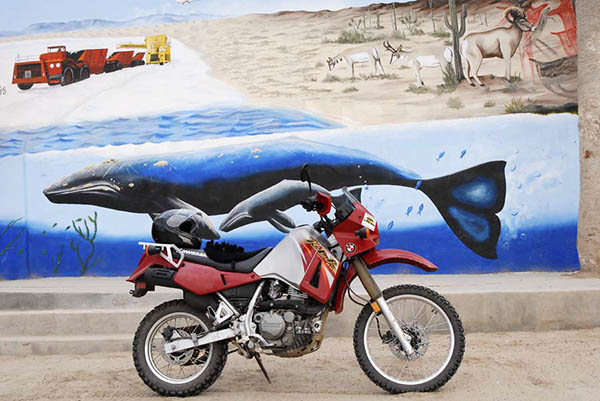
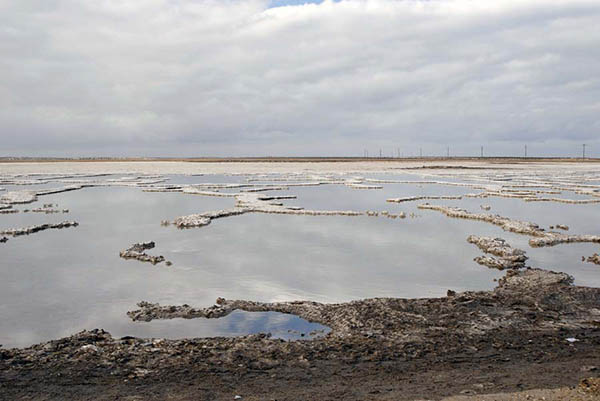
This is a mural on Guerrero Negro’s supermarket wall.This is one of the salt flats. When this area dries, the salt company will scrape up the salt, flood it again, and repeat the process.
As I mentioned above, Guerrero Negro was our turn-around point on this trip. Here’s a shot on the way home, in the desert headed north.
Those Cardon cactus are impressive.
We stopped again in El Rosario, this time for a lunch at Mama Espinoza’s. This is their take on fish tacos. They were excellent.
Fish tacos at Mama Espinoza’s. Life doesn’t get any better.Maria, our waitress in Mama Espinoza’s. There are a lot of ladies named Maria in Mexico.
After Mama Espinoza’s, we topped off at the Pemex station in El Rosario and continued north.
On the Transpeninsular Highway, south of Ensenada. I had to stop and grab a shot of this cactus path.
We rolled into Ensenada well after dark and decided to call it a day. That night we stayed in the Best Western in Ensenada’s tourist district, and it was nothing like any US Best Western. It was a really nice place. We unpacked and parked the KLRs right next to the entrance, and a guy who worked at the hotel put a rope barricade around them. We didn’t know if it was to keep people from touching the bikes, or if it was to isolate them for another reason…John’s KLR’s fuel petcock had developed a drip, and because of that, the area soon reeked of gasoline.
To be continued…
Want to read about more epic motorcycle rides? Click here to get to our Rides page.
Hey, why not sign up for our automatic email updates? You might win one of our adventure ride books. Just enter your email address here:
We promise we won’t share your email address with anyone else.
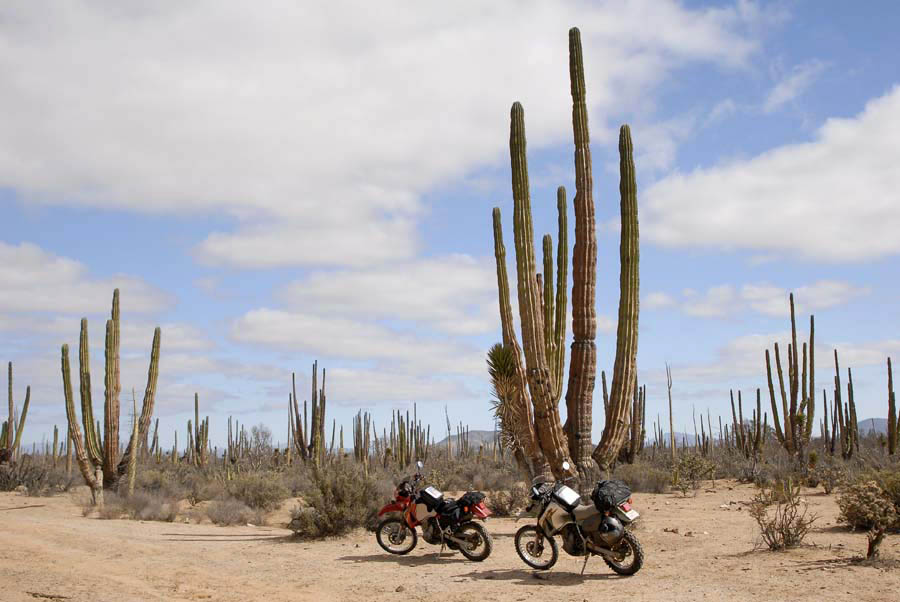
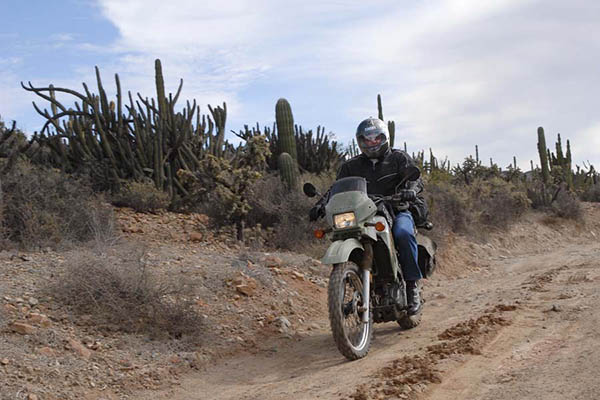
When the Transpeninsular Highway continues south after leaving El Rosario, it crosses a long bridge across the dry Rio El Rosario and then winds into the mountains on the northern edge of the Valle de los Cirios. The wilderness starts here, and it is awesome. I love this area. It’s the first place you encounter cardon cactus and the cirios. These things grow only in Baja (you won’t find them anywhere else on the planet). The Cardon are the giant cactus that look something like the saguaro cactus in Arizona, but the cardon are much, much larger. The cirios are the weird-looking thin shoots that grow to heights of around 30 or 40 feet (maybe even more). Someone once wrote that they look like a plant that Dr. Suess would have designed, and I think that’s a good description. They have this kind of weird, whimsical, goofy look…the kind of thing one might create when under the influence of, well, whatever your preferred mind-altering substance is.
I grabbed a few shots of our KLRs a few miles into the mountains. You can see the cardon and the cirios in the background.
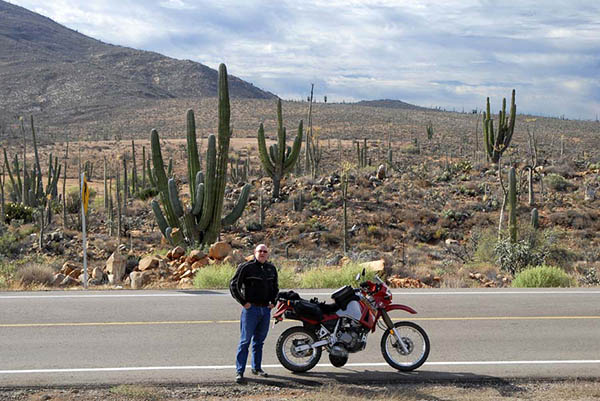
My KLR 650. I had the Kawi soft luggage on it and a Nelson-Rigg tank bag.John’s KLR. These bikes just keep going and going. They’re perfect for this kind of ride.Baja cacti. It’s one photo op after another in Baja.A shot along the Transpeninsular Highway in the Valle de los Cirios.Baja John standing by my KLR. The background almost looks like it’s been painted into this scene.
After rolling along the highway a few more miles, I saw something out of the corner of my eye on the road. At first I wasn’t sure, and then as I was playing back the image mentally, I decided I needed to turn around and take another look…
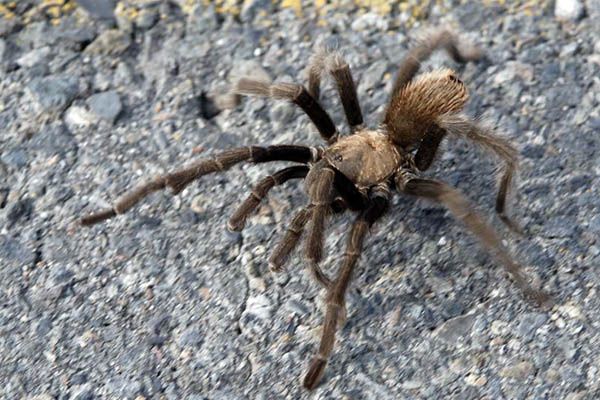
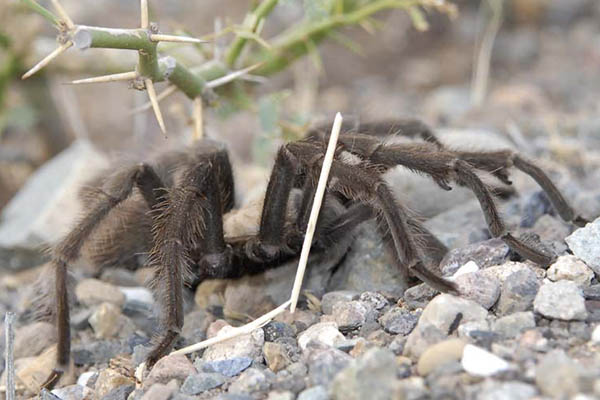
Yep, my eyes weren’t playing tricks. I had seen what I thought I saw. Is that correct grammatically? Whatever. The spider was huge.
Wow, that was one monstrous tarantula! We parked the bikes and started taking photos. This spider was easily double the size of the tarantulas I’ve seen in California.
John got down in front of the tarantula. He squatted to get a closer look, and then something wild happened. The spider ran straight at John. We were both shocked at its speed. They normally seem very deliberate and slow, but I have to tell you, that one moved terrifyingly fast.
John jumped up, screamed, and propelled himself backwards faster than a Democrat mistakenly wandering into a Trump rally. John was paddling backward so fast he looked like an old Warner Brothers roadrunner cartoon.
We both laughed after it happened. Here we were, two guys old enough to know better, screwing around with a ginormous tarantula in the middle of the Baja peninsula, laughing like a couple of kids. Baja does that to you.
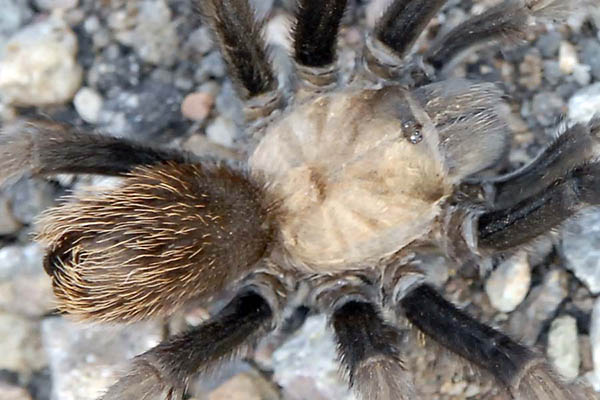
Look at this fellow’s little beady eyes. And his hairy butt. That’s quite a hairdo. It kind of reminds me of Beavis and Butthead. Come to think of it, those might be appropriate names for John and me.The tarantula crawled under a plant, I took a few more photos, and we were on our way.
I think I already mentioned that I had my Nikon D200 on this trip and an older (non-VR) 24-120 Nikon lens. I mostly shot at f/8 (the 24-120’s sweet spot) in the aperture mode, which is a mode that works well for me. I also had the 12-24 Tokina wide angle lens along for the ride, but I never even mounted it on the camera. The 24-120 is not a macro lens, but it did an acceptable job here. The Tokina lens does a good job, too, but the 24-120 Nikon was handling everything for me on this ride.
Our next planned stop was the Mission San Fernando Rey de Espana Velicata. We almost didn’t go. I had been spooked by the dogs, and I told John the night before that I wasn’t too keen on rolling through any more little villages with dogs. John waited awhile and casually mentioned that he really wanted to see some of the sights accessible only by dirt roads. I acquiesced and I’m glad I did. We saw some amazing things…things we wouldn’t have seen if we hadn’t wandered off road.
Further down the Transpeninsular Highway, we saw the sign for the Mission San Fernando Rey de Espana Velicata and a dirt road veering off to the west. I took the turn first, and son of a gun, a dog materialized out of nowhere and started chasing me. This time the dog was so small it was funny. It was a little Chihuahua, and he looked anything but threatening. The little guy was behind me yapping up a storm and I was enjoying the chase. Those little legs were pumping for all they were worth and he still couldn’t keep up. It was me, the Chihuahua, and John (in that order) rolling down this dirt road. The pup was struggling to keep up, barking all the while and trying his best to be intimidating. I could hear John laughing behind me. I should have grabbed a picture.
On the road to the Mission San Fernando Rey de Espana Velicata
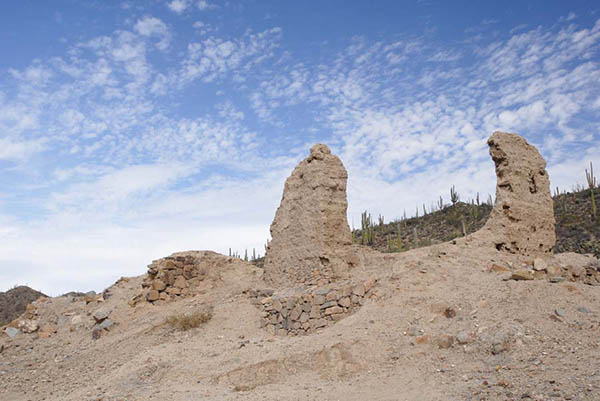
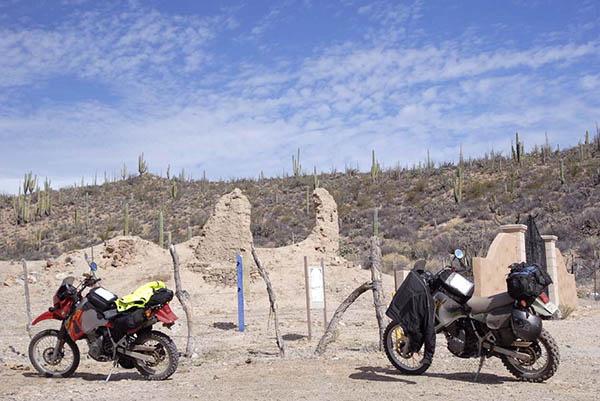
The Mission San Fernando Rey de Espana Velicata was the only one in Baja founded by the Franciscans (the Jesuits did all the others). It only lasted from 1769 to 1818. It was built to convert the local Cochimi Indians to Catholicism (that was how it was advertised; basically, the missions were labor camps with a touch of that old time religion). Unfortunately, the Spaniards brought diseases for which the indigenous people had no immunity, and disease soon ravaged the area. The entire mission system in Mexico ended in the early 1800s, when Mexico gained its independence from Spain. It’s not a pretty story, but there’s a history here and it’s intriguing to visit these ancient places (especially when they are well off the beaten path).
The Mission San Fernando Rey de Espana Velicata. This is all that’s left of it.Our KLRs parked in front of the mission ruins.
The place was amazing. I’d seen the sign and the dirt road to get to the mission on each of my prior Baja visits, but I had never been to see it. Getting there and taking it all in was fun.
After visiting the Mission San Fernando Rey de Espana Velicata, we rolled south along the Transpeninsular Highway a few more miles and took another dirt road (this time to the east) to see the ruins at El Marmol. El Marmol was a world-famous marble and onyx quarry 50 years ago. Like the mission, we’d seen the signs for it on our earlier travels through Baja, but we had never made the trip out there to see it. I always wanted to see what El Marmol was all about, especially after reading about it in several Baja references. Carole Lombard had a bathtub made from El Marmol marble, you know.
The ride out to El Marmol was exciting. The road was rough and had deep sand in several spots. My friend Bob had previously told me that the best way to take this stuff was at high speed, and that’s what we did. It made an enormous difference. I could see the rough road beneath me, but the KLR’s long-travel suspension let me fly over it. It was almost an out-of-body experience. I enjoyed it. I was in the zone, and suddenly, we were there.
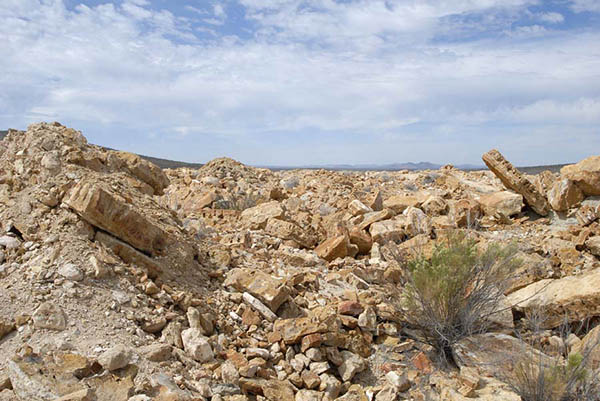
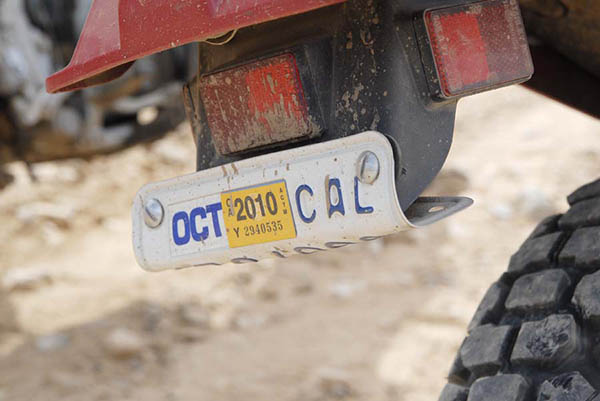
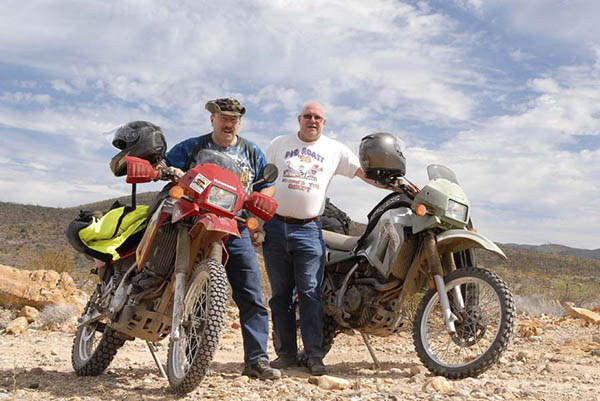
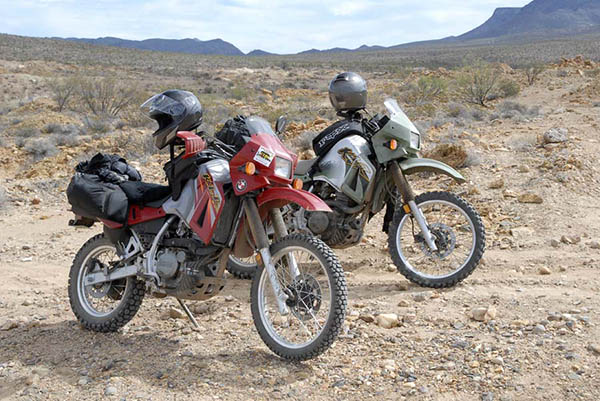
El Marmol. There isn’t much to it, other than a pile of big rocks. Folks still come out here to get the marble. We saw a few Mexicans loading some into a tiny pickup truck.I bottomed the suspension in a few spots on the ride out to El Marmol, and this is what it did to my KLR’s license plate. Many first-gen KLR owners relocate their license plate up on top of the rear fender. Now I know why.Two KLRistas at El Marmol. That’s my yellow riding jacket on my KLR. It seemed to aggravate any dog who saw it.The KLRs at El Marmol.
We stopped for a break on the way out of El Marmol where the dirt road rejoined the Transpeninsular Highway. We had a good conversation with Jose, a police officer from Catavina who consented to a photo.
Good buddy Jose, my tocayo.
There were two dogs hanging around the place watching John, Jose, and me. They seemed friendly enough when John gave one of them a snack. Then we got on the motorcycles and it was as if someone had flipped a switch. The dogs instantly turned mean, snarling and going after John, who was accelerating sharply way (a relative term, to be sure, when you’re on a KLR). There’s a rule in Mexico, I guess. If you’re a dog and you see a guy on a motorcycle, you’ve got a reputation to maintain. This time, though, both dogs went after John and ignored me. They chased John all the way back to the highway, with me following. Hey, that’s was okay by me. I’d already earned my combat pay.
The dogs chasing John, though, didn’t seem to have their hearts in it. They were chasing John like it was part of their job description and the boss was watching. Going through the motions. Phoning it in. You know the drill.
I thought about that as we continued south. I reasoned and hoped that as went further into Mexico (and we were about 350 miles into Baja at this point), the dogs might be nicer. Our next destination was Guerrero Negro, 500 miles south of the border. We would soon find out.
Check out our other Epic Motorcycle Rides, and watch the ExNotes blog for the next installment of the Baja KLR Khronicles!
Like what you’re reading? Sign up for our automatic email updates, and you’ll be eligible for our quarterly drawing to win one of our adventure motorcycle books. Want to read about our other Baja motorcycle adventures? Order your own copy of Moto Baja here!