Phavorite Photos: Luoyang Nightrider

By Joe Berk

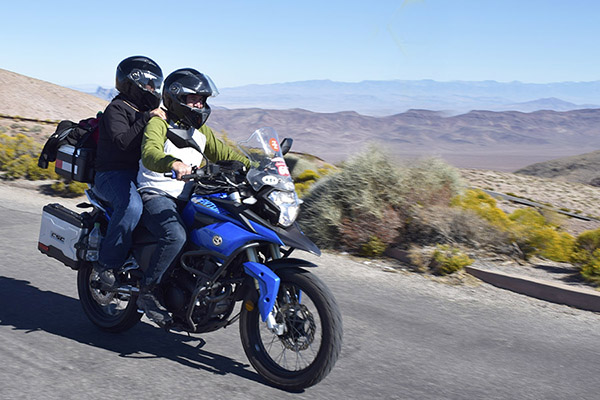
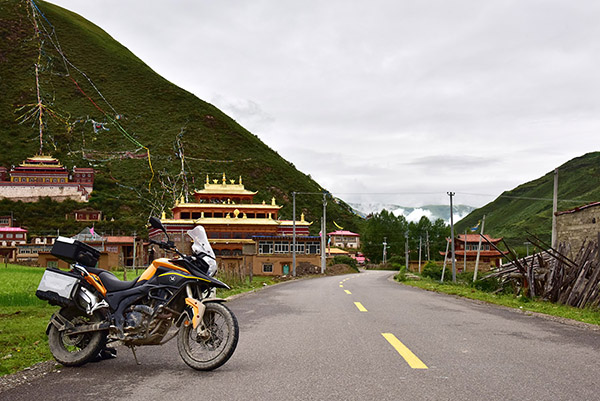
We’d been on the road for about a month, riding a big loop through most of China.  It was the ride of a lifetime, Zongshen was picking up the cost, and we were having a ball.  It was me, riding compadre Joe Gresh, and Sergeant Zuo, our fearless retired Chinese Army Sergeant Major.  I’d be hard pressed to identify any other single month in which I’d so much fun.  Great riding, great companions, great roads, great food, and great photo ops.  My book , Riding China, is about that ride and it included a chapter on Luoyang; here’s a quote from it leading up to the photo above:

It was dark when we walked home, and I watched people riding by in the sultry summer night air on their motor scooters.  I knew I had to capture at least some of it for the blog and for this book, so I went back to the room for my Nikon and the 24-120 lens.  I cranked the ISO up to 3200 and let her rip.  It was great.

The technique is called panning; you swing the camera to stay on a moving subject, which freezes the subject and blurs the background to convey a sense of motion.  Not every photo turns out using this technique, but when one does, it’s spectacular.

We stayed in Luoyang for two nights, and it was a well-earned rest we all needed.  Those were good times.  I miss the guys we rode with.

The above photo is one of many included in Riding China.  If you would like to read more about that ride, pick up a copy!


Join our Facebook ExNotes page!


Help us keep the lights on:


Don’t forget: Visit our advertisers!


The Jim Carmichel Marlin

By Joe Berk

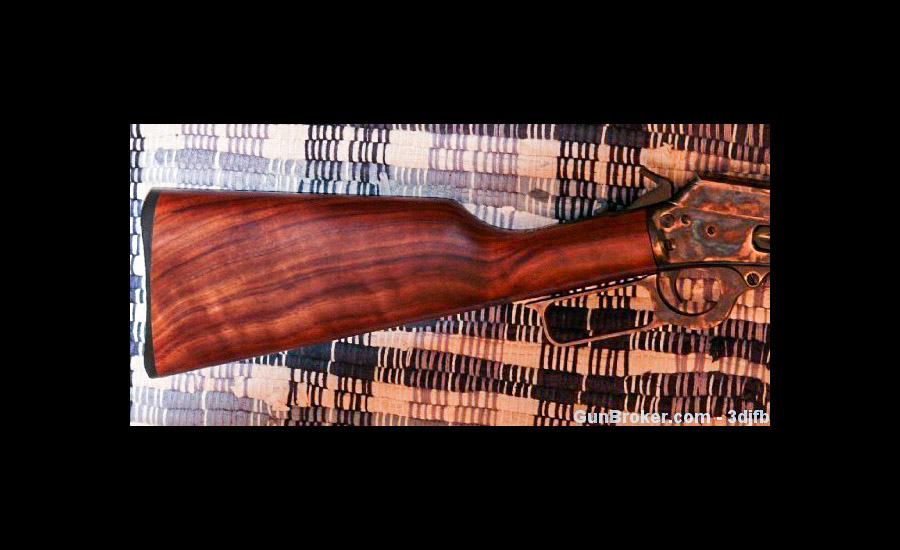
I am a fan of Marlin lever action rifles, and when I saw this one in a Gunbroker ad 15 years ago, I knew I had to have it.  I’ve been reading Jim Carmichel’s articles for a good 30 or 40 years, and owning a rifle that he once called his just felt right.  I already had the .38 Special dies, so there would be no additional expense for that (although that became a moot point, as I decided to keep this rifle unfired).

Adding fuel to the fire was the fact that the tuned Marlin rifles (slicked up for cowboy action shooting) were just about impossible to find back then, and not too long after that Marlin stopped offering these guns altogether.  That’s kind of moot, too, as I’m not a cowboy action shooter and at this point in my life I have no plans to become one.  And then there was the thing that’s always been irresistable to me:  Pretty walnut.   This rifle checked all the boxes for me:  Good walnut, good provenance, rarity, color case hardening, an octagonal barrel, an action job, and it was made from my favorite firearm material (i.e., unobtanium).  I called the shop selling the gun, worked out a trade for a handgun I no longer wanted and a little cash, and the Cowboy Carmichel Marlin you see here was on its way to me.

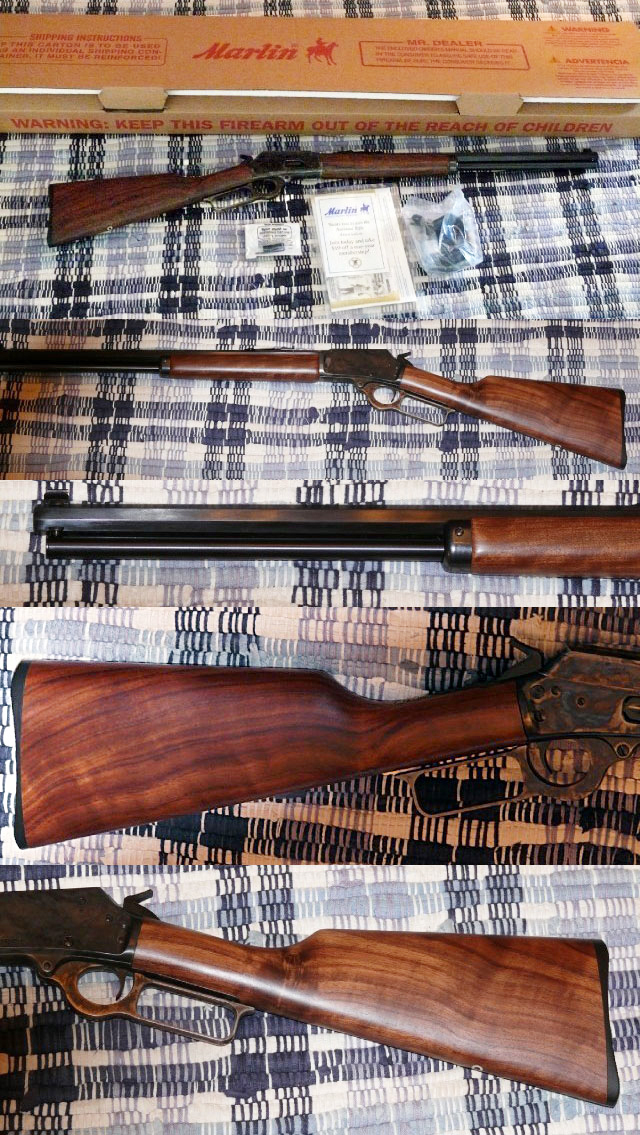
A composite of photos from the original 2011 Gunbroker ad.

When I remember to do so, I save the Gunbroker ads that prompt me to purchase a firearm.  Here’s the text from that ad:

Rare Marlin Cowboy Competition in .38 Special, 20″ octagon barrel, case colored receiver. This rifle is unfired and owned originally by Jim Carmichael, the shooting editor for Outdoor Life magazine. It comes with the box numbered to the rifle, manual, hammer extension, lock and a letter attesting to being part of the Carmichael collection. Very nice wood, nice metal and finish, unfired and collectible.  Factory tuned for cowboy action shooting.  Shipping is $45 CONUS upon receipt of payment and copy of FFL.  Has special “factory-tuning” operations performed on it to enhance levering speed and target acquisition. “Tuned” parts include: finger lever, finger lever plunger spring, hammer, breech bolt, breech bolt lock, carrier, hammer spring, and ejector. For serious Cowboy Action shooting competitors who want a lightning-fast carbine, the 1894 Cowboy Competition is the perfect choice. Features a 20″ octagon barrel for quick sight alignment, and a western-style straight-grip walnut stock. Sights are traditional Marble adjustable semi-buckhorn rear and Marble carbine front. The receiver, bolt, trigger guard plate and lever of the 38 Special are color case-hardened for an authentic 19th Century look. To accommodate tang sight installation, the serial number is located on the left side of the receiver.

Caliber 38 Special. Capacity 10-shot tubular magazine. Lever action with squared finger lever; side ejection; color case hardened receiver, bolt, trigger guard plate and lever; solid top receiver; hammer block safety. Straight-grip American black walnut; hard rubber butt plate; tough Mar-Shield finish; blued steel fore-end cap.  Tapered octagon barrel with deep-cut Ballard-type rifling (6 grooves). Twist Rate 1:16″ r.h.  Adjustable Marble semi-buckhorn rear, Marble carbine front sight. Offset hammer spur (right or left hand) for scope use. Serial number is on left side of receiver, instead of tang, allowing custom installation of a tang sight by a competent gunsmith.  Overall Length 37.5″Weight 6.5 lbs.

Sometimes you see something that you recognize is a want and not a need.  I didn’t need the Carmichel Cowboy rifle, but I sure as hell wanted it.  And now I own it.

The ExNotes blog has a number of other Marlin stories, and you can find them here.


Join our Facebook ExNotes page!


Help us keep the lights on:


Don’t forget: Visit our advertisers!


Phavorite Photos: Utah Highway 12

By Joe Berk

When good buddy Baja John and yours truly ran the mother of all publicity stunts (the CSC Motorcycles Western America Adventure Ride) through the western United States, I had the easy part.  I simply rode at the head of the formation of our dozen or so Chinese, Colombian, and US riders.  Baja John did all the heavy lifting: Selecting our routes, mapping out the course, and handling all the hotel reservations.  John did a hell of a job, finding roads that were scenic, twisty, and representative of the best riding America has to offer.  Of all the roads we rode, one in particular stands out:  Utah’s Highway 12.

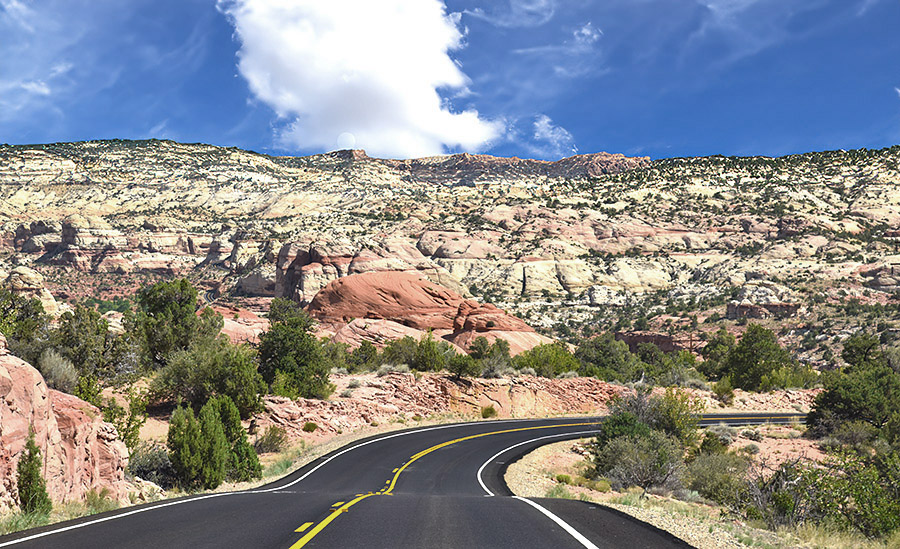
Utah Highway 12 runs from just east of Bryce Canyon National Park to Capitol Reef National Park, and it something out of a psychedelic mapmaker’s mind with the vibrance turned up.  Way up.   The road winds its way through by bright pink and white sandstone cliffs, with its black tarmac and yellow lines piercing a path through a dramatic landscape.  It is fine motorcycling; the stuff of dreams and brilliant memories.  If you’ve never ridden Utah, trust me on this: You need to.

I enjoyed that stretch of Utah so much that a year or two later Susie and I repeated the trip, and it was along Utah Highway 12 that I stopped and grabbed the photo you see above.  Sometimes these photos are a little tricky to capture while standing in the road, focusing on composition, angling the polarizer for the best saturation and reflection elimination, holding the camera steady, and grabbing the best possible photograph, all the while listening intently for any traffic barreling up the road behind me.  The trick is to not get run over while seeking the perfect picture.  So far, I’ve been lucky.

I used my Old Faithful combo (my Nikon D810 camera and 24-120 lens) for the above photo.  I used to think prime lenses (i.e., lenses of the non-zoom variety) provided the sharpest images, but the Nikon 24-120 lens changed my mind.  It’s as sharp a lens as any of the several I’ve used.  I did not use a tripod.  The Nikon 24-120 has a built-in vibration reduction feature, so on a bright and sunny day there’s really no need for a tripod.  Hand-held is good enough.

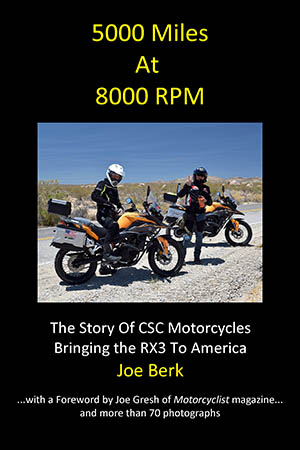
There’s a bit more to the story, and that’s another story.  I pitched this stretch of road as a “Destinations” piece for Motorcycle Classics magazine, and they bought it.  You can read that article here, and you can read a few of my other destinations pieces here.  If you are not a Motorcycle Classics subscriber, you should be.  It’s one of the few remaining motorcycle print publications, and it has always been one of the best.  And if you want to read more about our trek across the western US, get yourself a copy of 5000 Miles at 8000 RPM.


Earlier Phavorite Photos?  You bet!  Click on each to get their story.


Join our Facebook ExNotes page!


Help us keep the lights on:


Don’t forget: Visit our advertisers!


The Rifleman’s Rifle

By Joe Berk

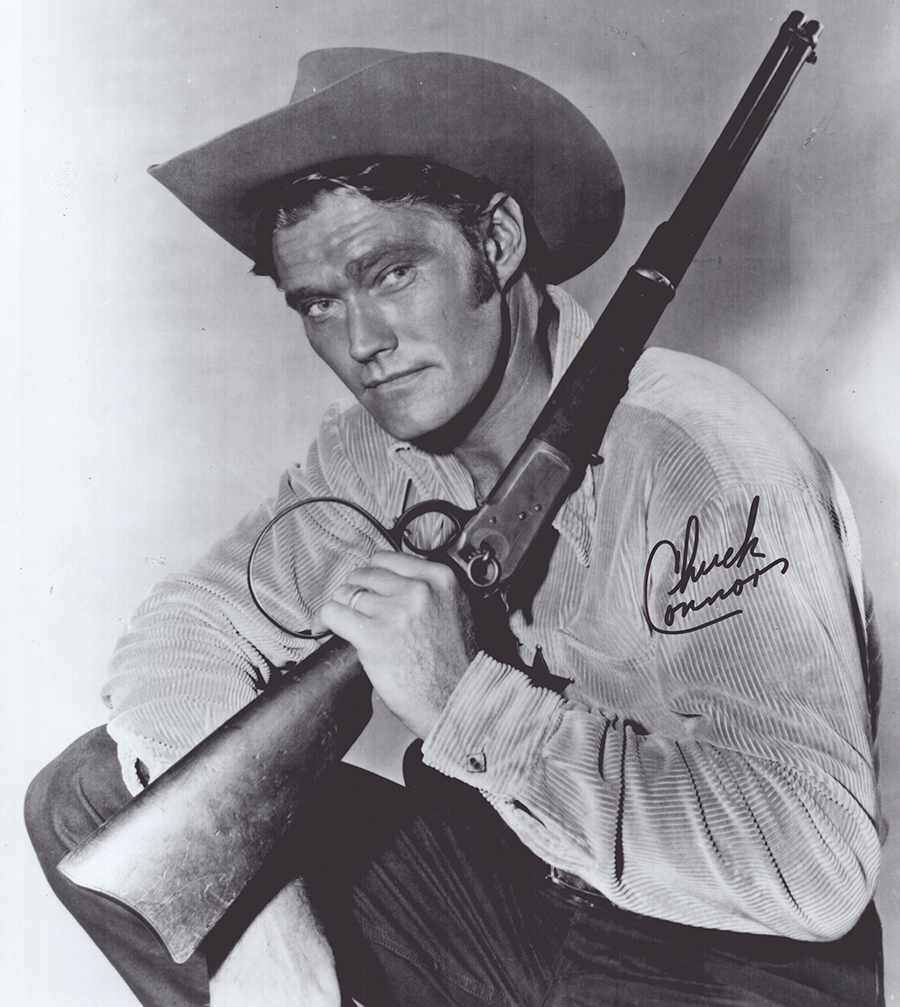
As a kid growing up in the ’50s, I watched a bunch of cowboy movies and TV series.  One was The Rifleman, starring Chuck Connor.  Unlike most of the TV shows in which the hero carried a Colt 1873 Single Action Army revolver (a “six shooter”), Connor’s character carried a Winchester 1892.  The rifles he used recently went up for auction, and the price attained was stratospheric.


Join our Facebook ExNotes page!


Help us keep the lights on:


Don’t forget: Visit our advertisers!


Magnificent Motoliterature!

By Joe Berk

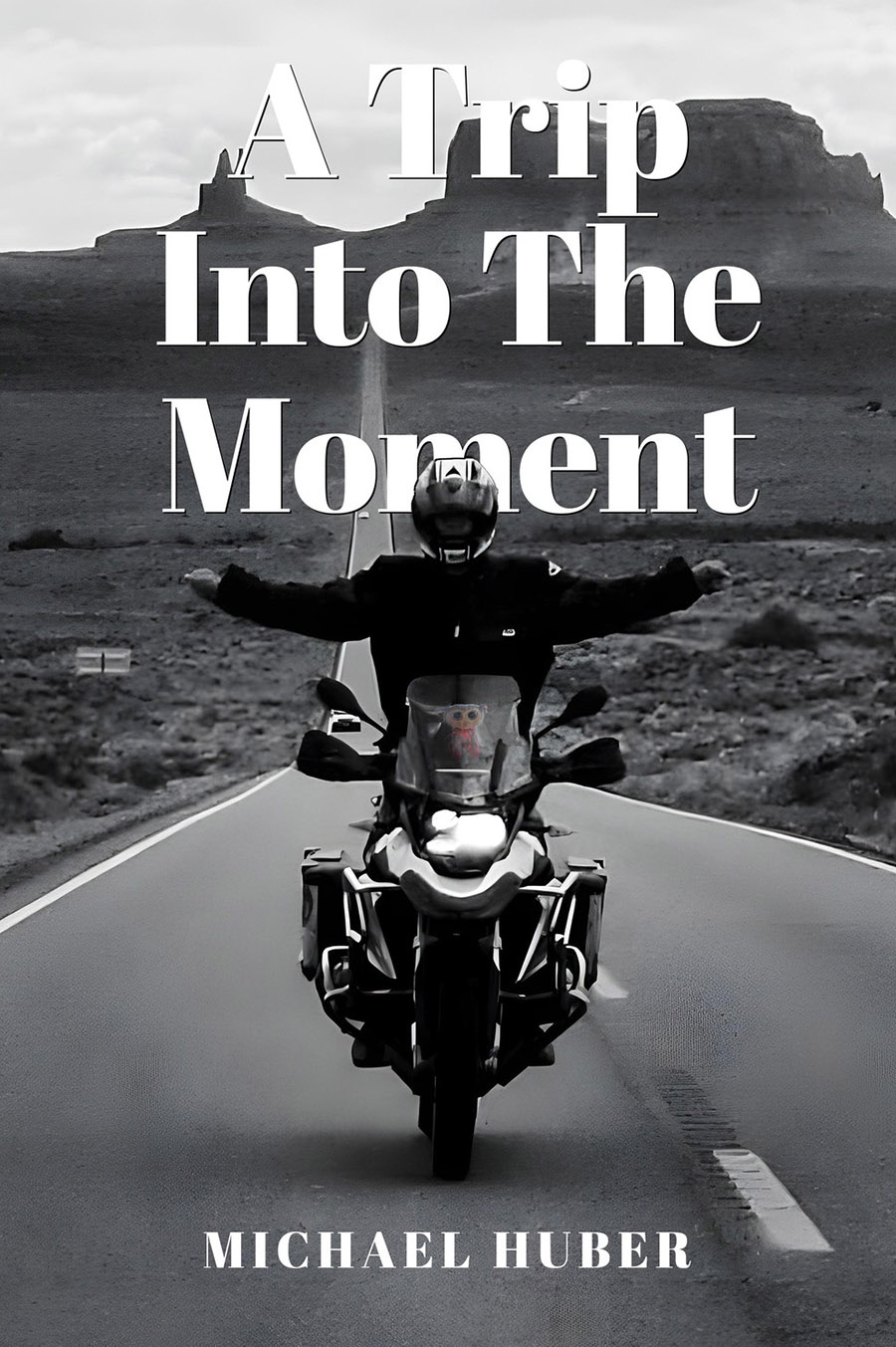
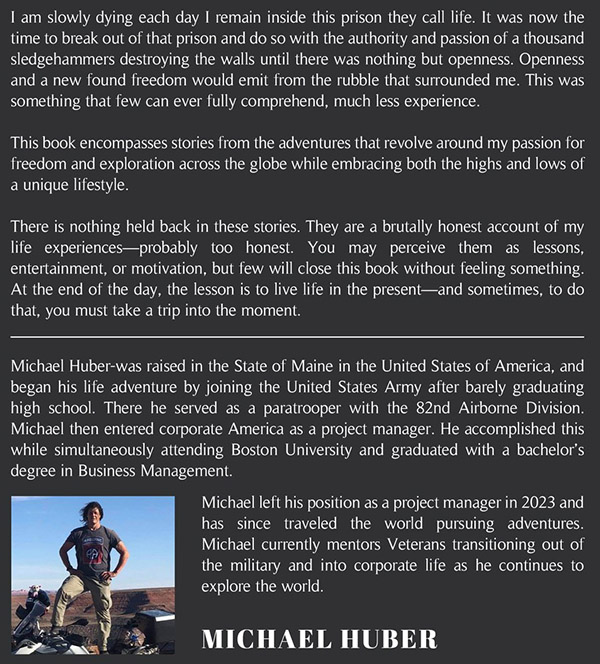
It had to happen:  Good buddy and frequent ExNotes blogger Mike Huber wrote a book!  Mike’s book is A Trip Into The Moment, published by Native Book Publishing.  You should buy it now from Amazon.  Here’s the back cover blurb:

We are a literary bunch, us ExNotes writers.  Joe Gresh and I published a collection of our favorite stories not too long ago, and I’ve penned (or keyboarded) a few myself.  Here’s a link to the Gresh and yours truly book, A Cup O’ Joes:

Want to lose weight, ride faster, and impress your friends?  Add our books to your library and drop a Huber, Gresh, or Berk quote from time to time.  Better yet, buy a copy of each of our books and post this blog’s link on your social media (it will help with sales)!


Join our Facebook ExNotes page!


Help us keep the lights on:


Don’t forget: Visit our advertisers!


ExNotes Movie Review: The Stringer

By Joe Berk

The Stringer is a recently released show on Netflix.  It tells the story behind a photo most folks my age remember well: The 1972 Vietnam War photograph of a little girl, Phan Thị Kim Phúc, who was severely burned by a napalm  bomb dropped by a South Vietnamese aircraft.

The story goes like this:  Nguyễn Thành Nghệ is the photographer who actually took the photo.  Nghệ was a stringer (a freelance photographer).  When he sold the photo to Carl Robinson at the Associated Press, the guy in charge (Horst Faas, who died in 2012) decided to attribute it to Nick Ut, an AP staff photographer.  Robinson felt uncomfortable about doing so, but did as he was told.  Ut was present at the scene when the photo was taken and willingly accepted credit for the photo, although he had to know he had not taken it.

The photo went on to win the 1973 Pulitzer Prize for Spot News Photography, the World Press Photo award for Photo of the Year, and the George Polk News Photography award.  It made Nick Ut’s career.

Carl Robinson went public with what he had been told to do 50 years later (which would be 2022).  The Netflix show (The Stringer) presents compelling arguments that Nghệ , not Ut, was the actual photographer.  The Associated Press rejects these claims and still attributes the photo to Ut; World Press Photo accepted Nghệ’s authorship and stripped Ut of its award.

Not included in the movie are the details of Phan Thị Kim Phúc’s life after the 1972 napalm bombing.  She endured multiple surgeries and great pain in the years after.  Ms. Phúc grew up in what become communist Vietnam and subsequently moved to Cuba, where she became a pharmacist and married.  While living in Cuba, she was on a flight to Moscow when she left the plane during a stop in Newfoundland and requested political asylum in Canada (which was granted).   Today, Ms. Phúc is a Canadian citizen.  She leads several international foundations focused on helping children who are war victims.

The Stringer is one of the better shows I’ve seen recently.  If you are a Netflix subscriber, it’s one I recommend you not miss.


Join our Facebook ExNotes page!


Never miss an ExNotes blog:


Help us keep the lights on:


Don’t forget: Visit our advertisers!


Singapore’s Live Turtle Museum

By Joe Berk

I’ve always held a fascination for turtles and tortoises.  It started when I was a kid growing up in New Jersey.  We lived in a rural part of the Garden State, and although you might be surprised to read it, a good variety of turtles and tortoises lived in the lakes, streams, and wooded areas around our home. Box turtles, wood turtles, spotted turtles, painted turtles, snapping turtles, alligator snappers, and more.  As a kid, I caught a few of these, kept them as pets for a while, and then released them.  Mom planted a strawberry patch in the field behind our house, and it was a safe bet that you could usually find a box turtle or two sampling the goods.  It was a cool place to grow up.

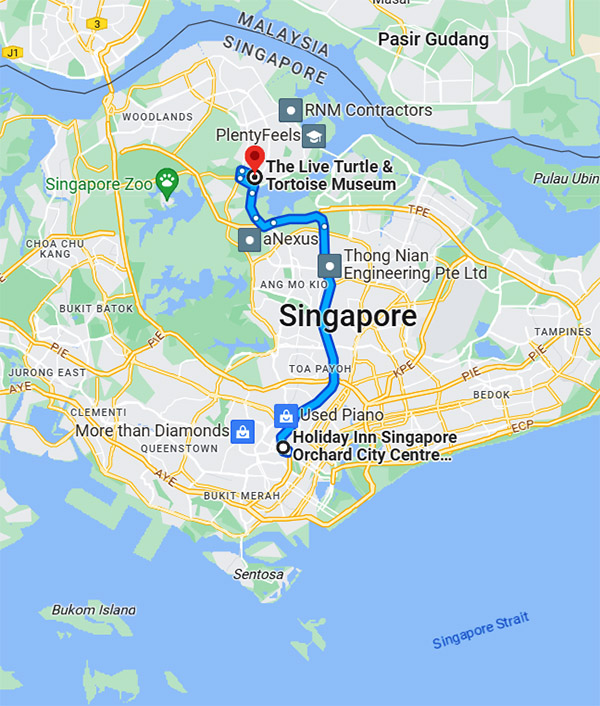
On a recent trip to Singapore, Sue and I were casting about for something to do one weekend.  We’ve been to Singapore several times, we’ve seen most of the sights, and we wanted to see something new.  A quick Google search pointed us to Singapore’s Live Turtle Museum.    It’s on the other side of the island from where we usually stay (the hoity-toity Orchard Road area).   We hopped into a cab in front of our hotel and the cab driver gave us an odd look when we told him our destination.

The cabbie told us we might have some difficulty getting back “from the other side” but I thought I knew better.  Singapore is not that big, I reasoned.   Boy, was I ever wrong.

The ride to the Turtle Museum was about 45 minutes, and the second half of that was fairly desolate.  Northern Singapore looks completely different from the Singapore I knew, which is a locale of wide boulevards, fancy cars (think Ferraris, Rolls Royces, and Bentleys), fancy hotels, and high-end shops.  In fact, it seems about every other store on Orchard Road is a Rolex or Breitling authorized dealer.  Not so on the other side.  It’s jungles and grassy plains.  And one Turtle Museum.

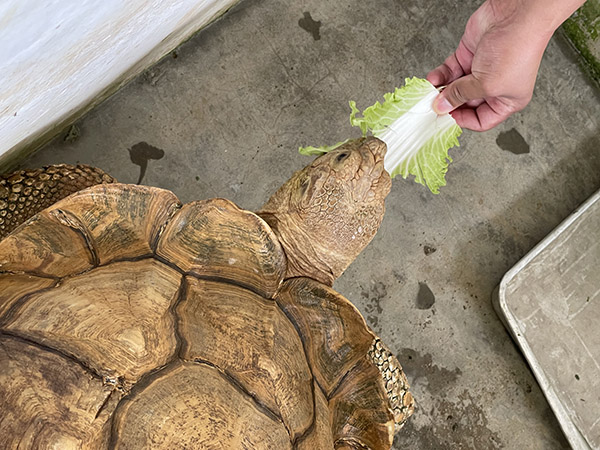
Once we entered the Turtle Museum, one of the first things we noticed is that you can buy lettuce to feed to the tortoises.  Tortoises love lettuce.  Feed one a little lettuce and you have a friend for life.

Sue bought some lettuce, fed it to a tortoise, and it was her new best buddy.

The Turtle Museum had many different species of tortoises and turtles.  I’ll caption the photos with the various species.

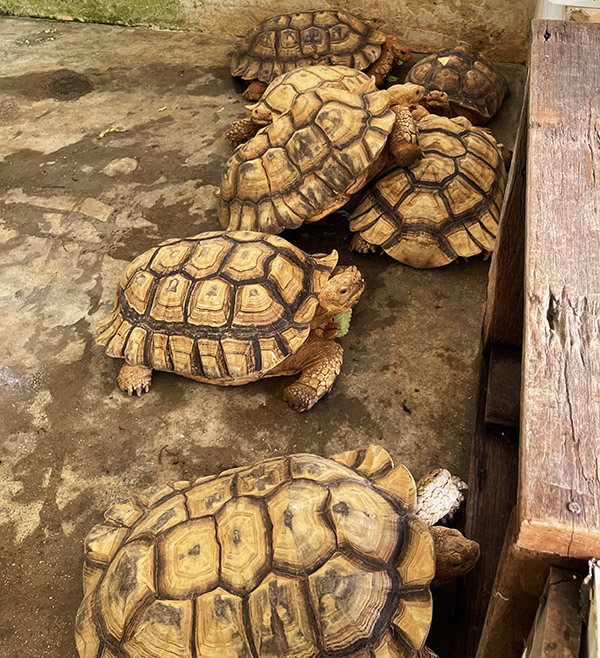
These are African spurred tortoises, also known as Sulcata tortoises. The can get as big as 100 pounds. They dig burrows down as deep as 20 feet to escape the heat in Africa.
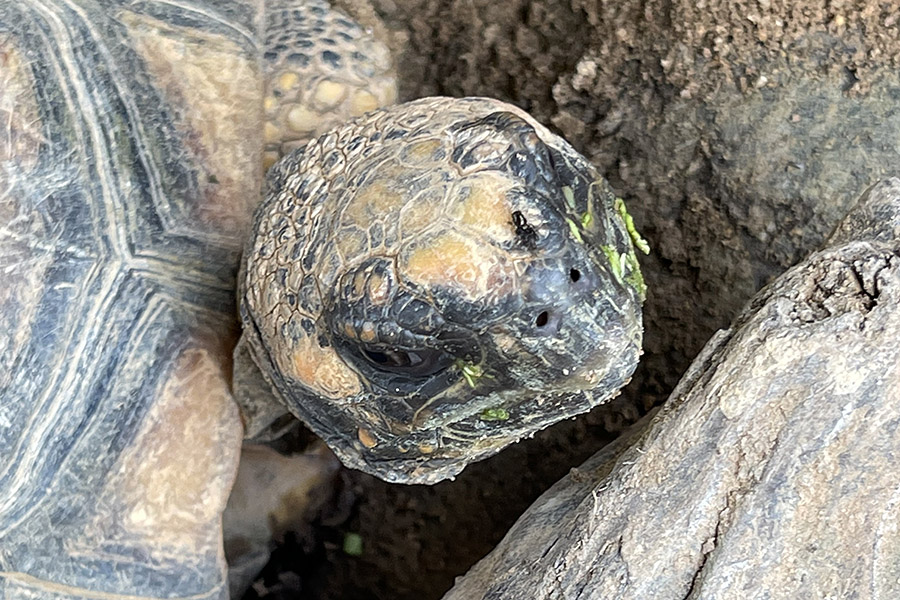
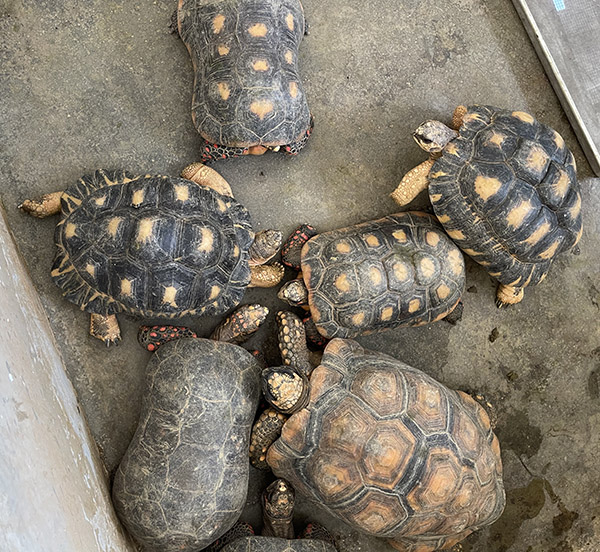
These are red-footed tortoises from South America. They are found from Panama to Argentina. They will grow as large as 14 inches and they live about 50 years.
Here’s an Indian Star tortoise. They can be found in the grasslands and forests of India and Sri Lanka.
This is an Indian Spotted Pond turtle. They are an endangered species.
This is an albino Pig-Nose turtle, also known as a Fly River turtle.
A closer view of the Pig Nose turtle. You can see how it gets its name. This species is found in northern Australia, southern New Guinea, and West Papua. It is a unique freshwater turtle; it’s the only species with flipper-like feet (similar to sea turtles).
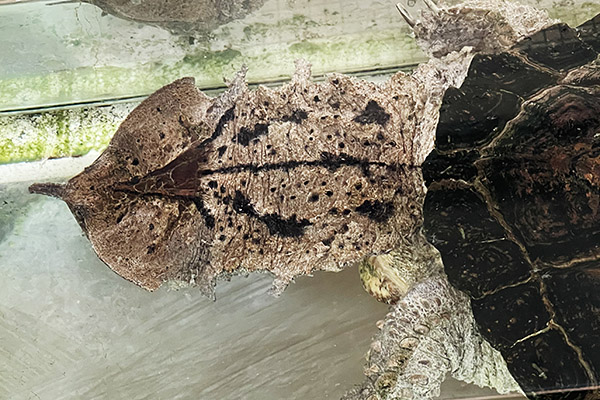
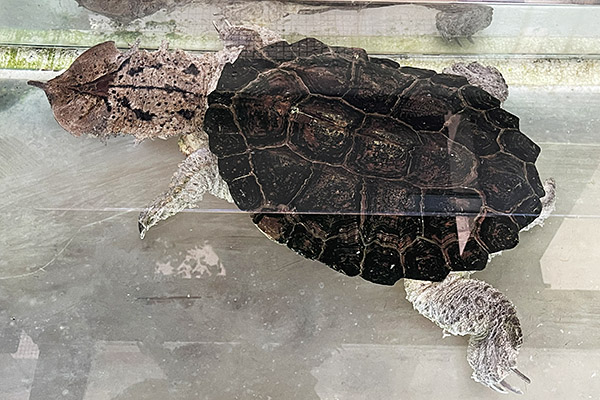
Here’s a strange one: The Mata Mata turtle. It takes the word “camouflage” to a new level.
Another view of the Mata Mata turtle. It’s native to South American streams, stagnant pools, marshes, and swamps in the Amazon River basin.
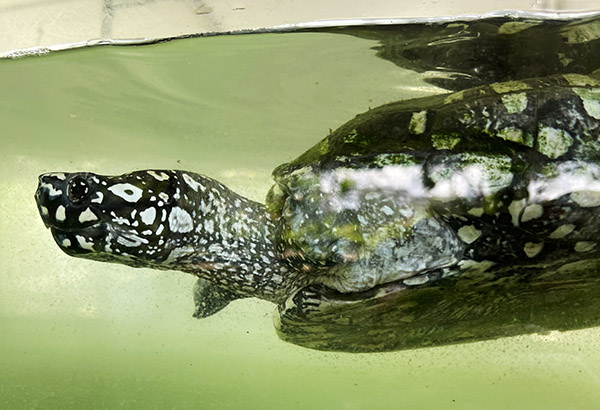
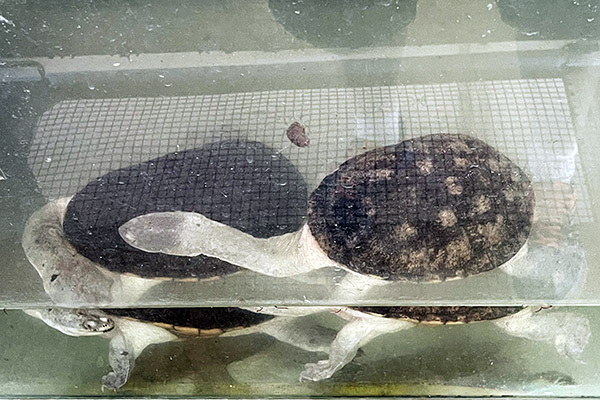
This is a Snake Necked turtle, a species found in Australia and southern New Guinea. They use their long necks to snap up prey.

So there you have it:  The Turtle Museum in Singapore.  I enjoyed it right up to the time we left.  Because the Museum is in such a remote location, there were no cabs waiting outside when we were ready to return to our Orchard Street hotel.  Neither Sue nor I could get a signal on our cell phones, and there was no wireless coverage, either, so that ruled out calling a cab. To compound the problem, Singapore doesn’t have Uber of Lyft.  We went back to Museum’s office area; fortunately, the office had Internet access and they secured a taxi for us.  We had to wait a while for our ride, but that was okay.  We had a good time.  It was something different, and we saw a part of Singapore we had not seen before.


Join our Facebook ExNotes page!


Help us keep the lights on:


Don’t forget: Visit our advertisers!


The Wayback Machine: The Five Best Motorcycle Books Ever

By Joe Berk

Listicles, Gresh calls them…articles based around the (fill in the number) best things to do, worst things to do, motorcycles, movies, and more.  One of Gresh’s friends told him that lists get more hits than any other kind of Internet article.  I was a bit skeptical when I first heard that, but Google Analytics doesn’t lie:  When we do a listicle, our hits go up big time.  And comments, too.  We like comments.  And a lot of this blogging game is about the hits and comments.  Gresh’s The 5 Stupidest Ideas in Motorcycling, my recent The Big Ride: 5 Factors Affecting Daily Mileage, and other ExNote listicles…they’ve all done extremely well.

This listicle thing has me thinking in terms of the five best whatever when I’m spitballing new blog ideas, and the list du jour is on motorcycle books.  It’s a topic near and dear to my heart and one we’ve touched on lightly before, although the emphasis in the past has usually been on a single book.  I think I’ve read just about every motorcycle book ever published, and I particularly like the travel stories.  That said,  I think this introduction is long enough.  Let’s get to it.

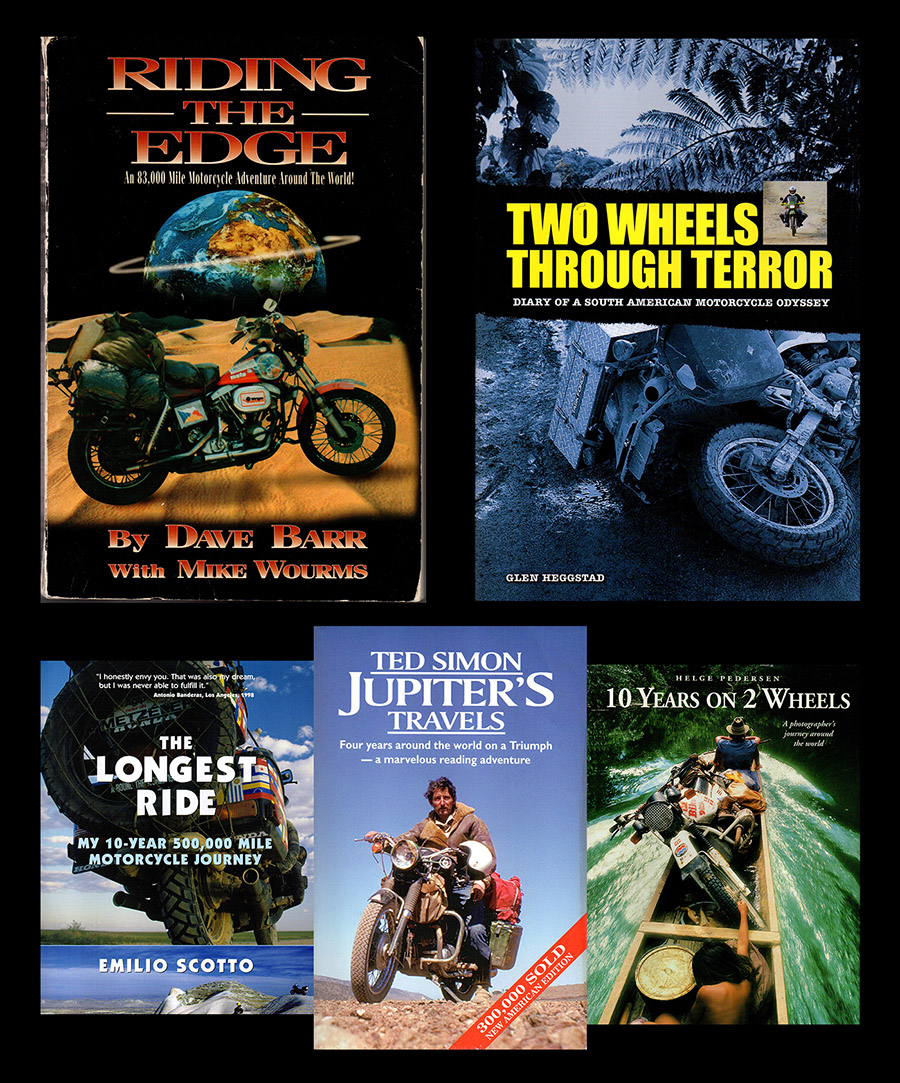
Riding the Edge

Riding the Edge, in my opinion, is the greatest motorcycle adventure story ever told, made all the more significant by two facts.   The first is that Dave Barr, the author, did the ride after losing both legs to a land mine in Africa; the second is that Dave did the ride on a beat up old ’72 Harley Super Glide that had 100,000 miles on the odometer before he started.
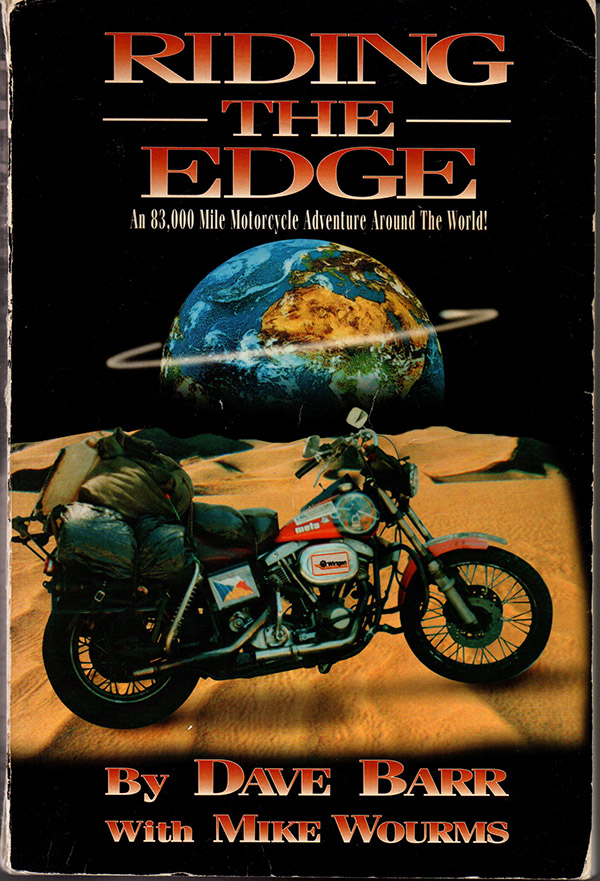
I know Dave Barr and I’ve ridden with him.  I can tell you that he is one hell of a man, and Riding the Edge is one hell of a story.  The ride took four years, mostly because Dave pretty much financed the trip himself.  He’d ride a country or two, run out of money, get a job and save for a bit, and then continue.  I read Riding the Edge nearly two decades ago, and it’s the book that lit my fire for international motorcycle riding.  None of the rides I’ve done (even though I’ve ridden through a few of the countries Barr did) begins to approach Dave Barr’s accomplishments.  The guy is my hero.

Riding the Edge is written in an easy, conversational style.  I’ve probably read my copy a half-dozen times.  In fact, as I type this, I’m thinking I need to put it on my nightstand and read some of my favorite parts again.  If you go for any of the books on this list, Riding the Edge is the one you have to read.

The Longest Ride

Emilio Scotto.   Remember that name, and remember The Longest Ride.  This is a guy who had never left his native Argentina, thought it might be cool to see the world on a motorcycle, bought a Gold Wing (which he named the Black Princess), and then…well, you can guess the rest.  He rode around the world on a motorcycle.
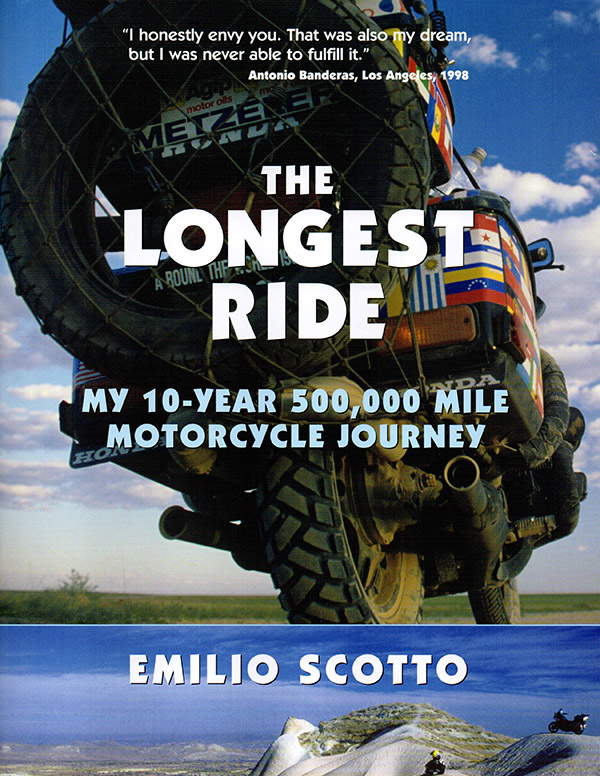
Emilio took 10 years for his trip around the world, and he covered 500,000 miles in the process.  He’s another guy who is good with a camera.  I thoroughly enjoyed The Longest Ride.  I think you will, too.

Two Wheels Through Terror

Glen Heggstad…that’s another name you want to remember.  Mix one martial arts expert, a Kawasaki KLR 650, a kidnaping (his own), a trip through South America, and a natural propensity for writing well and you’ll have Two Wheels Through Terror.  I love the book for several reasons, including the fact that Mr. Heggstad used a KLR 650 (one of the world’s great adventure touring motorcycles), the way he tells the story of his kidnaping in Colombia (a country I rode in), and his wonderful writing.
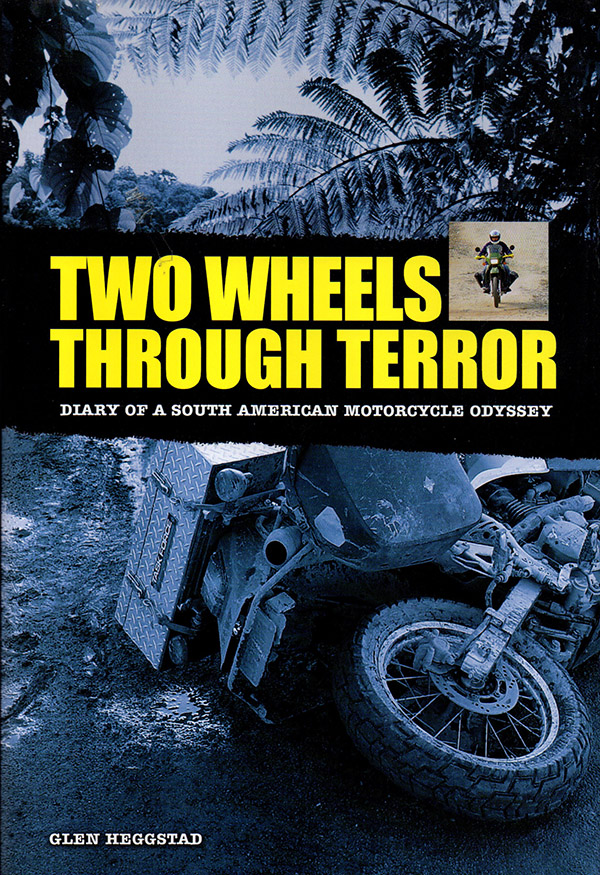
I’ve met Glen a couple of times.  The first time was at a local BMW dealership when he spoke of his travels; the second time was at his booth at the Long Beach International Motorcycle Show.  Glen is a hell of a man, a hell of a writer, and a hell of a fighter (all of which emerge in Two Wheels Through Terror).  He is a guy who just won’t quit when the going gets tough.  I admire the man greatly.

Jupiter’s Travels

Ah, Ted Simon, one of the granddaddies of adventure motorcycle riding.  I’d heard about his book, Jupiter’s Travels, for years before I finally bought a copy and read it, and then I felt like a fool for not having read it sooner.
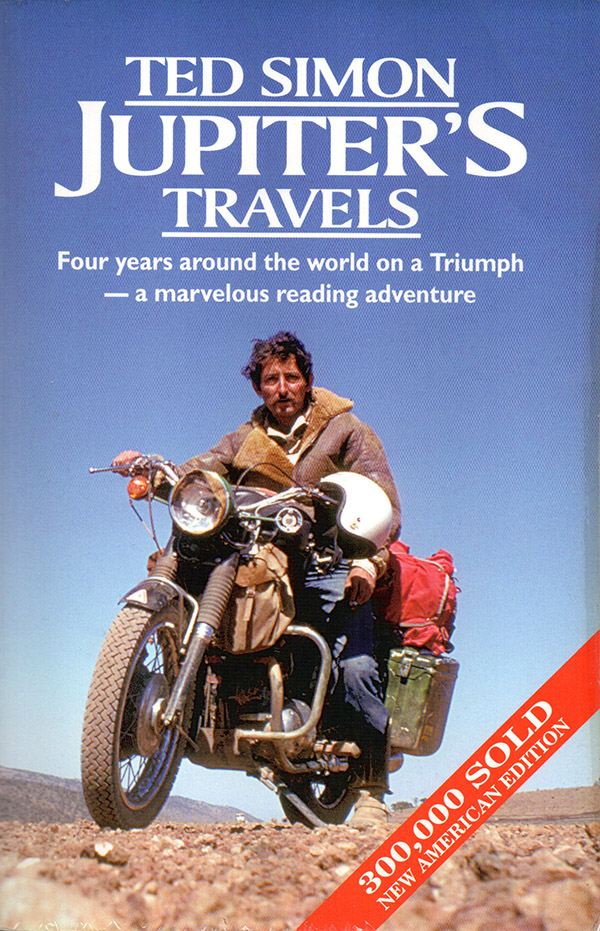
Jupiter’s Travels was one of the first books about riding a motorcycle around the world, and what made it all the more interesting for me was that Simon didn’t do it as a publicity stunt.  No big sponsors, no support vehicles, no nothing, a lot like the other great journeys on this list.  It was what the guy wanted to do, so he quit his job and did it.  Simon’s bike was a 500cc air-cooled Triumph, and I liked that, too.  I’m a big fan of the old British vertical twins (the Triumph was a state-of-the-motorcycle-art when Ted Simon did his ride).  Trust me on this, folks:  Jupiter’s Travels is a motoliterature classic, and it’s one you need to read.

10 Years on 2 Wheels

Helge Pedersen is another name you want to know.  He is a phenomenal world traveler, writer, and photographer, and 10 Years on 2 Wheels is a phenomenal read.
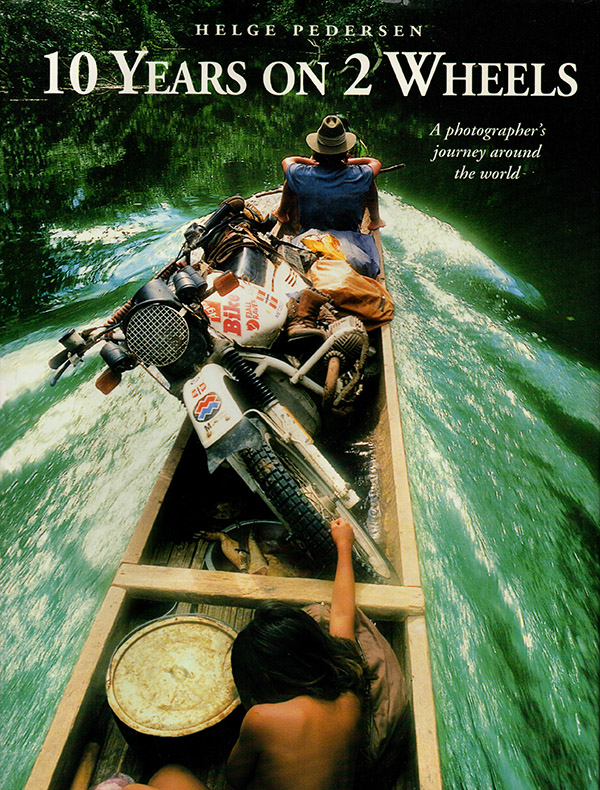
What sets 10 Years on 2 Wheels apart is the photography, and you get a sense of that just by seeing the cover (this is one of those rare books that you can, indeed, judge by its cover).  10 Years on 2 Wheels is what inspired me to get serious about capturing great photographs during my travels, and Helge’s photos are fabulous (they’re art, actually).  This is a physically large book, and that makes the images even more of a treat.

So that’s it: Our list of the five best motorcycle books.  What do you think?  Leave your comments and suggestions here.   We want to hear them!


More book reviews?   You can find them here!


Join our Facebook ExNotes page!


Never miss an ExNotes blog:


Help us keep the lights on:


Don’t forget: Visit our advertisers!


Fort Snelling State Park, Minnesota

By Joe Berk

Minnesota’s Fort Snelling State Park is a subject more worthy of a multi-volume book than a single blog post.   The challenge in a blog piece is to hit the high points, so bear with me as I attempt to do so.  Sue and I recently visited the Minneapolis/St. Paul area, and Sue found several interesting spots to visit. One of them was Fort Snelling.

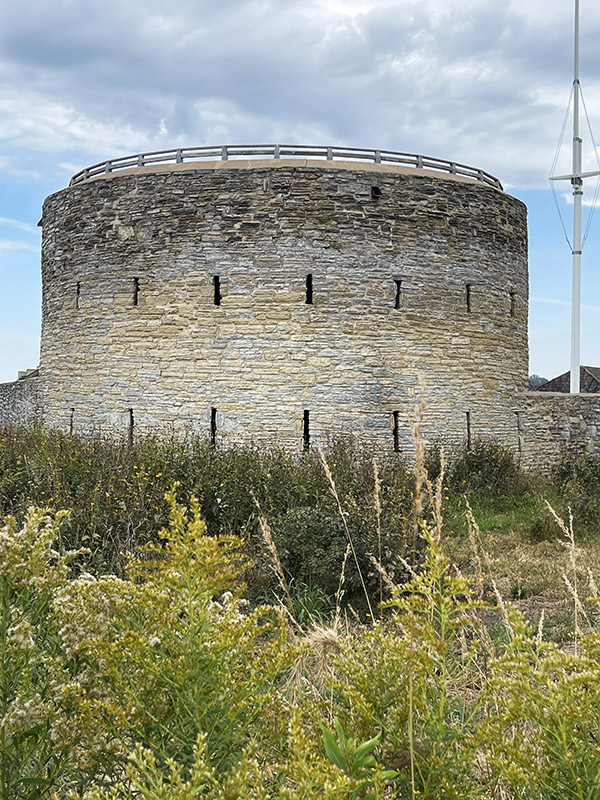
The Tower, also known as the Magazine, dominates Fort Snelling. It was used to store gunpowder. It also served as a prison.
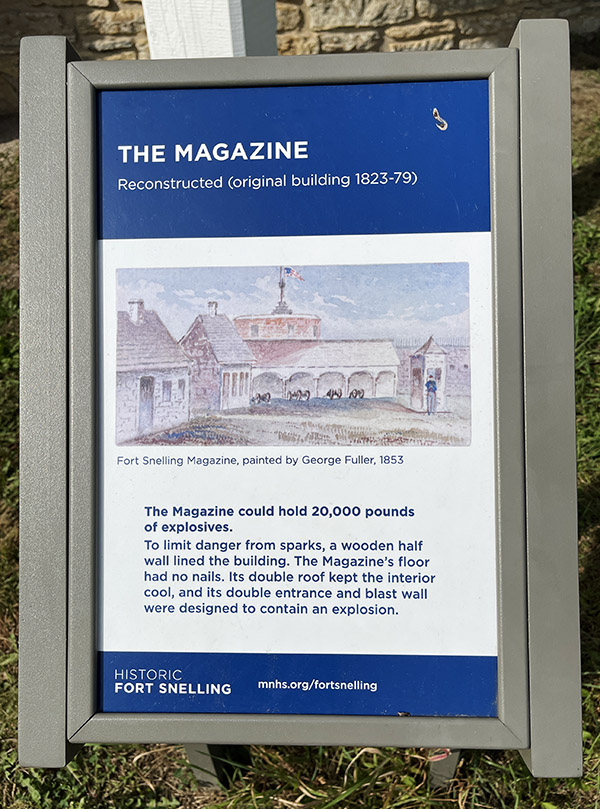
More information on the Magazine.
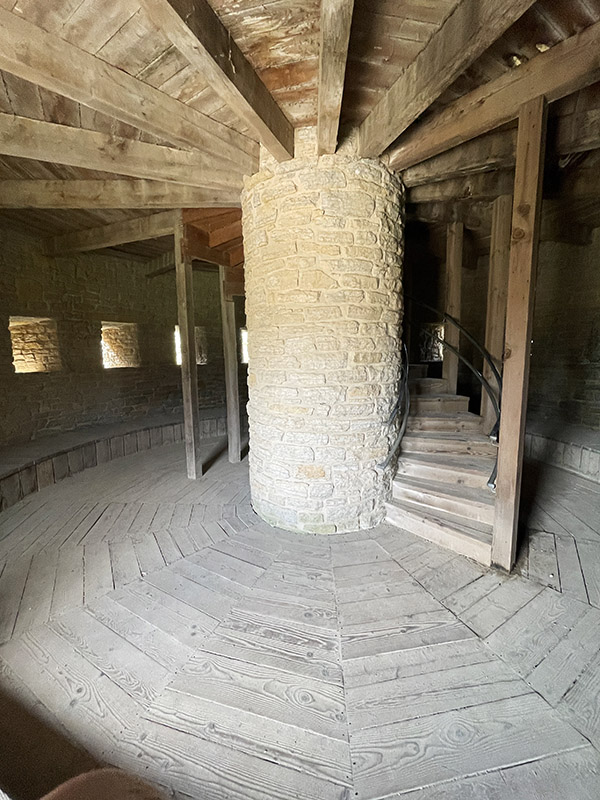
Inside the magazine. You can take the stairs to the top.
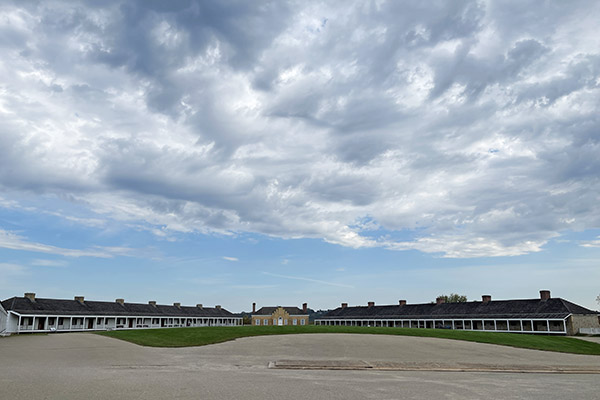
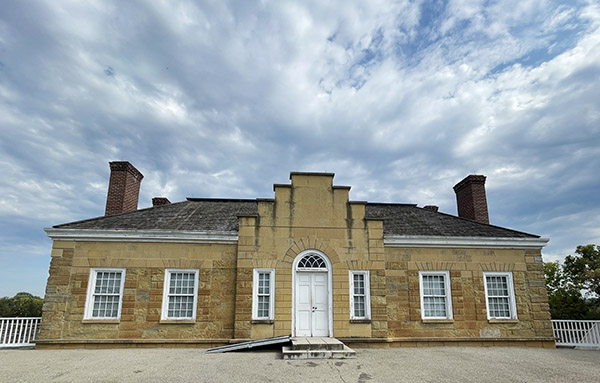
A view of Fort Snelling’s barracks and shop area. The house in the center was the commanding officer’s quarters.

Fort Snelling is located where the Minnesota and Mississippi Rivers meet. Here’s a bit of its background and just a few of the significant things that happened there:

    • Fort Snelling was founded in 1820
    • The Mdewakanton Dakota Native American people believe that this area is the center of the Earth.
    • In 1805, Lieutenant Zebulon Pike met with the Mdewakanton Dakota and signed a questionable treaty to purchase the area for the United States. Most historians believe that neither Pike (of Pike’s Peak fame) nor the Native American representatives were authorized to strike such a deal. Pike paid about $200,000 for the area, which consisted of about 155,320 acres, but left the amount blank in the treaty he brought back to Washington. The US Congress changed the amount to $2,000, but didn’t pay the Dakota people in cash. The Government instead provided goods it felt were worth about $2,000.
    • Lieutenant Colonel Henry Leavenworth built the initial outpost in 1819.
    • Colonel Josiah Snelling assumed command in 1820 and finished construction; he died in 1827 after being recalled to Washington.
    • Minnesota’s first post office opened at Fort Snelling in 1827, the same year that Colonel Zachary Taylor assumed command.
    • Slavery existed at Fort Snelling up until 1857.
    • Dred Scott (of the Dredd Scott Decision fame) and Harriet Robinson Scott were among slave population at Fort Snelling.
    • Fort Snelling acted as a concentration camp for the Dakota people before they were sent to Nebraska.
    • The fort was a primary recruiting station during the Civil War, the Spanish American War, World War I, and World War II.
    • In 1848, portions of the military reservation were set aside and would become St. Paul.
    • In 1856 Major Edward Canby became the fort. Canby would go on to become a general, and would hold the dubious distinction the only general killed in the Indian wars. Canby, a Minnesota town, bears his name.
    • The fort was the primary military base during the Dakota War of 1862.
    • In 1916, when General John J. Pershing was chasing Pancho Villa in Mexico, Minnesota’s National Guard was activated at Fort Snelling to provide border security.
    • In 1944, the Army’s Military Intelligence branch operated at Japanese language school at Fort Snelling, which was relocated to its current location in Monterey, California when Fort Snelling was decommissioned in 1946.
    • Restoration of the old Fort Snelling began in 1957.
    • Fort Snelling became a National Historic Landmark in 1960.
    • Fort Snelling  State Park opened in 1962.  It is Minnesota’s most visited state park.

Here are a few additional photos we grabbed as we wandered through the Fort Snelling grounds.

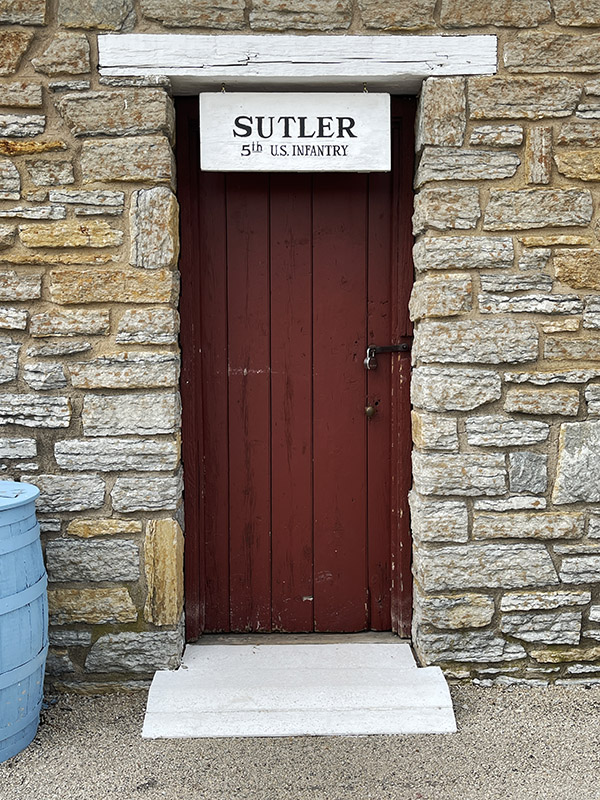
The Post’s general store (a sutler is a storekeeper who sold food, clothing, personal items, etc., to soldiers at a military camp or post; today it would be called the Post Exchange).
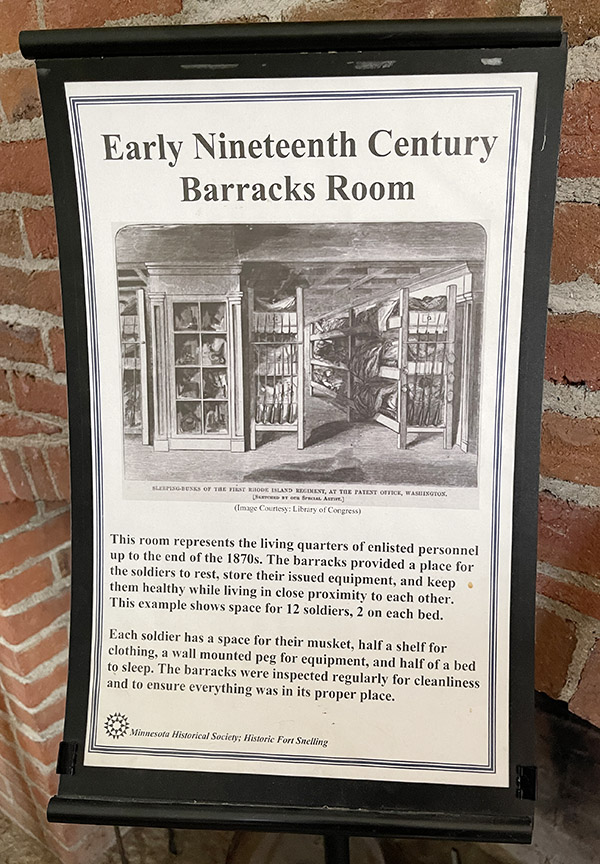
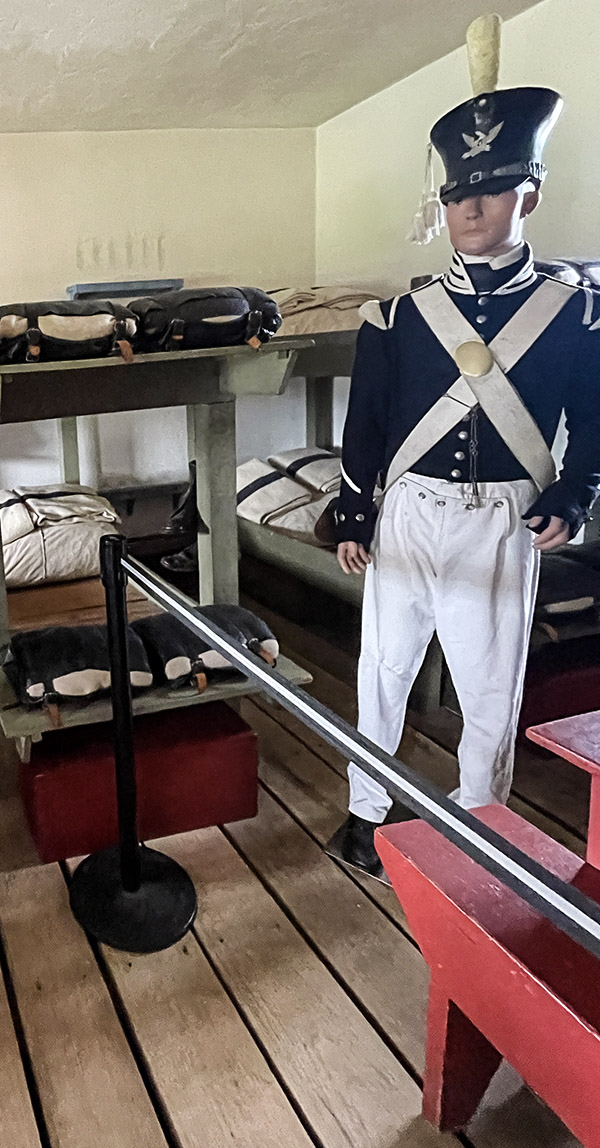
Information about early barracks living.
Inside an early barracks room.
The Commandant’s quarters. You can go inside, too.
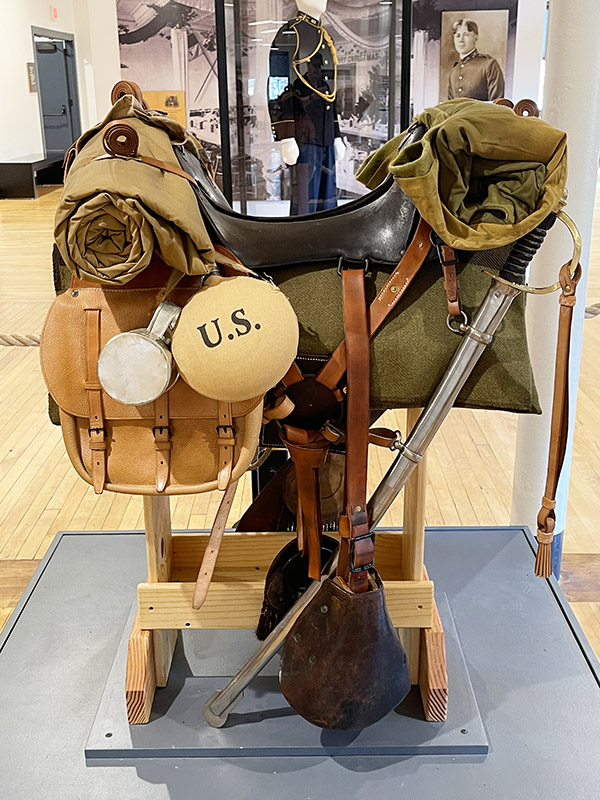
Early Army gear on display in the Fort Snelling State Park Museum.

There’s an interesting Museum that houses a number of exhibits as you enter Fort Snelling State Park.  Our visit was a good one.  We opted for the guided tour and it was money well spent.  Our tour guide was enthusiastic and made the tour interesting.  If you ever pass through the Minneapolis/St. Paul area, Fort Snelling should be on your list of places to visit.


Join our Facebook ExNotes page!


Never miss an ExNotes blog:


Help us keep the lights on:


Don’t forget: Visit our advertisers!

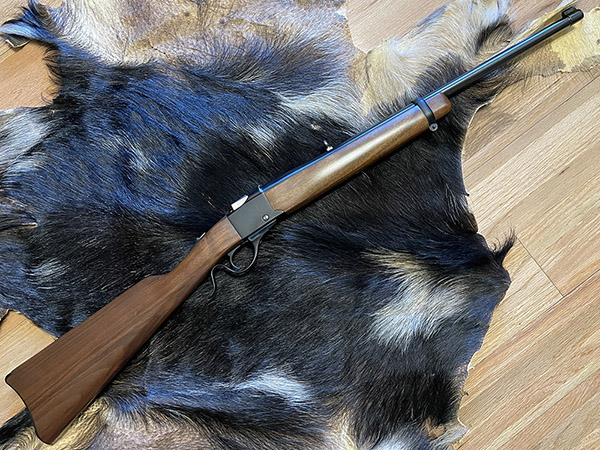
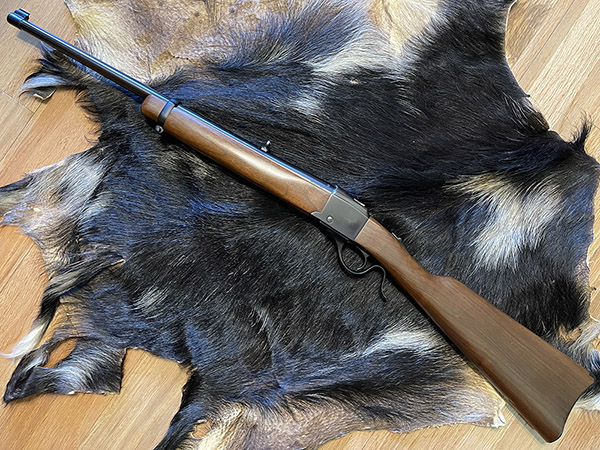
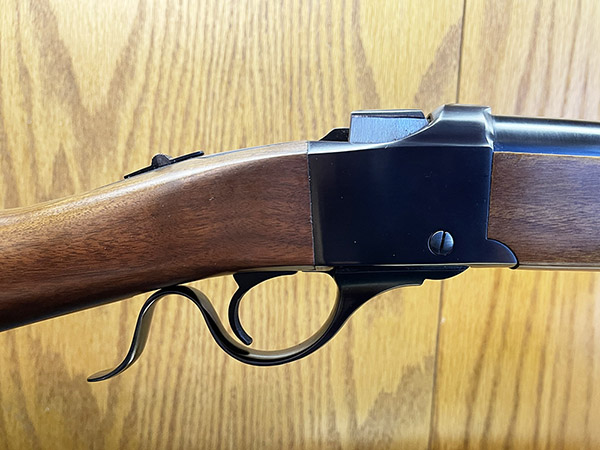
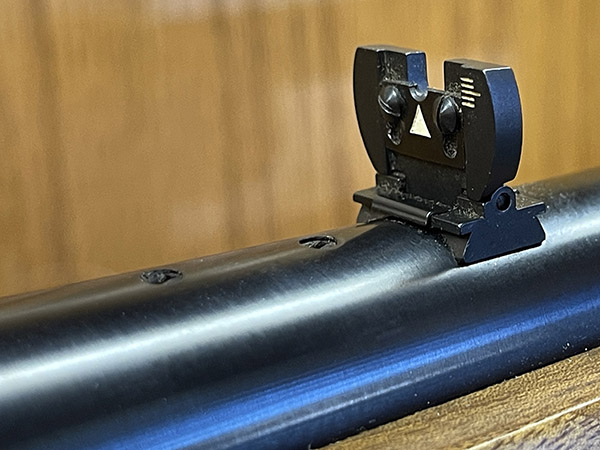
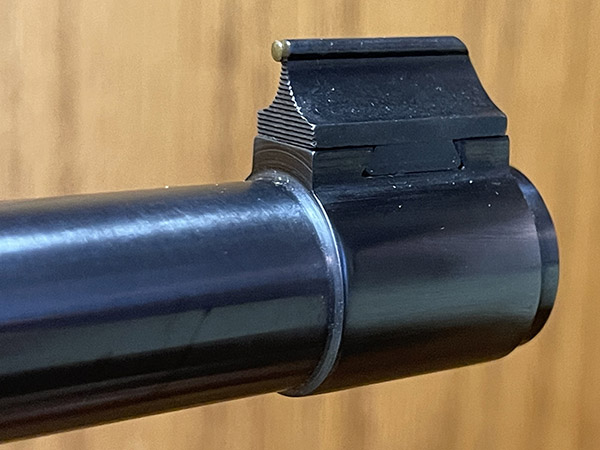
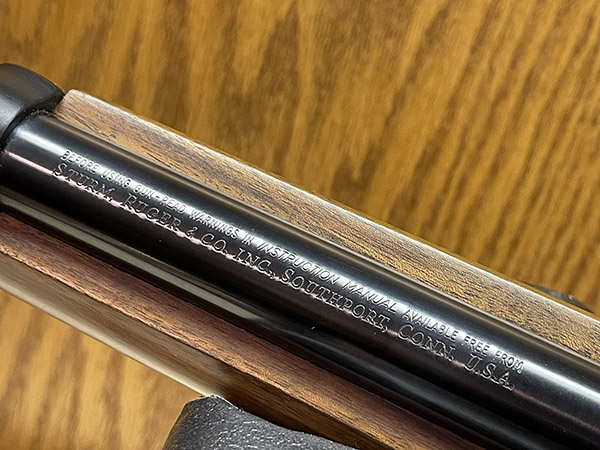
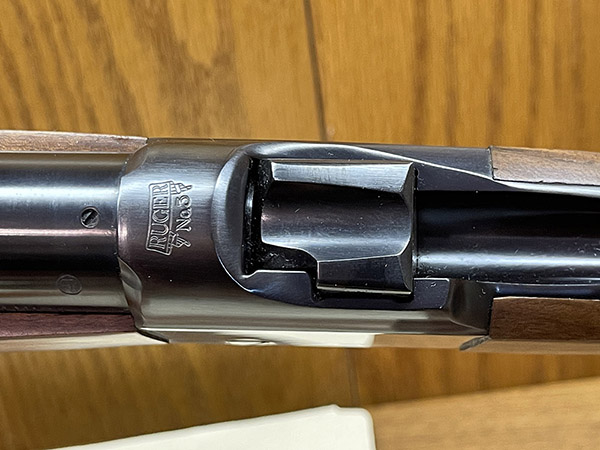
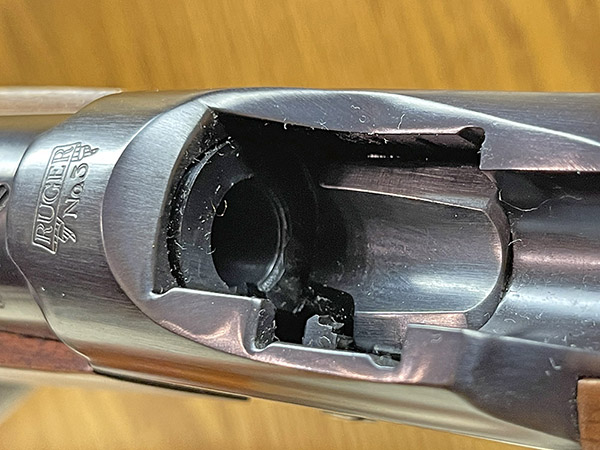
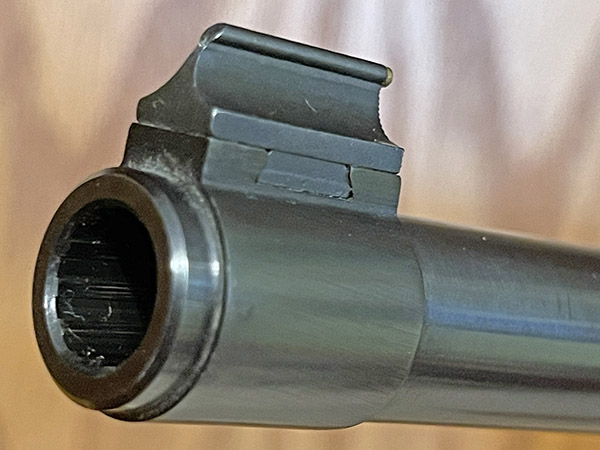
A Very Rare Ruger No. 3

By Joe Berk

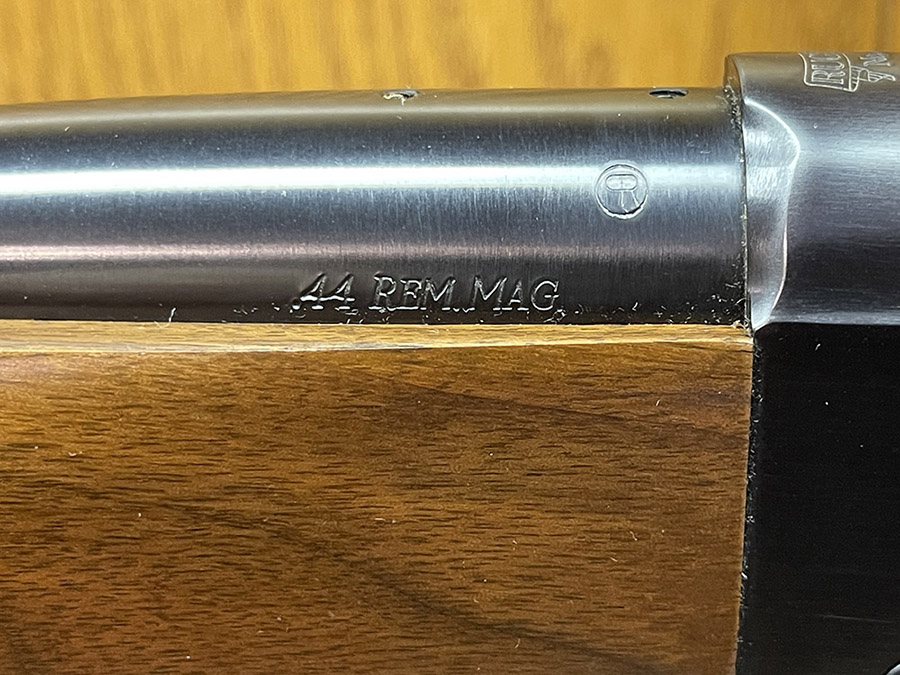
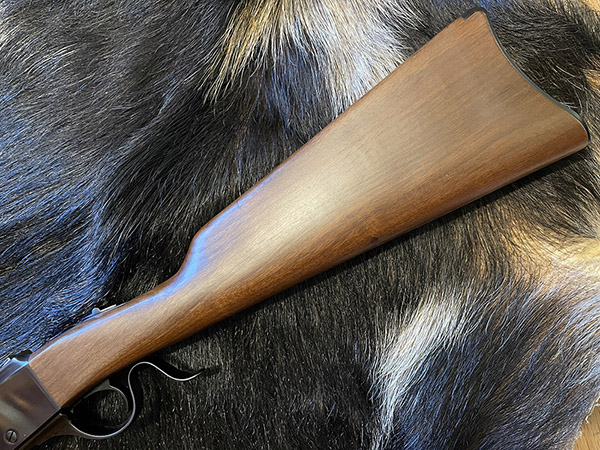
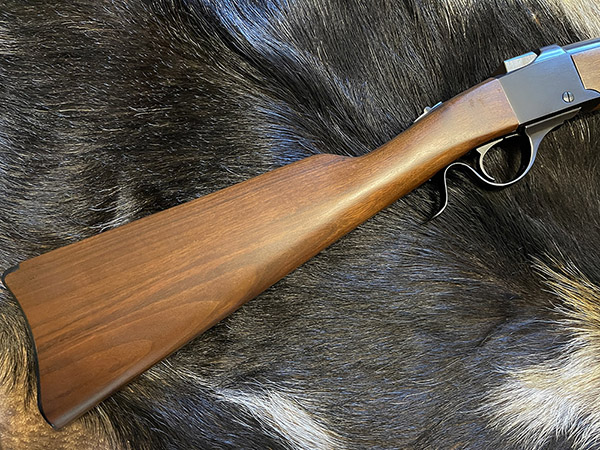
The Ruger No. 3 was Ruger’s economy version of their higher end No. 1 rifle.  Unlike the No. 1, the No. 3 had plain walnut stocks, no checkering, slightly less polished bluing, and a simplified loading lever styled like those on early single shot Winchesters.  The No. 3 was introduced in 1973 in three classic cartridges:  .45-70 Government, .30 40 Krag, and .22 Hornet.  In later years, Ruger offered the No. 3 in .223 Remington, .375 Winchester, and .44 Magnum.  Ruger discontinued the No. 3 in 1986, so any No. 3 will be at least 40 years old today.

Of all the chamberings (with one exception I’ll mention in a bit), the .44 Magnum is thought to be the rarest.  Ruger doesn’t release production figures, so nobody outside of Ruger really knows how many were made.  Online estimates include 200 to 400, 867, and “less than a thousand,” but these are all guesses based on who knows what.  Like a lot of Internet info, all we know for sure is that at least two of the guesses are wrong (and maybe all three are).

You almost never see a .44 Magnum Ruger No. 3 for sale.  I’m downsizing my collection and I thought I would sell mine, but after seeing the Gunbroker ad and looking at the rifle a bit more, I took the ad down.  This is one I’m going to keep.

Even though I’m letting a few rifles go, I still have the collector bug.  The only No. 3 Rugers I don’t have are the .223 Remington and the .375 Winchester.  If I came across either of those at a killer price, I’d be mightily tempted.

The rarest Ruger No. 3 rifles ever made?  It’s rumored that a couple left the factory chambered in .30 06.  I’ve never seen one.  The other very rare chambering is a modified .30 Carbine designed to replicate the trajectory of the 1980s-ish General Dynamics Viper anti-tank weapon.  That No. 3 was a barreled action that fit inside a Viper launch tube (the Viper was a shoulder-launched anti-tank missile, kind 0f a modern day bazooka).  I’ve seen and handled those, as I worked on the Viper engineering development program at GD back in the day.  One of these days I’ll get around to doing a blog on it.


We’ve written about Ruger No. 3 rifles before in other chamberings.  Here’s a list of links for easy reference:

A .30 40 Krag Ruger No. 3
A .22 Hornet Ruger No. 3
Ruger No. 3 .45 70 Loads
Undoing Bubba


Join our Facebook ExNotes page!


Help us keep the lights on:


Don’t forget: Visit our advertisers!