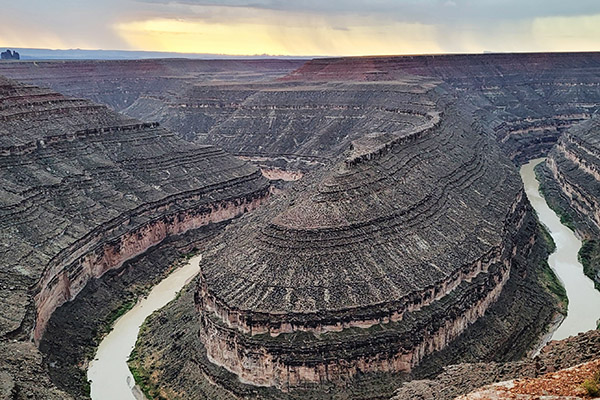
As I left the gas station in Mexican Hat the sky was looking extremely menacing. I knew that camping in a lower elevation in the Valley of the Gods may not have been the best idea, due to possible flooding. The roads can get really slick with rain. There was a great state park just a few miles away. In fact, it is such a great place to camp I was hesitant to name it here, but it is Gooseneck State Park. There are about 20 campsites there which are on the edge of a 1,000 foot drop into what looks exactly like Horseshoe Bend. This park would suffice for my home for the evening, although in hindsight I should have gotten a hotel. But then there wouldn’t be a story.
I pulled into Gooseneck State Park and set my tent up. The sky was black. It really looked menacing, and I was quite sure it wouldn’t be a dry night. After setting up my tent I did my usual walk around the park and talked with other campers. I began chatting up some other riders and invited them over for a beer and to share my fire. Within five minutes of talking to them one replied to me as he pointed to the sky. “Yeah, you may need all those beers for yourself, and there is no way we are having a fire. Good luck.”
A few minutes later I found myself in my tent alone drinking my beers as the sky opened up. This was not good. As the rains continued to pelt down the winds picked up. Within two beers the ground became so soaked that my tent stakes had uprooted in the now mud puddle I was camped in. The tent was being blown all over just making loud cracking noises like a whip. Fortunately, I had brought my panniers inside and positioned them at diagonal corners of the tent in an attempt to keep the tent somewhat grounded. Unfortunately, the winds had grown so strong that my entrance zipper was ripped apart.
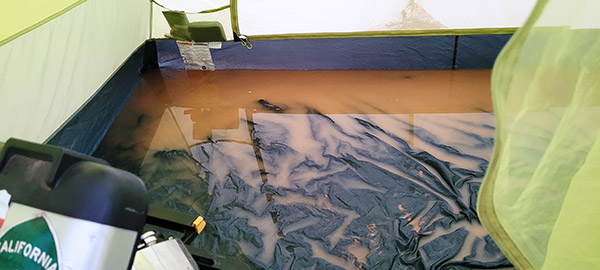
I felt like this was as bad as it would get. Sadly, I was mistaken as a strong gust got under the tent and threw my pannier across the tent and in doing so the floor of my tent was ripped apart. I managed to get a little bit of sleep that evening but not much. In the morning as I awoke at 5:00 a.m., I noticed my tent had a couple inches of water in it. It resembled a kiddie pool. Everything I owned was soaked.
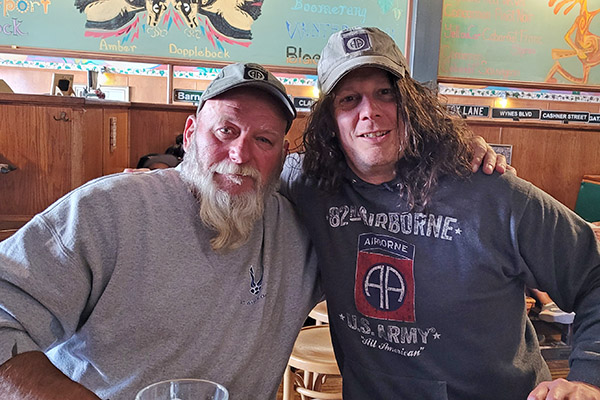
By 05:30 I had everything packed up and I was ready to find a coffee shop to dry out in. My plan for that day was to meet one of my 82nd Airborne friends in Cortez, Colorado for lunch. Even though I had an early start I showed up late, due to trying to dry my gear out. When asked why I was late I simply replied I had to hit a hardware store for duct tape. He then looked me up and down as I was covered in mud and even my 82nd Airborne hat was destroyed from the previous night. “What the fuck happened to you?” he asked as he took in my appearance. I ordered a beer and began to tell him of my adventure. Even though I had a rough night, Scenic Byway 163 is still one of the greatest roads in the United States.
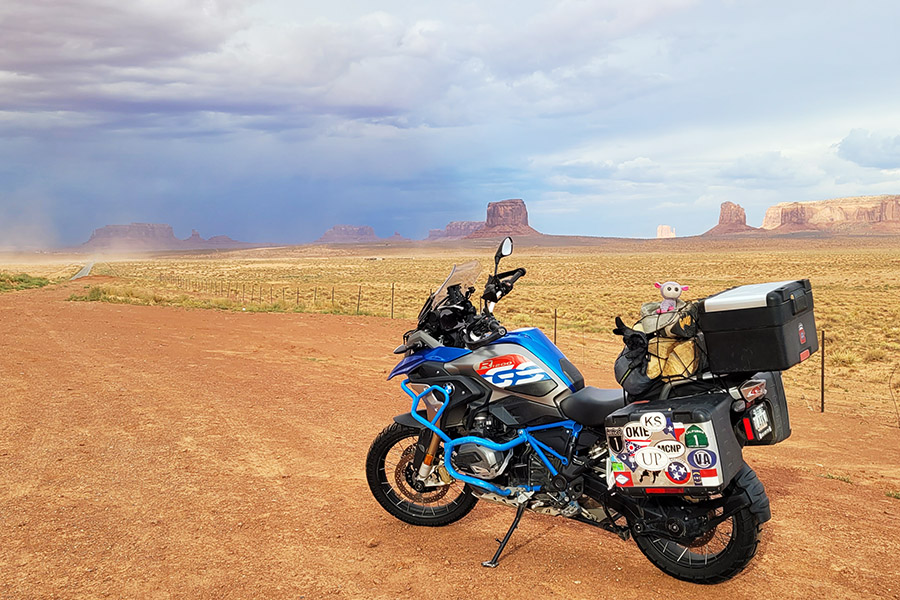
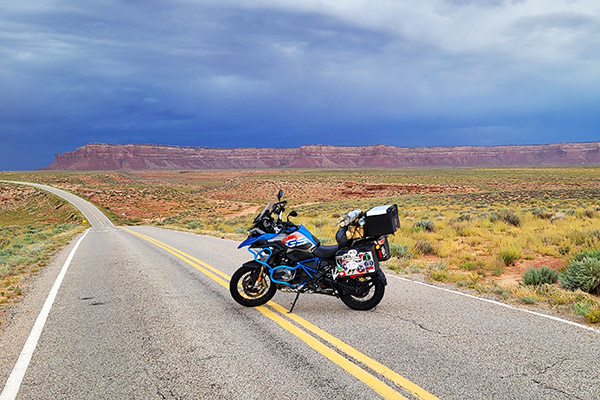
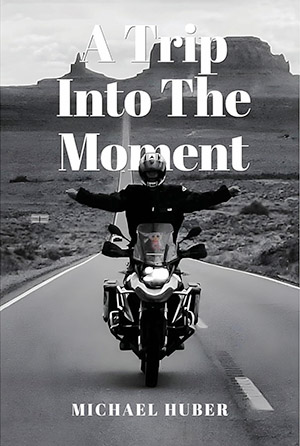
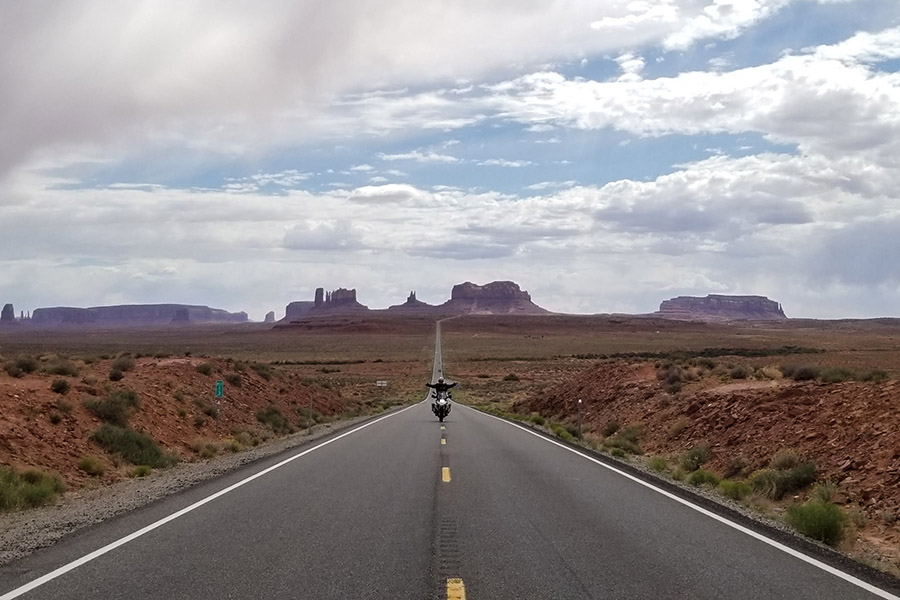
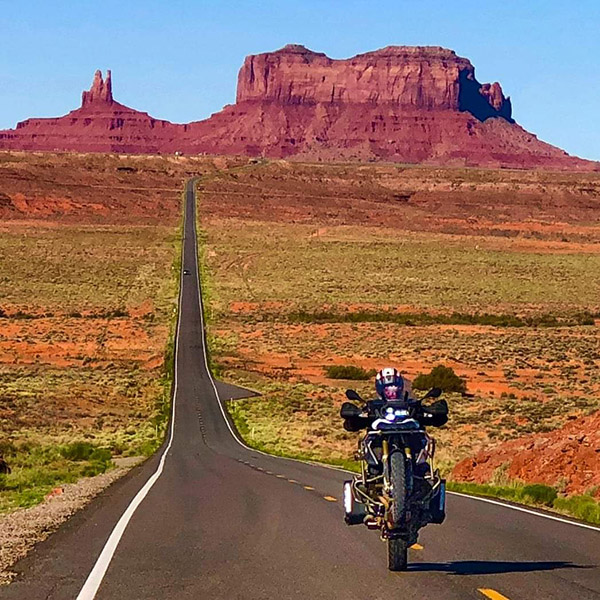
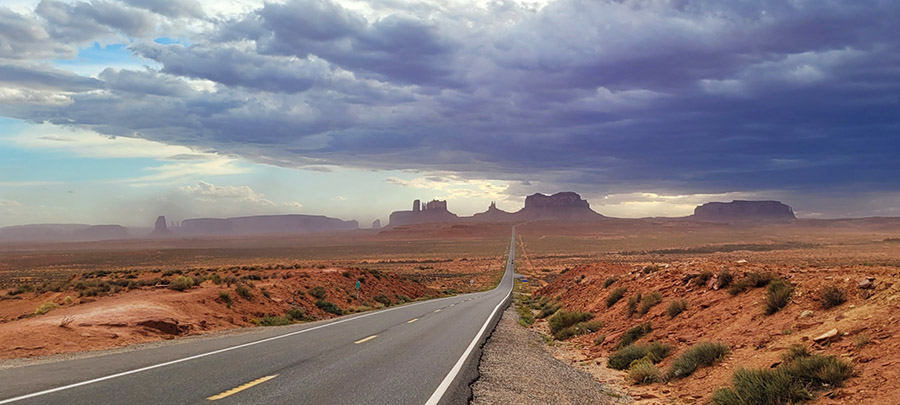
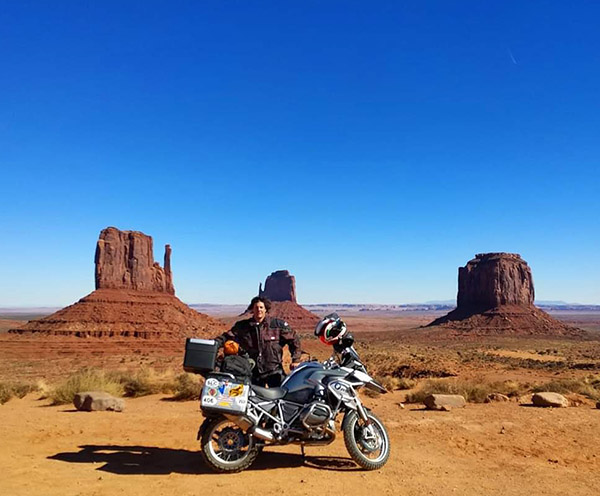
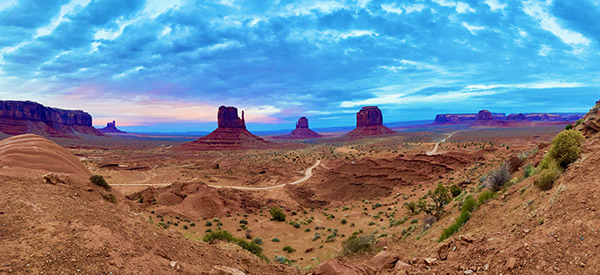
Arizona Highway 163 is one of the most iconic roads in the United States. This is the road through Monument Valley. From Easy Rider to Forest Gump to numerous westerns, when you ride this road you are in a magical place (especially on a motorcycle). It’s a big reason why I chose it as the cover for my book (and that’s cheap plug for A Trip Into The Moment). I’ve ridden Highway 163 many times on my BMW GS1200. Most times it was uneventful, but as with most things in life, as soon as you relax and feel comfortable Mother Nature will find a way to remind you exactly how small you are.
One of my last trips on Highway 163, I stopped in Kayenta to fuel up and reload on water. It was late September, and the weather was perfect. I had a 45-mile drive to Mexican Hat, where I would grab firewood and camp in the Valley of the Gods. I never listen to music but felt The Band’s song, The Weight, was warranted to just set the tone and add more color to this final stretch. I was the Easy Rider!
As I tore out of Kayenta everything was just coming together perfectly. This was to be the coolest ride I’d ever done. With the music screaming throughout my helmet I eased into the moment and just embraced it. That was until I looked to the left and saw a sheet of brown coming at me. It was a sandstorm. Without missing a beat I pulled in my clutch, clicked down two gears and took off. I had about 30 miles to go and felt confident I could make it to safety in Mexican Hat. Safety would only be a gas station awning, but that would be enough to protect me from the stinging sands.
I made it as the sandstorm changed direction and went due south; however, I wasn’t out of the woods yet as a downpour began. I loaded up on a few snacks and water, and was waiting the storm out when a Harley rumbled up to join me under the awning. The two-up Harley riders had just come down Moki Dugway and were soaked and shaken. Fair enough. Even on my BMW GS1200 I would not want to attempt that, especially going down those hairpin dirt roads with no guardrails and nothing but a sheer vertical drop if you were to slide. It’s very unforgiving.
We chatted for the better part of an hour on our riding experience as the rain came down around us. When asked how long I was out riding, the guy almost fell off his bike with my reply: I think I have been out for four years or so. As the rain let up, we said our farewells. They went south and I went west toward Valley of the Gods to set up camp.
I think the best part about this story is a year later learning how small the world actually is. I had been helping a friend who I didn’t know too well navigate working remotely. I gave him a lot of ideas and tips and offered to assist if he needed anything else. I hadn’t heard from him for almost two years when I received an email. He had been hiking in Colorado and sat on an overlook to take in the views when a couple joined him and they began chatting about life and travel (the usual overlook conversations). The conversation then turned to people they had met and the couple mentioned this long-haired guy on a BMW with a stuffed animal they had met on Highway 163. My friend replied that he knew me; he had helped me get off the ground working remotely. They all had a good laugh and continued their hikes. These coincidences in meeting others who had met me probably could be its own blog, but I felt this story fits nicely here.
Returning now to that beautiful September day: Upon leaving the gas station in Mexican Hat the sky began to darken yet again. A new adjustment had to be made to avoid another storm. This one looked worse than both the sandstorm and the thunderstorm I had dodged. I was pretty confident my luck had run out in terms of staying dry at this point. Being familiar with the area there I knew there was one alternative that could protect me from the storm, but would I make it before the sky opened up?
The 1995 Buell Thunderbolt is home safe and dry. It was good to meet up with Berk out in California. He really pulled out the stops: I had my own room, he bought me a bunch of food, took me on a tour of the San Gabriel mountains and helped pick up the Buell from Iconic Motorbikes. I really don’t deserve this much kindness. But I’m not turning it down.
The trip back to New Mexico was uneventful except for a steady rain that fell from Phoenix all the way to Las Cruces, New Mexico. It was nice to be snug and warm in the Toyota. I see why people drive cars.
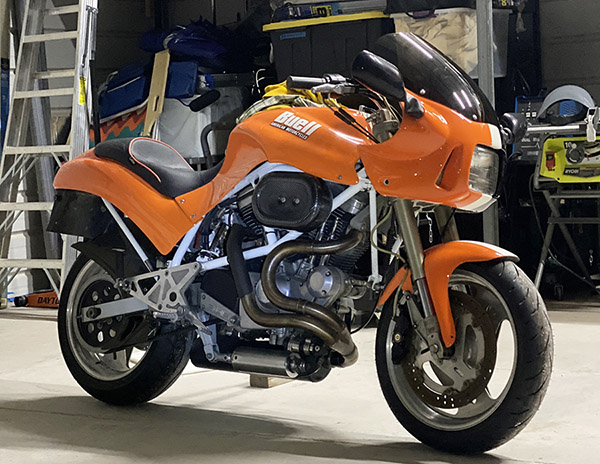
The Buell in Bay 2 of the shed. CT recently cleaned this area so I’ll have room to work on the bike.
Driving in the rain gives you time to think and I thought about how much longer I’ll be strong enough to suffer the elements on a motorcycle. It was a grey, melancholy ride. The bright orange and black Buell cheered me up whenever I looked in the rear view mirror. I got back home at dark. It started to rain. I left the Buell in the truck.
The rain was drizzling the next day when we unloaded the Buell. It was a slick, wet plastic Toyota bed liner that the front tire slid out of and down the ramp. Luckily CT was there to back me up if the Buell started to tumble. We managed to park the bike in the shed, I dried off the Buell and started examining my prize.
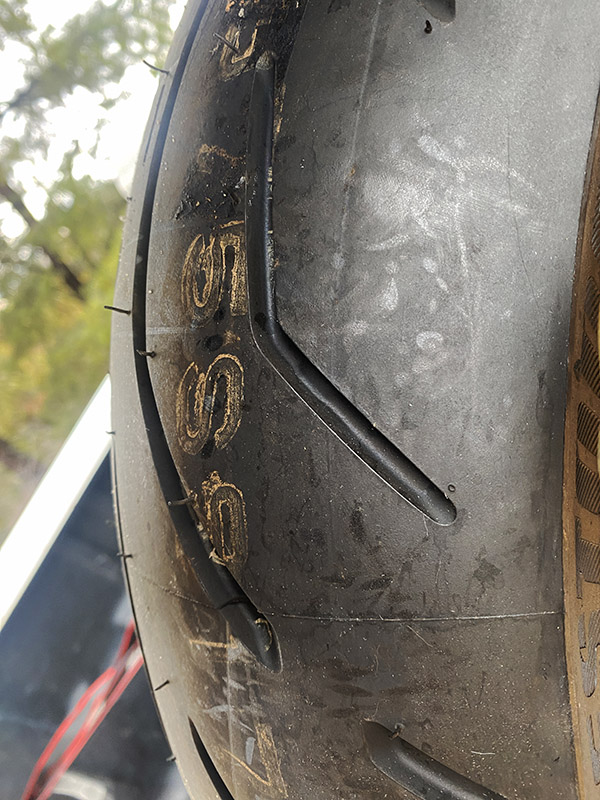
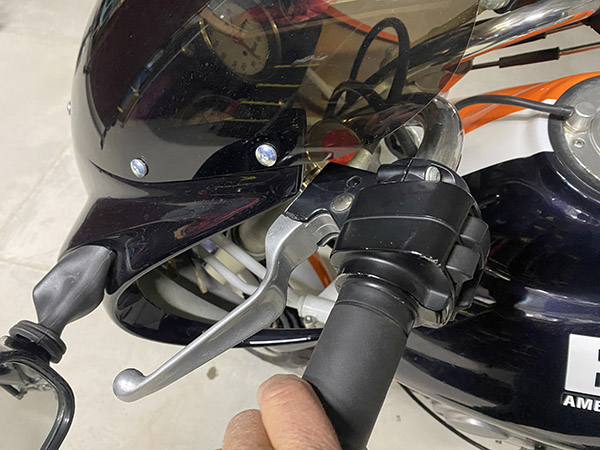
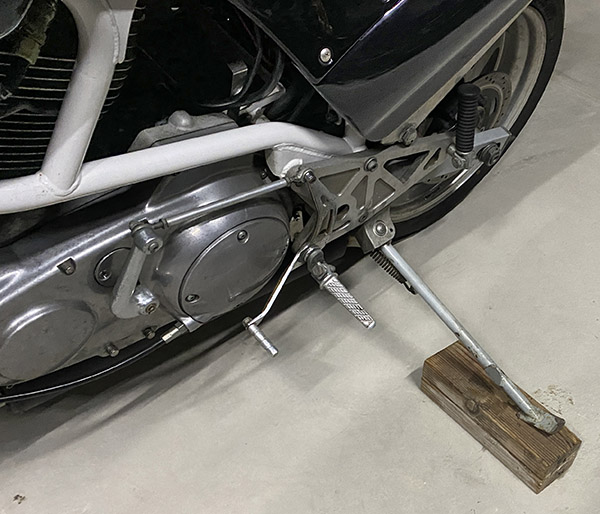
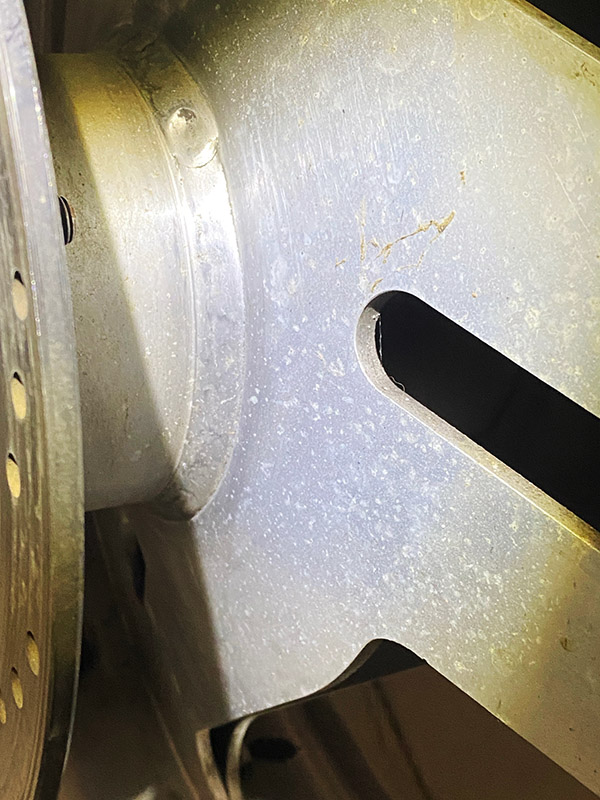
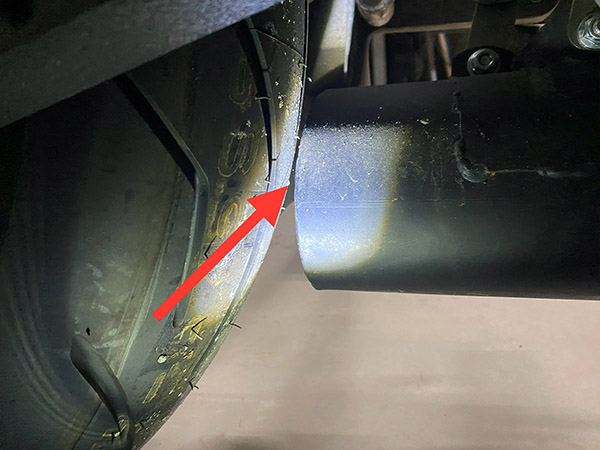
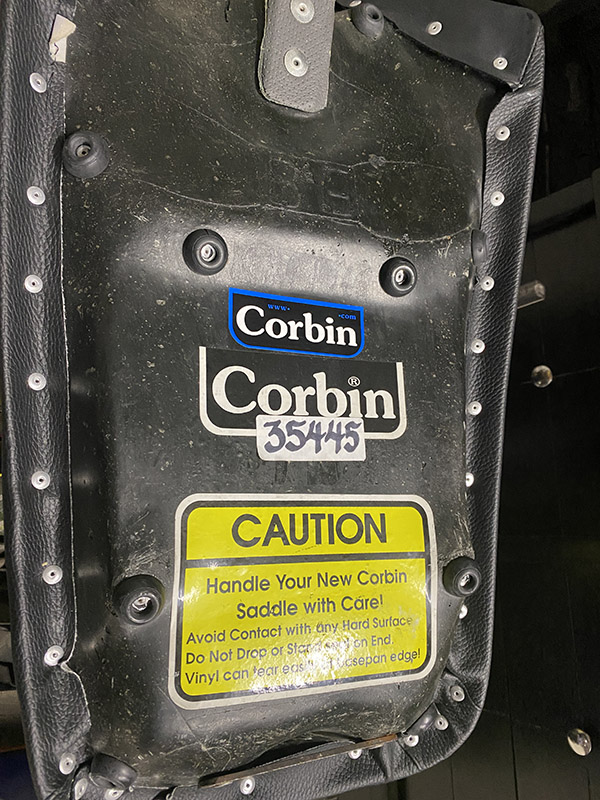
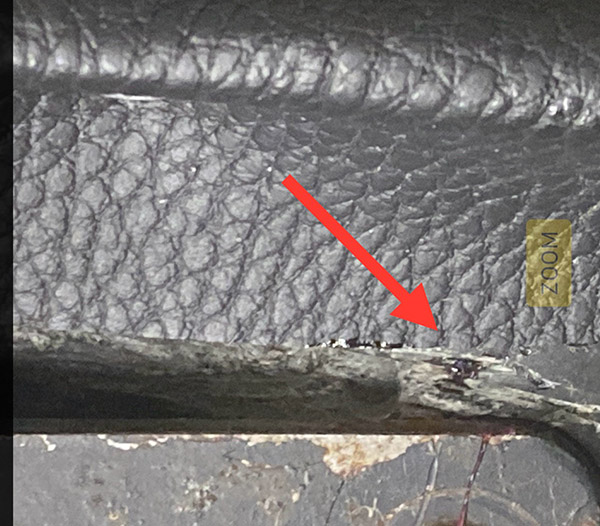
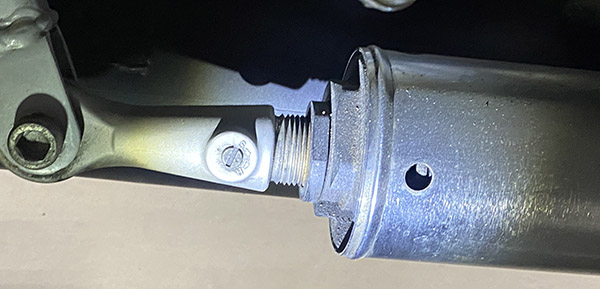
Both Bridgestone Battleaxe tires are unused and still have printing on the tread surface. The date code is from 2015 so 10 years old and never been warmed up. Before you tell me they are dangerous let me cut you off and say I’m running them. There are no cracks or check marks, they have been out of the sunlight, the rubber feels soft. I’m going to risk it.I’ll need to do a little adjusting as the handlebars hit the frame-mount faring. The faring has cut outs for low bars but these higher bars don’t align with the openings.The kickstand leans the bike way over. The stand is worn in the aluminum holder. I’ll need to shim this a bit or possibly put a slight bend in the stand to make the bike sit more upright.Performance Machine spun aluminum wheels are two halves joined at the hub and (I’m guessing) welded inside. A lick of polish should have them looking new.The under-slung muffler is uncomfortably close to the rear tire. Maybe the new drive belt will move the wheel back a bit. If not, I’ll have to make a bit of clearance.The Buell came with a Corbin seat. I don’t understand why this seat is so heavy. It’s like it’s made of lead. My brief time in the saddle seemed ok. Longer road tests to come.The Corbin seat fits the Buell well but the rear, locking latch doesn’t line up. The lever hits the seat too soon. It looks like someone tried to grind a bit of clearance but didn’t do enough. I’ll see what I can do, I’m just glad the seat didn’t blow off on the way home.The rear suspension is pretty stiff. I’m going to take out a bit of preload assuming this is where you adjust preload. With a Buell you can’t be too sure.
Now to start buying stuff for the Buell starting with a battery, seals for the stuck rear brake, fork seals and a fresh drive belt followed by a carb cleaning and a gas tank flush. Hopefully I’ll have a video of the bike running for Buell Fever Part 3.
After spending a couple months freezing in Nepal I was more than ready for a restful month (or three, as it turned out). I was craving warmth, a steak, and some scuba diving, and southern Thailand quenched my thirst for all three.
After a month or two in southern Thailand spending the days scuba diving and embracing the sun it was time to head north. The previous year when I was in Chaing Mai I got sick off eating elephant poop, not intentionally but it had me leashed to a toilet for four or five days and ruined my entire itinerary. It was now time to return to Chaing Mai and steer clear of the elephants.
Everywhere in Thailand there are a ton of Temples to visit and northern Thailand was no different. After a few tours and meeting a ton of new friends the road to Pai kept coming up as one of the best roads to motorcycle in Asia. I located a rental shop in Chaing Mai and rented a bike for seven days. This was a rather long time as the road to Pai roundtrip only took two or three days. I figured with the added days I may do a layover day somewhere and just blast around the northern tip of Thailand to some less frequented parts of the country and have some shorter days on the bike.
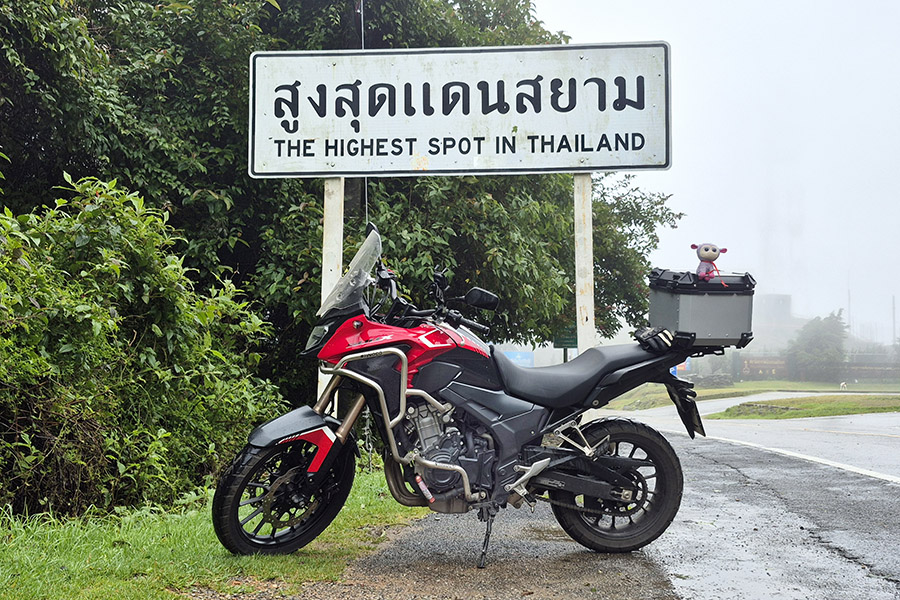
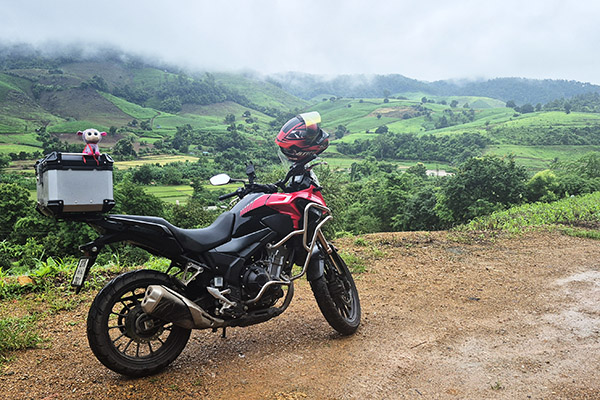
My trip to Pai ended up being delayed two days as there was a massive monsoon that blew through and needless to say it wasn’t good riding weather. Once the storm cleared I left on a Honda 500cc motorcycle ready to tear these roads up. Although it rained usually once a day at one time or another it was tolerable and outside some wet roads my first few days were going well. The roads were incredible and it was quite similar to motorcycling in Vermont, outside of driving on the left hand side of the road. There were beautiful twisties and colorful canopies of vegetation that provided a kaleidoscope of colors when the sun made it through the foliage.
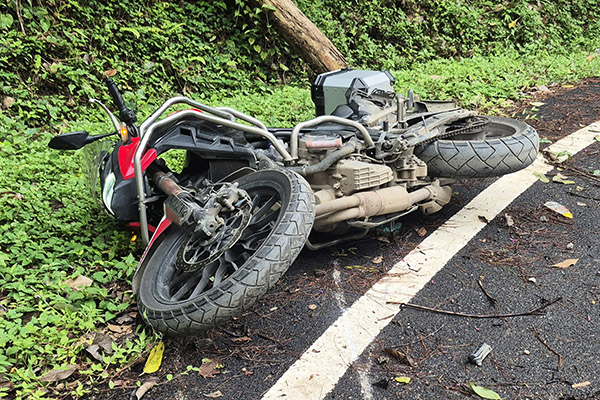
As I stated most the times the roads were wet and I adjusted my speed with the ever-changing road conditions. What I didn’t factor in was an oil spill on one of the corners as I approached Pai. All I remember is “boy that slid out from under me really smoothly” and the next moment I was floating through the air. Prior to being a paratrooper is I am very proficient at playing patty cake with the earth. I executed the perfect PLF (parachute landing fall) and as I slid down the road after that execution I couldn’t stop laughing as the bike was spinning like a 600-pound fidget spinner and went off the road and settled into the grass.
As I stood up I performed a self-assessment of the damage to myself. I was very fortunate. Just a few scrapes and bruises. My shirt and pants were pretty tore up I noticed a very sharp pain in my ribs. I definitely cracked, broke, or fractured a rib. I picked up the bike and noticed one mirror was destroyed and my right foot peg was snapped off. Also my front brake handle outside of a 2-inch piece was snapped off. I had about four days left with the motorcycle so I would just use one finger on the front brake and move my leg from the rear peg to tap the rear brake as needed for the remainder of my trip. My tourism layover days were now replaced with staying in bed to nurse my injuries with Chang beers.
I ended up completing all the roads I had planned on and it was now time to return the motorcycle to Chang Mai and continue to rest the cracked rib. I am certain if this accident had happened in the United States the bill to the damaged motorcycle would have been over 1,000USD, but in Thailand it was under 100USD and I threw in a few Chang beers for a tip. The road to Pai is really one of the better roads I have ridden on, outside of the oil slick of course. Still, it was a great way to explore northern Thailand.
As my age keeps creeping up and I slowly fall apart like Jeff Goldblum in the movie, The Fly, there is an urgency, a panic lying just below my normally placid exterior. Time is running short for all of us and if you have unfulfilled dreams, it’s best to get a move on.
The ill -fated VR1000, inspiration for my Buell’s paint.
Owning a tube frame Buell has been on my wish list since the S2 model came out in the mid 90’s. The combination of modern sport bike and 1957 lawnmower engine had a strange appeal to me and let’s face it: everyone should own a Sportster.
The dawn of 2026 found me frantically searching the internet for a 2000+ Buell Cyclone and I found a few. Several were pretty beat up all were reasonably priced but far away.
The deal I missed due to my inherent thriftiness.
I happened upon Iconic Motorbike Auctions and they had a pile of Buells from a private collection. The crown jewel was a Cyclone with only 6 total miles. It was a brand new, 25-year-old motorcycle. I bid on the bike and it made reserve at $4,000. What a deal! $4K was out of my self-imposed Buell budget so I stopped bidding. Someone got a hell of a deal.
Next up at Iconic was a clean, Buell Ulysses complete with Buell saddle bags. It was a gas-in-frame model. I prefer a tube-framed Buell but bid on the Ulysses anyway. It sold for $3,250! I didn’t bid anymore on it because it just wasn’t the bike I wanted. Although if I got it for $2K I would have learned to love it. After that, Iconic had an S3 with saddlebags that went for over $5,000. Now I was starting to freak out. I had Buell Fever bad-like. What if I was witnessing a Buell market correction in real time?
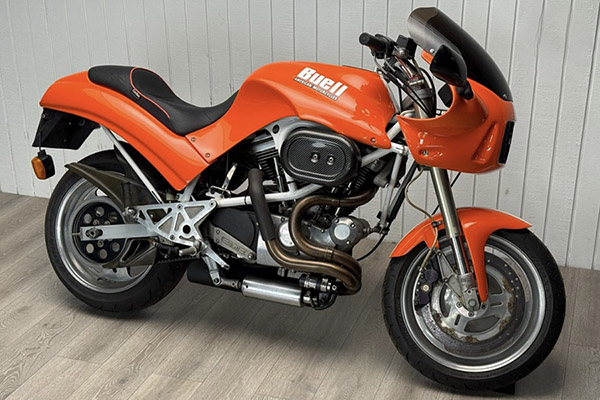
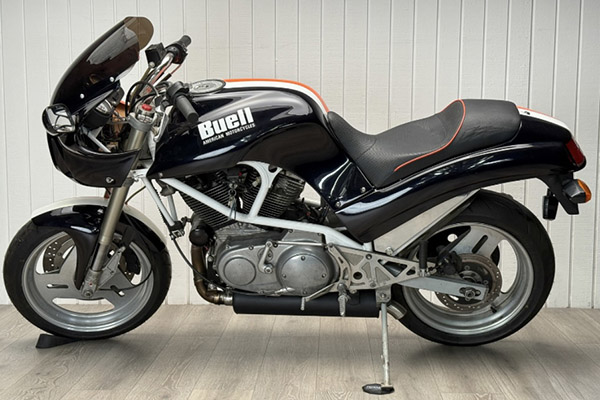
It’s like getting two bikes in one! Orange on the right.And black on the left.
Iconic has a buy-it-now section for motorcycles that don’t make their auction reserve. I plundered around in buy-it-now and found a beautiful 1995 Thunderbolt with only 13,000 miles for $3,000. It has a few minor issues to sort out like any 30-year-old motorcycle but what really got to me was the Harley VR1000-tribute paint scheme . It looked cool as hell. I loved the paint job. I pushed the button.
It’s not an actual Cyclone, but it mostly is a Cyclone. The main cosmetic difference is the front forks and faring. Also the 1995 Thunderbolt used a bone-stock Sportster engine that Cycle World dynoed at 65-ish horsepower. Later Buell’s were pumped up a lot with Buell-specific heads and other parts churning out 100 horsepower.
While I wouldn’t mind another 35 horsepower, the truth is I just putt around on bikes. My go-fast days are behind me much like the strange growth I had cut out of my back a few months ago (see The Fly with Jeff Goldblum).
One advantage to the Sportster engine is that parts availability should be excellent for the remainder of my life and beyond. If I truly need more oomph there are tons of Sportster hop-up parts and 60 years of institutional knowledge on the Internet. 75 horsepower is a pipe and cams away.
But I probably won’t do anything to the Thunderbolt except ride it and look at it. I’ll be fixing the minor issues right here on ExhaustNotes so you’ll be able to follow along with this Buellishness.
Got to go. Driving out to Panorama City in California to pick up my dream bike from Iconic motorbikes.
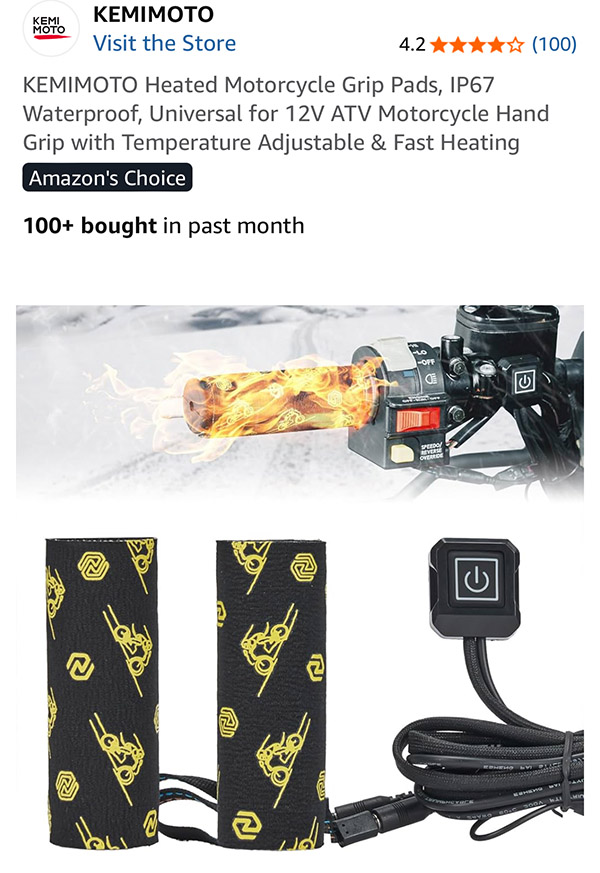
Old Man Winter is taking his sweet time here in New Mexico. It is late December, 70 degrees and the frozen old git still hasn’t made much of a dent. But he will arrive and I’ll be ready with my new Kemimoto heated grips.
I’ve set up the Kawasaki ZRX as my cold weather bike with a 12-volt receptacle for an Aerostitch heated vest and these grips will complete my preparations for the cold. If it ever gets here.
Installation would normally be simple as the wiring connects directly to the host bike’s battery. The main problem with this setup is if you accidentally leave the grips on and drain your battery. In the cold.
I couldn’t find an unused, switched power connection on the factory harness so I rigged a cube-type relay under the headlight faring that energizes from the instrument light circuit. This ensures the grips are off when the key is off. Power for the grips comes from the Areostitch vest power lead and runs up to the relay.
The heating elements just wrap around your existing grips and a 3-power level switch needs to go somewhere. I used a fairing mount bolt to secure the included switch bracket on the right side of the gauge cluster. It’s not a great location but it was easy.
Heat-wise these grips crank it out. On high you can feel the burn. This setting would be good for freezing weather. Low was still too hot during my 60-degree test ride so it should be good for average New Mexico winter conditions.
That wrap around heating element never really gets very tight on the grips so you’ll need to reset its position as it slowly creeps around the throttle. Or squeeze tighter.
The on-off switch is dimly lit so in sunlight it’s hard to tell what power level the thing is set at (red=high, blue=medium, green=low) I had to stop and cup my hand over the switch to see the illumination.
While I haven’t tested the grips in truly cold weather I’m sure they will help. It’s nice to pop the switch on when the elevation climbs over 7000 feet. Cuddly and warm best describes the feeling.
How long the grips will last is anyone’s guess but they’re easily unwrapped, unplugged and stored for the 10 months a year they are unnecessary in sunny, warm New Mexico. The harness, relay and switch remain on the bike full time.
I’m satisfied with the Kemimoto heated grips and give them a solid 3-star rating, a rating that could be improved if they fit the grips tighter and the switch was brighter. Maybe a section of elastic would help hold the grips better but what do I know. Now if Old Man Winter would get off his butt I could try them out in proper conditions.
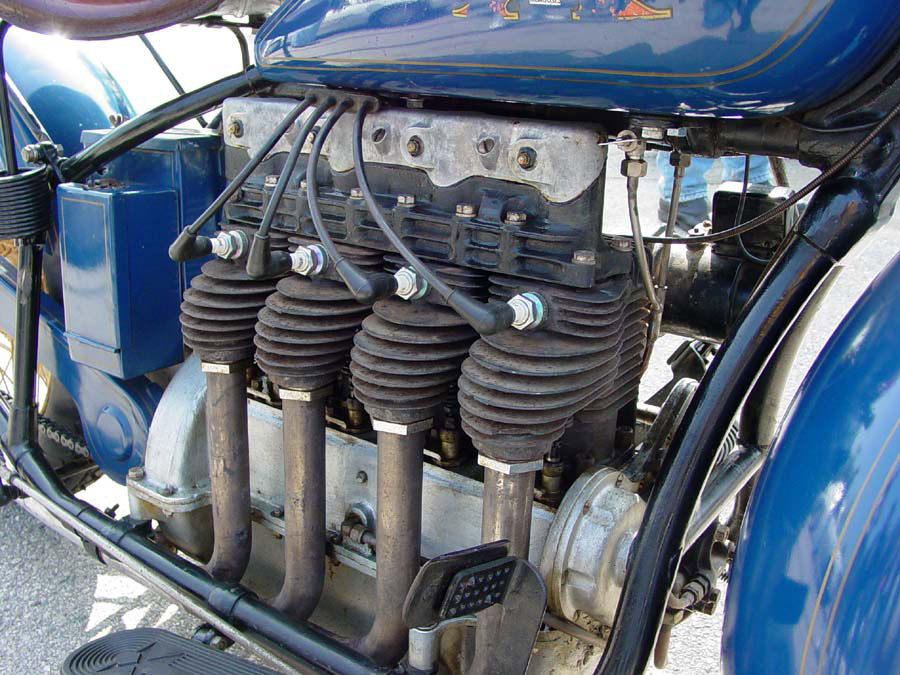
Eight-cylinder motorcycles are rare. The first was the 1907 Curtiss V8, another early one was the 1950s Moto Guzzi V8 racing bike, there’s the the Chevy V8-powered motorcycles made by Boss Hoss, and the Morbidelli V8. Most recently, there’s the new Chinese Great Wall Souo S2000 GL (it has a 2000cc flat-eight engine).
The Curtiss V8 motorcycle was the first eight-cylinder motorcycle. It dates to 1907. If you want to see an original Curtiss V8, get yourself a ticket to the Smithsonian. If you want to see a reproduction of one of the Curtiss V8s, look no further than Jay Leno’s collection:
The Moto Guzzi V8 was built for the 1955-57 racing season; it was never a street motorcycle. I didn’t know too much about that bike (other than that a drawing of it adorned the cover of Melissa Pearson’s outstanding motorcycle book, The Perfect Vehicle : What It Is About Motorcycles). I found a YouTube video that tells us a bit about the Guzzi V8:
My first exposure to an 8-cylinder motorcycle was the Boss Hoss. I saw these bikes at one of the Laughlin River Runs back in the 1990s. The Boss Hoss company had two or three of these bikes on display in the parking lot outside one of the casinos. I sat on one at lifted it off the sidestand. That was enough for me. I’ll bet that bike weighed a thousand pounds. It was an absurd approach to motorcycling, and my 10 or 15 seconds of stationary seat time convinced I could easily live without one. Somewhere I have a photo my friend Dick Scott took of me on the thing, but I didn’t think enough of the bike to bother looking for it for inclusion in this blog. These bikes go for around $70K (maybe less if you can find one used). Boss Hoss offers these in both a small block Chevy version, and a big block Chevy model. Save your money, folks. But if you want to see more, here’s a video on these ridiculous machines:
The short-lived Morbidelli V8 motorcycle was offered in the mid-1990s. Even though I’d see some of the world’s most exotic sports bikes here in southern California (especially on the Angeles Crest Highway), I’ve never seen one of these bikes in person. To me, the name is of-putting enough, and it was billed as the world’s most expensive motorcycles. Thanks, but I’ll take a pass. I found a YouTube video on the Morbidelli. Check this out:
And finally, there’s the the Chinese Great Wall SOUO S2000 flat eight, a bike that takes the boxer engine concept to octopusian extremes. I’ve never seen one of these, either, but in keeping with my approach to his blog, here’s yet another video:
My take on all of the above? Too much of a good thing is just that: Too much. I’ll never own an 8-cylinder motorcycle, and that’s okay by me.
Missed our other ¿Quantos Pistones? stories? Here they are:
Yet again apologies for the prolonged hiatus from writing. I think five or six countries have passed since my previous blogs and I have just been caught up in the moment and dealing with life in my own way (is there any other way to deal with it?). Having a bit of downtime over the holidays I thought I would try to pick up where I believe I left off.
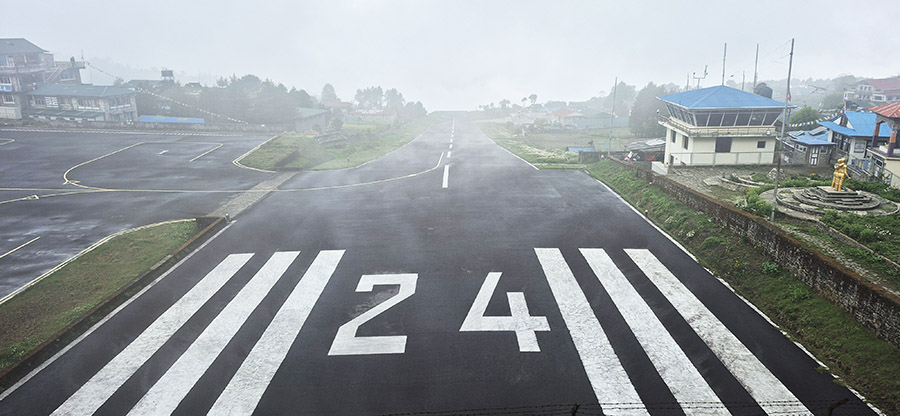
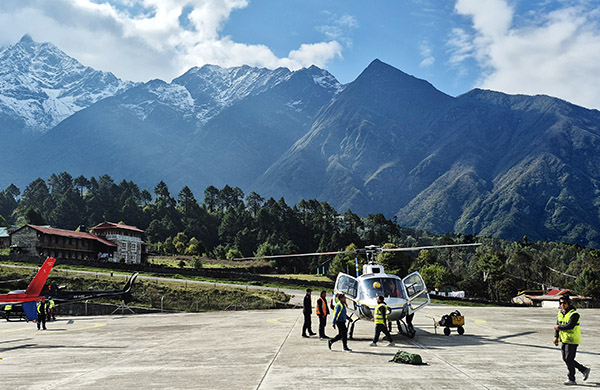
In April I was scheduled for a 0700 flight from Ramechhap Airport in Nepal into Lukla Airport, which is the gateway to Everest Base Camp. It is only a 20-minute flight between the two airports and as I stated in my previous blog after three days of delays forced me to scrap the Everest Base Camp trek originally. This was due to constant cancellations e to weather conditions. As you can imagine the weather patterns in the Himalayan Mountains aren’t always smooth. There is nothing more demoralizing then boarding a flight and having the props fire up and then have the flight scratched and having to deplane. Actually, there is. That being if you fly halfway to Lukla and then are forced to return to Ramechhap due to winds. This isn’t the best way to start off your journey to the rooftop of the world.
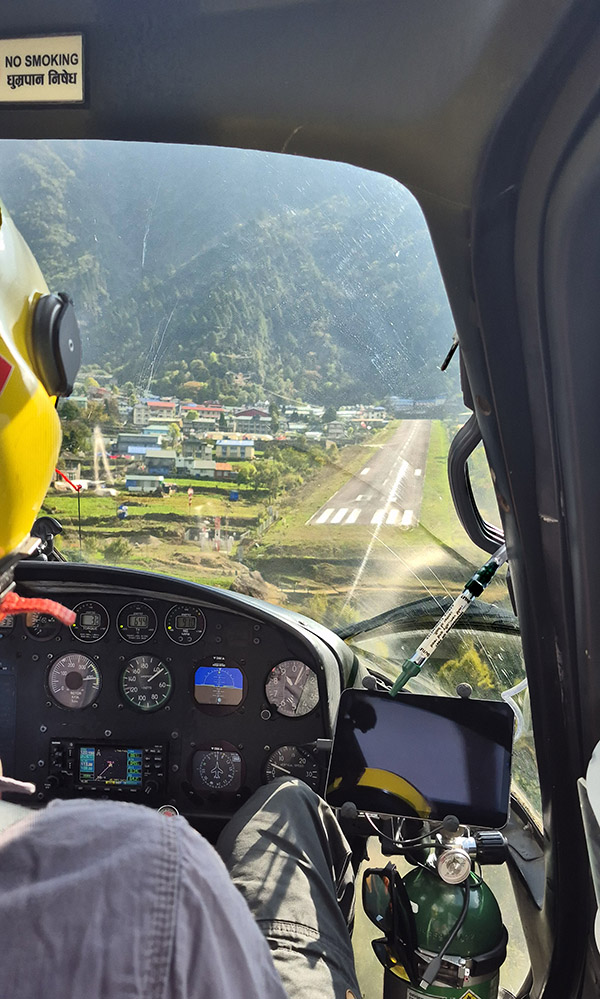
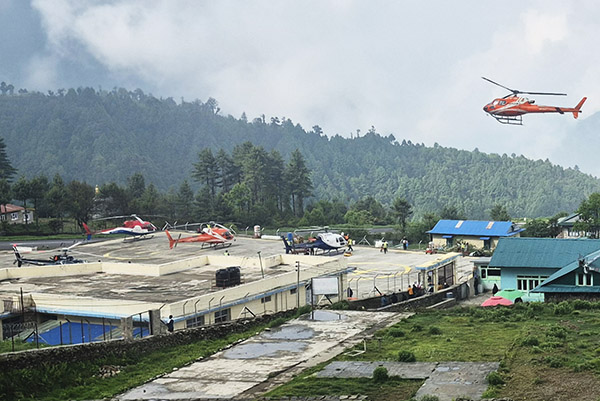
Lukla Airport is the world’s most dangerous airport. Nature is brutal in these mountains and add in the dramatic runway at a 45-degree angle which ends abruptly and drops off 2,000 feet into some foggy abyss becomes a recipe for either numerous cancelled flights, or worse yet, a disaster. When the Airport is up and running it is quite a sight. Helicopters in and out constantly in-between fixed wing aircraft landing and gear and supplies being wheeled all over the tarmac. It’s probably not only the most dangerous airport in the world but the busiest one for having only a single runway.
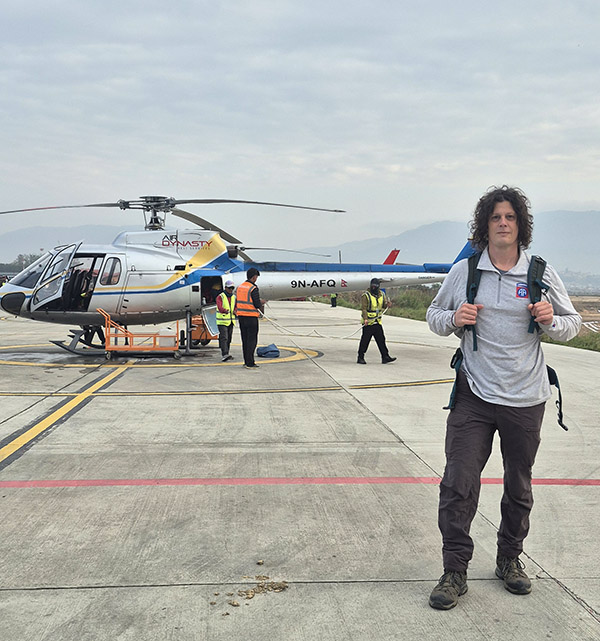
The other thing that I was to learn was even though it took four days to obtain a successful flight into the airport (I ended up opting for a helicopter to improve my odds of making it to Everest Base Camp) was that leaving Lukla airport is just as difficult. After two days of cancelled flights to return to Katmandu I once again chose to take a helicopter.
I was fortunate that I was in no rush, that and having the foresight to obtain a 90-day visa for Nepal almost assured me that I would eventually make it in and out of Lukla with minimal stress. Having both time and patience was required for this as five full days of my two months in Nepal were spent gaining access and leaving Everest Base Camp through Lukla Airport. I knew this time spent sitting in the airport making new friends would pay off once I began the trek to Everest Base Camp.
Another great asset was having my tour guide Kiran from www.theholidaytrek.com make the layovers much more tolerable as all I had to do was show up and hope the flight would be a go. He took care of all the bookings, rebookings, and hotel accommodation setups. I am not one to plug companies and I rarely am on tours but Kiran made being stranded for five days almost fun. There also was another positive out of it. While having a captive audience in Lukla I became friends with another trekker and we are going to be neighbors in the next country I travel to in a week. Colombia!
When driving around Lake Superior (and all the Great Lakes), the waters appear to be calm. At least they do to me, and it feels kind of odd, because each of the Great Lakes are so big you can’t see the other side. In other words, from the shore they appear to be as big as the ocean, except there are no waves. But that’s not always the case. In stormy weather, the Great Lakes can get rough. In 1905, just one storm damaged 29 vessels. You might wonder: Is there that much shipping on the Great Lakes? The short answer is yes, and in particular, a lot of iron ore mined in Minnesota went by ship to Wisconsin and other locations. U.S. Steel alone had 112 ore-carrying ships in 1901.
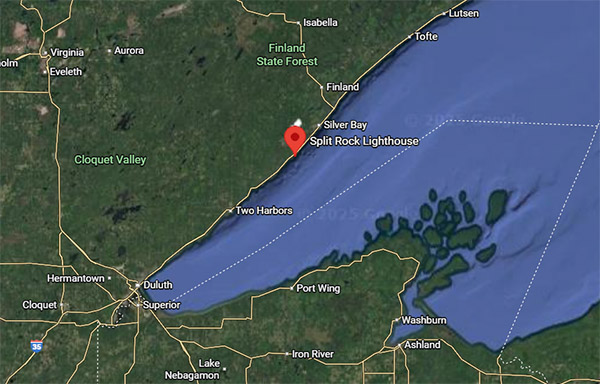
Split Rock’s location along Lake Superior. We rode there from Duluth.
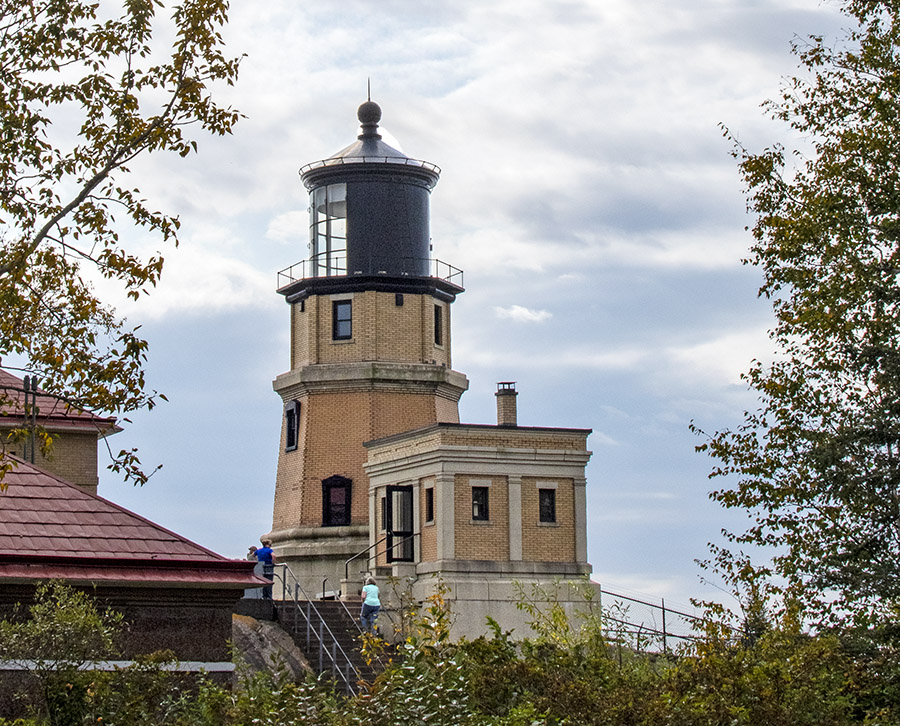
The U.S. Steel president lobbied Washington for a lighthouse along Minnesota’s rocky shoreline, and in 1907 Congress allocated $75,000 to build one. It became known as the Split Rock Lighthouse because the huge rock upon which it sits has a large vertical cleave.
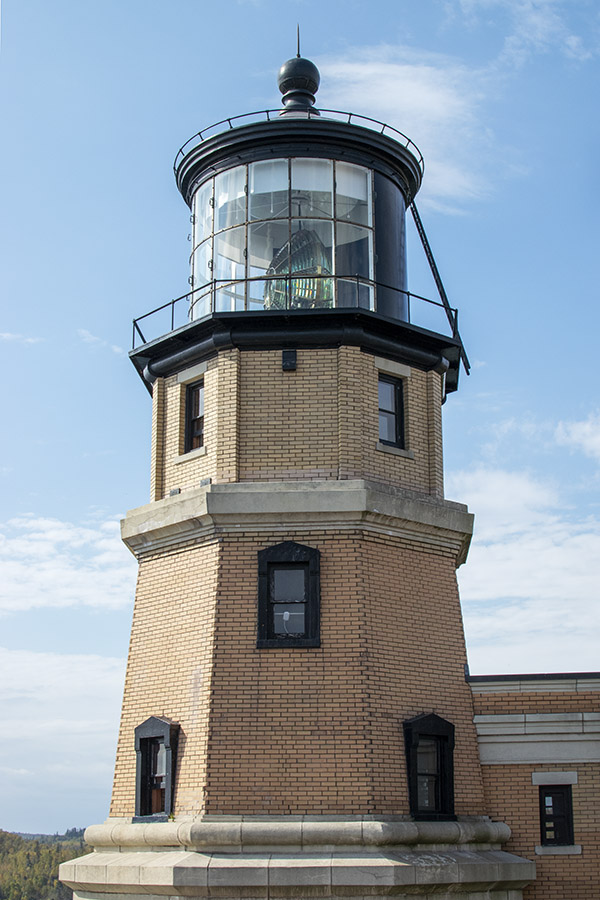
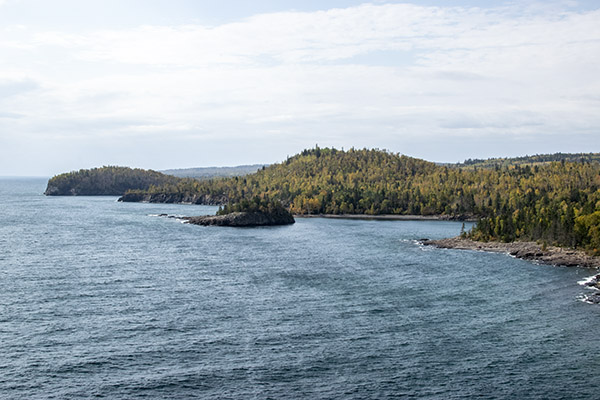
The Split Rock Lighthouse.A view of the Lake Superior shoreline from atop Split Rock.
Construction started in 1907 and finished in 1910, when the lighthouse was commissioned. The U.S. Lighthouse Service operated it until 1939, when all U.S. lighthouses came under U.S. Coast Guard. The Coast Guard is responsible for all lighthouses, but that no longer includes Split Rock. Split Rock shut down as a navigational aid in 1969. Other navigation systems such as Long Range Navigation (LORAN) and the Global Positioning System (GPS) now meet that role. Only five staffed U.S. lighthouses remain in service today; all others have been decommissioned or operate under automated control.
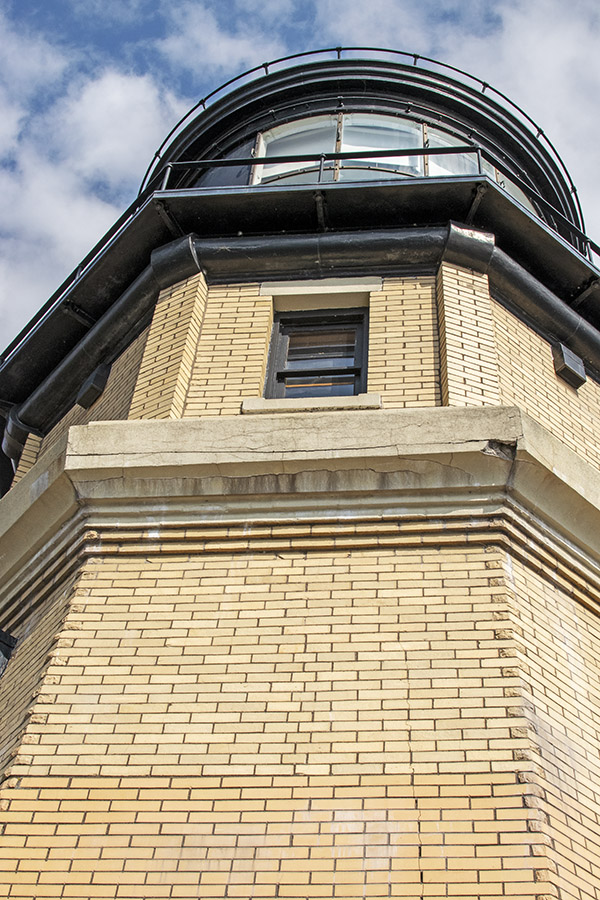
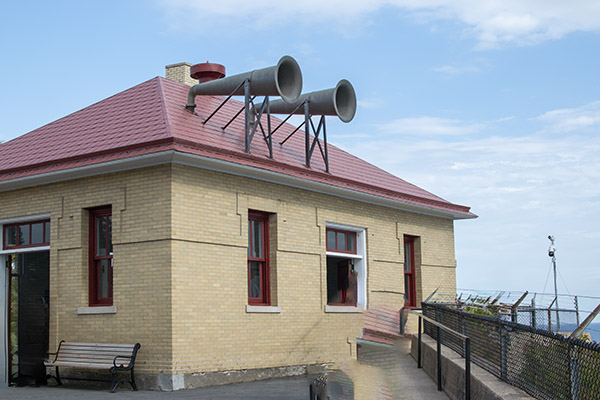
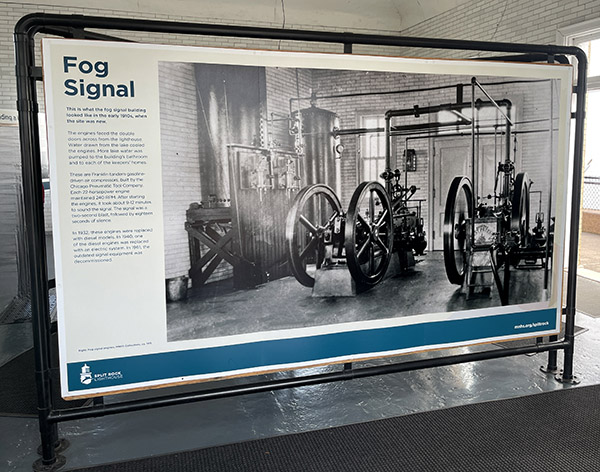
Looking up at the lighthouse tower from its base. I was armed only with my D3300 Nikon and a 35mm 1.8 prime lens. It’s a system you zoom with your feet (i.e., moving closer to or away from the subject). Sometimes there’s not enough room to move around.Foghorns atop the foghorn building. When they were operational, they sounded a 2-second blast every 18 seconds. They went out of service in the 1960s. The horns are activated once a year now.The foghorns were initially powered by two compressors driven by internal combustion engines. Cooling water for the engines was drawn from Lake Superior.
The site transferred to the State of Minnesota in 1971, and in 1976 control shifted to the Minnesota Historical Society. In 2011, it was designated a National Historic Landmark.
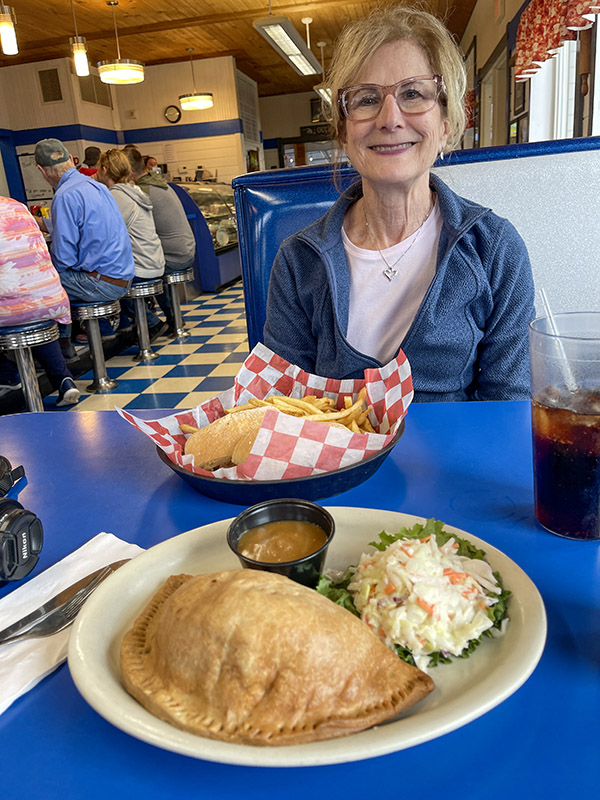
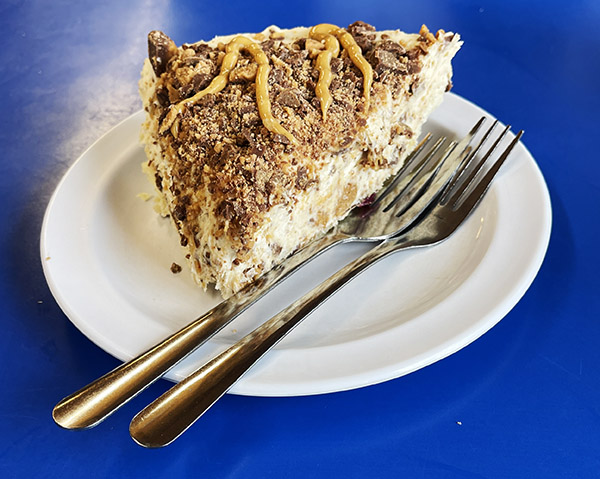
Susie had Betty’s fish and chips; I opted for the caribou chicken pasty. Both were excellent.We split a slice of Betty’s toffee cream pie for dessert. It was awesome.
The ride out to the lighthouse from Duluth (where we stayed for a couple of days) was beautiful. We followed Minnesota 61 north for 47 miles. It was a beautiful ride along the Lake Superior shoreline. On the trip north, we notice Betty’s Pies (a restaurant), and we stopped there for dinner on the way back. There was an hour wait to get in, but it was worth it.
After our dinner, there was a young couple parked next to us on a pair of sports bikes. The gal was on a nondescript Japanese bike; the guy was on a Triumph Speed Triple (and that definitely caught my attention). We followed them back along Minnesota Highway 61, and after a few miles they veered left on Scenic Drive (which follows the Lake Superior shoreline much more closely). That is an appropriate name. Scenic Drive took us directly into Duluth and our hotel. It was a fun day.
Looking for a great place to ride? Hey, that’s our specialty. I write about great Destinations regularly for Motorcycle Classics magazine. You can read about my favorites here:
I tested four different .45 Colt loads in three different six shooters yesterday. The revolvers were an 1873 Taylor-tuned Uberti SAA with a 5½ inch barrel, a stainless steel Ruger 4 5/8 inch Blackhawk, and a 200th Year Ruger 7½ inch Blackhawk. Conditions were way less than ideal: It was windy and I was there in the afternoon, which meant I was shooting into the sun on the West End Gun Club’s 50-foot handgun range.
My Uberti with a Schrade stag-handled large folding knife. Both are elegant.
Every time I shoot the Uberti, I’m reminded how elegant the 1873 design is. The Ruger Blackhawks look good and shoot well, but they are a bit “clunky” compared to the old Colt design. The 1873 SAA just feels graceful. It’s a delight to hold and to shoot.
Ruger’s stainless steel, 4 5/8 inch barreled Blackhawk chambered in .45 Colt. It’s a slick sixgun.A 200th Year 7 1/2 inch Ruger Blackhawk, also chambered in .45 Colt. I bought it about 15 years ago; I fired it for the first time in this load evaluation.
As I was unlocking the gate to get into the range, a low-rent-gangbanger-looking, dirty, tattooed guy pulled up behind me in a beat up old white Honda. He obviously had been waiting to follow me in. Even though I’m armed, I’m always a little nervous when I get out of the car to unlock the gate because it’s desolate out there and it’s a good ambush spot. The guy sure didn’t look like a Republican to me. I asked him to show his membership card and he went into his “no habla” routine. I told him I wouldn’t leave the gate open without seeing his membership card, and he suddenly had enough “habla” to understand that. He turned around and left. A recent WEGC email explained that these guys steal brass and other stuff from the range, so I’m guessing that’s what this dirtball wanted.
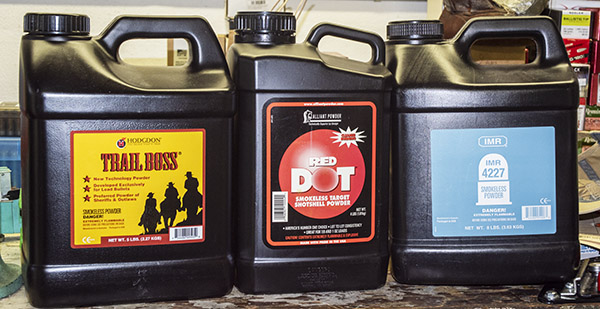
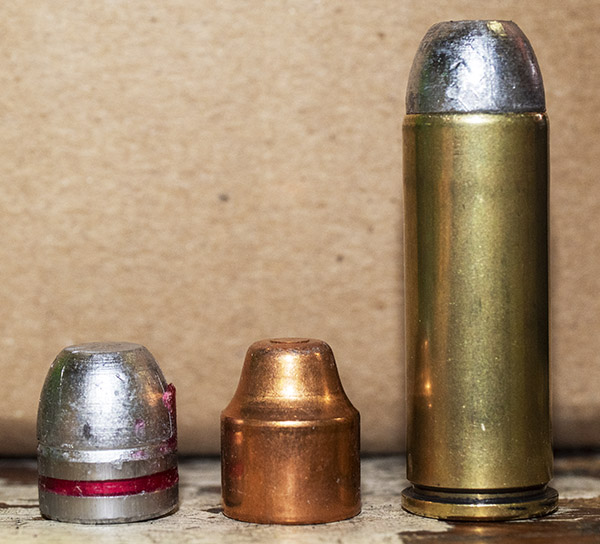
The three propellants used for this test series: Hodgdon Trail Boss, Hercules Red Dot, and IMR 4227.The 200-grain cast bullet, the 185-grain Winchester jacketed semiwadcutter, and a loaded .45 Colt cartridge.
The loads used Trail Boss, IMR 4227, and Red Dot powder. I had been loading .45 Colt with Trail Boss because it is what the Cowboy Action Shooters use and it was presumably a low velocity load. To my surprise, the Trail Boss velocities were only very slightly below the other powders’ velocities. I loaded with two different bullets (Winchester’s 185-grain jacketed semiwadcutter and a 200-grain cast roundness bullet with a truncated ogive).
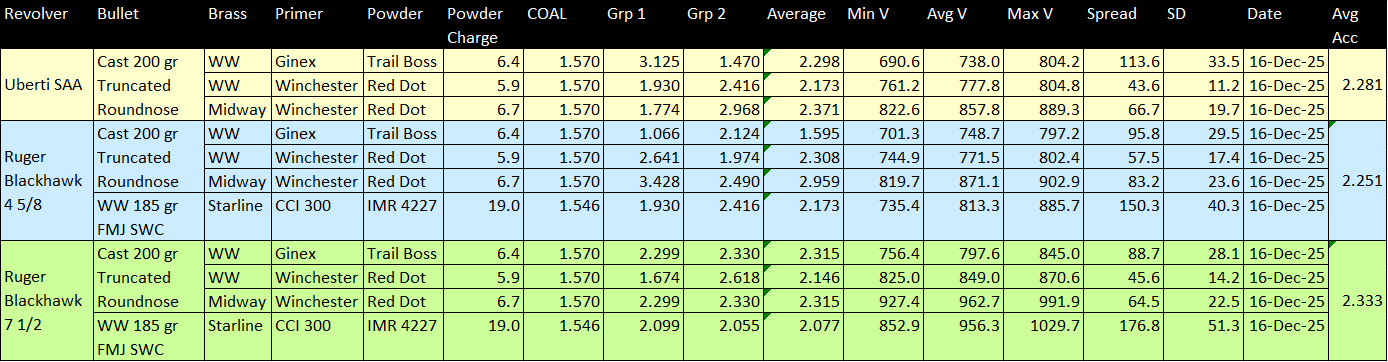
The results of my testing are in the table below. The table’s font (as it appears in the blog) is tiny, but if you click on it, the table will open with a larger and more readable display.
Here are the inferences I make from the above data:
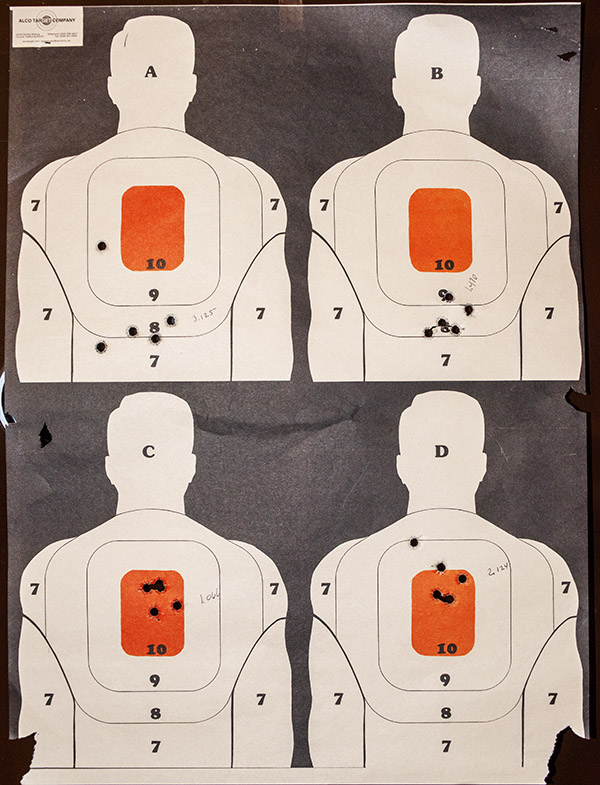
There are some large groups sprinkled in the above data (above 3 inches); that’s probably due to the poor shooting conditions and me. My first group was one of the worst; I attribute that to me settling down for subsequent groups.
I used Alco’s target with four mini-silhouettes. Shooting conditions were less than ideal.
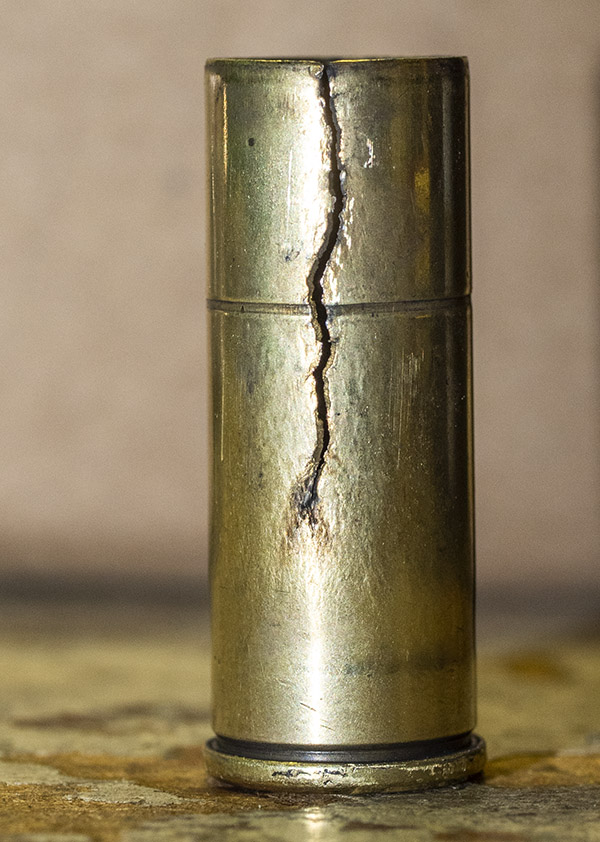
I also noticed that one of the cases had split, and the bullet from that case would have been a flyer. With the exception of the one case that split, none of the cartridges exhibited any pressure signs. All cases extracted easily (other than the one that split) and none had flattened primers.
It happens. This cartridge case had been loaded one too many times. When this occurs, it results in a flyer.
The Lee cast bullet reloading manual shows the 200-grain truncated roundnose bullet accuracy load to be 5.6 grains of Red Dot, which is at the very bottom end of the range. I went with 5.9 grains because the Red Dot loads don’t occupy much of the case volume and I felt uncomfortable with that. I might try the lower load of Red Dot (i.e., 5.6 grains) next time I’m reloading, but I think I’m going to just stick with 5.9 grains. It works well enough in all three revolvers.
The Trail Boss spreads and standard deviations were large, which surprised me. I’ve had good accuracy at 50 feet with this powder, but the large standard deviations mean that at longer ranges the accuracy will be poor. I could feel the difference in recoil with the Trail Boss load; one round would give a sharp crack back, and the next might be much lighter. The Trail Boss chronograph data supports that subjective assessment.
I have a lot of Red Dot propellant, so I wanted to evaluate it in the .45 Colt. It did well. In general, the Red Dot velocity spreads and standard deviations were lower than those with Trail Boss or IMR 4227. That was a surprise, too.
Overall average group size (all guns, all loads) with the cast 200-grain bullets was 2.275 inches. Overall average group size (all guns, all loads) with the full metal jacket semi-wadcutter Winchester bullets was 2.125 inches. That’s not much of a difference.
You might be wondering why I didn’t try the IMR 4227 loads in the Uberti SAA. I thought these would be a lot hotter loads because the load data was for Ruger revolvers. Turns out the velocities were in line with the Trail Boss and Red Dot loads. I could have shot the IMR 4227 in the Uberti, but I didn’t realize that when I was on the range. I was very surprised at the huge velocity spreads and standard deviations with IMR 4227.
Recoil for all the loads listed in the table above was not oppressive. But I wouldn’t characterize the recoil as light, either. The .45 Colt is a big cartridge.
As expected, the 7 ½ inch Blackhawk velocities were slightly higher than were those for the other two shorter-barreled revolvers. The longer sight radius on the 7 ½ Ruger didn’t make much difference in accuracy. That’s counterintuitive. It may just be that the wind and shooting into the sun masked any advantage the longer sight radius offered.
Overall accuracy for the revolvers with all loads was essentially the same (see the last column in the above table). I could repeat this evaluation under better range conditions, but I think I have enough information to select a good load. While the groups were not stellar (they were in the 2-inch+ range), the above convinces me that Red Dot is a good powder in .45 Colt. I’ll probably standardize at 5.9 grains of Red Dot with the 200-grain cast bullet. The velocity is high enough for my purposes and I love that low standard deviation.
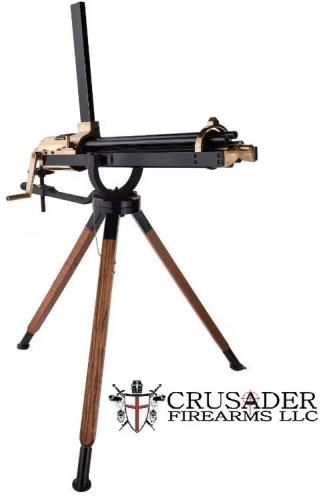
I’m a student of the Gatling gun and as you tell from reading this piece, I’m a big fan of the .45 Colt cartridge. After finishing this blog, I briefly wondered: Were any of the original Gatlings chambered in .45 Colt? The short answer is no. Even though the .45 Colt was a prevalent cartridge during the era of the original Gatlings, none were built for this cartridge (they instead used the much more powerful .45 70 rifle cartridge). That was then, though, and this is now. You can buy a current reproduction of the Gatling chambered in .45 Colt. That would be cool, but it would be expensive to keep such a beast fed.
Crusader’s .45 Colt Gatling Gun. It’s only $8149.99.
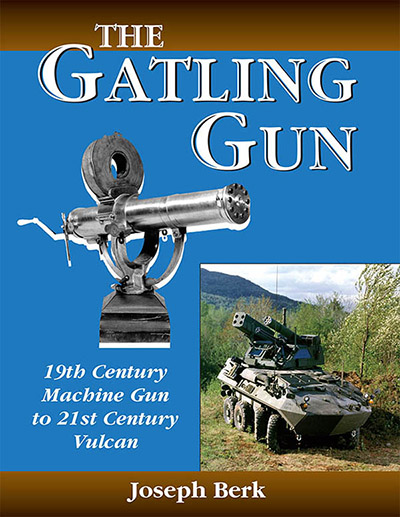
If you want to know more about Gatling guns (including their early history, the transition to modern weapon systems, and their current applications), pick up your copy of The Gatling Gun.



 After a month or two in southern Thailand spending the days scuba diving and embracing the sun it was time to head north. The previous year when I was in Chaing Mai I got sick off eating elephant poop, not intentionally but it had me leashed to a toilet for four or five days and ruined my entire itinerary. It was now time to return to Chaing Mai and steer clear of the elephants.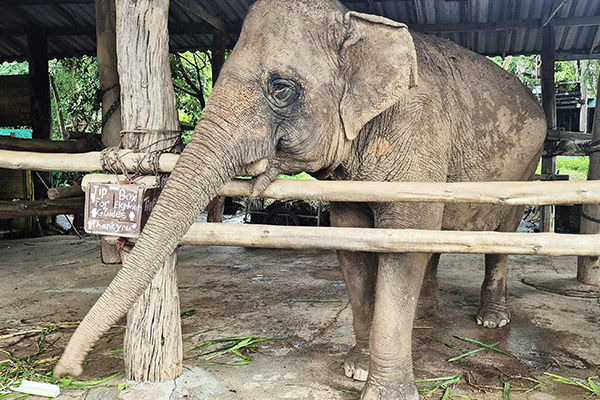



 I’ve set up the Kawasaki ZRX as my cold weather bike with a 12-volt receptacle for an Aerostitch heated vest and these grips will complete my preparations for the cold. If it ever gets here.