Big Boy And The Mother Of Intentions

By Joe Gresh

Motorcycle riding gives you a good excuse to go places and see things, not that you need an excuse. I like a steam train, I have a motorcycle, thus riding up to Ogden, Utah to see a big old steam train seemed like a sensible thing to do.

My Carrizozo Mudchuckers buddy, Mike, was all for the idea so we planned to meet Big Boy, the last of the steam locomotives, in Ogden, where the train would stop for two days. As we waited for the appointed day the normally beautiful New Mexico weather cooled and became cloudy with rising damp. Ogden, being 900 miles north of us, was experiencing the same weather degradation except much, much colder.

Just a few days before leaving there was snow and rain in Utah. A 75-car pile up in Denver, and rain and cold all along our route north, had us thinking “this ride will suck.” I kept watching the weather reports hoping for a better forecast, but it looked like miserable weather the entire trip north only starting to ease off a bit on the Monday we would start riding home from Ogden.

I have plenty of cold weather riding gear. Things like electric vests, heated grips and a plastic rain suit can keep you warm enough. I’ll use them if there is no other option. But there was another, simpler option: Don’t ride into the rain and cold.

One day before were planned to leave I called the Mudchucker and said: How about we go to Willow Springs for vintage motorcycle racing instead? Call me a fair weather rider but sunny California was an easy sell. We dumped Ogden and the Big Boy steam train faster than oil prices rose after we bombed Iran.
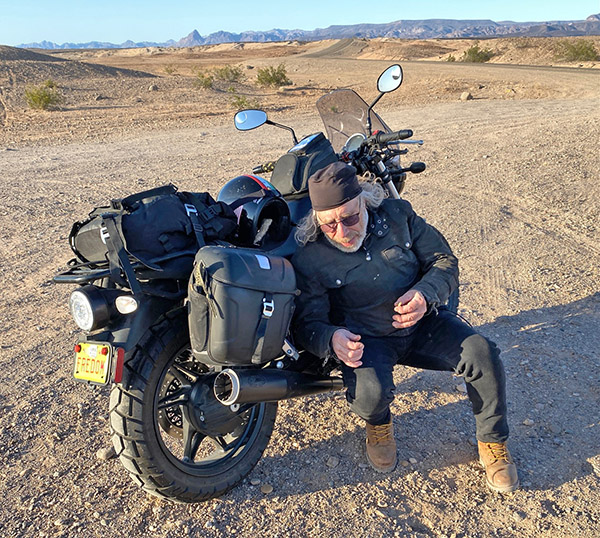
The Mudchucker taking a break from headwinds.

The plan worked. We left town a day later than the Big Boy run. That allowed some of the bad weather to move east. Our first day on the road was cool, cloudy but comfortable, the second day we had strong headwinds and 40-degree cold, but nothing nearly as painful as the stuff we would have experienced earlier and further north.

We mostly followed old Route 66 west jumping on and off Interstate 40 as required. It was an odd time of year I guess. The entire town of Seligman was closed: Gas stations, food markets, all shuttered. Further on we rolled into tiny reservation villages with nothing available to buy or rent. I admit, traffic was light on historic Route 66.  If a guy set up a food truck he’d starve to death.

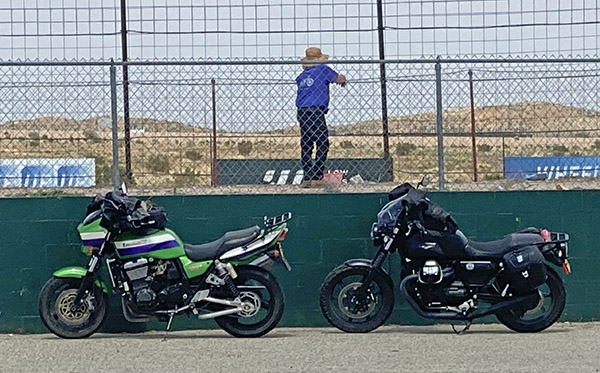
On westward we rode, through Kingman down to Oatman. Again, every store in the tourist-friendly little donkey-town of Oatman was closed. The day ran long, we needed ice cream, it was getting dark, I couldn’t see much through the dark face shield on my helmet, and we pulled into an abandoned gas station to check out the motel situation in Needles. The Mudchucker was tired. He stopped next to me and toppled over. I tried to hold us up but the combined weight of Mike, his Moto Guzzi V7 and my ZRX1100 Kawasaki was too much.

We went down like the stock market after we instituted tariffs.  The bikes were stacked against each other much like the system is stacked against the common man. It took a bit of doing to untangle them and lift the bikes upright. Damage was light: a few dings in the right-side Guzzi jug, a busted turn signal, scratched gas tank, and bent brake levers on the ZRX1100. Amazingly, there were no dents or major issues.
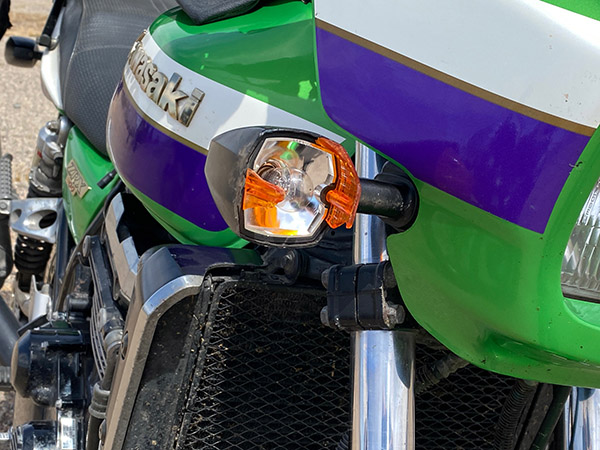
Not a lot of damage for tossing one bike on top of another.

A homeless guy camped at the gas station saw the whole thing. He didn’t laugh or say anything. He must have thought we were total losers.

The tip over had us in a melancholy mood. In the motel that evening we talked about that inevitable day, our strength gone, our skeletons frail, the day when we could no longer ride. Mike felt a side car was the way to go. I favored a three cylinder, two stroke, Kawasaki-powered gurney.

But gurney-time isn’t here yet and by the third day we were riding along basking in the warm Mojave desert. Things were looking up and thoughts of our physical decay burned away. Or maybe we just forgot we were falling apart. I hear that happens but I can’t remember where I heard it. Route 66 to Amboy was closed so we had to stay on Interstate 40, only returning to Route 66 west after paying $7.50 per gallon of gas at Ludlow.
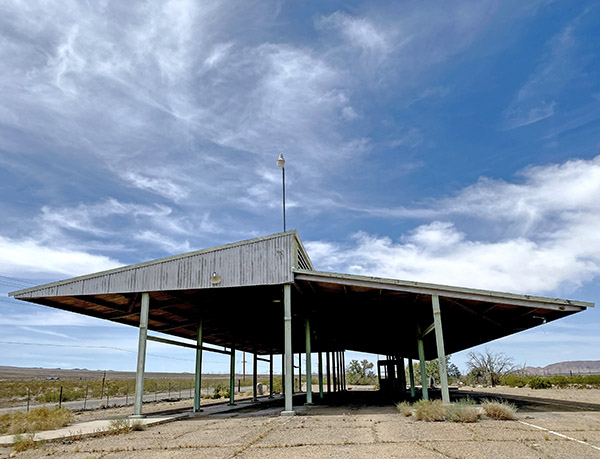
Some kind of inspection station east of Barstow on Route 66.

Out of Barstow we rode past Hinkley, the toxic-water town made famous by Julia Roberts and Erin Brockovich. We made it to Lancaster, our base camp for Willow Springs.

Lancaster is an interesting place. On the back roads we came in on there were piles of trash dumped everywhere. I guess the town doesn’t have a dump. Or maybe the dump fee is too high so people drive out of town a few miles and drop their load. It reminded me of the trash piles I used to pick through in the Florida Everglades. You can find some good metal in those piles.

I saw some nice chairs 5 miles from Lancaster.  If I had the Toyota truck, I would have grabbed them. There was a lot of broken concrete that would make excellent fill back at the ranch. Drywall was another popular item on the side of the road. Once in town things cleaned up slightly, and Lancaster looked much the same as other generic, California desert towns: New chain stores along the highway, decomposing shops, homeless people and frequent stop lights in the old sections.

The Wyndham motel on Avenue I was new and along the highway. They have a pretty good breakfast setup. There were the usual sausage paddies, scrambled eggs and pour-your-own waffles. We waddled out to the bikes and rode the 20 miles to Willow Springs racetrack.

Vintage motorcycle racing is mostly a family affair. Spectators not directly involved with the racing or supporting the racers are rare and we had the grandstands to ourselves. Multitudes of classes meant non-stop action all day long.
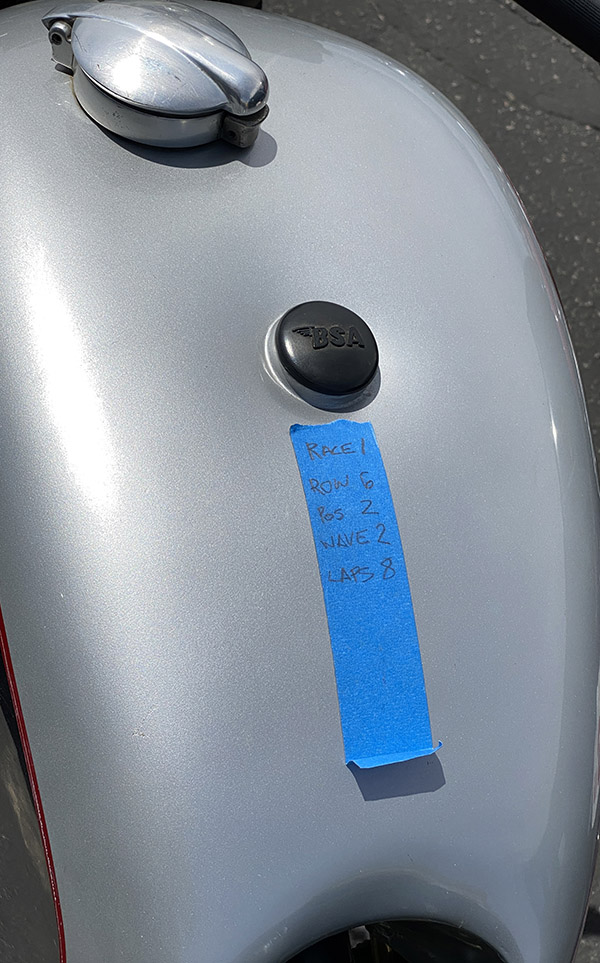
Lots of races and classes to keep track of at an AHRMA event. You won’t leave the track unsatisfied.

AHRMA racing covers all eras with heavy emphasis on bikes that were never actually raced back in the day, at least compared to the races I saw as a youth. Honda 160s are a popular class and an example of bikes that were never raced where I grew up.
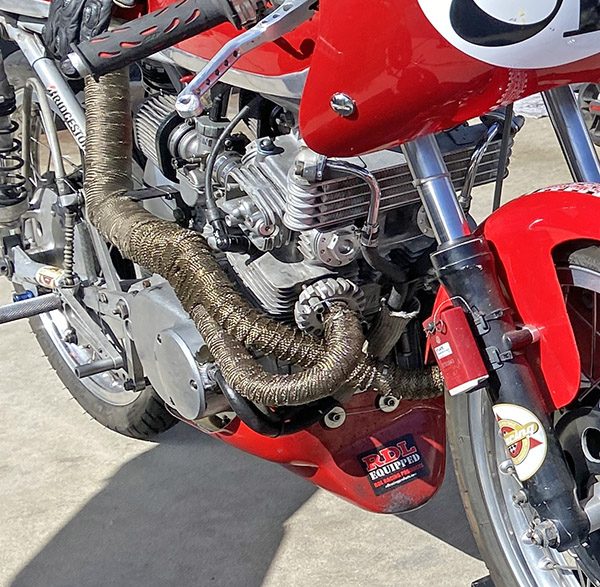
Sloper 160 Hondas are strangely popular. I had one as a teen. In stock form they would hit 75 MPH. In race trim a bit faster.

An unusual number of Moto Gizzards circulated the Big Willow track. Maybe because they were so popular, only a few Yamaha Twins survived to race AHRMA. Most of the race bikes were 4-strokes.  In the 1970s that ratio would be flipped and 2-strokes ruled the track. I guess the point is to run what you want and have fun with it.
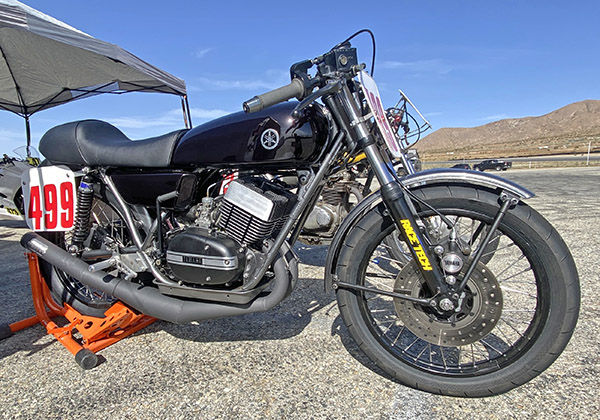
The RD350 went from a mainstay of road racing to a rare bird at historic events.

The Willow races were not as well attended as the Laguna Seca AHRMA events. Laguna Seca is set in soft, coastal hills and has space for vintage motocross along with a vintage trials section. The camping at Laguna Seca is better. I suppose you can camp at Willow but it’s more of a motor home type camping than a tent. I’m not sure what happened between AHRMA and Laguna Seca and it’s none of my business, but I wish they would get it sorted out and go back to Laguna.
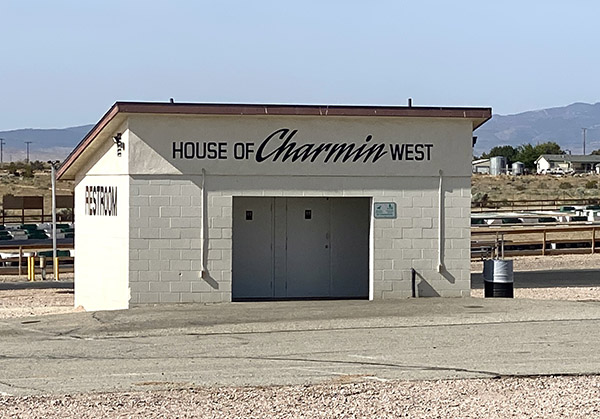
Nice, clean, crappers at Willow. A clean crapper makes the day just that much nicer.

Willow isn’t bad, mind you. The racetrack recently sold and the new owners are fixing it up a bit. There are several tracks and the food concession was better than Laguna. You can get a decent meal at Willow.

The last time I was at Willow Springs was in the 1970s. The pit looks the same and there are added buildings along the front straight. My memories are dimming and I can’t remember why I was there in the ’70s, but it was probably motorcycle racing of some sort.
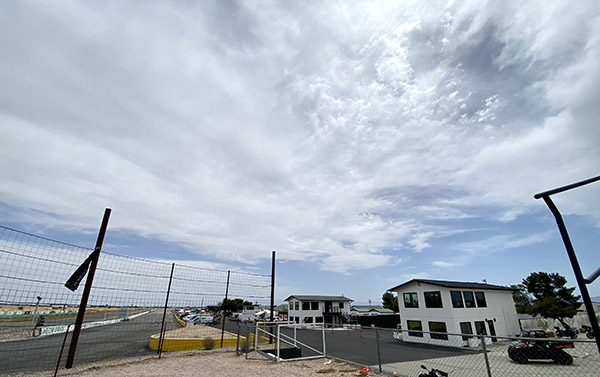
If you take away the little houses, pit row looks about the same as I remember from the 1970s.
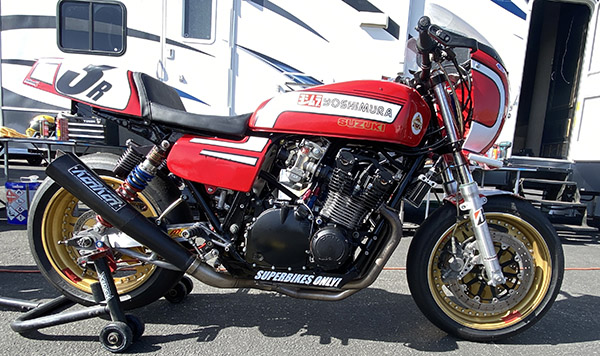
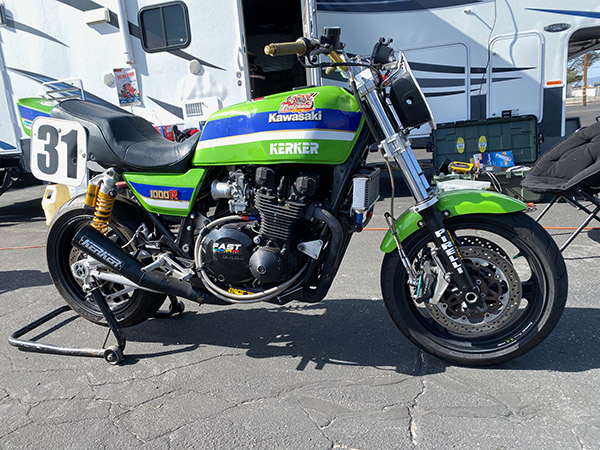
Kawasaki built a Superbike production racer called the S2. I don’t know if this is one but it looks like one.
Suzuki big-block race bike. Although, it could be a 750. I didn’t look that close.
SR500. Great bike from Yamaha unfortunately suffering from The Slows. My XL350 could stay with them through the gears and pull away at top end.
Roper and Fulton on Italian Harley-Davidsons. About 100 years of racing experience in this photo. They are faster than you. Sorry about the cell phone photo.
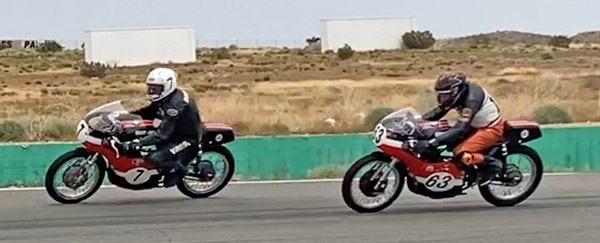
Zippy Yamaha 100cc twin. I might get a stocker one of these one day.
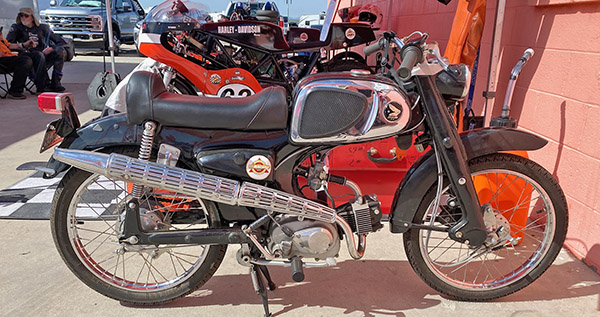
CA110(?) I have one of these in pieces waiting for assembly. The engine is shot so I bought a clone 140cc overhead cam engine. It fits the gram and clears the front wheel by 1/4-inch.
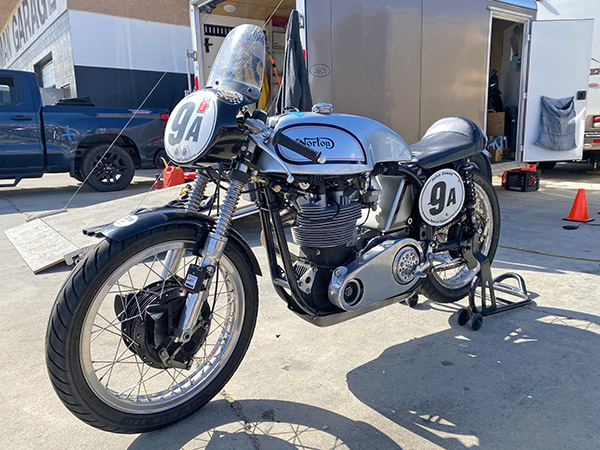
Manx Norton. For a while these 500cc singles ruled the road racing world. Still faster than a SR500.
If you don’t like crowds you’ll love AHRMA racing.

Rosamond, the town closest to Willow has grown quite a bit and lots of housing developments are being thrown together. Eventually someone will build houses around Willow if the new owners don’t do it first.

The ride back to New Mexico was full-on warm. We took backroads from Lancaster to Victorville and sort of paralleled Interstate 10 along Yucca Valley and Twentynine Palms to Parker, Arizona. Our miles per day were shrinking and we were stopping more often. Temperatures reached 95 along the sparsely populated Highway 62.

I was smelling the barn, you know? I kind of lost it on the last day in Show Low. We woke up at 4:30 am to get an early start. I wanted to get home and the Mudchucker was leisurely watching TV and eating a bagel. By 8:30 a.m., I had been awake 4 hours and drank 16 cups of coffee waiting. I had a lot of pent-up nervous energy.
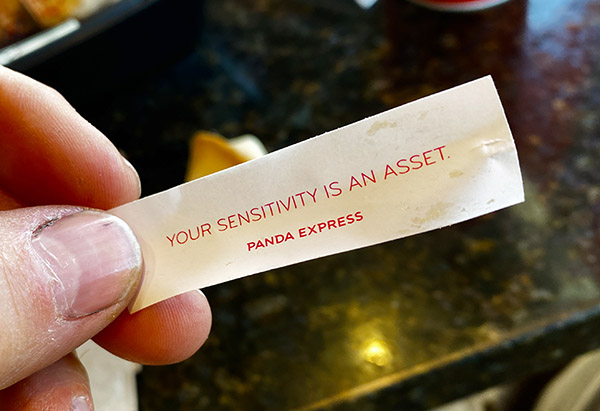
Maybe 7 days on the road rubbed my nerves raw. It doesn’t seem like an asset.

Finally underway, we burned up the highway into New Mexico, a slight frost between us, and I managed to get home at a decent time (before dark). I’m starting to wonder if 7 days on the road is too much for me. Riding motorcycles with a partner is a series of compromises strung together with miles and miles of pavement. Are the compromises worth the companionship? I’m sure I must annoy the Mudchucker at times.

Maybe I’m just getting old and cranky. At least, that’s the excuse I’m going to use.


Subscribe to ExNotes for free!


We need your support! Do what you can to help ExNotes stay in the black!


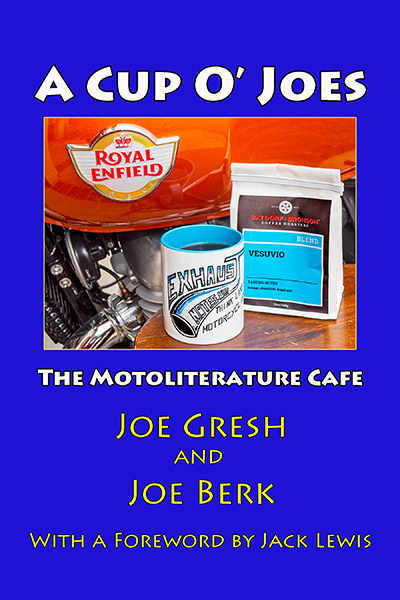
More Gresh? You bet! Check out A Cup O’ Joes!

Join our Facebook ExNotes page!
Scenic Byway 163 (Arizona to Utah): Part 2

By Mike Huber

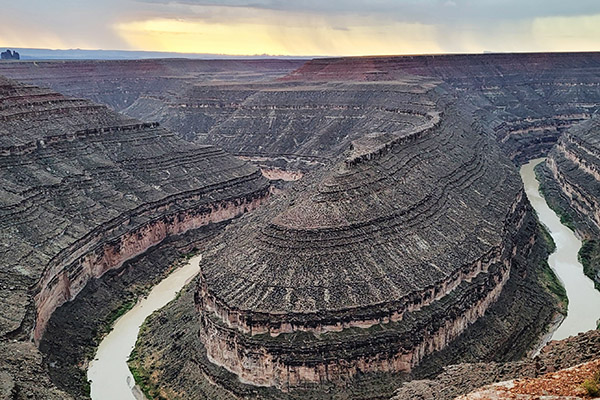
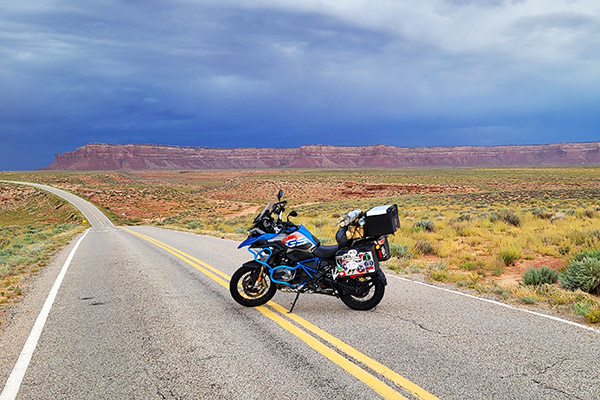
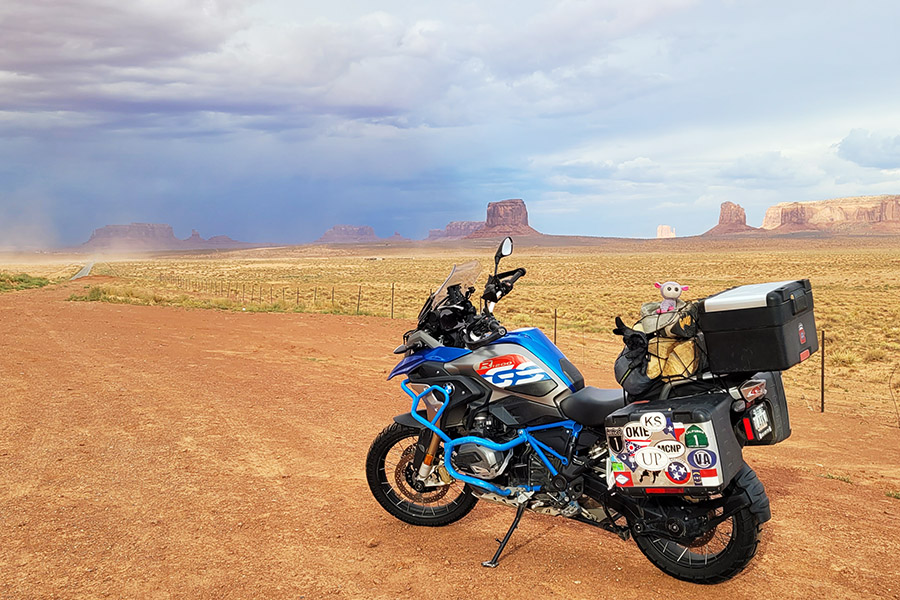
As I left the gas station in Mexican Hat the sky was looking extremely menacing.  I knew that camping in a lower elevation in the Valley of the Gods may not have been the best idea, due to possible flooding.  The roads can get really slick with rain.  There was a great state park just a few miles away.  In fact, it is such a great place to camp I was hesitant to name it here, but it is Gooseneck State Park.  There are about 20 campsites there which are on the edge of a 1,000 foot drop into what looks exactly like Horseshoe Bend.  This park would suffice for my home for the evening, although in hindsight I should have gotten a hotel.  But then there wouldn’t be a story.

I pulled into Gooseneck State Park and set my tent up.  The sky was black.  It really looked menacing, and I was quite sure it wouldn’t be a dry night.  After setting up my tent I did my usual walk around the park and talked with other campers.  I began chatting up some other riders and invited them over for a beer and to share my fire.  Within five minutes of talking to them one replied to me as he pointed to the sky. “Yeah, you may need all those beers for yourself, and there is no way we are having a fire.  Good luck.”

A few minutes later I found myself in my tent alone drinking my beers as the sky opened up.  This was not good.  As the rains continued to pelt down the winds picked up.  Within two beers the ground became so soaked that my tent stakes had uprooted in the now mud puddle I was camped in.  The tent was being blown all over just making loud cracking noises like a whip.  Fortunately, I had brought my panniers inside and positioned them at diagonal corners of the tent in an attempt to keep the tent somewhat grounded.  Unfortunately, the winds had grown so strong that my entrance zipper was ripped apart.

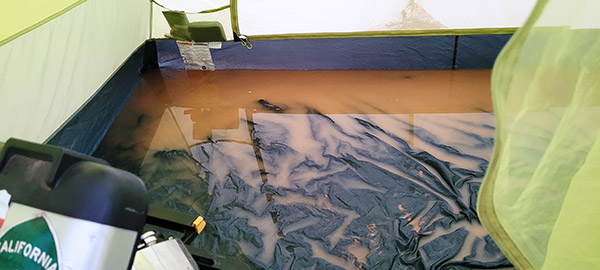
I felt like this was as bad as it would get. Sadly, I was mistaken as a strong gust got under the tent and threw my pannier across the tent and in doing so the floor of my tent was ripped apart.  I managed to get a little bit of sleep that evening but not much.  In the morning as I awoke at 5:00 a.m., I noticed my tent had a couple inches of water in it.  It resembled a kiddie pool.  Everything I owned was soaked.

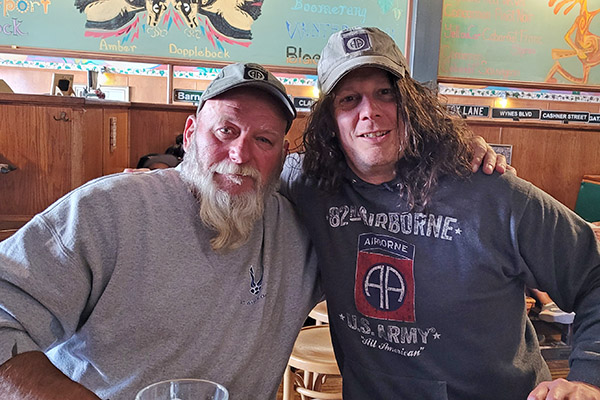
By 05:30 I had everything packed up and I was ready to find a coffee shop to dry out in.  My plan for that day was to meet one of my 82nd Airborne friends in Cortez, Colorado for lunch.  Even though I had an early start I showed up late, due to trying to dry my gear out.  When asked why I was late I simply replied I had to hit a hardware store for duct tape.  He then looked me up and down as I was covered in mud and even my 82nd Airborne hat was destroyed from the previous night. “What the fuck happened to you?” he asked as he took in my appearance.  I ordered a beer and began to tell him of my adventure. Even though I had a rough night, Scenic Byway 163 is still one of the greatest roads in the United States.


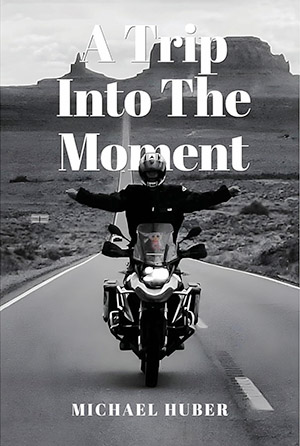
More Huber? Check out A Trip Into The Moment.


Join our Facebook ExNotes page!


Help us keep the lights on:


Don’t forget: Visit our advertisers!


El Puerco Times Two: Part 2

By Joe Berk

An upfront warning:  If you’re squeamish, you should skip this blog.  


It rained hard after Tom, John, and I returned from our first day’s hunt, but that was okay.  The Dunton Ranch has nice accommodations.  Heat, hot water, cooking gear, refrigerator, shower, comfortable bunks, and more.  Just bring food and ammo.  It’s a gentlemanly way to hunt, and if nothing else, John and I are gentlemen. No more pitching tents and sleeping on the ground for us.

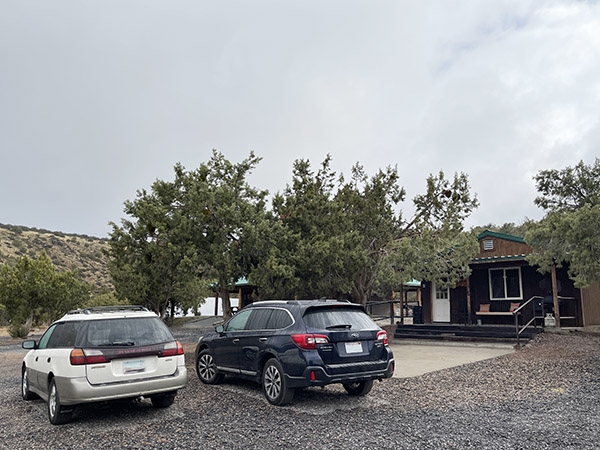
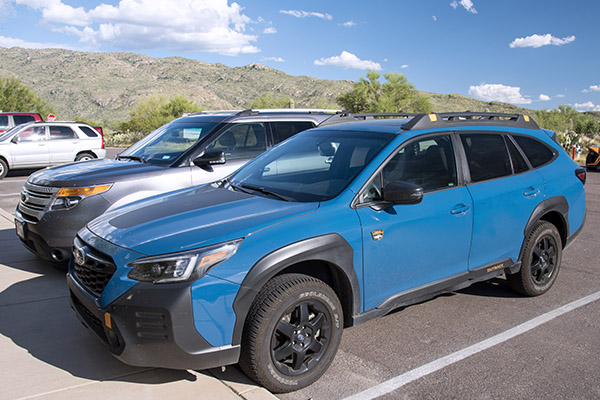
Subaru Outbacks, parked in front of our Dunton Ranch cabin.  John and I are both Subie fans.

When Tom picked us up the next morning, he told me my hog weighed 219 pounds, and that he recovered the bullet.  It had come to rest just inside the hog’s hide on the opposite side of where I shot it.  I was very interested in seeing that bullet.  Tom had prepped the hog and two sides of pork were hanging in the Ranch’s freezer.  Tom told us he had stood outside in the rain the previous night skinning and dressing it.  My pig weighed 219 pounds.

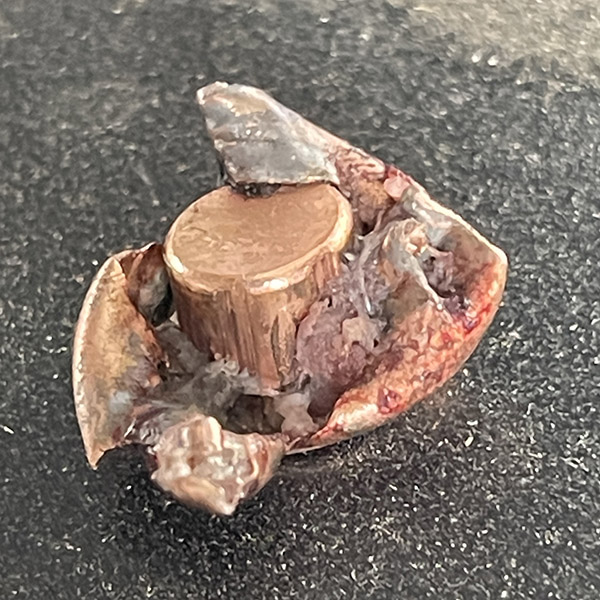
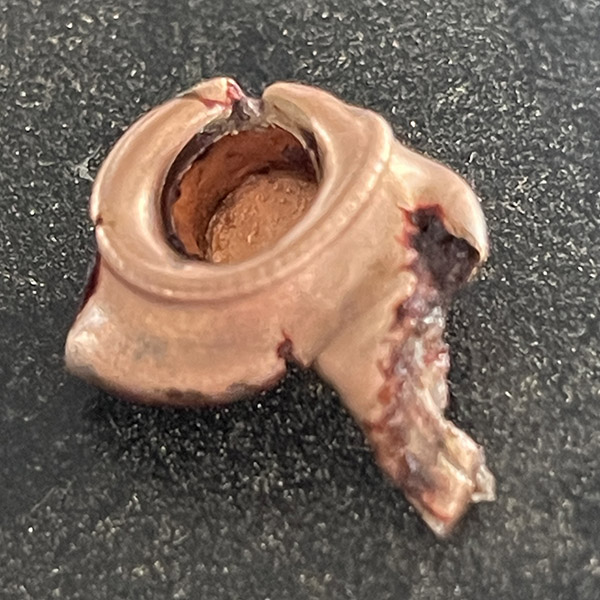
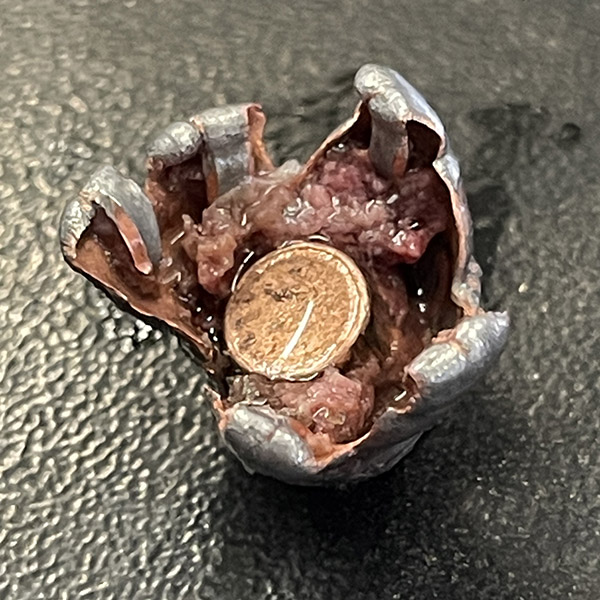
Tom showed me the bullet.  My hog was a clean kill, but the bullet had failed.  Its lead core separated from the cupper cup.  Not that it made any difference to the pig.

My bullet, post impact. The copper jacket should the bullet had mushroomed nicely (which is what you want), but when I turned it over, I was disappointed (see below).
My bullet’s copper jacket. The jacket peeled back nicely. The lead core was gone. It should have still been in the jacket. John’s bullet would behave the way it was supposed to, but mine had not.

Tom told me the bullet had cleanly impacted the hog’s spine and taken out a fist-sized chunk of it.  The hog was dead before it hit the ground, but the bullet had separated.  It bothered me enough that I called Hornady when I returned home, and I’ll tell you about that later in this blog.

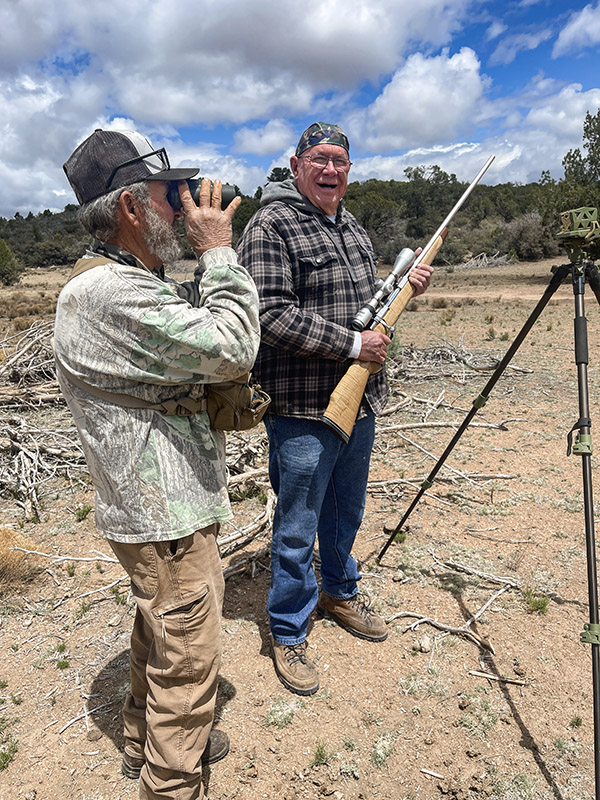
Tom, our guide, and Baja John checking the zero on John’s .25 06 Browning. The zero was exactly where it needed to be. We were good to go.

John’s rifle is a beautiful curly maple Browning A-Bolt chambered in .25 06.  That’s a cartridge I had never owned, but not because I didn’t like it.  Everything I’ve ever read about the .25 06 has been positive.  Flat shooting, accurate, easy to find ammo and brass for…it has all the right things going for it and it rings all the bells.  And I love A-Bolt Brownings.  John’s rifle is all stainless steel, it has an octagonal barrel, and it wears a Nikon 3×9 telescopic sight finished in silver to match the rest of the rifle.  It’s a beautiful firearm.

When John first bought his Browning several years ago, he visited us and we spent some time at the West End Gun Club zeroing it.  John hadn’t shot the rifle too much since then, and he wanted to check the rifle’s zero before we hunted.  Tom took us to a place where we could do so by firing at a pile of large boulders he knew to be a hundred yards away.  John fired two shots and both hit exactly where he intended.

I took my Ruger with me again, but I already had my pig.  I didn’t intend to shoot my rifle again unless we encountered a Russian boar.

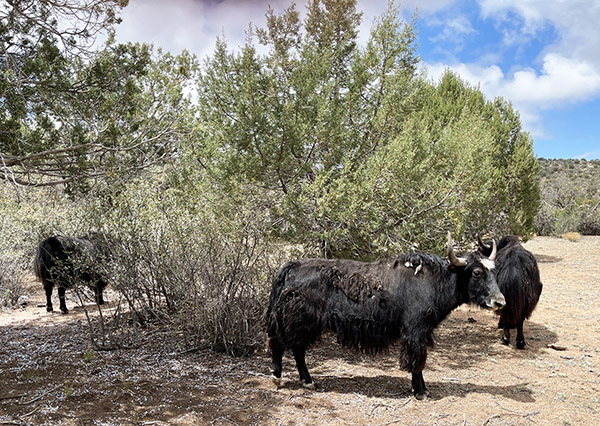
Yakkety Yak! Yaks on the Dunton Ranch. Shooting a yak is not something that’s made my bucket list. Your mileage may vary.

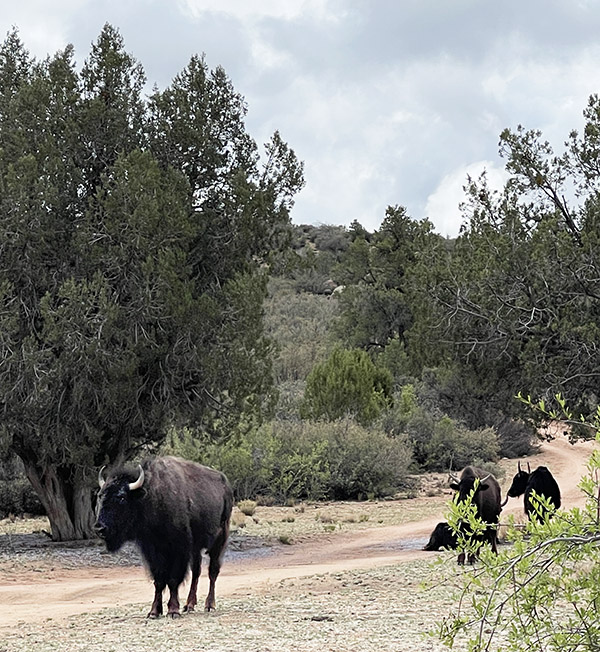
Although we had seen several Ossabaw hogs yesterday, none were around that second morning.  Tom said he had been out earlier (before retrieving us) and he hadn’t seen any pigs, either.  He said the previous night’s downpour most likely had driven them away.  We did see several yaks and a bison.  Dunton keeps a lot of game on his ranch.  Neither John nor I had any desire to shoot one of these large animals.

A Dunton Ranch bison. These are too cool to shoot, in my opinion. Your opinion may be different.  I respect your right to be wrong.

After riding around in the truck and walking most of the morning, we finally spotted several hogs.  Tom scoped them and put the distance at 77 yards.  It was John’s turn at bat and he took but a single swing.  Just as had occurred the day before, all it took was one shot and it was game over.  The .25 06 did its job.

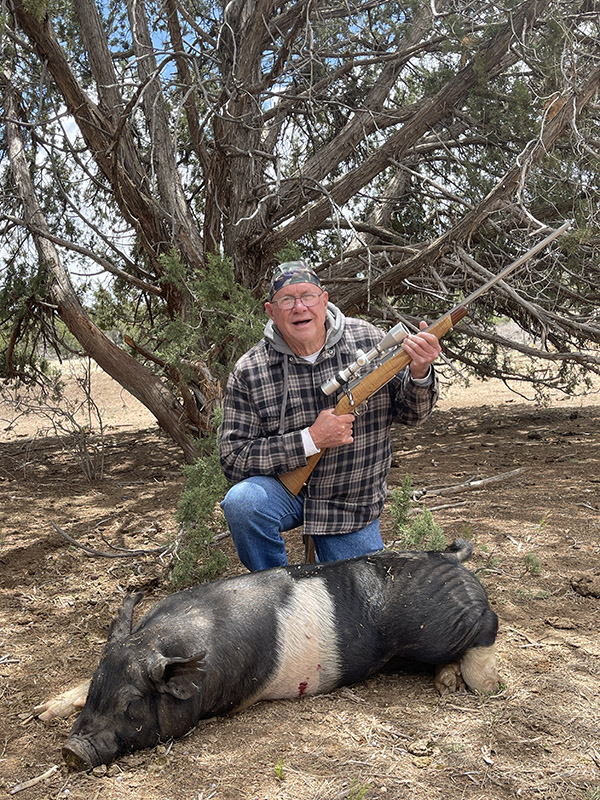
John and his Ossabaw. We both had our pigs for this trip. Our hunt was a success.

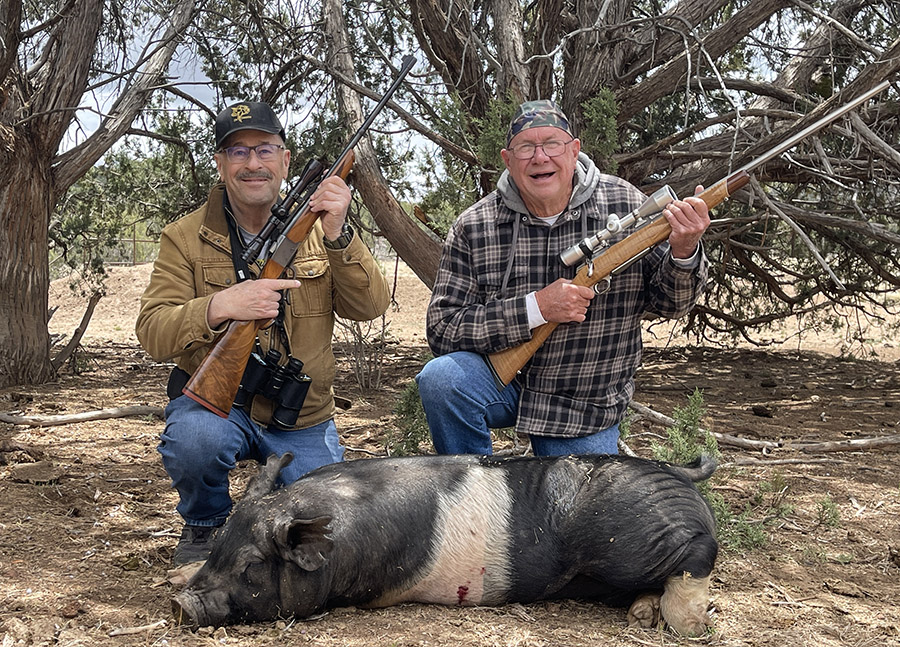
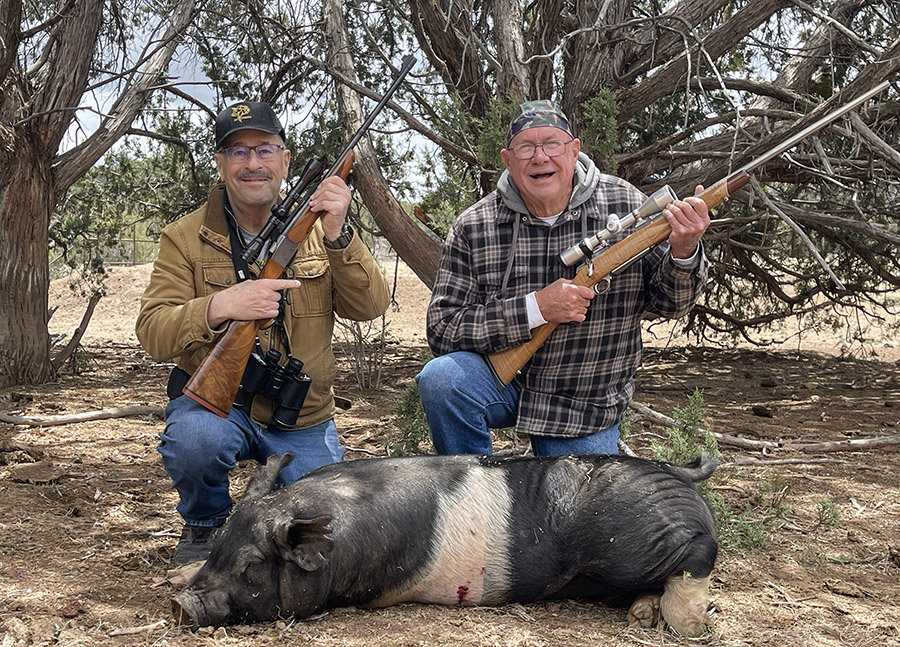
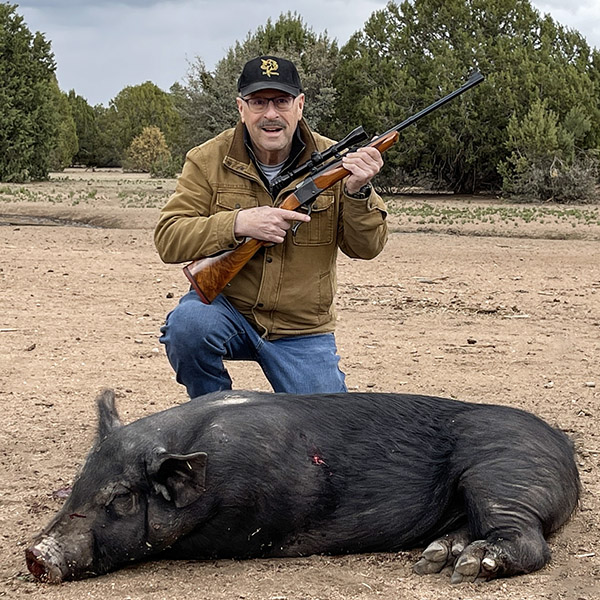
When we walked up to the pig, we grabbed a few more photos, including the one of John and I posing behind his pig.  It’s the photo you see at the top of this blog.

Tom asked if we’d like to go to one of the blinds and sit around waiting for a Russian to possibly stroll by while he dressed John’s pig.  I asked if they would enter this part of the ranch with the Ossabaws present.  “Yep, they will,” Tom said.  “They’ll mate with the  female Ossabaws.”

“I guess they’re not too particular,” I said.  John, Tom, and I had a good laugh.

John said he’d like to go back and watch Tom dress his hog.  Neither of us had seen that before.  I realized I wanted to see it, too.  We went back to the ranch proper, and wow, we really had our eyes opened.  It’s not like you see meat at the supermarket, all neatly packaged and ready to go.

The first thing Tom showed us was my hog, all dressed out, with both sides hanging in the refrigerator.  Tom pointed to where my bullet had hit the hog’s spine.   The damage was staggering.

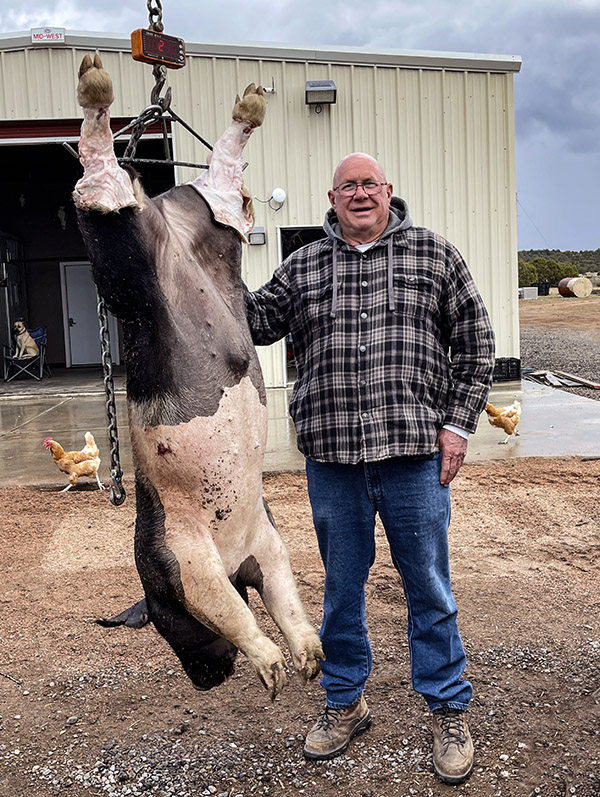
We went back outside and Tom used a Bobcat tractor to lift John’s hog out of the trailer.  The hooks had a scale attached, and John’s hog came in at 225 pounds.  He outdid me by 6 pounds (not that we were competing).

John and his Ossabaw. The little thing on the chain (it looks like an iPhone) is a digital scale.

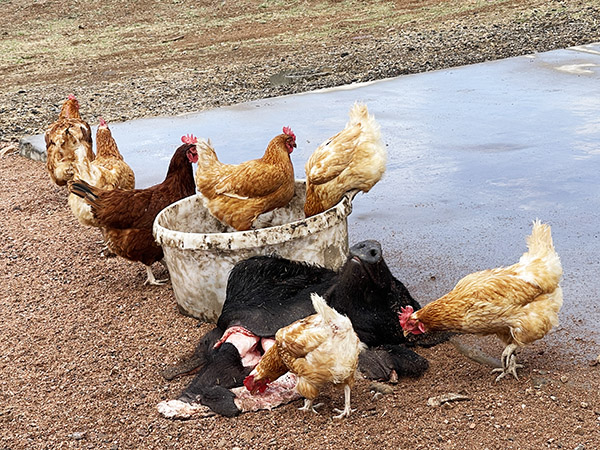
Tom went to work on the pig and what followed was amazing.  I had no idea dressing out a hog was so labor intensive.  It took Tom a good hour and a half, maybe more, to complete the job.  It probably would have taken Tom less time if John and I hadn’t asked so many questions and taken so many pictures.  All the while, chickens wandered into the area and were eating bits and pieces that fell off the hog as Tom worked on it.  They’re carnivores, you know.  There were turkeys strutting around, too, but they kept their distance (but not their silence).  It was hard not to laugh as the turkeys gobbled up a storm at each other.  It reminded me of what passes for political discussion these days.

Carniv0rous chickens. Who knew?

Speaking of storms, while Tom worked on John’s hog it started raining again.  Hard.  John and I stepped into the metal building and watched Tom work from under cover.  When the rain turned to hail, Tom took a break and joined us in there.

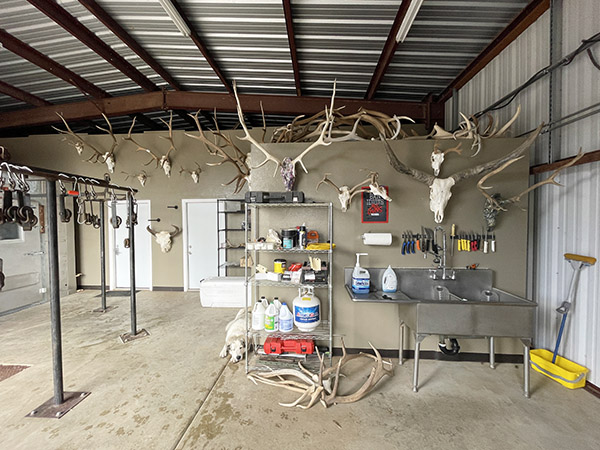
I looked around inside the metal building and realized again that the Dunton Ranch offers all kinds of hunting.  It really is an impressive operation.  I felt lucky being able to experience it.

The dressing room. Not the kind of dressing room I’d been in before.

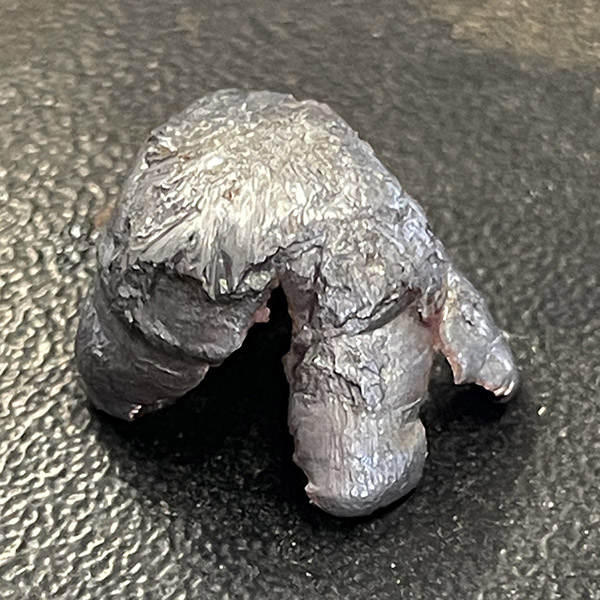
Tom finished up his chores on John’s hog and as he neared completion, he found John’s .25-caliber bullet.  John used Federal factory ammo with 120-grain jacketed softpoint bullets.  Unlike my Hornady bullet, the Federal bullet performed exactly as it was supposed to, mushrooming in a manner worthy of a bullet ad.  It was located just under the skin on the opposite side of the hog.

The bottom side of John’s .25-caliber bullet. Note how the copper jacket had flowered out, and the lead adhered to the jacket petals.
The business end of the John’s .25 06 bullet. It mushroomed to more than twice its original diamter and remained intact. This is stellar bullet performance.

That night (which was only the second day we’d been on the Dunton Ranch), John and I decided to head into Kingman for dinner.  We could have cooked in our cabin, but we were reveling in our pig-hunting success and we wanted to celebrate.  Tom recommended a Mexican restaurant in town (El Palacio) and his recommendation was a home run.

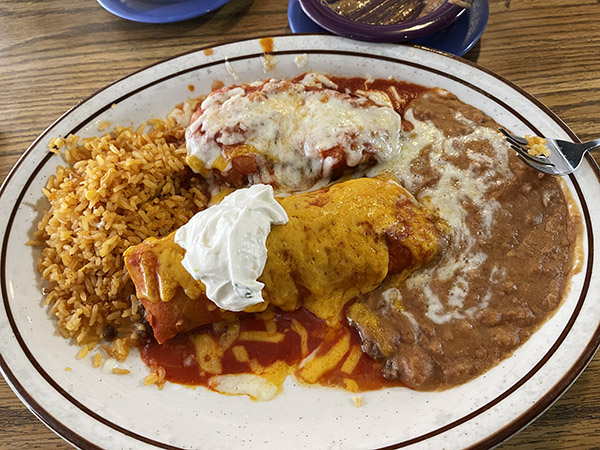
My Mexican plate at El Palacio. It was great!
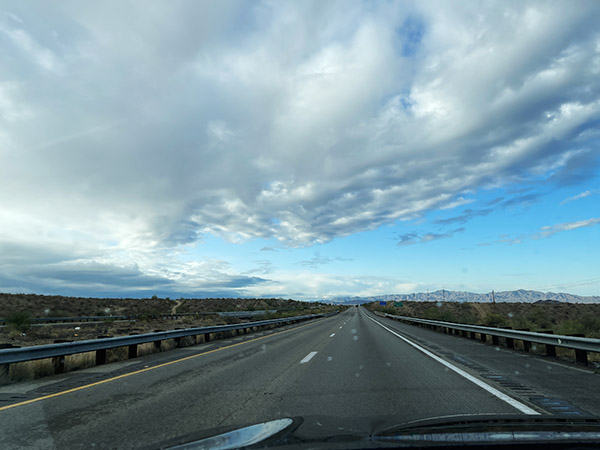
On Interstate 40, headed back to California, just west of Kingman. It was clear sailing all the way home.

The ride home was enjoyable.  It rained hard all night Tuesday and it rained as I was leaving Wednesday morning, but as soon as I passed Kingman I could see the skies clearing.  It was an easy ride back to California.  I stopped at Del Taco in Barstow and had a taco (they’re the best Del Taco anywhere).

Once I was home, I unpacked, ran a patch soaked in Patch-Out (my preferred rifle solvent) through the No. 1’s barrel, and then I called Hornady.  I spoke with a nice guy there and told him what happened with my .30 06 bullet.  “It happens,” he said.  It’s more likely to happen, he went on, if the bullet is traveling at extremely high velocities or if the game was too close (before the bullet had a chance to slow).  I explained that my .30 06 load’s muzzle velocity was just below 2900 feet per second (I knew this because I had chronographed the load, I explained) and the hog was a measured 117 yards away (and I knew this because our guide had a rangefinder).  The Hornady man was impressed that I knew all that, and then mentioned that if a bullet strikes bone, it is also more likely to separate.  Ding ding ding!  That was exactly what happened on my hog.

The Hornady engineer told me that one way to avoid cup and core separation is to use a monolithic bullet (they are made of solid copper, with no lead core).  He was almost apologetic when he explained that monolithic bullets are more expensive than lead bullets because copper costs more than lead.  That may be my next step at some point in the future.

We are not allowed to hunt with lead bullets in California (the folks in our legislature are afraid that we might kill an animal, leave it, and then a California condor might eat it and get lead poisoning).  You know, the California Condor, the super rare endangered species (that there are almost none of) might ingest an animal carcass with the remnants of a lead bullet fragment in it and die of lead poisoning.  I’m serious; that’s what our politicians here in California are worried about.  I shouldn’t be too hard on them, I suppose, because we have something in common.  I and the rest of the TDS loonies here in California can both make this statement: None of us ever found any Russians.  For the TDS-afflicted, it is imaginary secret agents in Moscow.  For me, it is a Russian boar.  My Russians are real, though, and on one of these trips, I’ll get one.

Anyway, it might be time to start experimenting with monolithic bullets.  Maybe it’s a good thing we have that no lead law here in LooneyLand.

To get back on topic:  Our hunt was a rousing success.  The Dunton Ranch showed us a great time, and John and I each got our pigs.  I can’t wait to do it again.


Missed Part 1 of the El Puerco story?  It’s right here.


Join our Facebook ExNotes page!


Never miss an ExNotes blog:


Help us keep the lights on:


Don’t forget: Visit our advertisers!


El Puerco Times Two: Part 1

By Joe Berk

It had been way too long since I hunted pig, and that was a character flaw I aimed to correct.  Baja John immediately said “Hell, yeah” when I asked if he wanted to join me on an Arizona pig hunt, and it was game on.  I’ve known John for half my life, and that means I’ve known him for a long time.  We’ve done a lot of trips through Mexico and elsewhere on our motorcycles.  We know how to have fun.

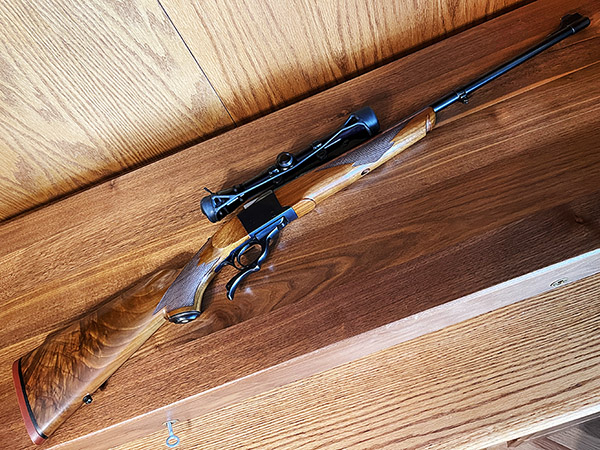
My Ruger No. 1 in .30 06. It’s a long time favorite. I mounted a 4X Redfield the year I bought the Ruger, and it’s never left the rifle.

Getting ready for the hunt was nearly as much fun as the hunt itself.  I knew I’d be bringing my 200th Year .30 06 Ruger No. 1A with me.  It’s a rifle I’ve owned and hunted with for 50 years.  You’ve read about it before here on the ExhaustNotes blog.  On a previous hunt, I used Hornady’s 150 grain jacketed softpoint bullet in my Model 70 Winchester and it worked well.  I had not developed a load with that bullet for the Ruger, though, so I set about doing that.  The secret sauce was 51.0 grains of IMR 4064, which gave an average velocity of 2869.3 feet per second (with a tiny 14.1 feet per second standard deviation) and great accuracy.  The load was surprisingly fast for the Ruger’s 22-inch barrel; the No. 1 shot this load at the same velocity as my Weatherby’s 26-inch barrel.

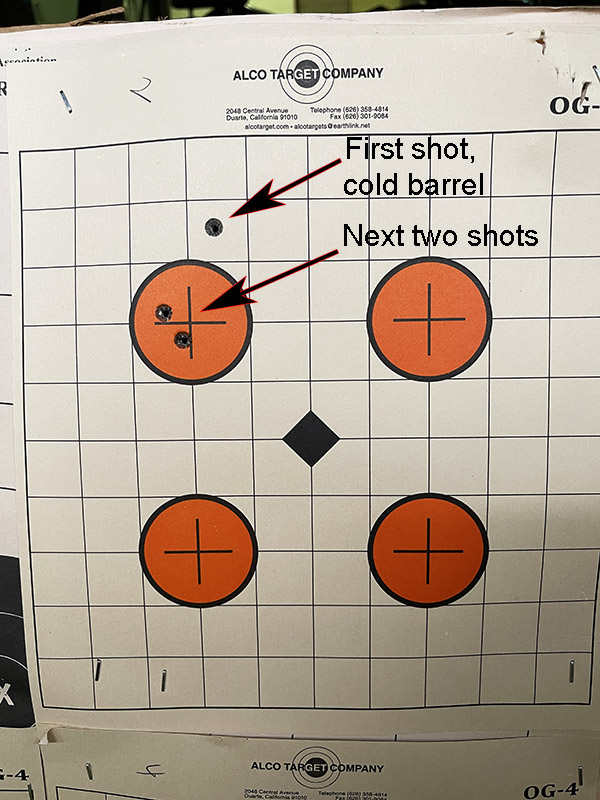
A week before the hunt, I checked the Ruger No. 1’s zero at 100 yards. The first shot from a cold and oiled barrel was a scosh high; the next two were right on the money. The rifle was ready.

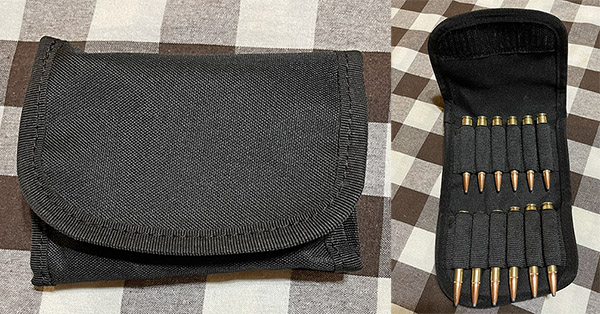
I knew I needed binoculars, which I already had, and a way to carry ammo (which I didn’t have).  I found a cool belt-mounted ammo pouch on Amazon; the next day it was delivered to my home.

A cool little belt-mounted ammo pouch. It costs $8 on Amazon.

I had everything I needed; I loaded the Subie and pointed it east.  We would hunt on the Dunton Ranch, about 325 miles away in Arizona.  The weather was going to be a crapshoot.  Everyone was predicting rain, and they were right.  We would be lucky, though.  It would be overcast and rain a lot, but not while we were in the field.

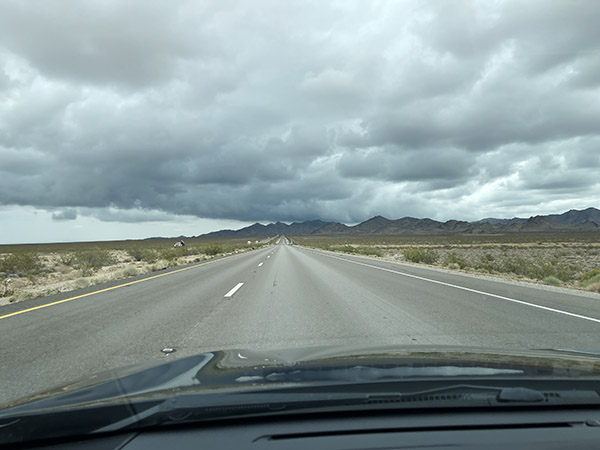
My six-hour ride under gray skies to Kingman was pleasant.  It rained a bit, but it stopped just before I reached Kingman.  Sirius XM blasted ’50s hits the entire way.

On the road to the Dunton ranch. I had a travel mug full of coffee Sue had prepared for me. I enjoyed the drive.

When I arrived at the Ranch, Tom (our guide) met me.  John wouldn’t be getting in until later that evening.  Tom asked if I wanted to hunt that afternoon, before Baja John arrived.  You bet, I said, and we were off.

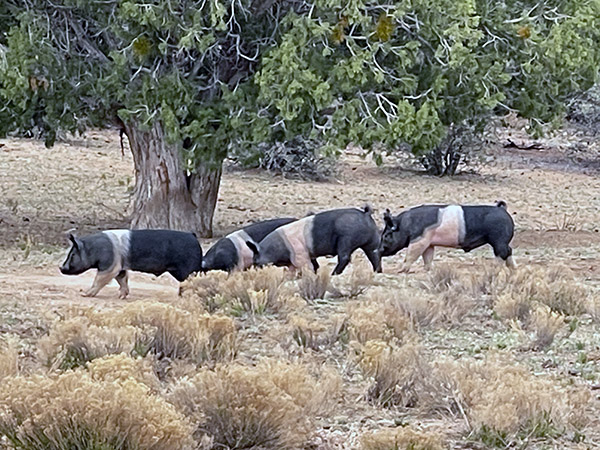
Ossabaw hogs in Arizona.  They are an even-tempered pig.  They are what Tom calls “meat pigs.”

Scott Dunton keeps his ranch stocked with at least three flavors of hog, including Russians and Ossabaw pigs.  I had not seen a Russian boar on my last hunt, and I would not see one on this hunt, but that’s okay.  It’s good to set goals in life, and one of my goals is to someday get a Russian boar.  It didn’t happen on my Dunton Ranch pig hunt a decade ago, and it wouldn’t happen on this trip, but we started seeing Ossabaws almost immediately.  Wikipedia tells us that the Ossabaw pigs are descendants of feral hogs on Ossabaw Island, Georgia.   The Ossabaws were originally released on that island by Spanish explorers in the 16th century.  Imagine that.

Tom and I set out and like I said above, we saw Ossabaws fairly quickly.  I told Tom that I really wanted to get a Russian.  “They’re smaller, they’re harder to find, they’re nocturnal, and they’re mean,” Tom said.  “Some boys out here last week got a nice one.”  He told me he could set me up in a blind, but the odds of seeing a Russian were low.

A while later, we came upon a group of Ossabaws.  Tom had a rangefinder and he scoped the distance at 117 yards.  “What do you think?” he asked.

My mind was racing.  I started thinking about Mike Wolfe on American Pickers.  He often says the time to buy something is when you see it.  You don’t know if you’ll ever see it again.  I thought it would be cool to have John there when I shot a pig, but I didn’t know if we would see any later.  I wanted a Russian; these were Ossabaws.  But they were there.  I could hear Mike Wolfe:  The time to shoot a pig is when you see one.  “Can I shoot one of these and then take a Russian if we see one later?” I asked.

“You can do whatever you want,” Tom said.

Tom set up his tripod, which is a cool field version of a rifle rest.  I had never used one before (I’d never even seen one before).  I looked at the Ossabaw 117 yards away through the 4-power Redfield.  The hog was standing broadside to me.  Fifty years ago, I used to shoot metallic silhouette pigs that were a third that size at three times the distance (385 meters, to be precise), with no rest, shooting offhand.   But that was 50 years ago.  My eyesight isn’t what it used to be, my ability to shoot a rifle offhand isn’t what it used to be, and hell, I’m not what I used to be.

It was time.  I rested the Ruger in the tripod rest and held on the hog’s shoulder.  I watched the reticle sashay around against the hog’s dark form and started applying pressure to the Ruger’s trigger.  Things felt right.  I was in the zone.  I didn’t hear the shot, and I didn’t feel the recoil, as is always the case for me when hunting.  The hog fell over, away from me, just as a metallic silhouette javelina would do.

“That was a nice shot,” Tom said.  I don’t think he said it because I was the client.  He probably sees a lot of misses out here from other clients.  The hog’s rear legs twitched in the air.

“Should I put another round in him?” I asked Tom.

“No, he’s gone,” Tom answered. “It would just destroy more meat.”  I looked again and the hog was still.

Success: 117 yards, my Ruger No. 1, and an Ossabaw hog.

We walked up to the hog.  I could see where the bullet entered (satisfyingly just about where I had aimed).   I was surprised; I could not find an exit wound.  When I .30 06’d a hog at the Dunton Ranch on my last visit, the bullet sailed right through.   Not this time, though.  More on that later.

I posed with my Ossabaw for the obligatory Bwana photo.   Tom and I struggled to roll El Puerco over.  We tried to lift it onto the back of the truck and could not.   Tom told me he needed to get the trailer (which had a winch), and he told me he would drop me off at a blind.  “You might see a Russian come by,” he said.   That was enough for me.  “I’ll come back out here later with John to pick you up.”

I got comfortable in the blind, which overlooked a watering hole about a hundred yards away.  I scoped everything I could through my binoculars, imagining every rock and bush in my field of view might be a Russian.  I felt like a Democrat looking for the imaginary Russians (I really wanted to see one, but they just weren’t there).  A small group of Ossabaws showed up at the watering hole.  I watched them through my binoculars.  They did what pigs do, and then they started meandering around a bit. Towards me.

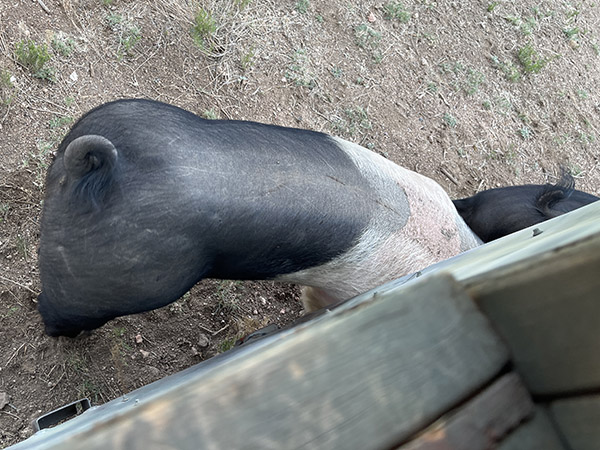
An Ossabaw hog just outside the blind’s window. Were they coming for payback?

Golly, I thought.  The Ossabaw hogs were getting close.  Then, they literally walked right up to the blind.  I could feel it rock around as the pigs rubbed up against the walls.  They know, I thought.  I had shot Porky (or maybe it was Petunia?) and it was payback time.  They had come for me.

I could hear the pigs grunting just below the blind’s window.  I remembered my iPhone.  I took a picture, holding the phone just outside the window.  I don’t mind sharing with you that I was more than a little bit afraid.  My Smith and Wesson Shield and its nine rounds of hot 9mm ammo were back in the Subie.  The sportsman-like snob appeal of hunting with a single-shot rifle suddenly didn’t seem like such a good idea.  I had my one round I could put in the chamber, but I wouldn’t be able to reload quickly enough if the pigs wanted to exact their revenge on me.  One shot.  I was the Barney Fife of pig hunters.

Nah, I thought, these are just pigs being pigs.  Or were they?

If you crank up your computer’s volume all the way up and listen, you can hear their grunts.

After the pigs had their fill of terrorizing this septuagenarian New Jersey refugee, they wandered off.   My heart rate returned to its normal bradycardic 50 bpm or so.  I went back to glassing the surrounding vista.  Nobody’s going to believe this, I thought.

An hour or so later, Tom and Baja John were back in the truck.   No Russians had wandered by.  I was glad John had made it okay but I was disappointed I had seen no Russians.  I imagined I knew what Adam Schiff must have felt like when Robert Mueller testified before Congress.   Where the hell are these Russians?


Stay tuned: El Puerco Part 2 airs tomorrow!


Join our Facebook ExNotes page!

Never miss an ExNotes blog:


Help us keep the lights on:

Four National Parks, One Inspiring Ride, and Fuel for the Open Road

By Bobbie Surber

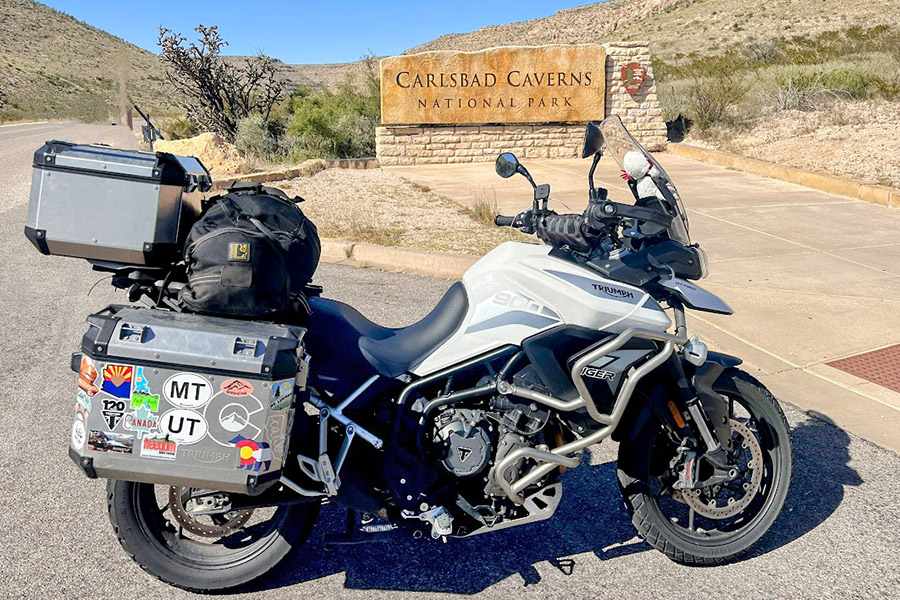
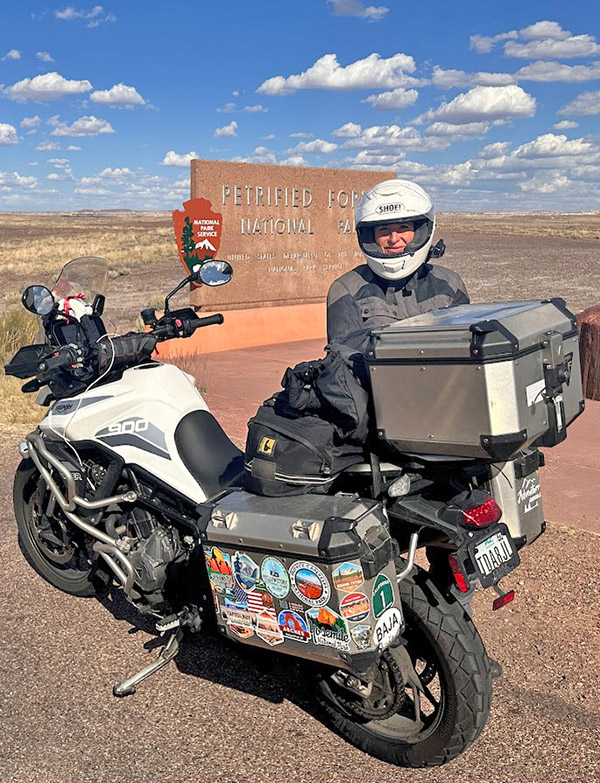
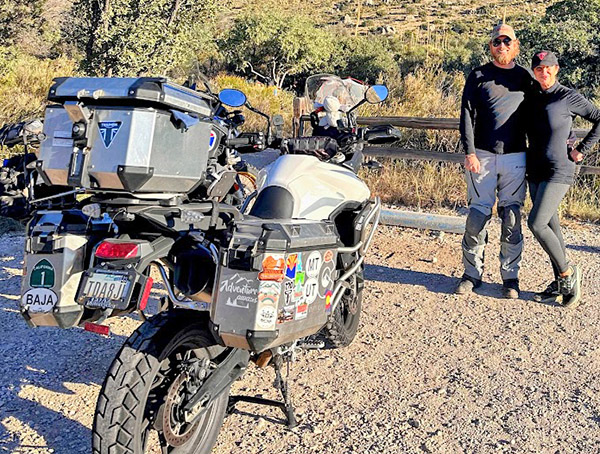
Embarking on a spontaneous journey this past October to explore multiple national parks, my dependable Triumph Tiger 900 GT Pro (Tippi), and I escaped from an approaching winter. The objective? An inspiring tour encompassing White Sands, Carlsbad Caverns, Guadalupe, and the Petrified Forest National Parks. With an insatiable love for national parks, these scenic wonders often become a focal point during my motorcycle travels. Spending around 60-70 percent of my time on the road, I am drawn to these incredible natural havens.

Starting from Sedona on a crisp fall afternoon, I cruised through Oak Creek Canyon, reveling in the solitary road and the vibrant autumn leaves adorning the red rock landscape. Petrified Forest National Park is a familiar stop with ancient petrified logs and captivating vistas.

I continued through the desolate upper desert plains, making my way to Springerville, Arizona, before the next leg of my adventure.

The next morning’s journey steered me toward Faywood Hot Springs in New Mexico, but boy, was it a wild ride! Wrestling with savage winds that rivaled a cyclone, I stumbled upon a rider down on the road.  As we righted his bike, we ascertained the downed rider was scraped and bruised but fine. My nerves shot, I sought respite from the tempestuous gusts and made a beeline for Alpine, where winds had gone rogue, hitting outrageous gusts of 80 miles per hour. Amid what seemed to be tornado-like chaos, I found solace in the embrace of snug and hospitable Alpine, Arizona.
Rolling into Faywood Hot Springs in New Mexico a day late due to the windstorms, I was greeted by humble cabins and campsites stretching across the desert with views of distant foothills. As Tippi’s tires crunched on the gravel, I found myself in a moment straight out of a motorcycle comedy flick. Decked out head to toe in my riding gear, I sfound myself in a nudist colony!  Out of nowhere two mostly naked gents emerged, strutting towards me to help park my bike. Picture this: two bare souls, one bike, and a dangerous scenario brewing. They helped with the genuine enthusiasm of a nudist biker pit crew, and I could not help but nervously accept. However, my mind raced faster than Tippi’s engine, worrying about potential mishaps—my bike toppling over one of them or an accidental heat encounter with certain sensitive areas. The stakes were high, at least for them, and my concern was off the charts!

With Tippi safely parked (and the naked pit crew miraculously unscathed), I swiftly ditched my gear and clothing for the remainder of the day, joining the affable and entertaining guests at the bathing suit optional pools. Trust me, regaling the encounter turned into a comedic highlight of my adventure, spinning a tale of the night’s shenanigans that truly supported my aforementioned moto flick!

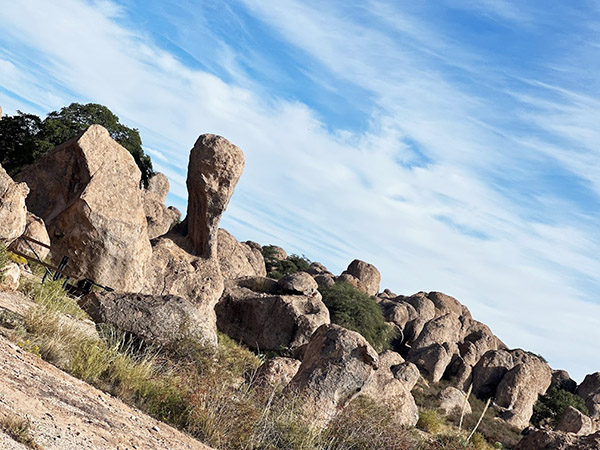
Eager to witness the sunrise and embark on my ride, I packed Tippi.  I anticipated a solar eclipse, but not before a detour to the City of Rocks State Park (a hidden gem a few miles away). Although time allowed only a brief hike and a few photographs, the park’s charm put it on my must-return list.

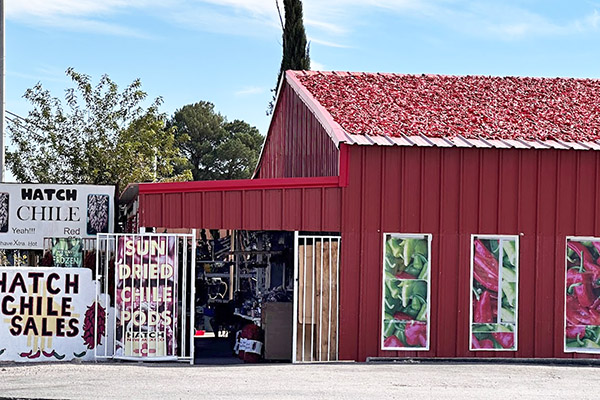
Continuing my journey, a stop at Hatch, New Mexico, promised a feast of authentic Mexican cuisine renowned for its chili.  It lived up to its reputation as I dove into a plate of green chili smothered enchiladas. But before my feast the anticipation of the eclipse lingered as I parked by the roadside with Tippi and a few fellow travelers, hoping for an unobstructed view. Unfortunately, a thin veil of clouds dampened our expectations, casting a shadow over the anticipated celestial spectacle, although the shifting light added its own atmospheric drama.

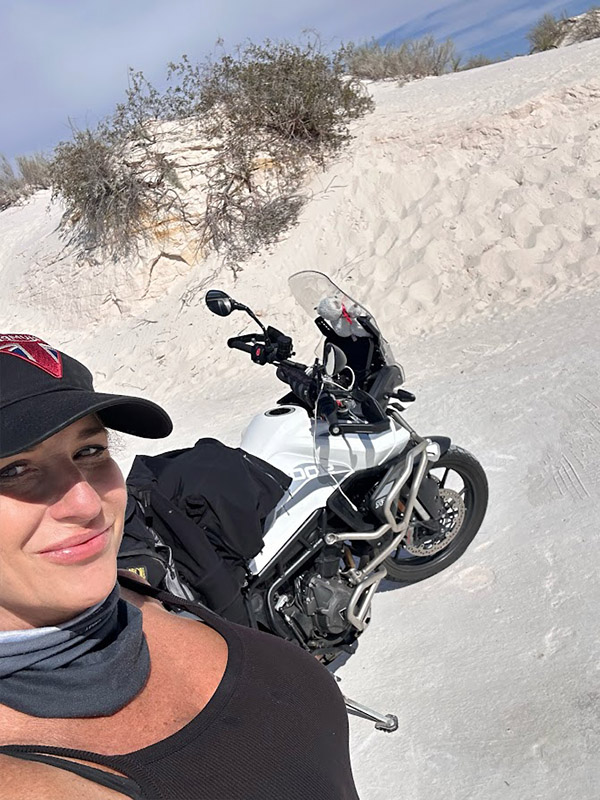
The adventure continued as I resumed my ride, following I-25 to I-70 for a two-hour journey leading me to White Sands National Park. Here, nature unveiled a captivating spectacle as I ventured deeper into the park. The landscape transformed into a mesmerizing sand festival, each mile revealing taller and more majestic sand dunes that stretched endlessly to the horizon. The park’s beauty and ethereal ambiance made my farewell bittersweet.

Leaving enchanting White Sands behind, I ventured onward, headed for Cloudcroft, New Mexico, where a charming hostel awaited.  This oasis in the mountains promised a restful evening, a sanctuary after a day filled with unexpected turns and nature’s breathtaking displays. I am a huge fan of hostels while traveling solo, not only for the inexpensive lodging but also for the opportunity to meet with fellow adventurers. Cloudcroft Hostel did not disappoint!  It is labor of love by a transplant named Stephanie, a fellow rider from Germany. The night’s stay even included a house concert with a traveling performer. I drifted off to sleep that night with the thought of returning to this delightful place.

Bright and early the following morning, I embarked on a dual adventure to Carlsbad Caverns and Guadalupe National Park. My first stop was in Carlsbad, where I had a planned visit with a fellow rider.  Parker and I arranged to meet at a historic restaurant.  Meeting this captivating rider in person matched the fascination I felt from afar. Our interaction was brief as I had to rush to make my 1:00 p.m. to the caverns. Negotiating the winding roads with enthusiasm, I navigated to the visitor center while maneuvering through the curves, passing slower vehicles, and arriving on time. The caverns exceeded expectations, and I leisurely explored the most picturesque chambers.

Daylight was fleeing, and I knew I had to rush to Guadalupe National Park before sunset. To my delight, a pleasant surprise awaited me as Parker joined me. Guadalupe, an unassuming jewel of a desert park boasting Texas’s highest peak, instantly captured my heart with its desert sunset over the rugged peaks. The night flew by quickly as I prodded Parker for more tales of his exhilarating riding adventures.  It made this stop an unforgettable highlight.

The following morning greeted me with thoughts swirling about the completion of my four-park tour and the route home. In a moment of whimsy, I yearned to revisit Cloudcroft for another night.  Such impulses are the joys of traveling by bike…logic takes a backseat to wanderlust! Retracing the previous day’s path, I arrived in the afternoon, affording me a chance to explore the historic downtown area.

In a move that defied logic (as is the norm in my travels), I reasoned that it made perfect sense to detour back home through Mesa, Arizona, for my bike’s much-needed service. The return ride, riddled with its own set of challenges, became a tale, featuring unexpected twists and yet another memorable encounter at a unique hot spring.  It’s a story for another time!

As I reflect on my incredible journey filled with unexpected encounters, stunning landscapes, and fellow riders’ camaraderie, the allure of the open road and unpredictability of travel are the true treasures of my motorcycle expeditions. Each detour, unplanned stop, and quirky encounter combined to create a tapestry of unforgettable experiences.  It is what fuels my passion for exploration and two wheel travel. Until the next adventure beckons, I will carry these memories as fuel for the road ahead.


Never miss an ExNotes blog:


Don’t forget: Visit our advertisers!


ExNotes Product Review: Waymo Self-Driving Cars

By Joe Gresh

There is a megacity out in the Arizona desert. It runs for miles and miles, ever expanding into the scrublands. Phoenix, Chandler, Tempe, Scottsdale and other towns have merged into one, giant, golf course subdivision splattered with Wal-Marts, drug stores and tilt-up warehouse mattress vendors. It’s hot, dry and thirsty. I don’t understand why so many people willingly bake in the sun. Waymo, the self-driving taxicab company has found a way to eliminate a few of those people.

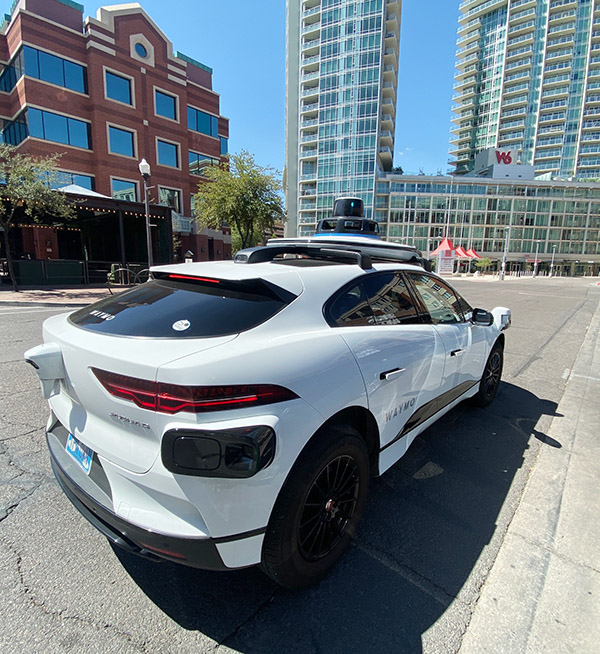
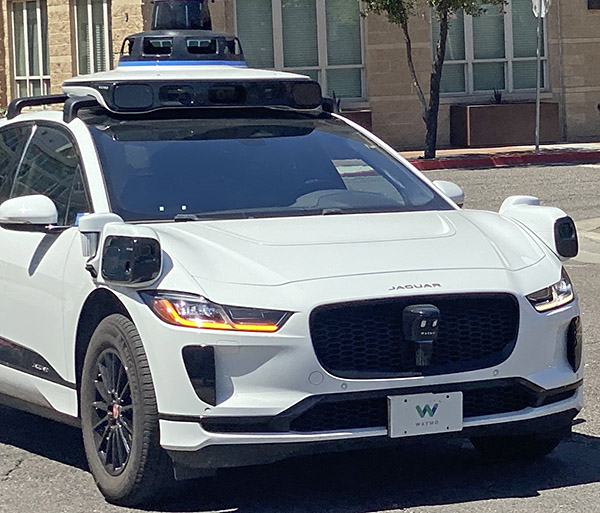
ExNotes tested the Waymo’s plying the streets of downtown Tempe. Laid out in a grid pattern with tall buildings blocking radio signals Tempe would be a tough test for Waymo. How the system works is you download an app and enter your information. Next you order a car telling Waymo where you are and where you want to go. How long you wait for a car depends on traffic or rider loads. CT and I took Waymo rides three times and the usual wait was 5 or 10 minutes. The Waymo cars we rode in at Tempe are made by Jaguar and look like any generic, white SUV-ish car, except the Waymo’s bristle with cameras and sensors on all four corners and the roof.

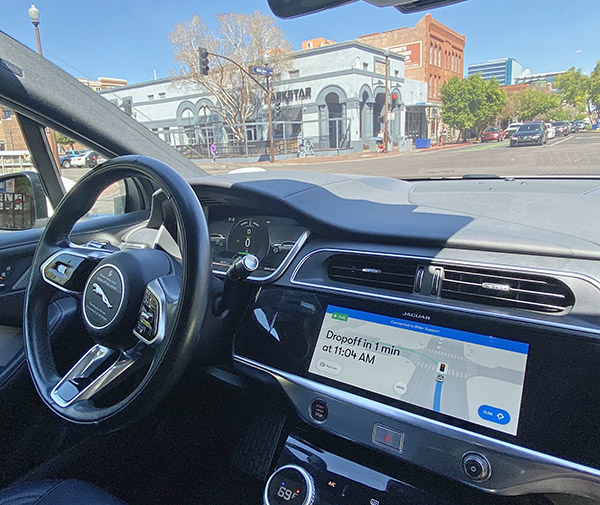
Let me cut to the chase and tell you the actual driverless-car part worked great. You can sit in the front seat or rear seat, once inside with your seatbelt on you push the start field on the dash display. The Waymo will watch for traffic and pull out onto the street just like a person is driving. The car still has a steering wheel that spins around as the car makes corners. The Waymo doesn’t pussyfoot around, either. It accelerates right up to speed and takes curves with a bit of hustle. It stopped at stop signs, circled roundabouts and waited patiently at traffic lights.

I felt totally comfortable sitting in the passenger seat letting the computer drive. I suspect that’s because I’ve been installing autopilots in boats for 50 years. From the first Metal Marine Pilot to the latest digital units tied into GPS and radars. I’m used to sitting at the helm with the boat steering on its own. Of course there are a lot less things to run into on the water compared to downtown city streets, but I saw the Waymo as just a fancier version of electronic stuff I’ve dealt with for years.

As there is no driver, there is no need to tip. The short Waymo rides we took cost around $4 each and the money is charged through the app. You get in, arrive at your destination and get out. Oddly enough, the technology of the self-driving car wasn’t where Waymo fell down on the job.

Our problems came during the pick up process. Waymo’s app will tell you to walk 700 feet this way or head 350 feet south on Fifth Street feet while you’re waiting for the car. You can watch the car’s progress on the app and judge arrival time. After following the apps instructions we found it best to ignore the app and stay in one spot and wait until we could see the Waymo, and then walk towards it.  Pick up was usually fairly close but one time the car waited for us about a block and a half away.

We were walking all over trying to find the thing. Waymo’s app has a toot horn feature and we used this to echolocate the car. Upon our arrival the car decided it had waited long enough and drove off. We were 15 feet away. It’s kind of dumb because Waymo knows your location via the phone app. It knows how far away you are and can see you moving towards the car. Also, Waymo needs a “Pick me up where you dropped me off” feature to cut down on walking time. As the software is configured now Waymo might drop you at the front door of your destination but when you call for a pickup the car might be down by the river.

Long time ExNotes readers will know I’m not the sort of guy known for embracing the future. But being a motorcyclist I can see the advantages of ever-vigilant computers replacing the brain-dead car drivers that kill us so often. I’d rather ride in a megacity full of Waymos than the usual collection of phone texters, blind drunks and road ragers.

It’s still early times in the self-driving car business and the road driving part is already amazingly good. I could tell no difference between the Waymo and a human driver. The weather was perfect in Tempe so I can’t speak to how the car would perform in a snowstorm or on icy roads. Maybe it defaults to park? I can see personal self-driving cars becoming popular if we can figure out all the legal ramifications and who gets the blame in an accident. But it’s not like we don’t have accidents now. I say bring on the future.


My Solo Motorcycle Journey from Sedona to Canada: Part I

By Bobbie Surber

As a passionate female solo rider, I often find myself facing a barrage of incredulous looks and questions from both strangers and friends. They ask the usual list of queries: “Is it safe?” “Where will you stay?” “What if your bike drops?” It’s become almost customary to respond by sharing my blog or articles that capture the essence of the joy I find in solo travel, whether by foot or by bike. This brings me to my latest and most epic solo adventure – a motorcycle journey from my home in the enchanting town of Sedona, Arizona, all the way up to the stunning landscapes of Canada. Covering over 6,700 miles of magical terrain, this journey was a test of my spirit and a celebration of my love for long distance motorcycle travel.

It all began last fall when the idea of a ride to Canada took hold of me. I knew that this was the journey I was meant to embark upon. I was determined to take my time, to savor the journey, and to visit as many National Parks as possible along the way. My plan was simple yet liberating: I would make up my route no more than a week in advance, pack light, and camp as much as possible off my trusty motorcycle, a three-cylinder Triumph Tiger 900 GT Pro, lovingly named Tippi.

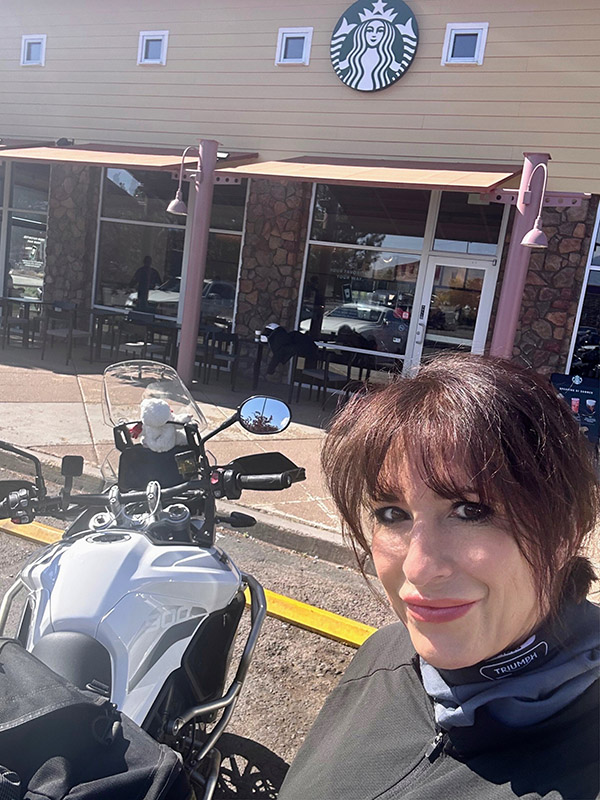
On the crisp morning of June 2nd, with the sun just beginning to warm the high desert of Sedona, I geared up for my adventure little did I know then that I would be gone for 11 plus weeks. The air carried an unusual coolness, a welcome departure from the scorching desert temperatures. My first stop was an obligatory one – Flagstaff, Arizona, just a short 30-mile ride from Sedona. The journey up Oak Creek Canyon was a visual feast, with Red Rock views and sinuous twists and turns that are a motorcyclist’s dream. I found myself at a Starbucks in Flagstaff, sipping on a well-deserved Americano, wondering what the day had in store for me as I charted my course towards North Grand Canyon National Park.

Leaving the comfort of Flagstaff behind, I embarked on Highway 89-A, leaving the tall pines of the city in my rearview mirror. The road led me to Lees Ferry, a spot where I could steal a quick moment with the majestic Colorado River. Riding through this part of Arizona on 89A felt like transitioning to another world. The landscape shifted from rugged mountains to a breathtaking desert expanse. Sandy plains, cacti, and the awe-inspiring sight of the Colorado River slicing through towering cliffs and canyons greeted me. Every time I ride through this area, I feel like I’m letting go of the worries of the world and immersing myself in the raw beauty of nature.

Arriving at Lee’s Ferry, I gazed in wonder at the grandeur of the Colorado River. Red Rock bluffs reached skyward, casting their reflections onto the water’s surface. A few photos captured the essence of the moment, and then I was back on the road, with Tippi carrying me across the vastness of the desert landscape with mountains looming in the distance with turbulent looking skies, laden with the threat of rain seemingly daring me to press onward.

Press on I did, and by the time I arrived at Jacob Lake, I was soaked to the bone. The reward, though, was immediate and satisfying. The general store at Jacob Lake had the antidote to my damp spirits – a hot cup of coffee and the most heavenly homemade cookies I’ve ever tasted in Arizona. While I warmed up and indulged my taste buds, I chatted with fellow riders who regaled me with tales of epic early June snowstorms they’d encountered that day while riding back from the Grand Canyon. It’s moments like these, swapping stories with fellow riders, that make a solo journey so enriching.

A swift pit stop at Jacob Lake was followed by the task of setting up my tent, which proved to be a bit of a challenge in the rain. But that’s the essence of adventure riding, isn’t it? You adapt, you overcome, and you keep moving forward. With my campsite established, I wasted no time and headed to North Grand Canyon. Fortunately, I was spared the snow, but a wicked hailstorm tested my resolve as I carefully made my way further up the rim.

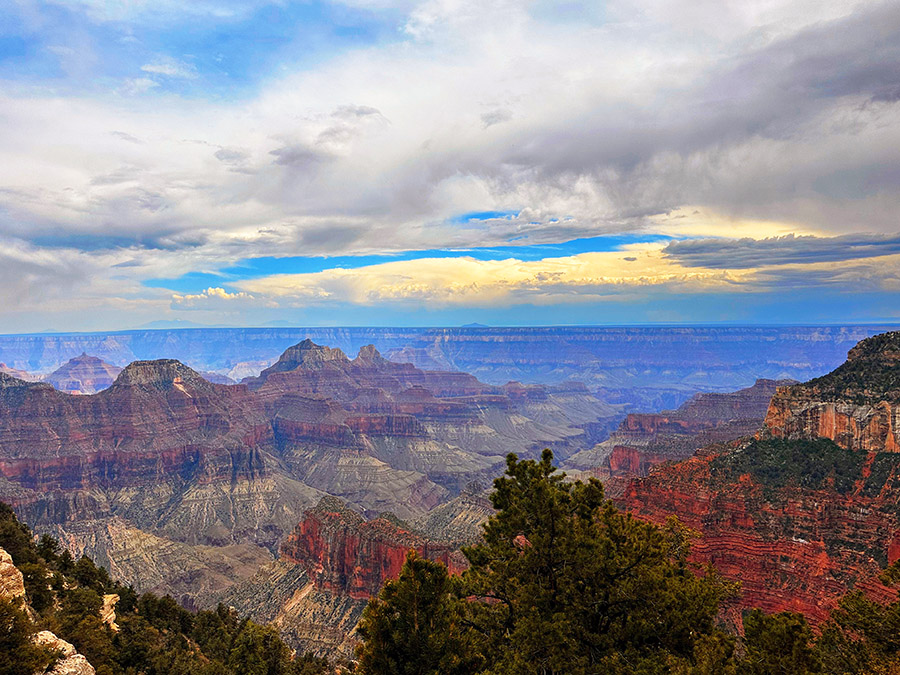
By the time I reached the park, the weather gods seemed to have taken pity on me. Dry weather prevailed, and I was treated to the most dramatic skies one could hope for when visiting the North Grand Canyon. As I stood there, gazing out into the vast expanse of this natural wonder, I couldn’t help but feel humbled by the forces of nature and the grandeur of the world we live in. It was a moment of pure serenity amidst the chaos of my journey.

The following morning, I bid farewell to North Grand Canyon, heading down into Kanab for a quick gas and coffee break before completing the remainder of my ride on Highway 89A, with Zion National Park as my next destination. With two days and one night to immerse myself in the beauty of Zion, I was eager to experience the park in all its glory.

Entering Zion National Park on a motorcycle is a unique adventure. The winding roads and the freedom to embrace the open road add an extra layer of exhilaration to the journey. Plus, if you time it right, like I did, arriving early can help you avoid the epic traffic jams that can plague this popular destination.

Setting up camp as quickly as possible, I wasted no time in hopping onto a shuttle ride to the park’s lodge. From there, I embarked on a day of hiking, exploring several of Zion’s shorter trails. I couldn’t resist attempting to secure a permit for Angel’s Landing, a trail known for its breathtaking, albeit nerve-wracking, vistas. Alas, the permit eluded me, but that didn’t dampen my spirits. Zion offered me an array of other trails and sights to explore, and I reveled in every step I took.

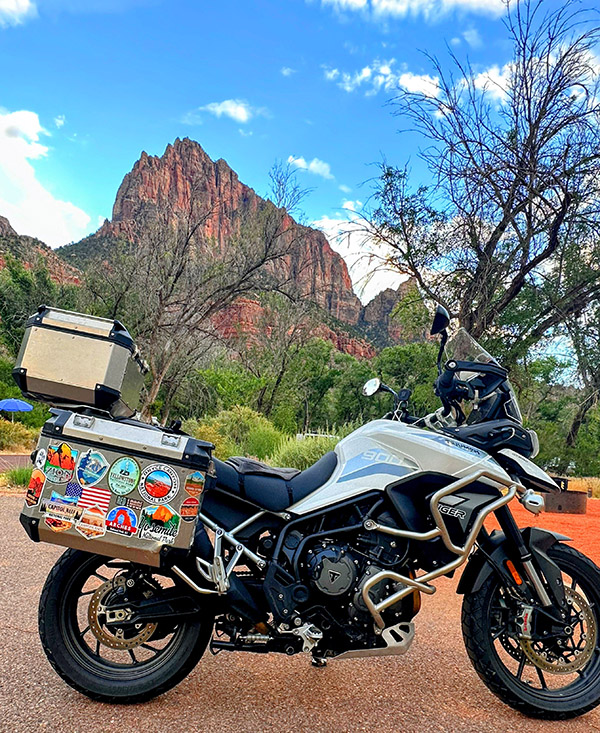
Zion’s rugged beauty is a testament to the power of nature’s sculpting hand. Towering sandstone cliffs, cascading waterfalls, and the vibrant colors of the Virgin River create a landscape that feels otherworldly. With my camera in hand, I captured every nuance of this remarkable place. Hiking a portion of the Narrows, with water rushing around me, was a highlight I’ll carry with me forever. Zion National Park, with its mesmerizing mix of desert and oasis, and once again confirming why I love this park so much.

As I lay in my tent that night, listening to the sounds of the wilderness around me, I couldn’t help but reflect on the incredible journey I’d embarked upon. From the stunning landscapes of my hometown of Sedona to the awe-inspiring grandeur of the Grand Canyon and the mesmerizing beauty of Zion, my solo motorcycle ride to Canada had already been a whirlwind of experiences. And this was just the beginning.

My journey would continue northward, taking me through more National Parks, enchanting towns, and breathtaking vistas, mountains, desolate beaches, and new friends I’d yet to meet. Each twist and turn of the road held the promise of new adventures and the opportunity to connect with the world in a way that only solo travel can offer. The open road called me, and I was more than ready to answer its invitation.


In the world of solo travel, there’s a unique freedom and self-discovery. It is a chance to test your limits, embrace the unknown, and find solace in the beauty of the world. My motorcycle journey from Sedona to Canada was not just a ride; it was a pilgrimage of the soul, an exploration of the heart, and a celebration of the indomitable spirit of the open road. As I drifted into sleep under the starry Utah sky, I couldn’t wait to see where the road would lead me next on this remarkable adventure.

My fellow adventurers, I invite you to stay tuned for the next captivating chapter of this solo ride from Sedona to Canada. The open road stretches before us, brimming with the promise of extraordinary experiences and inspiring tales yet to be written. With each twist of the throttle I embrace the unknown, and I can’t wait to share the unfolding journey of a lifetime with you.


Never miss an ExNotes blog:


The Franklin Automobile Museum in Tucson, Arizona

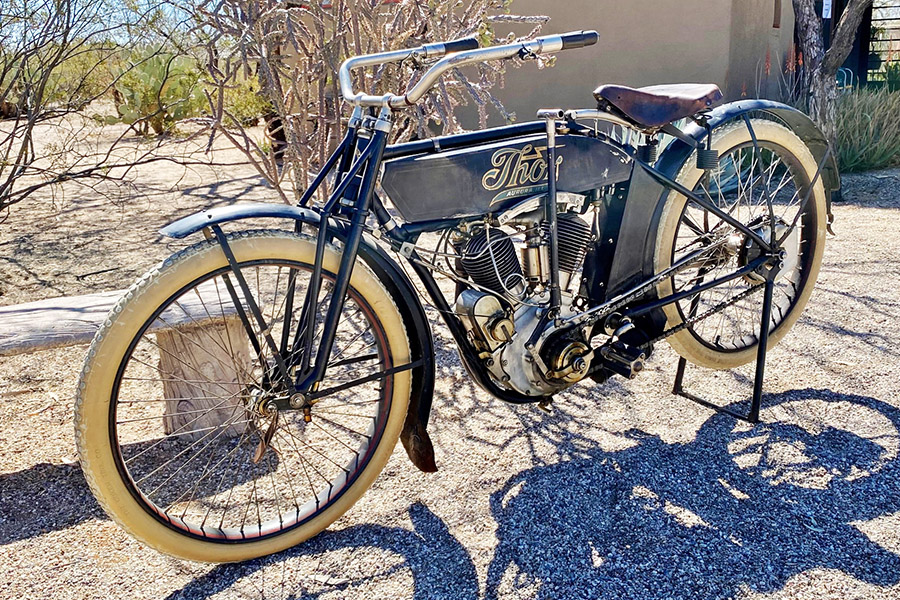
That motorcycle you see in the photo above is a 1913 Thor.  It’s not been restored; the paint is original, as are the tires (and they still hold air).   You don’t see something like that every day, and it’s something I didn’t even know was there.  “There” being the Franklin Automobile Museum in Tucson, Arizona, a hidden gem in every sense of the word (more on that in a second).

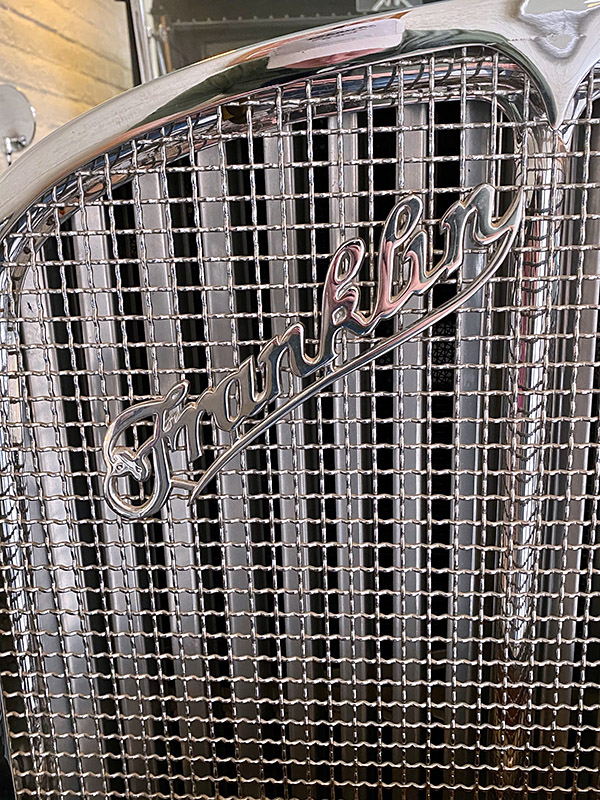
A Franklin grill. These are majestic automobiles.

Never heard of the Franklin automobile?  Don’t feel bad; I hadn’t, either.  In checking out what museums were in the Tucson area, we found the Franklin Automobile Museum with an Internet search.  The Franklin Automobile Museum has been called Tucson’s best kept secret.  I believe it.  I’ve been to Tucson many times and, as I said above, I had never heard of it.

Franklins were luxury cars, competitors to Cadillacs and other high end automobiles before the Great Depression.   A Ford Model A in those days might cost $600.  Most Franklins cost about $3,000; some went as high as $6,500.

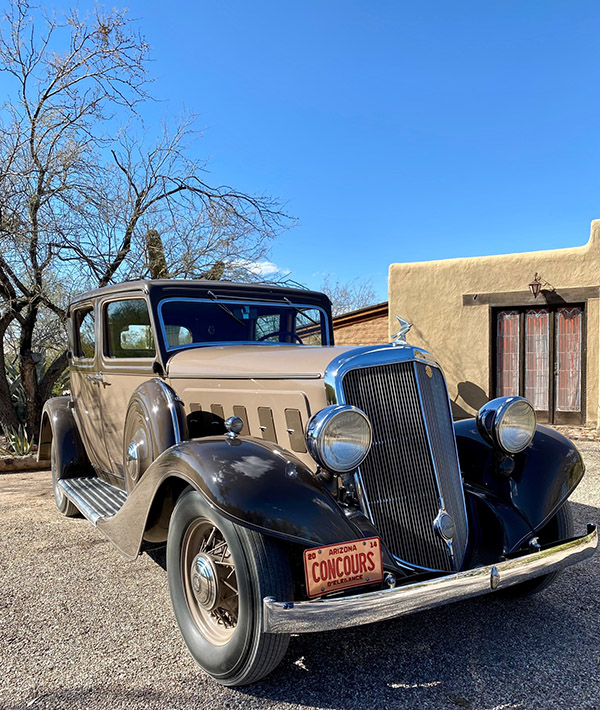
A 1934 Franklin 19-B Club Sedan. This automobile has a 274-cubic-inch factory supercharged air-cooled straight six engine.

The first Franklin was designed by John Wilkinson in 1900.  An industrialist named Herbert H. Franklin manufactured the cars, and the car was named accordingly.  Franklins featured air cooled engines (initially four cylinder engines, but as the company grew, so did the cars and their engines…all the way up to a V-12, and yes, even the V-12 engines were air cooled).  The cars were manufactured in Syracuse, New York.  Franklin built approximately 153,000 cars from 1902 to 1934, and then the firm closed its doors, a victim of the Great Depression.

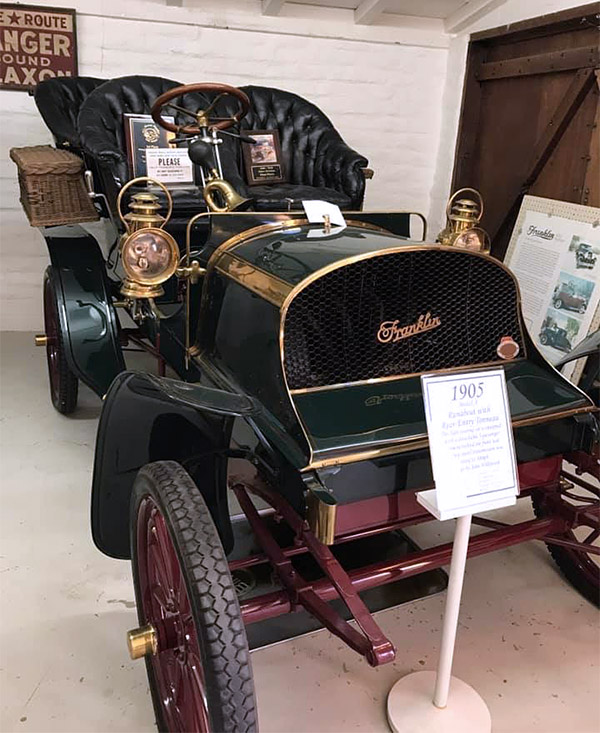
An early 1905 Franklin Model A Runabout. The car has a transversely mounted air cooled inline four cylinder engine.

The H.H. Franklin Club, founded in 1951, aimed to preserve the legacy of these automobiles.  Approximately 3700 Franklins survive.

The Franklin Automobile Museum came to be as a result of the late Thomas Hubbard, a Tucson businessman.   Hubbard was born in New York but raised by his aunt and in Tucson.  Hubbard’s parents owned a Franklin.  They visited Thomas in Tucson every year, driving the Franklin from New York to Arizona.  Hubbard was impressed by his parent’s annual road trips, and he bought his first Franklin in 1953.  It was the first of many.  Hubbard opened the Franklin Automobile Museum in Tucson in 1962.

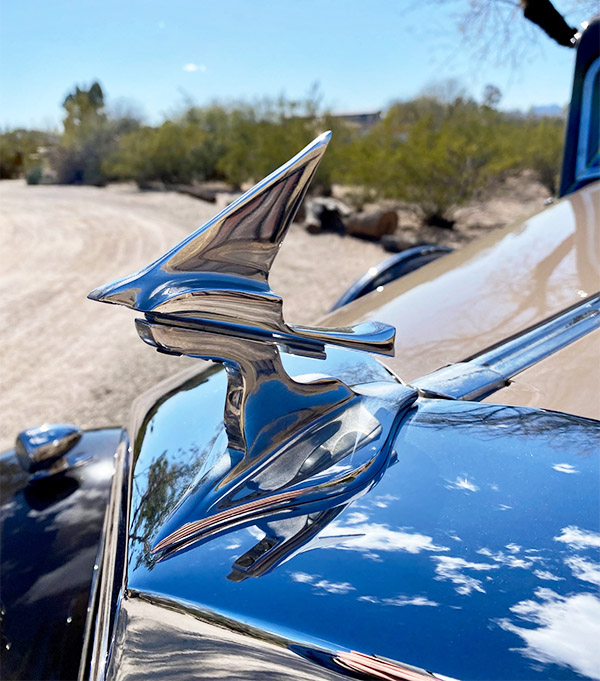
The distinctive Franklin hood ornament.
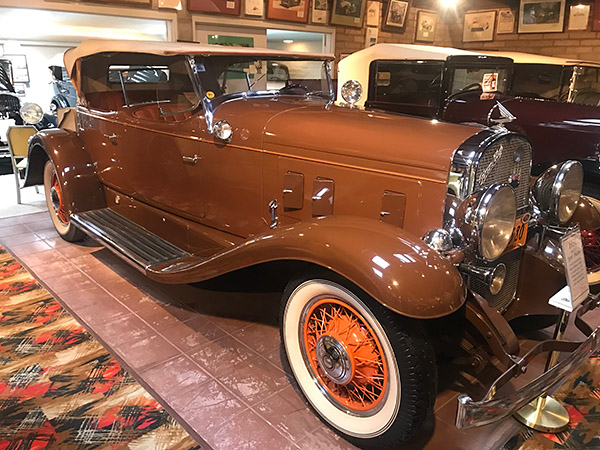
A 1931 Franklin 153 DeLuxe Phaeton, with a custom body by the Merrimac Body Company. This Franklin has the 274 cubic inch air cooled straight six engine. This car’s original price was $6,500, a heady sum in 1931!
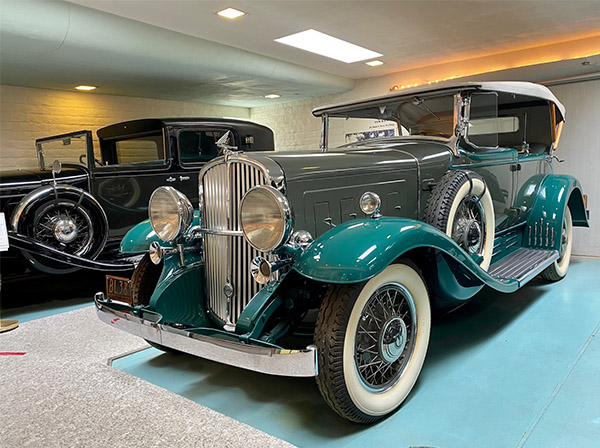
A 1932 Franklin Series 16 Pursuit Phaeton, with the original factory body style and colors. This car has the same 274 cubic inch straight six air cooled engine. It was the first year of the synchronized transmission.

The Franklin Museum is tucked away in northeast Tucson’s Richland Heights area at 1405 East Kleindale Road.   It’s not a place you would just stumble on to or notice from the street.  If you use a nav system to find your way to the address (a highly recommended to get there), don’t be surprised when you enter the neighborhood:  Even though the Museum is in a major American city, the roads in this area are dirt.  And even though the address is on East Kleindale, the Museum entrance is on Vine (just around the corner).

The Franklin Automobile Museum is open mid-October to Memorial Day, Wednesday through Saturday, 10 a.m. to 4 p.m.  Admission is $12, with discounts available for senior citizens and students.  I’d give the place two thumbs up, and that’s only because I don’t have three thumbs.  It’s well worth a visit.


A special thanks for Tony Warren of the Franklin Automobile Museum for the photos you see here.


Help keep us publishing:  Click on those pop up ads!


Never miss an ExNotes blog:

Saguaros and Subarus

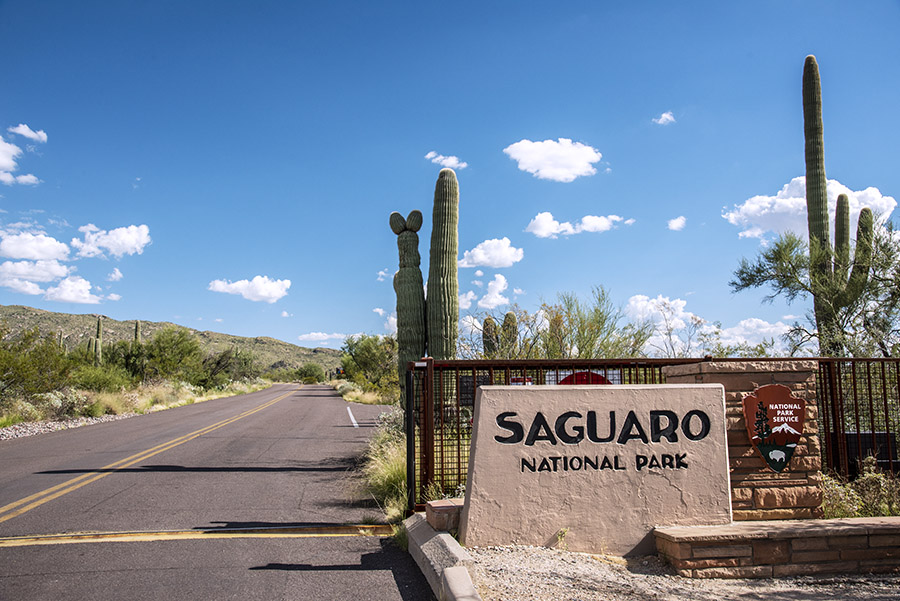
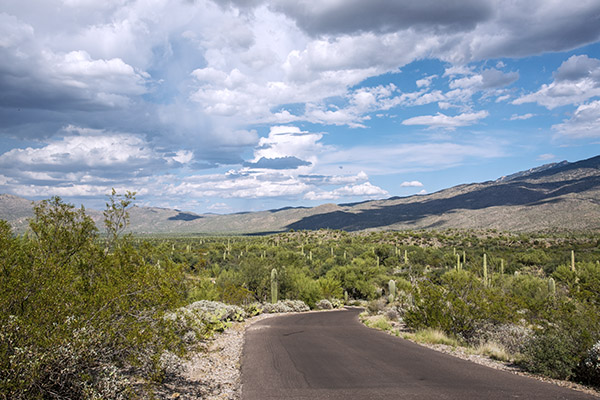
Susie and I were recently in Arizona and we found ourselves near the entrance to Saguaro National Park.  There are two sections of Saguaro National Park; we were near the one with an 8-mile driving loop through it.  It was an easy one-hour ride with frequent stops for photos.

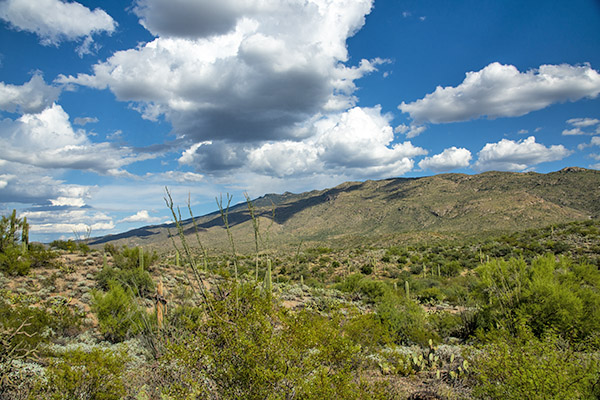
Arizona is a vibrant state. Bright blues, and green hills and valleys from the Tanque Verde’s waters.
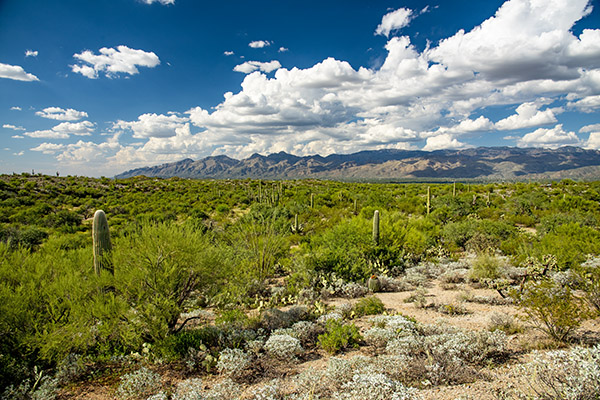
Another case of Mother Nature moving the vibrance and saturation sliders to the right.
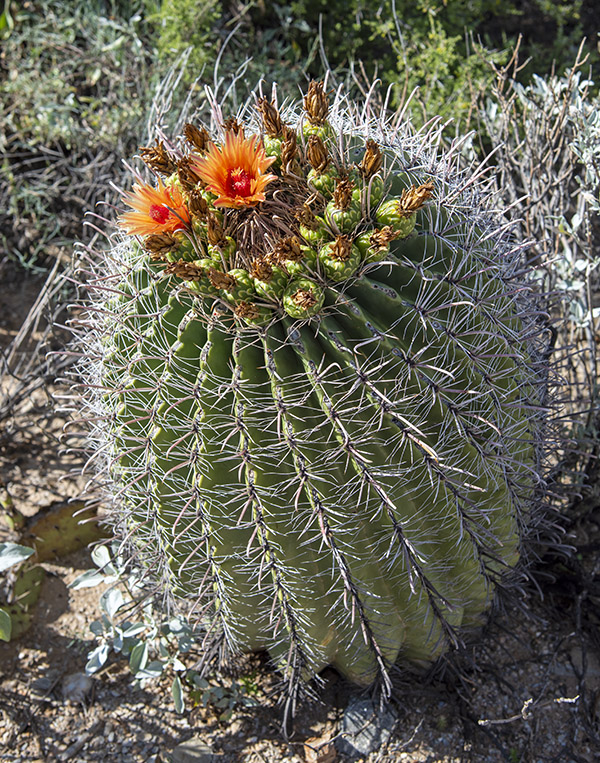
A barrel cactus, with two blooming flowers.
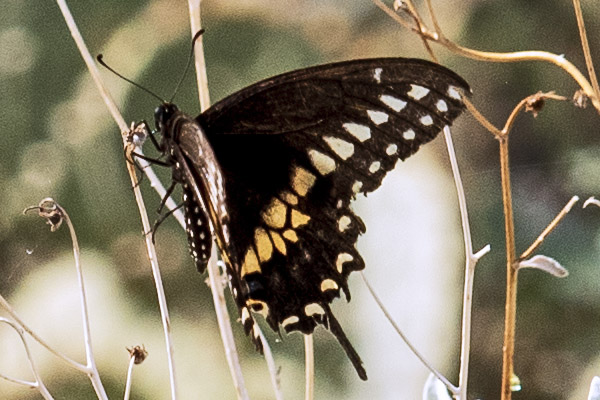
There were a lot of butterflies flitting about. This one landed for a few seconds. I didn’t really have the right lens for this sort of photo.
The 8-mile loop through Saguaro National Park is a one way road, with markings for tortoise crossings, rabbit crossings, javelina crossings, and more. All we saw was a lone rabbit. It was hot out there.
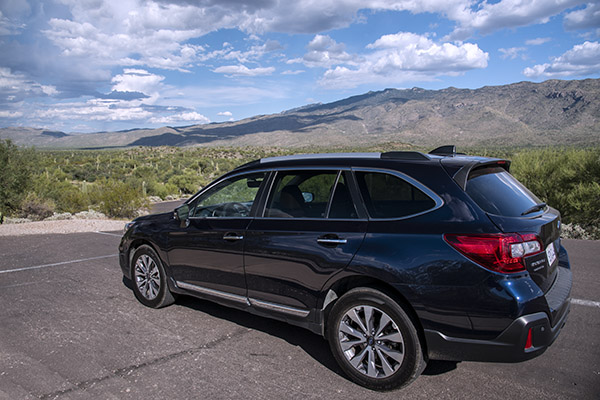
The Starship Subaru. It’s perfect for these kinds of road trips.
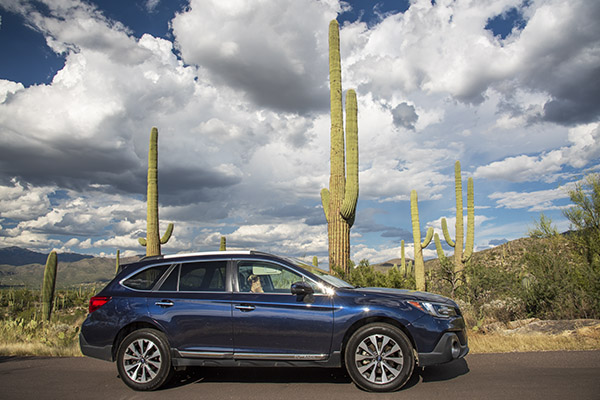
The Outback framed by the Park’s namesake cactus.

On these kinds of trips, I love traveling in my Subaru Outback.  If it gets hot, I turn on the air conditioning.  If it gets cold, I turn on the heater.  If it rains, I turn on the windshield wipers.  If I want music or news, I turn on the radio.  If I don’t know how to get someplace, I turn on the nav system.  I can carry as much stuff as I want, even more if I fold down the rear seats.  Don’t get me wrong; I like riding my motorcycle and I’ve done some big motorcycle trips.  But there’s something to be said about traveling with your wife in a comfortable car.  This is the third Subaru I’ve owned, and my next car will be another Subaru.

We stopped in the small visitor center before we left Saguaro National Park, and to my surprise, a new Subaru Wilderness Outback was in the parking lot.   It’s a version with different trim, more ground clearance, restyled bumpers (front and rear) for better approach angles, and lower gearing.  I like the idea of everything except the lower gearing and the trim.  Somehow, the Wilderness styling makes it look cheap (in my opinion) and the lower gearing lowers fuel economy.

I’ve owned three Subies now, starting with a 2006 WRX, a 2013 CrossTrek, and my current Outback.  They have all been great automobiles.

So, about this most recent trip:  We meandered through Arizona and New Mexico, and our travels included stops at the Tinfiny Ranch, the Albuquerque Balloon Fiesta, and more.  Stay tuned; there are more blogs coming your way from this adventure.  We had a blast.


Never miss an ExNotes blog:


Help us keep the lights on:   Please click on those popup ads!

ExhaustNotes Travel: The North Rim

Berk recently did a story on the Grand Canyon and I have visited the park many times. I’ve never made it to the North Rim however, and a trip to Las Vegas, Nevada was a wonderful opportunity to check out the other side of that great big hole in the ground as it was practically on the way. If you plan on going know that the North Rim closes around the end of November. When we arrived a few days before Thanksgiving the ranger station, restaurant, gift shop and lodge were all closed. The park was still open but the place was deserted. Only us and a few other cars were at the park that day.

National Park fees are getting kind of pricey.  35 dollars was the day pass fee except there was no one to collect the money. There was an electronic-pay box near the Ranger Station. Several of the other visitors were poking and prodding at the box but no one was having any success actually paying. Payees would stab their card in and look to the waiting customers as if to say, “What do I do now?” Someone else would try to help the lost soul but we were getting nowhere. I never got a chance at the box because we decided it must be out of service and besides we were just taking a drive through.

The North Rim is quite a bit different than the South Rim. For one, it’s about 1000 feet higher in elevation. The slope is different also: rain water on the North Rim flows into the canyon while rain water flows away from the canyon on the South Rim. What this means is that the South Rim is relatively straight along the edge with many places to pull over and gaze at the canyon, The North Rim has fjord-like canyons that intersect the Colorado River gorge at right angles so getting to view points means longer drives and some backtracking to get to the next one. There are fewer car-accessible spots on the North Rim and in fact most of it is hiking material. I don’t hike.

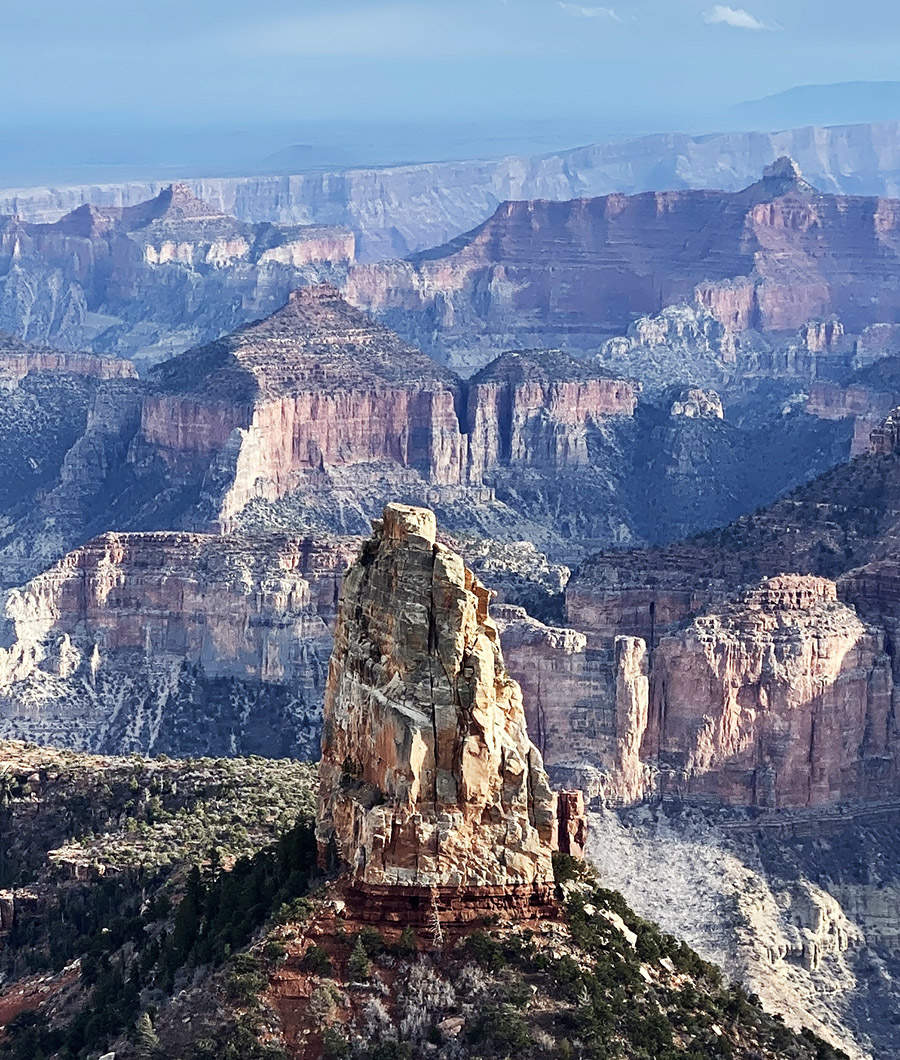
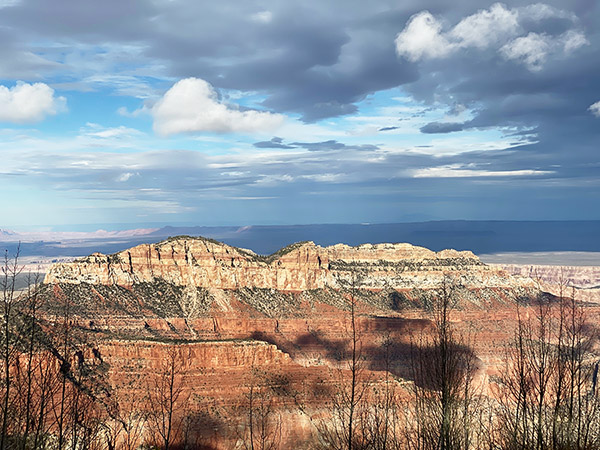
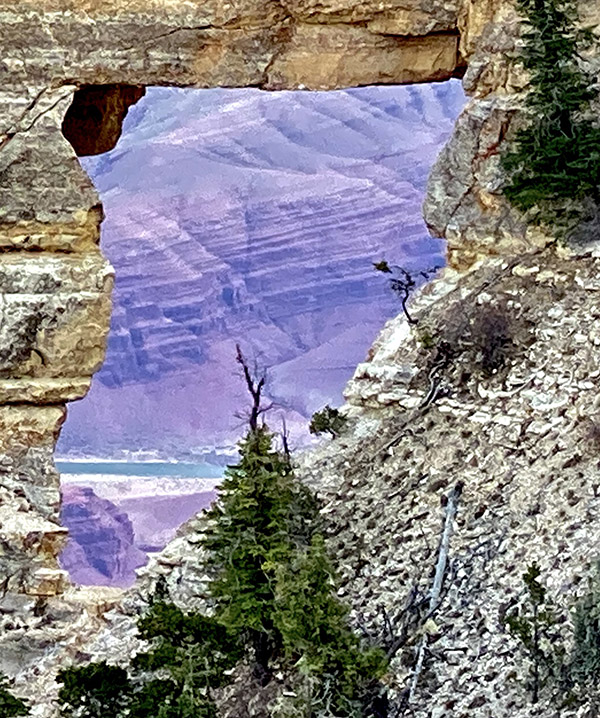
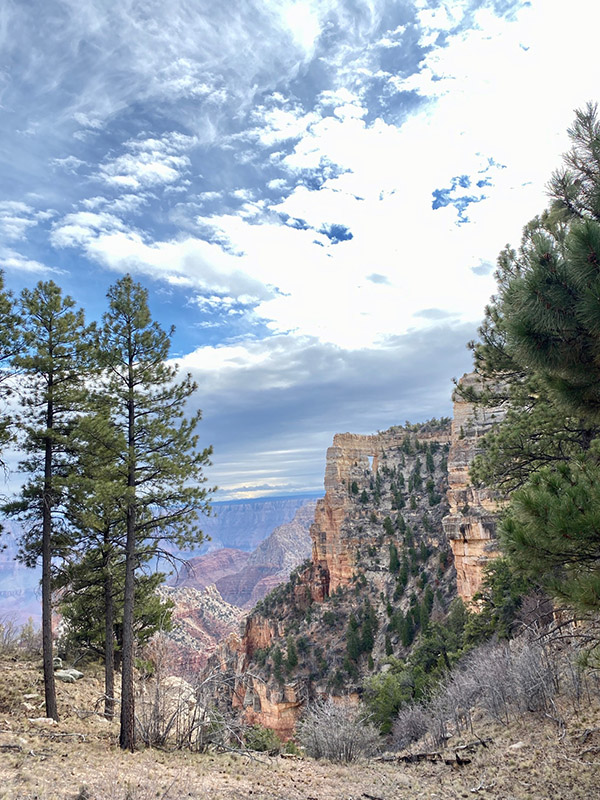
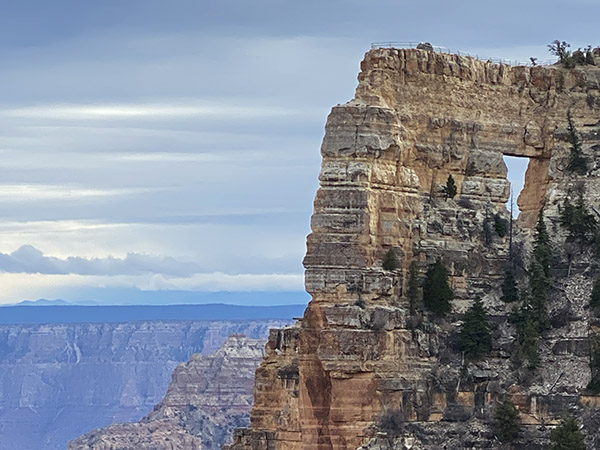
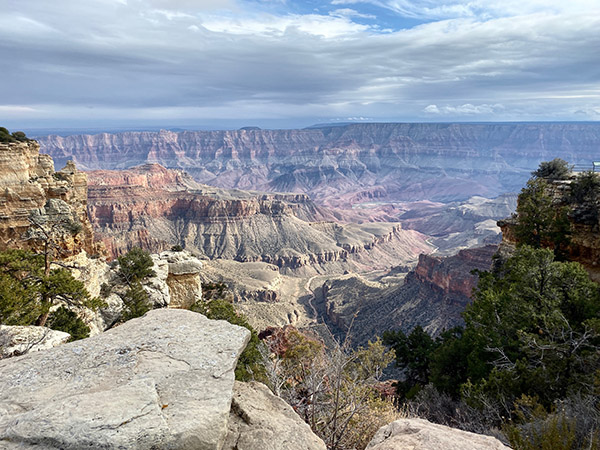
There are supposed to be bison running around but except for chipmunks we saw very little wildlife mostly due to the onset of winter. The critters were probably settling in snug somewhere we couldn’t see. The view points may be fewer but the views are still spectacular at the North Rim. My cell phone camera was dwarfed by the immensity of the scene and the photos you see in this story reflect that tiny little sensor.

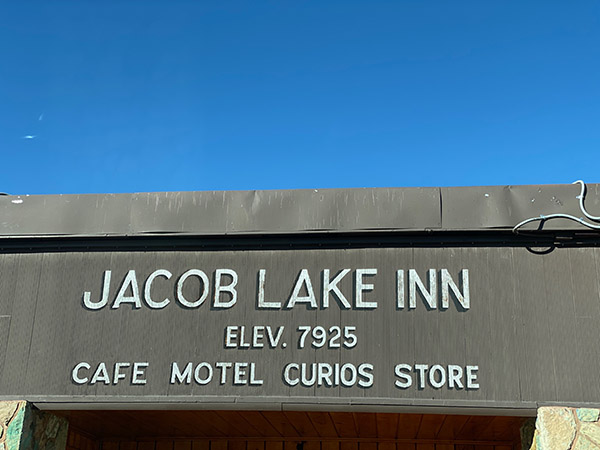
The North Rim is kind of far from anywhere; the closest lodging we could find was at the Jacob Lake Lodge. The Jacob Lake Lodge is an all-in-one resort with rooms, a gift shop, a nice place to eat and a gas station. The staff was made up of bright young college students who work several-month shifts then go back to school. There are staff accommodations on site. CT and I were amazed at how smart, kind and genuinely good people these kids were. The entire place was run by 20 year-olds, not an adult in sight.

Jacob Lake Lodge is open year around and is worth a visit even if the North Rim is closed. There is a big fireplace and comfy seats to sit in as you pen manifestos or just check your email. The logs are 3 feet long and the fire is tended to by the 20-somethings. The drive up on 89A takes you from mostly desert to pine forests in a few miles. I’ll be going back again because I missed Jacob Lake’s famous pie due to eating so much food. You should go, too.


Here’s a link to our earlier Grand Canyon story, and here’s a link to our Reviews page (it has other National Parks).