By Joe Berk
In prior ¿Quantos Pistones? posts, I wrote about engines with which I had personal experience. When dealing with five-cylinder engines, though, I cannot do that. I don’t think I’ve ever even seen a five-cylinder motorcycle. They exist, though, and I found them by poking around a bit on the Internet. The best source was Wikipedia, which lists several. I used Wikipedia as the basis for further research, and I went beyond that to include others found online.
The Straight Fives
These fall into two categories: Custom-built motorcycles created from stock bikes, and Honda’s 1960s small displacement Grand Prix racing motorcycles.
Honda built the RC148 (the first edition of their 125cc inline five-cylinder, four-stroke engine), and the RC 149 (which was a further development effort). The RC149 is reported to have reached speeds of over 130 mph. It had an 8-speed transmission and the pistons must have been about the size of thimbles. Well, not really. This engine was originally based on Honda’s 50cc twin (can you imagine such a thing). Take two and a half 50cc twins, throw in some Honda pixie dust, and voilà, you get an inline 125cc 5-cylinder GP bike. It must have been exciting, being an engineer at Honda back in the 1960s.
Here’s a video I found of Honda techs evaluating an RC149 on a Honda test track. If you like listening to engines wail (their, um, ExhaustNotes), you’ll enjoy this one:
There have also been custom straight fives fabricated from other engines. Here’s one based on the Kawasaki three-cylinder 750cc two stroke:
Those bikes must have been impressive, too. I thought I once saw something on the Internet about a similar custom Kawasaki 900 (you know, like Gresh’s old Zed) that had been cobbled into an inline 5-cylinder machine, but I couldn’t find it again. Maybe it was in a dream.
Honda’s V-5 GP Bikes
Honda was the only player in the V-5 game, and they only did so on their GP bikes in the early 2000s. That bike was designated the RC211V. Everyone else used either a V-4 or an inline four.
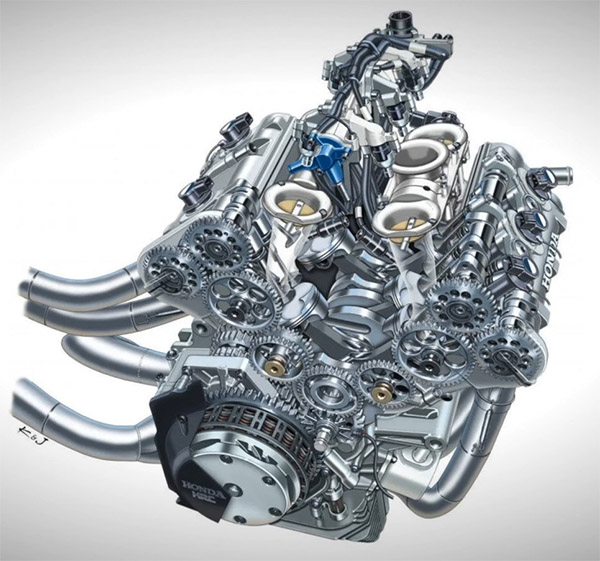
The reasons are very technical, but they all boil down to two advantages:
-
- The V-5 engine was actually smaller than either a V-4 or an inline four engine, and
- The V-5 engine had an inherent power advantage over the other four-cylinder engines.
The above is explained well in the video below.
The Verdel Radial 5
Here’s one that has a bit of controversy about it: The Verdel radial 5-cylinder bike:
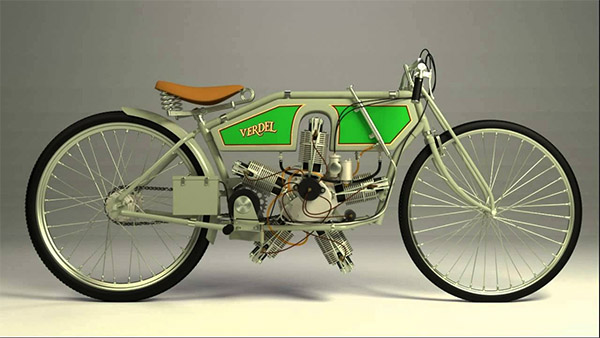
Some have written about it as a rare, 1912 motorcycle, but it’s not. It was built in Britain by an engineer in the late 1990s. A notable motorcycle museum bought it thinking it was a genuine vintage motorcycle (Verdel did exist, but the company made aircraft engines, not motorcycles), and apparently the museum has since acknowledged that this never was a production motorcycle from Verdel. It kind of looks the part, so it’s easy to understand how the museum fell for the vintage bike story. The ground clearance and those two cylinders hanging out from the bike’s undercarriage just scream for a skid plate.
Go Puch Yourself
Sorry, I couldn’t resist that (every once in a while, my New Jersey roots emerge). Back to the story: Here’s another interesting 5-cylinder custom motorcycle assembled by a talented builder using Puch moped engines.
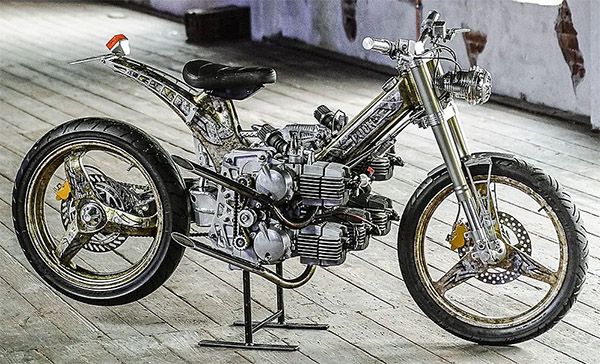
Uwe Oltman (that’s the builder’s name), a guy in Germany, assembled the custom you see above from five Puch 50cc (actually, 48.8cc) moped engines.
The info I found says the bike is pretty much an unrideable showpiece due to the noise and heat from the five Puch 2-stroke engines. They’ve been poked out to 70cc each, so I guess that makes this creation a 350. As design exercises go, I think it’s cool.
Megola
I first heard of this from a friend who had a conversation about rare motorcycles with Jay Leno. Mr. Leno has a Megola in his collection. The Megolas were German bikes from 1921 to 1925 in Munich. The name is combination of its designers’ names (Meixner, Gockerell, and Landgraf).
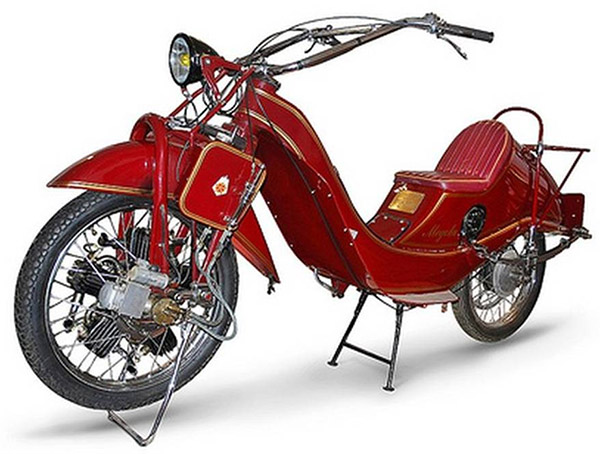
Megolas are about as weird as motorcycles can be. The engine’s five cylinders rotate around the front axle, with a 6-to-1 transmission that cuts the axle rotation to one sixth of the engine’s speed. The 640cc engine ran at 3600 rpm, which turned the front wheel at 600 rpm, which provided a top speed of about 60 mph. There’s no clutch, so when a Megola rider came to a stop, so did the engine. The owner’s manual suggested riding in small circles if you didn’t want to shut the engine off. Weird, huh?
So there you have it: The Fives. Next up in our ¿Quantos Pistones? series will be (you guessed it) the Sixes. That one will be easier, as I owned a Honda CBX a few years ago. Stay tuned!
Ah, missed a couple! I thought I had them all, but then I found this video, and it identified a couple more 5-cylinder bikes. Take a look; it’s worth a watch!
Missed our earlier ¿Quantos Pistones? stories on the Singles, the Twins, the Triples, and the Fours? Hey, no problemo! Here they are:
¿Quantos Pistones? (The Fours)
¿Quantos Pistones? (The Triples)
¿Quantos Pistones? (The Twins)
¿Quantos Pistones? (The Singles)
Join our Facebook ExNotes page!
Never miss an ExNotes blog:
Help us keep the lights on:
Don’t forget: Visit our advertisers!