Two days ago I posted a blog on loading .223 Remington for the Mini 14 with IMR 3031, and I asked the question you see in the title: Does weighing each charge matter?
In a word: Yes
Some associated questions:
Does weighing each charge make for a smaller group?
Again, the answer is yes.
Does weighing each charge make the velocity extreme spread and standard deviation smaller? Surprisingly, no. I saw only a small difference with the 25.5 grains of IMR 3031 loads (in fact, the spread and standard deviation were slightly smaller for the cartridges charged directly from the dispenser).
So what works best with IMR 3031 and the 55-grain full metal jacket boattail bullet in the Mini 14 rifle: The minimum load, or a near max load? With the bullet I used in my rifle, the near max charge was the clear winner. Just to check out the lower end of the charge spectrum, I also loaded with 24.0 grains of IMR 3031. The extreme spread and standard deviation were atrocious, and the accuracy was poor. This is a cartridge that likes to be loaded hot when shooting the 55-grain bullet.
First, all the usual accuracy caveats:
I’m an old guy.
My eyes ain’t what they used to be.
It was windy as hell out there.
I was shooting into the sun.
I didn’t trim my brass.
I didn’t clean the primer pockets.
I used old brass.
The way I had my targets posted was distracting (more on that below)
You get the idea. I have a bunch of excuses. It wasn’t me. I didn’t do it. It’s not my fault. I would have made a good criminal, I think.
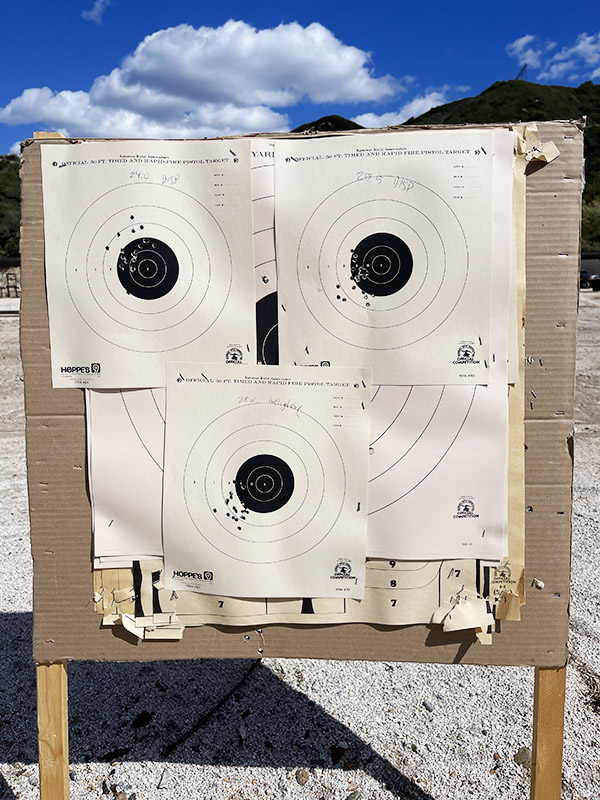
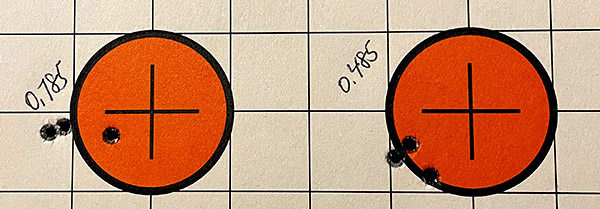
My targets. I shot at 50-ft pistol targets at 50 yards. The top left target was with the 24.0-grain IMR 3031 load (with the propellant dispensed from the dispenser straight into the case). The top right target was with the 25.5-grain IMR 3031 load (again, with the propellant dispensed from the dispenser straight into the case). The bottom center target was with 25.5 grains of IMR 3031, but I weighed each charge using a powder trickler to give me exactly 25.5 grains in each case. There are 20 rounds on each target.
It may not look like much now, but you can see a bit of the black bullseye on a previous target peeking out between the two upper targets. It’s also just above the bottom target. That bit of black was enormously distracting using the aperture rear sight on the Mini 14. I had a hard time hanging on to the target I was aiming at. I didn’t realize that when I stapled the pistol targets to the target stand, and it may have skewed my results with respect to group size. Live and learn, I guess.
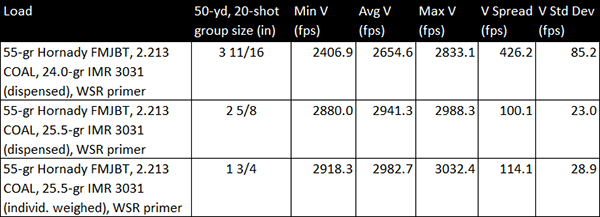
Here are the group size and chronograph results:
Why, you might ask, is the standard deviation and spread slightly larger for the more-precisely-metered 25.5-grain load? I can’t say. There might be other variables at play I didn’t control, or it might just be normal statistical variation. But the group size says all I need to know. Weighing each charge makes for smaller groups, and that’s usually what I’m chasing.
All right, all you Mini 14 and other rifle reloaders, the question du jour is this: Does it make a difference if you weigh each powder charge versus simply dropping them from the powder dispenser?
I always suspected the answer was no, but I want to answer the question more rigorously. I also want to try IMR 3031 in the Mini 14. I have an 8-lb bottle and I have not loaded .223 ammo with it.
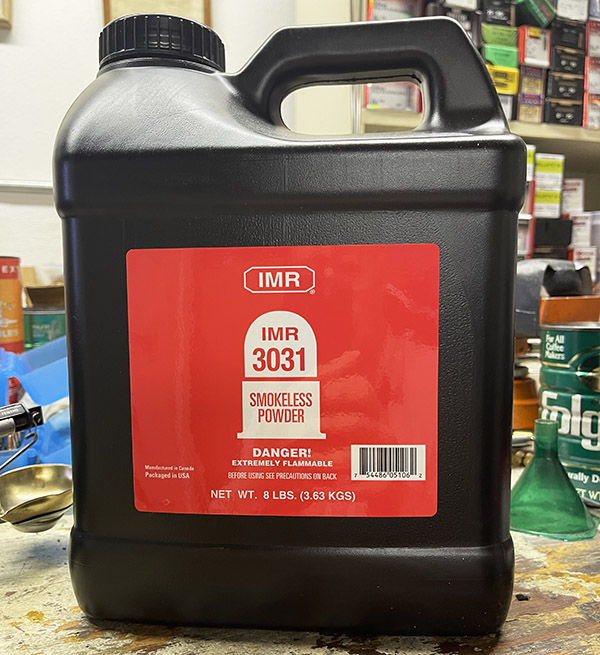
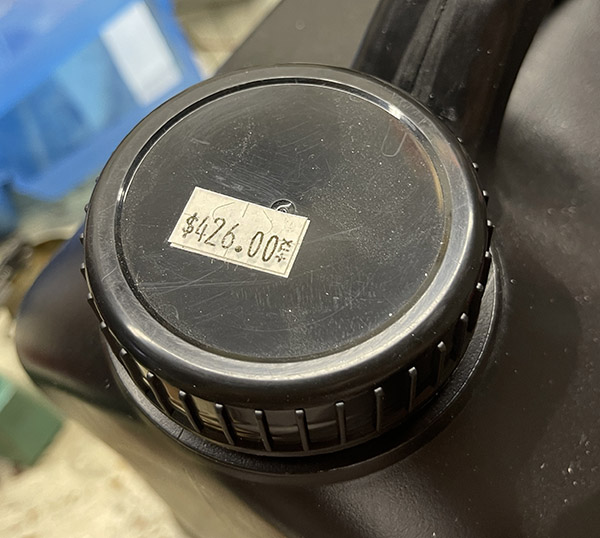
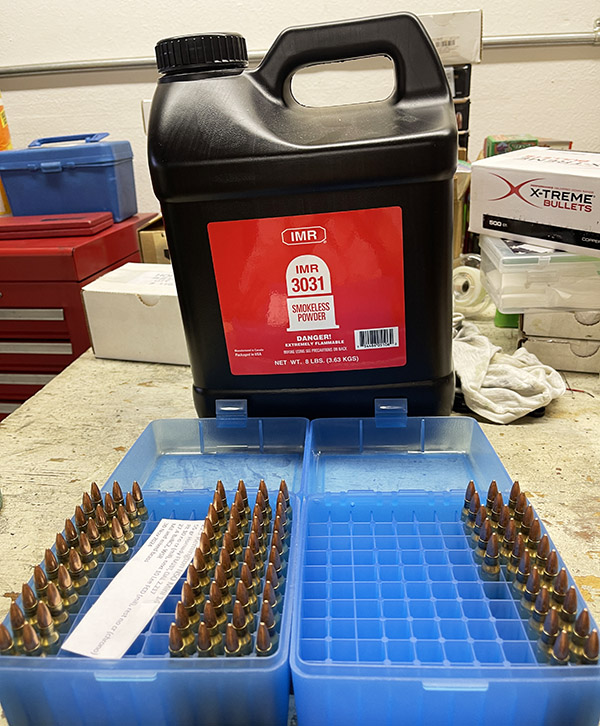
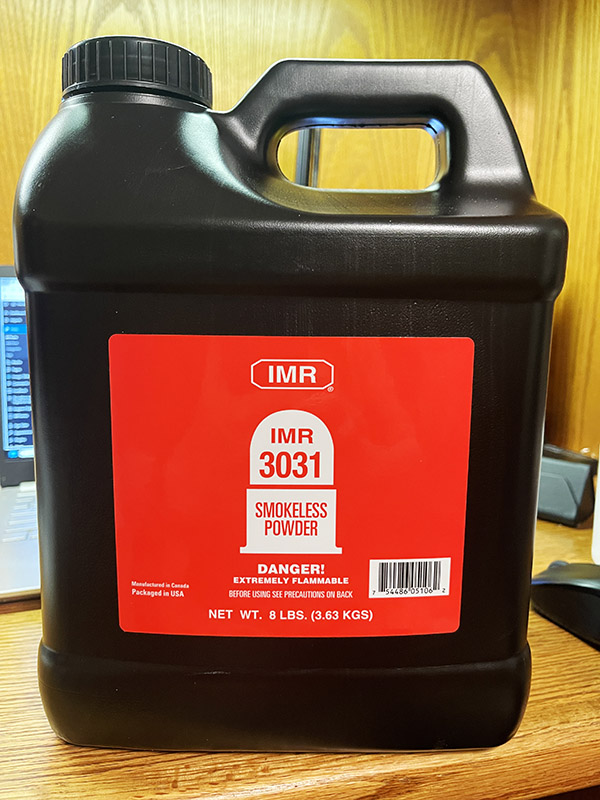
An 8-lb bottle of IMR 3031. That’s good for about 2240 .223 rounds.Powder prices have gone through the roof in the last couple of years. I can’t believe I actually shelled out $426 (plus tax!) for a bottle of powder. It is what it is.
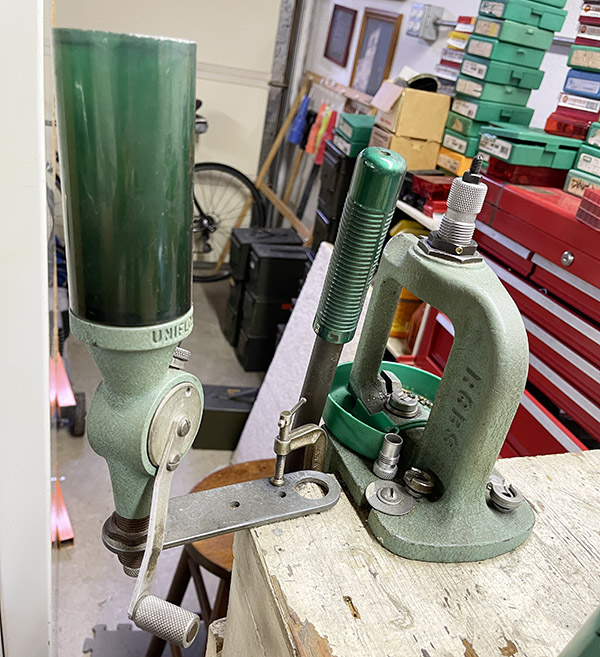
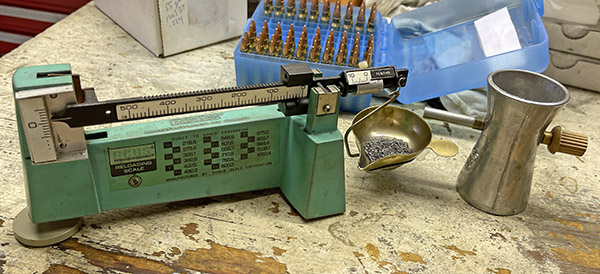
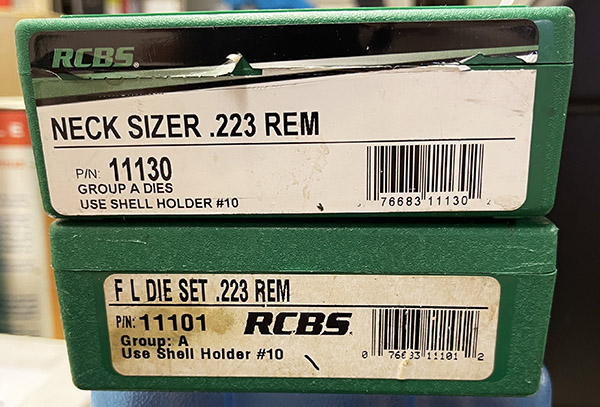
For this experiment, I used my trusty RCBS Rockchucker (a tool I’ve been using for more than 50 years now), RCBS dies (with a neck size only die for the depriming and resizing step), an old RCBS balance beam scale (another tool I’ve been using for more than 50 years), my RCBS powder dispenser (ditto on the time in service), and an RCBS powder dribbler (yep, I’ve been using that one since I was in the Army, too).
I’ve been using my RCBS Rockchucker and powder dispenser since 1974. RCBS makes good gear. It lasts forever.Hornady 55-grain full metal jacket boattail bullets: Good stuff in the Mini 14.
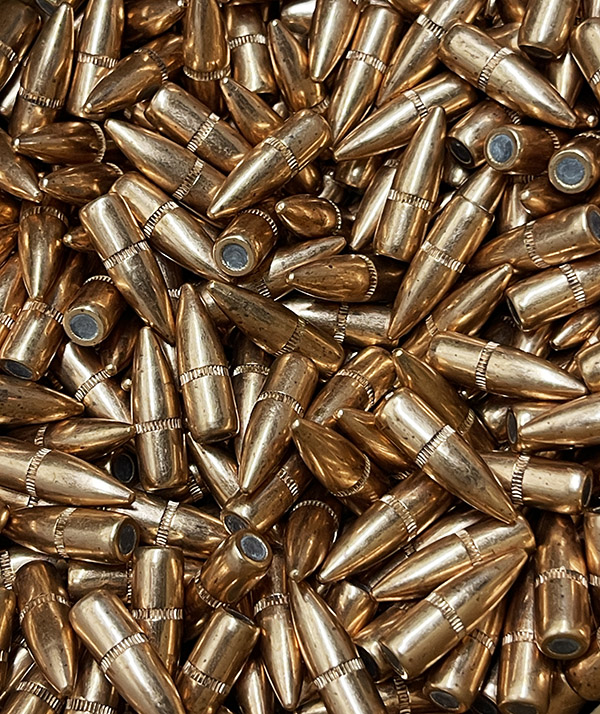
The IMR 3031 load data came right out of the online Speer reloading page. For 55-grain bullets in the .223 Remington, Speer showed an IMR 3031 load ranging from 24.0 grains to 26.0 grains (a compressed load). I went with Lake City brass and Winchester small rifle primers. Cartridge overall length was set at 2.213 inches. I loaded one group of cartridges with 24.0 grains of IMR 3031 (dispensed directly from the powder dispenser to the cartridge, without weighing each charge), another group of cartridges with 25.5 grains of IMR 3031 (similarly dispensed from the powder dispenser), and a final group of cartridges with (again) 25.5 grains of IMR 3031, but this time I trickled the charge in to have exactly 25.5 grains.
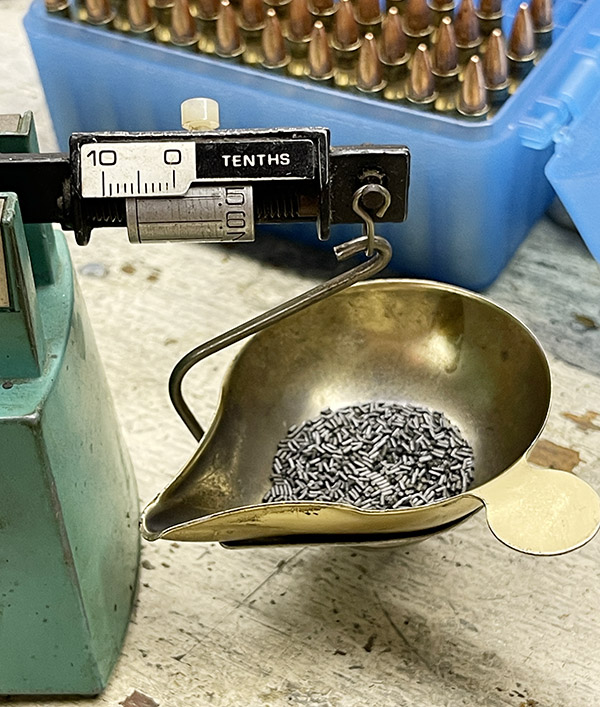
25.5 grains of IMR 3031 in my old RCBS balance beam scale. It’s another RCBS tool I’ve been using for 50+ years.
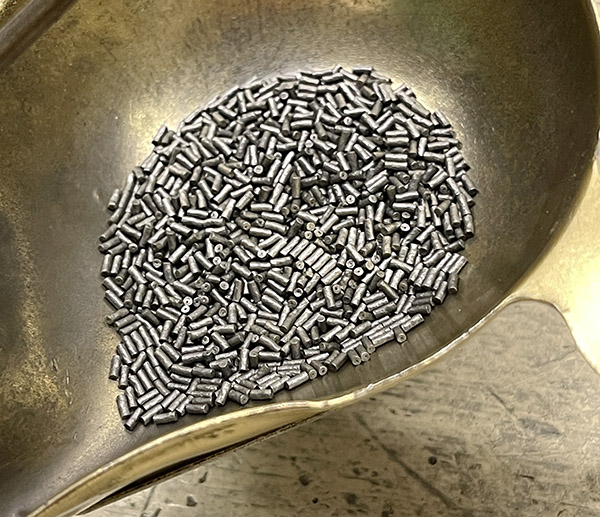
IMR 3031 is a stick powder, and the individual sticks are relatively large. The powder dispenser was showing a variation of about 0.3 grains in the charges it threw. I didn’t know what that would do to accuracy and how it would affect velocity variation. I made that last batch weighing each charge to see if doing so (i.e., to get exactly 25.5 grains, with no variation in charge weight) would improve accuracy and reduce velocity variation. That’s what this experiment and this blog post are all about.
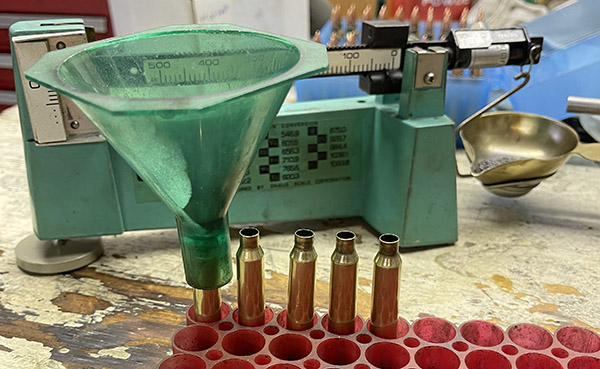
The RCBS powder trickler. The drill is to set the dispenser for just under the desired throw weight, and then trickle in the last 0.1-0.2 grains to get exactly 25.5 grains.Another long-lived RCBS tool: My powder funnel. Yep, that plastic part has been working well for me for the same 5+ decades.I use an RCBS neck sizing die and an RCBS bullet sizing die when loading .223 ammo for the Mini 14.
On that neck size only business, in the past while developing Mini 14 loads I found that the rifle groups much better if I don’t full length resize the cases, but instead neck size only. A guy on an internet forum wanted to go to war with me over that, responding angrily with NO NO NO!!! His comments emphasized the unsuitability of neck sized cartridges in a semi-automatic rifle, my stupidity, and my questionable ancestry. I told him I appreciated his inputs, but when I read them to my rifle, it ignored them completely and continued to function with 100% reliability. That ratcheted the guy up even more. I’ll tell you: The Internet brings out the worst in some people. Boorish behavior, the dumbing down of the human race, and online disinhibition have changed us, and not for the better. Anyway, I digress…back to the main topic.
IMR 3031. Big sticks. We’ll see how it shoots.
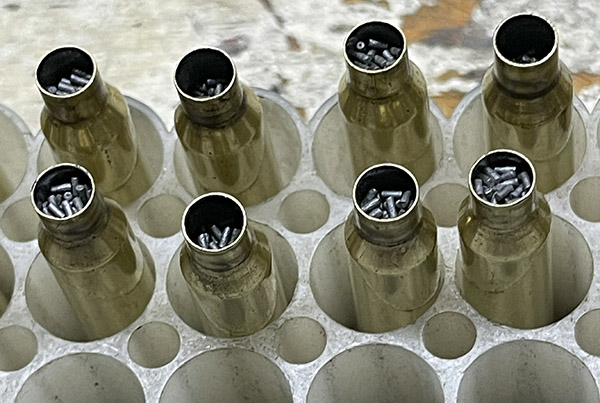
As mentioned above, IMR 3031 is a stick powder, and the sticks are big enough to interfere with cycling the RCBS powder dispenser. Ball powders fall smoothly; stick powders want to catch in the rotary mechanism’s cavity. When I dispensed powder directly into each case, I saw significant variations in case fill.
Case fill when filling cases straight from the powder dispenser. Note the variations in fill level.
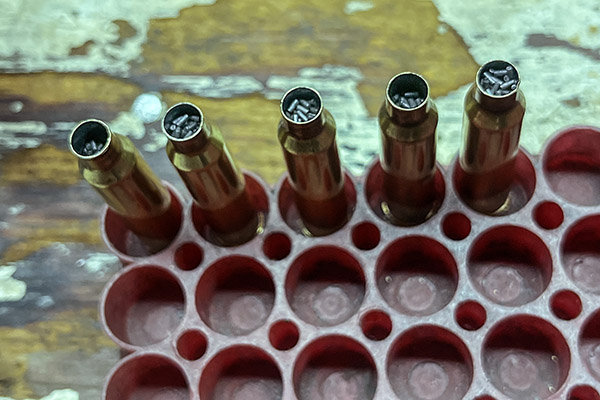
I know that the case fill variations are more due to how the propellant falls in the case than anything else. I didn’t think they were driven by propellant weight variations. When I weighed each powder charge and added those to the cases, I observed the same kind of case fill variations (which I think supports my “let the sticks fall where they may” hypothesis).
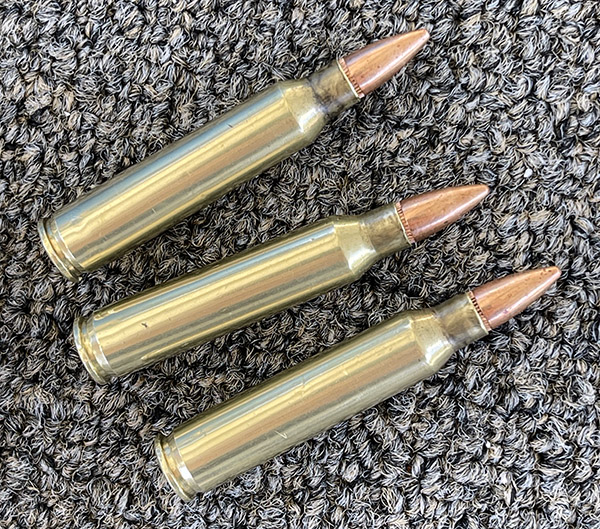
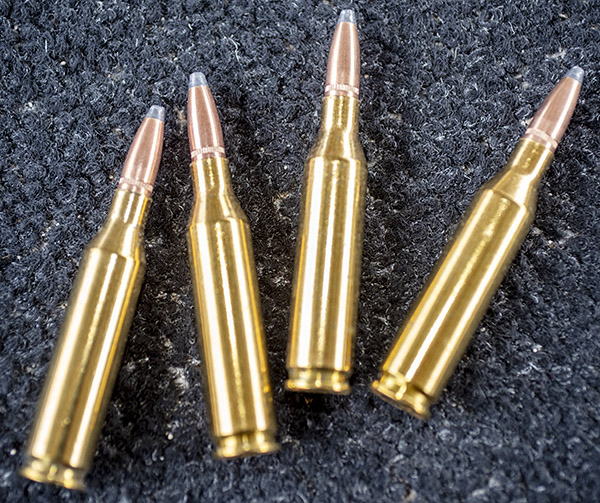
Case fills when precisely trickling in 25.5 grains of IMR 3031. The variations in fill level are similarly random to variations that occur when filling the cases directly from the powder dispenser. Note that these are compressed loads; the propellant will be compressed during the bullet seating operation.Finished .223 ammunition, loaded into three different test sample groups: Loads with 24.0 grains with powder dispensed directly into the case, 25.5 grains with powder dispensed directly into the case, and 25.5 grains with powder trickled and weighed before loading into the case.
With my ammo groups complete, I was ready to head to the West End Gun Club to test for accuracy and velocity. A few thoughts up front:
My accuracy tests should be taken with a very large grain of salt. My Mini 14 has iron sights and my vision is not what it used to be. Instead of shooting 5-shot groups at 100 yards, I’m going to shoot a single 20-shot group with each load at 50 yards. I’m an old guy and that’s my approach. If you don’t like it, start your own blog.
The chrono results will be much more rigorous. I trust my Garmin chrono big time. It’s one of the best bits of gear I own.
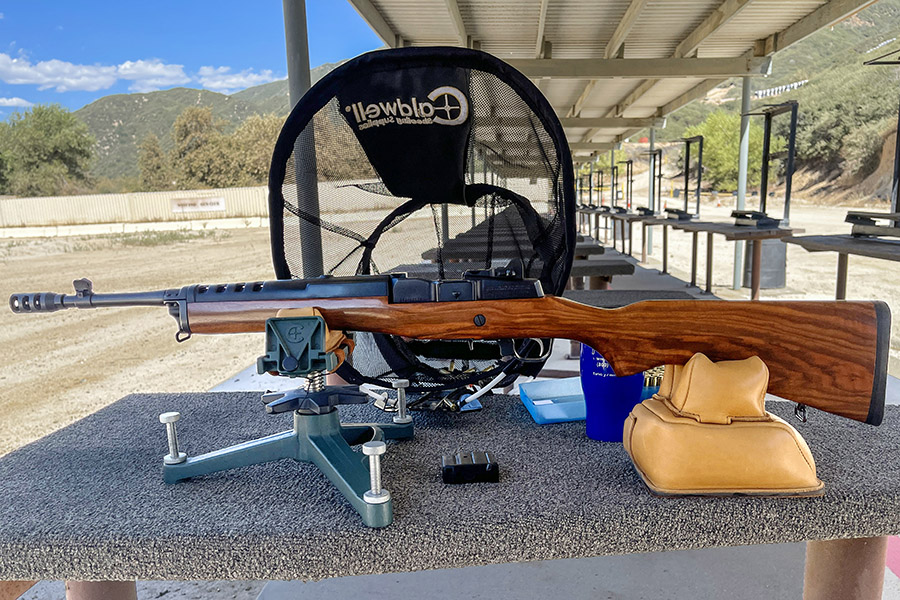
My Mini 14 is the same one you’ve seen before here on the ExNotes blog. It’s my least accurate rifle, and it is one of the most fun to shoot.
Well, this blog is getting a bit long, so I’ll call it a day and say that’s enough for now. I’m off to the range. Watch for the results in another day or two.
The surplus Mosin-Nagant rifles that were everywhere (until Obama was in office) were the best gun deals ever; now, you hardly see them anywhere, and when you do, they go for big bucks. You used to be able to buy a Mosin for $79 at Big 5. I started playing around with them about 15 years ago. Today, when you see one, it’s not unusual for the store to have them marked at $500 (or more).
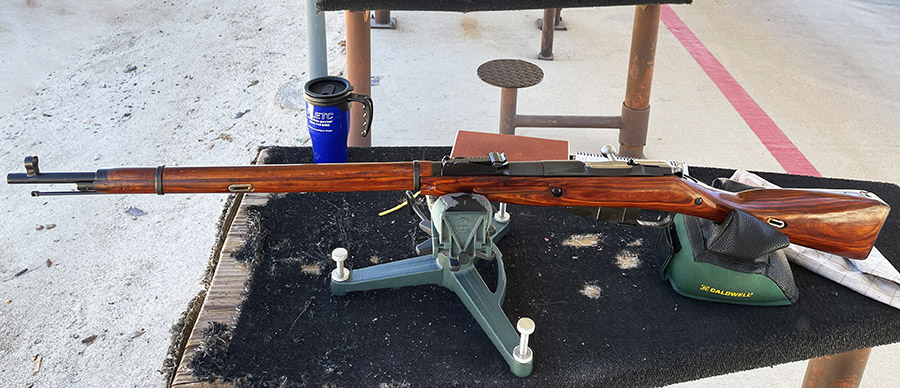
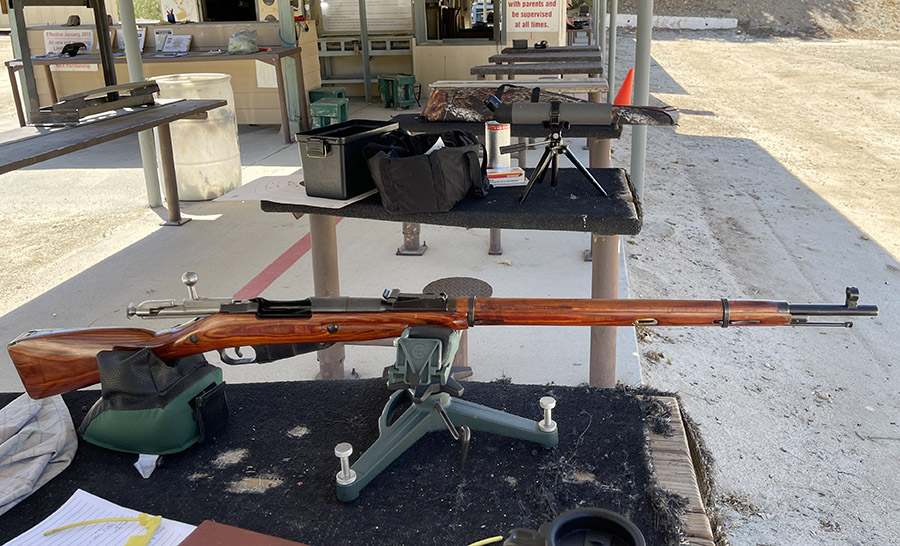
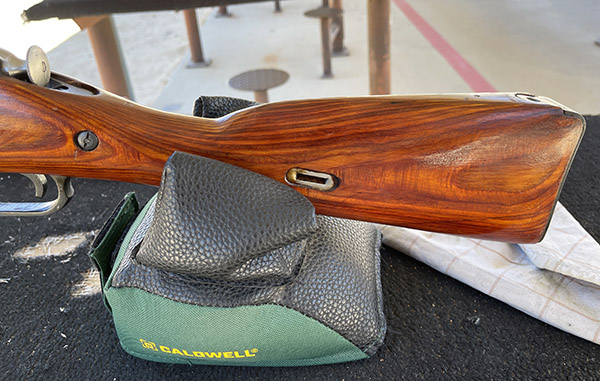
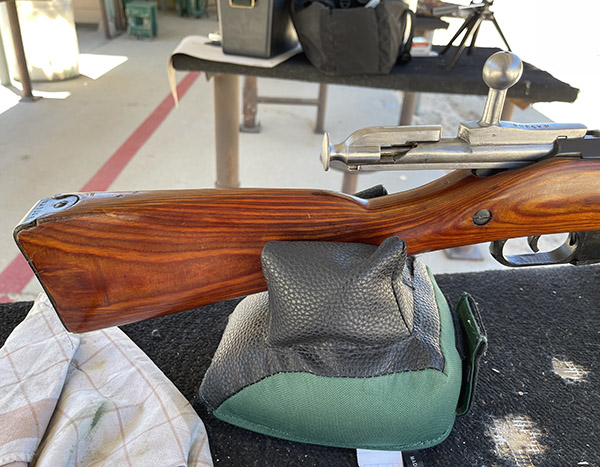
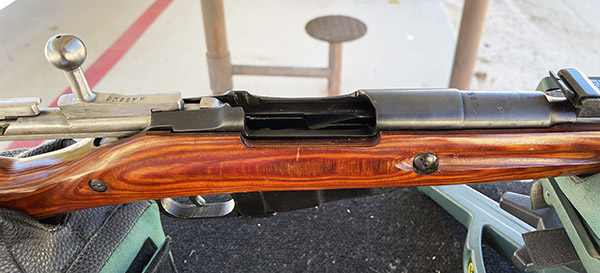
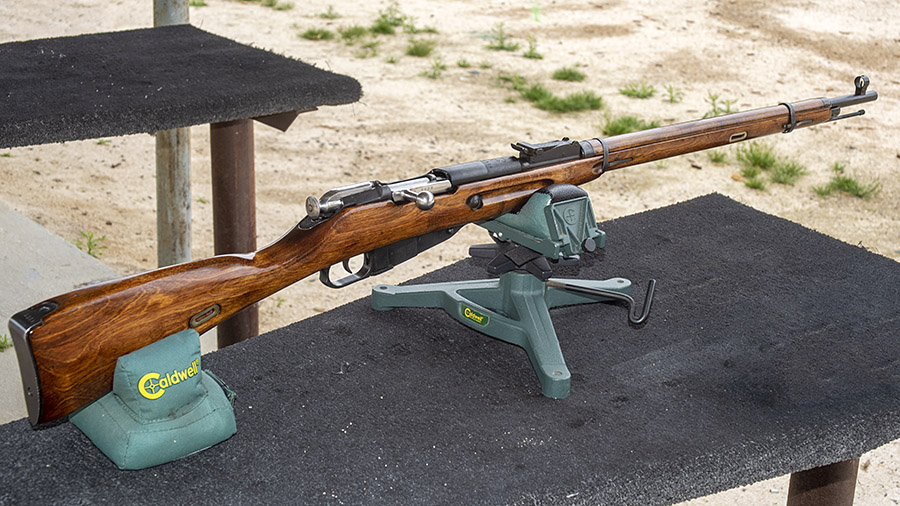
One of mine is a laminated stock Mosin 91/30, which is not seen too often. I bought it about 10 years ago from Gunrunner’s in Duarte for $239 and stuck it in the safe. Until today, I had not fired it. It’s a Tula (there were two makers; Tula was one) with a round receiver. It was made originally in 1939. After the war, the Soviets refurbed most of them and a very few were fitted with laminated stocks. I’ve never seen another one on the range. It’s a pretty rifle, and I like the look of it. Laminated wood stocks are usually much more stable than a standard stock, so I think that’s helping this rifle’s accuracy.
My laminated Mosin has the usual nicks and dings. The serial numbers all match (stock, magazine, bolt, receiver, and bayonet). The trigger is heavy, gritty, and just God-awful. For the groups you see here, I used my new favorite Mosin load (42.0 grains of IMR 3031 and the PRVI PPU 150-grain jacketed softpoint boattail bullet).
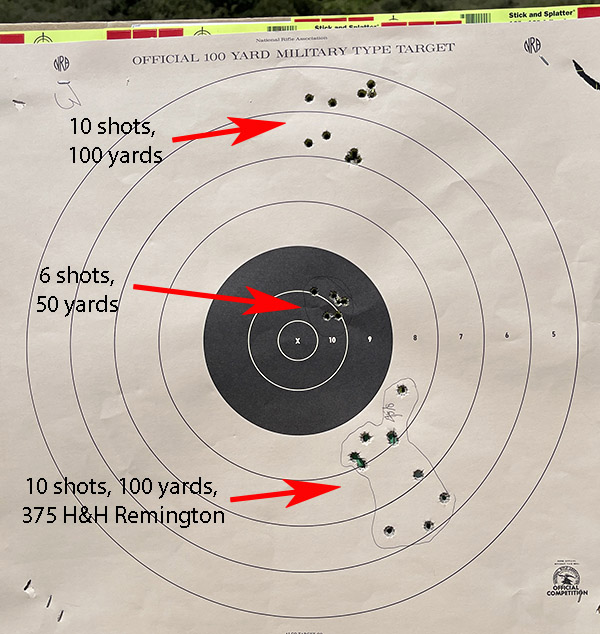
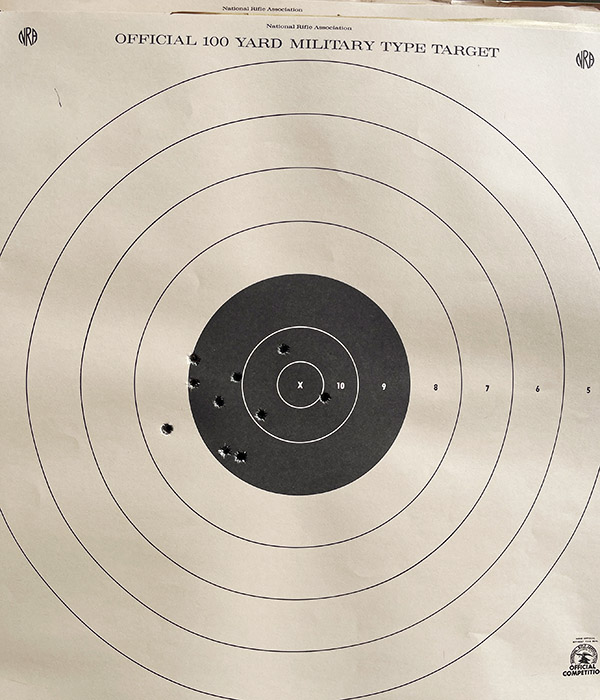
The rifle, I think, shoots well (even with its terrible trigger, and it was pretty windy out there the day I shot the groups you see above). Because I am a cheap SOB, I reused a target from a previous range session with my .375 H&H, so you can ignore the group to low right of the bullseye. With my laminated-stock Mosin, I first shot 6 rounds at 50 yards to see where the rifle was printing (my aim point was at 6:00 on the bullseye). Then I moved the target out to 100 yards and fired another 10 rounds using the same aimpoint. The 50-yard group measures 1 1/8 inch; the 100-yard group measures 2 13/16 inch. That’s not too bad for the first time out, and not too bad for an old guy using iron sights.
My rear sight is already all the way down. I am going to look for a front sight with a taller post (if you know who might offer these, please let me know). The rifle probably has a 500-meter battlesight zero (or whatever the Russians used), and it was probably set up with the bayonet installed (which makes the rifle shoot to the right without the bayonet). I can adjust the windage by drifting the front sight; I can’t lower the elevation without getting a taller front post.
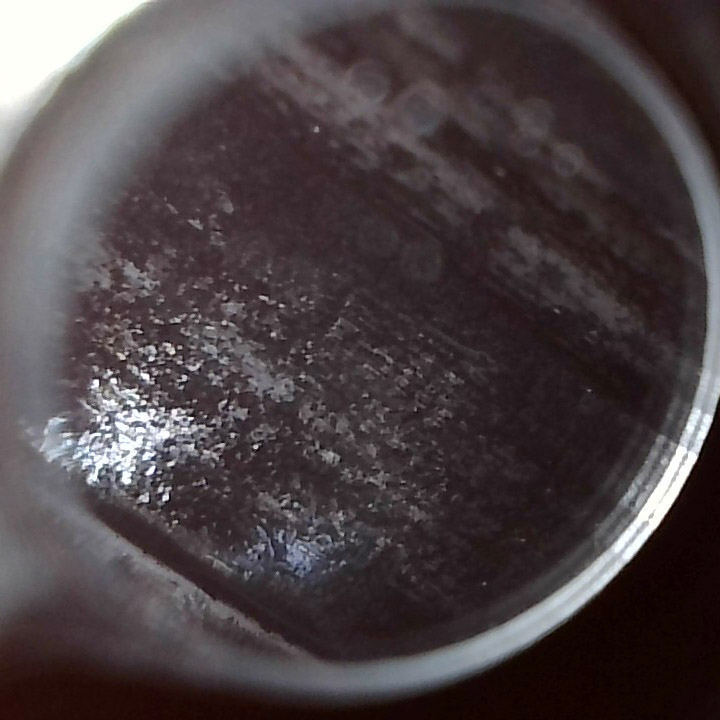
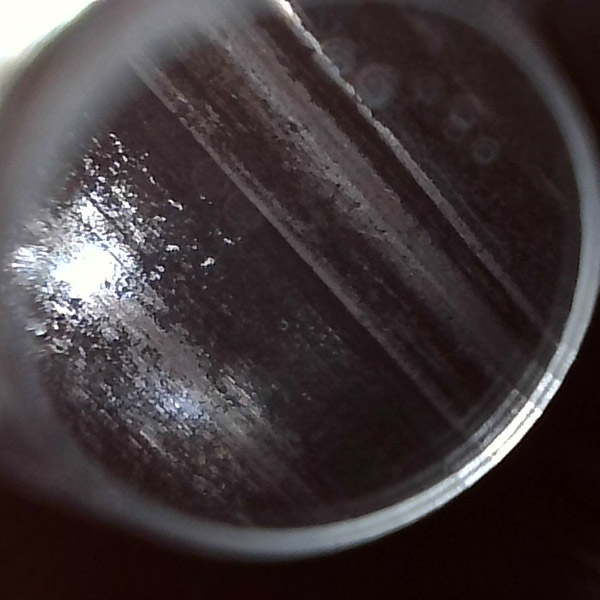
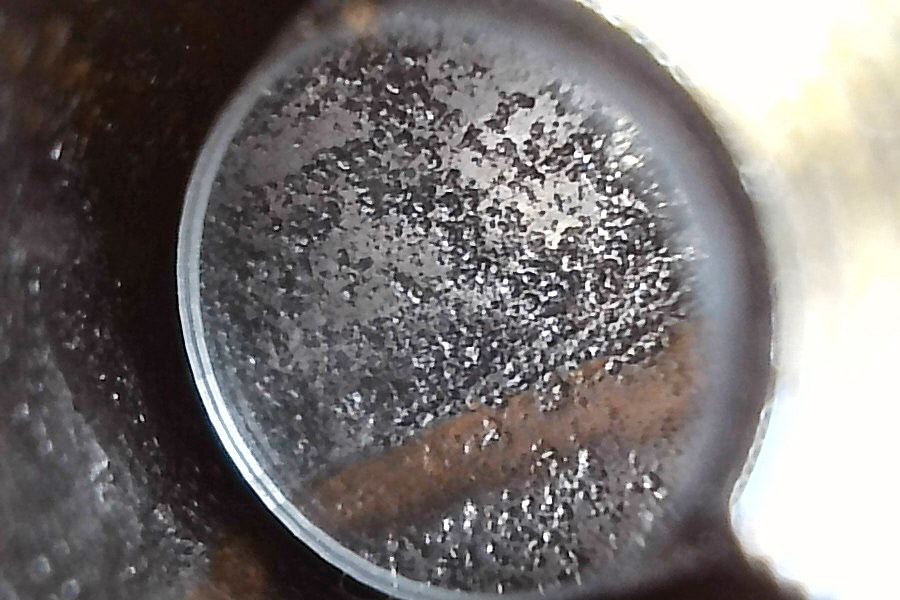
You might be wondering what the bore looks like on this rifle. I can show you:
There are some takeaways from the above photos:
The bore is better in some spots than in others.
When these rifles saw action in World War II (as this one probably did), the ammo used had corrosive primers. The effects of that are visible.
Even Mosin-Nagant rifles with funky bores can shoot well.
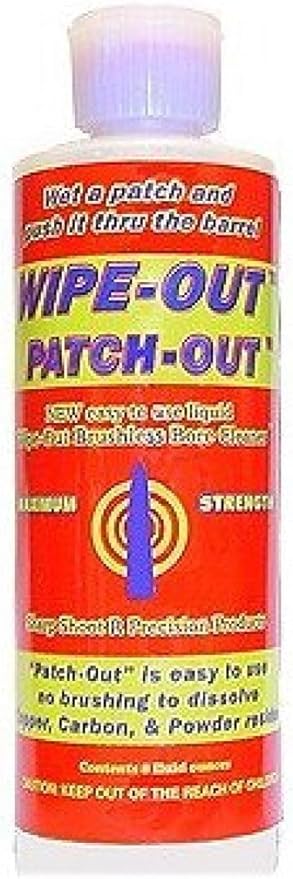
The bore cleaning copper fouling solvent I use, Patch-Out, does a good job. It works a lot better than Hoppes No. 9. You don’t see any copper in the photos above.
Incidentally, if you’ve never seen the movie Enemy at the Gates, it’s one of the best movies ever (in my opinion). The Mosin-Nagant rifle plays a starring role. The opening scenes are really well done. Take a look:
I’ve written a lot about the Mosin-Nagant 91/30 rifle. I love these old rifles. Here are my earlier posts:
I recently bought an 8-lb container of IMR 3031 on the theory that the time to buy something is when you see it, and I’ve been researching loads for various cartridges using that powder.
IMR 3031, and lots of it.
IMR 3031 doesn’t appear too often in modern reloading manuals, which struck me as odd because when I first started playing with things that go bang it seemed like 3031 was an almost universal propellant, good for whatever ails you. So I dug out some reloading manuals from the 1970s, and as I expected, 3031 showed up for a bunch of different cartridges. One of them is 7.62x54R, and I wanted to see if I could develop a decent load for my Mosin-Nagant. I should point out at this point that there’s nothing special about my 1940 Tula Mosin (other than the fact that it’s one of my favorite rifles). In fact, the barrel looks more like a sewer pipe than a precision shooting instrument.
My Mosin-Nagant’s bore. It ain’t pretty.
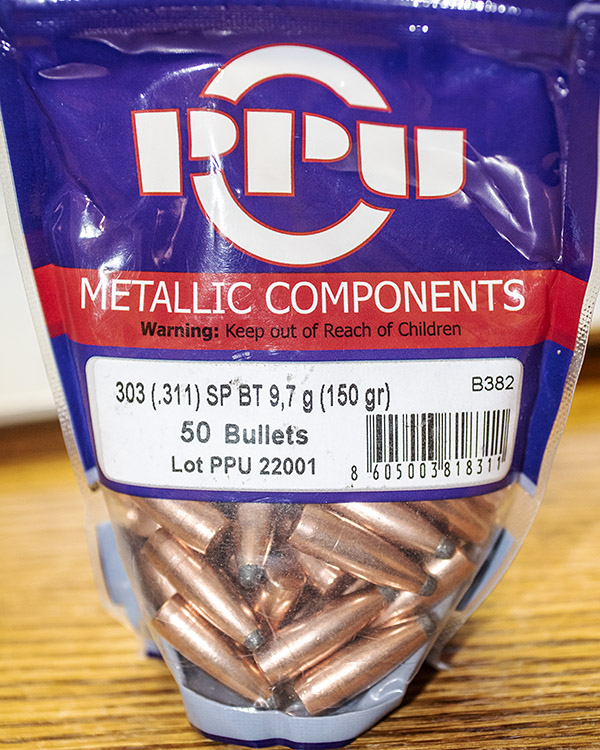
I loaded the ammo for this test series with the PPU Partizan 150-grain, 0.311-inch diameter, jacketed softpoint boattail bullet. These are relatively inexpensive bullets (they go for around $.30 each from Graf’s, which I guess is cheap by today’s standards). These bullets pop up for sale occasionally, and a while back I bought 500 of them.
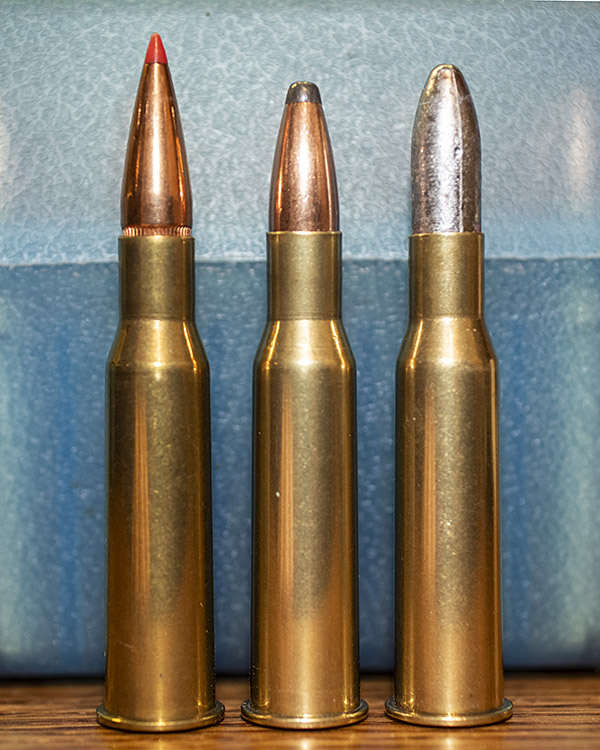
PPU bullets. They are relatively inexpensive. Sometimes they go on sale.Three different 7.62x54R reloads. From left to right, it’s the Hornady V-Max bullet, the PPU jacketed softpoint bullet, and a cast lead bullet. I shot only the PPU bullets for this blog.
My testing consisted of five different IMR 3031 loads to see how they performed at 100 yards. The drill was to fire 10 rounds each at charges of 39.0, 40.0, 41.0, 42.0, and 43.0 grains. I used PRVI Partizan brass and Winchester primers, and I seated the bullets for an overall cartridge length of 2.790 inches with no crimp. Here’s what I found:
The chrono and accuracry results. 42.0 grains of IMR 3031 seems to be the sweet spot.A 100-yard target group with the 42.0 grain IMR 3031 load.
The sweet spot appears to be right about 41.0 to 42.0 grains of IMR 3031 (the target above is with 42.0 grains). The standard deviation is smaller for the 42.0-grain load with the same group size, so that’s what I’m going with. Recoil was moderate with all loads; none of the loads showed any pressure signs. None of the above were compressed charges. The 43.0-grain load had a smaller standard deviation, but the group opened up and shifted to the left, so I’m going to call the 42.0-grain load good. It’s as good as the groups I was getting with IMR 4320, which had previously been my Mosin accuracy load.
Before any of you out there in the blogosphere get your shorts in a knot about using older reloading manuals, I realize the manual companies (and others who parrot them) advise against doing so. The theory is that the propellant formulations have changed and what the old manuals show as a safe load may not necessarily be so today. I get it. That’s why I start testing at the bottom of the range and work up, looking for pressure signs along the way. The current and the 2007 Hornady manuals do not list IMR 3031 for the 7.62x54R. The 1973 Hornady manual (the first one I ever bought when I was just getting started in this game) shows a max of 44.4 grains with a 150-grain bullet, which is why I stopped my initial testing at 43.0 grains. None of the loads I tested showed any pressure signs and recoil was moderate with all loads. I think the new manuals feature new powders because the powder companies pay for the manuals to include their newest stuff. I don’t think they do it because the powders are necessarily better. Maybe I’m wrong. I’m a cynical old fart.
I should point out that my findings are not rigorous for two reasons:
I’m not that good a shot, and
My eyes are not what they used to be. It’s getting increasingly more difficult to get the front sight in sharp focus (ah, to be 72 again…). I do the best I can.
But I’m still out there having fun, and that’s what important.
I’ve written a lot about the Mosin-Nagant 91/30 rifle. Here are my earlier posts:
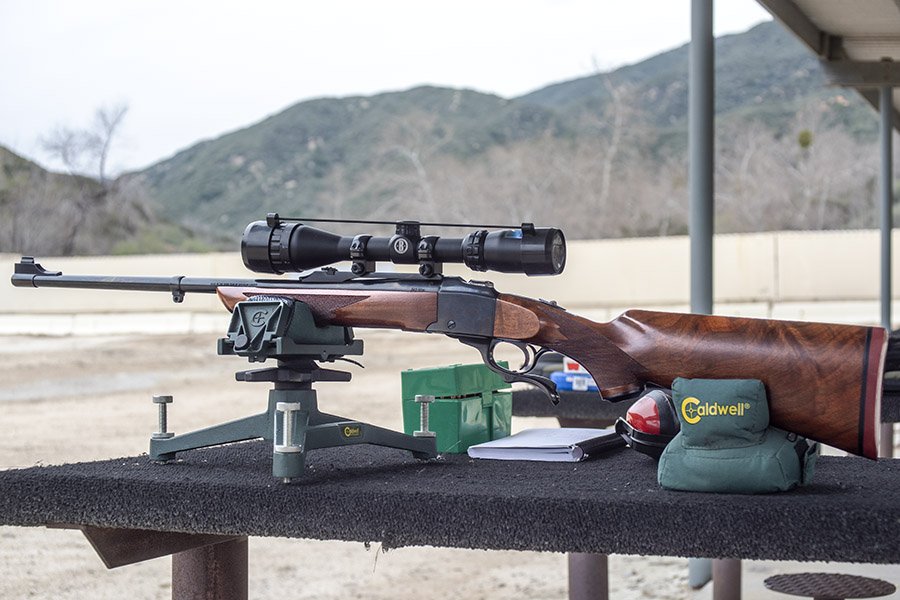
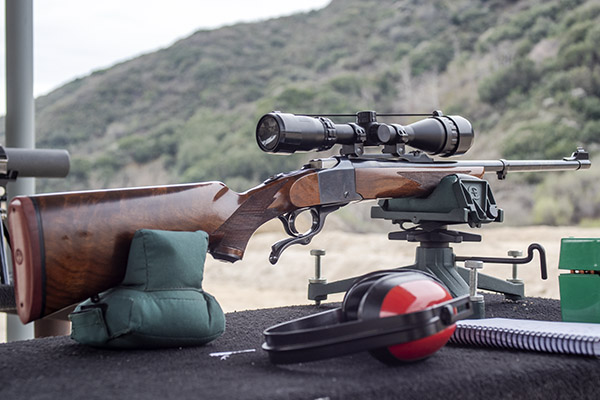
This story is about finding a decent load for my .243 200th Year Ruger No. 1 rifle. The rifle is 48 years old now, but the old girl can still get it on. I didn’t think my Ruger was particularly accurate at first, but wow, it’s a shooter.
Good wood, a good looking 200th Year Ruger No.1A, and a day on the range. Life is good.
I’ve tried a lot of loads in this rifle and I probably would have given up except for what I saw happen with another shooter. He had a .243 No. 1 in the 1B configuration (that’s the one with no iron sights, a 26-inch barrel, and a beavertail forearm), and he didn’t like it at all. To me, not liking a Ruger No. 1 is a crime against nature, but that guy was frustrated with his .243 and he had given up on it. He spent good money (Ruger No. 1 rifles sell for around $2,000 today) and it just seemed like a shame. When I first tried my .243 No. 1 it wasn’t very accurate, but I decided I wasn’t going to be that other guy. I was confident I could find a good load. Actually, I found three, and they are listed below by bullet weight. They are all of comparable accuracy in my rifle.
Accuracy Load No. 1
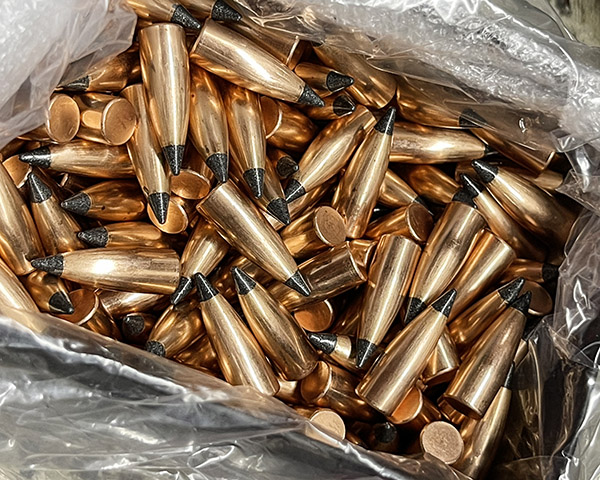
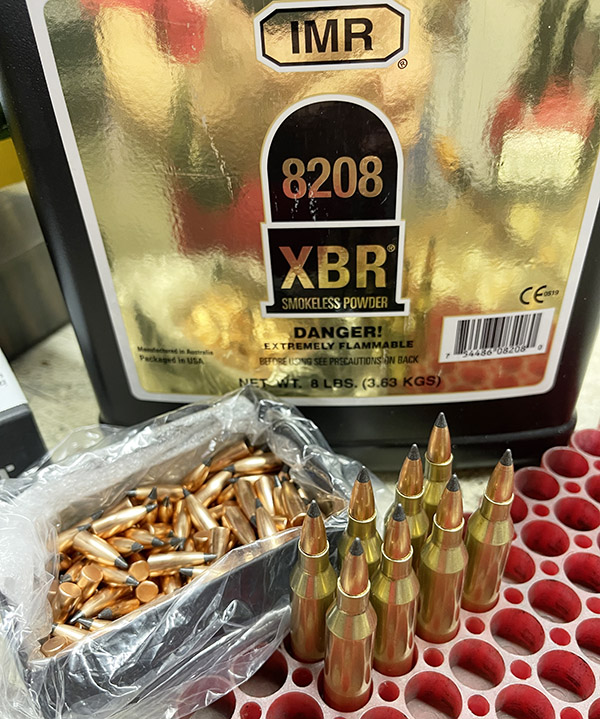
Nosler 55-grain .243 bullets. It’s the lightest bullet available for the .243.Bullets, loaded ammo, and XBR 8208 propellant.
My first accuracy load for this rifle is the 55-grain Nosler Varmegeddon flat base bullet with 40.0 grains of XBR 8208 propellant. I seated the bullets to a cartridge overall length of 2.606 inches without a crimp, but I haven’t experimented with bullet seating depth or crimping. I used Fiocchi large rifle primers because at the time, primers were scarce and I bought 1500 of the Fiocchis when I could.
Accuracy Load No. 2
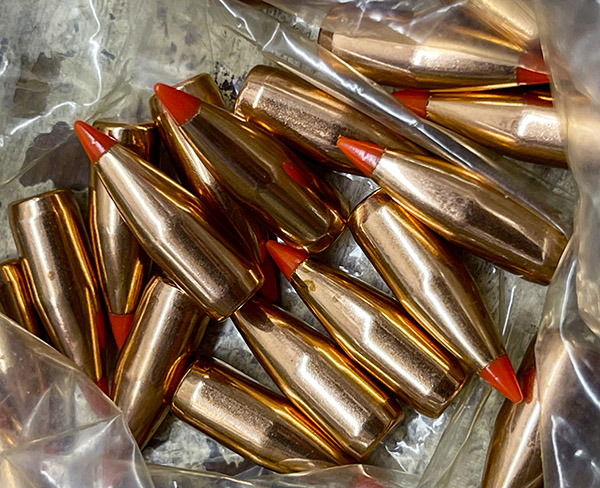
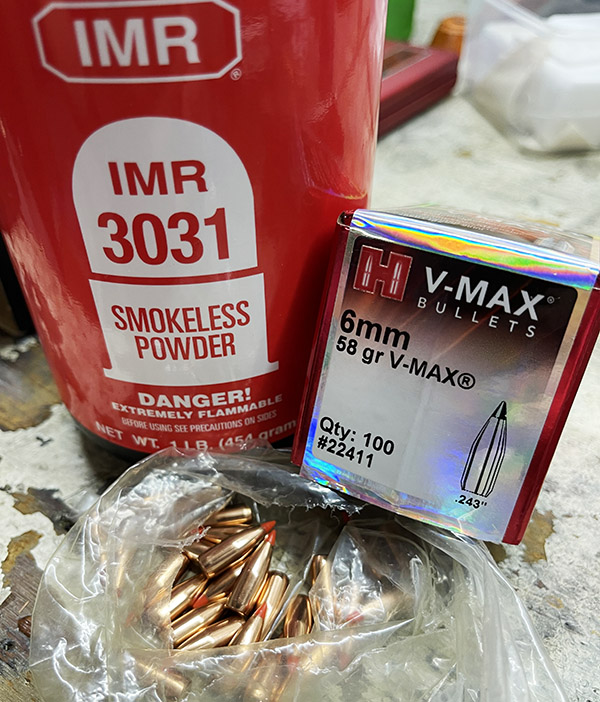
Hornady 58-grain VMax bullets. Hornady makes a good-looking bullet.I shot all the rounds I loaded with this bullet, so this picture will have to do.
Another excellent load is the 58-grain Hornady VMax bullet with 42.0 grains of IMR 3031 propellant. I ordinarily wouldn’t use IMR 3031 in the .243, but I had a tiny bit of it left from some development work on another cartridge and good buddy Kevin told me IMR 3031 was his powder of choice for the .243. It was a good recommendation. I set these rounds up with a cartridge overall length of 2.620 inches. Like the load above, I have not tried different seating depths or crimping.
Accuracy Load No. 3
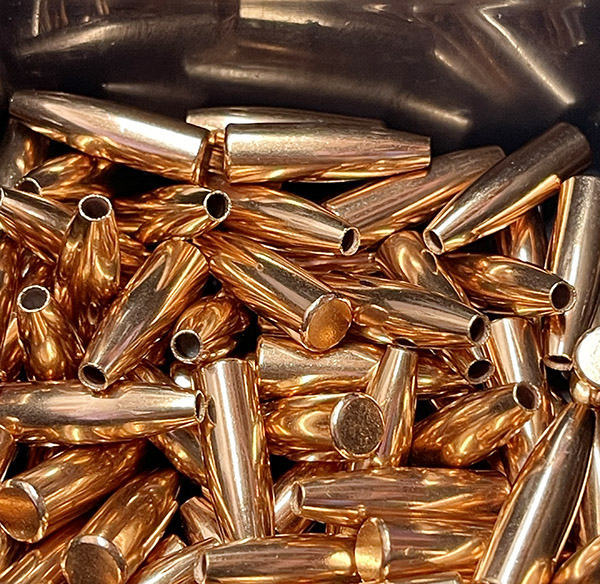
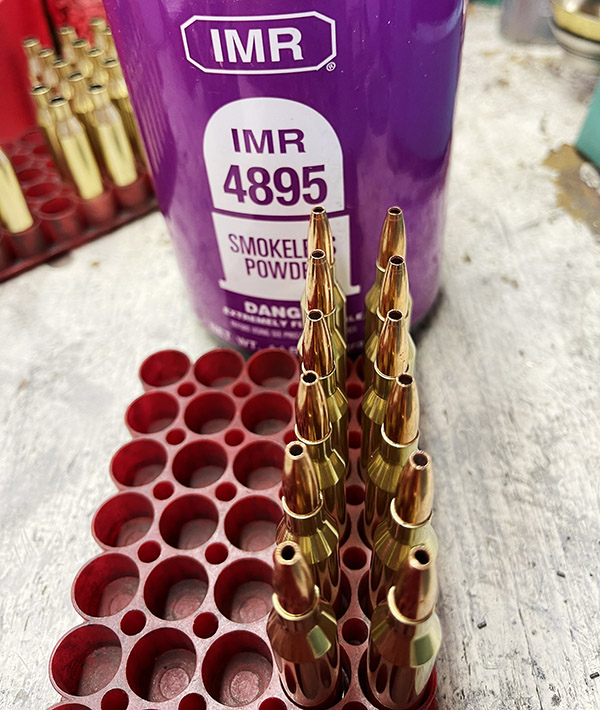
Cavernous hollowpoints in the 75-grain Speer varmint bullets. These shoot exceptionally well.I found IMR 4895 works well with the Speer 75-grain bullets.
My third accuracy load is the 75-grain Speer Varmint hollowpoint bullet with 39.0 grains of IMR 4895 propellant. I loaded this round to an overall length of 2.620 inches, and like the others above, I have not experimented with overall length or crimping.
What I Haven’t Tried and What Didn’t Work (for me)
I have a couple of boxes of 65-grain Hornady V-Max bullets and I’ve only tried them with a few powders. So far, nothing gave me acceptable accuracy with these bullets.
.243 ammo loaded with PRVI 100-grain bullets. I couldn’t find the secret sauce to make this bullet accurate. Hornady 100-grain bullets weren’t any better.
I also have a bunch of 100-grain bullets (from Hornady and PRVI). Neither of these 100-grain bullets grouped well. They stabilized (no target key holing), but the groups just weren’t very good. That’s okay; I’m not going to use the .243 on pigs or deer. But if I ever took it varmint hunting, the accuracy loads listed above would get the job done.
The Bottom Line
Typical results with the accuracy loads listed above.
Any of the above loads will shoot a three-shot group at or below 0.75 inches at 100 yards. The groups would be tighter with a more skilled rifleman. For me, getting the old .243 to group into three quarters of an inch is good enough. I’ll call it a day with load development on this rifle and stick with the loads above. On to the next rifle. Stay tuned.