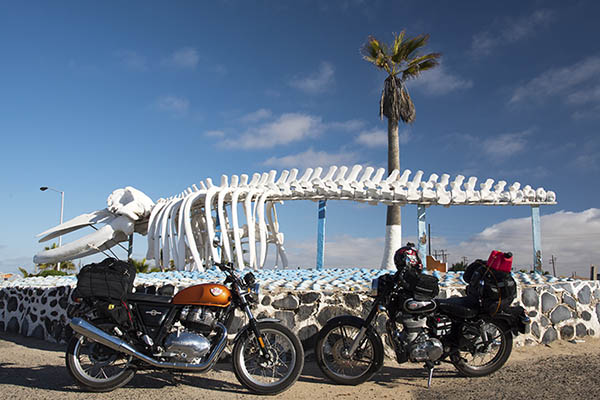
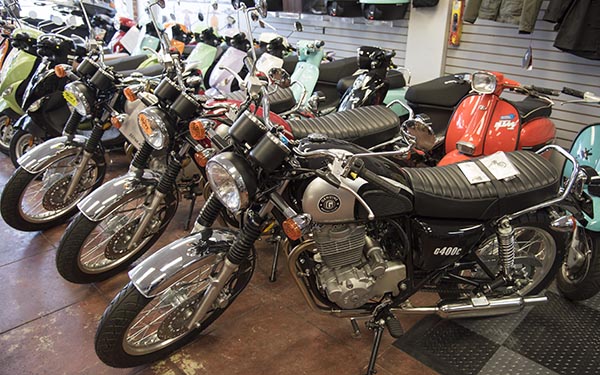
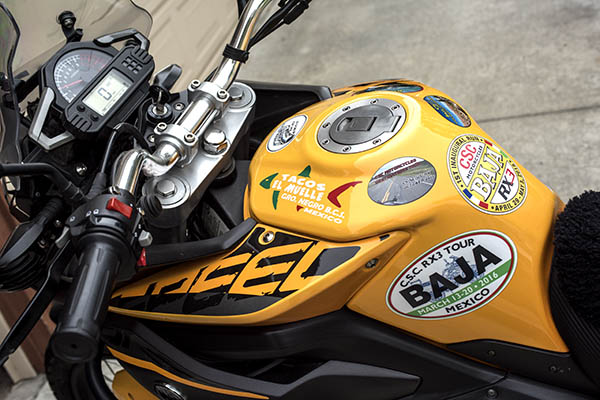
I thought it might make for a nice change of pace if I actually posted something about motorcycles on this here motorcycle blog, so yesterday I fired up my faithful old RX3 and rode over to CSC Motorcycles. Steve has a very cool 1982 Yamaha Seca that he said I could ride, and I wanted to experience what it’s like to ride a nearly-40-year-old motorcycle, built during the Reagan Administration, with only 1700 miles on the clock. I’ll have a story on that later (Spoiler Alert: The RX3 is a nicer motorcycle). For today, I grabbed a few photos of my RX3 and I wanted to talk about my bike and its decals a bit.
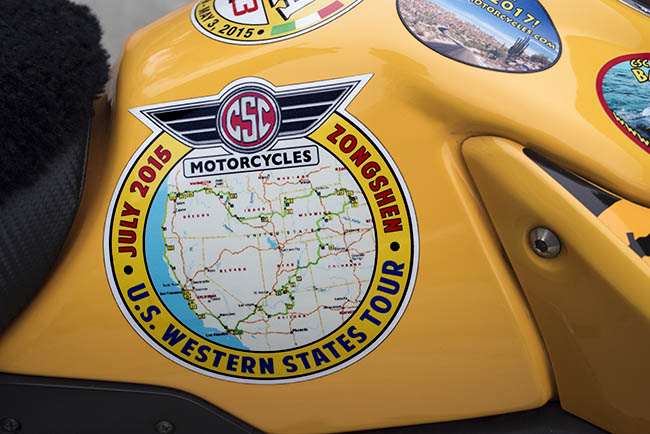
Restaurants, Baja Runs, and more…my RX3 wears its decals like campaign ribbons. In a very real sense, that’s exactly what they are.
My RX3 is one of the very first ones delivered to America when CSC starting importing the bikes, and the story behind that is well told (if I do say so myself) in 5000 Miles at 8000 RPM. It’s orange, which became sort of a nice orange-yellow over the years, and I like the look. I also like the look of a lot of decals. I always thought that was a cool aspect of the whole ADV thing, telling folks where you’ve been and (with the help of a little artwork and adhesive) bragging about it a bit. And my RX3 and I have covered a few miles.
My first big RX3 ride, and one of the things that I think put CSC and the RX3 on the map was the 2015 Baja Run (our first, and maybe a first in the motorcycle industry for a new bike introduction). I didn’t know how that would go, I was nervous as hell that the bikes wouldn’t fare well, but my fears were unfounded. It was an incredible ride. And, it was our first decal. That’s the big round one you see just above the my saddle in the photo above.
Next up: The Chinese and a couple of cool guys from Colombia wanted to come to the US and ride with us. And I got to meet a cool guy named Joe Gresh, who Motorcyclist magazine sent to ride with us. You need to read 5000 Miles At 5000 RPM to get the full story on that adventure tour, too. It was grand. Azusa to Mt. Rushmore in South Dakota, ride west across Wyoming, Idaho, and Washington, and then a turn left at the ocean to ride the western US coast back to So Cal. The relevant point here is that ride made for a bitchin’ decal, which you can see in the photo below.
The Western America Adventure Ride. It was grand. 5000 miles, lots of bikes, and not a single breakdown. Gresh staged a burnout with his RX3 in Port Orford, Oregon…the burnout heard around the world. John Welker planned our stops and navigated for us. It was a magnificent ride.
Then we did a bunch more CSC Baja rides, and with each one came another decal. Then I did a ride across China with Gresh on a couple of RX3s we borrowed from Zongshen (I wrote a book about that one, too). Then it was a ride around the Andes Mountains in Colombia with my good buddies Juan (who was on ride across America with us) and Carlos, both supercool guys who took great care of me in Medellin, Barichara, Mompos, and a whole bunch of other magnificent Colombian destinations. Yep, that resulted in yet another book.
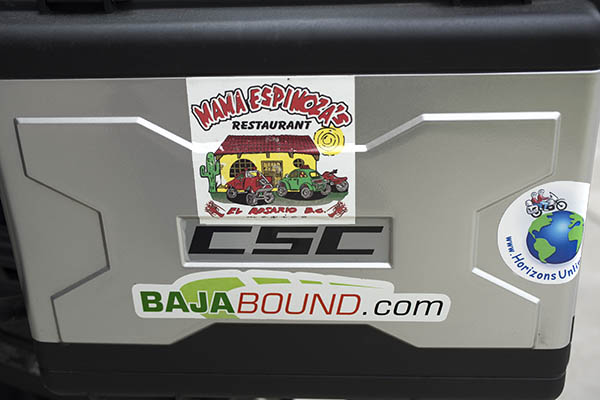
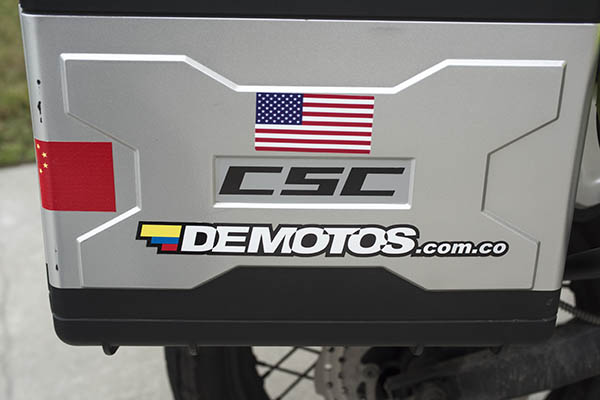
Luggage decals…Mama Espinoza’s in El Rosario (incredible lobster burritos), BajaBound Mexican insurance (the best), and the Horizons Unlimited Rally in northern California.My Chinese buddies gave me a Chinese flag to put on my bike, I had to add a US flag to show where my loyalties lie, and a decal good buddy Juan’s Colombian motorcycle magazine, DeMotos.com.co.
I could ask if you knew how many RX3 breakdowns I experienced in all those miles, but I know you already know the answer: Zero.
Yep, that little 250 has taken me to hell and back, and my RX3 just keeps running and running and running. An added benefit? Mine is orange (it’s the fastest color, Orlando).
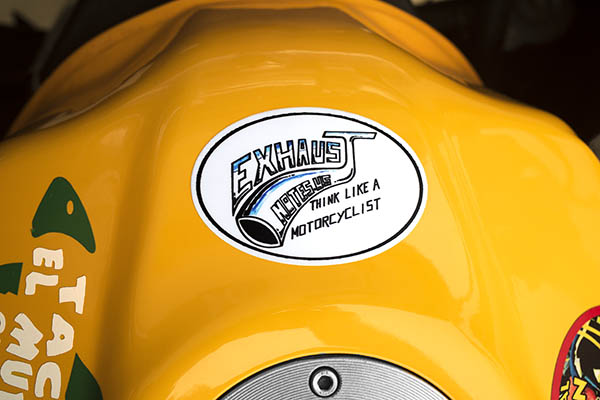
And that brings us to now, and the latest decal to adorn my well-broken-in, trusty, faithful and fearless companion. It’s the supercool ExhaustNotes.us decal, and it’s perfect on my RX3.
Joe Gresh had a magnificent idea in creating an ExhaustNotes.us decal. I had just enough real estate to add it to my RX3!
So there you have it. Imagine that: A motorcycle story on a motorcycle blog! And there’s more motorcycle stuff in the pipeline. Truth be told, I enjoyed my RX3 sprint this morning, and it helped me realize I need to ride it more. Welker called me about Sturgis a couple of says ago. That might be fun. If I go, I’d do it on the RX3. I’d forgotten just how magnificent a motorcycle the RX3 is.
Stay tuned, folks…there’s more coming!
Would you like your very own ExNotes decal? Hey, sign up for our automatic email updates, and we’ll shoot a couple out to you!
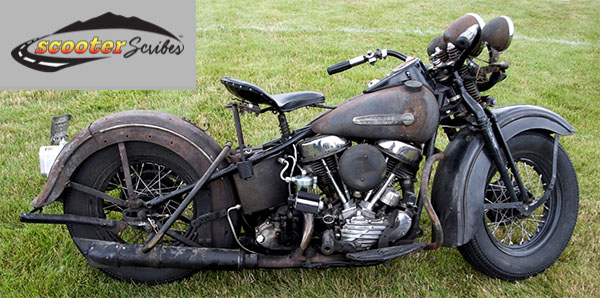
Ah, lots of good news and a few things to catch up on. For starters, I was alerted to another top notch motorcycle site, and that’s Terry Roorda’s ScooterScribes.news site. You’ll like it.
Terry is the former Thunder Press editor, and there’s lots of cool V-Twin stuff on ScooterScribes, and you don’t have to be a Big Twin dude or dudette to appreciate it. It’s good. Trust me.
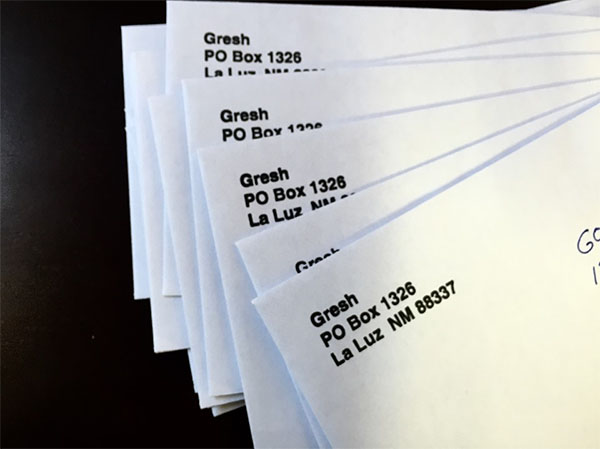
More good news…the ExNotes stickers are in, and the extensive Direct Mail arm of the ExNotes empire is busy sending them out.
We sent an email requesting your address if you signed up, so watch for it and shoot that info back to us. We promise that as soon as we get your snail mail address and confirmed that you’re on our email list, we’ll shoot them out to you as soon as we get around to it. Want to help us more? Hey, share our site and get more folks to sign up for our automatic emails, or just get them to visit www.ExhaustNotes.us. We think we’ve got a good thing going. Guns, motorcycles, scooters, opinions, dream bikes, resurrected bikes, books, articles, Baja, and lots, lots more. Let us know what you think by posting your comments here on the blog. We get all kinds of inputs. Folks want more on Harleys, they want less on Harleys, they want more political commentary (seriously?), they want less political commentary…hey, let us know. There’s no guarantee we’ll take any of it seriously, but you never know.
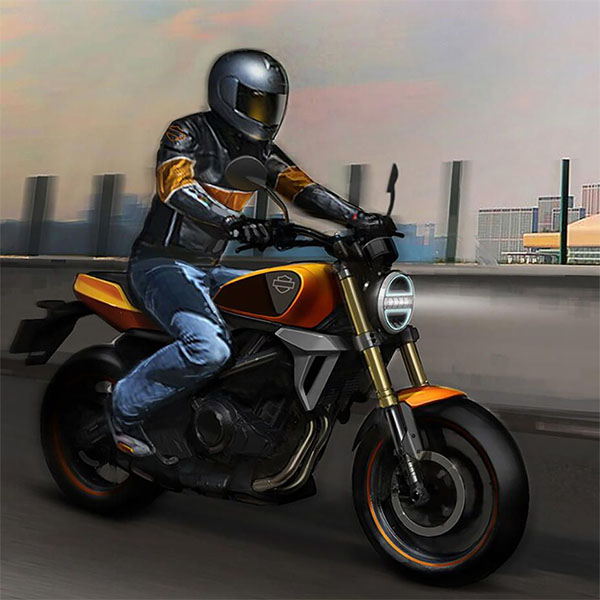
Yet more news…several online pubs are breaking the news that Harley is working with a Chinese company to offer a small HD.
Hey, we saw a Chinese manufacturer making parts for Harley a decade ago. But the recent news is this is going to be a complete small bike, just over 300cc. I’m surprised Harley didn’t do this several years ago, but then, Gresh and I were in the catbird’s seat on the small bike thing from the gitgo. CSC and Zongshen were way ahead of the curve on this one. Dollars to donuts says that the small Harley will find its way to the US, and that’s a good thing. I’ve seen the photos and I think it looks good. I’m waiting for the inevitable jokes and the anti-China rants to start, but Harley, if you’re reading this, ignore those folks. The only thing worse than a smartass is a dumbass, and anyone who criticizes a motorcycle based solely on its Chinese origin is most definitely in that latter category.
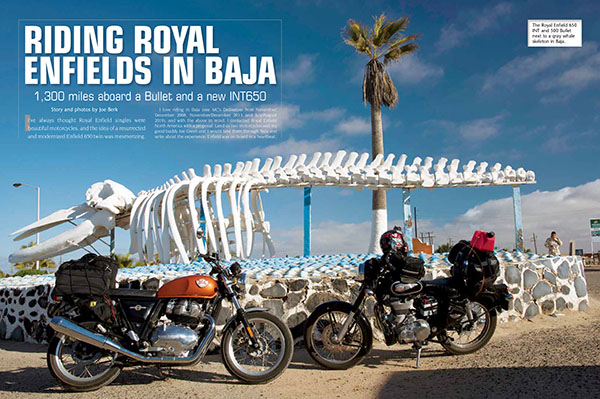
One last bit of news…make sure you pick up the latest issue of Motorcycle Classics magazine. It’s got my feature story on our Enfield Baja trip, and my Destinations piece on Tecate. Good stuff, Motorcycle Classics is.
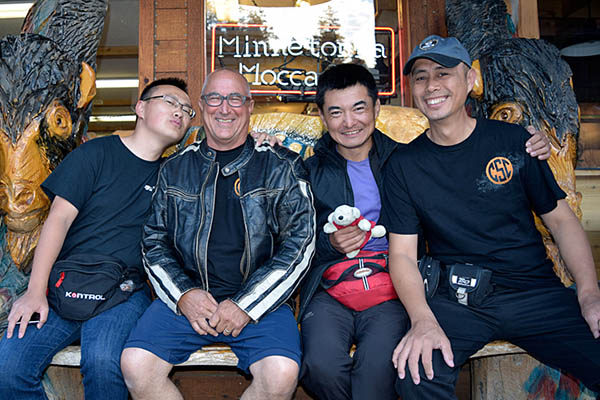
Hugo, Joe, Tony and Zuo near Mt. Rushmore, South Dakota.
My good buddy Joe Gresh is an astute observer of the human condition and he writes about it well. This is a piece he did after the 5,000-mile Western America Adventure Ride, when we rode 250cc Chinese motorcycles from LA to Sturgis to Portland and back to LA. We had about a dozen riders and not a single motorcycle breakdown. The bikes’ stellar performance notwithstanding, we sure caught flak on the Internet about riding Chinese bikes (and it was only on the Internet; no one we met in person had anything but compliments for us and the bikes). Joe wrote a column titled “Motoracism” in the now-defunct Motorcyclist magazine about that trip (along with an outstanding story about the ride). Joe’s adept at stirring the pot by telling the truth, and the keyboard commandos crawled out in droves from under their bridges when “Motoracism” was published. Here’s the original article. Take a look…
Motoracism and Brand-Bashing in the Moto World Are you offended by a Chinese-built bike?
Joe Gresh January 11, 2016
Look out! An army of strange bikes aimed at our heartland! Or is it just a line of motorcycles like any other, except this time they’re made in China?
We all suffer from racism’s influence. It’s an off-key loop playing from an early age, a low frequency rumble of dislike for the “other.” It’s ancient and tribal, a rotted pet forever scratching at the door because we keep tossing it scraps of our fear. Racism gives the weak succor and the strong an excuse for bad behavior. We work hard to become less racist, but exclusion is a powerful medicine.
Especially when it comes to motorcycles. Brand bashing is ancient, part of what motorcyclists do. It’s our way of hazing new riders and pointing out the absurdity of our own transportation choice. Unlike more virulent forms of racism, motoracism doesn’t prevent us from enjoying each other’s company or even becoming friends.
In web life, we are much less tolerant. Whenever I test a bike for Motorcyclist I spend time lurking on motorcycle forums. This is partly to gather owner-generated data, stuff I may miss in the short time I have with a testbike. Mostly I do it because it’s a way to rack up thousands of surrogate road test miles without having to actually ride the bike. Think of yourselves as unpaid interns slogging through the hard work of living with your motorcycle choice while I skim the cream of your observations into my Batdorf & Bronson coffee.
Every motorcycle brand has fans and detractors, and I enjoy the smack talk among riders. Check out the rekindled Indian/Harley-Davidson rivalry: They picked up right where they left off in 1953. Then there’s this Chinese-built Zongshen (CSC) RX3 I recently rode. Man, what a reaction that one got. Along with generally favorable opinions from Zong owners I saw lots of irrational anger over this motorcycle.
All because it was built in China.
To give the motoracists their due, until Zongshen came along Chinese-built bikes were pretty much crap. (I read that on the Internet.) Except for the Chinese-built bikes rebadged for the major manufacturers. I guess if you don’t know that your engine and suspension were built in China it won’t hurt you.
Mirroring traditional racism, the more successful the Chinese become at building motorcycles the more motoracists feel aggrieved. The modest goodness of the Zongshen has caused motoracists to redirect their ire at US/China trade relations, our looming military conflict in the South China Sea, and working conditions on the Chinese mainland.
Like Japanese motorcycles in the 1960s, buying a Chinese motorcycle today reflects poorly on your patriotism. You’ll be accused of condoning child slavery or helping to sling shovelfuls of kittens into the furnaces of sinister ChiCom factories. Participate in a Zongshen forum discussion long enough and someone inevitably asks why you hate America. I’ve had Facebook friends tell me I shouldn’t post information about the Zongshen—that I must be on their payroll. I’m just testing a bike, man. This reaction doesn’t happen with any other brand and they all pay me the same amount: zilch.
So if you’re angry about working conditions in a Chinese motorcycle factory, but not about similar conditions in a USA-based Amazon fulfillment warehouse (selling mostly Chinese products) you might be a motoracist. If you type moral outrage on your Chinese-built computer complaining about China’s poor quality control while sitting in your Chinese-built chair and answering your Chinese-built cell phone you might be a motoracist. If you’re outraged that the Zongshen 250 can’t match the performance of a motorcycle five times its displacement and five times its cost you might be a motoracist. I want you to take a thoughtful moment and ask yourself if your motoracism isn’t just plain old racism hiding behind mechanical toys. If it is, stop doing it, and let’s get back to bashing other motorcycles for the right reasons: the goofy jerks who ride them.
Good stuff, and great writing. If you’d like to read Joe’s piece about the ride, just click here. And if you’d like to know more about the RX3 motorcycles we rode on our ride through the American West, just click here.
This has been a busy week, and lots of good things are happening. We’re having rain all over, and even thunder, lightning, and hail, but things are happening!
For starters, our good buddies at Janus Motorcycles made the New York Times in yesterday’s edition. You can read the story here. Folks, from a public relations perspective, it just doesn’t get any better than getting a story in the New York Times. It’s a tremendous accomplishment, especially when considered in light of the fact that the story spoke so very well of Janus and their team. I enjoyed the Baja ride with Devin and Jordan tremendously, and it’s good to see these guys doing well. Wow. The New York Times. I am impressed!
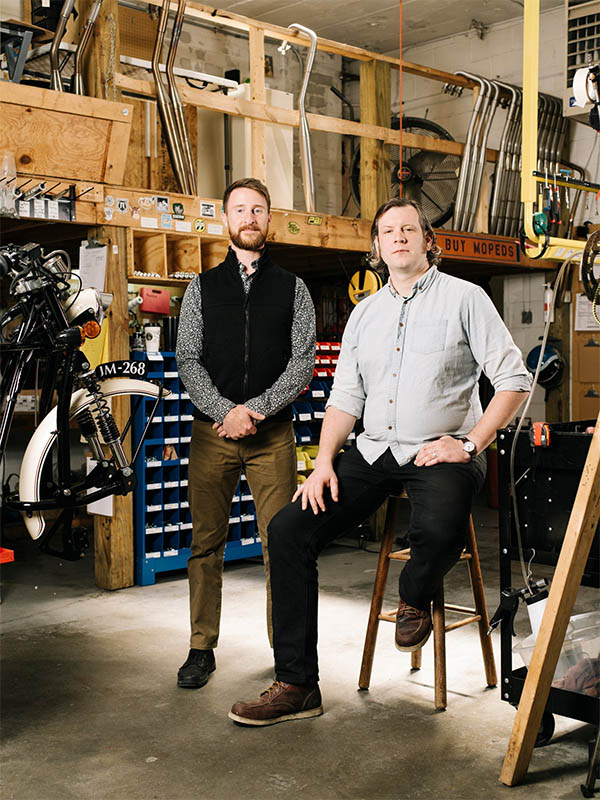
Devin Biek and Richard Worsham, the Janus founders. I rode Baja with Devin. Richard rode a Janus across the United States.
Next up: The CSC guys are in the middle of their Moab get-together, and following the photos on Facebook, it looks like they are having a hell of a good time. Good for them! CSC does more rides with their customers than any motorcycle company I know, and that’s a good thing. They’re out there offering test rides on the new San Gabriel and the RX4, too. Cool stuff.
And a few more developments…we’ve now got a page indexing our more memorable adventure rides, and it’s appropriately titled Epic Motorcycle Rides. Click on the link to take a look. We’ve covered past rides on the ExNotes blog, and this new page provides a convenient index to all our rides in one easy spot. The Janus run, the Enfield run, the Three Flags Classic, the 150cc Mustang run down to Cabo, motorcycle racing in Baja, videos from the different rides, and more. It’s all on Epic Motorcycle Rides!
We’ve got a lot of new stuff coming your way, folks. I’ve been playing with some cast bullet loads in the 1903 Springfield and we’ll have a piece on it soon. We’ve got more motorcycle stories queued up, including one about running the KLRs through Baja. We’ve got two new Facebook groups launched…one is the Crappy Old Motorcycle Association (or COMA, for short), and the other is Guns and Ammo, each with a focus on just what their names imply. And of course, we have our Facebook ExhaustNotes page. We’d like you to sign up on all three…hey, we all could use more Facebook in our lives!
One more thing…please consider signing up for the blog’s email updates. You might win a copy of Destinations at the end of this quarter if you do!
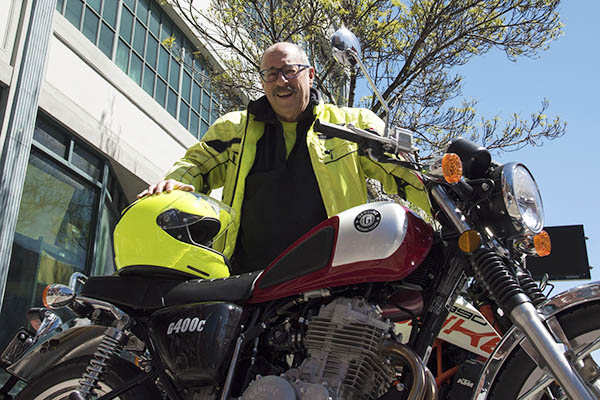
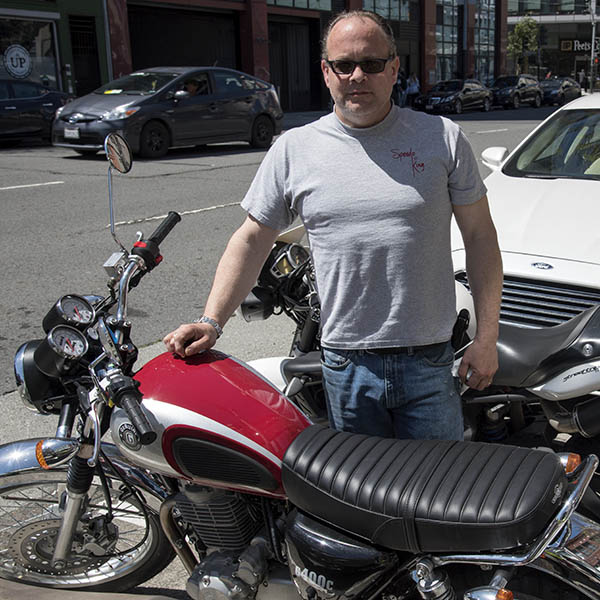
Yours truly and the Genuine G400c, patrolling the mean streets of San Francisco!
This is one of those blogs for which I could have used any of several titles. The Real Deal got the nod, as this is indeed the real deal…a genuine (pardon the pun) motorcycle. Another contender was The Streets of San Francisco, like that Karl Malden and Michael Douglas show 30 years ago. And yet another was We Are Living In Interesting Times (read on, and you’ll see what I mean).
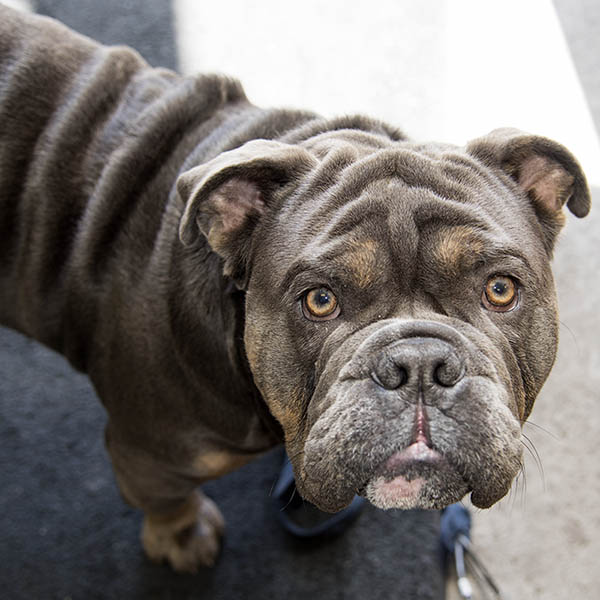
Anyway, enough of the trip down memory lane and alternative blog titles. I made a few memories of my own yesterday, riding around downtown San Francisco around good buddy Lunchbox’s San Francisco Scooter Centre. Barry is the guy who owns and runs the dealership, but Lunchbox is the guy in charge. He’s about a year old now (I’ve known him since he was a pup), and he’s a cool 82 lbs. After checking in with Lunchbox, I visited with Barry for a bit. I always like coming up here. I like Lunchbox, I like the city, I like the San Francisco Scooter Centre, and I like Barry.
Lunchbox, the man in charge. He’s cool. He lets Barry think he’s the guy running the San Francisco Scooter Centre, but Lunchbox is the one really calling the shots.Good buddy Barry and the Genuine G400c motorcycle.
Barry and I had a great taco lunch downtown, we talked about the motorcycle market, and we swapped stories about a couple of our other common interests. Then it was time to get on the G400c. Barry tossed me the keys and the bike’s registration, and told me to have fun. Being a guy who aims to please, I did as I was told. It was easy on the Genuine.
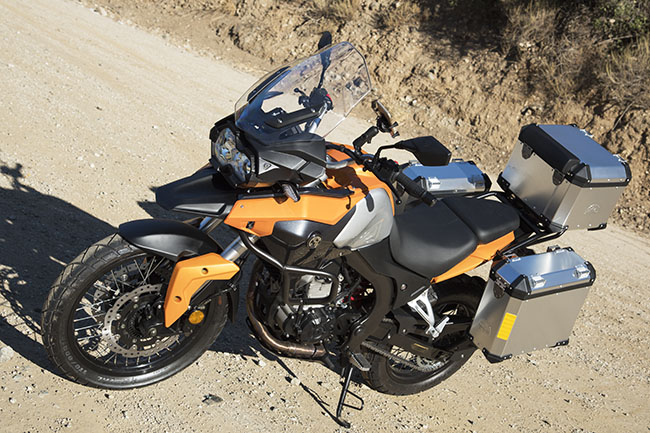
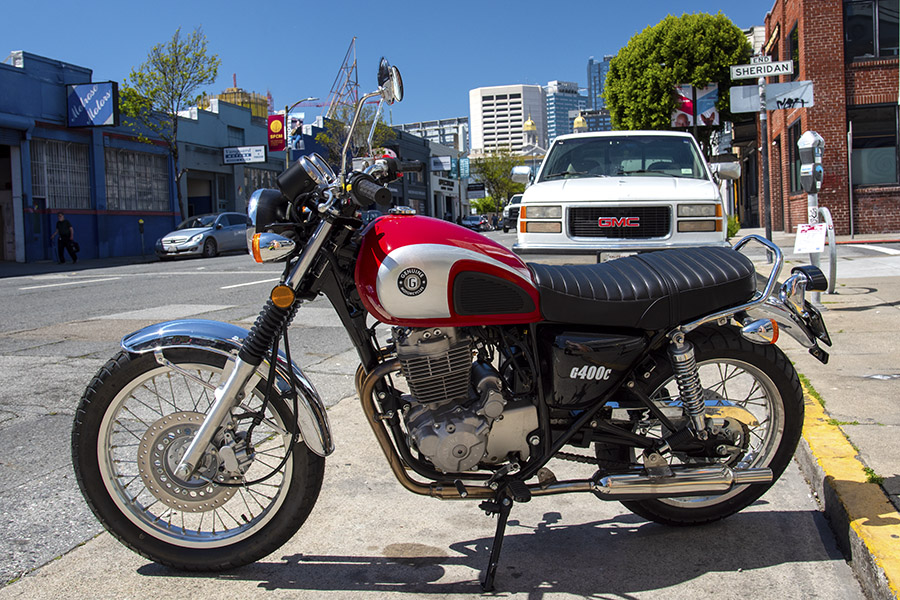
So let me tell you about the Genuine G400c. The first thing I noticed was that it’s a motorcycle. A real motorcycle. Tear drop gas tank (where the gas actually goes), a tach and speedo that look like a tach and speedo should, and a long, low, flat seat (good for moving around on when necessary, carrying a passenger, and strapping on soft luggage for longer trips). Wire wheels. Chrome fenders. Chrome handlebars that put the controls in comfortable reach. It all came together the way it should. Yessiree, this is a motorcycle that is visually appealing. None of that Ricky Racer, low bar face on the tank, angry Ninja insect, or giraffesque ADV wannabe silliness or styling. This is a motorcycle that looks like a motorcycle should.
The next thing I noticed was that the G400c was easy to throw a leg over. It’s been a while since I’ve been on a bike where I could say that. I’ll say more on this in a bit.
And another thing I noticed was that the bike sounds like a motorcycle. A real motorcycle. A Genuine motorcycle. I like that, too. I had my big Nikon with me (the D810) and I grabbed a video of the startup sequence…
This bike sounds good. It has a nice, deep, throaty rumble. The skyscrapers I darted between in downtown San Francisco amplified the exhaust note, and the reverberations were intoxicating. There’s something undeniably cool about riding a nimble, throaty motorcycle in a city. It would have been cool to grab more video of myself riding around San Francisco, but I’m not as talented as Joe Gresh in that regard and besides, I was having too much fun. You can have a great ride or you can make a great video. Unless you’re Joe Gresh, you can’t do both at the same time.
So back to that nimble thing. You’re reading something written by a guy who thinks that somewhere in the 1970s and the 1980s the wheels came off the wagon here in the US with regard to motorcycle size and complexity, and until very recently, things have continued to get nuttier as the years have gone by and advertising guys (who are supposed to be creative people) kept defaulting to bigger has to be better. My thoughts are in synch with most of the rest of the motorcycle world (not the aforementioned advertising gurus) in that I think a 250cc is the perfect size. A 400cc single is even better, especially if it comes in a 250cc-sized package, and that’s what the G400c is.
I don’t know the Genuine’s weight. I could find it in a few seconds with a Google search, but I don’t need to. I know what I need to know from my ride, and that’s this: The G400c is light and it’s nimble, and that’s all the spec I need. Hell, you can’t trust what most of the manufacturers tell you about their bikes’ weights, anyway. And even if you could believe their numbers, what really matters is where a bike’s center of gravity is located. Make it too high, and a motorcycle will feel unwieldy regardless of its weight. Make it low, though, and a bike becomes flickable, agile, nimble, and just plain fun to ride. That’s what this machine is. I had fun splitting lanes and braaapping around downtown San Francisco. The G400c is perfect for that, but that’s not the only arena in which I see it excelling. I think the G400c would be a great bike for a Baja ride, too. Someday. We’ll see.
Next up: Seat height. It’s the same story here, folks. Like I said earlier, I could throw my leg over the seat without having to take a yoga class or do any stretching exercises, and you know what? That’s a good feeling. The saddle is low enough to make getting on and off the bike easy, and that’s decidedly not the case for a lot of motorcycles these days.
You might ask about suspension travel. When I was younger and dumber, I used to pour over the spec sheets you’d see in the motorcycle magazines, and then I realized that unless you plan to ride motocross, the only thing a ton of suspension travel does for a street bike is make thing way too tall. The G400c seat height was just where I needed it to be. And on that suspension travel topic, I’ll let you in on a little secret: Even though our taxes in California (and San Francisco in particular) are among the highest in the world, we still have lousy streets with lots of potholes and rough sections. The G400c was fine being flung around in the city, sloppy streets and road surfaces notwithstanding. It soaked it all up without a whimper. I’d like to buttonhole our politicians someday and ask them: Exactly where does all that tax money go? In the meantime, though, I know the suspension on the G400c gets the job done.
Mean streets? Bring ’em on. The G400c was just plain fun riding around San Francisco. It’s a comfortable, right-sized motorcycle.
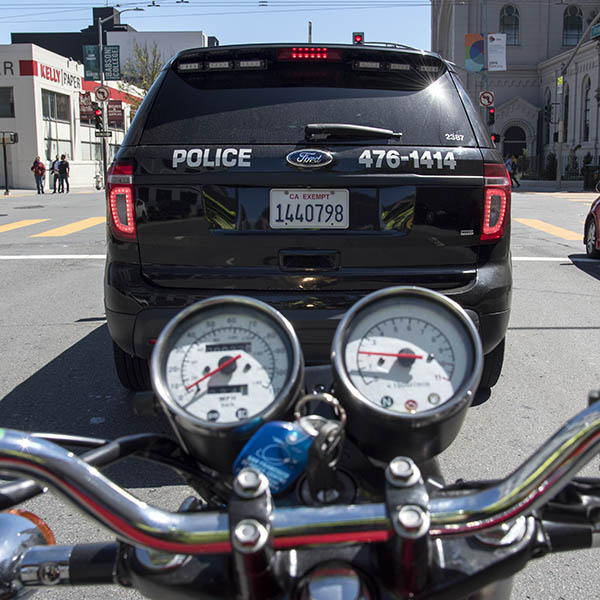
I didn’t take the G400c on the freeway, although Barry invited me to do so. Nope, the freeways are typically a mess in San Francisco, and I figured (correctly, as I experienced on the drive out of San Francisco later in the day) I could actually get more miles in and reach higher top speeds on the city streets. And I did. Until this guy you see in the photo caught up with me, lit me up, and started casting dirty looks my way. Then he got in front of me. Point taken, Officer. I rode a bit more like a normal person after that.
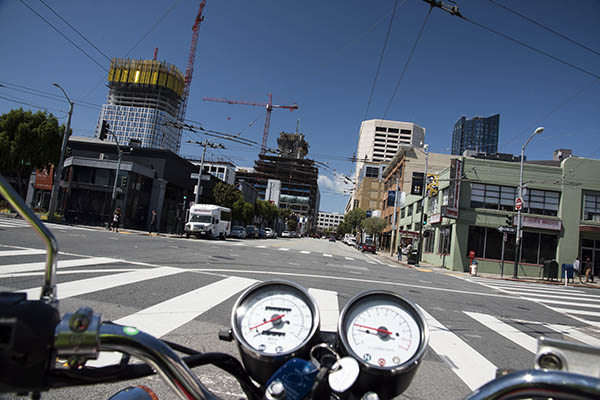
Another view from the cockpit. I like the instrument layout. It’s what a motorcycle is supposed to look like.
Okay, let’s not ignore the 800-lb gorilla in the room: The G400c is manufactured in China. As many of you know, I know a little bit about Chinese motorcycles and I played a tangential role in making the case for Chinese quality when CSC Motorcycles started importing the Zongshen RX3 back in 2015. You might have trepidations about buying a Chinese motorcycle, and it’s almost a certainty you know people who badmouth Chinese products. My advice when you hear the inevitable anti-China mush is to remember that God loves stupid people (because He sure made a lot of them). Yeah, they’ve got their stories about their buddy who worked at a dealer 10 years ago and he told them…well, you get the idea. Folks, these people just don’t know.
I know a little bit about this topic, I think. Maybe more than most of the weenies posting opinions on Facebook and the motorcycle forums.
My advice is to blow these weenies off, get yourself to a dealer, and see for yourself. I know a little bit about quality and manufacturing, I’ve been in several Chinese manufacturing plants, and I’m here to tell you that Chinese motorcycle quality is as good as or better than anything that’s out there. Consider this: Automobile and motorcycle companies like BMW, Vespa, Honda, Suzuki, and many others have components, major subassemblies, engines, and complete motorcycles manufactured in China. These world-class companies wouldn’t be doing that if the quality was low.
You might have a concern about the G400c being a new bike, that is to say, one that doesn’t have a track record. Actually, that’s not the case. This motorcycle has been rolling around China for a good three years now (I saw them when I rode across China on the RX3 a few years ago). The G400c is manufactured for Genuine by Shineray (it’s pronounced Shin-yu-way), and in China, they have been selling two versions of the bike for several years (a street version and an adventure-touring-styled version). The riding in China is way tougher than it is here. We tend to use our motorcycles as toys. In China, motorcycles are work horses. They are ridden hard and put away wet.
Another thing that’s nice about the G400c motor is that it’s a Honda clone. The concept (but not the engine) here is the same as the Honda CG clone motors that power the CSC and Janus bikes…an engine based on a Honda design built for an environment where folks don’t take care of their bikes. It’s a different Honda motor design, but it’s a proven design. It’s a strong, torquey, fuel injected single.
The G400c’s braking is good. It’s a single disk in front, and a drum in the rear. A lot of folks will be grasping their chest and convulsing at the thought of a drum brake in back, but it works, and it works for me. Again, don’t let some kid writing a magazine article (or worse, someone posting an opinion on Facebook) tell you that you have to have a disk brake in back. Drum brakes have worked fine for decades. It’s one of the things keeping the cost down on this bike, and it’s a reasonable tradeoff. Like it said, it works for me.
What I don’t know yet is the parts availability question, nor do I know about the availability of a shop manual. Those are fair questions to ask a dealer. I didn’t, mostly because I was focused on the riding.
Genuine states the top speed is over 80 mph. I’ve ridden bikes with the same engine in China and I saw indicated speeds on city streets over 90 mph and the bike still had more left (and at that point I thought to myself “Whoa, Bucko…what am I doing here?”). I think the top end is more than adequate for any real world needs. And on that note, this is another area in which you hear the keyboard commandos espouse things like “Ah need a bike made in ‘Merica that can do at least a hunnert twenty miles per hour or I’ll get run over…” You do, huh? Hey, I rode across China, I’ve been up and down Baja a bunch of times, I circumnavigated the Andes Mountains in Colombia, and I’ve ridden all over the US. And I did all of this on 250cc motorcycles. Motorcycles made in China, to be specific. But what do I know?
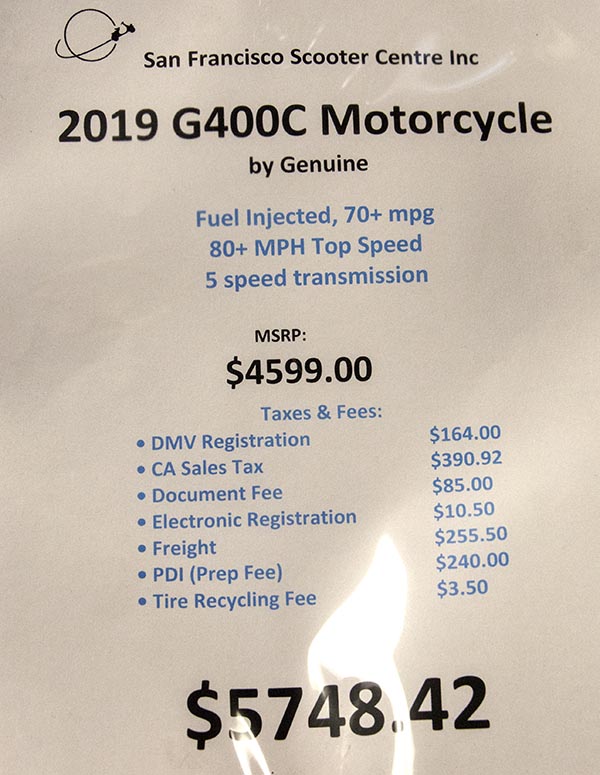
You might ask: Are there any negatives? I guess to play magazine road test writer I have to find something, and on the G400c it might be that some of the details could be more finely finished. Maybe the handlebar switchgear castings could be polished a little more, things like that. Barry told me the bike I rode is one of the very earliest ones to arrive in America, and that Genuine is sweating the cosmetic details like this. But these are minor points. The next question would be: Would I recommend buying this bike? To that question, the answer is yes. They retail at about $4600, and with all the fees they go out the door at a notch above $5700. Barry is one of the few honest dealers I know in that he doesn’t treat setup and freight as a major profit center. Here’s how he has the bikes priced…
The G400c pricing sheet at the San Francisco Scooter Centre. Freight and setup are honest numbers here, which isn’t the case at many other dealers.
We are living in interesting times. Just a few years ago the small motorcycle landscape in the US was pretty barren, and what few bikes were out there carried stupid-high prices and obscene dealer freight and setup fees. Our choices in recent decades have been outrageously tall, fat, and heavy motorcycles with prices in the stratosphere. Today, the moto menu before us is interesting and intriguing, and it’s rooted in the real world. There’s the CSC Motorcycles line with several 250cc selections and soon, the 450cc RX4. There the Janus line of magnificently-handcrafted contemporary classics. There’s Royal Enfield, with their 400cc Himalayan, 500cc Classic, and soon-to-be-released 650cc Interceptor (at an incredible $5795). I’ve ridden nearly all of these motorcycles (I haven’t caught a ride on the Himalayan yet, but that’s coming up), and I’ve ridden many of them through Baja (you can read about our Enfield Baja trip, the Janus Baja trip, and any of several CSC Baja trips). And now, there’s another great bike in the mix: The Genuine 400c. For the first time in a long time, we have choices. Good choices that won’t break the bank. Life is good, folks.
Check out our related Genuine G400c and San Francisco Scooter Centre posts!
I was up in San Francisco a week or so ago and I stopped by good buddy Barry’s San Francisco Scooter Centre for two reasons: To say hello to Barry, and to check out the new Genuine G400c motorcycle. It’s the bike manufactured by Shineray (in Chongqing, China), and I had seen two versions of it when I rode across China on an RX3 nearly three years go.
Brand new Genuine G400c motorcycles in good buddy Barry’s San Francisco Scooter Centre.The new Genuine’s pricing in the San Francisco Scooter Centre. Like other Asian and Indian bikes from Royal Enfield, CSC, and BMW, the price is seriously lower than others on the market from the Big 4 and Europe. Unlike many other dealers, the San Francisco Scooter Centre’s setup, documentation, and freight charges are honest and reasonable.
I didn’t have the time or the gear to ride the Genuine G400c last week, but Barry said he wants me to try the new machine and he offered a ride. I’m going to do that later this month, and I’ll tell you more about the bike when I do.
The products available to us as motorcyclists sure are changing, and there’s no doubt the imports from China and India are rocking our world. Gresh and I have a bit of experience on Zongshen’s RX3, RX4, and TT250 (made in China and imported by CSC). I’ve had some seat time on the new BMW 310 made in India. Joe and I recently completed a week-long adventure in Baja riding the Royal Enfield 500cc Bullet and their new 650cc Interceptor (both made in India). I don’t have any time yet on Harley’s 500cc and 750cc v-twin cruisers (also made in India), but I’m working on correcting that character flaw. There’s an old proverb that says “may you live in interesting times.” We certainly are.
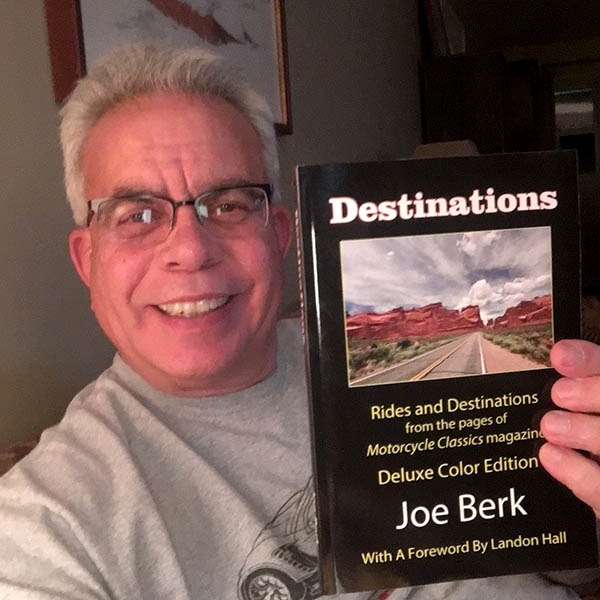
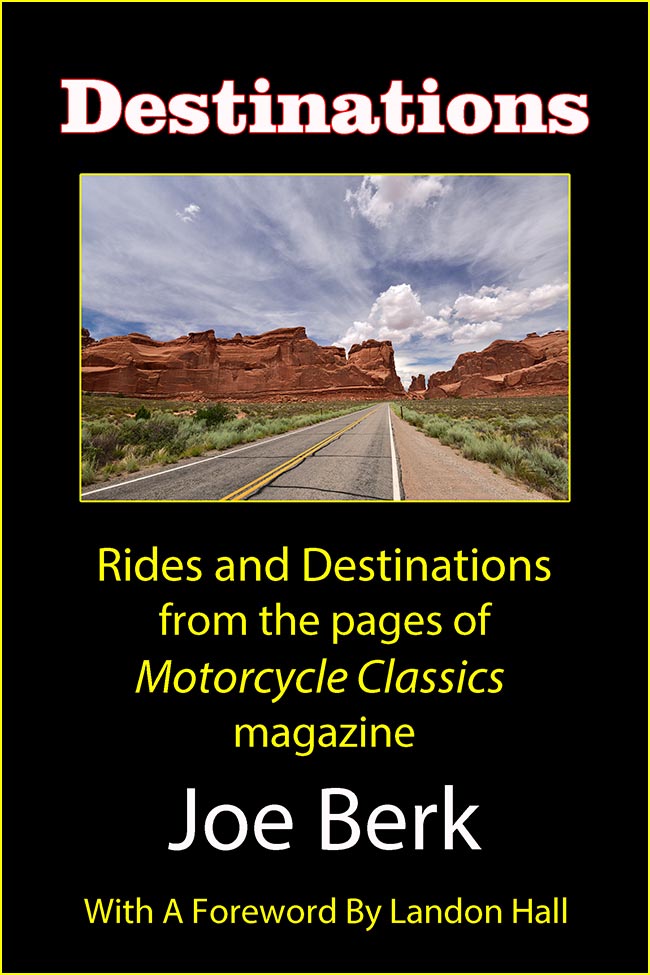
Hey, more good news: I finally received my printed copies of Destinations, and my story on Kitt Peak National Observatory is in the next issue of Motorcycle Classics magazine. You can see all of theDestinations pieces (and get your very own copy) right here. Good buddy Mike did. Mike and I graduated junior high school and high school together back in the day (as in 50 years ago), and we still talk to each other a couple of times each month. Good friends and good times!
Good buddy Mike, who knows a good thing when he sees it!
Good buddy Bob, our most recent adventure moto book contest winner!
It’s that time again, and our first quarter 2019 adventure motorcycle book contest winner is good buddy Bob. Bob became eligible when he signed up for our automatic email blog updates, and you can, too! We’re giving away another book at the end of this quarter, and all you have to do is sign up for our automatic email updates.
When we notified Bob of his win, he wrote to us…
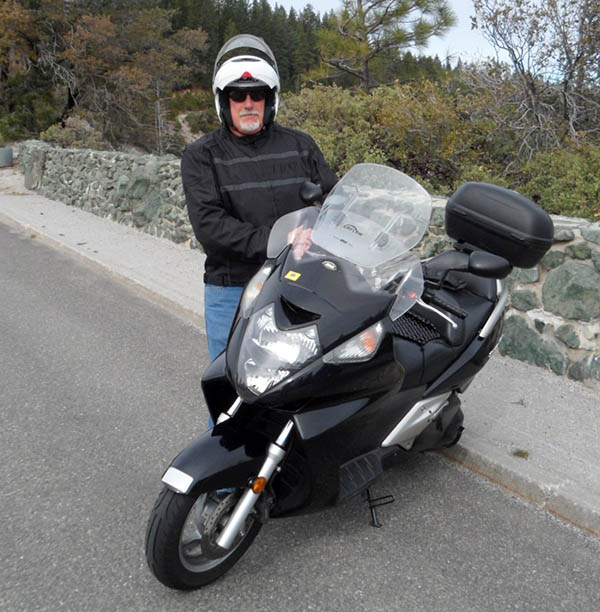
I like your approach with the Zongshens…1200cc is not required for touring. My touring machine is shown in the photo: A 2002 Honda Silverwing scooter. I sold it with 35K showing on the odometer and later bought another.
Bob, your copy of Destinations, our latest moto adventure book, will be going out to you in the next few days. Congratulations to you and thanks for being an ExhaustNotes reader!
Here’s Part II of our grand ride to the top of Volcan Nevado del Ruiz. Colombia was an awesome adventure, and my good buddies Juan and Carlos were great traveling companions. Here you go, folks….
As I mentioned earlier, our riding positions were Juan, me, and Carlos. Juan was just amazing. I was keeping up, but I was working hard to do it. And I knew Juan and Carlos had dialed it back for me.
Juan made it look so easy. He would sometimes ride through the curves standing on the pegs, almost as if he needed to give himself more of a challenge. At one point, we were taking a set of curves at speeds way above those at which I would normally ride, with the bikes leaned over at an unimaginable angle, when I looked ahead at Juan. He was standing on the pegs again, with his motorcycle leaned way over in a sweeping curve, and he was reaching back to check the latch on one of his panniers. He was doing this as if it was the most normal thing in the world. Both he and Carlos are incredible riders.
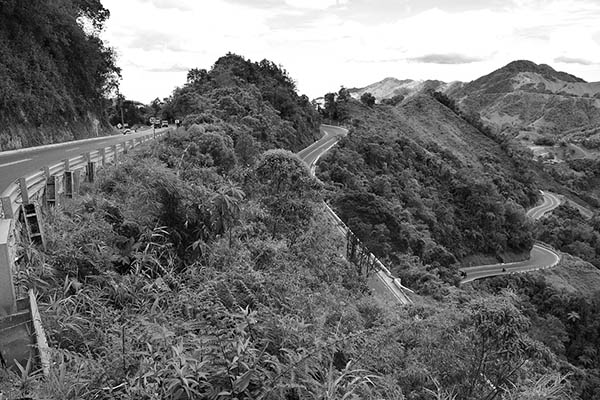
Colombian chicken-strip-reducing twisties on our climb to the top.
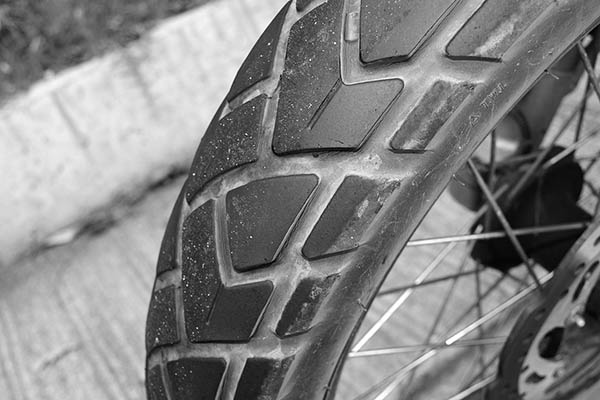
Juan knew another photo spot, and we stopped. He and Carlos took positions on the side of the road to take photos, but I zeroed in on my front tire. I wanted to check out my chicken strips.
Chicken strips are the edges of the tire tread that haven’t contacted the road surface. The harder you corner on a motorcycle, the more you lean the bike over, and the narrower your chicken strips become. Our ride during the last 30 miles or so had been aggressive, and my chicken strips showed it. They were about as narrow as any I have ever created on a motorcycle.
Juan and Carlos came over. They thought I had a problem with the motorcycle’s front tire until they saw me photographing it. Both guys laughed. They knew immediately what I was doing.
“I was watching you in the mirrors,” Juan said, “and you are riding more strongly. We will make you an honorary Colombian motorcyclist!”
The spot Juan had selected to stop was indeed a good one. The Nikon 18-55mm lens came off the camera I replaced it with the Tokina 12-24mm. I grabbed a shot that became one of my favorites (it’s the one you see above).
Chicken strips (the narrow unused tread area at the tire’s edge).
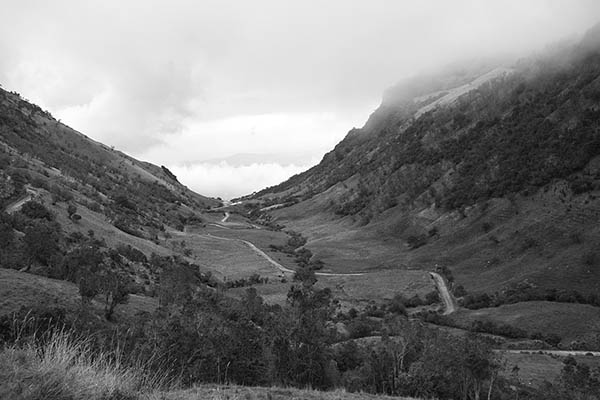
The climb continued, we turned left at an intersection, and then we made a right turn onto a dirt road. We were in the fog, but the fog had not descended to reach us. We had climbed into the clouds to reach it.
It was cold. I could barely see Juan through the fog and I thought it was because my visor had clouded over. I lifted the visor and I realized that it was indeed fogged over, but the visibility wasn’t any better with it up. We were in the soup, and it was thick.
I hit the toggle switch on the left handlebar to activate the RX3’s emergency flashers. I saw Carlos follow my example in my rear view mirrors, and then Juan did so, too. I fixated on Juan’s taillight and his flashers; it was really all I could see in that thick soup. I was glad I was wearing my contact lenses instead of glasses; I would not have been able to see anything if I had worn my glasses.
I could barely see the dirt road beneath my wheels (the fog was that thick). The road had not turned to mud (and for that I was grateful). I felt the moisture hitting my face. It was cold.
That dirt road and the fog we were riding through went on and on and on. I saw a sign that said we were at 3400 meters. Wow, I thought after doing a quick mental calculation. That’s over 11,000 feet! It was about as high as I’ve ever been on a motorcycle, but it was a record that would be broken just a few more miles up the road.
As we continued, the moisture continued to smack my face, but it was stinging more. I thought maybe it was freezing rain. It seemed to bother my eyes quite a bit more, too. I put my visor down and it fogged over immediately. I put it back up just as quickly as I had put it down. This was extreme riding.
13,000 feet and climbing!
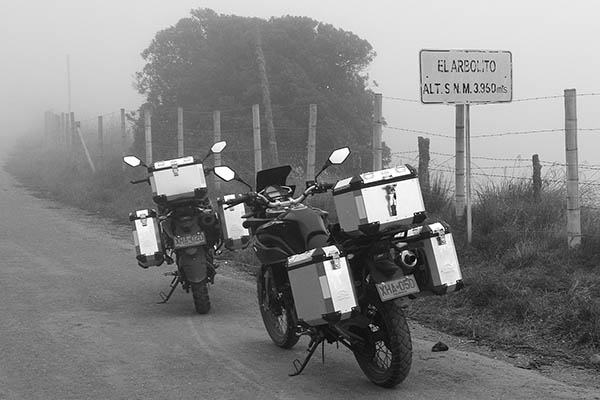
Juan stopped at another sign. We were now at 3,950 meters! That’s 13,000 feet. I was cold, but I knew I had to get the camera out for a photo of the bikes next to this sign. I told Juan the elevation was amazing, and he told me we would be climbing even higher.
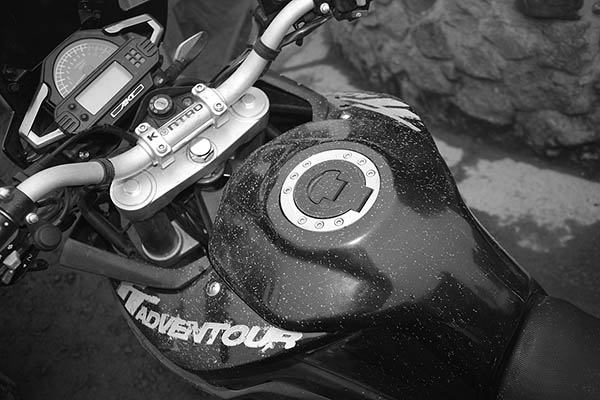
Then Juan noticed something on my jacket. He looked at my bike and he became very excited. My jacket and the bikes had little specks of dust on them. Those little specks were what I had felt hitting me in the face. They hadn’t been freezing rain droplets. They were volcanic dust! The volcano we were riding up to was belching its innards all over us!
Volcanic dust on my RX3 in Colombia.
Juan was excited. “I’ve been up here maybe 10 times,” he said, and I’ve never seen this. The volcano knows we are here, Joe, and it is talking to us.”
We rode another couple of miles and we arrived at the Colombian National Park headquarters for the volcano. The bikes were covered with volcanic dust. Our helmets were muddy because of it. My eyes itched, but I didn’t dare rub them. I now knew my eyes were irritated because they had cinders in them, and rubbing them would grind that dust into my eyeballs. Nope, it would be best to let the tears that were streaming down my face do what they were designed to do and wash this stuff out naturally.
The people manning the Colombian National Park told us they were sending people away, back down from the volcano because it was active. Imagine that!
A volcano!
And it was active!
Wowee!
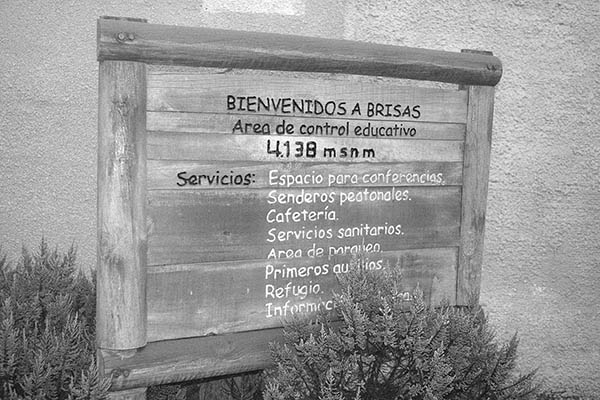
The sign at the top told us we were at 4,138 meters. That’s 13,562 feet, folks. And we rode up here on our 250cc motorcycles!
That’s 13,562 feet above sea level, just below the rim of an active volcano!
Juan told us there was a trail that went all the way up to the volcano’s rim, and that was above 15,000 feet. The Colombian government no longer allowed any kind of motorized traffic on that trail, so we couldn’t take the motorcycles. Juan told me he had done that ride while it was still legal to do so, and he had done it on a 100cc two-stroke Yamaha while riding two up! This guy is one hardcore biker, I thought.
We stayed for a bit, we had a cup of tea, we took a few photos, and we left. That would be one more checkmark on my bucket list. I didn’t even know riding up to an active volcano had been one of the things I wanted to do in my life. Having now done it, though, I can tell you what we accomplished that day deserved a spot on the list. It felt good knowing I could say I had done it.
We rode another 10 miles or so on dirt roads, downhill all the way, to a hotel that was about as far off the beaten path as I have ever been.
It was still bitter cold as we rode down the side of the volcano, but I was feeling good. I’ve said it in every chapter, and I’ll say it again: Juan was showing me one hell of a good time. This Colombian adventure tour was the most exciting motorcycle ride of my life.
Our destination that evening was the Hotel Termales, and it was at the end of a long dirt road. The Hotel Termales was interesting. As we rode in, there were springs emerging along the side of the road. The springs were small, but they gave off a lot of steam in the cold air. I could smell the sulfur. It was obvious we were in a very geologically active region.
The dirt road leading from Volcan Nevado del Ruiz to the Hotel Termales.
As we were unloading the bikes I realized just how cold it was. The sulfur smell was heavy, but it wasn’t too objectionable. The aroma reminded me of Yellowstone National Park in Wyoming or that stretch in Baja between Mexicali and San Felipe (two other geologically active regions I had ridden through on previous motorcycle adventures).
We checked in and a young guy carried my bags up to my room. It was a great room at the far end of the hotel. I had a huge window just above the bed with a commanding view of Manizales, the nearest town nestled in a valley perhaps 30 miles away. The lights of Manizales sparkled in the evening air. It would have made a good photograph, but truth be told, I was about photographed out that night. The ride up to the volcano had been demanding and I wanted to get in that hot pool.
The bellboy explained how to work the heater. To my surprise, it was an electrical heater that blew air through an electrically-heated grid. It was noisy and I thought it might keep me up, but I enjoyed the heat it threw as soon as the guy turned it on. I thought it was odd that with all the hot water coming out of the ground the hotel opted for electrical heating. That’s what happens when you’re an engineer, I guess. You look at things and wonder why.
I met Juan and Carlos in the lobby and we went outdoors to the hot springs pool. We were in our swimsuits and, wow, it was cold out there! Juan had warned us that he pool water was scalding hot and it was best to ease into it gradually, but it was so cold out there I wanted to get submerged as quickly as I could. It was a real shock going from the frigid air into that super-hot water, but I acclimated to it quickly. It was wonderful soaking up all that heat. I had been chilled to the bone, and now I was being boiled. The water had a strong sulfur odor, but I didn’t mind that at all. I was enjoying the heat.
I found that the water temperature, while hot throughout the pool, was much hotter where the water fed into the pool. I stayed close to the water inlets as very hot water cascaded over my shoulders and neck. These areas bothered me every night, no doubt due to the muscle tension associated with riding the Colombian twisties. Those hot springs helped enormously. It was better than being in a Jacuzzi.
That night we ate in the Hotel Termales restaurant. I strayed from my usual evening meal (nearly always chicken) and I tried the truche (that’s Spanish for trout). It was exquisite. Trout in the US is always a dicey proposition. Usually there’s only a small amount of meat on the fish (US trout all belong to Weight Watchers, I suppose). That was not the case here. Even though the truche was about the same length as a US trout, it easily had twice the meat on the bone. It was succulent, it had a pink hue to it, and it almost tasted like salmon. It so intrigued me that I looked up truche up on the Internet, and I learned that trout is actually in the salmon family. In Colombia, I guess the trout family relationship is much stronger than it is in the US.
I slept like a baby that night. The hot air heater didn’t keep me up at all. It was very cold outside, but my room was toasty.
So, back to what I mentioned at the beginning of this chapter…as I fell asleep that night, I thought about everything we did that day. Day 7, just like Days 1 through 6, had been a full day. Breakfast in Honda, exploring the town and the very first bridge to cross the Magdalena River, the river museum, Fresno, hard core cornering as we climbed into the clouds, bitter cold, fog more obscure than the US tax code, dirt roads, riding higher than I had ever ridden before (above 13,562 feet!), volcanic dust from a volcano that could have used some Pepto Bismol, a hot springs bath, and a delicious trout dinner. It had been another day in Paradise. I was loving it.
I thought about everything we had done during the day, and then I realized tomorrow was Day 8. I felt a strong twinge of regret when I realized it would be our last day on the road in Colombia.
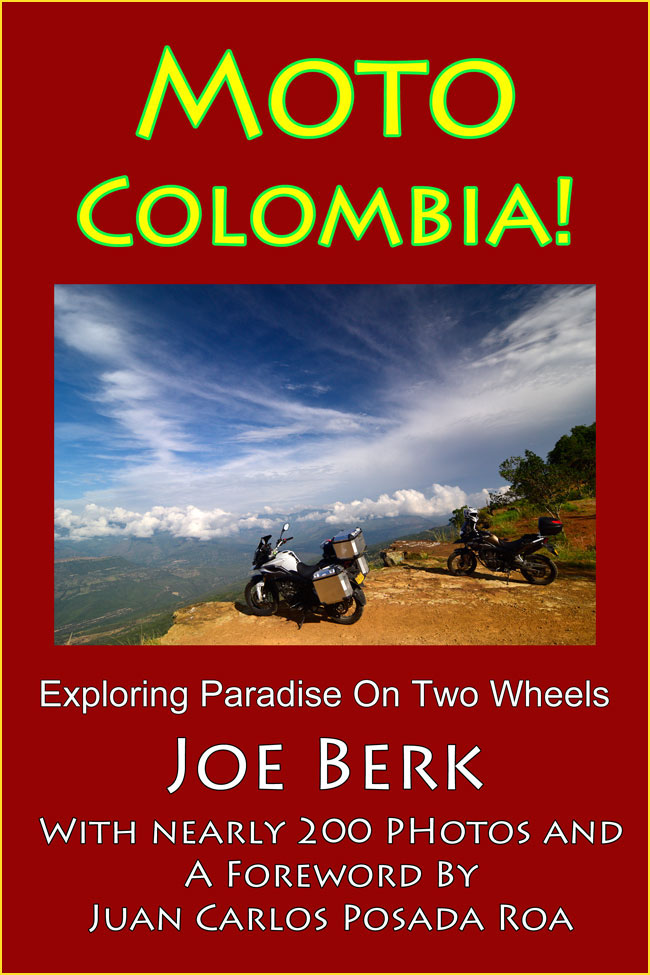
And there you have it! If you want to read the entire story, get yourself a copy of Moto Colombia!
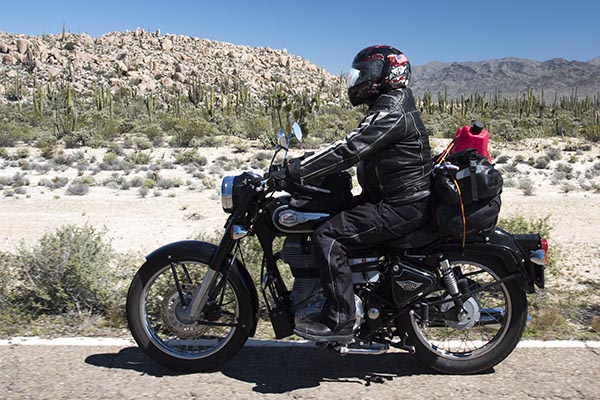
You might wonder why the first photo in a blog about the Royal Enfield Bullet is a CSC TT250. Let me explain. That guy in the photo above is good buddy Dan, with whom I’ve ridden in Baja a couple of times on the CSC trips (once on TT250s, and the other time on the RX3s). Dan is the only guy I know who owns an Enfield Bullet, and before I go into the good, the bad, and the ugly regarding my Bullet experience, I called him to get his take on the bike. Dan has owned his Bullet since 2013, it’s the fuel injected model (like the one I rode), and he has 7500 miles on it. Lest you think Dan doesn’t ride much, he owns several motorcycles, and that’s why he only has 7500 miles on his Enfield.
Dan told me his Bullet has been trouble free, but he also told me he is fastidious in maintaining it and he is a conservative rider. Dan said things vibrate loose and you have to keep an eye on that, but his bike has never broken down, it’s never had any electrical issues (like the missing and stumbling Joe Gresh and I experienced on the entire Baja trip), and he likes the bike. That’s good input, and it’s what I hoped I would hear.
For reasons I’ll explain later, I asked Dan about the rear sprocket and chain maintenance, and he laughed. “It’s the only thing I was going to mention,” Dan said. He replaced his rear sprocket at 7500 miles, and he is a fanatic about chain maintenance and lubrication. More on that in a bit, folks.
Another bit of background up front. Royal Enfield North America was kind enough to lend Joe and I a Bullet. Our particular bike was a 2016 press bike that had been stored at a dealer for some time (not Southern California Motorcycles, but another Enfield dealer), and when we received it, it was in a state of extreme neglect. I won’t go into that in detail (you can read about it in a prior blog); I’ll just mention it again and touch on it a few times through this post. The Enfield Bullet is an old school bike and it requires maintenance; this one had essentially none and it put a damper on our trip. I wanted to love the bike and write great things about it; the condition of the bike made that difficult.
This is what a motorcycle is supposed to look like.Joe Gresh on a Royal Enfield Bullet in Baja. Life is good.
With that as a backdrop, let’s get into a detailed review.
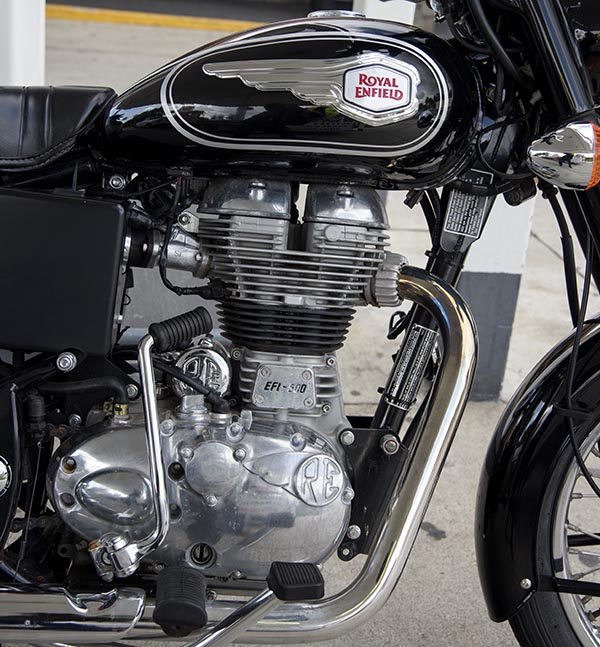
I think the Bullet is a beautiful motorcycle. It has a look I just love. It screams 1950s, it screams British, and I love the feel and sound of a big single. The black paint and chrome work for me. The pinstriping is superb, and I found a video that shows how Royal Enfield does it…
The centerpiece of any motorcycle has to be the engine, and on this count, the Bullet excels. That beautiful, tall, exquisitely-finned single and its polished cases can only be described as stunning. It’s what a motorcycle is all about. No water-cooled, take-the-fairings-off-and-I-look-like-a-washing-machine silliness here. Nope. This is a motorcycle, with the accent on motor. I love the look.
A motorcycle with a motor you can see!
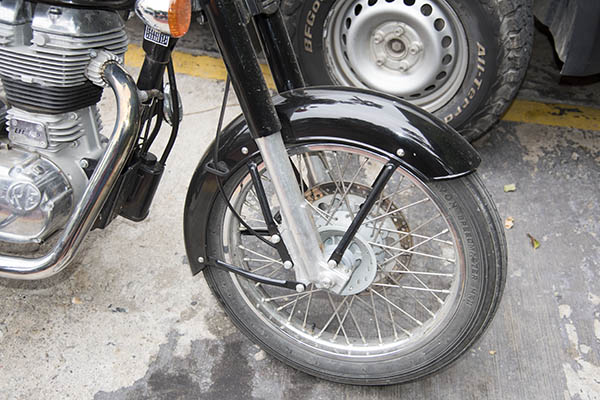
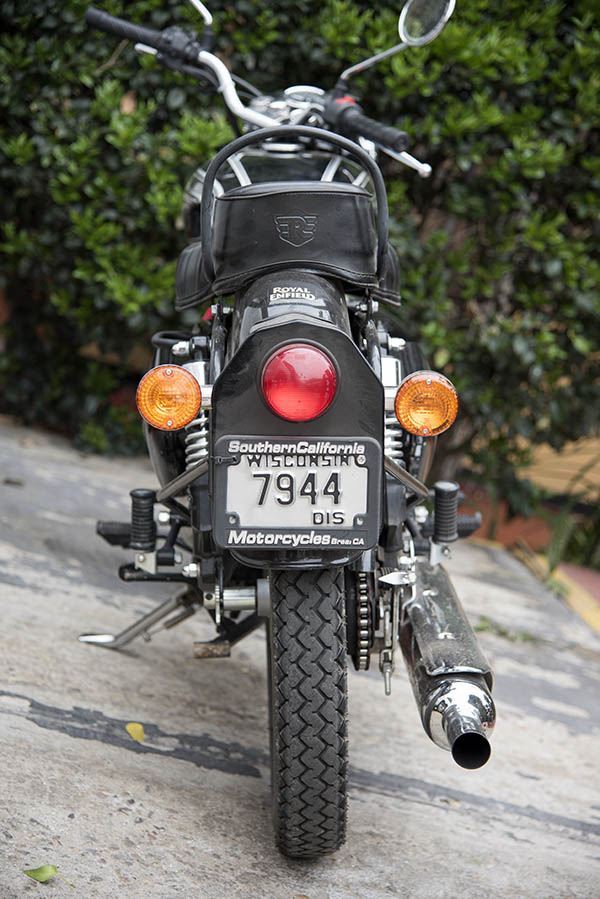
The Bullet’s fenders are enormous, deeply-valanced metal structures. They have a very 1950s look, which I like. No plastic here, folks. Curiously, the rear fender was not centered on the rear tire when viewed from behind. The wheels were aligned and the bike tracked true. My take is that the tolerance build up and assembly technique allowed the mismatch. My old 1978 Triumph Bonneville suffered from the same cosmetic issue.
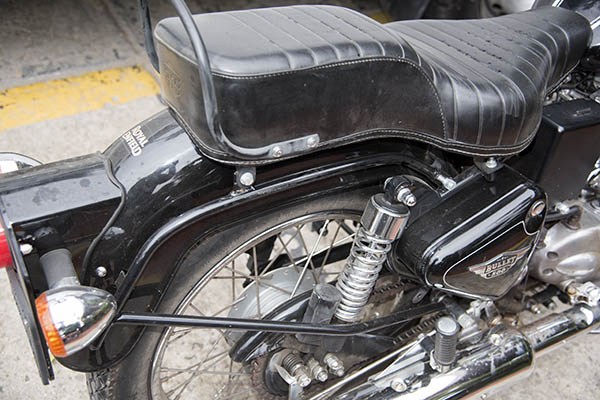
Deeply valanced and all metal…no mud is going to splash up on this puppy!The rear fender is similarly deep and serious. Check out the support bars running from the fender to the frame. It’s a good place to attach bungee cords. Note also the stepped seat. It was hard, but comfortable. Check out the rear drum brake (the newer ones have disk brakes front and rear, and ABS).See the rear fender and seat bias to the left? The tires were aligned and the bike tracked true. This bike started life at Southern California Motorcycles and I wished it had been delivered by them (it would have been in much better shape). Our bike had been kept at another California Enfield dealer.
The front brake is good. It’s a disk brake and it stops well. The rear brake on the 2016 model I rode was a drum brake, which was adequate but not great. The newer Enfield 500s have ABS and a disk brake in back. I didn’t attempt to get the brakes to fade. That sort of whackadoodle stuff is best left to the mainstream moto media journalists as they flog bikes and overuse catchy phrases like “the controls fell easily to hand…” (that’s Gresh’s line; I wished I had thought of it). The brakes worked fine for us.
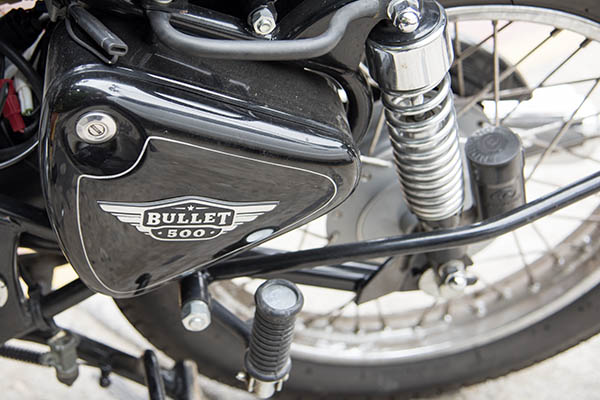
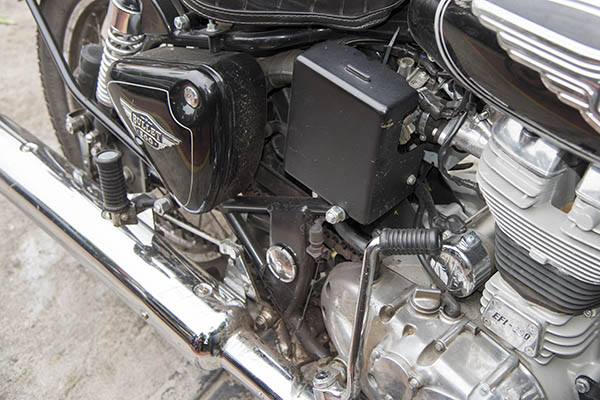
The Bullet comes with a decent tool kit (that’s the good news), which we actually had to use several times in Baja (that’s the bad news). It’s stored in a key-locked metal container on the left side of the bike. There’s a similar key-locked metal container on the right, and it provides access to the air cleaner.
The tool kit and the fuse box are inside the ignition-key-opened box on the left side of the bike.The air cleaner is in in the locked container on the right side of the bike.
There’s another key-locked metal cover on the left side of the bike covering the battery, and that’s another good news story. The battery is big, and the terminals are accessible even with the cover on. That makes good sense. On our press bike, the battery was shot when we received the bike (we didn’t know that before we left for Mexico, though) and we had to buy a new battery in Guerrero Negro. We bought it at a tiny shop tucked away on a dirt road, and as you can imagine they didn’t stock Royal Enfield parts. We bought one that was close enough in size to go into the bike (but we couldn’t put the battery cover back on after installation). It worked just fine. Like they say, halitosis is better than no breath at all.
The Bullet has a kick starter. It looks cool, but the big single is tough to kick over. Both Gresh and I failed to start the bike with the kick start. I view the kick starter as more ornamental than functional. The electric starter works well, although our bike would go through several crankshaft rotations before it fired up. It was kind of like starting an old radial-engine airplane. It would get the engine turning, somewhere in there a little British chap yelled CONTACT, and then the engine would run on its own.
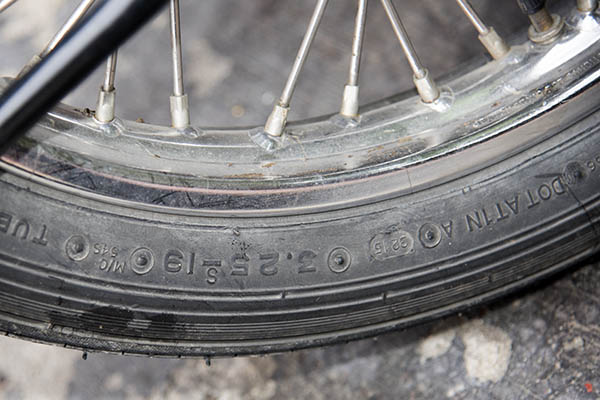
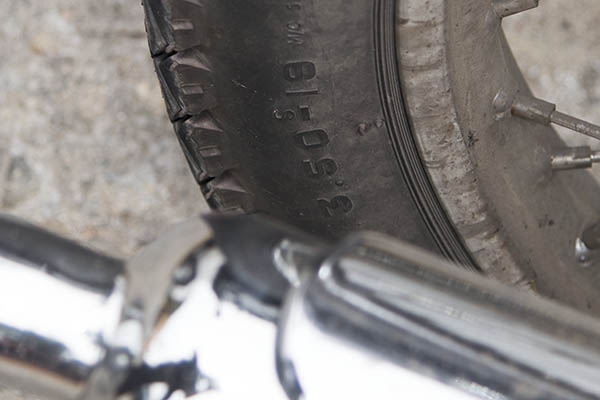
The wheels and tires on the Enfield are another old school touch. They’re both 19 inchers, with a 3.25×19 in front and 3.50×19 in the rear. Both have old-school tread designs. Both felt secure on the road and in the dirt, their narrow treads notwithstanding.
The Bullet’s 3.25×19 front tire.The Bullet’s 3.50×19 rear tire.
The fuel cap was not attached to the fuel tank, and it was the kind you completely unscrew. The Enfield website says the Bullet’s fuel tank holds 3.5 gallons. On the long stretch from Catavina to the Pemex station 20 miles north of Guerrero Negro (a distance of exactly 110 miles) the low fuel light indicator was just starting to flicker about 100 yards shy of the gas station. I don’t know for sure how many miles are left when that happens, but with a published capacity of 3.5 gallons, I suspect that like most fuel injected bikes, the low fuel light comes on early. Motorcycle manufacturers do that to keep the fuel pump immersed in fuel (it’s how the fuel pump is cooled). The Bullet’s fuel economy was superior. Gresh got just over 75 mpg riding it down to the border, and I got 72.something riding it north from the border. With that kind of fuel economy, I’m guessing that when the low fuel light comes on there’s still a good two gallons left in the tank.
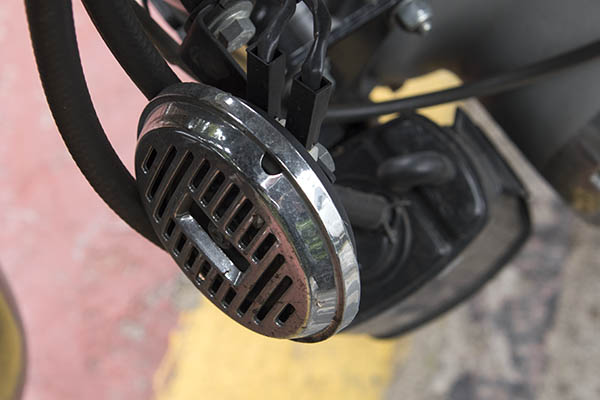
At first, I thought the Bullet’s horn was tragic. It bleated like a baby lamb (sitting on the motorcycle, I could hear it, but no one else could). Then the battery died, and like I explained above, by the grace of God we found a useable replacement in Guerrero Negro. With the new battery the horn flat out honked. It’s a good horn, one that speaks with the authority a proper 500cc thumper should have.
The Bullet’s horn works well with a good battery.
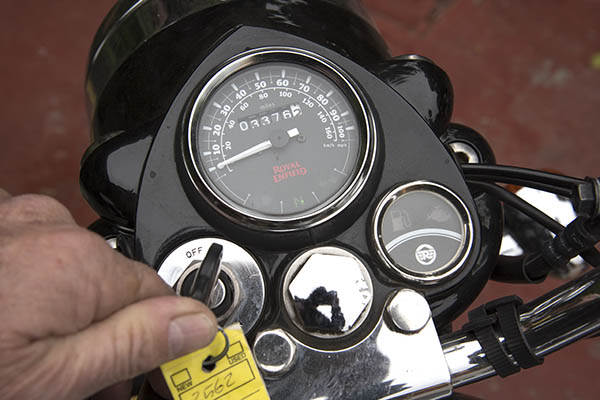
Instrumentation can only be described as primitive. Adequate would be stretching the word. There’s a speedometer and an odometer, but no tripmeter. There’s no tach, but the engine speeds were low enough that you could almost calculate rpm by counting thumps and using a wristwatch. There’s a fuel warning light but no fuel gage. That makes for dicey riding. You either have to hope the fuel warning light leaves enough range to make the next gas station (very dicey in parts of Baja), or you need to remember the odometer reading when you last filled up (very dicey at my age), or you need to ride with someone who has a trip meter on their bike (very dicey unless you know people in high places in Royal Enfield North America, like I do). There’s a check engine light (which is kind of funny, because like I explained at the beginning, this motorcycle is all motor…yep, the engine’s there alright!), there’s a turn signal indicator (which I never could see in the daytime), there’s a high beam indicator (can’t see it in the daytime), and there’s a neutral light (same story, you just can’t see it during the day). One other mild concern for me was that when I cruised between 55 and 65 mph (the Enfield’s sweet spot), the speedo needle obscures the odometer and I could not tell how far I’d ridden when I tried to use the odometer as a fuel gage.
The ignition switch has two positions (on and off). It’s labeled “IGNITION” just in case you don’t get it. Speedo, odo, neutral, high beam, turn signals, check engine, low fuel, and that’s it. The neutral light is actually on in this photo.
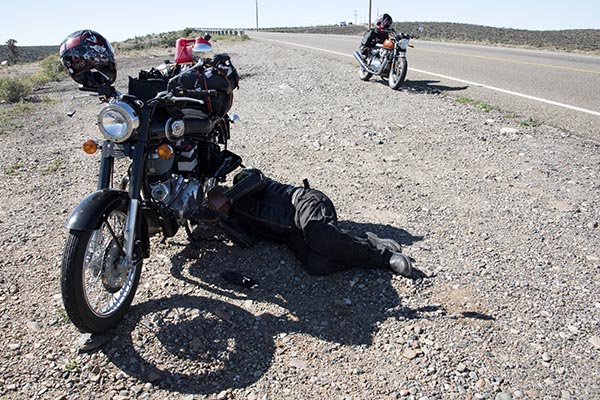
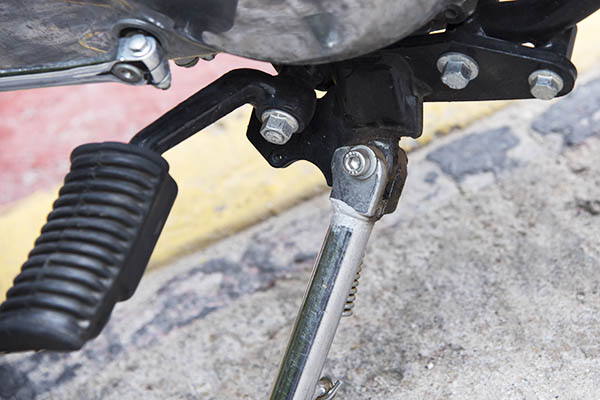
The Bullet has both a centerstand and a kickstand, and it was easy to deploy both. On our ride, after the third day I was sure the bike was leaning more to the left than it had been on the kickstand. Gresh looked at it and he started laughing. It sure was. The thing leaned further left than Bernie Sanders. The sidestand and the left footpeg are bolted to a metal plate, which is in turn bolted to the frame. That plate was bending. Gresh deployed the sidestand and stood on it, which bent the mounting plate back to a more reasonable position. We thought we were good until the bike died on the road a short while later. It didn’t start missing or stumbling this time; it just died as if someone had turned the ignition off. Here’s why: The kickstand actuates a “kickstand down” switch, which prohibits engine operation if the kickstand is extended (sort of; bear with me on this part of the story).
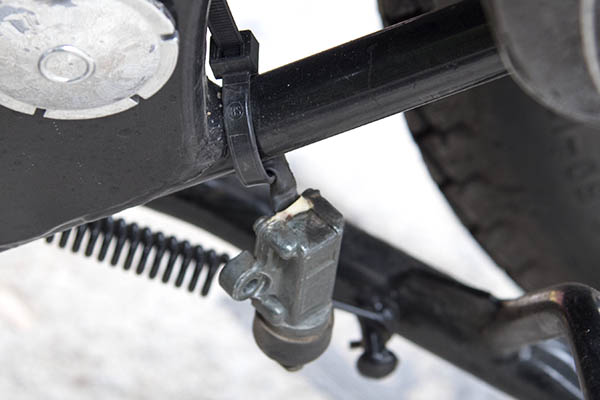
We had another failure the morning we left Guerrero Negro, and it was one of those sudden “ignition off” failures. Joe unbolted the kickstand interlock switch by the side of the road out there in the Baja desert and we did a quick test to find out if the switch needs to be open or closed to allow engine operation. We quickly concluded it is a normally-closed switch, and then we simply ziptied the switch to the frame after removing it from the kickstand mounting plate. From that point on, our easy-to-fool Bullet thought the kickstand was always up. Problem solved; no more engine sudden death syndrome. Yeah, things were going south, but in its defense, problems on the Bullet are easy to diagnose and fix.
Joe Gresh, inflight missile mechanic.The plate holding the kickstand and the right footpeg. The bad news it bends easily. The good news is it bends easily back. More bad news is that bending it back into position disrupted the relationship between the kickstand interlock switch and the kickstand. More good news is that it was easy to bypass.The kickstand interlock switch, ziptied to the frame after removal. No more engine shutting off.
The plate securing the kickstand is either underdesigned (i.e., it’s too weak), or the metal was improperly heat treated and it’s too soft. In the bike’s defense, I was carrying about 50-60 lbs of stuff in my Wolfman bags and Nelson-Rigg tailpack, and I have a habit of standing on the left footpeg and throwing my right leg over the luggage when I get on a bike. That puts a strain on the kickstand and its mount. But that’s a likely scenario for any rider, and the bike should have been able to take it without the kickstand mounting plate bending.
One more thing on the kickstand switch…the logic is weird. With the bike on the sidestand, you can crank the engine all you want. It just won’t fire. Consequently, you can’t idle the bike to let it warm up on the kickstand (if the bike is running, as soon as you extend the kickstand, the engine dies). But you can crank the starter with the bike on the kickstand. I think that’s dumb, because it will allow you to propel the bike forward on the kickstand if the bike is in gear. On most bikes, with the kickstand down you can’t crank or run the motorcycle. That’s how I would do it, but then, I don’t sell a zillion bikes a year like Royal Enfield does, so what do I know?
I found the Bullet to be surprisingly comfortable, more so even than the Interceptor and most other motorcycles. The seat was hard and the step in it prevents moving around during long hours in the saddle, but the ergonomics worked for me. Gresh said the same thing. The bike doesn’t have a fairing or a windshield, but it was supremely comfortable at any speed.
Suspension, front and rear, is non-adjustable on the Bullet. It’s not an issue for me. Stack 20 mattresses, put a pea underneath the mess, and I can’t tell you if that pea is there or not. For me, adjustable suspension is the same sort of thing. I think the entire concept of adjustable suspension for most folks is a joke (particularly suspension dampening), little more than a marketing gimmick. I’ve had bikes with adjustable suspension that I rode for years and I never changed the factory suspension settings. Your mileage may vary. I don’t know the suspension travel, but whatever it is, I found it to be sufficient. I carried a lot of freight on the Bullet over roughly 1300 Baja miles and I never bottomed out.
The Bullet’s top speed was somewhere in the indicated 72-73 mph range. The bike had enough power for passing, but just barely. Again, for the kind of riding I do, it was adequate. On the US freeways down to Mexico, we ran at about 60-65 mph, we stuck to the right lane, and we were fine. Enfield advertises 27 horsepower for this motorcycle, and that figure sounds about right. My 250cc Zongshen RX3 has 25 horsepower, it’s a little lighter, and it’s a little faster. But I recognize that nobody buys the 500cc Enfield to race other motorcycles. I suspect the people who buy this bike don’t care about 0-60 times or top speeds. It’s all about the vintage riding experience, and in that regard, the Enfield excels.
The Bullet frame is a massive tubular steel affair, like they made them when men were men and well, you get the idea. On some of the rear portions of the frame, the tube diameter was so large my bungee cord hooks wouldn’t fit. The Bullet has these sort of frame runners that go outside the bike on either side in the rear; those were very handy for bungee cord hookups.
On the ride home, with 20 miles to go at the end of our trip, the Bullet started misbehaving big time. It was clanking and banging, so much so that I initially thought I had thrown a rod or toasted a main bearing. Nope, it wasn’t that at all. We hit a bit of rain, and even though we had lubed the chain that morning and found it to be sufficiently tight, it was bone dry from the rain and it was hopping over the rear sprocket. The chain was already rusty, and the rear sprocket teeth were rounded and hooked. In under 3500 miles. Amazing. That’s what my good buddy Dan laughed about when I called him earlier. His take on it is that Enfield uses a very cheap and soft rear sprocket. That and the neglectful dealer’s lack of maintenance on our Bullet combined to toast the chain, the rear sprocket, and probably the front sprocket. In defense of the Bullet, it got me home, but the last few miles of our trip were at 10 mph or less.
As I stated at the beginning of this blog, and as Joe and I talked about in previous blogs, the dealer who had this bike did nothing we could see to maintain it, and they certainly did nothing to prep the bike for our Baja trip. When the Bullet was delivered, the oil was a quart down, the chain was rusty, the spark plug wire and lead were corroded, and the battery was on its last legs. Before the bike was delivered, I called the dealer to ask if the Bullet had a tool kit, and the salesperson I spoke with became defensive. Like Steve Martin used to say, well, excuuuuse me. The bike was a press bike, and it probably was abused by others writing about, you know, the controls falling easily to hand and such (and maybe doing burnouts and wheelies), but there was just no excuse for the bike to be delivered in the condition it was in. It only had 2264 miles on the odometer when we got it. Royal Enfield was apologetic and embarrassed by all of it; the dealer should be ashamed. I think that was a major screwup on their part. Maybe they just don’t care, or perhaps they’re too busy finding new ways to inflate ADM fees and overcharge for desmodromic valve adjustments. Whatever. I’ll never buy a motorcycle from them. On the other hand, the dealer who provided the Interceptor (Southern California Motorcycles) delivered that bike in perfect condition. That’s the way it’s supposed to be.
The Bullet dealer’s failure to prep the 500 was unfortunate. I really wanted to love the thing and maybe buy one, but I can’t after what we experienced. That’s a shame. The Bullet reminded me of my ’92 Harley Softail in many ways. It was a paint-shaker at speed, it was okay on the freeway, it excelled on country roads, and it looked, felt, and sounded like a motorcycle should.
The last topic I’ll touch on is the Bullet’s pricing. For whatever reason, I thought the Bullet’s MSRP was around $4795, but I was off by nearly a thousand bucks. A new Enfield 500 is $5599, and that’s before the fiction dealers call freight and setup. A new 650 Interceptor is $5799. To me, that’s nuts. For an extra two hundred bucks, the Interceptor is just too much motorcycle to pass up. Maybe Enfield is going to phase out the 500. Or maybe the Bullet just costs that much to make (which I think is very, very unlikely, as any Bullet tooling or other fixed costs were probably amortized before most of the folks reading this were born). I like the Bullet enough to consider going the Joe Gresh route (you know, buy a used one for cheap). But a nationwide search on CycleTrader showed almost no used Bullets for sale, and the few that were listed were close enough to a new bike’s price that their owners (in my opinion) were dreaming. Go figure. I guess folks who own these bikes just don’t sell them, and I think that speaks well for the bike.
You might be wondering…why did we take a 2016 Bullet instead of a 2019 new Enfield 500? Hey, you go to war with the Army you have, and the 2016 Bullet is what the good folks at Royal Enfield North America gave to us. I don’t know if some of the things I’m writing about have been addressed in newer versions. Maybe it’s not fair to do a road test on a bike that’s already 3 years old, but if there’s any unfairness here, it’s in the fact that the bike was just flat neglected, and that’s something we had no control over.
So there you have it. Neglected or not, the Bullet got us down to Guerrero Negro and back, and it took us to see our friends in Scammon’s Lagoon. The whale watching this year was awesome…some of the best I’ve ever experienced.
Next up? Our take on the new Interceptor. That’s really exciting, both because it’s a new model and to my knowledge we are the first folks in the US to take the new 650 Enfield on a real adventure ride.
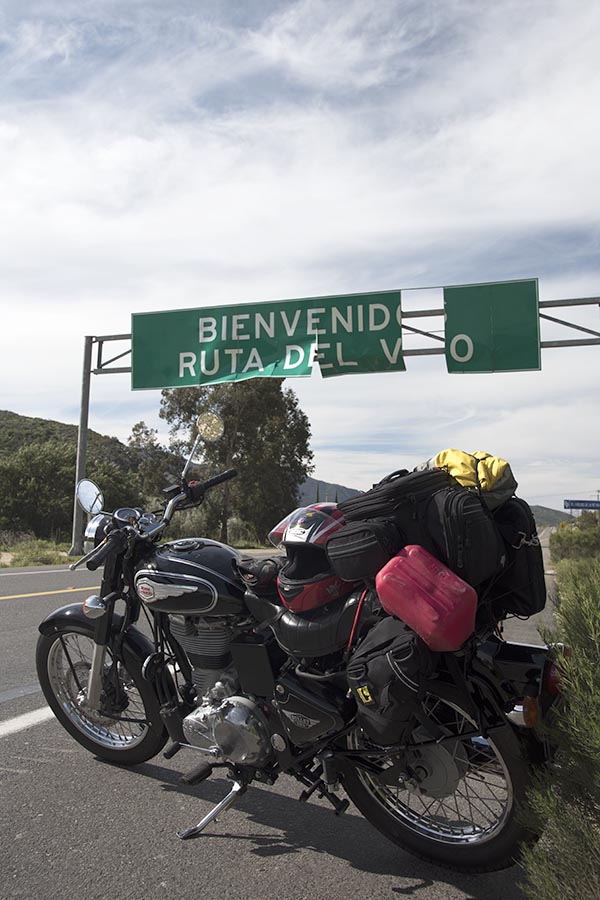
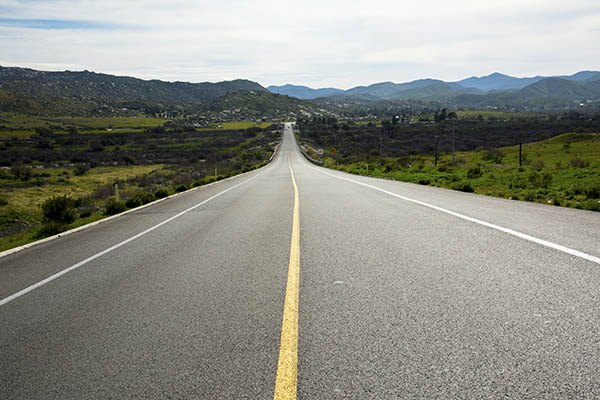
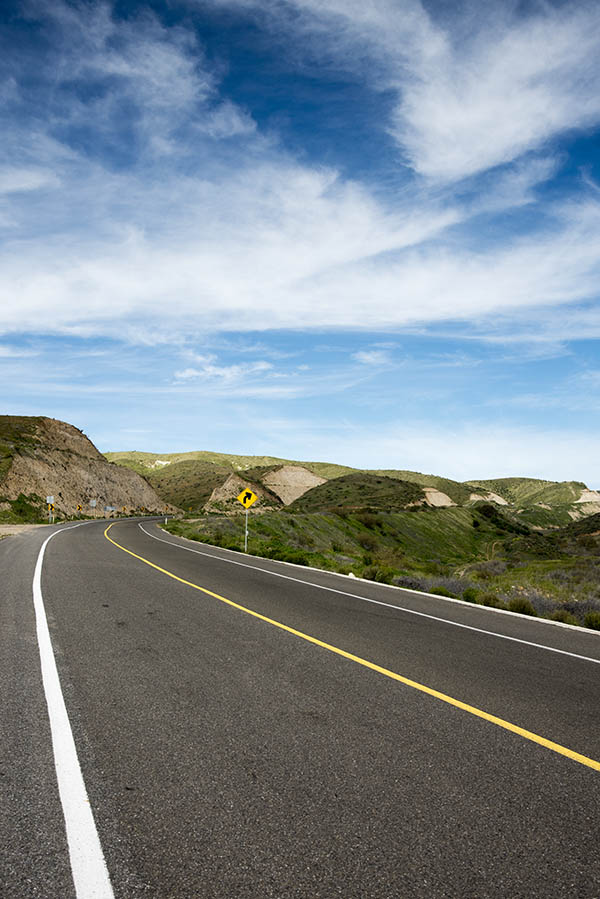
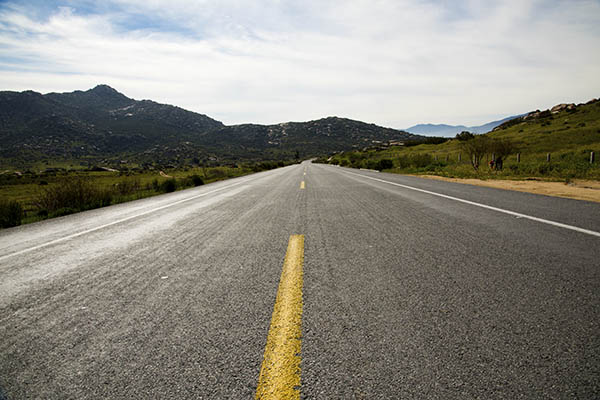
This post will wrap up our Tecate visit, and the focus of today’s blog is the road south out of Tecate. The Ruta del Vino is a magnificent road that runs through the northern Baja countryside to Ensenada, passing directly through one of Baja’s wine growing regions.
If you missed the earlier Tecate posts, here are the links:
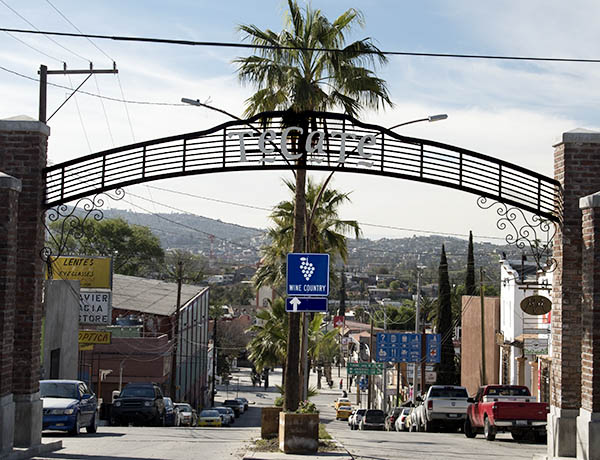
Getting to the Ruta del Vino is easy. After entering Baja through Tecate, just continue south. You’ll pass under the Tecate sign shown in yesterday’s blog, hang a left on Avenida Revolución, and then turn right on Boulevard Universidad (which becomes the Ruta del Vino and Mexico Highway 3).
Welcome to Tecate!
You’ll pass through the center of Tecate and climb a hill as you leave Tecate. You’ll see a bunch of pottery stories selling clay bowls of all kinds. A little further south is a monastery on your left, and a little beyond that is a sign over the road welcoming you to the Ruta del Vino.
The Ruta del Vino has several things to offer. The first is magnificent scenery through Mexican countryside. Then there are the vineyards. They are on both sides of the road. The third are the restaurants and hotels. And I guess the fourth is the destination, as the Ruta del Vino runs all the way to El Sauzal, a tiny community on Ensenada’s northern edge. That’s where the Ruta del Vino intersects with Baja’s Transpeninsular Highway. Turn left and the Transpeninsular Highway will take you through Ensenada and all the way to Cabo San Lucas. Turn north and you’re on your way to Tijuana and San Diego.
Along the Ruta del Vino, which is Mexico’s Highway 3.Another view along the Ruta del Vino.
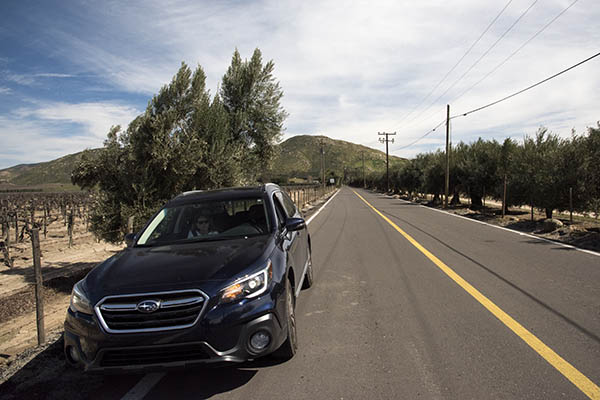
Northern Baja wines are surprisingly good. I’m not a wine connoisseur; I just think they are good and they are certainly reasonably priced. My favorite vineyard is the L.A. Cetto vineyard, which is roughly 45 miles or so south of Tecate. As you’re traveling south on the Ruta del Vino, the L.A. Cetto vineyard is on your left. The road to it used to be dirt, but it was recently paved and it’s an easy ride now. The L.A. Cetto vineyard usually has a fair crowd and on our last visit, there was a general feeling of excitement in anticipation of a visit by senior members of the Catholic clergy. As we were leaving, an entourage of several priests and the region’s Cardinal were arriving.
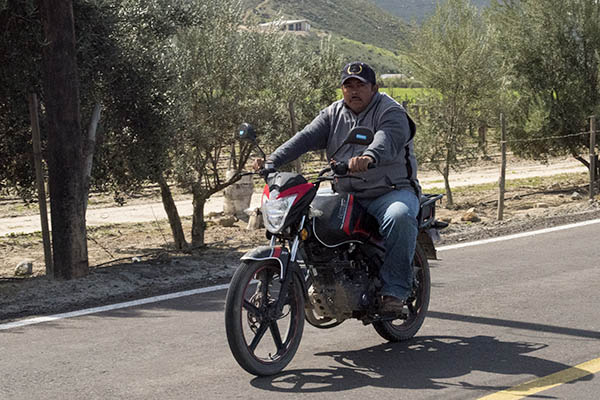
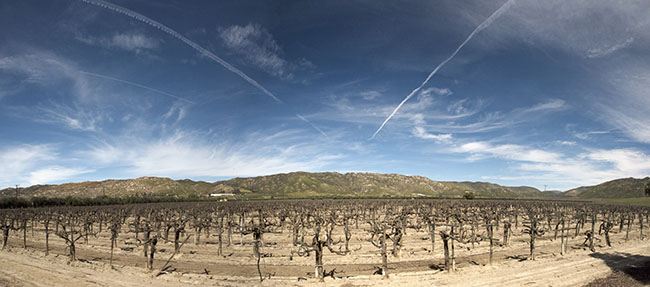
The now-paved road leading to the L.A. Cetto Vineyard. That’s my Subie Outback, which is a grand automobile for these kinds of tours.A Mexican motorcyclist on the road to the L.A. Cetto vineyard. All the gear, all the time. The motorcycle is a Zongshen, marketed in Mexico under the Italika name.The L.A. Cetto grapes. This is a composite photo showing a 180-degree view from the south (on the left) to the north (on the right). It’s stitched together from three photos. Photoshop does a great job at these kinds of things.
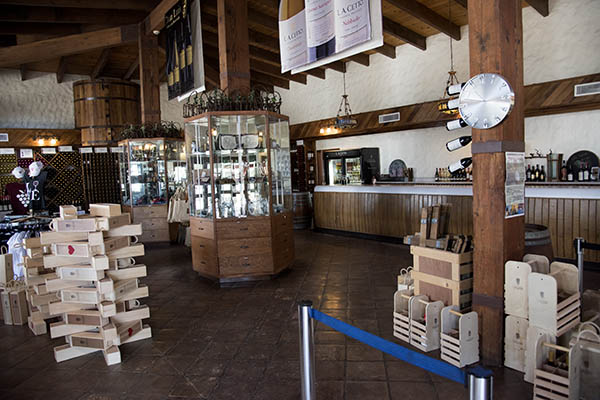
The L.A. Cetto vineyard offers wine tasting, and they sell wines, vinegars, olive oil, olives, cheeses, nuts, and more. When I’m on the motorcycle, my friends and I will usually stop to buy some cheese and olives for a snack. The vineyard has outdoor tables in front of the wine tasting areas. The vineyard also offers factory tours, but they were only in Spanish on the day of my most recent visit. You can buy and get back across the border with any amount of olives and olive oil you wish to take, but there’s a one bottle limit on wine. I picked up an L.A. Cetto Malbec on this visit, which I’ll try later this month. If you’d like to read more about the L.A. Cetto vineyard, here’s an excellent article in the BajaBound.com newsletter.
The L.A. Cetto tasting room and store.
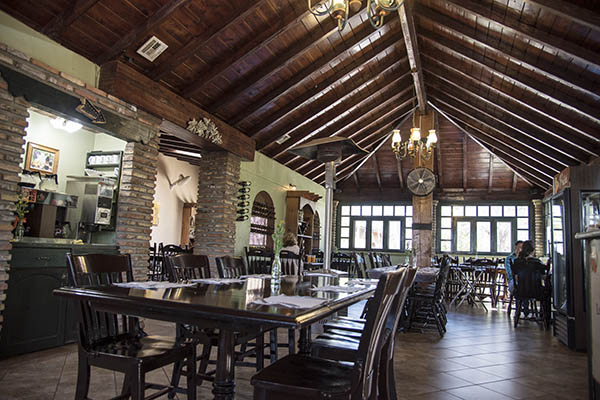
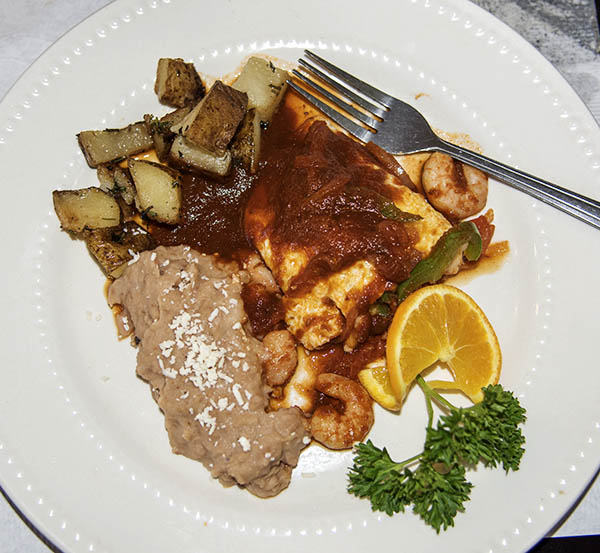
We had a great lunch at Los Naranjos, which is just a short jaunt further south on the Ruta del Vino. It’s about a half mile down the road on the right. The cuisine there is impressive, and nothing wraps up a great meal at Los Naranjos better than their apple pie. Make sure you try a glass of their namesake orange juice, too. They grow their own oranges and squeeze their own juice. It’s superb. One more thing: The salsas at Los Naranjos are the best I’ve ever had. One in particular was a darker salsa with crushed almonds. I asked if I could buy a bottle of it, but Los Naranjos doesn’t sell this one other than as a serving with each meal. They saw how much I liked this particular salsa, though, and the chef made up a couple of plastic containers for me to take home.
Inside Los Naranjos. It’s rare to see it this empty. On Sundays, it’s a favored destination for Mexican riders and it’s packed.Susie and I split a shrimp omelet for lunch. This was just half of the normal serving.
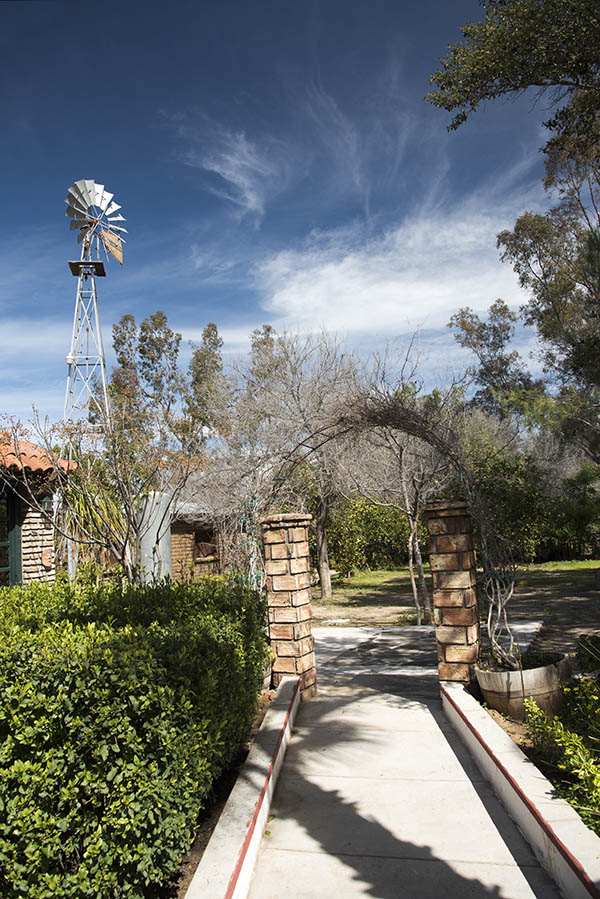
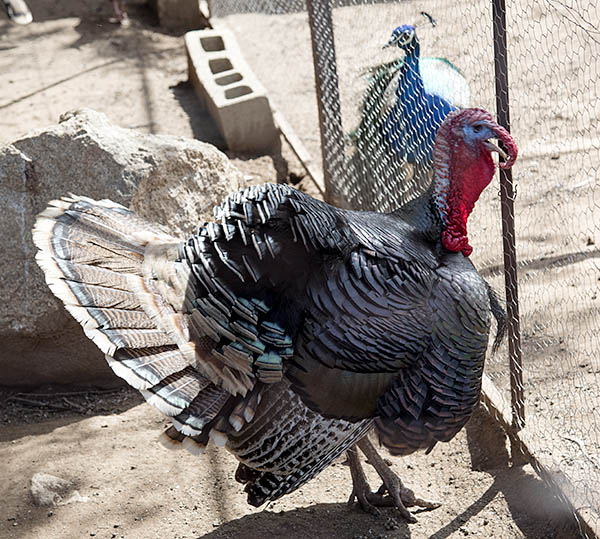
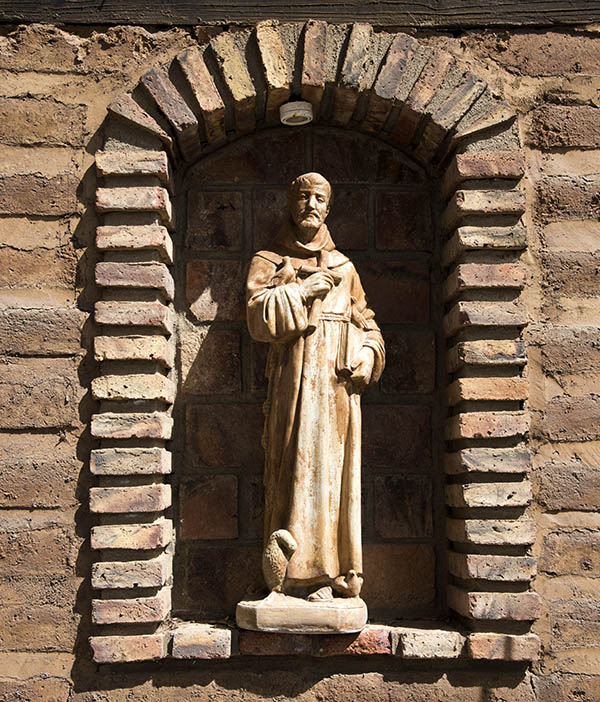
Los Naranjos is part of a larger country estate. You can walk around the grounds and take in the interesting sculptures, birds, tilework, and more. I also found out that there’s a 30-room hotel on the premises, something I did not know before this trip. I think a stay there will find its way into a future Baja itinerary.
The grounds around Los Naranjos.A Los Naranjos turkey.Los Naranjos wall sculpture.
To put all this in perspective, all the recent blog posts about Tecate and the Ruta del Vino described what Susie and I did in less than 24 hours. We rode down from the Los Angeles area in the afternoon on a Thursday, crossed the border into Tecate around 4:00 p.m, had our great dinner at Amores that night, we enjoyed a wonderful breakfast in Malinalli Sabores Autóctonos the next morning, we explored downtown Tecate later that morning, and did our trip along the Ruta del Vino in the afternoon. Then it was back up to the border to get back into the US that afternoon.
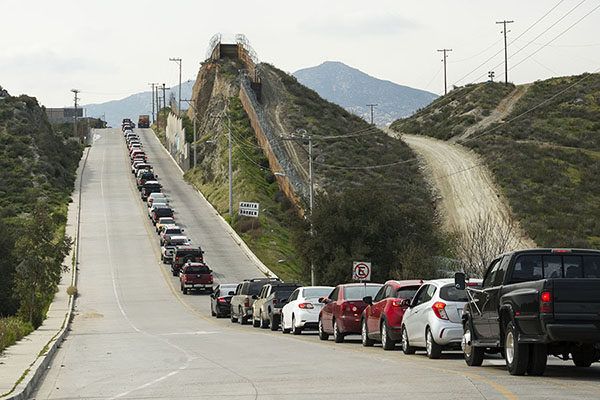
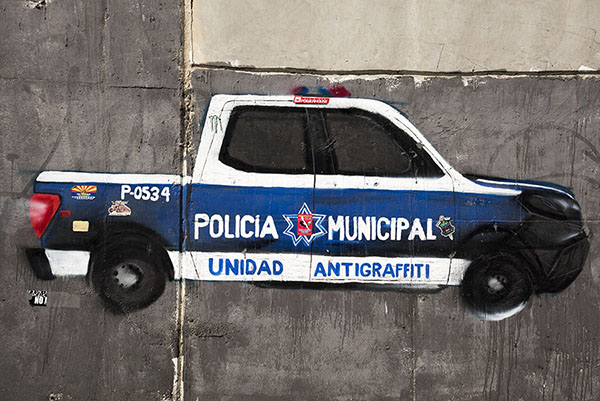
Waiting in line to cross the border. The Wall already exists. That’s the US on the other side. It would have been a lot quicker getting through on the motorcycles.Wall art as we waited to cross the border. Photo by Susie.
Getting back to the border is not too hard to do, and the lines to get back into the US are generally better than they would be in Tijuana. Just follow the Ruta del Vino back into Tecate, and as you near the center of town, watch for the Garita (border) signs. You have to turn off to the right and parallel the US border for a mile or so, and then make a U-turn to get in line. On this last visit, because we were in the Subie, we had to get in the car line, and our wait was about an hour (you’ll want to take a restroom break before you get in line). If you’re on a motorcycle, though, you can get through a lot easier. Just find your way through Tecate to the point where the line of cars approaches the US border crossing, squirt through an opening in the K-barriers, and cut the line. We do this all the time on the bikes.
And folks, that was our whirlwind one-day Tecate junket. I liked this approach where instead of zooming up and down the peninsula, we selected a particular place and explored it in some detail. I’d like to do that in the San Quintin area on a future trip…there are some cool things down there. Anyway, Joe G and I are headed to Baja later this month on the motorcycles. Stay tuned; it’s going to be another grand trip!
 Terry is the former Thunder Press editor, and there’s lots of cool V-Twin stuff on
 We sent an email requesting your address if you signed up, so watch for it and shoot that info back to us. We promise that as soon as we get your snail mail address and confirmed that you’re on our email list, we’ll shoot them out to you as soon as we get around to it. Want to help us more? Hey, share our site and get more folks to sign up for our automatic emails, or just get them to visit
  Hey, we saw a Chinese manufacturer making parts for Harley a decade ago. But the recent news is this is going to be a complete small bike, just over 300cc. I’m surprised Harley didn’t do this several years ago, but then, Gresh and I were in the catbird’s seat on the small bike thing from the gitgo.