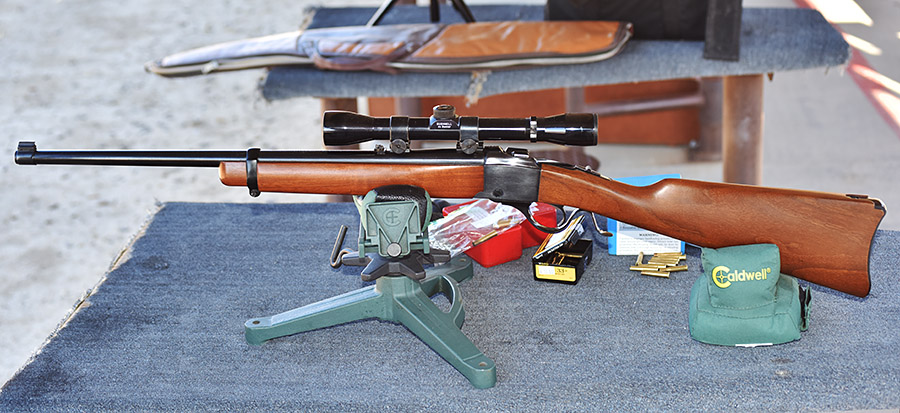
A .22 Hornet Ruger No. 3!

I’ve written about the Hornet before (and I’ll give you a link to that past blog at the end of this one). The point of today’s writeup?  It’s about accuracy and a few different loads for the Hornet in my single-shot No. 3 Ruger.  I like the idea of a single-shot rifle and I love the .22 Hornet cartridge.  The .22 Hornet was the world’s first centerfire .22 cartridge, and in its day, it was a real hot rod.  Velocities range between 2400 and 2900 feet per second (sometimes a little more, depending on the load).  Recoil and muzzle blast are nearly nonexistent compared to other centerfire cartridges, and it’s a fun cartridge to shoot.
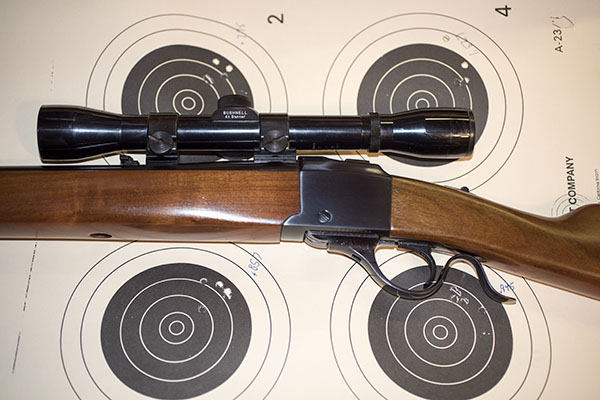
A Ruger No. 3 in .22 Hornet. It has a period-correct inexpensive Bushnell 4X scope, which is good enough for me. My rifle is in near-new condition.

The idea for this blog started when I saw three boxes of Speer 33-grain hollow point bullets a couple a few weeks ago at my reloading supply depot.  They were inexpensive (just $10 a box), so I bought all three.   I hadn’t tried the light Speer bullets and I wanted to see how they compared to an old favorite, the 45-grain Sierra Hornet bullet.  I also wanted to try a propellant that I had purchased previously (Lil Gun) and compare it to my favorite Hornet propellant (Winchester 296).   And my good buddy Tom recently gave me a bunch of old .22 Hornet ammo that I shot up on a prior outing, so I had a good supply of Hornet brass.  It all came together a week or two ago, and the result was a hundred rounds of reloaded .22 Hornet ammo in various load configurations.
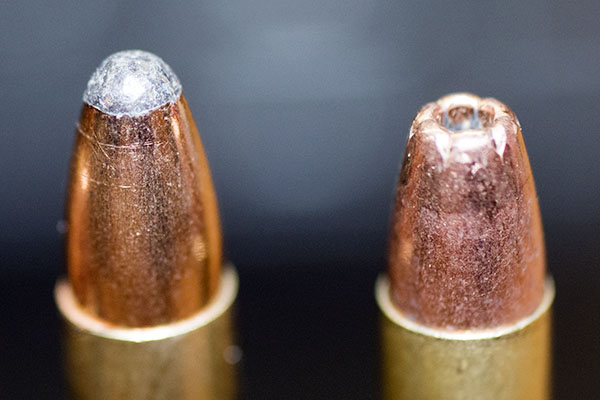
The Sierra 45-grain jacketed soft point bullet on the left, and the Speer 33-grain jacketed hollow point bullet on the right.

The Ruger No. 3 was the low-alternative to the fancier Ruger No. 1 back in the day.  The No. 1 had more figured walnut (in the 1970s, and maybe today, too), the No. 1 rifles with iron sights had fancier sights and a cool quarter rib, the No. 1 stock had a pistol grip and a rubber recoil pad, and the No. 1 had hand-cut checkering.  The No. 3 was a simpler gun, with plain walnut, an aluminum (later plastic) buttplate, no checkering, and a less-fancy iron sight setup.  In the 1970s, the No. 3 suggested retail price was $165, and you could buy them brand new all day long for $139.  The No. 1 retail price was $265, and those could similarly be had for $239.  Oh, how times have changed.  New No. 1 Rugers sell for something like $1500 today, and Ruger stopped making the No. 3 altogether.  It’s likely (in my opinion) that at some point in the not too distant future, Ruger will drop the No. 1, too.  That’s okay; it will make mine more valuable.  Not that I’m planning to sell anything.  It just feels better knowing the value is going up.

Ruger manufactured the No .3 from 1973 to 1986.  The very first one was chambered in .45 70 (a classic cartridge, to be sure), and then Ruger added two more classics:  The .22 Hornet and the .30-40 Krag.  Ruger built the rifle you see in this blog in 1978.  Ruger No. 3 rifles can still be found on the used gun market, but these days they go for about the same price as a used No. 1, which is usually somewhere between $800 and $1000.  Supply and demand, you know…they aren’t making any more No. 3 Rugers.
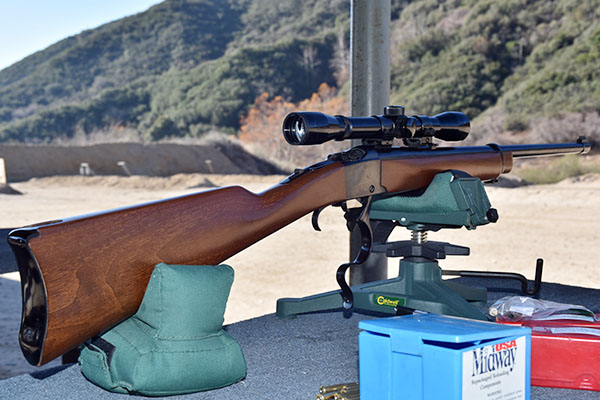
The Ruger No. 3 falling block action, with the lever open and the block in the retracted (or lowered) position.

The Ruger’s action is called a falling block because, well, it is. When you open the trigger guard/lever, the breechblock drops (it’s the silver thing you see in front of the trigger in the photo above), and that allows inserting a round in the chamber.
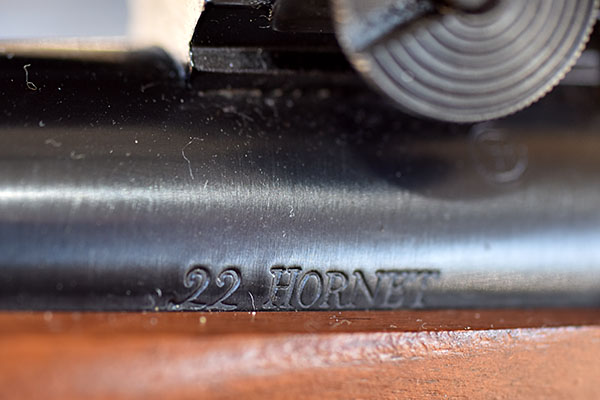
Ruger uses a distinctive font on its No. 1 and No. 3 rollmarks. This one is cool.
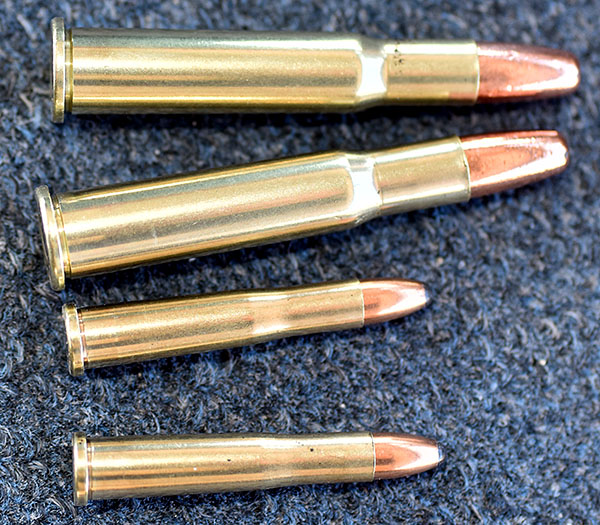
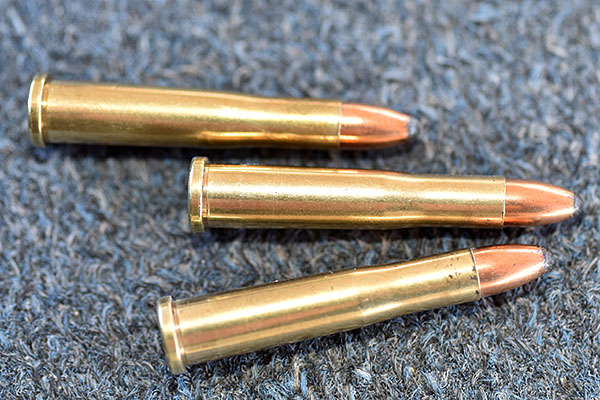
The .22 Hornet is a cute round. These are loaded with 45-grain Sierra jacketed softpoint bullets.
A sense of scale: .22 Hornet rounds next to a couple of .30 30 cartridges.
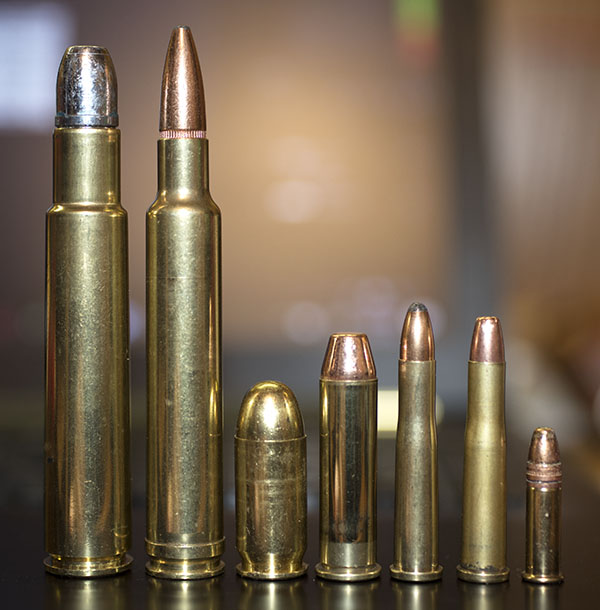
Another sense-of-scale photo. From left to right, that’s a .416 Rigby cartridge with a 350-grain cast Montana bullet, a .300 Weatherby Magnum with a 180-grain jacketed softpoint bullet, a .45 ACP with a 230-grain jacketed roundnose bullet, a .357 Magnum with a 158-grain plated bullet, a .22 Hornet with a 45-grain jacketed softpoint bullet, another .22 Hornet with a 33-grain jacketed hollowpoint bullet, and a .22 Long Rifle with a 40-grain plated bullet.

The Hornet is fun to shoot, but it’s one of those cartridges that is tricky to reload (a couple of others are .30 Carbine and 9mm; they are challenging to reload for other reasons).  Hornet brass is very thin (so you can’t reload it too many times and it’s easy to deform it when seating the bullet).  It’s hard to get the bullets started straight during the seating operation, and the whole reloading process just takes a lot more finesse than does reloading most other cartridges.  Everything is tiny.  That being said, though, I like reloading Hornet ammo, especially when good groups are the result.

So how did it go?  Not bad, I think.  Here are the results:
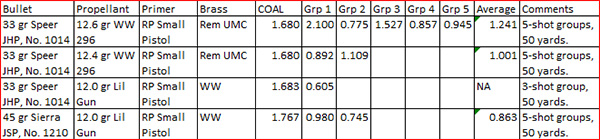
The 33-grain loads show promise.

My testing wasn’t exhaustive, and I only shot at 50 yards on this outing.  I tried a few new things with these tests.  As mentioned above, the Lil Gun propellant and 33-grain Speer bullets were two of the variables, and both did well.  I’d previously read that some shooters had better results using small pistol primers instead of small rifle primers, so tried that and it seems to be the case for me, too.  The theory is that small rifle primers, combined with the Hornet’s small case capacity, may blow the bullet out of the case before the powder can get a good burn going.  I don’t know if that’s the case or not, but the small pistol primers worked well for me.

The next steps for me will be to shoot these loads at 100 yards to see how the rifle does at that range.  The scope on my rifle is an inexpensive Bushnell straight 4X and it’s quite a bit more clear at 100 yards (it’s just a little bit out of focus at 50 yards).  We’ll see how that goes, and I’ll publish the results here.  Stay tuned, my friends.


You can read more Tales of the Gun stories here!

Help us keep the lights on:  Click on those popup ads!

A St. Francis Dam Followup

Susie and I were up in the Santa Clarita area last week and we thought we would attempt to find the St. Francis Dam site.  A quick Google search brought us to a map, we took a right off I-5 at the 126, and we soon found ourselves on San Francisquito Canyon Road.  Wow, after a bit of the burbs it grew rural real fast.   I know great roads, and folks, this is one.  San Francisquito Canyon Road is an awesome set of twisties, one I plan to return to soon on my motorcycle.

An amazing road, San Francisquito Canyon Road was, and there was a lot more of it. I’ll be back, and I’ll be back on two wheels.

We were only traveled a few miles when we came upon a large art deco building (an LA Department of Water and Power plant).  We had arrived.

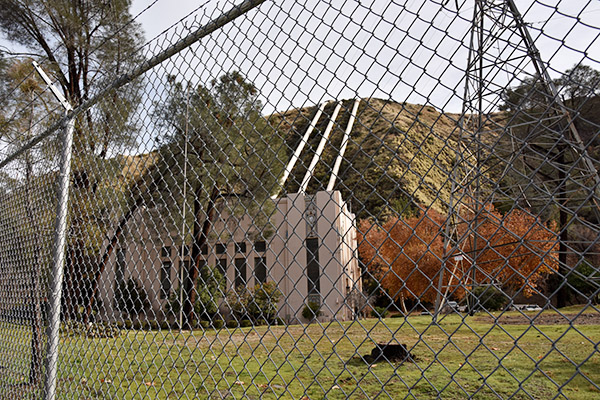
LA DWP’s Plant 2, an art deco hydroelectric generation facility on San Francisquito Road. The three huge pipes behind it carry water from the California aqueduct system.

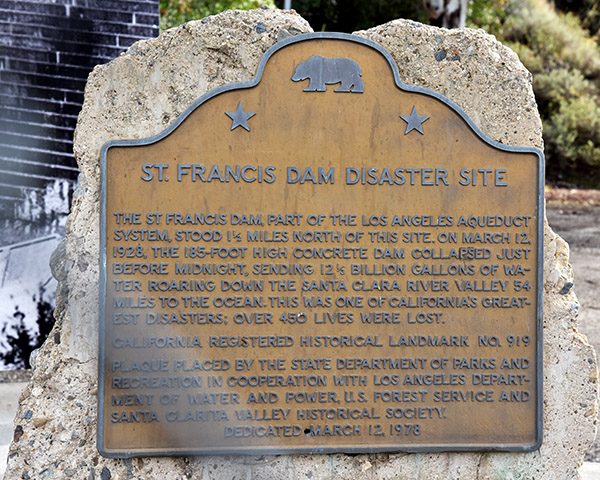
The DWP building was magnificent, and when we parked, we found this plaque:

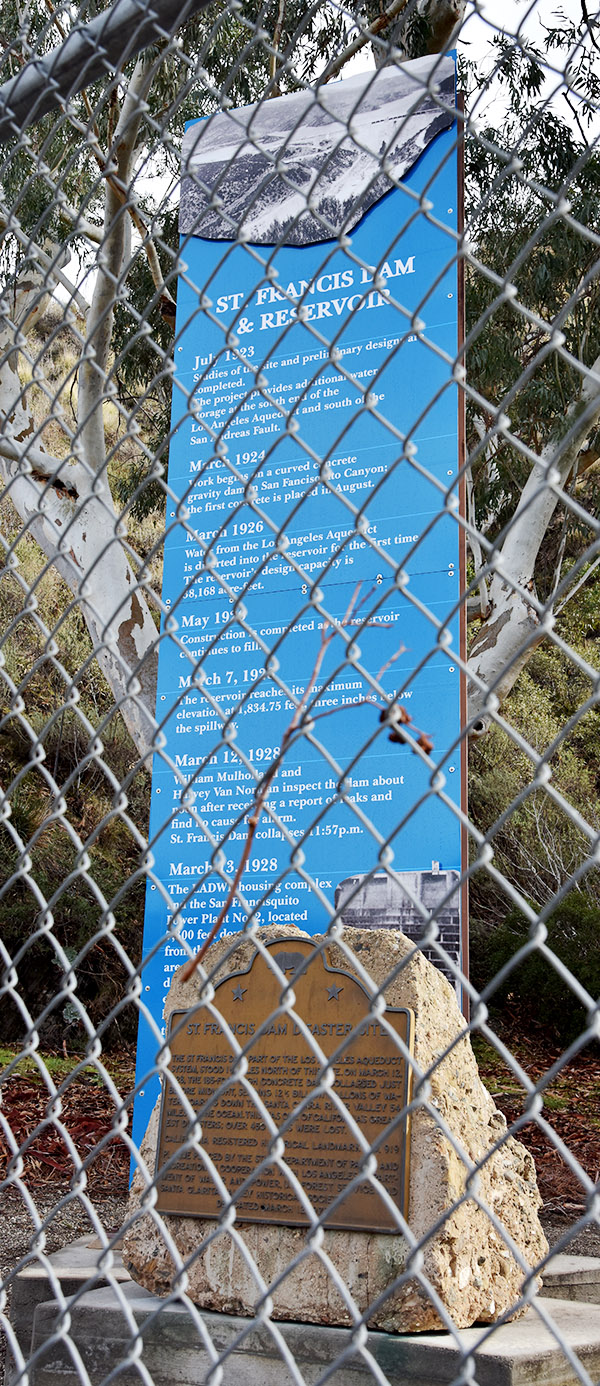
There you have it: The story, the plaque, and the location. We had arrived. Everything was behind a chain link fence, but it was still very cool. I’m going to guess the concrete behind the plaque is from the St. Francis dam.  We were standing where the wall of water released by the dam had passed.
A timeline of events leading up to the St. Francis Dam disaster of 1928.

As the plaque said, we were a mile and a half from where the actual dam had stood, so we continued north on San Francisquito Canyon Road.  The building (the one in the photo above) is a replacement…the original power plant was swept away when the dam collapsed.   I would think so; when the dam collapsed it released a 10-story tall 12 1/2 billion gallons of water.

We didn’t see the actual dam; the Internet told us it was a 5-minute hike east of the road (you can’t drive to it), and according to what we read, there’s not much of the dam left.   We drove north a little further and saw the dirt road leading to the site, but there was a gate and it was closed.  Maybe next time.

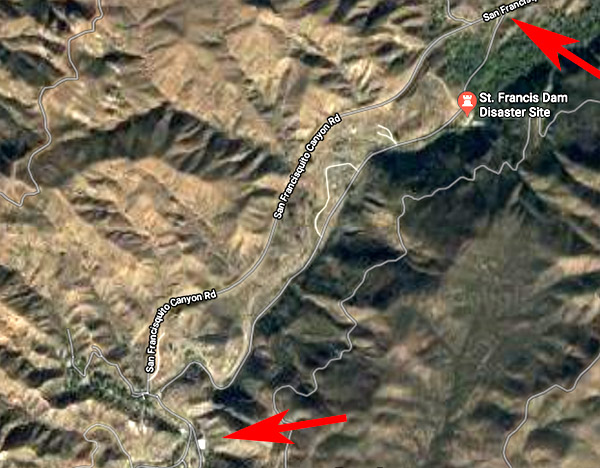
I was very intrigued by San Francisquito Canyon Road, and I wanted to know where it went.  I found this satellite photo map on Google:

The bottom arrow points to LA DWP Plant 2, the building you see in the photo at the top of this blog. The upper arrow points to our turnaround point. The site I found on the Internet said you can park there and hike to the actual dam site. The distance from one arrow to the other is about a mile and a half.  The other roads shown in this photo are all dirt.

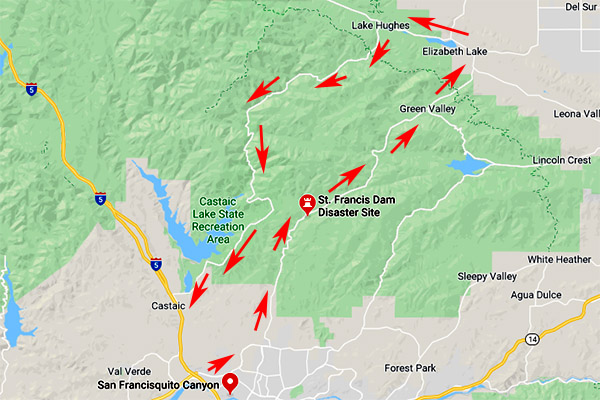
From the map, I could see that continuing north on San Francisquito Canyon Road would brings us to Elizabeth Lake Road, and from there it’s Lake Hughes Road south to get back to Interstate 5 near Castaic.   The little bit we did on San Francisquito Canyon Road showed it to be a great road.  I had ridden Elizabeth Lake Road on previous motorcycle rides (without realizing how close I was to the St. Francis Dam disaster site).  On the map, Lake Hughes Road appears to be even twistier than San Francisquito Canyon Road, and it looks like it would be a great ride.

My planned motorcycle ride: East at CA 126 off I-5, northeast on San Francisquito road to Elizabeth Lake Road, and then south on Lake Hughes Road. It’s going to be a good one.

I’m going to return to this area on my motorcycle and do the ride you see above.  It’s going to be great, and you’ll read about it right here.

Stay tuned!

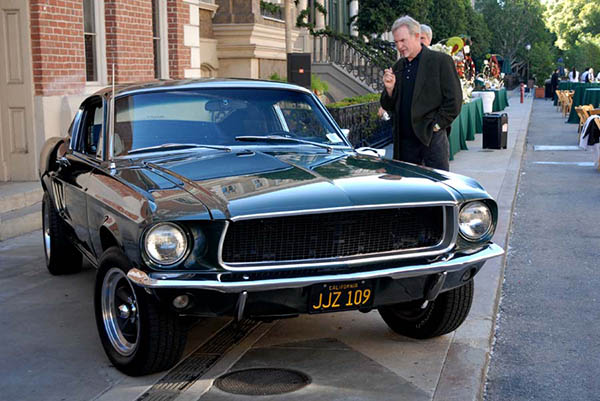
The $3.4M Mustang…

Well, it’s over…the auction for the Mustang used in the Steve McQueen movie Bullitt, the very car used in what is unquestionably the greatest chase scene ever filmed.  It set a new record for American muscle car sales.  I saw both Mustangs used in Bullitt at a Warner Brothers event celebrating the life of Bud Ekins (that story is here), and they were undeniably cool.

The Bullitt Mustang. Yeah, it was cool.  I shot this photo in 2007.

My good buddy and friend-since-grade-school Ralph predicted the Bullitt Mustang would go for over three million dollars, and he was right.  Surprisingly, that’s not the highest price ever paid at auction for an American car.  A Duesenberg sold for something around $22 million a while back.  That’s a bit more than what Gresh and I make on the ExNotes blog.  Quite a bit more, actually.

I saw Bullitt when it first played back in the day (it was released in 1968), and I’ve probably watched it a dozen times since.   My good buddy Richie and I drove into New Brunswick to see it at the RKO State movie theatre and it was electrifying.  The closest thing I’d ever seen to a chase scene that dramatic was the motorcycle chase in The Great Escape, and what do you know, Bud Ekins and Steve McQueen did the honors in that one, too.

A cherry ’70 Vette…

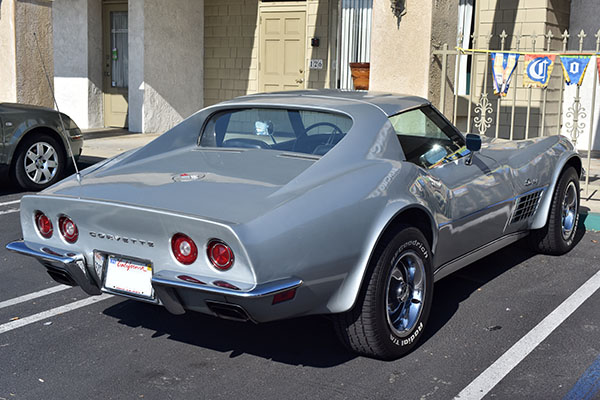
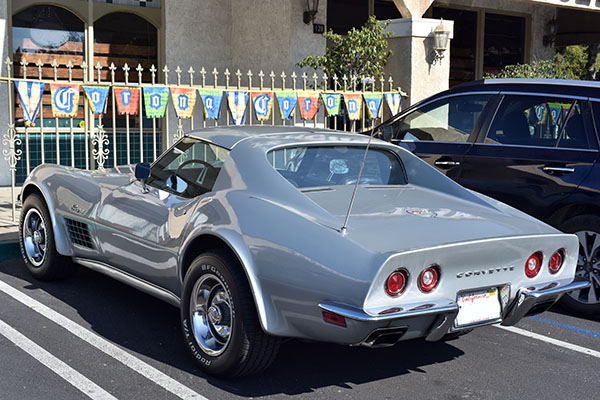
Good buddy Kirk was at our favorite Mexican restaurant a few days ago and he graciously consented to a photo or two of his 1970 Corvette.   It’s an awesome car.

I love old Vettes, and I think the C3 body style is one of the best.  I also like the C1, the C2, the C4, the C5, and well, you get the idea.  I like Corvettes.
Kirk’s Vette is from one of the lowest production years ever for the Corvette. Chevy went to the C3 body style in 1968, and Kirk told me that the ’68 and ’69 model years had so many problems that the car hit a sales trough in 1970.   Today, that translates into increased rarity for the ’70 model and increased demand.  Kirk’s car has the 350-cubic-inch motor and a three-speed Turbo Hydramatic transmission.   It’s incredibly cool and I love the look of a silver Corvette.

The Corvette you see above is 50 years old this year.   At that age, it could have its own midlife crisis, which is kind of funny as buying a Corvette is usually the result of guys having a midlife crisis.  I had a silver Corvette that I kept for 14 years (I sold it a couple of years ago).  It was a great car and I sometimes think about getting another one.  Folks would always ask me if it was my midlife crisis car, and I always told them I sure hoped so.  I bought it when I was 53 years old and I would like going for another 53 years.

Dream Bike: Triumph T160

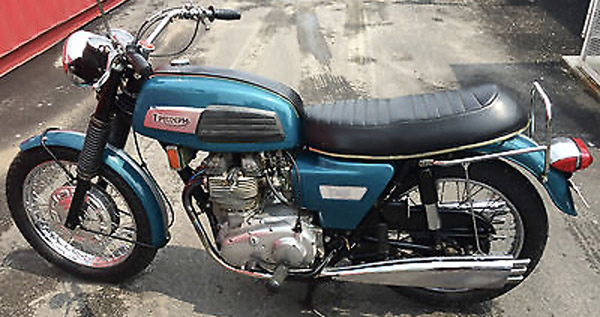
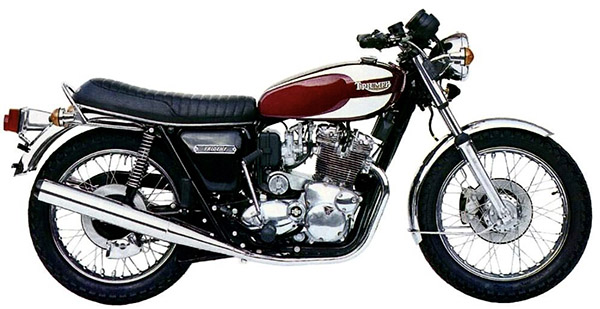
The mid-1970’s Triumph T160 is one of the best looking motorcycles ever. The swoopy tank, the perfect stance, the soft-edged thrum of its exhaust. I’ve wanted a T160 since I first saw one. They weren’t popular where I grew up so I didn’t get to see a real live 750 until they were already out of production.

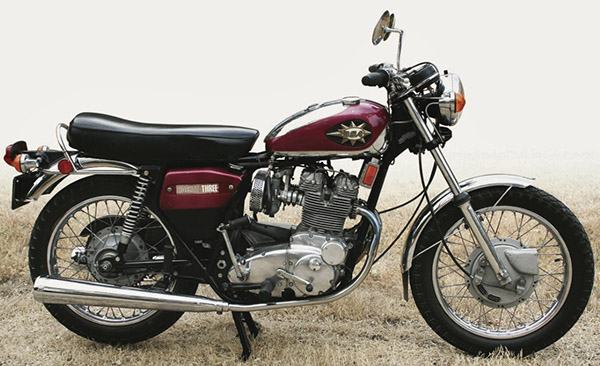
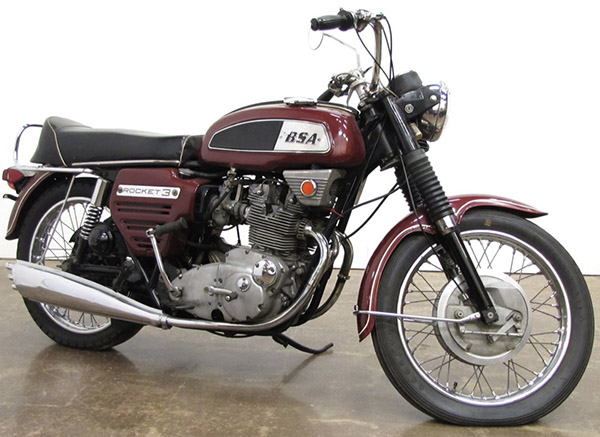
The T160’s engine is actually a BSA engine. But then again the BSA engine was a 500cc Triumph engine with an extra cylinder grafted on so who stole what? Not that it matters because the only real difference between BSA and Triumph’s versions of the 750cc three-banger was a slight forward slope to the BSA cylinder bank.

The older BSA triples are cool in a Jetsons kind of way. The square tank and the ray gun silencers didn’t sell well in the USA so BSA chromed the heck out of the thing and made it into a fire breathing hot rod. I’ve never seen one on the road, only in museums.

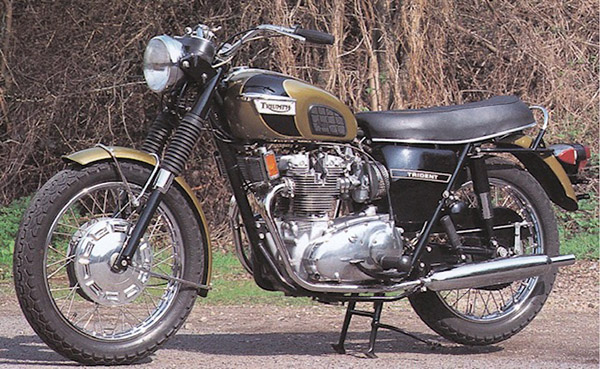
Triumph had the same problem with its modern-looking but slow selling triple. If I understand history correctly Triumph sent bodywork beauty kits to the USA to fix slow sales. These kits made the Triumph Trident look pretty much like any other Triumph made in the last 60 years.

The triple engine design consisted of typical British engineering: Why use one part when 32 parts will do the job just as well? The top deck of the crankcase had a gaping opening that the cylinder spigots fitted into. It looks weak to me. I’m surprised the crankcase doesn’t oil can at high compression levels. The center main bearing bolted in from the top, which is pretty strange. The sum of the triple’s complicated, ancient collection of parts worked amazingly well together, winning many road races against more advanced designs.

I would take any of the triples if you gave me one but the only one I would buy is the final Triumph T160 version. The T160 has an electric starter and the thing actually works on the few I’ve seen. Disc brakes front and rear means you don’t have to sacrifice stopping power to revel in the past. The styling of the T160 looks fresh 45 years after it rolled off of the assembly line. I like it better than the Vetter version.

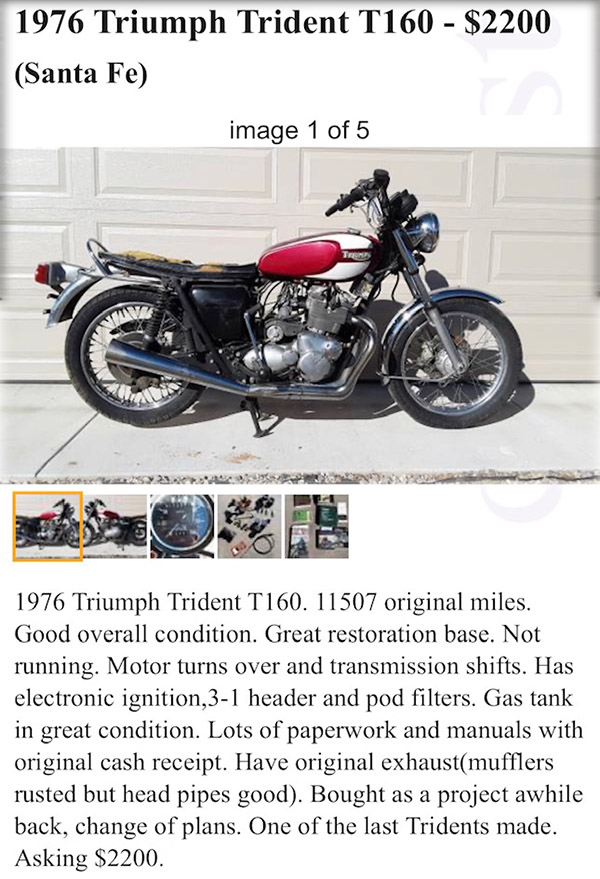
Beginning with the 1970’s Japanese Superbikes steamrolled everything in their path. When it comes to big bike, high horsepower nostalgia most American motorcyclists of a certain age go for a Kawasaki or Honda. Today, the relatively cheap price of a T160 reflects the lower esteem British bikes were held in at the time. If you want one like I do, Triumph/BSA triples are within reach of the average person. $5000 should get one in ridable condition with not-embarrassing cosmetics. $10,000 will buy a show bike. The T160 pushes all the right buttons for me and if I didn’t already have 47 projects lined up I would have grabbed this recent listing. Let me know if you need me to go pick it up for you.

What’s On Your Shelf?

Before the Internet I used to read books. Not just motorcycle magazines, although they were a great source of ideas, but real books. I shot a close-up photo of our bookshelf the other day for a Wastebook post. It was just for fun but looking at the photo I realized the impact some of the titles had on my typing. I never started out to write. I never dreamed of writing the Great American Novel. I fell into typing by osmosis and now I can’t stop. Once I was roped in I mostly tried to emulate my favorites. Find a writer you like and think like them. I don’t try to copy or mimic my favorites, I channel them as I type.

First up is A Confederacy of Dunces by John Kennedy Toole. Mr. Toole killed himself long before ACOD was published. It pisses me off that he chose that path for strictly selfish reasons: I wanted to read more of his stuff. ACOD is a huge, rambling thing full of recognizable personalities, disgusting situations and incredibly funny passages. The Levy pants story will be pleasing to anyone who has held a job (no matter how briefly) and the hot dog cart bit is familiar to anyone who ever tried to sell Christmas cards door to door.

The Best of S. J. Perelman is a collection of essays from The New Yorker. This is a guy you will want to steal from after the first verb. People will look at you like you’re crazy when reading this book on an airplane because you really will be laughing out loud. (Not to be confused with the nearly meaningless LOL, which is often used on the web for things that aren’t actually all that funny.) Perelman’s short bits cover a wide range of topics but always end up absurd. If I could write as well as him in today’s media environment I still wouldn’t be making any money but at least I’d have cigarettes.

The Portable Dorothy Parker is another collection of stories written for The New Yorker. That mag must have been something. At a time when women were routinely named Dorothy she did play reviews, poems, screenwriting and managed to get herself blacklisted. Less bitter than H. L. Mencken, Dorothy’s stories can be safely read both by people with suicidal tendencies and regular folks.

It seems like there are a lot of collected works on this shelf. CT organized it. The unseen hand of her masterful brain is behind the curtain. Anyway, don’t blame me. The Best of Robert Benchley is another collection in the smart, funny but down to earth mold. Benchley also wrote for The New Yorker (what a murderer’s row!) and he dabbled in Vanity Fair during slack times. When these stories were originally written the intention was to parcel them out slowly. Each issue of The New Yorker was an event. Best-Of collections hit you with a fire hose of quality that overwhelms your brain and maybe numbs your senses a bit.

The Commitments, The Snapper and The Van are three full-length books crammed into one small space. I’ve read The Commitments and The Van for sure. I can’t remember if I read The Snapper so I’ll have to get my magnifying glass out and check. If you only have time to read one of these stories by Roddy Doyle make sure it’s The Van. The Van is like Trainspotting except with food trucks instead of heroin.

The Best Short stories of O. Henry should be required reading for anyone thinking of writing for fun or…fun. O. Henry invented the ending-with-a-twist that featured large in last century’s story telling. We seem to have gotten away from these surprising finishes like, “Darn! She shouldn’t have cut her hair!” Now stories just kind of fade out with a pale, rictus arm reaching out of a lake or it’s revealed that the two main characters are father and son.

Finally, we come to Hunger by Knut Hamsun. This book was published in 1890 yet the ensuing 130 years have not dulled the edge of the humor in this book. Fittingly for this blog, the protagonist is a failed writer and we follow his slow starvation and descent into a delirium world. It’s funnier than it sounds. If you want to be a successful writer, learn a trade is what I took away from reading Hunger.

These are some of the books I use as inspiration when I’m faced with replacing a transmission in a Jeep or trying to work the self-checkout in Wal-Mart. At the emotional level, living in today’s world is no different than when these authors were writing. Life still becomes more ridiculous the deeper you dig into the thing and all we can do is shake our heads and crack wise. Wait here while I go sell my pocket watch.

The 2020 MacManus 1911

Stainless steel barrel, Parkerized finish, fixed sights, checkered wood grips, arched mainspring housing…the Springfield Armory Mil Spec 1911 gets the nod for the 2020 Colin D. MacManus Award to be presented later this year to a graduating cadet in the Rutgers University Reserve Officers Training Corps.  We reviewed the offerings from several 1911 manufacturers and I have personal experience with the .45 autos from many of them.  The Springfield Armory Mil Spec 1911 is the clear winner from several perspectives, not the least of which are accuracy, reliability, and close adherence to the US Army 1911 configuration.  I own a Springfield 1911, and three of my good buddies bought this exact model.   One of them is my friend Greg, and I’ve seen his gun shoot one-hole, 5-shot groups at 50 feet.  With any handgun, that’s as good as it gets.

The MacManus .45 shipped yesterday from the Springfield Armory factory, and it is on its way (through a New Jersey FFL, of course) to its new owner.  We’ll write about that when it happens, so stay tuned!


Click here for the story on the Colin D. MacManus Award.


Click here for more cool stuff on the 1911 and other great handguns.


Subscribe to ExNotes and keep up with all the good stories!

Jay Leno

Susie and I saw Jay Leno this weekend at the Cerritos Center for the Performing Arts and he was great.  The 90-minute show felt like it passed in a heartbeat, and I guess that’s the sign of greatness.  I laughed so hard my sides hurt.

I’ve seen Jay Leno in person several times at motorcycle events over the last few years, and I was surprised when writing this blog at how many photos I had.  He’s a regular at the Rock Store on Sunday mornings, and it was at the Rock Store where I first saw him in person.  He had arrived on his Y2K Huey-helicopter-jet-engine motorcycle before I did, and I didn’t realize he was there until I heard the characteristic whine of the Huey engine when he fired up his bike to leave.  It was pretty cool.

Jay Leno on his jet-powered Y2K motorcycle at the Rock Store.
Another shot of Jay Leno on his Y2K. I didn’t realize it when I grabbed this quick photo, but I caught my own image in Jay’s faceshield.

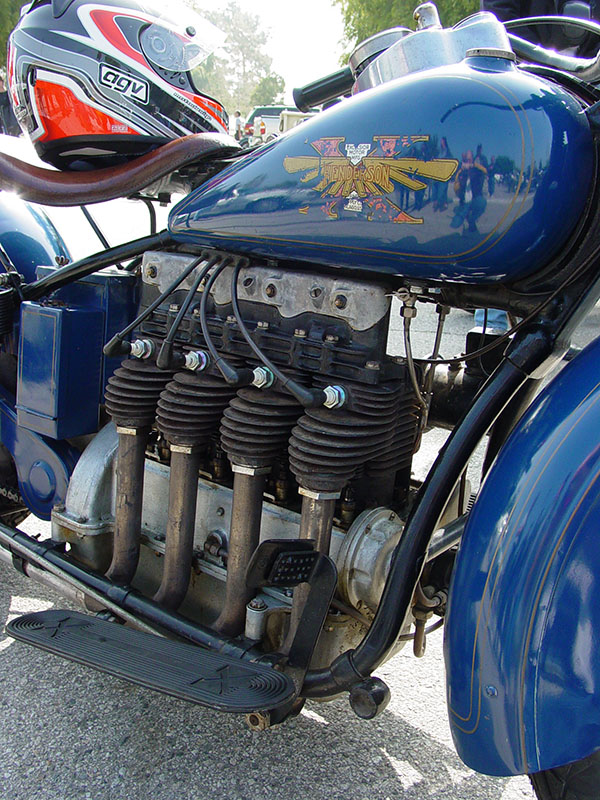
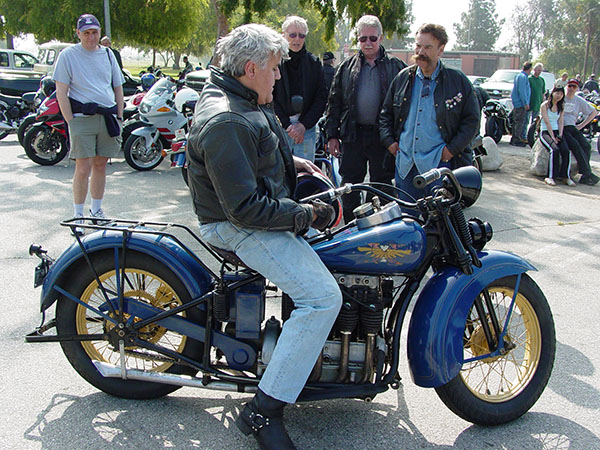
On another occasion, good buddy Marty and I were at a Hansen Dam Britbike bike get-together.  Most of the folks had already left for the classic bike run through the mountains when I saw this very classic vintage Excelsior enter the parking lot.  I was focused on the bike, as I could see it was unrestored but still in very good condition.

An unrestored but pristine Excelsior Four. It was an impressive motorcycle.

I was snapping photos while the rider was still on the machine, with no idea who he was.  When the helmet came off, though, there was Jay Leno.  For a few minutes, it was just him and me.  “Hi,” I said.  I can be very articulate sometimes.

“Hi back,” Jay responded, and then the standup started, from a world famous comedian sitting on a nearly-80-year-old motorcycle.  “It’s a ’36 Excelsior.  I got a call from a 92-year-old guy in Vegas getting a divorce and he needed to raise cash,” Jay said.

“Really?”  Like I said, I have a way with words.  Leno just smiled and shook his head.  It’s not often people can fool me, but if it’s going to happen, I guess if it’s Jay Leno it’s okay.

Jay Leno. Up close and personal at Hansen Dam. That motorcycle was unrestored.

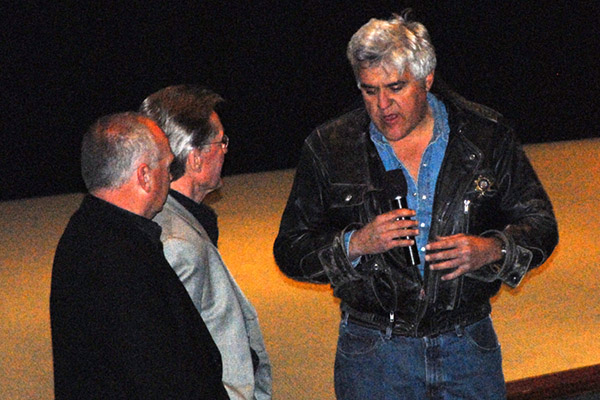
On another occasion, good buddy Marty and I rode to an event celebrating the life of Bud Ekins, the guy who brought Steve McQueen into the motorcycle world and went on to become one of Hollywood’s greatest stunt drivers.  Jay Leno was one of the speakers at this event (it was at Warner Brothers Studios), and I was able to get another photo.

Jay Leno speaking at Warner Brothers Studios. The guy on the left is Harvey Weinstein.

Here’s one last photo, and it’s another one at the Rock Store.  When Jay Leno arrives, he’s always by himself and he’s immediately mobbed by folks wanting autographs and photos.  That’s lasts for 15 minutes or so, Jay is always gracious, and then the crowd leaves to let him just poke around, looking at the bikes and making small talk like everyone else.  What always impressed me was that Jay Leno is completely unpretentious.  He’s just one of the guys.   My good buddy Dave Walker and I had ridden to the Rock Store on our Harleys when Jay happened by, and I asked him if I could get a photo with Dave.  Jay was on it in a New York minute, I probably took 20 photos, and Mr. Leno kept up a running banter the entire time.

After Jay left the Rock Store that day, I’m sure he spent the next several days telling folks he met Dave Walker.

I’ve seen Jay Leno a few other times when I didn’t grab photos, and he’s always the same nice guy, and he’s always good for a laugh.   He is exactly the guy we used to see every night on the Tonight show.  At the Love Run one year, he was the emcee and he asked if anyone had seen his buddy.   “He’s wearing a Harley T-shirt, he has gray hair and a beard, and he’s got a pot belly…”

Jay is still out there and he’s still doing standup.  And he’s still funny.   If you ever get a chance to see him, take it.   The guy does a great show, and it’s not an act.  He’s the real deal.

Book Review: Unleashing Engineering Creativity

Can you do that?  Review a book that you wrote?  Hey, Gresh and I write the blog.  Why am I even asking?

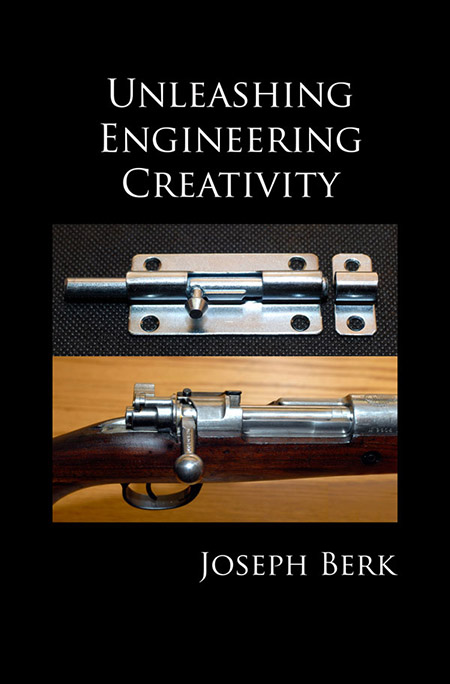
The book is Unleashing Engineering Creativity, and it came about as the result of a course I teach on engineering creativity.   The cover photo you see above popped up on my Facebook feed yesterday (there’s old Zuckerberg, thinking of me again).  So I shared the picture, and somebody made a comment that they didn’t understand the photos.

Okay, here’s the deal.  Paul Mauser is widely credited as the guy who invented the bolt action rifle, and as he told the story, the idea came to him when he observed a simple gate latch (like you see on the book cover above). That led to a long line of Mauser and other bolt action rifles (but Mauser was the first).  The one in the photo above is a Modelo 1909 Argentino Mauser, arguably the best version ever of the famed Model 98 Mauser (I have one and it is phenomenally accurate).  The gate latch?  That came from Lowe’s.  I bought it to shoot the above photo.

You might think that engineers sit around in white lab coats and think deep thoughts when they need to invent something.   It actually doesn’t work that way.  No engineer worth a damn sits around very much, and when we have to invent things on demand, we’re usually not very good at it.  In most companies, engineers just spitball it.  You know, what we euphemistically call brainstorming (it’s no accident that the initials are so appropriate; it’s not a very effective way to come up with new designs).

The bad news is that we (as human beings) are at our most creative when we’re about 5 years old, and we lose much of our natural creativity (over 90%, according to the experts) by the time we finish high school.   More bad news is that our creativity continues to erode after that.  Bad news indeed, but the good news is that there are a  bunch of great techniques we can use to get our creativity back.

One such technique is called TRIZ.  It’s an acronym for a bunch of Russian words I can’t pronounce, but basically it means we define the problem we are trying to solve and then we look into other areas in other fields to see how they solved the problem.  Like Paul Mauser did when he invented the bolt action rifle.  TRIZ is a little more complicated that, but you get the idea.

Unleashing Engineering Creativity has 17 different approaches for improving creativity.   It’s an expensive book, but if you’re looking to make the next technological breakthrough, the book’s cost is trivial.  Like I always tell people: Don’t wait for the movie.  I suppose I could do a YouTube video on some of the concepts.  Maybe later.  That YooHoo review still needs doing.


Sign up for free blog notifications!

Movie Review: The Forgotten Tragedy

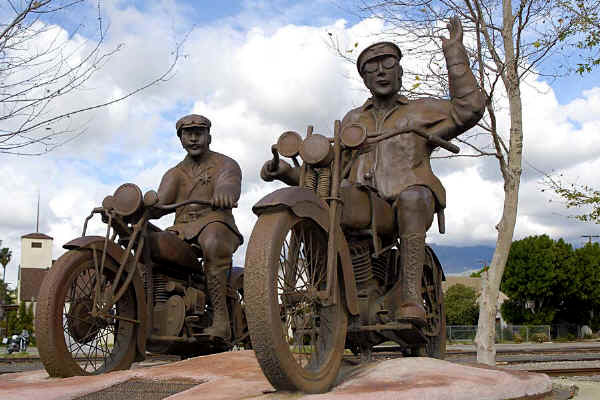
Last year we wrote a blog about The Warning, a statue honoing two motor officers who came to be known as the Paul Reveres of Santa Paula.   The statue was an unanticipated discovery on a motorcycle ride through Santa Paula, and it had my attention because it’s not the kind of monument you see every day.

The other night Sue and I were flipping through the movies on Amazon Prime, and to my great surprise one I had not seen before popped up:  The Forgotten Tragedy:  The Story of the St. Francis Dam. 

You know, I’m embarrassed to admit that when I first saw that statue in Santa Paula 10 years ago, I had never heard of the St. Francis Dam and its collapse.  I grew up on the east coast, and there’s a lot we never heard about back there.  It took a little digging for me to learn about California’s second largest disaster ever (the only event involving greater loss of life in the Golden State was the San Francisco earthquake), so the idea of a movie on the St. Francis Dam and its collapse had my immediate attention.   The Forgotten Tragedy is a documentary and it’s very well done.  It even included a bit about the motorcycle officers in the above statue (although it only mentioned one).

Trust me on this, my friends.  The Forgotten Tragedy:  The Story of the St. Francis Dam is worth viewing.