Stranded in Baja, Hearst Castle, and more…

Every once in a while we do a blog that covers a bunch of topics, and this is one of those times.

Good buddy Mike Huber and his friend Bobbie motorcycled Mexico (Baja, to be specific, almost another country all by itself), and he most recently published an excellent story about being stranded down there by the Covid 19 pandemic.  It’s not often that we recommend another blog, but hey, Mike’s writing is outstanding and it’s a great story.  Take a look; it’s very good.

My favorite motorcycle magazine (that would be Motorcycle Classics) sends out marketing emails on a regular basis, and in those emails they include links to past (and sometimes recent) articles.  I write for MC, and the most recent email that slipped into my inbox included a link to my Destinations piece on Hearst Castle.   You might want to read that story; I love Hearst Castle.  It’s closed for the pandemic, but the pandemic won’t last forever.  Hearst Castle will be there when it’s over.

We’re having a heat wave (both here in the Peoples Republik of Kalifornia and at Tinfiny Ranch).   That prompted us to start a piece on riding in extreme heat.   My first recommendation would be:  Don’t.   But things don’t always work out the way you want them to.  I once rode the length of Baja on a Mustang replicas with several friends, and due to a lack of research on my part we did the ride in Baja’s hottest month (and that’s September).  You can read about the 150cc Baja ride through Hell here.  Do you have any advice for riding in high temperatures?  Please share them with us (info@exhaustnotes.us) and we’ll include your recommendations here on the blog.

We have more motorcycle, gun and other stuff coming up, including info on Ruger’s new Custom Shop and their Super GP100 .357 Mag revolver, favored loads in the Henry .45 70 Single Shot, a piece on Turnbull’s iconic color case hardening and restoration services, a stunning (and tack-driving) Kimber with exhibition grade French walnut, the wrap-up of our ride through the Andes Mountains in Colombia, the Canton Fair, and for you fans of The Ten Commandments, making bricks without hay and mortar.  And a whole lot more.

Stay tuned, folks.

Book Review: Revolver

My daughter buys books for me, and she has a knack for finding great ones she knows I will enjoy.  The latest in a long line of successes is Jim Rasenberger’s Revolver:  Sam Colt and the Six-Shooter That Changed America.  I enjoyed the book on many levels because I’m a shooter, I like biographies, I’m a student of business success, I like to read about mechanical things, and I love history (especially the history of the American West).  Revolver checked all the boxes.

Samuel Colt was anything but an overnight success, but successful he sure was.  He was one of the key figures in our Industrial Revolution, and he made the concept of interchangeable parts and mass production work well before Henry Ford came along.   Colt started out as sailor on a merchant vessel, he became a huckster selling laughing gas exhibitions, he failed at his first attempt to build a firearms manufacturing business, and then he succeeded wildly when he worked with Samuel Walker, the Texas Ranger who guided Colt’s design of the famous Colt Walker.  Revolver delves deeply into all this, including the Colt Walker story, and a grand story it is.

On that topic of the Colt Walker:  The Walker was the .44 Magnum of its day, a gun so over-the-top in size and power that as Colonel Colt observed, “it would take a Texan to fire it.”  I always thought it would be cool to own a Walker, but Colt only made 1,100 of them, and originals don’t come up for sale too often.  The last one that did went for over a million dollars.  The blogging business is good, folks, but it ain’t that good.

Robert Duvall as Gus MacCrae in Lonesome Dove, the greatest story ever told (in my opinion). Gus carried a Colt Walker.

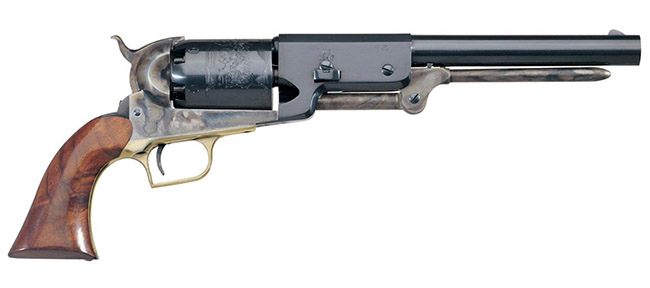
Uberti, a company in Italy, manufactures a replica of the original Colt Walker, and reading Revolver gave me the push I needed.  I ordered one this morning.  Good buddies Paul and Duane are both black powder aficionados, and I figure they can give me the help I’ll need learning how to load and shoot these historical weapons.

Uberti’s modern copy of a Colt Walker (one of these is headed my way). Colt manufactured just over a thousand Walkers in 1847-1848. Originals sell for something north of a million dollars.

If you’re looking for a good read, pick up a copy of Revolver.  I believe you’ll enjoy it.


More Tales of the Gun are here, and more product, book, and movie reviews are here.

Cast Bullets in a 7mm Magnum Ruger No. 1

A 200th Year Ruger No. 1S in 7mm Remington Magnum. With factory-level jacketed bullet loads, recoil is attention-getting.  With cast bullets, this magnum is a lot easier to shoot.  I shot cast bullets for the first time in this rifle this week.

When I was younger, I made my own bullets by casting them out of molten lead.  I cast bullets until I decided there wasn’t enough time to do everything I want to do.   Shooting can be a full time hobby, reloading can be a full time hobby, and casting can be a full time hobby.  There’s a little motorcycle riding and some writing thrown in there, too.  Something had to give, so a few years ago I sold all my bullet casting gear.

I still enjoy reloading and shooting cast bullets, though, for a lot of reasons.  Lighter recoil, cheaper bullets (usually), less barrel wear, and the big factor:  It’s fun and it’s challenging.  This fascination with cast bullets, for me, started when I ran with a bunch of gunsels in El Paso and one of the guys decided it would be fun if we had a cast bullet rifle bullseye competition.  Being mostly engineers, we reckoned that big bore rifles would be the way to go, as the larger bullet diameters and weights would tend to make bullet weight differences and imperfections negligible.  The first rifle I ever shot a cast bullet in was a .458 Win Mag.  I was hooked after the first shot, mostly because there was far less recoil than shooting jacketed factory ammo and the experience was much more enjoyable.  Then I fired four more shots and when I saw the 1-inch group at 100 yards (from a .458 Win Mag!) I was hooked.  We all shot big bores in those days:  .458s, .45 70s, .375 H&H Magnums, and such.  Cast bullets in these big calibers can be amazingly accurate.

Anyway, I fell in love with cast bullets and I’ve been shooting them ever since, but these days I buy my cast bullets.  I have a local source for cast bullets, and I have a few I like that I order online or pick up at my dealer (that’s Phillips Wholesale in Covina, California). I also poke around a bit on the Internet and a few weeks ago I found Gardner’s Cache, another commercial bullet casting operation.  What had my attention immediately is that Jim Gardner’s prices are relatively low, he’s a veteran, and he had something I had not been able to find elsewhere at a decent price:  7mm cast rifle bullets.  I wanted to try cast bullets in a couple of 7mm rifles (one being the Ruger No. 1 that you see at the top of this blog), so I ordered a box of 250.  Then USPS lost the shipment.  I filled out an online lost shipment report, the boys in blue located my bullets, and a few days later they arrived.   The Gardner bullets look great.

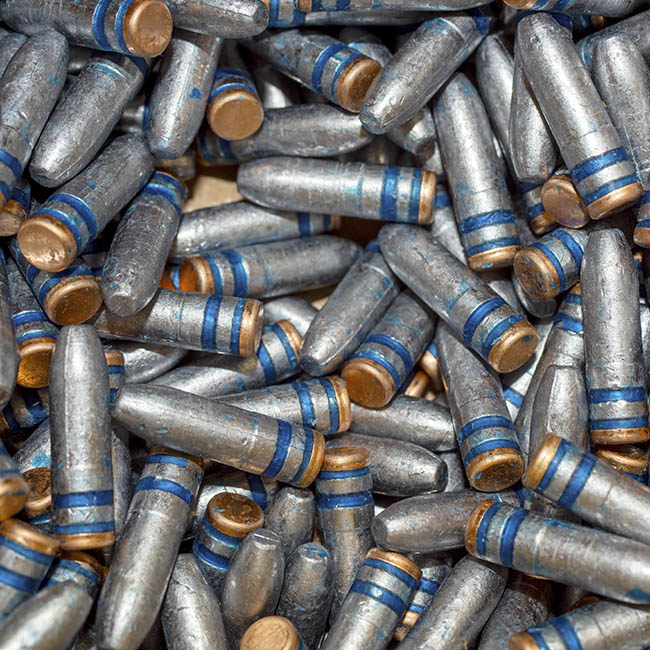
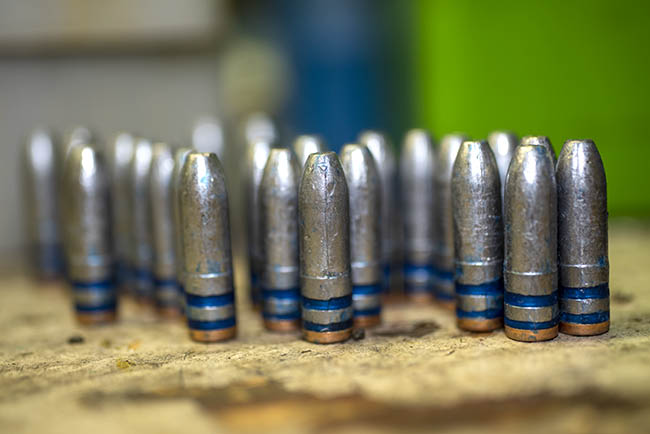
Beautiful cast Gardner 7mm bullets. Casting quality is high, and I was hoping accuracy would match. It did. I’m a happy camper.

I could see that the casting quality was high, so just for grins I measured 30 projectiles to get a feel for the variability.

In 30 bullets, the range of weights did not exceed 1.6 grains. The mean is the average weight, and the standard deviation is a measure of the variability around the average value.

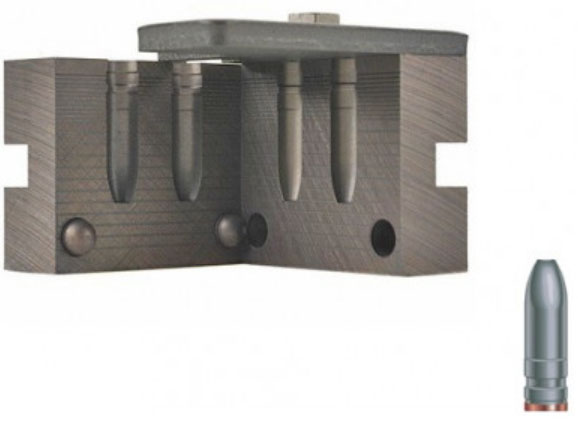
It was good.   You ordinarily get a lot more variability with cast bullets then you do with jacketed bullets, but the Gardner bullets were more consistent than other cast bullets I’ve used.  As I reviewed the data, it suddenly hit me that these  were supposed to be 145-grain bullets.  I could see from the bullets’ configuration that they matched the RCBS No. 82150 bullet mold, but what the mold maker tells you the bullet is supposed to weigh and what they actually weigh seldom line up.  I had seen this before with other cast bullets.

The RCBS No. 82150 bullet mold.  It’s not uncommon for the specified bullet weight to be different than what the mold actually throws, and that was the case here.
I like these bullets so much I had to grab another photo of them. The copper cap at the bullet’s base is called a gas check. It protects the back of the bullet from hot propellant gases and reduces barrel leading. The blue stuff is bullet lubricant, which eases the bullet’s passage through the bore and also helps to reduce leading.

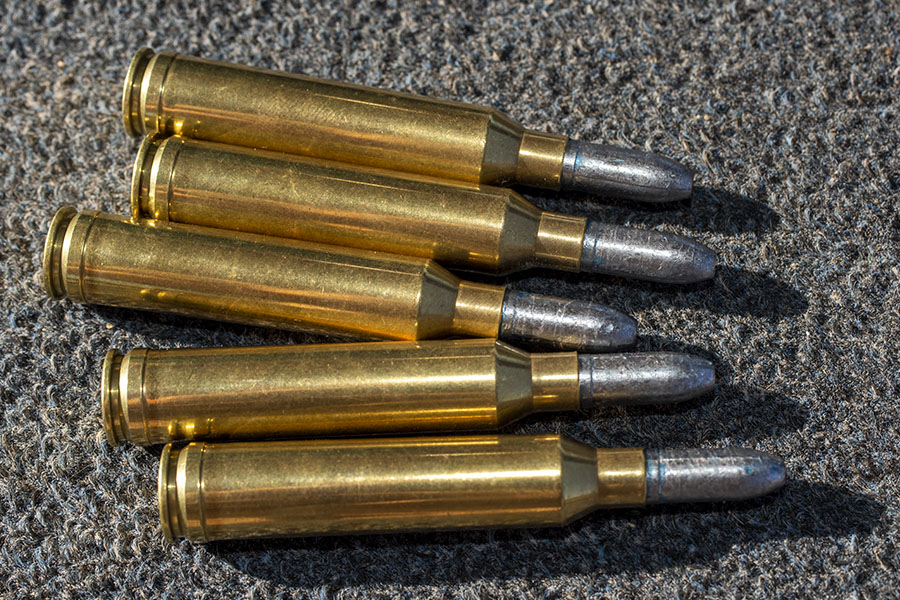
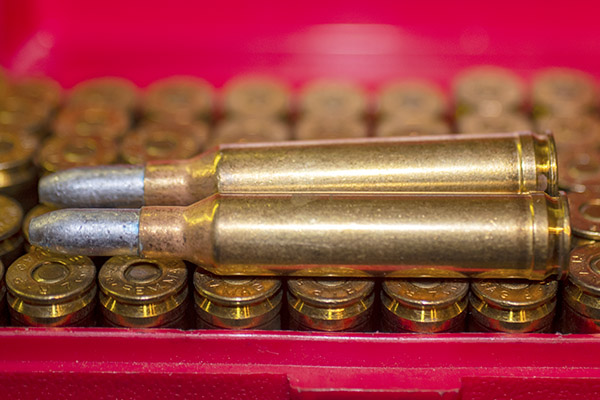
I loaded several configurations with my new Gardner cast bullets in virgin Remington brass I had on the shelf, and the cartridges looked good.

Loaded 7mm Remington Magnum ammo, waiting to be range tested. You can’t buy this kind of ammunition; you have to reload your own.

I went to the range the next day with the 7mm Remington Magnum Ruger No. 1 and my new cast bullet load, and after getting set up I fired the first load (with Unique propellant) at a single pistol target at 50 yards.  The rifle had been zeroed for a factory equivalent jacketed load, and the results were very predictable.  Whenever I’ve taken a centerfire rifle zeroed for factory ammo and shot cast bullets in it, the load is always about 10 inches low at 50 yards.

Two good groups (both around 1.5 inches) at 50 yards. The low group was fired with the scope still adjusted for jacketed ammo, and it was predictably 10 inches low. 80 clicks up on the Weaver and we’re in the money.

The required telescopic sight adjustment in going from jacketed to cast is something I know by heart:  80 clicks up.  You can see the first five-shot group at 6:00 in the 5-ring on the above target.  Windage looked about right, so I went 80 clicks up on the Ruger’s Weaver 3×9 scope.  Each click is 1/4-inch at a hundred yards so that means a click is 1/8-inch at 50 yards, and I had to go up 10 inches.  10 inches is 80 clicks.  I made that adjustment and oila, the second group was right where I wanted it.  It was exactly the same as the amount of elevation I had to crank into my .30 06 Browning B78 when going from jacketed to cast bullets.

Then I moved over to the other targets I had set up at 50 yards.  I’d like to tell you that all groups were tight, but hey, you do this to find out what works and what doesn’t.  My best group of the day was with 18.0 grains of Trail Boss propellant, but it wasn’t as consistent as the Unique load was.

Not bad, but not consistent. The next group with this same load was 3.140 inches. Was it me, was it the rifle, was it the bullet, or was it the load? We’ll find out on the next outing.  This might have been a 1.6-inch group at 100 yards, and that ain’t bad.

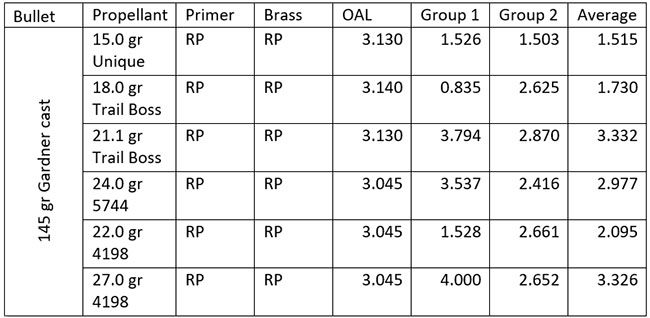
Here’s what I experienced with the first six loads I’ve tried with these bullets.   Yep, there’s a lot of variability on some, but I’m encouraged.

Accuracy results from the first six loads I tried with my 7mm Remington Magnum cast loads. I’ll focus primarily on Unique and Trail Boss, and seat the bullets out a little further for a longer overall cartridge length on the next set of loads.

I’ve already loaded more 7mm ammo with the Unique and Trail Boss loads, and I’m also going to try IMR 4227.  I don’t think that 4227 will do as well as the first two loads, though.  We’ll see.  After that, I’m moving the targets out to 100 yards.   That will be interesting, and when I do, you’ll see the results here on the ExNotes blog.

I already used about half of the 250 Gardner bullets that came in the first box.  The results in my Ruger No. 1 made me a happy camper and I ordered another 1000 7mm rifle bullets a few days ago.  If you want good cast bullets at a great price, you might take a look at Jim’s website.


More Tales of the Gun are waiting for you here!


Never miss an ExNotes blog!


Hit those pop up ads!

4 Things You Need To Survive Motorcycle Touring With Covid-19

With the advent of a killer virus sweeping the nation, traveling long distance by motorcycle has become more complicated. We used to hop on our motorcycles, ride all day and then in the evening get a room at the cheapest motel we could find. Those days are over. Don’t get me wrong; motels are still an option, much like Russian roulette is a fun parlor game. Go ahead, pull back those sheets and crawl inside. Did the maid really disinfect the room? Was the last traveler teeming with the virus, coughing and spitting his way to sleep? What can you touch and what can’t you touch?

Nowadays to go anywhere far on a motorcycle you’ll need to be able to camp, and not at commercial campgrounds either. Campground bathhouses were never a sterile environment in the first place, now they seem like a damp Club Med for viruses. I’ll take my chances with the bears, you know? I’m talking rough camping: riding into a National Forest, finding an out of the way spot with nice soft grass and bedding down for the night.

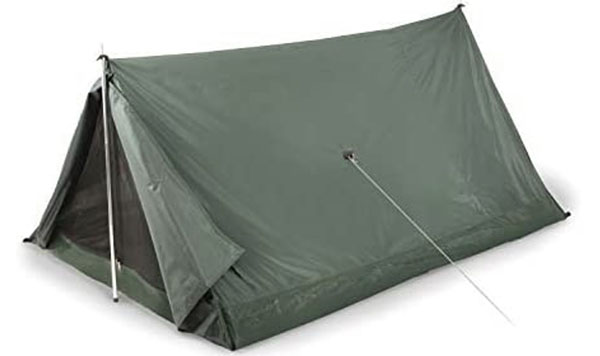
The first thing you’ll need is a tent. In my younger days I spent many uncomfortable nights sleeping out in the open. I’d pull over, toss a plastic tarp on the ground and just lay down. That was the full extent of my camping preparation. I’ve since learned that biting bugs, rain and animals make having a tent the way to go. I bought this small, old school style pup tent because I’m done setting up the flex-pole igloo type tents. Small pup tents are smaller and lighter than igloos and there are too many stressed elements in an igloo. Every Igloo tent I’ve owned ended up tearing.

I’m going to assume you already own a sleeping bag (everyone should). In addition to the sleeping bag an air mattress will drastically improve your chances of falling asleep inside that claustrophobic pup tent. If you’re 20 years old you could probably forgo the air mattress. I’m using one with a built in pump instead of the self-inflating type for two reasons. Number one is an inflatable packs down much smaller than a self-inflating type. Number two is the self-inflating pads compress and after a few minutes you’re on the ground anyway. The need to keep the size and weight of your camping gear to a minimum will become apparent when you start loading your motorcycle.

Hard-core riders can get away without a camp stove but I’m not a hard-core rider. I need my coffee in the morning or a can of warm soup in the evening. Unfortunately, while the burner itself is tiny, carrying one of these small, gas-powered stoves requires a bunch of other gear. I have one pot to boil water or soup, extra water to clean up the mess and then there’s the gas bottle, which is like three times the size of the camp stove. Not to mention the stuff you are going to cook. It’s a space and weight commitment you may not want to make. Plain old water and candy bars will work fine if it’s only a one-night road trip.

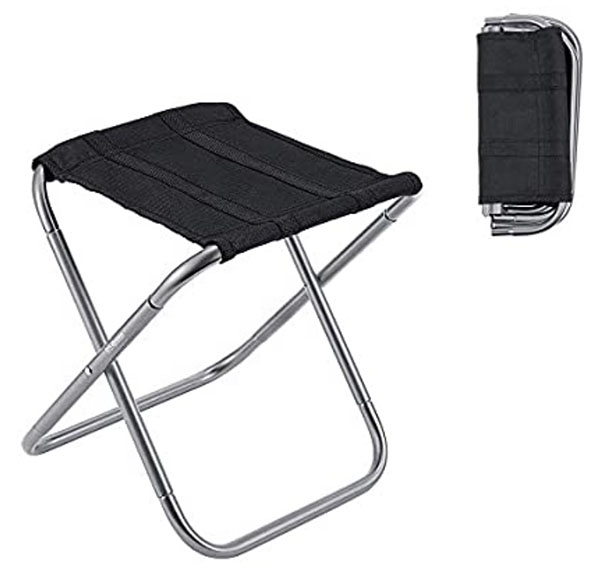
Now we are getting into purely luxury items. When you rough camp in the forest there are never picnic tables, benches, fire rings or screaming children. This type of folding camp chair can really make a campsite feel like home. There are two basic styles of small camp chairs, the tripod type and the X type. I prefer the X-type because they are less prone to sink into soft ground…like the ground you find in a forest. The tripod type is much easier to fold up so you’ll have to make your choice based on terrain and patience level.

All the gear in this story can be purchased for less than one night’s stay at a motel so there’s the cost savings to be considered. I can pack everything in one medium-sized stuff bag and bungee the mess to my motorcycle. It’s not an easy way to travel for sure but with many national and state parks closed now it’s about the only way to travel. I’ve recently purchased all the camping gear you see above attempting to make my pack smaller and lighter. And I’ve succeeded: It’s easily half the size and weight of my old camping gear. I’ve yet to use it in anger but that will change soon. My riding buddy Mike and I are going on a several day ride and since we are old, lung impaired and clinging to life by a thread we both feel like rough camping is the safest option Covid-wise.


Catch up on our most recent blogs here!

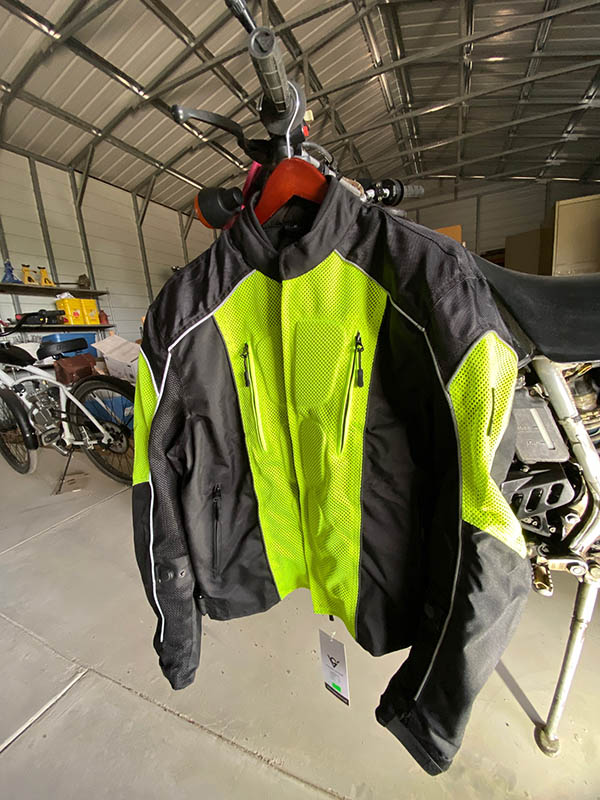
Hasty Conclusions:  First Look at Viking Cycle’s Warlock Jacket

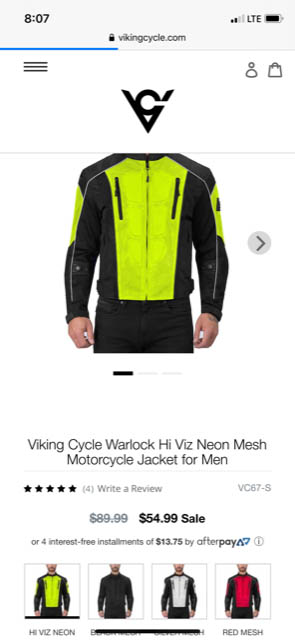
 Viking Cycle sent Joe Berk a new jacket to test and since I’m the loyal, half-witted sidekick, Berk made sure I got one, too. Viking Cycle was just in time with their products because the heat in New Mexico was getting a bit much for me. I was tempted to go bare on my motorcycle. The folks at Viking Cycle let me pick whichever jacket I wanted and I chose the Warlock, a mesh jacket that should flow plenty of air. I went with the high viz color because car drivers, along with Americans in general, are getting more careless in their comportment. And I look cool besides.

Viking Cycle’s prices are incredibly low. The Warlock mesh in several colors retails for just $54.99 and if you give Viking your email (or invent a new one) they will knock 15% off the already ridiculously low price. All the Viking gear is very economical (check out their website). If you’ve been paying attention to ExhaustNotes you know I’m a cheap bastard. The Warlock appeals to me in that place where my miser instinct festers.

The Warlock comes with a zip-in, vest-style liner, which I promptly removed and tossed into the growing pile of other inner liners. I don’t use them and on a mesh jacket it would defeat the purpose of the mesh. Instead I’ll toss a rain jacket over the Warlock if it gets too cool. Colder still and I’ll put a shirt on underneath the mesh. It’s all about the layers, man.

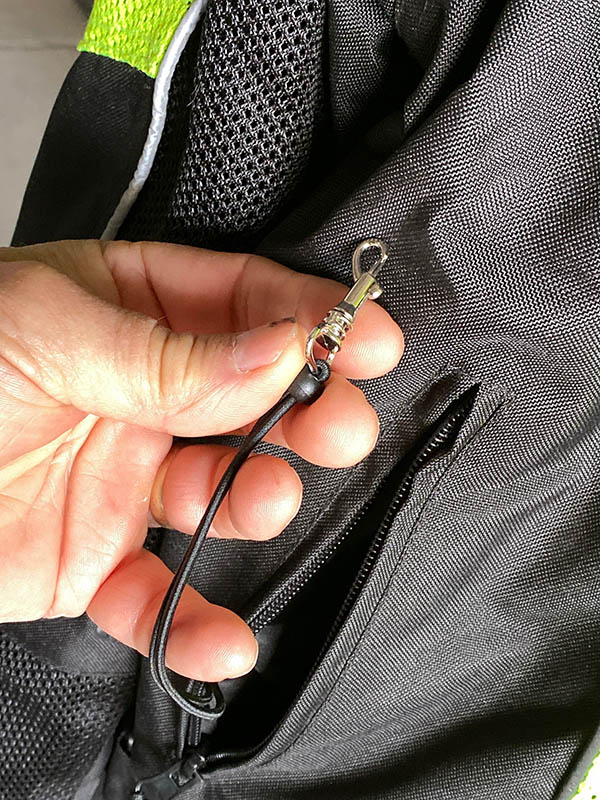
Kind of a neat feature that I’ve never seen before is the front-pocket lanyard. I guess you can clip your house keys or 9mm semi-automatic pistol to the lanyard and it will prevent them from falling onto the ground when you’re retrieving other items from the pocket. There are four front pockets and one inner pocket. The pockets are plastic so they should delay rainwater from getting inside but if it’s raining you will probably have the whole jacket covered anyway. The Warlock has back armor, elbow armor, and chest armor. The elbow armor slips into a hook-and-loop pouch and sometimes when I slide my arm into the sleeves my finger will catch on the pouch. Not a big deal but since I have not tested the jacket yet I have to come up with something.

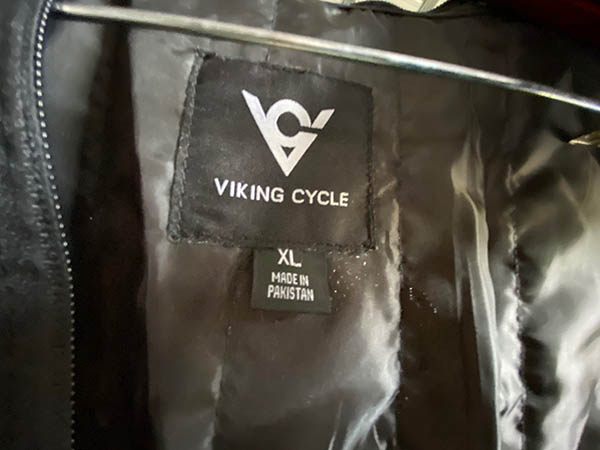
The Warlock is made in Pakistan which should appeal to my anti-China friends (I’m talking to you, Keith). To tell you the truth I’m not sure if we are at war with Pakistan or not but it can’t hurt to outsource some of our manufacturing to a wide variety of countries just to keep the world’s economy humming.

I like the fit of my XL Warlock. The arms are slim so they shouldn’t flap around yet the middle is suitably sized for a well-fed Westerner like me. As far as quality goes, the Warlock looks like any other mesh motorcycle jacket. I mean, I’m not a seamstress, I don’t see any glaring problems. I will need to put a few thousand miles on the Warlock mesh jacket to see if anything goes pear-shaped. Unfortunately it’s been raining like mad here in New Mexico and I don’t want to get my motorcycle dirty. Keep watching this space for a full road test of the Warlock.


See more ExhaustNotes product reviews here!

South By South Bend: Part 2

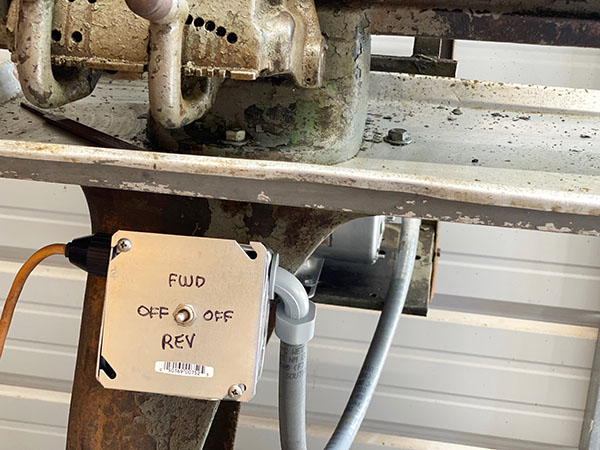
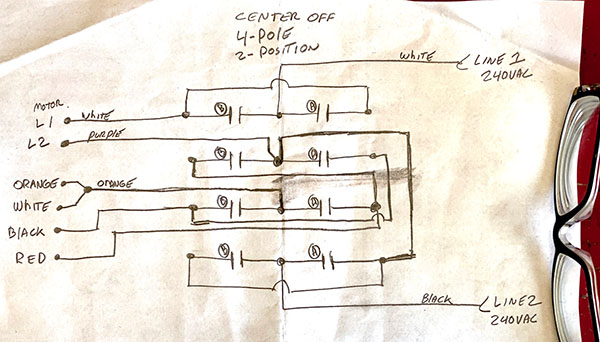
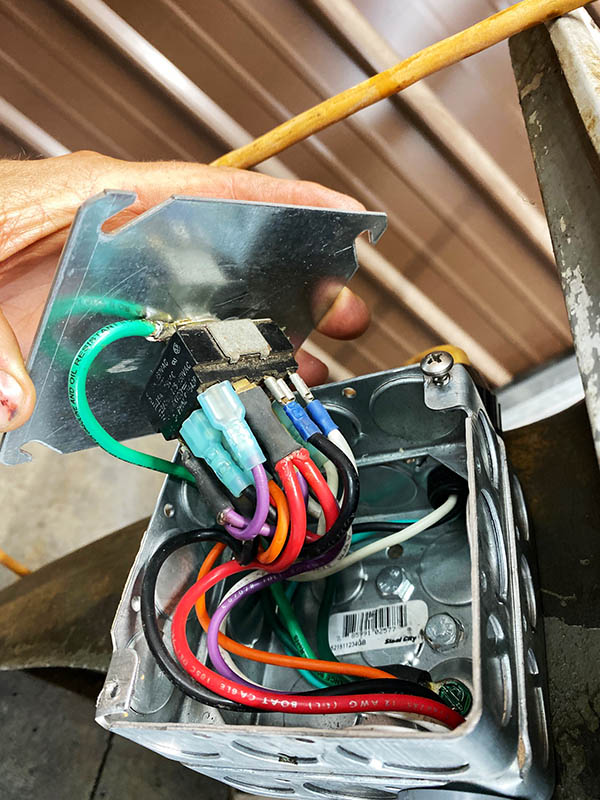
 The South Bend lathe project has been waylaid by several factors, none of them your fault. I did manage to wire the 4-pole, two-position, center-off toggle switch into the Harbor Freight ½ horsepower motor. So now I have forward and reverse. I’ll probably never use reverse but it’s good to have it in case you want to cut from the backside.

I could have made the motor reverse with a three-pole switch but since the motor is wired high voltage (240vac) you want all hot legs disconnected when the switch is in the off position. And I had the switch. The switch connections started out simple enough but soon I had wire coming out my ears. I ended up having to double up the metal junction box to allow enough space for the spaghetti.

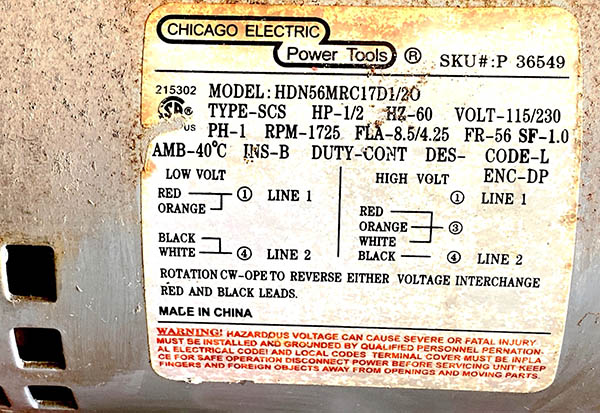
I normally don’t like complicated things but I couldn’t come up with a better way and it was like 115 degrees in the shed. Not a good temperature for thinking. I’ve included a shot of the Harbor Freight motor’s faceplate in case anyone can come up with a simpler way of reversing the motor.

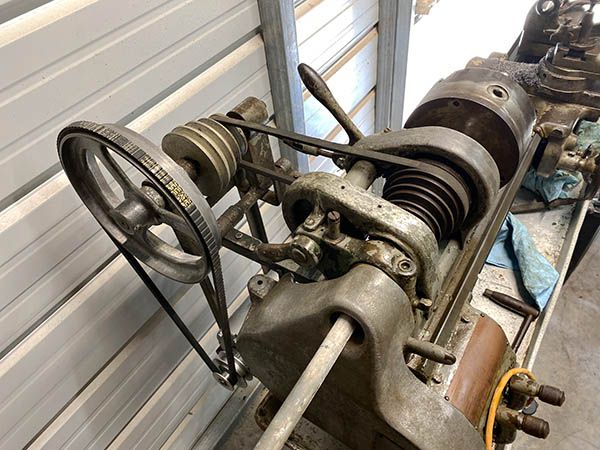
After the motor was running I had to file the 3/4-inch to 5/8-inch shaft-sleeve as it was too tight from the factory. I also cut down the tall key that was included in the sleeve package. The new belt is narrower than the original, or maybe not. The old one was pretty rotten. As it is situated, the inner face of the belt contacts the center of the motor pulley. The V-sides are supposed to do the contacting around here. I forget if A is wider than B in belt-speak but I’ll have to do a little work on the belt and pulleys. The thing works like it is so that’s good enough for now.

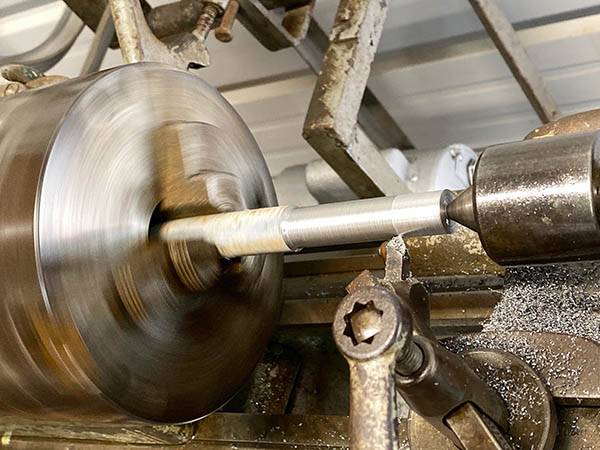
I’ve been relearning the various levers and knobs on the South Bend, levers and knobs that I knew blindfolded 40 years ago. My first cuts were ragged, a combination of no end support on the work piece and a cutting tool that has been in the lathe for eternity. I’ve since quelled the shaking by using a live center. That one change improved the appearance of the machined surface by 42%. The tool is still not what I want as it is tearing material more than cutting. I might try some of these newfangled carbide tools, the ones with a three-sided cutting edge that you can swap as it gets dull.

I’ve machined my test piece to roughly 5/8” so my next trick will be to dig around the junk box and see if I can find a thread cutting tool. You need a V with the correct angle. Watch this space for the threaded rod or mangled mess. I’ll also go over the remaining tooling I have for the South Bend. I’ve lost a lot of stuff over the years but there are still toys like steady rests, faceplates, and lathe dogs to clean up and experiment with.


You can read the first part of South Bend story here.

A recommended TT250 toolkit…

We’ve been featuring toolkits and rider resources in recent blogs, and here’s another one.  It’s based on tailoring a toolkit for a specific bike (in this case, the CSC TT250).  It’s from a blog I wrote for CSC about 4 years ago when I led a group of TT250 riders through northern Baja.  The idea is to carry a tool for every likely need, without carrying any unnecessary tools.  This blog should be particularly useful for TT250 riders.  The concept can be extended to any motorcycle.


Originally posted on October 13, 2016

I promised a recommended TT250 toolkit a few blogs back, and this afternoon I put together a list of the tools I’m going to bring with me on the Baja trip.   The Internet being what it is, I have no doubt this will spark a firestorm of controversy from those of you who have different ideas.  Hey, as my personal hero (that would be Dubya) once said, bring it on.   Seriously.  If there’s something you think I missed, let us know and if I think it makes sense I’ll add it to the list.   That last part is important.  I’m bringing along the tools I think I might need in the unlikely event something goes south.   I’m not planning on doing an engine rebuild on the side of the road.  Knock wood, I’ve only ever had one serious breakdown on any of my rides (and it wasn’t on a Chinese bike; in fact, it was on a bike that costs about 10 times what a new TT250 goes for…and that bike didn’t come with any tools).

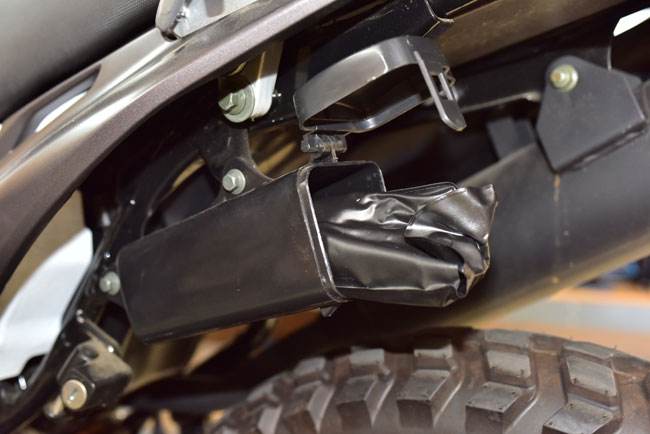
The TT250 comes with a modest tool kit mounted in a container along the frame, as you see below.

They say halitosis is better than no breath at all, and that’s kind of how I feel about the tool kits that come with new motorcycles (indeed, as mentioned above, some new motorcycles don’t include any tools).

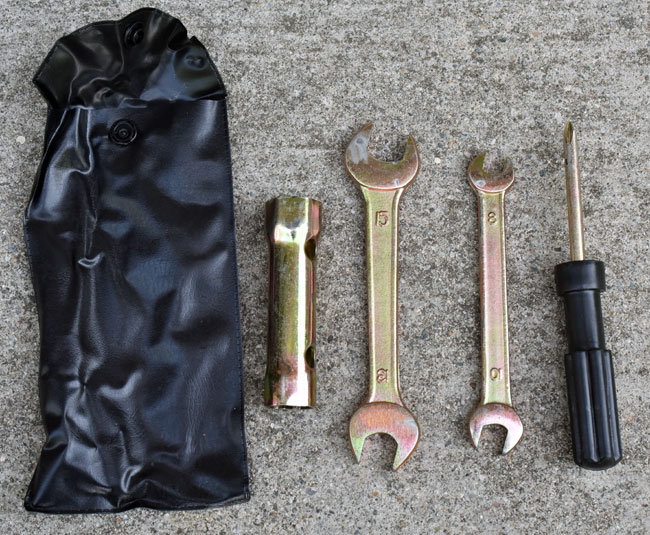
Here’s what you get with the stock TT250 tool kit:

It includes a screwdriver with both blade and Phillips head drives, two wrenches with 8mm, 10mm, 13m, and 15mm ends, and a pressed steel socket that you’re supposed to turn with the screwdriver shaft.  The problem is that I don’t think that pressed steel socket would hold its shape under serious torque (and even if it did, and you probably couldn’t exert enough torque with the screwdriver shaft to adequately tighten or loosen the larger fasteners or the spark plug).

I took a hard look at the nuts and bolts on my TT250 this morning, and here’s what I’m putting in my tool kit for Baja:

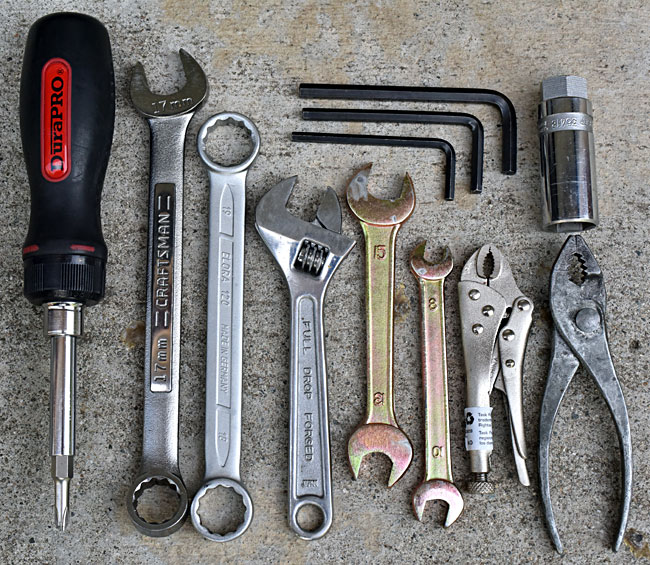
From left to right, here you go:

    • A reversible drive screwdriver with both Phillips and blade drives.  It’s a big screwdriver, but I like the thing.   It’s one of those tools that’s gone on all of my rides.
    • A 17mm wrench.   There are a lot of 17mm bolts and nuts on the TT250, including the oil drain plug.  It’s a must-have item.
    • A cool wrench that has both 18mm and 19mm box ends.  This will come in handy for both the front and rear axles.
    • A crescent wrench.  This is a catchall and it’s a good thing to have.  I could have left out several other wrenches and just taken the crescent, but I wanted the others.
    • I kept the two wrenches that come with the standard TT250 tool kit.  They fit virtually all of the smaller fasteners on the bike.
    • A small channel lock pliers.   I mainly carry these because I once read about a guy using them when he lost his shift lever.   I’ve never had that happen, but these things were on sale for a buck at a Lowe’s and I couldn’t pass them up.   If I ever lose a shift lever, I’ll be good to go.
    • A pair of pliers.  These came with my 1965 Honda Super 90 tool kit, which I bought in 1966.  I’ve had them with me on every ride ever since.
    • Allen drives in 4mm (for the fuel tank filler cap), 5mm (for the body panels), and 6mm (for the handlebar clamps).  I could have bought one of those pocketknife-like things that have a bunch of Allen drives, but these are the only three I think I’ll need and I didn’t want to add the bulk of the larger multi-driver tool.
    • A spark plug socket.   You might wonder why I don’t have a socket driver for it.  The 18mm wrench fits it perfectly.

And that’s about it, folks.  All of the above won’t fit in the little plastic case the original factory tool kit occupied, so they’ll go in a tool roll that’s going in my soft luggage.   That plastic box for the original tool kit?   I may use it to carry a burrito.


Want to see our other rider tool and resources blogs?   Here you go:

Rider Tools.  Good buddy Mike Huber, our paratrooper-at-large, wrote a concise compendium of website and other resources every adventure rider needs to know.

Rider Tools: Part 2.  This blog covers the tools Joe Gresh carries with him.  It’s a good one.  He saved my butt in Baja with that jump start gizmo!

Baja Spares.  This is a list of the stuff I take with me when I ride in Baja.

Tools For a Motorcycle Trip Part 2: You’ll Need a Luggage Rack

ExhaustNotes.us contributor Mike Huber recently wrote a story about tools to carry on a motorcycle trip. The story threw me because I was expecting a list of actual tools. Instead, Huber wrote about high tech software and hardware to make a motorcycle trip safer and more enjoyable. He should know as he lives on a motorcycle.

I’m always scratching for something to write about. The Internet consumes content at an incredible pace so I figured I’d steal Huber’s idea and write about the tools I carry on a motorcycle. This tool set may seem like a lot but I bring it along on a 7-mile run to the post office or a cross-country ride. Much like a large, ugly tail rack I won’t leave home on a motorcycle without tools.

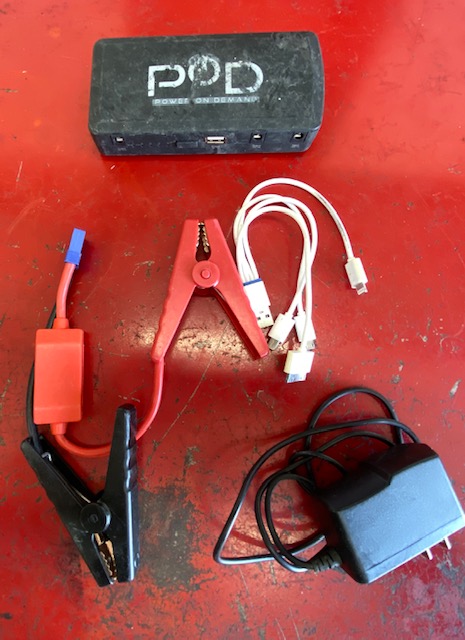
If your bike has a kick-starter these little jump starters are not a must-have but with a high-compression 500cc single cylinder and no kick starter the Husqvarna is a bear to push start with a dead battery. Luckily I haven’t needed to jump the Husky yet but I have used the jump starter to start cars, other motorcycles (see Royal Enfield Bullet) and just yesterday I used it to start the back-up generator when the power went out at Tinfiny Ranch.

My nephew, Anthony gave me this one and it’s a pricy unit but you can find them on Amazon for as low as $25. I have a cheapie in every car and they work well. Not only will the tiny, lightweight battery jumpstart a diesel tractor or large cruise ship, it will charge your cell phone many times over. The only flaw with them is that they hold a charge for so long you tend to forget about them. Remember to recharge the thing every 6 months or so.

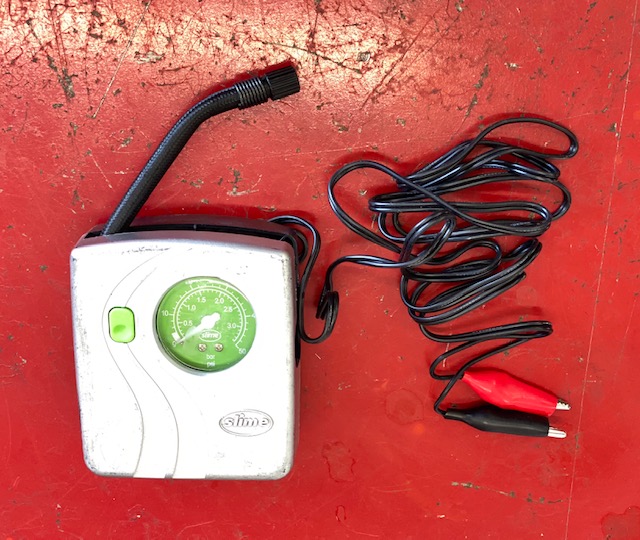
If you have a 12-volt system, not a given with old motorcycles, a small electric air compressor will save you hours of pumping after fixing a flat tire. This one is Slime brand but any of them will work. For some reason I frequently get flat tires so this pump sees regular action.

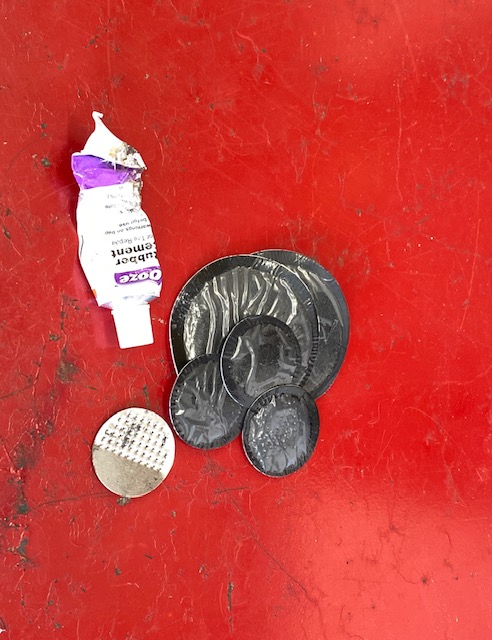
Of course a pump is useless without a patch kit. Most of my motorcycles still run inner tubes, which are a PITA, compared to tubeless tires. If you can find access to the hole without further damaging the tube patching is easy and reliable. I also carry a spare tube in case a tube becomes irreparable from my ham-fisted repair attempts.

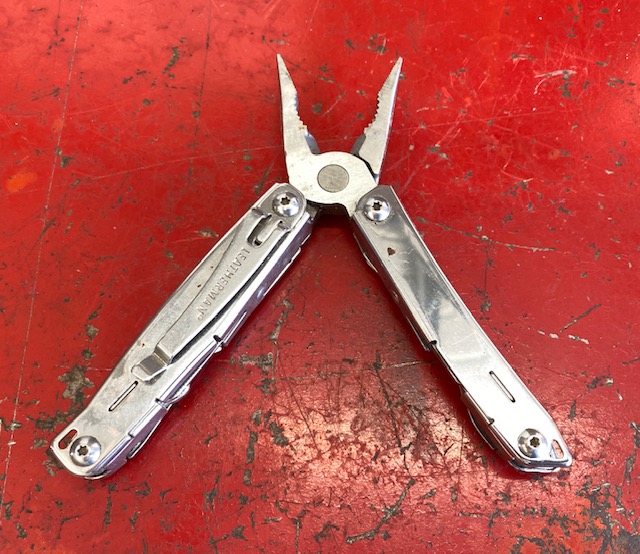
A Leatherman multi-tool pocketknife covers a lot of bases and takes up little space. There are other brands of multi-tool and they are ok but I still think the Leatherman is the best of the bunch. Leatherman also has a great warranty. If you break a blade just send it back and Leatherman will send you a new knife. I’ve done it twice and had no issues.

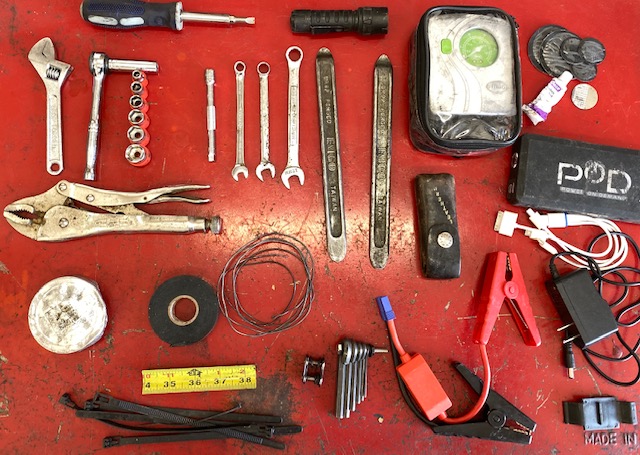
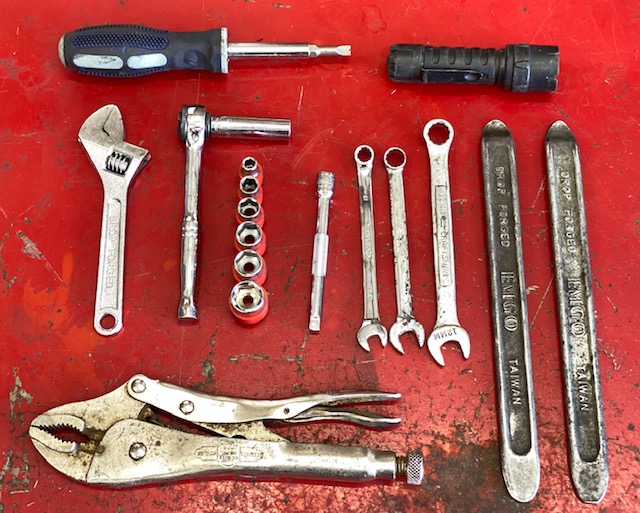
An assortment of basic tools will get you out of trouble most times. I carry vise grips, tire irons, a decent multi-tip screwdriver, a few wrenches and ¼-inch sockets with driver, and a little flashlight. Vise grips will most likely damage whatever you use them on but they will get the job done and you can replace the chewed up parts when you get back home. The small aluminum tin case seen in the cover photo contains a universal cable repair kit. This is a neat item with several different cable ends and a length of cable. The various ends screw on so you can make a temporary cable for damn near any motorcycle. I’ve never used this item but I will be well-chuffed (warning: Brit slang!) if I ever do need the thing.

I also carry a spare master link, electric tape for those melt downs, a bit of bailing wire, tie wraps and a length of measuring tape. The measuring tape is super for seal cleaning or shimming or even measuring.

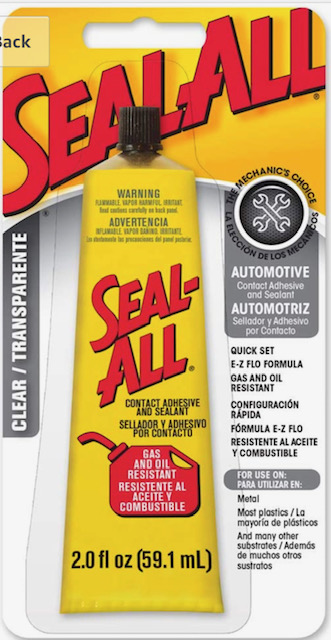
In addition to the basic tool set I add a few motorcycle brand-specific bits as I swap the tool set from bike-to-bike. A tube of Seal All rides with me on the Kawasaki 900 because the gas tank was very rusty and might spring a leak at any time. The Yamaha 360 gets a flywheel puller, a jug of two-stroke oil and a 21-inch front tube that will fit both wheels if it has too. The Husqvarna gets a 17-inch tube to suit its odd-sized wheels.

The tool kit rolls up in a canvas bag along with a few paper towels. No two ways about it, this kit is heavy. I look at it this way: The extra weight of the tools is offset by the lightness of my soul knowing I have the ability to fix most any minor problem on the road.


Hey, check out our ExhaustNotes.us home page, where we now have a quick index to our most recent blogs!

Freeze Warning

Summer has clawed its way up from the Tularosa valley and settled in here at 6000 feet. Tinfiny Ranch is hot. I have few real chores at Tinfiny except the ones I create for myself but keeping my wife cool is one of the prime directives. It’s hot enough to fire up the mini-split air conditioner, electric bill be dammed! I installed the mini-split 4 years ago; in fact I ordered it from China, in China, when me and Berk were out scrambling motorcycles in the Gobi desert. That was after we descended from high atop the Tibetan Plateau…for 40 days.

The mini-split installation was fairly easy: a Magic box that sits outside, a wall-mounted unit inside and a couple of copper pipes with a bit of wiring is all there is to the thing. The unit came pre-charged: all the gas was under pressure inside the magic box. I had to buy a vacuum pump to evacuate the line sets and then open the service valves. Presto! Nice cool air.

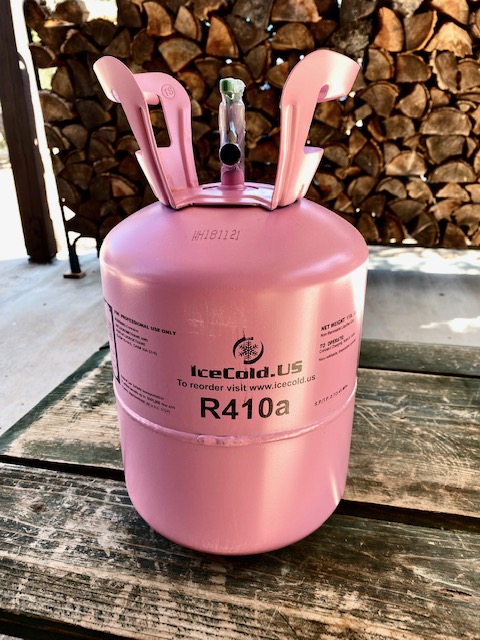
Unfortunately, sometime last winter the system sprung a leak: Tinfiny’s mini-split had lost its ability to keep my wife cool. If you’ve read ExhaustNotes.us before you’ll know that I have an aversion to calling in a repairman. Hiring someone who knows what they are doing clashes with the pioneer spirit here at Tinfiny. I googled the F3 error code and found the gas charge was low so I ordered an 11-pound container of 410A refrigerant. Pretty in pink and $80 with free shipping.

The tools required for the air conditioning trade used to be fairly expensive. A set of gauges and a vacuum pump might set you back $500 in the 1980s. A typical homeowner usually didn’t have that kind of equipment sitting next to the rake and that broken blue plastic kiddie pool. Thanks to the wonders of our modern global economy a middleclass pencil-pusher can set himself up in the air conditioning business for a couple hundred very devalued US dollars. Less if he doesn’t care to know what pressures his system runs.

Mini-split air conditioning systems are pretty simple at the mechanical-cooling level. A compressor squeezes the refrigerant gas into a liquid, increasing its heat. This hot, liquid refrigerant is then run through a condenser, which is nothing more than a radiator like the one in your car. The condenser cools the liquid refrigerant by transferring heat from the liquid to the outside air via the cooling fins of the condenser.

Next the cooled liquid refrigerant goes to the expansion valve. The expansion valve has a tiny hole that causes a pressure differential. The now low-pressure refrigerant travels to the evaporator which is another radiator located inside the room to be cooled. The room air temperature boils or expands the refrigerant, in the process drawing heat out of the room. After absorbing heat from the cooled space the refrigerant travels back to the compressor to start the cycle anew.

As this endless circle of suck, squeeze, condense, evaporate, return continues the room gets cooler and cooler until the thermostat shuts off the compressor or the room gets so cold the refrigerant won’t evaporate. Don’t hold your breath for the room to get that cold. While refrigeration theory is simple, all the extra components, controls and electronics involved with air-conditioning are not simple.

An interesting side note about mini-splits: The expansion valve is located inside the compressor/condenser unit that sits outside. This means that both refrigerant tubes going to the interior-mounted evaporator/fan unit are all part of the expansion cycle so both tubes get cold as opposed to one line hot, one line cold like in a traditional central air system.

Have all the fair-weather readers left the room? Good, because we’ve lost anyone with a functioning life and things are about to get even geekier. On my mini-split the only access for a pressure gauge is on the low-pressure side near the intake of the compressor. Gauge sets are usually the first thing a person buys when working on an air conditioner but to me they are the least important tool. My AC guru, Jerry, from The Florida Keys told me to feed the 410A in slowly until the evaporator gets uniformly cool and you’ve reached the right pressure. Who cares what the pressures are as long as the room gets cool, right?

I put the pressure gauge/manifold on the system anyway and fed a steady diet of 410A into the low-pressure side keeping things around 100-psi and it worked. For about 3 hours we had glorious cool air. My wife was happy. Was it me, or did each pass through the compressor seem like a little less cool air was blowing out? I had a leak. I kind of knew I had a leak before I started the filling process because it’s a sealed system: what else could cause low pressure?

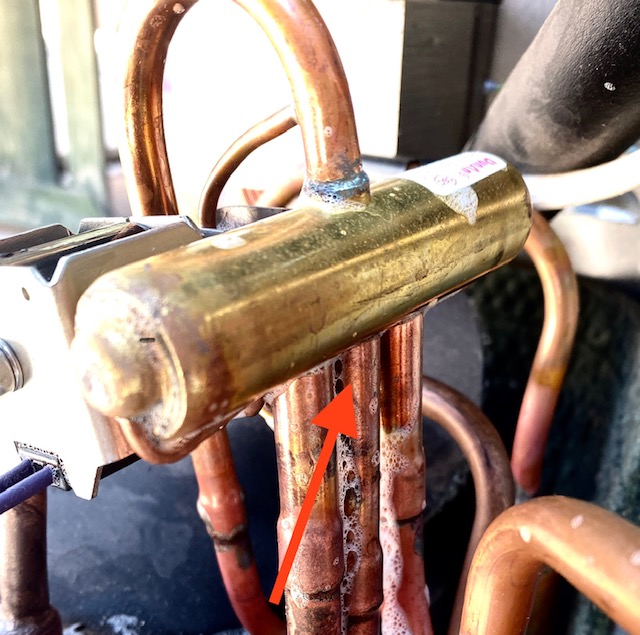
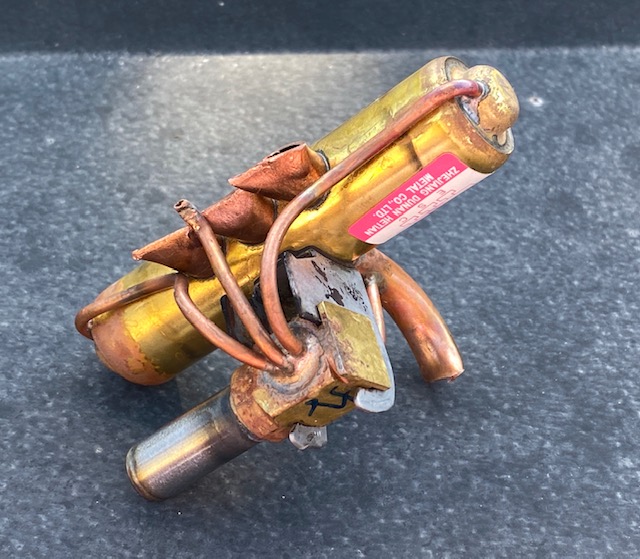
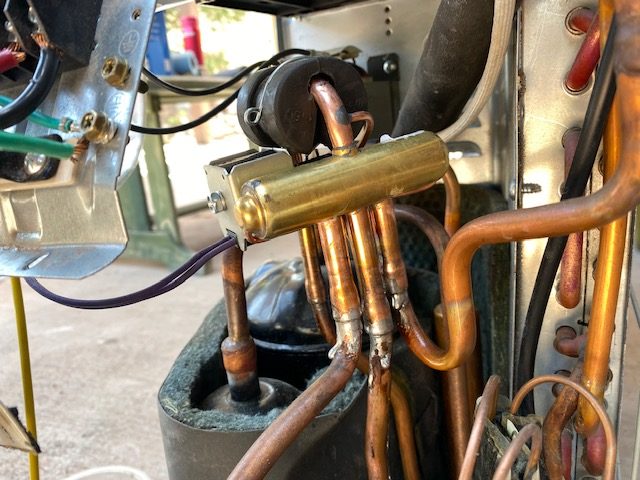
Much like finding a leak on a flat tire, soapy water revealed that the reversing valve was leaking where the tubes were soldered into the spool valve body. A quick note on reversing valves: They do exactly what they say they do. They reverse the direction refrigerant flows in the system making the evaporator the condenser and the condenser the evaporator. In reverse cycle, the unit tries to cool the outdoors and the interior unit warms the house. It makes a fairly efficient heat source as there are no heat strips or high wattage elements to suck up huge quantities of electricity.

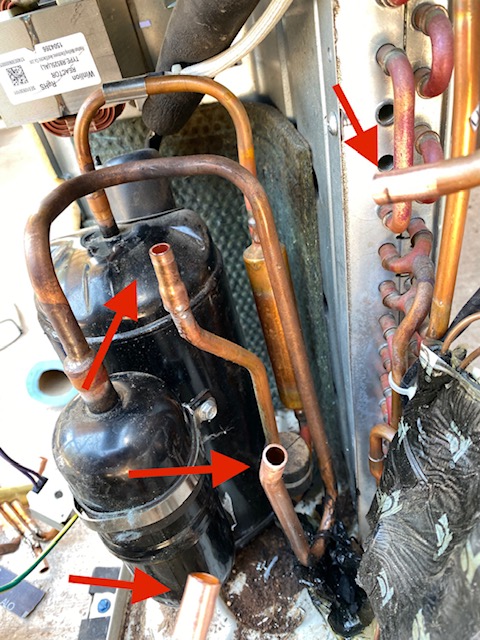
The operative word in mini-split land is “mini.” Everything is crammed together inside a small space making the valve swap more difficult than it needed to be. There are three short pipes almost touching each other and then one more off to the side. To remove the valve gracefully you’d need to heat all 4 joints at once. I don’t have 4 torches or 4 hands so I cut the old valve out. I then tried to de-solder the left over stubs but whatever the manufacturer used to solder their joints had a higher melting point than the copper pipe! The job was turning bad, man. The copper pipe would turn rubbery and that damn solder still would not let go. The wiring and insulation were catching on fire. I had to take a break.

My new plan was to abandon the old joints and cut each tube, lowering the valve a bit but I couldn’t find my small tubing cutter. I had to bend each pipe out of the restricted space to cut them. Of course you know any time you move pipes that have sat in position for years the risk of creating another leak is pretty much 100%. Manhandling the copper pipes back into position was another chore and I began to mentally prepare myself for the cost of a new AC unit ($600).

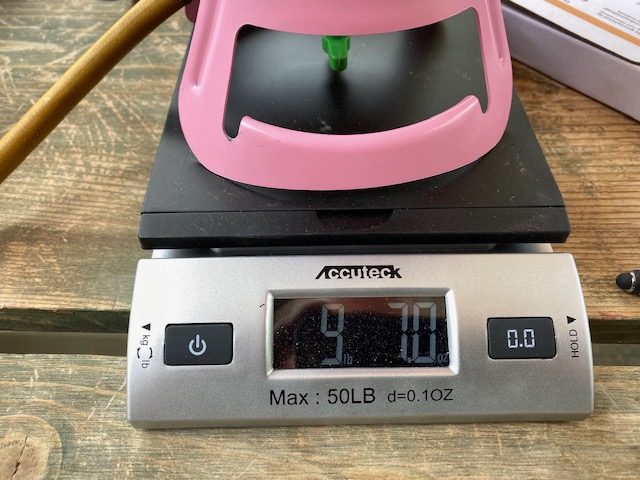
If you’ve lost all the gas out of your mini-split system the best way to charge it is to weigh in the correct amount of refrigerant (32 ounces in this case, plus a few ounces for the tubing runs). I guess now would be a good time to discuss the merits of filling liquid vs gas. Depending on the orientation of the gas bottle you’ll get liquid refrigerant or gas refrigerant out of the bottle. From what I’ve read online liquid charging preserves the ratio of the blended crap they sell us now to close that Ozone hole and save mankind. Sure it worked, the hole closed and all but what about my rights? Gas charging ends up favoring the lighter elements of the blend so each fill alters the ratio of the remaining refrigerant. Worst case it will decrease cooling performance and leave behind a compromised bottle of AC juice. 410A is not as bad as some of the other exotic blends but I liquid charged anyway because I’m a cutting edge, risk taking sort of dude.

In actual fact as soon as the liquid hits a pressure differential it turns to a gas. Things like your pressure gauge manifold knobs turn into expansion valves. As long as you don’t dump the juice in too fast and lock up the compressor with a slug of liquid 410A. Keep the stuff coming out the bottle liquid and your ratios will remain correct.

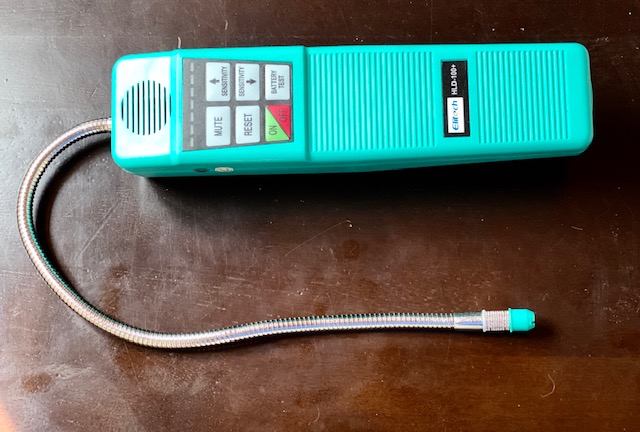
32 ounces of 410A bought us another few hours of nice, cool air before the mini-split began blowing room temperature air into Tinfiny’s living room (if you can call it living). The thing was still leaking. I never let a crisis go by without using it as an excuse to buy more tools. I used my new halogen sniffer on the condensing unit and found the new expansion valve leaking at my solder joints.

In retrospect I was rushing the job, frustrated with the confined space, fires and tired of messing with the stupid thing. I guess I didn’t get the pipes cleaned off enough or there might have been traces of oil that the solder flux didn’t get clean or who knows. The new valve passed the vacuum test but vacuum is nothing compared to the 300+psi high side running pressure.

Luckily a cool spell blew through Tinfiny Ranch, which bought me some time to think. I asked myself what was the main obstacle to success on this job? The main obstacle was the confined area to work on the valve. Then I said to myself, “Why not get rid of the valve?” it was like the blinding light of Jesus struck me! Of course! Make it cool only and I’ll worry about heat next winter!

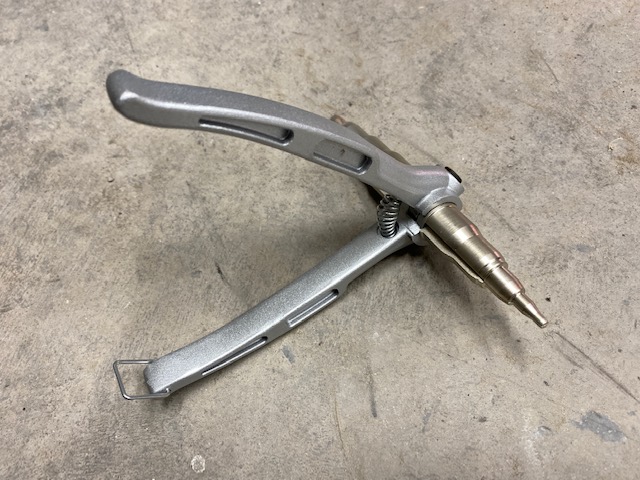
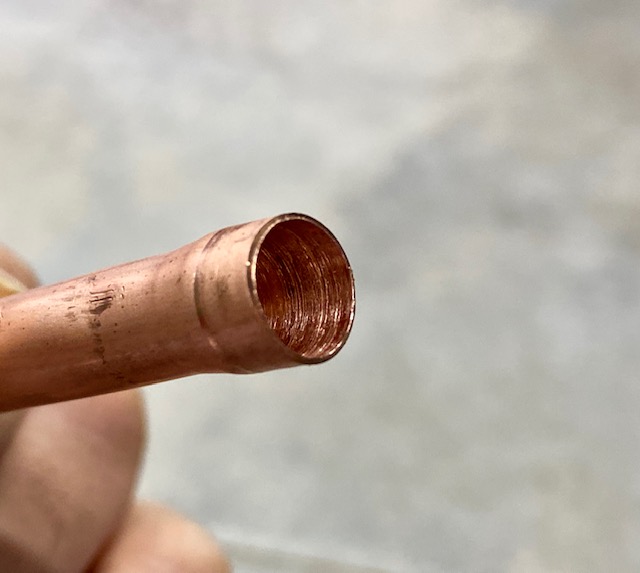
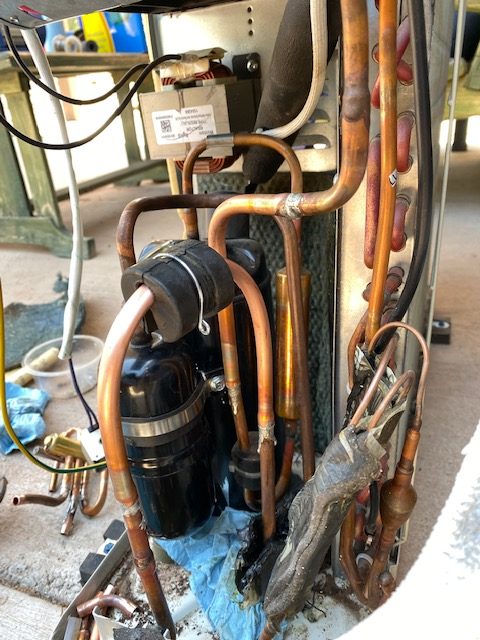
And so on the third day of working on the mini-split I bypassed the reversing valve. Using my new mini tubing cutter I made cuts in the pipe at different levels and wide apart, filling the gaps in the plumbing with new copper pipe. This also allowed me to use my new tubing expander on the jumper pipes. Anytime you can eliminate a solder joint it’s a good thing. The tubing expander gets rid of couplings and saves solder joints.

When I bought the pink, 11-pound bottle of 410A I figured it would last the rest of my life. After charging the system twice I was starting to worry I wouldn’t have enough gas to finish the job. I sanded the pipes with crocus cloth and wiped them down with paste flux. I might have gone a bit overboard with the solder as the stuff was running down the pipe. Usually when I solder copper pipe I let the solder wick into the joint then wipe the joints with a rag while the solder is still soft. It makes a clean looking joint. This time I didn’t touch anything for fear of causing a leak.

With the bypass pipes in place I charged the system yet again. 34 ounces of 410A put the low-side pressure near enough to 110 psi so I was in the ballpark charge-wise. Daytime temps have been in the mid-90’s and as I type this the mini-split has been cooling Tinfiny down to a crisp 70 degrees inside. And it’s been doing it for almost 5 days. If there’s a leak it’s a slow one.

Money-wise I may have to call it a wash. I bought a digital scale, a halogen sniffer, a mini tubing cutter, a bottle of 410A, a tubing expander and the rest of the tools I already owned. Maybe calling a pro would have been the way to go. I spent 3 days learning a lot about HVAC, cussing and thinking hard about the choices I make. And I would do the same thing again. It’s a good thing to peek inside the magic boxes of your life.

A Good Crisis

Good buddy Jake Lawson sent us a marvelous guest blog on his new Israeli Weapon Industries Tavor X95 (the one you see in the photo below), and it sure is an interesting story.  Folks, this man can write!  Enjoy.  I sure did.
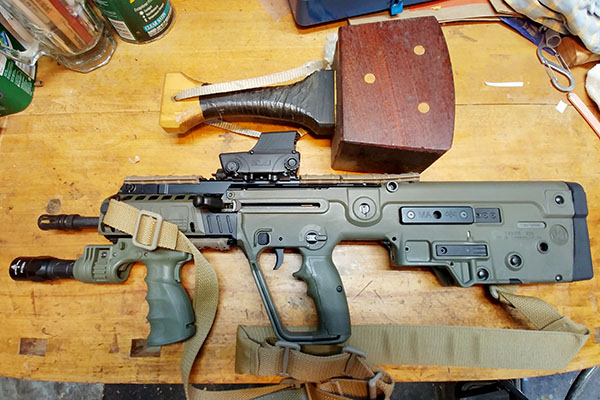

I wasn’t raised to respect Lego rifles.

There was no implication of egalitarianism in Dad’s gun culture: firearms were reserved for the martial few who took to the hills in Wranglers to provide for family, tribe, and the community of soft-handed city folk who’d never eaten brains for breakfast. We Lawsons, I was given to understand, descended from hunters and warriors and gamekeepers. We were special and worthy. We harbored innate skills.

Those blood-honed instincts were best served by very special rifles, furnished like Victorian houses and smelling, always, faintly of Hoppe’s No. 9 (we pronounced it “hoppies” and you should, too). I was occasionally loosed to wander wide-eyed through legendary temples like Kesselring’s while Dad traded country-boy bons mots with the staff. They’d nod at each other with the unspoken recognition of cowboys, bikers, and Seventh Day Adventists. Through the slanting half-light of well-secured buildings, racks of gleaming fire sticks whispered strong magic from the past, waiting like Excalibur to leap lively under the hand of a righteous knight.

Like classic hardware stores before canvas aprons gave way to the Playskool smocks of “home centers,” bygone gun stores offered only gradual apprenticeships into the mysteries. You started knee-high and – provided you paid respectful attention – you might one day grow into a man worth reckoning with. We had no internet to spawn new lingo by the day. You absorbed the patois the way artists learned line and color, with dawning awareness that most of the wisdom lay between the lines.

In those quieter times you could buy a rifle in most any variety store, but a man went to the altars of the elect to discuss blued, two-piece scope rings, buy a seasonal box of Winchester Silvertips, and run his fingers over the saddle straps of fine, leather scabbards. Those places, mostly killed off by Discount Gun Stores and their ilk, barely exist today. Where you find them, they’re secured by crabby, clannish insiders, guarding their diminishing cache of unique knowledge like tattered dragons squatting on a pile of dimes.

The full flower of our information age democratized knowledge on any number of subjects. This is largely a good thing. Who doesn’t want to download the part number for their dishwasher inlet valve alongside a quick, friendly video reminding you to wrap brass threads in nylon tape?

The internet also gave rise to tens of millions of Shake ‘n Bake™ experts who can quote the ballistics by range of 5.56mm 55-grain FMJ slugs but have never once shot a deer, bedded a walnut forend, or cleaned weapons to an armorer’s satisfaction.

Erupting angora-soft neck beards through scarlet fields of pimples, less good ol’ boys than fresh-faced kids, these are our experts now. Good-humored and alert, they staff brightly lit gun stores where you no longer ballpoint your way through BATF forms while leaning on the glass over surplus police revolvers, joking with someone’s crinkle-eyed uncle about your mental incapacities, but instead enter your digits into a dumb terminal, squatting humorlessly in the corner of a repurposed Blockbuster Video store that still reeks of Citrisolv. Lean hill hunters in woolen plaid are nowhere in sight, replaced by pasty Glock jocks sporting 5.11 Tactical trousers. The gun tech surely is better – so much better that you can build a reliable weapon on your kitchen table with no tooling more exotic than a wobbly drill press – but long glass cases littered with sci-fi props, zombie targets, and pimped-out banger bling make me miss my father’s Oldsmobile.

And there are AR-15s. So many AR-15s, in so many configurations, that kids today don’t say “my rifle” anymore. They call their gun “this build.”

Decades ago, I’d already had enough of M16s and their multifarious cousins: A1s, CAR-15s, A2s, SOPMODs, A4s, et al. Sure, they’re cool in those movies where Arnold gets 160 rounds out of every mag and never has a stoppage, but let’s get real: standing a pre-’64 Winnie up against a tac stack of AR-pattern rifles is like pushing Howie Long, wearing a Saville Row suit, into a police line-up of minor-in-possession suspects. Class or crass: pick one, and move along.

Having toted an M4 carbine across someone else’s desert at taxpayer expense, I conceived no special desire to spend a thousand bucks adopting one of my very own. I’d mistrusted those plasticky things since childhood. What kind of war weapon bitches like a parent when you don’t close the door? M1 Garands and M1911 Colts didn’t jam under fire! Mattel rifles?! I was sick of ‘em: sick of the Chevy 350 ubiquity of “modern sporting rifles,” sick of the little “oh s&!t” springs that zing away any time you don’t pay attention, and sick of dangling one from a single-point bungee sling, tied off to a 40-lb. shirt. I’d gone to work with my M4, slept with it, eaten with it, prayed with it, and I didn’t miss it for one lonely moment after our long-overdue divorce.

At some point, I realized that I’d gone my whole life without buying a rifle.

Now, this isn’t the hardship one might imagine. Most of us don’t need a rifle. I don’t need a rifle – and if I did, I could always peck open the safe and pull out the .30-30 I got as a Christmas present the year I joined up with Boy Scouts of America, or the pre-war .30-06 with its first series Leupold Gold Ring 3-9X scope that came down to me from Grandpa through Dad, or the .22 with the 4X Weaver that – strike that; I actually passed that one along to my mother-in-law to pop rattlers in her Arizona garden.

Or I could pull one of the rifles from the other side of the safe, where Pretty Wife’s inheritance encompasses more firepower than my own.

We’re not wealthy folks. Intrigued though I may be by long-range shooting, a Savage 110 with Accu-Trigger and a big honkin’ optic – let alone something fancy from Accuracy International – is not a hobby within my budget. It’s entirely too easy to shoot through two hundred bucks a day in ought-six or .308 ammunition, just getting the feel of things.

Also, that’s tougher on a rebuilt shoulder than I like to confess.

But still, I’d never bought a rifle. Never shopped for one “with intent,” never spec’ed one out just for me. Every long arm I’d shot was a loaner, a gift, an inheritance, or a duty weapon. That thought came to me from time to time and I pushed it down, and then it came tickling back. Some of those middle-aged tickles grow compelling. Plus I hearken to my sweetie’s frequent admonition to “have your midlife crises early, and often.”

Did I mention I’d never bought a rifle? According to family tradition, I still haven’t.

Oh, I had my aspirations. A bolt-action gun with a stainless, free-floated, heavy match barrel. A McMillen stock adjustable for comb height and length of pull, or maybe a thumbhole stock I carved myself from Circassian walnut, with a shoulder plate of polished ebony. Big scope, adjustable for ranges to infinity and beyond, with the kind of chambering that requires a dope card just to open the cartridge box: .338 Lapua, maybe.

Being more of a dream than a plan, that did not happen. For the record, I do not believe it will. In any event, I have the character more of a hip shooter than a sniper. I perform best when I think less. At least, that’s my excuse for all the busted plans in my life.

Hip shooters favor short rifles. They’re just easier to get through the door, whether that’s a HMMWV door or my bedroom door. Think more along the lines of Steve McQueen’s “mare’s leg” in Wanted Dead or Alive than the .45-110 Shiloh Sharps from Quigley Down Under.

Stubby rifles get a bad rap, though. As alleged “assault rifles,” they’re considered truculent by dint of terminology. The region where I live, always a “shall-issue” state due to our supreme court’s historic interpretations of Article I, Section 24 of the state constitution, swiftly retreats from our Wild West past.

There was an Ernst Home Center just down the road from the house where I lived through high school. It sold potted plants, plywood, drywall anchors, and guns. Nose-printed showcases lining the west wall displayed rows of Dan Wesson Pistol Packs boasting various selections of interchangeably-barreled revolvers, and I can remember wondering whether I’d need to be 18, or 21, to walk in and buy one of those O.G. “Lego guns,” right over the counter. Their big shrouds and barrel nuts made them a little funny-lookin’, but I didn’t mind too much.

There are waiting periods now, of course. Those have been legislatively hip for a while now, but recently my state went all-in on protecting us from the law-abiding. Now that semi-automatic rifles are considered a greater threat to society than pistols (a statistically unsupportable politifact), 18 year-old adults may no longer buy them here. Even those of us well past drinking age face the same ten-day waiting period for semi-auto rifles as for a handgun.

Year before last, possession of a Washington CCW meant that a citizen with such clearly documented legal standing could buy any legal weapon, from a long-mag Glock to a Barrett .50, without a waiting period or additional background check. That privilege recently vanished. Every single gun transfer, of every type, now requires a background check – including selling your old deer rifle to your cousin, or gifting it along to your daughter.

Strange times.

Now, in all honesty, none of that prevented an old cuss like me from buying an “assault rifle” any time I felt enough like it to muster the funds. However, two more laws now grind through our legislature: one to limit magazines to California’s ten-round max capacity, and the other an outright ban on “assault rifles.” Our Attorney General’s legislation request defines assault rifles as having a telescoping stock, pistol grip, detachable high-capacity magazine, forward grip, or a “combination flash suppressor and muzzle brake” (i.e. any M16-style bird cage) that “reduces muzzle climb and preserves shooter’s eyesight.”  Black rifles do not matter to Bob Ferguson. Neither, apparently, does a shooter’s eyesight.

Well, now. If there’s one way to make me want a thing, it’s to forbid it. All too human that way, I set about making my pitch to Pretty Wife. In these Trumpian times, a liberal activist like she just might respond perversely to me stocking in a practical little rifle.

Spoiler alert: it worked.

Again, I’ve never been much for customizing guns. That was gunsmith work when I was a tot, and my habits were formed then. No machine shop tools = no bore-sighted scope mounting (I don’t remember us calling them “optics” in the day).

Everything was some level of bespoke, back when. Even the humblest rifles were graced with pretty wooden stocks, inletted by the hands of people who cared. Bluing required preservation, and even when scrupulously cared for would slowly sacrifice itself over time, fading into colors soft and gentle as wisps of your grandmother’s hair.

Bought, issued, or given, the thing came to you as a piece of kinetic, mechanical art; wrought from the disparate elements of tree flesh, steel, bluing, oil, chrome, and smokeless powder. For me, rifles were objects of reverence in the manner of excellent tools: taught to sons as a secret language, and handed forward across generations.

Today’s guns are not that; surely especially not the jangle-parts “black rifles” that have ruthlessly displaced .30-30 Marlins as basic, go-to units for American rifle(wo)men. MSRs seem closer akin to the power tools at your home center: you may notice brand quality differences between Milwaukee (Colt) and Ridgid (KelTec), but you must delve much deeper into specialty retail to find heirloom-quality marques like Mafell (Blaser).

On the plus side, plastic-stocked rifles are utterly modular and have more accessories available than the H.O. train sets of my youth. In the future we now occupy, gun parts rain from the internet sky, fully engaging the tinkering mind.

As mentioned, I’m not sitting on a big go-to-Hell budget. When I shake a few nickels out of the sofa, they normally go toward tools &/or supplies for home improvement.

Yes, we’re still working on our house. We’ll likely be working on it on the day I die. Hopefully, between then and now, I’ll set aside a few hours to knock together a pine box for my carcass.

However, everything is situational. Rahm Emmanuel once exhorted, “Never let a serious crisis go to waste.” So it was when mean bubbas got meaner about Jews at around the same time our state government decided to restrict “assault rifles” that I pled my case for picking up a Hebrew Hammer… y’know, just in case we might need it. Better to have it and not need it than need it and not have it, right?

As mentioned, AR-pattern guns remain the most modular, not to say popular, sporting rifles on the planet. With upgrades and spares available for everything from the flash hider to the buffer spring, they’re the small-block Chevy of rifles. Problem is, I’m “that guy” – the sentimental boob who buys a flathead Ford, just to be different.

Or because he’d already spent so much time behind the wheel of a Chevy that the Corvettes started to feel like Caprice Classics. I’ve shot a few friends’ AR-15s, and (obviously) put in trigger time on Colt’s (and GM Hydramatic Division’s) M16A1 and A2. I’m good enough on a rifle-mounted M203 to bloop a 40mm grenade through a small window a couple hundred yards out; have put in range time (one-way and two-way) on the slightly odd M249 SAW; and I deployed with an ACOG-equipped M4.

So, lots of black rifle exposure.

Enough is enough and I’m sick to death of picking carbon out of the bolt faces and forcing cones of direct-impingement rifles. Filthy buggers, and still – after half a century of development! – stupidly prone to jamming. Jack’s rule for outdoor fun: if you have to keep snapping shut a modesty panel to keep your rifle’s bikini line shaved, someone made a questionable design choice.

I did want to shoot 5.56 NATO, though. It is to me what .30-06 M2 Ball was to WWII vets: familiar and readily available. It’s light to carry. It shoots pretty flat. It’s a ton cheaper than 7.62 NATO if you don’t reload (which I don’t), has low recoil and high velocity, and I know the ballistics by instinct.

After a couple hun’nerd hours of pleasant research, I dropped a notable sum for a chunky bullpup from the Promised Land of Zion, the Israeli Weapon Industries Tavor X95, and it is one cute rig. Despite our possible impending mag ban, I didn’t buy a bunch of bananas. For some reason, I seem to have a dozen or two of them already lying around.
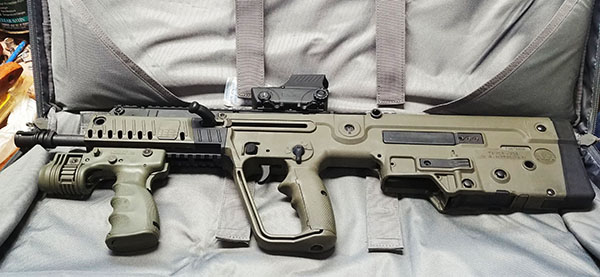
The plastic-chassis X95 ships in IDF black, “Flat Dark Earth” (light brown), or O.D. Green. Mine is the green, since it was available and I wanted not-black. Sue me. I’ve shot enough black rifles for two lifetimes.

I was stoked! When it came in, I trotted straight up to Precise Shooter L.L.C. and keyboarded my way through the computerized interrogation. Forking over the not-inconsiderable cash, I smuggled it home to play with it. First discovery: it comes apart easy as an AK. Punching a single pin flips open the overstuffed, La-Z-Boy butt cap (required to keep it legally lengthy), and you can slide out the gas piston works. Two pins more, and the trigger pack drops into your palm.
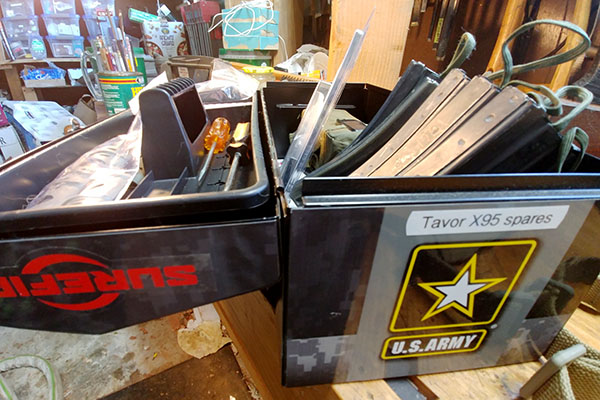
With 500 rounds and a clutch of extremely well-traveled “high capacity magazines” sleeping in an old .50-cal. can, I was all set to go terrorize some paper.

Yet there it sleeps, in our big, speckle-coated Cabela’s box, still waiting for me to go shoot it because I blew my entire budget on the carbine. My X95 bristles with virtues – it’s short and handy; conveniently modular; battle-proven; and reliable as a blacksmith vise – but an economical buy-in price does not number among its pleasures.

And I wanted an optic.

I was still saving up for one on the day we found ourselves smack amidst the next available serious crisis: coronavirus! Plus Australia on fire, locusts straight out of the Book of Revelation swarming over Africa, police riots from sea to shining sea, murder hornets illegally immigrating four towns to the north.

“Basically,” as the good Dr. Venkman said, “the worst parts of the Bible.”

I would fix it with retail!
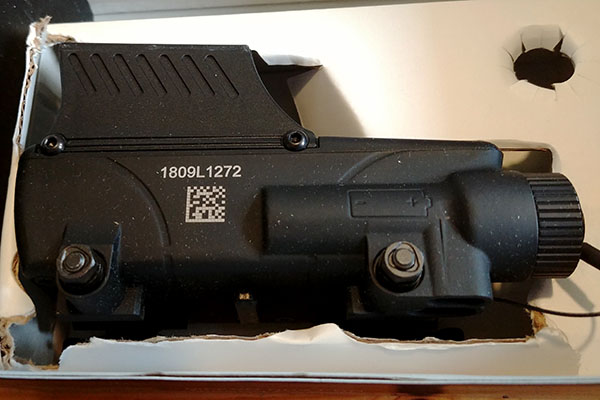
Pretty Wife was probably told about the pre-battlesight-zeroed, snappy little iron sights that defilade themselves flat into the carbine’s topside Picatinny rail, but I somehow don’t think that information took hold. If it did, she forgot about it somewhere between Initiative 1639 and now.

Once again, we had “the talk.”

This is a different talk than the one your dad had with you before high school. More like a negotiation, really. A sensitive one, at that. Once again, it turned out I’m more charming than I knew.

What? Is it my fault she loves me?

Following even more enjoyable research hours, I settled on a MEPRO Pro V2 from redoubtable IDF supplier Meprolight. It retailed for 600 bones, but Optics Planet had it for $550, with another fifty bucks off for St. Patrick’s Day. It’s well-reviewed on their site, and elsewhere.

One funky thing about a Tavor is that the comb is groundsnake-level to the top rail, forcing the use of a high (read “expen$ive”) mount for AR-optimized optics. And one funky thing about yours truly is that I tend to break stuff.
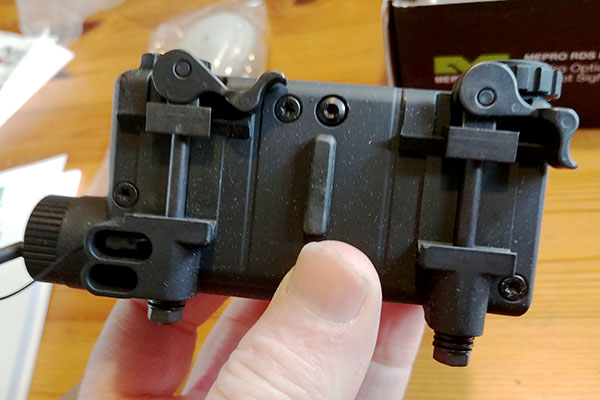
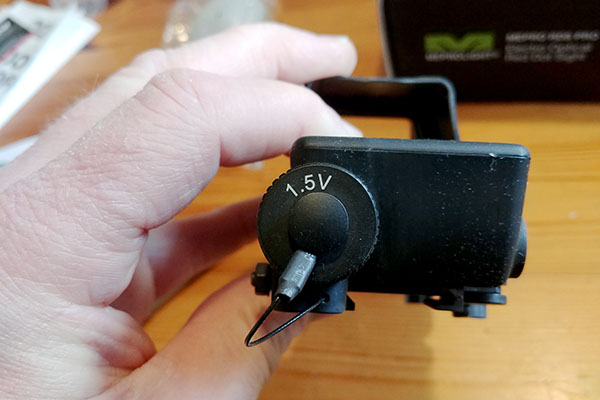
The Mepro has me covered on both fronts: the Israelis GI-proofed it for use by conscripts slogging through an eternal war zone, and they sized it specifically to mount on their front-line service rifle. That’s what the Tavor is (my version is the U.S. model, so no giggle switch but at least it isn’t black). Which is to say that both gun and gunsight were apocalypse-proofed by apocalypse experts.

“Expensive but hard to break” is how I grew to ride BMW motorcycles and to stock my shop with General International and Milwaukee and Record Power trade tools, and when I can pull it off I rarely regret that economic model.

My red-dotter hit the porch a couple of weeks ago. After side-eyeing its package for four days to see if any militant viruses leapt off, I pulled it out and cammed it onto the rail. Just to be sure it was tough enough (okay, actually because my spine’s last will & testament bequeathed me a permanent case of butterfingers), I dropped it onto my bench.

Twice.

Then once onto a concrete floor, just to be sure. Din’t seem to faze ‘er none.

I like the circled, 1.8-mil red dot more than others I’ve sampled, which are EOTech and the M68 (MIL-SPEC version of Aimpoint). It shows up well on every setting (except IR, obviously), and I figure I’ll be able to shoot it pretty well with both eyes open. That’s becoming important with the growth spurt of my bouncing baby cataracts. I also like that its dust- and water-sealed power compartment requires nothing more exotic than a lone, double-A battery.
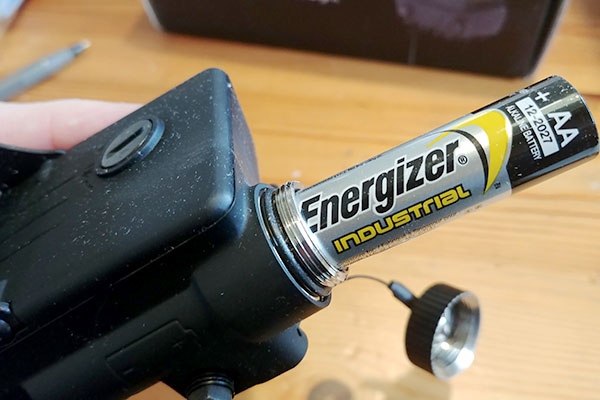
In another life, I ran range strings with an EOTech mounted on an M4. This optic inspires the same effortless targeting (hi, neighbors!), though hopefully without the fragility and short battery life of those earlier “picture window” sights. Reportedly, it runs for a dog’s age on that regular ol’ double-A, has auto-off and motion-restart, and is waterproof to a few meters’ depth. It’s also supposed to be mud- and sand-resistant, which is important given that the rifle it’s mounted on definitely is – there are torture test videos on YouTube showing military Tavors yanked out of sloppy mud holes and saltwater baths, then immediately loaded and fired full-auto without a pause for cleaning.

We’ll see. Again: I am known for breaking stuff.

I tried positioning the MEPRO in a couple different spots along the ridge rail, before I latched its nose into a photo finish with the charging handle’s rest position. Bonus of sticking to factory racing parts: with the backup iron sights erected, the peep and blade line right up spot-on with the orange bullseye. Still no gunsmithing. All I did was to press the mount forward against the rail teeth as I folded in the cam levers (the direction recoil will push it), and peer through it.

Zeroing should be a lolly. Once my submontane range reopens, I plan to adjust fire to an average two and a half inches low at 25 yards, then walk out the strings to 100m and see how my groups hold up. May change POI later, depending on ammo selection (it’s a Boolean for me: XM193 or XM855, with a mild preference for the latter), and on how it prints at 100 meters.

With its 16.5” barrel, my bullpup’s overall ballistics shouldn’t vary much from an AR15, but the ballistic arc will likely be “bloopier” due to a sighting axis about an inch higher over the bore. The V2’s half-mil clicks won’t make a precision rig out of it, but this is a battle rifle. I’ll be content if it shoots into 3 MOA at 100, and can tag a championship Frisbee at 300. If I can squeeze ‘er under 2 MOA with its suspiciously Kalashnikovian guts and my trifocaled eyes, I’ll be ecstatic.

So the sight is all mounted up and there’s ammo on the shelf, but I still can’t shoot it. In our gone-viral age, it seems rifle ranges aren’t yet considered “essential business.” Not that I disagree with that. I just like to fuss.

So I went back to shopping. There are but few American anxieties fully resistant to retail therapy.

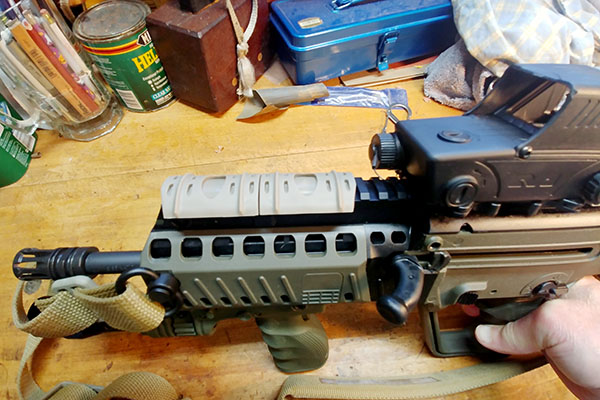
One of the spiffy, gunsmith-obviating features of the X95 is that its forend panels literally slide off at the touch of a button. You’ll discover one Picatinny rail under the bottom and another to either side of the front stock, each with its own quick-detach cover. Cool kids these days are all into KEYMOD or Magpul’s M-LOK system, but rails are solid and battle-tested. Grandpa would approve.

I decided I might want a “broomstick,” and would definitely want to mount a flashlight. For home defense, a short rifle beats the ever-lovin’ snot out of a long shotgun (that’s my opinion, worth what you paid). That augured in favor of a forward grip and weapon light.

Here’s the rub, though: the little sumbitch is like Yoda, short and stumpy with the gravitational pull of a black hole. While noticeably smaller than a stubby M4 with its federally controlled 14.5” barrel, the Tavor weighs as much empty (7.9 lbs.) as an M16A1 weighs with 30 rounds in the hopper. Not only do I disdain larding up guns with excess ballast, I also hate hanging snaggy accessories off the nose of a rifle (I’m talkin’ to you, AN/PEQ-2!). When it comes to clearing rooms, the slicker, the better.

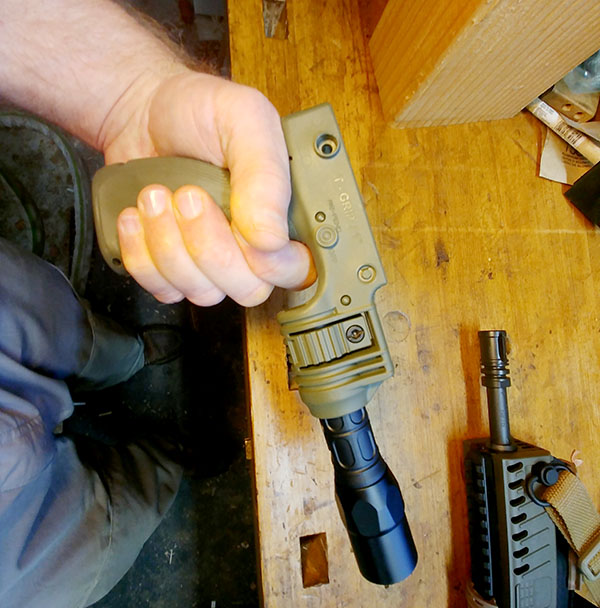
While poking around the merch sites and cheerful chat rooms of the gunweb, I found a FAB Defense forward grip on closeout, again from Optics Planet (full disclosure: I also suckered for their doorbuster-priced knife, a meaty and smooth-opening Chinese folder for under eight bucks). The FAB grip is rigged to mount a one-inch, rear-switch flashlight à la Streamlight or Surefire. It has a grip trigger to turn on the lights and (yes, really) a cross-bolt safety to prevent accidental illuminations.

It’s a pretty slick gizmo, plastic but solidly cast. FAB sustains a good rep, and I like the idea of NOT having the flashlight lashed to the side rail like a Fury Road War Boy hanging off an overclocked rat rod. The green is probably not perfectly matched to my rifle’s plastic, but I’m partially RG-colorblind and it looks just fine to me.
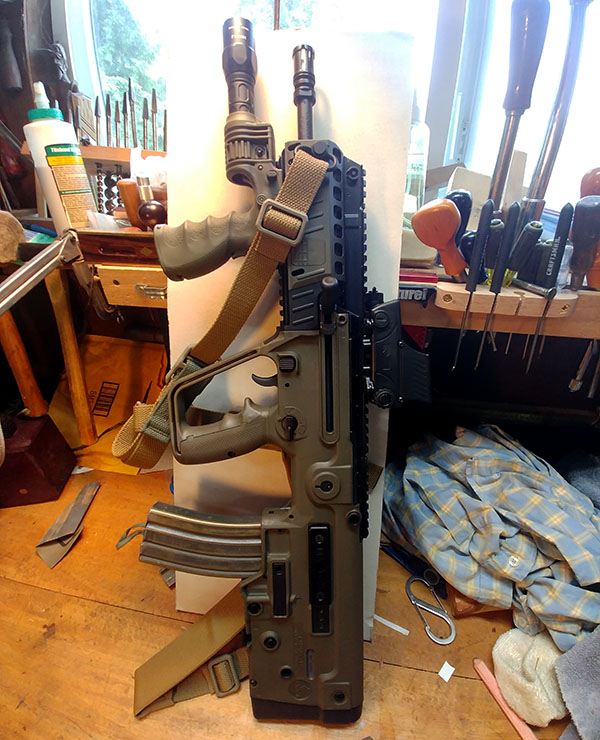
Will I come off like a pimply, overcompensating mall ninja with no real-world experience when I yank out this Ghostbuster wand at the range? Most certainly. I just don’t give a large rodent’s sphincter.

Speaking of pulling it out, I also settled on a case from which to pull it. IWI pushes a stout bag, knotted over with MOLLE gingerbread, for about 150 bucks. For reasons obvious to adults, I wanted something less “gunny” looking, so I ordered up SAVIOR Equipment’s “American Classic Tactical Double Short Rifle Gun Case Firearm Bag” in 28″ length.
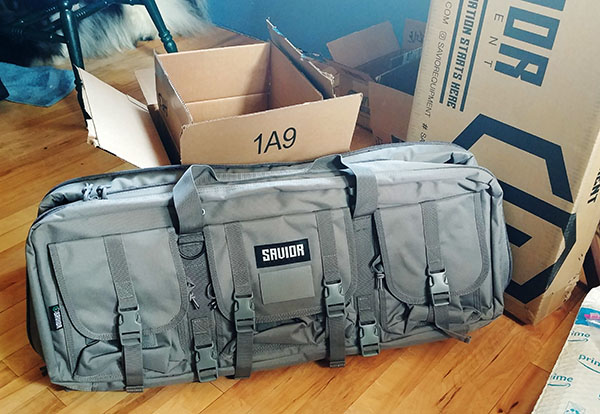
That’s a lot of words to describe a bag that costs less than fifty bucks!

And yes, you read that right: in 28″ length. The overall length of my bullpup is 26.4 inches. The overall length of the “spec ops cool guy” M4 that I toted in Iraq was 29.75 inches with the stock fully collapsed – and it had a 1.8-inch shorter barrel (same 1:7 rifling twist rate, though).

The bag is superb – not “pretty good for a third of the price,” but actually superb. Based on a lot of squinting at marketing pictures, it seems likely that it was stitched up in the same Chinese factory as IWI’s case, with the only noticeable difference being omission of the tacti-kewl MOLLE straps. My case is not green, black, or “flat dark earth,” but a business-like light grey, suitable for office tower or racquet club.

I don’t want to be a mall ninja everywhere.

Inside, it’s festooned with handy pockets, including not one but TWO rifle compartments. There’s additional space for a couple of handguns, cleaning kit, tools, spares, accessories, and fitted pockets for 18 USGI magazines loaded with 5.56 NATO (that’s 540 rounds, or more pork than adding TWO additional carbines to my double-rifle range bag). All this in a case that measures two feet, four inches long.

On the outside, it’s snugly padded with sturdy zippers, tie-down straps over each pocket, and handle straps circumstraddling the belly of the bag. There are metal D-rings for the padded shoulder strap. All told, this bag is ready to carry far more than I’m prepared to stuff it with.

Did I mention it’s 28 inches long? It’s TWENTY-EIGHT INCHES LONG! Looks like a dang tennis bag.

Not long after the bag hit our porch, it was followed by a Surefire G2X Tactical LED flashlight that snugs perfectly into the FAB grip, which itself turns out to have a quick-detach function: punch a button on the left side, and it slides off, with flashlight aboard, to transform into a “light pistol” separate from the weapon. Handy, I suppose, for those times when you want to check what’s happening across the backyard without actually aiming a rifle at your daughter’s fleeing boyfriend.

Or your granddaughter’s.
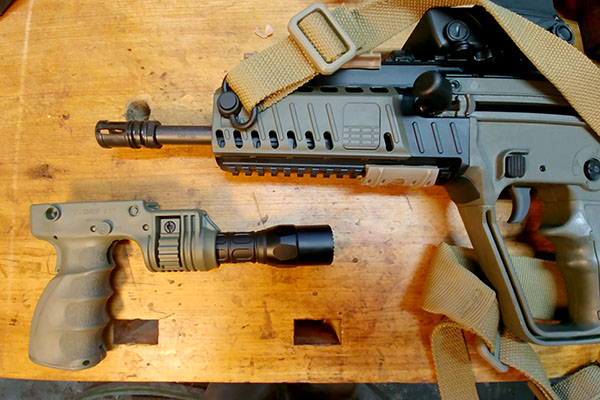
The weapon light, mounted, projects beyond the flash hider of my Tavor. Happily, the whole rig still fits into that cheap, sturdy bag that cost me less than an accessory port cover.

While Tavors may never achieve the teeming fettler’s aftermarket of the AR15, Manticore Arms has invested big design time into engineering tasty treats for it. I whiled a few pleasant hours dreaming my way through their catalog, as well.

One criticism of the X95 relates to modular reversibility. To make it easily switchable from right- to left-handed firers, it’s built with ejection ports on either side. Because it’s a bullpup, the unused ejection port lurks around the corner of your mouth. The factory’s plastic port cover allegedly does a poor job of controlling renegade gas discharge around its edges, resulting in the grey-black cheek bloom known as “Tavor face.” Apparently, that gets worse under suppressed fire.
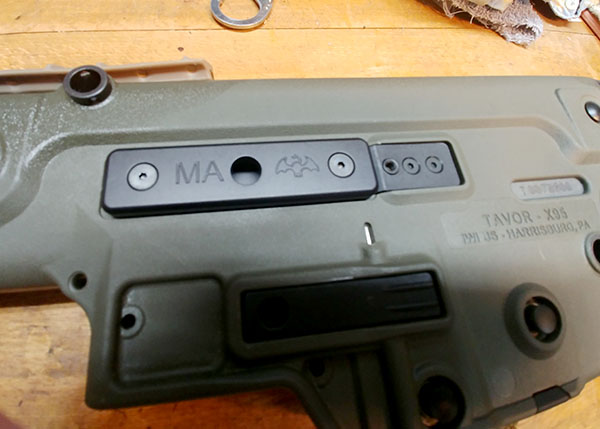
Although I don’t plan to run a suppressor, Manticore’s gasketed port cover is just ded sexy: two meticulously machined, black anodized panels sandwich a rubber gasket that bulges from the edges to seal the port hermetically. As a tidy bonus, Manticore’s port bling adds an extra QD mount for sling attachment, because why not?

Added to the factory-installed tackle, that gives me four (4) QD points on the cheek side (one of which is reversible to the other side), and two on the off side.

Speaking of slings, I went for a quick-adjust, padded Vickers Combat Applications sling from Blue Force Gear (back in the days before our world melted, “blue force” meant the good guys and “red team” was the opposition force, and that’s already more political than gun writing should ever get).
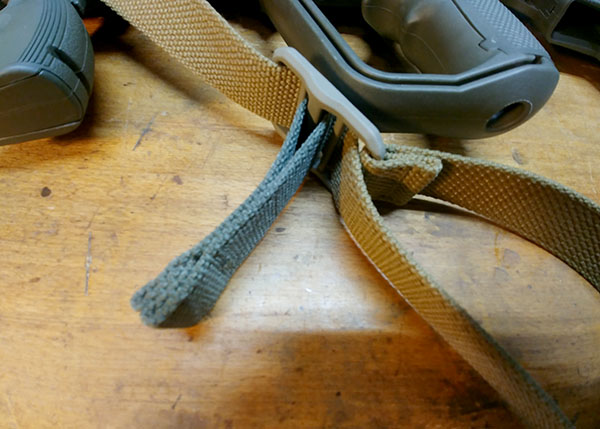
Because IWI thoughtfully included two stout QD swivels in the rifle box, I ordered my sling naked and saved $25.00. With a sale price at Optics Planet, that reduced expenditures for this well-regarded slippy-strap to solidly 30 bucks less than IWI wants for their convertible one- or two-point Savvy Sniper sling (I’m unlikely ever again to have use for a single-point sling).

My sling showed up in dirt-ignoring Coyote Brown. Tropical Camouflage seemed a bit over the top for our Pacific NW rain forests. Also, see under “I’ve had enough of black.”

What to say about a sling I haven’t taken anywhere yet? It’s comfortable; it’s slick to adjust, and I felt pretty silly after about a minute of standing in my office, running the adjustment tab up and down to practice shouldering my bangstick. Zing! Zing! Beware, dust bunnies!

Somewhen during this card-melting retail frenzy, I bought myself a ShootingSight “TAV-TOOL” from Bullpup Armory for about forty clams. This is a jacknife-style gizmo I really wanted to like, particularly since it includes the occasionally important barrel wrench (fifteen bucks OEM, all by itself). Although regrettably floppy and cheaply finished, the TAV-TOOL found a place in my range bag. Between that and a Leatherman Wave, I can cover most any fiddling that I’d take on away from home. Like a bicycle multitool, it may not be much good but its yellow-lettered bulk keeps me from losing whichever slim, black fiddle probe I need. Right. NOW.

More research on the aforementioned port cover revealed that the plastic chassis of my X95 might release gas, not only from the unused ejection port (now sealed up like Grant’s Tomb) but also from under the hind end of the top Picatinny rail. Encasing gas blooms in a plastic chassis results in a farty little beast. It’s probably the single most prevalent criticism of the gun. As a guy still annoyed by all the CLP eyewash I collected while trying to keep old Stoner platforms running I wasn’t overly concerned, but I had time on my hands.

Other owners have published various solutions, including smearing RV sealant all around the stock/rail junction. That sounded… nasty. Obviously, I don’t mind messing with my rifle. In early spring, that was what I set out to do.

I’m just not ready to mess up my rifle. Did I mention I’d never bought a new rifle before? Shoot, pard, it ain’t even been to the range yet!

No schmear here.

Turns out, IWI posted a little video on their site to address this exact issue. They suggest mounting a rail cover right at the back of the rail and shoving an IWI-logo, rubber zipper pull (full disclosure: I have one on my shop vest) under the back edge. Simple, eh? Though it does beg the question: if gas leakage is so easy to fix, why is it still an issue left for owners to solve? Reminds me of the ignition coils on cam belt Ducatis, but I digress…

Shopping for rail covers was a novel experience. Seems most of ‘em are purpose-built to make me walk tall and talk loud, banged out of aluminum and customized with silk-screened patriotism ranging from Punisher skulls to Bible verses – and they’re about 25 bucks a pop, too!

Enter Wal-Mart, carrying a bagful of rail covers from Acid Tactical (a woman-owned company, they proudly announce). Looking like tiny, rubber, desert tortoise shells in Flat Dark Earth, they cost $8.99 a dozen.

Shipping was free.

Since so many of them tumbled out of the cellophane sack, I went ahead and snapped ‘em on anywhere rail teeth might bite: behind the flashlight-enabled ghetto grip, and everywhere along the top rail not already covered by Meprolight’s finest.

Back, ye gases! Avaunt!

All dressed up and no place to go, I was really getting the itch to go shooting, but it still isn’t a thing here. Three more weeks, and my chosen range just might open… meantime, what else could I play with?

SBRs (“short-barreled rifles”) are any kind of rifle that’s cut-down for maneuverability. These are considered double-secret probation-level subversions of federal intent, here in the Land of the Free. They’re the assaultiest of assault rifles. You can order an upper receiver for an AR-15 with a 14-inch, 11.5-inch, 10.5-inch or even 7.5-inch barrel. This will make your black rifle shorter, MUCH louder, faster wearing, less reliable – and instantly felonious without a $200, recorded tax stamp from the Bureau of Alcohol, Tobacco, and Firearms, AKA “the fun police.”

As mentioned early on in this model builder’s manifesto, an X95 doesn’t need its pipe sawn short to be handy in a pinch. Even with its 16.5” barrel, the Tavor is just 26.4” long. Any shorter would require that same SBR signoff from BATF, because there’s a statutory minimum overall length to go with the statutory minimum barrel length.

Of course, people generally rob banks with pistols and a note. Even the shortest SBR is a whole lot harder to conceal than a garden variety SIG, and not a whole lot scarier. A muzzle in your face is a muzzle in your face, right?

Strike that. The Tavor is actually closer to twenty-EIGHT inches with its flash hider screwed in place. Now, like most modern rifles, my carbine has never had its flash hider removed. The thing is gummed on with thread sealant and horsed into place with a wrench, and here’s one of many places where our laws get weird.

To make Tavors ATF-compliant, IWI fits them with a U.S.-only, double-stuffed butt pad that adds an inch-plus to length of pull (i.e. distance from trigger to butt). There are few rifle rounds that recoil more softly than 5.56 NATO fired from a gas piston gun weighing damn near nine pounds, but this callipygous rump is their solution to legality.
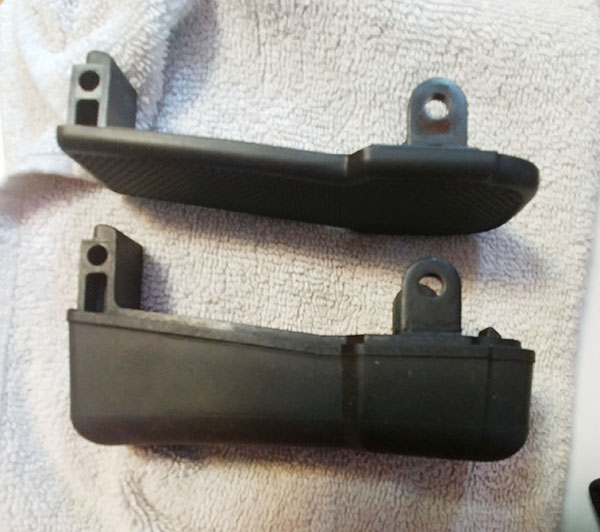
To understand just how silly that is, realize that the butt pad swings open when you drive out one pin, and falls right off if you then back a single screw out of a cross pin. You can change it with a pocketknife much more easily than you can denude the threaded muzzle, but there you have it: the stock is officially permanent, and the birdcage fungible, unless and until I drill a hole through the flash hider, into the barrel, and seize the whole works tight by brazing in a steel pin. I won’t do it. I’m averse to vandalizing new products for superficial security concerns and besides, having more options remains superior to having fewer options.

Manticore Arms produces a curved butt pad that somewhat restores the designed LOP and retains legal length, thanks to its hooked-top profile. It runs close to 70 bucks.

Here’s what I found out, though. One of the parts available for the X95 is the IDF’s flat butt plate. It’s legal in Canada and, presumably, in the U.S.A. if you have an 18.5”-barrel Tavor. Thin plates are made from rubberized plastic and run $14.99 each from IWI (for people hawking enormously expensive bullpups, they’re surprisingly reasonable about spares). My plan is to chop a chunk of aluminum or even rock maple into a length-extending top hook, inset a couple of screw inserts, then run small bolts through the butt plate into my cheater block. I’ll cover the whole thing with black heat shrink to keep a clean look.

If I get around to it, this little project should accomplish three goals. One, it will shrink my rifle for all practical purposes, while technically maintaining legal length. Two, it will give me one more thing to dink around with during this interminable viral lockdown.

Three, and most importantly, it will make me giggle.

Out of deeply felt personal incorrigibility, I might or might not already have installed the feloniously flat plate for a few minutes, just to experience what federal crime feels like. Probably not, though, and don’t tell anyone.

What else might I fiddle with? Well, the $350 Super Sabra trigger pack from Geissele seems as redundant as it is expensive – the X95 Tavor carries a vastly upgraded mechanism, relative to the crushing pull required for its predecessor, the Tavor SAR. I tried that trigger in a gun shop, and it was like trying to prize open a snapping turtle’s beak. Although still more a combat bang switch than a target trigger, X95s measure at around half the weight of a SAR.

Still may pop for Geissele’s “Lightning Bow” trigger, though, just to dial out most of the novella-length takeup.

IWI offers the option of switching out their swashbuckling “cutlass grip” for the pistol grip preferred by Israeli special operators, as well as grip panels that are slotted instead of pebbled to offer security when your palms are sweaty (for instance, if you happened to find yourself operating in a desert near the Mediterranean coastline). I’m not in any great hurry to do this for the same reason I haven’t ordered MagPul’s MBUS flip-up sights: I need to shoot it as-built before I fix what is likely not broken. If I needed it to feel and run just like an AR-15, I could have saved close to four figures by buying an AR in the first place.

Our buddies at Manticore Arms make a charging handle that alertly parks itself out of the way every time the bolt slams home. I’m attracted to it for the same reason people peel the plastic chrome off new cars – it just looks cleaner.

Manticore also makes a nice ambidextrous safety which, like gas sealing, frankly should have come stock from the factory.

The initial excuse for my carbine was quickly freighted with the additional burden of entertaining my adolescent world-building fantasies (and I should really get back to making furniture, which I’m frankly better at than fettling guns). Believe it or not, I aim to keep the overall package reasonably sleek, respecting the Wiley Clapp ethic of “everything you need, and nothing that you don’t.”

But then “need” can sure become a subjective and temporary judgment. Perfection ever flees at her lover’s course approach.

So on it goes, just like with Legos and dirt bikes and shop tools and jeeps. There’s always one more thing to tinker at and if there isn’t, we’ll find one. Ask any man who never outgrew tuning hot rods, creating worlds around Lionel trains, or organizing a warehouse wall lined with color-matched rollaways in a cellar shop two floors beneath the Lego Museum. The male monkey remains an inveterate fiddler. Against all practical sense, men will not be stopped from racing chain saws, stocking bug-out rigs, and re-programming our smart watches to open the garage door.

We control our recreational world – the part of life that matters, where imagination capers carelessly over responsibility’s grindstoned snout – by commissioning, refining, tearing apart, and rebuilding systems in the evanescent image of our dreams.

G-d help me if I ever buy a boat.


A great story, Jake, and thanks very much for sharing it with us.  When you get to the range with your new Tavor, we want to hear how it shoots!


Read more gun stuff on the ExhaustNotes Tales of the Gun page!